In this paper, we mainly focus on a fractal model of Fangzhu’s nanoscale surface for water collection which is established through He’s fractal derivative. Based on the fractal two-scale transform method, the approximate analytical solutions are obtained by the energy balance method and He’s frequency–amplitude formulation method with average residuals. Some specific numerical experiments of the model show that these two methods are simple and effective and can be adopted to other nonlinear fractal oscillators. In addition, these properties of the obtained solution reveal how to enhance the collection rate of Fangzhu by adjusting the smoothness of its surfaces.
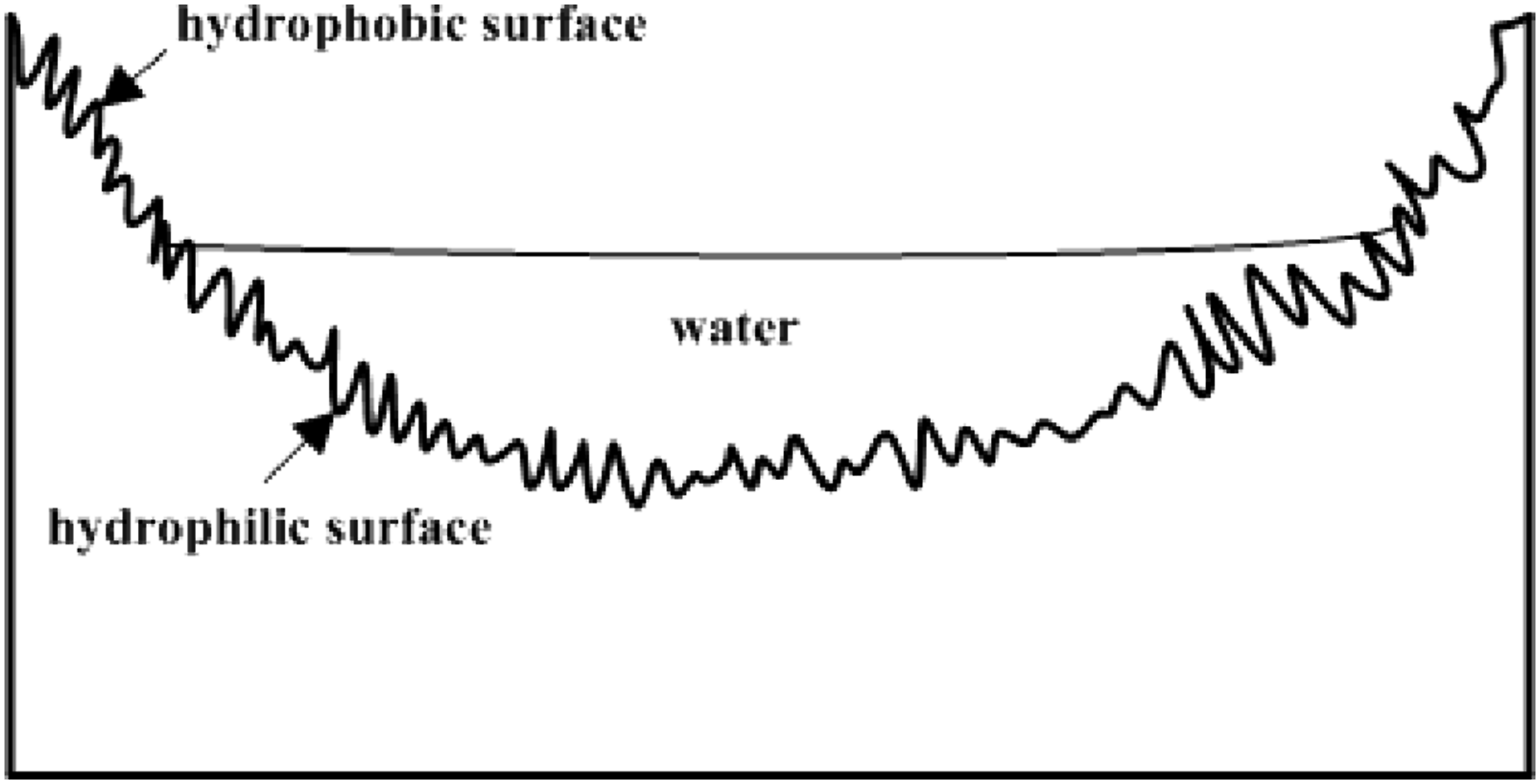
Fangzhu (方诸) is the oldest nano device in ancient China which can collect water from the air.1–4 In Ref. 1, He et al. explained the operating principle of the Fangzhu and its many possible applications in the future. As we know, the nanoscale surface of Fangzhu device plays an outsize role in water collection performance, the super-hydrophobic surface is used to absorb water molecules in the air, and the super-hydrophilic surface is well situated for transmitting the absorbed water molecules to the water collector (see Figure 1).1–3 The Fangzhu oscillator can be expressed by the following form1
in which are constants associated with the surface properties and is the mass of the molecule and is the distance between the hydrophilic surface and hydrophobic surface.
The unsmooth surface of Fangzhu.
Usually, Fangzhu oscillator is considered in a smooth space. Therefore, in order to investigate the potentially hidden properties of Fangzhu, a fractal modified model is introduced, which can disproportionately affect the movement of water molecules on the Fangzhu’s surface, and will significantly improve the water collection performance of the Fangzhu. However, the traditional derivative cannot describe the observed phenomena of non-smooth and discontinuous surfaces. So, He’s fractal derivative has to be used, which was proposed by a Chinese mathematician, Dr. Ji-Huan He,5–9 it is a wonderful mathematical tool to deal with discontinuous problems and can describe the physical problems in the fractal space .10–21 The modified fractal Fangzhu oscillator4 is given by
where denotes the He’s fractal derivative given as follows5–9
In order to simplify the calculation process, equation (1.2) becomes

where and .
Equation (1.4) is a fractal Duffing-like oscillator, and we call it as fractal Fangzhu oscillator. Wang constructed the variational principle for the fractal oscillator by the semi-inverse transform method and found the approximate analytical solution through the two-scale transform method5–9 and He’s frequency formula.22–25 If , equation (1.4) is equivalent to equation (1.1), which represents the motion of water molecules on the smooth surface of Fangzhu oscillator. Energy balance method was first proposed He,26–28 in thins method, a variational principle of the nonlinear oscillator is obtained, next a Hamiltonian is acquired, from which the angular frequency can be readily constructed. Subsequently, this method was used to solve many nonlinear oscillations.29–31 To solve nonlinear oscillators, Prof. Ji-Huan He proposed another simple but effective frequency–amplitude formulation.32–33 He’s frequency–amplitude formulation was used by many scholars with great success.34–36 Moreover, there are many methods to obtain the approximate analytical solution, such as Taylor series method,37–39 Homotopy perturbation method,40–44 Variational iteration method,45–47 He–Laplace method,48,49 and so on.50–52 As to the fractal nonlinear oscillator, these common methods are more complex to obtain the solution. Here, we employ two valid and simple methods to acquire the approximate analytical solution of the fractal nonlinear Fangzhu oscillator equation, which are called energy balance method and frequency–amplitude formulation method with average residuals.
In this paper, we focus on the fractal nonlinear Fangzhu oscillator equation. In Fractal Two-Scale Transform Method, we recall the two-scale transform method. In The Description of Two Methods, energy balance method and frequency–amplitude formulation method with average residuals are briefly introduced. The numerical experiments of two methods are given in the The Application of the Two Methods. These examples indicate that the two methods are impactful and convenient for solving the fractal problem.
Fractal two-scale transform method
In this part, we will simply describe the two-scale transform method. This method was introduced by He and his copartner,5–9 which is an effective and powerful method to research fractal problems. Its most direct application is to approximately transform the fractal space into the continuous dimension. On a smaller scale, due to the presence of hydrophilic and hydrophobic surfaces, the surface of Fangzhu is discontinuous. On the other hand, the larger scales show a smooth Fangzhu’s surface.The fractal two-scale transform is an approximate one to transform a fractal space on a small scale into a smooth space with a large scale. Since it was proposed, it has gradually become a hot topic in research field.
To ease the discussion of the fractal two-scale transform method, we consider the general fractal problem as follows

In the above model, , , , represent He’s fractal derivatives.
According to the fractal two-scale transform method, we have

Then, we apply equation (2.2) to equation (2.1), equation (2.1) can be written as

The more details about the fractal two-scale transform method, see Refs. 5–9.
The description of two methods
We analyze the general nonlinear oscillator with the following fractal derivative

with subject to the initial conditions
where is the nonlinear function about .
The variational principle of equation (3.1) can be expressed as the following form

With .
Energy balance method
According to the above variational principle, we can get the following Hamiltonian formulation

or
We assume equation (3.1) has the following solution with angular frequency

Substituting equation (3.6) into equation (3.5) yields

Equation (3.1) is only the approximation of the exact solution at when , which gives

Frequency–amplitude formulation method with average residuals
We also select a same suitable solution in the form

in which is the frequency which will be determined by the following step. Substituting equation (3.9) into equation (3.1) yields
The average residual is given as
With .
Choosing the specific two trial frequencies, , , and the residuals are, respectively, presented as

The frequency–amplitude formulation can be written as

The application of the two methods
Considering the following oscillator equation

with the initial conditions
By using the fractal two-scale transform method, equations (4.1) and (4.2) become the following form

subject to the corresponding initial conditions
The application of the energy balance method
Now, we adopt the energy balance method to construct the approximate analytical solution of the governing equation. On the basis of equation (3.3), the variational formulation can be written as

The Hamiltonian formulation is given as follows

or
Substituting equation (3.6) into equation (4.7), and we have

Let , we have

where .
When we let , we obtain
and then by substituting equation (4.10) into equation (3.6), we have the final result.
In order to conveniently show the movement mechanism of the approximate analytical solution, we take , , , , , .
The application of the frequency–amplitude formulation method with average residuals
If we take , , then the residual formulations can be written as
Substituting equation (4.13) into equation (3.13), the finial frequency of the approximate analytical solution is obtained.
In order to clearly present the movement mechanism of the approximate analytical solution, we also take , , , , , .
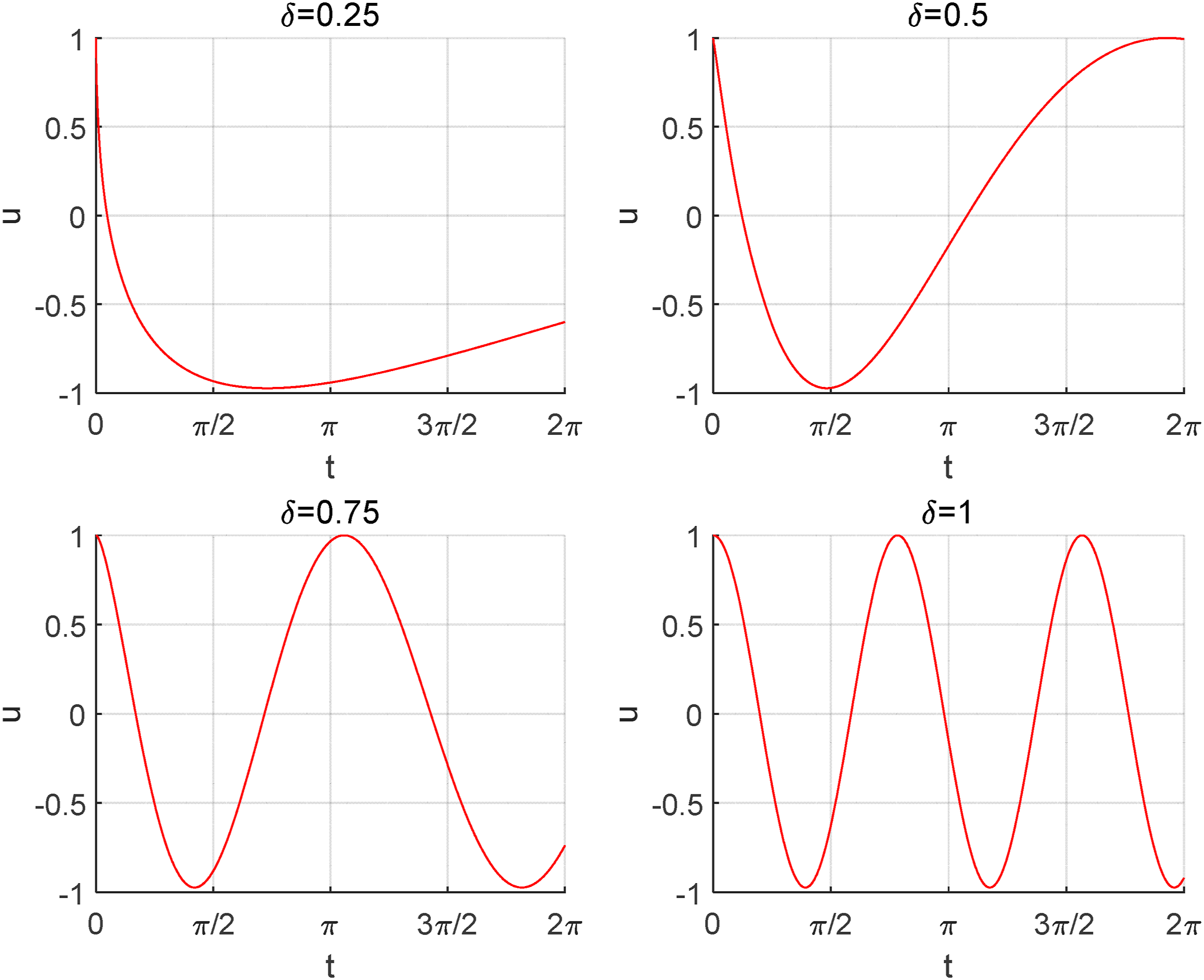
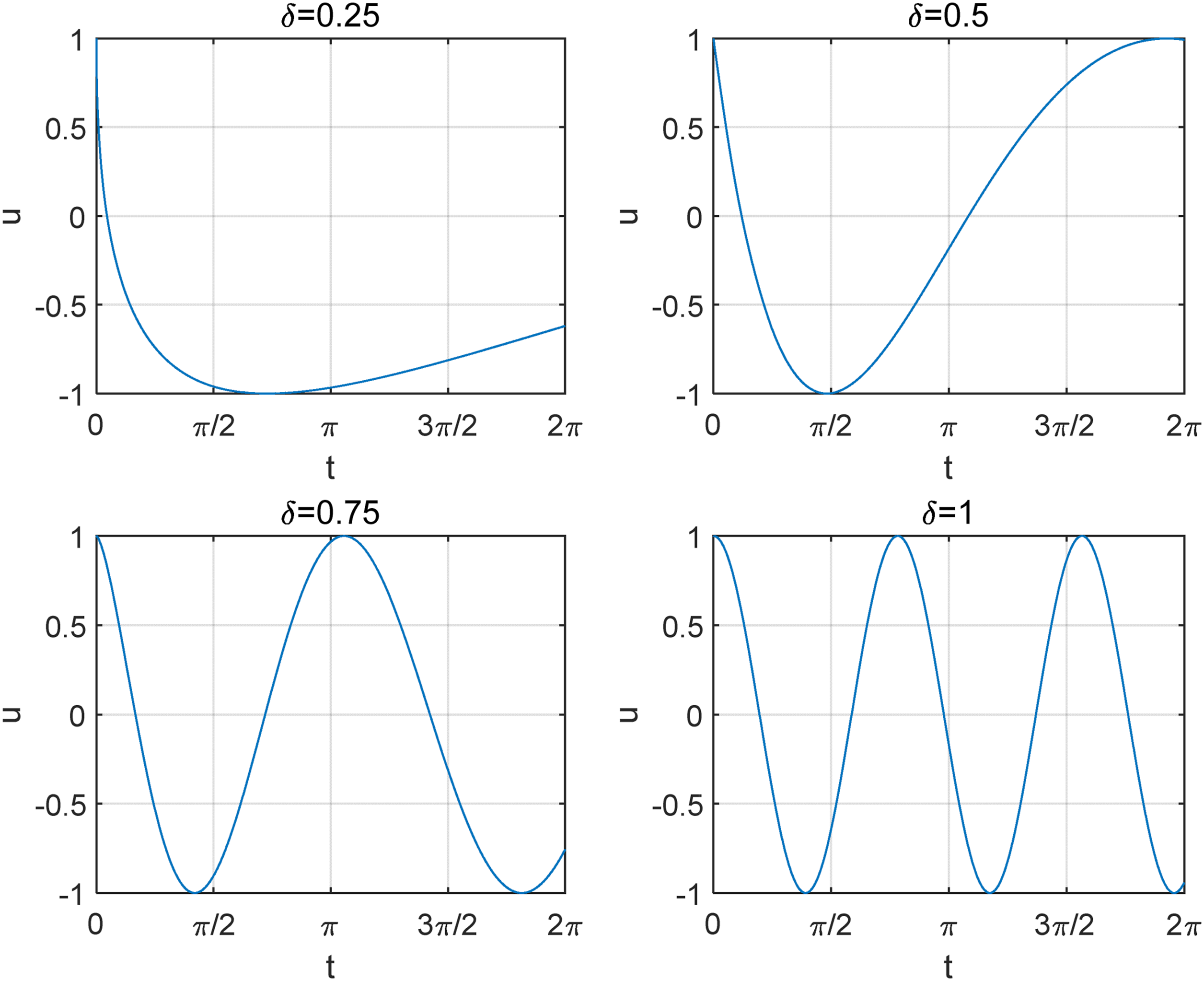
Figures 2 and 3 demonstrate the approximate solution of the fractal Fangzhu oscillator with different values of . It can be clearly seen from the figures that when increases gradually, the wave moves faster while denotes the fractal dimension. It can be seen that when gradually decreased, the water movement on the Fangzhu’s surface is very fast. However, the movement of water molecules on the Fangzhu’s surface is very slowly if becomes larger. From the above investigation, it can be found that the velocity of water molecules on the Fangzhu’s surface depends on the fractal dimension . This property can be applied to design a device for collecting water in the air or the surface of a waterproof object in outdoor.
The movement mechanism of the approximate analytical solution of equations (4.1)–(4.2) by energy balance method with , respectively.
The movement mechanism of the approximate analytical solution of equations (4.1)–(4.2) by frequency–amplitude formulation with average residuals with , respectively.
Conclusion
In this paper, we investigate a fractal model of Fangzhu’s nanoscale surface morphology for water collection by He’s fractal derivative. The two-type approximate analytical solutions of this fractal model are obtained based on the two-scale transform method by the energy balance method and the frequency–amplitude formulation with average residuals, respectively. From the Figures 2 and 3, it is easy to find that as the increases, the frequency of movement for the curve becomes smaller, so the fluctuation of the motion track becomes more frequent. In addition, the curves of the approximate analytical solutions obtained by these two methods are very similar, which proves the effectiveness of our two methods. The obtained solutions can reveal how to enhance the collection rate of water by increasing smoothness of the Fangzhu’s surfaces. These simple and effective methods can be used to analyze other nonlinear oscillators with the fractal derivative.
Footnotes
Declaration of conflicting interest
The author(s) declared the following potential conflicts of interest with respect to the research, authorship, and/or publication of this article: This work does not have any conflicts of interest.
Funding
The author(s) received no financial support for the research, authorship, and/or publication of this article.
Notations
References
1.
HeCHHeJHSedighiHM. Fangzhu (方诸): An ancient Chinese nanotechnology for water collection from air: History, mathematical insight, promises, and challenges. Math Method Appl Sci2020.
2.
HeJ-HEl-DibYO. Homotopy perturbation method for Fangzhu oscillator. J Math Chem2020; 58(10): 2245–2253.
3.
HeC-HLiuCHeJ-H, et al.Passive atmospheric water harvesting utilizing an ancient Chinese ink slab. Facta Universitatis, Ser Mech Eng2021; 19(2): 229–239.
4.
WangKL. Effect of Fangzhu’s nanoscale surface morphology on water collection. Math Method Appl Sci2020.
5.
HeJHAinQT. New promises and future challenges of fractal calculus: from two-scale thermodynamics to fractal variational principle. Therm Sci2020; 24(2): 659–681.
6.
AinQTHeJH. On two-scale dimension and its applications. Therm Sci2019; 23(3): 1707–1712.
7.
HeJ-H. Fractal calculus and its geometrical explanation. Results Phys2018; 10: 272–276.
8.
HeJ-H. A tutorial review on fractal spacetime and fractional calculus. Int J Theor Phys2014; 53(11): 3698–3718.
9.
HeJH. A new fractal derivation. Therm Sci2011; 15(1): S145–S147.
10.
HeJ-H. A fractal variational theory for one-dimensional compressible flow in a microgravity space. Fractals2020; 28(02): 2050024.
11.
WangQShiXHeJ-H, et al.Fractal calculus and its application to explanation of biomechanism of polar bear hairs. Fractals2018; 26(06): 1850086.
12.
LingWWWuPX. Variational principle of the Whitham-Broer-Kaup equation in shallow water wave with fractal derivatives. Therm Sci; 2021(01): 19.
13.
WangKL. Variational principle and its fractal approximate solution for fractal Lane-Emden equation. Int J Numer Method Heat Fluid Flow2020; 31(7): 2279–2287.
14.
WangKL. A new fractal model for the soliton motion in a microgravity space. Int J Numer Method Heat Fluid Flow2020; 31(1): 442–451.
15.
WangYDengQ. Fractal derivative model for tsunami traveling. Fractals2019; 27(02): 1950017.
16.
HeJHKouSJHeCH, et al.Fractal oscillation and its frequency-amplitude property. Fractals2021; 29(4): 2150105–2150991.
17.
ZuoY. Effect of SiC particles on viscosity of 3D print paste: a fractal rheological model and experimental verification. Therm Sci; 2021(01): 131.
18.
HeJ-HEl-DibYO. Periodic property of the time-fractional Kundu-Mukherjee-Naskar equation. Results Phys2020; 19: 103345.
19.
HeJHJinX. A short review on analytical methods for the capillary oscillator in a nanoscale deformable tube. Math Method Appl Sci2020.
20.
HeJ-H. The simplest approach to nonlinear oscillators. Results Phys2019; 15: 102546.
21.
HeJH. When mathematics meets thermal science: the simpler is the better. Therm Sci2021; 25(3B): 2039–2042.
22.
WangKL. A new fractal transform frequency formulation for fractal nonlinear oscillators. Fractals2021; 29(3): 2150062–2151251.
23.
FengGQNiuJY. He’s frequency formulation for nonlinear vibration of a porous foundation with fractal derivative. GEM-International J Geomathematics2021; 12(1): 1–8.
24.
HeJHHouWFQieN, et al.Hamiltonian-based frequency-amplitude formulation for nonlinear oscillators. Fu Mech Eng2021; 19(2): 199–208.
25.
QieNHouaWFHouaW-F, et al.The fastest insight into the large amplitude vibration of a string. Rep Mech Eng2021; 2(1): 1–5.
26.
HeJ-H. Preliminary report on the energy balance for nonlinear oscillations. Mech Res Commun2002; 29: 107–111.
27.
HeJ-H. Some asymptotic methods for strongly nonlinear equations. Int Journal Mod Physics B2006; 20(10): 1141–1199.
28.
HeJ-H. An elementary introduction to recently developed asymptotic methods and nanomechanics in textile engineering. Int J Mod Phys B2008; 22(21): 3487–3578.
29.
MomeniMJamshidiNBarariA, et al.Application of He’s energy balance method to Duffing-harmonic oscillators. Int J Comput Math2011; 88(1): 135–144.
30.
YounesianDAskariHSaadatniaZ, et al.Frequency analysis of strongly nonlinear generalized Duffing oscillators using He's frequency-amplitude formulation and He’s energy balance method. Comput Math Appl2010; 59(9): 3222–3228.
31.
FuYZhangJWanL. Application of the energy balance method to a nonlinear oscillator arising in the microelectromechanical system (MEMS). Curr Applied Physics2011; 11(3): 482–485.
32.
HeJ-H. Comment on ‘He’s frequency formulation for nonlinear oscillators’. Eur J Phys2008; 29(4): L19–L22.
33.
HeJH. An approximate amplitude-frequency relationship for a nonlinear oscillator with discontinuity. Nonlinear Sci Lett A2016; 7(3): 77–85.
34.
ZhaoL. He’s frequency–amplitude formulation for nonlinear oscillators with an irrational force. Comput Math Appl2009; 58(11–12): 2477–2479.
35.
RenZ-F. He’s frequency-amplitude formulation for nonlinear oscillators. Int J Mod Phys B2011; 25(17): 2379–2382.
36.
RenZ. Theoretical basis of He frequency-amplitude formulation for nonlinear oscillators. Nonlinear Sci Lett A2018; 9: 86–90.
37.
HeJ-H. Taylor series solution for a third order boundary value problem arising in architectural engineering. Ain Shams Eng J2020; 11(4): 1411–1414.
38.
HeC-HShenYJiF-Y, et al.Taylor series solution for fractal Bratu-type equation arising in electrospinning process. Fractals2020; 28(01): 2050011.
39.
ZhangJChengJPLiM, et al.Flower-like nickel-cobalt binary hydroxides with high specific capacitance: Tuning the composition and asymmetric capacitor application. J Electroanalytical Chem2015; 743: 38–45.
40.
HeJHEl‐DibYO. The reducing rank method to solve third‐order Duffing equation with the homotopy perturbation. Numer Method Partial Differential Equations2021; 37(2): 1800–1808.
41.
AliMAnjumNAinQT, et al.Homotopy perturbation method for the attachment oscillator arising in nanotechnology. Fibers Polym2021; 22(6): 1601–1606.
42.
HeJ-HEl-DibYO. Homotopy perturbation method with three expansions. J Math Chem2021; 59(4): 1139–1150.
43.
AnjumNHeJHAinQT, et al.Li-He’s modified homotopy perturbation method for doubly-clamped electrically actuated microbeams-based microelectromechanical system. Fu Mech Eng2021.
44.
AnjumNHeJ-H. Higher-order homotopy perturbation method for conservative nonlinear oscillators generally and microelectromechanical systems' oscillators particularly. Int J Mod Phys B2020; 34(32): 2050313.
45.
HeJ HLatifizadehH. A general numerical algorithm for nonlinear differential equations by the variational iteration method. Int J Numer Method Heat Fluid Flow2020.
46.
WazwazA-MEl-TantawySA. Optical Gaussons for nonlinear logarithmic Schrödinger equations via the variational iteration method. Optik2019; 180: 414–418.
Kumar MishraHNagarAK. He-Laplace method for linear and nonlinear partial differential equations. J Appl Math2012; 2012.
49.
PrakashJKothandapaniMBharathiV. Numerical approximations of nonlinear fractional differential difference equations by using modified He-Laplace method. Alexandria Eng J2016; 55(1): 645–651.
50.
SedighiHMDaneshmandF. Static and dynamic pull-in instability of multi-walled carbon nanotube probes by He’s iteration perturbation method. J Mech Sci Technol2014; 28(9): 3459–3469.
51.
SedighiHMShiraziKH. Bifurcation analysis in hunting dynamical behavior in a railway bogie: using novel exact equivalent functions for discontinuous nonlinearities. Scientia Iranica2012; 19(6): 1493–1501.
52.
SedighiHMMoory-ShirbaniMShishesazM, et al.Size-dependent dynamic behavior and instability analysis of nano-scale rotational varactor in the presence of Casimir attraction. Int J Appl Mech2016; 08(02): 1650018.