




Abstract
Based on the suggested parameter, a new analytical perturbation technique is presented to obtain highly ordered accurate analytical solutions for nonlinear Duffing oscillator with nonlinearity of high order. Comparing the obtained results with the numerical and other previously published results reveals the usefulness and correctness of the present technique. It is shown that the results are valid for small and large amplitudes. Indeed, it is found that our proposed technique produces more accurate and computationally results than the rival known methods. The obtained results show the efficiency and capability of the present perturbation technique to be applied to various strongly nonlinear differential equations.
Keywords
Introduction
Duffing harmonic oscillator is an ideal system; it is a common model for strongly nonlinear phenomena in engineering and science. It is a mathematical model used to describe the motion of a damped oscillator with a more complicated potential than in simple harmonic motion.
Duffing oscillators have been extensively applied to represent many physical systems which include the vibrations of beams and plates, the free vibration of a restrained uniform beam carrying intermediate lumped mass and undergoing large amplitudes of oscillation, the large amplitude oscillations of centrifugal governor systems, and the vibrations induced on different structures by fluid flow (see Refs. 1–6 and references therein).
Recently, the study of nonlinear Duffing oscillators has received much attention due to a variety of different engineering applications. Many researchers have applied various approximate methods to analyze different types of nonlinear Duffing oscillator equations. Some of these methods are multiple scales Lindstedt–Poincare method, 7 homotopy analysis method, 8 homotopy Pade technique, 9 stiffness analytical approximation method, 10 homotopy perturbation method,10–15 frequency amplitude formulation,16–20 energy balance method, 21 straightforward expansion method, 22 global error minimization method, 23 max–min approach, 24 global residue harmonic balance method,25–28 variational approach, 29 perturbation method,30,31 Hamiltonian approach32–34 harmonic balance method, 35 and coupled homotopy-variational approach. 36
The purpose of the current work is to apply a suggested perturbation technique to obtain higher order approximate periodic solutions for strongly nonlinear Duffing oscillators. Generally, the second-order approximate frequency has been determined which contains a few harmonic terms with lower order terms. Approximate frequencies up to second-order give high accuracy for both small and large amplitudes of oscillation, which considered more efficient than other known methods.
The suggested research work in this direction has several opportunities with the higher order nonlinear differential equations. In the future, we can develop several analytical methods conformable with fractional nonlinear differential equations and simulate the results using other known analytical37–39 and numerical methods.
This article is organized as follows. In the Duffing Oscillator with Nonlinearity of High Order section, we introduce a new analytical perturbation technique to obtain highly ordered accurate analytical solutions for the nonlinear Duffing oscillator with nonlinearity of high order. Numerical results and discussion are demonstrated in the Numerical Results and Discussion section. Finally, we provide our conclusions in the Conclusion section.
Duffing oscillator with nonlinearity of high order
To illustrate the provided technique, we consider the nonlinear Duffing oscillator with high order


















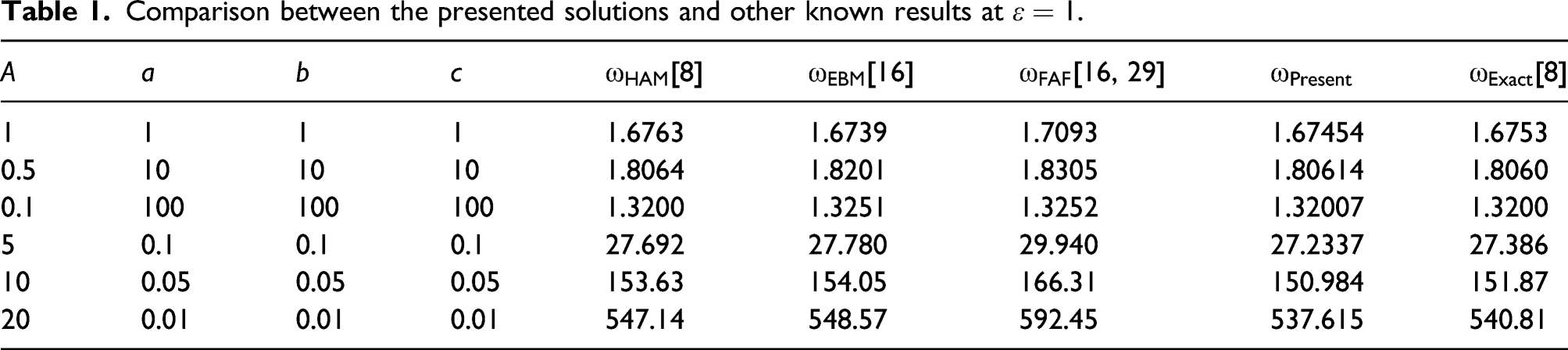
Comparison between the presented solutions and other known results at
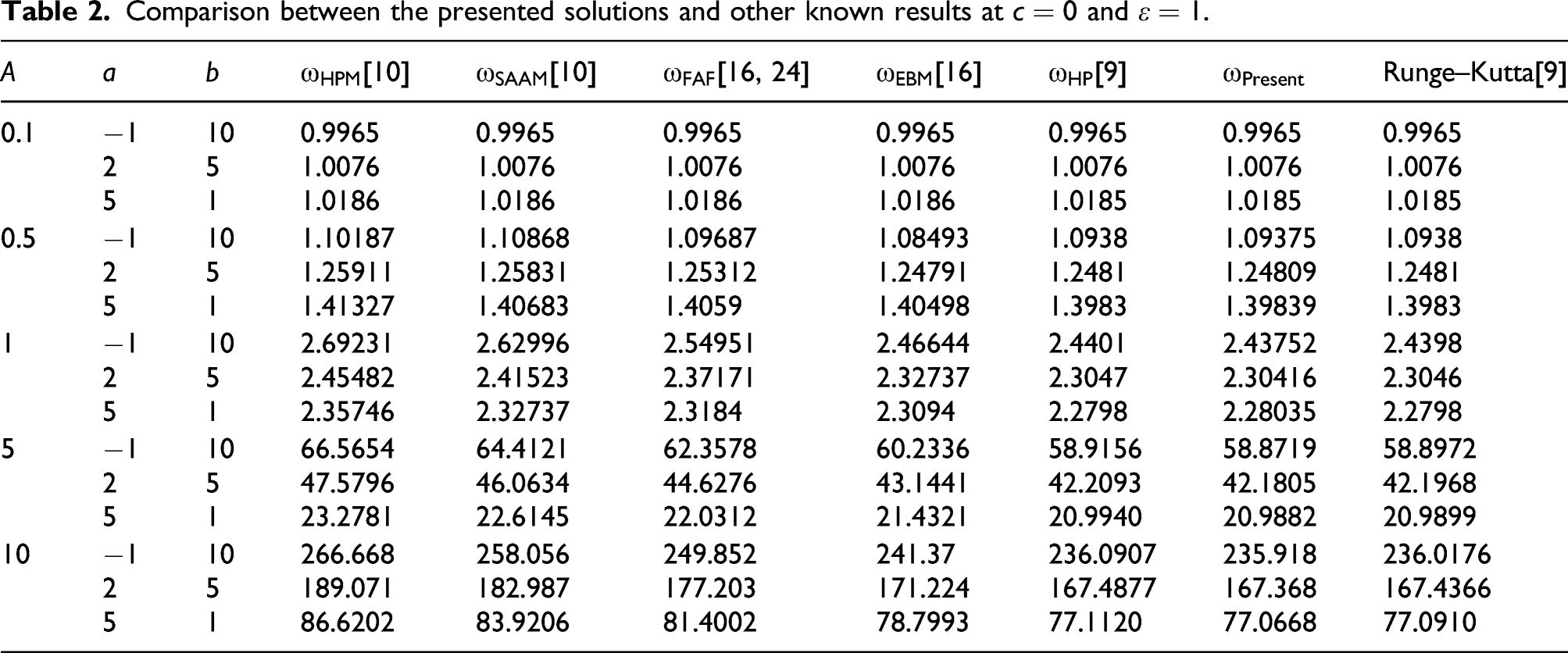
Comparison between the presented solutions and other known results at
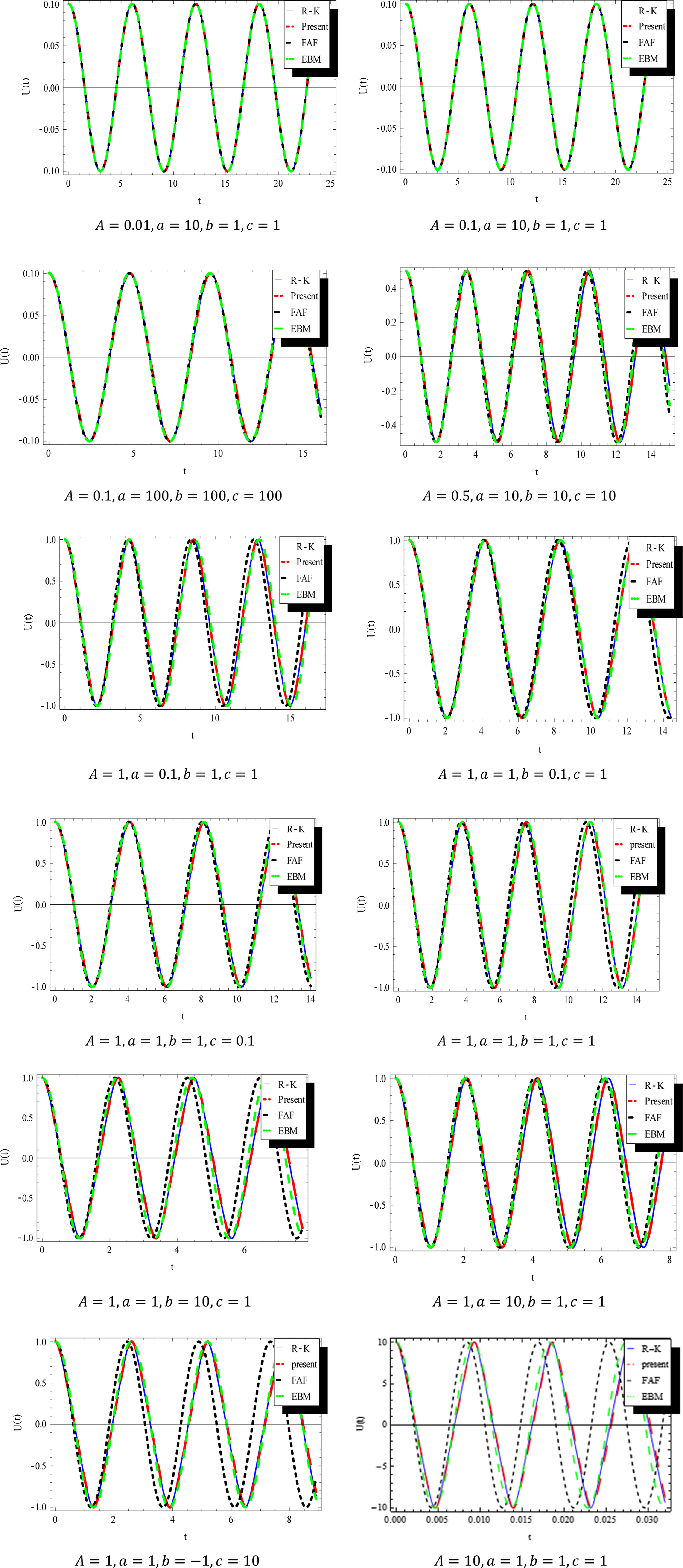
The comparison between analytical solution (red line), energy balance method (green line), frequency amplitude formulation (black line), and numerical solution (blue line) for
Numerical results and discussion
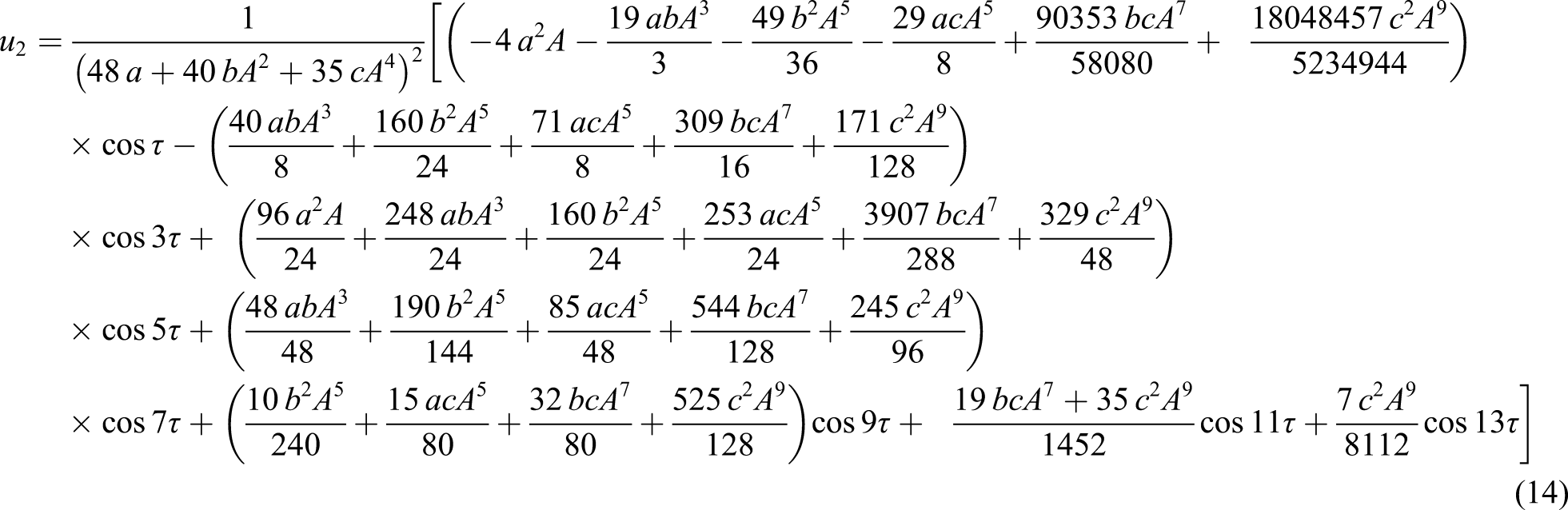
In order to ensure the validity of the present technique, we compare the obtained analytical solutions with the exact numerical solutions and with existing results which have been obtained by known analytical approximate methods and tabulated in Tables 1 and 2 and Figure 1, which indicates that the obtained solutions here are feasible, effective, and more accurate than the corresponding existing results obtained by previously mentioned methods. As can be seen in Figure 1, it is found that the proposed technique has excellent agreement with the numerical solution. Therefore, we conclude that the analytical technique presented in this article gives a high precision solution for the nonlinear Duffing oscillations. In addition, the present technique can be utilized in studying many other nonlinear oscillators.
Conclusion
An analytical amplitude–frequency relation has been enhanced up to the second-order approximations by introducing a new analytical perturbation technique to obtain an approximate solution of the nonlinear Duffing oscillator with high order. It turns out that all the results presented in this study agree perfectly with those obtained by the numerical solutions and improve the ones given by other methods. It is worth mentioning that our suggested method is simply applicable and leads to high accuracy of the obtained results.
Footnotes
Acknowledgment
Mohra Zayed appreciates the support provided by the Deanship of Scientific Research at King Khalid University, Saudi Arabia, through the General Research Program with grant GRP-29–42.
Declaration of conflicting interests
The author(s) declared no potential conflicts of interest with respect to the research, authorship, and/or publication of this article.
Funding
The author(s) disclosed receipt of the following financial support for the research, authorship, and/or publication of this article: FundRef Funding Sources King Khalid University (Grant/Award Number: “GRP-29-42.”).
