The homotopy perturbation method (HPM) was proposed by Ji-Huan. He was a rising star in analytical methods, and all traditional analytical methods had abdicated their crowns. It is straightforward and effective for many nonlinear problems; it deforms a complex problem into a linear system; however, it is still developing quickly. The method is difficult to deal with non-conservative oscillators, though many modifications have appeared. This review article features its last achievement in the nonlinear vibration theory with an emphasis on coupled damping nonlinear oscillators and includes the following categories: (1) Some fallacies in the study of non-conservative issues; (2) non-conservative Duffing oscillator with three expansions; (3)the non-conservative oscillators through the modified homotopy expansion; (4) the HPM for fractional non-conservative oscillators; (5) the homotopy perturbation method for delay non-conservative oscillators; and (6) quasi-exact solution based on He’s frequency formula. Each category is heuristically explained by examples, which can be used as paradigms for other applications. The emphasis of this article is put mainly on Ji-Huan He’s ideas and the present authors’ previous work on the HPM, so the citation might not be exhaustive.
Many problems in engineering are essentially nonlinear and are modeled by various nonlinear differential equations. In particular, nonlinear oscillators frequently appear in physics, engineering, biology, and other fields. For example, Fan et al.1 found that the low-frequency property of a capillary oscillation plays a vital role in mass and energy transmission in blood flow, permeability, and cell growth. The low frequency is also widely used in energy harvesting devices.2–4 Additionally, many phenomena can be fully explained by the vibration theory; for example, the release oscillation5–9 is the main factor affecting the ion release from a hollow fiber, while the thermal oscillation endows a cocoon with a particular bio-function.10 The instability of a system also caught much attention to avoid any damage.11
In general, solving nonlinear differential equations is more complicated than linear differential equations. This paper focuses on a heuristic review on the HPM for non-conservative oscillators by the HPM.12–13
The HPM has been expansively studied since 1999, and it has matured into a useful mathematics tool thanks to the efforts of many scientists, especially D.D. Ganji,14 A. Yildirim,15 D. Baleanu,16 S. Nadeem,17 S.T. Mohyud-din,18 Y. Khan,19 and others.20 The convergence of the unprecedented homotopy perturbation method21 was proved by many researchers for various cases,22–25 and various modifications appeared in the literature. Using the “modified homotopy perturbation method” as a search subject in Clarivate Analytics’ Web of Science, we found more than 400 items. Among all modifications, the He–Laplace method26 should be specially emphasized. The enhanced homotopy perturbation uses the rank upgrading technique.27,28 The former was proposed by Xiao-Xia Li and Chun-Hui He and has wide applications29–31; the latter is a couple of the HPM and the Laplace transform, and it has been proved to be tremendously effective for fractional differential equations.32–39 The couple of the HPM with other methods has also caught much attention, for example, the generalized differential quadrature method40 and the Fourier transform.41 The modifications with an auxiliary term and with two expanding parameters42 are also notable.
During this decade, several works have been accomplished in the development of the oscillation theory by using the HPM. The regular HPM is discussed as follows:
The HPM has overcome the inherent shortcoming of the traditional perturbation method for the small parameter assumption. The homotopy perturbation method is to construct a homotopy equation with an embedding parameter , which is changed from 0 to 1, and used as an expanding parameter for the small parameter in the perturbation method. When , the constructed homotopy equation becomes a linear equation, which is easy to be solved, while when , it becomes the original one. So the solution process is to deform a linear equation to the nonlinear one gradually, and it converges to the exact solution when . As the solution process does not depend on a small parameter in the equation, the solution is uniformly valid for both weakly and strongly nonlinear cases.
Now, to explain the concept of the HPM, we write down an equation in the form
where and N are, respectively, a linear operator and a nonlinear operator, and is a known function. A homotopy equation can be constructed as follows
or
where is the homotopy parameter, and it monotonically increases from zero to the unit. The regular HPM is used to search for a solution of equation (2) in a power series in ρ
Substituting (3) into the family equation (2) which can be rearranged in powers of as
where
Due to linearly independence in , the following equations are imposed
These equations are simpler inhomogeneous linear equations. Solving these equations one by one, we obtain . The approximate solution for equation (1) is found when ρ→1
The expansion (3) is suitable for the conservative nonlinear oscillator. The application of the regular HPM to the non-conservative nonlinear oscillator leads to a shortcoming. This shortcoming is surely in the presence of linear damping force as in the case of damping Duffing oscillator where the secular terms due to the perturbations cannot be removed, and the solution cannot be obtained.
In the literature, the frequency is also decomposed into a power series in ,12–13 but this is not enough for non-conservative oscillators, and the amplitude should also be expressed in a series in . We use the well-known Duffing equation with linear damping as an example to elucidate the idea of three expansions.
Let us consider first the conservative Duffing oscillator
The homotopy function can be built as
Suppose that the natural frequency and the function have been perturbed in the form
Substituting (10) and (11) into (9) and setting to zero like power in , we get
At this end, we have the following approximate solution
where is given by
To illustrate that the above procedure cannot succeed for the non-conservative Duffing oscillator, we consider the following damping oscillator
According to the above procedure, the homotopy equation corresponding to equation (19) becomes
By employing the two expansions (10) and (11) into equation (20) and setting all coefficients of like power of to zero and inserting the zero-order solution (14) into the first-order problems gives
Since the amplitude , , and , then there is no reason to eliminate the coefficient of . According to this shortcoming, we can conclude that the bits of knowledge of the conservative oscillators are not suitable for the non-conservative oscillators.
The homotopy perturbation method always leads to an approximate solution of a nonlinear problem, but sometimes an exact one can be obtained.43,44 The method was originally proposed to solving differential equations, but it can be used to solve fractal differential equations,45,46 fractional differential equations,47 and integral equations,48,49 and difference equations.50 It is extremely effective for inverse problems.51–53
The strong motive for this work is to avoid errors and erroneous results that occur due to the use of the classical method for problems involving damping forces. Some notes on using the classical homotopy perturbation method for solving the non-conservative oscillators are given in the section Some Fallacies in the Study of Non-Conservative Issues. For a good understanding of the homotopy perturbation method for the non-conservative oscillator, the reader is referred to the section Non-Conservative Duffing Oscillators with Three Expansions, where more developments could be found in the following sections. The basic idea depends on the technology of the normal form used in the damping linear differential equations which leads to derive a total frequency that governs the damping forces besides the restoring forces.
Some fallacies in the study of non-conservative issues
Sometimes, the removal of secular terms can be done, and the solution can be obtained, but these solutions are fakes, and the frequency–amplitude relationship is distorted, is not correct, and does not agree with the numerical solution.
One of the main drawbacks of the classical method is the existence of two different equations that come from avoiding secular terms. These represent two equations covering the same frequency parameter , and therefore, solutions of these equations will come to different results. The practice is always to try to combine these two equations into one to gain a specific result. It is worth noting that there is no ideal method that can be used in the merging process, which makes the solutions based on frequency accuracy. Therefore, an appropriate amendment must be sought to eliminate such obstacles to obtain the most accurate results. This is the subject of the present issues.
Some may think that using the properties of fractional differentiation may create a situation that can delete the secular terms, and thus, the desired solution can be obtained, but this is an illusion that we will show as follows:
Ex1: The idea is based on applying the fraction homotopy technique by introducing a fraction operator instead of the operator into equation (19) and then let into the final solution.54 Therefore, equation (19) becomes
The operator refers to the time-fractional operator obeys the definition of the Riemann–Liouville time-fractional derivative.
The corresponding homotopy equation becomes
By inserting the two expansions (10) and (11) into (23), for setting the identical power of to zero, yields
Employing the zero-order solution (14) into (24) and using the appendix yields
Then the total solution of (25) without secular terms is
To construct the frequency–amplitude relationship, we may combine (26) and (27) through the elimination between them and inserting the result into the expansion (10) and letting yields
Setting into the above relation leads to . In other words, inserting (26) into expansion (10) and setting becomes
Square (30) and adding to the squaring of (27) and setting result into the following relation
Since for periodic solution, the above relation must have positive roots, which cannot occur because the last term is always negative. Finally, they overcome the difficulty though the fraction calculus fails.
To find the frequency–amplitude relationship, from equation (34) by setting , we have
Another frequency equation is given by (38). Then there is duplication for the frequency–amplitude relationship. This represents a shortcoming in applying the regular homotopy perturbation method. The following examples can illustrate some of this fallacy:
Ex3: Consider the following delay harmonic second-order equation56
where are constant coefficients and refers to the time delay. If , the coefficient will play as natural frequency. For nonzero , this equation leads to obtaining non-oscillation solutions. In order to obtain an oscillation solution, we need to modify it by introducing the missing term in an artificial way. Rewrite equation (42) in an equivalent type
To obtain a periodic solution, the frequency must be chosen to have real and positive values.
At this stage, we can choose the two parts as
Construct the following homotopy equation
Substituting the regular expansion (11) into (45), we obtain the following linear system
The solution of equation (46) is equation (35). Consequently, we have
Substituting (35) and (48) into equation (47) yields
For the bounded solution, we must eliminate terms that produce secular terms from equation (49)
The absence of the parameter will lead to a shortcoming. Therefore, the presence of is important to avoid the shortcoming. To find the frequency equation, from equation (50) and by a simple calculation, we have
It is noted that the impact of the time delay is absent in the frequency equation (51) and so will be absent in the final solution. Accordingly, there is an allowance to discuss the implications of in the solution. However, by dropping the secular terms, the solution of the first-order problem because of the initial conditions becomes . At this stage, the complete solution for the homotopy equation (45) is given as
To ensure that there is a periodic solution, the frequency governed by the frequency equation (51) must be real. But equation (51) is a quadratic in . Since the middle term is fully positive and the last term is full negative, then there are no two alternative signs. Therefore, cannot be positive. Consequently, the periodic solution cannot be found. At this stage, the frequency equation and the solution (13) are fakes.
Since equation (42) is a second-order linear equation, then its exact solution can be formulated in the case of a small time-delay parameter . In neglecting in the Taylor expansion, the function can be expanded as
Inserting equation (53) into the original equation (42) becomes
Its exact solution through the normal form technique results in the form
Ex4: Consider the following delay Duffing equation57
One can think that the presence of the term delayed can suppress the weakness of the damped Duffing equation. Again, we will show that this belief is not true.
Convert equation (56) into the following equivalent type
Construct the following homotopy equation
Substituting the regular expansion (11) in the previous example into the above equation and rearranged in terms of powers of , we obtain the following equations
Substituting (35) and (48) into the first-order problem (60) yields
For a uniform solution, we must eliminate terms that produce secular terms from equation (61) to become
with the following solvability conditions
Squaring and adding to formulate the following frequency equation
Now, we have the following condition that must ensure that is positive
It remains another condition that is the discriminant must be positive to gain real roots of (64). It is easy to show that the discriminant cannot be positive. This discriminant can be arranged as a polynomial quadratic in , that is, . This polynomial will be positive if for all, and its discriminant must be negative. This aim requires
Satisfying conditions (66) should ensure that the roots of equation (64) are real. But this condition conflicts with the last condition in (65). So the frequency equation (64) is improper. Further, any solution that depends on (64) fakes.
According to failures found in the above examples, it is urgent to search for another technique to treat the nonlinear damping oscillators.
Non-conservative Duffing oscillators with three expansions
This section considers the damped Duffing equation, which has wide applications in engineering.
Ex5: The non-conservative Duffing equation is given as follows
This equation is difficult to be solved by the traditional homotopy perturbation method, and here is used a modification suggested by He and El-Dib in Ref. [58], where the solution, frequency, and amplitude are expanded in series of ρ.
The homotopy equation corresponding to equation (67) is
By a similar operation as above, we have the zero-order linear equation
Its exact solution is
where and are identified by the initial conditions.
Only one expansion is not enough, and for nonlinear oscillator, we also use the following expansion12–13
where is the frequency to be further determined; and are identified in view of no security term in .
The two expansions given in equation (11) and (71) are effective for the conservative case, and for non-conservative oscillators, the amplitude has to be expanded in the form
where the unknowns can be determined as the same rule for the determination of . In view of equations (71) and (72), equation (70) becomes
When , we have and Consequently, expansion (73) will convert to the solution (70). Thus, we have
In view of equations (11), (71), and (73), from equation (68), we can obtain the following linear system
To guarantee a periodic solution, the coefficients of and in equation (76) must be zero
In view of equation (91), our result given in equation (73) leads to that for the linear harmonic equation when the nonlinear term is ignored.
In view of equations (91), (80), and (84), we obtain the following second-order approximate solution from equation (77)
This solution is consistent with the solution when by the standard homotopy perturbation method.
It should be pointed out that μ > 0 for practical applications, and the frequency must be positive. To study its stability criteria, we rewrite equation (89) by introducing an artificial parameter ε
Using the traditional perturbation method to expand ω
By a simple operation as required by the perturbation method, we obtain
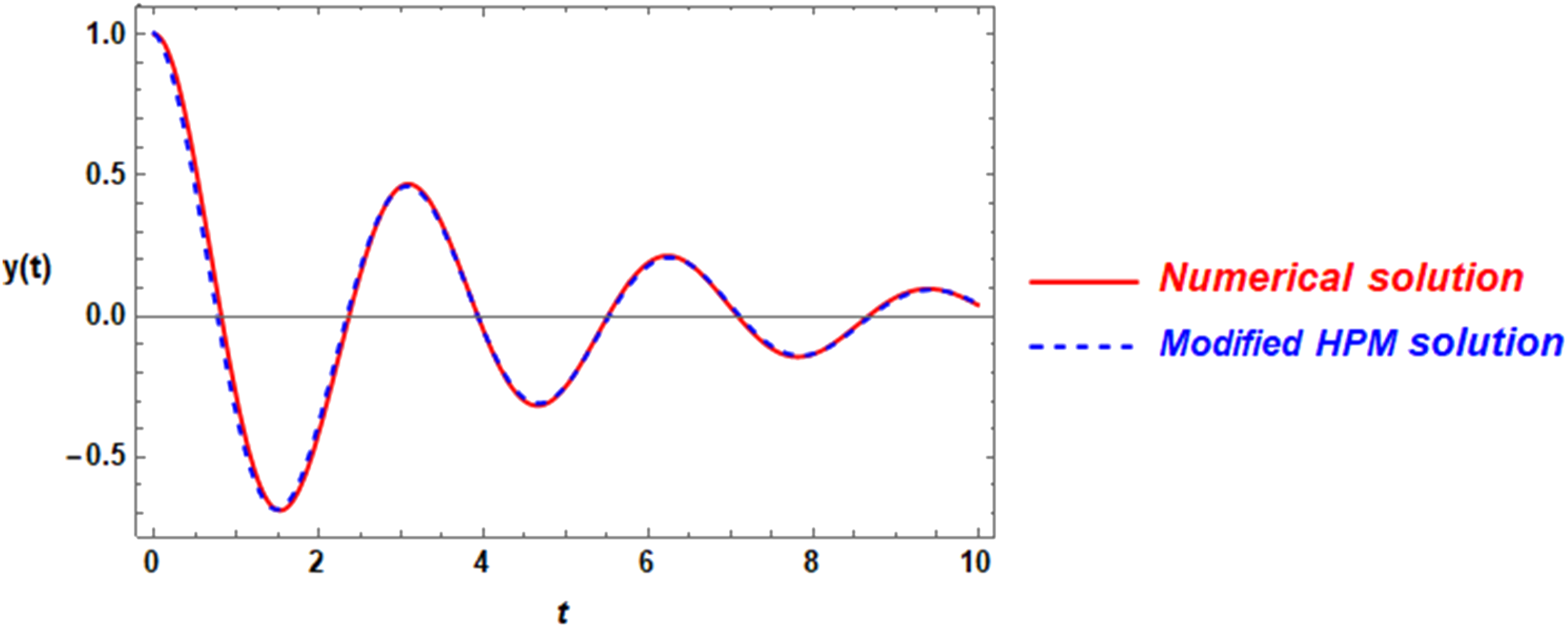
When , the stability conditions are the same as those obtained by the traditional homotopy perturbation method.12–13 The comparison of our result with the numerical one is given in Figure 1 for some given parameters, and a good agreement is found.
Comparison of the approximate solution of equation (92) with the numerical one when .
Ex6: The equations describing the lateral vibrations of a horizontally supported Jeffcott rotor system are given as follows59
where represents the damping coefficient, refers to the Duffing coefficient, measures the strength of the interaction, and denotes the linear frequency. The above system is subject to the initial conditions: . The above system represents a good application to the Duffing oscillator with three expansions given in the last example.
Suppose that the above system has a common frequency . By introducing this frequency into the system (99) becomes
Establish the corresponding homotopy equations in the form
Supposing the suggested solutions can be expanded in the form
Substituting (102) into (101) and equating like powers of to zero, yields
The first-order problem is given by
Insert (103) into (104) and dropping the secular terms gives
Under these solvability conditions (105), the solutions of the system (104) become
Employing (103) and (106) into the expansions (102) and letting yield the first-order approximate solutions in the form
To establish the frequency–amplitude equation, we need to combine the solvability conditions that are given in (105). This aim may require to multiply the first equation of (105) by and subtracted from the second equation multiplied by yields
At this stage, we may distinguish between two cases concerned to the relation of and . The first case where is known as the non-resonance case. The second case deals with the approaching of to . The last case is known as the internal resonance case.
For the internal resonance case, we may express the nearness of to by introducing a parameter defining as
Employing (109) with (105), one can estimate to be
At this end, the frequency becomes
The non-conservative oscillators through the modified homotopy expansion
To avoid the fails in solving the damping oscillators, EL-Dib60,61 uses the following modification for the homotopy exposition
The damping term is important for a damped oscillation. When , equation (112) reduces to the original one required by the homotopy perturbation method. It is noted that the parameter refers to all linear and nonlinear coefficients given in the nonlinear oscillators. It will be the damping coefficient of the simple damping Duffing oscillator. In the above examples Ex2 and Ex3, we can summarize the suitable decay parameter in each example. In Ex1, the suitable , and in Ex2, the damping parameter is constructed from the linear damping coefficient and the cubic nonlinear damping coefficient to be , and in Ex3 and Ex4, the damping parameter becomes φ = μ − (σ/Ω)sinΩτ.
The question now is how the damping parameter can be estimated. Usually, in the homotopy perturbations for the conservative oscillations, there is only one solvability condition used to determine the frequency–amplitude relationship. The application of the homotopy perturbation technique through the modified homotopy expansion will impose two solvability conditions: one of them used to construct the frequency equation and the second one used to determine the parameter . The absence of the parameter in the analysis of the non-conservative oscillator will lead to producing two solvability conditions in terms of the frequency parameter, and so duplication in the frequency equations occurs, which will produce wrong solutions.
In what follows, some examples are derived from the illustration:
Ex7: Consider the following Van der Pol oscillator62
where is the coefficient of the damping force.
To solve equation (113), we first write the corresponding homotopy equation in the form
where the unknowns and will be determined later. Inserting (112) into (114) and then setting the coefficient of the identical powers to zero yields the zero-order solution in the form
The first-order problem is
Employing (115) with (116) and dropping the secular terms yields
Free of the secular terms equation (116) has the solution
The first-order solution can be formulated in the form
Investigation of the above solution shows that the oscillation will grow up with increasing its amplitude as is increased. There is a special amplitude , where the oscillation has a periodic behavior and there is a conservation of energy.
Important note: It is observed that the nonlinear damping term in equation (113) has appeared into the decay parameter through replacing by . If we use this substitution from the beginning, then equation (113) will reduce to
This is a linear damping second-order equation having the following exact solution
where is the total frequency that is given by
The solution (121) is more accurate than the approximate solution (119) obtained through the perturbation technique.
Ex8: Consider the following two coupled damped Van der Pol oscillators63
where are constants. This system is subjected to the following initial conditions
Suppose that the above system has a common frequency to be determined. Therefore, the corresponding homotopy system can be established in the form
As mentioned before, the above nonlinear system can be converted to its corresponding linear one to facilitate the homotopy perturbation analysis, which leads to catching the exact solution. The converted system will arise through replacing and by and , respectively. The results are
Employing the system (112) into the system (126) and setting all identical powers in each equation to zero, we have
The system of the first-order problem is
Inserting the system of the zero-order solution into (128) and removing the secular terms requires
To obtain the frequency formulation, from equation (129), we have
Replacing the two ratios and from the decaying parameters and with the help of (129) and (131) yields
Where the first order solutions have vanished, then the perturbed solutions are, only, the zero solutions given in (127). Therefore, substituting (127) into (126) and using (130), to produce the following exact solutions
Ex9: The system of two coupled Van der Pol oscillators is one of the canonical models exhibiting the mutual synchronization behavior.64 Consider the following coupled Duffing–Van der Pol oscillator
where , , and are constants. Consider that this system has initial conditions
Introducing the common-conservative frequency and using the simplification given in the above examples into the system (136) becomes
Construct the homotopy system in the form
Consider the suggested solutions are performed as
Employing (140) into (139), then arranging in powers of , and setting the identical powers to zero yield
The first-order system is
Secular terms can be imposed when the zero-order solutions are inserted into the system (142). Removing the resulting secular terms requires that
It can be read, from the two solvability conditions (143), that there is a relationship between the two amplitudes and . That is
Employing (145) with (143), the frequency equation is found in the form
Solution of the first-order system without secular terms gives
Inserting (141) and (147) into (140) and letting lead to
where , and are given by (144) and (146), respectively.
Ex10: Consider the following generalized Van der Pol type oscillator65
The homotopy equation is
Considering the frequency analysis so that we define the following frequency expansion
Assuming that the function has been expanded as
Employing (151) and (152) with (150) and equating the identical powers of to zero yield
Solution of the zero-order problem leads to
Substituting (155) into (154), the requirement of no secular term in needs
If the first-order approximation is enough, then setting in the expansions (151) and (152) yields the approximate solution and the frequency, respectively
It is observed that the above oscillation becomes in the form of the conservative behavior when
By combining (159) and (161), we show the periodic solution can occur only when the amplitude satisfies the following relation
Ex11: In the present example, we have developed a technique for obtaining the asymptotic solutions of third-order critically damped linear systems. Consider the following linear third-order damping oscillator66,67
where , and are constants.
This problem is a linear damping third-order equation and its exact solution can be obtained through the modified homotopy perturbation analysis. The exact solution will arise when the first-order solution vanishes so that the zero-order solution is the exact one.
To apply the homotopy perturbation technique, the frequency parameter will be introduced in the form and equation (163) is rewritten as
where is the unknown frequency. Introducing a new variable U, which is defined as
Accordingly, we have
In view of equations (165) and (166), we can convert equation (164) into the form
The third-order equation of equation (163) is now converted to the second-order partner. The homotopy equation is
The solution is assumed to have the form
By the standard solution process required by the homotopy perturbation method, we have
The parameter can be simplified if is eliminated with the help of (173) which becomes
At this end, the exact solution of equation (167) is that
To derive the full decay solution of equation (163), (176) is inserted into (165) and the resulting first-order linear equation is solved to yield
This happens to be the exact solution, showing the effectiveness of the modified homotopy perturbation method.
Homotopy perturbation method for fractional non-conservative oscillators
Fractional vibration has become a hot topic in both mathematics and vibration theory. One of the most effective analytical methods for fractional oscillators is the homotopy perturbation method.
Ex12: The fractional damping Duffing equation is described as68,69
where , and are constants. The fractional derivative obeys the definition of the Riemann–Liouville time-fractional derivative. The initial conditions are assumed to be . Introducing the total frequency into equation (178) so that he homotopy equation is
Express the suggested solution in the form
Inserting (180) into (179) and proceeding what is required by the homotopy perturbation method, equation (179) becomes
The estimation becomes as follows
By setting , we obtain a linear system. The zero-order problem is
The first-order problem has the form
Inserting the solution of equation (185) into equation (186) yields
Employing the following fraction derivative of into equation (187)
Dropping the secular terms requires that
The total solution of equation (187) without the secular terms has the form
It is noted that the ordinary Duffing equation and its approximate solution can be obtained in the limit case as α→1.
The final first-order approximate solution reads
To enhance the solution and the frequency formula, we may select the decaying parameter , in the suggested solution (180), to be equal , and the approximate solution (192) becomes
Removing from the solvability condition (189) with the help of (194) yields the following frequency formula
Ex13: Consider the following fractional Van der Pol oscillator70
where is the coefficient of the damping coefficient. The initial conditions are selected to be y(0) = A and ẏ(0) = 0.
As mentioned before, equation (196) can be transformed to the linearized form by replacing to become ; then we have a harmonic linear second-order equation with a fractional damping term
Introducing the total frequency for the system under consideration and establishing the corresponding homotopy equation in the form
Inserting the expansion (180) into (198), the zero-order solution has the form
Employing (199) into (198) and dropping the secular terms yields
Because equation (198) is a linear equation, the first-order solution is . Accordingly, the zero-order solution represents the exact solution of equation (4). To find the frequency formulation, we set , and from equations (200) and (201), we have
So the exact solution becomes
The homotopy perturbation method for delay non-conservative oscillators
Ex14: Consider the following delayed Duffing equation71
The Duffing oscillator is given by the special case of the second-order pendulum equation.
The homotopy equation is
Substituting the expansion (180) into equation (205) and setting the identical powers of to zero yields the solution of the zero-order problem has the form
Accordingly, we have
The first-order problem is given by
Inserting (206) and (207) into (208) and removing secular terms requires that
Solution of equation (208) free of the secular terms is
The first approximate solution is
It is noted that when the decay parameter , in the expansion (180), has been replaced by the value of the delay parameter , then (210) becomes
For the delayed Duffing oscillator (204), stability of large amplitude is rapidly oscillating periodic solutions.
The frequency formula can be obtained free of the harmonic functions of . In view of equations (213) and (209), the following frequency–amplitude equation is obtained
It is observed that the solution (214) will oscillate when
Due to the vanishing of , the solution (221) becomes the exact solution which is
To relax the frequency equation without using the Taylor expansion, we may be assuming that the decay parameter in (180) becomes and then the solvability (225) should be changed to become
Express the non-conservative homotopy expansion as
Employing (236) into the homotopy equation (235) and setting the coefficient of the identical powers of to zero yields the first two terms of (236) in the following form:
Under these conditions, , and is the exact solution for equation (235)
In view of equations (241) and (242), is simplified as
In view of equation (243), from equation (232), we obtain the solution of equation (230), which is
The frequency formulation given in equation (241) is expressed in an inexplicit form. In order to have an explicit one, we introduce an artificial parameter in equation (241)
Expand the frequency as
Employing (247) into (246), collecting the identical power of , and setting it to zero yield
Inserting the solution of (248) into (249) to have the following approximate value
Ex17: Consider the following fractional damped Duffing oscillator with delay54
where , and are real constant coefficients. This system is subjected to . The nearness of to zero into equation (251) and the Duffing oscillator having a displacement time-delayed are found. As α has become close to unity, the velocity time-delayed of the Duffing equation should be obtained.
We will use the frequency expansion technique and the modified homotopy expansion to derive an approximate solution for the given equation. According to the homotopy technique, we can formulate the following homotopy equation
Expand each of the natural frequency as
Employing (180) and (253) into (252), we get the equations at each order as
The fractional-order derivative of , involved in equation (255), can be easily approximately established in the light of the fractional definition in the form
Substituting (259) into (258) and then dropping the secular terms yield
The uniform first-order solution is
For the one iteration process, we insert (256) and (262) into (180) for letting yields
Similarly, we insert (260) into (253) and setting gets
This is the frequency–amplitude relationship which depends on the time delay parameter and the order of the fractional parameter . To establish the frequency–amplitude equation free of the harmonic functions, we may take the decaying parameter as the delay parameter . Therefore, (261) may be changed to be
where the frequency can be estimated by squaring both (264) and (265) and adding yields
This frequency formulation can be directly used for practical applications.
Quasi-exact solution based on He’s frequency formula
There are alternative methods for nonlinear oscillators; some famous ones include the variational iteration method,74–79 the exp-function method,80–83 the variational theory,82–84 the G’/G-expansion method,85 the Bayesian inference method,86 the barycentric rational interpolation collocation method,87 and others.88 This section focuses itself on a simple method to find the frequency–amplitude relationship of a nonlinear oscillator using He’s frequency formulation,89–91 which represents a genius idea in converting a nonlinear equation into a linear equation. Since a linear equation often has a perfect solution, the solution of the linearized equation represents a near-perfect solution to the nonlinear equation, which is called a quasi-exact solution. However, dealing with a linear equation, whatever it is, is more accessible than dealing with a nonlinear equation.
Ex18: Consider the following oscillator of the Van der Pol type
where the potential function is defined as
It is seen that the nonlinear damping term in equation (268) is a harmonic function. Without expanding this function, a difficulty will arise to analyze this equation by a perturbation technique. The suitable simple process to solve the above equation is using the non-perturbative approach.
Based on He’s frequency formula, equation (268) is rewritten approximately as
where is estimated as
Further, the nonlinear damping coefficient is evaluated as
Now, equation (273) is a linear damping equation that is simpler than equation (268) where plays as a natural frequency. It is a solution having the exact form
where the non-conservative frequency is given by
He’s frequency formula has been widely applied to various nonlinear vibration problems, for example, vibration systems in a microgravity condition,92–94 3-D printing system,95 Fangzhu oscillator,96 the fractal cubic–quintic Duffing equation,97 the fractal Toda oscillator,98 and many modifications appeared in the literature.99–101
Ex19: Solve the following fractional damping Duffing equation using He’s frequency formula102
Now, equation (279) has a linear form with the fractional order. It can be solved using the modified homotopy technique. It is noted that the Duffing frequency will be used as a natural frequency for the linearized equation (279). Applying to both sides of equation (279), we have
A homotopy equation is
By a similar operation, as shown above, we have
It is noted that the following formulas are useful to use
Inserting (283) into (284) and using (285) and (286) yields
Dropping the secular terms requires
Under the above conditions, so that is the exact solution for the linearized equation (279) which is given by
This solution is called the quasi-exact solution of the original fractional Duffing equation.
Due to the complicated frequency formula (288), a perturbation technique can be used to get an approximation of it. Introduce a small parameter into (288) so that
Expanded the frequency in the form
Inserting (292) into (291), the zero-order and the first-order of the frequency expansion are estimated to become
The first-order approximate frequency formula can be obtained as
This approximate frequency can be used to estimate the decay parameter φ.
Conclusion
This work is focused on the analysis of the above-described examples for the non-conservative oscillators. As pointed out by D.D. Ganji in Science Watch on February 8, (2008), He’s perturbation method itself is mathematically beautiful and extremely accessible to non-mathematicians. This review article confirms this fact again, and the modification of the homotopy perturbation method has made the solution process for conservative oscillators extremely simple. In addition, we would also like to point out that our new modification is unique to HPM and that it does not exist in the other methods such as straightforward, Lindstedt–Poincare’ technique, multiple scales method, and others, and it can be used with these methods to address issues of the non-conservative oscillators, and it will give good results. This review article uses examples to show the basic ideas and the solution process and can be used as a paradigm for other applications.
Footnotes
Declaration of conflicting interests
The author(s) declared no potential conflicts of interest with respect to the research, authorship, and/or publication of this article.
Funding
The author(s) received no financial support for the research, authorship, and/or publication of this article.
ORCID iDs
Chun-Hui He
Yusry O El-Dib
Appendix
A1: The estimation of based on the Riemann–Liouville definition:
Firstly, one can remember the following relationships
Using the formula , one can write
References
1.
FanJZhangYRLiuY, et al.Explanation of the cell orientation in a nanofiber membrane by the geometric potential theory. Results Phys2019; 15: 102537. DOI: 10.1016/j.rinp.2019.10253.
2.
ZiYLGuoHYWenZ, et al.Harvesting low-frequency (< 5 Hz) irregular mechanical energy: a possible killer application of triboelectric nanogenerator. ACS Nano2016; 10(4): 4797–4805.
3.
LiHDTianCDengZD. Energy harvesting from low frequency applications using piezoelectric materials. Appl Phys Rev2014; 1(4): 041301. DOI: 10.1063/1.4900845.
4.
KulahHNajafiK. Energy scavenging from low-frequency vibrations by using frequency up-conversion for wireless sensor applications. IEEE Sensors J2008; 8: 261–268. DOI: 10.1109/JSEN.2008.917125.
5.
AliMNaveedNQura AinQT, et al.Homotopy perturbation method for the attachment oscillator arising in nanotechnology. Fibers Polym2021; 22(6): 1601–1606. DOI: 10.1007/s12221-021-0844-x.
6.
AnjumNHeJH. Two modifications of the homotopy perturbation method for nonlinear oscillators. J Appl Comput Mech2020; 6(SI): 1420–1425. DOI: 10.22055/JACM.2020.34850.2482.
7.
HeJHAnjumNSkrzypaczPS. A variational principle for a nonlinear oscillator arising in the microelectromechanical system. J Appl Comput Mech2020; 7(1): 78–83. DOI: 10.22055/JACM.2020.34847.2481.
8.
AnjumNHeJH. Nonlinear dynamic analysis of vibratory behavior of a graphene nano/microelectromechanical system. Math Methods Appl Sci2020; SPECIAL ISSUE PAPER:1–16. DOI: 10.1002/mma.6699.
9.
LinLYaoSWLiHG. Silver ion release from Ag/PET hollow fibers: mathematical model and its application to food packing. J Engineered Fiber Fabrics2020; 15: 1–16. Article Number 1558925020935448. DOI: 10.1177/1558925020935448.
10.
LiuFJZhangTHeCH, et al.Thermal oscillation arising in a heat shock of a porous hierarchy and its application. Facta Universitatis Ser Mech Eng2021. DOI: 10.22190/FUME210317054L.
11.
HeJHAmerTSElnaggarS, et al.Periodic property and instability of a rotating pendulum system. Axioms2021; 10: 191. DOI: 10.3390/axioms10030191.
HeJH. Some asymptotic methods for strongly nonlinear equations. Int J Mod Phys B2006; 20(10): 1141–1199.
14.
GanjiDD. The application of He’s homotopy perturbation method to nonlinear equations arising in heat transfer. Phys Lett A2006; 355(4–5): 337–341.
15.
YildirimAOzisT. Solutions of singular IVPs of Lane-Emden type by homotopy perturbation method. Phys Lett A2007; 369(1–2): 70–76.
16.
GolmankhanehAKGolmankhanehAKBaleanuD. On nonlinear fractional Klein-Gordon equation. Signal Process2011; 91(3): 446–451.
17.
AkbarNSNadeemS. Endoscopic effects on peristaltic flow of a nanofluid. Commun Theor Phys2011; 56(4): 761–768.
18.
Mohyud-DinSTYildirimASezerSA. Numerical soliton solutions of improved Boussinesq equation, Int J Numer Methods Heat Fluid Flow2011; 21(6–7): 822–827.
19.
KhanYWuQB. Homotopy perturbation transform method for nonlinear equations using He’s polynomials. Comput Mathematics Appl2011; 61(8): 1963–1967.
20.
HeJHEl-DibYO. The enhanced homotopy perturbation method for axial vibration of strings. Facta Universitatis: Mech Eng2021; 59: 1139–1150. DOI: 10.22190/FUME210125033H.
21.
SaranyaKMohanVKizekR, et al.Unprecedented homotopy perturbation method for solving nonlinear equations in the enzymatic reaction of glucose in a spherical matrix. Bioproc Biosyst2018; 41(2): 281–294. DOI: 10.1007/s00449-017-1865-0.
22.
BiazarJGhanbariBPorshokouhiMG, et al.He’s homotopy perturbation method: a strongly promising method for solving nonlinear systems of the mixed Volterra-Fredholm integral equations. Comput Mathematics Appl2011; 61(4): 1016–1023.
23.
BiazarJAminikhahH. Study of convergence of homotopy perturbation method for systems of partial differential equations. Comput Mathematics Appl2009; 58(11–12): 2221–2230.
24.
TurkyilmazogluM. Convergence of the homotopy perturbation method, convergence of the homotopy perturbation method. Int J Nonlinear Sci Numer Simulation2011; 12(1–8): 9–14.
25.
SayevandKJafariH. On systems of nonlinear equations: some modified iteration formulas by the homotopy perturbation method with accelerated fourth- and fifth-order convergence. Appl Math Model2016; 40(2): 1467–1476.
26.
MishraHKNagarAK. He-laplace method for linear and nonlinear partial differential equations. J Appl Mathematics2012; 2012, 16 pages. Article Number 180315. DOI: 10.1155/2012/180315.
27.
El-DibYO. Homotopy perturbation method with rank upgrading technique for the superior nonlinear oscillation. Math Comput Simul2021; 182: 555–565.
28.
El-DibYOMatoogRT. The rank upgrading technique for a harmonic restoring force of nonlinear oscillators. Appl Comput Mech2021; 7(2): 782–789.
29.
AnjumN. Li-He’s modified homotopy perturbation method for doubly-clamped electrically actuated microbeams-based microelectromechanical system. Facta Universitatis: Mech Eng2021. DOI: 10.22190/FUME210112025A.
30.
AnjumNHeJ-H. Higher-order homotopy perturbation method for conservative nonlinear oscillators generally and microelectromechanical systems’ oscillators particularly. Int J Mod Phys B2020; 34(32): Article number: 2050313.
31.
AnjumNHeJH. Homotopy perturbation method for N/MEMS oscillators. Math Methods Appl Sci2020; SPECIAL ISSUE PAPER:1–15. DOI: 10.1002/mma.6583.
32.
PrakashJKothandapaniMBharathiV. Numerical approximations of nonlinear fractional differential difference equations by using modified He-Laplace method. Alexandra Eng J2016; 55(1): 645–651.
33.
Filobello-NinoUVazquez-LealHHerrera-MayAL, et al.The study of heat transfer phenomena by using modified homotopy perturbation method coupled by Laplace transform. Therm Sci2020; 24(2): 1105–1115.
34.
WeiCF. Two-scale transform for 2-D fractal heat equation in a fractal space. Therm Sci2021; 25(3): 2339–2345.
35.
DengSXGeXX. Approximate analytical solution for Phi-four equation with He’s fractional derivative. Therm Sci2021; 25(3): 2369–2375.
36.
AnjumNAinQT. Application of He’s fractional derivative and fractional complex transform for time fractional Camassa-Holm equation. Therm Sci2020; 24(5): 3023–3030.
37.
ElgazeryNS. A Periodic Solution of the Newell-Whitehead-Segel (NWS) wave equation via fractional calculus. J Appl Comput Mech2020; 6(SI): 1293–1300. DOI: 10.22055/jacm.2020.33778.2285.
38.
El-DibYOMoatimidGMElgazeryNS. Stability analysis through a damped nonlinear wave equation. J Appl Comput Mech2020; 6(SI): 1394–1403. DOI: 10.22055/jacm.2020.34053.
39.
El-DibYOElgazeryNSMadyAA. Nonlinear dynamical analysis of a time-fractional Klein-Gordon equation. Pramana - J Phys2021; 95: 154. DOI: 10.1007/s12043-021-02184-z.
40.
ShafieiNKazemiMSafiM, et al.Nonlinear vibration of axially functionally graded non-uniform nanobeams. Int J Eng Sci2016; 106: 77–94.
41.
NourazarSSNazari-GolshanA. A new modification to homotopy perturbation method combined with Fourier transform for solving nonlinear Cauchy reaction diffusion equation. Indian J Phys2015; 89(1): 61–71.
42.
HeJH. Homotopy perturbation method with two expanding parameters. Indian J Phys2014; 88: 193–196.
43.
AzimzadehZVahidiARBabolianE. Exact solutions for non-linear Duffing’s equations by He’s homotopy perturbation method. Indian J Phys2012; 86(8): 721–726.
44.
GhanmiIKhiariNOmraniK. Exact solutions for some systems of PDEs by He’s homotopy perturbation method. Int J Numer Methods Biomed Eng2011; 27(2): 304–313.
45.
NadeemMHeJH. The homotopy perturbation method for fractional differential equations: part 2, two-scale transform. Int J Numer Methods Heat Fluid Flow2021. DOI: 10.1108/HFF-01.2021.0030.
46.
NadeemMHeJHIslamA. The homotopy perturbation method for fractional differential equations: part 1 Mohand transformInt J Numer Methods Heat Fluid Flow2021; 31(11): 3490–3504. DOI: 10.1108/HFF-11-2020-0703.
47.
WangKLYaoSW. He’s fractional derivative for the evolution equation. Therm Sci2020; 24(4): 2507–2513.
48.
NoeiaghdamSDregleaAHeJH, et al.Error estimation of the homotopy perturbation method to solve second kind volterra integral equations with piecewise smooth kernels: application of the CADNA library. Symmetry-Basel2020; 12(10): 1730. DOI: 10.3390/sym12101730.
49.
EladdadEETarifEA. On the coupling of the homotopy perturbation method and new integral transform for solving systems of partial differential equations. Adv In Math Phys2019; 2019: 1–7. DOI: 10.1155/2019/5658309.
50.
OzpinarFBelgacemFB. The discrete homotopy perturbation sumudu transform method for solving partial difference equations. Discrete and Continuous Dynamical Systems-Series S2019; 12(3): 615–624.
51.
TongSSWangWHanB. Accelerated homotopy perturbation iteration method for a non-smooth nonlinear ill-posed problem. Appl Numer Mathematics2021; 169: 122–145.
52.
XiaYXHanBFuZW. An accelerated homotopy perturbation iteration for nonlinear ill-posed problems in Banach spaces with uniformly convex penalty. Inverse Probl2021; 37(10): 105003. DOI: 10.1088/1361-6420/ac1ac2.
53.
El-DibYO. Multi-homotopy perturbation technique for solving nonlinear partial differential equations with Laplace transforms. Nonlinear Sci Lett A2018; 9: 349–359.
54.
El-DibYO. Stability approach of a fractional-delayed duffing oscillator. Discontinuity, Nonlinearity, and Complexity2020; 9(3): 367–376. DOI: 10.5890/DNC.2020.09.003.
55.
WaluyaySBVan HorssenWT. On approximations of first integrals for strongly nonlinear oscillators. Nonlinear Dyn2003; 32(2): 109–141. DOI: 10.1023/A:1024470410240.
56.
AgarwalRPBerezanskyLBravermanEDomoshnitskyA. Nonoscillation theory of functional differential equations with applications. Springer Science & Business Media, 2012. DOI 10.1007/978-1-4614-3455-9.
57.
HamdiMMohamedB. Control of bistability in a delayed duffing oscillator. Adv Acoust Vibration2012; 2012: 1–5. Article ID 872498. DOI: 10.1155/2012/872498.
58.
HeJHEl-DibYO. Homotopy perturbation method with three expansions. J Math Chem2021; 59: 1139–1150.
59.
SaeedNAKamelM. Active magnetic bearing-based tuned controller to suppress lateral vibrations of a nonlinear Jeffcott rotor system. Nonlinear Dyn2017; 90: 457–478. DOI: 10.1007/s11071-017-3675-y.
60.
El-DibYO. The frequency estimation for non-conservative nonlinear oscillation. Z Angew Math Mech2021; e202100187. DOI: 10.1002/zamm.202100187.
61.
El-DibYO. Criteria of vibration control in delayed third-order critically damped duffing oscillation. Archive of Applied Mechanics2021. DOI: 10.1007/s00419-021-02039-4.
62.
Van der PolB. A theory of the amplitude of free and forced triode vibrations, Radio Review (London). 1, 701–710 and 754–762 (1920).
63.
LowLAReinhall1PGStorti1DW, et al.Coupled van der Pol oscillators as a simplified model for generation of neural patterns for jellyfish locomotion. Struct Control Health Monit2006; 13: 417–429. DOI: 10.1002/stc.133.
64.
KengneJKenmogneFKamdoum TambaV. Experiment on bifurcation and chaos in coupled anisochronous self-excited systems: case of two coupled van der pol-duffing oscillators. J Nonlinear Dyn2014; 2014: 1–13. Article ID 815783. DOI: 10.1155/2014/815783.
65.
El-DibYO. The stability conditions of the cubic damping van der pol-duffing oscillator using the hpm with the frequency-expansion technology. Journal Applied Mathematics Computational Mechanics2018; 17(3): 31–44. DOI: 10.17512/jamcm.2018.3.03.
66.
GreguˇsM. Third order linear di_erential equations. Boston: D.Reidel Publishing Company, 1987.
67.
HeJHEl-DibYO. The reducing rank method to solve third-order Duffing equation with the homotopy perturbation. Numer Method Partial Differ Equ2021; 37(2): 1800–1808.
68.
KimVRomanP. Mathematical model of fractional duffing oscillator with variable memory. Mathematics2020; 8: 2063. DOI: 10.3390/math8112063.
69.
El-SayedAMAFE El-RaheemZSalmanSM. Discretization of forced Duffing system with fractional-order damping. Adv Difference Equations2014; 2014: 66. DOI: 10.1186/1687-1847-2014-66.
70.
XieFLinX. Asymptotic solution of the Van der Pol. Phys Scr2009; T136: 014033. DOI: 10.1088/0031-8949/2009/T136/014033.
71.
El-DibYO. Stability analysis of a strongly displacement time-delayed duffing oscillator using multiple scales homotopy perturbation method. Applied and Computational Mechanics2018; 4(4): 260–274. DOI: 10.22055/JACM.2017.23591.1164.
72.
GuillotLVergezCBrunoC. Continuation of Periodic Solutions of Various Types of Delay Differential Equations Using Asymptotic Numerical Method and Harmonic Balance Method. Nonlinear Dynamics. 2019; 97: 123–134.
73.
AlexanderDVolinskyILeviS, et al.Stability of third order neutral delay differential equations. AIP Conf Proc2019; 2159: 020002. DOI: 10.1063/1.5127464.
74.
HeJH. Variational iteration method-a kind of non-linear analytical technique: some examples. Int J Non-linear Mech1999; 34: 699–708.
75.
HeJHWuXH. Variational iteration method: new development and applications. Comput Mathematics Appl2007; 54: 881–894.
76.
HeJHWuXH. Variational iteration method: new development and applications. Comput Mathematics Appl2007; 54: 881–894.
77.
AnjumNHeJH. Laplace transform: making the variational iteration method easier. Appl Mathematics Lett2019; 92: 134–138.
78.
HeJH. Variational iteration method—Some recent results and new interpretations. J Comput Appl Mathematics2007; 207: 3–17.
79.
AnjumNHeJH. Analysis of nonlinear vibration of nano/microelectromechanical system switch induced by electromagnetic force under zero initial conditions. Alexandria Eng J2020; 59: 4343–4352.
HeJH. Exp-function method for fractional differential equations. Int J Nonlinear Sci Numer Simulation2013; 14(6): 363–366.
82.
HeJH. On the fractal variational principle for the Telegraph equation. Fractals2021; 29(1): 2150022.
83.
LingWWWuPX. Variational principle of the Whitham-Broer-Kaup equation in shallow water wave with fractal derivatives. Therm Sci2021; 25(2): 1249–1254. DOI: 10.2298/TSCI200301019L.
84.
HeJH. Hamiltonian-based frequency-amplitude formulation for nonlinear oscillators. Facta Universitatis-Series Mech Eng2021; 19(2): 199–208.
85.
TianYYanZZ. Travelling wave solutions for a surface wave equation in fluid mechanics. Therm Sci2016; 20(3): 893–898.
TianDHeJH. The barycentric rational interpolation collocation method for boundary value problems. Therm Sci2018; 22(4): 1773–1779.
88.
HeJHEl-DibYOMadyAA. Homotopy perturbation method for the fractal toda oscillator. Fractal Fract2021; 5: 93. DOI: 10.3390/fractalfract5030093.
89.
HeJH. The simplest approach to nonlinear oscillators. Results Phys2019; 15: 102546
90.
QieNHouWFHeJH. The fastest insight into the large amplitude vibration of a string. Rep Mech Eng2020; 2(1): 1–5. DOI: 10.31181/rme200102001q.
91.
HeJHGarcíaA. The simplest amplitude-period formula for non-conservative oscillators. Rep Mech Eng2021; 2(1): 143–148. DOI: 10.31181/rme200102143h.
92.
WangKL. A new fractal model for the soliton motion in a microgravity space. Int J Numer Methods Heat Fluid Flow2020; 31(1): 442–451. DOI: 10.1108/HFF-05-2020-0247.
93.
WangKL. He’s frequency formulation for fractal nonlinear oscillator arising in a microgravity space. Numerical Methods Partial Differential Equations2021; 37(2): 1374–1384.
94.
WangKL. A new fractal transform frequency formulation for fractal nonlinear oscillator. Fractals2021; 29(3): 2150062.
95.
ZuoY-T. A gecko-like fractal receptor of a three-dimensional printing technology: a fractal oscillator. J Math Chem2021; 59(3): 735–744. DOI: 10.1007/s10910-021-01212-y.
96.
Elias-ZunigaAPalacios-PinedaLMMartinez-RomeroO, et al.Dynamics response of the forced fangzhu fractal device for water collection from air. Fractals2021. DOI: 10.1142/S0218348X21501863.
97.
Elias-ZunigaAPalacios-PinedaLMJimenez-CedenoIH, et al.Analytical solution of the fractal cubi-quintic Duffing equation. Fractals2021; 29(4): 2150080.
98.
Elias-ZunigaAPalacios-PinedaLMJimenez-CedenoIH, et al.Equivalent power-form representation of the fractal Toda oscillator. Fractals2021; 29(2): 150034.
99.
Elias-ZunigaAPalacios-PinedaLMJiménez-CedeñoIH, et al.A fractal model for current generation in porous electrodes. J Electroanalytical Chem2021; 880: 114883.
100.
Elías-ZúñigaAPalacios-PinedaLMJiménez-CedeñoIH, et al.Enhanced He’s frequency-amplitude formulation for nonlinear oscillators. Results Phys2020; 19: 103626. DOI: 10.1016/j.rinp.2020.103626.
101.
HeJHEl-DibYO. Homotopy perturbation method with three expansions for Helmholtz-Fangzhu oscillator. Int J Mod Phys B2021; 35(24): 2150244. DOI: 10.1142/S0217979221502441.
102.
El-DibYOElgazeryNS. Effect of fractional derivative properties on the periodic solution of the nonlinear oscillations. Fractals2020; 28(7): 2050095. DOI: 10.1142/S0218348X20500954.