




Abstract
He’s frequency–amplitude formulation and its modifications mainly depend upon the residual calculation. A suitable choice of a residual leads to an ideal result. This paper discusses some effective methods for the residual calculation, and a modification with a free parameter is suggested to effectively estimate the frequency of a nonlinear oscillator. Furthermore, an energy-based residual calculation is also suggested, which is deduced from a variational principle.
Keywords
Introduction
A nonlinear vibration problem arises everywhere from everyday life to an atom vibration. Recently, the nanoscale vibration for smart adhesion,1,2 nanoscale nonlinear transverse vibration in a nanofiber-reinforced concrete pillar, 3 and the vibration of the micro-electromechanical systems4–7 have been caught much attention. The most important property of a nonlinear vibration system is the nonlinear relationship between the frequency and the amplitude. The self-cleaning of the Gecko’s feet and Lotus’ surface can be explained by the high frequency property of the water molecules on the surface. 2 Gecko effect and Lotus effect can be explained by the geometric potential theory.8–14
There are many analytical methods to accurately determine the frequency–amplitude relationship of a nonlinear oscillator, for example, the variational iteration method (VIM),15–18 the homotopy perturbation method (HPM),19–23 the Taylor series method,24–27 among which He’s frequency–amplitude formulation28–31 has been proved to be the simplest and relatively effective, which was first proposed by a Chinese mathematician, Prof. Ji-Huan He, in his famous review article “Some asymptotic methods for strongly nonlinear equations” in 2006. 28 Though only few lines were given, the method caught an immediate attention due to its extreme simplicity and remarkable accuracy, and there was a very hot discussion in Computers & Mathematics with Applications (issue 8 of 2011) and Journal of Low Frequency Noise Vibration and Active Control (Issues 3–4 of 2019). There were many modifications available in literature, and this paper focuses on Ren–Hu’s modification. 32
Nonlinear oscillator and its variational formulation
We consider a nonlinear oscillator in the form

Its variational formulation can be established by the semi-inverse method,33–39 which is


In equation (2),


Considering H is a constant, we have

Equation (6) implies equation (1) or
He’s frequency–amplitude formulation and its modification
He’s formulation is to choose two arbitrary frequencies ω1 and ω2 to produce two residual equations


The residuals in He’s frequency formulation are calculated as follows


The square of the frequency can be obtained as

In Ren–Hu’s modification,
32
the residuals are calculated as


Instead of equation (11), Ren and Hu suggested the following modification

The difference of He’s formulation and Ren–Hu’s modification lies on the calculation of the residuals. As illustrated in Figure 1, both methods can lead to a reasonable result.
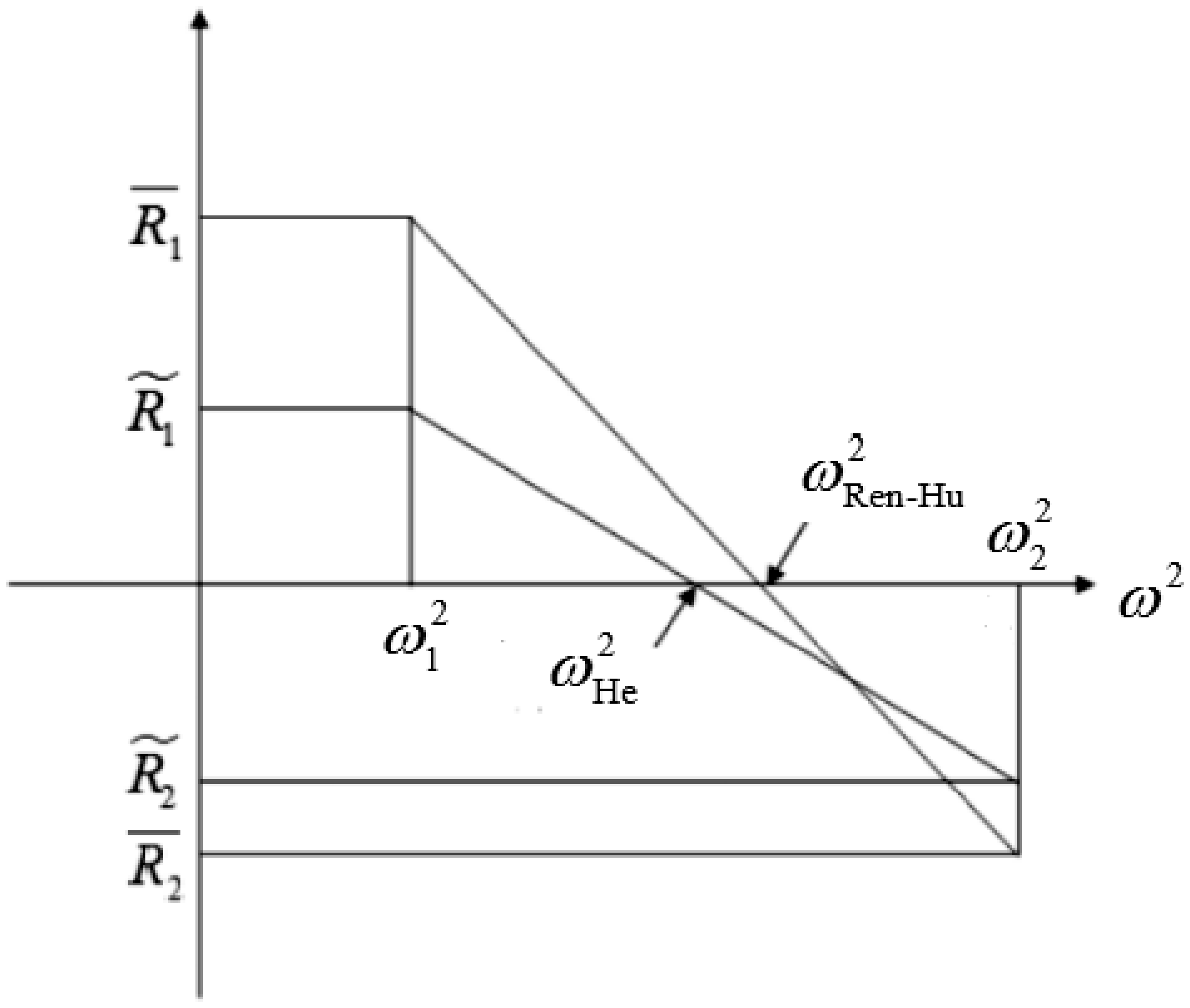
Comparison of He’s formulation and Ren–Hu’s modification.
Calculation of the residuals
Residual calculation plays an important role in He’s formulation, hereby gives an improvement


As a result, He’s formulation can be modified as

By suitable choice of m, a most accurate result can be obtained. For the simplest case, the frequency can be estimated by

An example
Consider the following Duffing oscillator27,40–42

By a simple calculation, we have



Table 1 shows the accuracy of each frequency estimation and good accuracy can be obtained; and equation (22) gives a much better result.
Comparison of each frequency estimation with the exact one for the case of A =1 and
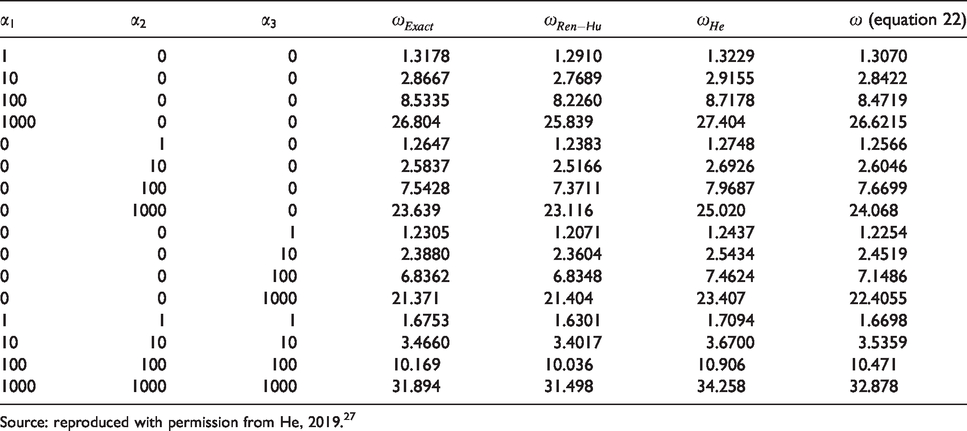
Source: reproduced with permission from He, 2019. 27
The approximate analytical solution and the exact numerical solution of equation (19) are shown in Figure 2. The error between the approximate analytical solution and the exact numerical solution of equation (19) are shown in Figure 3.
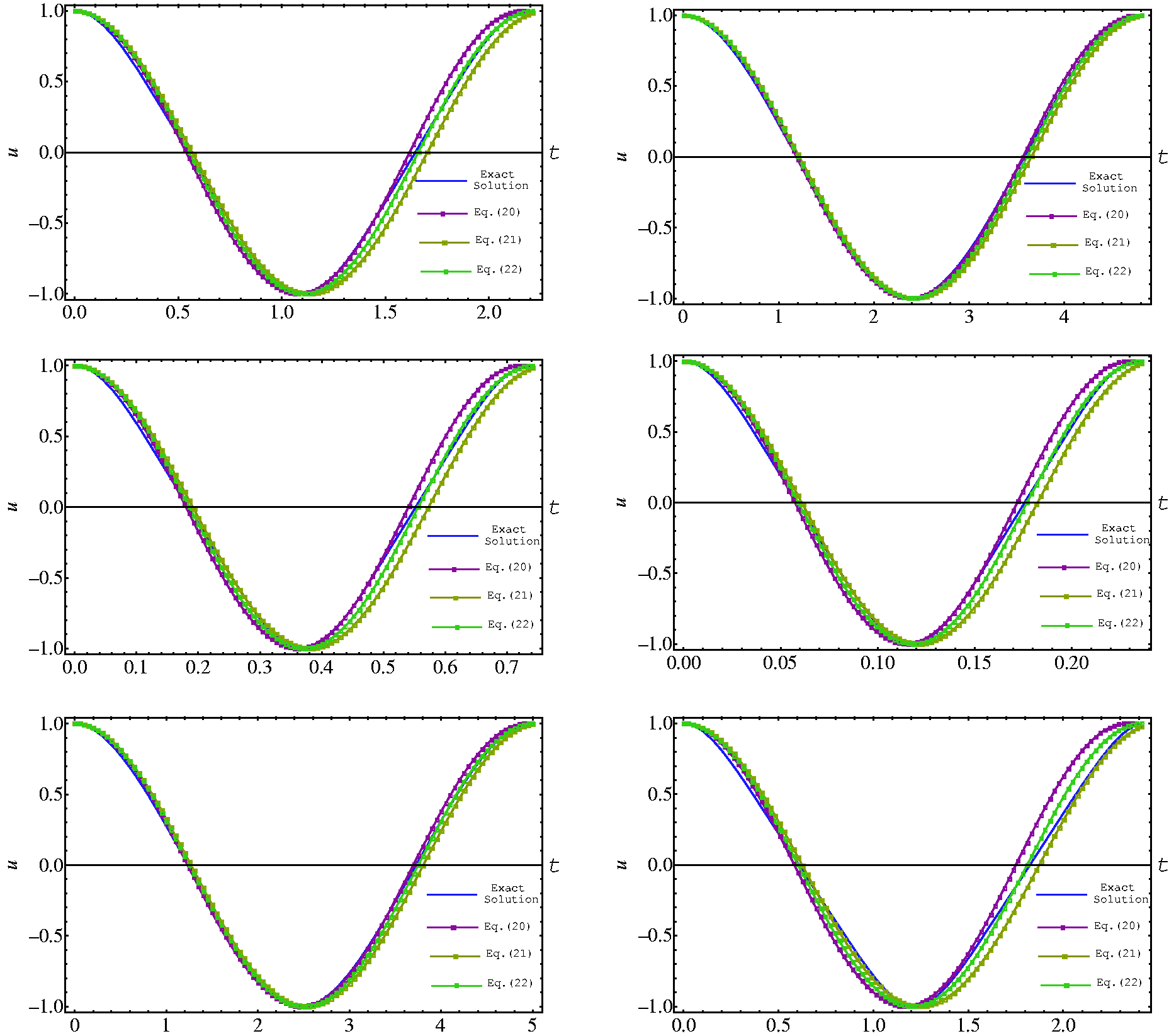
Comparison of approximate solution u with the exact solution.
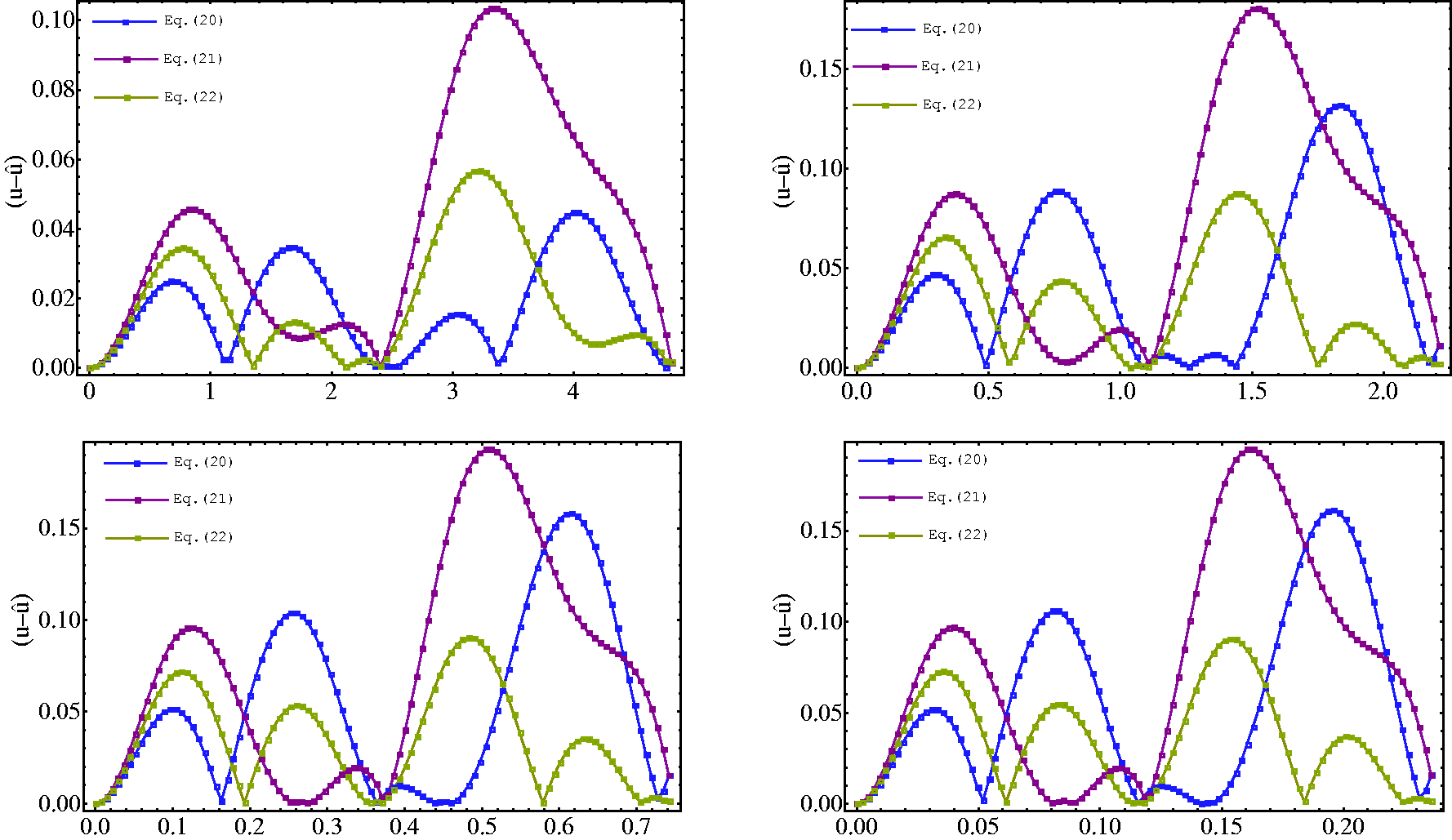
Error between the approximate solution u and the exact solution
Conclusion
This paper discusses the effect of residual estimation on the accuracy of the frequency obtained by He’s frequency formulation and its modification. Considering the calculation process for residuals in He’s formulation given in equation (11) and Ren–Hu’s modification given in equation (14) are equally simple, a more general frequency formulation is suggested with a free parameter by taking into account both He’s residuals and Ren–Hu’s ones. By suitable choice of the free parameter, the accuracy can be remarkably improved. The free parameter given in equation (17) can be optimally identified by the either the HPM 19 or the VIM 15 by using equation (17) as an initial guess, after one iteration, the free parameter can be effectively identified by requirement of no secular terms in the solution.
The present modification of He’s frequency formulation with a free parameter provides an auxiliary tool to further improvement of the accuracy without losing its simplicity, the method can be easily extended to other nonlinear vibrations with fractal derivatives, and we will discuss the application in a forthcoming paper.
Footnotes
Declaration of conflicting interests
The author(s) declared no potential conflicts of interest with respect to the research, authorship, and/or publication of this article.
Funding
The author(s) received no financial support for the research, authorship, and/or publication of this article.
