



Abstract
In this article, the gamma function method, for the first time ever, is used to solve the nonlinear cubic-quintic Duffing oscillators. The nonlinear cubic-quintic Duffing oscillators with and without the damped and quadratic terms are considered respectively. By the gamma function method, it only needs one-step to get the approximate solution. The comparisons with the existing solutions reveal that the proposed method is simple but effective in solving the small amplitude oscillation.
Introduction
Nonlinear oscillation can be seen everywhere in our daily life. The research on its vibration characteristics has always been a research hot spot. However, the explicit analytical solutions of nonlinear oscillator equations are few, and either numerical solutions or approximate analytical techniques are frequently used. Many scholars have made outstanding contributions and many different methods are obtained such as homotopy perturbation method,1–3 variational approach,4–9 variational iteration method,10–16 He’s frequency formulation,17–19 Hamiltonian approach,
20
Taylor series method,
21
and so on.22–24 The well-known Duffing oscillator equation was named after a German electrical engineer Georg Duffing who first proposed the equation in 1918,
25
and then, it is developed into different forms to describe many physical, mechanical engineering, circuits and biological processes in various areas of science.26–28 Thus, the study of the Duffing oscillator equation is important. In this article, we consider the nonlinear small amplitude cubic-quintic Duffing oscillators, which is


Inspired by the recent study on the special functions and nonlinear oscillators,29,30 we will use a new method so called the gamma function method to seek its frequency–amplitude formulation of equation (1.1).
The overall structure of this article is arranged as follows. The gamma function and its properties are presented in the section The Gamma Function. In the section The Gamma Function Method, the gamma function method is proposed and used to solve the nonlinear cubic-quintic Duffing oscillators without the damped and the quadratic terms. In the section Considering the Damped and Quadratic Terms, the nonlinear cubic-quintic Duffing oscillators considering the damped and the quadratic terms are studied. And the conclusion is presented in the Conclusion section.
The Gamma function
The well-known gamma function is defined as




The Gamma function method
For obtaining the solution of equation (1.1), we first linearize equation (1.1) as
30









By equation (3.9), we obtain the solution of equation (1.1) as The comparison between the gamma function method and Ref. 27 with different Comparison of the approximate frequency with different 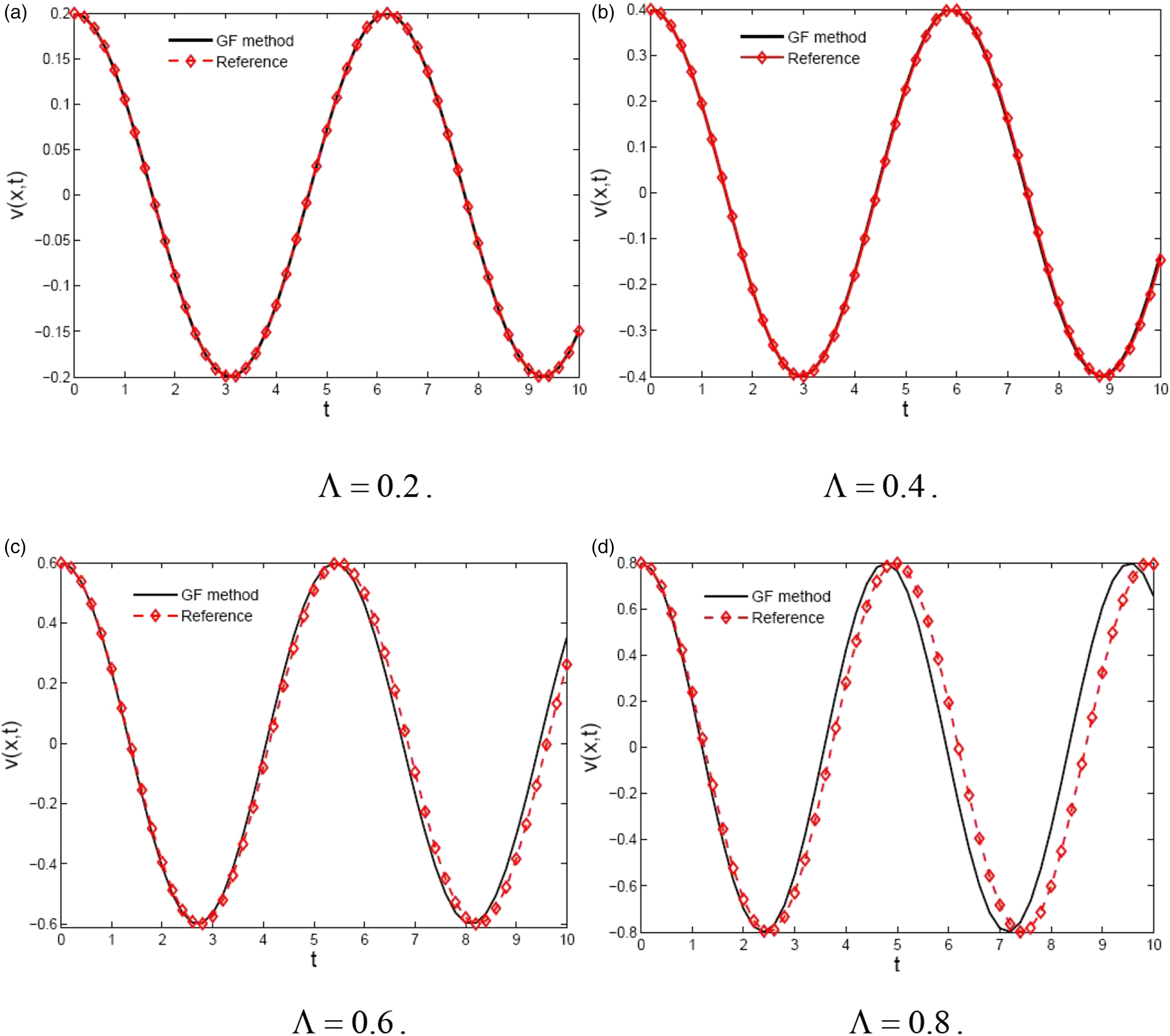


Considering the damped and quadratic terms
In this section, we use the gamma function method to solve the cubic-quintic Duffing oscillators with the damped and the quadratic terms as




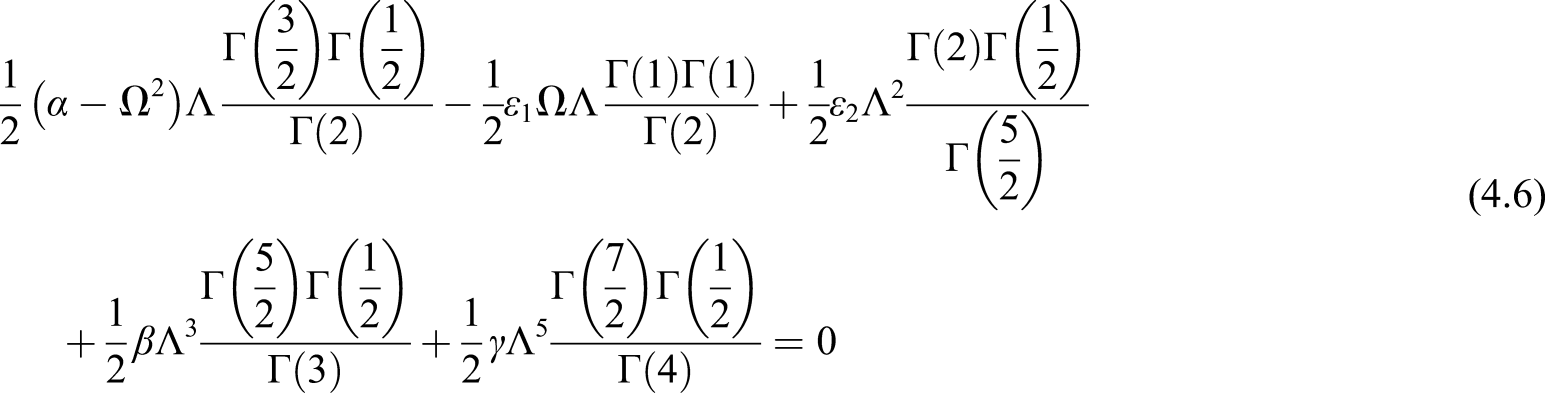



The solution of equation (4.1) can be obtained by the ancient Chinese algorithm (ACG),
33
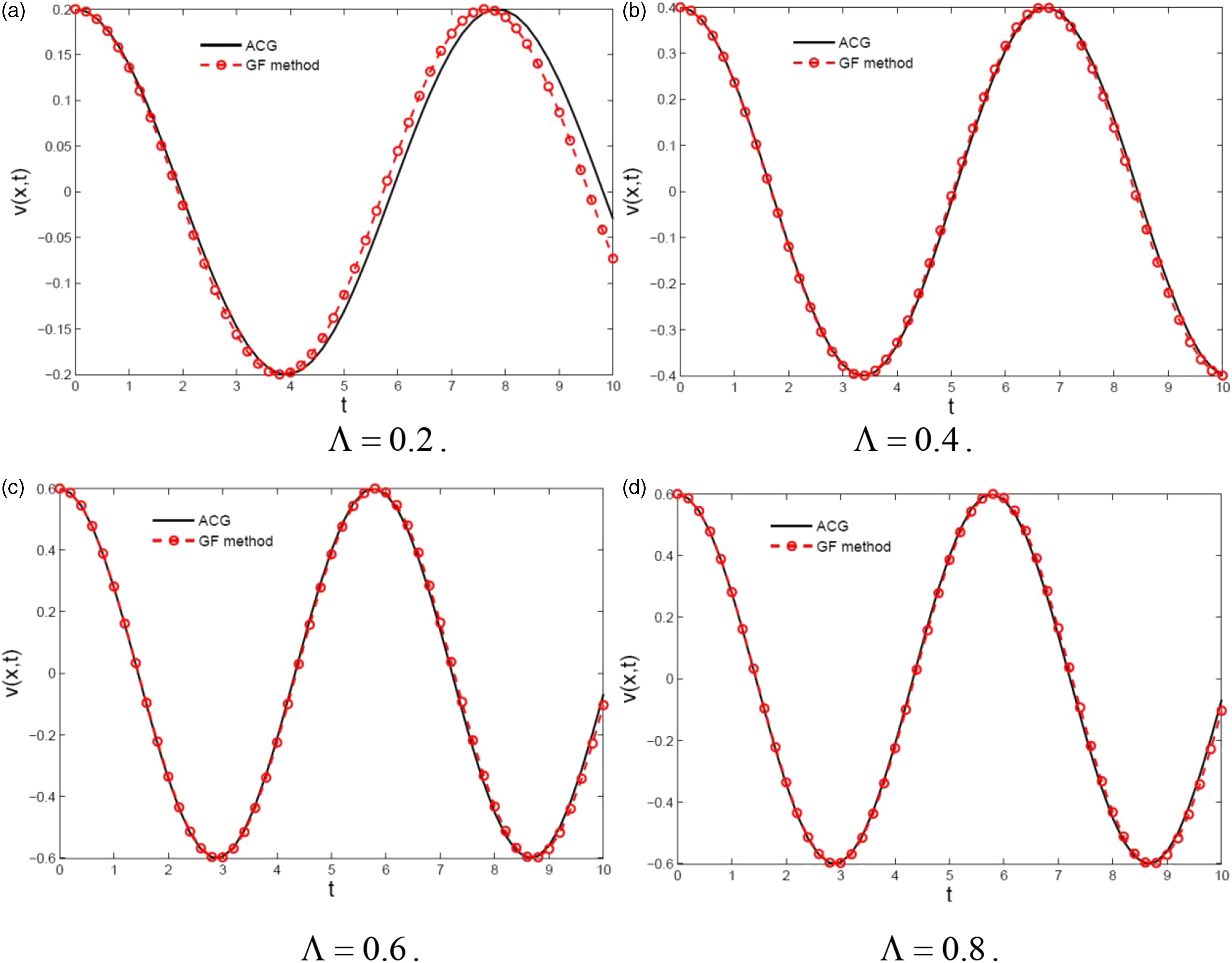
which is The comparison between the gamma function method and the ACG with different Comparison of the approximate frequency with different 

Conclusion
In this work, the gamma function method is used to solve the nonlinear cubic-quintic Duffing oscillators. It only takes one-step to obtain the amplitude–frequency relationship. Compared with the existing solution, it reveals that the gamma function method is remarkably accurate for the small amplitude oscillation. The obtained results in this article are expected to open up new horizons for the study of the small amplitude oscillation theory.
Footnotes
Declaration of conflicting interests
The author(s) declared no potential conflicts of interest with respect to the research, authorship, and/or publication of this article.
Funding
The author(s) disclosed receipt of the following financial support for the research, authorship, and/or publication of this article: This work is supported by Program of Henan Polytechnic University (No. B2018-40), the Fundamental Research Funds for the Universities of Henan Province(NSFRF210324), Innovative Scientists and Technicians Team of Henan Provincial High Education (21IRTSTHN016), and Key Project of Scientific and Technology Research of Henan Province (212102210224).
