




Abstract
Fast estimation of a nonlinear oscillator is very much needed in engineering, the perturbation method is valid only for weakly nonlinear oscillators. This paper gives some simple formula for this purpose, only simple calculation is needed to have a relatively high accuracy of the estimated frequency.
Introduction
Recently, García
1
and Suárez
2
gave some simple formulae for estimation of the period of a nonlinear oscillators. Considering a nonlinear oscillator in the form


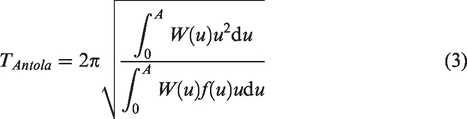
Both formulae given in equations (2) and (3) are simple and useful for practical applications. This mini review article summarizes some even simpler period/frequency formulae mainly based on previous work on this special direction.
He’s frequency formulation
For the nonlinear oscillator given in equation (1), we can choose two arbitrary trial frequencies




He’s frequency formula reads
3

For Duffing equation

Choosing

Note that
Geng and Cai
4
suggested a modification for equation (8)

The frequency formula was furthered improved in He5,6



For the Duffing equation

The accuracy of the frequency given in equation (15) is 7% when
We can re-write equation (1) in the form

If we search for an approximate solution in the form

Comparing equation (16) with a linear oscillator

We write Duffing equation in the form

Accordingly we have

Using He Chengtian’s average,
21
we have

Taylor series 34
To describe its trajectory of a nonlinear oscillator is extremely difficult for the whole solution domain, but it is relatively easy to give an accurate prediction of its trajectory at its initial stage [0, T/4], where T is its period. According to equation (1), we have

Differentiating equation (1) with respect to time, we can easily obtain the value for

A higher order Taylor series predicts a higher accuracy of its initial trajectory. Considering its periodic property, we have

To elucidate the effectiveness of this simple approach, we consider a nonlinear oscillator in the form
34

When

Solving equation (26) results in

Matching

Its period can be easily solved from equation (28), which reads

In He,
35
a fast estimation of frequency was given, which is


The usual location point is chosen as

Another simple estimation is

Using a weighting function, equation (33) can be modified as
2
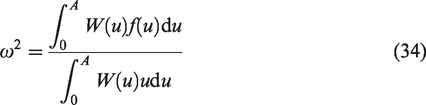
If we choose

The optimal value for
When
When
The García number is defined as a natural number. However, the optimal value of n in equation (35) is n = 25.3255.
Conclusions
This paper gives some simple formulae for fast prediction of frequency of a nonlinear oscillator, and all obtained results given in this paper are valid for the whole solution domain
Footnotes
Declaration of conflicting interests
The author(s) declared no potential conflicts of interest with respect to the research, authorship, and/or publication of this article.
Funding
The author(s) disclosed receipt of the following financial support for the research, authorship, and/or publication of this article: The work is supported by Priority Academic Program Development of Jiangsu Higher Education Institutions (PAPD), National Natural Science Foundation of China under grant No.11372205.