This paper presents a bio-evolutionary metaheuristic approach to study the harmonically oscillating behavior of the Duffing equation. The proposed methodology is an amalgamation of the artificial neural network with the firefly algorithm. A novelty in the activation of neurons of artificial neural network is described using the cosine function with the angular frequency. Chronologically, artificial neural network approximates discretizes the nonlinear functions of the governing problem, which then undergoes an optimization process by the firefly algorithm that then later generates the effective values of the unknown parameters. Generally, the algorithm and implementation of the scheme are assimilated by considering an application of Duffing-harmonic oscillator. Some error measurements, in order to discuss the convergence and accuracy of the scheme, are also visualized through tables and graphs. An effective optimized relationship between the angular frequency and amplitude is derived and its results are depicted in a tabular form. The comparison of the proposed methodology is also deliberated by homotopy perturbation method. Moreover, the geometrical illustration of the trajectories of the dynamic system is also added in the phase plane for different values of amplitude and angular frequency.
Problems of nonlinear vibration in conservative systems, bearing a wide history, have been interpreted to a great extent, in order to study various parametric behaviors of nonlinear vibrations of several mechanical objects.1–3 In this regard, several methods have been established to analyze these problems, analytically as well as numerically.4–6 Particularly, among many well-known oscillatory equations, the Duffing equation is found to be the most widely studied equation for its eminent applications in different fields of science, engineering, and biology. He et al.7 discussed Duffing-harmonic equation and established a relationship of between the frequency and amplitude of the oscillations using the Hamiltonian approach. Considering the same method, He et al. also discussed the approximate frequency–amplitude relationship of the nonlinear oscillators.8 Further, Ren9 restudied and derived the He's frequency–amplitude formulation for nonlinear oscillators from an ancient Chinese mathematical algorithm. Succinctly, the oscillating and chaotic nature of this nonlinear model has augmented a miraculous notion in the literature, as it imitates the dynamics of our natural world.10–16
In essence, the following equation for Duffing-harmonic oscillation is formulated and studied, i.e.
where represents the amplitude of the oscillation. The key objective of the paper is to establish a technique that provides effective solutions for the wide range of . Accordingly, the aim is achieved by using the technique based on artificial neural network (ANN)17–20 and the firefly optimization algorithm.21,22 The accuracy of the algorithm depends on the value of adjustable parameters, i.e. the weights of the ANNs. Therefore, to gain accurate approximations of these parameters, the training of these weights is made by a global optimizer firefly algorithm (FFA). For the governing oscillator (1), a novel activation function for neurons of ANN is ascertained by means of a cosine function with the angular frequency. In addition, the accuracy, convergence, and effectiveness of the established scheme are determined out by the comparison plots of the attained outcomes with the exact solutions together with the values of mean absolute error and root mean square error.
The remaining structure of the paper is defined as follows: the next section delineates the utilization of the proposed methodology on Duffing-harmonic oscillation in detail with the addition of the flowchart of the scheme and an error bound relation. Then, the acquired relations of frequency and amplitude with the efficacious discussion on the behavior of oscillation and weights of the neural network are discussed. The final section covers the concluding remarks and motivational recommendations for the future work.
Methodological configuration
In this section, the implementation of the ANN on Duffing-harmonic oscillation is elaborated as follows.
Intelligent approximation
Any arbitrary continuous function and its derivatives on a compact set can be approximated by taking into account the components of feed forward artificial neural, i.e. multiple inputs, single hidden layer with a linear output layer without bias. The solution of equation (1) can be approximated by the following continuous mapping18
where are real-valued unknown weights of the network, is the number of neurons, is said to be the activation function and is said to be a linear sum defined as, . For the case of nonlinear oscillation,7,8 the trial solution of is accomplished by taking in the activation function . Therefore, the weighted sum of second-order derivative , would become
The estimated model for equation (1) can be formulated by substituting the weighted sums of the networks, equations (2) and (3), in equation (1). It is well known that the angular frequency in the Duffing-harmonic oscillation depends on the amplitude of motion . Taking into account different assumptions for , some techniques have been illustrated that provide accurate results but for small values of . These techniques have illustrated that the error for the angular frequency could be up to 1.60% for the range .10 Apparently, it is difficult to obtain a method, which has the capability to give an accurate result with the error less than 1.60% in a wide range of . Hence, keeping this in mind, a highly effective numerical procedure of optimization is proposed that produces accurate results and produces the least errors.
Fitness function
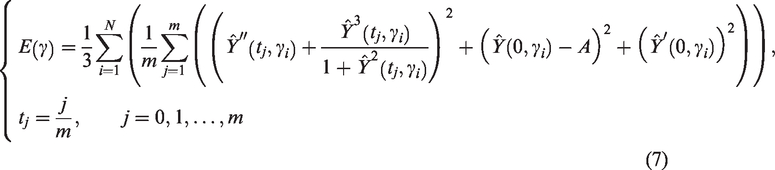
The robustness of any methodology is examined by defining an error function, which is formed by substituting the approximated functions and in equation (1). The objective function for the optimization algorithm is to minimize the mean square error, outlined as follows
where is constructed as
and , are expanded by using the initial conditions of equation (1) as
On discretizing , for equal segments in equation (5), the fitness function of equation (4) takes the following form
As evident, the adjustable parameters used in equations (2) and (3), for which , and come closer to zero, the value of also approaches 0, which then produces approximate solution, that are highly compatible with the exact solution.
FFA
Nowadays, metaheuristic optimization algorithms are playing an important role for being very promising in solving optimization problems.23 Most of these algorithms are structured in such a way that their systematic procedures meticulously work like biological creatures. Here, we consider the FFA, for the optimization purpose of the fitness function and obtain precise solutions of weights of ANN. Being a nature-inspired algorithm, the system of FFA methodically functions like the biotic behavior of the fireflies.21,22 The algorithm is carried out as follows:
Let, represent firefly swarm, where is the number of neurons (weights) to be minimized and are the number of fireflies, where the associated position of firefly is .
The light intensity used by fireflies to attract one another is denoted by , which inversely depends on the distance between the species and air absorption of light.
The error function is considered as the objective function, to convert the governing problem into an optimization problem. On the other hand, it is used to measure the brightness at a particular position.
Fireflies move randomly so the distance varies between firefly and firefly . The strength of attractiveness of a firefly, which is directly proportional to the light intensity of the adjacent firefly, is outlined as
where is the initial attractiveness and is the light absorption coefficient.
Consequently, if the light intensity of a firefly at the position is brighter than that at , then the movement of firefly towards firefly is computed as
where is a randomization factor that controls the magnitude of the stochastic perturbation of , and is random number generator.
When all the fireflies have been modified, the best firefly will perform a controlled random walk across the search space
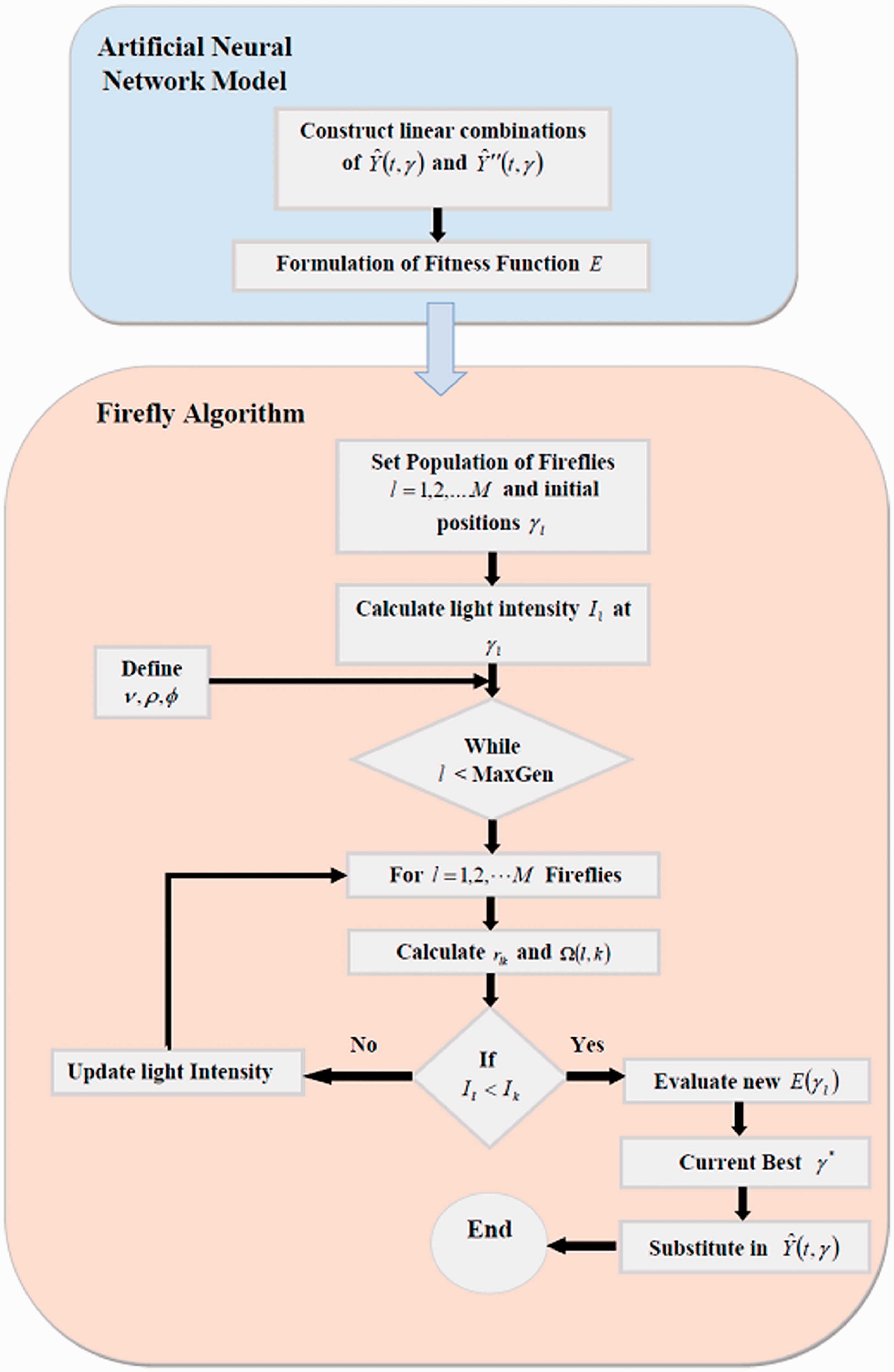
Suppose, is the optimal solution of the optimization problem (8), then by substituting it into equation (2), the approximate solution of equation (1) is achieved efficiently. The flowchart of the proposed algorithm is also demonstrated graphically in Figure 1.
The procedural layout of the proposed scheme.
Error bounds and convergence
In this sequel, an assessment for the accuracy and boundedness of the solutions of is carried out. Since the continuous mapping expansion (2) is contemplated as the approximate solution of equation (1), it must satisfy the following error function, i.e. for
where is the exact solution of the governing problem (1) at different values of . Correspondingly, if with be any positive integer, then the truncation limit is enlarged until , at each point becomes diminutive than the specified value .
Let is a square integrable continuous function in interval , so that the series (2) becomes convergent for . Thus, equation (2) can be expanded as
Since is bounded , we can write
Here, , as , . The association of summation gives
Using multiplicative property, we get
Since is bounded, then , and are also bounded; therefore, there exist numbers , such that , and , . Hence
where it can be perceptibly observed that the error bound is inversely proportional to the number of neurons. Hence, the series expansion (2) converges to the exact solution of equation (1), as number of neurons approaches infinity, i.e. .
Frequency–amplitude relationship
The proposed method can be advantageously used to acquire optimized association between angular frequency and amplitude of Duffing-harmonic oscillation. After substituting the weighted sums, i.e. equations (2) to (3) in equation (1), we get
Therefore, we obtain the following relationship by taking
Homotopy perturbation method
The parameter-expansion methods are widely used in dealing with nonlinear problems. In this section, the implementation of homotopy perturbation method (HPM)16 is shown, which will be exercised for the comparative study of the proposed technique in results discussion. The construction of homotopy equation (1) is carried out as
On expanding the coefficient of the linear term (−1) and the solution into the following forms23
Submitting equations (22) and (23) into equation (21), and processing the perturbation method, we obtain the following linear equations
If the first order approximate is searched, then from equation (21), we have . Thus, from equation (29) the following frequency can be generated
Equation (28) is valid for the case when , because when , there does not exist any periodic solution to equation (1).
Simulation and results
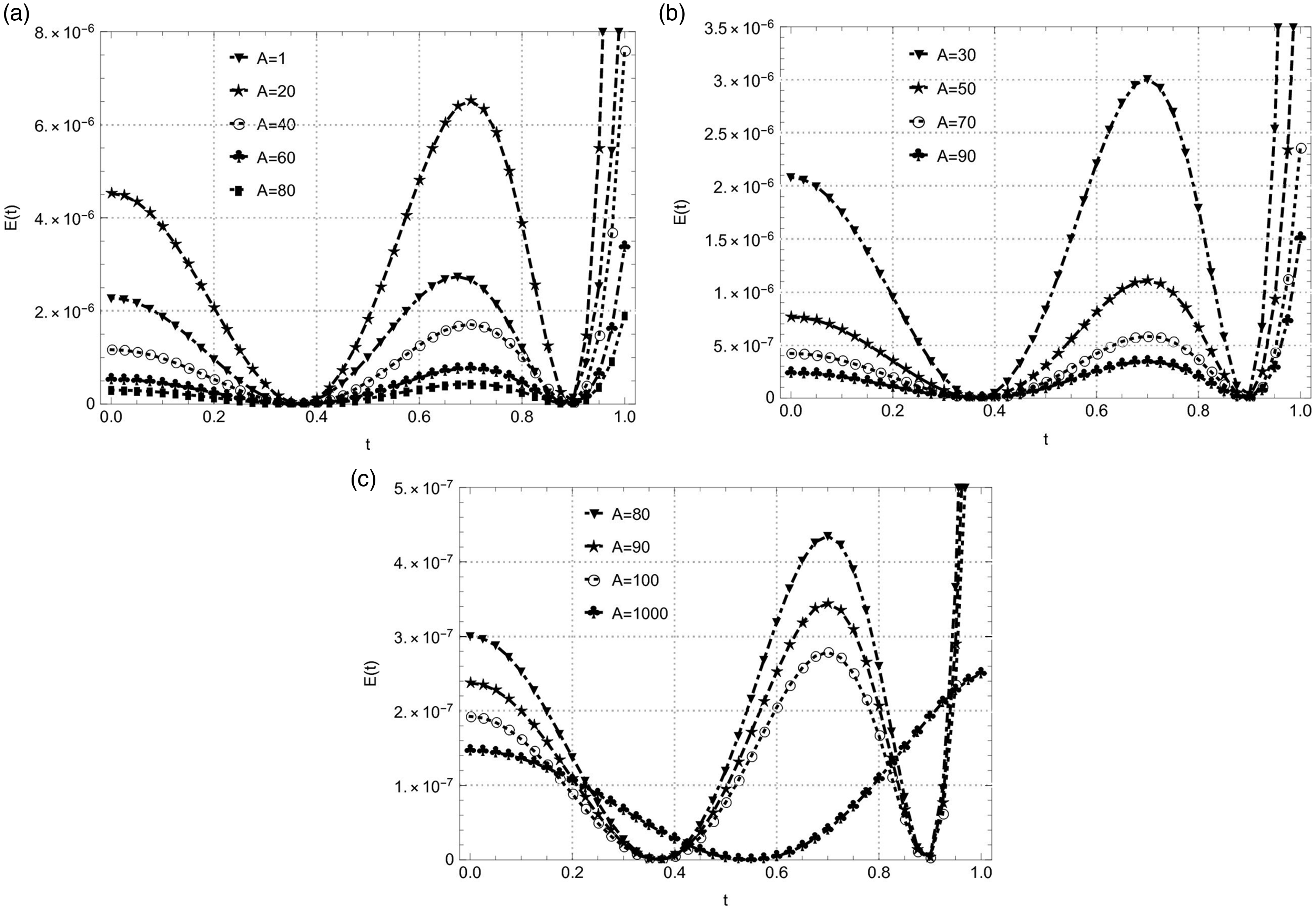
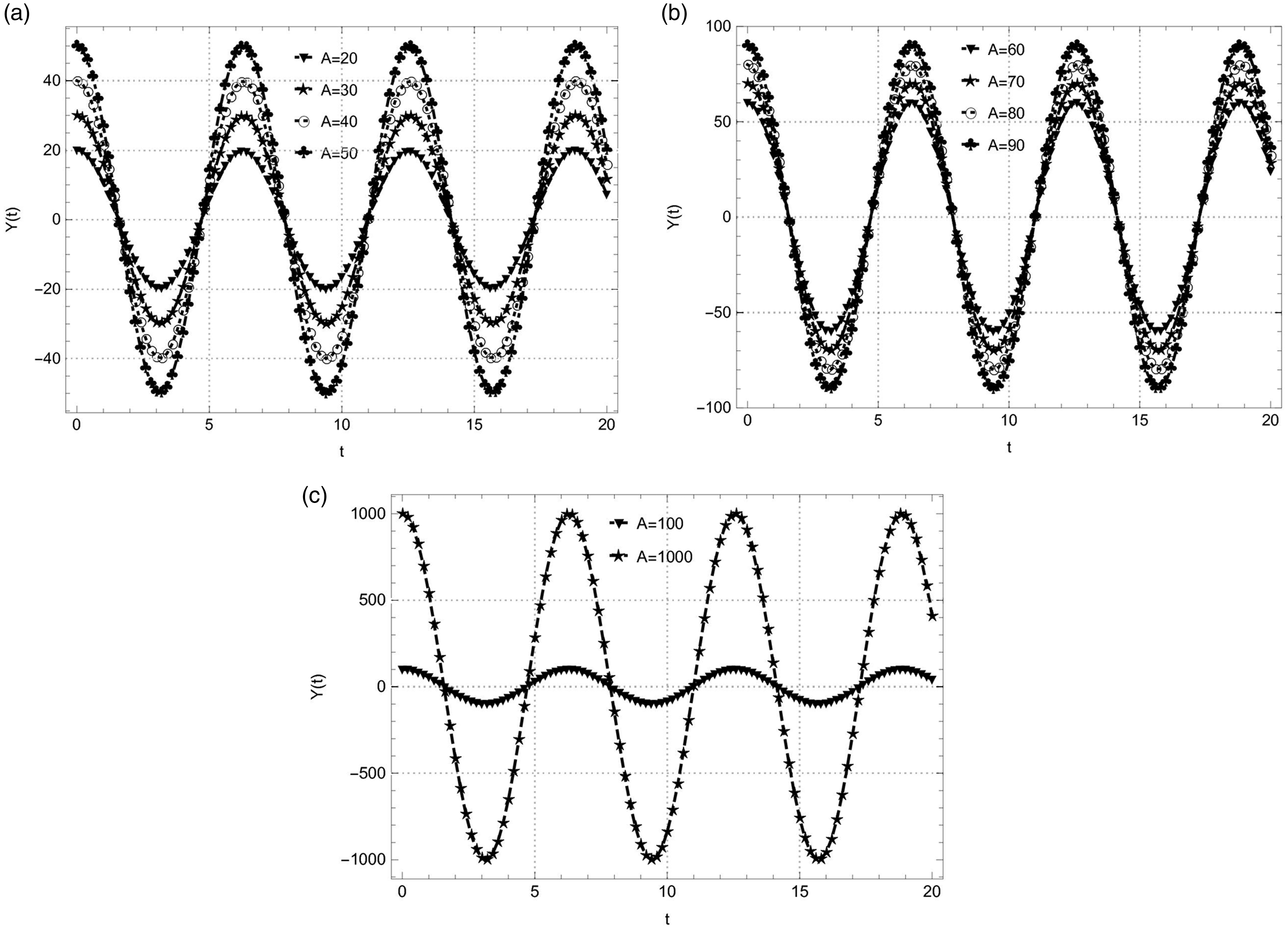
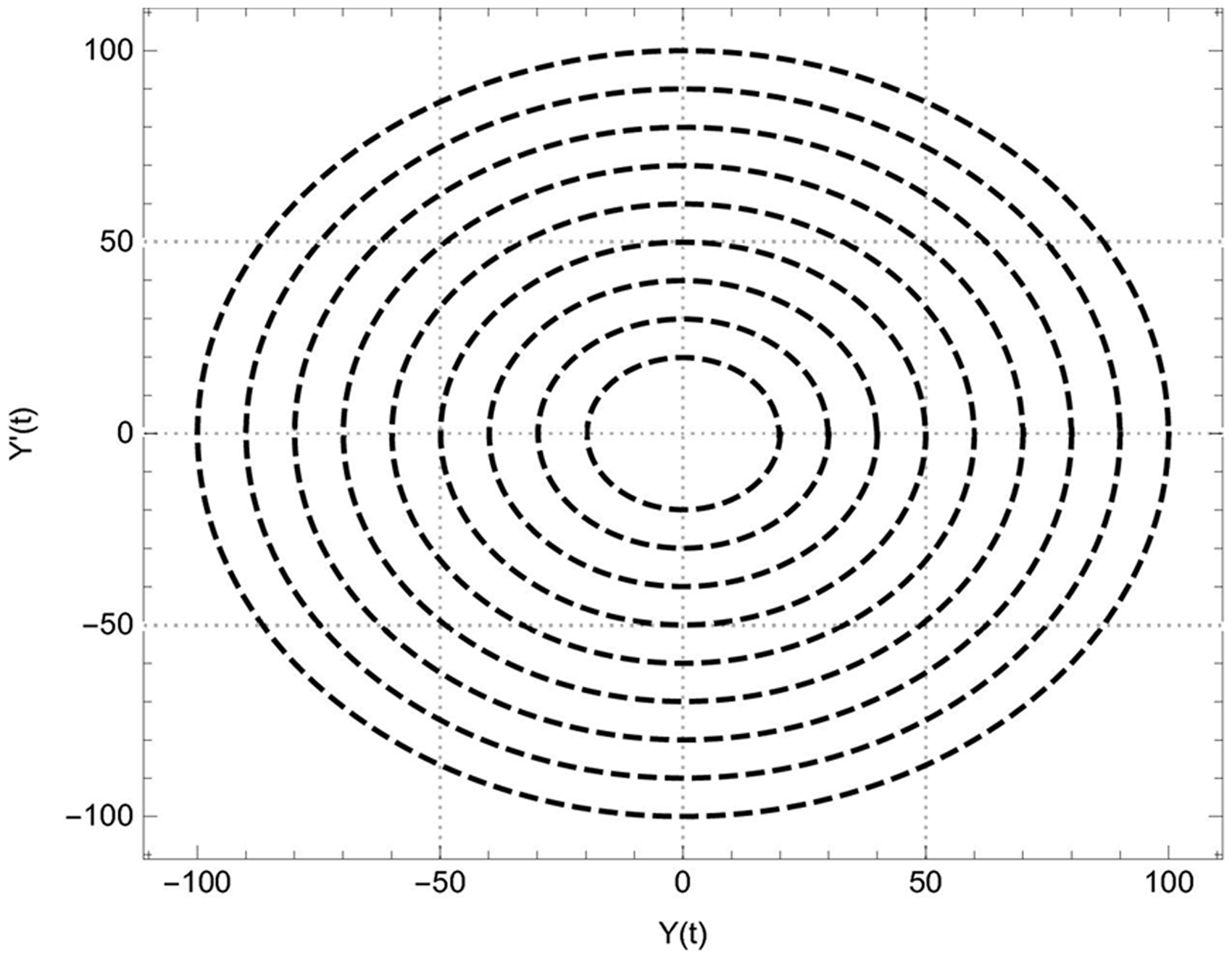
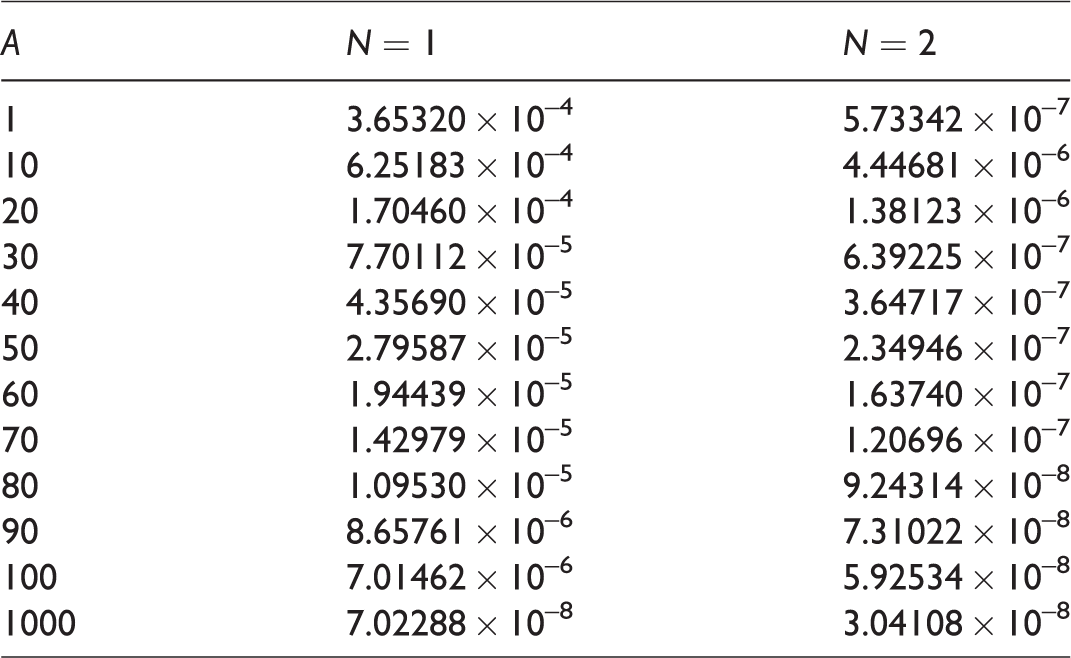
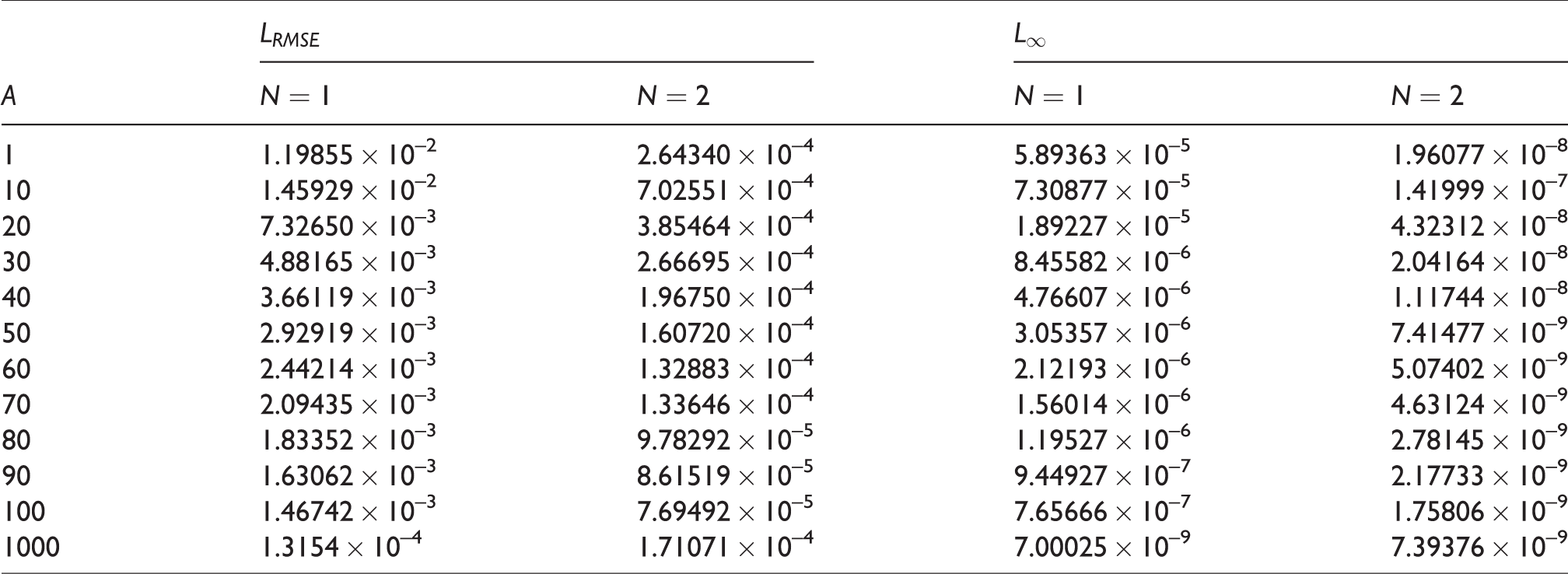
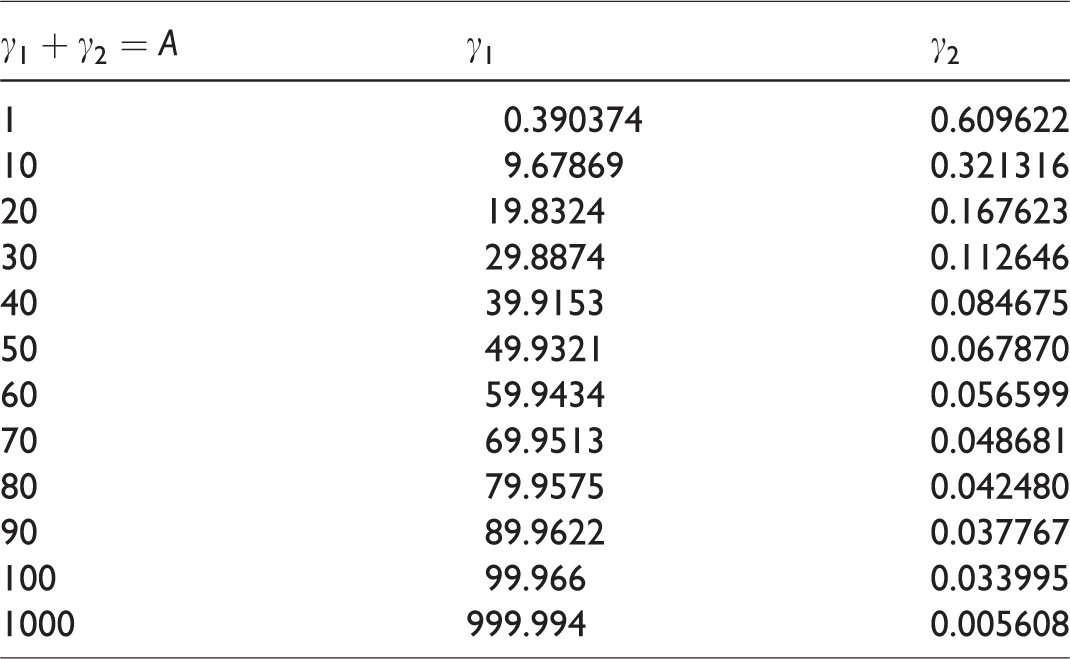
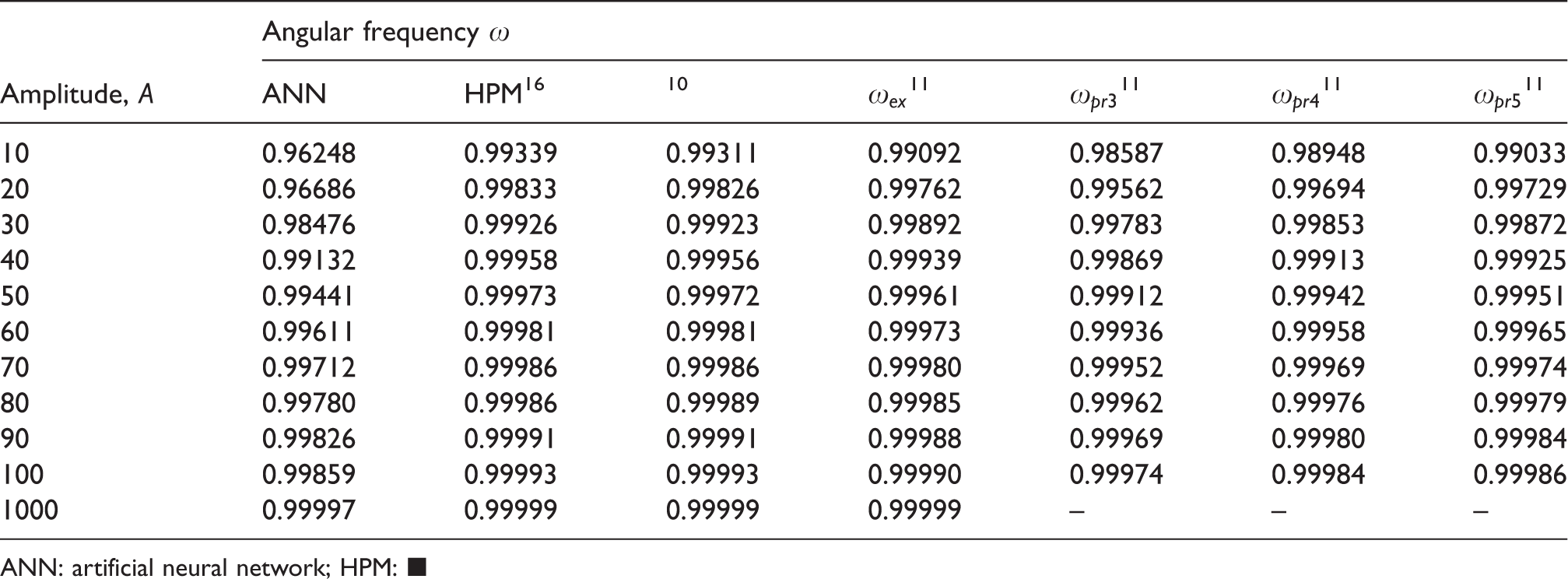
Applying the procedure mentioned in the ‘Methodological configuration’ section, efficient analytical results are attained for . Table 1 shows the minimum values of the error function , defined in equation (4), which elaborates the accuracy of the method for a small number of weights of ANN. The values of are obtained for a large range of amplitude, i.e. , of which few of them are depicted in Table 1. It also justifies the positive effect of on the solution, i.e. for fixed values of neurons , as the value of amplitude increases the lesser the minimum value of is achieved, which on the other hand indicates the higher accuracy of the approximated solution . Furthermore, Table 2 illustrates some other measurements of error functions, namely, root mean square error and mean absolute error . These functions also define a gradual decrease in values as the value of amplitude increases. The optimized weight of ANN and comparative results of relation between and are described in Tables 3 and 4, respectively, where the oscillating values of angular frequency can be seen clearly at the different values of . In this table, the optimized values of are mapped out using equation (13) the sum of two optimized weights and , which in turn generates optimized values of . Moreover, Figure 2(a) to (c) is the pictorial representation of the error function for different values of , with respect to , whereas Figure 3(a) to (c) describes several harmonically oscillating motions of the solutions for various values of and . The dynamical behavior of the nonlinear Duffing oscillator is accomplished by plotting a phase portrait trajectories of the solution for , which is shown in Figure 4.
(a) to (c). Curvy shapes of fitness function attained from the proposed method for different values of , and .
(a) to (c). Oscillatory solutions of attained from the proposed method for different values of , and .
Phase plane trajectory of Duffing-harmonic oscillator for and .
Minimum values of fitness function for different calculated values of , and .
1
3.65320 × 10⁻⁴
5.73342 × 10⁻⁷
10
6.25183 × 10⁻⁴
4.44681 × 10⁻⁶
20
1.70460 × 10⁻⁴
1.38123 × 10⁻⁶
30
7.70112 × 10⁻⁵
6.39225 × 10⁻⁷
40
4.35690 × 10⁻⁵
3.64717 × 10⁻⁷
50
2.79587 × 10⁻⁵
2.34946 × 10⁻⁷
60
1.94439 × 10⁻⁵
1.63740 × 10⁻⁷
70
1.42979 × 10⁻⁵
1.20696 × 10⁻⁷
80
1.09530 × 10⁻⁵
9.24314 × 10⁻⁸
90
8.65761 × 10⁻⁶
7.31022 × 10⁻⁸
100
7.01462 × 10⁻⁶
5.92534 × 10⁻⁸
1000
7.02288 × 10⁻⁸
3.04108 × 10⁻⁸
Computed values of root mean square and mean absolute error of error function for different calculated values of , and .
1
1.19855 × 10⁻²
2.64340 × 10⁻⁴
5.89363 × 10⁻⁵
1.96077 × 10⁻⁸
10
1.45929 × 10⁻²
7.02551 × 10⁻⁴
7.30877 × 10⁻⁵
1.41999 × 10⁻⁷
20
7.32650 × 10⁻³
3.85464 × 10⁻⁴
1.89227 × 10⁻⁵
4.32312 × 10⁻⁸
30
4.88165 × 10⁻³
2.66695 × 10⁻⁴
8.45582 × 10⁻⁶
2.04164 × 10⁻⁸
40
3.66119 × 10⁻³
1.96750 × 10⁻⁴
4.76607 × 10⁻⁶
1.11744 × 10⁻⁸
50
2.92919 × 10⁻³
1.60720 × 10⁻⁴
3.05357 × 10⁻⁶
7.41477 × 10⁻⁹
60
2.44214 × 10⁻³
1.32883 × 10⁻⁴
2.12193 × 10⁻⁶
5.07402 × 10⁻⁹
70
2.09435 × 10⁻³
1.33646 × 10⁻⁴
1.56014 × 10⁻⁶
4.63124 × 10⁻⁹
80
1.83352 × 10⁻³
9.78292 × 10⁻⁵
1.19527 × 10⁻⁶
2.78145 × 10⁻⁹
90
1.63062 × 10⁻³
8.61519 × 10⁻⁵
9.44927 × 10⁻⁷
2.17733 × 10⁻⁹
100
1.46742 × 10⁻³
7.69492 × 10⁻⁵
7.65666 × 10⁻⁷
1.75806 × 10⁻⁹
1000
1.3154 × 10⁻⁴
1.71071 × 10⁻⁴
7.00025 × 10⁻⁹
7.39376 × 10⁻⁹
Optimized values of weights of ANN .
1
0.390374
0.609622
10
9.67869
0.321316
20
19.8324
0.167623
30
29.8874
0.112646
40
39.9153
0.084675
50
49.9321
0.067870
60
59.9434
0.056599
70
69.9513
0.048681
80
79.9575
0.042480
90
89.9622
0.037767
100
99.966
0.033995
1000
999.994
0.005608
Comparison results for ANN, HPM and other methods, for the amplitude and angular frequency , of the Duffing-harmonic oscillation for .
Angular frequency
Amplitude,
ANN
HPM16
10
11
11
11
11
10
0.96248
0.99339
0.99311
0.99092
0.98587
0.98948
0.99033
20
0.96686
0.99833
0.99826
0.99762
0.99562
0.99694
0.99729
30
0.98476
0.99926
0.99923
0.99892
0.99783
0.99853
0.99872
40
0.99132
0.99958
0.99956
0.99939
0.99869
0.99913
0.99925
50
0.99441
0.99973
0.99972
0.99961
0.99912
0.99942
0.99951
60
0.99611
0.99981
0.99981
0.99973
0.99936
0.99958
0.99965
70
0.99712
0.99986
0.99986
0.99980
0.99952
0.99969
0.99974
80
0.99780
0.99986
0.99989
0.99985
0.99962
0.99976
0.99979
90
0.99826
0.99991
0.99991
0.99988
0.99969
0.99980
0.99984
100
0.99859
0.99993
0.99993
0.99990
0.99974
0.99984
0.99986
1000
0.99997
0.99999
0.99999
0.99999
–
–
–
ANN: artificial neural network; HPM: ▪
Conclusion and future recommendation
In this endeavor, we studied a systematic approach using ANN together with the FFA for Duffing-harmonic oscillator. Consequently, the following outcomes are achieved from the whole study:
Achievement of the main objective of this attempt, i.e. procured accurate solutions of Duffing harmonic-oscillator for wide range of amplitudes, with error less than .
Successful implementation of ANN demonstrates the applicability of ANN on nonlinear dynamical equations to get oscillatory solutions for a small number of neurons.
The activation of artificial neurons of ANN is performed by taking cosine function comprising the angular frequency of the oscillation that has not been considered in the literature yet.
Optimization of the system, to attain the values of unknown weights of ANN, which is magnificently carried out by FFA, elaborates a new application of recently constructed bionic algorithms.
Amalgamation of both efficient methods comes up with a remarkably proficient scheme for all intents and purposes of mathematical models in different fields of science and engineering.
Analytical solutions are beneficial to study any model in multiple ways, i.e. compactly, graphically or in a tabular form. Here, the proposed methodology provides not only an analytically optimized solution but also an optimized association of angular frequency and amplitude .
In future, some more bio-inspired optimizing algorithms will be considered to solve and study different characteristics of differential equations occurring in vast areas of science, engineering, and biology. These algorithms merged with other existing methods enable the solution of every type of differential models including, but not limited to nonlinear, delay, and partial differential models. Henceforth, these schemes will be used to solve nonlinear differential equations of dynamical systems.
Footnotes
Acknowledgements
All the authors are grateful for the comments of the referees.
Declaration of conflicting interests
The author(s) declared no potential conflicts of interest with respect to the research, authorship, and/or publication of this article.
Funding
The author(s) received no financial support for the research, authorship, and/or publication of this article.
References
1.
KhnaijarABenamarR.A discrete model for nonlinear vibration of beams resting on various types of elastic foundations. Adv Acoust Vibr2017;
2017: Article ID 4740851.
2.
SaettaERegaG.Modeling, dimension reduction and nonlinear vibrations of thermo mechanically coupled laminated plates. Proc Eng2016; 144: 875–882.
3.
Amabili M. Reduced-order models for nonlinear vibrations, based on natural modes: the case of the circular cylindrical shell. Philos Trans R Soc A: Mathematical, Physical and Engineering Sciences 2013; 371. DOI: 10.1098/rsta.2012.0474.
4.
WuQChenELuY, et al. Modified Runge-Kutta method for solving nonlinear vibration of axially travelling string system. In: The 21st international congress on sound and vibration, Beijing, China, 13–17 July 2014, vol. 5, pp. 3896–3901.
5.
HasratiEAnsariRTorabiJ.A novel numerical solution strategy for solving nonlinear free and forced vibration problems of cylindrical shells. Appl Math Model2018;
53: 653–672.
6.
HoffmannRLiebichR.Characterization calculation of nonlinear vibrations in gas foil bearing systems: an experimental and numerical investigation. J Sound Vibr2018;
412: 389–409.
7.
HeJHZhongTTangL.Hamiltonian approach to Duffing-harmonic equation. Int J Nonlinear Sci Numer Simul2010;
11: 43–46.
8.
HeJH.Hamiltonian approach to nonlinear oscillators. Phys Lett A2010;
374: 2312–2314.
9.
RenZY.Theoretical basis of He's frequency-amplitude formulation for nonlinear oscillators. Nonlinear Sci Lett A2018;
9: 86–90.
10.
MickensRE.Mathematical and numerical study of the Duffing harmonic oscillator. J Sound Vibr2001;
244: 563–567.
11.
ChenYZ.Multiple-parameters technique for higher accurate numerical solution of Duffing-harmonic oscillation. Acta Mech2011;
218: 217–224.
12.
Syam MI, Raja MAZ, Syam MM, et al. An accurate method for solving the undamped duffing. Int J ApplComput Math 2018; 4: 69.
13.
DuanJS.The periodic solution of fractional oscillation equation with periodic input. Adv Math Phys2013; Article ID 869484.
KhanNARiazFKhanNA.Parameters approach applied on nonlinear oscillators. Shock Vibr2014; Article ID 624147.
16.
WuYHeJH.Homotopy perturbation method for nonlinear oscillators with coordinate dependent mass. Results Phys2018;
10: 270–271.
17.
PakdamanMAhmadianAEffatiS, et al.
Solving differential equations of fractional order using an optimization technique based on training artificial neural network. Appl Math Comput2017;
293: 81–95.
18.
MalekABedokhtiRS.Numerical solution for high order differential equations using a hybrid neural network-optimization method. Appl Math Comput2006;
183: 260–271.
19.
Munir A, Manzar MA, Khan NA, et al. Intelligent computing approach to analyze the dynamics of wirecoating withOldroyd 8-constant fluid. Neural Comput Appl 2017. DOI: 10.1007/s00521-017-3107-4
20.
MallSChakravertyS.Comparison of artificial neural network architecture in solving ordinary differential equations. Adv Artif Neural Syst2013;
2013: Article ID 181895.
YangXS.Firefly algorithm, stochastic test functions and design optimization. IJBIC2010;
2: 78–84.
23.
KhanNARazzaqOAHameedT, et al.
Numerical scheme for global optimization of fractional optimal control problem with boundary conditions. Int J Innov Comput Inform Control2017;
13: 1669–1679.