




Abstract
The enhanced perturbation method is used to improve a governing equation to a higher order, followed by the classic perturbation method. This paper adopts the basic idea of the method to construct a homotopy equation with a higher order. The results show that this modification of the homotopy perturbation method leads to a very high accuracy of the obtained solution. Its solution process is elucidated by using Duffing oscillator as an example, and the obtained frequency is valid for all amplitudes from an extremely small value to infinity with a maximal error of 3.34%. The main merit of this higher order homotopy perturbation method is that the obtained frequency is valid for the whole solution domain.
Introduction
Homotopy perturbation method is a coupled method of the classical perturbation method and the homotopy technology, and it can be widely used to solve various non-linear problems.1–14 The development of the perturbation method can boost the homotopy perturbation method. The multiple scales in the perturbation method were adopted by El-Dib, and the multiple scales homotopy perturbation method can effectively solve various forced non-linear vibrations.
15
Recently, Filobello-Nino et al. proposed a modification of perturbation method, called the enhanced perturbation method.
16
This modification overcomes all shortcomings of the perturbation method. To give a brief introduction to the enhanced perturbation method, we consider the following Duffing equation

Equation (1) can be written in the form

According to the enhanced perturbation method,
16
we can apply the so-called annihilator operator

The enhanced perturbation method can solve wide classes of non-linear problems, where the classic perturbation method fails. 16
A modified homotopy perturbation method in view of the enhanced perturbation method
The enhanced perturbation method is extremely effective for forced oscillators.
16
In this paper, we consider the Duffing equation without a forced term



To illustrate the basic idea to couple the enhanced perturbation method in the solution process of the homotopy perturbation method, a linear oscillator is considered as follows

The enhanced perturbation method
16
leads to the following higher order differential equation

Replacing

We give a similar way to improve the order of equation (4). Differentiating equation (4) with respect to time twice, we have


Replacing


A simple homotopy equation can be established

The solution is expanded into a series of p

Using the parameter expansion technology,6,17 and the coefficient of the linear term, 1, is also expanded into a series of p

Substituting equations (15) and (16) into equation (14), expanding the resultant equation and collecting the same powers of p, proceeding the same way as the perturbation method, we have


By the initial conditions, equations (5) and (6), we can solve

Substituting

By a simple manipulation, equation (20) can be re-written in the form
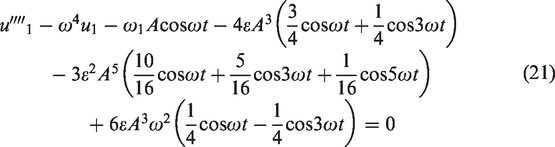

The solution of u1 should avoid

If we search for only the first-order approximate solution, setting p = 1 in equation (16), we have

Solving
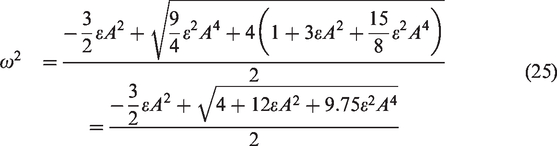
In order to verify the accuracy of our result, we consider two extreme cases: (1) When

This is exactly same as that obtained by the classic homotopy perturbation method6,11 (2) when



That means our result is valid for all
Conclusions
The enhanced perturbation method has many fascinating properties; it can easily deal with non-linear differential equations by improving the order of the original differential equation.
16
This paper shows the basic idea of the enhanced perturbation method can be adopted in the homotopy perturbation method, making the solution process much more reliable and accurate. We recommend this modification of the homotopy perturbation method as the higher order homotopy perturbation method, and the results are valid for all
Footnotes
Declaration of conflicting interests
The author(s) declared no potential conflicts of interest with respect to the research, authorship, and/or publication of this article.
Funding
The author(s) received no financial support for the research, authorship, and/or publication of this article.