




Abstract
Keywords
Introduction
Despite intense international and local efforts to combat the pandemic, the human immunodeficiency virus (HIV) and the acquired immune deficiency syndrome (AIDS) continue to be major global health tragedies. Even within nations, HIV infections vary by region.1,2 In the fight to contain the HIV pandemic, these variations in HIV prevalence have significant ramifications. At the end of 2021, 38.4 million people worldwide were infected with HIV. Worldwide, an estimated 0.7% of adults between the ages of 15 and 49 are infected with HIV, though the extent of the epidemic continues to vary significantly from country to country. 3 Nearly one in every 25 adults (3.4%) in the WHO African Region are infected with HIV, accounting for more than two-thirds of HIV-positive individuals worldwide. 3
Monitoring and evaluation (M&E) is seen as critical for measuring success of any project. To this end, designing and implementing an effective national M&E system is essential to Ghana’s HIV and AIDS response. Monitoring and evaluation is a system that collects, analyses data and produces information that enable local, regional, national and international stakeholders to measure progress and impact of programs. 4 Monitoring and evaluation capacity building is believed to contribute directly to improving performance and is known to play an important role in sustaining and improving programs over time.
Towards enhancing the HIV and AIDS M&E structure at the community level, the Ghana AIDS Commission (GAC) undertook an in-depth assessment and gap analysis. The analysis revealed gaps in human capacity with regards to: M&E knowledge and skills, data management and analysis, indicator definitions, reporting guidelines and local information use. 5
A key strategy in Ghana’s M&E Plan is the institutionalization and sustainability of M&E capacity strengthening. In consultation with the United States, President’s Emergency Plan for AIDS Relief (PEPFAR) through the Centers for Disease Control and Prevention (CDC), Ghana’s HIV and AIDS M&E (GHAME) project was initiated in collaboration with Morehouse School of Medicine (MSM) and the School of Public Health, University of Ghana (SPH). This grant award provided a 5-year, culturally competent, M&E training program across all 10 regions of Ghana in partnership with the Ghana AIDS Commission. This collaboration: (1) assessed current M&E needs in Ghana, (2) developed an M&E training curriculum specific to Ghana, (3) offered 10-day M&E workshops to government employees and NGO’s representatives responsible for M&E at the sub-district, district, regional, and national levels.
The GHAME intervention has improved the M&E capacity of M&E officers and focal persons of selected implementing partners in Ghana. 6 However, high attrition of M&E persons trained coupled with the high number of people yet to be trained makes this venture very expensive and difficult to sustain without continuous and adequate funding. According to the Ghana AIDS Commission, this single course is insufficient to meet the varied needs at various levels of the national M&E structure due to both its content and location. 7
Review of GHAME training reports shows most participants describing the 2-weeks training as too short. Given that all participants were M&E officers of their respective institutions, a longer training period would mean they would be out of the office for a longer period. This would be a difficult option for most institutions that are already battling with inadequate staff. However, with the advancement and widespread application of information and communication technology (ICT), online learning and capacity building platforms have evolved to augment traditional face-to-face teaching methods. The combination of pressure of work, insufficient funding and limited HIV and AIDS M&E knowledge and skills is the driving force to consider the use of online training. It is believed that online learning platform for HIV and AIDS M&E would be more cost-effective and a more sustainable means of capacity building. Jay Cross, (2004) was the first to have introduced what is known as e-learning or web-based education in 1998. 8 Some researchers define e-learning and online learning as using web-based technologies to deliver content to improve knowledge and skills. 9 According to Rosenberg (2001), e-learning involves the use of internet platforms to carryout knowledge enhancing activities. 10 Other studies have included mobile and wireless applications as means of providing online learning teachings. 11
Currently, there is lack of a web-based capacity training programme in the area of HIV and AIDS M&E in Ghana. The introduction of an e-learning platform would help build capacity of these HIV and AIDS M&E officers and focal persons of institutions implementing HIV and AIDS programs in Ghana. This formative study, therefore, sought to investigate whether M&E officers and focal persons of institutions implementing HIV and AIDS projects in Ghana will be willing to take part in a web-based learning platform as means of building their HIV and AIDS M&E capacity. It will also investigate factors that will influence their participation in such a platform.
Research model and hypotheses development
The conceptual model is rooted in the original TAM
12
which relates to the construct perceived usefulness (PU), perceived ease of use (PEOU) and behavioural intention (BI). The original TAM was tested together with some additional factors such as Experience with Online Learning (OLC), Internet usage (IU) and Importance to success (ITS) on attitude toward usage (ATU) and Acceptability/intention to use (AITU) of online learning platform of M&E officers and focal persons. The basic TAM is supported with four antecedents. The first two; Experience with Online Learning (OLC) and Internet usage (IU) precede Perceived usefulness (PU) and the final two; Internet discussion (ID) and Importance to success (ITS) precede Perceived ease of use (PEOU).
12
The proposed conceptual framework/model including eight (8) hypotheses is shown in Figure 1, and the basis of this model has been provided based on literature. Proposed conceptual path model.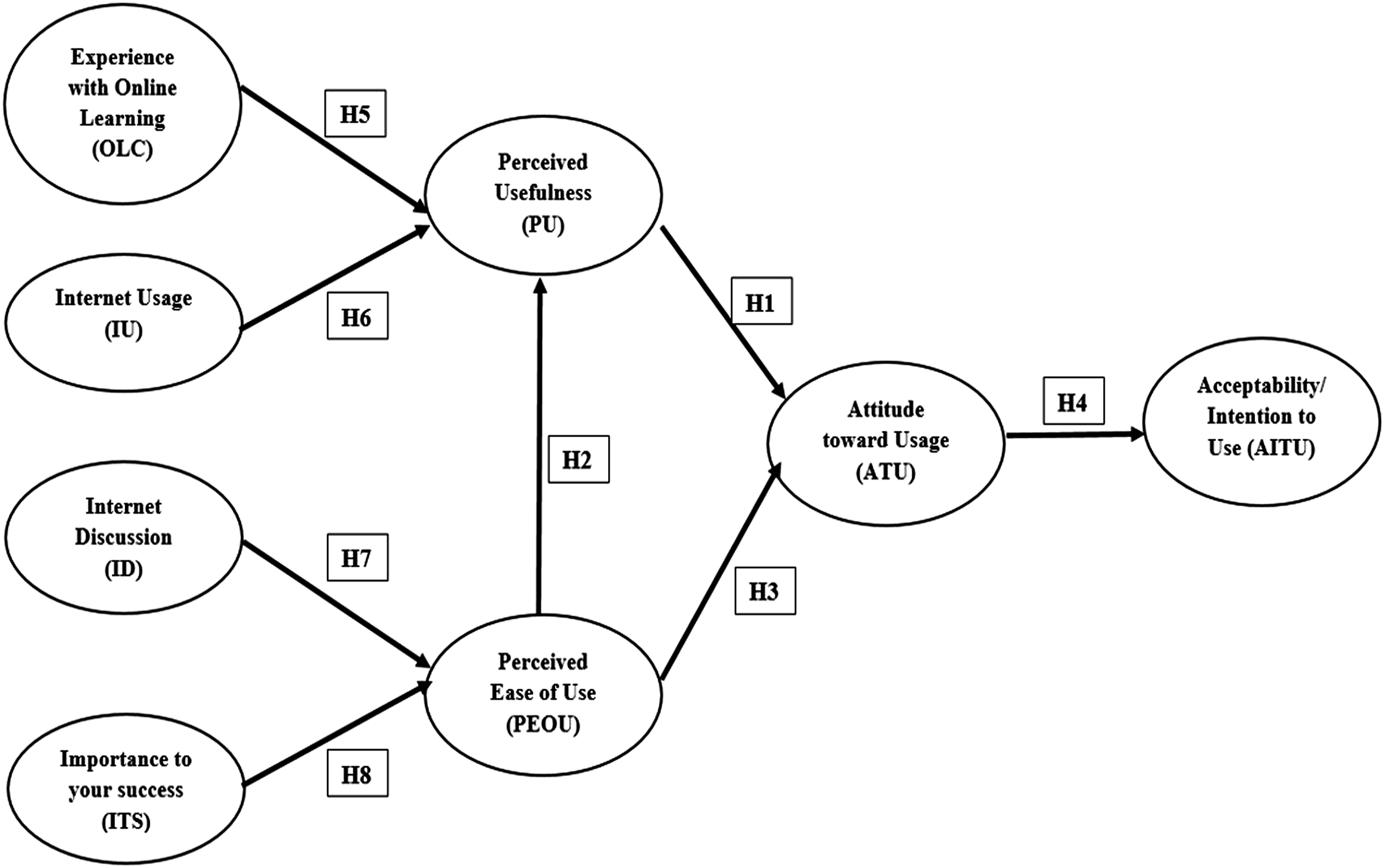
Perceived ease of use and Perceived usefulness
Perceived ease of use is one’s understanding of system to be easy and uncomplicated.
13
Davis et al., (1989) also explained that PU is one’s perceived usage of a particular system to be favourable in helping him or her to executive job.
13
Some studies done in the past reported some level of inconsistencies in the outcome of PEOU and PU with respect to intention to use of a particular system. They indicated that the relationship was statistically significant14-18 and were in study context, the techniques and the size of the sample used. Based on this, Mouakket and Bettayeb (2015) emphasized that intension to use was positive and significantly influenced by PU.
19
Another study conducted by Chang and Tung (2008) concluded that PEOU was a strong and positive factor of intension to adopt a particular system.
20
This was also supported by Peng et al., (2009).
21
In addition, another study confirmed the findings of earlier studies that intension to use is directly and significantly influenced by PEOU.
22
In the study of factors affecting a web-based systems, researchers postulated that PU is a strong influencer of behavioural intension to use a system ,15,18 but Chang and Tung (2008) indicated no significant effect of PU on intension to use web-based learning system.
20
However, Tarhini et al., (2016) said that PU and PEOU are major factors influencing intension to use in an e-learning environment.
23
Upon these reviews our study formulated these hypotheses below:
Acceptability/intention to use and attitude toward usage
The original TAM (specifically, PEOU and PU) has been well implemented and developed a relationship with the acceptance of technology, and however boost the attitude towards usage of persons (Davis, 1989). Several studies have been carried out to support this relationship.13,18,24-28 In addition, the influence of behavioural intension to use on attitude towards usage has been widely studied within web-based learning context.12,18,20,22,29-32 Furthermore, behavioural intension to use have a positive significant influence on attitude towards usage of a technology in theory of planned behaviour (TPB), TAM and decomposed theory of planned behaviour (DTPB) model. According to Taylor and Todd (1995b), previous experience of an individual in using a technology will increase his or her motivation and thereby increasing attitude towards usage.
26
In order to be consistent with earlier studies, our study has also tested the influence of behavioural intension to use on attitude towards usage to ensure consistency. It has also been observed by Tarhini et al., (2016) that the association between behavioural intension to use and attitude towards usage for e-learning cannot be overlooked.
23
We have therefore hypothesised that;
Online learning experience, Internet usage and discussion and Importance to success
According to Ali et al., (2015a), internet usage and one’s experience have a positive relationship with individual’s technology acceptance.
24
Previous studies have included internet experience as an important factor to technology acceptance.24,27,33-38 According to Hackbarth et al., (2003), an individual’s perception grows as their internet experience increases.
39
In a study conducted by Liao and Cheung (2001), internet experience was found to have a significant effect on individual’s technology acceptance, which is very important in determining attitude towards usage.
40
Similar research conducted by Anandarajan et al., (2000) equally underscored the relevance of internet experience in studies done using TAM.
41
Due to limited online learning studies focusing on internet experience, our study adopted this indicator because of its relevance within the TAM concept as pointed out in earlier studies. This study therefore hypothesised the following;
Methods
Data source
The data collection tool was built on the TAM model and was administered to the selected M&E officers and focal persons to examine perceived usefulness, ease of use, barriers and acceptability of a web-based learning platform for HIV and AIDS M&E. The study also collected data on respondent’s level of M&E and ICT knowledge, skills and experience. Data collection was done between November 2016 and January 2017.
Participant selection
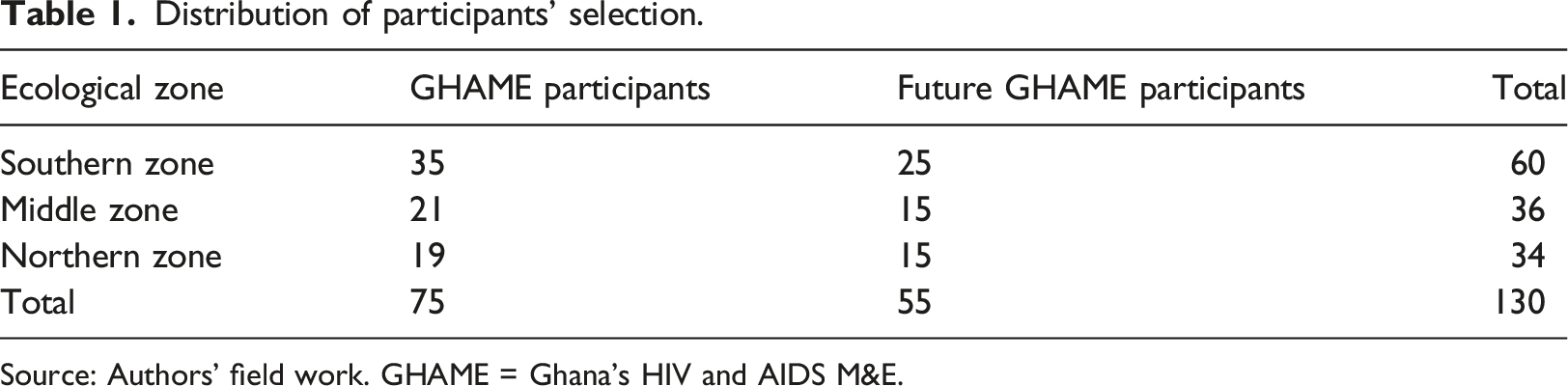
Distribution of participants’ selection.
Source: Authors’ field work. GHAME = Ghana’s HIV and AIDS M&E.
Data collection tools
The main constructs of data collection tool was based on the technology acceptance model (TAM) as shown in the conceptual path model (Figure 1). The constructs were measured using series of continuous or Likert scale concepts. 13 The data collection tool was based on previous studies with some revisions to conform to the research objective by adapting the TAM scales.13,42,43 The TAM model constructs used 44 items that accessed “internet usage” (7 items), “experience with online learning” (4 items), “perceived usefulness” (10 items), “perceived ease of use” (5 items), “attitude towards usage” (6 items), “internet discussion” (3 items), “importance to your success” (5 items) and “acceptability/intention to use” (4 items). The measurement scale for all responses was built on five-point Likert scale starting from 1 (“strongly disagree”) to 5 (“strongly agree”)44,45; 1 being the least and 5 being the highest. The questionnaire was developed in English and was administered in English.
Inclusion and exclusion criteria
GHAME participants (past and present) at local government Agencies, Health Facilities and Non-Governmental Organisations were recruited for the study.
Analysis
Data entry and cleaning for the quantitative data was done using Microsoft Access 2010 while STATA Version 15 was used for the analysis. Thorough observation of study participants was done to have complete understanding of the data set. Test for normality of data was carried out using Shapiro-Wilk and Bartlett test to determine the symmetry of all continuous data. Continuous and categorical variables were analysed using means and percentages. We also reported means and their standard deviations as well. The reliability of the variables in the dataset were assessed by examining Cronbach’s alpha coefficient. Goodness of fit Indices for Scale Validity Tests was conducted using chi-square statistic (Additional file 2). The chi-square test of statistic is a natural index used to measure the goodness-of-fit between data and the model. 46 Test of associations to determine the most striking factors that affects acceptance and other various categorical variables of interest were conducted using the Likelihood Ratio test. Principal component analysis with a varimax rotation method was employed to classify the principal predictors of acceptability/intention to use M&E online platform for M&E capacity building (Additional file 1). A statistical reliability test (Additional file 1) was also done to evaluate the internal consistency of the survey items using Cronbach’s alpha reliability coefficients. 44 A model fit indices test using goodness of fit was also determined to know whether the model has the capacity to predict how accurate the model fits the set of observations. 44 Structural Equation Modelling technique was employed to assess the model and construct validity was also examined by scrutinising the results of the model. STATA version 15 was used to calculate the path coefficients and test the model hypothesis. A p-value of less than 0.05 was used as basis for considering a statistically significant model.
Results
Background information, M&E and IT experience of participants
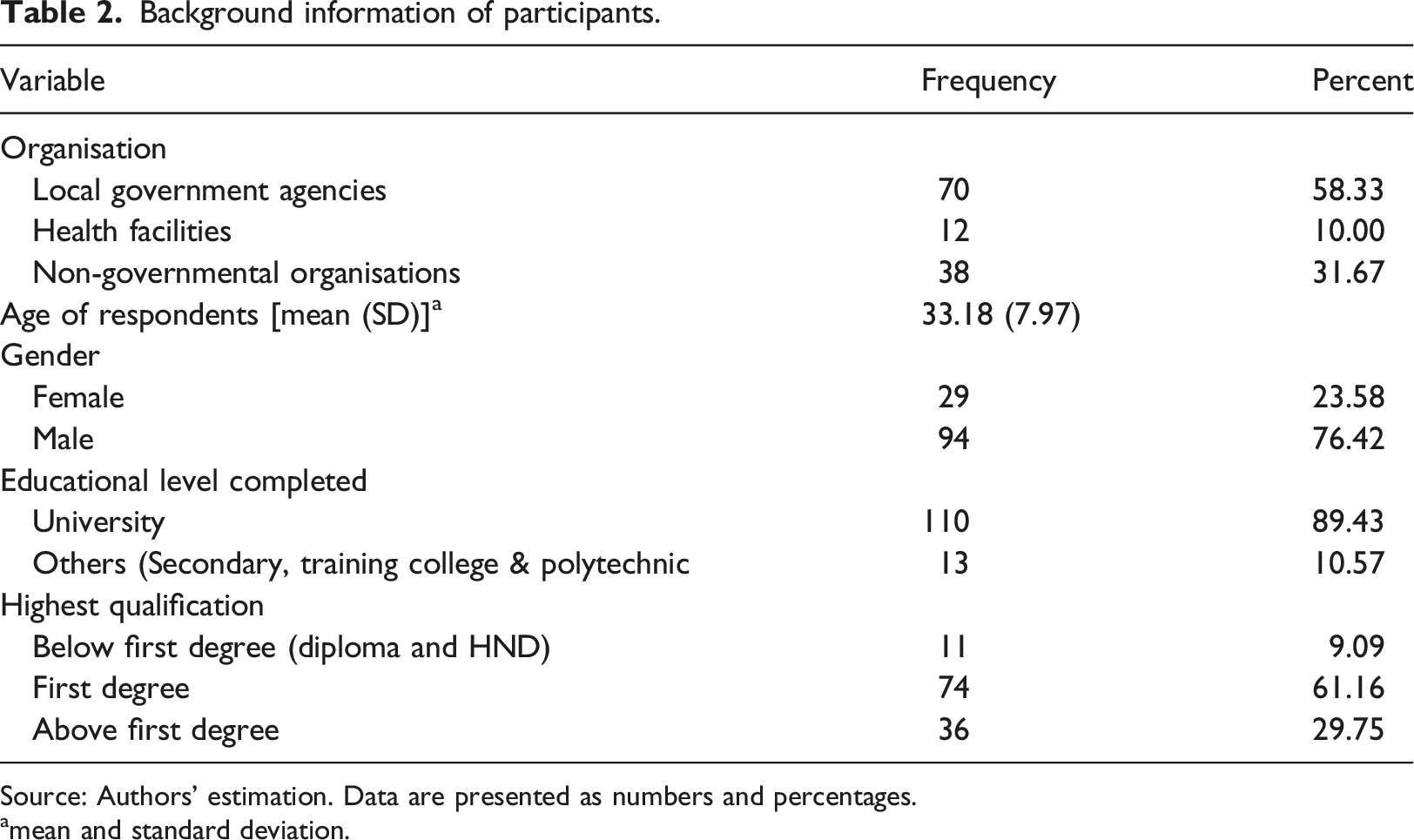
Background information of participants.
Source: Authors’ estimation. Data are presented as numbers and percentages.
amean and standard deviation.
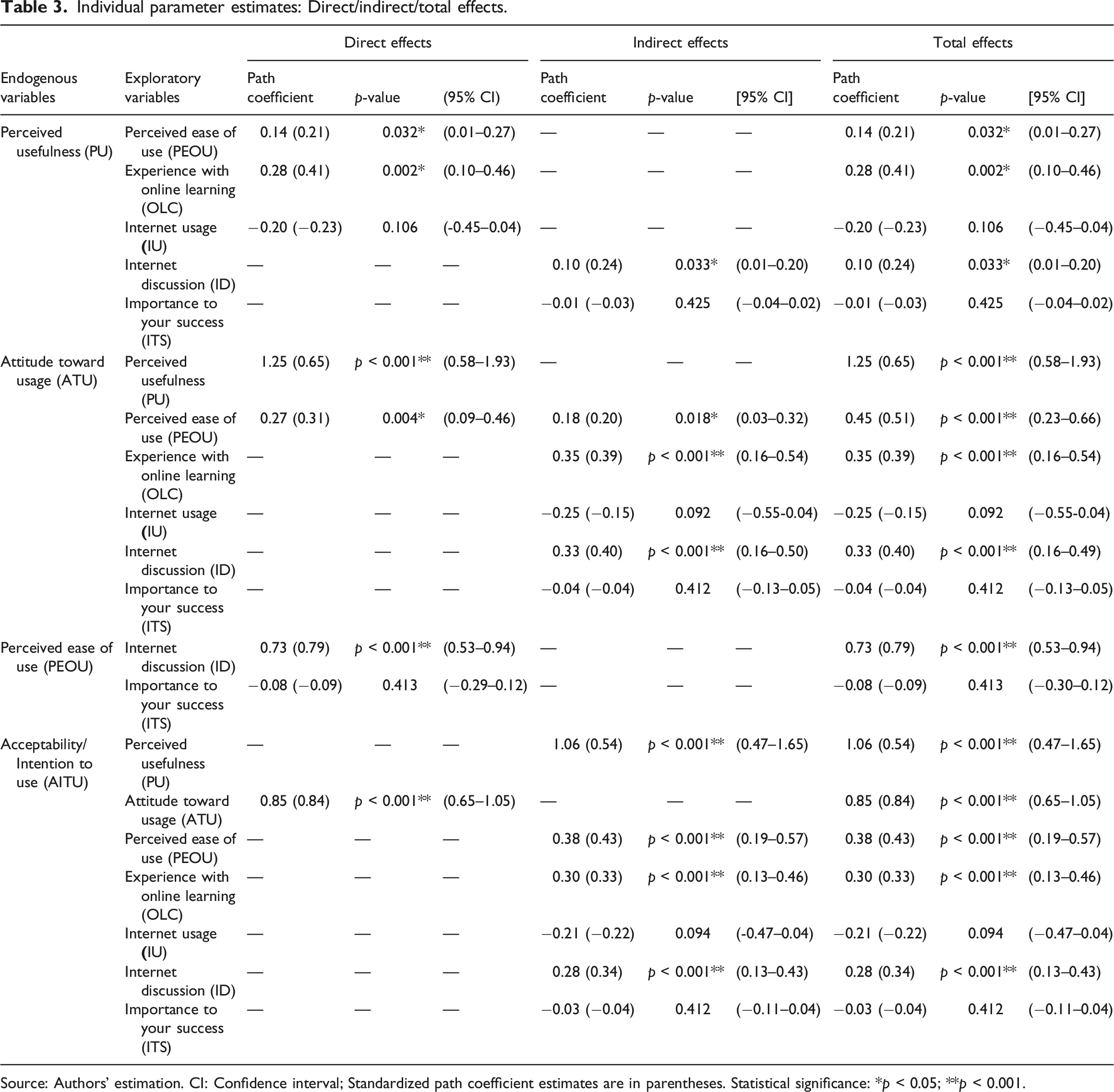
Results of hypothesis testing of individual parameter estimates of factors affecting acceptability/intention to use HIV/AIDS M&E online learning platform (Direct/Indirect/Total Effects) using Structural Equation Modelling (SEM)
Direct effect
The variable approximations test the statistical significance and power of each of the formulated hypothesis in the model. The exogenous (independent) factors may directly or indirectly affect the endogenous (dependent) variables. The standardized approximations give room to the authors to determine the relative contribution of predictor variable to each outcome variable of interest and as well as compare across groups. 47
Individual parameter estimates: Direct/indirect/total effects.
Source: Authors’ estimation. CI: Confidence interval; Standardized path coefficient estimates are in parentheses. Statistical significance: *p < 0.05; **p < 0.001.
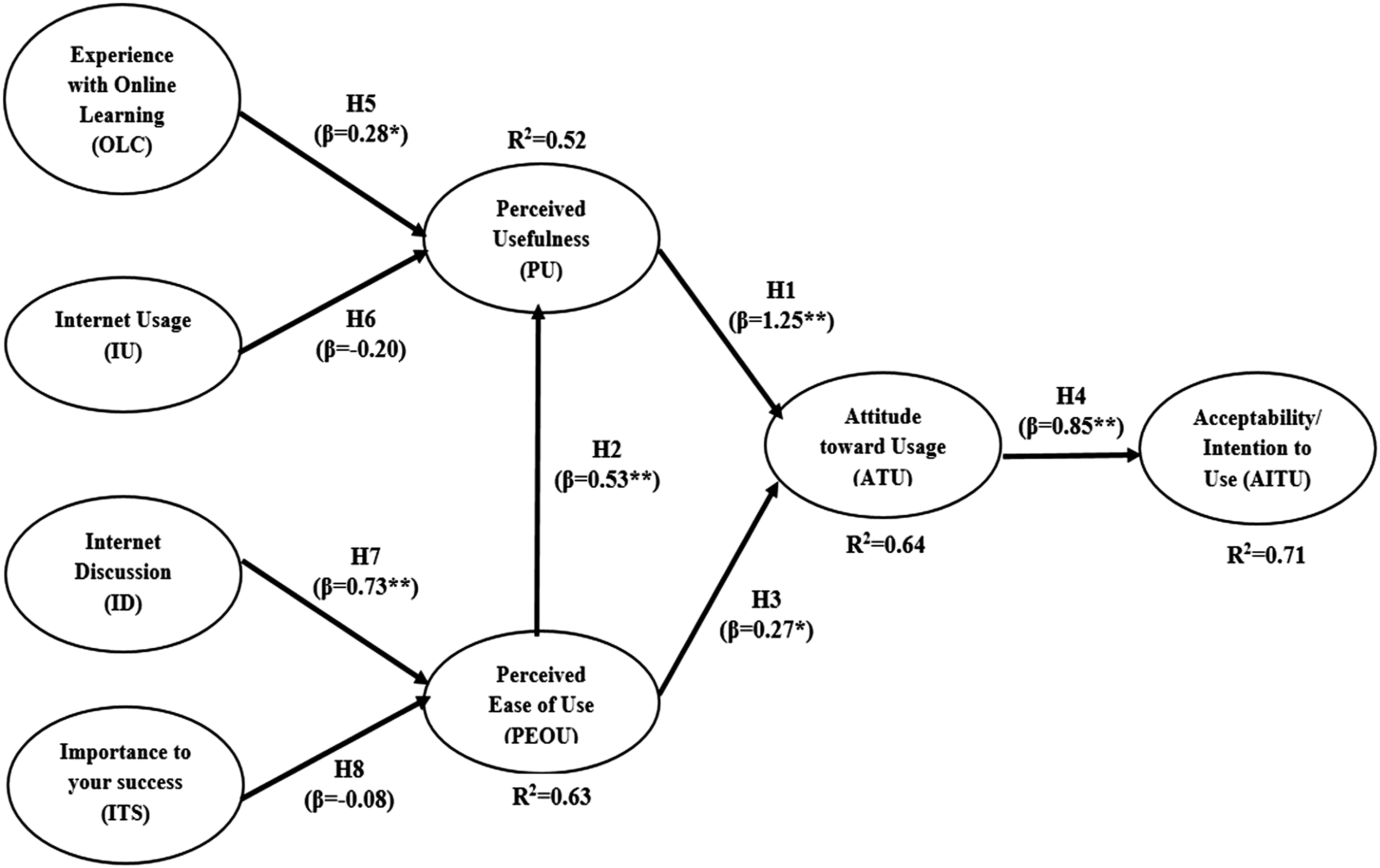
Structural equation modelling path diagram of latent variables.
The analysis also revealed that a unit change in Perceived ease of use (PEOU) will significantly increase Perceived usefulness (PU) by 0.14 with p-value = 0.032. This supports hypothesis 2 that there is positive relationship between Perceived ease of use (PEOU) and perceived usefulness (PU) in the adoption of HIV/AIDS M&E online learning platform (Table 3; Figure 2). Perceived ease of use (PEOU) also had a positive statistically significant influence on Attitude toward usage (ATU) with path coefficient of 0.27 and p-value = 0.004 in the adoption of HIV/AIDS M&E online learning platform of M&E officers and HIV and AIDS focal persons of institutions implementing HIV and AIDS projects in Ghana. This supports hypothesis 3 that there is positive relationship between perceived ease of use (PEOU) and attitude toward usage (ATU) in the adoption of HIV/AIDS M&E online learning platform.
The analysis shows that a unit change in Attitude toward usage (ATU) will significantly increase Acceptability/Intention to Use (AITU) HIV/AIDS M&E online learning platform by 0.85 with p-value <0.0001. This supports hypothesis 4 that there is a positive relationship between attitude toward usage (ATU) and Acceptability/Intention to use (AITU)) HIV/AIDS M&E online learning platform (Table 3; Figure 2).
Further analysis also shows that, a unit change in experience with online Learning (OLC) will significantly increase perceived usefulness (PU) of HIV/AIDS M&E online learning platform by 0.28 with p-value = 0.0002. This supports hypothesis 5 that there is positive relationship between Experience with online Learning (OLC) and perceived usefulness (PU) of HIV/AIDS M&E online learning platform (Table 3; Figure 2).
Internet Usage (IU) did not have any significant influence on Perceived usefulness (PU) with path coefficient of −0.20 and p-value = 0.106. We therefore reject hypothesis 6 and conclude that there is no positive relationship between Internet usage (IU) and perceived usefulness (PU) of HIV/AIDS M&E online learning platform (Table 3; Figure 2).
Internet Discussion (ID) however, had a positive influence on PEOU with path coefficient of 0.73 and p-value <0.001. A unit change in Internet Discussion (ID) will significantly increase PEOU of HIV/AIDS M&E online learning platform by 0.73 with p-value <0.001. This supports hypothesis 7 that there is positive relationship between Internet discussion (ID) and perceived ease of use (PEOU) of HIV/AIDS M&E online learning platform (Table 3; Figure 2).
Importance to your success (ITS) did not have a significant influence on Perceived ease of use (PEOU) of HIV/AIDS M&E online learning platform with path coefficient of −0.08 and p-value = 0.413. We therefore reject hypothesis 8 and conclude that there is no positive relationship between Importance to success (ITS) and perceived ease of use (PEOU) of HIV/AIDS M&E online learning platform of M&E officers and HIV/AIDS focal persons of institutions implementing HIV/AIDS projects in Ghana (Table 3; Figure 2).
Figure 2 shows R-squared values for each of the dependent parameters. PEOU accounted for 63% of the variation in PU. The combinations of PEOU and PU also accounted for 52% variation in ATU of HIV/AIDS M&E online learning platform. The overall model shows 71% of the variation of HIV/AIDS M&E officers and focal persons’ AITU HIV/AIDS M&E online learning platform as captured by the independent variables in the model (Table 3; Figure 2).
Indirect effect
Standardized indirect effects are summarized in Table 3 to throw more light on the indirect effect of each of the independent variable on the dependent variable. OLC had indirect influence on ATU of HIV/AIDS M&E online learning platform, which was mediated by PU. IU had indirect influence on ATU, mediated by PEOU. PU and PEOU had a positive statistically significant indirect influence on AITU, all mediated by ATU. OLC had statistically significant indirect influence on AITU, which was mediated by PU and ATU. Also, IU had positive significant indirect influence on AITU HIV/AIDS M&E online learning platform, which was mediated by PEOU and ATU. Indirect influence are additions to any direct influence that the exogenous variables may have on endogenous variables (Table 3).
Total effects
There is evidence that PU, ATU, PEOU, OLC and ID had a statistically significant influence on AITU of HIV/AIDS M&E online learning platform (Table 3). PEOU had a positive statistically significant influence on ATU with a total path coefficient of 0.45 and p-value <0.001. This outcome shows that a unit change in PEOU will increase ATU of M&E online learning platform by 0.45. This supports hypothesis 3 that there is positive relationship between perceived ease of use (PEOU) and attitude toward usage (ATU) in the adoption of M&E online learning platform. There was no statistical evidence of IU and ITS having any influence on AITU of HIV/AIDS M&E online learning platform (Table 3).
Discussion and implications
Discussion
Information technology is key to online learning development. The progress in the internet applications and online-related tools have impacted the increase of online learning. 48 This study sought to explore the Acceptability for an Online Capacity Building Platform for HIV and AIDS Monitoring and Evaluation (M&E) in Ghana. Well-built ICT tools give a platform to improve skills, knowledge transfer and have control over data.49–51
The technology acceptance model cannot be looked at without M&E officers’ attitude towards a particular system.52,53 The TAM determines factors of M&E officers’ behavioural intentions to use a new technology. Research suggest that the desire to use any system is determined by the person’s attitude.54,55 The results from this study supports this relationship, as it indicate that attitude towards an online learning platform has a positive significant influence on intention to use the M&E online learning platform. In addition, the attitude of the individual is affected by how useful the new system would help them achieve their goals. The study found that, PU has a positive influence on M&E officers’ attitude towards the M&E online learning platform. This outcome is supported by other studies.54,55 It is imperative that future implementation of M&E online learning platform to enhance M&E capacity building would focus on the users. This approach is necessary because the user perceived the system to be useful and thereby serving their purpose.56–58
Studies have also shown that ATU is significantly influenced by Perceived ease of use (PEOU).40,49–51 This study confirms this outcome that perceived ease of use (PEOU) has a positive influence on M&E officers’ attitude toward usage (ATU) of M&E online learning platform. Once the systems is seen to be flexible and free from difficulties, M&E officers would develop a favourable attitude towards it. 59 Every user has his/her own way of perceiving any new technology. They would develop a positive attitude towards the system once they see it to be flexible. So it is important that users of the system would be engaged in when it comes to implementation of this laudable project. PEOU is the extent to which one trust that using the system would be easy and free from hustle. 60 These findings are in agreement with a study conducted by Shanaq and Bani-Domi (2010) for 28 teachers and 118 students, which revealed that they both have positive attitude toward e-learning. 61 The findings are also consistent with similar studies13,45,59 which indicated that PEOU has a significant effect on both PU and ATU. M&E officers and focal persons who find online learning platform easy to use could explain this significant effect and are likely to have favourable attitudes toward the perceived usefulness of the M&E online learning platform. According to Shroff et al., (2011), “users’ positive feelings toward the perceived ease of use of technology are correlated with continual use of the technology”. 59 This research did not establish a significant relationship between importance to your success (ITS) and acceptability/intention to use M&E online learning platform.
A person’s attitude is influenced by the manner in which they presumed a technology would be useful to them. Once they consider the technology to be appropriate and useful, they show a positive attitude towards it. Therefore, attitude toward usage (ATU) has a positive influence on Acceptability/Intention to use (AITU).59,62–64 This findings is also supported by our study that, there is a positive relationship between M&E officers’ attitude toward usage (ATU) and Acceptability/Intention to use (AITU) M&E online learning platform. It is important to note that combined factors such as individual performance and effort positively affect acceptability/Intention to use (AITU) a new system. 54 In a nutshell, perceived usefulness and perceived ease of use mediated by attitude towards usage would influence acceptability/Intention to use (AITU) of the new M&E online learning platform.
Concerning M&E officers’ Experience with Online Learning (OLC), our result show that OLC has a positive significant relationship with PU of the M&E online learning platform. This finding is consistent with previous studies that found positive relationship between experience and perceived usefulness.65–68 They reported that when users feel adequate they are more likely to find a system to be useful. So, in the e-learning environment, there is need to enhance the capacity of users in a timely manner to boost their confidence to use the new technology. In this study, the M&E officers’ experience with online learning facilities with additional technical support would urge them to perceive the M&E online learning platform to be useful. The results of our study show no relationship between M&E officers’ Internet usage (IU) and PU of M&E online learning platform. This is consistent with some previous studies.33,69–71 The relationship between IU and PU is a clear indication for further research. The insignificant relationship between internet usage and perceived usefulness of M&E online learning platform shows experience associated with internet usage may not be a factor related to M&E officers’ perceived usefulness of online learning platform. From the HIV/AIDS M&E online learning platform implementation point of view, it is a welcoming finding since perceived usefulness of a well-built M&E e-learning platform may not be link to previous internet usage experience.
Discussions with regards to the internet and importance of e-learning platforms have been deemed to be part of a person’s subjective norms. Internet discussion was found to be associated with perceived ease of use of M&E online learning platform. Abdad et al., (2009) indicated that individuals will use an e-learning platform with little peer pressure once they have high expectations of it serving their communication purposes. 33 This accounts for the high influence of ID on PEOU in this study. Since there is limited studies investigating subjective factors influencing PEOU, further research is required to examine these subjective norms influence on PEOU. This study found no relationship between importance to success (ITS) and perceived ease of use (PEOU) of HIV/AIDS M&E online learning platform.
Implications
In planning for a new online training platform, the programme implementing partners should take into consideration the view of the users of the system and explore their possible acceptance of the systems. The results of this study show that attitude towards an online learning platform, perceived usefulness, and ease of use of the system all have significant influence on intention to use the M&E online learning platform. This suggest that future implementation of M&E online learning platform to enhance M&E capacity building would focus on the users. This approach is necessary because the user perceived the system to be useful and thereby serving their purpose. Once the system is seen to be flexible and free from difficulties, M&E officers would develop a favourable attitude towards it. So, it is important that users of the system would be engaged when it comes to implementation of this M&E online learning platform project. In addition, programme implementers can enhance user acceptability of M&E online learning platform by engaging M&E officers in the design and implementation process by evaluating their perception (PU, PEOU) about the M&E online learning platform at key stages of the design process and take measures to correct any negative perception that may arise. The results also show that experience with online learning (OLC) has a positive significant relationship with PU of the M&E online learning platform. It shows that M&E officers who have computer related capabilities trust themselves to be in the position to use the M&E online learning platform and see the system as an easy to use. This call for programme implementing partners as part of building capacity for M&E to invest in infrastructure for Internet and related technologies and equipment to facilitate online learning, meetings, and discussions.
The strength and limitation of the study
The strength of this research is the method of analysis applied, which is the structural equation modelling (SEM). The SEM was applied because of the advantages it has over the multiple regression method to determine the extent of effect of the independent variable on the dependent variable. SEM is able to show both the direct and indirect effect of the independent variables on the dependent variable as compared to multiple regression method. An important limitation of the study is small sample involved in the study making it difficult to draw a general conclusion for the entire country. This is as a results of the targeted training for only persons involved in the monitoring and evaluation of HIV/AIDS activities across the country. Another limitation is that the model did not adjust for potential confounders such as age, gender, educational level and organisational type because SEM is a system of relations among latent and measured variables and not demographic characteristics. 72
Conclusion and recommendations
Our study sought to explore the Acceptability for an Online Capacity Building Platform for HIV and AIDS M&E in Ghana. This study has shown that the M&E Officers and focal persons have high acceptability for an online capacity building platform for M&E. The M&E online learning platform is part of e-learning technologies, which when utilised in addition to face-to-face training programme, has the potential to provide a more sustainable M&E capacity building for HIV and AIDS in Ghana.
Despite the findings, we recommend that future study must be done to confirm the validity of the model. It is obvious that several factors may have influence on acceptability/Intention to use M&E online platform for capacity building and satisfaction in online learning environments. Additional perfection of the proposed model may ascertain other factors that influence the quality of M&E online learning for capacity building. For instance, there are some course content factors such as course content, structure, designs and instructor experience that have not been examined in this research. Addressing these shortfalls would enhance the generalization of the findings to other M&E training approaches.
Supplemental Material
Supplemental Material - Exploring factors influencing acceptability of online capacity building platform for HIV and AIDS monitoring and evaluation in Ghana
Supplemental Material for Exploring factors influencing acceptability of online capacity building platform for HIV and AIDS monitoring and evaluation in Ghana by Samuel KK Dery, Frances Baaba da-Costa Vroom, Charity K Asem and Godwin Adzakpah in Health Informatics Journal.
Footnotes
Acknowledgements
The authors wish to thank Ghana AIDS Commission (GAC), United States President’s Emergency Plan for AIDS Relief (PEPFAR) through the Centers for Disease Control and Prevention (CDC), Morehouse School of Medicine (MSM) and the School of Public Health, University of Ghana (SPH) for all the support provided for the study to be carried out.
Authors’ Contributions
The study was conceptualised and designed by SKKD. CKA undertook literature review for the study and coordinated the field data collection. GA and SKKD undertook the analysis, interpreted the results and produced manuscript in line with the journal’s guidelines. FBDV and SKD reviewed the manuscript. All authors thoroughly reviewed the draft manuscript and approved the final version.
Declaration of conflicting interests
The author(s) declared no potential conflicts of interest with respect to the research, authorship, and/or publication of this article.
Funding
The author(s) disclosed receipt of the following financial support for the research, authorship, and/or publication of this article: This work was supported by the UJMT Fogarty Global Health Fellows Program.
Ethical Consideration
The research was reviewed and approved by Institutional Review Board (IRB) of Noguchi Memorial Institute for Medical Research, University of Ghana. The Institutional Review Board (IRB) number issued is 083/15-16. Study participants gave a written informed consent.

Supplemental Material
Supplemental material for this article is available online.
References
Supplementary Material
Please find the following supplemental material available below.
For Open Access articles published under a Creative Commons License, all supplemental material carries the same license as the article it is associated with.
For non-Open Access articles published, all supplemental material carries a non-exclusive license, and permission requests for re-use of supplemental material or any part of supplemental material shall be sent directly to the copyright owner as specified in the copyright notice associated with the article.
