




Abstract
Consumers are increasingly using social media to interact with other consumers about health conditions and treatment options. This study aimed to investigate the advantages and disadvantages of using social media for health-related purposes from the consumers’ perspectives. Five focus groups with 36 Australian adults with a chronic condition and on medication were conducted, audio-recorded, transcribed verbatim, and thematically analysed. Consumers reported that social media was very convenient, for accessing health-related information and for peer engagement; user-friendly; improved their health knowledge; empowered them; and provided social and emotional support. The disadvantages included information overload, wasting time; negative feelings; doubts about online information credibility; and issues related to online interactions. Despite some disadvantages, health-related use of social media led consumers to feel supported, knowledgeable, and empowered. Consumers’ motivation to keep accessing social media for health-related purposes opens up avenues for the delivery of services via social media.
Background
Social media (SM) can be defined as a group of web-based technologies and applications whose content is created by the users. 1 It may be divided into content sharing (e.g. Blogs, YouTube, and Wikipedia) and relationship building platforms (e.g. Facebook and LinkedIn). 2 SM has changed the way people communicate with one another, including communication about health. 3 As versatile and user-friendly platforms, SM can facilitate patients’ and healthcare professionals’ (HCPs) communications about health issues which can also bring new opportunities and challenges to the healthcare sector. 4
The interactive and participatory nature of SM has afforded consumers not only the opportunity to access health-related information but also to provide it. 5 Online communities of patients with a shared health problem are very popular, 6 offering several advantages to consumers. For instance, they serve as a platform for health-related discussions. Common subjects discussed have included disease symptoms, prognosis, examinations and procedures, and treatments. 7 Studies have shown that interactions with peers in online health communities have been beneficial for those living with chronic diseases.8–18 In these communities, patients can provide and receive social support, cultivate companionship, exert social influence, and communicate with one another.9,19 Several SM platforms, such as blogs, 15 YouTube, 14 Wikipedia, 20 Twitter, 21 and Facebook, 17 can be used by consumers for health-related purposes.
However, the use of communication technology for health-related purposes may also have disadvantages. As Finfgeld 22 explained, online health communities presented challenges as a mode of communication since communication via text lacked non-verbal cues, required its participants to have access to the Internet, could lead to Internet addiction, cause anxiety due to a delay in receiving a reply for a question asked, foster socially inappropriate or even aggressive behaviour, and could delay those actually needing health care from seeking it. Another recent study reporting on the barriers of SM use found that privacy and misinformation were the main problems facing consumers. 23
Due to its widespread use and pervasive nature, SM has been advocated as a relatively inexpensive way of delivering health promotion messages, 24 and in the future, health care may be more commonly delivered via SM. As consumers are increasingly using SM for health-related reasons, HCPs need to be aware of the benefits and potential pitfalls associated with such use.23,24 A comprehensive understanding based on sound evidence is crucial before health stakeholders start investing in the use of new technologies such as SM. 25
The overall aim of this study was therefore to investigate consumers’ self-reported participation on SM for health-related purposes, with a specific objective, to explore their opinions about the advantages and disadvantages based on their experiences.
Methods
This study employed focus groups to explore consumers’ experiences, opinions, and perceptions about their use of SM for health-related purposes. Focus groups are an efficient way of gathering the views of several individuals simultaneously, 26 uncovering important constructs that may not be tapped through individual interviews, 27 and supporting important lines of investigation, such as consumers’ behaviours. 28 Furthermore, the literature also recommends further research about patients’ online communication using qualitative methods, such as focus groups. 29 This study (project number 2015/895) received approval from the University of Sydney Human Research Ethics Committee.
Participants and recruitment
Inclusion criteria
Individuals were eligible to participate if they met the following criteria: (a) adults (>18 years) with a chronic disease; (b) on medication for that disease; (c) had used SM to discuss health-related issues in the last 12 months; and (d) able to participate in the study without the assistance of a translator.
Recruitment
Participants were recruited from the Sydney metropolitan area by a recruitment agency. A total of 40 participants were recruited, with 36 taking part. Each participant was reimbursed A$80 for their time and travel expenses. All participants received verbal and written information about the study.
Focus group conduct
Five focus groups were conducted in three distinct geographical areas of Sydney. They were held in venues commonly used for group discussions and were close to participants. Upon arrival at the venue, participants were provided with a participant information sheet and completed a consent form and a demographics survey. Discussions lasted between 60 and 90 min and were facilitated by P.A., a female pharmacist and academic experienced in conducting focus groups. A focus group guide was developed to guide the discussion and address the study objectives (Appendix 1). Discussions were audio-recorded, and notes were taken to assist with asking probing questions to elicit further information from the participants and to facilitate subsequent data analysis. Focus groups were conducted until saturation, 30 which was observed at the conclusion of the fourth focus group. A fifth focus group, initially planned, was conducted for validation purposes.
Data analysis
Data analysis started simultaneously with data collection. 31 Note taking during the discussions and debriefing immediately after each session ensured that all data were considered, and a preliminary analysis conducted. 27 The focus groups were audiotaped and transcribed verbatim with tracking of individual speakers. Transcripts were thematically analysed. 32 They were coded by A.B. and the coding process, including its classification into themes and subthemes, was discussed with P.A. The transcripts were coded line-by-line with the assistance of a computer software (NVivo 11®). The coding process was open, not restricted by theoretical assumptions and was dynamic and iteratively developed throughout the analysis. An inductive approach 33 assured a data-driven approach. Codes with a repeated pattern were collated together and grouped into sub-themes and later assembled into overarching themes.
Results
A total of 36 participants took part in 5 focus groups (Table 1). Several disease states were represented among the participants, such as hypertension, depression, anxiety, cancer, arthritis, and Crohn’s disease.
Participants’ demographics.
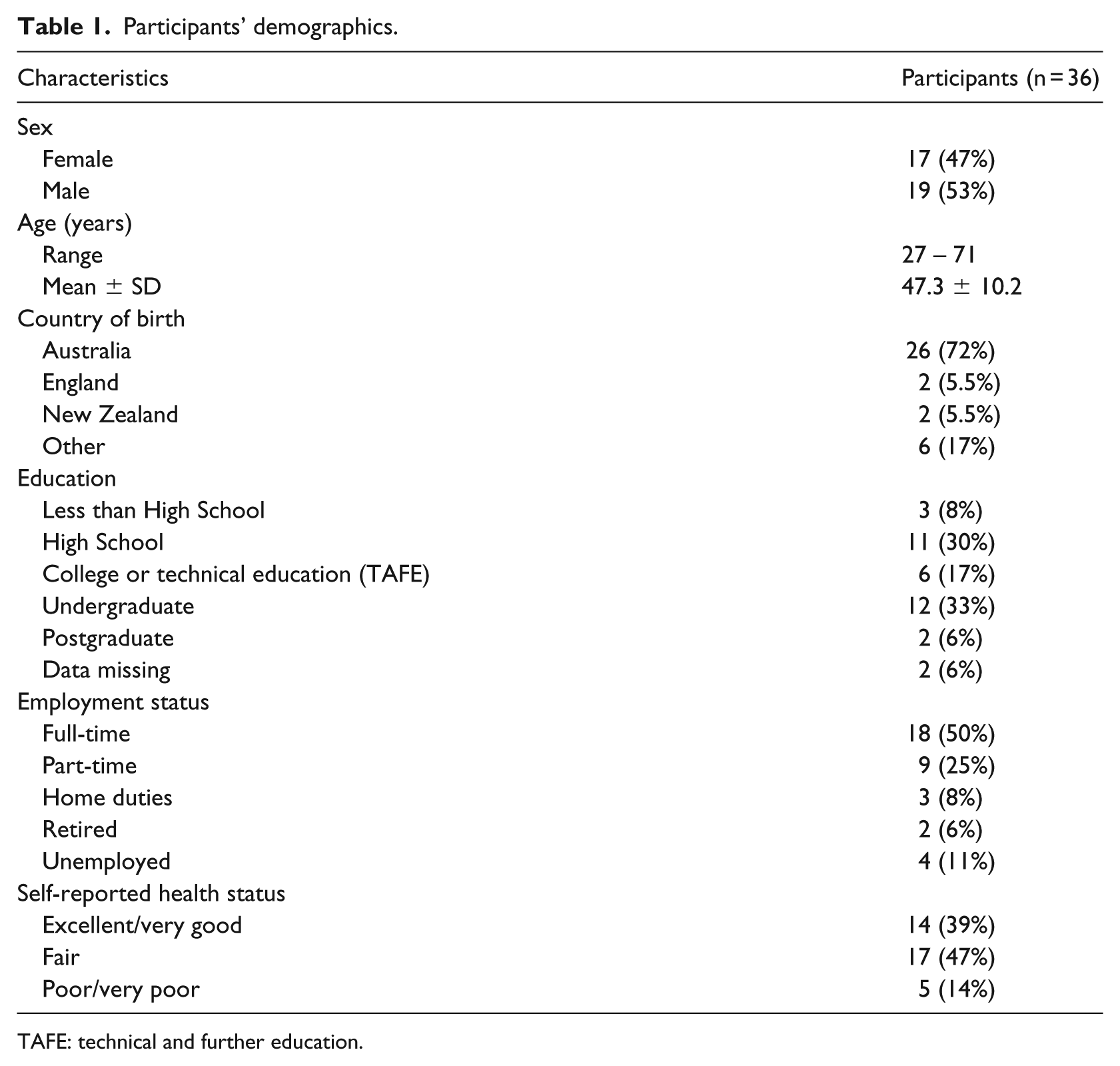
TAFE: technical and further education.
Two themes related to the benefits and drawbacks of using SM for health-related purposes, as experienced and perceived by the consumers, emerged during the focus group discussions.
Benefits of SM
The benefits afforded by using SM for health-related purposes as reported by the participants were diverse, and sometimes they overlapped. This theme has been categorised into the following sub-themes: convenience, user-friendliness, better understanding of health information, empowerment, and social and emotional support.
Convenience
The convenience of access was one of the major advantages of using SM for health-related purposes. Most participants mentioned that it was very easy to access SM, and therefore access information and interact with others online. Information was available at their fingertips, virtually all the time, through the use of computers, tablets, and particularly smartphones. Facebook was seen as a one-stop platform in which a wide range of activities occurred and where health-related groups or pages could be easily accessed, for example, participating in a disease-specific Facebook group.
User-friendliness
User-friendliness was another SM asset. As a lot of information shared via these platforms was created by users themselves or at least curated by the users, they were perceived to be more user-friendly and relevant than information found on websites developed by HCPs and organisations. In addition, SM use did not require any information technology training and everyone with access to SM could not only access but also provide any kind of information, including health-related ones: now it’s sort of the everyday person can access it … like I haven’t got a doctor’s degree, or I don’t even have courses on computers. And I can actually get around there and get some help … get some good advice. (focus group [FG] 5, female participant [f] 32)
Better understanding of health information
Health information obtained on SM was reportedly easy to understand and could have a greater impact on consumers than that obtained from regular sources, including HCPs: I’ve gone to specialists who tell you about the operation and the risks and you just sit there and listen to … but then I go online, I read it, and it’s just completely different … when he told me that was fine but when you read it on SM online, it just hits you in a different way. (FG4, m23)
Participants suggested that learning health information from peers instead of HCPs was not only easier to understand but also more real and relevant: ‘I guess, you know it’s a person who’s gone through it and they do it more descriptive’ (FG4, f27) and ‘I would say dramatic’ (FG4, f28).
Empowerment
The knowledge acquired on the Internet and SM platforms influenced the way participants perceived themselves. Overall, participants viewed themselves more positively, with an increasing sense of empowerment through, primarily, improved perceived health literacy: ‘I think if you know the language and the concepts and closer to a level that a doctor understands or operates in, it’s a little bit easier, the interaction’ (FG2, f10). Many participants expressed that they were better at communicating with their doctors, particularly at articulating and describing their health problems (‘I think I’m more assertive and I think I can probably articulate myself a little better because I’m a little bit more well informed’ (FG5, m35)) and asking relevant questions (‘I think it helps also to ask your doctor the right questions … because you understand your conditions better’ (FG2, f12)).
The improved perceived health literacy and communication was believed to optimise the interaction with medical doctors: ‘if you go and prepare yourself for a session with the doctor, you know what exactly you want to ask’ (FG5, f31).
Access to health information and discussions with peers were reported to not only increase knowledge and health literacy but also demystify assumptions about HCPs: ‘it does help you to understand that nothing’s infallible, no system is infallible, or practitioner, or doctor’ (FG2, m11) and allowed participants to better navigate the healthcare system: sometimes you can feel very disempowered in the medical system … and you want to try and take back some of that control, and have a say in the decision-making process. You need to arm yourself with as much information as you can. (FG2, f10)
Social and emotional support
Another important component of the empowerment provided by SM was the social connections with peers and the emotional support received, encouraging consumers to move forward and be optimistic. SM had enabled consumers to publish their stories about dealing with health issues. Accessing and reading such stories was highly valued by the participants as they had a positive subjective effect on them, that is, despite still having the medical problem, relating to others made them suffer less from it and start to have a positive outlook: one of the lovely girls who’s had surgery, wrote a big blog when she went traveling around the world. I think having access to it just gives a lot of people hope … If she can do it, I can do it. (FG1, f5)
Drawbacks of SM
This section reports the negative aspects of using SM and interactive online platforms, as experienced by the participants. It is important to note that even though negative perceptions of SM were reported, they did not prevent participants from using SM regularly.
Distraction and waste of time
A very common disadvantage of SM use for health-related purposes was the fact it was time-consuming: ‘it chews up a lot of your time’ (FG1, m6), ‘it can be quite time-consuming. Because you need to spend time trolling through … there’s usually more than one kind of cluster of discussion going around the same topics’ (FG2, f14).
Some participants believed that they did not have enough time to be on SM and gain enough information: ‘you can research to your heart’s content … [but] you just haven’t got enough time to keep going. You think “oh my god, there’s so much to go into here and learn”, but there’s just not enough time’ (FG5, f32).
This plethora of user-friendly platforms not only grabbed their attention but also often diverted them from their initial searches, making their initial search longer than expected: ‘you can get distracted’ (FG2, m11), ‘it’s easy to lose focus on what you originally went on there for’ (FG2, f14); ‘that’s a problem. So not a hypochondriac in real life, but yet on the net you become one’ (FG2, m13). To deal with this issue, some participants became more disciplined using their time efficiently: ‘just trying not to be addicted to looking all the time … just having a set amount of time’ (FG5, f32).
Overload of online health information
Most participants believed that the abundance of health information available on SM and other online platforms could backfire and prevent people from acquiring the information needed. Some participants reported being overwhelmed: ‘I thought for one time I was depressed … so there’s a sea, a tsunami of stuff on anti-depression. So that was hard to sift through’ (FG1, m7). Most participants believed that this information overload together with the many options available to access could contribute to people feeling lost, with negative impacts: ‘sometimes it pulls you in different directions and it’s not necessarily healthy’ (FG5, m36); one of the downsides to this sort of plethora of information is, probably your stress level can be higher than what it should be … if you read something which is sort of worse than your condition, you may relate. (FG1, m6)
Negative feelings
Some participants found it challenging to learn more about their condition and prognosis online: when I first had my issues, I found that I couldn’t actually read about it … or talk about it, because it would make me worse. So that’s another thing with the kind of social networking and things like that, it’s actually kind of hard for a person to kind of read it, like go through it as well, at the time. (FG3, f16)
SM not only improved participants’ awareness of their problem but also sometimes increased that knowledge to a level which created additional stress for them, making it difficult to cope with the information gained and the potential consequences. It was particularly distressful to learn about negative experiences and outcomes of others with the same health problem. Increased awareness of peers’ disease complications, health deterioration, and death were reported as factors which increase negative feelings among SM group participants.
Some participants expressed that they had to remain positive despite reading about other people’s experiences. To avoid this situation, some participants learned to selectively choose useful information, avoiding worse case scenarios: ‘You just have to go around, to try to look at the positive side. People’s situation’s different, circumstances are different … whatever they experience may not 100% apply to your situation’ (FG3, f17).
Credibility of source of information
Although perceived trustworthy sources were the most accessed by the participants, most felt that they could not completely trust the information available on SM platforms: ‘I’d probably read as much as I could. But take it with a grain of salt’ (FG5, m35). One of the issues faced was the inconsistency of information found: ‘those forums, it can be a bit inconsistent … you kind of go back and forth sometimes because people, like everyone will have different experiences’ (FG3, m19). Most participants perceived HCPs as their ‘safe haven’ for health information, including for evaluation and confirmation of information found online.
Issues with online interactions
Three broad issues were raised with online interactions. Some participants reported disagreements, particularly with hasty replies. Slowness or lack of response to questions on SM also caused disappointment. A third issue, although not common, was the presence of people causing ‘problems’. During focus group discussions, these people were labelled as ‘trolls’, that is, people who deliberately posted provocative messages with the intention of causing disruption and argument: I go to one group, sort of secret and there’s always trolls coming in. It’s really weird that people do all that stuff … But yeah, they just want to harass people like give them a hard time, but, which is good that a lot of these groups you have to ask to join. And then you feel a lot more … it is safer in there. (FG5, f32)
Advertisements
A nuisance mentioned by a few participants was the fact the SM platforms were sending out advertisements based on what consumers were accessing: I might just be on Facebook and then I see an ad pop up, which every time you go on Facebook and Google something, Facebook will start sending you advertisements all the time about it. So, if I type in hypertension in Google, all of a sudden, ‘do you want the new blood pressure machine?’ (FG2, m13)
Discussion
This study has identified the advantages and disadvantages of using SM for health-related purposes, including medications and medical conditions, as experienced by the consumers themselves. The use of SM was positively perceived despite some drawbacks mentioned. Some advantages were related to the factors that drew consumers to use SM for health-related reasons in the first place. For example, SM provided the opportunity for consumers to access health information sources including other consumers considered as ‘experiential experts’. 34 As the information on SM is imparted by peers, it is generally more accessible with user-friendly language.
The most prominent SM advantage was empowerment. Empowerment can be understood as a process by which people gain mastery over their lives 35 and patients acquire autonomy for the decisions concerning their healthcare. 36 For those with a chronic condition, an important component of empowerment is health education. It is reflected in a combination of increased knowledge, skills, and self-awareness about needs and values leading patients to define and achieve their own goals. 36 As found in this study, SM can have an important role in empowering consumers as it apparently has a positive impact on health education as expressed by participants, and led to perceived increased health literacy and better communication with HCPs. This is in line with studies that have reported online patient support groups were able to empower their participants.37–39 Online patient support groups started to emerge in the 1990s 40 and have empowered patients through allowing the exchange of information and experiences, provision of support, improvements in interactions with clinicians, enhanced self-esteem, increased optimism, and enhanced social well-being. 38 SM can probably be more effective than online support groups since the communities built can last longer. The conceptual framework of consumer empowerment is focused on providing patients with knowledge and skills in order for them to take responsibility for implementing changes impacting their health. 41 In this regard, HCPs should become familiar with the use of SM for health-related purposes to support consumer empowerment.
Another important advantage of using SM for health-related purposes was the social support. Participants could break the isolation experienced as a result of their chronic condition as they could easily contact and relate to people in similar situations. As reported in previous studies, meeting people undergoing similar health issues has a positive impact.42–44 Via these platforms, consumers can express their emotions, 37 particularly when struggling with emotional difficulties, 45 and receive the necessary support in very critical and difficult moments. 46 Further studies on the long-term effect of SM should be performed, as a study with online forums 34 reported that the positive effect of social and emotional support could be transitory for those experiencing chronic conditions, as their condition may deteriorate despite online participation, or because they may feel lonely in real life in the long term. 34
It has been reported that patients with diverse social networks better manage their condition than those with fewer connections. 47 As SM facilitates the expansion of one’s network without temporal, spatial, or geographical limitations, 48 it is expected that SM can have a positive impact on health, particularly for chronic disease self-management. Our study confirmed findings from previous research that showed that consumers find support from other consumers.8,49 The online interaction with peers allowed consumers to freely share their problems,45,50 and thereby experience a positive psychological effect due to decreased depression and anxiety associated with their health condition. 51
This study also found that SM can create some issues. It highlighted that consumers can be overloaded by the amount of online health information available, including the large number of SM platforms where patients’ experiences are shared. This finding corroborates previous research reporting that SM platforms can cause consumers to feel overwhelmed. 4 Consumers cannot only feel lost online but also get frustrated and nervous about it. This presents an opportunity for HCPs to be appropriately trained to guide consumers in their online health activities. The fact that this was a very common issue warrants further research.
Another drawback connected to the previous one was that SM activities were time-consuming. Participants reported wasting a lot of time due to a compulsion to remain online, becoming a ‘net hypochondriac’ as defined by one participant. This is in line with a study which reported that SM use for health could even be addictive, that is, consumers diverting time dedicated to usual daily tasks to be on SM. 52 The vast array of options and information available is worsened by the fact that misinformation may also be found. It has been reported that the lack of reliability of the online health information is a major concern for consumers. 53 The spiralling increase in health information posted by consumers makes the task of discerning reliable from misleading content even more difficult. 54 That problem was corroborated by our study. It should be noted that the concern about misinformation among patients is shared by both consumers and HCPs. 55
Another disadvantage faced by consumers was becoming distressed by the information they accessed, especially about complications other people with the same condition were dealing with. This increased worry and anxiety had a negative impact on participants’ optimism and has also been reported in a survey with an online support group for infertility. 52 In addition, people using SM have an expectation of receiving fast replies. Therefore, not receiving a prompt reply was poorly perceived. This negative effect was reported in previous research not only within SM 52 but also with electronic forms of communication that preceded SM;56,57 this could have a demoralising effect. 58 Therefore, while SM is regarded as a useful resource for receiving information quickly, this can also be its downfall if participants do not receive replies or feedbacks in a timely manner.
Although participants reported some disturbance (trolls), this issue is probably less common in SM platforms than in online forums. SM can efficiently prevent troublemakers from infiltrating groups as people have to ask to join groups and are accepted only by group administrators. In case this process fails, a member can be excluded. SM groups can be analogous to clubs in the offline world, that is, they can be open to anyone, closed (approval required), or secret (by invitation only). 59 Probably the closed option is the one that favours both the inclusion of new members while preventing disturbance by not accepting or excluding those who do not follow the group’s norms.
SM are intrinsically open platforms, making it harder than previous online platforms to hide users’ identities. 60 SM probably offers less opportunity to be anonymous as users are required to set up a profile, which generally includes name, date of birth, hobbies, and so on. However, our study showed that participants were able to either remain anonymous or restrict what others could see via the use of privacy settings. Previous research found that privacy is a major concern and a barrier to consumers resorting to SM for health-related purposes, 23 and that online anonymity is particularly important for people living with a stigmatised conditions. 34 Anonymity was not found to be directly related to coping 34 and thereby managing SM privacy settings could be a better option as mentioned by several participants in this study. Even though SM privacy was a concern and a barrier, it was also possible to be fully addressed and turned into an advantage as consumers get more SM savvy.
Conclusion
Participants felt empowered by their participation on SM, finding information and social and emotional support from peers dealing with similar health issues. However, participants felt overwhelmed with the information, and that they were spending too much time online. All things considered, this study suggests that SM advantages outweigh the disadvantages since consumers kept using SM for health-related reasons. Therefore, it is important that HCPs and health stakeholders are fully aware of consumers’ use of SM for health to better meet the needs of these new patients and assist them to maximise the benefits afforded by SM.
Footnotes
Appendix 1
Acknowledgements
The authors wish to thank all participants in this study who provided their valuable experiences and opinions. The study was conceived and designed by all authors. A.B. assisted the focus group sessions, took notes, reviewed the verbatim transcripts, conducted the analysis, and wrote the manuscript. P.A. conducted the focus group discussions, assisted in the thematic analysis, checked the codes and themes, and critically reviewed and revised the manuscript. T.F.C. critically reviewed and revised the manuscript. The final article was approved by all authors.
Declaration of conflicting interests
The author(s) declared no potential conflicts of interest with respect to the research, authorship, and/or publication of this article.
Funding
The author(s) disclosed receipt of the following financial support for the research, authorship, and/or publication of this article: This work was partially funded by a grant awarded to Arcelio Benetoli for Professional Innovation offered by the Young Pharmacist Group (YPG) – International Pharmaceutical Federation (FIP) and FIP Foundation for Education and Research at the 75th FIP World Congress of Pharmacy and Pharmaceutical Sciences. Dusseldorf, Germany 29 September–3 October 2015. At the time of the study, Arcelio Benetoli held a scholarship from the Brazilian Government/National Council for Scientific and Technological Development (CNPq) ‘Science Without Borders’ Programme, for his PhD.
