




Abstract
Google is the most used search engine in the world, and likely to be used by caregivers of stroke survivors to find online forums and online communities to connect with other caregivers. This study aims to identify the types of websites accessed by caregivers of stroke survivors to connect with other caregivers, and analyse the online content produced by caregivers to identify their unmet needs. The first 20 websites from eight search strings entered into Google were systematically reviewed. Unmet needs on included websites were identified using a pre-determined coding schedule. Six websites were analysed. Most were discussion boards (n = 5, 83%) developed by organisations in the United States (n = 4, 66.6%). Overall, 2124 unmet needs appeared in 896 posts from caregivers. ‘Emotional and psychological’ were the most reported needs across posts (n = 765, 36%). Content produced on websites may address social isolation and provide insight into delivering and developing services to meet the needs of caregivers of stroke survivors.
Keywords
Introduction
Many stroke survivors experience ongoing cognitive and/or physical disabilities post-stroke, and often require a caregiver to support them at home following the discharge from acute care. The most common tasks that caregivers report assisting stroke survivors with are related to cognitive or emotional tasks, mobility and healthcare. 1 Many caregivers who assist stroke survivors are informal caregivers, also known as unpaid or primary caregivers. Although these caregivers may be family members, friends or neighbours, caregivers of stroke survivors are predominantly female spouses of the stroke survivor. 2 Caregivers of stroke survivors often report feeling underprepared for the caregiving role, receiving inadequate stroke-related information from healthcare professionals, loss of autonomy, and increasing social isolation.3–7 As a result, caregivers commonly experience a decline in their own physical and mental health, and a reduced quality of life after starting the caregiving role.8–10 The Internet is rapidly becoming a major source of health information and social connection, and the previous research has found that patients and caregivers most commonly use websites and social media (defined as engaging online user–generated content, such as blogs, social networking sites, virtual social worlds, and content communities) 11 for self-care and as a tool to post and share their experiences. 12
Researchers have attempted to develop websites for stroke survivors and their caregivers that are acceptable and useful in enhancing preparedness for the caregiving role.13–15 Rochette et al. 13 piloted a stroke rehabilitation website for stroke survivors and their families called ‘StrokEngine-Family’. Although participants rated the website as usable and containing valuable information, they also requested more information on emotional support, and local referrals for emotional support. 13 Stone 15 conducted a pilot study using an interactive website that aimed to enhance resources for caregivers following the discharge of the stroke survivor. Caregivers felt more prepared following website use; however, the website did not help to meet caregiver needs, and satisfaction with resources did not increase following the pilot. Interestingly, these piloted websites did not have a platform for caregivers of stroke survivors to connect with other stroke survivors, despite connecting with others being the second most common use of social media by caregivers and patients. 12 A randomised controlled trial with 144 caregivers (103 identified as novices towards using web-based programmes) to assess the effectiveness of an online intervention for caregivers and stroke survivors (Caring~Web) at increasing well-being found that caregivers who received access to Caring~Web made more informed health-related decisions and had a significant reduction in service use compared to the control group. 16 These findings highlight that online interventions may be cost-effective, usable, and result in lower burden to the healthcare system by reducing service use.
Google is the most commonly used website and search engine in the world.17–19 Google’s unique search engine results are due to their Page Rank Algorithm, which provides access to websites that are ranked as most relevant to the search based on (1) frequency and location of keywords within the webpage, (2) how long the webpage has existed, and (3) how many other web pages link to that page.20,21 Traditionally, healthcare providers have been the primary source of medical education and services; however, many consumers are turning to Google to obtain health-related information,22–24 and these users are likely to encounter information based on the Page Rank Algorithm. Due to the increasing use of Google as a source of health information, the search engine has been reviewed as a technology to fill the gap for consumers in patient-centred healthcare provision, 25 an option for online self-diagnosis of medical issues, 26 and as a platform for people with chronic illnesses who are seeking health-related information. 27 While assessing different aspects of Google as a health resource, the various studies all conclude that health professionals should provide patients with high-quality and trustworthy online resources. Caregivers of stroke survivors may seek out information on Google to fill in knowledge gaps in stroke-related care6,7,28–30 and address other unique unmet needs that are not addressed by available support services and resources.
Caregivers of stroke survivors may turn to online resources to connect with other caregivers and voice their unmet needs and concerns in online communities. Google is the most likely place where carers of stroke survivors would begin to search for information developed and produced by other caregivers of stroke survivors or carer groups.17,18 This study aims to (1) identify the types of websites available to caregivers of stroke survivors who seek support or to connect online with other caregivers of stroke survivors, and (2) analyse the online content produced by caregivers of stroke survivors to identify their unmet needs.
Methods
Study design
An Internet-based study was conducted using Boolean search strategies in the Google search engine in October 2017. A Boolean search allows the combination of operators such as ‘AND’ and ‘OR’ to produce more relevant and targeted search results. 31 The study received approval from the University of Newcastle Human Research Ethics Committee, Approval No. H-2017-0274.
Eligibility criteria
Websites were included if they (1) were produced or developed by carers or carer groups (e.g. online chat room, social media forums), (2) contained content that carers of stroke survivors had produced about their unmet needs and concerns in a caregiving role, or (3) were developed by professional organisations (e.g. National Stroke Foundation) and contained firsthand testimonial of the needs and concerns of carers of stroke survivors. These websites included forums, discussion boards and blogs on professional websites where caregivers could provide their stories and experiences.
Websites were excluded if they were (1) intended for carers of other populations such as people with dementia; (2) developed and produced by professional organisations and provided information and/and or help guides; (3) were in languages other than English; (4) other forms of media that did not include firsthand testimonials of carers of stroke survivors including newspaper articles and academic papers; (5) not publicly accessible; that is, required the researcher to register and/or create an account on the website to access private content; and (6) duplicates of other websites brought up in the searches.
Search strategy
One member of the research team (A.M.J.D.) searched the Google search engine using the following search terms: ‘carer OR caregiver of stroke survivors’ needs’, ‘carer OR caregiver of stroke survivors’ concerns’, ‘carer OR caregiver of stroke survivors’ help’, ‘carer OR caregiver of stroke survivors’ support’, ‘carer OR caregiver of stroke survivors’ talk’, ‘carer OR caregivers of stroke survivors’ chat’, ‘caring for a stroke survivor’ and ‘family of stroke survivor help’.
The authors of this study were using an Australia-based IP address. For unbiased search results, the Internet browser history of the research member was cleared, and cookies were erased before each search. The member of the research team who performed the search ensured that they were not logged into any online accounts, such as Google Plus. Based on the previous research,32,33 the first two pages (20 websites) found in the Google search engine of each search term were reviewed. These results represent the pages that carers of stroke survivors are most likely to encounter when they search for other individuals and communities of carers of stroke survivors who have unmet needs and concerns. Where possible, forums were searched for caregiving spaces that were identified as sections of the websites as dedicated to caregivers’ questions/topics.
Data extraction
One researcher (A.M.J.D.) screened the 120 websites for inclusion and exclusion criteria. A.M.J.D. then evaluated the content of these websites using a pre-determined coding schedule of unmet needs based on the previous research of caregivers of people who have cancer 34 and caregivers of stroke survivors7,35 (Supplementary Appendix A). Data from these posts were extracted by A.M.J.D., tabled, and all coding was checked for accuracy independently by a second reviewer (O.W.). The two reviewers discussed these findings, and if a discrepancy existed and a consensus could not be reached, a third reviewer was contacted to make the final decision. General information about the websites was also recorded, including the amount of posts on each website, the population of posters, and type of website that was identified.
Results
Of the 120 Google websites searched on the unmet needs and concerns of caregivers of stroke survivors, six were included in the final analysis. A flow chart of this process is shown in Figure 1.
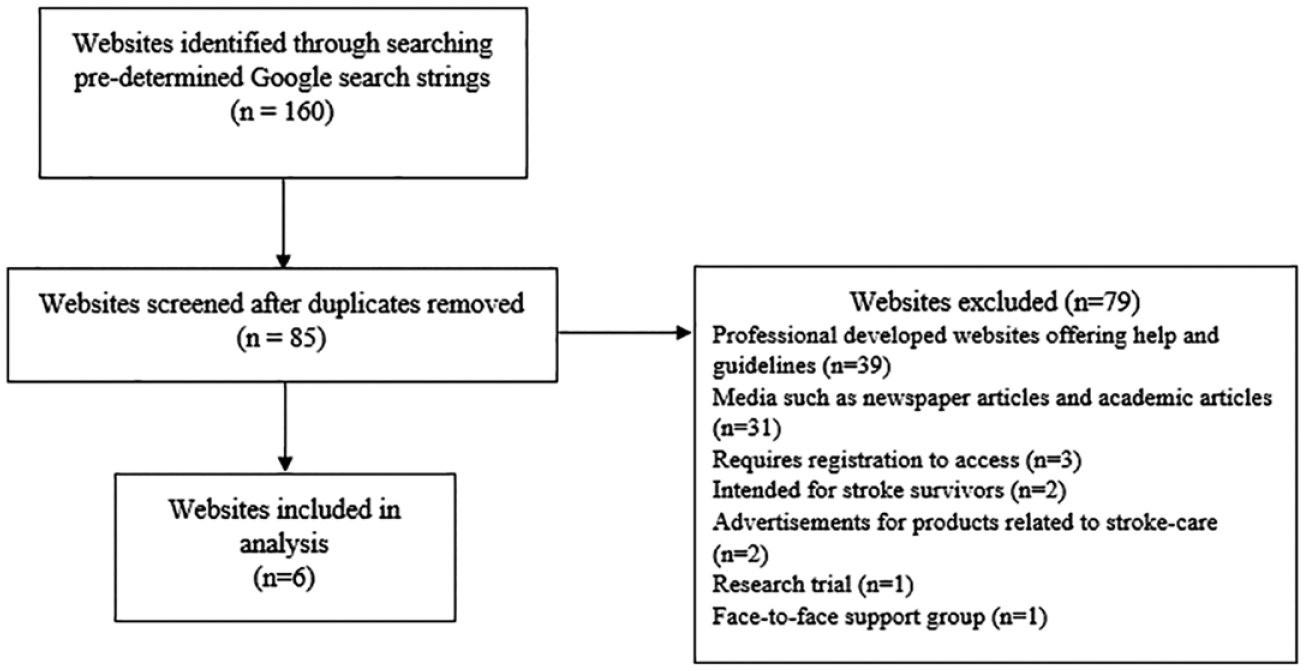
Flowchart of Google website screening process.
The websites identified were all developed by organisations, and the content was freely available to the public without registering an account with the website. Five websites were online discussion boards (83%), and one website was a single post blog (17%). Some excluded websites also offered links to external online support: 11 discussion boards, four chat rooms and one blog. The majority of the websites were developed by organisations in the United States (n = 4, 66.6%) while the remaining two websites were developed in Australia (n = 1, 16.7%) and the United Kingdom (n = 1, 16.7%).
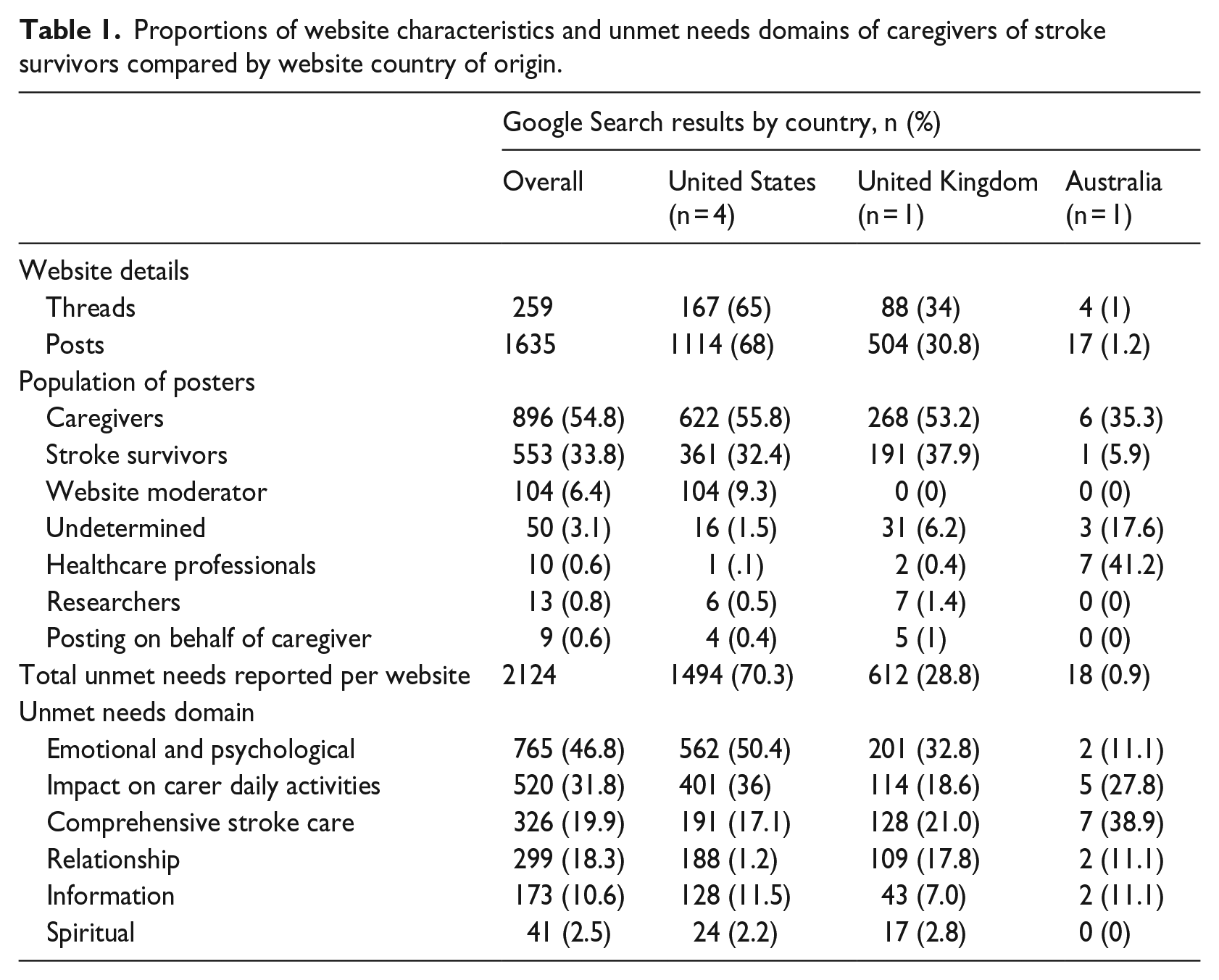
Overall, 256 threads containing 1636 individual posts were identified. Threads on websites ranged from 1 to 103 (M = 42.67) and there was an average of 6.3 posts per thread. The two reviewers agreed on over 99 per cent of the unmet needs coding, with further discussion resolving all conflicts. The majority of posters were caregivers of stroke survivors (n = 896, 54.8%); however, around one third of posters were also stroke survivors (n = 553, 33.8%). Smaller percentages of posters were moderators of the website (n = 104, 6.4%), undetermined posters (n = 51, 3.1%), researchers (n = 13, 0.8%), healthcare professionals (n = 10, 0.6%) and people posting concern for caregivers or stroke survivors who were not primary or secondary caregivers themselves (n = 9, 0.5%). Posters were identified either through the content of their posts or by their public site profile if possible. More information regarding the characteristics of websites overall and compared by country of origin can be found in Table 1.
Proportions of website characteristics and unmet needs domains of caregivers of stroke survivors compared by website country of origin.
Only the posts produced by caregivers of stroke survivors (n = 896) were analysed using the predefined coding schedule. Overall, 2124 unmet needs were identified over 896 posts of caregivers of stroke survivors, an average of 2.4 unmet needs per post. It was found that ‘Emotional and Psychological’ was the most commonly reported needs domain appearing 765 times over 896 posts (85.5%). The most commonly reported sub-domain was ‘Help Dealing with Own Emotional Distress’, which appeared in just under 25 per cent of posts from caregivers of stroke survivors (n = 397, 24.3%). The prevalence for each needs domain and sub-domain is reported in Table 2.
Summary of domains and proportions for subcategories of unmet needs of carers of stroke survivors in identified in Google search results posts (n = 2124).
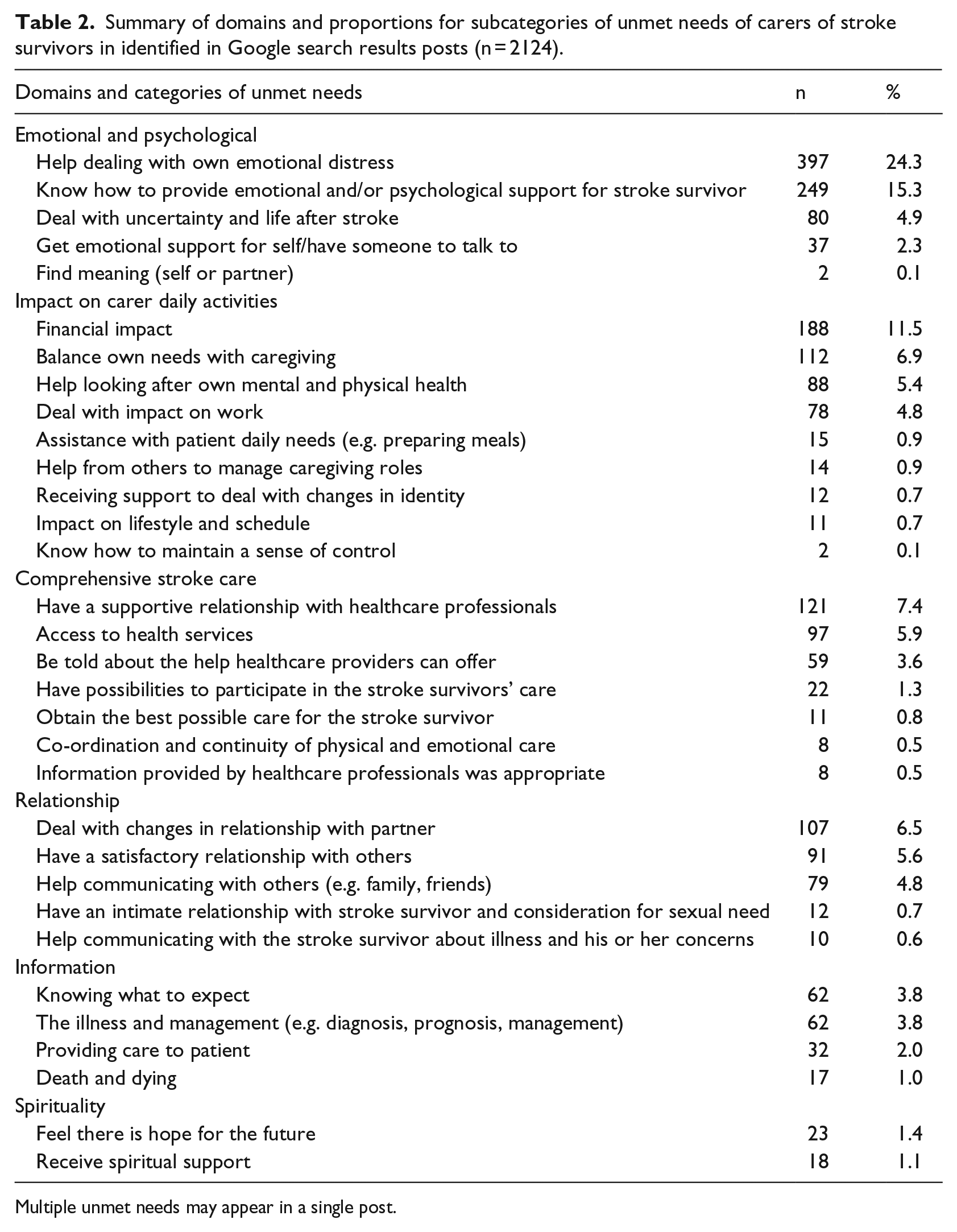
Multiple unmet needs may appear in a single post.
Discussion
This study examined the websites that caregivers of stroke survivors are likely to encounter using the Google search engine to connect with other caregivers of stroke survivors. The findings of this study suggest that for caregivers of stroke survivors using Google for this purpose, the most frequently encountered websites will be discussion boards based in the United States. Importantly, there are few freely available online web resources to enable peer-to-peer connection with other caregivers. Caregivers of stroke survivors are likely to encounter only a very small minority of public access forums to connect with other caregivers of stroke survivors, as only six of the 85 unique websites (7.1%) identified met this study’s inclusion criteria. If caregivers were willing to create an account to post on forums or chat rooms, three additional websites were available to connect with other caregivers.
In the current study, the most reported unmet needs domain was ‘Psychological and Emotional’, in which ‘Help Dealing with Own Emotional Distress’ was the most reported sub-domain followed by provision of emotional support to the survivor. These findings are consistent with previous studies using traditional methodologies. The previous research has found that 47.5 per cent of caregivers commonly used social media for self-care and peer-to-peer support 12 and have requested an emotional support module as an addition to a website that was piloted with caregivers of stroke survivors. 13 The findings suggest that there is a need to provide caregivers of stroke survivors a platform to engage in self-care and provide peer-to-peer and emotional support through exchanging ideas, sharing experiences and giving and receiving support to other caregivers of stroke survivors.
The financial impact on carer daily activities was reported as the third-most common topic posted on these websites by caregivers of stroke survivors. In previous studies, caregivers have identified that financial aspects of caregiving such as access to external support, adequate respite care and financial assistance as important to allow carers to maintain some previous activities and assist them manage their role as a caregiver to a stroke survivor.36,37 Often family members give up their jobs to provide care, leaving them without financial support to engage in and maintain previously enjoyed social activities. 38 As a result, the financial, health and social consequences of being an informal carer are often connected. These results suggest that caregivers of stroke survivors are not receiving the support they need through available social services, and it is possible that they are turning to online communities for support and information.
On average, caregivers of stroke survivors were receiving six replies to their initial question. A large number of people who posted in caregiving spaces and responded to these questions on these websites were stroke survivors themselves, with over one third of posters identifying as having experienced a stroke (33.8%). Many stroke survivors offered their perspective on the stroke event and provided education and resources for caregivers. This could be interpreted as caregivers of stroke survivors receiving a positive support and education through social media. Caregivers of stroke survivors may benefit from online websites, forums and spaces dedicated to connecting with other caregivers to provide and receive support from other caregivers of stroke survivors in an online community.
Healthcare professionals and website moderators with a healthcare background are more likely to provide evidence-based information from trustworthy sources,39–41 rather than anecdotal evidence of health-related information from other users who are caregivers or stroke survivors. Website moderators were also found only on US websites, while healthcare professionals were the highest reported users on the Australian website for caregivers. Therefore, it is possible that caregivers of stroke survivors who access websites based in the United States and Australia may receive more reliable and targeted support for their needs and interests, compared to websites based in the United Kingdom or other countries. A potential solution to this issue is the development of an international forum for caregivers of stroke survivors, with moderators and healthcare providers who provide information and resources relevant to their healthcare systems and countries. Surprisingly, few websites from a limited number of countries met the criteria for our study. In this study, the unmet needs of caregivers of stroke survivors identified on these websites were comparable to previous studies that used more traditional methods such as self-report surveys and researcher-driven qualitative research. There is a need to further develop, evaluate and refine websites that offer country-specific information on local support, services and healthcare systems information that may help reduce the unmet needs of caregivers of stroke survivors.
Practical implications
These findings have relevant implications for stroke caregivers, clinicians and researchers. During the study, it was impossible to tell the nationality of every caregiver who posted. Some caregivers did identify from being in countries outside of the country-specific website seeking help, but the proportion of people who actually identified their nationality was miniscule. An international forum with additional country-specific information would be the ideal outcome for an online resource for caregivers of stroke survivors. Furthermore, an international online platform would allow caregivers of stroke survivors worldwide to connect and share their stories and experiences with other caregivers, engage in self-care and provide emotional support. We recommend that the development of web resources targeted at caregivers of stroke survivors to include and/or refine existing modules or spaces to provide the opportunity for connection between caregivers and needed information provision.
Given the popularity and accessibility of Google worldwide, caregiving organisations worldwide should consider refining existing websites and further developing online resources that allow caregivers of stroke survivors a space to engage in self-care and receive peer-to-peer, emotional and informational support with other caregivers. In the previous research, caregivers of stroke survivors have requested self-care and emotional support modules be integrated into online websites and programmes,13,15,16 which may increase usability and acceptability of programmes that are delivered online. An online platform would further allow healthcare providers the opportunity to reach caregivers of stroke survivors with both international and country-specific information. Furthermore, by identifying areas and raising awareness of active unmet needs within international and country-specific online communities, the provision of care to caregivers of stroke survivors may increase across varying countries and healthcare systems. Therefore, the development of these resources may reduce financial burden on the healthcare system on a wider scale by increasing caregivers of stroke survivors’ health and well-being outcomes, and in turn increasing the well-being of the person that they care for.
Study limitations
One limitation of this study was that Google was the only online platform that was reviewed on the unmet needs of caregivers of stroke survivors. Google was selected for this study as it is the most used website and search engine in the world, and mostly likely to provide the most generalisable results of websites that caregivers are likely to encounter when seeking information and support by the results delivered through the Google Page Rank Algorithm.20,21 Other popular online search engines such as Yahoo (the seventh most visited website in the world) 19 may provide different search results for the caregivers of stroke survivors who choose to use alternative search engines to Google. Reviewing other highly used social media websites such as Facebook and Reddit 19 in addition to Google websites may also provide a more comprehensive understanding of the unmet needs of caregivers of stroke survivors.
The second limitation of this study was the exclusion of websites that were not publicly accessible. This limitation may have underestimated the amount of support available to caregivers of stroke survivors if they were willing to make an account on additional websites. The authors excluded sites that were private due to ethical considerations, privacy and respect. Some websites required an account holder to identify as a caregiver or stroke survivor, and others required an account to allow real-time chatting with other people within the forum in online chatrooms. Authors only sought to access testimonials that were freely available to the public. Accessing and reviewing posts on private forums would ethically require the consent of the caregiver who made the post, as they may have viewed private forums as safer and more secure to share their stories. Therefore, it was not feasible to contact all caregivers who posted in private forums to gain consent for this study. As a result, the unmet needs of caregivers of stroke survivors expressed on private websites may be different compared to those on public forums.
Most of the identified websites were created in the United States; however, we were unable to obtain data about the nationalities of people viewing or posting on these websites. Furthermore, only English-language websites were searched, so the findings of our study may not be generalisable to non-English-speaking countries in which caregivers of stroke survivors may be experiencing different cultural unmet needs compared to those in English-speaking countries. An additional limitation of this study was that the authors were limited to using an Australian IP address, which may have influenced the results of the searches to make them more relevant to Australia. The information revealed across platforms and languages on the varying healthcare system and country-specific information may offer greater insight into preferences for information and programme delivery, and how to improve and refine existing interventions and services that are currently lacking for caregivers of stroke survivors.
Future research
Reviewing Google websites as a resource to identify unmet needs highlights that there are very few support and resources available to caregivers, particularly for those who live outside of the United States. Therefore, it is unlikely that those living outside of the United States, even including the single website for caregivers of stroke survivors in Australia and the United Kingdom which met the criteria for this study, there is likely to be little information about country-specific local resources and support services. The Google search engine was also useful for identifying unmet needs, with very similar needs identified to those obtained using more costly methods in the previous research using traditional methods. The firsthand unmoderated testimonials from caregivers of stroke survivors could be used to inform and develop services, interventions and trustworthy, accessible information for caregivers of stroke survivors internationally. Using Google may also be beneficial to caregivers of other people, such as those of people with cancer, as it will offer similar insight into their unique needs in addition to other resources.
Conclusions
In this study, we found that websites using the Google engine was useful for identifying unmet needs of caregivers of stroke survivors and provide useful information on the resources available to caregivers online in addition to traditional methods. Reviewing online resources such as Google and social media may be beneficial in addition to traditional data collection methods when informing the development of support services and interventions to meet the needs of caregivers of stroke survivors. Emotional and psychological unmet needs were the most reported unmet needs of caregivers of stroke survivors in posts that were made on these websites. It is possible that caregivers would benefit from being provided an online platform to engage in self-care and peer-to-peer support in addition to routine information provision at the time of the stroke survivors’ discharge home.
Supplemental Material
JHI852530_Supplemental_material_CLN – Supplemental material for The unmet needs of carers of stroke survivors: An evaluation of Google search results
Supplemental material, JHI852530_Supplemental_material_CLN for The unmet needs of carers of stroke survivors: An evaluation of Google search results by Alexandra MJ Denham, Olivia Wynne, Amanda L Baker, Neil J Spratt and Billie Bonevski in Health Informatics Journal
Footnotes
Author’s note
Neil J Spratt is now affiliated with Priority Research Centre for Stroke and Brain Injury, Hunter Medical Research Institute, New Lambton Heights, NSW 2305, Australia.
Declaration of conflicting interests
The author(s) declared no potential conflicts of interest with respect to the research, authorship, and/or publication of this article.
Funding
The author(s) disclosed receipt of the following financial support for the research, authorship and/or publication of this article: AMJD is supported by a Research Training Program (RTP), University of Newcastle PhD Scholarship and Hunter Medical Research Institute/Emlyn and Jennie Thomas Postgraduate Medical Research Scholarship. ALB is supported by an NHMRC Senior Research Fellowship. NJS was the recipient of a co-funded National Health and Medical Research Council/National Heart Foundation Career Development/Future Leader Fellowship (APPS1110629/100827). BB is supported by the University of Newcastle, and a Faculty of Health and Medicine, University of Newcastle Gladys M Brawn Career Development Fellowship.

References
Supplementary Material
Please find the following supplemental material available below.
For Open Access articles published under a Creative Commons License, all supplemental material carries the same license as the article it is associated with.
For non-Open Access articles published, all supplemental material carries a non-exclusive license, and permission requests for re-use of supplemental material or any part of supplemental material shall be sent directly to the copyright owner as specified in the copyright notice associated with the article.
