




Abstract
In developed countries, antenatal education aims to reduce difficulties that mothers and fathers experience during transition to parenthood. However, fathers are often distracted from preparing themselves by the attention given to preparing and supporting mothers. Developments in digital communication present alternative means of supporting fathers at this time. Studies, across a range of health concerns, have reported successful outcomes from text-based interventions. Text messaging, focusing on the issues that cause paternal distress at this time, could provide timely, targeted, and effective support to fathers in their transition to parenthood. This study aimed to develop a corpus of messages that could be sent to new fathers during pregnancy and in the months after birth. Messages were intended to support new dads in caring for their own physical and mental health, nurturing strong relationships with their child, and developing strong parenting partnerships. The process employed in message development was similar to that previously employed in developing messages for people who had experienced a cardiac event. A corpus of messages and linked information focusing on fathers’ relationships with their children, partners, and themselves were initially developed by a core group. The corpus was then culled, refined, and expanded by a larger, more diverse, group of experts (n = 46), including parents, academics, and practitioners. The iterative, consultative process used in this study proved to be a functional way of developing and refining a large corpus of timed messages, and linked information, which could be sent to new fathers during their transition to fatherhood.
Keywords
Introduction
For many fathers, the first year of parenting is often marked by psychological distress, as they grapple with social isolation and emerging difficulties in their relationships with their partners, their new children, and with themselves. 1 The distress that fathers experience at this time has implications for the fathers themselves, their partner’s emotional well-being, and for the social and emotional well-being of their children.2,3 In developed countries, antenatal education is expected to ameliorate or reduce these difficulties by preparing both mothers and fathers for their transition to parenthood. 4 However, services provided to parents at this time, such as face-to-face and online classes, tend to focus their curriculum on preparing for the birth. Fathers are often distracted from considering their own preparation for parenting by focusing on their role as a support person for their partner and by a lack of insight into the challenges that they are likely to face in the coming months.5–7
Fathers may be better prepared for their transition to parenthood by being provided with information on key issues such as infant development, crying and settling, role and relationship changes, managing psychological distress, and understanding how to provide effective support for their partners. 8 To adequately and consistently address the needs of fathers, it may be more effective to deliver this information and support directly to them, outside of forums preparing their partners for childbirth, at time when the information is relevant, and in a manner that fits with their needs.
Fathers form a hard to reach populations due to a range of factors such as the persistence of gendered parenting roles and responsibilities, the lack of support that men experience in the workplace for their fathering role, the gendered expectations of providers, and the expectations of men themselves.5,9 Although these and other barriers have remained unsatisfactorily stable over time, there is now a substantial body of evidence describing how they can be taken into account when providing men with family-related services.10–12 Recommendations for father inclusive practice include factors such as matching service times to men’s availability by running services after hours, hiring more male staff, and reducing the feminisation of service delivery by neutralising décor, displaying posters and pictures that include male imagery, and having reading material available that is better suited to men waiting for appointments. However, attempts to apply the above recommendations in practice are often ad hoc while practice change requires considerable effort and support. It is also evident that results are often discouraging and that practitioners, particularly those in child and maternal services, often revert to a maternal orientation when the opportunity arises. 13
The emergence of mobile communication technologies that enable the delivery of affordable, convenient, personalised, and engaging health information directly to men provides an opportunity to avoid many of the barriers to father inclusion by dissociating service delivery from the constraints of clinical environments.14,15 The development of text-based services could therefore provide an effective means for consistently supporting large numbers of new dads during their transition to parenthood. The widespread uptake of mobile phones in western economies now means that text messaging offers a potentially important tool to communicate with fathers during the perinatal period. Text messaging has been successfully employed in programmes focusing on weight reduction, diabetes management, medication compliance, and peer support in mental health programmes. 16 Text messaging has also been shown to be effective in engaging a population of homeless men, known to be extremely hard to reach, with support services. 17 However, there are currently no reports on the use of text-based messaging systems to support fathers during their transition to parenthood. In developing a text-based intervention for this group of men, it is important to carefully consider the key purpose, or strategic aim, of the messages that new dads would receive.
During their transition to parenthood, fathers are developing a new, parenting relationship with his partner along with an attachment relationship with their child. 18 Many fathers experience high levels of distress as they struggle to adjust to these new and changing relationships which can be compounded by a sense of isolation from previous social networks and altered levels of intimacy in their relationship with their partner. 18 Although fathers may be compensated for the loss of connection that they experience by an emerging relationship with their new child, the formation of strong father–child attachments is often slower to develop in intensity than that which occurs between mothers and their babies. 19 The current project aimed to develop a corpus of supportive text messages that can promote the father–child bond, support and enhance a father’s relationship with his partner, and help fathers to better monitor and manage their own mental health.
There were opportunities to apply learnings from projects that previously developed health-related text messages and reported on the processes used in their message development. Text4baby, a US project employing technology to provide health information to new mothers, used expert opinion, a literature review, and maternal focus groups to develop topic areas before working with federal agencies and experts to develop message content for a corpus of over 240 messages. 20 Redfern et al. 21 took a more staged and consultative approach to the drafting of messages designed to support lifestyle change in people with cardiovascular disease. After developing an initial corpus of messages from clinical experience, Redfern et al.’s messages were validated by academics and clinicians and then by potential users who gave their thoughts on a draft corpus of messages. Redfern et al. then used this feedback to refine and expand their body of messages before trialling them in a clinical cohort.
This article reports on the methods used to develop large group of relationship-focused messages that address fathers’ needs at specific points on a timeline spanning 12 weeks gestation to 24 weeks after the birth.
Methods
A corpus of messages (N = 129), including 27 messages developed during a related pilot study, 22 was constructed by the investigators using readily available web-based sources of information from reliable sites, and both clinical and academic expertise in the areas child development, father self-care, infant attachment, and coparenting relationships. These messages were designed to address relationship factors that were likely to occur between the father and his partner, his child, and himself during his transition to parenthood.
A reference group (N = 46) was formed to review the messages. The reference group comprised health professionals, academics, and representatives from non-government organisations providing family services. All participants in this group had demonstrated a strong interest in the transition to fathering through their clinical work, publications, and presentations. Most of the members were currently working in Australia, but there was also representation from Europe (n = 3) and North America (n = 4).
For the purposes of review, messages were divided into nine subcategories: feeding support, drug and alcohol, family violence, father–infant care, father–infant relationship, parenting partnership, partner care, child safety, and father self-care. Members were each asked to nominate two of these subcategories where they had expertise. Each member was then sent a selection of messages, with most receiving 15 messages, from their nominated areas of interest, and asked to provide feedback for each message, on 5-point Likert-type scales ranging from 0 (strongly disagree) to 5 (strongly agree). Questions about each message explored; the importance of the issue addressed in the message, the clarity and readability of the message, and the acceptability of the message to fathers. Members were also asked to provide an opinion on whether or not the available evidence supported the intention to send the message to new dads and if there were any other messages that they thought should be included in the corpus. A time limit was set at 3 weeks, for each member to respond, and a reminder was emailed after 2 weeks.
A protocol was drafted to interpret and judge reference group responses to the Likert-type questions during the questionnaire development phase. 23 Mean scores equal or below 3 on ‘importance of the message’ resulted in the message being discarded. Mean score equal or below 3 on ‘clarity’ resulted in the message being substantially reworded or discarded if that could not be achieved. A mean score below or equal to 3.5 on ‘acceptability’ resulted in the message being discarded. The decision to nominate a higher cut-off for the acceptability question was due to concern about distributing messages with the potential to contribute to paternal distress.
Following this stage of the review process, links to webpages, from highly relevant, evidence-based, government, and not-for-profit sources, were added to many of the texts (N = 57). The updated corpus of messages (N = 127) were then allocated to positions on a timeline from 12 weeks gestation to 24 weeks postnatal and the entire timed cohort was circulated to the reference group for their consideration. For this final stage of the review process, all members of the reference group were asked to provide feedback on areas of concern regarding either messages or links. Feedback from this phase of the process was then reviewed by a small working party and the corpus of messages was finalised.
Results
In the first round, where reviewers (N = 46) were asked to critique approximately 15 items each, 772 message reviews were provided by 94 per cent (N = 43) of the reference group; three reviewers did not respond within the allocated time period. Most items were reviewed by several members of the reference group (M = 7.0, range = 2–14, SD = 2.75). Nine items received only two reviews and these were in the area of father–infant care, where only a limited number of members expressed a sense of interest/expertise.
Reviewers generally rated all messages very highly (see Table 1). Four items, which did not meet the predetermined cut-off levels, were removed, for example: ‘When tired or distressed, some parents think their child is trying to upset them. I really do prefer it when you are calm’ was deleted from the corpus due to concerns about both clarity and acceptability. However, another two items about teething the introduction of solids were added to the corpus following reviewer suggestions. These additional items were considered to address important issues that had been previously overlooked. Despite the generally positive nature of the critiques, 109/127 (86%) messages were reworded in response to suggestions, for example: ‘I will learn to love your face and I will try to copy your facial movements? I will do this from a very early age’ was changed to ‘I will learn to love your face and I will try to copy things that you do with your face from a very early age’. In another example: ‘Lots of food in and poops out. It’s normal for newborn babies to poo many times a day’ was redrafted to read ‘Lots of food in and poops out. Newborn babies often poo many times a day. Sometimes we don’t. How am I doing dad?’
Means of reviewer feedback on items.
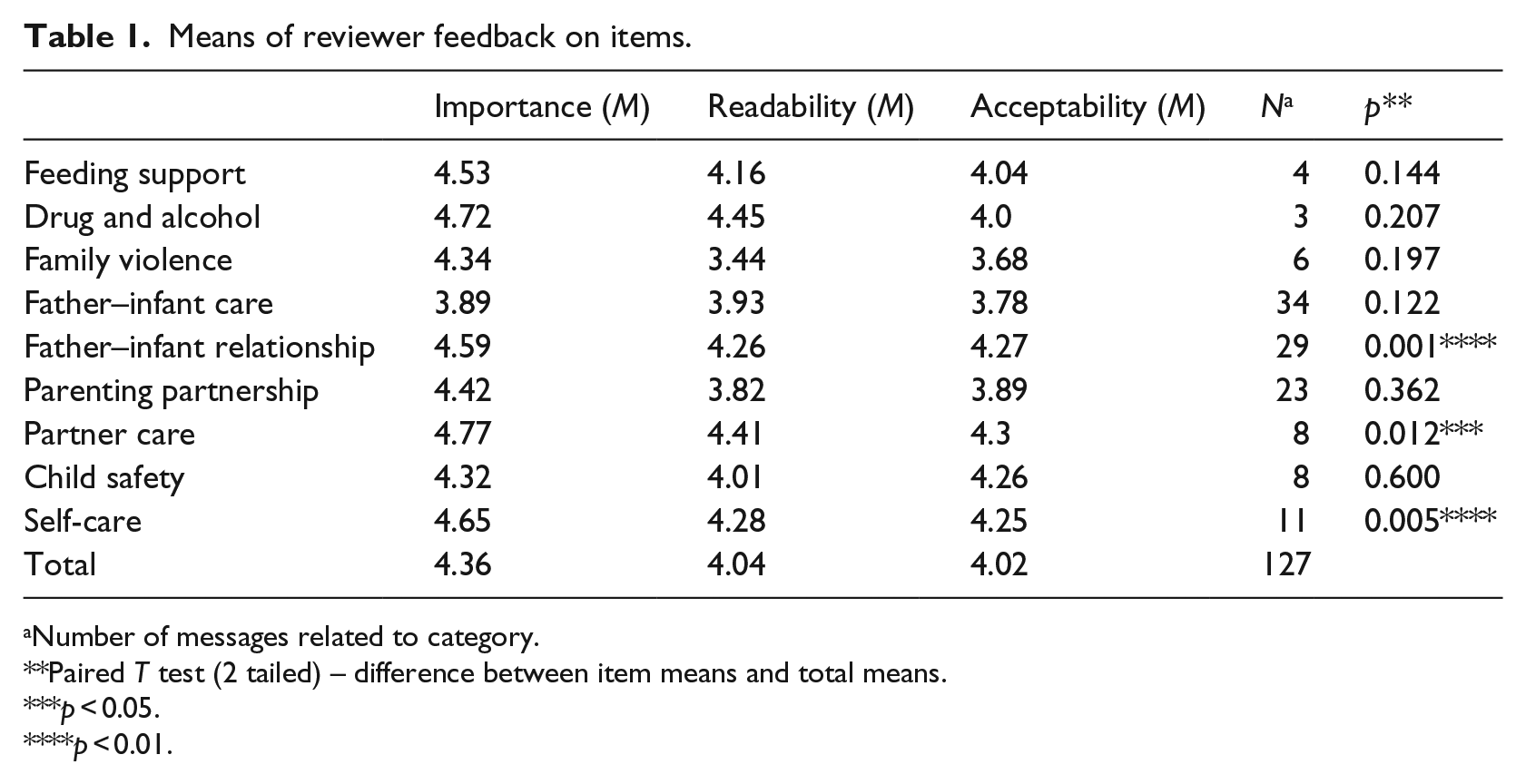
Number of messages related to category.
Paired T test (2 tailed) – difference between item means and total means.
p < 0.05.
*p < 0.01.
The greatest area of disagreement arose around four messages related to breastfeeding, which were also items that attracted the largest number of reviews (M = 9.5). Concern about these items centred on a tension between either encouraging fathers to promote breastfeeding or to support their partner’s choices. These tensions were resolved by adjusting messages to carefully address these concerns; such as the following message, scheduled to arrive 20 weeks before delivery, which was changed from ‘Breastfeeding. Good for baby, good for Mum, and good for the wallet. Let her know if you want this for your family’ to ‘Breastfeeding. Great for baby, good for Mum, and easy on the wallet. If mum wants to breastfeed then let her know you want this for your family’. A later message, scheduled to arrive after the baby was born, was changed from ‘If Mum is struggling with breastfeeding you can find ways to support her and encourage her to keep going’ to ‘If breastfeeding isn’t working out or isn’t right for mum that’s OK. Babies thrive on the love they get from their parents. You could remind mum of this’.
There were a number of other changes across the corpus of messages. One important change, as a result of reviewer recommendations, was to have as many messages as possible expressed as if they were coming from the child, either in utero or after birth. In other cases, the reviewers made small but important suggestions which improved both clarity and accuracy, for example … ‘The nurses will want to take some blood from baby’s foot to test for gene or blood disorders. Best to find out early. [Link to website included]’ was changed to ‘The nurses will want to take some blood from my foot to test for rare medical conditions. Best to find out early dad. [Link to website included]’. Although many of the changes that were made, as a result of this process, were subtle they made important contributions to accuracy, clarity, and readability of messages (M = 5.86 years of education, SD = 2.32) across the corpus. 24
Feedback from reviewers was generally very positive but there were some item groups – father–infant relationship, partner care, and self-care – that rated significantly higher than the mean of all groups (see Table 1). Items on father–infant care averaged the lowest scores on reviewer feedback, but the mean of these scores was not significantly different to the group mean.
When the revised corpus of messages, including links, was circulated to the entire reference group, with instruction to provide feedback on areas of concern regarding messages or links, 14 members of the reference group provided feedback. This was the first time that members of the group were able to see the entire corpus of messages. Feedback on this final round of reviews included only minor comments resulting in modest changes to some messages. No messages were deleted as a result of this phase in the process and only two links were redirected.
Discussion
The consultative processes employed in these phases of the project achieved the aims of developing, fine tuning, and validating a corpus of messages that could be confidently sent to new fathers during their transition to parenthood. The review process made a major contribution to the clarity of the messages through both suggestions from reviewers to make messages clearer, and the advice that reviewers gave on how messages could be better constructed. This consultative process therefore resulted in substantial refinement of messages across the corpus. The outcomes achieved through this process gave investigators confidence that messages in the corpus were likely to be important, clear, readable, and acceptable to new fathers.
A previous systematic review in the area of text message development has noted the importance of detailed documentation of the processes associated with message development in order to understand mechanisms of behaviour change.15,25 The use of the present process to expand and validate a corpus of messages adds to the literature in this field by replicating components of the process that Redfern et al. 21 applied to message development in a different context. This study found that the process was readily understood by members of the reference group and enabled them to focus their involvement to their areas of speciality. This study found the current process workable in the context of relationship-focused message development targeted at new fathers. The process has contributed to the validity of the corpus of messages by generating evidence of expert support, however; the acceptability of the messages and the effect that they have on fathers in their transition to parenthood is yet to be explored.
Limitations
Although efforts were made to form a reference group with adequate experience from a broad range of disciplinary perspectives, the quality of this group could have been enhanced by deliberately including more consumer representation. It was fortunate that many members were parents or grandparents themselves and that some of these were parents, both mothers and fathers, of younger children. The initial process of message development could also have been enhanced with a more deliberate, and therefore replicable, approach to the review of available information. Future projects on text development could develop clear and repeatable processes for the review of both the formal and informal sources of information used in the development of an initial corpus of messages.
Conclusion
The processes employed in recruiting a multidisciplinary reference group, having the group members identify their areas of interest, and seeking their feedback on a reasonably small group of messages proved to be an effective way to develop and validate a corpus of relationship-focused text messages for new fathers. The consultative process employed to refine and validate the corpus of text messages, which could be sent to new dads during their transition to fatherhood, contributed to the quality and range of messages while also providing confidence in the accuracy, readability, and acceptability of items. The messages developed through this process form the first corpus of relationship-focused text messages designed to support new fathers during their transition to parenthood.
Footnotes
Acknowledgements
The authors would like to acknowledge the contribution of the 46 members of the reference group in supporting the development of these messages.
Declaration of Conflicting Interests
The author(s) declared no potential conflicts of interest with respect to the research, authorship, and/or publication of this article.
Funding
The author(s) disclosed receipt of the following financial support for the research, authorship, and/or publication of this article: The research reported in this paper was supported by funding from Mowvember and beyondblue.