



Abstract
Current theories of bilingualism argue that the language practices of bilinguals are drawn from a single linguistic repertoire, and that enabling access to the full breadth of students’ language practices can be a vital resource for further language development. This challenges commonplace practices within English as an Additional Language (EAL) education in Australia, where curriculum, pedagogy, and assessment are predicated on monolingual (English-only) structures. Even though many teachers identify with the need to draw on students’ linguistic repertoires, a lack of pedagogical guidance can result in disengagement with this issue. As we move towards identifying and systematizing plurilingual practices, it is imperative we understand teacher stance towards the use of languages other than English in the classroom. This research, therefore, sought to explore the use of language mapping to build teachers’ awareness of their students’ communicative lifeworlds, and to reflect on their stance towards students’ languages (other than English) in contexts where the focus is learning English as an additional language. The findings illustrate pedagogical practices which go at least some way to subverting the dominance of English-only structures, as well as demonstrating that teacher positioning towards the use of first languages is dynamic in that it is responsive to changes in student context, as well as to new knowledge, as gained through the language mapping activities.
I Introduction
This article examines the teaching of English as an Additional Language (EAL) in the context of transitional English language schools in Australia, with particular attention to teachers’ awareness of languages other than English within such contexts, and their perception of those languages as a potential resource to support EAL development (e.g. García & Wei, 2014). In so doing, the study engages with the recent ‘multilingual turn’ in the field of applied linguistics which has turned attention to the potential of new pedagogical strategies in teaching English as a second or other language (TESOL) – such as translanguaging – to positively influence the acquisition of language by drawing on students’ existing skills, knowledge, and competence in their background language(s) (García & Lin, 2017; May, 2014). However, we approach this growing interest in translanguaging mindful that pedagogy – and teachers’ professional knowledge and practice – is highly situated (Cross, 2010; Johnson, 2006, 2009): what might be an ideal strategy under one set of conditions may have unintended consequences when taken up in other sites and contexts (Bax, 2003; Butler, 2005, 2011; Holliday, 1994; Hu, 2005; Kumaravadivelu, 2006; McDonough & Chaikitmongkol, 2007; Phan, 2008).
Most of the extant literature on translanguaging, at least with respect to its potential as a pedagogical strategy within languages education, has tended to focus on three broad types of contexts: immigrant students from predominantly Spanish-speaking backgrounds learning English in US bilingual programs (e.g. García & Kleyn, 2016; García, Johnson & Seltzer, 2017); community languages programs where students learn heritage languages associated with their ethnic background, especially in the UK (e.g. Creese & Blackledge, 2010; Li & Zhu, 2013); and, students’ use of languages in settings where the majority of instructional language is one other than that used beyond school, such as English-medium schooling in Hong Kong (Lin, 2013), or French immersion programs in Anglophone dominant regions of Canada (Cummins, 2007).
This study contributes to this growing body of literature by investigating how teachers perceive the potential of languages other than English within an intensive EAL environment, in an Anglophone dominant context. That is, and in contrast to the focus of a majority of other research to date, a pedagogical context in which students are often recent arrivals to a wider sociocultural setting where the classroom language is also the majority language being used beyond school (for a focus on non-Anglophone contexts, see also, for example, Mary & Young, 2017; Rosiers, 2017; Straszer, 2017). Students require a ‘working level of English’ for interpersonal and academic interaction, which is developed through a short, intensive course that aims to support transition into an English medium, mainstream school setting. We also examine the use of one particular methodological technique – language mapping (D’warte, 2013) – to assist EAL teachers to recognize the stance they hold towards students’ multilingual repertoires (García et al., 2017).
We begin by reflecting on the multilingual turn in applied linguistics and how the construct of translanguaging, in particular, has been taken up in the literature on plurilingual pedagogies for languages education. We then describe our use of language mapping as a methodological technique to build teachers’ awareness of the multilingual resources available in their contexts, followed by interviews on the extent to which teachers then saw a role for those resources to develop their students’ EAL competence. We conclude by discussing the findings that emerged from this process, and their implications for TESOL pedagogies in intensive EAL settings in the context of the multilingual turn.
1 The multilingual turn and the monolingual mindset: EAL in Australian schooling
There is growing recognition that the rapid flow of people, language, and cultural diversity characterizing this current era of globalization is contributing to new variations in how people communicate (Rymes, 2014; Taylor & Snoddon, 2013). These changes have been reflected in scholarship where the notion of language as a social practice – and the need to understand language through a focus on how language is enacted by and between people – has displaced conventional, geopolitically defined notions of ‘named’ languages (e.g. English, Japanese, Italian, etc.) as discrete, independent entities (Canagarajah, 2012; Jørgensen, 2008; Makoni & Pennycook, 2007). Rather, this evolving heteroglossic view of language ‘recognizes the multiplicity of languages and meanings in communicative interactions’ (Poza, 2017, p. 107), where the mixing of languages does not transpire in a way that suggests each language functions separately from the other, rather that languages work as one singular linguistic system shaped by ‘the social context of their interactions’ (García et al., 2017, p. 72; García & Wei, 2014).
This ‘multilingual turn’ (May, 2014) in how language is being theorized within applied linguistics and second language acquisition has important implications for teaching and education systems. Internationally, significant work has been undertaken on the practices of teachers and learners in multilingual classrooms, reframing all languages as potentially offering a rich, complex pedagogical resource to support the acquisition of new language, rather than the exclusive use of the target language (García et al., 2017; Poza, 2017). Understanding how students’ existing communicative repertoires might better support new language development has led to a shift in new pedagogies focused on what students already know and can do as the basis for language learning, in contrast to conventional teaching models centred on what students lack. This pedagogical reorientation better accords with contemporary theories of learning that emphasize the importance of building on students’ prior knowledge and capabilities (Lantolf & Thorne, 2006).
Translanguaging, in particular, has been a key concept framing much of this research. García (2009, p. 140) describes translanguaging as ‘the act performed by bilinguals of accessing different linguistic features or various modes of what are described as autonomous languages, in order to maximize communicative potential’. In other words, facilitating students to work in ways that position them as ‘power-users’ of language (Cross, 2016), with a focus on building their understanding of how their languages work together as a system. García et al.’s (2017, p. 72) orientation to translanguaging is one rooted in a critical-transformative tradition, where the goal of using multiple languages, especially learners’ home or heritage languages, is political as much as it is pedagogical: a restructuring of historical power imbalances in terms of which language(s) have assumed privilege other others.
Poza (2017), however, notes increasingly divergent views on what translanguaging pedagogy can look like in education beyond these critical origins, with his review of the literature identifying three broad categories of practice. First, those reflecting García’s original intent, with translanguaging pedagogies having wider socio-political transformative intentions; that is, to build wider awareness of how the conventional separation of ‘named’ languages and associated linguistic hierarchies perpetuates disadvantage, and to offer an alternate model that recognizes all languages as part of a single system which is to be valued in its own right. Second, those without a broader social justice agenda, but which nevertheless recognize that translanguaging can better empower learners to acquire new language by capitalizing on their existing skills and knowledge, as well as questioning the extent to which the goal of the language learner should be to emulate a monolingual speaker of the language. Third, practices that Poza describes as ‘repackage[ed] code switching’ (p. 103): the movement between what, for teachers and learners, remain distinct features of conceptually separate languages, as opposed to framing language, language use, and language learning as being the capacity to work with all of the language resources available to the learner as an holistic, interrelated system for meeting their needs. Conflating codeswitching with translanguaging in this way is problematic, in Poza’s view, for its failure to challenge the imperialist, race-, and class-based ideologies perpetuated by language standardization (see also Makoni & Pennycook, 2007).
Possible orientations towards heteroglossic approaches in education in the Australian context is highly situated, and intimately linked to the underlying education system and socio-political context. Australia’s population is characterized by a high degree of cultural and linguistic diversity, with nearly 49% of citizens either born overseas, or having at least one parent born overseas (Australian Bureau of Statistics, 2017). More than a fifth of Australians speak a language other than English as their main language at home, with even higher concentrations in metropolitan areas such as Sydney (38%) and Melbourne (35%). Yet, in contrast to this linguistic diversity in the wider society, the conceptualization of language and literacy in policies around curriculum, pedagogy, and assessment that make up the Australian education system is resolutely monolingual in orientation (Schalley, Guillemin & Eisenchlas, 2015). Although Australian language policies have, at times, been innovative and expansive, more recent policies have become increasingly restrictive and assimilationist in their focus and intent. The National Policy on Languages (Lo Bianco, 1987), for example, promoted greater learning of and support for languages in schools and the community and celebrated Australia’s linguistic diversity. Subsequent policies, on the other hand, have become more narrowly focused with outcomes in English literacy being designated key national benchmarks for determining educational attainment (e.g. Moore, 1995; Simpson, Caffery, & McConvell, 2009), with Schalley et al. (2015, p. 170) arguing that ‘the more multilingual Australian society has become, the more assimilationist the policies and the more monolingual the orientation of the society politicians envisage and pursue.’
This ‘monolingual mindset’ is stark within the Australian education system (Hajek & Slaughter, 2015), where policies that inform curriculum, pedagogy, and assessment are predicated on English-only assumptions which ignore the broader range of language and literacy resources that students who learn English as an additional language bring to that learning (e.g. Cross, 2009; Macqueen et al., 2019). These monolingual assumptions are perpetuated, in part, by a close mapping of the EAL curriculum with the English (mother tongue) curriculum in its structure and outcomes, alongside a conflation of first and second language acquisition (Alford & Jetnikoff, 2011; Simpson et al., 2009), and an increasing lack of a professional recognition of the specialist skills and knowledge that EAL teachers bring to multilingual school contexts (Cross, 2012; Hammond, 2012). In short, the principles which have come to underpin policy in Australia view the use of any language other than English as a ‘zero-sum game’ (Lin, 2013, p. 524): an unnecessary distraction that reduces exposure to the target language being learned, which in turn reduces students’ opportunities to learn that language. This view holds that target language exposure correlates with target language learning, and that teaching and learning endeavors should focus exclusively on use of the second language (Lin, 2013). Transition to English (as an additional language) should be through English (as the only language).
2 Transgressive possibilities: Teacher agents, policy enactments, and pedagogic practice
Although our focus thus far has been policy settings within the Australian education system, the implementation of policy depends on its interpretation at the classroom level: teachers can be the ultimate point of departure for education policy (Lo Bianco, 2010). While policy can position certain forms of linguistic and cultural knowledge as more valuable than others, Lo Bianco argues that the decisions teachers make choosing curriculum content, and how they implement pedagogical practices, ‘ultimately constitute an enacted language and literacy policy’ (p. 165).
This role of the teacher ‘as a historical, sociological agent within larger (and political) contexts’ (Cross, 2010, p. 434) is therefore of central interest in this research, located in an English Language School that aims to prepare emerging English speakers for entry into a mainstream system where English monolingualism is the default orientation for teaching and learning. With these contextual and policy settings suggesting the use of English only in the classroom, the agentive role of the classroom teacher is of particular interest in how they see languages other than English having potential value and a role in such a setting. Once the different kinds of resources that exist within their classroom are brought to their attention – through the language mapping process we describe below – we seek to understand:
Teachers’ positioning towards the use of first languages (L1) in the EAL classroom, and how their practices sit relative to Poza’s (2017) three categories of translanguaging (i.e. critical-transformative, learning-oriented, or code-switching); and
How this professional position/knowledge is informed by their sociocultural context for practice, and individual histories and experience.
In addition, we also seek to examine:
3. The impact of language mapping as a methodological technique in raising teachers’ awareness of languages other than English, and how this can lead to changes in practice.
II Research site, design, and methods
This research took place in an English Language School in the State of Victoria, Australia, attended by newly arrived students who receive either 12 months of English language instruction (along with skills to assist with general learning) if they are from refugee backgrounds with disrupted histories of schooling, or six months of English language instruction if they are international students or migrants (with typically intact histories of schooling), before moving into the mainstream education system. The school caters for primary and secondary school-aged students whose English language skills are on a continuum from genuine beginners, who have never learned any English prior to arrival, to those with English language and literacy skills close to typical peer competency. The school has rolling enrolments, meaning that students can enter school at any point in the year, within six months of arriving in Australia, and can be with the same class and teacher for as little as a few weeks, and up to 20 weeks (i.e. a semester). Class groups are culturally and linguistically diverse and typically have between 12 and 16 students, with a high rotation of students across classes, as well as in and out of the school. Within this highly multilingual context where all students are English language learners, students are taught by expert teachers with specialist EAL qualifications, a majority of whom self-identify as monolinguals in English.
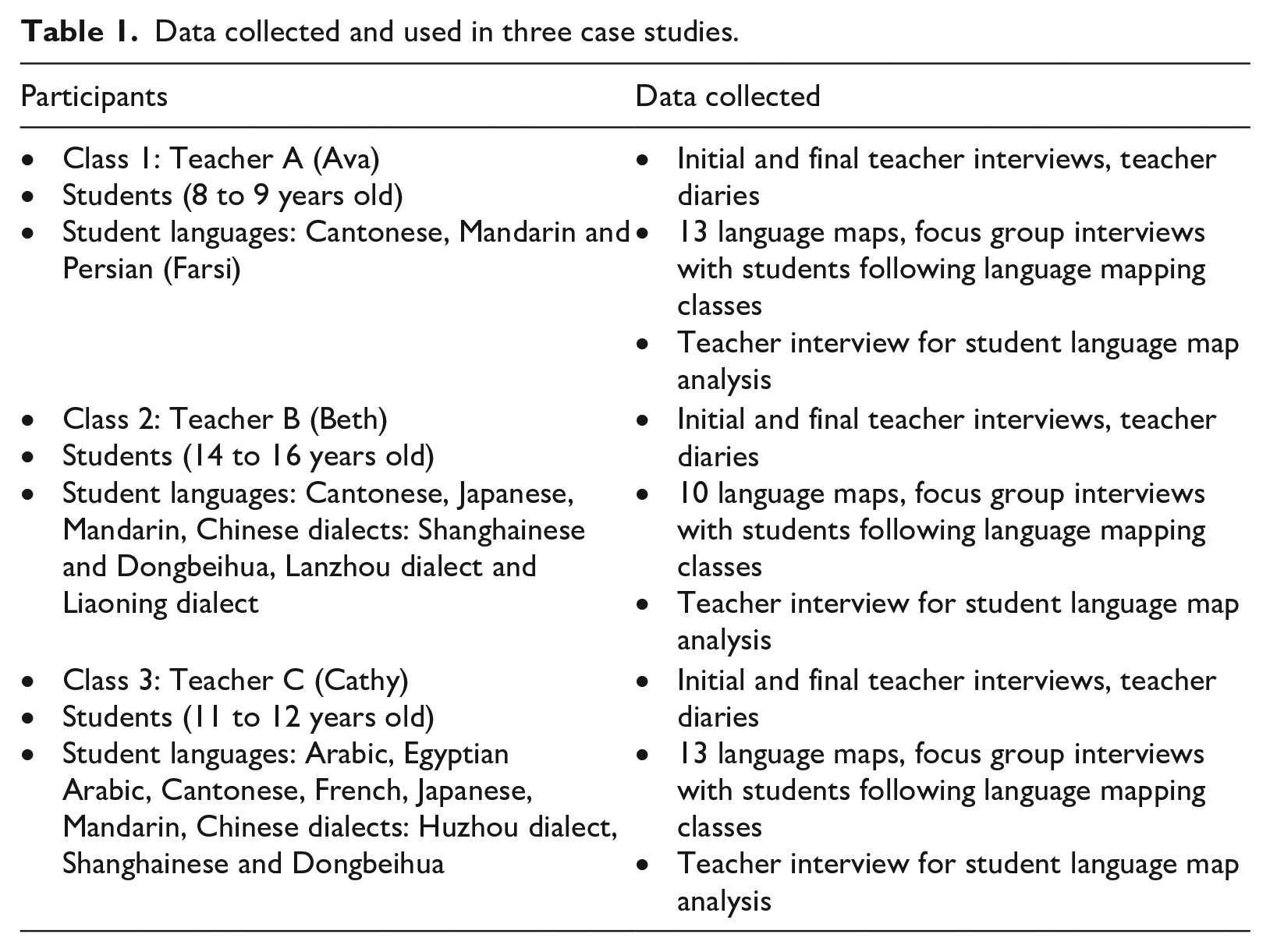
The first phase of the project involved a professional learning seminar, open to all teachers at the school site, focusing on recent theorizations in second language acquisition to explain the aims and purpose of the broader study. Twelve staff members attended the training, with seven teachers requesting to participate in the remaining phases of the study, with the focus of this article being three of those teachers (see Table 1).
Data collected and used in three case studies.
The second phase of the study involved interviews with each teacher about their own communicative repertoires, their prior experience of teaching and learning language, their existing knowledge of their students’ communicative repertoires, and their current beliefs about the place of students’ other languages in the EAL classroom. The third phase then introduced language mapping as a tool to raise teacher awareness of their students’ communicative repertoires. Language mapping draws on D’warte and her colleagues’ (e.g. D’warte, 2013, 2014; D’warte & Somerville, 2014; Somerville, D’warte, & Sawyer, 2016) use of linguistic ethnography to research what students and their teachers can learn from documenting and sharing their own linguistic practices with each other. In this study, we move D’warte’s application of language mapping in multilingual, multicultural mainstream classroom communities into EAL intensive classrooms.
Language mapping involves detailing everyday language practices, both in and outside of school, through the creation of visual representations, such as geographical maps, organizational schemas, or text and picture-based depictions of language use (D’warte, 2013). Creating a visual representation of a communicative repertoire is a complex, abstract activity which needs scaffolding, particularly in an emerging English language context where some students have been in Australia for as little as two weeks. In this study, we provided guiding questions and visual materials (e.g. pictures of people students might communicate with, places they might use languages at, or activities they might use languages for) to prompt responses that could then be used to construct each map. Visual aides were based around each question (following) and were tailored to the cultural backgrounds of the students:
What languages do you speak?
Who do you communicate with? With which languages?
How do you communicate with people? For example, talking in person, text messages, skyping, emails, etc.
Which languages do you use in different locations? For example, at school, at sport, at church, with family, at the shops, at the doctors, at language school, etc.
What do you do with language? For example, help my parents with the shopping, talk with friends, read books, watch movies/TV shows, homework, etc.
To familiarize students with the task, the first attempt at creating a map was done in small groups, leading to the creation of group maps. The following two classes then provided time for students to work on individual maps, with students encouraged to use any language they wished to create their own individual maps. Once maps were completed, focus group interviews were conducted with students where they provided elaboration about each of their maps in a group, with students from the same language background assisting each other to provide explanations in English. Multilingual aides within the school and Farsi, Mandarin, and Cantonese-speaking co-researchers helped translate for students when required. In total, 73 language maps were collected with 36 of those maps informing the analysis discussed in this article. 1
The fourth phase of the project began with teacher analyses of their own students’ translated language maps, augmented with information from the student focus group interviews. To scaffold their analysis, teachers worked in pairs to discuss their maps, with a request that they sort their maps into what they saw as ‘meaningful groups’, and to consider on what basis they saw the maps in each group having a meaningful relationship. Teachers were then asked to maintain a diary for a week, with a daily reflection about whether anything they had learned from the language mapping analysis had influenced any pedagogic choices in classes that day. Specifically, teachers were asked to consider:
Whether any knowledge gained from the mapping exercise informed or changed their teaching, however subtly; and
Whether teachers did anything differently in planning, organizing activities, or in how they interacted with students, and why.
These diaries were then reviewed by the research team to inform questions for a final project interview with each teacher, about what they now knew of their students’ language resources, and whether they saw this knowledge having an impact on their approach to teaching in this EAL setting, and the reasons why or why not.
Below we present narratives for three of these teacher case studies, with reference to the teachers’ prior practices, how informative the language mapping exercise was for each teacher, and its impact on teaching practices. These three cases were chosen as they presented interesting points of contrast in the teachers saw as the potential of the L1 in this setting, given their own experiences and histories, as well as their interpretation of their current context and students’ needs.
III Analysis
Class 1: Bringing voices to life
The teacher of Class 1, Ava, is a qualified primary school teacher with a post-graduate diploma in TESOL. Ava started as a generalist primary school teacher in a regional (non-metropolitan) location, working with Indigenous children who had greater difficulty in accessing the curriculum than other students. She then moved to a metropolitan school where large influxes of refugees from Vietnam, Serbia and Croatia with no English were placed in her school and her classes. These teaching contexts focused her interest in working with students from an EAL background and led to her eventual move to an English language school. Ava, who describes herself as monolingual, is a strong believer of students’ L1 as a valuable and important resources to bring into the classroom.
Ava’s class consists of newly arrived students from 8 to 9 years old, equivalent to the middle primary level (Years 3 to 4), with little or no English language skills (Equivalent to the Victorian EAL continuum levels BL to B1; Department of Education and Training, Victoria, n.d.). As her students are migrants, not refugees, they receive 20 weeks of tuition before moving into a mainstream school. As the students enter her class with little English, Ava focuses on allowing any practice into the class that builds the confidence of her students as ‘I find that it can be a humiliating classroom, the second language classroom’. She brings in a range of activities so that students can showcase their L1, ‘and they’re proud of that too. And I like to build on that’. Examples include bilingual reading where students read the book in their L1 and Ava reads it in English; writing in their L1 as well as English, and singing in their L1.
In parent teacher interviews, often mediated by translators, Ava reports that parents identify the critical role of their children in brokering for them in multiple contexts in their daily lives and tries to create space for this skill to develop in class. As she explains, I currently have one student in particular, who’s our go-to bilinguist in the room, and it gives them a lot of confidence, I think. Just watching them flip between languages. I think it helps both languages. I think it helps his English and it helps his first language . . . everybody goes to [him] for interpreting, or explanations, or elaborations, or, I can see how he’s really concentrating really hard, trying to get their words, and he’s thinking about their first language conversation that he’s having with his peer, and then working really hard at how he’s going to then talk to me about that in English.
The introduction of the language mapping activity with students at this level of proficiency can be challenging as the technique depends on relatively abstract questions as prompts to stimulate students’ thinking about how, where, when, and why they use different languages for different purposes in their everyday lives. In addition, this type of student-centered activity was not a familiar educational experience for some students. Ava revisited the main question words over several lessons and undertook the group and individual language mapping activities when a Multicultural Education Aide (MEA) was available to support her in class. MEAs work closely with EAL teachers both in English language schools and in mainstream schools with EAL students and typically speak one or more languages of the student cohort.
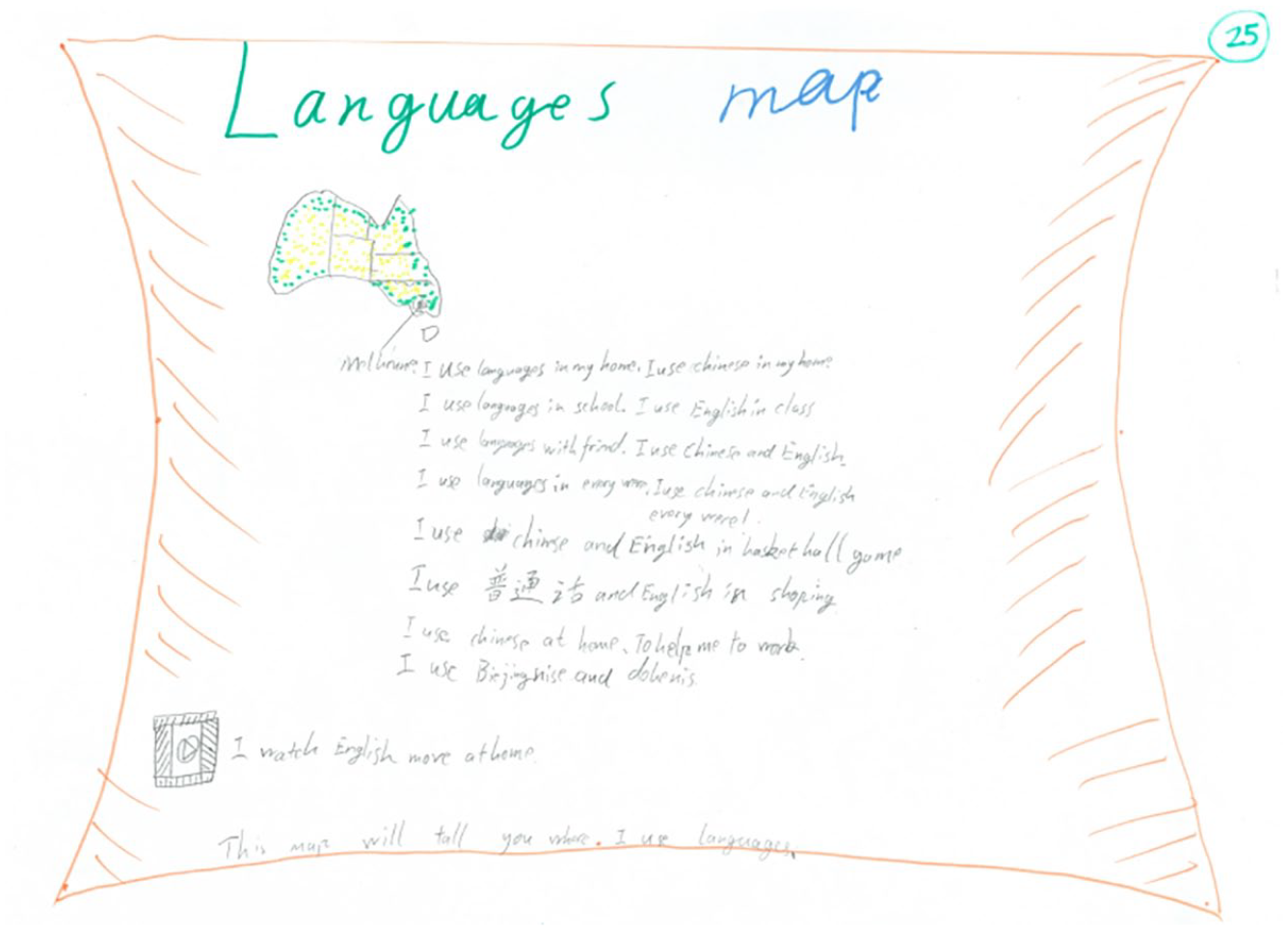
Ava reflected deeply on the language mapping experience and the implications of her analysis for her classroom. She focused on several keys ideas around the notion of transition to Australia and the Australian education system as ‘silencing’. The first point that she noticed when analysing the maps was that students were hesitant to identify as English language speakers, even though most students used some English on their maps and in explaining their maps (as examples, see Figures 1 and 2). The lack of identification with English in the maps indicated an inward-looking experience of family life for many students, with limited friendships and outside school activities (such as sporting clubs) at this early stage of their transition to Australia. Ava was ‘shocked’ at the lack of English usage in the children’s lives, but also at the lack of L1 use as well. The maps showed an absence of family members and, in further investigating the children’s lives outside of school, Ava discovered that many students had left family members behind and were quite isolated. Ava elaborates: I found out a lot more about them when they started speaking about their houses. And you can see it too, how isolated a lot of them are when they draw their pictures. Especially they feel very isolated here in Melbourne . . . So I found that quite profound. And, which was obviously a lot of them were quite lonely here and not using very much language at all even, not even their own language in fact because a lot of them don’t have siblings and spend a lot of time on their own . . . I was shocked at that . . . I’ve since discovered quite a few grandparents are looking after my students so that’s another reason perhaps why they don’t have quite the level of conversation and life outside school that I would expect.
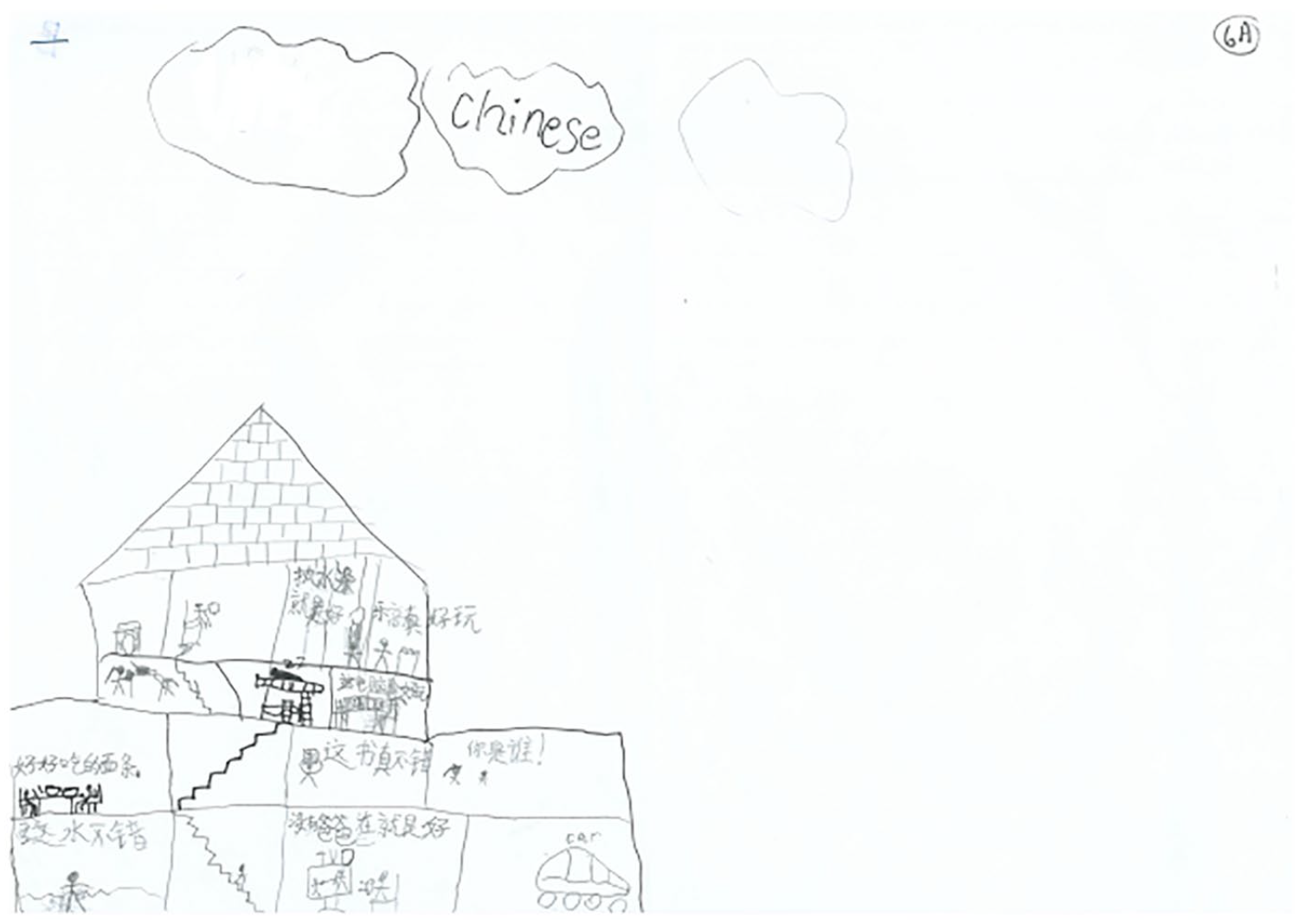
Sample map 1, class 1: Middle primary level.
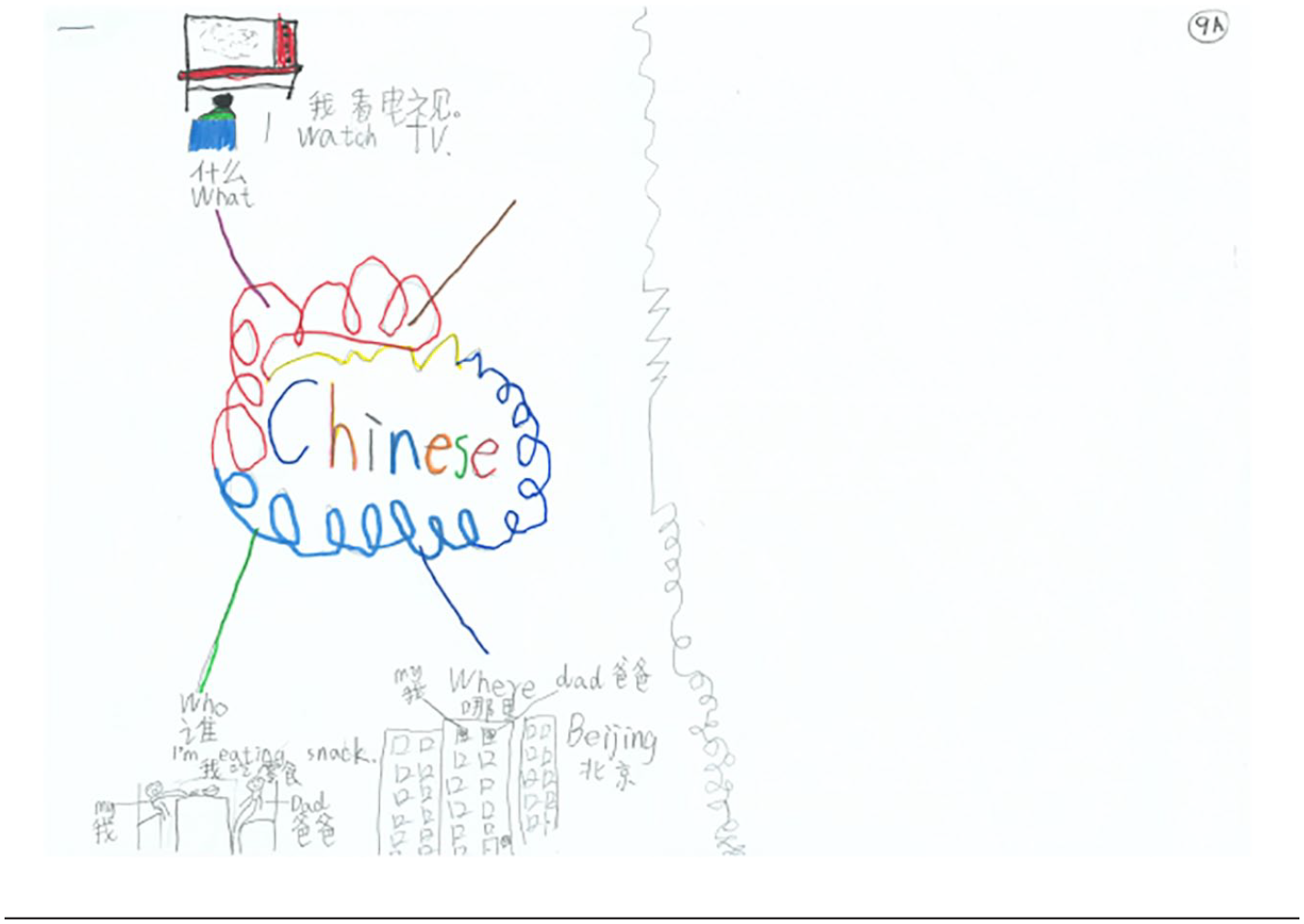
Sample map 2, class 1: Middle primary level.
In reflecting in her teaching journal, Ava decided that she needed to focus on both bringing the students languages into the class more, as well as making more connections with students’ background knowledge and prior experiences so that students could connect their L1 learning experiences and skills with their learning of English. Ava also noted the disjuncture between the ease of students communicating among themselves and formal structures she taught in English, observing: The way they drew and spoke in their own language which was all very relaxed sort of language, casual sort of language, and I thought, perhaps I don’t do quite enough of that in English. To take away, perhaps a bit more for these ranked beginners, to take away the formalness of learning English. Have it a bit more spoken-like which is a springboard to something else.
Ava noted a wide range of small changes that she brought into her teaching which followed through on the points she noted in her journal. For example, on an excursion to the zoo, rather than pairing students with speakers of other languages as she had done in the past, she paired same language speakers together. This resulted in greater engagement with the excursion since it allowed deeper discussion of the zoo experience between students in the L1, which then transferred into negotiated English conversations during subsequent whole class and teacher–student discussions. As she explains: I normally would have stopped them from doing the other [using first languages], or not stopped them, but discouraged it definitely. And they had things that they wanted to share, ‘Oh, we saw that in China’, and they wanted to talk about stuff from home and again I’d already thought, maybe I better do a bit more, spend a bit more time on that, and so we’d talk about . . . we ended up talking about other zoos in other countries and I just thought that they were just a bit more engaged with it and they were excited to talk to me about trying to find the words about what they wanted to share.
To write an exposition about the zoo excursion back at school, students were again encouraged to work in same language groups, where possible, of two to three students. Although they did not have enough English to express everything they wanted to say, the students sought assistance from the teacher on meanings and translations, as well as using bilingual dictionaries and Google Translate, to find the language to express their ideas. Ava recounts, for example: They asked me for a lot of words like ‘What does this mean?’ you know, they wanted to have a lot of things interpreted, they used Google Translate a lot to get things like, you know, like conservation and things like that that they didn’t know the English word for and then had to explain to me too . . . They haven’t got enough English to explain what they’re trying to say with ‘threatened species’ and things like that. But I thought that working with the group, being able to do that in their own language first, was really good.
When undertaking report writing about marsupial animals, Ava started as usual, with oral engagement with the students, drawing on their L1. However, she then added in the step of having students write down all the words in their L1, with the assistance of bilingual dictionaries and Google Translate, before having them write the words in English. Writing in an L1 was also encouraged in the building of phrases, expanding into full sentences, allowing, Ava argued, students to develop greater confidence in their language learning journey by bringing the L1 along as English was being introduced. Although a small step, Ava felt that giving the students the chance to write their language down, as opposed to a brief oral discussion about equivalent words for marsupials in their languages, had a significant benefit in the final production of the reports.
Class 2: Context is important, but first languages always have a place
The teacher in Class 2, Beth, is an experienced teacher with qualifications in primary school teaching, as well as a Master of TESOL. Beth has taught across a wide range of teaching contexts including in primary level classes in highly multilingual, low socio-economic status schools in Australia, as well as in India, before returning to Australia to teach in English language schools where she has worked extensively with refugee students from Sudan, Afghanistan and Myanmar (Burma). Beth only speaks English fluently, but has learnt Indonesian at school, has picked up bits and pieces of languages as she has travelled, and speaks Italian as the language of cooking with her family. Her class consists of 11- to 12-year-old students, predominantly from China, who will transition into Years 5 or 6 at the upper primary level. Their level of English is higher than that of students in Ava’s class and they are, for example, increasingly able to communicate in English in ‘predictable social and learning situations, understanding some decontextualized English and expressing simple messages in basic English’ (B2 to B3 levels; Department of Education and Training, Victoria, n.d.).
Beth believes that all languages have an important role in the EAL classroom and that denying access to their L1 denies students access to their prior knowledge and learning tools. However, having predominantly worked with refugee students but more recently with migrant students from non-refugee backgrounds, Beth believes that context greatly effects decisions around L1 use in her classrooms, both for her as a teacher and in how her students use their L1. When working with refugee students, Beth argues it is critical that she gets to know her students, their level of experience with schooling, and what conceptual knowledge they bring to the English language classroom. For example, Beth developed L1 assessment tools for her refugee students, with the assistance of MEAs. The tests allow Beth and the MEAs to understand what concepts students have been exposed to, including for example, counting systems, alphabetic systems and how time is determined (e.g. the crow of the rooster as a major marker of time in the day), so that they can build on this knowledge in their language classes. Beth argues it is important that even in highly multilingual refugee classes that students get to use as much L1 as necessary, even if students are the only speaker of their language: Well because my belief would just be that I just want them to make connections. So it’s not necessarily about them sharing it with everybody but it’s just about their individual brain power and making those connections with their prior knowledge and their new knowledge. And forming an association and a connection between that. And so simply, you know, we’ve got small classes, so it would just be whenever we’re covering what we are ‘Oh, tell me in your first language’ and hearing those five different words as well as the English . . . I feel it complements their learning and getting them to make that connection.
This extends to Beth strongly supporting the continued use of first languages at home in the belief that the socio-emotional benefits will support English language acquisition at home. In Beth’s own words: I know that’s something that I’ve always emphasized, and still do, that they should always use their first language within the home environment. You know a lot of the parents here say ‘Oh, I’ll try and use English with them to help them get better results’, whereas I still believe that they should use their first language because it’s important for them to have the capacity to communicate fluently and to build the strong relationship connection with their family . . . and good relationships within your home environment will help you learn your L2 [second language] at school.
Working out how to ensure L1 use is beneficial for her high-ability migrant student cohort is an ongoing process for Beth. These students are highly literate with extended schooling experiences before they entered the English Language School and therefore have much of the conceptual knowledge required for schooling. Beth finds that her students tend to predominantly use their first languages in the classroom and have a functional relationship with English where they are focused on just getting the answer right. Beth still employs many of her techniques such as including bilingual reading, the use of translations by an MEA and the use of digital bilingual dictionaries and bilingual vocabulary maps; however, she changes her approach depending on whether she feels it will be beneficial for the students’ language learning. Beth highlights below, for example, the importance of being selective when working with L1 and text types to avoid confusion due to assumptions about prior knowledge and cultural norms: One example was last week where I was using some L1 working with an MEA – we were looking at genre, text types – because they’re educated and they’ve got an understanding within their education system, they’re 12 years old, they’ve been exposed to it throughout their primary education . . . If we were to use their L1 to talk about text types, then they would actually get all of their understanding of genre and attach that to what we are presenting here in our Australian context as text types, and that’s going to be confusing because they’re different, the way those texts are constructed. So because they’ve been educated I’m probably more selective, I suppose, in how I use L1.
Given the short period of time Beth has with her students, 10 weeks with her current class, she is conscious of the fact that they are about to enter school at the Year 7 level but are reading at around a Year 2 to 3 level, she is focusing on reading strategies that students can use to understand text, including how first languages can assist in the decoding of text. Students have created a reading strategies poster that they contribute to each week, including L1 strategies, and when she works with these texts she explains: [I highlight and make] sure they’ve got the language and the awareness of strategies . . . so we always ask them ‘When we were reading this text, what was helpful for you? What did you do?’ and then each week we just make that list grow and grow and then we refer back to it . . . we just get them to intentionally think through and talk about the thinking processes of how they use their L1 to decipher the meaning and comprehending the text and getting them to draw connections between those words.
In undertaking the language mapping activity (as examples, see Figures 3 and 4), Beth did not feel that she had made any changes to her approach in class as she was already given considerable thought to the differences between her previous refugee cohorts and current migrants cohorts and how her use of students’ L1 needed to change as well. The diversity of dialects within the student group, both for the Chinese-born students and the Egyptian-born student was an interesting revelation for Beth, but what was most surprising was the reluctance of students to discuss their use of dialects. Beth suggested that this was possibly due to some students lacking metalinguistic awareness and understanding of their own practices, while for other students, an awareness of the social implications of hierarchy across dialects may be behind their reluctance to discuss their family dialects. The use of the language maps did reaffirm Beth’s position as to the importance of MEAs in the classroom, of students negotiating and assisting each other in their L1, and students’ first languages as assets in supporting learning and thinking processes.
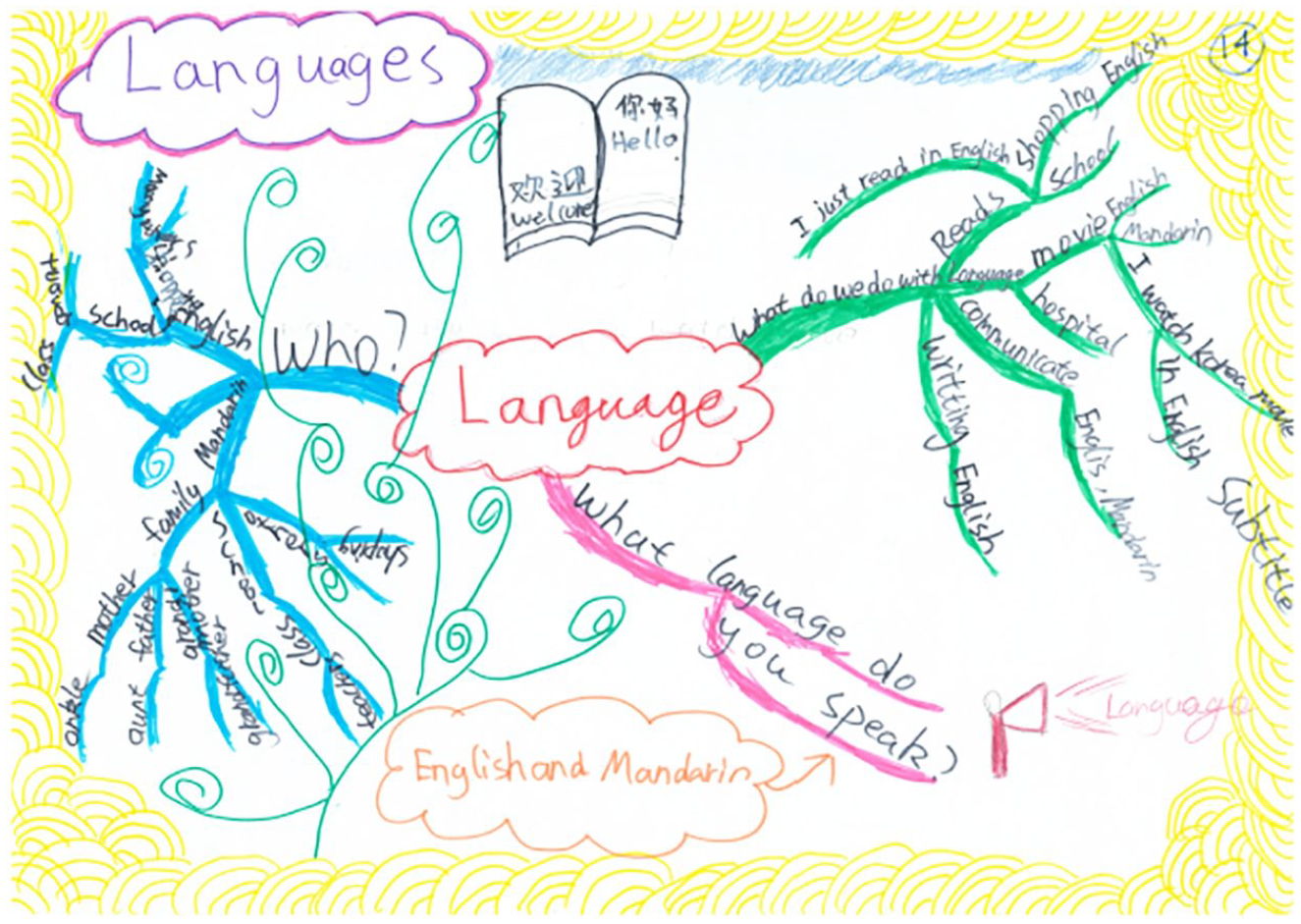
Sample map 3, class 2: Upper primary level.
Sample map 4, class 2: Upper primary level.
Class 3: Understanding the breadth of communicative repertories
The teacher of class 3, Cathy, is an experienced secondary school teacher with preservice training in the curriculum areas of Mainstream English, TESOL, and French, as well as having completed further research-based postgraduate studies in TESOL. Cathy’s class consists of secondary level students, 14 to 16 years of age, from a lower intermediate to advanced level of English (Levels S2 to S4; Department of Education and Training, Victoria, n.d.). Students in Cathy’s class are all from China and staying with host families with small groups of other Chinese international students, or with guardians in Australia. Having worked as a mainstream secondary teacher in a regional school with EAL students, Cathy is conscious of the language and study skills EAL students most need when they arrive in mainstream school and tries to focus on these issues in her lessons.
In her classes, Cathy is supportive of the use of languages other than English and encourages students to draw on resources such as bilingual dictionaries (through smartphones), creating bilingual vocabulary lists, and creating and using digital bilingual flashcards, although Cathy also puts a strong focus on building in a range of strategies before translation, such as encouraging students to develop their own understandings of words by guessing in context, using prefixes or place in the sentence to aid understanding, and then, if needed, as a final step, move onto translation with fellow students or by checking with bilingual online sources to confirm their understanding of concepts or vocabulary.
Students in Class 3 produced a significantly different style of maps compared to the other two classes reported here, with greater use of text and icons (as examples, see Figures 5 and 6). The maps also revealed rich and diverse social lives with both family and friends, mediated through a range of social media technologies.
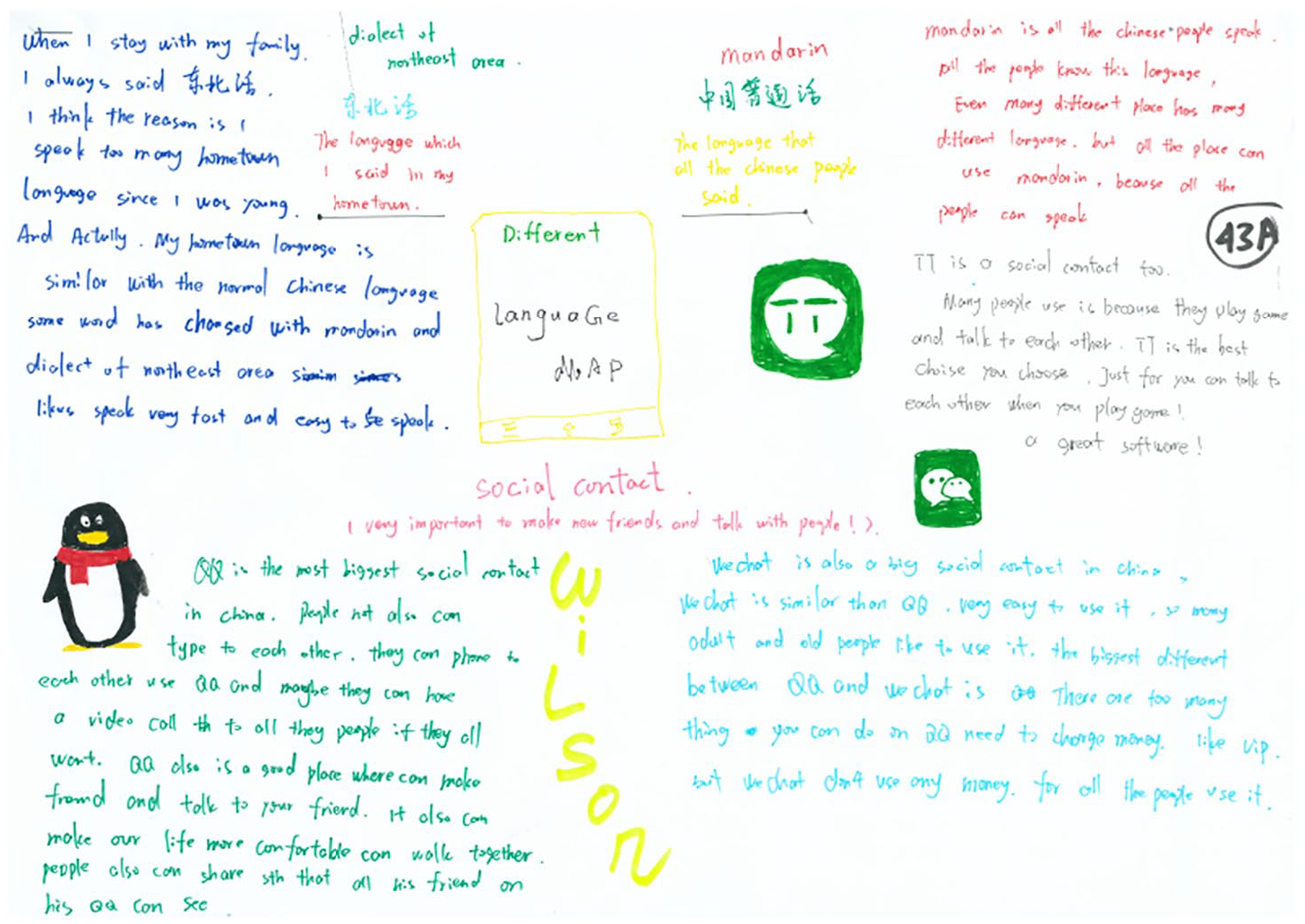
Sample map 5, class 3: Upper secondary level.
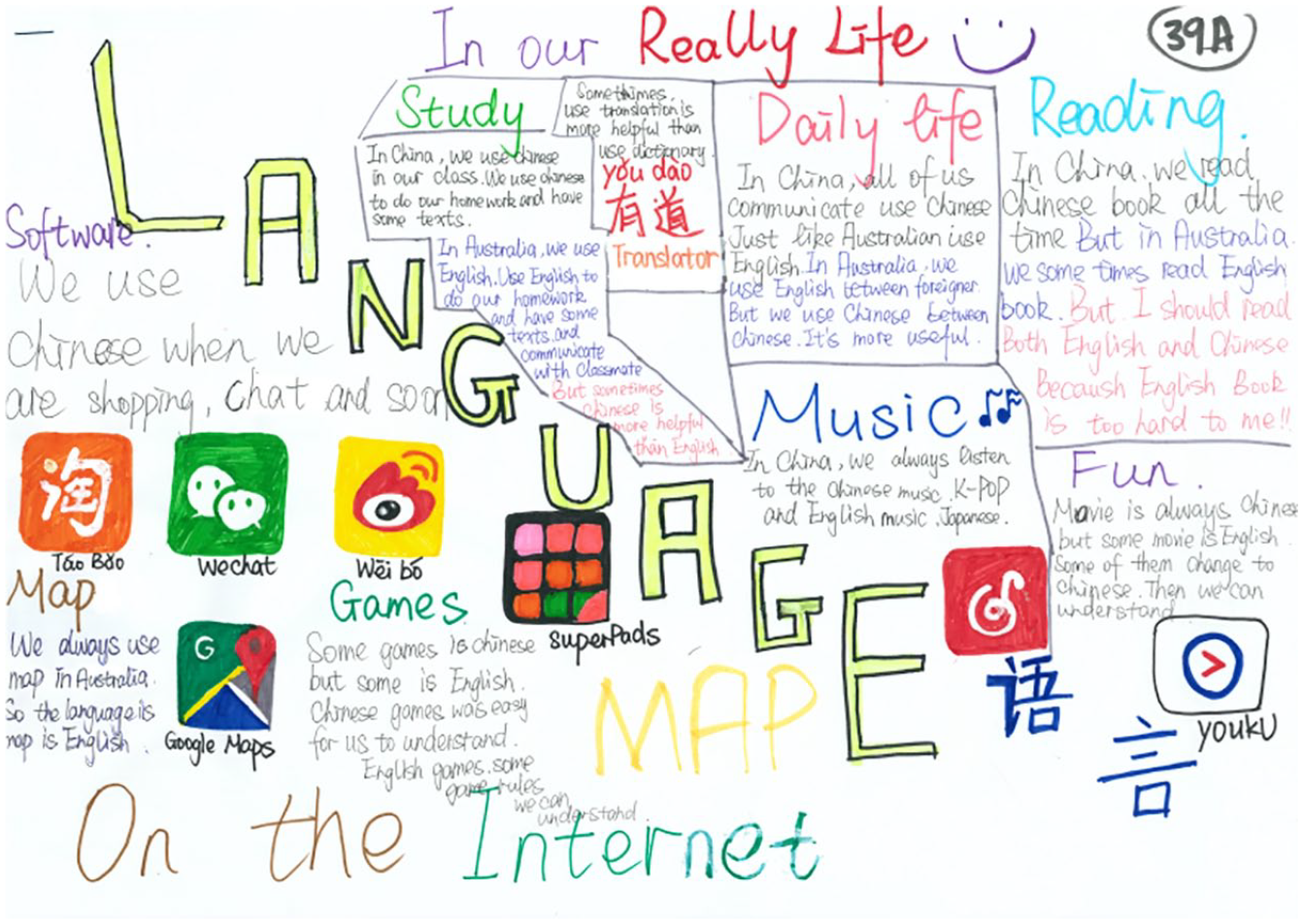
Sample map 6, class 3: Upper secondary level.
Cathy’s analysis of student maps focused on highlighting the importance of understanding students’ whole linguistic worlds, both inside and outside the classroom so that a tailored response could be developed for her students. One of the most interesting insights for Cathy was the limited use of English for interpersonal communication outside of the classroom and, for some students, their sense that English is a language learnt for use in the classroom, but not as a means of everyday communication. Outside of class, the maps revealed that for some students there was only limited, functional use of English, while the use of their other languages were a rich part of their broader social life. This led Cathy to reflect: Probably the most interesting insight for me was how their use of English outside the classroom is reasonably limited. That they are using it, they are in Australia but they’re using it in these very functional ways. And it really got me thinking you know we talk a lot about the differences between an ESL context and an EFL context and you know sometimes I feel that some of our students here are half way between, because they are, particularly if they are living in a suburb where there’s a big Chinese community then they’re not getting total immersion. So that made me think well I just need to really give them as much practice, like intensive English-speaking practice, in the classroom as I can. Because they’re not necessarily to the same extent as students from other language backgrounds getting that constant practice and immersion outside the classroom.
Cathy argues that she has a responsibility to provide the type of training and support that students are not necessarily going to receive in the mainstream school setting. With strong metalinguistic knowledge, her students are able to understand complex grammatical knowledge more easily than other students, and they rigorously complete written homework, often asking for more. The limited use of spoken English was a concern however, particularly as Cathy’s experience at the mainstream secondary level had shown her that students cannot share and develop their knowledge if they cannot communicate their ideas. As Cathy elaborates, for example: They need to be taught phrases for responding to other students during class discussion (e.g. ‘That’s a good point’) and for expressing disagreement in a polite and nuanced way (‘I see what you mean, but . . .’). Otherwise they can’t access the discussion, and their wealth of knowledge remains locked away in their heads!
As a result, Cathy has made small changes to bring a greater focus to speaking in English into the classroom, and to give students exposure to a wider range of functions and registers for spoken English. For example, Cathy made a shift from often starting lessons with a writing task, to starting with a speaking activity so that students can practice and have time to think about language before starting writing. In addition, Cathy is also working on moving students away from the practice of always reverting to Mandarin for conversations in class, rather than persevering in English. Although she recognizes the importance of students both in EAL and mainstream contexts being able to verbally conference with other speakers of Chinese languages and dialects, particularly when students are seeking clarification from each other, she believes it is a good habit to push for this particular group of students. However, Cathy argues that for future classes, she would review all decisions around language use for each new group and make decisions in the context of students’ broader language lives, rather than just the classroom.
Overall, Cathy found the language mapping exercises informative from her own perspective but, on reflection, believes it would have also been beneficial for students to explore some of the ideas that she considered after analysing the maps, such as the use of languages across domains. In this way, students would have a greater awareness of the strengths and gaps in their language learning activities and could better understand her decisions around language use in the classroom.
IV Discussion
As the application of translanguaging as a pedagogical frame has moved across diverse educational spaces, its underlying intention and affordances has also transformed and changed. Poza (2017) argues that translanguaging as transformative pedagogy seeks to offer alternative models of education to those that stigmatize and separate minority languages from the lived experiences of students (e.g. García, 2009). However, Poza notes that translanguaging has also been positioned without a broader social justice agenda, focusing on allowing students to capitalize on their existing skills and knowledge as they acquire a new language. The third approach Poza identifies across recent research is one that focuses on code switching, or the movement between distinct language systems without drawing attention to interconnections between linguistic resources.
As is apparent in Poza’s review of translanguaging research, orientations to heteroglossic approaches in education are highly context dependent. We also argue, however, that although teachers are subject to the constraints of any education policy context, the pedagogical choices they ultimately do make constitute enacted language and literacy policy (Lo Bianco, 2010), including choices that help determine the position and value of linguistic and cultural knowledge. This research therefore sought to explore how language mapping might help build teachers’ awareness of their students’ communicative lifeworlds, and then reflect on their pedagogical stance towards students’ languages (other than English) in contexts where the focus is learning English as an additional language.
Although the educational purpose of English-intensive schools is to develop students’ English language skills, the three teachers examined in this article employed intentional pedagogical choices that ultimately softened ‘hard’ boundaries between English as ‘the’ medium of instruction, and students’ broader linguistic repertoires. All three teachers demonstrated strong personal beliefs, based on their professional and life experiences, about the importance of first languages in the EAL classroom, while also voicing important contextual reasons for their pedagogic choices. While their teachers already incorporated a number of strategies and activities that were mindful of students’ first language, the findings of this research demonstrated that their position on the use of the L1 is dynamic, in that it is responsive to changes in student context, as well as to new knowledge, as gained through the language mapping activities that formed the intervention in this study.
Ava, for example, already included a range of bilingual activities in her classes and sought to position students as holders of knowledge, allowing opportunities for students to bring their languages into her classes in a respectful and enjoyable manner. However, for Ava, the languages mapping resulted in greater awareness of how the transition process impacted her students; namely, one of ‘silencing’, as some students struggled with separation from family members and isolation in new home contexts. Her changes in strategies in the classroom were designed to assist students to regain their voice(s), in any language, through micro-targeting of languages from a visual and word level, through to the discourse level.
Beth did not draw on the language mapping to inform changes to her own pedagogic approach but used it to deepen existing professional knowledge and discussions with peers about differences between the needs of students with disrupted schooling and those with extensive schooling experiences, and how first languages could be best utilized in each circumstance. For students with interrupted schooling, accessing first languages play a crucial role in helping Beth to understand her students and their prior experiences, while for the students, accessing first languages assists in drawing upon relevant conceptual knowledge and schooling experiences as they build their English language skills. For educated migrant students, given the short amount of time Beth may have with these students, greater focus is placed on strategies to help students decode text and access information once they are in the mainstream system, including how first languages can facilitate these processes. The use of first language was negotiated in part with the MEAs in order to ensure that its use was as beneficial as possible given the conceptual knowledge that already existed.
At the secondary school level, Cathy also focused on the importance of tailoring responses in relation to first language use to each cohort. The depiction of students’ broader communicative repertoires through the language mapping, revealed to Cathy a significant gap in students’ language practices, particularly the lack of English being used for interpersonal communication. While still supporting a range of multilingual strategies in the classroom, Cathy placed greater emphasis on oral competencies, bringing oral tasks to the start of lessons, and encouraging the use of English in classroom discourse. This decision was made in order to foster greater opportunities to develop English for broader communicative uses, with the challenges of secondary school in mind.
Although we have only focused on three teachers from the larger research cohort, these cases nevertheless illustrate very concrete practices which go at least some way to subverting the dominance of English-only structures within education systems, despite the narrowing of national priorities and even more localized school-level preferences. These cases also demonstrate that even very experienced EAL teachers – with an already heightened awareness of and sensitivity to their students’ complex sociolinguistic profiles – still gained new professional knowledge about working with students’ background languages through the language mapping technique, leading to new pedagogical practices. With the move towards finding ways to better engage with all cultural and linguistic repertoires students bring into the language classroom, these findings raise important points for ongoing professional learning for additional language teachers. This includes support for practicing teachers’ awareness of the diversity of languages and linguistic resources within their classrooms, and how they can be incorporated into new practices and possibilities.
