




Abstract
Arising in Europe in the early 1990s, content and language integrated learning (CLIL) has become a popular educational approach. CLIL involves a dual focus on content and language learning with an additional language used as the medium of instruction. Although CLIL has received much attention and spread widely around the world, there is limited discussion that critically examines CLIL in relation to its core construct of integration between content and language learning. In particular, the phrasing of ‘content and language integrated learning’ gestures towards viewing language and content as separate entities. With these fundamental issues in mind, we discuss ways in which translanguaging pedagogies can provide a fruitful direction towards a critical integration of content and language learning in multilingual settings. With a view to contributing to a dynamic integration of content and language learning, we argue that CLIL pedagogies informed by translanguaging allow fluidity in meaning-making practices and critically re-examine the construct of language in CLIL. This approach responds to recent calls for more critical approaches to CLIL in order to challenge ‘English-only’/target-language-only pedagogies, ‘native-(English-)speakerism’, and unequal power relations between content and language teachers in many CLIL programs. Implications of this approach to CLIL classrooms in diverse settings are also discussed.
Keywords
Introduction: Emergence of CLIL and Related Controversies
Contemporary pedagogical practices that concern the teaching of disciplinary content in an additional language first appeared in the 1960s. They were adopted by bilingual and immersion programs in Canada, the Netherlands, Finland and Sweden as part of the multilingual education provision in these countries (Hemmi and Banegas, 2021). Such approaches that have a dual commitment to the goals of both language and content learning have been termed immersion, content-based instruction (CBI), and English-medium instruction (EMI) and have been used to refer to classrooms where there are opportunities for students to utilize and learn the target language through content learning (Lin, 2016).
With a sense of urgency to prepare for the 21st-century knowledge economy and unprecedented new technological developments, the European Commission first coined the term ‘content and language integrated learning’ (CLIL) in the early 1990s. Initially, CLIL was designed as one of several provisions to promote the use of two European languages in addition to the first language of European citizens to prepare them for mobility, integration and the future labor market (European Commission, 2004). It was seen as an alternative to other approaches to foreign language education, such as communicative language teaching (Coyle, 2008). Soon after, it shifted its focus to the learning of content in an additional language, which can be applied in both kindergarten to 12th grade (K-12) and higher education. Subsequently, CLIL was welcomed at the policy level (European Commission, 2004, 2007) and in grassroots educational communities (Dalton-Puffer, 2011). The success of CLIL's design and implementation in Europe attracted much attention around the world and led to its introduction in other places, including South America, Africa and Asia (Hemmi and Banegas, 2021; Tsou and Baker, 2021; Yang, 2015).
The enthusiastic, even ‘evangelical’ tone (Banegas, 2011; Harrop, 2012) of CLIL's early development nonetheless facilitated a terminological debate surrounding CLIL and other bilingual education; as Pérez Cañado (2016) put it, a ‘craze’ became a ‘conundrum’. Some researchers questioned the validity of claims made about the effectiveness of CLIL and pointed to the potential dangers of it being an elitist approach (Bruton, 2011, 2013) that has worked to reinforce social and educational inequalities (Llinares and Evnitskaya, 2021). Despite these cautionary accounts, major CLIL research has been acritical (Cenoz et al., 2014), focusing on building an effective theoretical, empirical and pedagogical frame (Morton, under review; Sohn, under review).
As critical plurilingual educators, we see a need to critically approach the potential outcomes of CLIL in various educational contexts. What we mean by critical CLIL is exposing the political dimensions and power relations involved in language teaching (Pennycook, 2001) and questioning concepts such as native speaker, language, identity and agency (Makoni and Makoni, 2012). Specifically, we focus on the integrative nature of CLIL because integration is known as a characteristic of CLIL that makes it unique among other bilingual and educational approaches. Nonetheless, there is not yet an up-to-date discussion as to the extent to which the nature of integration has been developed from a critical lens.
With this gap in mind, we conducted a critical review of the nature and extent of the integration of CLIL in two related aspects: first, the ways in which language is conceptualized in CLIL, which seems to favor English and promote monolingualism and elitism, and second, the degree to which language and content are integrated in practice, which seems to exacerbate the division between language and content. Then, we bring attention to recent discussions of translanguaging and CLIL, specifically translanguaging and flows (Lemke and Lin, 2022; Lin et al., 2020) and pedagogical translanguaging (Cenoz and Gorter, 2021). We argue that pedagogical translanguaging through the use of the curriculum genre named the Multimodalities-Entextualisation Cycle (MEC) (Lin, 2015) is one possible perspective to move forward a dynamic conceptualization of the core construct of content and language integration with a specific commitment towards fostering equality and empowerment in CLIL for plurilingual students and teachers.
In what follows, we first discuss the ways in which language is constructed in CLIL and how it has been developed by CLIL scholars. Then, with a specific focus on power, equity and empowerment, we address two critical issues related to language in CLIL, discussing how they may unintentionally disempower plurilingual students and teachers. Finally, we explore alternative possibilities by drawing on the recent discussion of translanguaging in CLIL, specifically translanguaging and flows, and a curriculum genre inspired by this lens, the MEC, to provide a more rigorous, sensible approach to CLIL learning and teaching.
Development of the Construct of Language in CLIL
Although CLIL was inspired by preceding types of bilingual education, such as Canadian immersion and US bilingual education, its implementation in K-12 as well as university contexts in Europe in the 1990s has shifted its focus to learning content in an additional language. For example, Coyle’s (1999) 4Cs framework – content, communication, cognition and culture – provided a basis for bringing different facets of CLIL practices to support CLIL pedagogical developments. Later, the communication dimension was expanded into the language triptych (Coyle et al., 2010): the language of learning, which is the language needed to construct subject matter, including grammar, vocabulary, structures and functions of language; the language for learning, which is language use that enables participation in learning activities, such as reading a text, taking key meanings from a text and synthesizing them, doing certain activities in the classroom, working collaboratively, and posting online what students have learned; and the language through learning, which means language development through engaging in more advanced cognitive processes, including knowledge and skill development, and integration and internalization of learning.
The conceptualization of the language triptych also demonstrates that language in CLIL entails engagement with what Schleppegrell (2004) calls ‘the language of schooling’, the idea that language is a set of meaning-making resources used when learning different academic subjects. In this regard, language in CLIL refers to the language of subject matter that is highly relevant to academic language and literacy and schooling. Subsequently, there has been growing interest in functional and pragmatic uses of language (Dalton-Puffer and Nikula, 2006; Llinares et al., 2012) to further understand how language in CLIL classrooms becomes a meaning-making resource for learning. For example, Llinares et al. (2012) combined Vygotskyan sociocultural theory of learning and systemic functional linguistics (SFL) to demonstrate the roles of language in classroom communication and in genres and registers where subject-specific knowledge is constructed.
The challenge in integration in CLIL is, then, to conceptualize how content and language are intrinsically interdependent, since discipline subjects are taught through language, and learners use language to demonstrate their understanding of disciplinary concepts (Schleppegrell, 2004). For the purpose of knowledge-building in the respective disciplines where CLIL is used, Dalton-Puffer (2013) introduced the construct of cognitive discourse functions (CDFs) as a link between language and content. Dalton-Puffer (2016) explains that language is ‘the chief locus of knowledge construction’ where subjects are ‘talked into being’ (30). CDFs are designed to equip learners with the linguistic tools they need to engage in ‘knowledge-oriented communication, patterns, and schemata of a discursive, lexical, and grammatical nature […] where knowledge is being constructed and made intersubjectively accessible’ (Dalton-Puffer, 2016: 31). The creation of CDFs has become a key concept for integrating content and language in CLIL programs.
Rethinking Integration in CLIL: Promoting English-Only? Separating Content and Language?
The above overview shows that researchers and practitioners of CLIL have strived to move away from the traditional separation between language and content. Despite these efforts, there are several concerning issues that hinder integration between language(s) and between content and language(s). First, there is a great emphasis on English as the only language that plays a role in the integration of content, which privileges the spread of this language in education globally and disregards the linguistic diversity of CLIL settings. Second, there is a distinctive separation between content and language in practice, despite the emphasis on integration in the original conceptualization of CLIL. In what follows, we discuss integration among languages as well as integration between content and language to find productive, alternative approaches for CLIL.
Rethinking Integration among Language(s): English, Monolingualism and Elitism
Although CLIL originated in a context where plurilingualism is the norm, there has been limited discussion as to how CLIL programs incorporate linguistic diversity (Cenoz and Gorter, 2013). In fact, there has been a tendency in CLIL programs to silo one linguistic code over others, placing English as the only medium of instruction. As Dalton-Puffer (2011: 183) notes, the ‘overwhelming prevalence of English’ has led to a disproportionate focus on content and English integrated learning (CEIL), leading to the marginalization of languages other than English in diverse contexts (Merino and Lasagabaster, 2018; Pimentel Siqueira et al., 2018).
These responses raise a concern in relation to the first ‘L’ in CLIL, which originally referred to any additional language other than the first language (L1) of the learner but has been associated only with English (Airey, 2012; Cenoz and Gorter, 2013).
The recent conceptualization of ‘language’ in CLIL is grounded in the cognitive and functional aspects of language, leaving insufficient room to discuss how integration between languages can be achieved in CLIL classrooms (except Martínez-Adrián et al., 2019). Others have also noted that there has been much confusion over CLIL and EMI and that CLIL and EMI are frequently used interchangeably in diverse settings (Dafouz and Smit, 2014; Macaro et al., 2018). Cenoz (2015) similarly indicated when comparing examples of CLIL and CBI in Basque education, where content knowledge is taught through both English and Basque to students whose L1 is Spanish, that CLIL and CBI programs share similar features – for example, the use of a second language (L2) as the medium of instruction, the language for instruction (e.g. a socioeconomically powerful L2 such as English), societal and educational aims, and types of students. In recognition of the difficulty of setting a clear boundary between CLIL and other bilingual education approaches, CLIL has been seen as an umbrella term that encompasses a combination of various content and language educational approaches (Dalton-Puffer et al., 2014).
Nonetheless, this openness does not necessarily allow fluidity or multiplicity of languages and registers as the L in CLIL is developed into CEIL and school registers. Enforcing monolingual norms (Jakonen, 2016) in turn creates a limited space for local or home languages in CLIL curricula, reproducing English as the language of knowledge, school, science and technology. In addition, this provides limited space for folk or alternative knowledges, languages and discourses to come into CLIL curricula, promoting elitism that welcomes ‘brighter or more motivated’ students (Bruton, 2015) and favors students’ previous proficiency in English (Yang, 2015). For example, in Spain, the use of an additional language as a medium of instruction in K-12 has been frequently associated with elite private schools, whereas immigrant students seldom enroll in CLIL programs (Martín Rojo, 2013). In Kazakhstan, Karabassova (2018) observes that CLIL was mainly disseminated in the country by state-funded elite schools for gifted students, implemented in 2008 in grades 7 to 12 as a model of trilingual education (Kazakh, Russian and English) to be followed by mainstream schools. In higher education in Taiwan, Yang (2015) found that high levels of students’ academic achievement in a CLIL program were associated with high levels of English language proficiency at the entry point, which raised the public's belief in CLIL as an ‘English-elite’ program.
Putting linguistic and cultural knowledge and diversity aside may result in demeaning the cultural knowledge that teachers and students bring from their homes and communities while also limiting students’ rights to access and to learn. Relaño-Pastor (2015) showed how the implementation of CLIL through the medium of Spanish and English creates Madrid as a bilingual Spanish–English community at the cost of erasing the languages of immigrant students who use languages other than Spanish and English. Karabassova and San Isidro (2020) also observed how teachers and students needed to contend with a one-language/one-subject policy in public schools in Kazakhstan. They noted that the policy promoting a monolingual orientation to the medium of instruction in English clashed with the linguistic and ethnic diversity of their students (also see Sah and Li, 2022, for the context of Nepal).
Efforts at rethinking integration between languages with an emphasis on plurilingualism and translanguaging have been discussed (Martínez-Adrián et al., 2019). Some CLIL pioneers (Coyle and Meyer, 2021; Meyer et al., 2015) have also unfolded a pluriliteracies approach to CLIL to develop a deeper understanding of subject-matter content. Acknowledging the sociolinguistic realities of increasingly plurilingual societies, Coyle and Meyer (2021) emphasized the importance of supporting all learners in acquiring a pluriliterate repertoire that encompasses not only multiple languages, discourses, dialects and registers, but also multiple modes and channels of communication and semiotic systems. Given the sociopolitical climate in which CLIL is expanding, it is important to move ‘beyond CLIL’ as Coyle and Meyer (2021) originally suggested. After discussing issues of integration between language and content, we will elaborate on the recent discussion of translanguaging in CLIL.
Rethinking Integration between Language and Content in CLIL: Collaboration and Knowledge Hierarchies
One recurring issue related to the integration of content and language is the assumption that content and language are completely separable. As Nikula et al. (2016: 2) reflect, ‘the very phrasing “content and language integration” may push us towards considering language and content as separate’. In fact, subject and language pedagogies form their own largely independent universe of discourse, both in the daily life of educational institutions and in the world of academic research (Lasagabaster, 2018), which Lin (2016: 63) also refers to as an ‘intercurricular disconnect’.
There are social, political and economic implications of implementing CLIL. Nikula et al. (2016) admitted that integration of content and language at the institutional level is difficult due to bureaucratic barriers to interdisciplinary collaboration. Even when language content is part of the curriculum, it is often impromptu, with little evidence-based language theory, and the identification of learning needs is often improvised. Nikula et al. (2016) also reported that although there is careful planning of the teaching of content, language-learning outcomes are not planned, or they are developed by the teacher during classes, which inevitably creates a hierarchical relationship between content and language faculty collaborations. Airey (2012) and others (Wallace et al., 2020) identified that content teachers struggle to recognize the interrelationship between disciplinary knowledge and language learning, assuming that discipline-specific content is taught independently of the language of instruction.
Such separation of content and language also motivates the perception of content instruction as superior. Discussing CLIL in higher education, Airey (2016) argues that not all courses have language learning outcomes because disciplinary language learning is rarely part of the curriculum. Instead, institutions offer disciplinary language learning courses as a ‘remedial activity’ outside the curriculum to those students who do not demonstrate previous knowledge of the language of instruction, especially international or exchange students who are required to take international proficiency exams. This issue is not limited to higher education. Examining teacher identity in secondary schools in Hong Kong, Trent (2010) found a hierarchy of disciplines and power relations that value subject content over language needs, which sometimes do not contribute to collaboration between language and content specialists. He attributes this idea to the concept of ‘economies of meanings’, in which some meanings achieve higher status than others according to the value given to them by participants in disciplinary communities (Wenger, 1998). Such discrepancies in teachers’ perceptions promote a division between disciplines, with language treated as lower in status. (However, there are studies that transcend such hierarchies; see Tai, 2022).
Nonetheless, genuine collaboration between content and language teachers is considered key to successfully implementing an integrated CLIL curriculum (Lin, 2016; Wallace et al., 2020). Lasagabaster (2018) argues that team teaching formed by content and language teachers has a positive impact not only on students’ content learning, but also on teachers, as they are encouraged to design, plan and assess their pedagogical practices in such mutually collaborative work. As an exemplary model of partnership in CLIL, Zappa-Hollman (2018) describes a first-year university program with a theory-based, syllabus-led curriculum in which credit-bearing English language courses are designed to teach disciplinary registers alongside content courses. In this model, discipline and language instructors frequently conduct mutual class visits with subsequent debriefings. It is also important to note that collaboration between language and discipline instructors happens with acknowledgment that the extra time and effort involved warrants either credits or another form of compensation, which values subject-specific expertise from both content and language faculty.
These models of collaboration could solve the issue of integrating content and language in CLIL. However, there are still issues. On the one hand, collaboration between content and language faculty is challenging, due in part to lack of funding to keep two teachers doing the work of one (Lasagabaster, 2018). On the other hand, language specialists and content specialists have different pedagogical practices that are influenced by their distinct disciplines (Lin, 2016), so the separation of language and content may still endure in such a collaboration. Therefore, it is important to go beyond this bounded understanding of content and language in addition to sociopolitical and economic concerns. Focusing on how CLIL can be moved in a more fruitful direction, we next introduce translanguaging and how it has been implicated in CLIL.
Exploring Potentials of Translanguaging in CLIL
Translanguaging has recently become a popular approach in bilingual education. Going beyond code-switching, translanguaging is ‘centered not on languages as has been often the case, but on the practices of bilinguals that are readily observable’ (García, 2009a: 44). Translanguaging is also conceptualized as a pedagogical approach to help students learn the less familiar by connecting it with the more familiar (Lin, 2020). Recently, there has been increasing interest in using translanguaging in CLIL programs to help teachers make content teaching more familiar to students. This approach values the home languages of learners and facilitates the integration of content and language (Cenoz and Gorter, 2013; Nikula and Moore, 2019). In this regard, translanguaging in the classroom aims to mirror the behaviors of plurilinguals, since translanguaging is the natural way that they communicate (Cenoz and Gorter, 2021; Moore and Nikula, 2016).
Translanguaging pedagogy calls for a dynamic and holistic view of bilingualism. Unlike the view of adding two or more autonomous languages, such as L1 and L2, the dynamic conceptualization of bilingualism turns attention to a speaker's semiotic repertoire, called a trans-semiotic system. This means that beyond the mixing of two or more named languages, there are other semiotic resources that encompass meaning-making signs (García and Wei, 2014). This holistic view acknowledges gestures, visuals, body language, sounds and other semiotic signs as meaning-making resources entangled in the process of communication. Lin (2015) has named this entanglement ‘trans-semiotizing’ based on Michael Halliday's trans-semiotic view for conceptualizing how language and other semiotic resources interact and intertwine in human communication. Lin (2019: 11) proposes that translanguaging alongside trans-semiotizing enables students and teachers to keep the ‘uninterrupted flow of meaning-making with their emotional involvement and momentum in extending their understanding of the world’.
This idea is further developed into the perspective of translanguaging and flows (Lemke and Lin, 2022; Lin et al., 2020). Instead of seeing communication as moment-to-moment exchange, this perspective sees the flow of communication across multiple timescales that involve individuals who are interconnected to themselves, their communities and their past histories and ongoing development (Lemke and Lin, 2022; Lin et al., 2020). Lemke and Lin (2022) draw on Paul Thibault's distributed view of language, defined as ‘an assemblage of diverse material, biological, semiotic and cognitive properties and capacities which languaging agents orchestrate in real-time and across a diversity of timescales’ (Thibault, 2017: 82). A distributed view of language explains that human meaning-making is a process that does not operate with isolated linguistics systems that are housed in each speaker's mind; instead, the resources used for meaning making are distributed among speakers (including speakers’ bodies) and a variety of artifacts and elements in the setting, and these resources do not come in bounded systems. (Lin and He, 2017: 231)
Since its inception, translanguaging has been claimed to have the potential to be transformative, especially in bilingual education. Some scholars argue that it can empower linguistically minoritized students by bringing their voices and identities to classrooms in a creative way, defying monolingual ideologies and resisting marginalization (García and Wei, 2014; Tai and Wei, 2021). Others look at the transformativeness of translanguaging as similar to that of critical literacy. Lau (2019) claims that both translanguaging and critical literacy legitimate the fluidity, hybridity and creativity of literacy practices involved in the multiple use of languages and modes in learning, challenging the hegemony of monoglossic ideologies. Lau (2019: 81) also claims that both translanguaging and critical literacies leverage ‘students’ diverse language, culture and semiotic resources for transformative ways of knowledge construction’.
With the development of translanguaging as a theory, there has been growing attention to translanguaging as a pedagogy. This pedagogical approach vividly exemplifies the potential of translanguaging to address concerns of integration between so-called L1, L2 or other named languages, and between content and language. First, translanguaging aims to activate multilinguals’ resources and to expand language and content learning. A well-planned, systematic pedagogy of translanguaging can emphasize the fluidity of linguistic practices at its core, opposing the tendency that promotes the separation of named languages (Cenoz and Gorter, 2021; Sah and Li, 2022). Second, translanguaging pedagogical lenses help teachers understand the complex ways in which their plurilingual students communicate, looking at their different levels of proficiency as one of the features of translanguaging, and not as a deficiency that needs remediation. In CLIL classes, translanguaging pedagogy also encourages teachers to design lessons that raise students’ metalinguistic awareness by using two or more languages to compare their features, teaching discipline-specific vocabularies, and unpacking and packing complex words (Moore and Nikula, 2016). Next, we illustrate how translanguaging pedagogy unfolds in CLIL classrooms to demonstrate how plurilingual teachers and students navigate the two concerns that we have discussed in this paper.
Examples of Translanguaging and Trans-Semiotizing in CLIL: Use of MEC Design
Because CLIL originated and developed in Europe, the large body of research and discussion of CLIL has much relevancy in the European context. However, as CLIL has spread to other postcolonial or former shadow colonies where EMI has been dominant, a call for a more sustained translanguaging pedagogy has grown. In what follows, we discuss two ground-breaking studies in Hong Kong that illustrate how a particular curriculum genre that is guided by recent theorization of translanguaging pedagogies facilitates learning content in an additional language. In this context, English is used as the medium of instruction where both teachers and students are plurilinguals and whose English is seen as insufficient compared to that of native speakers.
The selection of the studies was motivated by their use of a curriculum genre named the MEC, developed by Lin (2015). The MEC functions as a heuristic planning tool for teachers to design a unit of work using multimodalities and translanguaging. The MEC aims to scaffold students’ meaning-making through various stages in a lesson unit in which teacher and students engage using multimodal learning resources to enrich students’ genre-based disciplinary learning experiences. Figure 1 shows the MEC cycle with its stages. As can be seen, the MEC promotes the use of different kinds and combinations of everyday L1/L2 spoken/written texts and multimodalities (e.g. bilingual/notes, graphic organizers, mind maps, visuals). Students, then, are scaffolded to incorporate their experiences into a spoken or written text, supported by concrete language scaffolding tools, such as discipline-specific vocabulary lists, key sentence frames and writing/speaking prompts, or L2 written or spoken academic genres (Lin, 2015).
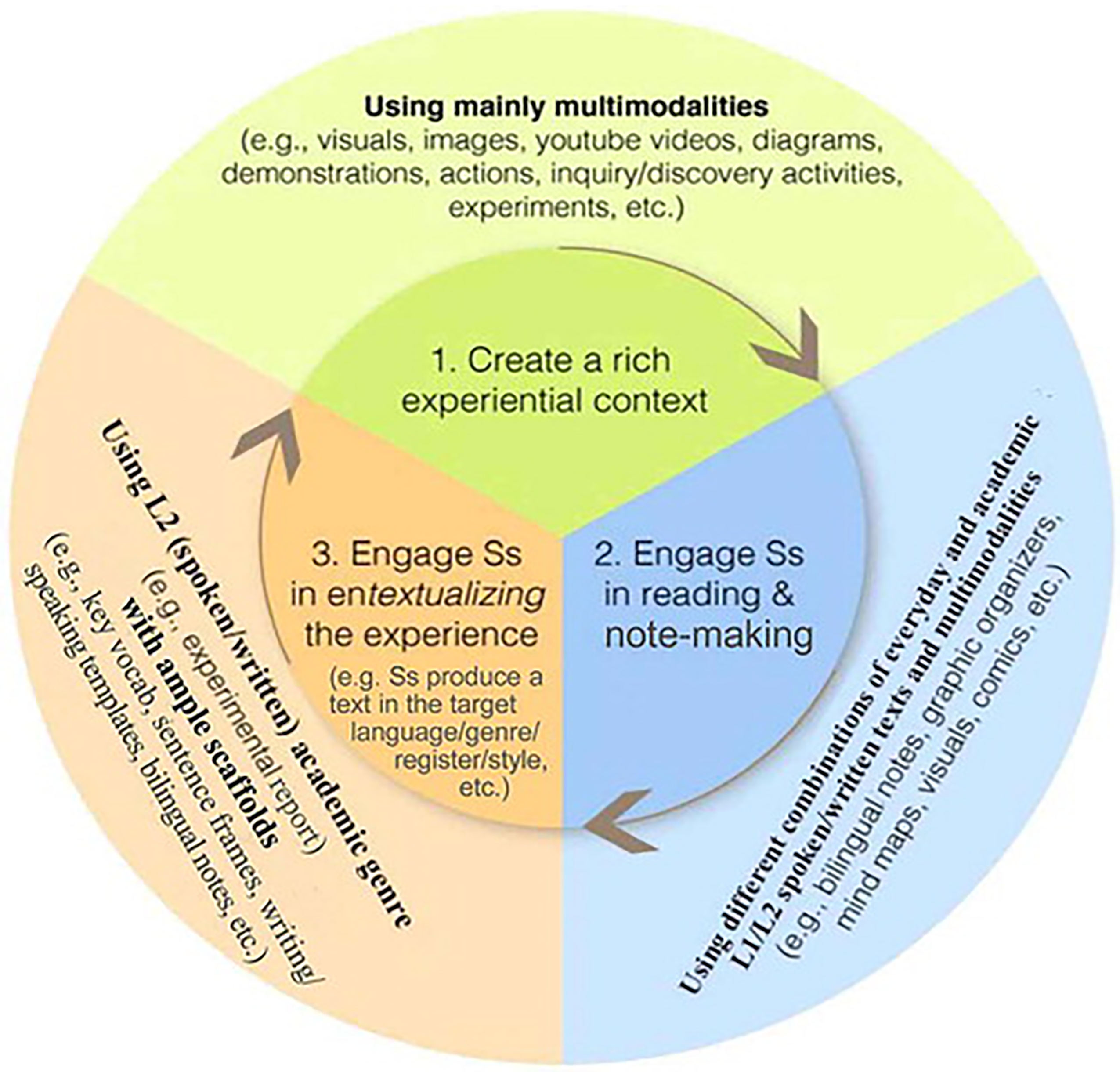
The multimodalities-entextualisation cycle (MEC), from Wu and Lin (2019: 254).
In the first selected case, Wu and Lin (2019) reported a design-based ethnographic study in a grade-10 biology class which incorporated the MEC to design an inquiry-based multimodal and multisensory lesson that explored the transpiration process of plants. During the lessons, students learned the topic with the use of diagrams, drawings, a textbook and their familiar language, Cantonese. Wu and Lin (2019: 261) noted: Through the intricate entanglement of familiar Cantonese language features, visuals, gestures, body movement and scientific English language features, a multi-semiotic world and history that is embodied in the students’ daily life is evoked and repositioned: What is happening in the process of transpiration pull invisible to the naked eye (in which water is lost from plant cells and pulled up from the roots through a series of causal processes) is made analogous to the students’ daily life experience, logic and series of embodied actions associated with the Cantonese lexical collocations of ‘no water (無水) – then get water (攞水)’ as expressed in everyday style Cantonese and the students could feel like themselves becoming water entering the microscopic cell structures and travelling inside.
Students in the study reported how the use of multiple resources and modes was relevant to their learning of the content. One stated: ‘So, when I write about the processes of transpiration pull in English now, I have the drawings and the teacher's step-by-step gesturing vividly in my mind and I just need to follow it to get it right’ (Wu and Lin, 2019: 266). This study illustrates the flows of linguistic, multimodal, bodily and material resources, including tools, and artifacts that contributed dynamically to understanding of scientific concepts. While the classroom participants still live under the domination of English in the education system in Hong Kong, their local situated practices transgress the official English-only policy. The MEC is in principle to be reiterated without an end-point, thus in a way breaking the English domination in cycles of learning while pushing students to expand their meaning-making repertoires (e.g. in Stage 3 of the MEC).
The second example using the MEC comes from He and Lin (2021), who partnered with one Cantonese-English speaking teacher in a grade-9 EMI program who had 14 female students from Pakistani and Indian families. He and Lin (2021) reported that the adaption of the MEC facilitated a space for translanguaging and trans-semiotizing as well as academic language development. In the classroom, students learned about the circulatory system in English while interacting with each other through various MEC-inspired classroom activities (e.g. labeling various components in a diagram, providing metaphoric descriptions, showing relevant videos, drawing on the blackboard, moving hands and using realia). They spoke different languages (Urdu, Cantonese and English) and different registers (colloquial and academic), used artefacts, and shared various meanings and feelings by connecting different personal events that happened at different scales (now and then, here and there, concrete and abstract), all of which feature translanguaging and trans-semiotizing. He and Lin (2021) argued that the orchestration of different meaning-making resources helped both the students and the teacher explore the scientific knowledge in a more personal, dynamic and engaging way. In doing so, they also challenge (albeit in an implicit, local, situated way) the official English-only policy in EMI classrooms in Hong Kong.
Discussion and Conclusion
Since its advent in the early 1990s, CLIL has been widely welcomed, celebrated and accepted in schools and universities around the world. Although CLIL has continuously been developed and adapted from its original conceptualization, there has been some concern that its implementation has been acritical. Key issues include the insufficient integration of languages as well as integration between language and content, which have not fulfilled CLIL's initial design and commitment. There have been possible ways of integrating content and language (Coyle et al., 2010; Dalton-Puffer, 2016); however, the focus on English in CLIL has favored a monolingual orientation, which works to marginalize students’ alternative knowledge systems and meaning-making resources, privileging students from mainstream, educated, upper- or middle-class families. This tendency of CLIL programs has been critiqued as an elitist, English-only monolingual model, and there have been calls for alternative lenses to embrace difference, fluidity and transformation in education.
There are additional concerns surrounding the integration of content and language learning. Although collaboration between content and language experts has been considered the key component for successful implementation of CLIL programs, it has been documented that this process is not easy. CLIL design requires not only enormous personal commitment, time and energy, but also more funding and personnel hires, making institutions and content faculty often reluctant to systemize collaboration with language educators. In addition, because neoliberal policies and discourses promote the idea of education for workforce formation, there has been much emphasis on subject knowledge that favors content educators, while support from language educators is often improvised and considered remedial. These processes, in return, may create professional hierarchies between content and language educators within educational institutions, deskilling the knowledge and expertise that language educators have.
With the stated concerns in mind, we aim to spotlight the recent development of translanguaging in CLIL. Although translanguaging has developed from bilingual education, translanguaging as a practical theory of language has been applied to CLIL contexts to account for the coexistence of learners’ languages and the integration of these languages with content (Moore and Nikula, 2016). A handful of empirical studies have shed light on how plurilingual teachers and students move away from reductionist, elitist and English-only conceptions of CLIL. Through the MEC design, which adopts translanguaging and trans-semiotizing perspectives, several empirical studies have demonstrated how learners share their semiotic repertoires, expand them and co-contribute to the flow of communication (He et al., 2016; Lin and He, 2017). More fluid and dynamic models offer a space where learning becomes a transformative activity in which the personal (hi)stories and experiences of students are included and validated.
Nonetheless, some cautionary accounts question whether translanguaging alone can promote social justice. Kubota (2020) indicates that the theoretical ideal of translanguaging to foster the plurality of linguistic practices is distant from the singularity present in social realities, since many real-world conditions work in a monolingual way. She argues that ‘[t]o contribute to actual social change, translanguaging and plurilingualism need to find a closer synergy with critical multiculturalism, by exploring deeper questions of linguistic and cultural inequalities in relation to colonialism, imperialism, capitalism, and associated language ideologies’ (317). Recent discussion on translanguaging and flows (Lemke and Lin, 2022) nicely addresses this concern by paying attention not only to moment-to-moment classroom communications, but also to dynamic flows on a larger scale, acknowledging historicity, coloniality and language learning.
To this end, as Lemke and Lin (2022) and Kubota (2020) proposed, we argue that explicit promotion of equity and freedom for learners through integrating different pedagogical approaches is needed to account for difference and fluidity to transform power structures and social inequalities. Additionally, as García (2009b) suggested, the construct of integration in CLIL has to be expanded and adapted to the realities of the contexts in which it is planned and implemented. Advancing translanguaging as a theory of language as well as pedagogy for learning in CLIL will provide both a theoretical and a practical lens to further bring fluidity to meaning-making and knowledge-construction practices for students and teachers with diverse socioeconomic, racial and gender backgrounds, allowing them to participate in their own learning in an equal, democratic manner.
Footnotes
Declaration of Conflicting Interests
The author(s) declared no potential conflicts of interest with respect to the research, authorship and/or publication of this article.
Funding
The author(s) disclosed receipt of the following financial support for the research, authorship, and/or publication of this article: This work is supported by Angel M. Y. Lin's Tier 1 Canada Research Chair (CRC) grant in Plurilingual and Intercultural Education (950-231629, GT# 21961).
