



Abstract
Strategic use of learners’ multilingual resources in a content and language integrated learning (CLIL) classroom enables learners to employ all of their linguistic repertoires to make sense of what they learn to construct and demonstrate new content and language understanding and skills. This study examines a CLIL teacher’s cognition – what they know, believe, think, and do – on allowing multilingual practices among learners with limited foreign language proficiency. An in-depth analysis of the qualitative data collected from a Japanese/Humanities CLIL teacher working in an Australian secondary school revealed two key findings. Namely, this study identified: (1) the influence of complex sociocultural factors in shaping a language teacher’s pedagogic decisions and actions – specifically, when and how to mobilize learners’ multilingual resources; and (2) the positive impact of teacher pedagogy in enabling students to become resourceful and agentic to work through challenging tasks persistently to achieve the desired outcomes as perceived by the teacher. It concludes by providing an implication arising from the findings, highlighting the need for re-orienting and developing language teachers’ professional knowledge and practice to leverage students’ multilingual resources while addressing complex contextual demands in their teaching.
Keywords
I Introduction
Mobilizing multilingual students’ full linguistic repertoire in the process of teaching and learning has gained strong recognition within applied linguistics. For example, what May (2014, p. i) calls the multilingual turn offers ‘a critique of, and alternative to, still-dominant monolingual theories, pedagogies, and practices’ in various language education settings, such as Second Language Acquisition (SLA), Teaching English to Speakers of Other Languages (TESOL), and bilingual education. It calls for a non-deficit and asset-based view (Choi & Slaughter, 2020; Cross et al., 2022) of students’ multilingual resources, which are understood in this study as multilingual learners’ entire linguistic repertoire encompassing ‘not only linguistic elements but also their trajectories as language learners and language users’ (Cenoz & Gorter, 2022a, p. 16). In Australia, where this study was conducted, a growing number of studies have begun to acknowledge the affordance of a plurilingual approach, such as pedagogical translanguaging (Cenoz & Gorter, 2022a, 2022b; Li, 2018), that acknowledges and leverages multilingual learners’ entire linguistic repertoire in the process of learning in the English as an Additional Language (EAL) context (Choi & Slaughter, 2020; Choi et al., 2024; Cross et al., 2022; French, 2019; French & Armitage, 2020; Ollerhead, 2018). Although there are not many studies and further research is therefore required, the potential of such a multilingual practice has also been examined in the foreign language teaching and learning setting in Australia. For example, Gearon and Cross (2020) illustrate the benefits of students’ use of multiple linguistic resources – Spanish and English in this case – in facilitating their cognition in a content and language integrated learning (CLIL) classroom.
These Australian studies primarily focus on how students use their multilingual resources and the associated benefits in the learning process. For multilingual learners, such use may appear as ‘a naturally occurring phenomenon’ (Canagarajah, 2011, p. 401); however, the creation of ‘safe spaces’ (p. 415) and intentional teacher mediation are necessary, should the learners’ entire linguistic repertoire be used for the ‘process of knowledge construction’, as they may not know how to do so effectively in the learning process (Li, 2018, p. 15; see also Canagarajah, 2011; Moore & Nikula, 2016). Their arguments point to the importance of teachers in shaping and enacting multilingual practices in the classroom. Yet, given the strong focus on students in the aforementioned Australian studies, an important dimension that remains under-researched is the systematic investigation into teacher perspectives on mobilizing learners’ full linguistic repertoire in the teaching and learning process, suggesting a need for further investigation.
To address this gap, the current study draws on the notion of language teacher cognition, as it enables the exploration of what teachers ‘know, believe, think, and do’ (Borg, 2003, p. 81) to make sense of their practices in light of leveraging learners’ multilingual resources within their specific context. As Kubanyiova and Feryok (2015) argue, investigating language teacher cognition requires understanding the complex interplays and tensions between teachers’ personal, professional, and sociohistorical/cultural factors (see also Cross, 2010). This study, therefore, employs Activity Theory as an analytical framework (Engeström, 1987, 1999) to systematically explore qualitative accounts gathered from a teacher who used CLIL pedagogy to provide an immersive foreign language teaching and learning environment in which Humanities were taught through Japanese in Melbourne, Australia. Specifically, it examines his perspectives, stances, feelings, and practices in facilitating the use of multilingual resources among learners who had up to 1.5 years of experience learning Japanese as a foreign language. The central contribution of this study is the articulation of the teacher’s pedagogical decision-making in relation to leveraging students’ whole linguistic repertoire based on the notion of language teacher cognition. Although the current study is situated in the Australian context, its findings and pedagogical implications could be applicable to other similar settings, as they shed light on how teachers can establish a multilingual environment whereby students’ entire multilingual resources are mobilized pedagogically while addressing complex sociocultural/historical demands that shape their activity of teaching.
II Literature review
1 Mobilizing students’ multilingual resources in CLIL classrooms
CLIL is a ‘dual-focused’ approach to develop new content and language knowledge and skills through the target language that learners are still learning (Mehisto et al., 2008, p. 9). Such a focus seems counter-intuitive for many learners, as having access to the medium of instruction is often considered the most basic condition for learning to occur (Cross, 2012). CLIL teachers are, therefore, required to establish an appropriate level of content and cognition while considering the linguistic demands for their learners who have different language proficiency and learning experiences (Coyle et al., 2010). Failing to do so could lead to students experiencing cognitive overload and adverse emotional reactions in the learning process (Otwinowska & Foryś, 2017).
To address such challenges, the significance of leveraging learners’ entire linguistic repertoire – an approach that aligns with earlier conceptualizations and emphases in translanguaging literature (García, 2009; García & Li, 2014; García et al., 2017) – has been recognized by various studies conducted in English as a foreign language (EFL) and bilingual/immersion CLIL contexts (Cenoz & Gorter, 2022c; He & Lin, 2023; Lin, 2015; Lin & Lo, 2017; Lo, 2015; Moore & Nikula, 2016; Nikula & Moore, 2019; San Isidro & Lasagabaster, 2019; Skinnari & Nikula, 2017; Wong & Tian, 2025). For instance, focusing on CLIL classrooms in Hong Kong, Lo and Lin (2015) argue for the use of students’ whole meaning-making repertoire to scaffold the process of learning new content and language simultaneously while ‘actively building and capitalizing on other kinds of resources in their [learners’] communicative repertoires’ (p. 263). Similarly, drawing on the classroom interactional data collected from secondary CLIL classrooms in Finland, Spain, and Austria, Moore and Nikula (2016) assert that the use of students’ whole linguistic resources as pedagogic tools can make more visible the ‘coexistence and value of both L1 [first language] and L2 [second language]’ (p. 212) to ‘contribute both to content learning and the maintenance of interactive flow’ in CLIL classrooms (p. 232). Such practice, therefore, offers a space for CLIL learners to draw on their multilingual resources for meaning-making (Li, 2018; Lin, 2019).
Although the abovementioned studies point to significant benefits of mobilizing learners’ multilingual resources in CLIL classrooms, teachers need to have a cautious attitude when doing so. As Canagarajah (2011, p. 402) argues, there is a need for teaching multilingual learners how to use their resources in class meaningfully rather than ‘romanticiz[ing]’ such practices as something they can use naturally. Indeed, Bruen and Kelly (2017, p. 378) highlight a potential danger of overusing language learners’ prominent language if left to their own devices, resulting in ‘failure on the part of the learner to acquire an ability to think in the L2’. Therefore, teachers are required to make informed decisions about how to leverage students’ multilingual resources pedagogically within their specific sociocultural contexts because how such resources can be used constructively is ‘highly context dependent’ (Moore & Nikula, 2016, p. 232). As will be discussed below, understanding language teacher cognition is important here as it enables us to examine teachers’ specific pedagogical decision-making and actions in light of their ‘personal, professional, social, cultural, and historical contexts’ (Borg, 2019, p. 20).
2 Language teacher cognition and activity theory as a conceptual framework to analyse language teacher practice
Borg (2006, p. 126) argues language teacher cognitions are ‘shaped by the totality of teachers’ lived experiences’. Borg (2019) elaborates on this by highlighting that: individual teacher cognition does not originate or operate in a vacuum and it is influenced in powerful ways by a range of personal, physical, sociocultural, and historical milieus which interact, in both remote and immediate ways, to shape who teachers are and what they do. (p. 6)
Borg’s discussions suggest that studies of language teacher cognition need to consider the ‘pivotal role of context’ (Kubanyiova & Feryok, 2015, p. 445) that integrates ‘the teachers’ action and thoughts’ (Burns et al., 2015, p. 597). Furthermore, understanding language teacher cognition also requires appreciating the cognitive and emotional dissonances that indicate contradictions between what they do and think, manifested in their practice of teaching (Burns et al., 2015; Cross, 2010; Golombek, 2015; Johnson & Golombek, 2016). Given such multiple dimensions that influence language teacher cognition, Kubanyiova and Feryok (2015) contend the importance of conceptualizing it as ‘emergent sense making in action’ (p. 445), enabling us to make sense of teacher practice in their specific sociocultural contexts and its impact on students’ language learning experience.
Their discussion has an important methodological implication. Namely, researching language teacher cognition needs to be ‘genetic’ (Feryok, 2018, p. 119), suggesting how research methodology should systematically examine how different sociocultural factors and conditions influence the emergence of language teacher cognition. In this way, language teacher cognition research becomes ‘a dialogic process in which researchers and participants co-construct meanings and understandings discursively’ (Borg, 2019, p. 7). Such reciprocity would enable the dialectic unity of thought and language (Vygotsky, 1987) and help to address ‘instances of cognitive/emotional dissonance’ via ‘responsive mediation’ (Johnson & Golombek, 2016, p. 44).
Therefore, to understand complex personal, professional, sociohistorical and cultural factors that affect language teacher cognition, this study draws on Engeström’s (1987, 1999) work of second generation activity theory. It provides a systematic conceptual framework to analyse language teachers’ mental processes and instances of practice as a socioculturally constructed activity (Cross, 2010). Such an activity is represented by the following elements as its minimum constituents, indicating intricate interrelationships that influence language teacher cognition: ‘objects, subjects, mediating artefacts (signs and tools), rules, community, and division of labor’ (Figure 1) (Engeström & Miettinen, 1999, p. 9).
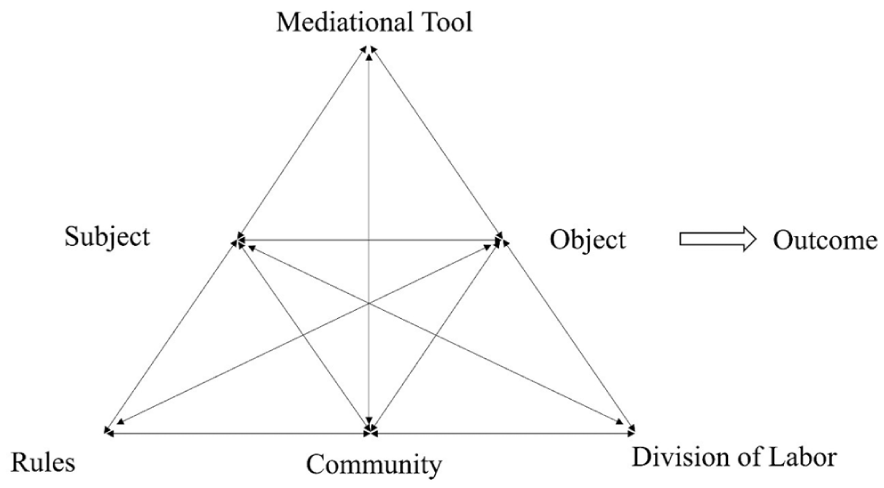
The structure of an activity system.
Specifically, the upper part of the triangle illustrates the dialectic relationships among the subject, object, and mediational tool that affect subject’s goal/object-oriented actions. The object of the activity system is the ‘problem space’ (Engeström & Sannino, 2010, p. 6) to which subject’s attentions and actions are directed. Furthermore, subject’s actions shape and are shaped by the rules, such as social norms, the relevant community within subject’s specific sociocultural contexts, and the division of labor performed by different individuals within the activity system (Engeström, 1987; Lantolf & Thorne, 2006).
As Nicolini (2012) argues, each of the conceptual elements that constitute an activity system is ‘inherently conflictual, dialectic, and developmental’ (p. 113). It suggests that analysing genesis, existence, and resolution of different contradictions is pivotal to understanding how an activity system in focus evolves into a new state of development. In relation to the focus of this study, for example, such a transformation could be envisaged in terms of teachers furthering their professional knowledge and practices to better support student learning in their specific contexts.
3 Contextual factors affecting the delivery of language education in Australia
As discussed above, different sociocultural factors significantly influence language teachers’ thinking and doing (Borg, 2019; Kubanyiova & Feryok, 2015). Johnson and Golombek (2011, p. 3), therefore, contend that language teachers’ professional knowledge and practices need to be understood ‘holistically’ as they are ‘shaped by [their] engagement in social activities’ within their specific contexts. Considering the crucial role of context in shaping language teacher cognition, this section outlines the factors that affect language education in Australia, thereby establishing the overarching context for this study.
Language education in Australian schools faces various challenges, including the provision of quality programs, high attrition rates beyond compulsory years, limited time available for language programs, and students’ diminished motivation to learn another language (Clyne, 1997, 2008; Lo Bianco & Slaughter, 2009, 2017; Scarino, 2014; State of Victoria, 2021). One key factor influencing such longstanding challenges relates to monolingualism or what is called ‘monolingual mindset’ (Clyne, 2008, p. 348), which considers knowing English is sufficient given its status as a lingua franca. This impacts how language programs are often less valued compared with, for example, the subject English within institutionalized settings (Turner, 2019). Coupled with other factors that affect the provision of language education, such as socio-political/economic rationalization, institutional policies and priorities, crowded curricula (Lo Bianco & Slaughter, 2009, 2017; Scarino, 2014), the abovementioned positioning of language education can shape teacher practice; namely, teaching language as an object of study rather than a communicative and meaning-making tool. Consequently, this affects teachers’ choice of pedagogy that may not provide ample interaction opportunities for language learners (Turner, 2019). As Turner (2019) points out: The norm is for languages to be taught as a subject, and cross-curricular use of these languages is considered to be a bonus rather than a requirement. Further, a foreign language is not compulsory in senior secondary school . . . The result of these monolingual educational structures is that students may be leaving mainstream schooling with limited opportunities to speak in a language other than English. (p. 6)
For example, Cross’s (2010) in-depth analysis of a Japanese language teacher practice in an Australian secondary school illustrates how different priorities – for example, the school’s emphasis on middle-years program and building students’ general English literacy skills – impact teacher pedagogy to focus on ‘a structural approach to teaching language . . . [rather] than a communicatively oriented style’ (p. 446). In his analysis, Cross (2010, p. 446) also highlights how ‘little Japanese was actually used within lessons’. Although his analysis was based only on the data gathered from one teacher, it exemplifies Turner’s (2019, p. 6) point about how ‘monolingual educational structures’ can lead to limited meaningful target language input and output opportunities in language classrooms.
Additionally, limited time is often allocated for language education in Australia. For instance, students learn a language for ‘an average of 53.2 minutes per week’ in Victorian government primary schools and for any duration from 120 to 180 or more minutes per week in secondary schools (State of Victoria, 2021, p. 27). Furthermore, most students have minimum target language exposure opportunities outside the classroom (Ohki & Cross, 2024). Therefore, language teachers’ pedagogy, particularly the use of an approach, such as CLIL, that provides maximum immersive target language input and output opportunities, is pivotal to establishing a generative condition for learning another language in Australia.
This contextual backdrop has an important implication for the point made earlier about the need for a teacher’s context-dependent responses in mobilizing learners’ multilingual resources in class (Moore & Nikula, 2016). As discussed above, examining language teacher cognition helps to make sense of teacher practice in their specific sociocultural contexts. However, as stated in the introduction, there is a need for a systematic investigation into language teacher cognition on mobilizing learners’ multilingual resources in the Australian language education context. Therefore, this study sought to answer the following research questions to address this research gap:
Research question 1: How does a CLIL teacher mobilize learners’ multilingual resources in class, and why?
Research question 2: What are the perceived impacts of leveraging learners’ multilingual resources on their learning process?
III Research setting and design
1 Setting and participant
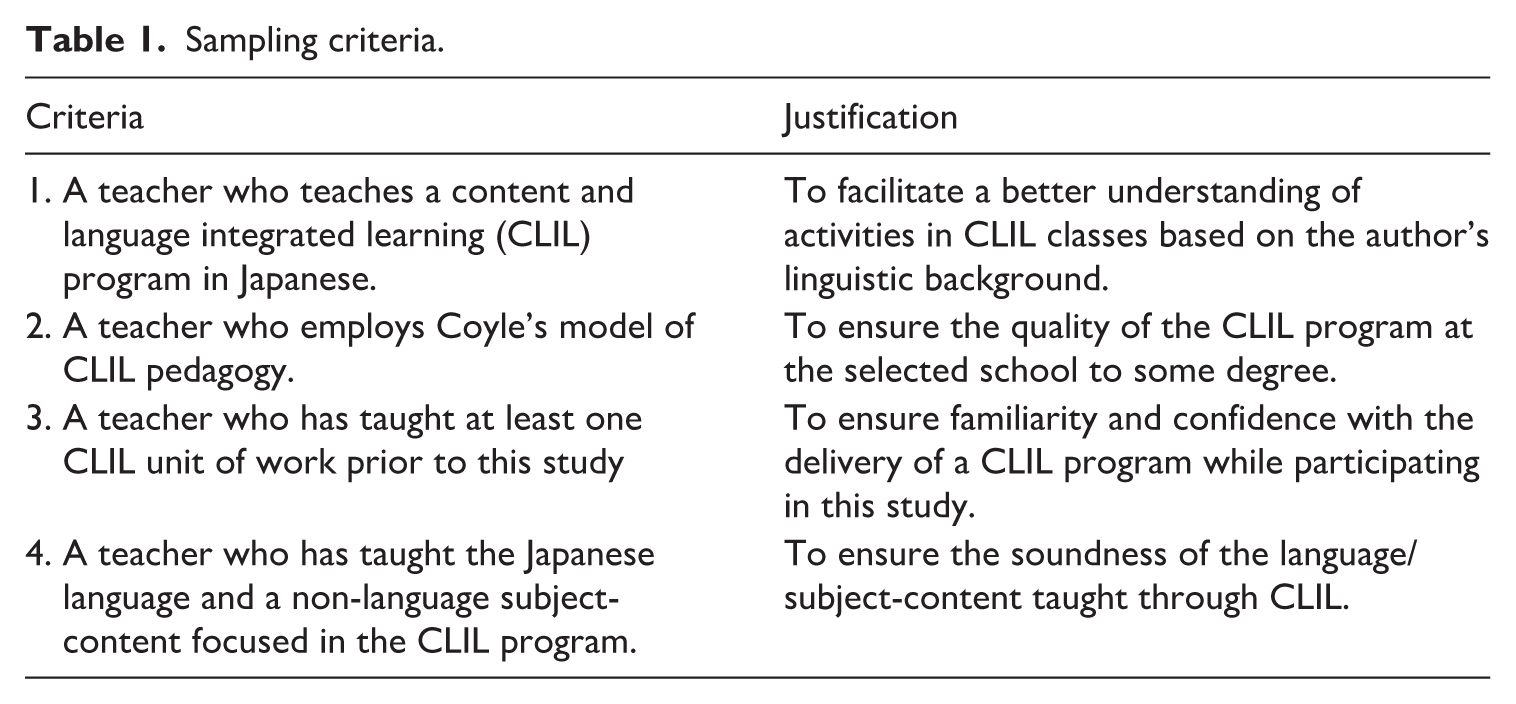
This study uses the data gathered from an experienced Japanese and Humanities teacher, Nigel (pseudonym), who works at a recently established P-12 government college (hereafter the College) in Melbourne, Australia. Nigel was selected as a participant based on the criterion sampling approach (Table 1) to ensure relevant information was generated from the sample (Patton, 2002).
Sampling criteria.
Nigel is an experienced teacher of Japanese and Humanities, who has taught these subjects to students in years 7 to 12 for over two decades. Nigel has developed his expertise in these two areas through his tertiary studies in a Bachelor of Arts and a Diploma in Modern Languages, specialized in Japanese. Furthermore, as part of his professional learning as a teacher, Nigel has completed a Professional Certificate in Education in CLIL in 2012. In the same year, combining his expertise in teaching Japanese and Humanities, Nigel started teaching a unit of work on the Renaissance and Feudal Japan through Japanese using CLIL pedagogy at a school where he was previously teaching.
In 2018, a year after its opening, Nigel joined the College as the Head of Japanese to establish an innovative, authentic, and meaningful Japanese program together with the other Japanese teachers. As one of Nigel’s key innovative initiatives, a Japanese/Humanities CLIL program was endorsed by the school principal and the other Japanese and Humanities teachers. As a result, Nigel began delivering the History and Geography units through Japanese using CLIL in semester two in 2019.
Nigel’s CLIL program was timetabled as a Humanities subject, running three periods a week. This timetabling enabled most of his CLIL students to learn about and through Japanese throughout the year. Namely, they were able to undertake a semester-long Year 9 Japanese language class to learn Japanese as an object of study in semester one and a Japanese/Humanities CLIL program in semester two, both of which were taught by Nigel. Additionally, this timetabling also allowed six Year 8 students in a High Achievers Program to opt into the CLIL subject while learning Japanese as a Year 8 compulsory subject taught by another Japanese teacher. For this study, ethics clearance was obtained from the university, and written informed consent was sought from the school principal, Nigel, and students and their parents/guardians using the standard process approved by the university.
2 Research design
a Data collection
This current study employed ‘instrumental case study’ (Stake, 1995, p. 3) – a method that requires an in-depth investigation into the case, including its sociocultural/historical context(s) and actions – to explore and provide insights into the aforementioned research questions (Harrison et al., 2017; Priya, 2021; Stake, 2005, 2006; Stark & Torrance, 2005; Yin, 2014). It used multiple techniques to generate qualitative data: document analysis, semi-structured interviews (SSI), class observations, and stimulated recall interviews (SRI). Table 2 summarizes the overview of the data collection approach.
Summary of the data collection phases and techniques.
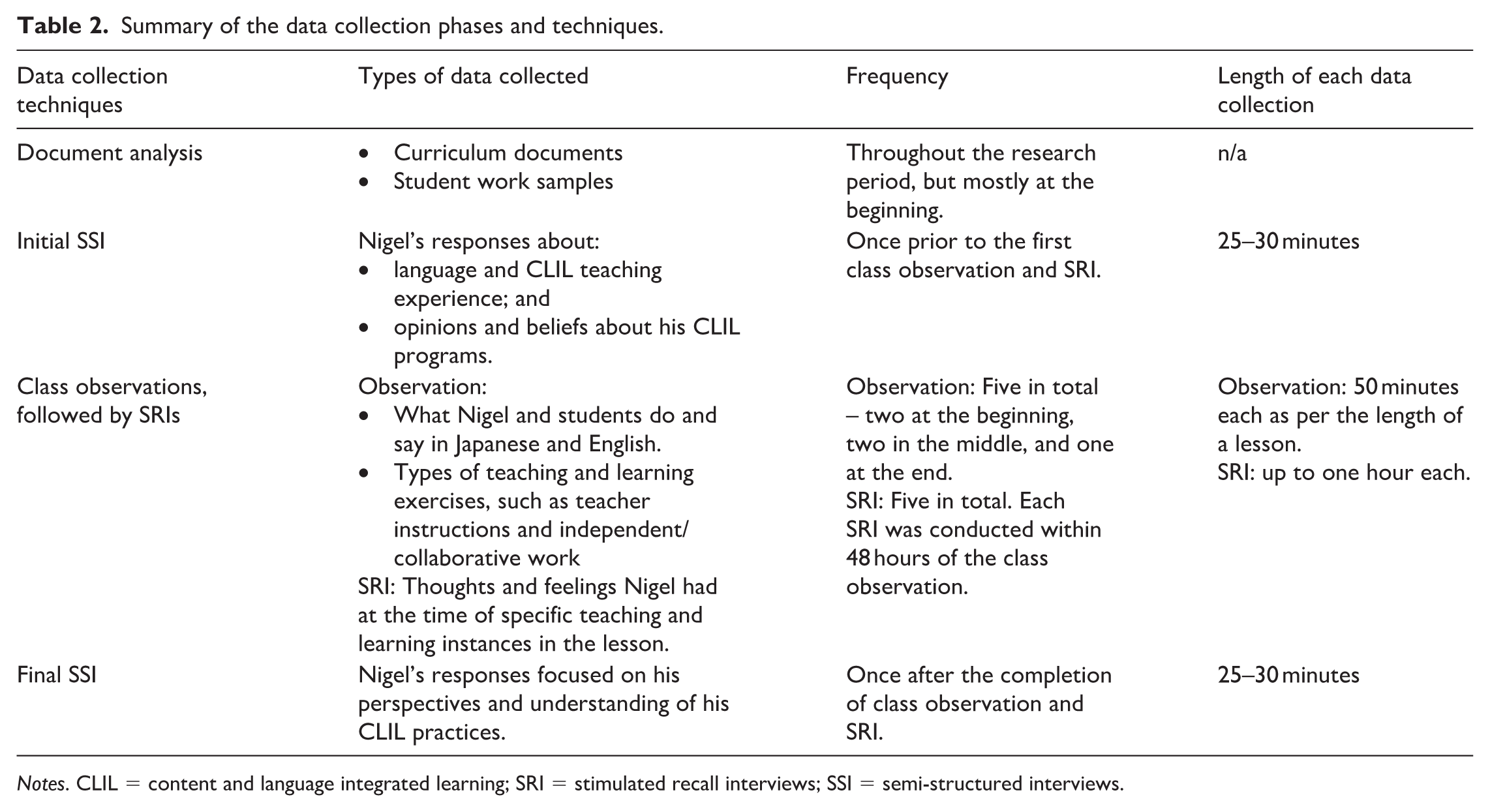
Notes. CLIL = content and language integrated learning; SRI = stimulated recall interviews; SSI = semi-structured interviews.
Specifically, the curriculum documents used for document analysis were collected from Nigel with his consent, as they were generally accessible only to the teachers at the College. Samples of work from students who have given permission were photocopied by Nigel after each class observation. The original copies were returned to the students in the following lesson. The initial SSI was framed around questions about Nigel’s experience as a language/CLIL teacher, and his opinions and beliefs about his CLIL program. Open-ended questions and probes were used to help him respond and voice his opinions and thoughts. Some of the questions included, for example:
Can you talk about how you got into teaching Japanese and CLIL?
Can you talk about the CLIL program at your school?
Why do you think so?
Can you explain a bit more in detail?
Similarly, the final SSI included the open-ended and probing questions to understand his experience in teaching the CLIL program, and his perceptions of students’ learning experiences, such as:
Can you talk about your experience in teaching this specific CLIL unit of work?
How do you describe students’ learning experience in CLIL compared with the standard Japanese classes?
Can you elaborate on that point?
What made you say that?
With regard to class observations, which were video recorded for later use during SRIs, although this study did not use structured/pre-determined sets of observation checklists, certain decisions on what to observe were made with reference to the research questions prior to the initial observation. Therefore, it focused on observing and recording the following general points while keeping the research questions in mind:
what the teacher does and says;
what students do and say;
types of activities, such as teacher instruction, lecture, independent task, pair work, and/or group task; and
use of languages (Japanese and English).
Immediately after each observation, the fieldnotes and video recordings were used to revisit the specific events and prepare for the SRIs. During the SRI, specific moments from the recording were played to facilitate Nigel’s reflection along with open-ended probing questions, such as:
What were you thinking at this point?
What was your thinking then?
Can you elaborate on that point?
b Data analysis
The data analysis was carried out based on coding and developing thematic categories described by Creswell and Guetterman (2019). The initial step involved analysing data by transcribing the stimulated recall and semi-structured interviews, which were coded based on the aforementioned conceptual categories defined in Engeström’s (1987, 1999) activity system schemata (Figure 1) – i.e. ‘objects, subjects, mediating artefacts (signs and tools), rules, community, and division of labor’ (Engeström & Miettinen, 1999, p. 9). For example, any information relevant to Nigel was coded as the subject of analysis, such as his previous language-teaching experiences and his approaches to teaching content and language at the College. Doing so allowed the researcher to understand his lived experiences, offering the lens through which the activity system was analysed and interpreted. Furthermore, the object of the activity system was identified based on any decisions that Nigel made in relation to his students, such as their language and content knowledge and skills, learning preferences, and characteristics, rather than the learners themselves. His remarks about specific pedagogical approaches, learning tasks, and the use of languages were coded as mediational tools of the activity. Additionally, any information related to curriculum/syllabus requirements, the school principal/teachers, and Nigel’s roles as a content/language specialist were coded as rules, community, and division of labor, respectively.
In discussing the findings below, the transcripts of the video footage were used as a vignette to exemplify the instances of concrete activity. Specific extracts from stimulated-recall and semi-structured interviews were presented alongside the analysis to provide in-depth insights. Each quote was labeled based on the type of interview and line numbers of the transcripts, such as initial SSI 1-5, second SRI 5-10. The relevant information collected through the document analysis and class observations was also used to elaborate on the analysis (Lincoln & Guba, 1985).
IV Findings
The data collected from Nigel revealed his strategic pedagogic choice to mobilize learners’ multilingual resources when focusing on particular content-related skills called historical empathy – a skill to ‘analyse the different perspectives of people in the past and how these perspectives are influenced by significant events, ideas, location, beliefs, and values’ (Victorian Curriculum and Assessment Authority, 2017) – rather than allowing them to use such resources anytime at their disposal. As detailed below, such a teacher practice enabled learners to engage in higher-order thinking involving creating, evaluating, and analysing (Anderson & Krathwohl, 2001) through the task that required them to create an imaginative dialogue. This section is structured based on the research questions of this study. It begins with a vignette of a particular teaching and learning episode that illustrates how Nigel mobilized his students’ multilingual resources purposefully. This instance of practice is then analysed as ‘activity’ to explain a contradiction that influenced Nigel’s thinking and pedagogic decision-making and action. These two parts together address research question 1. The last part of this section discusses Nigel’s perception of the impacts of resolving the contradiction through creating a multilingual environment on students’ learning process, responding to research question 2.
1 Instance of teacher practice in mobilizing learners’ multilingual resources
The following teaching and learning episode focuses on a brief example of classroom interaction representing how Nigel encouraged his students to use their L1, English, as a resource to work on a higher-order thinking task to create an imaginative dialogue. It occurred during the second class observation.
Nigel started explaining a learning task in which students were required to make a dialogue between two people in the feudal system during the Edo period Japan. In preparation for this task, students made a summary note about key concepts, such as houkenseido (‘a social hierarchy during the Edo period’) and its constituents: tennou (‘emperor’), shogun (‘general’), daimyou (‘feudal lord’), samurai (‘warrior’), noumin (‘farmer’), shounin (‘merchant’), shokunin (‘artisan’), and hinin (‘outcast’). Nigel instructed the class as follows:
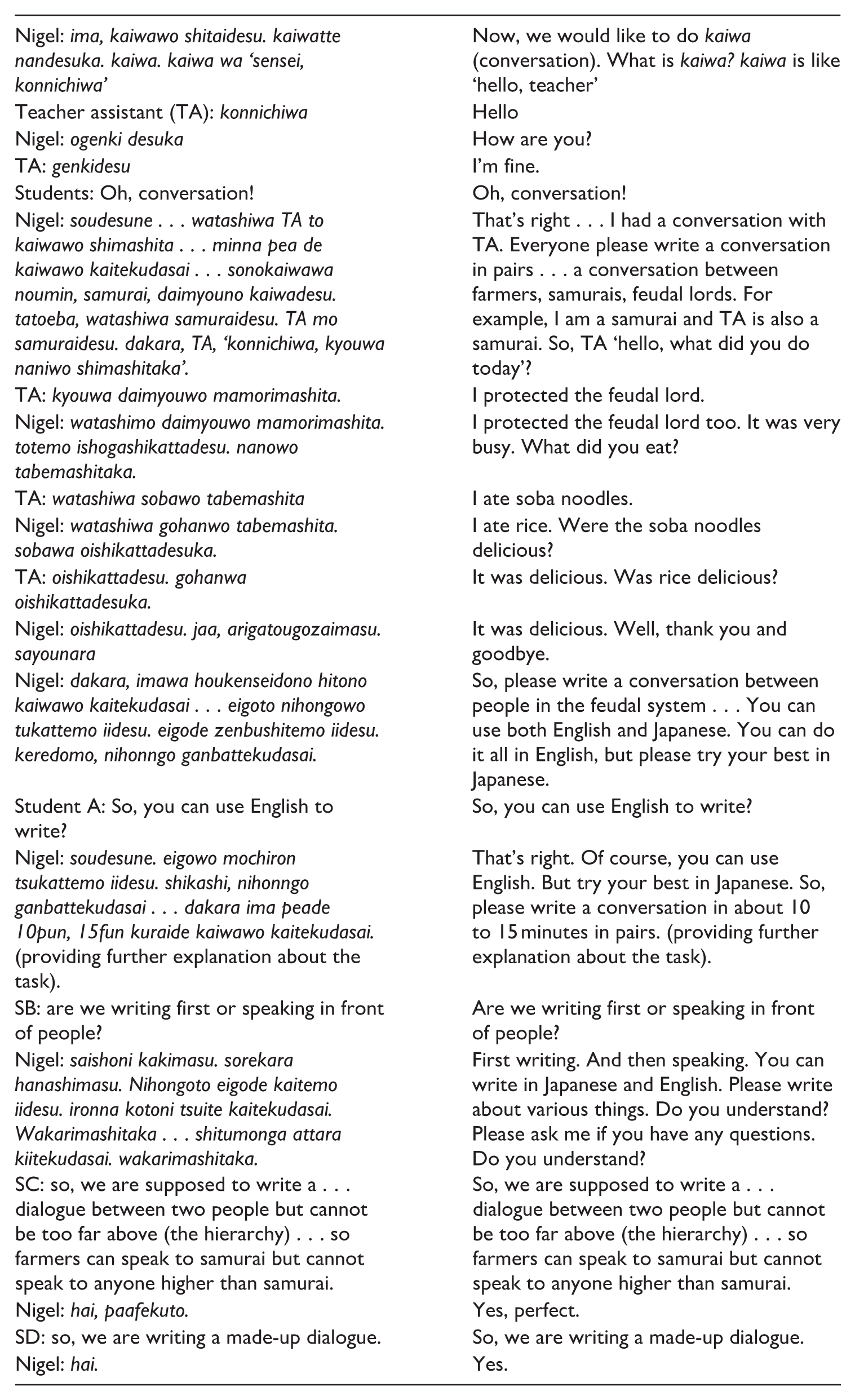
As shown in this vignette, Nigel seems to encourage his students to use English to a varying degree, such as 100% or a mixture of English and Japanese, to work on this task rather than forcing them to do so all in Japanese. This is not to say that Nigel prohibits students’ use of English in class, as evident in the vignette, he mostly expects his students to use Japanese in completing any learning tasks. In this specific task, however, Nigel sees a benefit of allowing students to use English because it asks them to engage in higher-order thinking to demonstrate their historical empathy skills – i.e. analysing how various statuses, social layers, and cultural values within the Edo period hierarchy influenced how people communicated with one another – through creating an imaginative dialogue, as detailed below.
2 A contradiction driving Nigel’s pedagogic decision for mobilizing students’ multilingual resources
During the stimulated recall interview relevant to the vignette, Nigel frequently referred to having a ‘safety net’ that leverages students’ multilingual resources to scaffold their engagement and demonstration of historical empathy skills. Although he often emphasized the importance of students’ active and consistent use of Japanese throughout this study, his justification for encouraging the use of English demonstrated in the vignette seems to reflect his understanding of the object within the activity system in focus; namely, his students’ current limited linguistic knowledge and skills, given their experience of learning Japanese for just over 18 months. As shown in the excerpt below, this understanding seems to have shaped his belief about the potential difficulties they might encounter if required to demonstrate their historical empathy skills entirely in Japanese: Researcher: could you please explain . . . why you gave them the options. Eigo de kaitemo iidesu demo nihongo de ganbatte kudasai [you can write it in English but try your best in Japanese]. You gave them quite a few options of what they can do for this task. Nigel: I wanted the task to be inclusive. It’s about the work. It’s not necessarily about the language in that, at that point. I think if I said to do it in Japanese, I would have had 10 kids really really struggling . . . So, part of my thinking there is ‘I don’t really mind the language because I’ve given them all the input in Japanese’ . . . and we are not at a point with this group where I’ve done a lot of expressive language [in writing] in Japanese . . . I wanted to make sure that they had a safety net because again the risk if I didn’t provide that safety net is that I have, you know, 10 kids sitting there doing nothing . . . and getting frustrated when they can do this task. I don’t mind if it’s in English because at least then they can engage with the history and historical empathy part of it, even if they don’t have the language to communicate that way. (Second SRI 166-1861)
1
This quote suggests that what was driving Nigel’s pedagogic decision-making and action to mobilize students’ multilingual resources in this specific activity system was a contradiction between the Japanese language used as a mediational tool and object that relates to Nigel’s perception of his students’ limited language skills to complete this task. Such a contradiction is represented as the dotted line shown in Figure 2.
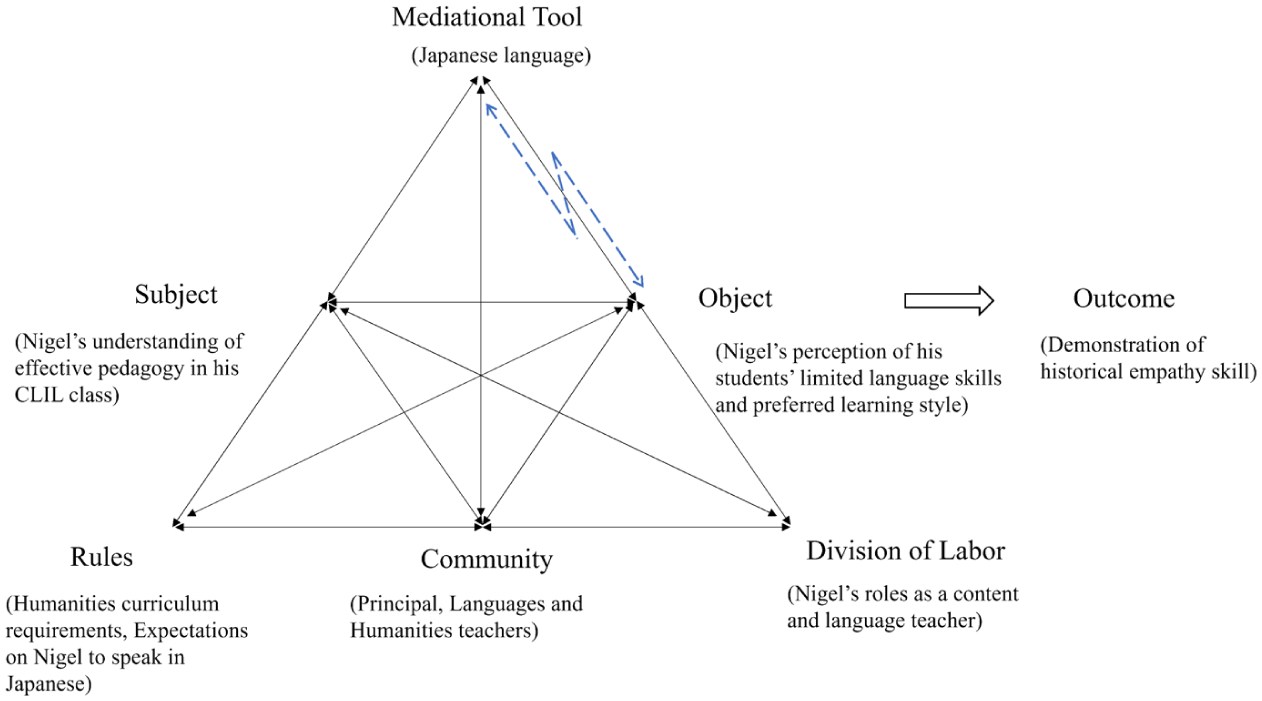
A contradiction between tool and object in Nigel’s activity system.
This contradiction exists in his activity system because Nigel sees the significance of providing a Japanese immersive environment where his students would often encounter and be required to use, for example, new/unfamiliar lexis and syntax. He believes that using such a new/unfamiliar word is integral to his CLIL class, knowing the pedagogical principles behind CLIL and his students’ learning preferences: They don’t want risk-free teaching. They do not want me to just go over what they know. If I’m just going over what they know, they can do that by themselves. (Third SRI 264-265)
With appropriate scaffolding, Nigel argues, such an approach can encourage learners’ active engagement in class while providing a Japanese immersive environment to stimulate their curiosity about learning Japanese: It gives those kids, who really want, something to be curious about. So, I have got kids in class who are picking up these words [in Japanese] really quickly so gives them the opportunity to have a challenge to have a word that they need to revise. (First SRI 480-487)
However, Nigel was also conscious of the desired outcome related to students’ demonstration of their historical empathy skills. As explained earlier, Nigel’s CLIL class was timetabled as a Humanities subject. Therefore, the resolution of the tool-object contradiction was necessary for him to achieve this outcome and address the curriculum requirements as the rule within the activity system in focus. As he stated: I think historical empathy . . . is really really important. So, the skill of speaking, the skill of interpreting cultural appropriateness, even language-wise is important to understand the interrelationship with people in different hierarchies. So, absolutely . . . I would say very important . . . in the Victorian curriculum. (SRI 1 562-567)
Therefore, Nigel seems to perceive a strong need for his students to engage in higher-order thinking to demonstrate their historical empathy skills by allowing them to draw on their multilingual resources rather than forcing them to use only Japanese and ‘plug in keywords’ on a template to create a dialogue, which he believes they can do with their limited Japanese competency. As he stated: If I give a formula in a history class, so if I’m teaching Middle Ages history and ‘I want you to have a conversation between a Baron and a Knight’. So, one of you needs to be a Baron and one of you needs to be a Knight. So, the Baron goes to the Knight, ‘hey Knight, where is my taxes and the Knight goes, oh, sorry I haven’t had time to go and get your taxes. The baron goes, you go and get my taxes’ . . . So, you know, you can give them the idea but in a history sense you want them to have that freedom to take that where they want to take it. From a language sense, we would probably scaffold that wouldn’t we? We probably think about a template for that conversation. We would make it really clear everything what you talk about. The kids are essentially plugging in keywords. That’s limiting. That is really limiting in terms of what they can do. (First SRI 731-741; emphasis added)
Furthermore, during the final SSI, Nigel highlighted how encouraging students’ use of their multilingual resources in this and other similar tasks enabled them to build their ‘cognition up with their thinking’ (15). In his view, his strategic pedagogical choice was pivotal as it enabled him to cater for ‘the needs of students regardless of what point they come’ (34–35) into the classroom. Importantly, from Nigel’s perspective, such a pedagogical approach had a positive influence on students’ learning, as will be discussed next.
3 Nigel’s perception of the impacts of resolving a contradiction through mobilizing students’ multilingual resources
The resolution of the tool-object contradiction within the activity system in focus, through the establishment of a multilingual space that encouraged students to draw on their entire linguistic repertoire as a new mediational tool, resulted in two positive outcomes related to learner agency, as perceived by Nigel. First, he believes that doing so encouraged some students to exercise agency to ‘have a go’ (Second SRI 199) at using Japanese rather than English – despite his perception that some of them had limited linguistic knowledge and skills – to demonstrate their historical empathy skills successfully: I said, you know, ganbatte kudasai [try your best], you know, it’s setting that bar and ended up with eight or nine kids doing [it in] Japanese. So, half the class did it in Japanese and half did in English. (Second SRI 191-193)
During the same interview, Nigel shared the following sample of students’ work about a conversation between a samurai and the feudal lord in Japanese. From his perspective, it demonstrates his students’ historical empathy skills as they appropriately analysed and interpreted how these people in a different social hierarchy might have acted in this specific situation, thus achieving the aforementioned desired outcome:
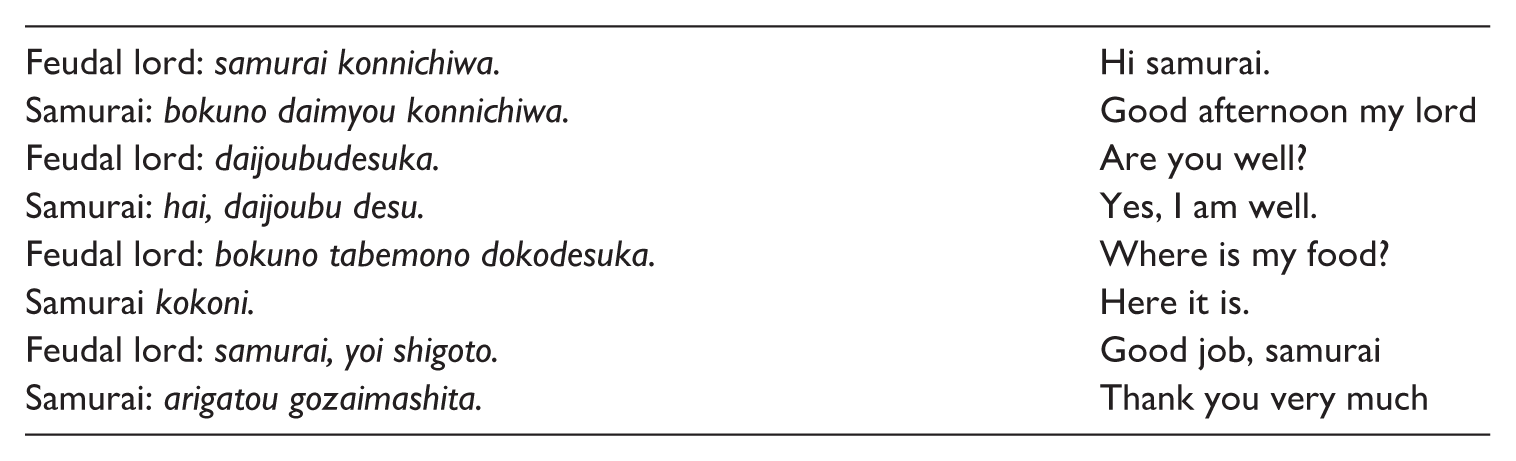
Second, and relatedly, Nigel believes that the introduction of a new mediational tool facilitated the agency of those students who initially worked on the task in English to accomplish the desired outcome; namely, translating their work into Japanese as homework on their own initiative: Nigel: Even some of the ones who did it in English were going to go back and translate it in Japanese. So, you know, one of them is going to go home tonight and translate it, you know, these kids wanted the chance to do in Japanese. So, I don’t want to take that away from them, but also I had to have a safety net. Researcher: Okay. Because of having the safety net, students were able to work in Japanese. Nigel: Correct. It’s strange that having the safety actually meant that some of them did in Japanese so I don’t understand how that happened. But yeah they seem to want to have a go at it. (Second SRI 193-200)
As Nigel argued during the final SSI, he believed these students had ‘greater thinking and greater learning’ (157) opportunities, being allowed to – or at least having as an option to – use their linguistic repertoires in demonstrating historical empathy skills in class.
V Discussion
The above analysis of Nigel’s accounts of the activity in focus reveals how language teacher cognition – in this case, what Nigel knows, believes, thinks, and does in relation to mobilizing students’ multilingual resources – is shaped by complex and interrelated elements within the activity system (Feryok, 2018; Kubanyiova & Feryok, 2015). Specifically, the identification and analysis of the tool-object contradiction in his activity system led to an understanding of Nigel’s thinking and strategic pedagogic decisions – namely, his ‘emergent sense making in action’ (Kubanyiova & Feryok, 2015, p. 445) – regarding when and how to mobilize his students’ multilingual resources in class to realize the desired outcome and address the curriculum requirement, understood here as the rule within his activity system. Nigel’s rationale and decision to do so provide a different insight from the findings of various CLIL studies in European and Asian EFL contexts and in the immersion setting. Such studies highlight the use of multilingual practices for facilitating classroom interaction, the learning process, and the consolidation and demonstration of learners’ content and language knowledge (Lasagabaster, 2013; Lo, 2015; Nikula & Moore, 2019; San Isidro & Lasagabaster, 2019; Wong & Tian, 2025). In contrast, as discussed in the findings, Nigel chose to do so when he saw a need for his students to demonstrate the subject-specific skills that demand higher-order thinking (Anderson & Krathwohl, 2001), such as analysing and interpreting the historical event and creating a dialogue. Therefore, how Nigel leveraged his students’ multilingual resources was not ‘random’ but ‘functional’ (Moore & Nikula, 2016, p. 232), because, in doing so, he still provided a Japanese-rich learning environment, as evident in the data, to ensure the maximum target language input and output opportunities while enabling his students to meet the required learning outcomes.
This finding is significant as it offers an empirical insight into how a language teacher’s pedagogical thinking, beliefs, and actions for mobilizing students’ full linguistic repertoire are shaped by complex sociocultural and historical variables that they need to navigate in their specific settings. Specifically, in the context of Australian language education, where Nigel’s practice is situated, as discussed in the literature review, the majority of students learning a language other than English in Australia do not often have an environment to be exposed to the target language outside the classroom. In turn, target language exposure in class is often limited due to multiple factors, including, for instance, ‘monolingual mindset’ (Clyne, 2008, p. 348), crowded curricula, and timetabling that affect the overall time allocated for the language education (Lo Bianco & Slaughter, 2009, 2017; Scarino, 2014). In this context, ensuring ample opportunities for target language input and output is essential for establishing a generative condition for language learning and facilitating students’ engagement and ability to think through and use the target language. In fact, when such an environment is created, Cross (2012) highlights how Year 10 students were able to think through the target language when learning new content about ‘cultural, economic, and adventure tourism’ (p. 438) through Japanese, despite them not being able to understand everything that was said all in Japanese.
Given the significance of, and perhaps the necessity for, maximizing opportunities for learners to use the target language in the Australian language education context, the learners’ use of multilingual resources would need to be strategic to realize ‘personalized learning’ and their agency (Coyle et al., 2010, p. 42). This was evident in this study, as Nigel made a pedagogic decision to introduce a new mediational tool to allow students to use English as a ‘strategic resource’ (Gearon & Cross, 2020, p. 137) to engage them in a higher-order thinking task beyond their current linguistic competency – which is understood here as the object within his activity system – based on his perception that some students were ‘not at a point’ to be able to ‘use Japanese in that thinking’. As described in Section IV.2, such a tool functioned as a ‘safety net’, leading to what Nigel perceived as a surprising but constructive outcome that enabled students’ agency in using limited Japanese they knew creatively to engage in the task persistently and willingly to demonstrate their historical empathy skills. His practice, therefore, reflects on Larsen-Freeman’s (2019, p. 72) argument that highlights how language learner agency can be fostered where learners understand that ‘they have options from which to choose’ to demonstrate their ‘capacity to create their own patterns with meaning’.
In this sense, Nigel’s strategic pedagogic action, which was shaped by complex and interrelated elements within his activity of teaching, enabled him to create an optimal condition and environment for ‘learning leading development’ (Holzman, 2010, p. 31) where learners were able to exercise their agency to ‘make mistakes, and support each other to do what they do not yet know how to do’ in the target language (Lobman, 2007, p. 605). Furthermore, the way in which Nigel leveraged students’ multilingual resources in class scaffolded the learning process for those students who had yet to develop adequate language competency. As discussed in the findings, they first worked through the task in English, followed by translating it into Japanese. Although having an extra step, from Nigel’s perspective, it was helpful for them to stay engaged in the learning process that provided appropriate levels of cognitive engagement relative to their developing target language knowledge and skills. In this way, those learners were also able to become resourceful and exercise their agency to ‘create meaning and to position oneself in a manner one wishes’ in the language learning process (Larsen-Freeman, 2019, p. 72).
VI Conclusions
This study used Engeström’s (1987, 1999) second generation activity theory to investigate language teacher cognition on mobilizing students’ multilingual resources in the context of Australian language education, where literature finds significant challenges in establishing generative language learning conditions (Lo Bianco & Slaughter, 2009, 2016; Scarino, 2014). It offered an understanding of how complex sociocultural elements that constitute an activity of language teaching and learning influence what a CLIL teacher knows, believes, thinks, and does regarding leveraging students’ full linguistic repertoire to achieve a desired outcome; namely, providing students with the choice to draw on their linguistic resources when focusing on the subject-specific skills, rather than primarily facilitating the class interactions or the demonstration of content-specific knowledge as highlighted in the literature (Nikula & Moore, 2019; Wong & Tian, 2025). Understanding language teacher cognition in this way, in turn, enabled this study to articulate the positive impact of such a teacher practice on students’ learning process as perceived by the teacher: i.e. facilitating students’ agency in using the target language persistently and willingly, creating a challenging yet constructive, inclusive, and well-scaffolded environment for students with different target language knowledge and competency. This study’s findings, therefore, suggest possible ways to address the long-lasting challenges of language education in Australian schools.
Given the significance of complex personal, professional, and sociohistorical/cultural factors that shape language teacher cognition, this study offers the following implication: there is a need for re-orienting and developing the professional knowledge and practices of CLIL teachers – and language teachers more generally – in Australia, and possibly in similar contexts beyond, such as foreign language teaching settings in the UK and the USA, to consider how they could leverage ‘all the students’ linguistic resources – including dynamic and affordances between languages’ strategically and pedagogically while responding to the complex contextual considerations that they must address in their activity of teaching (Gearon & Cross, 2020, p. 139; emphasis in original). However, this study acknowledges its limitations regarding the generalizability of the findings in two ways: it focused only on a CLIL teacher in a single school rather than on multiple cases; and the diverse and complex sociocultural conditions that can shape language teacher cognition may differ significantly from those that influenced Nigel’s thinking and practice. Therefore, further research is needed with more participants and study sites to address the limitations of the current study and to gain a more comprehensive understanding of the complex interplay between the different contextual factors and what CLIL/language teachers ‘know, believe, think, and do’ (Borg, 2003, p. 81) regarding mobilizing learners’ multilingual resources. In so doing, future studies would have the potential to determine the extent to which the findings and the implication arising from the current study might apply in other similar contexts in Australia and beyond.
Footnotes
Acknowledgements
I would like to thank the teacher and students who participated in this study.
Data availability
Research data is not available to the public to adhere to the ethics approval obtained for this project.
Funding
The authors received no financial support for the research, authorship, and/or publication of this article.
Ethical considerations
Ethical approval was obtained from the Faculty of Education Human Ethics Advisory Group (FoE HEAG) at the University of Melbourne (HREC ID: 1852766.1).
Consent to participate
This study has obtained written informed consent from the participants.
