




Abstract
The ‘multilingual turn’ has opened up a variety of creative, participatory methods for researchers and educators to explore language learners’ linguistic repertoires, language practices and resources, and linguistic experiences. In this article, we draw on data from the English as an additional language (EAL) secondary school classroom context where we use what we call ‘language trajectory grids’ to make visible EAL students’ English language learning experiences. The grid activity involves plotting learners’ emotions, practices, relationships, and life circumstances with their resources, practices and historical events onto a chronological grid. Using a narrative structure to make sense of learners’ grids and the ‘small stories’ (Barkhuizen, 2009) participants shared during the activity, we discuss the affordances of such devices in opening up space for teachers and learners to critically reflect on the complexities and vibrancy of contemporary multilingual language journeys; to recognize situational factors that influence dispositions towards language, language learning and identity; and as a powerful starting point for students and teachers to engage in ‘collaborative relations of power’.
Keywords
I Introduction
This article examines the use of a multimodal student-centered device: language trajectory grids to visually capture and to explore through narrative, language learners’ lived linguistic experiences. In this endeavor, we build on evolving theoretical developments within the field of language education in response to the ‘multilingual turn’ (May, 2014). The multilingual turn seeks to challenge monolingual biases with ‘a range of theoretical lenses that help us to examine language and what it means to individuals and societies’ (Conteh & Meier, 2014, p. 3). Through this heteroglossic view of language and language use, multilinguals are positioned as multicompetent individuals who draw on the breadth of their meaning-making resources to engage in complex and dynamic communicative practices (e.g. Canagarajah, 2013; García & Wei, 2014; Makoni & Pennycook, 2007). This standpoint has significant implications for education systems, where monoglossic and monolingual curriculum and assessment frameworks tend to predominate, particularly in English-medium education systems; structures which exert a heavy influence on pedagogic choices, curriculum innovation and the accommodation of a stance towards multilingualism (e.g. Costley, 2014; Kleyn & García, 2019; Macqueen et al., 2019; Schalley, Guillemin, & Eisenchlas, 2015).
In unpacking implications for educational practice, a diversifying range of literature has argued for the need to draw upon and build on learners’ full cultural and linguistic repertoires as a vital resource for educational development (e.g. Cummins & Early, 2011; García & Wei, 2014; Gutiérrez & Rogoff, 2003; Lin & He, 2017). The positioning of learners and mean-making practices as complex and dynamic has opened up a variety of multimodal, speaker-centered methods captured visually (through photographs, hand drawn body portraits and maps, Lego blocks) and explained narratively for researchers and educators to explore language learners’ entire linguistic repertoires, language practices and resources, and linguistic experiences (e.g. Dutton et al., 2018; Nikula & Pitkänen-Huhta, 2008; Prasad, 2014; Purkarthofer, 2019). These multimodal methods allow us to explore numerous aspects of learner as well as educator experiences. However, in looking at identity texts to explore the complexity and vibrancy of learners’ linguistic repertoires, Dutton et al. (2018, p. 31) argue that when students are not able to understand and recognize their own linguistic resources, they ‘may internalize deficit views of their own skills’ (see also Gutiérrez & Rogoff, 2003; Safford & Costley, 2008). While each of these multimodal methods allows for exploration of different aspects of the language learning experience as well as the language learner, we employ the use of language trajectory grids to explore the linguistic journeys of learners and to understand the discourses that have led them to their current disposition towards languages education: a sociohistorical perspective designed to deepen our understanding of how educators can work towards transformative goals with their students.
In the following section, we reflect on the contribution of a growing body of literature on speaker-centered, multimodal methods for gaining richer and more complex pictures of multilingual experiences, linguistic repertoires and lives. We then outline our research context – an Australian high school with high numbers of students of English as an additional language (EAL), and detail how the data was created and analysed to make sense of learners’ experiences. We present our findings in the form of a narrative, followed by a discussion of the pedagogical insights we have gained from exploring the complexities and vibrancy of multilingual EAL learners’ English language learning journeys, and our recommendations for moving collaboratively towards transformative educational goals.
II Identity texts for transformative language education
With over 350 languages spoken across the country, Australia has a complex linguistic ecology formed by the traditional and contact-based languages, and re-awakening languages of Indigenous Australia, the languages of migration, and English – the latter being the national language and de facto official language of Australia (Lo Bianco & Slaughter, 2017). This diversity flows through to the education system, where approximately 300,000 students, or nearly 8% of the school-aged population speak English as an additional language (EAL) (Australian Council of TESOL Associations, 2017). In the Australian State of Victoria, where this research was undertaken, students learning EAL are a significant group ‘represent[ing] 13 per cent of all students’ (Department of Education & Training, Victoria, 2018a). In 2017, Victorian government schools enrolled 6,984 newly arrived EAL learners, students who have been in Australia for only six months or less, with 134 different language backgrounds identified amongst this cohort. The top 10 language backgrounds of these newly arrived EAL students include Mandarin, other Chinese dialects, Arabic, Dari, Samoan, Hindi, Assyrian Neo-Aramaic, Urdu, Vietnamese, and Hazaraghi (Department of Education & Training, Victoria, 2018b).
While such numerical figures and naming of languages can provide language educators with snapshots of the linguistic diversity in their contexts, such contextual information often obscures the complex histories and experiences many EAL students have built through particular discourses and practices engaging with English in academic and non-academic contexts. As mentioned, our research seeks to explore the historical development of language learner identity through the use of multimodal, speaker-centered methods. Visual methodologies can be beneficial when ‘addressing aspects of multilingualism as subjectively experienced, which as a rule involves emotionally charged events’ (Kalaja & Melo-Pfeifer, 2019, p. 4).
The use of visual methodologies can also allow for greater agency for participants. In looking at the language learning experiences of multilingual migrants in Australia. Chik (2019, p. 17) argues that the use of visual methodologies allowed participants to reflect on their lived experiences and to choose to represent information that is meaningful through both the visual artefacts they produced and in subsequent interviews with researchers. Chik (2019, p. 30) contends that the use of visual portraits:
empower[ed] the participants to shape the direction of their storylines during interviews. The visual drawings give them the tool to move from being reactive to interview questions to being proactive in framing how they want their stories to be told. In this sense, the portraits (together with the timeline) provides greater equity in a collaborative research environment.
In language education, scholars frame the use of such oral, written or visual texts which reveal some aspect of students’ own lives, and are shaped by their cultural backgrounds, as ‘identity texts’ (Cummins & Early, 2011). Identity texts can create opportunities for students to move from a deficit view of their school experiences and of self, to one which reveals and nurtures their strengths. Having the ability to reveal their knowledge and abilities can promote learners’ ‘self-esteem and confidence’ which ‘in turn promotes learning’ (Dutton et al., 2018, p. 31). In creating ‘language maps’ for example, which involves students visually representing the ways they use language every day, inside and outside of school, Dutton et al. (2018, p. 40) found that:
[m]apping validates student and community languages and reveals children’s multimodal language and cultural worlds. Mapping has helped us and the students to realize what they know and what they can do, and this raises everyone’s expectations and encourages us to design more complex tasks so children can apply their developing understandings to writing English texts.
Language mapping not only drew out students’ knowledges and skills but was also used as a tool for teaching and learning. In D’warte’s (2013) language mapping study, young people were engaged in studying linguistic repertoires and their use of language and literacy inside and outside of the classroom in primary and high schools. In this context, teachers were positioned as co-researchers with academics, and the students were positioned as researchers of their own language practices – as linguistic ethnographers – ‘who work with their teachers to document and analyze how and when they use one or more languages to read, write, talk, listen and view in their everyday worlds’ (Dutton et al., 2018, p. 31). We will draw on this idea of teachers and learners’ collaboration as co-researchers in Section VI drawing on Brisk and Harrington’s (2006) notion of ‘situational context lessons’.
III Research site, design and method
This research project is situated within a transformative paradigm. The central tenets of transformative education are to problematize practice, that is, question the status quo, and to engage in (self) reflexivity through dialogue, in order to recognize difference, gain an understanding of difference, and to understand and respect others’ identities (Cummins, 2000). Transformative educators seek to overturn traditional frameworks of power, promote collaboration and dialogue in classrooms, and empower learners by cultivating an assertion of their identities (Kincheloe & McLaren, 2000; Taylor, 2011). We understand this growing popularity of speaker-centered, multimodal methods, which offer detailed insider’s views, as powerful, ethical and resourceful ways of teachers and minority language learners working towards such goals in language education. Through this research project we aim to understand how gaining a richer and complex understanding of English in contemporary multilingual EAL students’ learning journeys can provide valuable insights for teachers of EAL learners in their pedagogical designs for learning.
The research site for this project is Summer Hills High School (pseudonym), a public secondary school in suburban Melbourne where 37% of the students are from a non-English speaking background. With a large majority of EAL students from various parts of China, the school provides well-being and linguistic support by employing counsellors, a psychologist, and multicultural education aides (MEA) who speak English, Mandarin and Cantonese. MEAs assist with a range of communicative activities to help teachers and students in the teaching and learning process. In the classes we observed, the MEA mainly performed the role of a translator translating classroom content. In a separate article, we present our findings on the role of translations in EAL classrooms. Here, we focus on describing the use of language trajectory grids and its value for pedagogy.
Students who participated in the study all attended the same EAL support class at the school and, although students were able to opt-in to the study, all students in the class chose to participate. Fourteen Year 10 EAL students, nine females and five males between the ages of 15 and 16 were therefore included in the study. 1 Thirteen of the students were from mainland China and one from Malaysia. The majority of the students have been to an intensive English language school, a pathway provided by the government for eligible new arrival EAL students, for six months up to a year upon arrival in Australia before transitioning to mainstream schools. Once entering a mainstream school, students may or may not be in separate EAL support classes, and typically join mainstream English classes with first language learners. At the time of the research the students had been in Australia somewhere between three weeks to two and a half years and were living either with relatives or in homestays.
The use of ‘language trajectory grids’ came about in part, due to the constraints of conducting research within busy school contexts. With only a small window of opportunity to work with students and staff, and unable to conduct focus group interview sessions due to students’ busy timetable and limited classroom space, the researchers and teacher worked on integrating ‘language trajectory grids’ as an in-class task that would simultaneously draw out students’ language learning experiences and be used as a stimulus writing prompt to produce the work they were doing on narratives. As a result, two 150-minutes classes were recorded over two days. Data was recorded through audio and video devices – two audio recorders on opposite sides of the room, placed on students’ desks, and two small cameras placed in the front and back of the room. The teacher, MEA, and researcher (Julie) wore lapel microphones to capture interactions in moments of close proximity with the students. We received consent from all of the students, parents/caretakers, principal, teacher and MEA to collect information helpful for our project.
In developing their grids, students were asked to plot their English reading and writing journeys including information on their timelines, feelings and reasons for their feelings. 2 Students were able to plot their experiences quickly and pinpoint very specific details including events, people, practices, artefacts, educational systems and their own sense of self-regulation. The teacher, MEA and researchers engaged with students individually as they walked around the room and asked the students questions about the statements they made on their grids. In these interactions, students told ‘small stories’ (Barkhuizen, 2009), short stories about an event that happened that made them feel or think a certain way. A final questionnaire was given to students to capture their comments on their engagement in different school subjects, their feelings about translation support in the classroom, and their use of non-English linguistic resources for learning and entertainment purposes. Comments from the questionnaire relevant to our discussion will be added in Section IV.
IV Analysis
In making sense of students’ relationship with English and their current language-related struggles and practices across school subjects and activities, we separated their histories into three major periods – primary years, transitional period, 3 and secondary years. Next, we used thematic analysis (Lapadat, 2010) to look for common themes that came through the grids and transcripts from the audio recordings in each period. The dominant themes were: ‘individual differences’, ‘exams and scores’, ‘friendships’, ‘new language and knowledge realizations’, ‘language difficulties’, ‘teachers’, ‘use of other linguistic resources’, and ‘lack of confidence’. A narrative structure allowed us to bring all of the comments together within each theme and gain insight into their individual differences as well as commonalities in their English language learning journeys.
Studies on motivation in language learning use ‘motigraphs’ (Lamb, 2016) to monitor learners’ motivational shifts. However, the grids we present here have not been used to track learners’ motivation levels. Although motivation level appears as a central axis on the grids, the purpose of having motivation levels on the grid was purely to help students to quickly map their experiences and emotions. However, in analysing the grids we followed carefully the contours of the lines students drew, as they are part of the comments students made on the grids. To identify the motivation levels in the transcripts, we labelled the levels as ‘Low’, ‘Moderately Low’, ‘Moderate’, ‘Moderately High’, ‘High’, and ‘Off the Grid’ (see Figures 1–10). Looking carefully at the grids, we noticed the highs and the lows were not always ‘clear cut’ and aligned against a particular event on the timeline. We tried to capture the subtle rising and falling lines (using descriptions such as ‘slight drop’, ‘slight rise’, ‘slight drop below moderate’, ‘slight rise above moderate’, ‘slight (sharp) drop’). Some students used dotted lines to convey alignment between their timelines and their plotted experiences, and arrows that signal additional information (Figure 1). Documenting these details help us convey the precision to which the students remember these embodied moments. Time and place are italicized and statements that convey reasons or explanations of their emotions are in plain form in the transcripts.
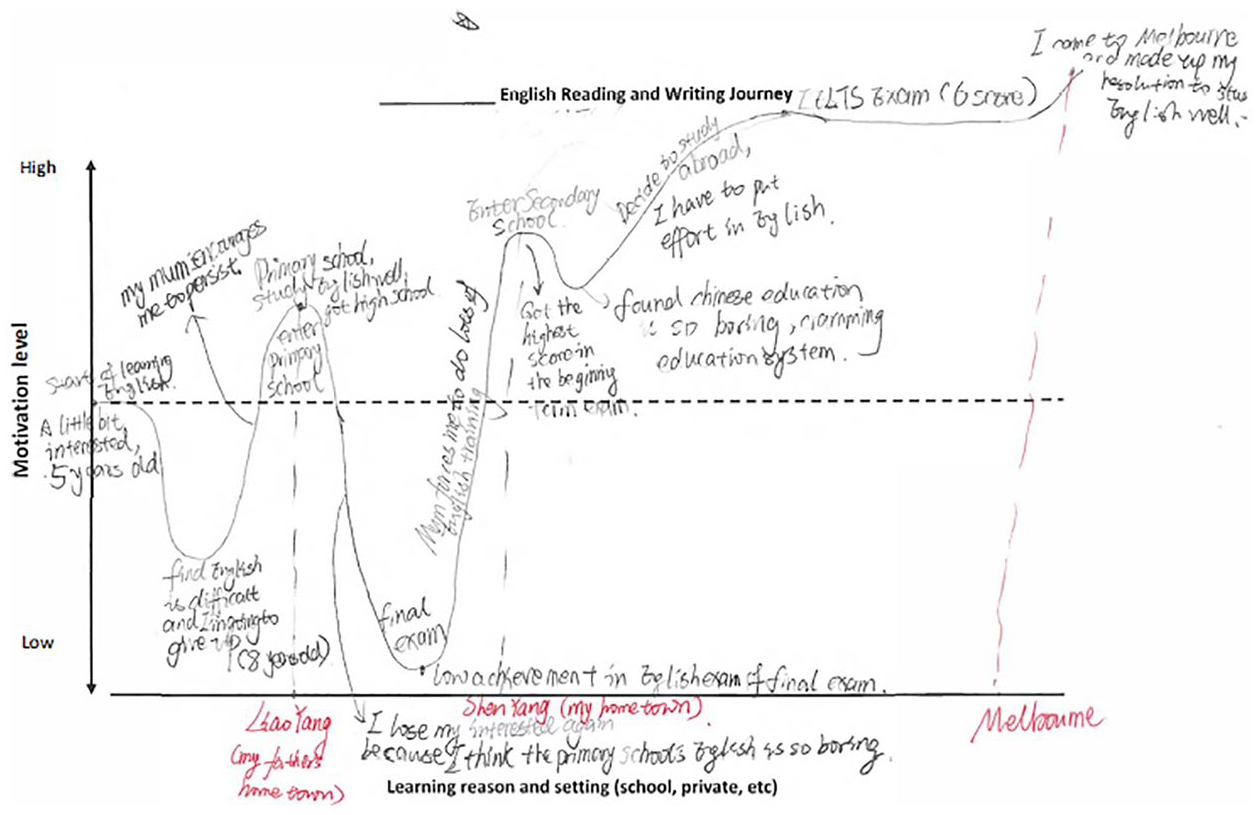
Sally’s grid
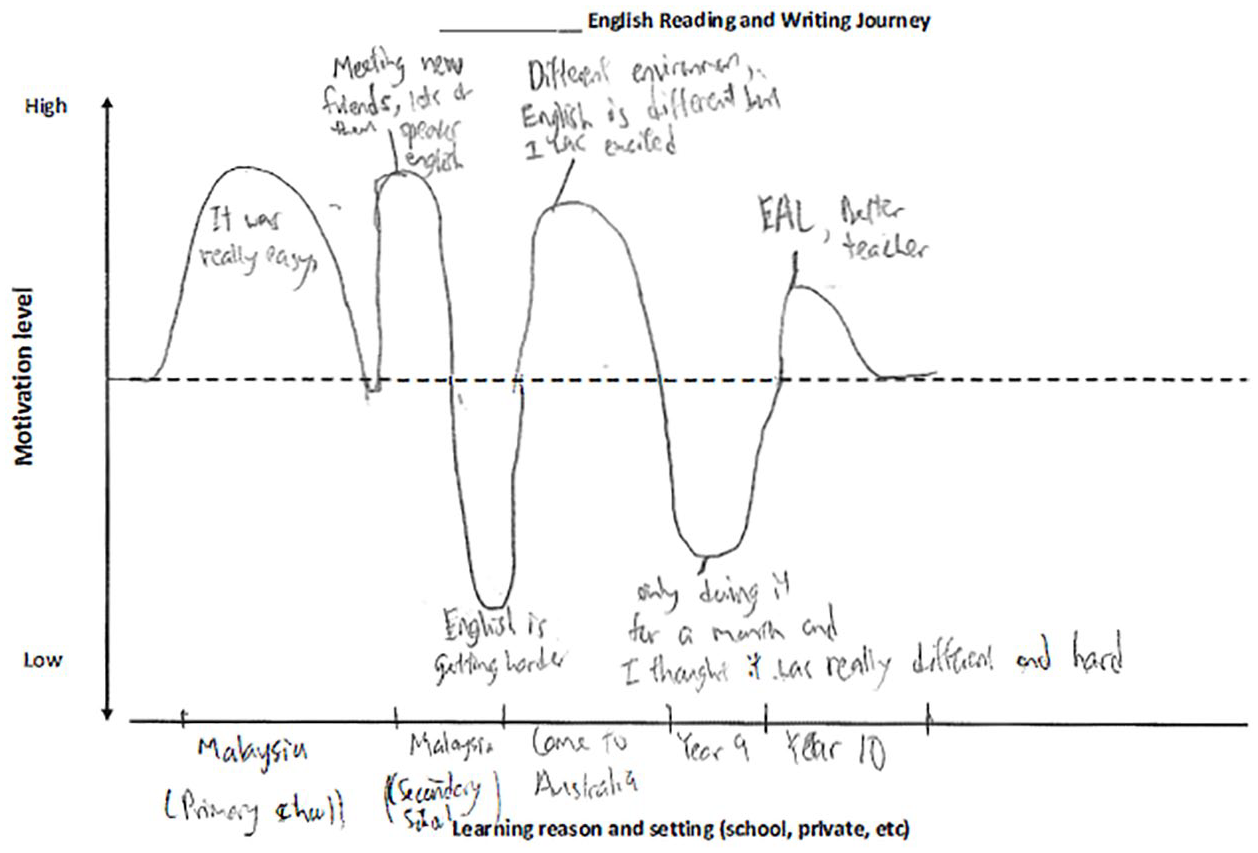
Sam’s grid
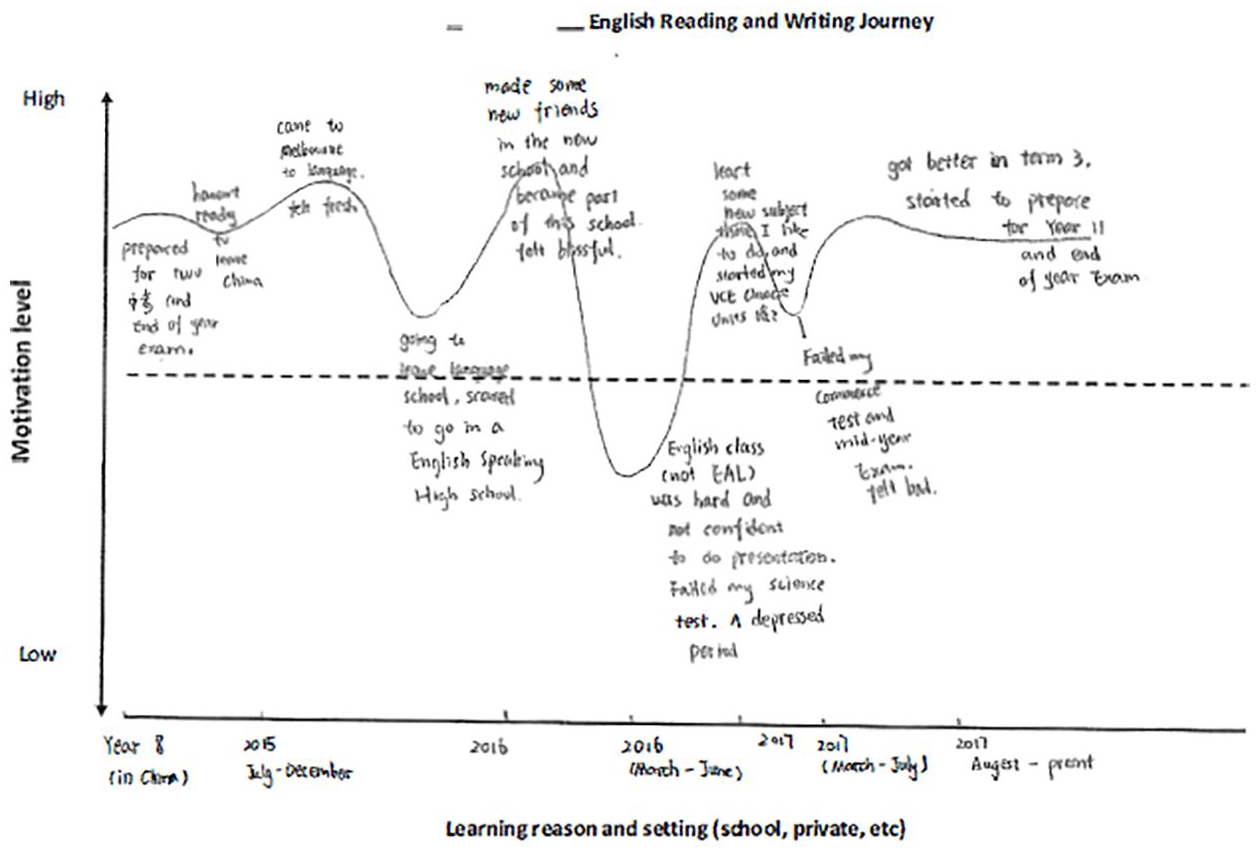
Kathy’s grid
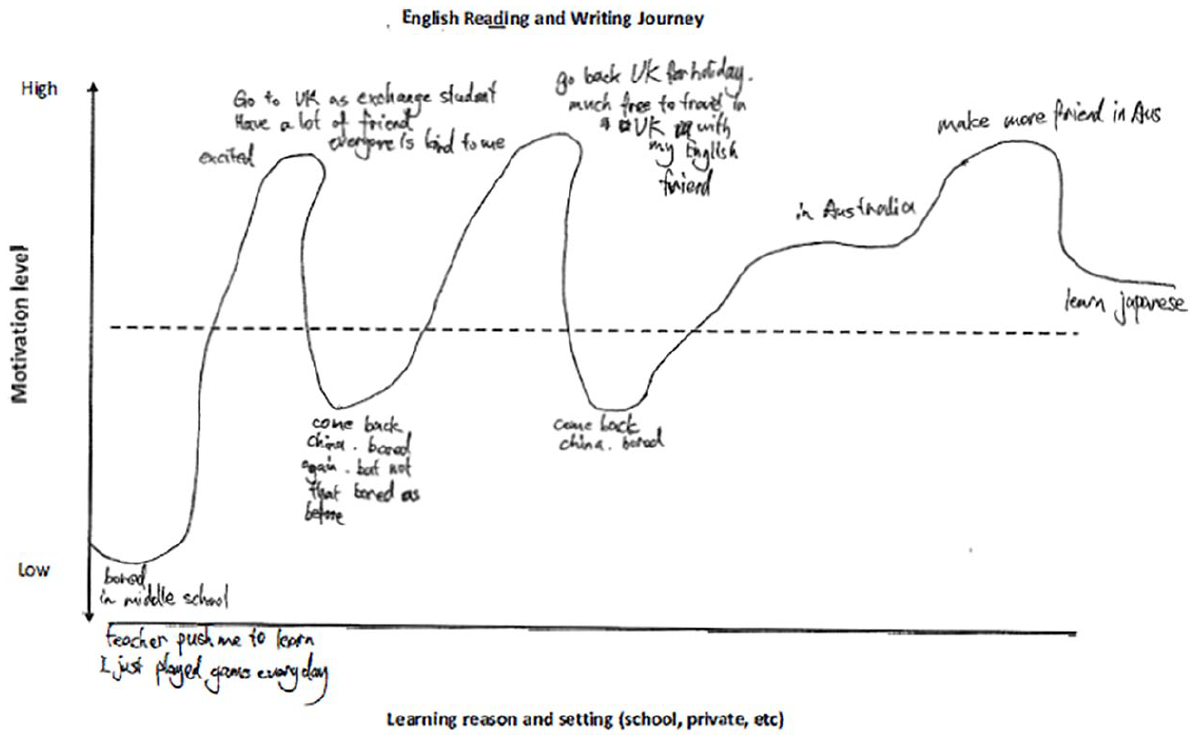
Cat’s grid
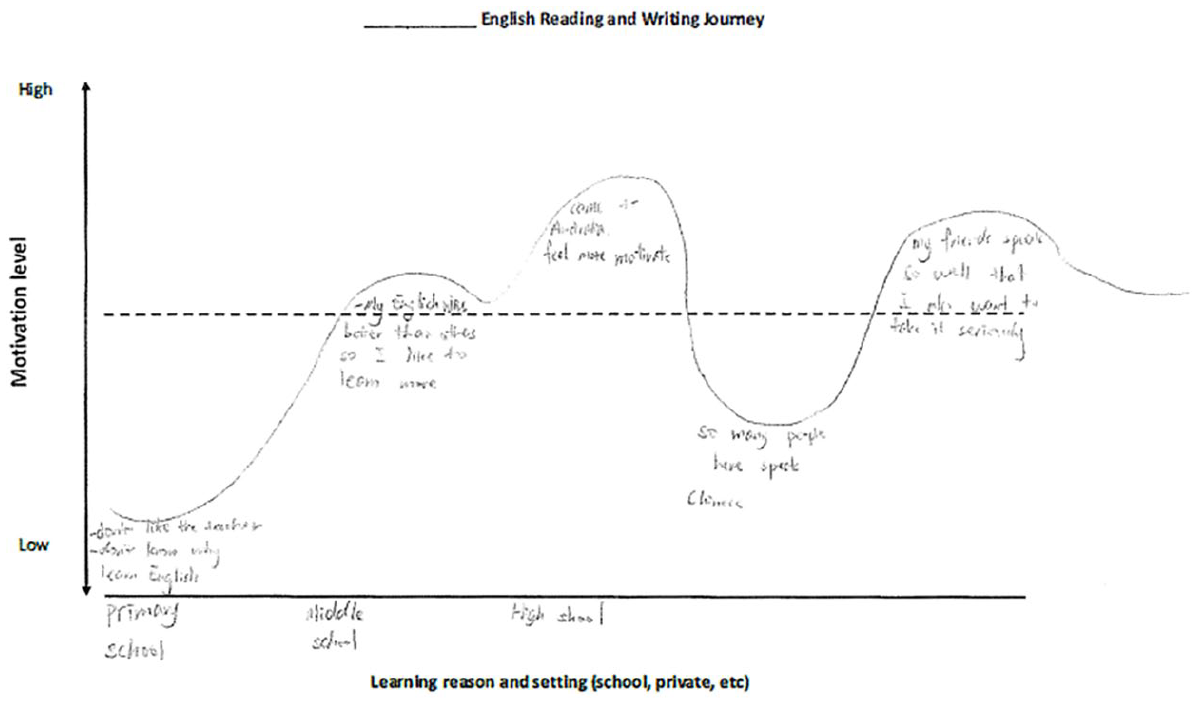
Vanessa’s grid
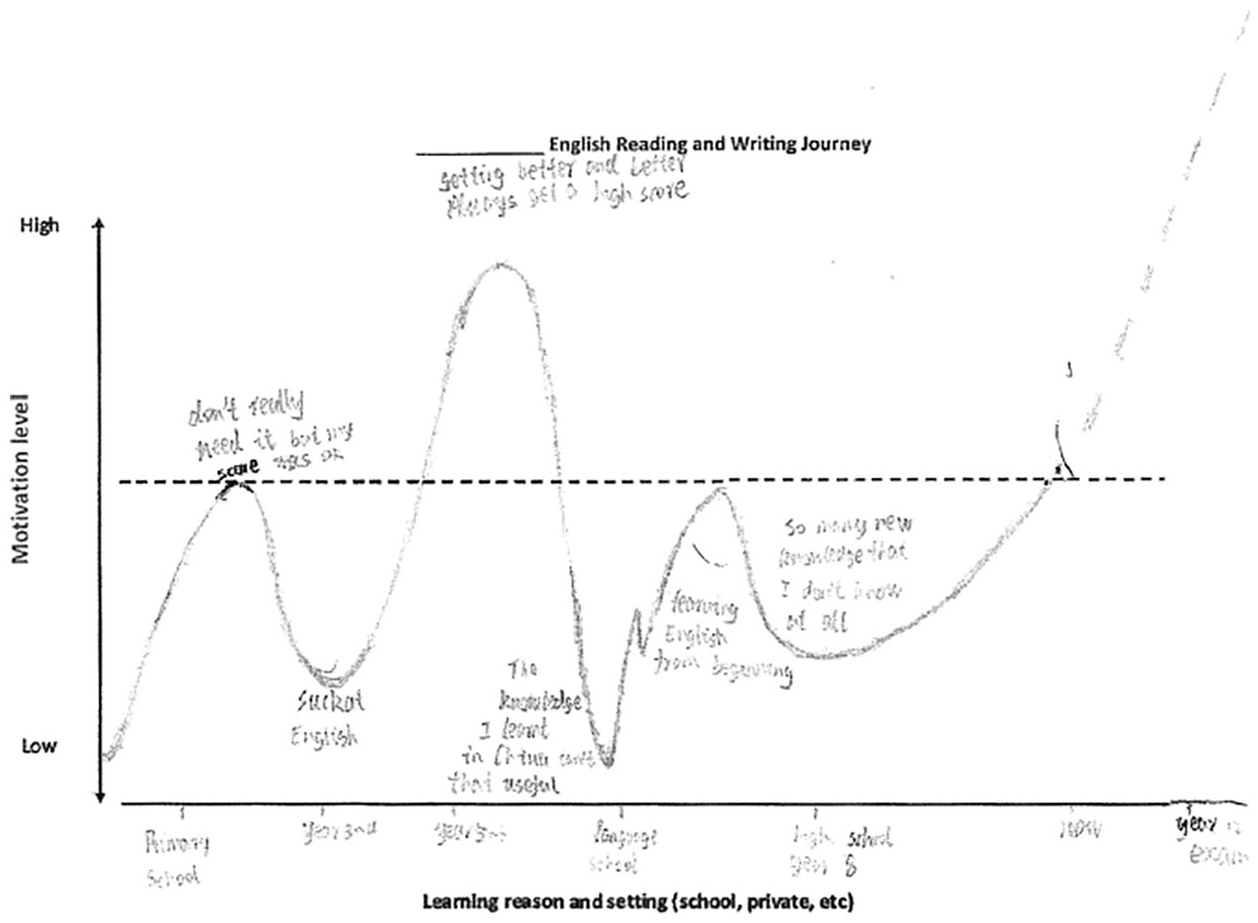
Jason’s grid
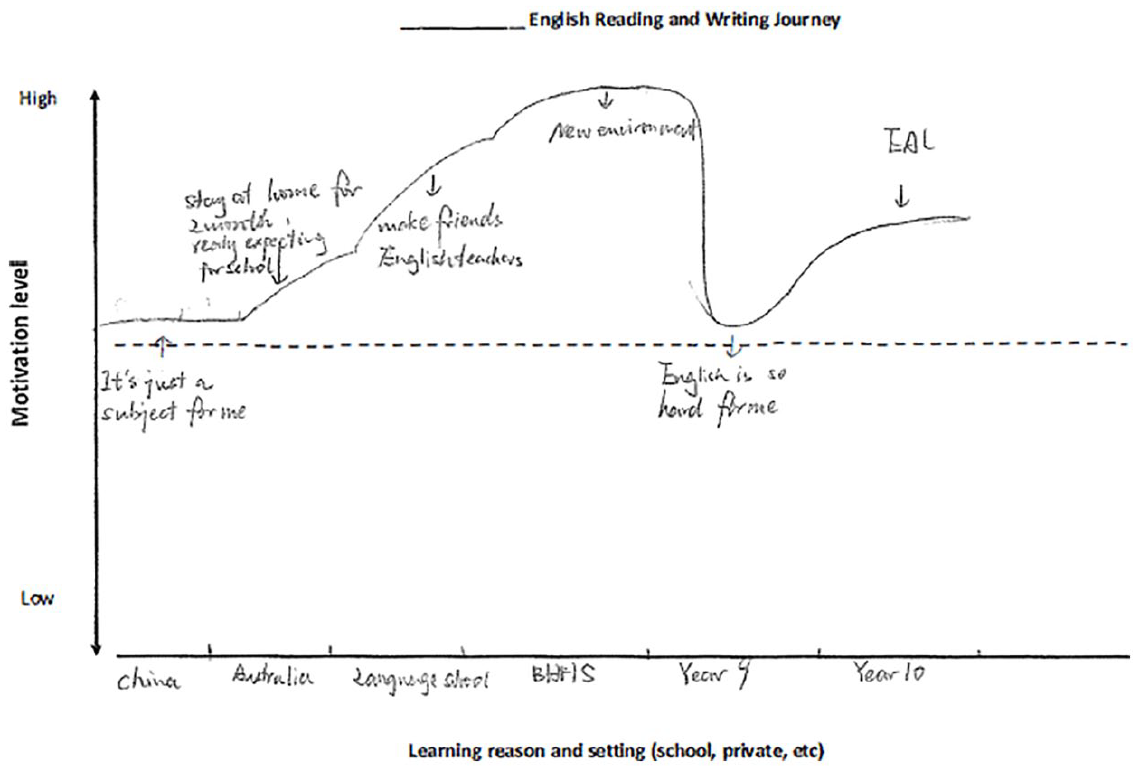
Elizabeth’s grid
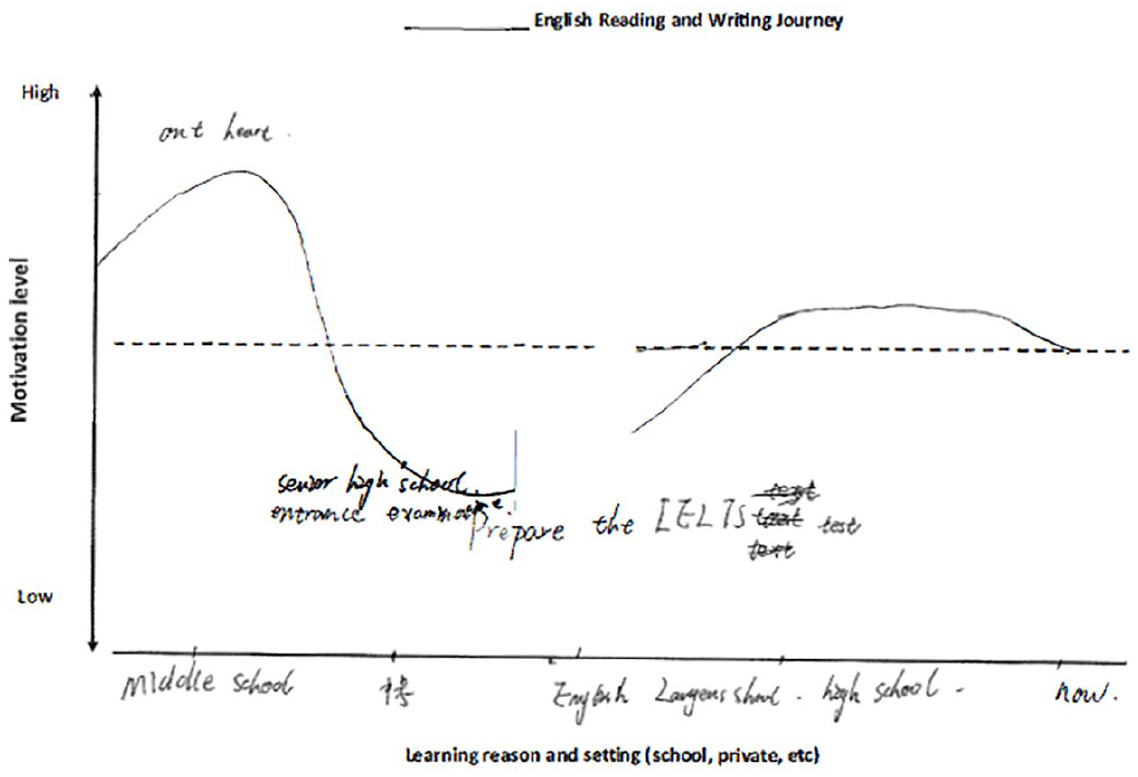
Karry’s grid
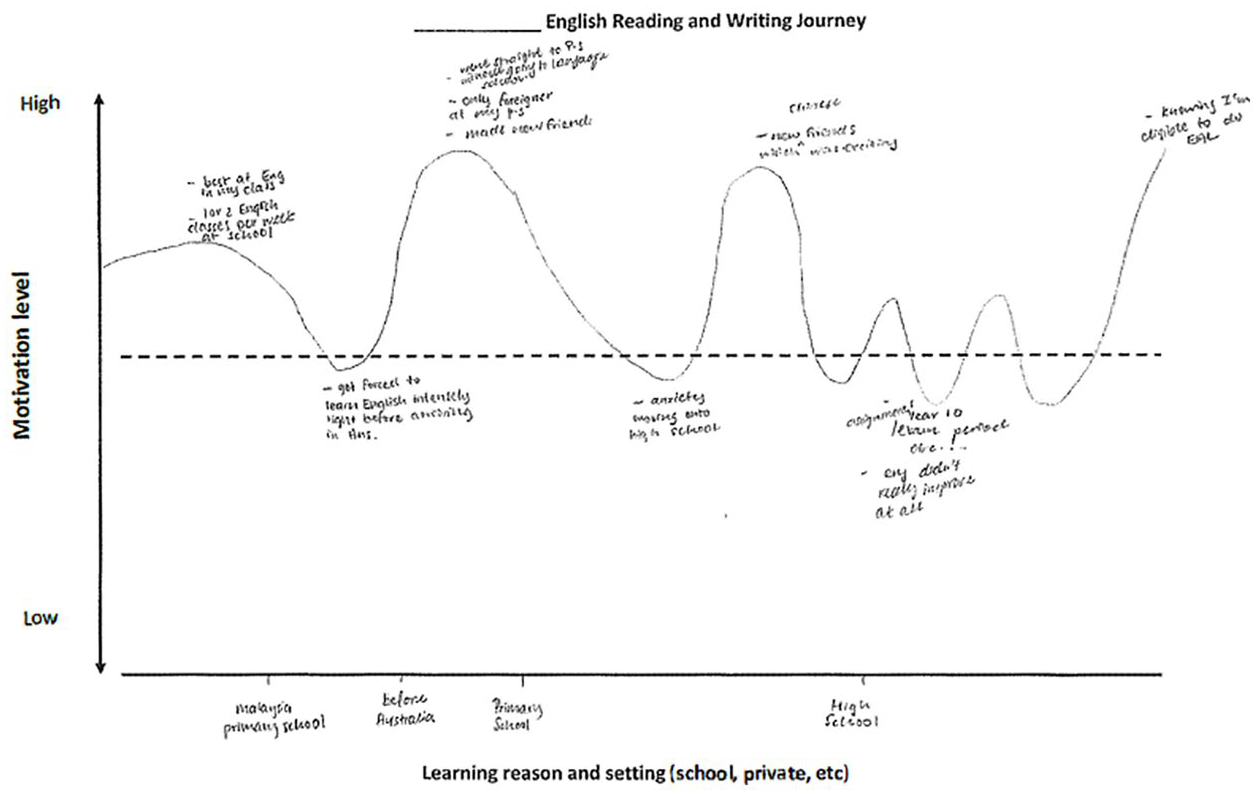
Yun’s grid
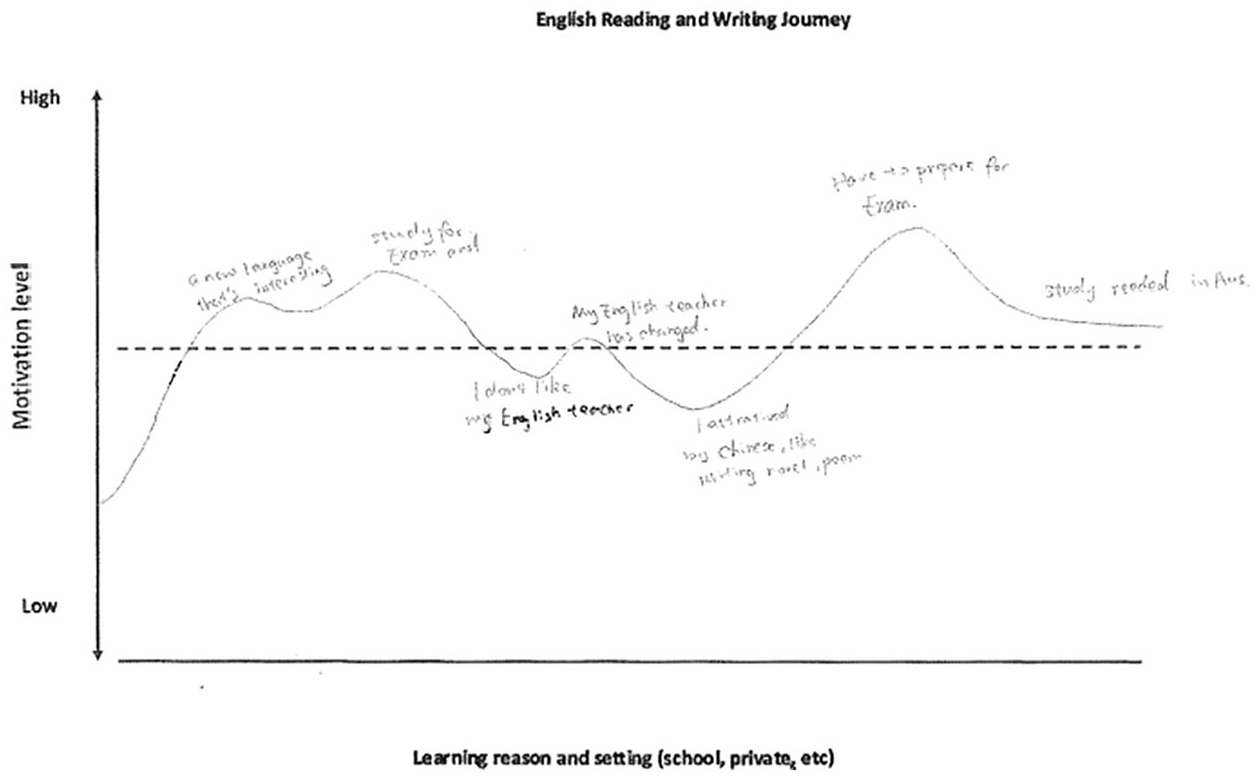
Phoebe’s grid
Once the task was underway, each student plotted their journey in ways that made sense to them. Thus, the information they chose to illuminate does not always conform neatly to our instructions (i.e. to include information on their timelines, feelings and reasons for their feelings).
V Learning about EAL students’ experiences through English language trajectories
Drawing on students’ English language trajectory grids, audio-recorded conversations with students as they produced the grids in class, and questionnaire responses, we present our understanding of EAL students’ multilingual language learning experiences, the overarching dimensions that shape their relationship to English and the effects of the major linguistic, cultural and educational discourses and practices that continue to shape their lives. In Section VI, we discuss the implications of these findings in relation to pedagogical designs for learning.
1 Primary years
a Individual differences
Although participants had a common experience of early language study, students remember their engagement with English differently. As a compulsory subject in primary schools both in China and Malaysia, students will typically receive as Yun points out ‘1 or 2 English classes per week at school’ (Figure 9). 4 Sam discovers ‘[English] was really easy’ for him (Figure 2). Phoebe welcomes learning ‘a new language’ which she sees as ‘interesting’ (Figure 10). On the other hand, Jason realizes he ‘suck[s] at English (Figure 6) and Elizabeth is indifferent towards English: ‘It’s just a subject for me’ (Figure 7). Jason further points out he ‘[didn’t] really need it’ and Vanessa similarly states ‘[I] don’t’ know why [I was] learn[ing] English’ (Figure 5). People, such as teachers begin to play a role in their introduction to the new language with comments such as: ‘[I] don’t like the teacher’ (Figure 5) but parents feature more powerfully: ‘my mum encourages me to persist’, ‘mum forces me to do lots of English training’ (Figure 1).
Being ‘forced’ appears also in Yun’s history: ‘got forced to learn English intensely right before arriving in Aus[tralia]’. Parents typically expose children to learning English much earlier than when school system’s dictate, as shown in Sally’s grid: ‘[I was] a little bit interested [when I was] 5 years old’ but at 8 years old, she states ‘[I] find English is difficult and I’m going to give up.’ Children already develop a sense of affinity and/or aversion for English before entering primary school. ‘By age 11 and 12’, as Besser and Chik’s (2014) study shows of Hong Kong children learning English, ‘children are aware of the position English plays in the manifestation of a society structured by unequal access to economic capital, and this awareness plays an integral role in their developing narrative identities as English speakers’ (p. 308).
b Exams and scores
Entering primary school opens up a world of preparing for and taking English exams. Scores begin to define how they see themselves as English language learners. Jason states, ‘[I] don’t really need it but my score was ok’. Then in Years 5 and 6, he states, ‘[I’m] getting better and better, always get a high score’ (Figure 6). Yun states, ‘[I was] best at English in my class’ (Figure 9). By ‘best’ she means she ‘got the top marks in the tests’ (audio recording). Students understand achieving high scores requires concentration and effort, as Sally points out: ‘Primary school, study English well, got high score’. However, Sally’s motivation plummets by the end of her primary school years when she receives ‘low achievement in English exam of final exam’. She explains: ‘I lose my interest again because I think the primary school’s English is so boring’. With her mother’s push to study English harder, she manages to ‘get the highest score in the beginning term exam’ when she enters secondary school. Soon enough, she began losing interest again because she ‘found Chinese education is so boring, cramming education system’ (Figure 1). As they experience myriad feelings of being bored, forced, and admired while learning English, their parents’ desires gradually come to shape their own as shown in Sally’s statements upon entering secondary school and preparing to move to Australia where she decides: ‘I have to put effort in English’, and in Australia: ‘I came to Melbourne and made up my resolution to study English well.’
2 Transitional period
a Friendships
The ‘friend’ dimension flows through many of the grids and we focus on Cat’s grid to highlight this theme. It is not atypical for students to move from one city to another within and outside of China throughout their formal schooling lives as shown in Sally’s timeline (from Liao Yang to Shen Yang to Melbourne, Figure 1). With the rise of Chinese transnationalism (Duff, 2015), students can also frequently move between China and overseas locations such as, the United Kingdom as shown in Cat’s grid (Figure 4). Cat starts by pointing out she was ‘bored in middle school’. The ‘teacher push[ed] me to learn, I just played game everyday.’ She became ‘excited’ when she [went] to the UK as [an] exchange student. She moves back to China and is ‘bored again, [but] not that bored as before.’ She once again goes to the UK for a holiday. Then travels back to China and is ‘bored’ again. The making of new friends feature prominently in her grid. In her first trip to the UK, she states ‘[I had] a lot of friend[s], everyone [was] kind to me’. When she returns for a holiday, she is ‘free to travel in [the] UK with [her] English friend’. In moving to Australia, she indicates her motivation as high because she ‘make[s] more friends in [Australia]’.
In relation to friends, students also point out their friends’ linguistic backgrounds and skills. We present Sam and Yun’s data as two examples. In Sam’s experience when he first entered secondary school in Malaysia, he states ‘[I was] meeting new friends, lots of them [speak] English’ (Figure 2). Sam went to primary school in Malaysia where he spoke English with a mixture of other languages with his friends. He liked that his new friends spoke English because ‘it’s the language I feel most comfortable in’ (audio recording). However, in Yun’s case she appreciated being amongst students from China. Yun arrived in Australia during her primary school years ‘without going to [a] language school’ and was ‘the only foreigner at [the] primary school’ (Figure 9). She ‘made new friends’ from diverse linguistic backgrounds but entering a high school with a large population of Chinese learners, making ‘new Chinese friends . . . was exciting’. Whether students believe it is beneficial to be in an English medium environment to improve their English proficiency is thus not a straightforward matter. Speakers’ life circumstances, their emotional ties to a language, and immediate community surroundings shape their multilingual developments across time and space.
b New language and knowledge realizations
Overall, friendships help students overcome feelings of anxiety and fear during these transitional periods as students continue to ‘study for exams’ (Figure 10), such as taking 中考 (zhong kao, ‘senior high school entrance examination’) (Figure 3; Figure 8) and the IELTS exam (Figure 1; Figure 8) as they prepare for their moves to Australia. Upon arrival in Australia and in language schools, they also come to the realization the knowledge of English they bring with them is not useful for navigating their school lives in Australia. During his time at the language school, Jason realized ‘the knowledge I learnt in China isn’t that useful’ (Figure 6). At this point of realization where he indicates very low motivation, the line rises to moderately low with a slight, sharp drop that then rises to the moderate level. He attributes that slight sharp period as a period when he realized he had to ‘[learn] English from the beginning’. Similarly, in Sam’s grid as he transitions into secondary school, he realizes ‘English is getting harder’ (Figure 2). During these transitional periods, students make strong resolutions to ‘put effort in English’ and ‘study English well’ (Figure 1). Through their many experiences of achievements and failures in tests, they have built up competitive dispositions such as in Vanessa’s grid ‘my English was better than others so I have to learn more’ (Figure 5). While they continue to work hard in their secondary years as we will show in the following section, they realize the language they need for each subject is beyond their current capacities.
3 Secondary school
a Language difficulties
Students are generally in high spirits as they enter their secondary years as demonstrated in the high motivation in Elizabeth’s grid where she points out the reason being the: ‘new environment’ entering Summer Hills High School (pseudonym; see Figure 7). Sam also states when he first came to Australia: ‘different environment, English is different but I was excited’ (Figure 2). Both of their motivation levels plunge in Year 9 with Sam realizing ‘Only doing it for a month and I thought it was really different and hard’. Elizabeth also states, and ‘English is so hard for me’. Similarly, Kathy also states ‘English class (not EAL) was hard and [I was] not confident to do presentation[s]. Failed my Science test. A depressed period’ (Figure 3). Furthermore, she states, ‘failed my commerce test and mid-year exam. Felt bad.’ In asking students why they felt certain school subjects were difficult for them in the questionnaire, students responded: ‘Language is difficult and I don’t like Biology, ‘The language is difficult’, ‘Because commerce need to memorize a lot of terminology’, ‘It’s boring’, ‘Some subject is useless’.
In the grids, students also reflected on the gap between their existing knowledge and the knowledge needed in their current learning contexts. In Year 8 Jason realizes: ‘[there are] so many new knowledge that I don’t know at all’. Students’ comments help us to understand it is not only issues of linguistic knowledge that make learning difficult but also the pedagogical ways in which teachers make the knowledge relevant or interesting to students’ lives.
b Teachers
Teachers, and subject English and EAL teachers, feature more prominently in this period. In Phoebe’s grid she explicitly states: ‘I don’t like my English teacher’; her motivation rose slightly when the ‘English teacher has changed’ (Figure 10). In my conversations with Phoebe she clarified the former teacher refers to her subject English teacher and the latter teacher is a subject English teacher who also teaches EAL students in a separate class (audio recordings). More recently, she has been busy channeling her energies to ‘prepare for exam[s]’ and is continuing to ‘study’ so she takes little notice of her like or dislike of teachers. Yun, as mentioned earlier has from her primary years seen herself as ‘best at English in [her] class’ but in Year 10 she felt her ‘English didn’t really improve at all’ (note: Yun is referring to her performance in her subject English class) (Figure 9). Her motivation soars in her current phase, as she states, ‘knowing I’m eligible to do EAL’. 5 Sam’s motivation also rises with the comment ‘EAL, Better teacher’ (Figure 2) and in conversations with him in class he mentioned he liked the EAL class ‘because it’s easier’ (audio recording). Elizabeth’s motivation is also on the rise which she signifies with the subject ‘EAL’ (Figure 7). In conversations with the students during the making of their grids, anecdotes involving subject English teachers came up frequently. Pointing at Elizabeth’s Year 9 comment ‘English is so hard for me’ (Figure 7), the following conversation ensues:
Why was English so hard in Year 9?
Because I did English in Year 9 and there’s no EAL so they are all English speakers and they do presentations and I can’t so at first I can’t even understand what the teacher is talking about.
So what did you do?
I’m just sitting there and did nothing. Yeah, my English teacher was really nice and he said I don’t need to give the presentation and I don’t have homework the whole year 9 English.
Is that good or bad?
I don’t know. I cut school A LOT!
So you got to Year 10 EAL and it’s a lot better?
Yeah, the teacher is very nice and I know need to try harder. And I have homework.
(audio recording)
At this point in the conversation, Alice (the teacher) joins in and Elizabeth further talks about her confusion:
So you did EAL in Year 9 here? And it was really hard?
Yeah. Only for half a year. I talked to my English teacher and said I want to do Mathematics this year. And my math teacher said ‘Your English is not good enough, talk to your English teacher.’ And then my English teacher told me, ‘It’s your Math subject, not English.’ And then . . .
So, did you end up doing Maths this year?
Yes. It’s difficult but good.
Your grid – it doesn’t look like there was any time when your motivation was low.
Yeah. I always liked English but I’m just not good at it.
(audio recording)
Although students recognize there is a difference in subject English and EAL teachers’ instruction, it is not clear what exactly is ‘better’ about EAL teachers or ‘easier’ in EAL classrooms. We can assume the differentiation has something to do with EAL teachers having more knowledge of second language acquisition and language (i.e. grammar) constructions. More scaffolding and attention to language features are commonly found advice in the EAL pedagogical space in Australia (Derewianka & Jones, 2010; Gibbons, 2014) so these may be factors in students’ understandings.
Students are generally confused, as shown in Elizabeth’s experience, about who to consult when they have questions or would like to voice their requests; they struggle to approach their teachers. It is not surprising given the answers students provided in the questionnaire when asked whether they feel their teachers understand their learning needs. Only one responded ‘my teachers understand my learning need’. The rest left the answer blank and one responded, ‘maybe’. When also asked how they get help to complete schoolwork in the questionnaire, four students responded, ‘ask friends’, three students look up ‘web-dictionaries’, two students rely on ‘out of school tutoring’, two students ‘ask teachers’, one student wrote ‘search online’ and the rest left their answers blank. However, when issues of scaffolding of language learning are not adequately supported, when students ‘can’t even understand what the teacher is talking about’, they no longer seek assistance. As Elizabeth shows, students end up either ‘sitting there and [doing] nothing’ or disengaging completely i.e. ‘cut[ting] school A LOT!’
c Use of other linguistic resources
Although we only asked for information related to their English learning experiences, non-English details also flowed in and surrounded talk around the grids. Cat stops her grid stating she is currently ‘learning Japanese’ and explains that she isn’t as excited reading and writing in English as she was before (audio recording). After talking about her interest in Japanese for a while, Julie asked Cat whether she uses Chinese to help her learn in other subjects.
I don’t always need to use Chinese and for like subjects like Science, I don’t think it’s always useful. It’s so tiring – why I want to look up in Chinese?
It’s a lot of effort right? You have to . . .
Yeah, it’s not necessary. And I can do it in English if I try. It’s much faster and more convenient and I can use the words.
(audio recording)
Having had the experience of being an exchange student in the UK for a period of time during her early secondary years, she explained there are many units she didn’t learn in China and because of her short sojourn to the UK where everything was new for her, she doesn’t quite remember what she learned academically. It is not that Cat rejects using her first language for learning, rather when or when not to use it depends on whether there is a need, how convenient it is and whether it is useful within the timeframe she has to learn new ideas (i.e. if students have not learned the words or concepts in their first language, they will find it unnecessary to use their first languages).
From a different angle, Phoebe indicates a decrease in her motivation for English because she became interested in writing in Chinese. She states: ‘I attracted by Chinese, like writing novel, poem’ (Figure 10). The reason for this as she explains is ‘I can’t write in English as vivid as I do in Chinese’ (audio recording, see also Lin (2010) on writing in English because it gave her the freedom to say things she couldn’t in Chinese). On whether the students felt it was useful to use their first language to learn English in school, three students responded: ‘No. It’s not useful to use my L1 to learn English. Just use all the English’, ‘I think it’s less useful than use ‘English’ to learn ‘English’ because I think the situation is important’, ‘No. I used Chinese to learn English in China for 9 years and it didn’t work as well as I am here learning for a year.’ However, three other students responded: ‘Yes, it’s easier to understand’, ‘Yes using my L1 to learn English can makes more sense’, and ‘Yes, I think it’s useful to translate, but sometimes there are slang so not always useful’ (questionnaire responses).
For many of the students, English is not the language they engage with for personal hobbies and entertainment and there was a limitation in the use of the trajectory grids to only focus on English. As we learned through the questionnaire on the kinds of linguistic activities they like doing outside of school, students included: ‘watch Korean and Chinese dramas on Netflix’, ‘watch Korean [music] groups on YouTube and watch k-drama, and ‘participate in Japanese anime festival’. Students are traversing through multilingual spaces outside of their L1 and English but also using their existing linguistic resources (L1 and English) to read subtitles, song lyrics and profiles of their favorite bands in whichever language translations are available. In the process they are picking up bits of Korean words and phrases.
Cat tells Julie she sometimes watches Korean dramas every day saying, ‘I really wanna learn Korean!’ (audio recording). In other recordings between the MEA, Jason and Sally (speaking in Chinese), Jason is discussing his fondness of the Japanese language and says: ‘我跟你讲哦,我买了一本日文的英语书啊, 我发现我的日文进步了,英文 . . .’ [Look, I bought an English textbook written in Japanese, I found my Japanese improved, but English level . . .] . . . ‘我现在已经可以说日式英文了 [I am already able to speak Japanese–English].’
d Language and identity
The focus of the lessons we observed was writing narratives and students such as Sally were able to immediately and creatively generate a narrative based on the storyline of her grid. She changes the character’s name from Sally to Miss Victoria and the topic from English to Piano, calling her piece Victoria’s piano journey (Victoria possibly because she is living in the state of Victoria and calls the city Miss Victoria is living in, ‘Melody’ given her piece is about playing the piano). However, other students struggled either with how to start a fictional/non-fictional story or what exactly to write about as they didn’t feel their English language learning journeys were interesting as stories. At this point, the teacher tried to offer some ideas:
Maybe you could talk about how you changed your name when you came to Australia.
I don’t like my English name.
Did you choose it?
Yeah I choose it but I wanna go by my Chinese name cuz like I don’t feel like Elizabeth is MY name. In school when they call me Elizabeth I will answer but I just feel like that’s not me. But I’m scared like some teachers won’t pronounce it right.
So you need to correct them.
[silence]
(audio recording)
It is critical to consider the implications of the impact on students when they feel that an identity marker as important as a name ends up sounding ‘out of place’ from the mouths of their teachers. Given the power differential between student and teacher, correcting a teacher could be beyond the pragmatic skills of students, with differences in normative cultural practices also playing a role. The result, as illustrated above, can be the silencing of students.
VI Discussion
This article has focused on the use of visual methodologies as an avenue through which to explore students’ language trajectories and to consider implications for teacher pedagogy. Our analysis of students’ English language learning experiences reveals long and complex experiences of learning and using English. From a young age, students come to understand English has a non-negotiable presence in their lives, with exam scores marking a sense of whether they are ‘good’ or ‘bad’ at English. The practice of taking entrance exams and tests intensifies throughout their secondary years in China and Australia. However, discourses of achievement (i.e. being the ‘best’ (Figure 9), ‘always get[ting] a high score’ (Figure 6) disappear from their grids in their new contexts. As they move in and out of different cultural education systems, students develop, ‘negative assessments of their abilities which [are] based solely on their lack of experience in English’ (Safford & Costley, 2008, p. 141). Students utter discourses of being ‘not good’, ‘not that good’, or ‘not good enough’ (audio recordings) at English.
Although our use of the language trajectory grids, undertaken in the context of EAL English writing classes, only focused on mapping English language learning experiences, the importance and complexity of students’ linguistic repertoires emerged through discussions with students and their ‘small stories’. As seen through the analysis, the students are making full use of their resources in Chinese and English in out of classroom reading, viewing, and listening practices, for instance, listening to Korean but reading in Chinese or English for comprehension. Students are also engaging with English by ‘crossing’ into a third language as shown in Jason’s example where he is studying from an English textbook by reading Japanese explanations. As shown in Rampton’s (1995, p. 8) work on ‘language crossing’, speakers ‘move across social and ethnic boundaries using a language that is generally not thought to ‘belong’ to the speaker, is also a way for speakers to ‘explore other people’s ethnicities, embracing them and/or creating new ones’. Other students such as Cat demonstrate strategic and sensible deployment of her linguistic resources as she sees fit.
In an English-medium educational system, which insists on a monolingual perspective in curriculum, pedagogy and assessment (e.g. Cross, 2009; Hammond, 2012; Macqueen et al. 2019), such complex language resources, curiosities, and literacy practices of multilingual students too often go unrecognized. This omission can leave students with little or no alternatives to build their confidence, as shown in Elizabeth’s shrugging, silence and cutting school in moments of intense power dynamics and language difficulties (on EAL students’ silence in schools, see also Safford and Costley, 2008).
There is a complexity of variables that impact on students whereby the breadth of their linguistic resources is sidelined, contributing to a discourse pattern of immigrant students blaming ‘themselves, their language, and their culture for what happens to them (Brisk & Harrington, 2006, p. 170). Cummins (2009, p. 261) argues that as educators, we need to help students discover for themselves, their own histories of deficit discourses informed by ‘inequitable social structures and polices’ and to actively create ‘images of students as linguistically talented and intellectually powerful’ within education systems (p. 270). ‘Empowerment’ of students then, in this sense, is generated though interaction between students and educators, through ‘collaborative relations of power’ (p. 263).
‘Identity texts’ which consist of a range of speaker-centered, multimodal methods, as we have outlined earlier, can critically engage multilingual EAL students in the above-mentioned processes. Learner-centered approaches (Nunan, 2012) that position teachers and learners as co-researchers as shown in D’warte’s (2013) work, and ‘situational context (SC) lessons’ can provide a powerful framework for engagement. On the benefits of SC, Brisk and Harrington (2006, pp. 169–170) explain:
Students and teachers have no control over situational factors, but they can objectively analyze them. In the SC lessons students research such factors and reflect on how they affect them as language and literacy learners, as students, and as members of our society. Objective analysis of these factors helps students understand their present circumstances and react in a constructive way. Carefully planned lessons allow students to objectively analyze external factors influencing their lives as learners.
With identity texts, the content is generated by students’ real-life experiences, holistically bringing together a variety of forces that have come to shape their realities. By engaging in research activities, guided carefully by teachers, such as interrogating, interviewing and finding patterns between the language ideologies of their own and peers’ experiences, students can gain a critical awareness of the complex and dynamic interplay of the politics of education and the complexities and vibrancies of multilingual language learning journeys. Such new understandings have the potential to disrupt the deeply ingrained discourses that negatively position English language learners and help them to work out for themselves a rationale of why certain positionings are untenable. The process of students’ learning is also a process of teachers’ learning where ‘teachers familiarize themselves with the situational factors that affect bilinguals’ (Brisk & Harrington, 2006, p. 158).
In an era of migration, mobility, complexity (Blommaert, 2016; Canagarajah, 2017) and growing inequalities, ‘just good teaching’ (de Jong & Harper, 2005) is simply ‘not good enough’ to help minority language students develop an ‘intelligent, imaginative, and linguistically talented’ (Cummins, 2009, p. 265) voice that will be recognized and respected as multilingual speakers. EAL instructional spaces need to become more than merely ‘better’ learning spaces for students because they are ‘easier’ with ‘very nice’ teachers. While tackling the complex work of meeting curriculum requirements and teaching language for school literacies, educators need to ensure EAL students’ diverse meaning-making resources, cultural experiences and identity negotiations do not become invisible and are connected to the content they are learning. A growing body of literature suggests such dimensions are not only possible in schools (see, for example, Choi & Ollerhead, 2018; French, 2016; Heugh, 2015; Sierens & Van Avermaet, 2013) ‘but also necessary in education and most particularly for learning’ (Heugh, 2018, p. 360).
Through this research we have explored how the use of identity texts can be used to explore the linguistic journey of learners and the discourses and situational factors that have led them to their current dispositions towards language, language learning and identity. In comparison to other mechanisms such as ‘demolinguistic mappings’ (i.e. mapping percentages of language backgrounds; see Pennycook & Otsuji, 2015), generic labels such as ‘English language learners’ or ‘EAL’, and student profiles in Excel spreadsheets, the use of identity texts in this research provided a powerful starting point for students and teachers to engage in building ‘collaborative relations of power’.
A limitation in this research was the focus on English language learning only, and future use of language trajectory grids would benefit from the integration of all elements in students’ linguistic repertoires. Although this did emerge through ‘small stories’, the integration of broader elements could enable a deeper understanding not only of discourses of language learning, but also their intersection with language practices.
Footnotes
Funding
The author(s) disclosed receipt of the following financial support for the research, authorship, and/or publication of this article: The authors received support through a grant from the Melbourne Graduate School of Education for the writing phase of this project.
