



Abstract
Six electoral cycles since the implementation of Brazil’s gender quota, just 15% of the 513 members of the Chamber of Deputies are women. We ask how parties’ use of informal institutions mediates the effectiveness of the gender quota. Drawing on data from more than 4,000 state-level party organizations, we show that parties employ informal practices that intentionally and non-intentionally interact with gender equity rules to affect women’s political representation: the intentional nomination of phantom candidates (“laranjas”) allows parties to comply with the letter of the quota law, without effectively supporting women’s candidacies—to the detriment of women’s election; meanwhile, the extended use of provisional commissions to minimize oversight on candidate selection poses an obstacle to the quota and women’s candidacies and election more generally. Quota resistance characterizes an instance of both the likely inadvertent effects of informal institutions employed for non-gendered motivations and party leaders acting to preserve their own power.
Introduction
Formal and informal party practices interact in the “secret garden of politics” to influence the candidate selection process, with gendered implications (Bjarnegård, 2013; Bjarnegård and Kenny, 2015, 2016; Bjarnegård and Zetterberg, 2016, 2019; Gallagher and Marsh, 1988; Kenny, 2013; Kenny and Verge, 2016). Among the formal selection criteria guiding recruitment are candidacy requirements that shape the perceived viability of individual aspirants and collectively construct the supply pool (Aldrich, 2020; Bjarnegård and Zetterberg, 2019; Hazan and Rahat, 2010; Hinojosa, 2012). Gender quotas are one such criterion, and have helped to remedy men’s descriptive overrepresentation globally (Annesley, 2015; Dahlerup, 2006; Hughes, 2011; Krook, 2009; Krook and O’Brien, 2010; Tripp and Kang, 2007). Yet as compellingly articulated in the feminist institutionalist literature, electoral and party systems and formal and informal party rules mediate gender quotas, posing important constraints to their implementation, to the detriment of women’s political representation (Baldez, 2007; Franceschet et al., 2012; Johnson, 2016; Murray, 2010; Verge and de la Fuente, 2014).
In a region where gender quotas have flourished, with many countries managing to increase the shares of women in legislatures substantially, Brazil stands as an anomaly. Since its implementation in national and state legislative elections in 1998, Brazil’s gender quota has been notoriously ineffective (Araújo, 2003; Bolognesi, 2012; Wylie and dos Santos, 2016). Characterized as “a law on paper only,” even subsequent efforts to reform the quota in 2009 and 2018 have come up empty handed (Wylie et al., 2019). Six electoral cycles since the quota’s initial implementation, with three of those elections held after the 2009 mini-reform, just 15% of the 513 members of Brazil’s Chamber of Deputies are women.
This article situates the failure of Brazil’s quota law to enhance women’s descriptive representation within the literatures on informal institutions and feminist institutionalism. We ask how parties’ use of informal institutions mediates quota effectiveness. Following Helmke and Levitsky, who define informal institutions as “socially shared rules, usually unwritten, that are created, communicated, and enforced outside of officially sanctioned channels” (2004: 56), we argue that parties employ informal practices of candidate recruitment and support that intentionally and non-intentionally interact with gender equity rules to affect women’s political representation.
Employing this framework to understand challenges to institutional approaches to gender equity, we classify intentionally accommodating informal institutions as those that purposefully emerge in response to formal efforts to increase women’s political representation and inadvertently competing informal institutions as those that interact with gender equity rules unintentionally. In the case of Brazil, parties’ practice of nominating sacrificial lambs and phantom candidates (“laranjas”) is an example of an intentionally accommodating informal institution: a gendered response to the adoption and strengthening of the Brazilian quota law. In turn, parties’ extended use of provisional commissions constitutes an inadvertently competing informal institution as it is a non-intentionally gendered practice used to minimize oversight on candidate selection.
As articulated by Waylen, “informal institutions can often be difficult to perceive—somewhat like dark matter—but we know they are there because of their effects on other things” (Waylen, 2017: 4). Our selection of these two informal institutions is a strategic choice driven in part by their observability and availability of rich data (Barbieri et al., 2019; Wylie et al., 2019). Laranjas and the extended use of provisional commissions are just two of the many mechanisms that fall under our gendered conceptualization of informal institutions that thwart gender equity rules in Brazil and elsewhere.
Specifically, we posit that state parties’ nomination of laranjas and extended use of provisional commissions undermine the gender quota—even after reforms to strengthen the policy’s design. To test this argument, we draw on candidate-level electoral data and state-level party characteristics from more than 4,000 state party organizations in six election cycles (1998–2018) for Brazil’s national Chamber of Deputies and 27 state legislatures.
We find that state parties’ employment of informal institutions poses challenges to women’s political representation. The nomination of laranjas allows parties to comply with the letter of the law, without effectively supporting women’s candidacies—to the detriment of women’s election. Meanwhile, parties’ extended use of provisional commissions constrains quota enforcement and hinders women’s candidacies and electoral prospects. We show that quota resistance characterizes an instance of both the likely inadvertent effects of informal institutions employed for non-gendered motivations (Bjarnegård and Zetterberg, 2016) and party elites acting to preserve their own power (Catalano Weeks, 2018; Fréchette et al., 2008; Gatto, 2016; Murray et al., 2012; Valdini, 2019). Our focus on formal and informal institutions and the intentionality behind their interactions illustrates how even seemingly gender-neutral practices have profound gendered implications (Bjarnegård and Zetterberg, 2016; Waylen, 2014, 2017), and how processes of institutional design and reform are inherently gendered (Mackay, 2014; Mackay and Krook, 2011).
Gendered informal institutions
Candidate selection processes are at once guided by formal and informal party practices (Aldrich, 2020; Bjarnegård, 2013; Bjarnegård and Kenny, 2015, 2016; Bjarnegård and Zetterberg, 2016, 2019; Gallagher and Marsh, 1988; Kenny, 2013; Kenny and Verge, 2016). As such, recruitment constitutes a key arena in the discussion on institutional change and continuity, illustrating how formal and informal institutions interact and the consequences thereof. With a crisis of representation besetting many countries in and beyond the third wave of democratization, the capacity of formal institutional fixes (such as gender quotas) to mitigate representational deficits has attracted much scrutiny.
The rapidity with which gender quotas have diffused belies the persistent challenges to such formal institutional reforms. The extensive literature on institutional change emphasizes that altering the formal rules is not only difficult, but even when “successful” may be insufficient to disrupt the status quo (Mahoney and Thelen, 2009). Particularly when reforms stand to redistribute power, actors will resist change, and in the face of change, will develop mechanisms for attenuating their impact (Catalano Weeks, 2018; Gatto, 2016; Mackay, 2014; Mahoney and Thelen, 2009; Valdini, 2019; Waylen, 2014).
The post-design phase of institutional reform, whereby new formal rules may both interact with pre-existing institutional frameworks and motivate the creation of new informal practices, warrants heightened scrutiny in the case of gender equity reforms, which may be especially “vulnerable to regress” (Mackay, 2014). Although “mainstream” institutionalist work has largely neglected the gendered dimensions of institutional dynamics (Mackay et al., 2010; Waylen, 2014: 215), the feminist institutionalist (FI) approach reveals the myriad ways gender manifests in the design, implementation, operation, transformation, and persistence of institutions (Mackay, 2014; Mackay et al., 2010; Mackay and Krook, 2011; Waylen, 2017).
Scholars applying FI have been especially attuned to the gendered implications of interacting formal and informal institutions (Bjarnegård, 2013; Franceschet, 2010; Kenny, 2013; Lovenduski, 1998, 2012; Mackay, 2014; Waylen, 2017), “highlight(ing) the operation of informal mechanisms that shape institutional processes, developments and outcomes” (Mackay et al., 2010: 581). While all instances of electoral reform arguably have gendered consequences in that they affect the allocation of power, gender is clearly central to understanding gender equity reforms such as quotas. Not only do quotas aim to seat women, but they are mediated by gendered actors and spaces, and their implementation and enforcement may at once affect and be affected by intraparty power struggles (Catalano Weeks, 2018; Krook, 2015).
More generally, we know that the effects of formal institutional change are mediated by the “great survival tenacity” of “the deep-seated cultural inheritance that underlies many informal constraints” (North, 1990: 91). The institutional layering process suggests that new formal institutions are layered upon not only prior formal rules but also a host of informal norms. It is precisely the informality of those institutions that makes them difficult to displace, which bears important implications for whether institutional reforms achieve their expected outcomes. Helmke and Levitsky’s typology of the interaction of formal and informal institutions includes one dimension on whether formal and informal institutions converge or diverge, and another dimension on whether actors expect formal institutions to be enforced. When interacting formal and informal institutions converge, informal institutions may reinforce effective institutions (“complementary”) or substitute ineffective formal rules (“substitutive”). When the outcomes of those interactions diverge, informal institutions may subvert the expected outcomes of effective formal institutions (“accommodating”) or take advantage of the ineffectiveness of formal rules in ways that challenge (“competing”) expected outcomes (Helmke and Levitsky, 2004, 2006).
Legislated candidate gender quotas have the stated purpose of increasing the nomination of women candidates with the ultimate goal of enhancing women’s representation. From this point of departure, complementary informal institutions reinforce gender quotas’ objective and substitutive informal institutions provide alternative means for increasing women’s descriptive representation if the formal design of a gender quotas is lacking. Conversely, accommodating institutions are adaptive practices in response to the enforcement of gender quotas, while competing institutions consist of practices that take advantage of failures in formal rules. Notably, these formal rules are not limited to the gender quota itself, and informal institutions that emerge from the limitations of other institutions may still interact with the quota in detrimental ways.
Since our objective is to understand how informal institutions interact with formal rules to the detriment of women’s representation, our focus is on the use of divergent informal institutions. As a number of studies have shown, men political elites’ actions toward gender quotas reflect their attempts to preserve their own power (Catalano Weeks, 2018; Fréchette et al., 2008; Gatto, 2016; Valdini, 2019). Intentionally accommodating practices emerge in response to the adoption or strengthening of gender equity efforts, as purposeful efforts to undermine the spirit of the institution. But new formal institutions are embedded into a pre-existing infrastructure of formal and informal institutions (Mahoney and Thelen, 2009). That is, informal institutions that emerge from the failures of other formal institutions, may still inadvertently compete with gender quota outcomes even if non-intentionally. In other words, because political dynamics are gendered (Mackay, 2014; Waylen, 2014), informal practices employed for purposes other than undermining the gender quota may still inadvertently hinder women’s political representation. Parties’ nomination of laranjas and extended use of provisional commissions are two observable manifestations of accommodating and competing informal institutions, respectively.
The Brazilian case
Despite having been one of the early adopters of a gender quota in Latin America, Brazil has maintained its low levels of women’s political representation, even after electing (and reelecting) a woman to the presidency. The minimal impact of the gender quota on women’s descriptive representation in Brazil has often been analyzed in terms of its design and fit with open-list proportional representation (OLPR) rules (Araújo, 2003; Miguel and Biroli, 2010; Sacchet, 2016; Sacchet and Speck, 2012). The informal institutions that shape the practices of candidate recruitment and electoral campaigns, however, remain understudied.
The Brazilian National Congress is composed of two houses, the Chamber of Deputies and the Senate. The combined effects of high district magnitude (8–70) and OLPR electoral rules result in hyper-competitive, expensive, and personalistic elections that intensify intraparty competition, privilege “entrepreneurial” candidates, and entrench an inchoate and clientelistic party system (Mainwaring, 1999). That system deters the political prospects of women, who despite being 44% of party members, are starkly underrepresented among party leaders, candidates, and elected officials (Wylie, 2020).
The gender quota applies to the federal legislature’s lower house, which has 513 seats allocated through OLPR in 27 statewide multimember districts. The same rules apply to Brazil’s 27 state and 5,570 municipal legislatures. In the Brazilian variant of OLPR, the only official candidate list presented to voters is an alphabetized district-wide list, which is incompatible with placement mandates—a key aspect of gender quota designs that has contributed to women’s election cross-nationally (Htun and Jones, 2002; Schwindt-Bayer, 2010). The failures of the Brazilian quota, however, cannot only be attributed to the country’s electoral system.
The policy’s design itself creates obstacles to its successful implementation (Gatto, 2016). Since the original quota allowed parties to submit lists with nominations up to 150% of the number of available seats and only required that they “reserve” candidacies for women, parties could comply with the letter of the law without nominating a single woman by leaving 30% of candidacies reserved but ultimately unfilled. In 2009, Brazil enacted an electoral “mini-reform” that included changes to the language of the gender quota from “reserve” to “fill”—since the 2010 elections, parties have been expected to nominate women to 30% of candidacies, rather than simply reserve those positions, although enforcement remained weak until 2014 (Wylie and dos Santos, 2016; Wylie et al., 2019). In the wake of several unsuccessful attempts to strengthen gender quota provisions through legislative means, a change in the campaign finance law led to the creation of a public campaign fund, opening an alternative route to effectuate the quota. Soon after the creation of the multi-million-dollar public campaign fund, women legislators filed a successful motion with the higher courts to request that 30% of the funds be reserved for women’s candidacies (Barbieri et al., 2019; Gatto and Thome, 2020).
The strengthening of the gender quota prompted the emergence of accommodating informal institutions to subvert quota outcomes. The proliferation of women sacrificial lambs and phantom candidates, known as laranjas, is such an example. Laranjas differ in intentionality and legality and are not all women, but share in common that they are candidates in name only (Wylie et al., 2019). Some laranjas may not know that their candidacy was registered: there have even been instances of parties allegedly using women’s Facebook profile photos and information to register false candidacies that could assist with quota compliance without diverting party resources from the campaigns of more valued candidacies (Barba, 2014). Other laranjas are complicit in their false candidacy, allowing their party to use their name to facilitate quota compliance, with the understanding that party support will be more forthcoming for their future electoral bids. By our calculations, of the 23,964 women candidacies for the Chamber of Deputies and state legislative assemblies from 1998–2018, over 30% were probable laranjas. In the 2014 elections, the first in which the gender quota was actively enforced, the use of laranjas increased starkly, with nearly half of all women candidates being likely laranjas. The rates of likely laranjas were significantly higher among non-leftist parties (32.6% of women candidates, 7.1% of candidates overall), than leftist parties (24.8% of women candidates, 6.0% of candidates overall), a suggestive indicator of the salience of internal party culture and organizational characteristics.
Informal institutions that emerge in response to other formal elements of the Brazilian electoral code may also have non-intentionally gendered consequences for the recruitment and election of women—rendering them competing institutions. While the formal rules ascribed by the Political Parties Law (9.096/1995), Electoral Law (9.504.1997), and party statutes dictate the candidate selection process, parties can evade those procedures if they register their party organizations as provisional commissions (comissões provisórias) rather than party directorates. Formally, the provisional commissions clause is intended to allow leniency to newly formed parties with limited membership by allowing them to establish provisional party organizations in a municipality or state for up to 180 days. However, this formal rule is routinely abused by parties that maintain provisional commissions non-provisionally—with especially egregious use by the more inchoate parties—in an attempt to circumvent oversight in the selection process and beyond (Guarnieri, 2011; Wylie, 2018). Among the 2,083 unique state parties that competed in the 1998–2018 elections for state legislatures and have registered municipal-level party organizations, on average, 64.1% of their municipal party organizations were provisional commissions; a conspicuous 43.8% of those state parties (913) had exclusively provisional commissions throughout their state. Reliance on provisional commissions is significantly higher among non-leftist parties (71.6%) than leftist parties (47.6%). Tellingly, the average duration of municipal provisional commissions was over 648 days—well-beyond what is formally allowed by law—offering suggestive evidence of the widespread abuse of and failure to enforce this formal rule.
Theoretical expectations
We understand the role of informal institutions as permeating through different steps of the electoral process, resulting in gendered impacts at the nomination and election stages. We focus on two types of observable informal institutions that we expect to influence these two stages of the electoral process: a) the nomination of laranjas and b) the abuse of provisional commissions.
The laranjas phenomenon is reflective of a broader trend of using sacrificial lamb candidates to meet quota targets without displacing the status quo (Thomas and Bodet, 2013). Thus, it constitutes an intentionally accommodating institution. We expect that:
The abuse of provisional commissions represents a competing informal institution with a potentially non-intentional influence on women’s political representation that is divergent from the gender quota’s objective. State party leaders have deployed the mechanism to deter or dissolve party directorates, minimizing oversight and consolidating exclusive control over candidate selection decisions (Bolognesi, 2013; Guarnieri, 2011). Centralized candidate-selection processes are heavily elite-dependent, so they can constrain formal institutions (Aldrich, 2020). Provisional commissions suffer from an accountability deficit, so we expect this interaction to ultimately undermine quota compliance with detrimental consequences for women’s electoral prospects (Wylie, 2018). We expect that:
Research design
One of the challenges of tracing the role of informal institutions in shaping outcomes is that, as unwritten practices, their prevalence is not well-established or easily measurable. We focus here on observable informal institutions and their effects on women’s candidacies and election. We use official individual-level data from candidates to the Chamber of Deputies and state legislatures from 1998–2018 (N = 111,467) to generate data at the level of state party candidate lists (N = 8,393). This allows us to assess how aspects specific to the state-level party organizations that are responsible for recruitment and campaign support influence their propensity to nominate and elect women.
Accordingly, we employ two main dependent variables. Our first dependent variable, % women candidacies, is calculated as the share of women nominated by a state party for a given election. The variable ranges from 0 to 100 and has a mean of 20.5. Only 28% of the 8,393 state party lists in the six elections encompassing the 1998–2018 period met the 30% quota target. Our second dependent variable, % women elected, pertains to the share of women elected by a state party in a given election. The variable ranges from 0 to 100 and has a mean of 12.3. Since several of Brazil’s state parties do not elect a single person, employing this variable incurs in a decrease in the number of cases analyzed.
Our main explanatory variables are proxies for state party organizations’ use of informal institutions. To examine the influence of an accommodating informal institution, we measure the share of laranjas each state party nominates in a given race. Candidates qualify as likely laranjas if they secured no more than 1% of the vote of the last person to get elected in their state (as per Wylie et al., 2019). We then compute the total number of laranjas over the total number of candidates a state party nominates for a given race to develop the variable % laranjas. 1 By using the total number of candidates as the denominator rather than the number of women candidates, we preserve all observations, as all state parties in the dataset ran at least one candidate in the elections under consideration. Nearly one-third of the state parties participating in these elections failed to run a single woman candidate. To account for the fact that some state parties achieve a 0% score for % laranjas due solely to their candidate lists being comprised exclusively of men, we control for N women candidates, equal to the count of women candidates a state party runs in a given election.
To assess the effect of a competing informal institution, we account for parties’ reliance on provisional commissions, by employing the variable % provisional commissions. To construct this variable, we consider all municipal-level state-party organizations active at the time of the election and determine whether they were registered as provisional commissions or party directorates. We then calculate the state-level prevalence of provisional commissions as the percentage of a state party’s total number of registered municipal party organizations that are provisional commissions. 2 To account for the relative presence of party organizations across state parties, we add a control, N total party orgs, equal to the total number of municipal party organizations (provisional commissions and directorates) of a state party. We expect a higher number of party organizations within a given state to improve women’s political career opportunities by offering them more access points.
We include a number of controls. Because we also seek to understand the role of formal institutions in shaping parties’ willingness to nominate, support, and elect women, we include the binary variable after reform, for which all races taking place after the mini-electoral reform of 2009 are assigned a value of 1. We expect this variable to be positively correlated with our dependent variables.
Promoting gender equity and gender quotas is often on the agenda of left-wing parties (Caul, 1999; Kjerulf Dubrow, 2011). Descriptive statistical analyses also indicate that non-leftist parties are more likely to nominate laranjas and rely on provisional commissions. We control for these factors with party left-right ideology. This variable, calculated by Power and Rodrigues-Silveira (2019), is available for all Brazilian parties with representation in the National Congress. Given that negative values pertain to left-wing parties, we expect the variable to be negatively correlated with our dependent variables.
In Brazil, clientelistic parties abound and programmatic parties are the exception (Hunter, 2010; Mainwaring, 1999). Clientelism empowers local power brokers and ascribes influence to homosocial capital, entrenching male overrepresentation (Bjarnegård, 2013). In Brazil, the question of whether a party is programmatic or clientelistic is highly correlated with party ideology; at the national level, nearly all programmatic parties are leftist (Mainwaring, 1999). As such, we expect party left-right ideology to capture most of the effect of programmatic parties. We supplement that proxy with N total party orgs—a party’s total number of municipal-level organizations within the state. We expect more territorially complex parties will have a greater capacity to recruit and elect women candidates (Wylie, 2018).
Because we estimate the prevalence of laranjas based in part on candidate vote totals, it is important to control for the electoral strength of state parties. Party magnitude is the total number of seats won by a state party in a given election. Although the literature on women’s representation holds that party magnitude generally increases women’s chance of election, that finding derives largely from closed-list proportional representation elections (see Schmidt, 2009). In Brazil’s OLPR electoral context, however, women remain grossly underrepresented in most of the country’s major parties (Bolognesi, 2013; Wylie, 2018). Since party magnitude could affect women’s representation in either direction, we are agnostic about expected effects.
The competitiveness of elections may also influence parties’ candidate recruitment and campaign support strategies. To control for this, we include the variable competitiveness, which is an index developed by Santos (1997), factoring in the number of candidates (N) and available seats (M) per state (N/(2*M)) − 1, to calculate the competitiveness of each district’s election. Values over 1 are considered “high competitiveness.” The variable ranges from 0.51 to 19.3, reflecting the intense competition in Brazilian legislative elections. We expect competitiveness to be negatively associated with our dependent variables.
Finally, because we pool together races for seats in state legislative assemblies and the federal Chamber of Deputies, we include the binary variable assemblies, for which 1 refers to state legislative races. Seats in the national Chamber of Deputies are more prestigious and provide officeholders with greater material benefits and opportunities than those in state legislatures. As such, we expect that parties will be particularly protective of those seats and more prone to adopt informal institutions that can curb the entry of outsiders in those races. Descriptive statistics for our variables are available in Appendix A.
Analysis
A descriptive overview of women’s candidacies and elections from 1998 to 2018 illustrates the limitations of formal legal efforts to alter the gender composition of Brazilian legislatures. Although the 2009 mini-reform officially changed the quota language enabling enforcement, expectations of quota compliance were minimal in 2010. Indeed, of the 1,271 state parties contesting federal and state legislative elections in 2010, only 281 (22.1%) met the 30% target for women candidacies. If fact, more state parties ran no women at all (398, or 31.3%) than complied with the quota.
In the run up to the 2014 elections, the TSE offered more credible threats of quota enforcement, launching a campaign to promote quota awareness and women’s political participation more broadly (Câmara Notícias, 2014). While quota compliance increased in the 2014 elections, the result was an increase in laranjas and stagnation in the percent women elected. In 2018, judicial decisions established a 30% reservation of public campaign funds for women’s candidacies—a change expected to increase women’s electoral viability. Indeed, this formal reform seems to have furthered parties’ likelihood of compliance with the gender quota, increasing both women’s nominations and their electoral chances. 3 As demonstrated in Figure 1, while the share of women candidates has increased over time, the percent of women deputies stagnated between 8–10% from 2002 to 2014, only increasing to 15% in 2018.
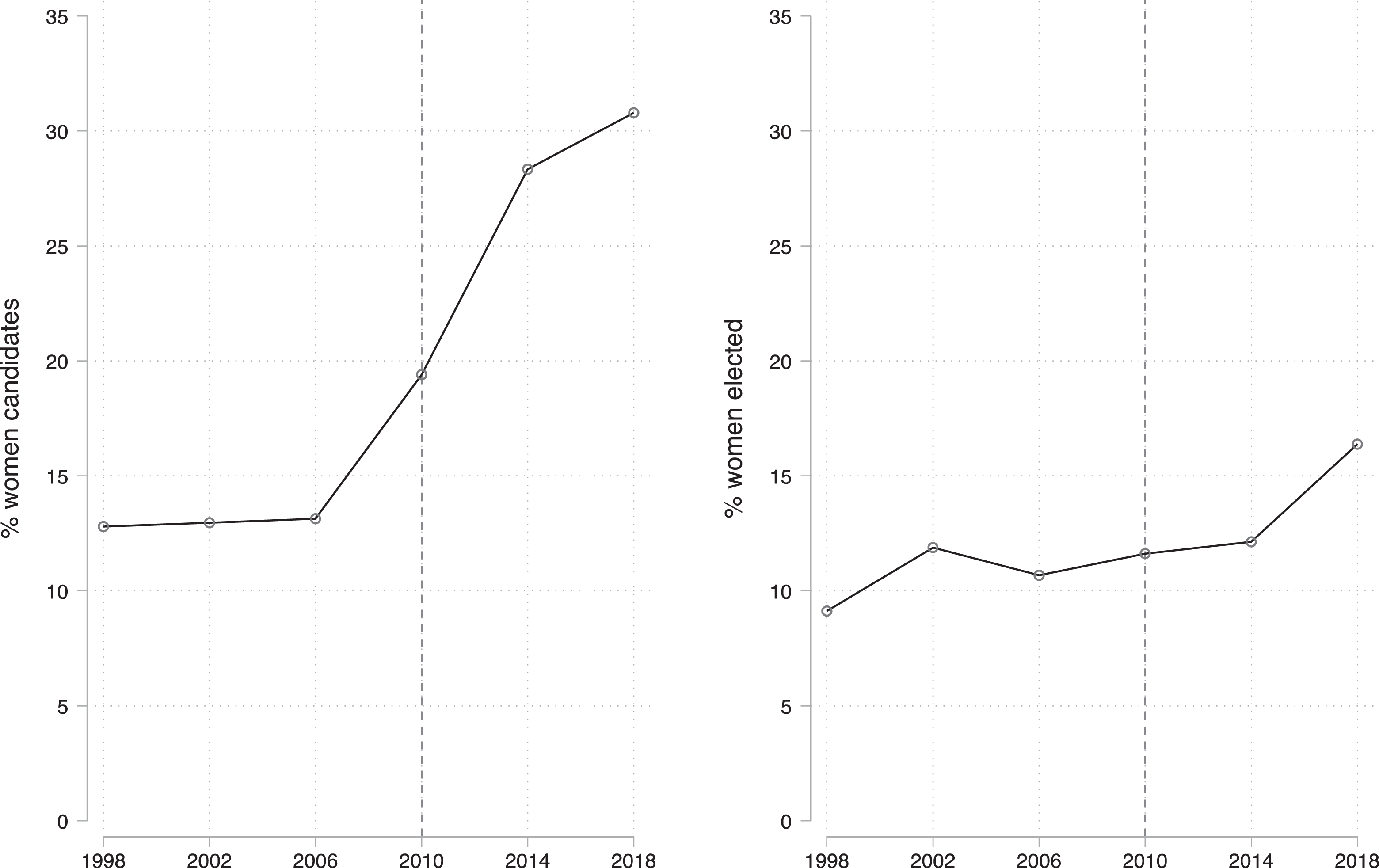
Quota compliance, women’s candidacies and election, 1998–2018. Note: Figure illustrates trends of women’s political representation in the Brazilian Chamber of Deputies and State Assemblies, as captured by our dependent variables. The vertical line marks the 2009 mini-reform. This and all other figures in this paper were formulated using plotplain (Bischof, 2017).
We ask whether parties’ employment of informal institutions contributes to women’s persisting levels of underrepresentation in Brazil. Table 1 summarizes our results from multilevel mixed-effects regressions with robust standard errors.
The impact of informal institutions on women’s candidacies and election, multilevel mixed-effects regressions (1998–2018).
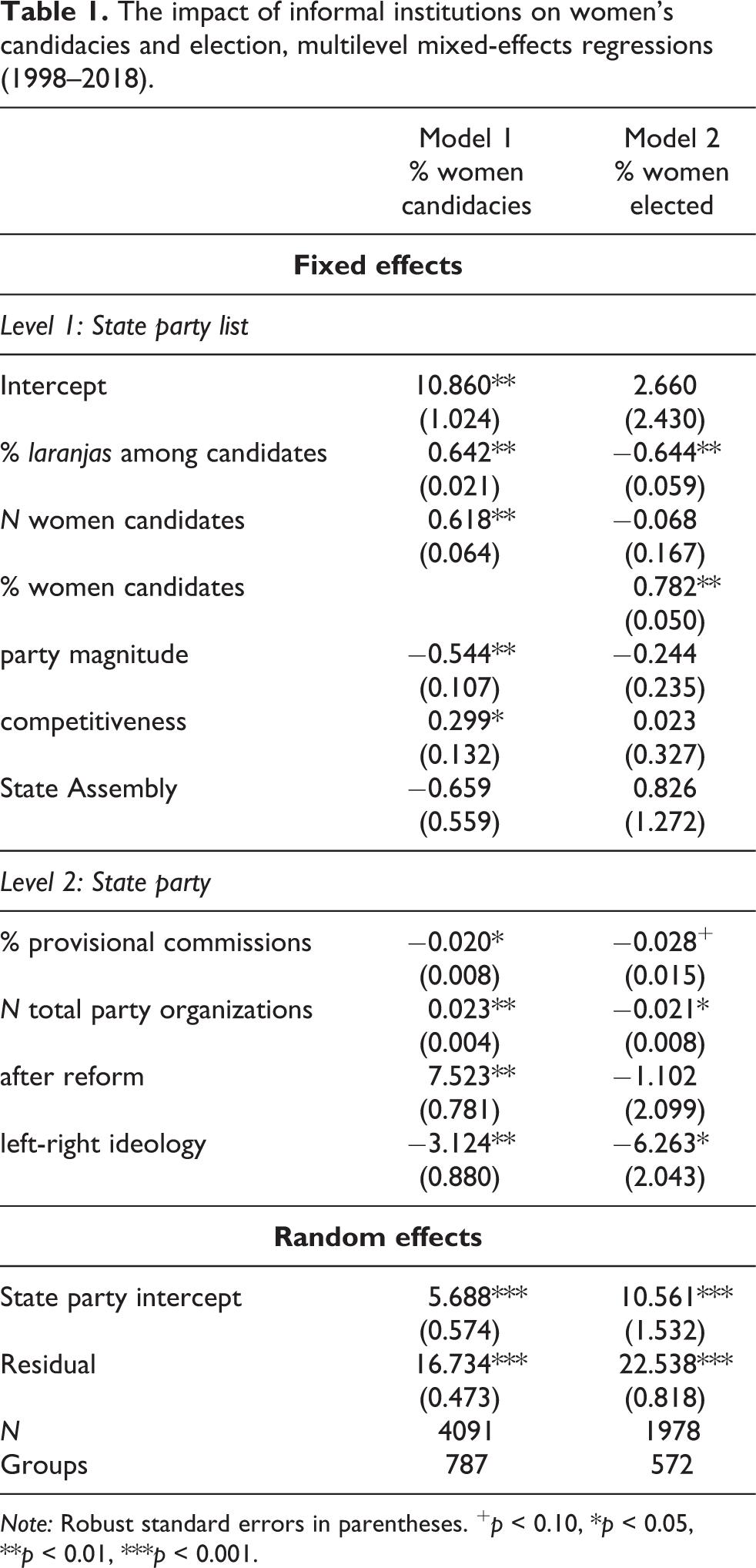
Note: Robust standard errors in parentheses. +p < 0.10, *p < 0.05, **p < 0.01, ***p < 0.001.
As shown, formal and informal institutions influence state parties’ propensity to nominate and elect women. As per H1a, parties’ use of an accommodating informal institution, laranjas, substantively inflates the share of women in their party lists: party lists in which only competitive women are running (i.e., none of the candidates are laranjas) have 19.3% of women in their lists, on average. Meanwhile, party lists in which 20% of candidates are laranjas tend to manage to meet quota requirements and nominate an average of 32.1% of women candidates.
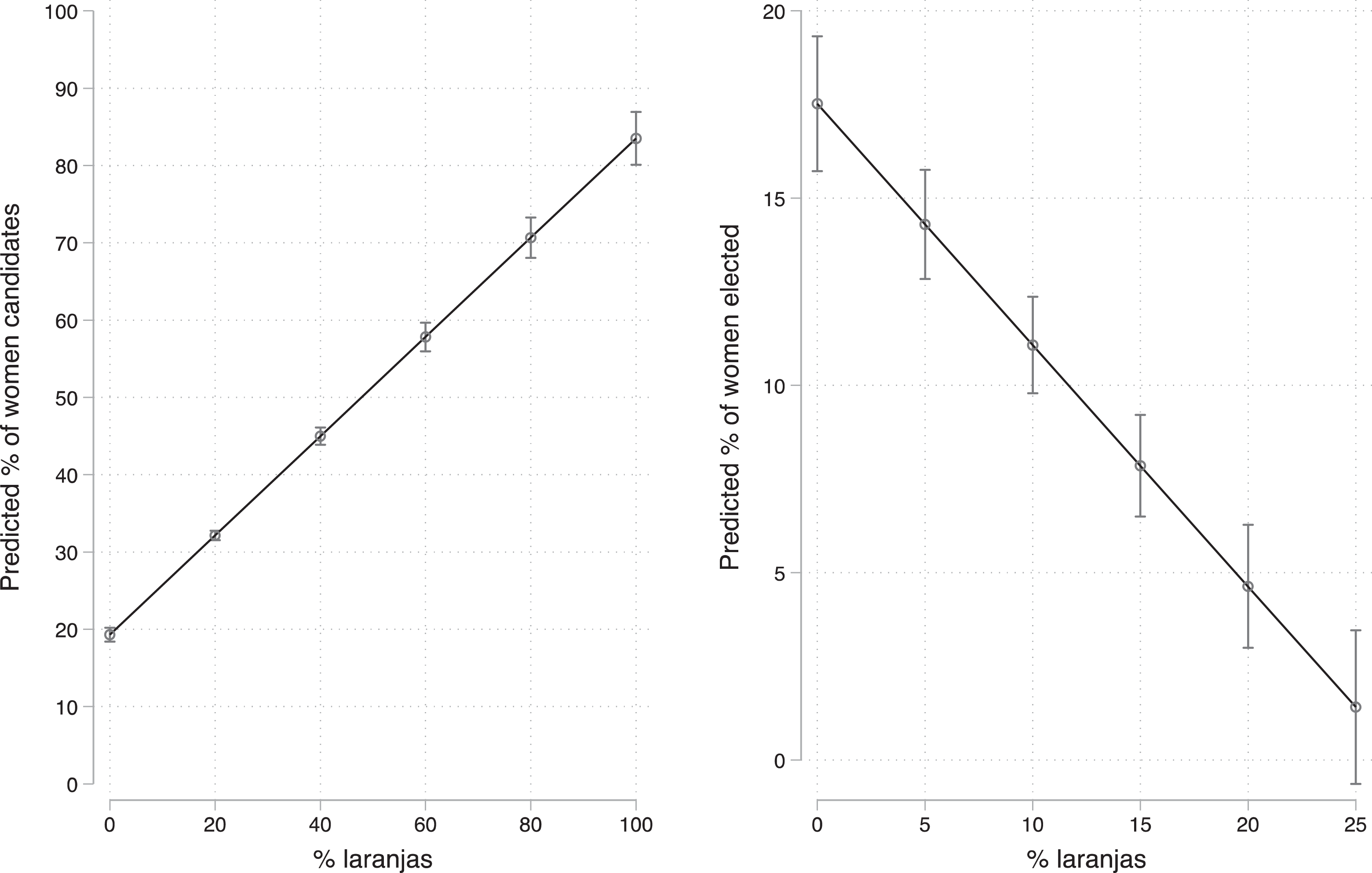
Predicted effects of % laranjas.
Parties’ willingness to nominate higher shares of women, however, does not necessarily mean their support for women’s candidacies, as demonstrated by the negative and statistically significant association between the nomination of laranjas and the share of women elected, supporting H1b. 4 The negative impact of this accommodating institution on women’s descriptive representation is striking: while party lists in which 0% of women candidates are laranjas elect an average of 17.5% of women, parties with lists in which 20% of candidates are laranjas only elect an average of 4.6% of women—a difference of 12.9 percentage points. Figure 2 illustrates the predicted positive effects of laranjas on % women candidates (H1a) and its sharply negative predicted effects on % women elected (H1b).
While they emerge from failures in the enforcement of formal rules seemingly unrelated to the gender quota, in practice, parties’ abuse of provisional commissions undermines the capacity of the gender quota to enhance women’s descriptive representation. As per our expectations in H2a–b, party organizations that disproportionately rely on provisional commissions nominate and elect lower shares of women to office, effects that are statistically and substantively significant. 5 The substantive effects of the use of provisional commissions on women’s descriptive representation are much smaller than that of laranjas: parties that do not rely on provisional commissions (i.e., only have permanent directorates) nominate and elect an average of 26.5% and 14.2% women, respectively. Meanwhile, parties that only rely on provisional commissions (i.e., they represent 100% of their organizations) nominate and elect an average of 24.5% and 11.4% women, respectively.
It makes sense that parties’ use of provisional commissions on women’s representation is less pronounced than that of laranjas: while the nomination of laranjas consists of an intentionally accommodating informal practice employed to undermine the quota’s expected outcomes, the extended employment of provisional commissions is used for other reasons—namely, to minimize oversight on parties’ candidate selection procedures. Yet this informal institution still interacts with and undermines quota effectiveness. Figure 3 illustrates the predicted substantive effects of parties’ reliance on provisional commissions on women’s candidacies and women’s election (holding other variables at their means), supporting H2a–b.
The employment of informal practices do not seem to affect all women equally. In exploratory analyses employing data on candidates’ racial identity (only available for the 2014 and 2018 elections), we find that the 2009 mini-reform might have motivated parties to increase their recruitment of white women to a higher degree than Afro-Brazilian women: parties’ use of provisional commissions and laranjas has a less drastic impact on Afro-Brazilian women—something that could result from party elites’ overwhelmingly white and male networks (Carneiro, 2010; Rios et al., 2017).
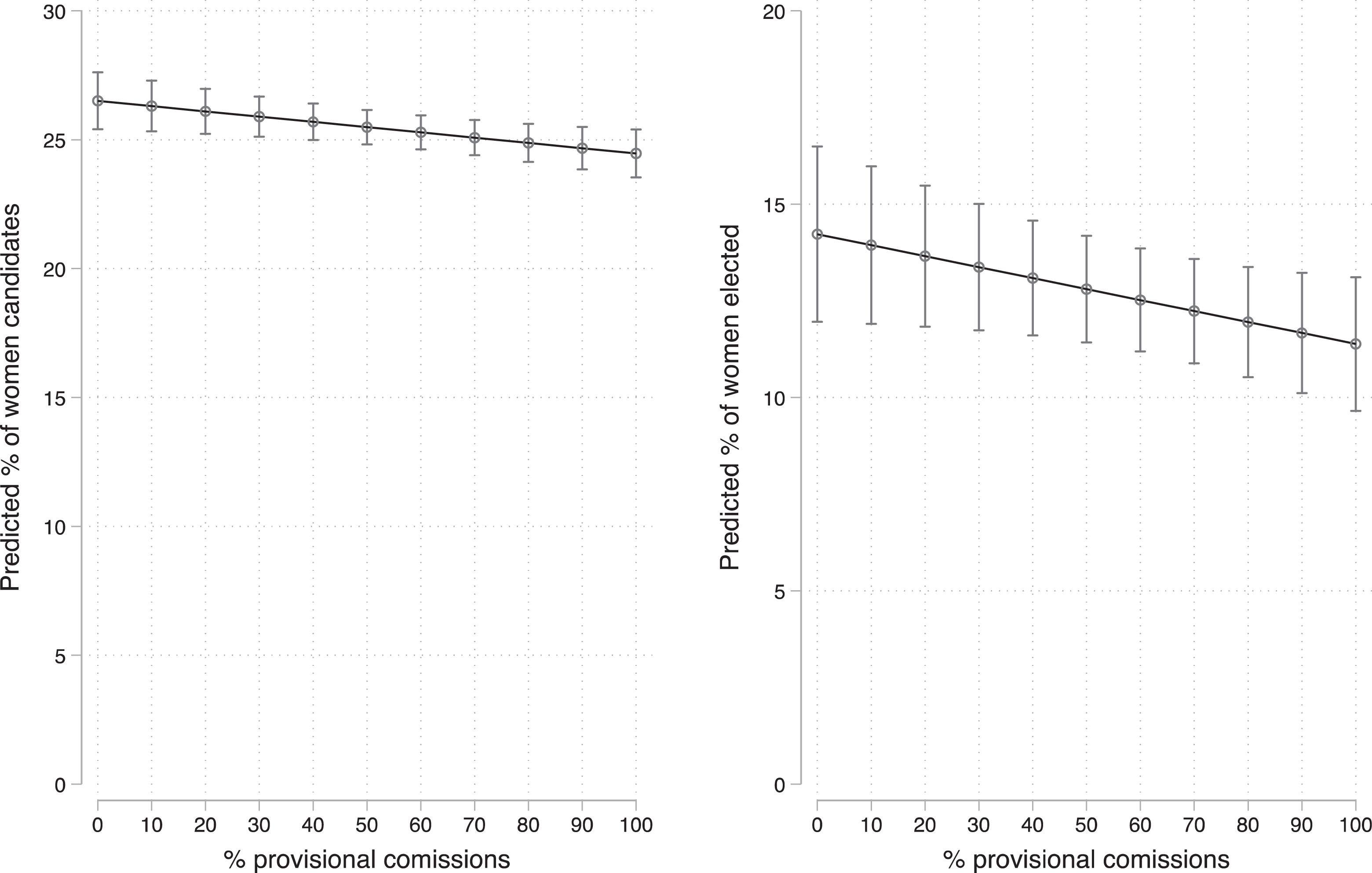
Predicted effects of provisional commissions.
We have shown that informal institutions shape women’s political participation in the electoral process in significant ways. But what about formal institutions? Scholars and practitioners have traditionally perceived the 2009 mini-electoral reform as a key improvement to Brazil’s weak gender quota designs. Indeed, the reform is associated with higher shares of women’s candidacies: after the reform, state party lists were four times more likely to be quota compliant than before. Yet that compliance does not parlay into a higher share of elected women, as indicated by the insignificant coefficient for after reform in Model 2: rather than effectively recruiting and supporting women candidates, the reform motivated parties to comply nominally with the quota by nominating laranjas, an accommodating institutional intentionally meant to undermine efforts to strengthen the quota’s formal provisions.
Other measures of state party-level characteristics also produce statistically significant coefficients. As shown in Table 1, N total party orgs is positively associated with % women candidates. However, the variable is negatively associated with % women elected. Although more territorially complex and institutionalized parties have greater capacity to recruit women candidates, their will to actually support those candidates may be compromised by entrenched party elites eager to preserve their own power (Wylie, 2018). Even while the more established and electorally strong parties typically have more developed recruitment networks, and are thus ostensibly better situated to nominate competitive candidates, we find that party magnitude is negatively associated with women’s nominations, as captured in our model of % women candidacies, and is insignificant for % women elected. These findings suggest that besides the two more easily observable types of informal institutions explicitly captured by our models, other types of informal practices may also be shaping women’s political representation. These results also remind us that capacity does not equate will.
Our control variables yield the expected results. N women candidates is positively associated with % women candidates, but tellingly, is unrelated to % women elected, offering additional evidence that the boost in women candidates has entailed the use of laranjas rather than viable candidates. As indicated by the negative and statistically significant coefficients produced by our measure of left-right ideology, parties from the left, which are more likely to be programmatic, are also more prone to run and elect women. This is consistent with the existing literature that shows that women’s political prospects may be enhanced in programmatic parties, which tend to run collective, ideas-based campaigns, and have more institutionalized party organizations that are better positioned to recruit and support women candidates (Wylie, 2018). Competition is statistically significantly and positively associated with % women candidates, but not with % women elected. Finally, our binary variable distinguishing between races for the Chamber of Deputies and state assemblies does not produce statistically significant coefficients.
Conclusions
After two decades, the Brazilian gender quota has yet to deliver. Previous work has attributed the failures of the Brazilian quota to formal institutions such as the quota’s design and its unfitness for the OLPR system. In the current article, we contribute to existing scholarship by examining the influence of parties’ reliance on informal institutions on the quota’s effectiveness.
Employing data from Brazil’s more than 4,000 party organizations, we evaluate how informal institutions work to subvert quota provisions. Building on Helmke and Levitsky (2004), we identify intentionality as another dimension that mediates formal-informal institutional interactions. Applying this framework, we classify intentionally accommodating informal institutions as those that emerge in response to the gender quota and inadvertently competing informal practices as those that are not intentionally gendered but still interact with the gender quotas to the detriment of women’s descriptive representation.
Given their observability, we focus on parties’ nomination of laranjas, an intentionally accommodating institution that became more frequently used in response to quota adoption and subsequent formal revisions, and on parties’ abuse of provisional commissions, an inadvertently competing institution that emerges from the ineffectiveness of other formal rules beyond the gender quota, but that nonetheless poses gendered implications, albeit unintentionally.
Specifically, we show that parties that nominate laranjas are more likely to nominally meet the quota, something that negatively affects women’s election. Additionally, we find that a party’s reliance on provisional commissions—which undermines accountability in party decision-making processes, including candidate recruitment—also has repercussions for women’s nominations and thus, election. While the intentionally accommodating institutions may be more profoundly detrimental to women’s political representation, informal institutions that are ostensibly gender-neutral may also have significant gendered implications.
Our findings reinforce extant literature on the salience of interacting formal and informal institutions and intraparty power struggles in candidate recruitment processes. Interpreting our findings through a feminist institutionalist lens also sheds light into a mediating dimension of Helmke and Levitsky’s (2004) typology: intentionality. While Brazil may be an extreme case of quota underperformance, the framework we introduce may be useful to analyzing informal institutions in place in any given system. For example, previous work has identified the placement of women at the bottom of candidate lists, the nomination of women to less competitive districts, and even the practice of asking elected women to step down to make way for their male alternates as informal institutions that emerged as a response to gender quotas (Baldez, 2007). As per our framework, these constitute intentionally accommodating institutions. Meanwhile, unwritten candidate-selection procedures, vote-buying, and illegal practices of campaign finance are few examples of potentially inadvertently competing informal institutions.
More generally, theoretical insights and empirical findings build on work from Bjarnegård and Zetterberg (2016), Johnson (2016), Verge and de la Fuente (2014) and others attesting to the importance of centering gender while unpacking the “black box” of recruitment by party organizations. We also contribute to discussions of institutional change and continuity, corroborating research from Mackay and Krook (2011), Waylen (2014), and others on the gendered character of institutional change and the salience of informal institutions. Even as the limitations to formal institutional reforms are diagnosed and addressed, divergent informal institutions continue to proliferate. As such, we must name those institutions in order to rectify the limitations of and resistance to institutional change.
Supplemental material
Supplemental Material, sj-docx-1-ppq-10.1177_13540688211008842 - Informal institutions and gendered candidate selection in Brazilian parties
Supplemental Material, sj-docx-1-ppq-10.1177_13540688211008842 for Informal institutions and gendered candidate selection in Brazilian parties by Malu AC Gatto and Kristin N Wylie in Party Politics
Footnotes
Acknowledgements
We presented a prior version of this paper at the 2018 meeting of the Latin American Studies Association. We are thankful to participants and our discussant, Denisse Rodriguez Olivari, for their helpful feedback.
Declaration of conflicting interests
The author(s) declared no potential conflicts of interest with respect to the research, authorship, and/or publication of this article.
Funding
The author(s) received no financial support for the research, authorship, and/or publication of this article.

Supplemental material
Supplemental material for this article is available online.
Notes
References
Supplementary Material
Please find the following supplemental material available below.
For Open Access articles published under a Creative Commons License, all supplemental material carries the same license as the article it is associated with.
For non-Open Access articles published, all supplemental material carries a non-exclusive license, and permission requests for re-use of supplemental material or any part of supplemental material shall be sent directly to the copyright owner as specified in the copyright notice associated with the article.
