



Abstract
This article examines the circulation of unverified and misleading information during the 2023 Australian Voice to Parliament referendum, focusing on X (formerly Twitter). Adapting Harsin's concept of Regimes of Post-Truth and a participatory perspective of propaganda, we analyse over 224,000 posts, exploring the interplay of Voice-related discussions on X and campaign messaging. We find that the Yes campaign employed a traditional messaging approach, emphasising public support and presenting historical facts and statistics. In contrast, the No campaign's disciplined messaging style mobilised pan-partisan attention, fostering a collaborative ‘truth market’ on X about the constitutional amendment that eclipsed the Yes campaign's more conventional approach. A proliferation of conspiratorial assertions fostered collaborative work from No campaigners as well as participatory efforts from Yes campaigners to debunk and criticise them. We conclude that the No campaign cultivated a series of public relations-induced realities about the referendum, effectively managing attention within a hybrid media system.
Keywords
Introduction
Australia's history is woven with the traditions, stories, and experiences of its First Nations peoples. Despite this rich heritage, throughout Australia's colonial history the voices of First Nations peoples have often been relegated to the margins of national discourse. First Nations Australians do not enjoy the same equality of self-determination and collective rights that many other Australians take for granted (Hobbs and Jones, 2022). A key moment in the timeline to address this occurred when the Australian Prime Minister Anthony Albanese formally announced the Voice to Parliament referendum on 23rd March 2023. The referendum sought to establish a constitutionally enshrined advisory body, as called for in the Uluru Statement from the Heart, a one-page 2017 document from First Nations leaders seeking constitutional recognition and a greater voice in Australian policymaking. The referendum occurred on 14th October 2023 and failed to get majority support with over 60% of Australians voting ‘no’. When the referendum was announced, polls showed support for the Yes vote at around 65%. While several factors explain the rapid shift of support over such a short period of time – lack of bipartisan support, entrenched social and economic inequality, and enduring racism in Australian society (Wellauer et al., 2023) – perhaps the most defining characteristic of the referendum was the volume of misinformation and conspiracy theories circulating during its lead-up.
The Australian Electoral Commission (AEC) reported that it was tagged in more than 100,000 social media posts (Besser, 2023) as the agency attempted to debunk misleading and factually incorrect content about the voting process. Notable claims included that the AEC was supporting the Yes campaign due to biased advertisements and that rigged U.S.-based Dominion Voting Systems would be used for the referendum, even though Australia has no legislation allowing electronic voting machines to be used (Cefai, 2023). Adding to such concerns was a widely publicised complaint from leading ‘Vote No’ campaigner and Opposition Leader Peter Dutton, who questioned why a tick on a Voice referendum ballot would be counted as a Yes vote but a cross would not be counted as a No vote. Dutton was reproached by the AEC for these ‘factually incorrect’ claims because this approach has been used for over 30 years by the commission (Massola, 2023). More broadly, fact-checkers observed across social media a high volume of rumour-mongering that played on voters’ emotions and distrust in authorities and government (Chan et al., 2023). We define rumours here using the definition provided by Harsin (2006), who, drawing on Pendleton (1998), defines rumour as propositions lacking secure standards of evidence: ‘[s]omething may or may not be the case’ (Harsin, 2006: 86). For Harsin, a crisis of verification pinpoints a key political challenge associated with rumours and ‘just asking questions’ rhetoric. Such epistemically free-floating assertions require journalists and authorities to verify claims, a process that often significantly lags their production rate and consequences.
Adding to widespread rumours about the Voice referendum were a range of conspiracy theories in circulation. A notable conspiracy theory that gained widespread public attention asserted that the United Nations (UN) would take over Australia if the Yes campaign was successful. As Chan et al., (2023) write, this narrative framed the Voice as a ‘Trojan horse’ that would allow the UN to steal land and restrict individual rights. Moreover, it was not confined to fringe actors – the term ‘Trojan horse’ was adopted by prominent No campaigners, including federal shadow minister for Indigenous Australians Jacinta Nampijinpa Price, former federal Member of Parliament (MP) George Christensen, as well as former Neighbours actress Nicola Charles (Chan et al., 2023). Likewise, Peter Dutton's consistent framing of the Voice throughout the leadup to the referendum as a shadowy ‘elite’ campaign that serves vested interests arguably provided strategic resources for conspiratorial discourse circulating in the media ecosystem (Keane, 2023). The UN Voice conspiracy theory gained such widespread attention that Anthony Albanese addressed it in a press conference: What has occurred during this campaign is a lot of information being put out there, including by some who know that it is not true … I've seen stuff saying that all private ownership would disappear, that it is about the United Nations taking control of Australia. (Workman et al., 2023, emphasis added)
The first are claims of hidden agendas and deception, asserting that powerful actors are hiding secret and malevolent agendas that are not in the public interest (Douglas et al., 2019; Hofstadter, 1964; Sunstein and Vermeule, 2009). For instance, social media posts claiming the Voice is a covert operation to control political power fit into this category. The second characteristic is accusations of corruption or illegality, where those promoting or opposing the Voice are alleged to be engaging in illegal or corrupt activities, reflecting a general mistrust of institutional and political authority often central to conspiracy theories (Douglas et al., 2017). The third characteristic of conspiratorial assertions is bold claims unsupported by credible and independently verified empirical evidence, or what we might broadly frame as post-truth empiricism (Lewandowsky et al., 2017). For example, claims about the Voice leading to drastic negative societal consequences such as ‘apartheid’ that rely on anecdotal evidence, or unverified sources fit this characteristic. The fourth characteristic is emotionally charged language inciting exaggerated fear, anger, or distrust, including terms such as ‘destroy democracy’, ‘racial segregation’ or ‘unprecedented control’. Emotionally charged language becomes conspiratorial when it exaggerates threats and bypasses rational evaluation to construct a sense of urgency or crisis to rally opposition against the alleged malevolent intentions of elite actors (Marcus et al., 2000). The fifth characteristic of conspiratorial assertions is ‘Us versus Them’ narratives that construct a dichotomy between the ‘good’ everyday citizenry and the ‘evil’ elites or out-groups with secretive intentions (Douglas et al., 2019; Tajfel and Turner, 1979) and often frames elites as adversaries of the common people. For example, social media posts that frame the Voice as a tool of elite oppression or manipulation of the population fits this category. These five characteristics are not exhaustive, nor are they mutually exclusive. However, they provide a useful analytic category distinct from other concepts such as rumour and conspiracy theories and foster a shift from analysing message content to message strategy, as discussed further below.
Given this context, the present article examines the role that X (formerly known as Twitter) played in the broader context of rumours, unverified information, and conspiratorial content circulating about the Voice in mainstream media as well as strategic messaging from politicians. It focuses on X because of the platform's role as a central infrastructural node in flows of political communication, where journalists and politicians are not only active on it but also perceive it as a ‘barometer’ of public opinion and predictor of news coverage (Jacobs and Spierings, 2016: 101). While X (and formerly Twitter) activity is not predictive of electoral outcomes, it is a critical part of the media ecology for its role in shaping newsworthiness and party messaging (Murthy, 2015). Moreover, recent scholarship has highlighted the participatory dimensions of mis- and disinformation, where platforms play a critical mediating role in the feedback loop of communication between political elites and audiences that forms a kind of ‘collaborative’ model (Starbird et al., 2019) or ‘participatory propaganda’ (Wanless and Berk, 2017). In this approach, communication flows between audiences and elite actors are neither top-down nor bottom-up but better understood as a multi-step flow process (Graham et al., 2021) that involves a feedback loop of not only audiences and elite actors but also ‘conversation starters, active engagers, influencers, network builders and information bridges’ (Starbird et al., 2023: 14). Although these ideas have gained traction, to date there have been few empirical studies that examine how this occurs outside a U.S. context.
Drawing on Harsin's concept of Regimes of Post-Truth or ROPT (Harsin, 2015) and supported by topic model analysis of over 224,000 original Voice-related posts on X as well as Voice-related news articles and messaging from politicians, we further develop and examine this ‘participatory’ view. Adding to the perspective, we make a conceptual intervention by directing our focus on how political elites systematically managed ‘attention’ during the referendum via a privileged mode of communication that exploits post-truth conditions. Taking care to avoid the conceptual precarity and politicisation of the terms mis- and disinformation, we situate the paper within the lens of propaganda. In this article, we define propaganda broadly as ‘the deliberate, systematic attempt to shape perceptions, manipulate cognitions, and direct behaviour to achieve a response that furthers the desired intent of the propagandist’ (Jowett and O'Donnell, 2018, as cited in Harsin, 2024: 3). We use the term propaganda here not negatively but as a precise way to describe and understand the strategic, PR-driven, socio-technically oriented elite messaging during the Voice. In achieving the study's aims, we make a novel contribution to our understanding of digital propaganda, broadly speaking, in at least two ways: (1) how audiences can be misled not necessarily by patently ‘false’ information but by a constructed ‘truth market’ consisting of many, often competing, rumours, unverified claims, conspiratorial assertions, and conspiracy theories; and (2) how actors across a range of ideological camps and interest groups are targeted and drawn as participants into the field of attention management, often unwittingly. In doing so, the paper joins recent challenges to the field of ‘disinformation studies’ (Harsin, 2024), identifying the need for a conceptual shift from messaging content to messaging strategy, or more broadly a closer attention to propaganda and its evolving forms. The paper is guided by three research questions:
What kind of Voice-related content gained the most attention on X and how did this differ by attitude (Vote Yes or Vote No)? In what ways did elite framing of the Voice by politicians and opinion leaders shape user participation on X? What kinds of conspiratorial content gained the most attention on X and who was spreading it?
Methods
We collected 224,966 original posts (i.e. excluding retweets) containing the terms ‘Voice to Parliament’ OR ‘Uluru Statement’ OR (Voice Referendum) OR VoteYes OR VoteNo OR voicereferendum OR ulurustatement OR yes23 #VoiceToParliament or ‘Voice to Parliament’. The date range of collection was 1st January 2023 and 14th October 2023 and included 40,141 unique X accounts. The data collection consisted of two phases. In the first phase, we used the Academic Twitter API and the twarc2 command line software to collect data between 1st January 2023 and 3rd July 2023. After this date, API access was no longer available and we developed infrastructure to scrape posts using the NodeXL software, continuously until the day of the referendum on 14th October 2023. As the scraping is from the Twitter search functionality, the query also retrieves posts from accounts that have the relevant keywords in their profiles (e.g. #VoteYes). We therefore manually filtered the scraped dataset to remove a small number of posts unrelated to the referendum.
To address the research questions, we applied BERTopic topic modelling on the data, generating 130 topics. Topic modelling is a method for summarising large text data to identify themes and trends (Blei et al., 2003). Traditional methods like Latent Dirichlet Allocation are common, but recent advancements have led to more sophisticated models. BERTopic, which uses transformer-based embeddings and clustering techniques, produces coherent and interpretable topics (Grootendorst, 2022). We cleaned the data by removing URLs and junk characters with regular expressions. We set min_topic_size to 200 to ensure each topic had enough documents and allowed BERTopic to determine the optimal number of topics. This flexibility helped the model find the most suitable topic structure for our data. The model was fit to the cleaned dataset, resulting in a list of topics and their associated probabilities. Our primary analytical approach involves a qualitative content analysis of the top 10 topics from the model, covering 144,214 posts (64.1% of the dataset). Adapting the content analysis methods developed by Linvill et al. (2019), we assessed the top terms and reviewed a random sample of 50 representative documents per topic to interpret the context and nuances of the messaging. Key themes were identified by examining recurring narratives, keywords, phrases, and concepts within each topic, focusing on both Yes and No campaigns. Direct quotes from representative documents were used to illustrate themes and provide examples. To ensure robustness, we cross-verified the results with additional documents from outside the random sample and engaged in peer debriefing (Creswell and Miller, 2000) to further validate our analysis and findings. Peer debriefing was conducted after the topic model was fitted and preliminary content analysis completed.
Complementing this analysis, we calculated engagement metrics for each post to assess public interaction. We focused on the top three posts by engagement per topic, providing insight into the most attention-grabbing content. Engagement was defined as the combined normalised (Z-score) values of replies and quote tweets, chosen for representing more involved interactions than ‘likes’ and retweets. A Z-score is used to identify how far a given data point is from the average, measured in terms of standard deviations. This approach mitigates the influence of inauthentic engagement such as click farmers and bots, as retweets and likes require less effort and cognitive engagement. The Z-score for each metric was calculated using the formula Z = (X – μ)/σ, where X is the original value, μ is the mean of the metric, and σ is the standard deviation of the metric. The composite engagement score for each post was then calculated as the sum of the Z-scores for replies and quote tweets.
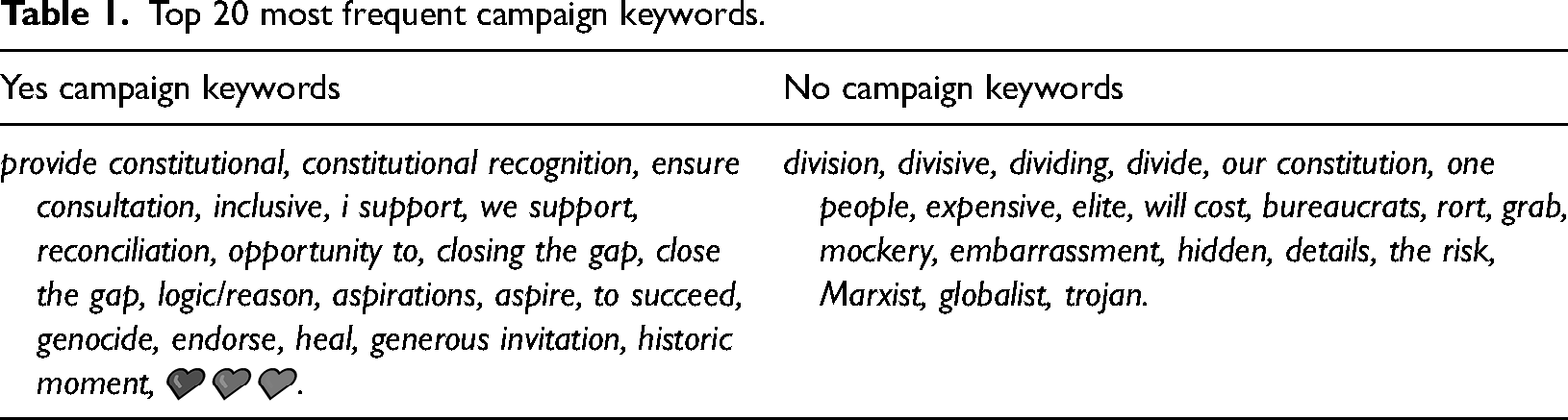
To assess keyword prevalence for each campaign over time, we identified terms associated with each campaign's messaging. First, we categorised posts into ‘Yes’, ‘No’, or ‘Other’ based on partisan hashtags. Posts with hashtags like #VoteYes were assigned to ‘Yes’, while those with #VoteNo were assigned to ‘No’. Posts without partisan hashtags or hashtags from both sides were labelled ‘Other’. Next, we identified the top 20 unigrams, bigrams, and trigrams from the documents, manually filtering out common phrases like ‘referendum’ or ‘Voice to Parliament’ (Table 1). We use line plots and descriptive statistics to assess the campaign-related keywords frequencies over time.
Top 20 most frequent campaign keywords.
Topic model analysis: The No campaign’s narratives eclipsed the Yes campaign for attention
In this section we analyse the top 10 topics, which encompasses 144,214 posts (64.1% of the total dataset). The results indicate a highly polarised environment on X and that the No campaign's messaging strategies and narratives dominated the conversations, drawing the Yes campaigners into a ‘rearguard battle’ (Bruns and Angus, 2023) and drowning out the Yes campaign's core narratives. Table 2 provides an overview of the topics, including a label and the number of posts belonging to that topic as a percentage of the total dataset.
Summary of topics discussed during the Voice to Parliament on X.
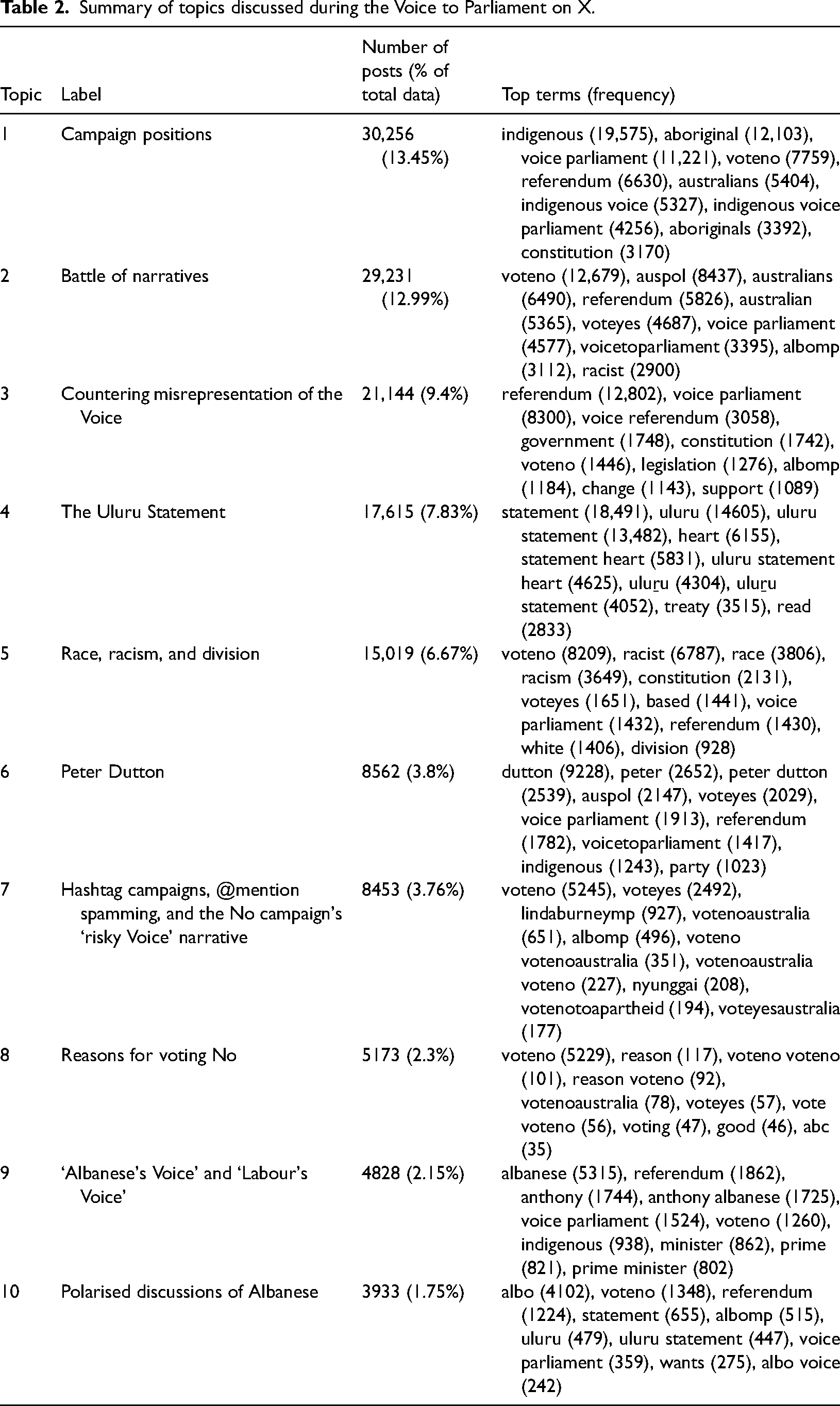
Topic 1 encompasses campaign positions about the Voice referendum, highlighting main narratives and arguments from both sides. Elite Yes advocates like Prime Minister Anthony Albanese, Linda Burney MP, and Chris Minns MP have widely discussed posts that emphasise constitutional recognition, listening to First Nations people, and addressing historic and contemporary injustices (Figure 1). Conversely, opponents argue that the Voice would divide the nation, is unnecessary, costly, and a power grab by elites. High engagement posts in Topic 1 from No campaigners, notably Senator Pauline Hanson and former MP Craig Kelly, argue that the Voice is divisive, racist, unfair, and dangerous (see Figure 2).
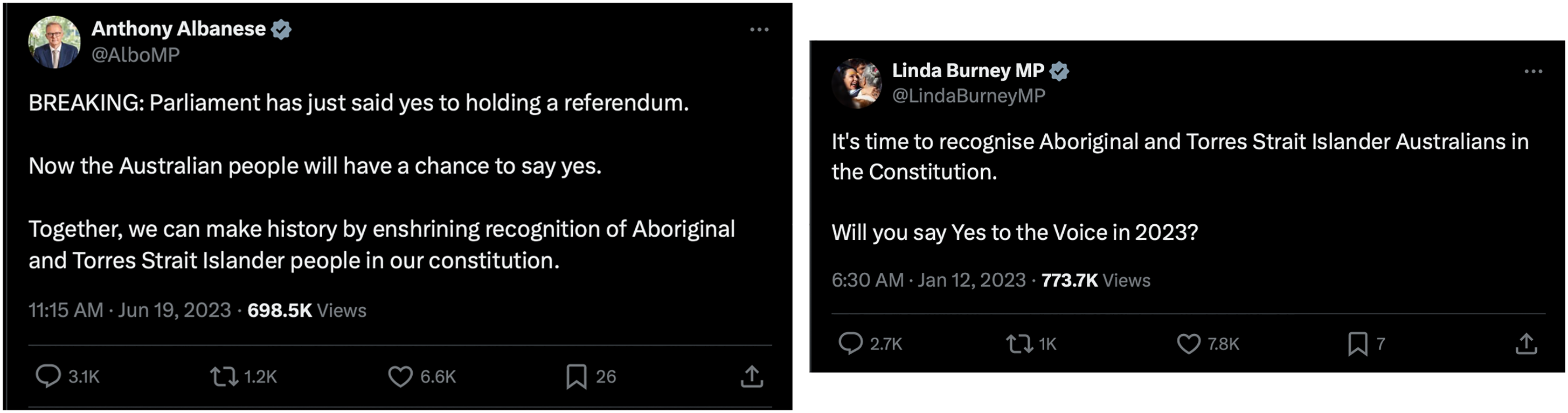
Top posts from Yes campaigners promoting the Voice and focussing attention on debunking No campaign narratives.
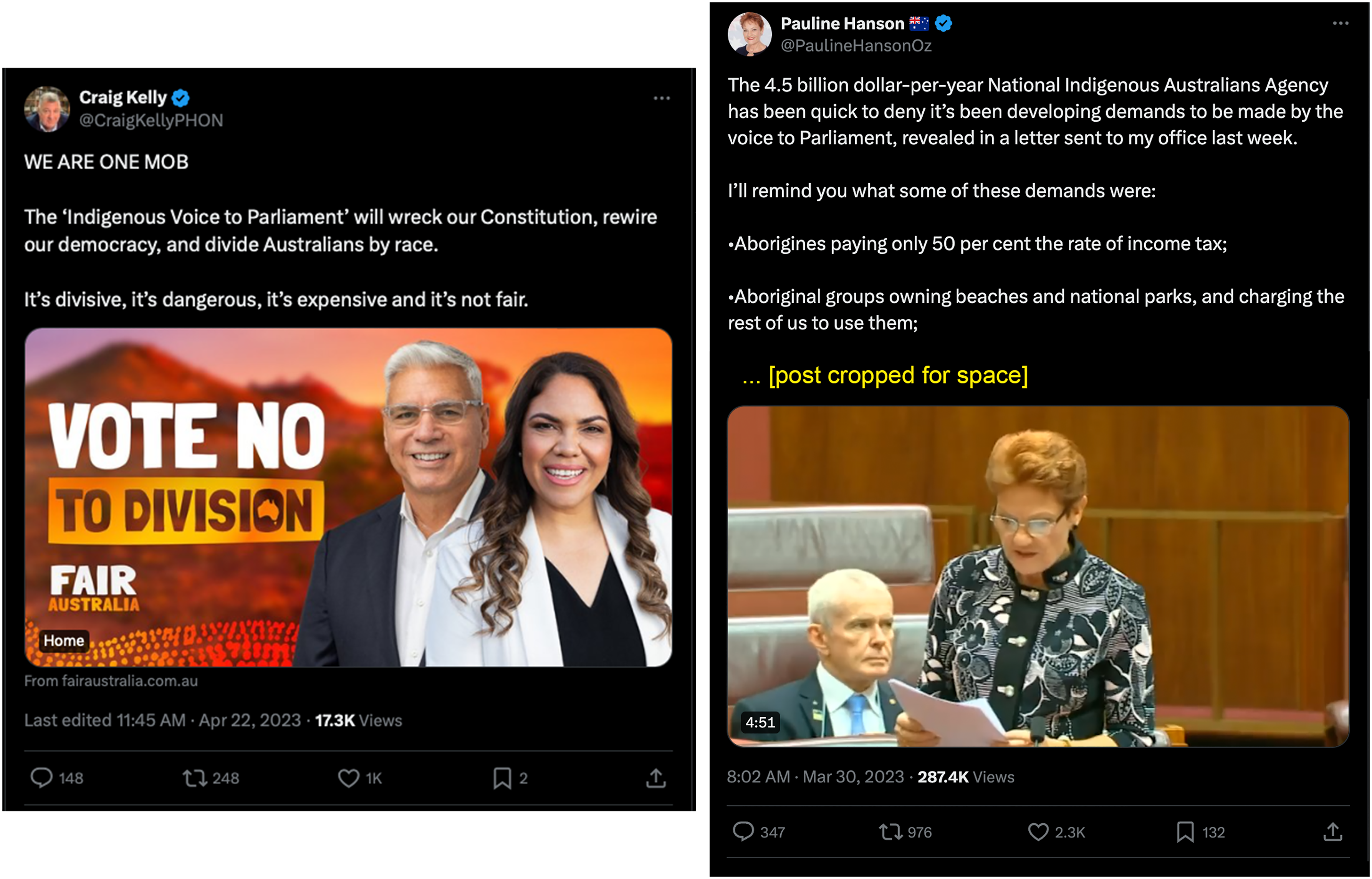
Top posts within Topic 1 from elite No campaigners on X driving campaign positions about the Voice referendum.
One of the most widely discussed No campaign posts from Senator Hanson lists ‘demands’ purportedly from the National Indigenous Australians Agency (NIAA) to the Voice, including claims like ‘local Aborigines owning rivers and streams and charging for water consumption’. Framed using colonialist language (Amnesty International, 2015), Hanson framed these findings as a ‘leak’ with ‘bombshell’ implications, using them strategically in a news management exercise (Harsin, 2006, 2018). Senator Jacinta Nampijinpa Price also claimed that ‘secret government documents’ revealed the ‘real agenda’ behind the Voice, but these claims were found misleading by Australian Associated Press and RMIT ABC Fact Check, as the document did not reflect the NIAA's views but rather a series of consultations and meetings for the Voice with over 1200 delegates (RMIT ABC Fact Check, 2023; Summers, 2023).
Yes campaigners in Topic 1 respond by debunking and criticising No campaign positions. For example, Eddie Synot has a top post citing a Guardian article debunking the idea that the Voice is racist. Fringe Yes accounts actively combat No messaging, with posts countering the No campaign's claims and using hashtags like #LNPToxicNastyParty, #LNPNeverAgain, and #LNPRacistParty. Both sides accuse each other of racism, but in different ways. While No campaigners claim the Voice process is racist, Yes campaigners accuse No advocates of racism. For instance, one high engagement post states: ‘Anyone else being told they are racist for voting YES to The Voice? The amount of cognitive dissonance displayed by the NO voters by projecting their racism onto us is off the charts. #VoiceToParliament #VoteYesAustralia #VoteYes #LNPToxicNastyParty #LNPNeverAgain #auspol  ’.
’.
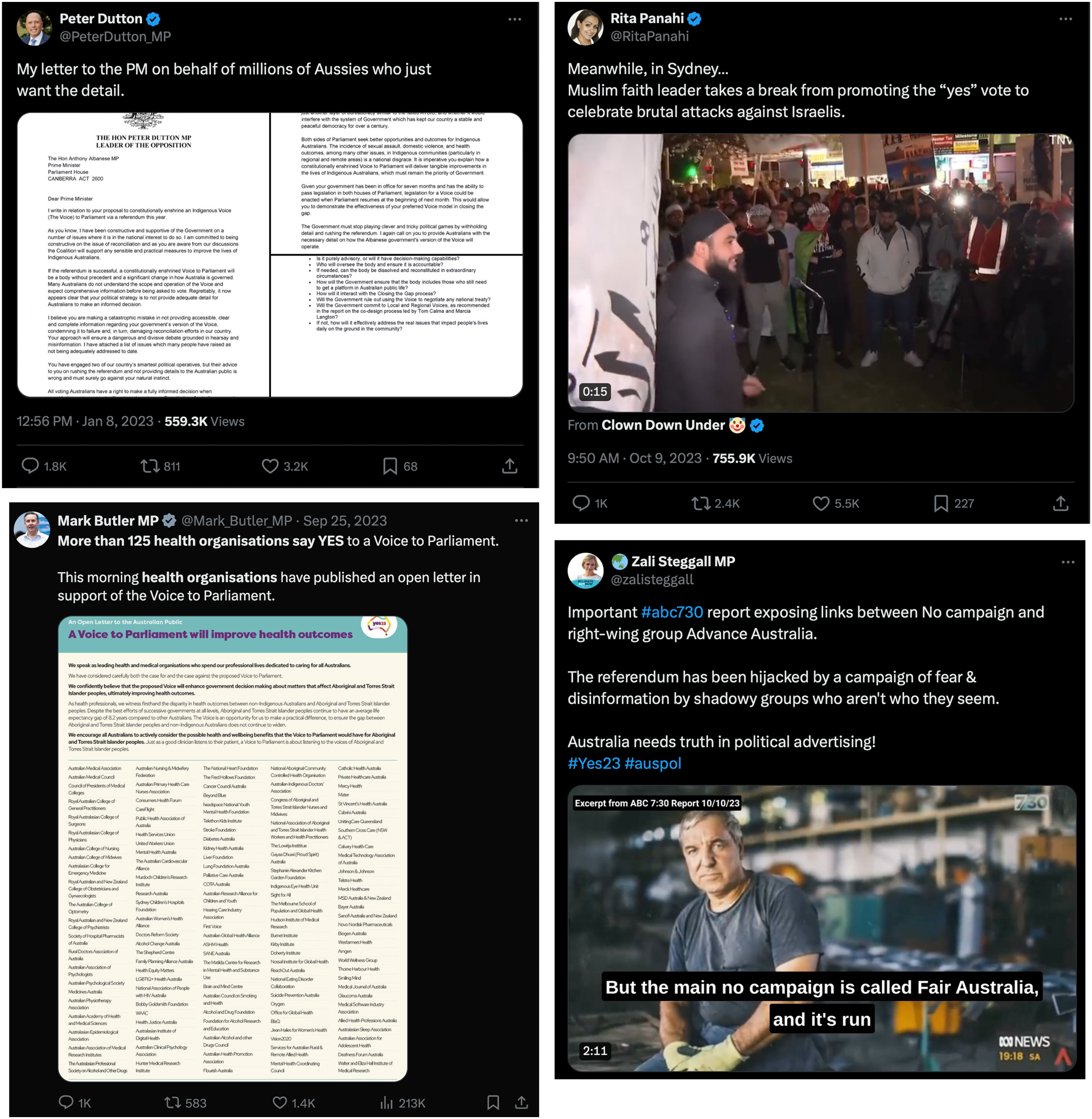
Topic 2 reflects the battle of narratives, highlighting the strategies and narratives that each side employed to try and win over voters. In this topic, the Yes campaign emphasises facts and expert opinions about the legal, social, and political benefits of the Voice, primarily to counteract what they perceive as misleading and misinformed arguments from No campaigners that are ‘hijacking’ and exploiting the issue. As the top three most engaged with posts for Topic 2 show (Figure 3), the No campaign narratives dominate attention. This topic captures a ‘battle of narratives’ firmly fought out on the No campaign's home ground. Opposition Leader Peter Dutton receives the largest proportion replies and quote tweets – both from Yes and No campaigners – for his assertions in a letter to the PM that the Voice proposal does not contain enough detail and is causing a ‘divisive and dangerous debate grounded in hearsay and misinformation’. Sky News Australia host Rita Panahi attracts both critical and supportive attention for posting a video from a pseudonymous fringe account. It serves as a strategic tool to frame the Yes campaign negatively by linking it to terrorism using emotionally charged language (‘brutal attacks’) and to rally support, drive engagement, and exploit political polarisation around the Israel–Palestine conflict. The third top post in this topic is from Independent MP Zali Steggall, who attracts a lot of discussion about an alleged ‘fear and disinformation’ campaign by ‘shadowy groups’ that are amplifying the No campaign's messaging. This post fits the category of a conspiratorial assertion based on the characteristics we identified previously.
Top posts by engagement for Topic 3.
Yes campaigners further draw attention to the ‘lack of detail’ narrative of elite No campaigners by drawing on resources from experts. For example, one user writes: ‘Voice to Parliament: Debunking 10 myths and misconceptions. An excellent piece by @MonashUni. Peter Dutton & Barnaby Joyce should be ashamed of their fear-mongering misinformation’. In the article, O'Bryan and Gerber (2023) argue that too much detail will confuse voters and there is already sufficient information in the detailed set of principles on which the Voice will be based, including a detailed report setting out what a legislated Voice would look like. Similarly, in an article promoted widely by Yes campaigners in Topic 2, a range of legal experts systematically argue that there is sufficient detail for voters to make an informed vote at the referendum (Appleby et al., 2023). Point 10 in this article contradicts Dutton's claims that more detail is required, effectively positioning expert authority against the anecdotal evidence supporting Dutton's assertions about requiring more ‘detail’ from Yes campaigners. This battle of narratives produced a ‘pile-on’ of Yes campaigners criticising Dutton and arguing with fringe No campaigners, who they believe are intentionally misleading people. It also contributes to many Yes campaigners in Topic 2 – including elites such as MP Zali Steggall – raising questions about who is behind the No campaign, leading to conspiratorial assertions that ‘shadowy’ No campaigners are manipulating public opinion.
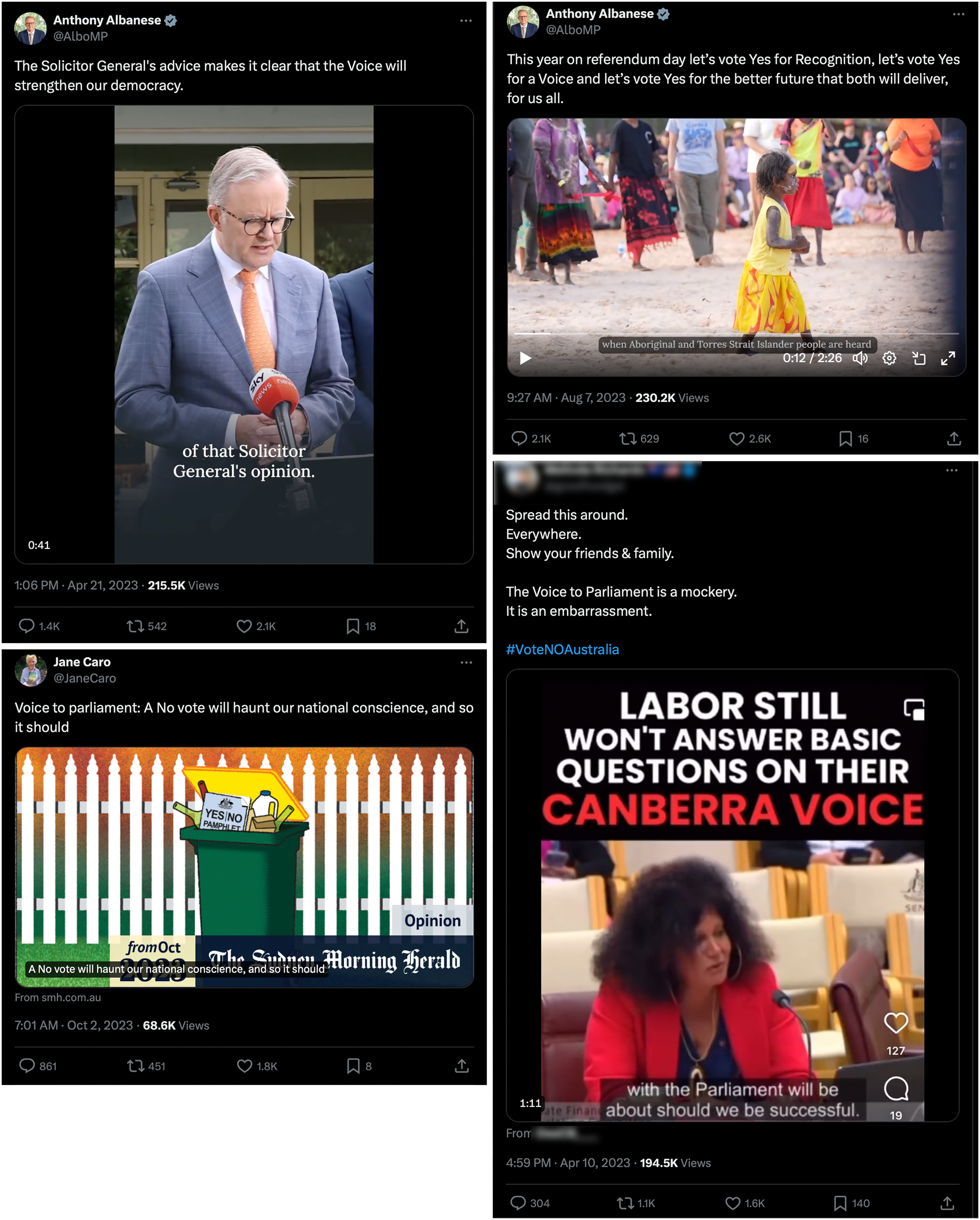
Topic 3 is primarily about campaign activism and Yes campaigners actively countering perceived misrepresentations of the Voice. The Yes campaign continues to spread arguments about unity, historical justice, and benefits of the Voice. However, the majority of the messaging focuses on countering and debunking misrepresentations of the Voice proposal, particularly from political figures. The No campaign raises doubts about the Voice process, portraying it as divisive and part of a secretive agenda to consolidate elite privilege and erode Australian democracy through risky constitutional changes. For instance, one of the top posts from PM Albanese (Figure 4) addresses the No campaign narrative that enshrining a Voice in the Constitution will erode democracy. These counter-narratives draw on the authoritative expertise of the Solicitor General to assure voters that the process is robust and is widely promoted by Albanese and Yes campaigners as evidence against the alleged dangers of the Voice. A concentration of fringe No campaign accounts in Topic 3 echo Dutton's assertions that the voice lacks ‘detail’ and generate their own content elaborating on this idea. For example, Table 3 shows a highly discussed No campaign post in Topic 3 suggests that there isn't enough detail in the referendum because the Labour government is hiding it. It features a video clip of Senator James McGrath questioning Senator Malarndirri McCarthy during Senate Estimates, with McCarthy repeatedly stating that details will be determined if the referendum succeeds. Yes campaigners actively try to counter the ‘lack of details’ and ‘secret elite agenda’ narratives that have conspiratorial characteristics.
Top posts by engagement for Topic 3.
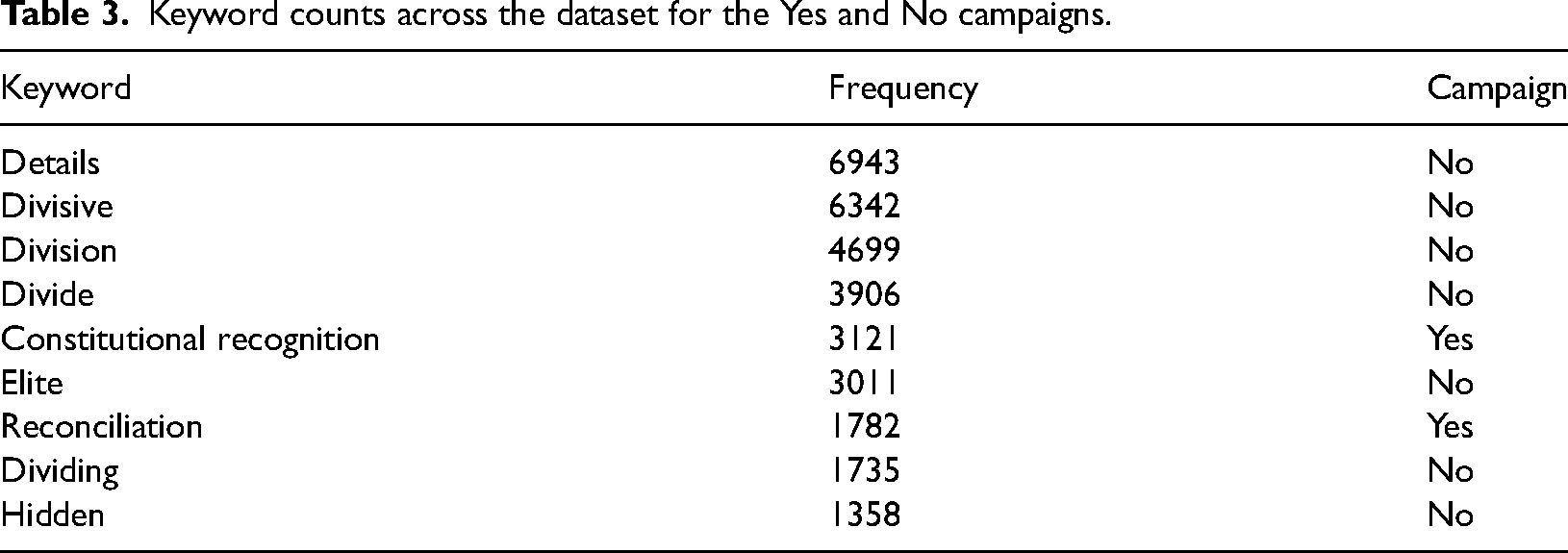
Keyword counts across the dataset for the Yes and No campaigns.
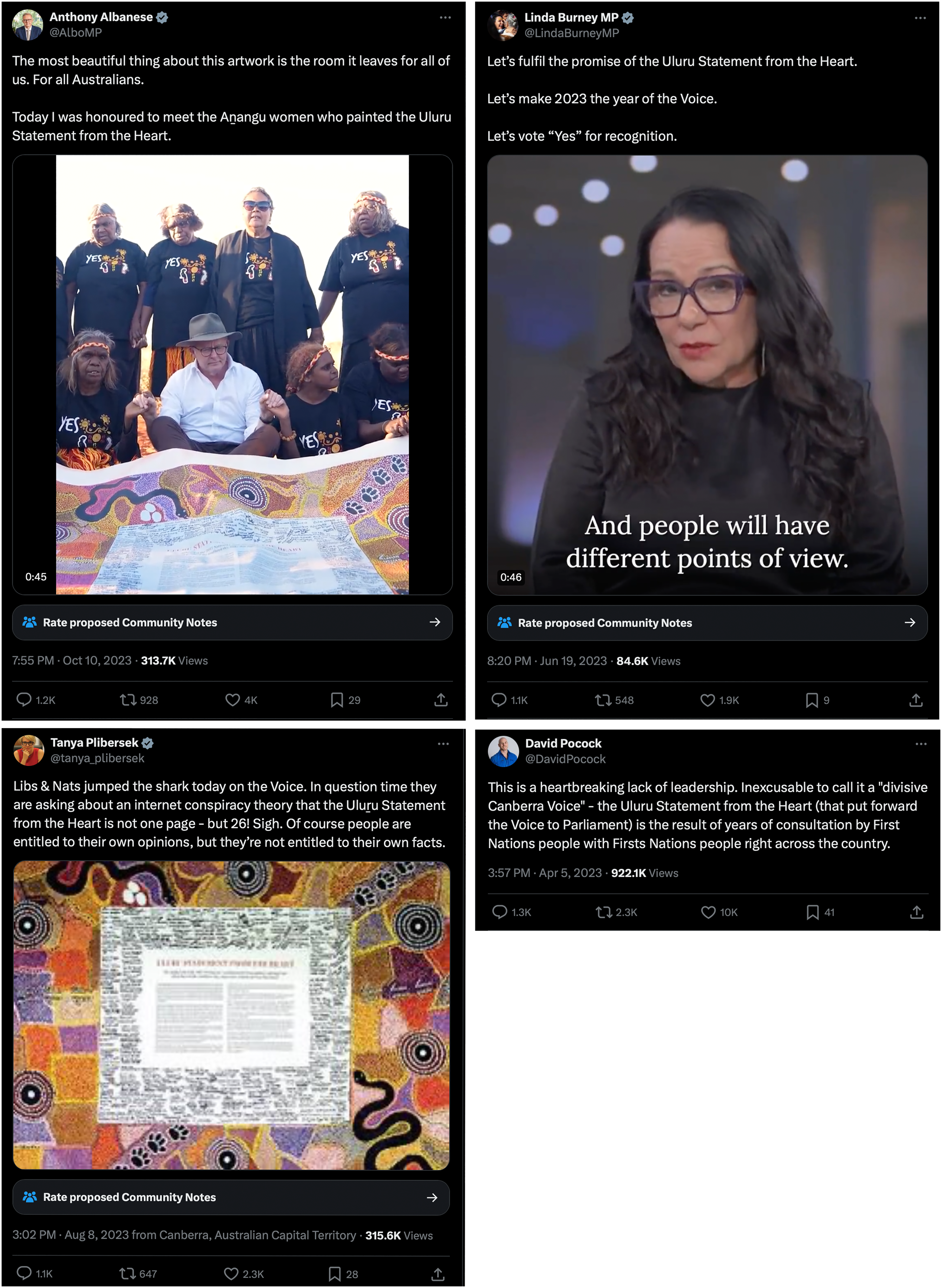
Topic 4 captures polarised arguments about the Uluru Statement from the Heart. Yes campaigners defend its legitimacy and debunk what they see as misinformation and conspiracy theories about the document, while No campaigners portray it as divisive and unrepresentative of Indigenous Australians, leading to constitutional and legal risks. As Figure 5 shows, two of the top three posts in this topic are from politicians criticising the No campaign's narratives. Independent Senator David Pocock criticises the ‘divisive Canberra voice’ phrasing used by Dutton, arguing it contradicts the rigour of the Uluru Statement. Dutton announces the Liberal Party's opposition to the referendum, reiterating it as divisive and city-focused at the expense of regional communities. Another top post from MP Tanya Plibersek criticises No campaign politicians using parliamentary privilege to air the ‘Internet conspiracy theory’ that the Uluru Statement is 26 pages long. RMIT Fact Check and other experts concluded this claim is false (Jeffery, 2023). This echoes earlier debunking of the ‘secret demands’ narratives set out by Senator Hanson and Senator Price.
Top posts by engagement for Topic 4.
Many fringe No campaign accounts in Topic 3 quote-tweet and link to an article in a left-leaning magazine describing the Voice as a ‘con job’ (Gibson, 2023). Gibson's article, posted by politically progressive elite No campaigners like journalist John Pilger, was reappropriated by conservative No campaigners. For instance, one user in Topic 3 writes: ‘Even if it's for different reasons, I totally agree with him [Gibson] here. It's a corptocratic globalist con job. Australia is being lied to about the Voice to Parliament. Almost no elders were consulted for the Uluru Statement’. Regardless of its original intentions, Gibson's article was used across the partisan divide to promote conspiratorial assertions (e.g. that the Voice is ‘a corptocratic globalist con job’) common in anti-globalist conspiracy theories. Conspiratorial messaging in Topic 2 supports Dutton's No campaign messaging, and Yes campaigners target such content by blaming its prevalence on Dutton and other elites.
Topic 5 centres on polarised discussions of race and accusations of racism from both sides of the debate. As Figure 6 shows, two out of the three top posts in this topic are from elite Yes campaigners criticising what they perceive as racism and deception in the No campaign activities and messaging. Yes campaigners assert that the No camp is intentionally using clandestine information operations (‘All of a sudden 100 s of accounts … popped up’) and strategic misleading of the population (‘… confirming for Peter Dutton that misinformation works’). These posts border on conspiratorial as they make bold claims about elite manipulation that are otherwise unsupported by independently verified empirical evidence, further contributing to polarised discussions in Topic 5 around each side accusing the other of ‘misinformation’ and racism. As Figure 6 shows, fringe No campaign account received high engagement for their post claiming that the Yes campaigners are being hateful and accusing them of racism, which attracted support from No campaigners (including replies from Warren Mundine) and criticism from No campaigners who feel they are misinterpreted or question the authenticity of the claim. More generally, No campaigners express concerns about enshrining race in the Constitution. As one user writes, ‘Everyone is equal in our country and we want race out of our constitution. Vote NO on Albanese's Voice to Parliament’. On the other hand, Yes campaigners assert that opposition to the Voice is rooted in racism and defend the Voice as a move towards justice and equality. For example, one widely circulated post in this topic stated: ‘To all of the racists out there who I have triggered with this tweet, just letting you know that I don't respond to racist rants. Cheers everyone’.
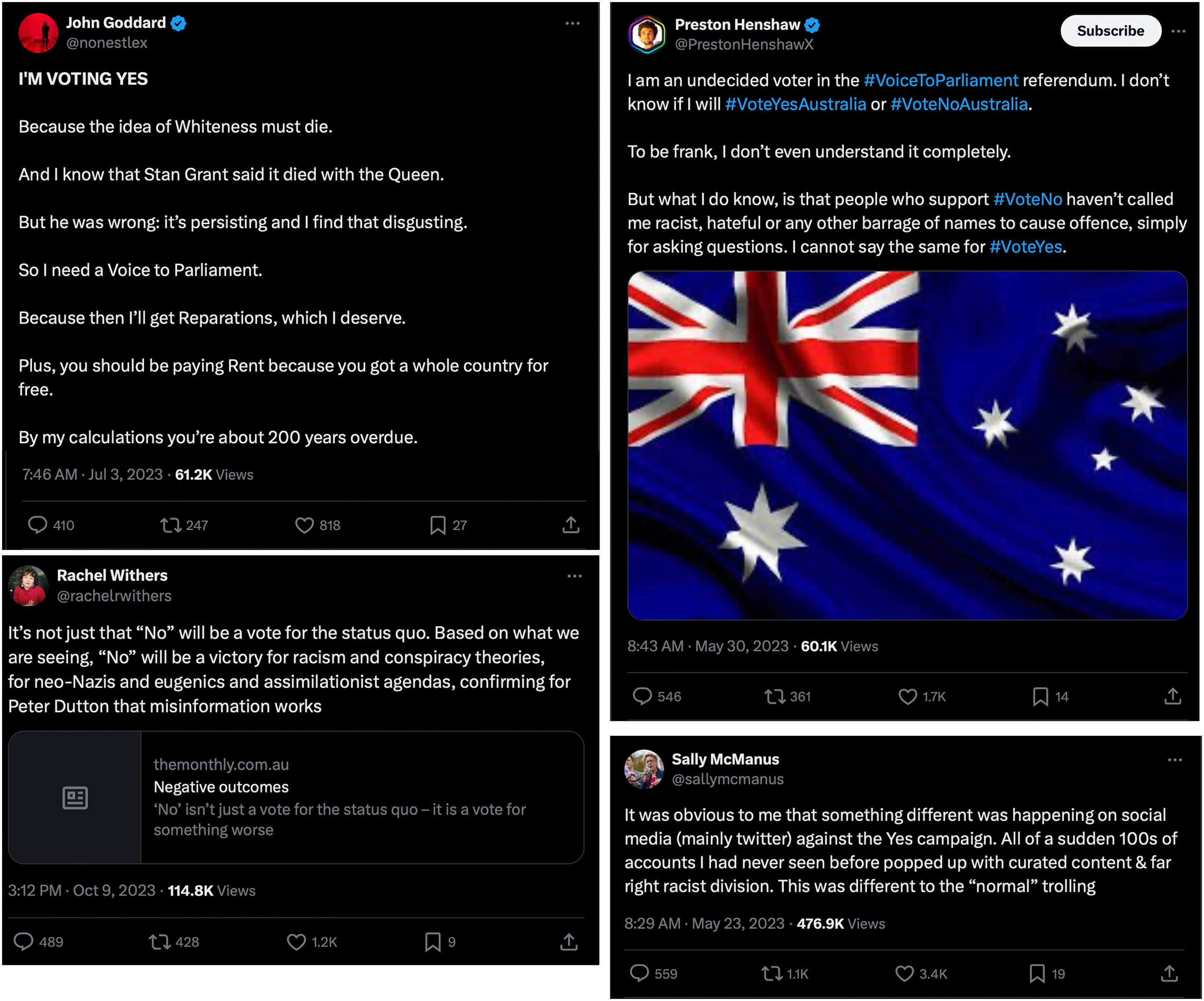
Top posts by engagement for Topic 5.
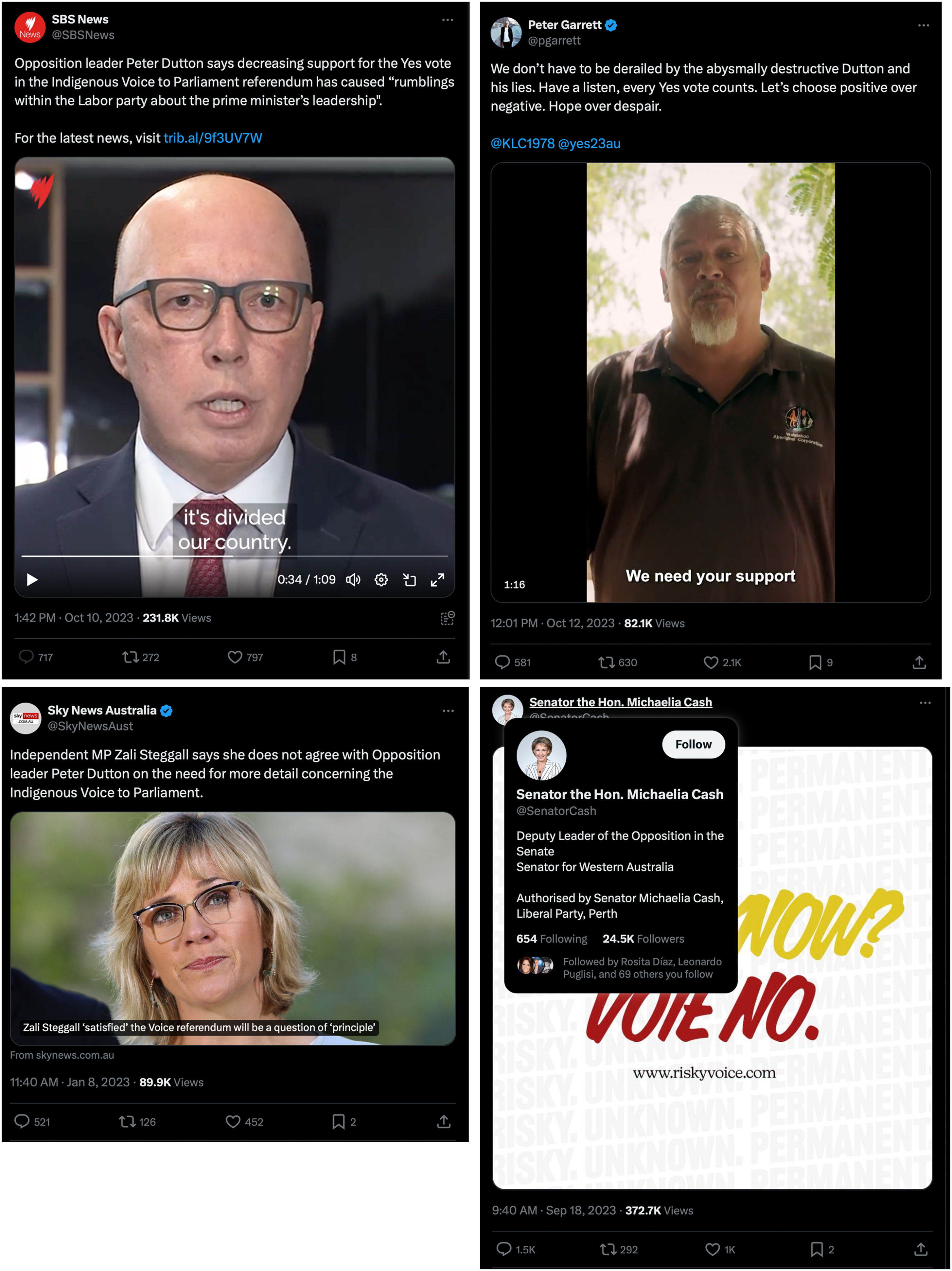
Top posts by engagement for Topic 6.
Topic 6 focuses on Opposition Leader Peter Dutton and his stance against the referendum. This topic captures a breadth of opinions about Dutton – some positive but mostly negative. Yes campaigners emphasise a perceived lack of leadership and empathy, along with assertions that Dutton intentionally lied or otherwise misled the public with his rhetoric. As one fringe Yes campaigner posted: ‘Peter Dutton boycotted the Apology to the Stolen Generation, yet attended George Pell's service. This is enough to show you what sort of monster he truly is’. As Figure 7 shows, two of the three widely discussed posts in this topic were from opinion leaders, including notable barrister and activist Julian Burnside and former politician and musician Peter Garrett. Burnside claims that Dutton ‘devised or approved the lies which support the No campaign’ and Garrett uses emotive language to describe ‘the abysmally destructive Dutton and his lies’. In contrast, No campaigners speak positively about Dutton, view him as a strong leader, and use his criticisms to question the feasibility and implications of the Voice, although No campaign posts are less visible in this topic. For instance, one fringe No campaigner wrote: ‘Peter Dutton spot on again. If these football codes think they have some moral superiority to promote a voice to parliament then maybe they should also not promote sports gambling. This is what strong leadership looks like’.
Topic 7 is focussed on hashtag campaigns and mentioning politicians and opinion leaders to get their attention to rally support or provoke a response. MP Linda Burney is mentioned frequently by both Yes and No campaigners. Yes campaigners mention Burney in a positive context, highlighting endorsements from various public figures, organisations and communities, along with various hashtag campaign hashtag supporting the Voice. No campaigners employ hashtags like #VoteNoAustralia and #VoteNoToApartheid to criticise Burney and other Yes advocates, questioning their competence and motives. The No campaigners use Burney's prominence to suggest that the Voice is driven by a select number of Indigenous elites rather than a national consensus. Politicians such as Senator Malcolm Roberts have widely discussed posts that contain conspiratorial assertions and use emotive imagery to capture attention (Figure 8). There is a sizeable discussion in Topic 7 about the ‘risk’ of the Voice, mainly coming from elite No campaigners but attracting a considerable pile-on from Yes campaigners who criticise what they perceive as ‘misinformation’. Figure 8 shows that two of the most discussed posts in this topic are from LNP Senator Michaelia Cash and political strategist and businessman Warren Mundine (@nyunggai). In these posts, both Cash and Mundine send warnings that the Voice is risky, using campaign graphics and imagery to make their point. These posts are highly polarising and often regress into each side spamming their own campaign hashtags in the replies in Topic 7. Elite Yes campaigners are critical of Mundine and generate discussion for posts calling attention to his messaging strategy (Figure 8).
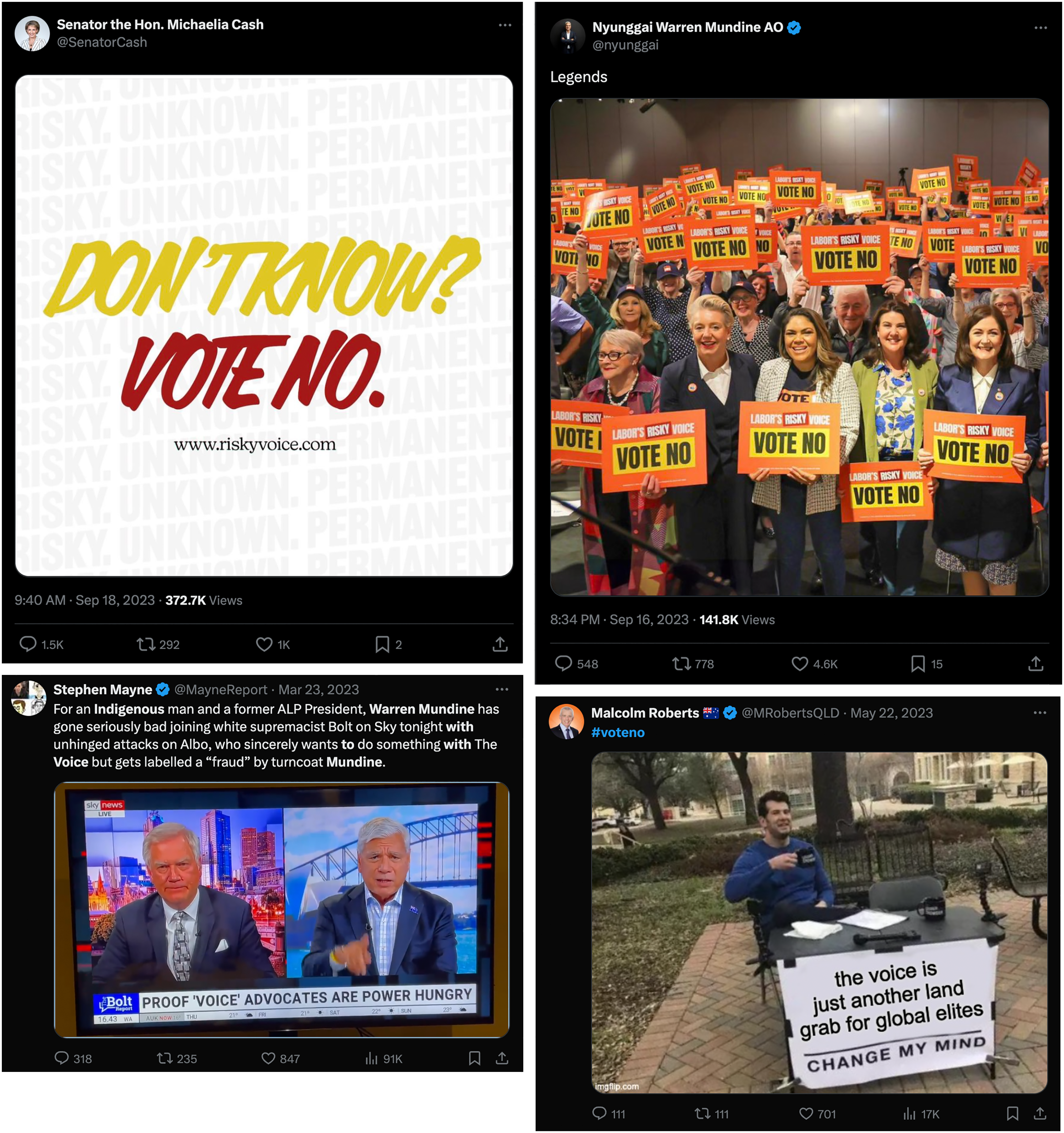
Top posts by engagement for Topic 7.
Topic 8 aggregates a wide range of narratives and arguments that encompass the concerns and objections raised by the No campaign. Common themes are concerns about enshrining racism in the Constitution, potential legal issues and challenges, and fears of social division. In making these arguments, posts in Topic 8 often reference prominent No campaigner Warren Mundine and quote tweet and reply to his posts. Indeed, as Figure 9 shows, the two most discussed posts are from @FairAusADV, a conservative advocacy group spearheaded by Senator Jacinta Nampijinpa Price and Warren Mundine (@nyunggai). @FairAusADV posts a video interview outlining why the Voice is a ‘MAJOR legal threat’, while Mundine links to an article by Peta Credlin that suggests notable Yes campaigners such as Indigenous lawyer Noel Pearson are given too much of a say. The Yes campaign is less visible in this topic and their focus is on debunking misconceptions and ‘myths’ propagated by the No campaign.
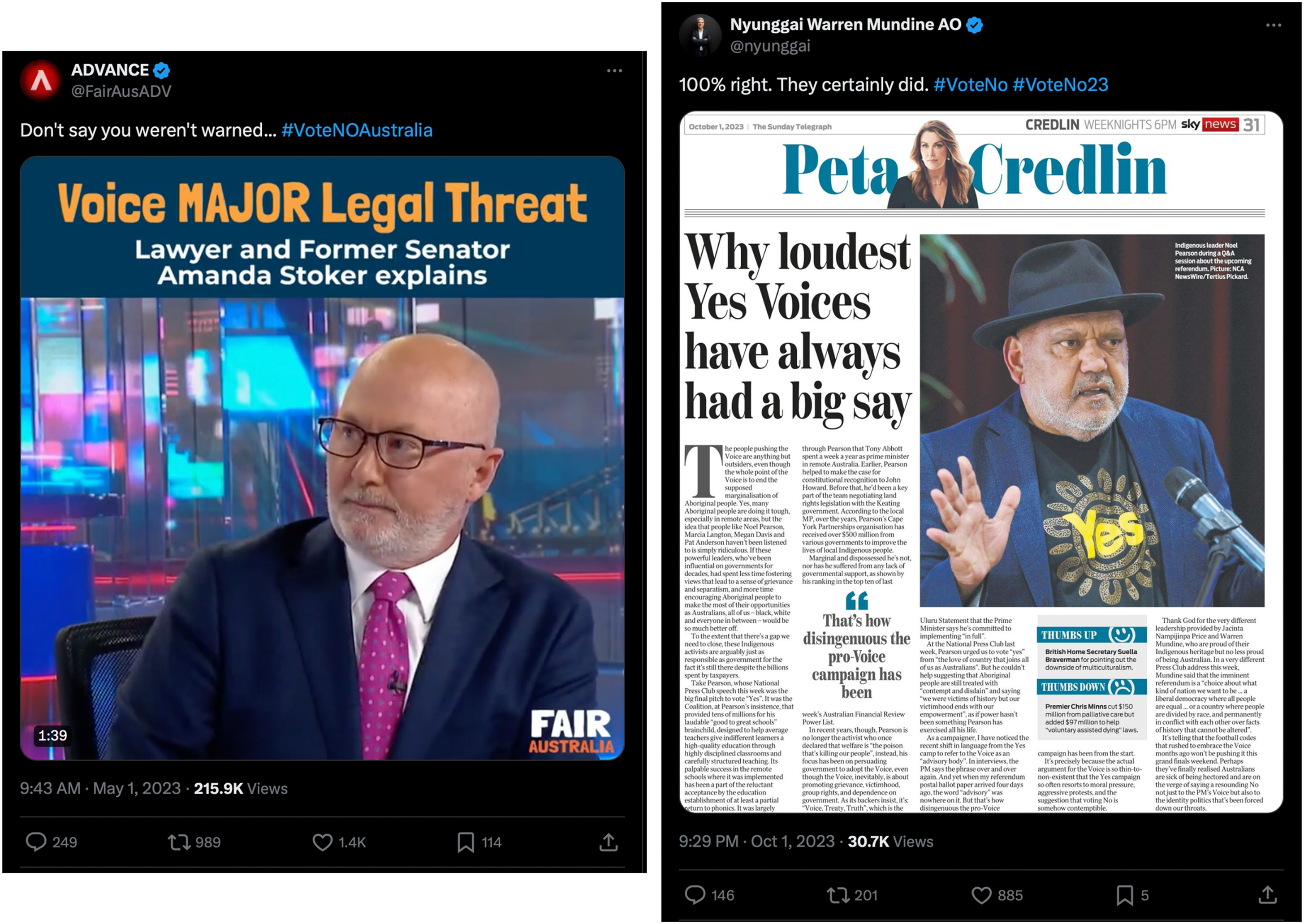
Top posts by engagement for Topic 8.
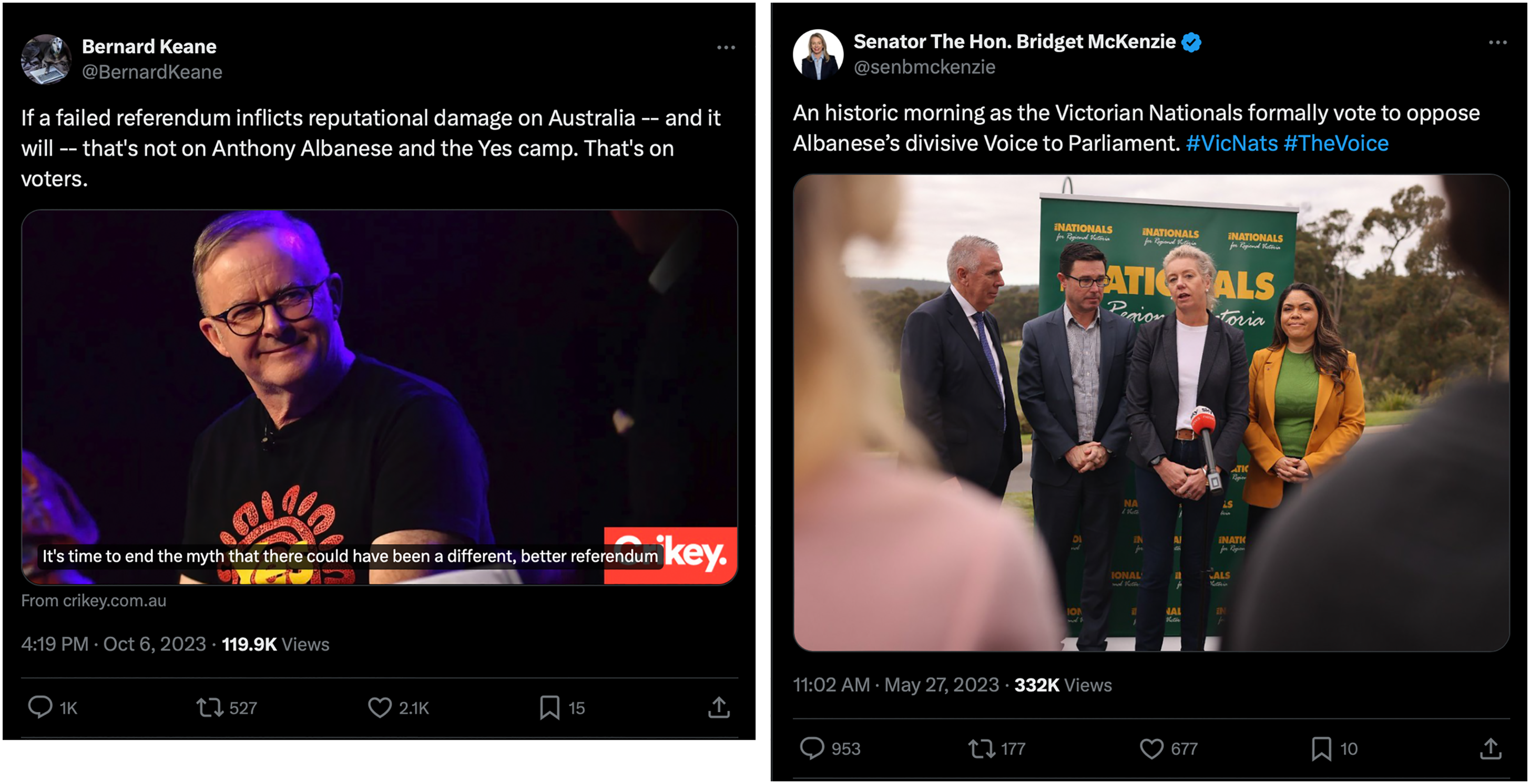
Top posts by engagement for Topic 9.
Topic 9 centres on the motivations and actions of Albanese, with a particular focus on the No campaign's framing of the referendum as ‘Albanese's Voice’ and ‘Labour's Voice’ (Figure 10). This framing is used to undermine the initiative by construing it as political manoeuvring designed to sow division rather than a genuine effort to improve Indigenous representation. The most discussed post in this topic is from Crikey journalist Bernard Keane, who tries to defend Albanese and the Yes campaign against the plummeting polls leading up to the voting day. The second two most discussed posts authored by Senator Bridget McKenzie and the official LNP account frame the referendum as ‘Albanese's divisive Voice’ and ‘Labour's Voice’ that ‘would be legally risky’. Other notable No campaigners appear in Topic 9, including a widely retweeted post from Senator Pauline Hanson that posts a Sky News Australia video with the message: ‘The sinister true agenda of Albanese's race-based Voice is finally being exposed. Albanese has been misleading you about his Voice, about the Uluru statement, about federal treaty, about everything! Please watch this full expose [sic] and arm yourself with the truth. #VoteNoAustralia’. Many fringe No campaigners quote tweet and reply to this post as evidence of a conspiracy, namely that Albanese has a hidden agenda and is wilfully misleading the public to serve the interests of an elite few. Yes campaigners in Topic 9 rally to deflect blame from Albanese and to validate his reputation and authenticity.
Topic 10 captures a polarising discussion of the Prime Minister. Yes campaigners emphasise his commitment to the Voice as part of the Uluru Statement and how his leadership is crucial for achieving good outcomes for Indigenous people. No campaigners continue their framing of the referendum as ‘Albo's Voice’, suggesting it is an inauthentic personal project and that he is not informed enough. As Figure 11 shows, the most discussed posts include a post from journalist and former senator Derryn Hinch, who implies hypocrisy from Albanese for his use of Uluru as a backdrop given the controversy around the climbing ban. Yes campaigners actively defend Albanese's emotional outpouring in response to a post by journalist James Massola, while No campaigners suggest it is inauthentic. A variety of fringe No campaigners rally in this topic to undermine Albanese's credibility, arguing that he hasn’t read the Uluru Statement. Yes campaigners try to debunk these narratives by highlighting fact checkers who debunk the misleading claim that the document is 26 pages long.
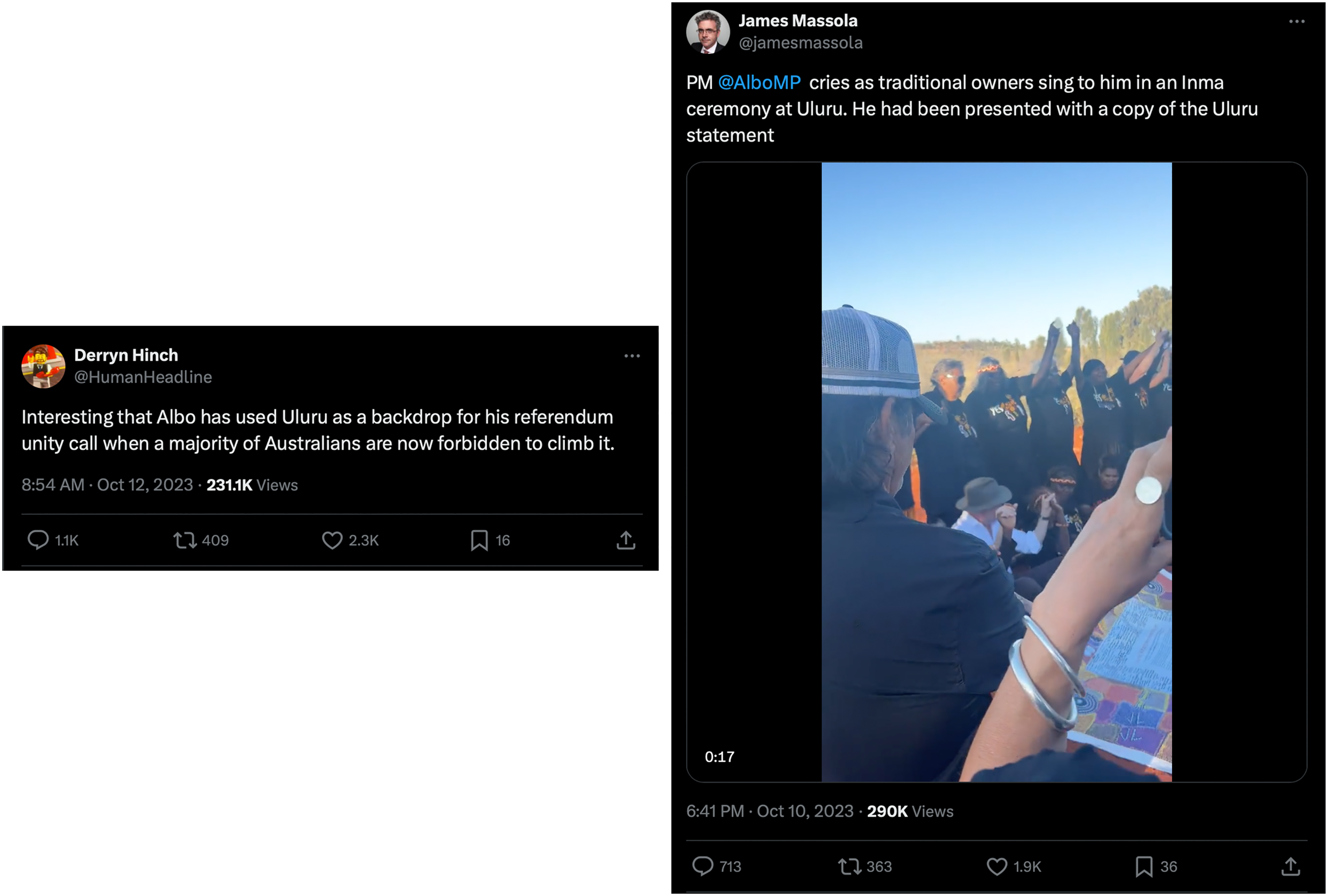
Top posts by engagement for Topic 10.
Assessing the No campaign's post-truth strategy of attention management
The results of the topic model analysis clearly suggest that the No campaign captured the most attention on X during the referendum. To further assess this across the entire dataset, we conducted a keyword analysis to examine the prevalence of Yes- and No-related keywords over time. As Figure 12 shows, keywords associated with No campaign messaging received considerably more occurrences compared to Yes campaign keywords. The No campaign keywords occurred 32,150 times compared to 7776 for the Yes campaign, meaning that the No campaign received 4.3 times as many keyword occurrences. The most frequently occurring keyword was ‘details’, which appeared 6943 times in the data. By contrast, the most frequent keyword of the Yes campaign was ‘constitutional recognition’, with 3121 occurrences. The top 10 keywords by frequency are provided in Table 3, showing that the Yes campaign only had two out of the top ten most frequent keywords in campaign messaging.
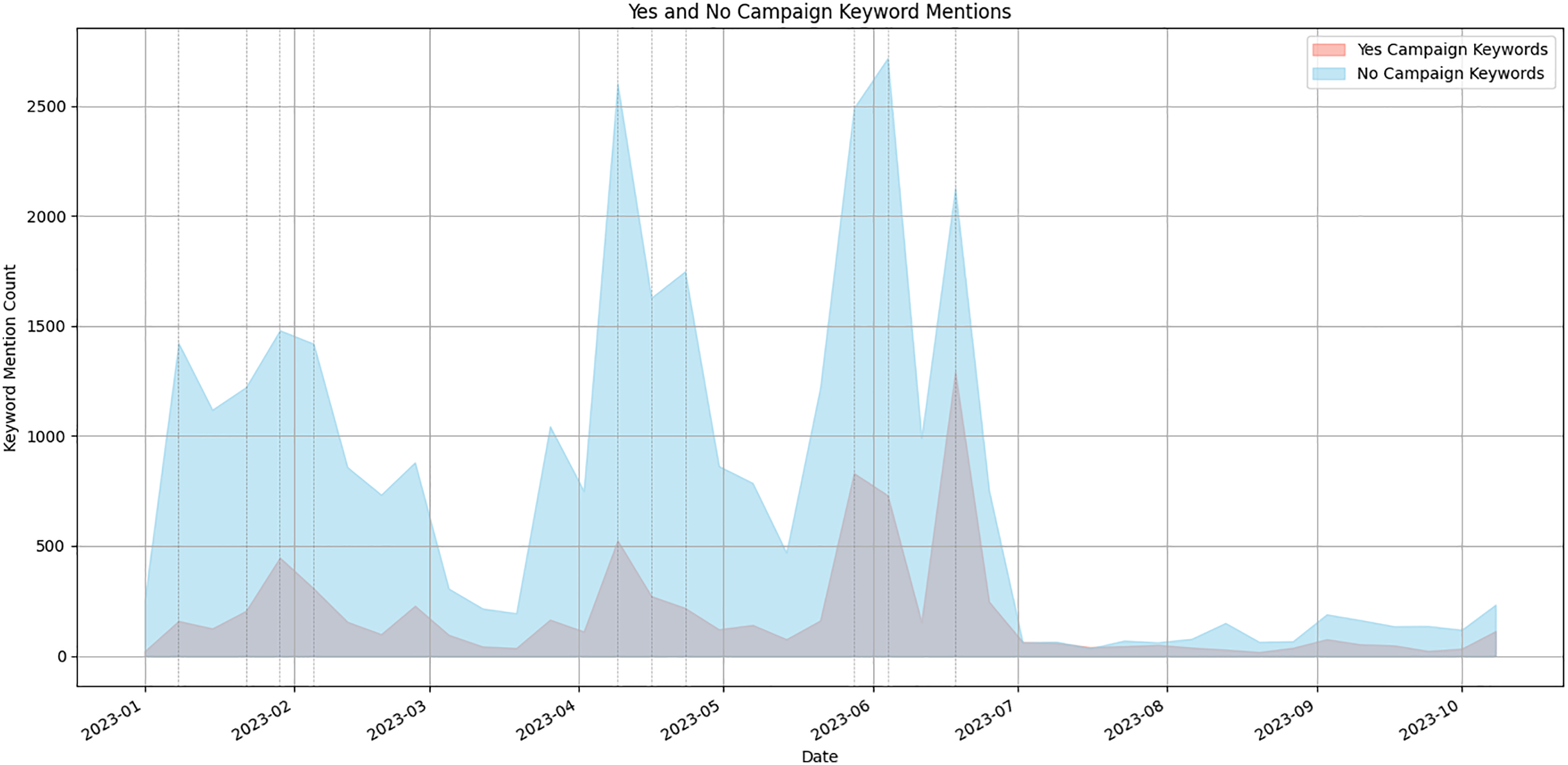
Frequency count of keywords over time for the Yes and No campaign.
For the No campaign, the top keywords and topic model analysis suggest that the campaign pivoted on a disciplined set of slogans and assertions from elite campaigners. These were taken up in a participatory fashion by fringe and civil society No campaigners on X, who produced their own content and elaborations, receiving participatory attention from both elite and fringe Yes campaigners who criticised and tried to debunk and counter them. Based on the analysis presented, the No campaign's assertions can be summarised as follows:
The Voice is race-based and will undermine racial equality. The Voice will divide Australia. The Voice does not have enough details. The Voice is legally risky. The Voice has a hidden agenda to consolidate elite privilege.
As a form of political communication, these assertions are arguably grounded in a post-truth style of messaging, particularly characterised by rumour-like propositions lacking secure standards of evidence (Harsin, 2006) and bold claims unsupported by credible and independently verified empirical evidence (Lewandowsky et al., 2017). Indeed, experts offer answers to a range of ‘myths,’ ‘misconceptions,’ and ‘confusions’ about the Voice that directly correspond to the No campaign messaging observed in the topic model analysis. For example, the first proposition fits into Claim 1 in Chan's (2023) typology: ‘The Voice is racist and excludes others; Legislation to combat racism will be needed once the Voice to Parliament comes into effect.’ The second proposition accords with Claim 2, 4, and 7: that the Voice will divide the nation by race; that the Voice risks increasing racism in society; and that the Voice will create apartheid in Australia. Informational articles by leading independent experts similarly map to these five core No campaign assertions (Appleby et al., 2023; O’Bryan and Gerber, 2023).
We showed that the claim of insufficient detail in the referendum received the most attention, as measured by keyword prominence and prevalence within the top 10 topics. This assertion arguably misrepresents basic facts about how referendums function because it either ignores or is unaware of the fact that laws in Australia are governed by the Australian Parliament and Executive Government (Mayo et al., 2022). As Thomas (2023) writes, the proposed Voice cannot make binding demands or veto legislation. Legal experts from three Australian universities further debunked this claim (Appleby et al., 2023), highlighting differences in constitutional change details versus legislation details and emphasising that the details of the constitutional change are well-documented and public, including the wording of the amendment, the referendum question, and the explanatory memorandum. The detailed design of the Voice, which would be legislated post-referendum, is appropriately left to be determined by parliament, ensuring flexibility and responsiveness to future needs (Appleby et al., 2023). This is a point repeatedly made by Albanese, who stated: We anticipated [a] range of objections including this unrealistic demand that all the detail be furnished up front, he said. You can propose model A, B or C, but they are not the detail. It was always subject to parliament. (Sakkal, 2023)
The topic model analysis shows that the ‘lack of details’ assertion was driven by leading No campaigners like Dutton, whose messaging during the campaign had a dedicated topic of discussion. This gained traction from both No campaigners who produced content promoting it and Yes campaigners who criticised and debunked it. The No campaign assertions appeared immune to fact-checking or engagement with reasoned deliberation and expert-informed information, reflecting the post-truth dimensions of their messaging strategy. In contrast to the Yes campaign's messaging, posts from the No campaign were largely predicated on anecdotal evidence and emotionally charged language to foster distrust and a sense of crisis. Elite No campaigners co-opted declining levels of ‘passive trust’ (Giddens, 1994) towards political leaders, institutions and academic experts, cultivating a kind of ‘active trust’ that needs constant renewal (Harsin, 2018).
This is not to say the No campaign's claims lacked empiricism. As the topic model analysis showed, claims from both elites and fringe actors were supported by collaborative work to find what they believed to be evidence. The difference is that the No campaign's ‘just asking questions’ and ‘Do Your Own Research’ mode of empiricism (Tripodi et al., 2023) was grounded in trust in populist politicians, conservative news media like Sky News Australia, and partisan advocacy groups like Advance and Fair Australia. For example, in Topic 1, we highlighted attention given to Senator Hanson's and Senator Price's claims that the Uluru Statement from the Heart is 26 pages long and contains a list of secret demands, obtained by a Freedom of Information (FOI) request. The claim, first discussed in parliament by Deputy Liberal leader Sussan Ley and publicised by Sky News host Peta Credlin, was debunked by SBS News and AAP (Summers, 2023). The FOI documents were background information and minutes of regional dialogues held in 2016 and 2017. RMIT FactLab concluded that Hanson's claim of a secret list revealing the ‘real agenda’ behind the Voice is false (Davidson and Jeffery, 2023). Yet, our findings show these conspiratorial assertions gained attention on social media, evoking strong reactions from Yes campaigners who posted messages calling it ‘misinformation’ and ‘disinformation’. Indeed, Albanese called it a ‘QAnon of a theory … We have all sorts of conspiracy stuff out there, but this is a ripper’ (SBS News, 2023). In topics 2 and 4, we saw this claim rebuked by Yes campaign politicians like Zali Steggall and Tanya Plibersek. Tellingly, on 2nd October 2023, just two weeks before the referendum date, one of the most widely discussed posts in Topic 8 was from Sky News Australia, linking to an article about how Albanese blamed ‘disinformation’ for the rising number of Labor voters planning to vote ‘No’ at the Voice at the referendum (Sky News Australia, 2023).
Discussion and conclusion
Our analysis suggests that the primary aim of elite No campaigners was not merely disseminating falsehoods; instead, their objective was to establish a ‘truth market’ within the public sphere. For Harsin, this is a systematic post-truth approach to political communication that ‘emphasizes discord, confusion, polarised views … and elite attempts to produce and manage these “truth markets” or competitions’ (Harsin, 2018: 3). The No campaign's messaging on X cultivated an atmosphere of scepticism and inquiry, leveraging the conditions of a ‘regime of post-truth’ (Harsin, 2018) marked by diminishing trust in scientific expertise and governmental authority. The official No campaign's disciplined messaging about ‘racial division’, ‘lack of detail’, distrust of the referendum process, and ‘Canberran elites’ spurred both support and participatory content creation from anti-Voice campaigners on X, as well as a response that mobilised Yes campaigners to focus attention on it.
In the topic model analysis, we found that Yes campaigners employed a more traditional messaging approach, emphasising public support from corporations and celebrities and presenting historical facts and statistics about First Nations representation and equality. The Yes campaign messaging, particularly from Albanese, made implicit appeals to the ‘good character’ of the Australian people. While posts from leading Yes campaigners were widely discussed, they did not attract as much attention as the more emotive messaging that either ambiguously addressed or disregarded expert and institutional authority, appealing instead to anecdotal evidence and active trust in conservative politicians and news media. Our detailed analysis of the top 10 topics showed that Yes campaigners dedicated much discussion to debunking and criticising the No campaign's narratives, which they viewed as conspiratorial, misleading, and in bad faith. This resonates with Phillips’ (2018) notion of the ‘oxygen of amplification’ whereby attempts to debunk or criticise unverified or misleading narratives can often serve to amplify them. This trend of the Yes campaign focusing on a ‘rearguard battle’ (Bruns and Angus, 2023) with the No campaign's messaging continued throughout the entire lead up to the referendum. Moreover, we observe at times in our analysis that both elite and fringe Yes campaigners reacted to the No campaign's messaging strategies by framing them conspiratorially (e.g. in topic 2, MPs made claims of secret manipulation of public opinion without the support of independent verified evidence). To be sure, this is not conspiratorial content per se, but specific claims about the No campaign's messaging strategy.
This kind of targeted messaging from the No campaign, designed to elicit reliable outrage from a segment of the population, is not a new public relations technique. As Bernays wrote in 1928, using a biological metaphor: ‘Touch a nerve at a sensitive spot and you get an automatic response from certain specific members of the organism’. We observed this ‘automatic response’ on X from Yes campaigners, in response to politicians and opinion leaders, and fringe activists spreading conspiratorial assertions. Based on the five characteristics of conspiratorialism outlined at the outset of this paper and our topic model analysis, we conclude that the No campaign's attention management strategy incited fringe No campaigners to develop and spread conspiratorial content and provoked Yes campaigners into making conspiration assertions about the No campaign's messaging. We did not find a sizeable prevalence of full-blown conspiracy theories, but rather a proliferation of conspiratorial assertions that promoted collaborative work from No campaigners to find further ‘evidence’ and fostered collaborative dissent and vocal criticism from Yes campaigners. For users of the platform and arguably the broader public, the pervasiveness of content designed to provoke moral outrage (Santini et al., 2021) and invite conspiratorial ‘connecting the dots’ significantly amplified the challenges of navigating the ‘truth market’ of discourse about the referendum. Harsin (2018) highlights the dilemma facing post-truth deliberation: Resource-rich political and economic actors using big data analytics and sentiment analysis target audiences emotionally, hoping not simply to produce beliefs (ideological effects) but to modulate cognition, emotion, and attention, via quick likes/dislikes, shares, before moving on. In a culture of speed … slower, perhaps ‘quieter’ civil forms of communication are suspicious to some audiences. (Harsin, 2018: 19)
In contrast to the Yes campaign, the No campaign was not about spreading information but about producing ‘created circumstances’ (Bernays, 1928) that modulated public perceptions and exploited the rapidity of digital networks to control flows of attention. A near-constant supply of pseudo-events and rumour bombs (Harsin, 2006) attracted 24/7 news attention and fostered participatory discussions on platforms such as X from actors across the partisan divide. The Yes campaign's messaging approach, on the other hand, was not propagandistic in the same way. The reasoned, historically informed, mass-messaging style did not employ the same strategies of marketing and attention control but aimed to foster informed, deliberative discussion among the public. On the platform X, this approach failed to mobilise and manage attention. Based on the evidence, the Yes campaign's narratives were drowned out by the No campaign's strategy.
We conclude with a key provocation: the No campaign's misleading messaging on X was not predicated on outright falsehoods. Our findings suggest that it primarily relied on the systematic and strategic spread of unverified rumours and claims, as well as the weaponisation of context, serving as a form of attention management in Australia's hybrid media system. This places the campaign squarely within the conceptual remit of propaganda (Harsin, 2024), but with new socio-technical configurations and post-truth possibilities. Such tactics entangled fact-checkers and provoked opponents into participating and contributing to the oxygen of amplification (Phillips, 2018). We observed a highly polarised communication environment in the dataset under examination, with little or no meaningful dialogue between the Yes and No campaigns evident in the topic model analysis. One might argue that these attention management strategies are therefore anti-deliberative and may only serve to worsen distrust and political polarisation. We speculate that the No campaign's narrative of ‘social division’ became a self-fulfilling prophecy, as the emphasis on division and scepticism not only framed the discourse but also amplified and entrenched the very polarisation it predicted, providing few opportunities for cross-cutting agreement and constructive dialogue. While it remains unclear how much impact social media had on the referendum's outcome, platforms like X play an integral role in new configurations of propaganda that require urgent attention.
Footnotes
Acknowledgement
I sincerely thank Amelia Radke, Elise Thomas, and Kate FitzGerald for helpful comments on earlier drafts of this manuscript. I am also grateful to three anonymous reviewers, whose feedback greatly strengthened the theoretical and empirical contribution.
Declaration of conflicting interests
The author declared no potential conflicts of interest with respect to the research, authorship, and/or publication of this article.
Funding
The author disclosed receipt of the following financial support for the research, authorship, and/or publication of this article: This research is funded by an Australian Research Council DECRA grant: [DE220101435]. It is also supported by the QUT Digital Media Research Centre and the ARC Centre of Excellence for Automated Decision-Making and Society.

Correction (September 2024):
Acknowledgement section has been added in the article.