




Abstract
In the setting of increasingly more fragmented digital communication settings, the accuracy and honesty of (political) information has become subject of fierce debates and partisan attacks. Hence, the challenge of mis- and disinformation not only pertains to the truthfulness of information itself, but also to the discursive construction of supporting information as truthful and dissonant information as untrue or deliberately false. This paper inductively analyzes discourses of (un)truthfulness (Study 1, N = 1,777) and uses an Automated Content Analysis (Study 2, N = 56,666) to assess how reality, mis-, and disinformation are constructed by politicians in Austria, Germany, and the Netherlands. The findings point to an affinity between populism and disinformation: Right-wing populist politicians take issue ownership in discrediting established knowledge and attempt to create momentum for alternative realities that resonate with populist worldviews. Such discourses of (un)truthfulness may have an important impact on defining reality for voters.
Communicative untruthfulness not only pertains to the spread of incorrect or dishonest information, it is also used as a label to delegitimize or attack political opponents and sources of information (Egelhofer & Lecheler, 2019). In the past decades, many politicians around the globe attributed blame to the media for being dishonest, and deceiving the ordinary people (e.g., de Vreese et al., 2018; Egelhofer & Lecheler, 2019; Krämer, 2018). Media critique and attacks on the legitimacy of journalism has mainly been regarded as a right-wing populist tactic, for example expressed by Fortuyn and Wilders in the Netherlands and Trump in the US. In line with this, a growing body of literature points to the current crisis of (un)truthfulness in (digitized) information environments (e.g., Van Aelst et al., 2017; Waisbord, 2018).
Most conceptual and empirical research has started to explore the political consequences of mis- and disinformation (e.g., Wardle, 2017). However, we know little about how the discourse around (un)truthfulness is shaped by political actors through social media—who may use discourses of truthfulness to disseminate their own version of reality, whilst accusing other actors of spreading erroneous or misleading information (Tambini, 2017). Following extant literature, we expect that populist politicians are most likely to blame the media and political elites for lying and deceiving the people (e.g., de Vreese et al., 2018; Farhall et al., 2019).
Against this backdrop, this paper relies on a mixed-method comparative qualitative (Study 1) and an automated content analysis (Study 2) of the discourses around truth and dishonesty constructed by mainstream and populist politicians in three countries: Austria, Germany, and the Netherlands. These countries were selected to understand the extent to which discourses of (un)truthfulness are similar or different in comparable national settings: The included countries are all Western European democracies in which right-wing populism has been electorally successful in recent years (e.g., Aalberg et al., 2017). Even though we expect that anti-media sentiments can be expressed by political actors across the political spectrum, we test the assumption that discourses of untruthfulness, and disinformation in particular, are mostly right-wing populist communication tactics (e.g., de Vreese et al., 2018).
This paper distinguishes three discourses around the status of (un)truthfulness: (1) claims and constructions of the epistemic status of objective information and factual knowledge; (2) the perception of unintended communicative untruthfulness, or misinformation; and (3) the emphasis on dishonest, deliberately deceptive or manipulative communication (disinformation). Based on this conceptualization, and an inductive qualitative content analysis, we developed a dictionary to identify the salience of these three discourses in the direct communication of politicians. We specifically explore the empirical validity of three theoretical expectations postulated in extant literature: (1) have perceptions and accusations of mis- and disinformation increased over time, (2) are (right-wing) populist politicians more likely to cultivate perceived disinformation than mainstream politicians, and (3) are accusations of dishonesty more salient in election versus routine periods? Answering these questions contributes to a refined understanding of mis- and disinformation as a delegitimizing discursive tactic beyond facticity or Fake News as a genre (Egelhofer & Lecheler, 2019).
Conceptualizing Three Discourses of Truth and Fake: The Epistemological Status of Truth, Misinformation, and Disinformation
Arendt (1955) argues that opinions, and not truths, are the foundation of democratic decision-making. Yet, different opinions should be based on the same objective reality shared by all citizens and politicians. When the basic truths that inform opinions and political decisions are up for interpretation and debate, deliberative democracy is severely threatened (e.g., Van Aelst et al., 2017). This disunity of reason (Habermas, 1981) arises from a fragmentation of normative knowledge based on the interests of individuals instead of a consensual collective. To protect the core values of democracy, truth and politics should not be separated (Arendt, 1955). The replacement of historical facts with alternative facts undermines this principle—indicating that the factual reality can become constructed or debated (Monod, 2017). It is this notion that oftentimes informs politicians’ discourse on factual reality. Objective facts are labeled as fake news (Farhall et al., 2019), whereas made-up stories are sold as the (people’s) reality.
In his seminal work on propaganda techniques, Lasswell (1927) noted that propaganda revolves around controlling opinion by using different rhetorical devices (i.e., rumor and pictures) to manipulate social suggestion and mobilize communities against an enemy. To identify (un)truthfulness rhetoric, Lasswell and Namenwirth (1969) developed dictionaries capturing constructs related to the epistemic status of knowledge and untruthfulness. The discourses of (un)truthfulness measured in this study partly relate to these endeavors. Building further on this, we aim to capture references to disinformation or attacks on legacy journalism by flagging information as intentionally false (Farhall et al., 2019), and distinguish these from mere references to false information that is not disseminated to mislead or manipulate.
Moving beyond extant research that mainly looked at the fake news label (e.g., Egelhofer & Lecheler, 2019), we aim to understand the relation between truth and politics (Arendt, 1955) in a more refined way. Specifically, this paper conceptualizes the discursive construction of knowledge and mis- and disinformation in three different ways: (1) politicians may emphasize their interpretation of reality as honest and authentic; (2) politicians may emphasize that some information should be regarded as inaccurate; and (3) politicians may label information as intentionally false, misleading and dishonest.
Constructing the Epistemic Status of Factual Knowledge Online
Digital media settings in particular allow politicians to spread different news stories, and to directly establish a bond with the vox populi (e.g., Engesser et al., 2017), hereby adding to the confusion by distracting people from “inconvenient” truths, or by overloading them with real stories: A potential strategy to distract people from dishonest content, or make them forget the truth (e.g., Lippmann, 1922). At the same time, claiming truthfulness and inventing alternative truths can be a communication tactic to turn followers away from established knowledge, and make them believe congruent stories that confirm their political ideology or prior attitudes. Politicians can thus use social media to claim congruent truths, or use reality discourses to distract people from inconvenient realities. It is important to explore how truthfulness is referred to by politicians, as the discursive construction of reality may have an impact on the way that voters perceive reality. Against this backdrop, we introduce the first research question: To what extent and how are politicians constructing their version of reality as the truth? (RQ1).
Emphasizing Unintended Communicative Untruthfulness: Perceived Misinformation
Misinformation refers to the unintentional spread of information that is not supported by empirical or verifiable evidence or expert opinion (e.g., Tandoc Jr. et al., 2018; Thorson, 2016; Wardle, 2017). We know markedly little about the ways in which misinformation is signaled in today’s post-truth online media societies. Even if we cannot assess the veracity of misinformation constructions, politicians’ labeling of information as erroneous may reduce citizens’ trust in the media and politics—irrespective of whether this attribution is factually correct. Especially when politicians delegitimize information that is not in line with their worldview, whilst claiming that congruent information is real, constructions of reality and attributions of misinformation may not only increase distrust, but also foster polarized divides between the “right” in-group and the “factually incorrect” others.
The discursive construction of misinformation as an accusation may be a powerful tool for politicians to attribute responsibility to other parties (Egelhofer & Lecheler, 2019). Through their own ungated social media channels, politicians can discredit the accuracy of the information of different actors—hereby influencing the electorate’s perceptions of truth. Even though it reaches beyond the scope of this paper to fact-check all labels and accusations of false information, politicians may be selective in which sources, fragments of reality, and (expert) knowledge they label as false and true, hereby strategically constructing untruthfulness to make it fit their political agenda. We raise the following research question: To what extent and how is misinformation constructed by politicians in Austria, Germany and the Netherlands? (RQ2).
Shifting Blame for Lying: Constructing and Attributing Disinformation
Based on the hostile media phenomenon (HMP) (Kleinnijenhuis et al., 2020; Vallone et al., 1985), it can be argued that people have a tendency to prefer like-minded media that support their issue positions, whilst perceiving media coverage against their views as hostile. The HMP can also be applied to political communication. Political actors frequently accuse media coverage of being biased against their views (Matthes et al., 2019), which chimes in with our conceptualization of the discursive construction of disinformation.
Different from labeling information or sources as erroneous, references to disinformation imply that information is intentionally false, and disseminated to achieve political goals (e.g., Freelon & Wells, 2020; Tandoc Jr. et al., 2018). Disinformation constructions may have the most severe ramifications for deliberative democracy. Although labeling sources and knowledge as misinformation may be regarded as honest mistakes, shifting blame for lying, deceiving, and manipulating the truth may correspond to institutional distrust and cynicism among citizens (Bennett & Livingston, 2018)—who no longer trust the impartiality and honesty of the press. Against this backdrop of constructions and accusations of perceived disinformation, the following research question is proposed: To what extent and how is disinformation constructed and attributed by politicians on social media in Austria, Germany, and the Netherlands? (RQ3).
Finally, it is relevant to assess how the three discourses of (un)truthfulness are connected. Claiming reality and delegitimizing opposed information—irrespective of its actual veracity—may be an important political strategy in times of post-factual relativism (Van Aelst et al., 2017): Politicians can communicate an issue-congruent reality whilst marking other information as misleading or erroneous. We therefore ask: How are discourses of reality, mis-, and disinformation connected in politicians’ direct communication? (RQ4).
Discourses of Untruthfulness Across Mainstream and Populist Politicians
Politicians across the ideological spectrum may be involved in the discursive construction of reality, mis-, and disinformation. Even though all politicians may express some form of media critique, populist politicians or conservatives are found to be most likely to explicitly accuse the media of being dishonest or fake news outlets (Farhall et al., 2019). More specifically, the mainstream media are increasingly regarded as a salient scapegoat in populist rhetoric (e.g., de Vreese et al., 2018; Egelhofer & Lecheler, 2019; Krämer, 2018). The established media in particular are said to cover the elites’ dishonest worldview, whilst neglecting the concerns and worldviews of the ordinary people the media should represent. Especially discursive constructions of disinformation align with a populist communication tactic: Information is regarded as being deliberately biased and dishonest, opposing the people’s reality and honesty to lying others.
In line with this argument, the deliberate spread of communicative untruthfulness, or disinformation, has mainly been regarded as a phenomenon related to radical right-wing (populist) actors (Bennett & Livingston, 2018; Egelhofer & Lecheler, 2019; Krämer, 2018; Marwick & Lewis, 2017). In addition, populist rhetoric emphasizes an antagonist divide in society and politics: the “good” in-group is juxtaposed to the “evil” or “corrupt” others (e.g., Jagers & Walgrave, 2007). Even though the thin-ideology conceptualization may not be uncontested, populism essentially cultivates a binary view on politics and society in which the people are juxtaposed to the corrupt elite or dangerous others. The centrality of populist blame attribution may also take shape in the form of the discursive construction of reality vis-à-vis mis- and disinformation. Although all politicians can discursively construct reality, mis-, and disinformation, we expect that the discourses of (un)truthfulness are most prominent in the online communication of populist or radical-right-wing politicians. Against this backdrop, the following hypothesis can be introduced: (Radical) right-wing populist politicians are more likely to construct perceptions and accusations of disinformation than mainstream politicians in Austria, Germany, and the Netherlands (H1).
In this comparative study, we specifically look into the discourse of three countries that have been associated with the success of radical right-wing populist actors: Austria, Germany, and the Netherlands (Aalberg et al., 2017). The three national settings are relatively similar when it comes to political and media systems (Hallin & Mancini, 2004), and are all Western European democracies in which right-wing populism has found a fertile breeding ground, albeit to different extents and with a different history (Aalberg et al., 2017). The aim of including different national settings is not to find differences, but to assess the extent to which the different discourses of (un)truthfulness are robust across settings that are relatively similar.
The Development of Discourses of Truth and Fake Over Time
In the current setting of high levels of political distrust and successful populist actors throughout Europe (Aalberg et al., 2017; de Vreese et al., 2018), it seems that the cultivation and construction of mis- and disinformation by politicians has become an influential strategy to gain political success. We therefore expect that the overall use of references to the epistemic status of knowledge (RQ1), misinformation (RQ2), and disinformation (RQ3) by politicians has increased over time. We raise the following hypothesis: Politicians’ references to the epistemic status of truths, and constructions of mis- and disinformation have increased over time in Austria, Germany, and the Netherlands (H2a). As right-wing populists have claimed issue ownership over attributing blame to established knowledge whilst introducing an “alternative” people-centeric reality, it can be expected that the over-time increase in referring to (un)truthfulness can be attributed mostly to the radical right-wing populist party family. We therefore hypothesize that over-time increases in references to (un)truthfulness are stronger for right-wing populists than mainstream politicians (H2b)
In election periods, it is more relevant to point to the failures of political opponents compared to routine periods (Schmuck & Hameleers, 2020). Agenda setting theory holds that politicians can have a substantial influence on the media agenda and steer party choices (Kleinnijenhuis et al., 2007). Parties try to use their influence to get their issues and policies higher up in the media agenda, especially around election times. Applied to discourses of (un)truthfulness, delegitimizing the established order or media outlets may be an important political strategy to influence the media agenda—showing which parties can be trusted and which should be deemed deceptive and dishonest.
By delegitimizing the information spread by other politicians or the mainstream press, political actors may promote more momentum for their own policies and realities. Therefore, we hypothesize: Politicians’ constructions of disinformation are more salient in election compared to routine periods in Austria, Germany, and the Netherlands (H3a). We expect a difference between mainstream (established) and populist actors in the salience of constructing untruthfulness in election periods. The attribution of blame to the elites and established knowledge central in populist rhetoric, may be regarded as a strategy to gain electoral success (e.g., Aalberg et al., 2017). As populists may be most likely to strategically claim their people-centeric reality and discredit established truths, it can be expected that they rely most on this tactic in election times. We therefore hypothesize that the increased salience of discourses of (un)truthfulness is stronger for right-wing populist actors than mainstream politicians (H3b).
Study 1
As a first step in exploring the political discourses around (un)truthfulness in all countries, we inductively identify the nature of the discourse around truth, mis- and disinformation. Based on the inductive and qualitative findings presented here, a dictionary of the three discourses was developed for an automated content analysis (ACA). Not only do the qualitative findings offer a starting point for the ACA, they also provide in-depth insights into the ways in which politicians’ in the three countries distinguish “their” version of truth from the dishonest or inaccurate constructions of reality of others.
Method Study 1
Data collection and sample
Only posts that were communicated by political leaders were included in the sample frame. Responses to posts, or shared materials, were not coded. In the Netherlands, the direct Facebook communication of two leading politicians was collected in the most recent pre- and post-election period (March 15, 2017). The sampling strategy aimed for maximum variation in interpretations of (un)truthfulness. For this reason, the Facebook activity of the right-wing populist party leader Geert Wilders and the leader of the Dutch government Mark Rutte was scraped (January 1st, 2017–June 1st, 2017).
The German language sample was collected in Austria and Germany. Again, the theoretically motivated mainstream-populist divide was strategically captured in the sample frame. The Facebook activity of Austria’s right-wing populist politician Heinz-Christian Strache from the Austrian Freedom Party (FPÖ) and his conservative coalition partner Sebastian Kurz (ÖVP) as well as the party leader of the biggest opposition party, Christian Kern (SPÖ), were scraped. The Facebook postings of Austrian political leaders were investigated between July 15th, 2017 and October 15th, 2017. For Germany, Facebook postings of the Christian Democratic coalition of Angela Merkel (CDU), Horst Seehofer (CSU) and Martin Schulz’ Social Democrats (SPD) as well as the biggest opposition party, the right-wing populist AfD with party leaders Jörg Meuthens and Frauke Petry, were part of the sample. Postings between June 24th, 2017 and September 24th, 2017 were analyzed.
In all countries, the sampling strategy was based on the principle of theoretical saturation (e.g., Charmaz, 2006). Hence, when additional posts by politicians did not reveal novel insights into the core themes revolving around the sensitizing concepts of truth, fake (news), misinformation, disinformation and constructions of reality, the collection of new data stopped. In both countries, the initial sample consisted of 30 posts in the pre-election and 30 posts in the post-election. This sample was extended with new data to assess whether themes needed refinement or extension. The final sample consists of 568 posts in the Netherlands, 655 posts in Germany, and 554 posts in Austria. Most posts were selectively coded, and a subset of posts (about 10%) were coded line-by-line (see analysis section).
Analysis strategy
The data were analyzed using the three subsequent steps of coding specified in the Grounded Theory approach (e.g., Charmaz, 2006). Instead of line-by-line coding, however, selective coding was employed. Each post was read and re-read by the coders, but only segments of the posts that connected to references to truthfulness, mis-, or disinformation (with and without explicit terminology) were arced and assigned open codes. The context of the full post was still taken into account when assigning these codes. Hence, segments were coded in detail if a statement from a politician referred to the status of truth or reality, emphasized doubt/discussion about falsehoods, or contained a reference to deliberate misleading, a fake news accusation, or other forms of delegitimization.
We aimed to distinguish between misinformation and disinformation by using the sensitizing concepts of “lying” and “intentional deception” for disinformation and more general ways of flagging “erroneous” or “false” information without explicit references to the intentional deception/manipulation or political agenda of politicians for misinformation discourses. This distinction follows theoretical conceptualizations of, for example, Karlova and Fisher (2013). The distinction between mis- and disinformation was thus captured by looking for indicators of intentional misleading or deception for disinformation, and the absence of intentions in misinformation references. Untruthfulness (misinformation in general) contains all the references to claims, statements or information that is simply deemed untrue, whereas dishonesty involves the intention to misinform—making it an indicator of disinformation.
We specifically paid attention to the word choice and embedding of words used by politicians to construct reality and dishonest or inaccurate information. Focused coding was conducted on the list of resulting codes. During this step, the rich detailed and unique codes were brought to a higher level of abstraction, and partially elevated from the context of the individual posts. We mainly looked for variety between the discourses of truth. Finally, during axial coding, the emerging categories were linked.
The two coders discussed the coding procedure, including the inclusion criteria for segments of the data to be coded in the next steps. In the first steps, before coding the full corpora, English language materials that were comparable to the analyzed data in the main study were coded discussed by the independent coders—which informed the decision rules and coding procedures of the full study. When agreement was achieved, the full sample frame was coded.
Results Study 1
Discourses of reality communicated by mainstream and populist politicians
In all three countries, mainstream politicians emphasized the need for transparency and truthfulness, and emphasized that politicians should be honest. Most references to truthfulness, reality, and honesty were implicit. In Austria, Kern explicitly referred to the truth, credibility and honesty as core values that needed to be safeguarded. Likewise, Kern stated that “we have to offer concrete solutions and make politics credible.” Kurz demanded that we need to talk “honest about the truth and face problems” which indicates that he does not exempt himself from struggling to communicate truthfully. He says that “we need to stop sugar coating the truth.” In the Netherlands, mainstream politicians, such as the Dutch prime-minister Rutte, emphasized that it is important to be careful when communicating to the public: “It is crucial that we are careful with making claims to the public.” To mark the difference between verified facts and opinions, the Dutch prime-minister frequently quoted sources of facts or clearly indicated situations in which opinions were communicated “In my opinion [. . .]” or “We believe that [. . .].”
Across all three countries, it can be observed that discourses of reality communicated by right-wing populist politicians mainly revolved around emphasizing issue-congruent truths, and quoting and confirming sources that aligned with their issue positions. In Austria, Strache said that SPÖ and ÖVP are sugar-coating “the current crisis” in Austria and distort the country’s “sad reality.” This reality Strache refers to, seems to be obvious to him. When Strache posted a video, he asked his Facebook followers to “see for yourself” why the current government is not acceptable. This conveys the impression that his followers can construct the same reality as Strache. This reality claims that the opposition is not serving Austria well enough. He further implied that some media depicted the correct and truthful reality, whereas opposed media were not depicting the people’s reality. Similar references to the media were made by Wilders in the Dutch setting: He quoted information that supported his party or issue positions, for example in the newspaper De Telegraaf as truthful, while he referred to opposed sources of information as untruthful. In Germany, Jörg Meuthens referred to a certain reality that his home country must face. He specified that violent immigrants are the “German reality”—hereby indicating a discrepancy between a desired worldview and the actual reality that threatens the people.
It should be noted that referring to real information and truthful sources could be a disinformation tactic. Even though it reaches beyond the paper to fact-check the veracity of politicians’ reality references, the “realities” referred to are not by definition correct, and reality may be invented to distract people from aspects of reality that would delegitimize politicians.
References to misinformation by politicians
Mainstream politicians in all three countries only referred to unintentional misleading or false information in some rare occasions. These references to false information were typically addressed to politicians of opposed parties—who were accused of not being informed correctly, or misleading the electorate. In the Netherlands, for example, the prime-minister frequently holds Geert Wilders accountable for spreading false information. Likewise, Austria’s ÖVP party leader Kurz did not accuse other parties of lying, but rather promoted change because “the style of the old system is full of dishonesty.” Right-wing populist politicians referred to the untruthfulness of the media and political opponents, but these attributions were oftentimes paired with intentional deception (disinformation). In some cases, the attribution of deliberative or goal-directed manipulation was less explicit. Austria’s radical right-wing populist leader Strache denunciated other political parties by questioning their credibility: “How credible is the ÖVP-late-bloomer-(Sebastian) Kurz if he demands “zero tolerance” toward political Islamism which he however fostered for years”?
In the Netherlands, Wilders’ attributions of false information and untruthfulness included an implicit or explicit reference to deliberative falsehoods that are closer to the definition of disinformation than misinformation (see section below for examples).
Politicians’ discourses of disinformation
Disinformation discourses, and accusations of lies and dishonesty, were frequently present in the direct communication of all right-wing populist politicians in our sample. However, this discourse was not observed in the direct communication of mainstream politicians, who avoided blaming opposed politicians or the press of lying, or deliberately misleading the electorate. At least, such discourse was not observed in their social media expressions.
In the Netherlands, the right-wing populist politician Wilders explicitly referred to the untrustworthiness of the media, and blamed different actors for spreading disinformation among the public. He frequently used phrases such as “Fake photo” or “Fake News” to discredit different media organizations that allegedly opposed his “real” worldviews. Wilders also blamed mainstream media for not keeping their promises. Such discourse was frequently hostile in tone: “Unbelievable low-hearted scumbags of the RTL [commercial broadcaster]. How can they involve my family into this matter? This is disgusting!”
In Wilders’ discourse of untruthfulness, the mainstream media were framed as an enemy of the people, and blamed for deliberately damaging the Freedom Party: “A lot of media outlets only want to damage me and the Freedom Party. They hate us. Do not believe them. Fortunately, the Freedom Party is much stronger than their lies.” Wilders frequently used words such as “lying” “bullshit,” “hypocrisy,” “naïve,” “denial,” and “nonsense” to denounce other actors’ versions of reality. Moreover, left-wing (elite) politicians were frequently blamed for lying: “Hey, leftist elitist losers! I was right, and you were wrong!”
Austria’s radical right-wing populist leader Strache denunciated other political parties by questioning their credibility: “ÖVP-Kurz (..) has been proven to have lied. See for yourself!” In Germany, the party leaders of the right-wing populist AfD emphasized severe criticism toward the media. According to Meuthen, state owned media provide “advertisement for Angela Merkel which is embarrassing and hit a new journalistic low-point.” He compared this to infomercials about the chancellor and labeled it as “obsequious journalism.” Meuthen emphasized distrust in the media and attributed blame for spreading “fake news” to the state-aided ARD TV channel. Frauke Petry shared this hostility and said that “ARD tries (. . .) to twist the truth.” Meuthen accused the Tagesschau, another state-aided media institution, for not reporting about “700 illegal African immigrants” in Spain. He asked if the media wanted to hide certain content. He concluded that media institutions complicate matters for readers to find the “truth.” In his postings, state-aided media institutions are labeled as “Staatsfunk,” a rather negative but commonly used term in the political environment of radical-right parties. Privately owned media institutions seemed to be favored by the AfD due to their attributed credibility: “Private channels have proven to employ critical and independent journalism.”
Conclusion Study 1
The three discourses of reality, mis-, and disinformation mostly resonate with the communication tactics of right-wing populist politicians. The mainstream politicians in our sample did refer to reality and false information, but did so in a more implicit way. Still, they emphasized the merits of honesty and speaking truthfully, whilst signaling false information from opponents. Discourses of (un)truthfulness can thus be connected to populist communication (also see Waisbord, 2018) and the language used to denounce others is frequently identity-driven: we are truthful and honest, whereas the others are lying, manipulating, and deceiving us to gain (electoral) advantages.
Study 2: An Automated Content Analyses of Discourses of (Un)truthfulness
The specific language identified in the first inductive study, and the context surrounding words to refer to reality mis- and disinformation, were used as the input for the ACA of the salience of (1) reality, (2) misinformation, and (3) disinformation discourse in form of dictionaries. The central aims of the second study were to identify the relative salience of discourse of untruthfulness, the resonance of these discourse with (radical) right-wing politicians’ communication tactics, the development of accusations of (un)truthfulness over time, and the salience of such discourse in election versus routine periods.
Method Study 2
Data collection and sample
All Facebook postings from publicly available Facebook pages of political party leaders from Austria, Germany, and the Netherlands published between 2009 and 2018 were scraped with Netvizz (Rieder, 2013), a data extracting tool. We collected these Facebook posts as they reflected a relatively long period (in which many electoral shifts have taken place) of all direct communication of leading politicians across the three settings, which allowed us to assess how Facebook may offer a discursive opportunity approach for (un)truthfulness references. Across settings, Facebook is a more influential platform for political communication than other platforms, and more prone to anti-elitist sentiments than Twitter (Ernst et al., 2017). Due to the Dutch right-wing populist politician Wilders’ lack of Facebook postings (n = 1,381), his frequency of using the platform Twitter to communicate, and the similarity between Facebook postings and tweets in form of content, it was decided to include all Tweets (n = 15,585) from Wilders published between 2009 and 2018. 1 They were retrieved and collected using the Digital Methods Initiative’s Twitter Capture and Analysis Toolset (DMI-TCAT) (Borra & Rieder, 2014). No differences were found between the two platforms regarding the use of (un)truthfulness discourses. 2 By using the programming language Python 3.7.3, postings and tweets were arranged in Panda’s data frame (McKinney, 2010), and cleaned with the NLTK 3 (Bird et al., 2008).
Word lists
To establish the salience of (un)truthfulness discourses regarding (a) reality construction, (b) misinformation, and (c) disinformation, German and Dutch word lists were compiled. The wordlists were based on the findings of Study 1. More specifically, we compared the main themes of Study 1 with the raw qualitative material to assess which words were the best indicators of the three discourses—taking into account the context of words as well. Hence, if words indicated discourses of (un)truthfulness only in certain contexts (i.e., denial), we did not include it in the wordlist to avoid false positives. We tested and manually validated different versions of the wordlist. We ran earlier versions on a small sample and compared the results against the raw data to see if the words had the intended meaning in the posts. Based on his process, we developed the final wordlist of the best performing words. Here, it should be noted that the qualitative sample did only focus on a subset of mainstream and populist political actors and time periods that were analyzed in the quantitative phase of the study. We should note that mis- and disinformation discourses may overlap at times: Although the discourses refer to different types of untruthfulness, they both refer to the flagging of falsehoods by politicians. The decision to use these wordlists was based on precision. Although the word-lists may be shorter than earlier work in this area (e.g., Lasswell & Namenwirth, 1969), we started with a much longer wordlist that was validated across the three settings and found to result in low precision. Moreover, the distinction between the three discourses was harder to validate when using longer lists. To avoid overlap and increase precision, we decided to use a shorter wordlist, even if this may come at the cost of recall.
The amount of words per category differ among languages due to translations (see Online Supplemental Appendix A for word lists). To account for word conjugations in Dutch and German, we included key-word searches that included or allowed for various conjugations (dictionaries were used to find all conjugations, and the word lists were adjusted accordingly, for example, by including the term misinform*). Two rounds of inter-coder reliability tests on 114 and 100 units of analysis were conducted to compare the detection of relevant words by Python versus human coders. The word lists were continuously refined, and words were specified to avoid false positives. All three discourses scored satisfactorily high on Krippendorff’s alpha, and achieved an average percentage agreement of 97.5 % (see Supplemental Appendix B for inter-coder reliability indices). Applying a dictionary-based approach, each string of text from Facebook postings and Tweets was examined for presence in the word lists on (un)truthfulness using regular expression operations.
Furthermore, a random sample of 100 Facebook postings was coded manually to assess validity of the wordlists. Due to the high relevance scores for references to reality construction (90%), mis- and disinformation (both 98%), we conclude that the dictionaries are a valid tool to differentiate between the three (un)truthfulness discourses. These validity checks also show that, when taking the contexts of words into account, the classification of content as mis- versus disinformation still holds. Finally, we validated our findings using a related Lasswell dictionary that looked at indicators that also measured the epistemic status of knowledge and untruthfulness (loss of enlightenment). A Pearson correlation analysis reveals a positive and moderate association between the occurrence of disinformation and loss of enlightenment words (r = .38, p < .001) as well as a positive and moderate association between the occurrence of misinformation and loss of enlightenment words (r = .53, p < .001).
Categorization of political parties
Facebook postings were sourced from party leaders who had a publicly accessible Facebook page during their term. The data set includes the posts of 8 Austrian party leaders (n = 10,477), 16 from Germany (n = 24,250), and 11 from the Netherlands (n = 6,354). Most postings per country came from FPÖ’s Strache (n = 4,724), the Green’s Özdemir (n = 3,849), and SP’s Roemer (n = 1,677). The data set encompasses 56,666 (N) Tweets and Facebook postings. Classifications were informed by Chapel Hill Expert Surveys (CHES) (Polk et al., 2017) in which political scientists positioned parties on the general left-right scale, the economic left-right scale and the socio-cultural GAL/TAN (Green-Alternative-Libertarian / Traditionalist/Authoritarian/Nationalist) scale. Regarding the right-wing populist parties in our data set (the Dutch PVV, the German AfD and the Austrian FPÖ), we additionally took into account the categorization of Rooduijn et al. (2020).
Results Study 2
The salience of discourses of (un)truthfulness in politicians’ communication
To contextualize the qualitative findings presented in Study 1, we first looked at the salience of the three discourses of (un)truthfulness (see Table 1).
Proportion of References to Communicate (Un)Truthfulness on Social Media.
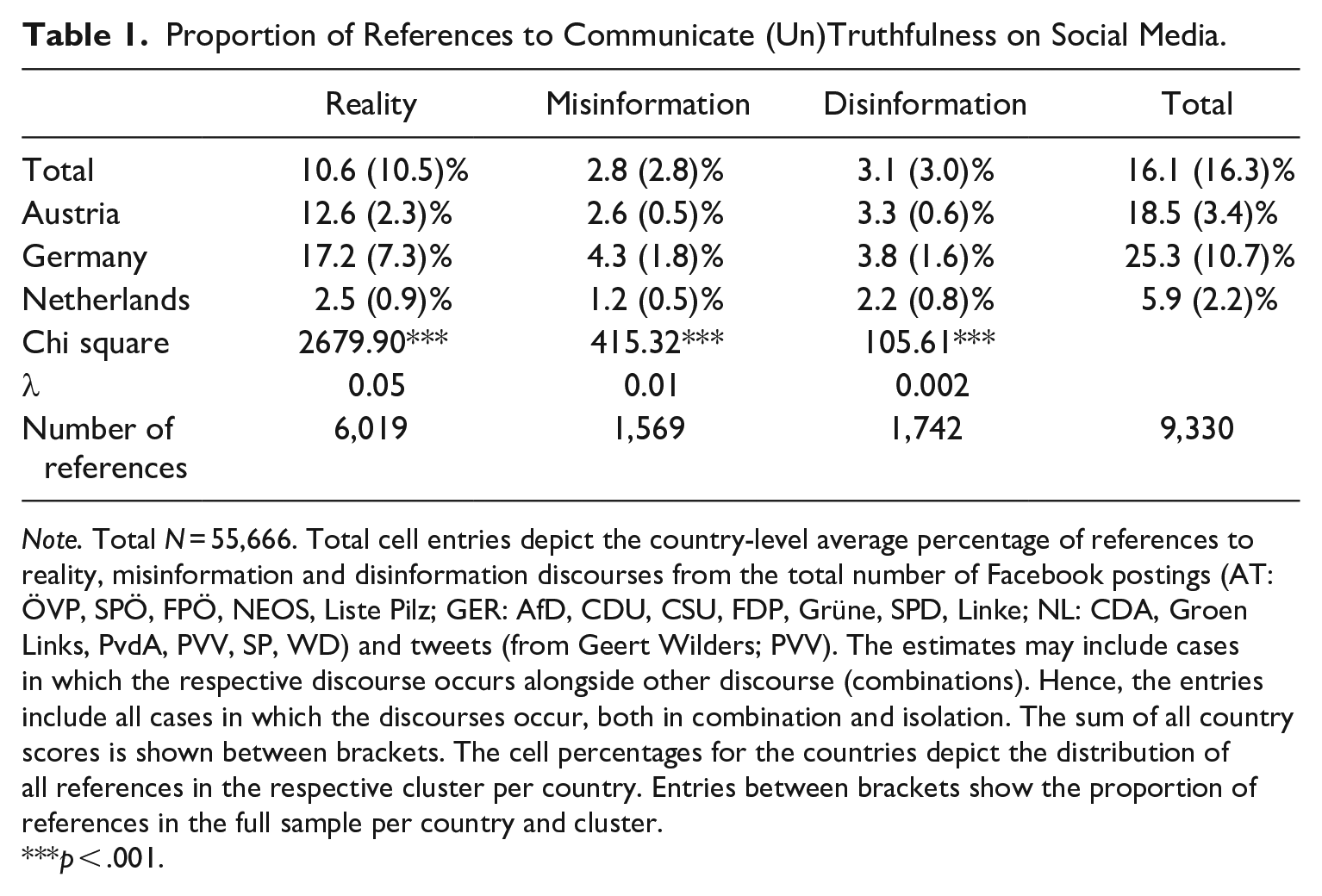
Note. Total N = 55,666. Total cell entries depict the country-level average percentage of references to reality, misinformation and disinformation discourses from the total number of Facebook postings (AT: ÖVP, SPÖ, FPÖ, NEOS, Liste Pilz; GER: AfD, CDU, CSU, FDP, Grüne, SPD, Linke; NL: CDA, Groen Links, PvdA, PVV, SP, WD) and tweets (from Geert Wilders; PVV). The estimates may include cases in which the respective discourse occurs alongside other discourse (combinations). Hence, the entries include all cases in which the discourses occur, both in combination and isolation. The sum of all country scores is shown between brackets. The cell percentages for the countries depict the distribution of all references in the respective cluster per country. Entries between brackets show the proportion of references in the full sample per country and cluster.
p < .001.
First, it can be noted that references to the epistemic status of knowledge and reality are most frequent (10.6% of all political communication). References to mis- and disinformation are less common: 2.8% of all posts contains references to misinformation and 3.1% of all communication contains an explicit attribution to deliberate untruthfulness (disinformation). There are some noteworthy country-level differences. Politicians in Germany contribute most to references of (un)truthfulness, followed by Austria and the Netherlands. Referring to reality, mis-, and disinformation is thus not equally present in all three countries. Remarkable is Germany’s leading role in the construction of reality discourses as they generated two third of all references to knowledge and reality. Furthermore, Supplemental Table C1 (in the Online Supplemental Appendix) shows the proportions of separate and clustered (un)truthfulness discourses. Interestingly, references to all three discourses appear together in only 0.7% of the available data, while references to reality construction are substantially more prominent as they appear in 8.8% of the analyzed Facebook posts. All possible pairwise combinations are equally likely to occur: 1.2% of our sample contains a reality and disinformation combination, whereas the other two combinations occur in 1.3% of all content (see Supplemental Table C1).
Right-wing populist politicians and discourses of (un)truthfulness
In the next step, we estimated logistic regression models to investigate which actors are most likely to communicate references to different types of (un)truthfulness in different periods (see Table 2).
Politicians and Their Use of (Un)Truthfulness Discourses in Austria, Germany, and the Netherlands.
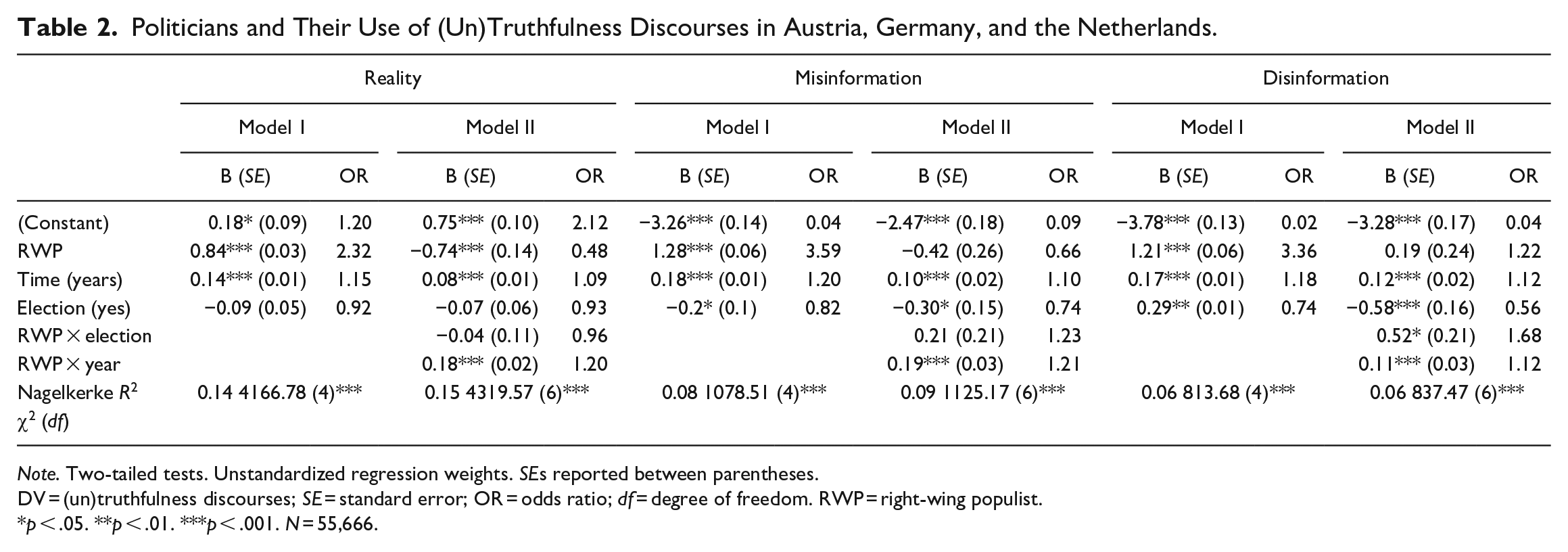
Note. Two-tailed tests. Unstandardized regression weights. SEs reported between parentheses.
DV = (un)truthfulness discourses; SE = standard error; OR = odds ratio; df = degree of freedom. RWP = right-wing populist.
p < .05. **p < .01. ***p < .001. N = 55,666.
We expected that constructions of disinformation could be considered as a communication tactic of especially (radical) right-wing populist politicians (H1). Our findings confirm this hypothesis. More specifically, as depicted in Table 2 (Model 1), radical right-wing populists in all countries are more likely to communicate disinformation than their mainstream competitors (b = 1.21, standard error (SE) = 0.06, p < 0.001, odds ratio = 3.36, 95% CI = [3.01, 3.75]). In fact, all three discourses that refer to reality, mis- or disinformation are more likely to be expressed by the radical right than mainstream politicians. Specifically, RWP parties are more likely to engage in discourses on misinformation compared to other political parties, (b = 1.28, SE = 0.06, p < 0.001, OR = 3.59, 95% CI = [3.21, 4.01]). Similarly, right-wing populists have a greater likelihood to make statements about reality and knowledge (b = 0.84, SE = 0.03, p < 0.001, OR = 2.32, 95% CI = [2.19, 2.46]) than the mainstream. These results are similar across all three countries: right-wing populists are more likely to express discourses of (un)truthfulness than their mainstream competitors in Austria, Germany, and the Netherlands—which supports H1.
Expressing (dis)honesty over time
We expected that references to all forms of reality and mis/disinformation have increased over time (H2a). As can be seen in Figure 1, we indeed see that all three discourses have become more salient over the years, albeit this mostly pertains to references to reality. This indicates that politicians have increasingly incorporated references to the truth, inaccurate information and dishonestly in their social media communication.
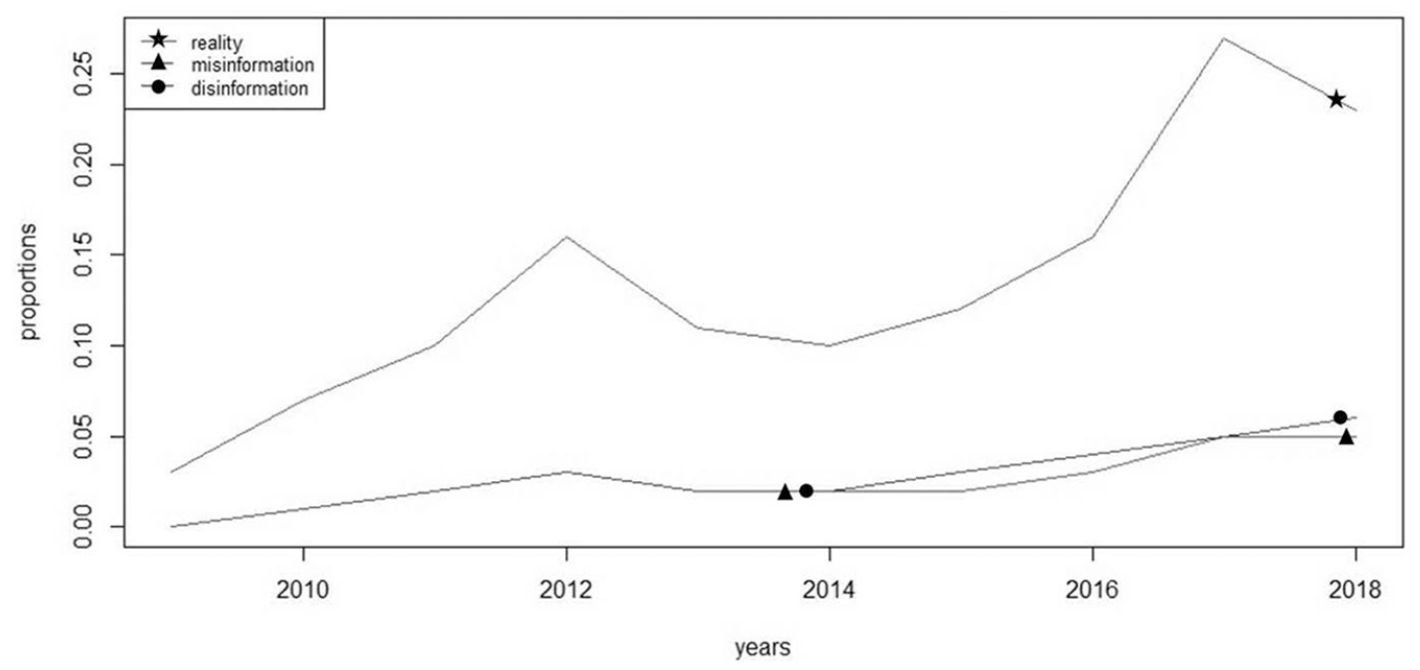
The proportion of discourses of (un)truthfulness on SNSs over time.
This is also confirmed by the logistic regression models summarized in Table 2 (Model I). For all three discourses, we see a positive and significant effect of time. Our findings thus support H2a: references to reality, mis-, and disinformation have indeed become more pervasive over time in the direct communication of politicians. We further expected that, as attributing blame to the media and cultivating distrust in knowledge resonates mostly with the communication tactics of radical right-wing populists, this increase is strongest for right-wing populist politicians (H2b). Our findings support H2b (see Table 2, Model II). More specifically, compared to the communication of mainstream politicians, the over-time increase in referring to (un)truthfulness is stronger for right-wing populist politicians.
Inspecting country-level differences (Supplemental Figure A1–A3), it should be noted that the yearly increase of references to (un)truthfulness is significant in Germany and the Netherlands, but not in Austria. In addition, the interaction effect between right-wing populism and discourses of (un)truthfulness are positive and significant in Austria and Germany, but not in the Netherlands. The figures also illustrate that the positive effect of right-wing populism on the three (un)truthfulness discourses diminishes in all countries if the interaction effects are included in the models. Right-wing populists’ references to reality, mis-, and disinformation are thus conditional on trends (i.e., yearly increases) and the presence of elections.
Naming and blaming as a strategy in election times
We expected that referring to reality and attributions of dishonesty and inaccuracy would be most salient in election periods—as it may be an important political tactic to credit or claim reality whilst emphasizing that others are dishonest or inaccurate (H3a). Our results only provide limited support for this expectation. More specifically, only references to disinformation are more salient in election than routine periods (see Table 2, Model I). The less “hostile” reality and misinformation discourses are equally salient in election and routine periods.
We also expected that the tactic of referring to communicative (un)truthfulness in election times would resonate most saliently with the communication tactics of right-wing populists (H3b). Again, this pattern can only be observed for references to disinformation (see Table 2, Model II). More specifically, radical-right wing populists are more likely to use references to disinformation in election versus routine period than their mainstream counterparts. Emphasizing the deliberate untruthfulness of the information setting is thus indeed especially a tactic used by radical right-wing populist—and this is used most frequently in competitive and conflict-driven election periods. This partially supports H3b.
The country-level plots of the odds ratios (Supplemental Figure A1–A3) show that references to reality discourses are only significantly more likely to occur at election times in Austria. The interaction effect of elections and right-wing populism on references to reality is negative in Austria only. Moreover, the positive interaction effect of right-wing populism and elections on disinformation is mostly driven by the Dutch data. Although not included in the figure (the effect did not fit the scale), the results indicate that RWP parties are much more likely to engage in disinformation discourses during election times compared to routine periods (b = 1.66, SE = 0.75, p = 0.03, OR = 5.27, 95% CI = [1.22, 22.83]).
Discussion
Despite the alleged salience of attacks on legacy journalism and the epistemic status of factual knowledge (e.g., Egelhofer & Lecheler, 2019), we know little about the ways in which politicians label information as (un)truthful via social media platforms. In line with previous endeavors that used wordlists for automated content analysis to capture discourses on the epistemic status of knowledge (Lasswell & Namenwirth, 1969), we aimed to explore how the discursive construction of reality can be contrasted to mis- and disinformation references in today’s digitized media ecologies, allegedly surrounded by increasing relativism toward facts and objectivity (Van Aelst et al., 2017).
In this paper, we look at the discursive construction of reality, mis-, and disinformation of mainstream versus populist politicians, and expected the strongest discursive affinity between populists’ communication and discourses of untruthfulness (also see de Vreese et al., 2018; Egelhofer & Lecheler, 2019). Hence, populism cultivates a binary view on politics and society, and attributes blame to the established order, which includes the legacy media. As debates on the truthfulness and objectivity of information are in conflict with the principles of a well-functioning democracy, in which all citizens should base their decisions on the same factual reality (Arendt, 1955) instead of a disunity of reason (Habermas, 1981), we believe that it is important to understand how politicians use social media channels to communicate discourses of (un)truthfulness to society.
The first study, a qualitative content analysis, revealed that attributions of reality and untruthfulness followed a partisan and identitarian rationale: the people-centeric reality of the in-group was highlighted as authentic, whereas elitist interpretations and information were criticized or labeled as Fake News. Looking at the discourses of mainstream versus populist actors, we see that the identification of reality and truthfulness, and referring to “honest mistakes,” can be found in the communication of all politicians. However, references to lying opponents mostly resonated with the communication tactics of populist actors.
Based on the inductive qualitative study, we developed and tested a dictionary to identify discourses of reality, misinformation, and disinformation in politicians’ social media content spread over the past 9 years. The ACA (N = 56,666) revealed that references to all three clusters have increased. In addition, and in line with our expectations, (radical) right-wing populist politicians are more likely to construct discourses of (un)truthfulness than mainstream politicians. Another key finding is that disinformation, and not discourses of reality or misinformation, become more visible in election times, especially among right-wing populists.
Based on these findings, we can identify a strong political parallelism between the communication styles and tactics of right-wing populists and discourses of (un)truthfulness (Waisbord, 2018). Populism revolves around emphasizing a binary societal divide: the ordinary people are separated from the corrupt elite (e.g., Mudde, 2004). Populist rhetoric involves blame attribution: the elite are held responsible for depriving the ordinary people. Populists oftentimes blame mainstream media and journalists as an elitist outsider that distorts reality. This affinity between populism and disinformation is confirmed by our empirical evidence: right-wing populist politicians in all three countries take issue ownership in discrediting elite and established knowledge and attempt to create momentum for alternative realities that resonate with populist worldviews. Here, we have to note that, to some extent, these findings are contingent upon a selection bias. The qualitative findings of the first study show that delegitimizing discourse was associated with right-wing populist leaders—which also steered the wordlists used in the second study. We did, however, include political actors of different ideological leanings in our analyses, and found that non-populist politicians use mis- and disinformation references substantially less—or at least not in explicit ways.
We found some noteworthy country-level differences. In Germany, the three discourses are more present than in the other countries. The Netherlands scores lowest on all three discourses. These findings indicate that German politicians are most likely to refer to (un)truthfulness. The fact that the Dutch case reveals substantially less salient discourses may be due to the clear issue ownership on claiming (un)truthfulness by Wilders (Freedom Party), but not the other politicians in the Netherlands. Likewise, partisan cleavages and political quarreling might have been less salient in the Dutch Facebook postings compared to Germany and Austria at the time of data collection. In addition, as shown by the Reuters news report 2019, media trust is higher in the Netherlands compared to Austria and Germany (Newman et al., 2019), which may explain why Dutch politicians feel the need to flag information as true or false to a lesser extent. Future research needs to further explain the drivers of country-level differences, but we expect that overall levels of (dis)trust in the population and partisan cleavages in the political system could be important drivers of differences in (un)truthfulness discourses.
An important implication of our findings is that the communication of politicians via their own controlled online platforms can impact the way reality and fake is interpreted by citizens. To understand political issues, citizens are for an important part dependent on the political information they receive—and they increasingly find news via digital means (e.g., Van Aelst et al., 2017). Importantly, the high-choice news environment is characterized by confirmation biases and patterns of attitude-consistent selective exposure (e.g., Knobloch-Westerwick et al., 2017). This means that citizens are most likely to select and accept information that resonates with their ideological orientations (e.g., Taber & Lodge, 2006). Previous empirical research indicated that such partisan and attitudinal biases have an important impact on how disinformation and corrective information are processed (e.g., Thorson, 2016).
Furthermore, communication by populists is most persuasive when citizens like and identify with the source (e.g., Hameleers & Schmuck, 2017). As citizens are most likely to believe disinformation when it is in line with their prior attitudes (Thorson, 2016), attributions of (dis)honesty by liked politicians that communicate congruent issue positions can have an impact on public opinion. Hence, when right-wing populist actors define reality and attribute dishonesty to journalists and mainstream politicians, their online followers that like and support them may take over these definitions of truth and fake. Hereby, politicians may play an important role in defining reality and cultivating distrust in established truths among their followers, meaning that the epistemic status of objective knowledge in deliberative democracy is at stake.
This study is not without its limitations. First of all, although we founded our dictionaries on conceptual literature and an extensive inductive qualitative content analysis, the ACA may need to be fine-grained and extended in further studies. Related, different languages may use different terms that are not always equivalent in meaning—which may cause issues of transferability across settings. In addition, the qualitative data informing the dictionary focused on only a subset of a actors and time periods. Dictionary-based approaches come with the limitation of both false positives (references to reality, mis- or dis-information are classified whereas they are not present) and false negatives (slightly different terms are used that are not included in the wordlist but do point to references of (un)truthfulness). We believe that the extensive pilot testing, validity checks, and refinement of the dictionary has partially resolved these issues but suggest that future research devotes more attention to the context of words and clusters of words, and may further rely on machine learning to classify clusters of (un)truthfulness.
Second, although we believe that the classification of discourses of reality, mis-, and disinformation is highly relevant as it may influence citizens’ perceptions of reality and fake, as well as their political evaluations (i.e., blame attributions), future research may need to devote more attention to the actual nature of (un)truthfulness of political communication. In addition, more attention should be devoted to the empirical distinction between mis- and disinformation. Both discourses are different, but both refer to the flagging of information deemed to be untrue. For this reason, it is hard to clearly separate the discourses based on wordlists. As the, at times nuanced, distinction between mis- and disinformation discourses may be embedded in the context of words, future research should devote more attention to the context. Third, references to reality and falsehoods, and accusations of deliberate manipulation are oftentimes multimodal in nature, which our second quantitative study overlooked. Memes, short videos, and posters are, for example, frequently used as attractive messages to shift blame to political opponents, or claim a version of reality that suits the perceptual screens of certain voters.
In addition, we could not rely on both Twitter and Facebook data for the right-wing populist leader in the Netherlands: Geert Wilders. Wilders’ Facebook page is merely a replication from his Twitter communication. Although this is not uncommon for politicians’ direct communication in general, and although we controlled for platform differences in our analyses, future research should devote more attention to the role of using platforms for spreading references to (un)truthfulness. As another limitation, even though we distinguished mis- and disinformation by identifying theoretically meaningful differences in discrediting knowledge, one important component of disinformation is difficult to code for automatically: the perceived (political) intentions of disseminators of disinformation. Hence, when accusations of disinformation are made, they may also refer to the political aim of the sender of disinformation (i.e., disrupting social order, gaining votes). Future (manual) content analyses may attempt to reveal the specific nature of accusations of disinformation in the political and media arena.
We should also note that our findings are mostly applicable to recent examples of right-wing populists’ critique on the legitimacy of the established order. Even though our findings confirm much older dictionaries, there could be different ways of attacking evidence, expert knowledge, and the legitimacy of the press that do not follow a (right-wing) populist rationale. We urge future research to expand our wordlists, include embeddings and look at different “least and most likely” cases to nuance our findings in less likely (right-wing) populist settings. Such endeavors may also look at the sensitivity of our proposed wordlist to different languages—which may use different terms to point to mis- or disinformation and (the epistemic status of) reality. Here, the combination and embedding of words may be very relevant.
Despite these limitations, we regard this study as one of the first contributions to map how discourses of mis- and disinformation are shaped in politicians’ communication—which may be an influential rhetorical device to delegitimize incongruent versions of reality and gain political success by promoting consistent realities. In today’s digital and fragmented information settings, constructions and accusations of untruthfulness may be more influential than disseminating objective information.
Supplemental Material
sj-pdf-1-crx-10.1177_0093650220982762 – Supplemental material for Constructing Discourses on (Un)truthfulness: Attributions of Reality, Misinformation, and Disinformation by Politicians in a Comparative Social Media Setting
Supplemental material, sj-pdf-1-crx-10.1177_0093650220982762 for Constructing Discourses on (Un)truthfulness: Attributions of Reality, Misinformation, and Disinformation by Politicians in a Comparative Social Media Setting by Michael Hameleers and Sophie Minihold in Communication Research
Supplemental Material
sj-pdf-2-crx-10.1177_0093650220982762 – Supplemental material for Constructing Discourses on (Un)truthfulness: Attributions of Reality, Misinformation, and Disinformation by Politicians in a Comparative Social Media Setting
Supplemental material, sj-pdf-2-crx-10.1177_0093650220982762 for Constructing Discourses on (Un)truthfulness: Attributions of Reality, Misinformation, and Disinformation by Politicians in a Comparative Social Media Setting by Michael Hameleers and Sophie Minihold in Communication Research
Footnotes
Declaration of Conflicting Interests
The authors declared no potential conflicts of interest with respect to the research, authorship, and/or publication of this article.
Funding
The authors received no financial support for the research, authorship, and/or publication of this article.

Supplemental Material
Supplemental material for this article is available online.
Notes
Author Biographies
References
Supplementary Material
Please find the following supplemental material available below.
For Open Access articles published under a Creative Commons License, all supplemental material carries the same license as the article it is associated with.
For non-Open Access articles published, all supplemental material carries a non-exclusive license, and permission requests for re-use of supplemental material or any part of supplemental material shall be sent directly to the copyright owner as specified in the copyright notice associated with the article.
