




Abstract
In today’s digital media ecology, alternative narratives and conspiracies spread rapidly, and may undermine the legitimacy of journalism and reinforce polarized divides in society. In this setting, constructions of truth may greatly vary across established and alternative media. In this paper, we use a comparative qualitative content analysis in the US and the Netherlands to offer in-depth insights into how factual claims are legitimized and delegitimized by alternative versus mainstream media outlets. We put the assumption of post-factual relativism and alternative truths to an empirical test: To what extent and how do alternative versus established media construct irreconcilable versions of reality? When political disagreement is no longer founded on a shared reality, representative democracy may be severely damaged and vulnerable to undermining discourses of untruthfulness.
We have entered an information era in which facts and truth claims increasingly become subject to alternative interpretations—a shift toward post-factual relativism (Van Aelst et al., 2017; Waisbord, 2018). With the lifting of gatekeeping barriers online, both professional and non-professional communicators can disseminate divergent versions of reality, resulting in the presence of alternative realities, conspiracies, and disinformation alongside factually accurate information (Waisbord, 2018). In this context, hyper-partisan and alternative media platforms may contest conventional knowledge of mainstream media and politicians (e.g., Heft et al., 2020), or even disseminate conspiracies emphasizing alternative interpretations (Ferrara, 2020). Against this backdrop, this paper discursively maps how media outlets with a different relationship to the establishment—mainstream versus alternative media—construct truth claims when covering news about COVID-19.
In this paper, we approach disinformation as part of a disruptive order (Bennett et al., 2007) that potentially contributes to the erosion of a consensual truth and the abundance of competing factual claims and delegitimizing narratives mainly associated with hyper-partisan alternative media (e.g., Müller & Schulz, 2021). This context may pave the way for divergent reconstructions of truth that strategically refer to objectivity—a standard traditionally defined as a “correspondence, grounded in correctness, between thought and reality” (Heidegger, 1943, p. 1). Employing this definition as sensitizing concept, we ask how alternative and established media construct truth claims when making claims about COVID-19. Here, we regard truth claims as constructions that can discursively be emphasized in the communicative acts of media platforms that aim to signal trustworthiness to their audiences.
The contrast between alternative and mainstream media explored in this paper does not imply that the reality constructions of different channels are completely isolated. Both mainstream and alternative media can refer to expert knowledge, empirical evidence or other indicators of trustworthiness to legitimize their truth claims. As alternative and mainstream media may coexist in people’s media diets (e.g., Gentzkow & Shapiro, 2011), and considering that they may both refer to expert knowledge and empirical evidence when legitimizing “their” truth claims, we inductively map how references to truthfulness may differ or overlap depending on media sources that are closer to or more distant from the establishment.
Extant literature has mostly focused on how hyper partisan media may delegitimize the established order (Saurette & Gunster, 2011; Yla-Anttila, 2018), but less is known about the different discourses used by alternative versus mainstream media to make factual claims believable for their audiences. To advance this field, we rely on qualitative content analyses of established and alternative news platforms in two regions that differ regarding the political and media system as well as the level of (dis)trust in expert knowledge and media sources: The Netherlands and the US. With this analysis, we assess how alternative realities (i.e., hoaxes, conspiracies) and delegitimizing discourse (i.e., Fake News accusations) are constructed by alternative media, and how they relate to truth claims expressed by the established media.
As a major contribution to literatures on disinformation and factual relativism, we approach conventional knowledge vis-à-vis alternative realities through the construction of truthfulness. Using this approach, we arrive at an in-depth understanding of convergent and divergent constructions of truthfulness, which may contribute to a better understanding of the disinformation order as a wider epistemic challenge. In the next sections of this paper, we first of all conceptualize truthfulness as a discursive phenomenon embedded in the disinformation order. After this, we present the research questions that guided the analysis of constructions of truth in alternative and mainstream media. In the next step, we present the results of a qualitative content analysis of U.S. and Dutch media covering COVID-19. We finally offer a discussion of the extent to which the different (de)legitimizing truth claims correspond to separate and irreconcilable realities across outlets.
Theoretical Framework
Constructions of Truth in the Context of Factual Relativism
A growing body of literature has examined the disinformation order as a wider phenomenon with a delegitimizing and destabilizing influence on democracy (Bennett & Livingston, 2018; Wardle & Derakhshan, 2017). To date, however, we know little about how competing truth claims are constructed in a context where facts have become more relative, partisan, and contradictory. Against this backdrop, we explore if and how the construction of alternative realities operates in isolation from references to a common established truth, as well as the extent to which it resonates with the delegitimization of expert knowledge and empirical evidence. To this end, we first offer a working definition of alternative versus established media, and explicate the concept of truth claims applied to these media types. After this, we explore how these concepts are similarly or differently constructed by alternative and mainstream media, depending on their distance or closeness to conventional notions of truth claims.
Alternative Versus Established Media
It is challenging to propose an exhaustive definition of alternative media, due to the many potential routines, practices and epistemologies involved (Forde, 2011). However, alternative media commonly share an opposition to mainstream or established media (Heft et al., 2020). In addition, alternative media may focus on the perspective of marginalized communities or minorities, such as the Chicago Defender, which covers the city’s Black community. These outlets may empower and represent voices neglected by mainstream media, but do not by definition attack conventional truth claims. Thus, as an umbrella term, alternative media may represent marginalized, oppressed or oppositional voices that are typically not represented in the coverage of mainstream media (Forde, 2011).
Despite the broadness of this conceptualization, alternative media have mainly been studied in the context of media platforms with a hyper partisan agenda, or alternative media that challenge and attack conventional knowledge. This agenda can be both left- and right-wing oriented, although most research has focused on the radical right-wing of the political spectrum (Heft et al., 2020, but see e.g., Couldry, 2002 for a study on left-wing alternative media). Our paper mainly focuses on alternative media with a clear anti-establishment narrative and ideological agenda. As we are interested in how conventional knowledge and truth claims are delegitimized, and alternative truth claims legitimized, we believe that focusing on alternative media with a more explicit anti-establishment perspective is theoretically meaningful. This way, we can contrast and compare the constructions of truth of platforms that are allegedly closer to the established order with the constructions of platforms that challenge and attack the mainstream.
We contrast this working definition of alternative media to established media. We regard established media as all channels (i.e., news media, online journalistic platforms) involved in the dissemination of conventional knowledge disseminated via official channels. Established media may differ from alternative media both in popularity (i.e., the size of the audience they address and reach) and closeness to conventional knowledge and established truth claims legitimized by recognized experts and political elites. Whereas alternative media may serve audience segments not represented by the mainstream (Forde, 2011; Heft et al., 2020), established media may represent the most dominant voices and discourse in a given context.
Importantly, established media should not be equated with truthful knowledge dissemination. In addition, just like alternative media, established media may voice an unjustified critique on other outlets, experts, or constructions of reality. This critique is not always founded on the best available relevant expert knowledge. The conceptualization forwarded here should thus be regarded as a tentative working definition: There is no clear boundary between alternative versus established media, as there may be a large grey area in between the two extremes—which is also contingent upon the context of production and consumption. That being said, our expectation that established media may employ a different repertoire when legitimizing truth claims through constructions of reality compared to alternative media with a clear anti-establishment stance leads us to deem the comparison between outlets relevant.
Objectivity and Truth
Philosophically, as postulated by Heidegger (1943, p. 1), “truth is correspondence, grounded in correctness, between proposition and thing.” A proposition becomes true when it accounts for the phenomenon being described. Although the concept of truth may signify a correspondence between a phenomenon and its description, the truth is subject to constructions and interpretations (Brewer, 2011). Hence, truth claims may be rated as most valid in contexts that are congruent and supportive of these claims (i.e., the claim that COVID-19 is a hoax may be regarded as most valid in communities that support conspiracies and oppose conventional expert knowledge).
Objectivity, although not the same as the truth, can be viewed as striving toward the maximum correspondence between the description of something and the reality that becomes accessible through observing empirical objects (Heidegger, 1943). Thus, truth refers to the level of correct correspondence between a thing and its description or conceptualization. Objectivity, however, refers to the process that aims to maximize the correspondence between things and their descriptions. In that sense, objectivity can be regarded as all the procedures, routines, and processes that are used to enhance and signify truthfulness, for example, through the avoidance of bias. In this paper, we essentially focus on how truth claims are constructed. Here, we will also pay attention to how principles of signaling objectivity may be used in order to legitimize (alternative) truth claims.
Just like the truth may be contingent upon context and constructions from different perspectives, objectivity can be discursively constructed in texts to enhance the trustworthiness of observations and perspectives, and herewith signal the correspondence between the description of a phenomenon and its existence (Tuchman, 1972). Claims on truth may therefore be contingent upon constructions and contextual factors, such as the actors legitimizing “their” construction of reality through the use of congruent expert knowledge and sources of evidence. In making truth claims, objectivity can be referred to strategically to signal the correspondence between reality and its descriptions, and herewith be used to add legitimacy to (alternative) narratives. In this paper, our analysis is limited to the textual elements used to signal truth. We therefore acknowledge that practices, performances, and role perceptions related to reliability and truth-finding employed by journalists cannot directly be revealed by looking at textual outcomes.
Truth Constructions in Mainstream Media
Based on this relative understanding of truthfulness, we aim to unravel the extent to which mainstream media arrive at a different construction of reality and factual claims than alternative media (e.g., Heft et al., 2020). Here, we follow the notion of objectivity as a journalistic performance (Boudana, 2011). We recognize objectivity explicitly as a discursive construction that can signal credibility to an intended audience. This discursive understanding aligns with Tuchman’s (1972) conceptualization of objectivity as a strategically used ritual to signal trustworthiness to audiences: journalists undergo different procedures, such as quoting expert sources or official statistics, to make claims about objectivity. Gathering news involves many practices, such as interviewing, presenting competing voices and verification, which “make it possible to reach the highest degree of correspondence between journalistic assertions and reality” (Boudana, 2011, p. 396). To meet this ideal, journalists are expected to rely on original and independent news reporting through direct observations and interactions between sources and journalists (Downie & Schudson, 2009). They also apply different transformations to source texts, such as elaborations, amplifications and reformulations, to maximize correspondence between reality and propositions for targeted audiences (Tenenboim-Weinblatt & Baden, 2018).
In line with this, we aim to inductively map how the (de)legitimization of information about COVID-19 communicated by established media is founded on different discourses of truth, for example, by quoting relevant expert sources or making claims about the level of (un)certainty. In other words, how are claims about truth constructed in established media to signal the highest possible correspondence between journalistic assertions and reality?
Truth Constructions in Alternative Media
Although alternative media may also claim to strive toward a maximum correspondence between reality and accounts of reality, the principles used may vary depending on their relationship to conventional knowledge and established institutions. Yla-Anttila (2018) describes how counter-media, a subcategory of hyper-partisan alternative media that strongly oppose established information, defy mainstream routines of objectivity and facticity. These media emphasize that truth-seeking must be acted by alternative media in lieu of mainstream experts (Heft et al., 2020; Yla-Anttila, 2018). Alternative platforms can adhere to common standards of knowledge, truth and evidence, but their values of truth may follow a populist logic stressing an antagonism between elite interpretations of reality and distant alternative epistemologies. Yla-Anttila (2018) refers to this as counter knowledge, or alternative knowledge challenging established sources of information, including a replacement of authoritative sources of knowledge with alternative ones.
A more contrasting epistemology of alternative platforms is reflected in the concept of epistemological populism coined by Saurette and Gunster (2011). In line with populism’s core idea of a pervasive antagonism between “pure” and “honest” ordinary people versus “corrupt” elites (Mudde, 2004), epistemological populism opposes the routines and practices of established truth seeking. In line with these principles, knowledge, and the maximum correspondence between reality and descriptions of it, can best be achieved by relying on experiences of the people and common sense whilst circumventing expert knowledge (Saurette & Gunster, 2011). In line with Yla-Anttila (2018), we regard both epistemic populism and counter knowledge as potential indicators of factual relativism in an age of disinformation, and these constructions of truth may closely fit the routines of the alternative media under investigation.
Based on these perspectives, the comparison between values and practices related to the discursive construction of truth across mainstream versus alternative media is worth considering. Alternative media may deviate from conventional truth constructions because they oppose and contest the establishment (Heft et al., 2020) or even call them Fake News (Müller & Schulz, 2021), but may also rely on expert sources to claim legitimacy (Yla-Anttila, 2018). To date, we know little about whether constructions and discourses of truth prevalent in established media are also present in alternative media. We therefore seek to offer inductive insights into how truth claims are legitimized by both media types, and how they delegitimize truth claims of opposed sources.
Comparing Constructions of Truth Across Settings
The framework of resilience to disinformation introduced by Humprecht et al. (2020) postulates that countries may be more or less resilient to the threats of disinformation depending on country-level factors. More specifically, countries with higher levels of polarization and high media distrust should be less well equipped to face the threats of disinformation as they are defined by the ability and motivation of citizens to access independent and reliable information. Extrapolating this argument to a wider epistemic disorder linked to the relative status of facts and the pervasiveness of delegitimizing discourses, we expect that the US and the Netherlands are belonging to different clusters of resilience (see Humprecht et al., 2020). Therefore, they may also offer different discursive opportunity structures for the (de)legitimization of truth claims.
More specifically, as a less resilient context, The US can be categorized as a region with relatively low trust in the (news) media and politics. In the US, distrust in truth-seeking institutions is relatively high, whereas expert knowledge and empirical evidence may be subject to partisan interpretations (Benkler et al., 2018). Based on the 2022 Reuters Digital News Report, it can be concluded that only 26% of Americans trust news generally, which is the lowest scoring country across 46 markets. As audiences are likely to encounter identity-consistent narratives in the US (Humprecht et al., 2020), they may also be regularly exposed to alternative narratives and counter-knowledge attacking opposed parties and truth claims.
In the Netherlands, the Democratic Corporatist model hosts a pluriform established media system reflecting the multiparty political system (Hallin & Mancini, 2004). As it is characterized by lower levels of polarization, and lower distrust in truth-seeking institutions and expert knowledge, it has been regarded as a more resilient context for the threats of disinformation (Humprecht et al., 2020). Together, considering within and between-country differences in the alternative platforms sampled, we use a different systems approach (Przeworski & Teune, 1970) to explore the common and different dimensions underlying (de-)legitimizing discourses across contexts, aiming to assess how universal de-legitimizing discourses around truth claims are across contexts. As the US and the Netherlands represent different systems in terms of resilience to disinformation threats (Humprecht et al., 2020), we explore if discourses of legitimization and delegitimization of truth claims are universal or distinct.
Research Questions
As we lack systematic insights into how truth claims are expressed in different media formats, we rely on an inductive qualitative endeavor. Most case studies have zoomed in on the discourses of disinformation in hyper-partisan or on alt-right platforms (e.g., Müller & Schulz, 2021; Yla-Anttila, 2018). As truth cannot be equated with certainty, and as focusing on facts would fail to recognize that facts are constructed in a given context (Schudson, 1978), we must rely on a flexible interpretative approach in which we focus on truth claims. The different routines, practices, and values toward establishing truth in established mainstream versus alternative media form our sensitizing concepts. To gain a better understanding of the construction of plausible truth claims in an antagonist discourse, we pose the following research questions.
RQ1: How is expert knowledge used to substantiate truth claims in alternative versus legacy media platforms?
RQ2: How is (empirical) evidence used to substantiate truth claims in alternative versus legacy media platforms?
RQ3: How is expert knowledge used to delegitimize truth claims in alternative versus legacy media platforms?
RQ4: How is (empirical) evidence used to delegitimize truth claims in alternative versus legacy media platforms?
Methods
Sample and Data Collection
We compare different media systems that vary on relevant factors related the (de)legitimization of truth claims—the Netherlands and the US. In both nations, we sample two (ideologically different) and relatively popular established news sources and two alternative news platforms that are also different in terms of ideology. In both countries, we predominately select right-wing media that we contrast and compare with one left-wing media outlet in each case. Comparable outlets are included on the basis of relative market share and ranking across the two national settings. For this reason, we included one more popular and one more fringe platform in each country to capture the breadth of alternative platforms with an anti-establishment perspective. Our initial sample consists of 25 “most popular” articles published by four outlets per country, established by number of views and engagement across articles on social media (i.e., likes and comments), covering an 8-week period ranging from December 1, 2020 to February 1, 2021. This period captures a variety in the stage of the vaccine debate (from a plausible scenario to an implemented reality). With a keyword search and manual relevance checks, all articles are ensured to deal with the COVID-19 vaccine.
Case Selection in the US
For the established media sample in the US, we selected articles from Associated Press and The Wall Street Journal (legacy formats). The Associated Press identifies itself as a cooperative and unincorporated association—which resonates with a more strict perspective on objectivity and neutrality. The Wall Street Journal (WSJ), in contrast, is a more specific business-focused outlet. While its news section has been regarded as relatively unbiased (Mitchell, 2014), its editorial pages are considered to be aligned with a conservative view (Jamieson & Cappella, 2008). As the outlet matches conventional constructions of truth claims aligned with the established order, we regard it as a relevant case for the analysis of how truth claims are constructed by established outlets.
We compare these outlets with alternative platforms Breitbart News and Alternet. Although they differ on a number of factors, such as level of professionalism, readership and ideology, we consider them alternative outlets as they share an opposition to the established order—and even each other considering their closeness to different extremes of the ideological spectrum. Hence, the left-wing platform Alternet may not only delegitimize or criticize established media, but may also attack alternative media that cater to the other extreme of the ideological spectrum. While it is not considered as a hyper-partisan or radical outlet, it can be viewed as an anti-establishment platform as it delegitimizes and challenges the established order and dominant power dynamics. As the aim of this paper is to incorporate a maximum variety of truth constructions, we believe it is a valuable platform to include.
Case Selection in the Netherlands
In the Netherlands, we compare the two established outlets de Telegraaf and NOS with the alternative media platforms niburu.co and Geenstijl.nl. De Telegraaf has been regarded as a traditional news outlet with more conservative and right-wing values (e.g., Hemels, 1997). We also compare this outlet with a more general news outlet with a less clear ideological position: the NOS. The two alternative platforms in the Dutch case differ in popularity and professionalism (similar to the US comparison). Whereas Geenstijl.nl can be regarded as a popular and relatively professional alternative right-wing website, niburu.co is a more fringe-like platform strongly opposing the status quo. Niburu.co does not clearly emphasize an ideological leaning. It is an alternative media platform that emphasizes a strong anti-establishment perspective, and an affinity with populist worldviews and conspiracies. These populist worldviews may correspond with both left-wing and right-wing ideological perspectives, although the platform mostly caters to a right-wing audience.
Here, we acknowledge that the selected outlets in the Netherlands reflect a less ideologically varied sample than the US sample. The alternative media space in the Netherlands mainly has a right-wing orientation, and left-wing alternative media are more marginal in terms of unique visitors and prominence. However, for the sake of balance and triangulation, we additionally analyzed 25 articles published by the left-wing alternative outlet Amsterdam Alternative, which claims to “stand for collective action and radical political debate for the sake of a desirable future for the many, not the few.”
We have mapped the outlets, their ideological leaning and popularity in terms of the number of users in (Appendix A) As shown in this Table, we selected established platforms with a relatively high and comparable market share in terms of unique monthly users in both countries. In addition, we selected one more popular and one less popular alternative outlet in each country. In terms of unique monthly visitors, the alternative platforms cater to substantially smaller audience fragments in both countries. However, the amount of unique visitors that these platforms consistently generate indicate that they are representing a small audience segment that should not be neglected, as it may represent a small group at the fringes that is loud in voicing their positions.
Analysis Strategy
To guide our analysis, we look for reasoning devices used to construct truth claims, and the legitimization of constructions of reality from the perspective of different outlets. Our sensitizing concepts include the construction of evidence, experts and factual knowledge in alternative and established media. Data collection and analysis stopped after theoretical saturation was reached. We first analyzed an initial sample of 25 articles per outlet—a number that proved to offer diverse insights into truth and reality constructions. After analyzing this sample, 10 more articles were selected and analyzed. We subsequently compared the open codes and themes of the two samples. As the additional 10 articles did not offer completely new findings that would change the interpretation of the main themes (i.e., the same patterns were confirmed, and there were only nuanced differences in styles), we believe that we adequately captured the theoretically relevant variety in the sampled articles. For all platforms, we selected 35 articles in total after both rounds of data analysis.
To analyze our corpora, we rely on the distinct coding steps of Grounded Theory (Charmaz, 2006). Firstly, we familiarized ourselves with the data by closely reading all material. Next, we open-coded the raw materials. For example, we used labels like “Accusation for hiding the truth about COVID-19 as a weapon” to label content pointing to a conspiracy that de-legitimized the established account of reality about the coronavirus. In the second step, these labels were raised to higher-order themes: Specific contexts were removed, and after constant comparison between open codes and emerging themes, more general patterns in the raw data were described analytically. This focused coding revealed themes closer related to our analytical interests: the processes by which alternative truth claims are legitimized and established truths attacked. Finally, during the last step of axial coding, we looked for connections between themes revolving around legitimizing and de-legitimizing discourses. Here, we explored the antagonistic nature of truth claims as the legitimization of alternative truth claims and the de-legitimization of established claims on truthfulness which revealed the relative nature of factual claims.
Reliability and Validity of Qualitative Analyses
The interpretative nature of qualitative textual data does not allow for the direct application of validity and reliability assessment used in quantitative content analyses. Applied to the nature of our data, we rely on different tools to enhance validity and reliability. Firstly, our reliance on distinct coding steps, documentation in the form of field notes, and computer-assisted coding enhance the validity of our analyses. Furthermore, thick descriptions offered in the results aim to stay as close as possible to the words and meanings expressed through text, enhancing the true-to-life nature of our findings. For reliability, the two independent coders regularly discussed the coding and sampling procedures and themes emerging from the data (peer debriefing). Disagreement in coding principles or interpretation derived from the data were discussed until mutual agreement was reached.
Results
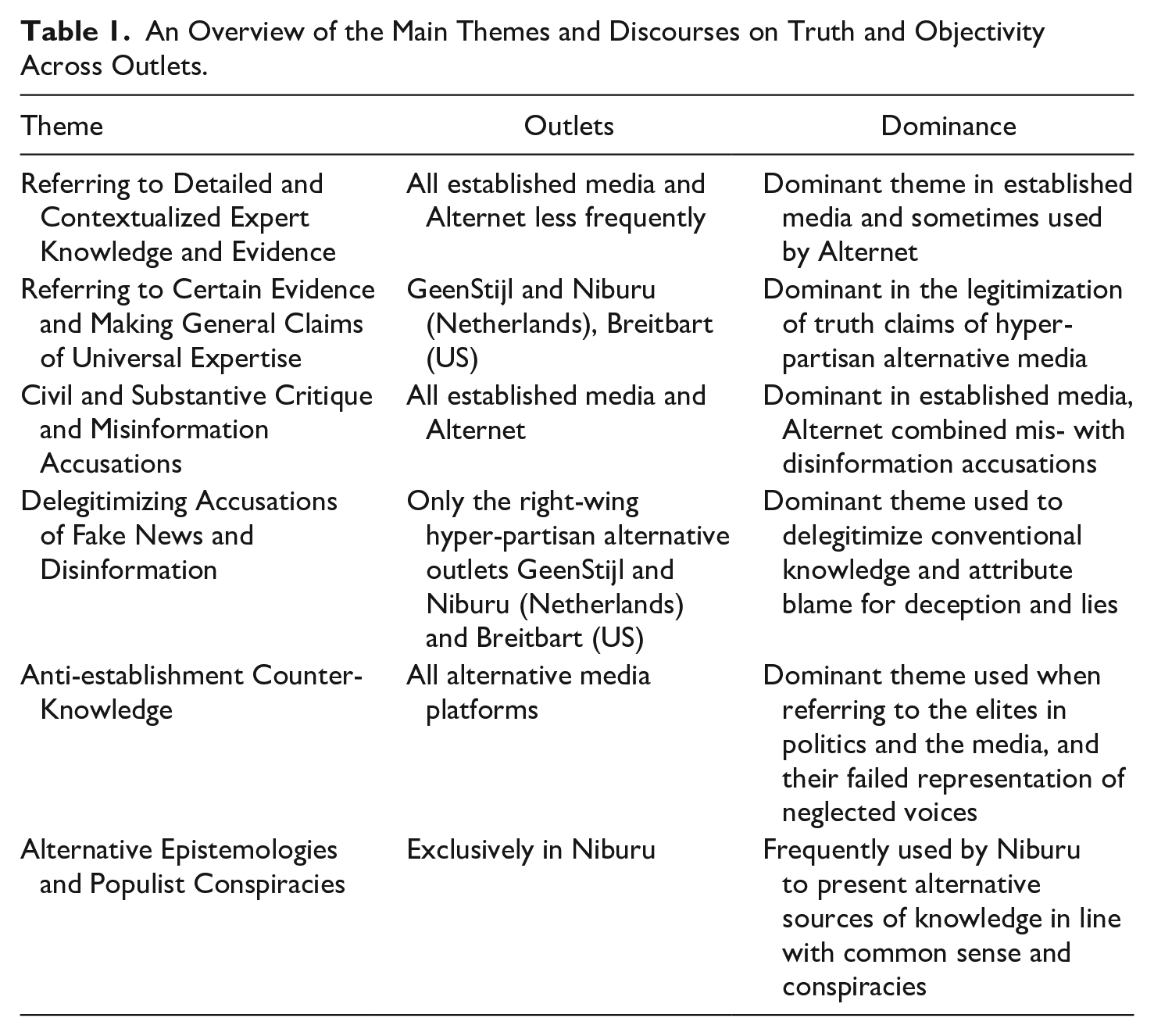
In the following results section, we present the main themes and grounded data for all legitimizing and delegitimizing narratives and styles separately. We focus on the discursive tools used by all outlets to legitimize and argue for “their” perspective on the truth about COVID-19, and how opposed or alternative perspectives on the same issue are attacked or de-legitimized. In Table 1, the different narratives are summarized, including the relevant outlets in which they were expressed. Before discussing the detailed themes, we will present a focused discussion of the different research questions.
An Overview of the Main Themes and Discourses on Truth and Objectivity Across Outlets.
The analyses indicate that expert knowledge plays a central role in both alternative and legacy media platforms (RQ1). However, in legacy media, expert knowledge is often substantiated with contextual information (i.e., fields of expertise and affiliations are mentioned), which is largely missing in the expert references of alternative platforms. Legacy platforms use expert knowledge to legitimize conventional truth claims, whereas alternative platforms use expert knowledge mostly as evidence for anti-establishment viewpoints—and as a contrast to the allegedly unreliable claims pushed by established media and politicians.
Regarding RQ2, we can see that empirical evidence used by legacy media often stresses the level of (un)certainty and dependencies of empirical evidence (i.e., a vaccine may be most effective under certain target groups or for certain variants of COVID-19). Just like the references to expert knowledge, (scientific) sources are mostly mentioned to contextualize empirical evidence. Alternative media refer to empirical evidence too, but often leave out the context or even decontextualize empirical evidence to emphasize the unreliability of elite sources and conventional truth claims disseminated by the established media and politicians. Across different alternative media, empirical evidence plays different roles in the construction of truth claims, which is discussed in more detail in the following sections.
The delegitimization of truth claims through expert knowledge is central in both legacy and alternative media platforms (RQ3). Legacy media platforms use experts to debunk conspiracies, disinformation, and counter-factual narratives that are often associated with alternative media. Here, fact-checking plays a central role. Alternative media, however, often use references to expert knowledge to attack the allegedly “fake” or misinformed experts that are associated with the established order. Alternative experts, such as doctors opposing the established order, are used as sources to emphasize that the conventional narrative claiming that COVID-19 is a severe health crisis is deceptive and based on misconceptions.
Empirical evidence plays a similar delegitimizing role (RQ4). Legacy media often refer to evidence and verified statistics to debunk myths and disinformation about the pandemic, herewith using it as evidence against claims that are allegedly not supported by empirical evidence. Alternative media use alternative sources of empirical evidence (i.e., by referring to statistics about death rates or alternative explanations of the pandemic) to strengthen the narrative that the elites are deceiving and misinforming the people about the severity of the health crisis. In the sections that follow, a more detailed “thick” description of the different narratives used to (de)legitimize truth claims through expert knowledge and empirical evidence is provided.
Referring to Detailed and Contextualized Expert Knowledge and Evidence
First, we explore how truth claims are legitimized across the different media platforms, and the roles of expert knowledge (RQ1) and empirical evidence (RQ2) in truth claims. The core theme related to detailed and contextualized knowledge was found in most of the truth claims of all established media outlets. The alternative platform Alternet also often explicated the context of expert knowledge, and used specific names to signal trustworthiness. The legitimization of the established sources’ truth was founded on evidence and experts forwarded by the authorities (i.e., the national health centers, the government, the WHO). Expert sources were typically university professors with relevant field-specific knowledge, a context that was explicitly referred to when making claims about evidence or expertise. The names of experts, their affiliation, and the relationship of their subject matter with the topic of the news item were always mentioned by the established sources. Empirical evidence was mostly referred to by including the context of research findings and statistics: “Johnson & Johnson argues that their corona vaccine offers 66 percent protection against moderate and severe types of COVID-19” (WSJ).
In the established outlets, truth claims were most often formulated in a wider context of scientific principles and truth-seeking, which touched on the uncertainty of evidence and the conditions under which certain claims were (in)valid. As the AP claimed: “A vaccine would need to be at least 80% effective, with about 75% of a population receiving it, to extinguish an epidemic without any other public-health measures, according to a study published in October in the American Journal of Preventive Medicine.” The articles published by the established sources highlighted the credibility of studies in accordance with scientific standards. Unfinished and non-peer reviewed studies were clearly flagged to guide mindful interpretation, coupled with recognition of uncertainty and doubt held by field experts (RQ2), “Yet scientists still don’t know if the mRNA vaccine can cross the placenta, and if it can, scientists don’t know if it would harm the fetus, maternal and fetal health experts say.”
In conclusion, our findings indicate that the legitimization of truth claims by the established outlets referred to journalistic principles of rigor, sourcing, and the verification of expert knowledge. Expert knowledge and research findings were placed in the context of scientific procedures, uncertainty, and the contingency of conclusions on external or contextual factors. Placing experts and findings in context, arriving at an estimation of (un)certainty, and transforming data and experts into relevant narratives for the targeted audiences were salient textual elements used to claim legitimacy.
Referring to Certain Evidence and Making General Claims of Universal Expertise
Related to RQ1 and RQ2, although the alternative outlets also consistently used expert knowledge and empirical evidence, their discourse around truth claims was substantially different, revolving less around the contextualization of sources and evidence. We found this theme in the Dutch alternative outlets GeenStijl and Niburu, and Breitbart in the US. Regarding the legitimization of truth claims, Breitbart and Niburu often use the same rhetorical strategies and legitimization tools as the established outlets: Doctors and experts, as well as empirical evidence, were referred to when substantiating anti-establishment truth claims. However, as a main difference, context was often omitted, while the validity of alternative anti-establishment expert knowledge was emphasized by explicitly flagging them as “real” experts. This is explicated by the following quote of an article published by Niburu: “Real doctors and scientists who don’t allow themselves to be silenced like most of the so-called experts, are coming with alarming stories on the consequences of the corona vaccine.”
Here, the contrast made between “real” and “so-called” or “fake” experts is meaningful: Claims on truthfulness were substantiated with references to experts, and this followed an antagonistic logic where expert sources of the establishment were discredited, and the term “real” was used to emphasize alternative experts as authentic, credible, and valid sources of information. This antagonistic narrative was absent in the established media sources.
In legitimizing their alternative truths, alternative media often used graphs and visualizations mimicking the styles of graphs in legacy journalism. However, a crucial difference was that the graphs—just like the expert sources—lacked specificity, context and a degree of (un)certainty. Axes were not accompanied by labels, graphs did not have a title, and there was often a lack of contextual information about the sources of data used to create figures. Overall, visualizations were mostly used to delegitimize the estimations and interpretations of the established order: “This graph clearly shows that Covid-19 is the same as a flu in terms of mortality rate. They are lying about this crisis.”
In comparison to the mainstream outlets, the Dutch alternative platforms Niburu and GeenStijl were less explicit in describing the relevance of expert sources or the origins and context of empirical evidence. Specifically, the platforms refer to “scientists,” the “majority of experts” or “research published in key scientific publications” without mentioning disciplines, traceable sources or the relevance of the expert knowledge to arguments made. Only in some instances, Niburu names specific doctors and alternative experts to refer to a community of doctors that challenges the established order: “The German doctor Heiko Schöning, who is part of a group of doctors fed up with the situation that this ordinary flu is misused to terrorize the entire population.” Context for the doctors’ expertise related to the issue concerned is left out, and the source is mainly mentioned to refer to a group of alternative experts that are opposed to the established experts and doctors.
When referring to expert knowledge, Niburu legitimizes alternative truth claims by referring to the antagonism between “fake” or “silenced” mainstream experts and the “real” and “honest” experts that substantiate their alternative truth claims. In that sense, a disinformation antagonism is reflected in the evidence offered for alternative truth claims: The establishment’s truth claims are deemed untrustworthy as they are not backed up by the analyses of “real” experts. Although GeenStijl also articulated an antagonistic narrative by expressing distrust toward elite actors, it did not emphasize a cleavage between “real” versus “fake” experts. The epistemic cleavage between alternative realities and notions of objectivity is thus more pronounced in Niburu.
The analysis of the left-leaning alternative news outlets Alternet in the US and Amsterdam Alternative in the Netherlands provide an interpretation of reality adjacent to that of the established sources, accepting the gravity of COVID-19 and the effectiveness of the vaccine. Truth claims are (de)legitimized by referencing experts and empirical evidence with mention of disciplines, traceable sources and contextual information relevant to the provided arguments. A different rhetorical strategy used by Alternet is the use of experts as authors of the articles, for example when writing about the effectiveness of vaccines. As a main difference with the established media, Alternet adheres less to the standard of including and transforming source materials into journalistic products (Tenenboim-Weinblatt & Baden, 2018), and uses quoted experts as sources of the journalistic narrative more directly. Just like Alternet, Amsterdam Alternative did not oppose the truth claims of the established media. This platform rather expressed an antagonism between deprived people and elite actors who failed to represent the needs of the majority of citizens. This stance was present in most of their coverage.
Our findings point to a meaningful difference in the discourse of the left- versus right-wing alternative media included in our sample. Although the right-wing alternative outlets in most of their articles accused elite actors of deception, corruption or being dishonest, the left-wing alternative media—Alternet and Amsterdam Alternative—are characterized by their activist perspective. While they share the establishment’s construction of reality and truth claims, their discourse is less distant and more activist in the sense that they interpret the moral and causal implications of how the established order deals with salient issues, such as COVID-19.
Civil and Substantive Critique and Misinformation Accusations
We find strong differences in the styles and language through delegitimizing narratives are presented (RQ3 and RQ4). The established media outlets, at times, cast doubt on the accuracy and validity of the knowledge and interpretations of expert sources (RQ3). Yet, such critique was mostly civil and argument-driven, and did not focus on personalized attacks but on the ability of scientists, experts, regulators and politicians to arrive at accurate conclusions. This contrasts the uncivil critique and moral antagonisms between “honest” and “fake” that were forwarded by most of the alternative platforms. Claims made by the established order were often relativized or criticized by verifying them with expert knowledge and scientific findings. This is exemplified in Dutch mainstream outlet de Telegraaf: “Irrespective of the good intentions behind our vaccination strategy, experts emphasize that it is too complicated in practice, and it will result in a lot of problems.” A similar discourse of civil critique is seen in the mainstream outlets in the US. Here, the validity of scientific expertise was questioned, for example, by doubting the rigor of scientific methods amidst a crisis: “How could scientists race out COVID-19 vaccines so fast without cutting corners?” Expert sources were not blamed for spreading deliberately false or deceptive information as in the alternative media (disinformation accusations), but expert knowledge and evidence were, at times, questioned for their accuracy and validity (misinformation accusations).
Different from the alternative outlets, delegitimizing claims in mainstream media were mostly presented as separate fact-checks or debunking claims. As shown in the US Wall Street Journal: “Experts say there is no evidence that the Pfizer vaccine would result in sterilization of women.” Such debunked falsehoods and misconceptions were linked to online platforms like social media generally instead of specific actors, indicating a “race” against social media, “Ms. Wood, a 72-year-old resident of Ogallala, Neb., is uneasy about getting the vaccine produced by Pfizer Inc. and Germany’s BioNTech, in part because of claims she said she read online that vaccines could alter a person’s DNA—a contention scientists say isn’t true.”
A similar debunking discourse was expressed by the left-wing alternative outlet in the US, Alternet, who actively de-bunked disinformation spread by “corona-virus deniers,” “anti-vaxxers” and conspiracy theorists, which they identify as Republicans and Trump supporters according to poll data on vaccine hesitancy: “A poll released Tuesday from the Kaiser Family Foundation—as people started receiving the first shots across the nation—showed vaccine hesitancy was highest among Republicans, at 42%, compared with just 12% among Democrats.”
The main difference between the delegitimizing narratives of the established media and Alternet was the partisan and ideological color of Alternet’s delegitimizations. Hence, Alternet did not only claim to de-bunk disinformation, but also dedicated full articles to accent failures of the Trump government to serve the public, as illustrated with the following quote: “Operation Warp Speed has been very active in paying billions of taxpayer money for procurement contracts and thus hoarding access to the very limited supply of vaccines that the whole world needs, but very inactive in making sure that the vaccines on which it puts its hands actually find their way into the arms of the American people.”
This further reveals an antagonism to the claims made by alt-right source Breitbart, which discussed the speedy arrival of the vaccine at lengths, but mentioned little about its distribution, unless it made Republicans look favorable: “Texas 1st State to Vaccinate Over 1 Million: Most States Behind in Administering Doses Are Democrat-Run.” Thus, the two alternative U.S. media platforms did not only contest the established order, but also delegitimized claims from the opposed alternative outlet based on partisan positions on the issue at hand.
Delegitimizing Accusations of Fake News and Disinformation
With the exception of Alternet and Amsterdam Alternative, the alternative media in our sample explicitly blamed the mainstream (media and political elites) for lying about facts and deliberately creating a false reality. In response to RQ3, experts were blamed for being corrupt and biased, whereas evidence was delegitimized as it was gathered through deceptive and wrong methods (RQ4). This can be illustrated by a quote from Niburu: “Would the mainstream media get a commission for every vaccine that is sold? Of all mainstream outlets, de Telegraaf is the most enthusiast vaccine-seller. Everything they do is focused on getting as many fellow citizens to the vaccine shot as soon as possible. Even when they know the severe risks involved.” The delegitimizing discourse blaming established media, politicians and other institutions was also reflected in other alternative media outlets. For example, Breitbart voiced a clear anti-mainstream, anti-left outlook on factual evidence that forms the subject of many of their articles that aim to expose “corporate media” or “fake media” in their “fight against disinformation.” Fact checks of legacy media such as NBC and the New York Times were presented as proponents of disinformation who called Trump a liar for believing a vaccine would arrive before the end of the year: “All the way back in May, with seven whole months left in the year, the left-wing serial-liars at NBC News “fact checked” Trump on this claim and told the public—get this. . . It would take a “miracle” to make what just happened happen.”
To legitimize their own truth claims against those created by established sources, alternative media performed their own fact checks, omitting the original sources under question. This can be exemplified with an excerpt from Breitbart: “In an effort to fight the spread of disinformation, I won’t link NBC’s fact check, but here’s what it looked like.” In addition to mainstream media, who were cast as spreading fake news, Breitbart also held Twitter responsible for not removing tweets related to a New York Times article deemed as fake news, but censoring those by Trump or Breitbart, “The silicon valley tech giant has been quite active in censoring or labeling posts on the coronavirus it deems to be misleading, in particular posts from President Donald Trump, as well as from Breitbart News.”
An important difference between the delegitimizing discourse in established versus alternative media is the type of accusations voiced: While mainstream media cast doubt on some expert interpretations (RQ3) and evidence (RQ4), these outlets did not make assumptions about dishonesty or a goal-directed strategy of deception and lies. Hence, they flagged misinformation and accused actors of not getting the facts right, but refrained from referring to intentional deception. Such misinformation accusations can be distinguished from the de-legitimizing discourse of the alternative media. Even though Alternet refrained from voicing explicit Fake News accusations, it clearly articulated a partisan agenda that delegitimized the opposed political party. The same applies to Amsterdam Alternative: This platform did not attack the honesty of established media or other actors, but did clearly reflect a left-wing partisan view when covering events and phenomena. Thus, although an anti-establishment narrative is expressed in the discourses of all alternative media, the extent to which alternative truth claims are legitimized and conventional knowledge delegitimized differs greatly across media outlets.
Anti-Establishment Counter-Knowledge
All alternative platforms expressed a clear anti-establishment perspective on how elites handled the virus, voicing a populist delegitimization narrative attacking allegedly deceptive conventional sources of knowledge (RQ3). The alternative platform GeenStijl, for example, used a populist communication style to emphasize the failure of elites and their unwillingness to solve the crisis adequately: “This man [the minister responsible for the Dutch corona-policy] has achieved absolutely nothing. He is part of a failing elite with own interests, lobby-channels and powerplay. After this man is demoted to major, we will keep on suffering from his competence.”
Next to high levels of negativity, critique and anti-establishment rhetoric, the Dutch platform voiced some nativist and relative deprivation elements resonating with a right-wing populist narrative: “You, as tax-paying hard-working Dutch citizens are punished for not having safe electricity in your bathroom. This does not concern undocumented illegal aliens.” Overall, GeenStijl’s tone of voice deviates from the establishment’s discourse on truth-telling: It is more conflict-oriented, oppositional, negative, sensational and refers less to facts and expert knowledge, with the people’s interpretations being more central. It thus presents alternative sources of counter-knowledge that are less concerned about referring to facts and expert-knowledge, and legitimizes its positions by emphasizing a divide between ordinary people and self-interested elites.
The U.S. platform Breitbart shares this anti-establishment perspective. Breitbart targets its recognized common enemies such as the Democratic Party, the World Health Organization and China by questioning and assessing relations as to provoke distrust. For example, “The contribution of the WHO to the coronavirus pandemic is a source of some debate, with many—including the former Trump administration in the United States—believing that it has been incompetent at best and more concerned with providing cover for the Chinese Communist Party than saving lives at worst.” These beliefs are communicated to position Breitbart on the side of science, contradictory to the Democrats, whose skepticism about Trump’s Operation Warp Speed, but eventual approval of a vaccine, makes them distrustful.
Although many anti-establishment claims made in alternative media outlets relied on empirical evidence, expert knowledge and even mainstream media (i.e., Breitbart shared different articles written by mainstream media sources, such as AP), they renegotiated and re-interpreted this evidence to make it fit their anti-establishment agenda. For example, Breitbart re-shared different mainstream articles containing no fragment of political tone, but covering, for example, public questions and concerns regarding the virus: “Can I stop wearing a mask after getting a COVID-19 vaccine?” By including mainstream sources, an alternative anti-establishment counter-knowledge was legitimized. Right-wing alternative media “transformed” evidence and expert knowledge presented in established formats to make it congruent with an anti-establishment position legitimizing attacks on the established order, for example, by referring to public support for positions that challenged the government’s treatment of the crisis.
Here, answers to all RQs are integrated: The legitimization of alternative truth claims is strengthened by emphasizing how the expert knowledge and empirical evidence of established sources is misleading and intentionally deceptive. Truth claims are thus formed in an antagonistic narrative separating “honest” experts and evidence from “dishonest” sources of knowledge coming from opposed parties.
Alternative Epistemologies and Populist Conspiracies
Most alternative media outlets, however, did not create an alternative populist epistemology that fundamentally disagreed with established truth-telling or factual claims. The de-legitimizing claims of the alternative platform Niburu are a key exception, as they clearly reflect a populist conspiracists style. The conspiracies forwarded in this outlet emphasize how “they” (the ruling elites) are attempting to consolidate power and take away everything from “us” (the ordinary people) by allegedly creating a “fake” reality that hides the “real” intentions of powerful elites: “The people are meant to experience a complete lack of freedom. The fake-pandemic is a psy-op. A psychological operation by the ruling elites intended to get us, the people, exactly where they want us to be.”
Another way Niburu de-legitimizes the established order and their truth claims is by asking confirmation-seeking leading questions raising fear, cynicism and severe distrust in the established order. These questions link the established order and mainstream media with conspiracies and blames them of hiding reality from the people: “Are the mainstream media secretly sponsored by the government, explaining why they never ask any critical question themselves whilst pushing these vaccines?” Niburu raises cynicism, fear and an extreme sense of deceit with detrimental consequences for the population: “Needles are disappearing in our bodies at a fast pace because citizens think they are safe then. However, in reality, they allow the elites to place a timebomb in their bodies.” Although the platform raises severe levels of fear and distrust itself, it also blames the established order for fear mongering: “The fear mongering campaign of the mainstream media is successful, as a great share of the population has lived in fear because of an invisible non-existing virus.” These conspiracies were only voiced by Niburu, but they were dominant on the platform—and they are in line with the most prominent conspiracies about COVID-19 on social media at the time of analysis.
In sum, the most extreme alternative platform included in the Dutch sample, Niburu, legitimizes the alternative truth claim that COVID-19 does not exist by forwarding alternative allegedly “real” and “honest” experts and scientists (RQ1) without specifying their expertise or origins. The platform also points to the quantity and consensus of experts and scientists by referring to “numerous” or “most scientists.” To assert that the virus does not exist, alternative anti-establishment numbers, facts and graphs are presented—again without a clear context or transparency about origins (RQ2). Their de-legitimization narratives follow a populist conspiracists style: The elites, such as the mainstream media, are blamed for fabricating evidence and numbers to hide reality from the people (RQ3 and RQ4).
Conclusion and Discussion
In this paper, we aimed to inductively map how references to truth are constructed in mainstream versus alternative media. We found that both mainstream and alternative media rely on expert knowledge and empirical evidence, as long as it can be used strategically to legitimize truth claims in a relevant manner for their audience. Whereas mainstream media explicate details, uncertainty, and context to legitimize truth claims, alternative media use alternative experts and sources of evidence outside their original context to strengthen their antagonistic outlook, and mark contrasts between “honest” sources of evidence and allegedly “dishonest” or “fake” truth claims of the established order.
Crucially, the discourses around the legitimization of truth claims were relatively similar in style across the different established media platforms, however, we find major differences within the category of alternative media. The repertoire of alternative media’s (de)legitimization practices is flexible, and can rely on a mix of established and alternative tools of counter-knowledge. Niburu illustrates how the difference between counter-knowledge and populist epistemologies is not as clear-cut as suggested (Yla-Anttila, 2018). Although the alternative media platform systematically rejects fundamental facts forwarded by established experts, pointing toward a populist antagonism between “deceptive” elites and “truth-deprived” people, the rhetorical tools of truth-telling used by established media are not circumvented. Rather, vague references to evidence, scientists, and experts are used to legitimize an alternative epistemology allegedly kept hidden from the public.
While we find support for the notion that alternative media are characterized by their opposition toward the established order and mainstream media (e.g., Haller et al., 2019), they do not systematically deviate from practices and routines signaling journalistic quality. Hence, despite support for the construction of counter-knowledge (Yla-Anttila, 2018) and epistemic populism (Saurette & Gunster, 2011), alternative media also refer to experts and sources of evidence to claim truth. Alternative media’s references to experts and evidence are less specific, often decontextualized, and used as a tool to delegitimize established expert sources and evidence. Hence, by introducing alternative experts and sources of empirical evidence, alternative media mark an antagonism between seemingly “fake” experts and evidence used by mainstream versus “real” and “honest” experts referred to by alternative media.
To signal trustworthiness, alternative outlets, such as Breitbart, selectively quote and link to truth claims expressed in established media. As such, they may exploit the perceived objectivity of established outlets, and take advantage of the fact that audience segments are not completely segregated in a digital world (Gentzkow & Shapiro, 2011). By using alternative expertise to discount experts, alternative media may contribute to factual relativism as expert knowledge is seen as part of competing truth claims. We can interpret this as epistemic inversion: Through the legitimization of alternative narratives and truth claims that counter conventional knowledge, falsehoods may be constructed as truths, whereas attacks on conventional knowledge construct verified knowledge and empirical evidence as false.
Our key findings reveal the lack of a universal alternative truth or mode of truth-telling expressed by alternative outlets (also see Heft et al., 2020). Although the Dutch alternative platform Niburu expresses distance from the established order in a populist manner, it did not deviate from the principles of truth-telling associated with the established order. They referred to alternative doctors, experts, or scientists to substantiate truth claims directly opposed to the authorities’ version of the truth. Similarly, in the U.S. setting, Breitbart uses sources held reliable by the public when confirming reality, such as the CDC. We do see that other alternative platforms—such as GeenStijl and Amsterdam Alternative in the Dutch setting and Alternet in the U.S. setting—express a view on reality in line with the established truth. These platforms de-legitimized the establishment in populist ways, but still acknowledged the same underlying truths: Their accusations targeted the interpretations and treatments of situations and events instead of the factual basis underlying reality.
As central theoretical contribution, we suggest that alternative platforms’ relation to the established truth can be mapped on three central dimensions varying across platforms: (1) its distance to or support for a conventional reality; (2) its interpretation of the severity of the establishment’s intentions to mislead, deceive or plot a scheme against the people; (3) the rhetorical tools used to legitimize alternative truth claims as expert-based versus people-centric evidence. These dimensions should be seen as a continuum where different alternative platforms or counter-factual narratives can be located. In a setting where facts and truths have become relative, politicized, and partisan (e.g., Van Aelst et al., 2017; Waisbord, 2018), we hope our conceptualization can be useful for future endeavors exploring the relative and flexible nature of truthfulness across contexts, platforms and issues.
There are limitations in scope of our findings and conclusions. First, we exclusively focused on truth claims in the context of COVID-19. Although we believe that the (de)legitimizing narratives identified may also apply to different polarizing issues, such as immigration and climate change, we leave it to future research to assess the transferability of our conclusions to other (alternative) platforms, issues, times, and countries. Second, it reaches beyond the scope of our descriptive analyses to reveal underlying intentions and real degrees of disinformation in alternative truth claims and counter-factual narratives expressed on distinct platforms. While we were interested in how truth claims were legitimized and delegitimized across platforms with a different relationship to the establishment, it may be of use to connect these findings to actual levels of disinformation across platforms in future research.
Finally, we mostly focused on right-wing alternative media when exploring counter-factual claims and delegitimizing narratives. Although this approach follows extant research mostly focusing on alternative right-wing online media (e.g., Müller & Schulz, 2021), the delegitimizing narratives and anti-establishment perspective of alternative media may also apply to left-wing alternative media, such as the globally operating platform Indymedia. Future work should include a more balanced sample of alternative media on the left and right-wing. It should also include different types of alternative media that offer an alternative to established news coverage, and herewith oppose legacy media’s focus on the general public or majority groups.
Despite these limitations, this study has offered important insights into the discursive construction of truth claims by alternative versus mainstream media platforms. Although references to expert knowledge and empirical evidence are central across outlets, alternative media often leave out context for expertise and use non-conventional expert sources to emphasize their opposition to the established order. The finding that constructions of truth are highly versatile within the diverse category of alternative media indicates that we cannot simply juxtapose mainstream to alternative media by focusing on alternative truth claims and delegitimizing accusations of disinformation.
Footnotes
Appendix A
Overview of the Cases Selected for the Analysis.
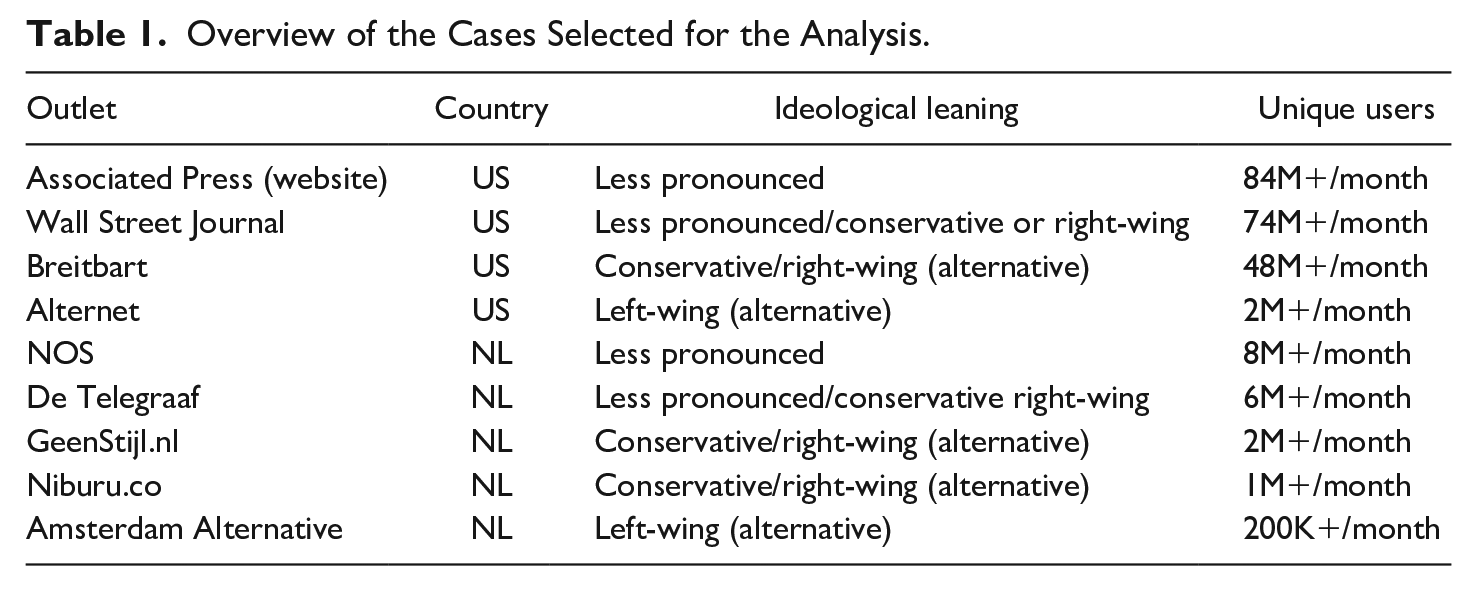
| Outlet | Country | Ideological leaning | Unique users |
|---|---|---|---|
| Associated Press (website) | US | Less pronounced | 84M+/month |
| Wall Street Journal | US | Less pronounced/conservative or right-wing | 74M+/month |
| Breitbart | US | Conservative/right-wing (alternative) | 48M+/month |
| Alternet | US | Left-wing (alternative) | 2M+/month |
| NOS | NL | Less pronounced | 8M+/month |
| De Telegraaf | NL | Less pronounced/conservative right-wing | 6M+/month |
| GeenStijl.nl | NL | Conservative/right-wing (alternative) | 2M+/month |
| Niburu.co | NL | Conservative/right-wing (alternative) | 1M+/month |
| Amsterdam Alternative | NL | Left-wing (alternative) | 200K+/month |
Declaration of Conflicting Interests
The authors declared no potential conflicts of interest with respect to the research, authorship, and/or publication of this article.
Funding
The authors received no financial support for the research, authorship, and/or publication of this article.
