




Abstract
Background:
Despite prior studies, transitions in smoking patterns are not fully understood. Getting arrested may alter an individual’s smoking pattern through processes proscribed by the criminological labeling theory. This study examined how arrest during emerging adulthood altered smoking behavior during subsequent years and whether there were differential effects by race/ethnicity and gender.
Methods:
We analyzed 15 waves of data from the National Longitudinal Survey of Youth 1997. Multinomial logistic regressions were performed using Stata software version 14.
Results:
For both genders, arrested black men and women had the most distinct smoking transitions (both increases and decreases) as compared with their non-arrested counterparts. Among men, particularly black males, arrest in early adulthood was associated with the men transitioning to both increased and decreased smoking. Patterns in smoking transitions for women were less clear, suggesting that women’s smoking may be influenced by factors not in the models. Women had a low probability of starting to smoke or increasing smoking if they were never arrested between 18 and 21 years of age.
Conclusions:
The results for transitioning into increased smoking offer some support for labeling theory processes. Other findings suggest that arrest may lead to some men reducing or quitting smoking. Early adulthood arrest may serve to “shock the system” and contribute to males altering their prior smoking behavior.
Implications:
Tobacco use over the life course, particularly across different racial and ethnic groups, remains understudied. This study contributes to the literature using a nationally representative sample to examine the effect of getting arrested in emerging adulthood on cigarette use during subsequent years. In conducting the study, investigators combined theories and methodological approaches from 2 complementary disciplines: public health and criminal justice. Because criminal justice policymakers tend to focus on issues like ex-offender unemployment, public health officials can provide guidance regarding the effect of justice system involvement on smoking, particularly given the adverse health outcomes of using cigarettes.
Introduction
Previous life course research has identified between 3 and 6 smoking trajectories.1-5 Smoking trajectories are distinguished by factors such as when an individual begins using cigarettes (particularly before, during, or post-adolescence) and whether they increase, decrease, remain stable, or fluctuate in smoking. Over the life course, individuals periodically encounter transitions (eg, important events) that may shift trajectories,6,7 including using cigarettes or other substances. 8 A transition such as arrest could shift a person from one smoking pathway to another as it may result in an individual incurring a label of criminal, 9 regardless of whether or not they were subsequently convicted and sentenced. 10
Getting arrested, incurring a label, and smoking
Empirical evidence suggests that labels often increase subsequent criminal activity.11-14 Why should this be the case? One possible explanation is that once a person has been arrested and labeled as a criminal, she or he is lumped in with others with a similar label. 9 This lumping-together could be through people’s opinions (eg, of friends, family, neighbors, local police, school officials, employers) or literally if the arrest leads to a conviction and probation, for instance. (The labeled individual would be assigned a probation officer and need to physically check in at the probation office, along with other probationers.) As such, the labeled person is likely to be exposed to more criminal norms (eg, joining a gang post-justice system involvement), 15 which may in turn contribute to additional criminality.16,17 There is a reciprocal relationship of sorts between a person’s behavior and society’s reaction to the individual’s behavior. 18 According to labeling theory, the label and the stigma that comes with it can get internalized by the individual and become a self-fulfilling cycle: “If they think I’m a bad person, I might as well act like one.”
The effect of simply getting arrested, regardless of whether there is a subsequent conviction or sentence, may linger for months or years adversely affecting a person’s life. 10 A label could end up changing a person’s life path in that she or he may incur myriad collateral consequences that limit their opportunities, particularly the inability to work in certain professions.19-21 These collateral consequences can result in stress to an individual, which may increase engagement in coping behaviors (eg, smoking) to alleviate the stress. 22 A labeled individual may find himself or herself in an environment (eg, probation office, jail) where she or he meets more smokers, which theoretically could normalize substance use. 23 She or he may develop a deviant self-image, resulting in illicit behavior that reinforces that self-image.17,11-14,16,24-27 Becoming a smoker could be one such behavior. Because labeling theory focuses on process over time, 28 some 17 have sought to blend it with life course theory, specifically examining “the role of social-structural consequences of early life sanctioning on later adult outcomes.”28(p458)
Prior research on the impact of the justice system on smoking: jail and prison smoking bans
The main types of tobacco control and cessation policies implemented in the United States are clean indoor air laws, taxing cigarettes, and smoking interventions. 29 Public health29-37 and criminal justice38,39 literature have examined the impact of smoking bans in jails and prisons, and how these affect subsequent smoking. Among the findings are improvement in some smoking-related symptoms 35 ; a lack of reduction in inmate smoking 33 ; a lack of violence in response to the ban 30 despite prison administrator fear that problems would ensue 39 ; and tobacco becoming a contraband item.30,38 An arrested individual may also spend time in custody (ie, in jail) where smoking may be banned, as they await subsequent processing (eg, if they cannot afford bail).
While it is valuable to know how smoke-free policies in prisons and jails affect individuals (eg, offenders, staff), incarcerated individuals only make up a small fraction of those under the supervision of the justice system. For every 1000 felony crimes, only about 20 individuals ultimately end up incarcerated in jail or prison. 40 Far greater numbers of individuals are affected through what is commonly referred to in the criminological literature as the criminal justice funnel. 40 The criminal justice funnel refers to the flow of individuals through the various parts of the justice system starting with the commission of a crime; an arrest being made; a case getting accepted for prosecution or getting dismissed; a plea bargain being offered, accepted, or rejected; a case going to trial; and the defendant being convicted or acquitted. If a defendant is found guilty, they may be sentenced to probation and/or community service (ie, doing time on the outside) or end up incarcerated. At many points in this process individuals may get diverted out. Charges against them may get dropped, for instance. They may get referred to a diversionary program 41 and avoid much of the formal mechanisms of the justice system. A focus on the smoking behaviors of incarcerated individuals, while important, misses a large swath of people who have come in contact with the justice system but do not make it to the most extreme form of supervision (jail or prison). This fact underscores the value of examining the effect of a broader form of justice system involvement—arrest—on smoking patterns.
Smoking in emerging adulthood
While smoking initiation rates among emerging adults have fallen recently, 42 emerging adults still have a high prevalence of cigarette smoking. 43 Exposure to nicotine among emerging adults may contribute to addiction and be harmful to an emerging adult’s still-developing brain. 44 Among younger individuals (eg, adolescents), nicotine exposure may affect the brain such that addiction is more likely to follow.45-49 This is relevant to this study as research 50 has found that brain development during the adolescent period may extend through emerging adulthood. In addition to an increased risk of addiction, other problems can include emerging adult smokers having reduced prefrontal attentional network activity. 51
Emerging adulthood involves important life transitions 52 —college attendance, marriage, parenthood—at a time when higher order reasoning is still developing.53-55 Beginning around 18 years old, 56 emerging adulthood may be a period of heightened vulnerability for initiating cigarette use57,58 when fluctuations 59 and increases58,60 in smoking have been observed. Smoking patterns are generally established after the age of 18 when individuals may be living on their own and can legally buy cigarettes.8,61 Transitions in smoking behavior among emerging adults have not been extensively examined, however. 1
Race, ethnicity, gender, and smoking
Race and ethnicity differences exist in smoking.8,62 Some research 63 has shown that whites initiate smoking more than blacks, and that black youth have lower rates of both initiating smoking and progressing to daily smoking compared with white and Hispanic youth. 64 Blacks have also been found to be less likely to stop smoking than other racial/ethnic groups.65,66 Hispanic emerging adults are also at risk for smoking. One study of Hispanic college students 67 found that smokers were more likely than non-smokers to drink weekly and use marijuana. Other research on Hispanics and smoking has similarly found that smoking was associated with the use of alcohol and illicit drugs. 68 Acculturation to mainstream U.S. culture has been found to have an inverse relationship with smoking among Hispanics. 69
As for gender, men and women may also differ in their smoking70,71 such as in different levels of smoking (eg, daily light vs heavy smoking). Leaving her parents’ home and becoming responsible for her own residence, social support, pregnancy, parenthood, and marriage have been linked to transitions in young women’s smoking behavior.72,73
Race, ethnicity, structural racism, labels, and smoking
Some criminal justice research 19 suggests that blacks and Hispanics are more likely to incur a label of “criminal” than whites, possibly because people of color are disproportionately arrested28,74,75 due to structural racism in the justice system. Structural racism, sometimes also called institutional racism, has been described with regard to police-citizen interactions as “suspect race [interacting] with neighborhood characteristics to animate the formation of suspicion among police officers” of residents of color.76(p312) While individual justice system actors (police, prosecutors, judges) may not see themselves as racially discriminatory or may not intend to make racist decisions, the result (eg, an arrest) ends up systematically disadvantaging blacks and Hispanics in a way that does not happen for whites, or as Ford77(p37) characterizes it, “racism without racists.” Black students are more likely to be suspended or expelled from school than are white students. 78 Youth of color are disproportionately targeted by the juvenile justice system, yet there is no one easy-to-point-to reason for why this happens. 79 Blacks are more likely to be arrested and convicted, and incur longer prison sentences, than are whites. 80 Hispanics are also more likely to end up incarcerated than are whites. 80 The greater the involvement with the justice system, the more likely an individual is to incur a label. The process described earlier (eg, getting lumped in with other labeled individuals; coming to see oneself as a bad person; taking up or continuing to smoke to alleviate stress or because smoking complements one’s negative self-image, or because the individual is now around more people who smoke) ensues.
The present study
To the extent that smoking could be an indicator of poorer life outcomes in the short term or long term, arrested individuals who incur a label and subsequently experience greater collateral consequences may smoke more. This study examined how early adulthood arrest alters smoking behavior during subsequent years. Of specific interest were whether there were differential effects by race/ethnicity and gender, both of which have been under-examined. This is a follow-up inquiry to a previously published study by Hassett-Walker et al 81 that examined transitions in substance use (marijuana, binge drinking) following an arrest. The following hypotheses are tested:
H1: Arrest in early adulthood will affect smoking transitions, leading to increased smoking among those arrested
H2: Early adulthood arrest will differentially affect individuals by race/ethnicity, with black and Hispanic individuals experiencing greater transitions into increased smoking than white individuals
H3: The differential impact of race on smoking transitions will be different between males and females
Methods
This study analyzed 15 waves of data from the National Longitudinal Survey of Youth (NLSY97), a nationally representative sample of individuals 12 to 18 years old when they were first interviewed in 1997. Respondents (n = 7298) have been interviewed annually since 1997. There remains an approximate 83 percent retention rate of the sample since 1997. Approval from the lead author’s institutional review board (IRB) was sought prior to conducting any analyses. As the NLSY97 data are de-identified and publicly available through the Bureau of Labor Statistics website, the IRB director determined that only an exempt application needed to be filed. More details on the sample size and smoking behavior at 18 years old by early adult arrest status, by race/ethnicity and gender, are shown in Table 1.
Gender and race/ethnicity smoking groups: sample size, arrested at 18-21 years old, smoking at 18 years old.

As seen in Table 1, the sample was nearly evenly divided between males and females. Within each gender, white males and females comprised the largest race group. More individuals who were arrested from 18 to 21 years old also smoked at the age of 18 than non-arrested individuals.
Variables
Smoking (dependent variable)
In each wave of data collection from 1997 to 2011, respondents were asked about their use of tobacco. The smoking stem questions were “have you smoked a cigarette since the last interview”; “during the past 30 days on how many days did you smoke a cigarette”; and “when you smoked a cigarette during the past 30 days, how many cigarettes did you usually smoke each day.” The raw smoking variables include 1 = occasional smoker (smoked between 1 and 29 days last month); 2 = light daily (<10 cigs/day); 3 = moderate daily (10-19 cigs/day); and specify that 4 (heavy daily) is specifically described as 20+ cigs/day. Preliminary frequency and histogram analyses revealed that the smoking variable was dominated by 0/non-smoker—it never accounted for less than 61.9% of the sample—with very tiny tails. Those individuals falling into the daily heavy smoking category never accounted for more than 6.2% of the sample in any given year.
Change scores were subsequently calculated from wave to wave, coding whether the participant had demonstrated any increase in smoking (regardless of what level smoker they had been during the prior wave); and whether they had shown any decrease in smoking, regardless of prior smoking level. The smoking variable was changed because the authors were specifically interested in individuals transitioning into higher or lower usage of cigarettes; but creating a change score using a variable with raw variables that have 5 semi-categorical, though ordered, categories would result in (1) a fairly difficult variable to understand, which would lead to an even more difficult-to-understand interpretation of the model results and (2) given that the non-smoking category was so dominant, the distribution would have too high of a peak at zero (the variable would range from −4 [extreme drop in smoking frequency] to +4 [extreme increase in smoking frequency]) and too small tails (ie, an extremely leptokurtic distribution, which can lead to inefficiency in an ordinary least squares [OLS] regression model).
After the change scores were calculated (which results in a −4 to +4 range), the variable was collapsed into a −1, 0, +1 ordinal scale whereby −1 represents any decrease in smoking frequency, 0 represents static/no change in smoking status, and +1 represents any increase in smoking frequency. A value of 1 was added to each value because multinomial logistic regression cannot typically be run if the dependent variable has a negative value. The final form of the change score for the dependent variable is 0 (decrease), 1 (static), and 2 (increase). Maintaining smoking status, also referred to as “static,” was used as the reference category for the multinomial logistic regressions.
Arrested at 18 to 21 years old (independent variable)
In each wave of data collection, respondents were asked if they had been arrested since the date of last interview. Respondents who were arrested at least once between the ages of 18 and 21 years (ie, emerging adulthood) were coded as being arrested; all others were coded as never arrested. Arrest is a commonly used measure in criminal justice research to operationalize incurring a label.19,28 Unlike with a juvenile arrest which will generally be sealed or be expunged once an individual turns 18 years old, an arrest at or after 18 will remain on an individual’s record. It may change subsequent life course opportunities, including educational plans and career choice, in ways these emerging adults may not yet fully grasp.
There are other ways that the independent variable could be measured, such as arrest during the year prior to a transition in smoking behavior. Analyses to account for this alternative operationalization of arrest are described in the “Results” section (subheading “Transitions in smoking versus remaining stable in smoking/non-smoking, based on arrest during the prior year”).
Control variables
To account for exogenous factors influencing smoking transitions, dichotomous control variables were included in the models: any smoking before the age of 18; arrested before 18 years old; whether an individual resided with their biological, married parents or not; and whether an individual was a U.S. citizen or foreign-born. On the suggestion of a reviewer of the initial manuscript draft, additional analyses were performed including measures of educational attainment (degree earned) and socioeconomic status (SES; parent’s mean income from 1997 to 1999), as these variables have been shown in prior empirical research82,83 to be related to smoking.
Model building and analyses
Multinomial logistic regressions were run using Stata software version 14, on each age transition group, from the 21 to 22 age transition group to the 29 to 30 age transition group. The graphs presented in Figures 1 to 4 were created using ggplot2 in R. The key independent variables of interest were arrest at 18 to 21 years old, race, gender, and their interaction. To avoid multicollinearity and an overly complicated model and interpretation, the sample was stratified by gender. Then, race, arrest at the age of 18 to 21 years, and their interaction were included in the model for each of these subsamples separately, along with the aforementioned covariates. Although this approach impedes being able to directly test the moderating effects of gender on smoking transitions, a comparison of estimates across models may provide suggestive evidence of gender-interaction effects.

Multinomial logistic regression estimates predicting transitions into increased smoking among men.

Multinomial logistic regression estimates predicting transitions into increased smoking among women.
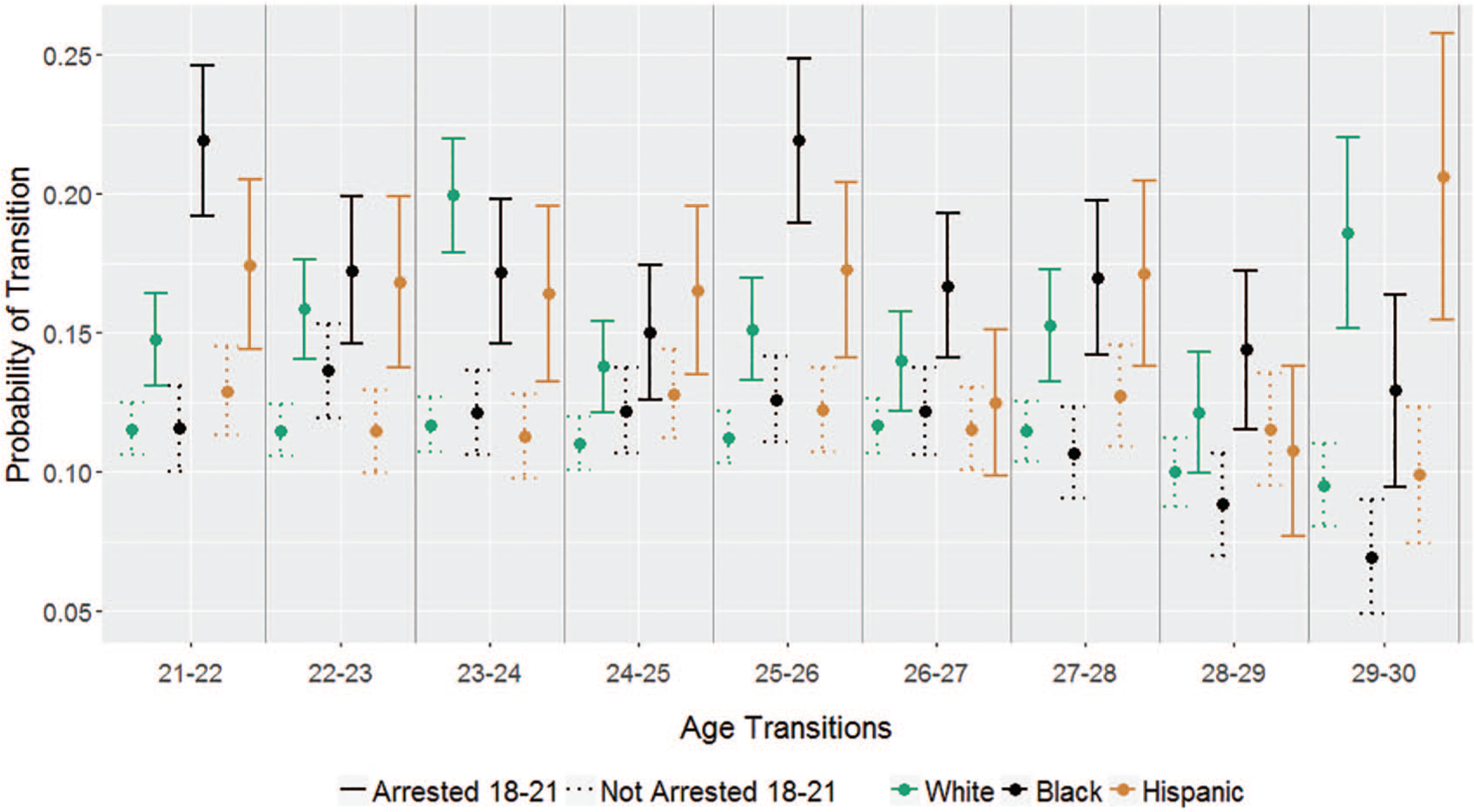
Multinomial logistic regression estimates predicting transitions into decreased smoking among men.

Multinomial logistic regression estimates predicting transitions into decreased smoking among women.
Results
Results from the regression analysis
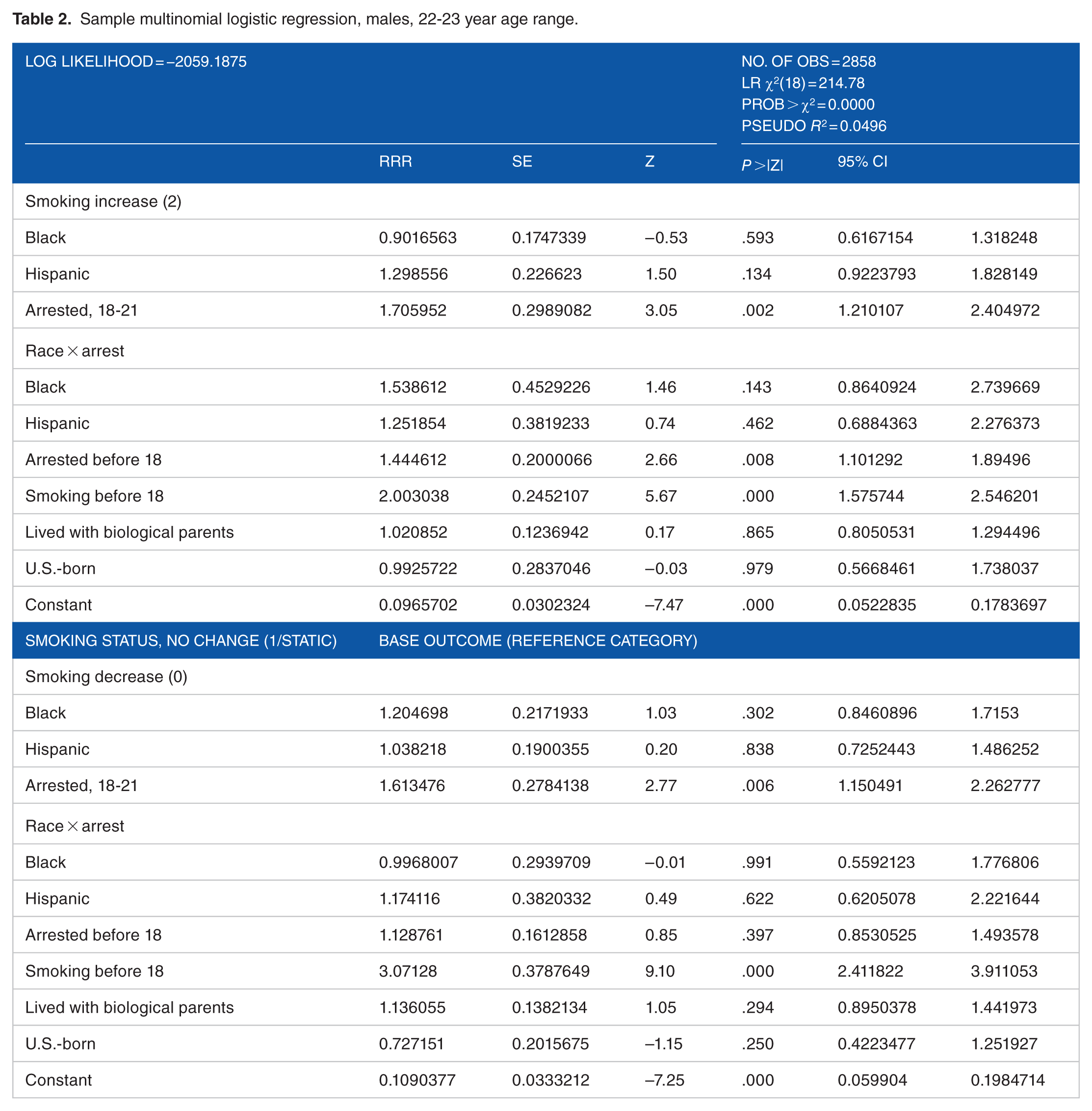
Due to article length consideration, copies of all the multinomial logistic regressions are not included in the article but are viewable here in an embedded link. (See Supplemental File 1; each figure illustrates 9 regressions, or a total of 36 regression tables.) An example of one regression, for males during the age period 22 to 23 years, is presented below in Table 2. As per the results in Table 2 and all the other regressions not shown, smoking before 18 years old was always significant (P < .001) with an odds ratio typically around 2 to 3. Arrest pre-18 and family structure were occasionally significant. U.S.-born was never significant at the 95% alpha level, though it approached significance in some of the models. Subsequent inclusion of degree earned and parent’s mean income did not substantively alter the consistent significance of smoking before 18 years old as a predictor of smoking transitions in every year, for both males and females. Higher degree earned was sometimes a meaningful predictor of smoking transitions (both increases and decreases) among both men and women; but parent’s mean income was not.
Sample multinomial logistic regression, males, 22-23 year age range.
Transitions into increased smoking versus remaining stable in smoking/non-smoking
Males
Figure 1 shows the impact of being arrested from 18 to 21 years old on the likelihood of transitions into increased smoking by race/ethnicity for males. Solid lines (of any color) indicate individuals with at least 1 arrest between 18 to 21 years, and dotted lines indicate individuals without an arrest. The results control for juvenile arrest, smoking before age 18, nuclear family structure, and being U.S.-born.
The effect of arrest on the likelihood of increasing smoking frequency is delayed, as there appears to be little effect on the 21 to 22 age transition group. As white and black men age, arrest in early adulthood appears to have an association with increased smoking as compared with males without an arrest, in most age transition periods. The most noticeable association is seen among arrested black males from 22 to 23 years (an approximate 20% probability of transition into increased smoking). The association between arrest and likelihood of transitioning into increased smoking continued as the men moved into their late 20s. Early adulthood arrest also affected Hispanic males’ transitions into smoking from non-smoking, although in fewer of the year-transition periods than for white and black men. In all age periods, it was unlikely that non-arrested men ever had higher probabilities of increased smoking than arrested men.
Females
The patterns for women of smoking transitions based on arrest were less distinct than the men’s patterns, with the caveat that statistical significance of any moderating gender effect cannot be directly determined. As seen in Figure 2, overall, the probabilities of transitions into increased smoking were seen most notable among arrested black women as compared with non-arrested black women. The effect is not consistent across all years, however. Arrested black women were more likely to transition into increased smoking in early- to mid-adulthood (during 23-26 years), peaking at around 24% likelihood during 25 to 26 years. In addition, during 28 to 29 years old, arrested black women had an approximately 23% likelihood of transitioning into increased smoking, higher than their non-arrested counterparts. Arrested white women were more likely than non-arrested white women to transition into increased smoking in only three of the age periods (23-24, 27-28, and 28-29 years old). The effects for Hispanic women were different still. During 21 to 22 and 24 to 25 years old, arrested Hispanic females were much more likely than their non-arrested counterparts to transition into increased smoking. In other years, however, the differences between arrested and non-arrested women were not notable. During 23 to 24 years, non-arrested Hispanic women may actually be more likely to transition into increased smoking, a result not seen among non-arrested white or black women, or among non-arrested Hispanic men.
Regardless of age or race, women had a very low probability of starting to smoke or increasing their smoking if they were never arrested between 18 and 21 years old. Not only are their estimates about the same across Figure 2 but non-arrested women also had very tight standard errors, meaning those estimates are fairly certain. This is mostly due to most women not being smokers, so their sample size is larger. In other words, women who were not arrested during 18 to 21 years live a relatively certain life of not picking up or increasing their smoking, whereas women who were arrested have a variety of estimates with larger standard errors (ie, uncertainty). A direct effect would be a stronger insight, but arrest leading to uncertainty in women’s lives is still an interesting finding.
Transitions into decreased smoking versus remaining stable in smoking/non-smoking
Males
Evidence of an association was also found between early adulthood arrest and the probability of males’ decreased smoking frequency (Figure 3), as compared with their non-arrested counterparts. As was seen in Figure 1, in all age periods seen in Figure 3, it is unlikely that non-arrested white, black, or Hispanic men ever have higher probabilities than their arrested counterparts. To consider Figures 1 and 3 together, whichever smoking behavior the men had engaged in (eg, non-smoking; light, moderate, or heavy daily smoking), an arrest in early adulthood may “shock the system” and shift the men into the opposite smoking behavior, for better (into decreased smoking; Figure 3) or worse (increased smoking; Figure 1). In Figure 3, for white and black arrested men, the association is seen across nearly all age transition periods and is most pronounced for black males.
Females
The patterns for women’s transitions into decreased smoking are similar to their patterns for transitions into increased smoking. As seen in Figure 4, the effect of arrest on transitioning into decreased smoking was most distinct among black females (as was the case with black women’s transitions into increased smoking, seen in Figure 2). Arrested white women were more likely to transition to decreased smoking in early adulthood. After that, their decreases in smoking were less dramatic and/or not different from smoking decreases by non-arrested white women.
Hispanic women showed less consistent patterns than white and black women. Only during 22 to 23 years old were arrested Hispanic women more likely to transition to decreased smoking, as compared with non-arrested Hispanic women. During their upper 20s, non-arrested Hispanic women were more likely to transition to decreased smoking than arrested Hispanic women, although not significantly.
Transitions in smoking versus remaining stable in smoking/non-smoking, based on arrest during the prior year
To account for the effect of arrest at a point in time later than emerging adulthood, the analyses described earlier were repeated, substituting arrest at 18 to 21 years old with arrest during the year prior to the transition in smoking behavior (eg, how does arrest at 21 years old affect transitions in smoking behavior from 21 to 22 years of age; how does arrest at 22 years old affect transitions in smoking behavior from 22 to 23 years of age; etc) (Supplemental File 2.)
Altering the independent variable from arrest during emerging adulthood to an arrest during the year prior to any transition in smoking behavior surprisingly did not greatly change the results presented above. Whether an arrest was in early adulthood or in their mid-20s, the impact on changes in smoking behavior—both increases and decreases—was felt more acutely by blacks than by whites. There were no noteworthy results for Hispanic men or women. Copies of the multinomial logistic regression analyses, too voluminous to include in the body of the article, are available upon request from the authors.
Discussion
This study examined how arrest during emerging adulthood arrest was associated with transitions in smoking through age 30 and how the association differed by race/ethnicity and gender. Three hypotheses were tested. First, it was theorized that arrest in early adulthood would affect smoking transitions leading to increased smoking among those arrested (H1). Second, the authors hypothesized that early adulthood arrest would differentially affect individuals by race/ethnicity, and that blacks and Hispanics would experience greater transitions into increased smoking than white individuals (H2). Labeling theory informed the study, as did prior research57,58 on smoking trajectories and transitions that suggests that emerging adulthood can be a time of increased smoking initiation and fluctuating smoking. Finally, the authors examined differential impacts of race on smoking transitions by gender (H3).
The authors found partial support for hypotheses 1 and 2, in that arrest was related to transitions to increased smoking sometimes. In addition, race and ethnicity differences in smoking transitions were found particularly among black individuals. Specifically, arrest in emerging adulthood had a significant effect on men, particularly black males, transitioning to both increased and decreased smoking. This suggests that early adulthood arrest may contribute to altering whatever smoking behavior the men had previously engaged in. As to hypothesis 3, women’s patterns in how arrest influenced smoking transitions were less clear than for the men, suggesting that women’s smoking is influenced by factors (eg, pregnancy) not in the present models. This is with the caveat that we cannot say whether any observed male-female differences are statistically significant. For both genders, arrested blacks had the most distinct smoking transitions (both increases and decreases) as compared with their non-arrested counterparts.
While arrested individuals transitioning into more smoking is supported by theory (eg, labeling), arrested individuals transitioning into less smoking must be otherwise explained. Arrest may serve as a wake-up call, with individuals subsequently acting to improve health-related behavior (eg, quitting or reducing their smoking). Alternatively, individuals with an arrest may have found themselves labeled and unemployed and decided to decrease or quit smoking because it was unaffordable. Other research 84 has found that anti-smoking household policy predicted smoking cessation and attempts to quit. Perhaps, the arrest and whatever came after (eg, subsequent arrests, conviction) lead to a shift in an individual’s home-living situation (eg, stricter parental or spousal rules on smoking in the house) which contributed to a transition into less smoking. Another possible explanation is that for some individuals, the arrest may have led to a conviction and incarceration in jail or prison—possibly a smoke-free facility—where cigarettes may have been less easily obtained or unobtainable.
The finding that arrest is related to both an increase and a decrease in prior smoking levels may seem contradictory. However, it makes sense in the context of the authors’ goal of examining any change in smoking, as opposed to maintaining existing smoking status (ie, remaining static), following an arrest. Increased or decreased smoking can be seen as 2 related measures of smoking change following a pivotal event that may shift an individual’s life pathway. In other words, arrest is associated with change in smoking, which could be either an increase or decrease in smoking varying by individual. Change in either direction among individuals was observed, rather than in both directions. It should be noted that this is not the first study to find that individuals in the same sample may experience seemingly contradictory increases and decreases in outcomes. One recently published study 85 found that repeated violent victimization was associated with both increased and decreased subsequent avoidance behavior by victims. Similarly, a study 86 of the effect of arrest on intimate partner violence by gender found the inconsistent result that men experienced more severe violence than did women, but women were injured more than men.
This study compares with the findings of other studies. Similar to other studies,8,62,63 we found racial and ethnic differences in smoking patterns. We improved on the findings of studies like Tucker et al 3 by examining smoking patterns beyond emerging adulthood (ie, to age 30). That said, there is still a need for more research on smoking trajectories, including pro-smoking influencing factors. 87 Our study also addresses important gaps in the literature including the fact that smoking behavior transitions by emerging adults have not to date been exhaustively examined. 1 As White et al4(p167) noted, there is a need for research that examines “transitions and turning points from adolescence to adulthood that may affect cessation and escalation differently for males and females.” This study taps into this gap.
This study also addresses gaps33,35 in the public health literature33,35 that has focused more on the effect of smoking bans in prisons and jails. Incarcerated individuals comprise only a small percentage of those supervised by the justice system. Examining the effect of arrest in emerging adulthood on smoking begets a much broader group of people affected by the justice system, at a formative period in their lives.
As was mentioned, the present inquiry is a follow-up to an earlier study by Hassett-Walker et al 81 that similarly examined how arrest in emerging adulthood influenced transitions in binge drinking and marijuana use. That study similarly found that arrest from 18 to 21 years of age influenced shifts—both increases and decreases—in substance use, particularly among men, and that there were differences by race and ethnicity. Taken together, the two studies’ findings suggest that labeling theory’s processes may explain some substance use behavior subsequent to incurring a label. That in both studies the association is felt most strongly among blacks, and men, suggests that labeling theory researchers may want to further examine the role of structural racism and discrimination in the labeling process. In addition to being race- and ethnicity-neutral, labeling theory is also gender-neutral. As some 88 have noted, men and women have different life experiences including different pathways into and out of crime. Involvement with the justice system, such as through an arrest and any ensuing label that is incurred, may be differentially experienced as well. The present study’s findings suggest that in some instances, the consequences may be stronger for males as indicated by greater smoking transitions. Labeling theorists may wish to consider incorporating gender-framed experiences into future research on the theory.
Limitations
As with all studies, there are limitations that should be acknowledged. The smoking measures only capture short time periods (30 days). Different results might have been found had an alternative dependent variable been used. The same may be said for our measure of labeling theory (arrest at 18-21 years old). Other variables operationalizing labeling theory (eg, conviction, type of criminal sanction [probation, jail, prison]) could have produced different outcomes. Parent’s mean income is one measure of SES. Additional SES measures—parent’s spouse or partner’s mean income in 1997-1999, and ratio of household income to poverty level in the previous year (1997)—were also considered but discarded. Parent’s spouse’s/partner’s mean income was not used since it, along with parent’s mean income, caused many of the models to not converge properly. Including parent’s mean income and ratio of household income to poverty in the models at the same time resulted in collinearity problems. Ratio of household income to poverty was not a meaningful predictor when it was included in the models instead of parent’s mean income. For women, in some of the smoking transition years, the inclusion of parent’s mean income along with degree earned resulted in the regression model not converging.
Initially, latent transition analyses (LTA) had been attempted since LTA allows researchers to examine shifts in their latent class membership in response to an event. However, attempts to include covariates to control for exogenous relationships, and even attempts to include interaction terms between the race and arrest variables to answer the current hypotheses, prevented the models from properly converging and often resulted in invalid parameter estimates for those models that did converge. Due to these model convergence issues, the researchers ultimately opted for using the smoking change score-dependent variables described earlier. Applying multinomial logistic regressions to these change scores yielded more stable model results.
Conclusions
Transitions in smoking—particularly increases—should be considered by policymakers seeking to alleviate the burden of collateral consequences on individuals processed through the justice system. This study speaks to the benefit of working across disciplines—specifically public health and criminal justice—to address arrestees’ and offenders’ adverse health behaviors (ie, smoking). As criminal justice policymakers do not typically focus on offenders’ smoking behavior, public health officials may be able to provide guidance in this area. Collaborative research teams comprising public health and criminal justice researchers may wish to further explore justice system involvement factors that contribute to decreases in smoking behavior in particular and consider the feasibility of smoking interventions that could be coordinated through police departments and probation offices (for example).
Given very recent findings89,90 about the dangers (eg, pulmonary diseases, death) of e-cigarettes and vaping, future research should consider the use of such products by individuals under the supervision of the justice system (eg, arrestees, probationers, inmates). Not enough is presently known in general about the effects of these alternative modes of nicotine delivery, let alone how their use may affect people with additional vulnerabilities (eg, offenders). It is unclear, for instance, whether the adverse effects are due to vaping mainly nicotine versus tetrahydrocannabinol (also known as THC, marijuana’s main psychoactive element) or some combination of both. E-cigarettes were initially framed as healthier alternatives to regular cigarettes and as having the potential to help chronic smokers smoke less. As such, they are a seeming Trojan horse of the tobacco industry. Individuals under justice department supervision often already carry myriad risk factors (eg, poverty, victimization histories, substance abuse problems), and e-cigarettes may pose a heightened danger for them. Future research should examine vaping—behaviors, health impacts of—among arrestees, probationers, inmates, and parolees.
Supplemental Material
5_Supplemental_File_1_logits_early_adulthood_arrest_xyz3163532750ed4 – Supplemental material for Examining Arrest and Cigarette Smoking in Emerging Adulthood
Supplemental material, 5_Supplemental_File_1_logits_early_adulthood_arrest_xyz3163532750ed4 for Examining Arrest and Cigarette Smoking in Emerging Adulthood by Connie Hassett-Walker and Mark Shadden in Tobacco Use Insights
Supplemental Material
6_Supplemental_File_2_logits_arrest_in_year_before_transition_xyz31635f7c1792f – Supplemental material for Examining Arrest and Cigarette Smoking in Emerging Adulthood
Supplemental material, 6_Supplemental_File_2_logits_arrest_in_year_before_transition_xyz31635f7c1792f for Examining Arrest and Cigarette Smoking in Emerging Adulthood by Connie Hassett-Walker and Mark Shadden in Tobacco Use Insights
Supplemental Material
Supplemental_File_3_logistic_regressions_men_women_education_SES_variables_added_xyz31635c3ccf8d3 – Supplemental material for Examining Arrest and Cigarette Smoking in Emerging Adulthood
Supplemental material, Supplemental_File_3_logistic_regressions_men_women_education_SES_variables_added_xyz31635c3ccf8d3 for Examining Arrest and Cigarette Smoking in Emerging Adulthood by Connie Hassett-Walker and Mark Shadden in Tobacco Use Insights
Footnotes
Funding:
The author(s) disclosed receipt of the following financial support for the research, authorship, and/or publication of this article: The study was supported by the National Institute on Drug Abuse of the National Institutes of Health (Award No. 1R15DA032875-01). The content is solely the responsibility of the authors and does not necessarily represent the official views of the National Institutes of Health.
Declaration of conflicting interests:
The author(s) declared no potential conflicts of interest with respect to the research, authorship, and/or publication of this article.
Author Contributions
CH-W wrote the majority of the paper, including the introduction, literature review, discussion, limitations and conclusion. She also wrote much of the method section and results. MS created Figures 1 through 4, and contributed to the writing of the method section, model building and analyses, and interpretation of the results.

Supplemental material
Supplemental material for this article is available online.
References
Supplementary Material
Please find the following supplemental material available below.
For Open Access articles published under a Creative Commons License, all supplemental material carries the same license as the article it is associated with.
For non-Open Access articles published, all supplemental material carries a non-exclusive license, and permission requests for re-use of supplemental material or any part of supplemental material shall be sent directly to the copyright owner as specified in the copyright notice associated with the article.
