






Abstract
Background
Cigarette smoking has been linked to several cancers worldwide. The characteristics of smokers have not been well documented among Nigerians.
Objective
This study assessed the prevalence and characteristics of cigarette smokers among the residents of Osogbo, in southwestern Nigeria.
Method
The study, a population based cross-sectional study of randomly selected consenting adult residents of Osogbo, was conducted in September of 2011. Data was collected using a semi-structured interviewer administered questionnaire on cigarette smoking.
Results
A total of 759 respondents were interviewed. Mean age was 42.1 ± 12.5 years. There were 364 (48%) males and 395 (52%) females. About 22% had ever smoked while 8.7% were current smokers, smoking an average of 22.9 ± 10.1 cigarettes per day. Males constituted the majority of current smokers. Most smokers (71%) were introduced to smoking by friends and ill health was the most often reported reason for quitting.
Conclusion
Cigarette smoking is commonly practiced among males in the studied population and awareness creation and advocacy should be conducted throughout the city in order to inform current smokers about the hazards and cumulative effects inherent in smoking.
Introduction
Worldwide, cigarette smoking has been noted to contribute to higher morbidity and mortality. 1 Cigarette smoking has been implicated in a number of diseases and is a risk factor for six of the eight leading causes of death in the world. Tobacco has killed an estimated 100 million people in the 20th century and continues to kill approximately 5.4 million people every year. This figure is expected to rise to 8 million deaths per year by 2030, 80% of which are expected to occur in the developing world. 1
Many chronic diseases are associated with exposure to cigarette smoke. Cigarette smoke has been shown to be dangerous to health. Smokers are also advised through several adverts that they are liable to die young if they do not stop smoking. 2 Several countries had therefore tried to control tobacco use among the population in order to reduce the prevalence of tobacco associated diseases in the general population. 1 The number of cigarette smoked, duration of smoking, and even stopping cigarette use have all been found to determine the prevalence of life threatening diseases such as lung cancer. 3 Smoking cessation improves both the quality and duration of life for smokers. 1 Passive smoking has also been shown to be dangerous to health.4,5 The prevalence of breast cancer and other cancers have been found to be higher among wives of smokers who themselves had never smoked.5,6 The need to stop smoking has led several countries to control tobacco use through legislations aimed at preventing smoking in public places. Additionally, in some countries tobacco companies are made to pay higher taxes to deliberately increase the cost of cigarettes above what the general populace can easily afford, therefore discouraging cigarette production. 1
Osogbo is the capital of the state of Osun and is therefore located in Southwestern Nigeria. Its population according to the 2006 census is 288,455. 7 The Osun State house of assembly passed anti-smoking legislation which was signed into law by the Osun State government in December 2009; the act made smoking in designated public areas in the state a punishable offence. The current situation regarding public smoking is not known; it is therefore difficult to assess the success or failure of the antismoking act since its passage. This study serves as a baseline study which could inform and guide policymakers on implementation strategies.
Methods
The study aimed to determine the prevalence of cigarette smoking and characteristics of cigarette smokers in Osogbo, southwest Nigeria. The study was conducted in September of 2011 and consisted of a population based cross-sectional study of consenting adult residents in Osogbo, the capital city of Osun State. Multi-stage sampling method was used to select a total of 759 participants in the study area. In the first stage, nine wards were selected through simple random sampling (balloting) of the twenty seven wards in the two local government areas of Osogbo. Each ward had an average of one hundred and ten households, with about ten of them not habitable. In the second stage, a systematic random sampling method was applied, with 7 as the sampling interval, in order to select 127 habitable households that were chosen for the study. Members of each household that were 18 years old and above were identified and their consent sought to participate. This was done after explaining the purpose of the study. Each respondent was interviewed in their homes for about 20 to 30 minutes. No respondents declined interview.
This survey was conducted using a pre-tested, semi-structured interviewer administered questionnaire containing questions on socio-demographic information, motivation for smoking, and smoking habits for all respondents. Other questions designed solely for cigarette smokers included question on current smoking issues and exposure to cigarette smoking. The questionnaire was translated to Yoruba–-the indigenous language–-and pretested in Ede town (Osun state) before being used for data collection. Thereafter, the survey was conducted using the pre-tested semi-structured interviewer administered questionnaire.
Respondents who ever smoked included persons who had smoked cigarette for at least six months during their lives; ‘current smokers’ include the respondents who smoked cigarettes in the one month prior to the start of the study. ‘Former smokers’ had smoked for at least six months but had not smoked in the one month prior to the start of the study, whereas ‘never smoked’ described respondents that had never smoked a cigarette. 8
The data were entered into SPSS 16 software and analyzed using univariate and chi square statistics as appropriate. P values < 0.05 were considered statistically significant.
Permission to conduct the study was granted from the State Hospital Ethics and Research Committee. Informed consent was taken from respondents. Additionally, confidentiality of information obtained was assured.
Results
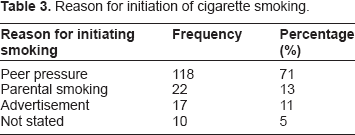
The mean age of the respondents was 42.1 ± 12.5 years. There were 364 (48%) males and 395 (52%) females. About 37% had tertiary education (Table 1). Only 22% of the respondents had ever smoked, while 8.7% were current smokers. A higher proportion of current smokers were males (13.2% vs. 4.6%; P = 0.001) (Table 2). Most smokers were introduced to smoking by friends (71%) and parental influence (13%) (Table 3).
Sociodemographic characteristics of the study population.

Pattern of cigarette smoking among the respondents.

Chi square test.
Reason for initiation of cigarette smoking.
Eighty five percent of the current smokers started smoking after their eighteenth birthday. The majority (77%) smoked 22.9 ± 10.1 (range 1–36) cigarettes per day, while 73% of smokers had smoked for more than 5 years (Table 4). The most common reasons for quitting cigarette smoking were ill health (56%) and economic factors (25%) (Table 5).
Smoking pattern among current smokers.

Reason for quitting cigarette smoking.

Discussion
The prevalence of cigarette smoking was low among the respondents when compared with previous studies in Nigeria.9,10 However, with the report that tobacco kills one person every six seconds worldwide 11,12 and the fact smoking could be responsible for one billion deaths in the 21st century,11,13 it becomes imperative that urgent steps are taken to reduce cigarette smoking among the population. The promulgation of the anti-smoking law in Osun state is a step in the right direction as this will reduce the prevalence of passive smokers in public places and its attendant consequences.
The study found that the prevalence of cigarette smoking was low among female respondents. Previous studies have shown similar findings among female Nigerians.3,10 This is a positive development, but with the higher prevalence among males the risks associated with passive smoke continues to endanger the health of innocent citizens, predominantly wives and children of smokers. In previous studies done across the globe passive smoking has been found to also result in high morbidity and mortality.1,2,4 These females may be non-cigarette smokers who are exposed at home and at workplaces to second and third hand smoke. 5
This study reported that both current and former smokers were influenced to smoke by their peers and parental smoking habits. This finding is similar to previous studies conducted across the globe that have shown that peer pressure and parental smoking could determine tobacco use among the populace.14,15
The study reported heavy smoking of about 23 sticks per day among the smoking population. This showed a high level of addiction, which suggested that to ensure tobacco use cessation, it might be necessary to refer these smokers for tobacco cessation therapy. Additionally, the anti-smoking law recently enacted by the Osun State Government of Nigeria might actually drive the smoking population to smoke in their homes, thereby exposing their wives, children, and neighbors to passive smoke. Various studies have shown that tobacco smoking and secondhand smoke constitute overwhelmingly the most significant risk factor for premature and preventable deaths from cancer, and across the board for chronic diseases in Nigeria.4,16
The finding in this study that ill health and economic reasons were adduced for stopping cigarette smoking showed that it is necessary to put in place information, education, and communication strategies that will help the general populace and individuals to stop smoking. This will in turn reduce the high morbidity and mortality among smokers and non-smokers alike. Increasing tax rates on cigarette products will increase the price of these products, thereby making cigarettes not readily available to the consumer. The revenue accrued from higher taxes could be used to educate the public about the dangers of smoking.
The study is limited to being a cross-sectional study that determined the prevalence of cigarette smoking and characteristics of cigarette smokers; no cause-effect relationship could be established. Additionally, while every effort was made to reassure the participants, some may have still refused to disclose their smoking status.
Author Contributions
EGA and SAO made substantial contributions to the conception and design of the study while all the authors were involved in data collection, analysis, and interpretation. All authors were involved in writing the manuscript and approved the final copy.
Funding
Author(s) disclose no funding sources.
Competing Interests
Author(s) disclose no potential conflicts of interest.
Footnotes
Acknowledgements
The authors wish to thank the entire staff of the Department of Preventive Medicine, State Hospital, Osogbo for their support and cooperation during the study period.
As a requirement of publication author(s) have provided to the publisher signed confirmation of compliance with legal and ethical obligations including but not limited to the following: authorship and contributorship, conflicts of interest, privacy and confidentiality and (where applicable) protection of human and animal research subjects. The authors have read and confirmed their agreement with the ICMJE authorship and conflict of interest criteria. The authors have also confirmed that this article is unique and not under consideration or published in any other publication, and that they have permission from rights holders to reproduce any copyrighted material. Any disclosures are made in this section. The external blind peer reviewers report no conflicts of interest.