



Abstract
Parkinson’s disease (PD) is the second major neuro-degenrative disorder that causes morbidity and mortality among older populations. Terpenoids were reported as potential neuro-protective agents. Therefore, this study seeks to unlock the inhibitory potential of terpenoids from Abrus precatorius seeds against proteins involve in PD pathogenesis. In this study, in silico molecular docking of 5 terpenoids derived from high-performance liquid chromatography (HPLC) analysis of A. precatorius seeds against α-synuclein, catechol-o-methyltransferase, and monoamine oxidase B which are markers of PD was performed using Autodock vina. The absorption, distribution, metabolism, excretion, and toxicity (ADME/Tox) of the hits were done using Swiss ADME predictor and molecular dynamic (MD) simulation of the hit-protein complex was performed using Desmond Schrodinger software. Five out of 6 compounds satisfied the ADME/Tox parameters and showed varying degrees of binding affinities with selected proteins. Drimenin-α-synuclein complex showed the lowest binding energy of −9.1 kcal/mol followed by interaction with key amino acid residues necessary for α-synuclein inhibition. The selection of this complex was justified by its stability in MD simulation conducted for 10 ns and exhibited stable interaction in terms of root mean square deviation (RMSD) and root mean square deviation error fluctuation (RMSF) values.
Introduction
Parkinson’s disease (PD) is characterized by neuro-degenerative disorder of the central nervous system which specifically affects the motor neuron, as the disease progress, nonmotor neurons symptoms begin to become more prevalent. 1 The disorder is also known as idiopathic Parkinsonism, hypokinetic rigid syndrome, and paralysis agitans. 2 The disorder has been associated with genetic mutation in 3 proteins namely α-synuclein, parkin, and ubiquitin carboxy-terminal hydroxylase, also in the autosomal dominant pattern of inheritance, idiopathic (mostly due to aging, genetic predisposition and environmental toxins), brain trauma, chemical poisons (manganese and carbon monoxide), iatrogenic (antipsychotics; butyrophenones and phenothiazine), and viral inflammation. 3 The symptoms of the disorder at early phases are characterized by movement alteration, such as body rigidity, shaking of hands, aberrant gait, and slowness; advanced stage of the disorder may involve cognitive and behavioural abnormality, resulting in dementia. 2 At present, there is no cure for this life-threatening disease but treatments focus on improving symptoms. 4 The administration of L-DOPA (also known as levodopa and l-3,4-dihydroxyphenylalanine) can improve the disease symptoms at its early stage. As the disease progress, L-DOPA becomes less effective coupled with side effects mainly by involuntary muscle movement. 1 Nutritional food intake and medical rehabilitation have been proven to be another effective way of improving the symptoms of PD.5,6 Recently, the neuro-protective potential of plant extracts and phytochemicals in PD through antioxidant and anti-inflammatory activities has been reviewed. 7 The therapeutic values of natural compounds in medicinal plants have prompt scientific investigation of their bioactive relevance in ameliorating this life-threatening disorder.
Abrus precatorius (AP) commonly called rosary pea belongs to the family fabaceae. 8 The phytochemicals compositions, antioxidants, and anti-inflammatory properties of AP seeds have been reported by Arora et al.8,9 The presence of terpenoids, alkaloids, and flavonoids has been scientifically validated in AP, which are presently used as therapeutic agents. The leaves and seeds of AP are rich in phyto-compounds that possess antimicrobial, antifertility, tumour inhibiting, antiallergic, antispermatogenic, memory enhancer, antioxidant, antiproliferative, anticancer, and antidiabetic properties. 10 The neuro-pharmacological activity of ethanolic leaf extract of AP has been reported. 11
In this study, the active compounds in AP seeds were evaluated using high-performance liquid chromatography (HPLC) technique. In silico techniques viz molecular docking, pharmacokinetics profile, molecular dynamics simulation, and drug-likeness properties were employed to study the pharmacological properties of terpenoids from AP seeds as potential drug candidates against PD.
Materials and Methods
Collection and preparation of plant sample
A. precatorius seeds were obtained during the dry season within the metropolis of Akungba-Akoko, Ondo State, Nigeria. The seeds were taxonomically identified and authenticated by Mr. Ologunore of the Department of Plant Science and Biotechnology, Adekunle Ajasin University, Akungba-Akoko (AAUA), Ondo State, Nigeria. The voucher number AAUA/20/502 was deposited at their herbarium. The seeds were dried at room temperature in the laboratory for 3 weeks and ground into powdery form.
Extraction, fractionation, and HPLC analysis of terpenoids from AP seeds
The extraction of the plant was carried out by the method proposed by Jiang et al. 12 The powdered seed of AP plant was soaked in n-hexane for 48 hr, the slurry obtained was filtered. The filtrate was concentrated under pressure with rotary evaporator. The method described by Akinloye et al 13 was employed for the fractionation of terpenoids. Briefly, a portion of the crude extract (56 g) was chromatographed on silica gel (with pore size 230-400 mesh) column with n-hexane/ethylacetate (85:15) as eluent. The terpenoids fraction obtained was dried and used for HPLC analysis.
The reference compounds used for HPLC analysis were purchased from Sigma inc (St. Louis, USA). HPLC analysis of terpenoids fraction of AP seeds was obtained using Shimadzu HPLC (Japan) with Prominence pump (LC-20AD), Prominence autosampler (SIL-20AHT), column oven (CTO-10ASvp), fluorescence detector (RF-10AXL), and Hypersil Gold column (4.6 × 250 cm, 5 μm, Thermo scientific, USA). Each of the reference compounds and plant material were performed in triplicate to obtain the retention time under the same conditions. Chromatogram peaks of the plant materials were identified based on the correlation of their retention time with those of the reference compounds.
In silico ADME toxicity screening and drug-likeness prediction
The ADME (absorption, distribution, metabolism, and excretion) and toxicity screening and drug-likeness prediction of the compounds were carried out using admetSAR1.0 prediction online tool (http://lmmd.ecust.edu.cn) 14 and swissADME server (http://www.swissadme.ch), 15 respectively, to predict the pharmacokinetics and pharmacodynamics properties of the compounds.
Library of AP-derived compounds, target proteins, and docking
The 3D structure of terpenoids that were obtained from AP fraction by HPLC analysis was downloaded from the pubChem (https://pubchem.ncbi.nlm.nih.gov). The target proteins; α-synuclein (3Q25), adenosine A2A (3UZA), catechol-o-methyltransferase (3A7E), and monoamine oxidase B (1ODJ) with crystallographic resolution of 1.9A0, 3.27 A0, 2.8 A0, and 2.4 A0, respectively, were downloaded from the protein data bank (http://rcsb.org). Five compounds with exception of pardinol A were docked against the catalytic site of the proteins using the binding pocket of the co-crystallized ligands which was removed prior to docking. The grid coordinates 7.595 × 31.350 × 10.520, 25.885 × −3.044 × 38.872, −15.648 × 18.283 × 16.004, and 4.080 × 9.104 × 5.891 of the co-crystallized ligand in the binding pocket of 3Q25, 3UZA, 3A7E, and 1ODJ, respectively, were employed for docking and binding energies were estimated using autodock vina from PyRx. 16 The 3D structure of target proteins were loaded into UCSF Chimera for protein preparation and energy minimization.
Molecular interactions between the amino acid residues of the protein-binding site and the ligands were viewed with discovery studio 2020.
Molecular dynamic simulation
The docking conformer of α-synuclein-drimenin complex was selected for the molecular dynamic (MD) simulation because they showed the highest binding affinity. The MD simulation study was performed by Desmond Schrödinger software, version 11.517 with OPLS 3e force field used to determine the α-synuclein-drimenin interaction, solvation was carried out with simple point charge (TIP4P) water model. The orthorhombic water box was employed to generate the glide box. 18 The box volume was minimized and the system charges were neutralized by adding Na+ and Cl−. Constant temperature and pressure were maintained at 300 k and 1.01325. 19 The simulation was performed using NPT ensemble for 10 ns. The root mean square deviation (RMSD) were estimated to monitor the stability of the α-synuclein and drimenin in their native motion
Results
HPLC analysis of AP seed terpenoids fraction
The result of the HPLC analysis of terpenoids fraction of AP seed is shown in Figure 1. Table 1 gives the concentration of the terpenoids in the fraction. High-performance liquid chromatography analysis revealed the presence of squalene (38.311 ± 2.031 ng/mL), geraniol (19.079 ± 1.421 ng/mL), nicamin (5.814 ± 0.652 ng/mL), pardinol (1.372 ± 0.022 ng/mL), drimenin (2.689 ± 0.071 ng/mL), and fusidic acid (14.019 ± 3.241 ng/mL). Squalene was the main terpenoids in the fraction, accounted for about 47.13% of the total terpenoids.

HPLC chromatogram of compounds presents in fraction of A. precatorius seeds.
Terpenoids present in the seeds of A. precatorius.
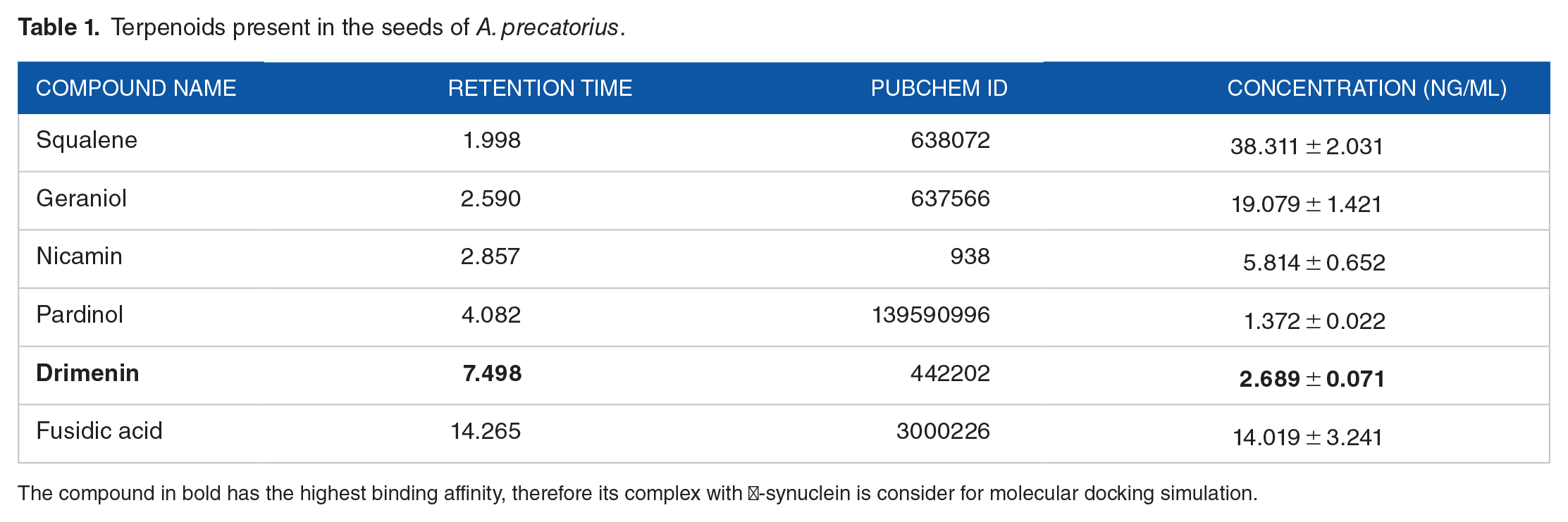
The compound in bold has the highest binding affinity, therefore its complex with α-synuclein is consider for molecular docking simulation.
Results of in silico study of terpenoids compounds from AP
From Table 2, 5 compounds except pardinol showed positive to blood–brain barrier (BBB+), human intestinal absorption (HIA+), fusidic acid and pardinol showed negative to Caco2, while other compounds showed Caco2 positive. Squalene, nicamin, and geraniol showed nonsubstrate to p-glycoprotein and CYP3A4, while pardinol A, drimenin, and fusidic acid revealed P-glycoprotein and CYP3A4 substrate. Suqalene was revealed to be carcinogenic while other compounds showed noncarcinogenicity.
In silico ADME toxicity screening of the compounds.

Abbreviations: ADME, absorption, distribution, metabolism, and excretion; BBB, blood brain barrier; CYP3A4 Inhibition/Substrate, Cytochrome 3A4 Inhibition/Substrate; HIA, human intestinal absorption; p-gp substrate/inhibitor, Caco-2 permeability P-glycoprotein substrate/ inhibitor.
In silico drug-likeness prediction of the compounds
Table 3 revealed that, all the compounds did not violate Lipinski’s rule of 5 except pardinol A; hence, pardinol A was exempted from further study. Both Pardinol A and fusidic acid has molecular weight greater than 500 which violated the lipinki’s rule of 5. The logkp reveals that pardinol A has the highest skin-penetrating potential (−7.23 cm/s).
In silico drug-likeness prediction of the compounds.

Abbreviations: MW, Molecular weight; HBA, Hydrogen bond acceptor; HBD, Hydrogen bond donor; TPSA, topological polar surface area; iLogp, Lipophilicity.
Molecular docking analysis of hits against neuro-degenerative proteins
Table 4 showed the docking scores of the ligands against neuro-degenerative enzymes. The binding affinities of the standard drug (donepezil = −8.9 and −7.3 kcal/mol) were observed to be higher than the hit compounds against adenosine A2A receptor and catechol-o-methyltransferase. Drimenin showed the highest binding affinity against α-synuclein (−9.1 kcal/mol) while fusidic acid has the highest binding affinity (−6.2 kcal/mol) against monoamine oxidase.
Docking scores (binding affinity) of the terpenoids compounds from AP seed and standard drug within the active sites of proteins.

As shown in Figure 2A to D, all the compounds were docked at the same active site as the co-crystalized ligand. These compounds interacted with various amino acids by conventional hydrogen bonds, van der waals, alkyl bond, and so on, at the same binding pocket of the target proteins.

Interaction between the hits and various protein (A) hits-α-synuclein complex, (B) hits-adenosine A2A complex, (C) hits–catechol-o-methyltransferase complex, and (D) hits–monoamine oxidase B complex.
Molecular dynamic simulation interaction of drimenin and α-synuclein
Figure 3 shows the secondary structure element (SSE) distribution by residue index throughout α-synuclein structure. Total SSE observed for the period of simulation was 45.51% with 32.86% appeared to be α-helix (shown in red) and 12.65% was revealed to be β-strands (shown in blue).

Secondary structure of α-synuclein.
Figure 4 shows the RMSD of α-synuclein (left Y-axis). All the protein frames were first aligned on the reference frame backbone, and then the RMSD was calculated based on the atom selection. The result indicated that the drimenin-α-synuclein complex reached its stable form at 6 ns and later loses its stability after 7 ns.

Protein-ligand RMSD.
Figure 5 revealed the bond interactions between α-synuclein-drimenin complex which was categorized into 4 types: hydrogen bond, hydrophobic, ionic, and water bridges. The result showed that hydrophobic interaction was favoured with TYR-156 interacting with hydrogen bond.

α-synuclein-drimenin contacts.
Figure 6 showed the 2D structure of drimenin-α-synuclein interactions that occurred more than 30.0% of the simulation period. Only TRP-231 and TYR-156 interacted with drimenin more than 30.0% during the simulation period.

Drimenin-α-synuclein contact.
Discussion
High performance liquid chromatography method for many naturally occurring compounds has been developed. 20 The number of terpenoids identified from the HPLC analysis of AP seeds in this study was limited by the number of reference standard which account for the unknown peaks in the chromatogram (Figure 1). A total of 6 terpenoids were identified from hexane/ethylacetate fraction of AP seeds (Table 1). Squalene (38.31 ng/mL) constitutes the highest concentration of terpenoids. Squalene is an isoprenoid compound, structurally similar to β-carotene, is an intermediate precursor in cholesterol synthesis. 21 The active oxygen scavenging activity of squalene and the effect of oral administration of squalene on a PD mouse model have been reported. 22 Also present in the fraction is geraniol (19.08 ng/ml), an acyclic isoprenoid monoterpene. 23 It has been reported to promote metabolism of inflammatory cells, increases glutathione (GSH) concentration, and stimulates antioxidant enzyme activities. 23 Geraniol was also reported to exerts an inhibitory potential on P38MAPK alteration and up-regulate NF-KB and COX-2 expression caused by 12-o-tetradecanoylphorbol-113-acetate (TPA). 24 Other phytoconstituents present in the seed fraction were Nicamin (5.81 ng/mL), pardinol (1.37 ng/mL), drimenin (2.69 ng/mL), and fusidic acid (14.02 ng/mL).
The use of ADME/Tox screening techniques is increasingly necessary in therapeutic selection for further processing, as increase numbers of compounds were discovered as potential drug candidate.25,26 The significant failure rate of potential drugs at late stage of development has been associated to ADME/Tox deficiencies; therefore, computational techniques remains the fastest and cost-effective model of screening therapeutic compounds. 26 In silico screening of BBB permeability plays an important role in early discovery of neurological drugs due to high throughput. 27 From Table 2, all the compounds except pardinol A were BBB+, that is, they can permeate the BBB. Most drugs are orally administered and for effectiveness, such drugs must be absorbed into the bloodstream for circulation, 28 human intestinal absorption, and Caco2 remains the tools for screening intestinal permeability of drug candidates. 29 All the compounds were human intestinal absorption positive (HIA+) while pardinol A and fusidic acid were observed to be negative to Caco2. The membrane transport protein, P-glycoprotein (P-gp) inhibits the absorption, distribution and bioavailability of drugs that appear to be its substrates and release them out of circulation. 29 From Table 2, pardinol A, drimenin, and fusidic acid were substrate of P-gp.
Several rules have been developed to examine the drug-likeness properties of drug candidates, with the most commonly used being the Lipinski Rule of Five. 29 According to Lipinki’s rule of 5, drug-like compounds should not violate more than one of the rules (molecular weight < 500; number of H-bond acceptors < 10; number of H-bond donor < 5; partition coefficient ⩽ 5 or MlogP > 4.15, and polar surface area ⩽ 140A0). 30 Results from this study (Table 3) revealed that all the hits except pardinol A obeyed Lipinski rule. Hence, the basis of exemption of pardinol A from further analysis.
Molecular docking is a computer-based tool frequently used in structure-based drug design. 31 It predicts the binding model and energy of compounds with the active pose of target proteins. 32 The compounds in this study demonstrated varying degree of binding affinities for the targets as shown in Table 4. The binding affinity of drimenin (−9.1 kcal/mol) for α-synuclein was observed to be higher than the standard ligand (donepezil: −8.7 kcal/mol). The binding affinity of donepezil against adenosine A2A receptor and catechol-o-methyltransferase (−8.9 kcal/mol and −7.3 kcal/mol, respectively) were observed to be higher than that of the terpenoids while fusidic acid against monoamine oxidase B (−6.2 kcal/mol) showed higher binding affinity than donepezil. Some monoterpenoids have been previously studied for their neurological activity via acetylcholinesterase inhibitory activity. 33 The inhibitory activity of volatile terpenoids as lead inhibitors of acetylcholinesterase in Alzheimer’s disease has been reported by Wojtunik-Kulesza et al. 34 The binding affinities observed in this study through molecular docking analysis agreed with the findings of Kumar et al 35 who identified new α-synuclein inhibitory compounds through in silico approach.
The result of the docking analysis showed that drimenin-α-symuclein complex has the highest binding affinity, this complex was selected as an ideal candidate against PD; hence, the validity and stability of the docking data were investigated by subjecting the complex to 10 ns MD simulation using Desmond package of Schrödinger (version 11v5). 17 The RMSD of the protein provides insight into its structural conformation throughout the simulation. 36 The RMSD for drimenin-α-synuclein complex was observed to be 4.0 Ao with initial fluctuation which was stabilized after 6.0 ns. The stabilization was observed between 6.0 and 7.5 ns. The changes of the order 1–3 Ao observed are perfectly acceptable for small, globular proteins like α-synuclein. The protein SSE showed that the percentage α-helix were higher than the β-strands. Certain type of protein sequences can adopt either an α-helical or a β-sheet conformation and a limited number of substitutions can convert an α-helical protein to a predominantly β-sheet protein. It has been confirmed that this conformational switch from α-helix to β-sheet structure plays a significant role in the mis-folding diseases as in amyloid fibril formation. 37
The bond of interaction between drimenin and α-synucleic is shown in Figure 5. TYRF-156 showed hydrogen bond at less than 0.1 interaction fractions. Consideration of the hydrogen bond properties in drug design is important because of their strong influence on drug specificity, metabolism, and absorption. Most of the interactions favours hydrophobic interaction which can be pi-pi, pi-cation, and other nonspecific interactions. Mostly, these types of interaction exist between hydrophobic amino acid and aromatic or aliphatic group on the compounds (ligands). Water bridges were also observed within the complex (Figure 5). These are hydrogen-bonded protein-ligand interaction mediated by a water molecule.
Conclusion
Drimenin showed higher binding affinity against α-synuclein compared to that of other terpenoids derived from hexane/ethylacate fraction of APs seed. Based on the docking result, evaluation of drimenin-α-synuclein complex stability by MD simulation reveals stable interaction of the complex for short period. Drimenin satisfied the ADME/Tox parameters and the complex formed with α-synuclein showed good trajectory analysis. Therefore, the inhibitory potentials of this compound against α-synuclein and other neuro-degenerative proteins in PD should further be explored for in vitro and in vivo experiment to validate its use for the management of PD.
Footnotes
Funding:
The author(s) received no financial support for the research, authorship, and/or publication of this article.
Declaration of Conflicting Interests:
The author(s) declared no potential conflicts of interest with respect to the research, authorship, and/or publication of this article.
Author Contributions
Damilola Alex Omoboyowa conceptualized and designed the study and wrote the manuscript, Toheeb A. Balogun performed the analysis. Oluwaseun Motunrayo Ommule contributed to the drafting of the manuscript. Oluwatosin Saibu critically review the manuscript.
