



Abstract
Objectives
The aim of the present study was to evaluate selected acute phase proteins (APPs) in 61 cats (mainly stray, domestic shorthair cats, aged 2 months to 17 years, 39 males and 22 females) presented with acute trauma at a university teaching hospital.
Methods
Serum amyloid A (SAA), haptoglobin (Hp), ceruloplasmin and albumin were compared with APPs in a population of healthy cats with similar demographic data and in cats with trauma, considering demographic data, trauma type and localisation (craniofacial and/or vertebral and/or appendicular, thoracic, abdominal and localised, multiple or polytrauma), anti-inflammatory treatment and outcome (survival to discharge or death). APPs were correlated to age, rectal temperature, body weight, total leukocyte, neutrophil, band neutrophil and lymphocyte counts, total protein, albumin:globulin ratio, base excess and hospitalisation duration.
Results
In cats with acute trauma, the median concentrations of SAA and Hp were significantly higher than in healthy control cats (90.5 vs 0.6 mg/ml and 130.7 vs 58.8 mg/dl, respectively; P <0.0001) and showed a median 150-fold increase and 2.2-fold increase, respectively, relative to healthy cats. Albumin was significantly lower in cats with trauma compared with healthy cats (3.4 vs 3.8 g/dl, respectively; P <0.0001) and in cats with vertebral trauma compared with cats with other trauma localisations. SAA showed a significantly positive correlation with length of hospitalisation (r = 0.488; P = 0.0003) in 50 surviving cats, while albumin showed a significantly negative correlation (r = –0.426; P = 0.0020), in addition to a negative correlation with band neutrophils (r = –0.329; P = 0.0097). In 15 cats with trauma in which APPs were also evaluated at discharge, SAA was significantly lower than at admission.
Conclusions and relevance
Acute trauma in cats is associated with significant increases in SAA and Hp and decreases in albumin. Testing SAA and albumin in cats with acute trauma may provide a useful prognostic indicator of length of hospitalisation, but no evaluated APPs are of prognostic value for survival.
Introduction
The acute phase response refers to a non-specific and complex reaction that occurs shortly after any tissue injury. 1 Acute phase proteins (APPs) are synthesised in the liver in response to pro-inflammatory cytokines as part of the acute phase reaction after stimuli such as inflammation, infection and neoplasia.
In cats, serum amyloid A (SAA), haptoglobin (Hp) and ceruloplasmin (Cp) are positive APPs that show a major (10- to 100-fold), moderate (five- to 10-fold) or minor (two-fold) increase in response to inflammation, respectively.1 –3 SAA is a reactant in the early stage of inflammation, 4 while Hp and Cp decrease slowly in serum compared with major proteins. Finally, APP concentrations increase proportionally to the severity of the inflammation. 2 Conversely, albumin is a negative APP, because its concentration decreases during the acute phase response. 1
APPs have been shown to have diagnostic and prognostic value in different feline infections and inflammatory diseases. SAA and Hp could potentially be useful biomarkers in diagnosing and assessing the postoperative period in feline pyometra. 5 An increase in SAA and Hp activity may indicate an active inflammatory state in feline leptospirosis. Increases in serum SAA and Cp concentrations were shown to be related to Dirofilaria immitis-associated clinical signs, whereas Hp increased in all seropositive cats. 6 Moreover, increases in Hp and SAA have been detected in cats with feline infectious peritonitis (FIP). 7 Hp is a useful biomarker in determining the necessary duration of treatment in feline plasmacytic gingivostomatitis, 8 and in discriminating healthy cats from cats with asymptomatic or symptomatic infection with Hepatozoon felis and Babesia vogeli. 9 Albumin has been reported to decrease in many feline inflammatory conditions, such as abscesses, pyothorax and fat necrosis, 10 and during infectious diseases, such as panleukopenia 11 and FIP. 7
Trauma is a physical injury to the body leading to tissue damage as a direct result of a violent or accidental event. 12 It is a frequent cause of the presentation of cats for emergency evaluation and is therefore an important cause of morbidity and mortality in the feline population.13,14
Trauma may result in an acute phase response, reflected by changes in the concentration of APPs. In racehorses, muscle and tendon injuries cause a moderate increase in SAA concentration, reflecting the acute phase response. 15 However, only one previous study has investigated the usefulness of SAA in cats with injury of an unspecified type. 16 Our study aimed to evaluate the concentrations of APPs in cats diagnosed with acute trauma. We hypothesised that acute trauma results in a significant change in APPs and that APP levels could be a useful prognostic indicator in managing cats with acute trauma.
Materials and methods
The medical records database of the University of Milan Veterinary Teaching Hospital, Italy, was searched for all cats diagnosed with acute trauma between May 2022 and July 2024. Inclusion criteria were cats with acute trauma, with hospital admission and a haematobiochemical profile performed within 5 days of the trauma history, seronegative for feline immunodeficiency virus (FIV) antibody test and feline leukaemia virus (FeLV) antigen test (SNAP Combo Plus; IDEXX Laboratories), faecal parvovirus antigen negative (SNAP Parvotest; IDEXX Laboratories) and for which a surplus of serum sample was available.
Data collected from the medical records of these cats with acute trauma included information on signalment: lifestyle (stray or shelter cats, privately owned cats), breed (domestic shorthair or longhair or other breed), age (kitten <1 year, young adult 1–6 years, mature adult 7–10 years, senior >10 years), sex (male or female) and neutering status (neutered or intact), physical examination findings (including rectal temperature, body weight), trauma type (localised, multiple or polytrauma) and trauma localisation (craniofacial and/or vertebral and/or appendicular trauma, chest or abdomen), whether anti-inflammatory treatment (non-steroidal anti-inflammatory drugs [NSAIDs] or corticosteroids) were given at hospital admission before blood sampling, base excess at venous acid–base status, total and differential leukocyte counts (total leukocytes, total neutrophils, band neutrophils and lymphocytes), total serum protein (TP) and albumin:globulin (A:G) ratio. The outcome was recorded, with survivors defined as cats that were alive and discharged from the hospital, while non-survivors were the cats that either died or were euthanased in the hospital. For survivors, the length of hospitalisation was calculated in days from the day of admission to the day of discharge from the hospital.
The APPs were evaluated in surplus serum collected for clinical purposes at hospital admission and, when available, at hospital discharge, on a COBAS Mira Chemistry Analyser (Real Time Diagnostic Systems) using a quantitative commercially available human SAA turbidimetric immunoassay validated for feline SAA determination (EUROLyser Diagnostica; normal value <10 µg/ml). 17 For Hp (Hagen Diagnostica) and Cp (BEN), a human quantitative turbidimetric immunoassay not validated in cats was used. For all three assays, two calibration-control specimens were analysed before evaluation of the study samples – one with low and one with high values for each APP – with all results within the manufacturer’s recommended reportable range. For both Hp and Cp, the intra-assay coefficients of variation were calculated on 20 replicate samples, each with low, medium and high concentrations of each APP, with results of 3.3%, 3.1% and 5.1% for Hp and 1.7%, 2.5% and 10.5% for Cp, respectively. Albumin was measured using the bromocresol green spectrophotometric method (Hagen Diagnostica).
The same APPs were also measured in a population of healthy cats (controls). These cats all underwent clinical examination, and standard haematological and biochemical profiles were performed either before neutering surgery or in cats presented for routine health screening examinations. All were seronegative for FIV antibodies and FeLV antigens.
Statistical analysis
For descriptive statistics, categorical data were reported as numbers and percentages. Because all data resulted in non-normal distributions, non-parametric data, such as median, range (minimum–maximum) and 25th–75th percentile, were used.
Comparison of demographic variables between cats with acute trauma and healthy control cats was performed using the χ2 test.
APP values were compared between cats with acute trauma and the control population. They were also compared within the trauma population, among different nominal variables (origin, breed, sex, neutering status, age class, trauma localisation, trauma type, anti-inflammatory treatment and outcome) using the Mann–Whitney rank-sum test for non-parametric data. Because all cats received opioid analgesics as analgesic treatment, the effect of this treatment on APP concentration was not considered. The median increase of APPs was calculated by dividing the median value in cats with trauma by the median value obtained in the control population.
Using Spearman’s rank correlation, the APP values in trauma cats were correlated to age, body weight, rectal temperature, haematological parameters (total leukocyte count, neutrophil count, band neutrophil count, lymphocyte count), biochemical parameters (TP, A:G ratio), base excess and length of hospitalisation.
Finally, APP median values were compared in the same trauma cat between hospital admission and discharge using Wilcoxon’s test for paired samples.
Results were considered significant if P <0.05. All analyses were performed with the commercially available statistical software package Medcalc version 22.009 (Medcalc Statistical Software).
Results
The only significant difference in demographic variables (breed, sex, neutering status, age and age class) between cats in the trauma population and control cats was in lifestyle. Cats with acute trauma were significantly more frequently (P<0.001) stray or shelter cats than control cats (Table 1).
Comparison of demographic variables between a population of 61 cats with acute trauma and 61 healthy control cats evaluated for acute phase proteins

Significant P values using the χ2 test are shown in bold type
DLH = domestic longhair; DSH = domestic shorthair
Cats with trauma had a similar median age of 2.3 years (range 2 months to 17 years, available for only 55 cats) with respect to healthy control cats (median age 2 years, range 3 months to 14.7 years; P = 0.887 using the Mann–Whitney test).
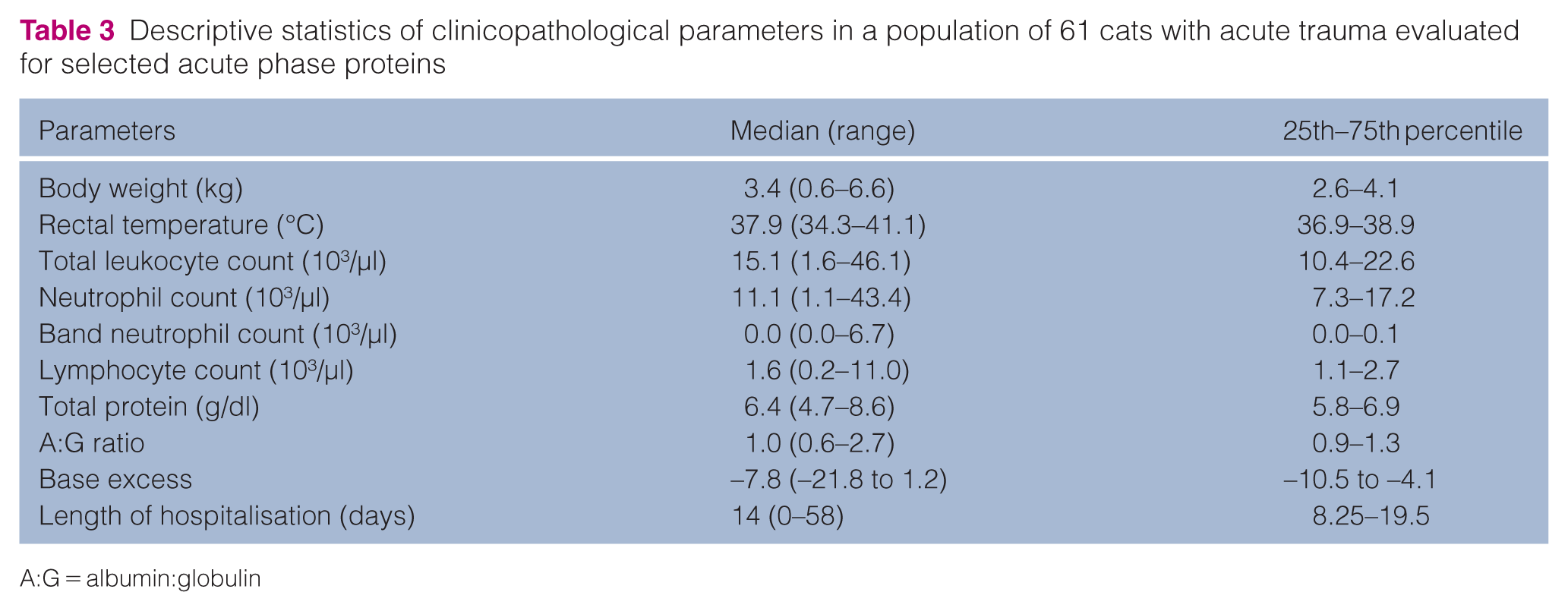
Tables 2 and 3 summarise the clinical and clinicopathological characteristics of 61 cats with acute trauma.
Clinical characteristics of a population of 61 cats with acute trauma evaluated for selected acute phase proteins

Descriptive statistics of clinicopathological parameters in a population of 61 cats with acute trauma evaluated for selected acute phase proteins
A:G = albumin:globulin
Of the cohort of 61 cats with trauma, only 10 had a confirmed history of the type of trauma. In the remaining cases, trauma was most likely due to vehicular accidents, inferred from lifestyle and origin (ie, stray colony cats or shelter cats). Of the 10 cats with a known history, one cat experienced blunt trauma from a kick and had an SAA value of 0.0 mg/ml. One cat sustained a tibial fracture during capture for neutering, with an SAA value of 4.0 mg/ml. One cat sustained trauma from being inside a washing machine, with an SAA value of 26.1 mg/ml. Another cat with a degloving injury of the tail had an SAA value of 44.0 mg/ml. Two cats that had fallen from a height presented with SAA values of 64.6 and 76.9 mg/ml, respectively. Two cats with bite-induced fractures had SAA levels of 121.2 and 118.8 mg/ml, respectively. Two additional cats with crush injuries leading to wounds and fractures had SAA values of 160.2 and 157.9 mg/ml, respectively. The six cats with blunt trauma had SAA values below the median (90.5 mg/ml), while two cats with bite-related injuries had SAA values above the median. The two cats with crush injuries showed the highest SAA values in the group, both exceeding the median value.
Rectal temperature was available for only 41 cats, and base excess for 43 cats. Two cats were excluded from the length of hospitalisation evaluation because they had illnesses (anaemia due to Candidatus Mycoplasma haemominutum and diabetes mellitus plus azotaemia, respectively) that biased the duration of hospitalisation for trauma treatment. Therefore, the length of hospitalisation was calculated for only 50/52 survivor cats.
When APPs were evaluated in all 61 cats with acute trauma, SAA and Hp were significantly higher, while albumin was significantly lower, compared with APPs in 61 control cats (Table 4, Figure 1). In cats with acute trauma, SAA showed a median 150-fold increase, while Hp showed a 2.2-fold increase with respect to control cats.
Comparison of acute phase proteins in a population of 61 cats with acute trauma and 61 healthy controls

Statistically significant P values using the Mann–Whitney test are shown in bold type
Cp = ceruloplasmin; Hp = haptoglobin; SAA = serum amyloid A

Multiple comparison box and whisker plots with all data plotted for (a) serum amyloid A (SAA), (b) haptoglobin (Hp), (c) ceruloplasmin (Cp) and (d) albumin values evaluated in 61 cats with acute trauma and 61 healthy controls. A line connects the SAA, Hp, Cp and albumin medians of the case and control groups. The box is drawn from the 25th to the 75th percentile, a horizontal line is drawn at the median and outlier values are shown in red
There were no statistically significant differences in APP levels between cats with acute trauma for different nominal variables, except for albumin, which was significantly lower (2.7 g/dl, 25th–75th percentile 2.6–3.3; P = 0.0090) in cats with vertebral trauma than in cats with other trauma localisations (Table 1 in the supplementary material).
APPs were correlated with numerical variables. SAA showed a significantly positive correlation with length of hospitalisation (r = 0.488; P = 0.0003) and a negative correlation with albumin concentration (r = –0.404; P = 0.0013). In addition to the negative correlation with SAA, albumin showed a significantly negative correlation with band neutrophil counts (r = –0.329; P = 0.0097) and with length of hospitalisation (r = –0.426; P = 0.0020) (Table 5).
Correlation between selected acute phase proteins and numerical variables in a population of 61 cats with acute trauma

The table cells are coloured according to the magnitude of the correlations, ranging from dark red for positive correlations (r = 1) to dark blue for negative correlations (r = –1.0). Significant P value using Spearman’s rank correlation shown in bold
A:G = albumin:globulin; APP = acute-phase protein; Cp = ceruloplasmin; Hp = haptoglobin; SAA = serum amyloid A
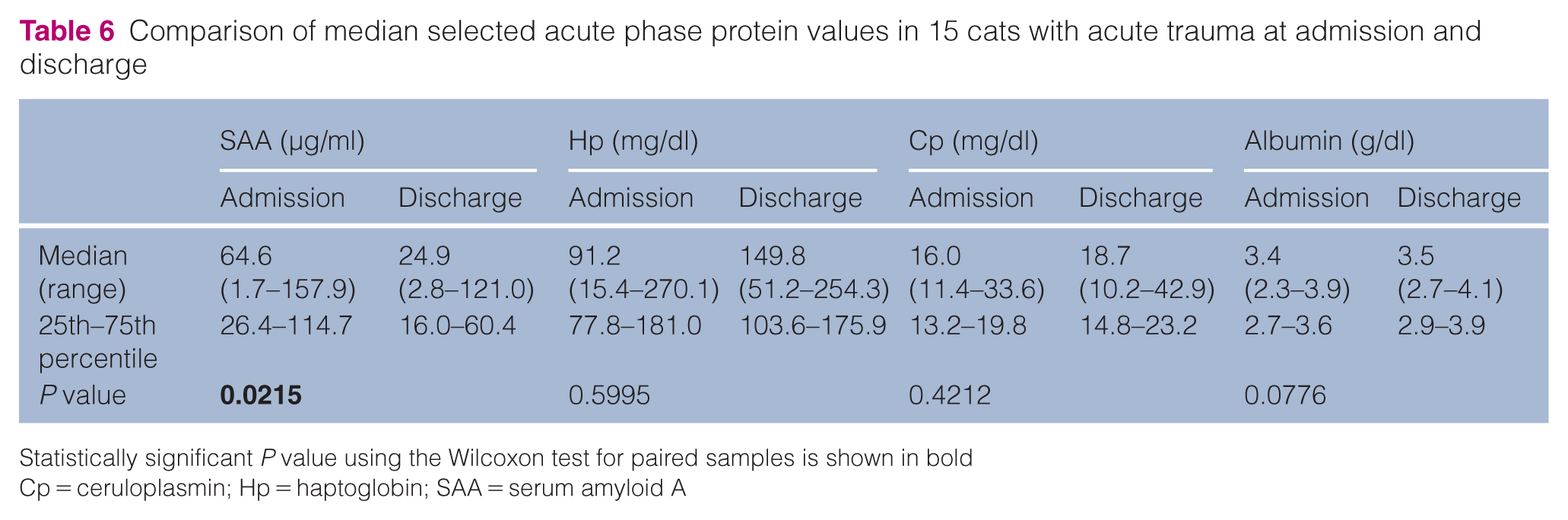
Finally, in 15 cats in which evaluation of APPs was conducted at both hospital admission and discharge, only SAA concentrations were significantly lower at discharge (P = 0.0215) (Table 6, Figure 2).
Comparison of median selected acute phase protein values in 15 cats with acute trauma at admission and discharge
Statistically significant P value using the Wilcoxon test for paired samples is shown in bold
Cp = ceruloplasmin; Hp = haptoglobin; SAA = serum amyloid A

Multiple comparison box and whisker plot with all data plotted and connected by a line for serum amyloid A values assessed in 15 cats with acute trauma at hospital admission and discharge. The box is drawn from the 25th to the 75th percentile and a horizontal line is drawn at the median
Discussion
To the authors’ knowledge, this is the first study to specifically assess the concentrations of selected APPs in cats with acute trauma. Only one previous paper investigated SAA concentrations in 47 cats with injury, with no mention of whether ‘injury’ related to acute or chronic injuries. 16
In the present study, the APP response in cats with trauma was evaluated through an APP profile that included one positive major (SAA), moderate (Hp) and minor (Cp) APP and one negative (albumin) APP. Our results showed that there was a 150-fold increase in SAA in cats with acute trauma relative to healthy controls, confirming the importance of this APP during acute trauma in cats. Since the magnitude of positive APP elevation correlates with the degree of injury, this huge increase underlines the severity of the inflammation linked to acute trauma. 2 Future studies might better clarify this correlation by correlating APP levels to a severity grading scale of the trauma, for example, the Animal Trauma Triage Score. 18 It could also be useful to correlate the APP level with the type of trauma in future studies, to explore the hypothesis that acute trauma resulting from a crush injury will result in higher APP levels compared with penetrating or blunt trauma. Since our feline population was mainly composed of stray colony or shelter cats, we have no confirmed history regarding the type of trauma in most cats. However, based on their lifestyle and origin, the most likely cause was vehicular accidents. Even if not statistically significant, of the 10 cats with a known history, the two cats with confirmed crush injuries showed the highest SAA values in the group, both exceeding the median SAA value.
Conversely to SAA, Hp showed only a minor, but significant, increase in cats with acute trauma. Serum Hp concentrations decrease slowly, compared with major APPs such as SAA, 4 making it a more accurate predictor of a chronic inflammatory disease process. 5 In fact, although not statistically significant, Hp values, like the Cp concentrations, were higher at discharge than the median values at hospital admission.
The results of this study confirmed albumin as an important negative APP and showed that inflammation due to acute trauma results in a significant decrease in serum albumin concentration, as demonstrated in previous studies.10,11 In addition, albumin was significantly lower in cats with huge trauma, such as vertebral trauma, than in cats with other trauma localisations. This suggests a correlation between changes in albumin concentration and the severity of trauma, although we did not explore this in detail in our study. In addition to the expected negative correlation with SAA (SAA is a globulin positive APP that increases as a result of inflammatory mediators, and that migrates in the alpha2 region on a serum protein electrophoretogram, while albumin is a negative APP that decreases during inflammation1,2), there was a significant negative correlation between albumin and band neutrophil counts and with length of hospitalisation. However, unlike in other diseases, such as panleukopenia, where a serum albumin concentration less than 30 g/l at presentation was associated with a negative outcome, 11 we observed no prognostic value of hypoalbuminaemia in cats with acute trauma.
Despite the wide investigation of APPs in different feline diseases, little evidence supports their prognostic role.19 –21 No association between SAA concentrations at hospital admission and outcome was identified in a study evaluating the diagnostic utility of SAA concentrations in critically ill cats measured at hospital admission for discrimination between infectious and non-infectious systemic inflammatory response syndrome. 19 No correlation was found between the serum concentration of SAA and prognosis in patients with intermediate- or large-cell, nasal and non-nasal lymphoma, with SAA concentrations elevated in patients with non-nasal lymphoma vs patients with tumours confined to the nasal cavity. 21 Another study failed to identify a prognostic role of serum SAA and Hp at hospital admission in predicting the outcome in cats with parvovirus infection. 20 In addition, in our study, neither SAA nor Hp or Cp at admission were able to predict the probability of survival in cats with acute trauma. However, the low mortality rate (14.8%) could have biased these results.
An important finding of our study is the significant positive correlation of SAA and the negative correlation of albumin concentration with the length of hospitalisation in cats with trauma. This result suggests that incorporating SAA and albumin measurement into the management of cats with acute trauma could provide enhanced monitoring of these patients, give feedback on the efficacy of therapeutic interventions, help predict the time to discharge and aid identification of high-risk cats that might experience a longer period of hospitalisation. In addition, SAA concentration significantly decreased over time in cats in which it was evaluated longitudinally both at admission and at discharge. However, this longitudinal evaluation was made in a limited number of cats (n = 15), which could have biased the final results.
There are some limitations to this study. The study is a single-centre university study, which may introduce geographical and institutional bias. In addition, the cats with trauma were mainly stray cats and, at our institution, hospitalisation of stray cats with trauma is generally longer than for privately owned cats. Studies have shown that healthy dogs kept in private households showed higher serum C-reactive protein values than dogs kept in very clean animal facilities, possibly due to exposure of privately owned dogs to environmental factors that stimulate the immune system.22,23 These differences could also result in differences in SAA between stray and privately owned cats. As the majority of animals in the study were stray colony or shelter cats, we were unable to establish a confirmed history regarding the type of trauma, although, based on their lifestyle and origin, this was most likely due to vehicular accidents. Grouping of all trauma cases without any assessment of the severity of the trauma, especially in relation to the type and degree of trauma sustained, could limit the clinical usefulness of our results. In addition, only retroviral and parvoviral infections were excluded in the feline population with acute trauma evaluated in this study, and other infectious diseases may have been present in some cats. We cannot be sure of the accuracy of the assays used to evaluate Hp and Cp in our study, as these had not been validated for use in cats. The performance of these assays depends on the cross-reactivity of antiserum raised to human Hp and Cp with feline Hp and Cp, but commercial, validated assays and reference materials for Cp and Hp evaluation in cats are not widely available. Regardless of these limitations, results were consistent with the expectation of a slower decrease of these APPs than SAA after trauma. Finally, our study did not identify a prognostic role for the concentration of the evaluated serum APPs at hospital admission in predicting the outcome in cats with trauma. It is possible that longitudinal monitoring in more cats, rather than a single APP determination, may better predict outcome, as suggested by previous studies in cats 20 and dogs. 24
Conclusions
Acute trauma in cats is associated with a significant increase in SAA and Hp. Measurement of SAA after trauma may provide a useful prognostic indicator of hospitalisation length and timing of discharge; however, it does not appear to be a reliable predictor of final outcome. More longitudinal studies are needed to better evaluate the utility of APPs for monitoring cats with trauma and to further clarify their prognostic role in feline acute injury. Finally, studies including a wider range of trauma types may reveal how the nature and severity of trauma influence APP responses in cats.
Supplemental Material
Supplementary table 1
Comparison of acute phase protein levels in a population of 61 cats with trauma showing different nominal variables.
Footnotes
Acknowledgements
The authors acknowledge support from the University of Milan through the article processing charge initiative.
Author note
The results of this research were presented, in part, at the 2024 International Society of Feline Medicine (ISFM) Congress, 27–30 June 2024, Malta, and published as an abstract in the Journal of Feline Medicine and Surgery as follows: Spada E, Carnevale L, Zurlo A, et al.
Supplementary material
The following files are available as supplementary material:
Supplementary table 1: Comparison of acute phase protein levels in a population of 61 cats with trauma showing different nominal variables.
Conflict of interest
The authors declared no potential conflicts of interest with respect to the research, authorship, and/or publication of this article.
Funding
The study was supported by Piano di Sostegno alla Ricerca 2022, Linea 2, University of Milan, Italy.
Ethical approval
The work described in this manuscript involved the use of non-experimental (owned or unowned) animals. Established internationally recognised high standards (‘best practice’) of veterinary clinical care for the individual patient were always followed and/or this work involved the use of cadavers. Ethical approval from a committee was therefore not specifically required for publication in JFMS. Although not required, where ethical approval was still obtained, it is stated in the manuscript.
Informed consent
Informed consent (verbal or written) was obtained from the owner or legal custodian of all animal(s) described in this work (experimental or non-experimental animals, including cadavers, tissues and samples) for all procedures undertaken (prospective or retrospective studies). No animals or people are identifiable within this publication, and therefore additional informed consent for publication was not required.

References
Supplementary Material
Please find the following supplemental material available below.
For Open Access articles published under a Creative Commons License, all supplemental material carries the same license as the article it is associated with.
For non-Open Access articles published, all supplemental material carries a non-exclusive license, and permission requests for re-use of supplemental material or any part of supplemental material shall be sent directly to the copyright owner as specified in the copyright notice associated with the article.
