




Abstract
The purpose of this study was to examine the ways in which teachers use language to promote vocabulary development (i.e., vocabulary talk moves) during science instruction in early-elementary classrooms. Twenty-four total science lessons were recorded by eight teachers, providing 894.27 min of observational data across three timepoints. Discourse analysis was used to identify specific research-aligned vocabulary talk moves. Findings revealed that the cohort of teachers used considerably more moves for building students’ knowledge of word meanings than for building students’ awareness of words and word learning or for interesting students in words and word learning. Likewise, the cohort used more authoritative moves (teacher telling) than dialogic moves (inviting student exploration and engagement). This study contributes to the field's understanding of the ways that science instruction supports literacy learning and literacy instruction supports science learning in the early-elementary grades. The findings from this study have implications for teacher professional development and policy.
Keywords
Vocabulary development is important for young children's learning because understanding the meaning of words in text is central to comprehending the text (Anderson & Freebody, 1981; Duke et al., 2011) and vocabulary is critical for disciplinary literacy as well (Wright & Gotwals, 2017). Observational studies of vocabulary instruction have primarily focused on the ways teachers support vocabulary development within the context of English language arts (ELA) instruction (Blachowicz, 1987; Carlisle et al., 2013; Nelson et al., 2015; Neugebauer et al., 2017; Silverman & Crandell, 2010; Silverman et al., 2014; Wanzek, 2014; Watts, 1995). To our knowledge, only one early-elementary observational study has examined vocabulary instruction outside of ELA instruction (Wright & Neuman, 2014). Given the sheer number of vocabulary words there are to learn (Anderson & Nagy, 1992), the reality that little time is devoted to vocabulary instruction within ELA instruction (Blachowicz, 1987; Nelson et al., 2015; Wanzek, 2014), and the fact that many words have discipline-specific meanings (Bravo & Cervetti, 2008), it is important to understand supports for vocabulary outside of ELA instruction.
Science instruction offers a rich context for word learning (Bravo & Cervetti, 2014; Gotwals & Wright, 2017; Wright & Gotwals, 2017; Wright & Neuman, 2014). The Next Generation Science Standards (NGSS) emphasize an inquiry-based and dialogic approach to science instruction that engages students in the communication of science from the very beginning of science education (National Research Council, 2012; NGSS Lead States, 2013). The National Research Council (2012) noted that students are continually introduced to new terms throughout science education and “the meanings of those terms can be learned only through opportunities to use and apply them in their specific contexts” (p. 76). Further, the National Research Council identified both technical terms and more general academic language (e.g., “analyze,” “correlation”) as words requiring “specific elaboration” to support students’ comprehension of science texts (p. 76). Vocabulary instruction has therefore been established as an important component of science education—with “vocabulary” appearing 22 times in the NGSS framework documents (Wright & Domke, 2019)—as students use words as tools (Nagy & Townsend, 2012) in the service of sensemaking.
The purpose of our observational study is to examine teachers’ vocabulary talk moves (VTMs)—ways of using language to promote vocabulary development—during science instruction in early-elementary classrooms. Understanding the ways teachers use VTMs during this instruction allows us to examine the opportunities for young children to develop vocabulary and simultaneously access science content, both of which are critical for science learning but may also support reading comprehension of texts that include science words and concepts (Kintsch, 2013).
Conceptual Framework
This study is framed by theoretical and empirical work centered around language learning, particularly as it pertains to the ways children's vocabularies develop through oral language in classroom settings. We draw on sociolinguistic and sociocultural theories (Bohannon & Bonvillian, 2001; Vygotsky, 1986) that center language development within interpersonal interactions and studies that establish a relationship between the talk of adults and the vocabulary development of children (e.g., Dickinson & Porche, 2011). Because of the important role adult speech plays in children's language learning, we examined the oral language interactions occurring between teachers and their students.
Drawing on Gee's (2014) notion that language is used to carry out specific actions rather than just to give one another information, we were particularly interested in the talk moves teachers made—or specific ways of using language to achieve specific outcomes (Michaels & O’Connor, 2015). In this study, we examined VTMs aligned with research on how children learn words.
This study is informed by Bakhtin's (1981) notions of authoritative and dialogic discourse. In a classroom context, authoritative discourse is often marked by teacher telling (e.g., telling students word meanings), while dialogic talk is marked by engaged and elaborated talk that brings together and explores ideas (e.g., inviting students to share their understandings and experiences related to new words and the concepts they represent) and is contingent and reflective of the talk of others (Boyd et al., 2019; Mortimer & Scott, 2003; Scott et al., 2006). In this study, we explored the function of VTMs in order to identify whether they were authoritative or dialogic.
Instructional Practices for Vocabulary Learning
The literature relative to how children learn words aligns with three types of instructional practices: building knowledge of word meanings, interesting students in words and word learning, and building awareness of words and word learning. Following, we outline the research base for each, which informed our analysis.
Building Knowledge of Word Meanings
Understanding word meanings—whether learning the meaning of unfamiliar words or learning additional meanings for familiar words—is at the core of vocabulary development. Many practices have been found to promote students’ understanding of word meanings, including providing explanations and definitions for words that have been targeted for instruction (Beck & McKeown, 2007), introducing target words within a variety of rich contexts (Stahl & Fairbanks, 1986), providing multiple exposures to target words (Biemiller & Boote, 2006), and engaging students in active processing or deeper processing that goes beyond just associating a word with its meaning (Stahl & Fairbanks, 1986). Additional practices include providing students with an image depicting a target word (Rosenthal & Ehri, 2008), showing an object representing a target word (Wasik & Hindman, 2014), acting out or demonstrating a target word or engaging students in doing so (Silverman & Crandell, 2010), highlighting examples and nonexamples that illustrate what target words mean (Coyne et al., 2010), showing students words in print (i.e., providing orthographic information) and/or drawing students’ attention to the sounds in target words (i.e., highlighting phonological information; Rosenthal & Ehri, 2008), and systematically reviewing target words (Zipoli et al., 2011).
Interesting Students in Words and Word Learning
For students to engage in the work of figuring out the meanings of unfamiliar words, researchers have suggested children need to view word learning as worthwhile and be curious about word meanings (Anderson & Nagy, 1992; Scott & Nagy, 2004). In a study of 27 kindergarten classes, Neugebauer et al. (2017) found that teachers’ use of language in ways that reinforced students’ word use, affirmed their recognition of word meanings, and helped them make personal connections to words was positively associated with gains in kindergartners’ end-of-year general vocabulary knowledge.
Building Awareness of Words and Word Learning
For students to become independent word learners, it is also important for them to have an awareness of how language works (i.e., metalinguistic awareness; Scott & Nagy, 2004) and an awareness of how they think about and learn words (i.e., metacognitive awareness; Kuhn, 2000; Wade & Reynolds, 1989). For example, Wise (2019) found that second graders who learned to use context clues to determine the meanings of unfamiliar words significantly outperformed students in the comparison condition with the skill of noticing unfamiliar words, which may support students’ incidental word learning. Additional practices for building awareness of words and word learning include teaching students to find and use word-part clues (Baumann et al., 2003), engaging students in deriving word meanings from context and then explaining the reasoning behind a definition (Cain, 2007), teaching students to detect semantic ambiguity by analyzing multiple-meaning words (e.g., “watch”) and sentences (e.g., “The cook looked over the menu”; Zipke et al., 2009), and providing direct instruction of metalinguistic and metacognitive strategies (e.g., teaching students to monitor and rank their level of knowledge for a word from partially to fully known; Lubliner & Smetana, 2005).
Dialogic Talk
Teachers often dominate classroom talk (Nystrand, 2006; Silverman et al., 2014), yet actively engaging students in word learning is a critical component of vocabulary development (Stahl & Fairbanks, 1986). Likewise, current recommendations (National Research Council, 2012; NGSS Lead States, 2013) and research (Chen et al., 2016; Gotwals et al., 2022; Herrenkohl & Guerra, 1998; Menninga et al., 2017) in science education call for inquiry-based, dialogic instruction.
Previous studies of talk moves (Beck et al., 1996; McKeown & Beck, 2004; Michener et al., 2018) have not centered on vocabulary instruction within the context of early-elementary science lessons. Vocabulary instruction within science lessons may be different from vocabulary instruction within ELA lessons due to discipline-specific language and literacy practices (Bravo & Cervetti, 2008; Gotwals et al., 2022; Moje, 2007; Wright, 2020) and instructional practices (Lee et al., 2013; National Academies of Sciences, Engineering, and Medicine, 2021). In this study, we examined VTMs within science instruction to understand how these align with discipline-specific recommendations for vocabulary instruction.
Opportunities for Vocabulary Development in Science Instruction
Science instruction has been established as a rich context for vocabulary development (Bravo & Cervetti, 2014; Gotwals & Wright, 2017; Wright & Gotwals, 2017; Wright & Neuman, 2014). In an observational study of vocabulary instruction across the school day in kindergarten classrooms, Wright and Neuman (2014) found that although students rarely received science instruction, when it was taught, science provided rich opportunities for vocabulary instruction. Wright and Gotwals (2017) found that vocabulary learning within science instruction was supported by curriculum materials designed to engage students in disciplinary oral language—or the ways that scientists talk. In a quasi-experimental study, Wright and Gotwals found that students in the intervention condition outperformed students in the business-as-usual comparison condition on measures of receptive science vocabulary and use of vocabulary in a science context. As a rich context for vocabulary learning, we examined teachers’ VTMs within science lessons.
Study Goals
National standards emphasize supporting vocabulary development within science instruction (National Research Council, 2012; NGSS Lead States, 2013), yet little is known about how teachers promote vocabulary development within this context in the early-elementary grades. Therefore, we asked the following research question: How do teachers use language to promote students’ vocabulary development during science instruction in early-elementary classrooms?
Our first objective was to identify the specific VTMs teachers used. We considered the range of instructional practices that research has shown to support vocabulary development: building knowledge of word meanings, interesting students in words and word learning, and building awareness of words and word learning. While such practices are components of frameworks commonly recommended for vocabulary instruction within the context of ELA lessons (Graves, 2006; Stahl & Nagy, 2006), it is unclear whether elementary teachers, who typically teach all subject areas, bring these ideas into science lessons. Therefore, in the present study, we were interested to see how these practices (might) manifest within science instruction. Our second objective was to examine the function of the VTMs teachers used. We considered whether VTMs were dialogic—inviting student exploration and engagement, in alignment with the emphasis by NGSS on engaging students in constructing explanations and creating models (National Research Council, 2012; NGSS Lead States, 2013)—or more authoritative, characterized by teacher telling (Boyd et al., 2019).
This observational study contributes to the field's understanding of how students’ oral language development may be supported during science instruction. By gaining a better understanding of the current state of vocabulary instruction within early-elementary science lessons, we can design professional development (PD) and curriculum materials to support elementary teachers in implementing effective vocabulary instruction in this context.
Method
This observational study is situated within a larger study of the
Participants
Eight early-elementary teachers who taught in the same elementary school in a small, rural district within a large Midwestern state participated in the present study, including one young 5s (transitional kindergarten), three kindergarten, two first-grade, and two second-grade teachers. On a background survey, all participants identified as white/European American females and had between 0.5 and 19 years of teaching experience. All participants self-reported having a bachelor's degree and three also had a master's degree. At the time of the study, 27.15% of students at the school were eligible for free or reduced-price lunch. The 188 students in participating classrooms identified as white/European American (95.74%), Black/African American (1.6%), biracial/multiethnic (1.6%), Hispanic/Latinx (0.53%), and Asian/Pacific Islander (0.53%). No students were learning English as an additional language.
Instructional Context
Mystery Science (Schacht & Peltz, 2020) was the district's formally adopted science curriculum: 18 out of 24 recorded lessons used this curriculum. Teachers also reported using a variety of other science resources including lessons from Teachers Pay Teachers, lessons from SOLID Start curricula, materials from a STEM Into Nature summer educator course at the Academy of Natural Resources, an activity from the University of Michigan's Natural History Museum program Dancing With Dinosaurs, and the Association of Fish and Wildlife Agency's Project Wild lesson What's That, Habitat? Five teachers reported having participated in Next Generation Science Exemplar PD during the academic year of the present study and one also reported participating in environmental education PD. Teachers reported typically spending 32–102 min per week on science instruction. During the data-collection year, all teachers participated in the SOLID Start PD focused on instructional practices to support science talk in K–2 classrooms.
Data Sources
This study draws on a demographic background and teaching experience information survey, a weekly instructional log (i.e., minutes of science instruction per day, activities within science lessons, and science curriculum materials used), and 24 video-recorded science lessons totaling 894.27 min of observational data, with lessons ranging in length from 13:27 to 1:13:25. Teachers recorded their science lessons three times, about once every four weeks during the semester.
Analytic Strategies
Given the important role adult speech plays in children's language learning (Dickinson & Porche, 2011), we examined teachers’ oral language interactions with their students. Specifically, we used discourse analysis techniques to examine how teachers used language to promote students’ vocabulary development. Discourse analysis is a useful approach for understanding specific actions carried out by language (Gee, 2014), and we wanted to identify the specific talk moves (Michaels & O’Connor, 2015) teachers made and whether these moves were authoritative or dialogic in nature (Mortimer & Scott, 2003).
In the present study, we expanded and refined a codebook for vocabulary talk that was initially developed by the first author in a pilot study examining one kindergarten teacher's vocabulary talk during 421.96 min of science instruction across 10 video-recorded lessons. In this initial study, the first author used teacher turn (i.e., everything the teacher said until another person spoke) as the unit of analysis and used two levels of codes. First-level codes were provisional codes (Miles et al., 2014; Saldaña, 2016) derived from the literature on how children learn words. The Knowledge & Understanding code captured talk that builds knowledge of word meanings. The Affective Factors code captured talk that interested students in words and word learning. The Metalinguistic & Metacognitive Awareness code captured talk that builds students’ awareness of words and word learning. We refer to these first-level codes as types of vocabulary talk. Second-level codes identified the specific VTMs teachers made within each type of vocabulary talk. Using pattern coding (Miles et al., 2014; Saldaña, 2016), we identified 24 different VTMs.
In the present study, we used teacher utterance as our unit of analysis (i.e., unit of speech with only one speaker and one main clause). In addition to syntax, we paid close attention to intonation contours, so that speech tacked on after terminal intonation was transcribed as a new utterance (Ratner & Brundage, 2018). We used teacher utterances as our unit of analysis rather than teacher turn because we found in our pilot study that teacher turns were often quite long and involved a number of different VTMs. In fact, we found that the teacher often used a VTM more than once within a turn; however, because each second-level code could only be applied once to a turn, this repeated use of VTMs within a turn was not captured. Silverman et al. (2014) also encountered this issue when selecting their unit of analysis for their observational study of vocabulary instruction within ELA lessons in Grades 3 through 5. They discovered that several different types of instruction often occurred within a turn and that “coding at the level of the turn appeared to mask the full extent to which teachers provided specific types of instruction” (p. 37). They opted for utterance as their unit of analysis in order to “reveal a more comprehensive and cumulative picture of the teachers’ instructional focus” (p. 37). Likewise, for the present study we opted for utterance as our unit of analysis for a finer-grain examination of vocabulary talk, which is consistent with other observational studies that have examined teacher talk in relation to children's vocabulary learning (Neugebauer et al., 2017).
We transcribed episodes of instruction that included at least one of the three types of vocabulary talk and then completed two cycles of analysis. First, we applied the two levels of provisional codes from the pilot study. Consistent with Gee's (2014) assertion that speakers often simultaneously carry out multiple actions with any one utterance, we applied each relevant code to utterances addressing multiple types of vocabulary talk and/or multiple VTMs. The second cycle focused on identifying additional VTMs beyond those identified in the pilot study. We initially worked with a subset of 10 randomly selected lessons to capture new VTMs used in the present study. We used pattern coding (Miles et al., 2014; Saldaña, 2016) to describe the specific VTMs teachers made. Focusing on one type of vocabulary talk at a time, we wrote descriptions of teachers’ utterances, summarizing what teachers said and naming what they did through language (Gee, 2014). We then (re)read teacher utterances, identified patterns across utterances, and revised descriptions to capture these patterns until we were able to name the specific VTM.
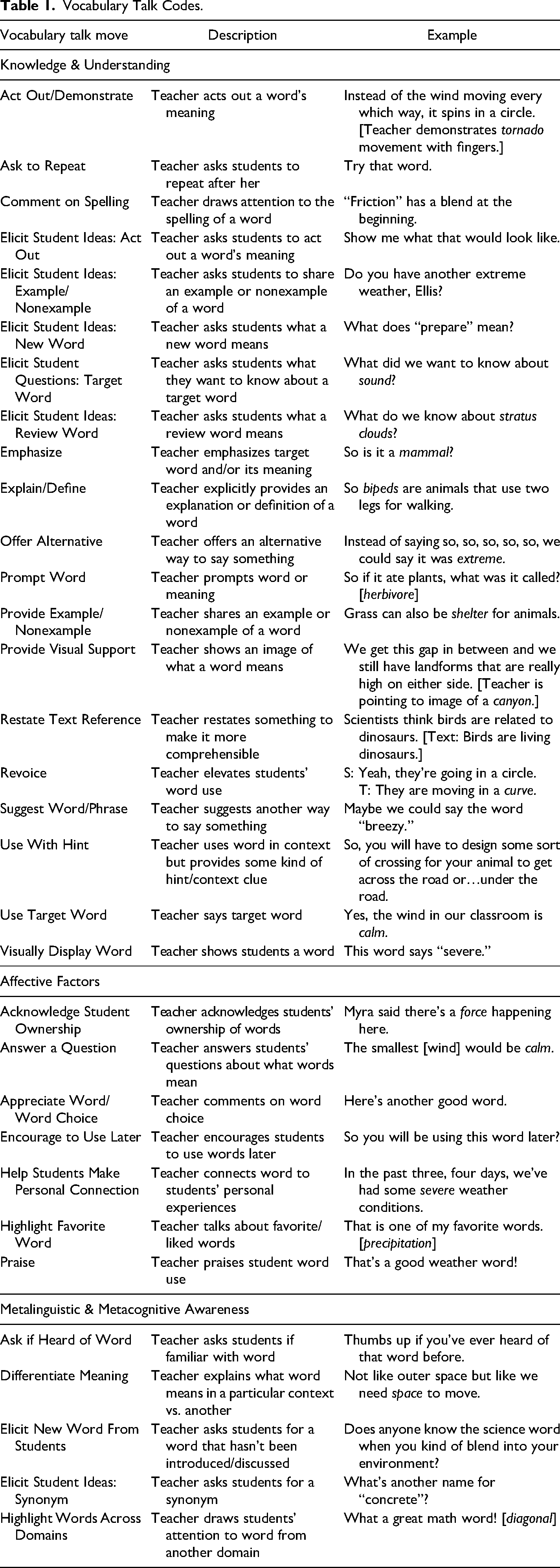
To validate our codes, the first author worked with a research assistant who was familiar with the context of the lessons and research on effective vocabulary instruction. We independently coded five of the 24 lessons (20.83% of the data). Codes matched with 89.46% agreement. Through discussion, we came to consensus on discrepancies and revised the codebook to reflect these decisions. The first author then coded the remaining lessons using this finalized codebook. See Table 1 for a description and example of each VTM.
Vocabulary Talk Codes.
During these two cycles of coding, we established relationships between VTMs (see Appendix A). Because repeated exposures to words in multiple contexts supports children with learning words (Stahl & Fairbanks, 1986), it was important to capture teachers’ use of words that had been targeted for instruction (see Appendix B). We defined a target word as a word related to science learning that the teacher seemingly targeted for instruction by bringing students’ awareness to the word and its meaning, such as by explaining or defining it. After determining which codes established a word as a target word (see “Identifying Target Words” in Appendix A), we then determined which VTMs were “Affiliated With Target Words” (i.e., only applied to utterances relating to established targeted words) and which were “Unaffiliated With Target Words” (i.e., including but not limited to utterances related to target words). These distinctions among VTMs allowed us to capture both VTMs focused on conveying the meaning of specific science-related terms and those supporting overall vocabulary development.
After analyzing the data set for types of VTMs, we then completed an analysis to identify the functions of the VTMs (Boyd & Markarian, 2015). We grouped VTMs by function (e.g., “Moves That Convey Meaning of Words”) and then categorized these grouping as either authoritative (teacher telling) or dialogic (inviting student exploration and engagement; Boyd et al., 2019).
Findings
Drawing from theoretical (Vygotsky, 1986) and empirical (e.g., Dickinson & Porche, 2011) work establishing a relationship between adults’ speech and children's vocabulary development, we examined teacher–student oral language interactions to better understand how teachers use language to promote word learning. We found that, collectively, teachers used 32 different VTMs that carried out eight different functions in support of the three different types of vocabulary talk.
Types of Vocabulary Talk
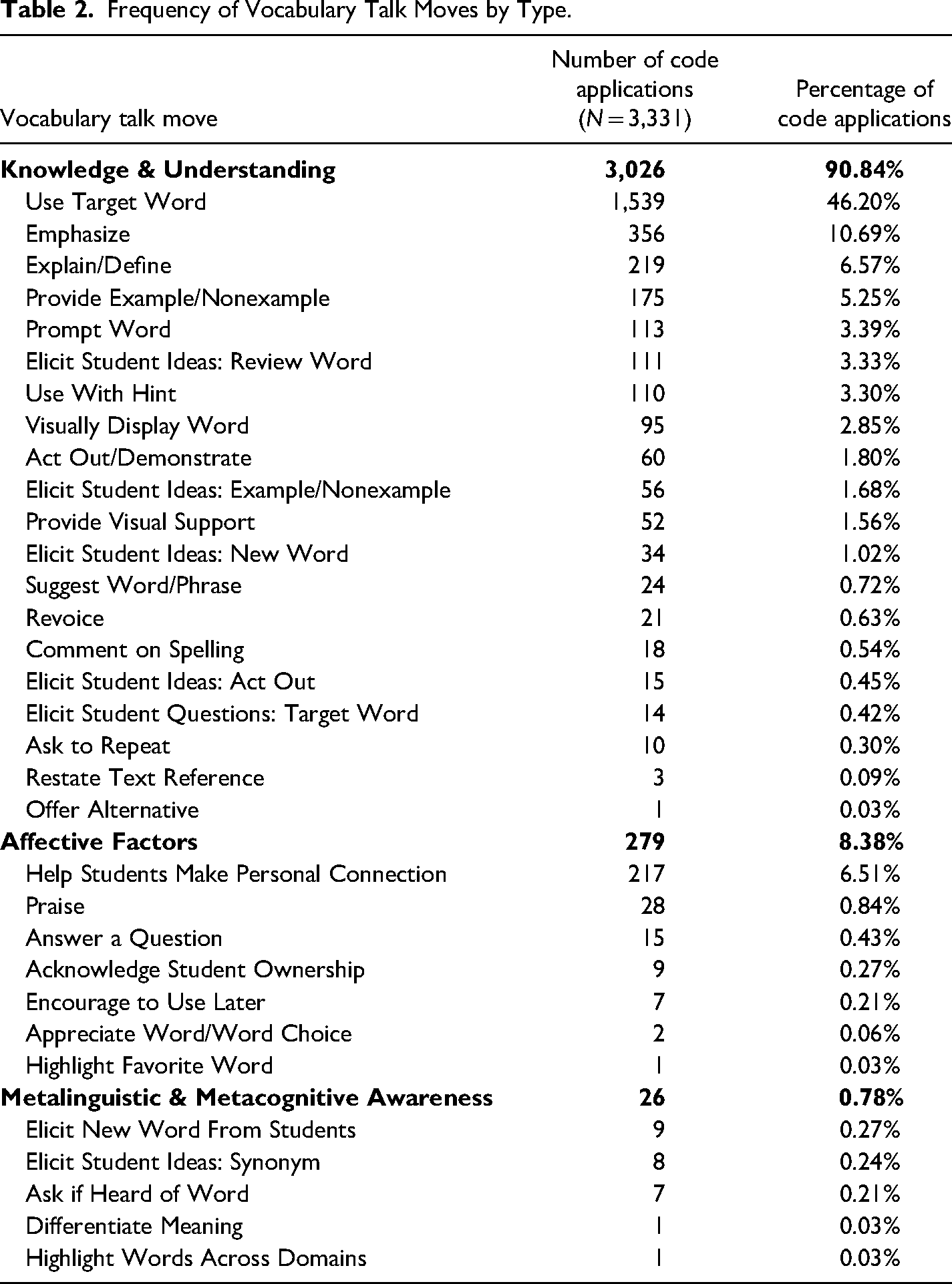
Table 2 shows the total number of times each VTM code was applied across all eight teachers and all 24 total video recordings. This table is organized with one section for each type of vocabulary talk, appearing in descending frequency of occurrence within the data set. Within each type of talk, specific VTMs appear in descending frequency of occurrence.
Frequency of Vocabulary Talk Moves by Type.
Knowledge & Understanding
As shown in Table 2, teachers used Knowledge & Understanding VTMs most frequently (90.84% of total code applications). Within this type of vocabulary talk, teachers used 20 different VTMs aligned with the research on building students’ knowledge of word meanings. The most frequently occurring Knowledge & Understanding VTM was using a target word (46.20%), which was also the most frequently occurring VTM overall—across all three types of vocabulary talk. The second most frequently occurring Knowledge & Understanding VTM was emphasizing a target word and/or its meaning, which was also the second most frequently occurring VTM overall (10.69%). The next most frequently occurring Knowledge & Understanding VTMs were explaining/defining a word (6.57%) and providing an example/nonexample of a word (5.25%). Teacher utterances were coded for each of these types of vocabulary talk when the teacher provided the explanation/definition or example/nonexample or when the teacher confirmed the accuracy of an explanation/definition or example/nonexample, such as when provided by a student. The following example shows how these VTMs looked in typical classroom interactions: Ms. Thompson: So “prepare” means “get ready.”
Ms. Thompson: What do you have to do to get ready for that extreme weather we had yesterday?
teacher emphasizes “get ready” and “extreme”
…
Ms. Thompson: You know what I did to prepare?
teacher emphasizes “prepare”
Ms. Thompson: Before the weather, before the severe weather came?
teacher emphasizes “severe”
Ms. Thompson: I went to the grocery store.
Ms. Thompson: And I made sure I had enough food at home.
In this example, Ms. Thompson (all names are pseudonyms) used the target words “extreme,” “prepare,” and “severe.” Using target words repeatedly provides students with multiple exposures to the words, as is evident in this example. Ms. Thompson often drew attention to target words by emphasizing them or their meaning. In this example, she provided a child-friendly explanation of the word “prepare”: get ready. She followed this explanation by actively engaging students in sharing examples of how they had recently prepared for severe winter weather and providing an example of how she prepared.
Teachers used 16 additional Knowledge & Understanding VTMs. For example, teachers used a word in context along with a hint, as when Ms. Henderson hinted, “So, you will have to design some sort of crossing for your animal to get across the road or … under the road.” Teachers sometimes acted out or demonstrated the meaning of a word while saying the word. For instance, Ms. Thompson demonstrated pulling while explaining, “If someone's pulling something, they’re moving it closer to themselves.” Teachers also provided visual support to illustrate the meaning of a word at times, as when Ms. Hill pointed to a photograph of the target word “canyon” and explained, “We get this gap in between and we still have landforms that are really high on either side.” (See Table 1 for examples of all VTMs.)
In summary, teachers used language during science instruction in many ways that are aligned with the research on building students’ knowledge of word meanings. These early-elementary teachers used many research-based vocabulary practices outside of literacy instruction. This alignment with research on how children learn words suggests that teachers likely promoted students’ vocabulary development with these Knowledge & Understanding VTMs.
Affective Factors
Teachers used Affective Factors VTMs with the second greatest frequency (8.38%). Within this type of vocabulary talk, teachers used seven different VTMs aligned with the theory and research on interesting students in words and word learning. Connecting to students’ personal experiences was the most frequently occurring Affective Factors VTM and the fourth most frequently occurring VTM overall (6.51%). The following example shows Ms. Henderson helping her young 5s students connect the target words “arrangement,” “water,” “food,” “shelter,” and “space” to the familiar context of their own classroom: Ms. Henderson: In our classroom we have an arrangement. [
teacher emphasizes “arrangement” and points around room
…
Ms. Henderson: Our water supply is right there. [
teacher points off camera
…
Ms. Henderson: Our food supply is in our cubby. [
teacher points in a different direction, off camera
…
Ms. Henderson: Our shelter is where we’re at, right? [
teacher emphasizes “shelter” and points in a circle around the room
Ms. Henderson: Our space is kind of small. [
Ms. Henderson: But for just being at school, we have enough space. [
In this example, Ms. Henderson helped students make personal connections to each term. While “food” and “water” are already familiar to 5-year-olds, “arrangement” and “space” are likely less familiar. By encouraging students to think of their food and water supplies, the adequacy of their space, their shelter, and how everything they need is arranged so that they do not need to leave the classroom, Ms. Henderson helped students connect to—and likely better understand—these target words. Students may have been more motivated to understand and use these words upon making these connections. Although helping students make personal connections often co-occurred with Knowledge & Understanding VTMs (e.g., providing an example/nonexample), as highlighted in this example, we based our coding on previous research by Neugebauer et al. (2017) that identified moves that connect words to students’ personal experiences and/or ask them to think about words in the context of their own personal experiences as affective talk. Because not all instances of providing examples/nonexamples helped students make personal connections, keeping these as distinct codes enabled us to better capture this nuance in teachers’ language use.
Teachers used six additional Affective Factors VTMs, including the move of praising student word use. For example, Ms. Thompson responded to a kindergartner's comment “My prediction is at yellow” by saying, “Oh, I love hearing the word ‘prediction.’” Teachers also answered students’ questions about what words mean or what a word for something is. For instance, a kindergarten student asked what a flood was, and Ms. Thompson explained, “A flood is when too much rain falls and there's kind of nowhere for it to go.” Teachers acknowledged students’ “ownership” of words by attributing words to the students who used them when sharing their ideas, as when Ms. Thompson noted, “Myra said there's a force happening here.” Teachers sometimes encouraged students to use a word at a later time, such as when Ms. Hill instructed, “This [‘insulating’] is the first big word we’re going to write down because you’re going to use it today.” Teachers occasionally showed appreciation for a word or word choice encountered within a lesson from a source other than students. For example, in response to Weather Conditions as the title of a read-aloud text, Ms. Nelson exclaimed, “Oooh, that's a fancy word.” Finally, the move of highlighting a favorite word was used once, when Ms. Nelson said, “That [‘precipitation’] is one of my favorite words.”
In summary, teachers used some language during science instruction in ways that are aligned with theory and research on interesting students in words and word learning. However, Affective Factors VTMs occurred infrequently overall, suggesting this was not a focus of vocabulary instruction during science lessons.
Metalinguistic & Metacognitive Awareness
Finally, teachers used Metalinguistic & Metacognitive Awareness VTMs least frequently (0.78%). Within this type of talk, teachers used five VTMs aligned with the research on increasing students’ awareness of words and word learning. Eliciting a new word from students was the most frequently occurring Metalinguistic & Metacognitive Awareness VTM (0.27%). The following example illustrates this move, as Ms. Nelson elicits the new word “camouflage” from her kindergartners: Ms. Nelson: The um, squirrel kind of blends in a little bit.
Child(ren): Yeah.
Ms. Nelson: What do we call that?
Ms. Nelson: Does anyone know the science word when you kind of blend into your environment?
Ms. Nelson: Ellis, do you know?
Child(ren): Um, camouflage.
Ms. Nelson: Camouflage.
In this example, Ms. Nelson asked if students knew a word for the concept she was describing. Here, students were familiar with the concept and the VTM served to link the concept with a technical term.
Additionally, teachers occasionally elicited a synonym for a target word from students, such as when Ms. Thompson asked, “What's another word you could use instead of ‘movement’?” They also asked students if they had heard of a word. For example, Ms. Thompson asked, “Who has heard of that word [‘friction’] before?” Two moves appeared only once in the data set. Ms. Henderson differentiated the meaning of a word from one context versus another when she explained, “Not like outer space but like we need space to move.” Finally, Ms. Nelson highlighted a word from across domains when she remarked, “What a great math word [‘diagonal’]!”
Although the research on building students’ metalinguistic and metacognitive awareness recommends instruction that teaches students to use contextual and morphemic analysis (Baumann et al., 2003; Wise, 2019), explain how word meanings are derived from context (Cain, 2007), detect semantic ambiguity (Zipke et al., 2009), and self-monitor (Lubliner & Smetana, 2005), the present study shows that such instruction was largely absent in these early-elementary science lessons.
Functions of Vocabulary Talk
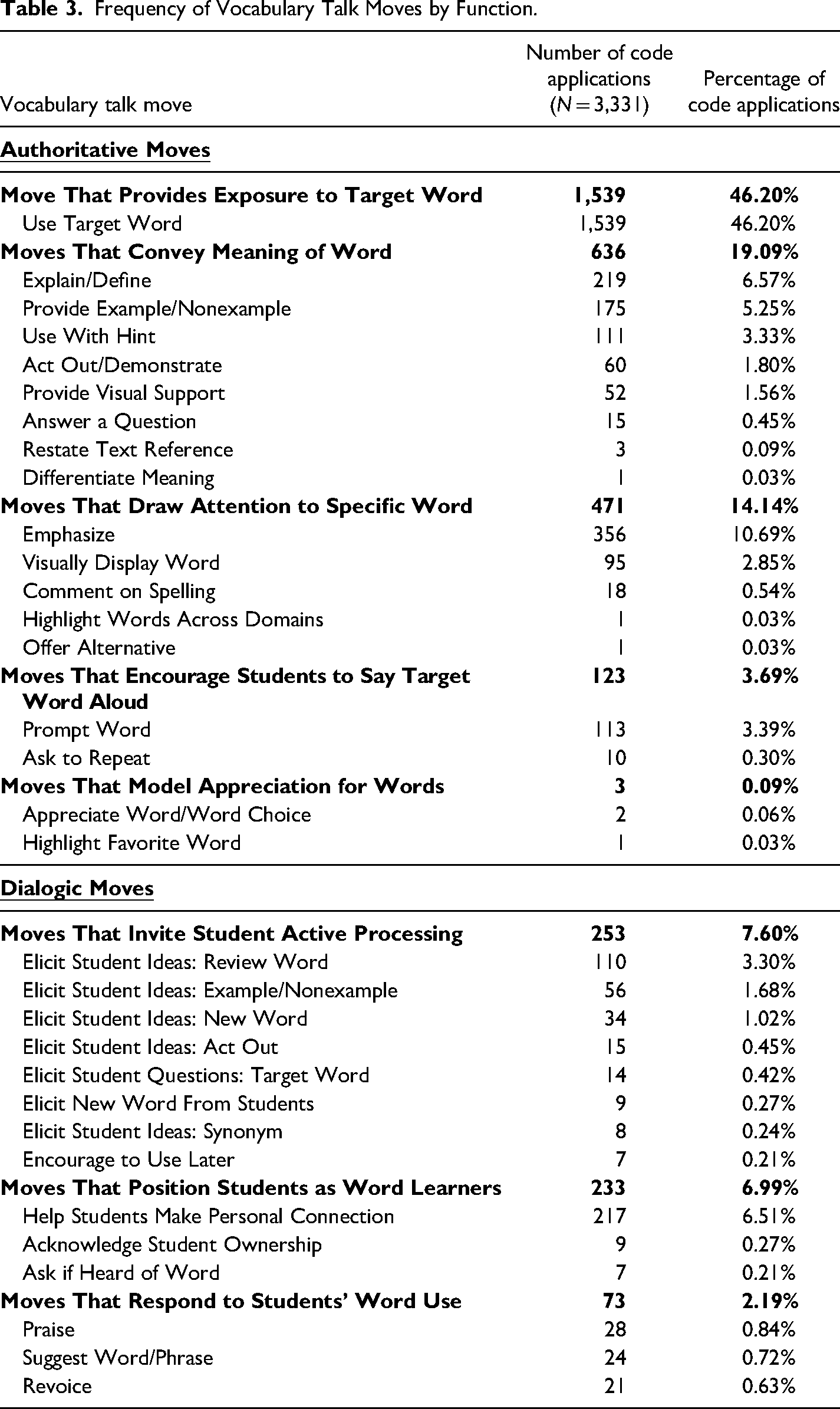
Table 3 shows the total number of times each VTM code was applied across all eight teachers and all 24 total video recordings, organized by the eight functions of the VTMs. This table is divided into two sections: authoritative moves and dialogic moves. Each section is organized by function of talk, appearing in descending frequency of occurrence within the data set. Within each function, specific VTMs appear in descending frequency of occurrence.
Frequency of Vocabulary Talk Moves by Function.
Authoritative Talk
Teachers engaged in considerably more authoritative talk (83.22%) than dialogic talk (16.78%). Authoritative moves are characterized by teacher telling (Boyd et al., 2019), and five different talk functions comprised this talk. Notably, talk serving to provide exposure to target words occurred most frequently (46.20%). This function was carried out by one VTM, using target words, such as when Ms. Howard told her second graders, “So we’re about to find out the material you’re going to use for our inventions.” Moves conveying the meaning of words occurred second most frequently (19.09%). Eight different VTMs carried out this function. For example, Ms. Henderson conveyed the meaning of the word “biped” to her young 5s by explaining, “So biped [sic] are animals that used two legs for walking.” She further conveyed the meaning by providing an example: “So we [humans] are bipeds.” Moves that served to draw attention to specific words occurred third most frequently (14.14%). As Table 3 shows, five different VTMs were used to carry out this function. For example, Ms. Baker drew attention to the target word “force” by emphasizing it when she said, “Well, might need to adjust our force.” Similarly, Ms. Hill drew attention to the word “insulating” by writing it on the board (i.e., visually displaying the word) when stating, “I’m going to put it here because chances are, you are going to use this in your writing later.” Next were moves encouraging students to say target words aloud (3.69%). Two VTMs carried out this function, such as when Ms. Nelson prompted students to say the word “temperature” aloud: “When the meteorologist checks the weather, they talk about precipitation, the clouds, the wind, and the what, Avery?” Additionally, Ms. Henderson encouraged students to say the target word “sauropod” aloud when she asked, “Can you say that word?” Finally, moves that served to model appreciation for words were used least frequently (0.09%). Two VTMs carried out this function, such as when Ms. Thompson showed appreciation for the term “extreme” by saying, “Here's another good word.” Likewise, Ms. Nelson modeled appreciation for the word “prediction” by noting: “That is one of my favorite words.” Therefore, teachers predominantly engaged in authoritative talk, using 18 different VTMs to carry out five different talk functions. An emphasis on teacher telling suggests that children's word-learning experiences within early-elementary science instruction are largely passive.
Dialogic Talk
As Table 3 shows, teachers engaged in considerably less dialogic talk (16.78%). Dialogic talk is characterized by inviting student exploration and engagement and responding in a contingent manner that is reflective of the talk of others (Boyd et al., 2019; Mortimer & Scott, 2003). This kind of talk was accomplished through three different talk functions. Moves inviting student active processing occurred most frequently within the dialogic talk data (7.60%). Eight different VTMs carried out this function. For instance, Ms. Thompson invited active processing by eliciting examples from students about how to prepare: “Tell me what you would need to prepare to go outside in this weather.” Relatedly, Ms. Baker invited active processing by eliciting students’ ideas for acting out the meaning of “push”: “What would that force look like?” Moves that served to position students as word learners occurred second most frequently within the dialogic talk data (6.99%). Three VTMs carried out this function. For example, Ms. Griffin positioned a student as a word learner when she acknowledged the student's ownership of the word “blend”: “That word that Micah used earlier: ‘blend.’” Similarly, Ms. Thompson positioned students as word learners when, after a week without school due to snow days, she asked if anyone had heard the word “severe” recently: “Have you heard anybody say that on the news?” Finally, moves that served to respond to students’ word use were used least frequently within the dialogic talk data (2.19%). Three VTMs carried out this function. For example, in response to a young 5 student's statement that a brown bear has less “wool” than a polar bear, Ms. Henderson revoiced the statement using the term “fur” in place of “wool.” Similarly, Ms. Hill responded to a student's use of the word “insulating” in her writing by praising, “Hannah used the word; she used ‘insulating.’” As these examples show, teachers encouraged some dialogic talk with their VTMs, carrying out three different talk functions with 14 different moves; however, opportunities for active vocabulary learning were quite limited within these early-elementary science lessons.
These findings demonstrate that teachers engaged in both authoritative and dialogic talk; however, a majority of teacher talk was authoritative, characterized by teacher telling rather than inviting student exploration and engagement. This finding suggests that within science lessons in early-elementary classrooms, there may be missed opportunities to bring together students’ ideas and actively engage them in word learning.
Discussion
The purpose of this study was to examine how teachers use language to promote vocabulary development during science instruction in the early-elementary grades. Our objectives were to identify specific VTMs and examine the function of those moves. We found that teachers used all three types of vocabulary talk during science instruction; however, they engaged in considerably more Knowledge & Understanding vocabulary talk (over 90%) than Affective Factors or Metalinguistic & Metacognitive Awareness talk. Similarly, teachers engaged in considerably more authoritative (over 80%) than dialogic talk.
We were interested to see which practices from the research on vocabulary learning would be present in science lessons. Predictably, teachers engaged most frequently in Knowledge & Understanding vocabulary talk, as understanding the meanings of words is at the heart of vocabulary development and far more studies have explored instructional practices for building students’ knowledge of word meanings than building students’ interest in or awareness of words and word learning. The present study shows that these teachers used language during science instruction in many ways (20 different VTMs) that are aligned with the research on building students’ knowledge of word meanings. This is promising for both literacy and science learning in the early-elementary grades because this suggests that teachers can build young children's vocabulary knowledge across content areas.
Notably, Affective Factors VTMs were used second most frequently. This type of vocabulary talk is based in the theory of word consciousness (Anderson & Nagy, 1992; Scott & Nagy, 2004), and to our knowledge, only one study has directly examined the specific impact of instruction that addresses affective factors on students’ vocabulary development. As Neugebauer et al. (2017) found, the teachers in the present study reinforced students’ word use (i.e., praise) and helped them make personal connections. Additionally, we found that teachers answered students’ questions about word meanings, celebrated students’ word use by acknowledging their “ownership” of words, encouraged students to use target words beyond the context of initial instruction, modeled appreciation for words and word choice, and modeled enjoyment of favorite words.
While it is promising that teachers engaged in Affective Factors talk, across the data set, this talk accounted for less than 9% of total vocabulary talk code applications, suggesting that interesting students in words and word learning was not a primary focus of teachers’ vocabulary instruction during science lessons. Similarly, Nelson et al. (2015) found that only a small percentage (1.60%) of K–3 teachers’ vocabulary instruction during the language arts block was devoted to promoting word consciousness (defined as playing word games, participating in word play, and using figures of speech). This lack of instruction focused on interesting students in words and word learning may be because these affective aspects of word learning are not as well researched as teaching students the meanings of individual words. Teachers may not be as familiar with this objective of vocabulary instruction, may not have instructional strategies to meet this objective, or may not be convinced of its importance. Further research is needed to examine the relationship between Affective Factors VTMs and students’ vocabulary development and to establish recommendations for what an ideal amount of instruction focused on Affective Factors would be.
Finally, Metalinguistic & Metacognitive Awareness VTMs accounted for less than 1% of total vocabulary talk code applications. While only a few of the studies examining instruction focused on developing metalinguistic and metacognitive awareness have taken place within the context of early-elementary classrooms (Cain, 2007; Freeman et al., 2019; Nash & Snowling, 2006; Wise, 2019), their findings point to the need for this kind of instruction in order to set young students on a path toward becoming independent word learners. As Wise (2019) argued, skills such as noticing unfamiliar words are important because they may support students’ incidental word learning. The lack of Metalinguistic & Metacognitive Awareness talk in the present study is consistent with observational studies of vocabulary instruction in ELA contexts (Nelson et al., 2015; Scott et al., 2003; Silverman et al., 2014; Watts, 1995). It may be that teachers are unaware or unconvinced of the importance of promoting students’ metalinguistic and metacognitive awareness. This points to the need for PD focused on developing students’ metalinguistic and metacognitive awareness—including within science instruction in the early-elementary grades. Further research is needed to establish recommendations for what an ideal amount of instruction focused on Metalinguistic & Metacognitive Awareness would be.
As with types of talk, the function of talk analysis revealed an imbalance in vocabulary talk. Teachers most frequently used authoritative moves, characterized by teacher telling, compared to dialogic moves, characterized by inviting student exploration and engagement (Boyd et al., 2019; Mortimer & Scott, 2003). A common finding in observational studies is that teachers do most of the talking within a classroom (Nystrand, 2006; Silverman et al., 2014), and it was evident that teachers in the present study did more talking related to vocabulary than their students. This may be related to the infrequent use of moves serving to invite student exploration and engagement with word learning. As many studies have shown that engaging students in active processing promotes word learning (Stahl & Fairbanks, 1986), this suggests another area for PD.
Further, science educators emphasize the importance of student talk for encouraging children's sensemaking (Benedict-Chambers et al., 2017; Chen et al., 2017) and providing equitable opportunities for children to participate in science learning (Chen et al., 2016; Menninga et al., 2017). They advocate for word-learning experiences to be dialogic, as students bring together and share their ideas while engaging with phenomenon (Gotwals et al., 2022; Haverly et al., 2021; Lee et al., 2013; National Academies of Sciences, Engineering, and Medicine, 2021; Wright, 2020). The present study suggests there are opportunities for this kind of engaged vocabulary learning within science instruction; however, teachers engaged in dialogic talk infrequently. Therefore, early-elementary teachers may still need support in shifting toward more dialogic vocabulary talk during science instruction (Gotwals et al., 2022).
There are several limitations to this study. First, all eight teachers identified as white/European American females, and they primarily taught white/European American students in a rural setting—none of whom were learning English as an additional language. This limits the generalizability of our findings to other contexts. Additionally, this study was unable to examine the ways that VTMs in science were linked to children's vocabulary, science, or literacy outcomes. Future research should investigate these potential relationships. Many teachers used the same curriculum materials, and these materials may have influenced the vocabulary talk in classrooms. Finally, our analysis specifically focused on vocabulary talk; however, future research should examine additional types of talk for ways literacy and science learning may be supported through teachers’ oral language interactions with students.
Given these limitations, this study shows that there are important opportunities for teachers to promote vocabulary development during early-elementary science instruction. Even with young learners, teachers can and do use language in research-aligned ways outside the context of literacy instruction to build students’ knowledge of word meanings during science instruction. The present study adds to the research base that has established science instruction as a rich context for vocabulary development (Gotwals & Wright, 2017; Wright & Gotwals, 2017; Wright & Neuman, 2014). This is especially important because science instruction is limited at the elementary level—often to make time for more literacy instruction (Plumley, 2019). However, it is critical for educators to understand that literacy learning is limited when students are not given the opportunity to develop vocabulary within the rich context provided by science instruction or to deepen science understandings that would provide valuable background knowledge to support text comprehension. Both vocabulary knowledge and background knowledge play pivotal roles in students’ reading comprehension (Kintsch, 2013); therefore, focusing instructional time on literacy at the expense of science instruction for the purpose of promoting literacy learning, in reality, is to the detriment of both literacy and science learning.
Supplemental Material
sj-docx-1-jlr-10.1177_1086296X231163117 - Supplemental material for Teachers’ Vocabulary Talk in Early-Elementary Science Instruction
Supplemental material, sj-docx-1-jlr-10.1177_1086296X231163117 for Teachers’ Vocabulary Talk in Early-Elementary Science Instruction by Blythe E. Anderson, Tanya S. Wight and Amelia Wenk Gotwals in Journal of Literacy Research
Supplemental Material
sj-docx-2-jlr-10.1177_1086296X231163117 - Supplemental material for Teachers’ Vocabulary Talk in Early-Elementary Science Instruction
Supplemental material, sj-docx-2-jlr-10.1177_1086296X231163117 for Teachers’ Vocabulary Talk in Early-Elementary Science Instruction by Blythe E. Anderson, Tanya S. Wight and Amelia Wenk Gotwals in Journal of Literacy Research
Supplemental Material
sj-docx-3-jlr-10.1177_1086296X231163117 - Supplemental material for Teachers’ Vocabulary Talk in Early-Elementary Science Instruction
Supplemental material, sj-docx-3-jlr-10.1177_1086296X231163117 for Teachers’ Vocabulary Talk in Early-Elementary Science Instruction by Blythe E. Anderson, Tanya S. Wight and Amelia Wenk Gotwals in Journal of Literacy Research
Supplemental Material
sj-docx-4-jlr-10.1177_1086296X231163117 - Supplemental material for Teachers’ Vocabulary Talk in Early-Elementary Science Instruction
Supplemental material, sj-docx-4-jlr-10.1177_1086296X231163117 for Teachers’ Vocabulary Talk in Early-Elementary Science Instruction by Blythe E. Anderson, Tanya S. Wight and Amelia Wenk Gotwals in Journal of Literacy Research
Supplemental Material
sj-docx-5-jlr-10.1177_1086296X231163117 - Supplemental material for Teachers’ Vocabulary Talk in Early-Elementary Science Instruction
Supplemental material, sj-docx-5-jlr-10.1177_1086296X231163117 for Teachers’ Vocabulary Talk in Early-Elementary Science Instruction by Blythe E. Anderson, Tanya S. Wight and Amelia Wenk Gotwals in Journal of Literacy Research
Supplemental Material
sj-docx-6-jlr-10.1177_1086296X231163117 - Supplemental material for Teachers’ Vocabulary Talk in Early-Elementary Science Instruction
Supplemental material, sj-docx-6-jlr-10.1177_1086296X231163117 for Teachers’ Vocabulary Talk in Early-Elementary Science Instruction by Blythe E. Anderson, Tanya S. Wight and Amelia Wenk Gotwals in Journal of Literacy Research
Footnotes
Declaration of Conflicting Interests
The author(s) declared no potential conflicts of interest with respect to the research, authorship, and/or publication of this article.
Funding
The author(s) disclosed receipt of the following financial support for the research, authorship, and/or publication of this article: This work was supported by the International Literacy Association Steven A. Stahl Research Grant and the National Science Foundation (grant number 1620580).

Supplemental Material
The online supplementary materials and abstracts in languages other than English are available at http://journals.sagepub.com/doi/suppl/10.1177/1086296X231163117
References
Supplementary Material
Please find the following supplemental material available below.
For Open Access articles published under a Creative Commons License, all supplemental material carries the same license as the article it is associated with.
For non-Open Access articles published, all supplemental material carries a non-exclusive license, and permission requests for re-use of supplemental material or any part of supplemental material shall be sent directly to the copyright owner as specified in the copyright notice associated with the article.
