




Abstract
The purpose of the present article is to attend to the theoretical and methodological implications of expanding a view of geosemiotic to include a social geography lens. A Geosemiotics
Keywords
Literacy events are shaped by and produced through the material and spatial resources that are readily available to children. As Rowe (2010) described, children use objects in place as cultural tools for forming intentions appropriate to local literacy events. As children learn to participate in literacy events, “what is ‘at hand’ becomes more and more that which the culture values and therefore makes readily available” (Kress, 2005, p. 13). Therefore, literacy objects in place represent not only the local literacy events but also the socially constructed globalized literacy practices communicated by these places, as “places bring together people who engage in a common activity, may share a particular history, or identify with a locality in a particular way” (Taylor & Phillips, 2017, p. 594). Understanding the material and spatial decisions of place provides a window into the literacy practices upheld by those sponsoring the literacy events (Brandt, 2001). One must look no further than the objects in place in a preschool classroom prior to the 1980s, when introducing books, paper, and crayons into an early childhood setting was unheard of (Schickedanz & Collins, 2013), to recognize that literacy objects in place convey the social norms of literacy practices, both culturally and historically defined. This article presents one methodological possibility seeking to understand the ways in which literacy places and spaces impact and are impacted by literacy events and practices.
Literacy places are twice-constructed—first by the sponsors who design them, and then by the persons who interpret and experience them (Taylor & Phillips, 2017). In part, places are designed by the objects emplaced there, and objects also carry an ideological load formed in other events in which they have historically been used (Brandt & Clinton, 2002). As an example, consider the use of basal programs in first-grade classrooms. If 80% of the included lessons focus on decoding strategies and only 20% address meaning-making, the teachers’ manual is an object in place in the first-grade classroom that carries an ideological load formed by those sponsoring the literacy events of the classroom, or those in a position to make decisions about the ways in which literacy is (or is not) seen as a tool for social change. Therefore, design decisions in the construction of place impact how these places are interpreted and experienced. Literacy places are distinct from spaces. Space communicates the possibility for the intersection of minds, bodies, and environments, but places are the points at which these intersections are realized (Taylor & Phillips, 2017).
Literacy spaces are also ideologically loaded, but in more bidirectional ways, that both reflect and shape local literacy practices. As such, literacy spaces frame interactions in physical, spatial, and social ways. Investigations of literacy spaces are not simply amplifications of the role of context in literacy events or practices, but rather are more complete and nuanced interpretations of literacy places as built through ongoing interactions, engagements, and practices. The foregrounding of “space in literacy studies provides valuable connections between the materiality of literacy and its flows in the new times” (Mills, Comber, & Kelly, 2013, p. 420). Foucault (1981) and then Soja (1989) challenged the exclusion of space in the consideration of mediation, purporting space as both producing and productive of social interaction. Lefebvre (1991) further heightened the importance of space in social interaction, theorizing that space itself is a social production, therefore, warranting the examination not only of things in place but also of the production of space through social science inquiry. Over the past few decades, there has been a renewed focus on literacy space by literacy researchers, particularly drawing on Lefebvre’s (1991) work. Spatialized contemporary literacy investigations affirm social geographers’ assertion that “space matters” (Soja, 2004, p. i). Therefore, a shift in attention from one of only discourses in place to an expanded notion of the social production of space demands a shift in methodological approaches to understanding such production.
For example, geosemiotics, or the study of signs/discourses in place to understand meaning-making in the physical world (as presented by scholars such as Scollon & Scollon, 2003) is a promising approach to understanding the role of place in literacy interactions. However, a geosemiotic approach must be complemented by (re)presentations of space-as-socially produced as methodological and theoretical considerations of place evolve beyond static representations of place-as-context. It “no longer seems sufficient to conceive space as a neutral container of talk and place merely a location where language is sampled” (Lou, 2017, p. 514) when the construct of context is viewed dialogically (Duranti & Goodwin, 1992). Space is socially constructed by language in its various modalities and material forms and at its relationship with other semiotic resources, such as visual display and spatial arrangement (Lou, 2017). It is the complexity of relationships—between the interaction order, the discourses, the semiotic aggregate, and the material resources in place—that comprises space. Thus, geosemiotic approaches capture the elements that compose the relationship; social geography attends to the complexities of the relationship.
Although literacy scholars have taken up social geography and geosemiotic approaches over the last few decades for different and separate purposes, the utility of a geosemiotic approach when complemented by the lens of social geography affords a more complete investigation of the dialogic relationship between place and space. Whereas until now geosemiotics and social geography have served as different and separate lenses, place and space are different but related constructs. For literacies researchers, meaning-making that produces places can be studied through geosemiotics, an analytical method for considering how places are produced through literacy interactions—the intersections of semiotic systems, people, and resources for meaning-making. From a social geography perspective, understanding space as socially constructed through these dynamic and discursive intersections affords analytical attention to these intersections. A geosemiotics
The purpose of this article is to attend to the theoretical and methodological implications of complementing a geosemiotic analysis of place with a social geography theory of space to more fully attend to the role of the social, the physical, and the spatial by “trying on” spatial analyses to further uncover the affordances Lefebvre’s social geography can offer to a geosemiotic investigation. I begin with a brief history of geosemiotics, describing place semiotics specifically, and advocate for the complementary considerations of place and space using social geography. I then describe and illustrate the ways an application of a geosemiotics
Geosemiotics as a Theory and a Method
Making sense of the representational spaces that overlay the material world begins with the study of signs and discourses of action in the material world. Per sociolinguists Scollon and Scollon (2003), “there is a social world presented in the material world through its discourses—signs, structures, other people, and our actions produce meanings in the light of those discourses” (p. 1). Geosemiotics is a place-based semiotic interpretation, primarily concerned with ways these discourses, or signs, are indexed in the world. Signs take the form of an icon (a sign resembling the object it represents), an index (a sign pointing to or referencing an object), or symbol (a sign arbitrarily representing an object). Sign categories are not mutually exclusive but can work together to represent meaning. All signs have indexicality in that the meaning they embody is influenced by this place at this time in this space. Therefore, sign placement in the real world is in contiguity with other objects in the real world (see Collins & Slembrouck, 2007).
Discourses in Place
Scollon and Scollon’s (2003) place-based approach to semiotics offers some methodological insight for investigating these constructs empirically. Influenced by the traditions of linguistic anthropology (Goffman, 1981), conversation analysis (Bourdieu, 1990), and social semiotics (Halliday, 1978; Kress, 2010), Scollon and Scollon (2003) defined geosemiotics as three systems interconnected at the site of social action—interaction order, visual semiotics, and place semiotics—to investigate the shift from abstract meaning to real-world meaning through the property of indexicality (e.g., a stop sign carries real-world meaning for pedestrians and motorists when placed at a highway intersection but only abstract meaning when located on a truck en route to said intersection). Interaction order represents embodied forms of discourse; visual semiotics explores disembodied forms of discourse; and place semiotics investigates the indexicality of discourses in time and space. Prior to work proposing a geosemiotic perspective, analytic attempts have foregrounded one of these three systems whereas the other two have served as “context.” Geosemiotics instead integrates the three to “form the meaning which we call place” (Scollon & Scollon, 2003, p. 12).
Interaction order
Grounded in Goffman’s (1981) work, the interaction order of geosemiotics can be defined as the indexability that is provided by the configurations of social interactions within a social scene. Each type of social interaction is a recognizable way of being with others in the social space; these ways of being represented agree upon social arrangements that maintain a sort of social interaction. Bodies take up space, and their positions communicate meaning to people around them, as they are an object in their world. Therefore, our bodies make and give off meaning read by others because of where they are and what they are doing in space. For example, our posture, movement, sense of time, and interpersonal distance are all semiotic resources communicating meaning through the interaction order (Goffman, 1981).
Visual semiotics
Heavily grounded in Kress and van Leeuwen’s (1996) work, visual semiotics is concerned with the representations of interaction order in images and signs, analyzing the compositional structures of visual images as they represent different forms of social interaction. Because visual semiotics are culturally specific, the understanding of the semiotic resources at play in any given sign or situation relies heavily on ethnographic investigations as well as visual documentation. The geosemiotic interest in visual semiotics is at once concerned with how the interaction order is represented visually (per Kress and van Leeuwen’s construct), as well as how the placement of the visual symbol in space influences its meaning. Visual semiotics explains how images represent the social world, whereas the indexicality of visual semiotics explains how images embody meaning because of the physicality of where they are encountered.
Place semiotics
The central thesis of geosemiotics is that where an action takes place is an important part of its meaning (Scollon & Scollon, 2003). The physicality of place serves as a semiotic resource to inform the interaction order, social production of space as described by Lefebvre (1991) and others: Everyone knows what is meant when we speak of a “room” in an apartment, the “corner” of the street, a “marketplace,” a shopping or cultural “centre,” a public “place,” and so on. These terms of everyday discourse serve to distinguish, but not to isolate, particular spaces and in general to describe a social space. They correspond to a specific use of that space, and hence to a spatial practice that they express and constitute (p. 16).
The place itself is a sign and communicates meaning—both the socially accepted affordances of a space and its social meaning.
For example, a lecture hall is well designed for hearing lectures, and therefore, hearing a lecture is the social practice people expect when they enter. One knows one is in a classroom because one sees a chalkboard, desks, bulletin boards, and books, for example. However, a lecture hall in an elite university also indexes a social group that attends that university (A. Lefstein, personal communication, April 2016). When “read” together, each of these signs forms a place signaling what sort of activity might be done in this space. Many kinds of social interactions are supported or encouraged by the built environment of a classroom, and these are different from the social interactions supported or encouraged by an airport hangar or an elevator, for example. There are preferred conditions for different social arrangements, existing on a continuum of relatively open, socially available spaces to relatively closed and tightly defined spaces. Therefore, a place semiotic analysis focuses on the types of social interaction supported or encouraged by this place.
Geosemiotics in Literacy Research
There is no single method for adopting a geosemiotic lens, but combining qualitative methods of an ethnographic tradition with the multimodal documentation of interactions, texts, spaces, and pathways provides researchers with the basis for analysis and interpretation (Nichols, Nixon, & Rowsell, 2011). Scholars of early literacy have applied geosemiotics to investigate the situatedness of signs and discourses as dynamic resources for the development of early literacy practices, as they are “lived” within home spaces (Rainbird & Rowsell, 2011), in community settings (Nichols, 2011; Nichols & Rainbird, 2013), in online spaces (Wohlwend, Vander Zanden, Husbye, & Kuby, 2011), and in commercial spaces (Nixon, 2011). Studies that use geosemiotics provide a more complex and dynamic description of children’s literacy learning by investigating both material and virtual places, compared with studies that use only ecological descriptions of children’s early literacy environments (e.g., Neuman & Celano, 2001). For example, Nichols and Rainbird (2013) applied a geosemiotic approach to investigate the resourcing of early learning in places that do not fit the traditional home/school dichotomy of early learning. They indexed the semiotic aggregates of a local mall, library, and church to highlight these spaces as places of early learning and to identify the discourses by which parents had access and gained entry.
A Semiotic Aggregate of Place
Social action takes place within the structure of a physical place and within the interaction order of the presentation of appropriate social selves to others in the immediate environment, all within the embodied habits of members of the sociocultural group (Scollon & Scollon, 2003). Therefore, place semiotics includes examining spatial design through the components of discourse in time/space (how discourse develops over time in various places and spaces in the classroom). It examines ways in which participants used their bodies, items, perceptual spaces, and personal distance to make and communicate meaning, and the impact of item indexicality and placement upon the discourse and interaction in the classroom. The interplay of these semiotic aggregates creates an “interdiscursive dialogicality” (Scollon & Scollon, 2003, p. 193). The discourses exist independently of one another and are not fundamentally changed by the presence of each other but coexist simultaneously. The entanglement of multiple semiotic aggregates enacted simultaneously creates a rich site for investigation, but the historically verbocentric nature of literacy researchers’ inquiries makes these aggregates equally difficult to analyze and represent.
Scollon and Scollon describe two ways to look at discourses in place analytically—through a discourse orientation or a place orientation. Discourse orientation analysis takes a decentralizing view of a discourse as it is distributed widely across many different times and places, and traces the discourses found in a single place as they lead to (potentially many) other places and times. Place orientation analysis focuses on the discourses that flow into, through, and out of one place.
Discourse orientation analyses
Literacy researchers investigating space as a social construct can undertake discourse orientation analyses to understand discourses traced across time and place. For example, Leander and Boldt (2013) described 10-year-old Lee’s fluidity of literacy discourses as a means of understanding his in- and out-of-school literacy practices. Similarly, Hollett and Ehret (2015) attended to the entanglement of time and space within the virtual world of (mine)crafting for a hospitalized 12-year-old boy, whereas Wohlwend et al. (2011) applied geosemiotics to explore children’s discourses of time and space in an online affinity space while they engaged in virtual play. Subsequently, Wohlwend (2014) investigated the discourses surrounding a toddler and an iPad as they led to other historical and cultural influences. These studies focus on how discourses flow into, through, and out of one place, with additional attention to the temporality of place and space. The construct of place supplements, but is not primary to, these inquiries. Instead, the epistemological approach applied in these investigations foregrounds discourses and social interactions in the analysis, spanning space and time. Where Leander’s, Wohlwend’s, and others’ work “stretch[ed] the analysis of social space across its multiple resources” (Leander, 2002b, p. 217), place orientation analyses are somewhat bound by the physical location to explore what spaces are socially constructed, given the multiple discourses that are present.
Place orientation analyses
In contrast, a place orientation analysis of discourse takes a centralizing view of a specific location, focusing on the gathering of discourses that produce a place as unique because of the discourses found there. This analysis sees any place as an aggregate of discourses, or a semiotic aggregate (Scollon & Scollon, 2003). A place orientation analysis allows us to consider the intersection of the interaction order, the visual signs in the built environment, and the built environment itself as an aggregate of discourses where social interaction takes place. Many place orientation analyses tend to describe the built environment in detail but pay only cursory attention to social interactions the environment affords. This may result from the tradition in which these investigations arose. Scollon and Scollon’s (2003) investigation of five international street corners relies on ethnographic observation and still photos to describe and define the mediational means of place unique to and common among the locations.
In the same vein, Rainbird and Rowsell (2011) described literacy nooks in young children’s homes, and how physicality influences the characteristics of literacy (inter)actions taking place. Similarly, Nichols (2011) investigated five local libraries using a geosemiotic lens to determine how social and material qualities of the libraries attended to various needs of different families. In both instances, determinations about affordances that semiotics of place provided to the interaction order were based on interviews with focal participants about their experiences of place, not observations of participant interactions in place.
A notable exception is Hackett’s (2014, 2016) investigations of young children’s movement in a museum as meaning-making. Hackett (2014) drew on ethnographic data generated from observations of parents and children in a museum to demonstrate children’s movement as a “powerful, intentional, and communicative practice” (p. 5). Attending to the ways in which the interlocutors move through space provides an additional layer of understanding—highlighting the role of socially constructed space as a participant in the interaction.
Even so, one of the central challenges Leander and Boldt (2013) identified in recent literacies research is the “textual domestication” of inquiry (p. 32). Literacy researchers attempting to characterize the fluidity of movements and interactions between people and things encounter pragmatic difficulties when transcribing temporal and ephemeral data using traditional static methods. For instance, while investigating how places and spaces of one early childhood classroom both reflect and shape local literacy events and practices (Whittingham, 2016, 2017), geosemiotics did not allow me to fully attend to the complexities of trying to tease out bidirectional and nonlinear relationships between interaction order, visual discourses, material resources, and the semiotic aggregate to fully understand literacy spaces of the preschool classroom as socially constructed. I found it necessary to think beyond a geosemiotic framework of place semiotics to think deeply about places and spaces as socially constructed. Social geography became the theoretical tool that provided the bidirectionality and complexity I was seeking. In the sections that follow, I summarize social geography as a theory, describe the affordances of a geosemiotic
Complementing With Social Geography: Social Geography and the Production of Space
In response to sociocultural theoretical frames, Foucault (1981) was among the first to begin to question in impactful ways why “history” was dialectic and rich for interpretation, whereas “space” was perceived as immutable. Theorizing the interplay among knowledge, power, and space, his critique gave rise to a way of considering spatiality in inquiry, an approach with the potential to generate more causal explanatory and transformative outcomes for literacy studies. Furthermore, American geographer and social critic Edward Soja (1989) argued that our lived environment is not solely a product of history, but also of human geography. He called for increasing attention to the spatial form in concrete social research and in informed political practice.
Where Soja emphasizes spatiality as the shaping force, Lefebvre (1991) saw space as a shapeable force, where space and society, history and geography are mutually constructed. The places and spaces in which people live are socially constructed; therefore, they are neither static nor permanent. All social relations remain abstractions until they are concretized in space. By foregrounding the role of space, Lefebvre presents a reinterpretation of the spatial, historical, and social as in balance (Soja, 2004). It is Lefebvre’s balanced approach and interest in the social production of space that informs the inquiry presented here. Lefebvre’s theory of the production of space can be summarized as a conceptual triad, employing the constructs of representations of space, spatial practices, and representational spaces.
Representations of Space
Representations of space are tied to the relations of production and to the “order” those relations impose, and hence to the knowledge of signs, codes, and relations. These representations are communicated through verbal and visual signs and are, therefore, observable. Architectural plans for a new housing development can serve as representations of future spaces, whereas a placard denoting the location of an historic protest or site of a wartime battle serve as representations of spaces of the past. Because verbal and visual signs are socially, culturally, and historically produced (Engeström, Miettinen, & Punamäki, 1999; Wertsch, 1993), representations of space are not neutral, but embody the social, cultural, and historical context in which they are created. For example, a geographically accurate world map is oriented differently than the world maps mass-produced for use in U.S. classrooms, which orient North America and Europe as their visual center. Much of the analysis presented in this article takes the form of maps or diagrams and is therefore an example of representations of space, sometimes referred to as conceived space (Lefebvre, 1991).
Spatial Practice
Spatial practice embraces production, reproduction, and the locations and spatial characteristics of each social formation. Spatial practices are encoded patterns that provide members of the social space with an understanding of the predictable expectations of performance. Analytically, the spatial practice of a society is “revealed through the deciphering of its space” (Lefebvre, 1991, p. 38). For example, the presence of a “take a ticket” machine at the deli counter in a Western grocery store communicates the spatial practice of taking turns with other patrons according to the number on the ticket you have taken. In contrast, velvet ropes hung from metal poles in a movie theater communicate the social practice of creating a single-file line to determine the order in which patrons are served. Whereas a geosemiotic analysis of interaction order considers the physical positions of bodies in place as communicating meaning (Goffman, 1981; Scollon & Scollon, 2003), Lefebvre asserts that spatial practices influence and are influenced by the bodies in space, maintaining a more bidirectional relationship.
Representational Spaces
If spatial representations are conceived space, and spatial practices are perceived space, then representational spaces are lived space. Therefore, representational spaces embody complex symbols of social life and are directly lived through associated images and symbols. Representational spaces overlay the physical, making symbolic use of the objects in the physical space. Thus, representational spaces are alive, and may be said to “speak” through coherent systems of nonverbal signs and symbols. “If space is a product. . . the ‘object’ of interest must be expected to shift from things in space to the actual production of space” (Lefebvre, 1991, p. 37). Where Scollon and Scollon’s (2003) place semiotics considered the discourses in terms of indexicality of place, Lefebvre removes the limits of indexicality when emphasizing the production of space. When applied to geosemiotics, Lefebvre’s shift serves as more of a push—advancing the view of the semiotic aggregate beyond that which is situated or indexed. Embedded in geosemiotics, Scollon and Scollon’s place semiotics considers the discourses observed to be influenced by the physical place, whereas Lefebvre conceives of representational spaces as both produced by and the production of these discourses. Therefore, social geography is a productive extension of geosemiotics, as it acknowledges more fully the bidirectional and nonlinear relationship between discourses of place and the social production of space. The following example is but one of many possible pathways to perceive of social geography as a productive extension of a geosemiotic analysis.
Applying the Geosemiotics←→Social Geography Method: The Social Production of Preschool(ed) Spaces
Having described the affordances of social geography as a necessary extension of place semiotics, what follows is one example of the analytical implications afforded when applying spatial theories of literacy to extend the work made possible by a geosemiotic lens. The methodological examples presented here are drawn from a data set collected as part of an instrumental case study (Stake, 1995) observing the proliferation of culturally responsive teaching practices (Ladson-Billings, 1994) despite the “downward pressure of performativity” (Nichols & Rainbird, 2013, p. 198) in one government-funded preschool. The case study was designed to understand the nature of classroom discourses given the presence of these teaching practices (Whittingham, 2016), and the factors that mediated such discourses.
My interest in mediating factors included (but was not limited to) the roles of place and space in teacher–child interactions. Geosemiotics alone did not afford the theoretical or methodological tools necessary to discover, or uncover, the ways in which spaces are socially produced for and by these interactions. When “trying on” different theoretical and methodological tools to address the intersection of built environment and social interaction, social geography afforded a natural complement to place semiotics. Therefore, the example that follows includes descriptions of spaces beyond the walls of the Triangle classroom (pseudonyms used throughout) to acknowledge these spaces as socially constructed, and to acknowledge their influence on the social interactions within the preschool classroom. I then present an example of data collection and analysis afforded by this hybrid approach to understand the ways the production of space through movement, as influenced by the built environment, afforded social interactions.
Representations of Space
The social interactions of the Triangle classroom are supported and afforded by the built environment. The classroom exists within a community center, situated within the Edgeview neighborhood, part of a large, midwestern city. Including the places and spaces beyond the walls of the classroom in a place orientation analysis affords a more complete understanding of space as socially created—through history, politics, and geography. Therefore, descriptions of the neighborhood, the community center, and the classroom as socially constructed space are a part of, not apart from, the preschoolers’ literacy interactions.
Neighborhood space
Located on the city’s south side, the Edgeview community has a long-standing reputation for its high rates of violence and poverty. Behind the center is an abandoned elevated train line. Across the four-lane highway on which the building sits is a store-front day care recently opened, with worn plastic slides and climbers within the fenced yard. Men gather on the corner or in the narrow alleyway that, along with a small-gated green space, separates the center from one of the city library branches next door. Vacant lots make nearby duplexes and credit unions visible. The semiotics of place communicate discourses of disinvestment and dilapidation. Yet, the physical places of the Edgeview community present but one of the many spaces in which the residents reside. Spaces of resilience, resistance, and perseverance are constructed locally, reflecting cultural and historical practices that have contributed to the resilience of families of color. The center in which the Triangle classroom is located is an example of one social support network.
Center space
The center is part of a statewide organization founded over 100 years ago as a foster care agency. Constructed in 2007, the building features rather striking, modern architecture and stands in stark contrast to the neighboring schools and office buildings, which embody more traditional, utilitarian designs. In other similar neighborhoods, the presence of a new building would represent a discourse of urban renewal or gentrification, which holds a false promise of investment in a neighborhood that current residents will soon no longer be able to afford (Mills et al., 2013). In contrast, the center reflects urban rejuvenation designed for and built alongside current residents. The physical place communicates a discourse of reinvestment, of commitment to the local community, and of worthiness to all who enter.
In contrast to the security doors common to other buildings on the block, center visitors find the entrance unlocked during operating hours. Upon entry, visitors are greeted by a female African American receptionist seated behind a desk, and an equally friendly female African American security guard, seated on a stool or chair in the open lobby. Typically, they are engaged with a parent, an accompanying child, or both. Everyone who enters must sign in and wear identification. These procedures create a space that simultaneously provides a sense of both belonging and security. The 32,000-square-foot facility features a large, centrally located, oval-shaped, two-story multipurpose area (space for gathering, play, and celebration) surrounded by classrooms (spaces and places of learning) and staff offices (spaces and places of support).
Classroom space
The second floor of the center houses eight architecturally identical preschool classrooms. Classroom pairs share a single entrance from the hallway, creating a “separate but together” feel (Figure 1). The fluidity with which teachers, parents, and children can enter and exit the space is in contrast to the student pathways in more traditional school settings that suggest “schooling is produced as a constrained space” (Leander, 2002b, p. 218). Additional windows of various sizes and heights face the hallways. Coupled with two large picture windows overlooking the street, these windows create a space where the distinction between in-school and out-of-school literacies and learning are bridged (Sheehy, 2009).
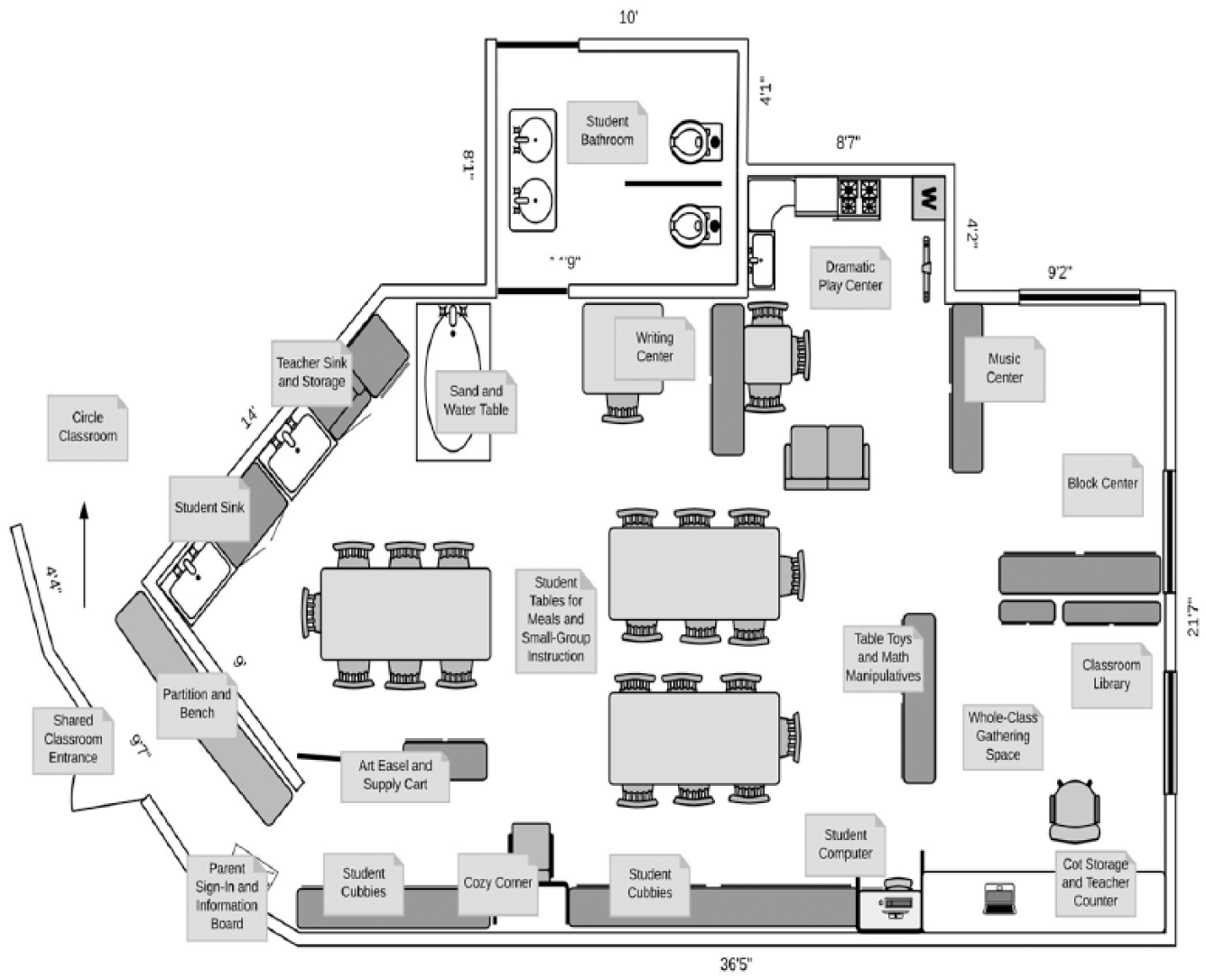
Triangle classroom floor plan as recreated in Lucidchart software.
The preceding discussion of the representational spaces, in which the Triangle classroom exists, addresses the first main task in applying a social geography approach to geosemiotics. As stated previously, “if space is a product. . . the ‘object’ of interest must be expected to shift from things in space to the actual production of space” (Lefebvre, 1991, p. 37). Therefore, an exploration of these representational spaces, as in the previous example, acknowledges that they are socially constructed. They are neither fixed nor static contexts within the Triangle classroom. Therefore, they both influence and are influenced by the representational spaces of the classroom itself.
Applying a Kressian analysis of visual semiotics to the same data would attend to the discourses communicated by the signs documented photographically. Applying a Scollon-esque analysis of geosemiotics would attend to the ways these signs and symbols are of influence on the interaction order through ethnographic observations, for example. However, applying these traditions when complemented by social geography affords a transcontextual interpretation of meaning-making. The hybrid investigation includes additional data gathering such as interviews with long-term residents, historical comparison of housing development and population information, and an analysis of center job descriptions. An analysis of classroom interaction is no longer separate from an analysis of the built environment in which the classroom exists, but is instead informed by the analysis of the built environment, recognizing the fluidity of influence across, between, and within each setting.
A more complete understanding of the classroom’s representational spaces is informed by an understanding of the historical, political, and social productions of space. Shifting attention to classroom representational spaces, a second important task of this ongoing work is to make transparent processes by which data analysis can take form. The approach to (re)presenting data that follows is shared generatively, not prescriptively, to “open up” additional merging of methodologies made possible by this merging of theoretical lenses.
Places and Spaces of the Triangle Classroom
Analysis through a geosemiotic lens requires an ethnographic understanding of the data (Scollon & Scollon, 2003). However, qualitative data collected in an ethnographic tradition are limited by human capacity, only documenting that which captures the observer’s attention, regardless of other interactions taking place outside this focus or line of sight. To provide a richer, more complete data set from which to better understand the social productions of space in the Triangle classroom, I also used video-based fieldwork (via two traditional camcorders and one GoPro wall mount) and visual documentation. A GoPro camera captured whole-body movement through the entire classroom from a pseudo bird’s-eye perspective, whereas the two camcorders were placed strategically in classroom “hotspots” to highlight interaction orders in real time. The GoPro’s long shot afforded a view of gross movement throughout the classroom, but it did not allow for fine-grained analysis of gesture and gaze. The camcorders’ focused shot afforded more fine-grained analyses but did not contextualize small-group interactions within the classroom’s larger social actions. Therefore, both angles were necessary and often viewed simultaneously during analysis. As a complement to field notes, video generation, and classroom photos, interviews with key participants contributed to my understanding of historical, political, and social productions of space that were not otherwise observable.
A recursive process of data collection and analysis provided a responsive yet systematic way to meaningfully filter a large data set that is the natural outcome of researching the “wonderful messiness of classroom interaction” (Wohlwend, 2009, p. 240). Reviewing video documentation alongside interviews and field notes allowed me to make principled choices when sampling for time and space. Revisiting the classroom events afforded close microanalyses, determining patterns of teacher movement and body arrangements over time, to determine what interactions occurred in what spaces. These initial analyses of large-scale movement (GoPro) could then be used to identify “hotspots” in time and place—identifying times of day and locations in the room most fertile for teacher–child interactions (camcorder placement). The findings generated by the GoPro data were then cross-referenced with the camcorder recordings, and an understanding of both was informed by the representational space analysis presented earlier. Taken together, these data uncovered the nature of interactions afforded by the space.
The GoPro video data were used to investigate ways in which classroom space influenced teacher–child interactions or the social production of teacher movement in the space. Patterns in field notes and patterns in F formations (Goffman, 1981) determined through an interaction order analysis (Whittingham, 2016) revealed that the most dynamic representational spaces were constructed when all three classroom teachers were present. A cursory review of the video data identified patterns in the ways in which teachers organized their bodies in space. However, to more deeply understand these patterns, I needed to see the teachers’ movement both separately and together, to track patterns in movement by person and across different daily events.
(Re)presenting Movement and Motion
Literacy researchers attempting to characterize movements and interactions encounter pragmatic tensions when transcribing temporal and ephemeral data using traditional and static methods. Human subjectivity of observation is not removed when recording devices are used; it simply delays until transcription interpretations of what was captured on screen (Ochs & Shohet, 2006). Transcription decisions are seen as theory (Ochs, 1979), insomuch as the transcript reflects underlying theoretical assumptions about interactions being represented. The mode of data (re)presentation reflects the subjectively established research aims, but also inevitably influences research findings. Transcription is, therefore, a problematic but necessary component of data analysis. Some type of systematic cataloging is necessary to make data accessible to the researcher, and yet any type of transcription becomes a form of (re)presentation subject to the researcher’s perspectives, aims, and lens.
Adopting the term representation in lieu of transcription more accurately describes the interpretive processes involved in the transformation of “raw” multimodal data into written form (Flewitt, Hampel, Hauck, & Lancaster, 2014). Two examples of static representations of motion (Ehret & Hollett, 2014; Leander, 2002a) contextualize the tradition in which I situate this analysis. Leander (2002a) represented bodies with ovals and gaze with small triangles and uses dotted lines to indicate movement. Ehret and Hollett (2014) used The Sims video game package to track the movement of one student through a virtually (re)created classroom space, screenshots of which appear in their final publication. To represent Triangle classroom movement, I returned to raw video data, taking still images at equal intervals. From these still images, I recreated positions of students and teachers using colors and shapes coordinating with initial movement analysis, and overlaid each recreation on the classroom floor plan created to scale using Lucidchart (Figure 1). Using the screen capture software Camtasia Studio 8, a LiveProGamer Recording Device, I then created a stop-action video segment to simulate the movement of interlocutors across time.
Together, investigations of representational spaces guided by ethnographic methods and representation of classroom movement informed by video data informed a spatial analysis afforded by complementary theoretical lenses. The following examples highlight one affordance of this spatial analysis—the ability to uncover findings at the intersection of multiple constructs. The analysis also affords a way for researchers and educators to think about literacy teaching and learning in terms of movement and how the movement and placement of objects and beings in place contribute to the social production of space, revealing power relationships and interpretations of power that may otherwise go unnoticed.
Place Semiotics + Interaction Order
Patterns in teacher and child movement afforded by the spatial analysis complement the interaction order analysis. For example, when reviewing similar events across days in the Triangle classroom, patterns in movement during the morning meeting and the read-aloud events are most similar. Per the interaction order analysis, these events primarily employed a monologic participation structure, where teachers decided the topic of conversation, role of the interlocutors, and duration of the interaction. In contrast, productions of space were most variant during center time, where interaction order analysis revealed a coconstructive participation structure. Coconstructive participation structures are characterized by students’ and teachers’ shared agency to determine the conversation topic, duration, location, and participants. The movement analysis reveals patterns in productions of space loosely mapped onto patterns in classroom participation structure. When the classroom event is structured and routine (read-alouds and writing time), productions of space are also structured and routine. When classroom events are open-ended and child-directed (center time), productions of space are less predictable across time (from day to day) and more responsive to student activity and interest.
Unsurprisingly, the agency afforded to students as coconstructors of space differs in accordance with instructional goals. Spatial analysis confirms this assumption and draws attention to how agency is afforded to, taken up by, and negotiated between students and teachers during less-structured events such as center time, but also during even more ephemeral moments, including transitions between events.
Social productions of space are made visible in many “otherwise unnoticed” moments in the Triangle classroom, transitional times. The small-group event occurs immediately following the morning meeting event each day. The instructional purpose, student grouping, and the physical location of the small-group event are determined by the teaching team. At the conclusions of the small-group event, students transition to the center event, a 45-min experience led by student interest and choice. Ms. O’Neal (green), Mr. Pearson (blue), and Ms. Zachmann (red) each facilitate a small-group event at one of the three tables. These predictable locations are in direct contrast to patterns in movement observed during the center event, when teachers’ movement and motion are more responsive to student influence.
The spatial analysis (represented in part in Figure 2) makes visible teachers’ locations in relation to one another and the movement of students through the classroom during a time of transition. Because the feet indicate the direction the teachers are facing, this analysis also affords an understanding of teachers’ attention in relation to one another. The representation reveals little evidence of “pivoting,” per Kendon’s (1990) description of “withness” in an F formation. Teachers’ bodies most often reflected a single point of attention, not shared attention between competing influences.
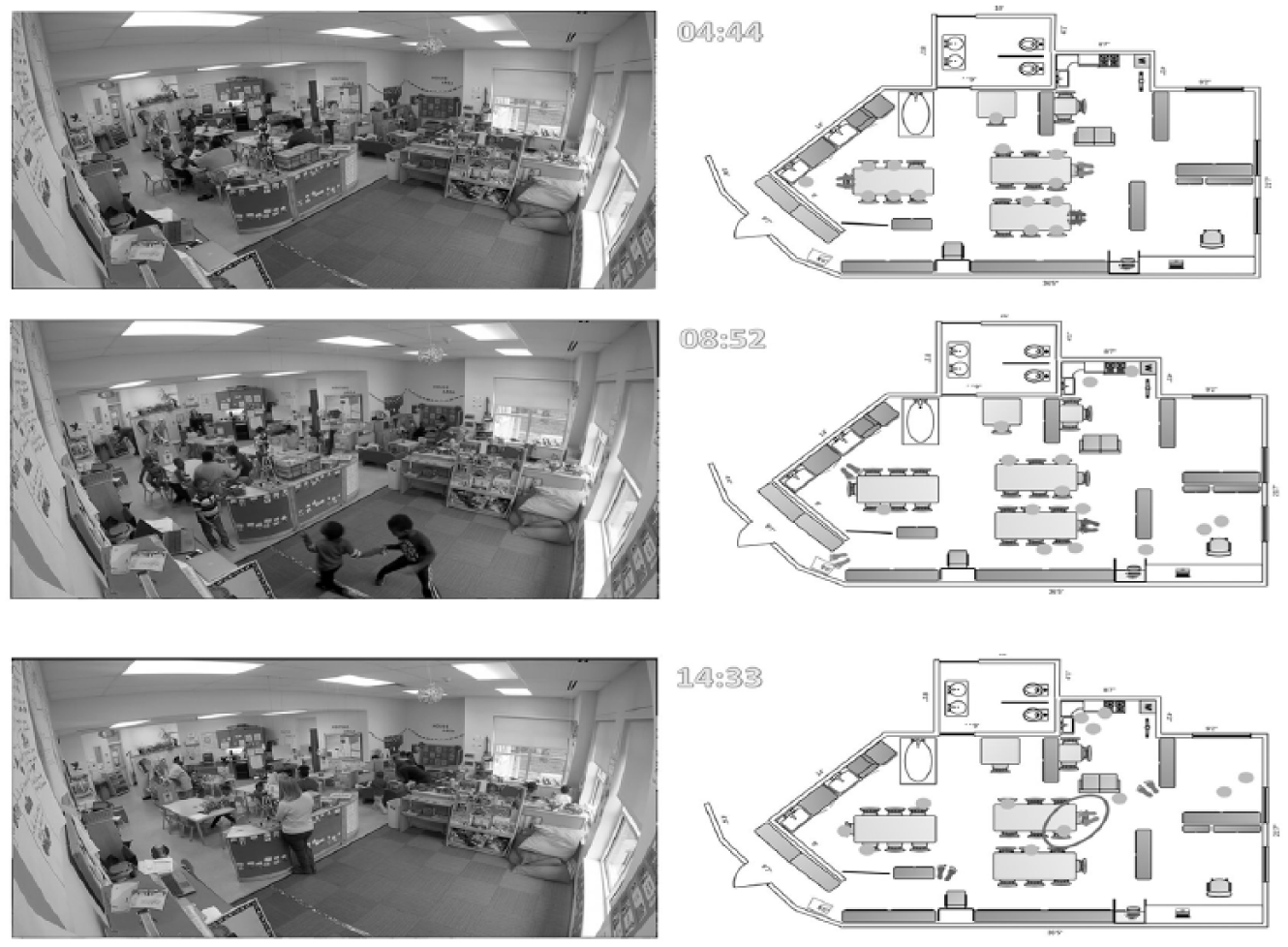
Sample of movement recreation from video stills.
For example, most students are initially still engaged in the small-group event, seated at tables alongside teachers (4:44). Over time, more students complete the small-group event and engage in the center event. The second image shows three students at Ms. O’Neal’s table still working on their small-group task (she has stepped away to retrieve a paper across the room); as three students leave Mr. Pearson’s table, one remains engaged in the task. Last, only Charmaine remains engaged in the small-group event. Ms. O’Neal also remains, seated facing Charmaine, offering individual support. Ms. O’Neal’s ability to attend to Charmaine’s needs and Charmaine’s ability to expect such attention are made possible in part by Mr. Pearson and Ms. Zachmann’s presence and position. Movement analysis of the same transition when only two teachers are present demonstrated little evidence of prolonged individual student attention. Local administration constructed a space in which three teachers were assigned to a classroom of 17 students (funding agencies require two). Three teachers coconstructed a space of temporal and spatial fluidity between classroom events. Charmaine and Ms. O’Neal coconstructed space of literacy teaching and learning. The movement analysis made these spaces visible.
Compliance with external mandates (e.g., scripted curricula, packaged materials, and prescribed allocations of instructional time) increasingly constrains and confines the spaces in which children and teachers interact. Attending to the near-ephemeral spaces of transition in the Triangle classroom provides an example that counters these “push down” narratives, making visible the patterns of movement and motion that “open up” otherwise shrinking spaces. Highlighting the movement of objects and bodies that facilitate the social production of agentive spaces uncovers possibilities of place otherwise unrecognized. The spatial analysis provides tools necessary to document these counternarratives, therefore, offering evidence of these possibilities for practitioners to facilitate and advocate student agency and ownership of learning.
Place Semiotics + Visual Semiotics
Combining the spatial analysis with a visual discourse analysis of the classroom space makes evident how objects in place contribute to the production of space, in this case to facilitate student autonomy and ownership of learning. Although the sequence of tasks when transitioning was predetermined by adults (students pushed in their chairs, washed their hands, found their center’s name tag on the display in the carpet area, and placed their center’s name tag at the center of their choosing), the temporality of student movement is autonomous of adult influence. Students’ fluid and individual pacing is facilitated by the step stool by the sink, the centers name tag display posted at child height, and the number of spaces on the center board at each center, indicating how many students can occupy each center at once. Objects convey discourses of student agency, as their use affords students the opportunity to move through space unregulated by adult directives. Attention to the production of space afforded by objects in space “opens up” a counternarrative to discourses of policed bodies often experienced by African American students in schooled spaces. (A full deconstruction of this discourse is outside the scope of this article; it is worth noting the possibilities of movement analysis to identify, call out, and counter these practices.)
The presence of this counternarrative as observed in the spatial analysis demonstrates the teachers’ commitment to the social production of space, as the teachers’ own spatial awareness and understanding of modal design is evidenced by their decisions about furniture layout to create sightlines, for example. When viewing these productions of space within and across events, patterns of teacher movement in relation to one another become evident. Rarely are two teachers standing side by side, but often teachers face one another across the room, communicating at a distance. Teachers rarely “check” the position of the other teachers before engaging with an individual student, but rather will verbally signal when they are unavailable and direct a student to a teacher who is. In basketball terms, their “zone defense” provides supervision as support, not suffocation, reifying the absence of policed bodies in the Triangle classroom.
Discussion
Compliance with external mandates increasingly constrains and confines the spaces in which children and teachers interact. Attending to spaces such as those constructed in and by the Triangle classroom makes visible patterns of movement and motion that “open up” otherwise shrinking spaces to facilitate student agency and ownership of learning. The benefit of understanding how place is used by children and teachers to produce spaces of literacy interaction underscores the importance of theorizing with geosemiotics, with social geography, and with the complementarity of the two.
As described earlier, the full utility of a geosemiotic analysis is only achieved when interaction order, visual semiotics, and place semiotics are attended to simultaneously. To date, interaction order analyses (Goffman, 1981), specifically those applying Kendon’s (1990) F formations, inform an understanding of the relationship between bodily placement and meaning-making. Geosemiotic interpretation of visual semiotic analyses (Kress & van Leeuwen, 1996) informs an understanding of the relationship between sign placement and meaning-making. Thus far, place semiotics has been taken up to a lesser degree in literacy research, limiting the potential of geosemiotic analysis on the whole. Complementing Scollon and Scollon’s approaches to place semiotics with a social geography lens creates opportunities for more robust theoretical and methodological applications of place semiotics, increasing the likelihood that the entire triad is applied to its fullest potential in literacy research and practice. In the sections that follow, I describe the implications for literacy theory, methods, and practices when utilizing the complementarity of the approaches.
Implications for Literacy Theory
If spatial practices are the space where relations are not only produced but reproduced, and power is produced in representations of space (Lefebvre, as cited in Sheehy, 2009), then it is essential to investigate representational spaces to understand the actions permitted, prohibited, and suggested by such spaces. By interrogating representational spaces, using a combination of geosemiotic and place semiotic lenses, this approach discovers, or uncovers, the social reproductions of power that exist (often silently) within a schooled space. Geosemiotics provides an “on the ground” framework for understanding the discourses of place, and social geography elevates our understanding of discourses in place to see their role in the social production of space.
The tools of geosemiotics bring into view power(s)-at-play, but social geography is necessary to seek the origins and the implications of the power as socially reproduced. Insomuch as the representational spaces constructed outside of the Triangle classroom impact literacy interactions within the Triangle classroom, so too do the literacy interactions of the Triangle classroom create representational spaces. Geosemiotics alone shows the power(s)-at-play when children navigate center time (e.g., autonomous center selection mediated by teacher decisions about signage and material placement). But, geosemiotics in combination with social geography bring into view the implications of this power (e.g., children’s unregulated movement giving way to the spontaneous enactment of F formations in which children direct the interactions, interlocutors, and materials that mediate literacy learning). Acknowledging this bidirectionality of influence also creates implications for how to conduct literacy research.
Implications for Literacy Research
A geosemiotic analysis informed by social geography unpacks the literacy teaching and learning in early childhood contexts in ways that otherwise go unnoticed when limited to viewing early literacy learning as an opportunity for foundational skill instruction. When children participate in the social production of space, with adults’ motion and movement responsive to (not dictating) student movement, students coauthor their own meaning-making. Qualitative data and movement analysis work considered in concert make known both the origins of power and the power(s)-at-play. For example, teachers interviewed described the intentional placement of furniture and materials to create distinct areas to facilitate specific routines (switching the bookshelf for the blocks shelf when students were distracted by the toys during read-alouds, but did not use the blocks during center time) and to create sightlines (allowing teachers to take a quick survey of student activity from any point in the classroom). However, movement analysis indicated that despite conscious efforts on the part of the teachers to create representations of space, patterns in teacher movement varied when two, rather than three, teachers were present. Three teachers were necessary (no matter the placement of the bookshelf) to maximize students’ opportunity to coauthor literacy interactions.
Informed by both data sources, it becomes clear that both immediate power(s)-at-play (object placement decisions) and systemic sources of power (classroom staffing decisions) affected the social productions of schooled space for members of the Triangle community. These methods are increasingly crucial in early childhood settings that serve as children’s first encounter with schooled spaces as materialized in school places. The geosemiotic analysis informed by social geography affords a way for researchers and educators to think about literacy teaching and learning in terms of movement and how the movement and placement of those objects and beings in place contribute to the social production of space.
Implications for Literacy Practices
Educators have long recognized the importance of creating classroom spaces conducive to learning, but the same attention has not been given to thoughts about how teachers are physically present in or navigate through school places. Combining movement analyses with teacher interviews can also make known the improvisational decisions teachers make about place and space. The recursive nature of this method allows teacher interviews to inform the researcher’s understanding of the video data, but also allows the video data to be used as a source of reflection for the teacher. Mentioned previously, Triangle teachers observed patterns in disengagement during read-alouds and the underutilization of materials during center time, causing them to rearrange classroom furniture. Reviewing video data alongside researchers or instructional coaches, teachers can identify patterns in movement illuminated by the analysis and consider productions of space their movement communicates to students. Do they tend to stand behind a desk, bookshelf, or projection screen, creating a distancing space between themselves and students? Do they tend to hover, or follow students, creating a policed space? Do they gravitate toward a focal position in the room, communicating a grounded or predictable space? Opportunities to increase student engagement, position students positively, and enhance social interactions hinge on teachers’ understandings of the influences of place and space on literacy teaching and learning. By asking these questions, teachers can begin to understand, and take ownership of, these influences.
Future analyses could include investigating student movements to demonstrate how learners make use of this autonomy and identifying patterns in students’ movement to determine the effectiveness of particular physical arrangements of materials. Given the potential values of further incorporating place and space in literacy research, in an early literacy context specifically, and given the need for methodological innovation to investigate issues of place and space, geosemiotics complemented by social geography offers a useful analytic lens to advance this field of inquiry.
Final Thoughts
The aim of this investigation was to advance an understanding of geosemiotics and social geography theoretically as they relate to early literacy places and spaces, and to advance how data can be analyzed and represented in this tradition. Spatial perspectives offer new theoretical and methodological approaches to understanding issues of teaching and learning. Even in their infancy, methods of investigation informed by a geosemiotics
Footnotes
Acknowledgements
The author gratefully acknowledges William H. Teale for his guidance during the earliest conceptions of this work, and Taffy E. Raphael for her guidance during the revision process. The author also thanks the teachers and students of the Triangle classroom for their participation.
Declaration of Conflicting Interests
The author declared no potential conflicts of interest with respect to the research, authorship, and/or publication of this article.
Funding
The author disclosed receipt of the following financial support for the research, authorship, and/or publication of this article: The author received funding from the University of Illinois at Chicago Graduate College Dean’s Scholar Fellowship and the International Literacy Association’s Helen M. Robinson Grant for partial support of this research.