




Abstract
The purpose of this study was to understand messages about the role of language and literacy in the Next Generation Science Standards and the C3 Framework for Social Studies standards documents. We engaged in a content analysis of (a) framework documents that provide the theoretical basis for the standards and (b) learning expectation statements for elementary grade students. Findings indicated a substantial emphasis on supporting language and literacy for disciplinary learning, with emphases on discipline-specific practices and apprenticing children into these practices, often through classroom discussion, beginning in the elementary grades. Although student expectations use similar terminology across science and social studies—for example, explain, argue, and ask—framework documents clarify disciplinary differences in the ways that these practices are enacted. Supporting students’ disciplinary language and literacy development in alignment with these ambitious standards will likely require substantial instructional change in elementary classrooms.
New national science and social studies standards emphasize the importance of beginning ambitious disciplinary instruction in the elementary school years. States have adopted or are making use of these standards—the Next Generation Science Standards (NGSS Lead States, 2013) and the C3 Framework for Social Studies (National Council for the Social Studies [NCSS], 2013)—to guide science and social studies instruction. Yet, recent studies show that science and social studies are rarely taught in the elementary school years (Blank, 2013; Fitchett, Heafner, & Lambert, 2014; Wright & Neuman, 2014). In the typical siloed view of the elementary school curriculum, time spent on one subject likely reduces time spent on another (e.g., time devoted to science means less time for English Language Arts [ELA] or vice versa; Berliner, 2011). Therefore, these standards have the potential to influence elementary grades instruction simply by increasing the time and focus on content-area learning.
Rather than a siloed view of instruction, an alternative way to look at new science and social standards might be to consider whether more opportunities for science and social studies might also enhance opportunities for language and literacy learning in the elementary grades. Not only does content knowledge support reading comprehension (e.g., for a review, see Cervetti & Wright, in press) but these standards might create new opportunities for young children to engage in learning discipline-specific language and literacies, thereby strengthening literacy and content instruction in the elementary curriculum. Cervetti and colleagues have argued that knowledge built through content-area learning supports students’ literacy development and that engagement in language and literacy practices supports content-area learning (e.g., Cervetti, Barber, Dorph, Pearson, & Goldschmidt, 2012). A growing body of evidence demonstrates that integrating language and literacy instruction with content-area learning in the elementary grades benefits student learning (e.g., Cervetti et al., 2012; Connor et al., 2017; Guthrie et al., 2009; Romance & Vitale, 2001; Wright & Gotwals, 2017). Yet, we do not know whether and how evidence from these empirical studies (or theories that guide these studies; see the theoretical framework section below) may be reflected in new content-area standards documents, which are likely to drive curriculum and instruction (Schmidt, Wang, & McKnight, 2005).
As a growing number of states adopt these new standards and attempt to increase their focus on science and social studies beginning in kindergarten, it is important to understand the ways in which language and literacy are considered in new science and social studies standards. Therefore, our goal was to understand the messages about the role of language and literacy in science and social studies learning that are instantiated in these standards documents. In particular, we were interested in whether the ideas in these new content-area standards may disrupt traditional siloed views of elementary literacy instruction by suggesting opportunities to support language and literacy during science and social studies instruction.
Theoretical Framework
This study was guided by sociolinguistic and sociocultural theories (e.g., Gee, 2004; Halliday, 1993; Lemke, 1990) that view oral and written language as critical for learning across all levels of schooling (e.g., Brophy, Alleman, & Halvorsen, 2013; Duschl & Osborne, 2002; Lee, Quinn, & Valdés, 2013) and disciplines (Donovan & Bransford, 2005; Hakuta & Santos, 2013; Lemke, 1990). There is evidence that classroom discourse develops metacognitive skills as children monitor their thinking and make their thinking transparent to be understood (Donovan & Bransford, 2005). Supports for spoken and written language also enable equitable participation in content-area learning, especially for emergent bilinguals or other students needing support with English academic language (e.g., Goldenberg & Coleman, 2010; Schleppegrell, 2001). Particularly for young students, who are not yet reading and writing independently, oral discourse can support engagement in the disciplines (e.g., Duschl, Schweingruber, & Shouse, 2007; Wright & Gotwals, 2017). For this study, we were interested in the ways in which these ideas about the importance of language and literacy for engagement in science and social studies are reflected in the standards documents we examined.
Yet, scholars have suggested that supporting language and literacy development more broadly in the classroom (e.g., as is indicated in the elementary grades Common Core State Standards [CCSS] for ELA) may not support students in discipline-specific language and literacy practices (e.g., T. Shanahan & Shanahan, 2008). Disciplinary literacies are considered cultural practices (e.g., Engle & Conant, 2002; Moje, 2007). Fang (2012) defined disciplinary literacy as “the ability to engage in social, semiotic, and cognitive practices consistent with those of content experts” (p. 19), continuing that disciplinary literacy is “grounded in the beliefs that reading and writing are integral to disciplinary practices and that disciplines differ not only in content but also in the ways this content is produced, communicated, and critiqued” (pp. 19-20).
Scholars who focus on disciplinary literacy seek to understand the use of written texts and oral language practices to communicate within the discipline (e.g., Fang, 2012; Fang & Schleppegrell, 2010; Lemke, 1990; Moje, 2007; Schleppegrell, 2001; C. Shanahan, Shanahan, & Misischia, 2011). As students learn a discipline, they are apprenticed into the community’s language and literacy practices as novices—for example, how to make an argument or an explanation in science (National Research Council [NRC], 2007). Eventually students learn and adopt these practices with modeling and scaffolding from more experienced community members such as their teachers (Moje, 2007).
Scholars who study disciplinary literacy from a systemic functional linguistics perspective argue that students also need to learn the discipline’s register (Schleppegrell, 2001), the lexical and grammatical features which are particular to a specific disciplinary context and may differ from casual, everyday talk. Examples of the science register include vocabulary with scientific meanings (e.g., the word front when discussing weather systems) that differ from everyday meanings, abstract nouns derived from verbs (i.e., nominalizations), and expository rather than narrative and dramatic accounts. Examples of the social studies register include vocabulary with social studies-specific meanings such as source, phrases that abstract actors’/participants’ identities (e.g., “the court decision declared”): and nominalizations that enable the connection of events to create a chain of reasoning (Fang, 2012; Fang & Schleppegrell, 2010).
These theories suggest that students need opportunities to learn both the oral and written discourse of particular disciplines. Therefore, we examine whether and how theoretical understandings of disciplinary language and literacy are taken up in science and social studies standards documents and whether these ideas are addressed in expectations for student outcomes at the elementary grades.
Supporting Disciplinary Literacy in the Elementary Grades
Although much of the literature on disciplinary literacy has focused on adolescent learners (Fang & Schleppegrell, 2010; Moje, 2015; T. Shanahan & Shanahan, 2008), recently scholars have argued that if we seek to support children as long-term participants in a disciplinary community, then students should be apprenticed into disciplinary practices from an early age in a developmentally appropriate manner (NRC, 2007; C. Shanahan & Shanahan, 2014; Wright & Gotwals, 2017). For example, C. Shanahan and Shanahan (2014) argued that with the CCSS’ emphasis on informational texts, students in upper elementary grades will increasingly encounter texts with disciplinary differences in how they communicate information. Therefore, elementary students will need support to read disciplinary text.
Studies demonstrate that with teacher modeling and scaffolding, elementary students can begin to adopt disciplinary discourse patterns (e.g., Beck, 2005; Brugar, 2016; Herrenkohl & Cornelius, 2013; Kim & Hand, 2015; McNeill, 2011; Strachan, 2015; Wright & Gotwals, 2017). For example, Herrenkohl and Cornelius (2013) found that a science and social studies curriculum focused on argumentation supported fifth- and sixth-grade students’ engagement in oral argumentation with evidence. In a multiple case study, Beck (2005) found that fourth graders began to appropriate deliberative discussion practices in social studies. Brugar (2016) found that when fifth graders learned and engaged in social studies disciplinary literacy practices of sourcing and contextualizing, they made greater gains toward mastery of social studies standards than did students in a comparison classroom.
Other studies that have focused on supporting disciplinary literacies for children in early elementary grades have encouraged students’ use of a disciplinary community’s oral language practices as a developmentally appropriate entry point for young students not yet reading and writing independently. For example, after Strachan (2015) engaged kindergartners in interactive read-alouds of economics informational texts, students showed statistically significant increases in their social studies knowledge and understanding of informational text features. In a recent study, we found that in schools with a high percentage of students receiving free or reduced-priced lunch, kindergartners who received a curriculum focused on supporting science talk outperformed children in business-as-usual classrooms in their receptive knowledge of science vocabulary and ability to apply new vocabulary to make claims, provide evidence-based support for their claims, and engage in discussion (Wright & Gotwals, 2017). Together, these studies provide initial evidence that with developmentally appropriate, ambitious pedagogy, young children can be apprenticed into engaging in disciplinary literacies.
Therefore, we focused on the ways that standards documents describe the role of language and literacy in elementary grades science and social studies learning. Specifically, we analyzed these documents to understand whether and how they provide messages about apprenticing young students into disciplinary language and literacy practices beginning in the elementary grades.
Focus on Standards Documents
In previous studies, researchers have analyzed national and state standards because standards have been viewed as an instrument of educational reform (Schmidt et al., 2005). Standards documents specify what students should learn at each grade level in a subject area, which in turn influences curriculum, instruction, and the assessment of student learning. For example, Troia and Olinghouse (2013) analyzed the extent to which the CCSS ELA standards addressed 36 evidence-based practices of writing assessment and instruction. Marri, Crocco, Shuttleworth, Gaudelli, and Grolnick (2012) analyzed state social studies standards to determine the amount and types of attention devoted to economics education. Across these examples, researchers argue for a focus on the content of standards documents because expectations for student learning likely influence the instruction students receive.
Although the CCSS ELA (National Governors Association Center for Best Practices & Council of Chief State School Officers, 2010) include standards for the use of informational texts as well as speaking, listening, and language in the elementary grades, recommendations specific to “Literacy in History/Social Studies, Science, & Technical Subjects” begin in sixth grade. Therefore, in this study, we examine science and social studies standards to see whether guidance for supporting disciplinary literacy in the elementary grades is provided in these documents. It is, of course, also important to understand the ways that science and social standards might provide opportunities to support mathematics learning, but this is beyond the scope of this study.
In other analyses of standards and related documents, scholars have focused specifically on understanding the language demands for emergent bilinguals in the NGSS. For example, Lee and colleagues (2013) analyzed the eight science and engineering practices in A Framework for K-12 Science Education and found the science and engineering practices to be “language-intensive,” thereby requiring “students to engage in classroom science discourse” to learn the “language of the science classroom” (p. 224). Based on this work, the Council of Chief State School Officers (2012) developed the Framework for English Language Proficiency Development Standards (ELPD) to enable stakeholders to better understand the language that bilingual students must acquire to successfully engage with both the CCSS and NGSS. For example, the ELPD presents the receptive and expressive language functions for each of the NGSS practices. Our analyses make use of this work in acknowledging the substantial language demands in the NGSS practices (see below). We add to this work by seeking to understand, in detail, the language and literacy expectations not only in the NGSS practices but also in science and social studies framework documents and in learning expectations for students. We also focus on messages around disciplinary literacy learning for all students regardless of English proficiency.
The Current Study
To our knowledge, there has not been a systematic content analysis to understand whether science and social studies standards documents suggest opportunities for young students to engage in language and literacy learning as part of science and social studies learning. Yet, understanding the messages in new standards is critical to support elementary teachers to enact ambitious and integrated instruction.
Specifically, we were guided by two research questions: (1) How do framework documents describe the role of language and literacy in disciplinary learning? And, (2) Are there expectations for disciplinary language and literacy learning in elementary grades science and social studies standards, and, if so, what specifically are elementary students expected to be able to do?
Method
To address these questions, we engaged in a content analysis of science and social studies standards documents. Content analysis is a systematic method for analyzing texts to make “replicable and valid inferences from texts to the contexts of their use” (Krippendorff, 2013, p. 24). This methodology can use both quantitative and qualitative techniques (Neuendorf, 2002), and it aligns with this study’s overarching goal to understand the ways that language and literacy are considered in documents that serve as guides for classroom instructional practice. Content analysis follows the following steps, as described by Hoffman, Wilson, Martínez, and Sailors (2011): (a) creating research questions linked to theory (see above), (b) aligning decisions with research questions, including limiting the content analysis’ focus to a particular purpose such as focusing on language and literacy in science and social studies standards documents, (c) describing the constructs used in the study, (d) describing the sampling process in selecting the texts under analysis, (e) selecting/developing a coding scheme, (f) discussing the coding process, and (g) tabulating and reporting. Our research questions are addressed above. We describe the remaining steps in the following sections. In our discussion, we describe how our findings might inform teachers as they support language and literacy during science and social studies instruction in elementary classrooms, thereby drawing inferences from our data to the instructional contexts these documents seek to inform.
Text Selection
Given our specific interest in understanding opportunities for supporting language and literacy in new science and social studies standards, the texts for this analysis included framework documents and elementary (K-5) student learning expectations for both science (NRC, 2012) and social studies (NCSS, 2013). We describe these documents below.
Framework documents
Both science and social studies standards are based on framework documents that provide a rationale and explanation for the standards. A Framework for K-12 Science Education (NRC, 2012) is a 385-page book that establishes a vision for K-12 science education and provides a rationale for the three dimensions that organize the NGSS. These dimensions include (a) eight science and engineering practices such as asking questions and defining problems, developing and using models, engaging in argument from evidence, and communicating information; (b) cross-cutting concepts used across all branches of science and engineering such as observing patterns, explaining causes and effects, and studying the conditions of stability and change; and (c) disciplinary core ideas from engineering/technology and the physical, life, and earth and space sciences.
Social Studies for the Next Generation: Purposes, Practices, and Implications of the College, Career, and Civic Life (C3) Framework for Social Studies State Standards (NCSS, 2013) is a 143-page book that includes student learning expectations described below. This text includes six introductory articles describing the guiding principles that informed the C3 Framework’s development and explaining the Inquiry Arc, an organizing structure of the framework and standards. The Inquiry Arc includes four dimensions: (a) the development of questions and inquiries; (b) the application of disciplinary concepts in civics, history, geography, and economics; (c) the evaluation of sources; and (d) the communication of and action taken based on conclusions. The C3 Framework also includes appendices describing the research base, applications to other areas of social studies, and connections to the CCSS for ELA. Therefore, to answer RQ1, when we analyzed the social studies framework documents, we analyzed all explanatory text in this book other than the student learning expectations, which were examined separately.
Student learning expectations
We analyzed science and social studies learning expectations for students, referred to as “performance expectations” in NGSS (NGSS Lead States, 2013) and performance “indicators” in the C3 Framework (NCSS, 2013). Both documents include statements about what children should be able to do at a particular grade level (NGSS) or grade-level band (C3 Framework). One important difference is that the C3 documents are intended to guide states in developing their own more specific standards. The C3 Standards focus on the processes of engaging in the social studies; they do not specify the specific historical, civics, geographical, and other content that students should learn at each grade level. In contrast, NGSS specifies specific content for each grade level—for example, kindergartners should learn about weather and climate. To answer RQ2 for this study, we analyzed all student learning expectations for kindergarten through fifth grade from the NGSS and C3.
Coding and Analysis
To answer RQ1 about how framework documents describe the role of language and literacy in disciplinary learning, we began by reading through the science and social studies frameworks. We found discussions of language and literacy interspersed throughout these documents. Therefore, we imported these documents into Dedoose, a qualitative coding software, and read them again, marking every sentence that discussed language and literacy. To ensure that we were being thorough, we also searched framework documents for a list of terms related to language and literacy. We generated an initial list including language, linguistic, term, vocabulary, read, write, listen, oral, speak, communicate, share, discuss, text, book, and report. We then used the documents to generate additional disciplinary terminology such as answer, ask, argue, claim, collaborate, describe, explain, model, representation, and source. We included terms related to graphical representations because “reading” and analyzing maps and historical images is important for social studies, as is interacting with written 2-D/3-D graphical models in science (Fang, 2012). We also searched for other disciplinary variants of terms such as define a problem to capture the engineering application of “asking questions” as established in the NGSS framework. We searched all terms using * to include inflected endings. If there was uncertainty as to whether a sentence addressed language and literacy, the authors discussed these items and came to agreement regarding inclusion/exclusion (Saldaña, 2016). For example, we excluded statements situating the standards as actors of language/literacy (e.g., “The Standards communicate . . .”) because these instantiations do not address our research questions.
To analyze the selected sections of text, we began with open coding of all selected sentences and their surrounding text to code for messages related to the role of language and literacy in disciplinary learning. We created shared analytic memos (Saldaña, 2016) with exemplar quotations from framework documents to identify initial themes such as an emphasis on communication and interaction and the importance of questions, argument, and explanation.
Next, we examined counts of language and literacy terms within the document to understand the relative emphasis on different aspects of language and literacy. We combined closely related terms such as ask, question, inquire, and request and calculated total occurrences of each term within the framework for each discipline. This enabled us to compare the ways in which the frameworks talked about language and literacy as well as the amount of emphasis they placed on particular language and literacy practices. To better understand the messages in the text, we created matrices (Miles & Huberman, 1994) that allowed us to sort and cluster sentences containing related terms. We used this analysis to further refine the themes from our initial open-coding. For example, we examined all sentences from the framework that used the term text and identified that science and social studies have different conceptions of “texts” that students read (which could include graphical models in science and maps in social studies) and of the ways in which students “read” these texts.
We then looked for references to the CCSS ELA standards in framework documents and examined those sections of text to understand messages related to the interaction between science and social studies standards and existing literacy expectations. We counted and coded each reference to the CCSS ELA to further refine our themes. Finally, we triangulated across all three of our analyses to refine and confirm our findings related to RQ1. We provide exemplar quotations to illustrate these themes.
To answer RQ2 about what specifically students are expected to do at this level, all student learning expectations for kindergarten through fifth grade were imported into an Excel spreadsheet. Learning expectations were sorted based on the verb phrases they contained, such as “ask questions” and “describe patterns.” We found that these documents sometimes used multiple phrases to refer to similar categories of student expectations. For example, within the practice of arguing in social studies, there were phrases such as “construct an argument,” “develop a claim,” “present an argument,” and “use evidence (to make a claim).” We developed a coding scheme combining these into broader category codes (i.e., in this case, “argue”). If statements contained multiple verb phrases, we coded each part of the statement to clarify what students would be expected to do. As an example, we coded the first-grade earth science standard, “1-ESS1-1. Use observations of the sun, moon, and stars to describe patterns that can be predicted,” as “use observations” and “describe.”
We individually coded 20% of the verb phrases with the broader category codes (e.g., analyze/interpret data, explain, answer/respond, and argue) with 90.8% inter-rater reliability. All disagreements were resolved jointly (Saldaña, 2016). We compared across disciplines quantitatively to understand how often particular behaviors are expected in science compared with social studies as well as by grade level (e.g., are students more likely to be expected to engage in particular practices at older grade levels?). We also examined the data qualitatively by analyzing categories of expected behaviors in relation to theories about disciplinary literacy and descriptions of these expectations in framework documents. For example, if the student expectation was “make an argument,” we used framework documents to understand whether students would be expected to engage in similar or different types of language and literacy practices in science compared with social studies. We provide exemplar quotations from the standards documents to demonstrate our findings.
Findings
Framework Documents
We first examined framework documents to understand how they describe the role of language and literacy in science and social studies learning as these documents provide the basis and rationale for student expectations. Our analyses led to two main themes: Framework documents (a) emphasize the importance of language and literacy for disciplinary learning and (b) underscore the need for disciplinary language and literacy beginning in the elementary grades. We provide evidence for these themes below.
Importance of language and literacy for disciplinary learning
We found substantial emphasis on language and literacy in framework documents. In the science framework, we found and analyzed 723 sentences that addressed language and literacy out of 4,137 sentences (17% of the text). In the social studies framework, we found and analyzed 602 sentences that addressed language and literacy out of 1,636 sentences (37% of the text). Overall, this indicates an extensive focus on language and literacy in documents that primarily address content-area learning, with a greater focus on language and literacy in the social studies framework compared with science.
The sentences we identified as addressing language and literacy articulate the importance of language, both spoken and written, for supporting disciplinary learning. As shown in Table 1, both frameworks include many references to written language, including text, reading, and writing. For example, the science framework states
Language and Literacy Terms in Framework Documents (Sorted by Frequency).
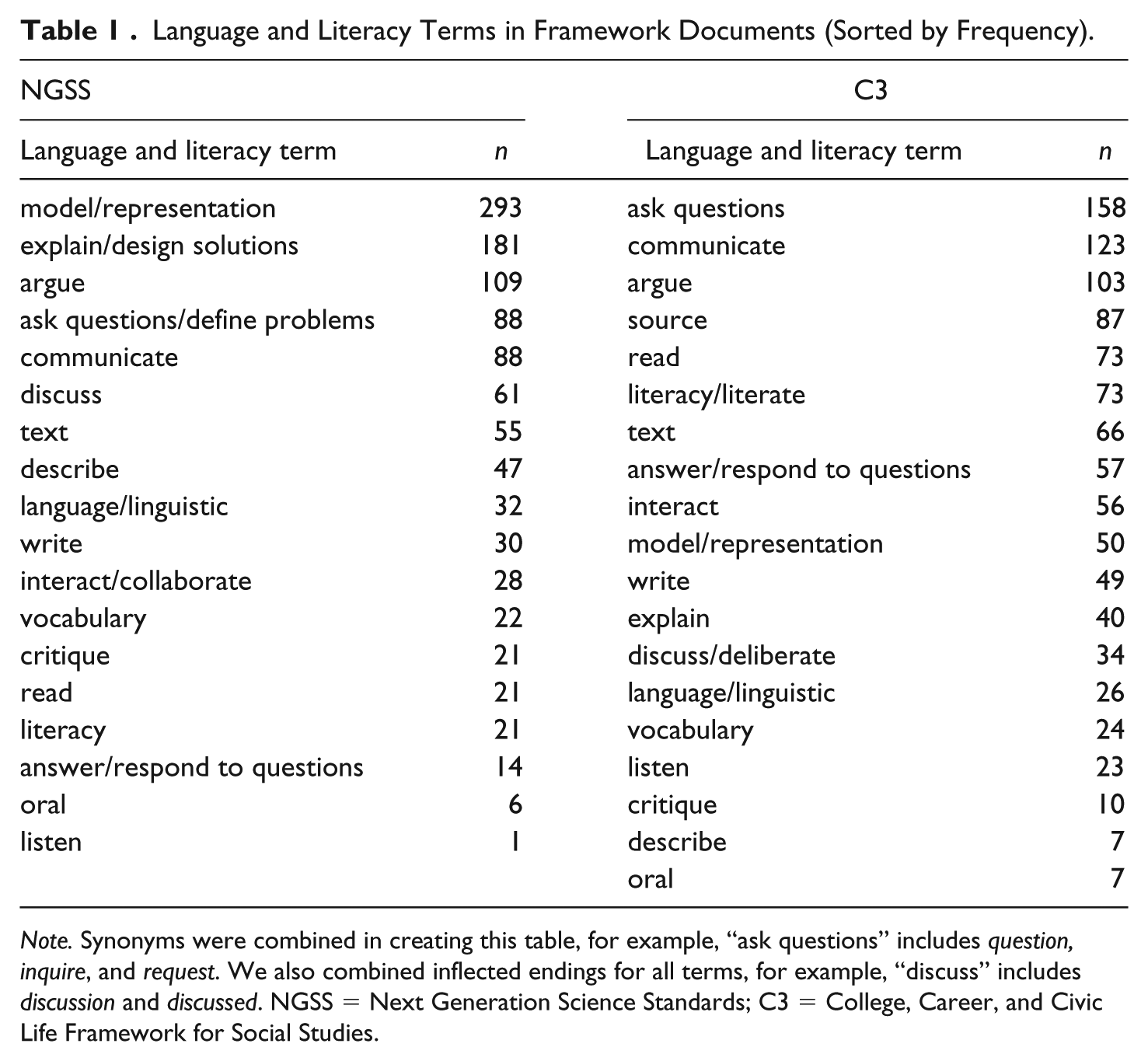
Note. Synonyms were combined in creating this table, for example, “ask questions” includes question, inquire, and request. We also combined inflected endings for all terms, for example, “discuss” includes discussion and discussed. NGSS = Next Generation Science Standards; C3 = College, Career, and Civic Life Framework for Social Studies.
Any education in science and engineering needs to develop students’ ability to read and produce domain-specific text. As such, every science or engineering lesson is in part a language lesson, particularly reading and producing the genres of texts that are intrinsic to science and engineering. (NRC, 2012, p. 76)
The social studies framework states that “as students gather and evaluate information, develop claims, and use evidence, they will engage with a variety of sources requiring a wide range of reading skills” (NCSS, 2013, p. 56). Therefore, language and literacy are considered integral to disciplinary engagement.
In addition, framework documents highlight the importance of oral language, with a particular focus on interaction and discussion (Table 1), to support students’ learning and sense-making. The science framework states that “students need to understand how to participate in scientific discussions, how to adopt a critical stance while respecting the contributions of others, and how to ask questions and revise their own opinions” (p. 252). The social studies framework states that “students, particularly before middle school, will need considerable guidance and support from adults and peers to construct suitable questions for inquiry. Such guidance and support will play out through conversations and collaboration” (p. 27).
Both science and social studies documents also emphasize the importance of oral and written language for communicating disciplinary learning and ideas. For example, the science framework states that “communicating in written or spoken form is another fundamental practice of science; it requires scientists to describe observations precisely, clarify their thinking, and justify their arguments” (p. 75). Similarly, the social studies framework acknowledges the importance of a broad range of language and literacy activities for communicating ideas in the social studies disciplines. For example, Although there is no substitute for thoughtful and persuasive writing, the Framework advocates expanding the means by which students communicate their preliminary and final conclusions . . . those means include a range of venues and a variety of forms (e.g., discussions, debates, policy analyses, video productions, and portfolios). (p. 19)
Therefore, language and literacy are portrayed as important to the “doing” and communicating of both science and social studies.
The science framework describes a developmental progression beginning with oral communication and moving toward more emphasis on written communication as students progress through the elementary grades: From the very start of their science education, students should be asked to engage in the communication of science, especially regarding the investigations they are conducting and the observations they are making . . . [Then,] beginning in upper elementary and middle school, the ability to interpret written materials becomes more important. (p. 76)
In addition, the social studies framework views oral and written communication as a way to gather evidence of student learning. For example, “explanations and arguments need to be communicated, for it is in this communication practice that teachers obtain evidence of growth in students” (p. 90). Therefore, while classroom discussion enables student learning, the ability to communicate ideas through oral and written language is an expected outcome of disciplinary learning.
Both science and social studies documents make references to the CCSS for ELA. In the science framework, there are eight references to the ELA Common Core standards. The framework explicitly highlights the eighth science practice of “obtaining, evaluating, and communicating information” as the primary linkage to ELA standards (p. 75). The C3 framework makes 184 references to the CCSS ELA, connecting ideas in the C3 to the CCSS and illustrating how the C3 expands upon the CCSS. It states that the framework’s authors view the literacy skills in the CCSS ELA standards “as establishing a foundation for inquiry in social studies” (p. 20). For example, the social studies framework describes how specific ELA standards such as “identifying an author’s purpose, main idea, and point of view . . . will help in evaluating the usefulness of a source” (p. 54). In addition to making ELA connections, the social studies framework states that “as a core area in the K-12 curriculum, social studies shares in the responsibility for literacy education, including the development of reading, writing, speaking and listening, and language skills” (p. xiv). Therefore, framework documents argue that language and literacy support social studies learning and social studies learning supports language and literacy development. Together, our findings demonstrate a substantial focus, across both framework documents, on the importance of language and literacy practices for disciplinary learning.
Disciplinary language and literacy in the elementary grades
In addition to emphasizing language and literacy as part of science and social studies learning, both framework documents focus on discipline-specific language and literacy practices beginning from the start of elementary school. We share evidence for this theme first from science and then from social studies framework documents.
The science framework discusses the practices of reading science texts, working with models, arguing and explaining, and asking questions. For example, “to master the reading of scientific material, students need opportunities to engage with such text and to identify its major features; they cannot be expected simply to apply reading skills learned elsewhere to master this unfamiliar genre effectively” (NRC, 2012, p. 77). It explains that “the jargon of science texts is essentially unfamiliar” and that along with passive voice, complex sentence structures, and the importance of knowing precise word meanings, science texts “require a mode of reading that is quite different from reading a novel or even a newspaper” (p. 74). Therefore, science framework documents align with theories of disciplinary literacy that focus on the need for students to understand particular features of science texts (e.g., Fang, 2012; Fang & Schleppegrell, 2010; C. Shanahan et al., 2011).
As shown in Table 1, the science framework also emphasizes the ability to create and interpret graphic representations and models from the “early” years of school. The framework states that “early work on reading science texts should also include explicit instruction and practice in interpreting tables, diagrams, and charts and coordinating information conveyed by them with information in written text” (p. 76).
Another important disciplinary literacy skill is the ability to make oral and written scientific explanations and arguments: “. . . because the spoken language of such discussions and presentations is as far from their everyday language as scientific text is from a novel, the development both of written and spoken scientific explanation/argumentation needs to proceed in parallel” (p. 77).
Finally, the science framework advocates for teaching “effective questioning strategies across all grade levels [emphasis added]” (p. 56), stating that the goal is to move from nonscientific questions that ask for opinions toward scientific questions “that request relevant empirical evidence; that seek to refine a model, an explanation, or an engineering problem; or that challenge the premise of an argument or the suitability of a design” (p. 56). For example, students should be able to “distinguish a scientific question (e.g., Why do helium balloons rise?) from a nonscientific question (Which of these colored balloons is the prettiest?)” (p. 55).
Similar to the science framework, the social studies framework discusses asking questions, arguing and explaining, and reading social studies texts/sources. As shown in Table 1, asking questions receives substantial attention in the social studies framework. The framework states that “students, particularly before middle school, will need considerable guidance and support from adults to construct questions that are suitable for inquiry” (NCSS, 2013, p. 24) and that teachers must “work to bridge student experience-based questions with disciplinary ones” (p. 90).
Argument and explanation are also emphasized in the social studies framework beginning in the elementary grades: “Even the youngest children understand the need to give reasons for their ideas” (p. 53). It states that students’ “initial claims will often be tentative and probing,” but using multiple sources, they will be able to use evidence to construct more sophisticated claims/counterclaims (p. 55). The social studies framework notes a disciplinary difference between the way that argumentation is viewed in social studies compared with the elementary CCSS ELA: The disciplines that make up the social studies . . . stress the importance of arguments, and in particular, the necessity of constructing them in ways that make use of sources and data as evidence. While in grades K-5, the ELA/Literacy Common Core Standards employ the term opinion to refer to a developing form of argument, the C3 Framework uses the term argument consistently throughout the K-12 grade bands. (p. 57)
In addition, the social studies framework emphasizes that young children can engage in discipline-specific uses of texts as “sources” and in discipline-specific types of oral discourse such as “deliberation” (i.e., “discussing issues and making choices and judgments with information and evidence, civility and respect, and concern for fair procedure”; p. 31).
Finally, both documents acknowledge the importance of learning discipline-specific vocabulary (see Table 1). The science framework states that “throughout their science education, students are continually introduced to new terms, and the meanings of those terms can be learned only through opportunities to use and apply them in their specific contexts” (p. 76). The importance of discipline-specific vocabulary is also noted in the social studies framework: “The C3 framework emphasizes disciplinary vocabulary through the introduction of new concepts and the language of the disciplines . . . students acquire and use academic and domain-specific words and phrases—words such as virtue, fiscal, spatial, and perspective” (pp. 50-51). Therefore, science and social studies documents largely focus on supporting students in learning the disciplinary language and literacy practices (e.g., argue, ask, explain), with some focus on lexical and grammatical features of academic language (i.e., register), as indicated by sentences in the framework documents using words such as term/vocabulary/word and language/linguistic.
Elementary Student Learning Expectations
For RQ2, we were interested in whether there are expectations for disciplinary language and literacy learning in elementary grades student expectations and, if so, what specifically elementary students are expected to be able to do. We had three key findings: (a) language and literacy are critical for “doing” student expectations, (b) students are expected to engage in similar practices across disciplines, but the ability to engage in these expectations will require discipline-specific language and literacy knowledge and skills, and (c) student expectations show evidence of apprenticing students into disciplinary literacies. We describe these findings further below.
Language and literacy for “doing” student expectations
As described above, framework documents establish the importance of language and literacy to science and social studies learning. As shown in Table 2, behaviors that the frameworks indicate will require language or literacy occurred frequently in both the NGSS and the C3 student expectations. For example, in science, students are expected to make observations, explain, obtain and use information from texts/media, argue, describe, ask questions, and communicate. In social studies, students are expected to explain, describe, ask questions, use sources, answer/respond, discuss/deliberate, summarize, and critique. However, standards rarely clarify whether oral or written language should be used to enact these student expectations.
Expected Behaviors in Student Standards (Sorted by Frequency).
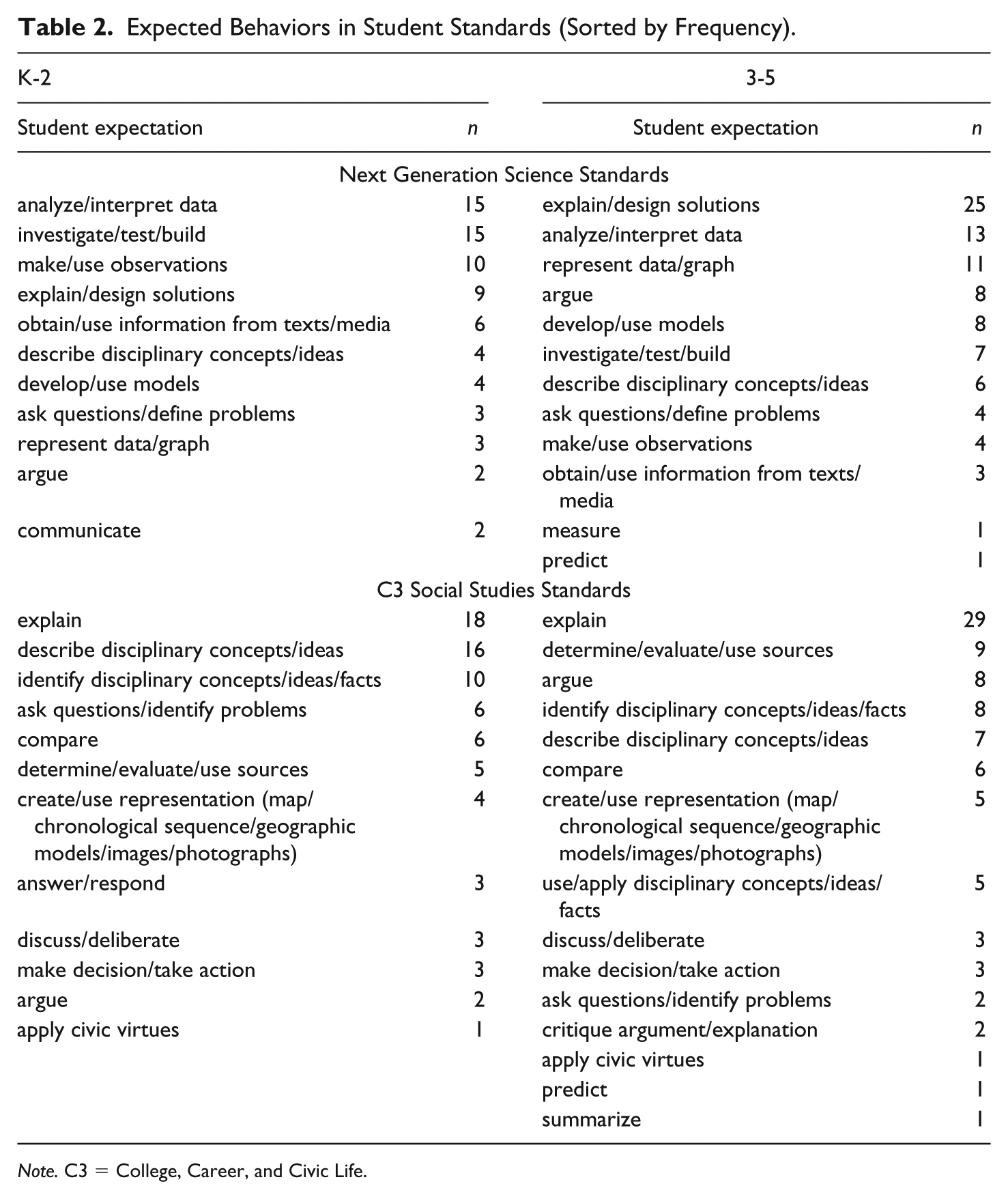
Note. C3 = College, Career, and Civic Life.
In addition, the framework documents explain that even student expectations that may not seem directly related to language and literacy (see Table 2) will require students to engage in discussion and/or oral/written communication to enact them. For example, science framework documents clarify that when students investigate or test, analyze and interpret data, or develop and use models, they will need to discuss and communicate their understandings. Therefore, students will be required to use both oral and written language to demonstrate that they are meeting expectations for disciplinary learning.
Engaging in discipline-specific language and literacy practices
Student expectations in science and social studies clearly specify discipline-specific literacies beginning in kindergarten. For example, in science, kindergarteners are expected to develop and use models and represent data. In social studies, K-2 students are expected to determine, evaluate, and use sources; to use maps, chronological sequences, and geographic models; and to deliberate. Clearly, these represent expectations for young students to engage in disciplinary literacies and to begin to learn the ways of communicating in science and the social studies.
When comparing science and social studies student expectations in Table 2, students are expected to engage in many similar practices. For example, explain is one of the most frequently expected practices, regardless of grade band, in both science and social studies student expectations. Students are also asked to engage in argumentation, ask questions, describe disciplinary concepts, and make predictions in both content areas. However, though these actions are referred to with the same terminology, their realizations, as described in framework documents, are different in science and social studies. Table 3 provides examples of student expectations that show some of these disciplinary differences.
Examples of Disciplinary Learning in Student Expectations.
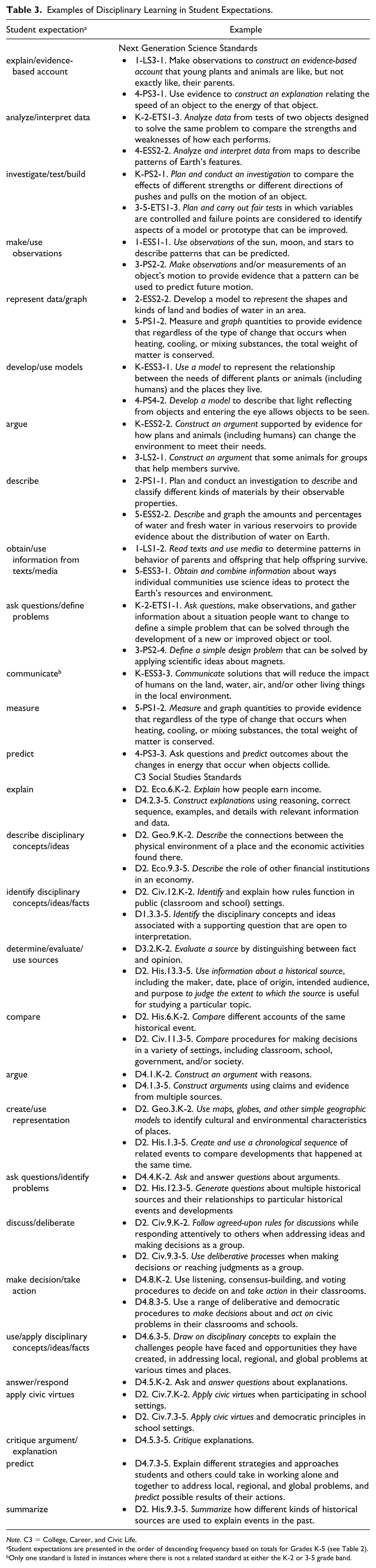
Note. C3 = College, Career, and Civic Life.
Student expectations are presented in the order of descending frequency based on totals for Grades K-5 (see Table 2).
Only one standard is listed in instances where there is not a related standard at either the K-2 or 3-5 grade band.
For example, when comparing standards related to explanation (see Table 3), not only does the content of students’ explanations differ across disciplines (e.g., how speed relates to energy vs. how people earn income) but also the ways in which explanations are constructed also differ. Science standards discuss using observations and evidence (collected through investigations) to construct an explanation while social studies standards expect reasoning and use of “sources”/information (i.e., likely from texts).
In another example, expectations related to asking questions may seem similar (Table 3), but yet again there are disciplinary differences. Not only does the science framework explain that the engineering practice of defining a design problem is analogous to the science practice of asking questions, but the types of questions asked in science also differ from those asked in social studies. Science questions are answered with evidence from analysis of data collected through observations or investigations. In contrast, the social studies framework explains that social studies questions are answered using disciplinary concepts, primary/secondary sources, and representations such as geographical models and chronological sequences. Therefore, expectations for elementary students include literacy practices that are particular to a discipline (e.g., use of sources in history or models in science) as well as broader literacy practices that are discipline-specific in their instantiations (e.g., how to ask a question in science compared with social studies).
Apprenticeship into disciplinary literacies
Because frameworks assert that students should be scaffolded/apprenticed into literacy practices beginning in early elementary grades, we were interested in whether there was evidence of learning progressions in the standards to support this idea. We compared the frequency with which specific student expectations occur in early and late elementary grade-level bands to understand how and whether apprenticeship is enacted.
As shown in Table 2, we see different expectations, in both science and social studies, based on grade-level band. For example, in both science and social studies, argumentation is included in K-2 student expectations, but there are far more student expectations related to argumentation than in later elementary grades. In science, K-2 expectations emphasize making and using observations, but in Grades 3 to 5, students are expected to represent the data they have gathered. In social studies, K-2 student expectations focus on identifying and describing disciplinary concepts, but upper elementary expectations emphasize the application of this knowledge through argument and the use and evaluation of sources. Therefore, in alignment with framework documents, there is evidence in student expectations that students should be apprenticed into disciplinary literacy practices that are more complex and require both more disciplinary knowledge and skill and more complex literacy practices.
Discussion
The purpose of this article is to understand the role of language and literacy in science and social studies standards for the elementary grades. Standards documents specify expectations for student learning that, in turn, influence the curriculum and classroom instruction that students are likely to receive. Typically, ELA and other content areas compete for time and instructional attention in the elementary curriculum (Berliner, 2011), but we were interested in whether new content-area standards aligned with theories and empirical evidence that language and literacy are integral for disciplinary learning and engagement beginning in the elementary grades (Cervetti et al., 2012; Connor et al., 2017; Guthrie et al., 2009; Romance & Vitale, 2001). This is because spoken and written language are critical for learning and communicating ideas, but also because as part of learning in science and social studies, children will need to be apprenticed into disciplinary literacies (i.e., the ways of communicating in oral and written language that may be particular to specific disciplines; Engle & Conant, 2002; Fang, 2012; Moje, 2007). We engaged in a content analysis to understand the messages about language and literacy learning for elementary students that are instantiated in science and social studies standards documents. This type of analysis may support elementary teachers and curriculum developers to read beyond surface expectations and consider the stances toward language and literacy that these standards advocate.
Overall, we found that the frameworks and learning expectations for science and social studies suggest many opportunities for supporting elementary students’ language and literacy development. In alignment with theory (e.g., Brophy et al., 2013; Donovan & Bransford, 2005; Duschl & Osborne, 2002; Hakuta & Santos, 2013; Lee et al., 2013; Lemke, 1990), the frameworks assert that language and literacy are integral components of doing disciplinary work. For example, both sets of standards focus on communicating ideas through oral and written language: reading, writing, and using discipline-specific texts; explaining; arguing; discussing; asking; and describing. Framework documents view disciplinary learning as reinforcing, but also extending, the CCSS ELA with an emphasis on discipline-specific language and literacy practices. For example, in science, students develop and use models, construct explanations, and make observations. In the social studies, students use and evaluate sources, use graphical representations such as maps and chronological sequences, and construct discipline-specific explanations. In another example, the K-5 CCSS ELA focus only on writing opinions, but elementary grades science and social studies frameworks expect students to make arguments first orally and then in written language by the upper elementary grades. Therefore, standards documents include language and literacy activities specific to the disciplines that are best learned while doing work in these disciplines.
The frameworks and learning expectations stress apprenticing children into disciplinary language and literacy practices from the start of school, thereby supporting the findings of previous studies that show positive outcomes of early apprenticeship (e.g., Beck, 2005; Brugar, 2016; Herrenkohl & Cornelius, 2013; Kim & Hand, 2015; McNeill, 2011; Strachan, 2015; Wright & Gotwals, 2017). Students in K-2 are expected to engage in argumentation, explanation, and evaluation, although to a lesser extent than in Grades 3 to 5 standards. To scaffold and support young children’s acquisition of these practices, the frameworks emphasized classroom discussion. Therefore, as prior work has established, oral discourse is an important way to apprentice children into disciplinary literacy practices even before children are reading and writing independently. Yet, the documents rarely specify whether student expectations should be enacted through oral or written language, so understanding this learning progression will be critical for teachers as they enact instruction aligned to the standards.
It is also through discussion and engagement in disciplinary practices that students learn the discipline’s register, including discipline-specific vocabulary. Nagy and Townsend (2012) have suggested that rather than focusing on academic vocabulary as an end in itself, scholars should focus on “words as tools,” defined as using “words as a means for communicating and thinking about disciplinary content” (p. 91). The frameworks reflect this view by emphasizing that students need opportunities to learn, use, and apply new vocabulary during disciplinary learning.
Overall, we found substantial evidence that new science and social studies standards align with theory and empirical research that demonstrate the importance of supporting elementary students’ language and literacy development during disciplinary learning. Yet, enacting this vision will require instructional change in the elementary grades. Most important, teachers, administrators, policy makers, and curriculum developers need to understand that rather than reducing time on science and social studies to focus on language and literacy (e.g., Berliner, 2011; Blank, 2013; Fitchett et al., 2014), enacting instruction that is aligned with the science and social studies standards includes supporting children’s language and literacy development during content-area instruction. The documents in this study portray language and literacy as tools for productive engagement in disciplinary learning, and they view disciplinary learning as an opportunity for students to learn discipline-specific language and literacy practices.
Understanding how to enact these standards will require looking beyond the lists of student expectations in standards documents. For example, though student expectations use similar terminology (e.g., explain, argue, and ask), framework documents clarify disciplinary differences in the ways that these practices are enacted. For example, teachers will need to support children in learning what counts as evidence to inform an argument, how explanations are formed, and the types of questions asked across different disciplines. The frameworks make these disciplinary nuances clear; therefore, teachers will need to read beyond student expectations and may need professional development to enact these ideas.
In addition to understanding disciplinary differences, teachers will also likely need support to engage students in language and literacy practices during science and social studies learning. For example, using classroom discussion to scaffold students’ disciplinary learning may require transitioning from traditional teacher initiation–student response–teacher evaluation (IRE) forms of engagement to more dialogic discourse aligned with social constructivist learning theories (NRC, 2007). The science framework states explicitly that “teachers will need support to learn how to facilitate appropriate and effective discourse in their classrooms” (p. 257). This entails increasing students’ talk time, using disciplinary-specific vocabulary, and engaging in disciplinary discourse practices, which may be challenging for elementary teachers who do not consider themselves experts in a particular discipline. For example, in one study, elementary teachers shared in interviews that disciplinary discourse practices, such as using claims and evidence for scientific argumentation, were unfamiliar and therefore challenging to teach (Wright & Gotwals, 2017). Therefore, the apprenticeship from oral to written discourse that we found instantiated in science and social studies standards may require substantial capacity building for elementary teachers.
Limitations and Conclusion
One limitation of engaging in document analyses is that while we focused on the information provided in standards documents, we do not know how these documents are currently influencing enacted instruction in classrooms. Standards documents have been critiqued not only as a mechanism for educational reform (Schmidt et al., 2005) but also for potentially leading to instruction that is not developmentally appropriate (e.g., Strauss, 2014). Although these criticisms remain important points for further study, we examined these documents because of their current influence in the field of education and because they are “consensus” documents presenting aspirations for ambitious instruction. Yet, questions remain about how to support young children to engage in disciplinary language and literacy and what is best taught at each grade level. We cannot determine from this analysis whether the developers of science and social studies standards considered exactly what and how much language and literacy support may be necessary for young children to meet some of the student expectations. For example, what instruction would it take to support kindergarten students to make an argument or provide an evidence-based explanation? This is a critical area for future research.
With these limitations in mind, our findings provide some elucidating information for understanding the ways in which language and literacy are considered in science and social studies standards. Although these standards clearly suggest opportunities to support students’ language and literacy development during science and social studies, enacting the vision of these standards will likely require substantial instructional change in many elementary classrooms.
Footnotes
Declaration of Conflicting Interests
The author(s) declared no potential conflicts of interest with respect to the research, authorship, and/or publication of this article.
Funding
The author(s) received no financial support for the research, authorship, and/or publication of this article.
