




Abstract
In educational contexts, including early childhood settings, ableism and racism circulate interdependently to define normalcy and deviance. Book reading offers an important platform for dismantling these interlocking ideologies with young children. In this article, we examine dis/ability and race talk in the context of picture-book reading, analyzing the ways four white, nondisabled teacher candidates attempted to discursively resist deficit-based framings of dis/ability and race with small groups of young children in preschool classrooms. Findings revealed how—despite stated intentions to advance educational justice—teacher candidates drew on discourse models that reinforced status quo notions of normativity. We argue that understanding how teacher candidates navigate dis/ability and race talk with young children in the context of literacy instruction can lend insight into the teacher education experiences needed to support these critical conversations.
This article focuses on how white, nondisabled teacher candidates attempt to discursively resist deficit framings of dis/ability and race in young children’s worlds, and the potential consequences of these interactions. The title of this article draws inspiration from Ferri and Connor (2014), who illustrated patterns of talking about dis/ability and race that contribute to the persistence of educational inequities. In educational contexts, including early childhood settings, ableism and racism circulate interdependently to equate whiteness with competence (Annamma et al., 2013; Leonardo & Broderick, 2011). From the disproportionate suspension and expulsion of preschoolers of Color for behavioral infractions (U.S. Department of Health and Human Services, U.S. Department of Education, 2017) to the ways children of Color are labeled “at risk” for school failure (Ladson-Billings, 2014), ability is often distributed and withheld along racial lines. Young children actively make meaning of dis/ability and race (Lalvani & Bacon, 2019; Park, 2011), grappling with these lines of “difference” and the dominant referent points against which difference is constructed (Thorius, 2019). As ableism and racism operate to define normalcy and deviance in early educational settings, we must reckon with how teachers can support young children in resisting such intractable ideologies.
In this article, we examine dis/ability and race talk in the context of shared book reading—a regular practice in early childhood contexts and an oft-cited platform for discursively resisting deficit ideologies in early childhood settings (e.g., Kuby, 2013; Vasquez, 2014). Scholars have discussed the value of reading literature with young children to counter ableism (Lalvani & Bacon, 2019) and racism (Rogers & Mosley, 2006). Similarly, educational justice organizations espouse book lists for teachers to facilitate dis/ability and race talk with young children and affirm young children’s identities (see Books for Littles, 2019; Teaching for Change, 2019). Yet, research investigating how teachers and young children talk about dis/ability and race is limited (Beneke & Cheatham, 2019; Yu et al., 2012). Moreover, such work generally considers experienced teachers’ discourse practices in relation to separate identity markers and connected ideologies (i.e., dis/ability talk or race talk). Less is known about how teacher candidates (TCs) are prepared to talk about dis/ability and race. Understanding how TCs navigate dis/ability and race talk with young children during literacy instruction can lend insight into teacher education experiences needed to support these critical conversations.
As two scholars committed to advancing educational justice in early childhood, we believe early literacy contexts are important sites for disrupting deficit-based narratives and affirming intersectionally marginalized children’s experiences. However, doing this well in practice is fraught with complexity, particularly for the white, nondisabled women who make up the majority of novice teachers in the United States (U.S. Bureau of Labor Statistics, Division of Labor Force Statistics, 2019a, 2019b). Indeed, despite their stated positive intentions, white, nondisabled teachers may reify dominant notions of normativity in terms of whiteness (Haviland, 2008) and ability (Collins, 2013) in practice. We focus on picture-book reading (i.e., read-alouds) as a prism through which to examine the ways four white, nondisabled TCs navigated dis/ability and race talk with young children in fieldwork placements, and how TCs revealed intersecting ideologies through their discourse practices.
Throughout the article, instead of privileging white and whiteness (and the history of racial domination they represent) with a capital letter, we follow Gotanda (1991), leaving these terms in lowercase. To discursively center dis/ability as normative, we use the term nondisabled. Following Annamma et al. (2013), we use a slash to highlight how dis/ability is socially constructed through language, reinscribing “ability” as normative and desirable. We asked: In what ways do teacher candidates maintain or resist normative discourses of race and dis/ability with young children during book reading?
Troubling Constructions of Normalcy in Early Childhood
Our analysis builds on the work of scholars who seek to dismantle the ways racism and ableism construct notions of normalcy in schools through intersectional processes (i.e., Annamma et al., 2013; Baglieri et al., 2011; Leonardo & Broderick, 2011). The aforementioned scholars recognize that dis/ability and race are social constructs, often used in tandem to sustain hierarchies of power in educational contexts by equating normalcy with whiteness and ability. By placing value on people’s bodies and minds based on socially constructed ideas of normalcy (Lewis, 2019), schools invoke corporeal deviance to perpetuate racial hierarchies (Erevelles & Minear, 2010), pathologizing children whose identities are positioned as “different” from an invisibilized referent norm (e.g., whiteness, ability; Thorius, 2019). For instance, Annamma (2018) found that dis/abled girls of Color were regularly labeled as outside school norms of learning and behavior, excessively surveilled, segregated, punished, and constructed as criminal. Although markers of race and dis/ability create intertwined realities for students, these intersections are rarely discussed in educational research (Ferri & Connor, 2014).. Thus, to dismantle white supremacy—“the taken-for-granted routine privileging of white interests that goes unremarked in the political mainstream” (Gillborn, 2005, p. 485)—racism and ableism need to be considered together in schools.
In early educational settings, evidence of the ways ableism and racism intersect to uphold whiteness and ability as normative can be seen in (a) professional frameworks for interpreting normative child development defined through a white, Eurocentric lens (Souto-Manning & Rabadi-Raol, 2018); (b) federal mandates to identify young children suspected to not meet such developmental milestones (Ferri & Bacon, 2011); (c) widespread labeling of young children of Color as “at risk” for school failure based on perceived deficits (e.g., “word gaps”; Dyson, 2015); (d) disciplinary data in which preschoolers of Color are disproportionately suspended and expelled (Wright & Ford, 2016); and (e) classroom materials (i.e., picture books, toys/dolls) that persistently center white, nondisabled ways of knowing and being (Crisp et al., 2016).
In the context of U.S. early educational systems in which ableism and racism operate to construct oppressive notions of normativity, young children are actively making meaning. Indeed, as early as age 3 years, young children may internalize deficit-based messages, form prejudicial attitudes, or act in discriminatory ways with regard to both dis/ability (Diamond & Tu, 2009) and race (Johnson & Aboud, 2017). Children’s conceptualizations of normativity and deviance do not simply emerge as a “natural” stage of development but are constructed through social processes in young children’s lives (Farago et al., 2017). Said differently, ableism and racism do not suddenly manifest in adulthood; these intersecting ideologies are animated by social interactions and discourses in early educational contexts, perpetuating harm for intersectionally marginalized young children. Therefore, we situate our study within a body of work that recognizes that the messages educators send about dis/ability and race matter as young children make meaning of their worlds.
Book Reading as a Site for Troubling Normalcy in Early Childhood
Early educators may use classroom literature to engage young children in critical conversations about dis/ability (Lalvani & Bacon, 2019) and race (Labadie et al., 2012). Purposefully initiating conversations about identity and power with young children in the context of book reading has the potential to raise critical consciousness (e.g., Farago et al., 2017). Yet resisting ableism and racism with young children is also fraught with challenges for new teachers, the majority of whom are white, nondisabled women, and whose social identities are pervasively centered (though often unmarked) in P–12 and postsecondary educational systems (Broderick & Lalvani, 2017; Picower, 2009). Indeed, aspiring teachers have themselves often been socialized into (and invested in) educational systems that construct normalcy in terms of whiteness and ability (Annamma, 2015). As TCs enter fieldwork contexts, cooperating teachers (the majority of whom are also white and nondisabled) engage in practices that deeply impact how TCs understand and take up discursive approaches in their own instruction (Pomerantz & Condie, 2017). Therefore, understanding how white, nondisabled TCs discursively appropriate or resist constructions of dis/ability and race with young children is necessary.
Early educators—including cooperating teachers—may deploy a range of discursive strategies to resist or reify notions of normalcy. For instance, when well-intentioned white teachers enter race talk with other adults, they may utilize a range of talk strategies to avoid appearing racist (Yoon, 2012), such as shifting the focus away from race and racism (Matias, 2013), emphasizing sameness (Solomona et al., 2005), or evading the use of particular words (Haviland, 2008). Relatedly, teachers may take up educational discourse that upholds narrow notions of competence, characterizing dis/ability as biological pathology (Liasidou, 2016) or as an individual problem that requires correction (Erevelles & Minear, 2010). A small body of literature documents ways experienced elementary teachers discursively resisted notions of normalcy. Hikida (2018) illustrated how a fifth-grade teacher disrupted discourses of individual deficiency in text-based discussions by holding space for “struggling” students of Color to assert their literate competencies. Rogers and Mosley (2006) identified how second-grade students and their teacher problematized whiteness in texts by questioning the author, looking for contradictions and absences in picture books. Little is known about the discursive strategies that novice teachers draw upon to talk about dis/ability and race in preschool settings.
Moreover, the participation frameworks early educators employ during book reading may undermine their efforts to address race and dis/ability with young children. While reading and talking about picture books is a regular practice in early childhood settings, teacher–child interactions during text-based discussions can vary significantly (Mehan, 1998). Although not specific to dis/ability and race talk, research demonstrates early childhood teachers typically determine and regulate conditions for children’s participation in talk (Duff, 2008) through explicit and implicit rules for who will talk when and to whom (Erickson, 1996; Philips, 2009). As early educators read picture books, they may signal expectations for child engagement, as well as the relevance of particular types of displays (Ekström, 2013). Participation frameworks may afford or constrain young children’s capacities to build on one another’s ideas, make authentic connections to prior experiences, ask critical questions, and collectively produce knowledge (e.g., Pantaleo, 2007). In a previous study (Beneke & Cheatham, 2019), we found experienced preschool teachers regulated children’s participation in race talk by initiating topics, asking display questions, and evaluating responses. The participation frameworks TCs employ during book reading presumably influence how meaning about dis/ability and race is made.
Finally, picture books themselves are not neutral, as topics in texts both index and reflect sociopolitical conversations about identity (Thomas, 2015). In other words, resisting ableism and racism with young children likely goes beyond teachers simply reading the words in a recommended picture book, because problematic ideologies can be enacted through texts and subtexts (Morrison, 1994). Critical literacy scholars discuss how teachers can use picture books as a provocation for dialogue, allowing time and space for young children to generate and test theories about topics in texts, interpret picture books from reflective and resistant perspectives in response to experiences of marginalization, and explore the politics of representation (Kuby, 2013; Vasquez, 2014). Yet, research on the extent to which novice teachers engage preschoolers in such critical reading strategies in the context of book reading is limited. Taken together, examining the discursive strategies that white, nondisabled TCs utilize to engage young children in enacting and recognizing ideas about identity (i.e., dis/ability, race) is necessary for dismantling oppressive notions of normalcy in early childhood.
Conceptual Framing
DisCrit
Disability critical race theory (DisCrit; Annamma et al., 2013) offers a lens for analyzing the interlocking relationship between ableism and racism in classroom discourse. Building on Black and critical race feminists’ call for intersectional analyses, DisCrit recognizes ways that dis/ability and race are co-constructed to uphold white supremacy, through invisibilized social processes (Annamma & Morrison, 2018). That is, status quo assumptions about educational standards of learning and behavior are rooted in ableism and racism, distributing benefits to those whose identity markers are perceived to be closest to norms of whiteness and ability, and creating qualitatively unique experiences of marginalization for dis/abled children of Color (Annamma et al., 2013). In this study, DisCrit supported our efforts to uncover connections between the constructions of dis/ability and race in early childhood classroom discourse, making visible how beliefs about dis/ability and race are mutually constituted through classroom talk. DisCrit also supported our inquiry into ways in which white, nondisabled TCs both perpetuated and resisted notions of normativity (i.e., whiteness and ability) in and through discourse about dis/ability and race.
D/discourse Theory
Gee’s (2014) theory of D/discourse provided a means to examine the sign systems TCs and young children used to build meaning about dis/ability and race, and the real-world consequences of this talk. For this study, we adopted Gee’s (2014) definition of discourse, which is different ways in which we humans integrate language with non-language “stuff,” such as different ways of thinking, acting, interacting . . . and using symbols, tools, and objects in the right places and at the right times so as to enact and recognize different identities and activities . . . [as well as to] distribute social goods in a certain way, make certain sorts of meaningful connections in our experience, and privilege certain symbol systems and ways of knowing over others. (p. 13)
From Gee’s perspective, “little d” discourses (i.e., micro-interactions, language bits such as syntax) are associated with “Big D” discourses (i.e., socially situated identities such as “Social Justice Teacher”) that constitute characteristic ways of saying, doing, and being (Rogers, 2011). “Big D” discourses have material consequences, as they frame resulting actions in terms of status, solidarity, the distribution of social goods, and power (Rogers & Mosley, 2006). Therefore, we were interested in how white, nondisabled TCs integrated spoken language (“little d” discourse) with picture books and nonverbal behavior to build meaning about dis/ability and race during book reading with young children, as well as how micro-interactions constituted characteristic “Big D” discourses, and the sociopolitical consequences of their interactions.
Together, DisCrit and D/discourse theory afforded investigation into intersecting micro-interactional processes through which TCs talked with young children about dis/ability and race talk. We examined how TCs used talk and texts with young children to enact and recognize ideas about identity (i.e., dis/ability, race), normativity, and deviance during book reading.
Context of the Study
The data for this analysis are derived from a participatory multiple case study (Bhattacharya, 2017) in which we collaborated with four TCs to understand a particular phenomenon (i.e., dis/ability and race talk in preschool) in relation to its real-life context (Merriam, 2009). Our interest in the relationship between early childhood discourse and oppressive constructions of normalcy emerged from dis/ability and race talk dilemmas we had each separately confronted in our former professional work with young children and families. As two white, nondisabled scholars, we utilized our conceptual framework to not only analyze participants’ discourse strategies but to hold ourselves accountable to the ways our positionalities impacted our data interpretation. We selected research processes to deepen our understanding of how harmful notions of normalcy are discursively produced in an attempt to mitigate them in teacher education, while simultaneously highlighting young children’s capacity to engage in dis/ability and race talk.
Study participants included four focal TCs, six mentor teachers, and 19 children in four different preschool classrooms. The broader data set consisted of phenomenological interviews (Seidman, 2013) and a modified version of Education Journey Mapping (see Annamma, 2016) with all four TCs (12 interviews, eight maps), video recordings of TCs’ practice in fieldwork sites (16 video recordings), semistructured interviews with all mentor teachers (six interviews), and interviews with 14 of the child participants (22 interviews). We previously analyzed TCs’ maps in relation to TC interviews to understand the messages about dis/ability and race that they navigated throughout their P–20 educational journeys (see Beneke, 2017). In this article, we used discourse analysis (Gee, 2014; Rogers, 2011) to study transcripts from 16 video-recorded book-reading events, examining the relationship between classroom micro-interactions and macro-level sociopolitical processes. Discourse analysis allowed us to enact our theoretical commitments, examining the extent to which notions of normalcy were (re)produced or resisted through preschool classroom talk. Gee (2014) explained that it is appropriate to draw on a wider set of contextual data to frame analysis of language in use. Thus, while book-reading transcripts are the primary focus of this analysis, data from interviews with TCs, mentor teachers, and young children provided relevant context, deepening our understanding of the dis/ability and race talk strategies TCs employed with young children. Throughout this article, all participants names are represented with pseudonyms.
Participants and Setting
At the time of the study, TC participants were enrolled in an undergraduate fieldwork course as part of their early childhood licensure program at a Midwestern university. Although we were both affiliated with the program at the time of the study, we were not participants’ course instructors, nor were we responsible for TCs’ grades. Teacher candidates were purposively selected to represent typical early childhood teacher demographics (i.e., white, female, nondisabled) in the United States (U.S. Bureau of Labor Statistics, Division of Labor Force Statistics, 2019a, 2019b), and included Cora (20 years old), Grace (25 years old), Maddie (19 years old), and Sydney (20 years old). Each TC indicated interest in talking about dis/ability and race with young children and had previous coursework in multicultural literature, as well as experience facilitating read-alouds with young children. Their fieldwork instructor had emphasized actively involving children in book-reading conversations but had not addressed text-based conversations about identity, fairness, or power. Given their prior experiences, TC participants agreed that reading books with small groups of children in fieldwork classrooms provided an entry point for beginning conversations about dis/ability and race.
As a fieldwork course requirement, TCs worked with mentor teachers in preschool classrooms for a minimum of 10 hr a week. Literacy practices in all four preschool classrooms were guided by Creative Curriculum (Teaching Strategies, 2016) and typically included small- and large-group activities, as well as open-ended interest areas. Cora and Grace were each placed in a co-taught preschool classroom at Children’s Campus—a university-affiliated private early learning center—and each had two mentor teachers. Maddie and Sydney, who were placed in two preschool classrooms at a local Head Start, each had one mentor teacher. All six mentor teachers identified as women (four white, one Latina, one Multiracial) and had at least 3 years of teaching experience. We used demographic forms completed by parents to select a total of 19 child participants for maximum diversity (Merriam, 2009); see Table 1 for child participant demographics in each fieldwork placement. Although both Children’s Campus and Head Start included children with a range of racial identities and dis/ability labels, child participants attending Head Start were overwhelmingly children of Color labeled “at risk” based on family income levels.
Child Participant Demographics by Teacher Candidate Fieldwork Placement.
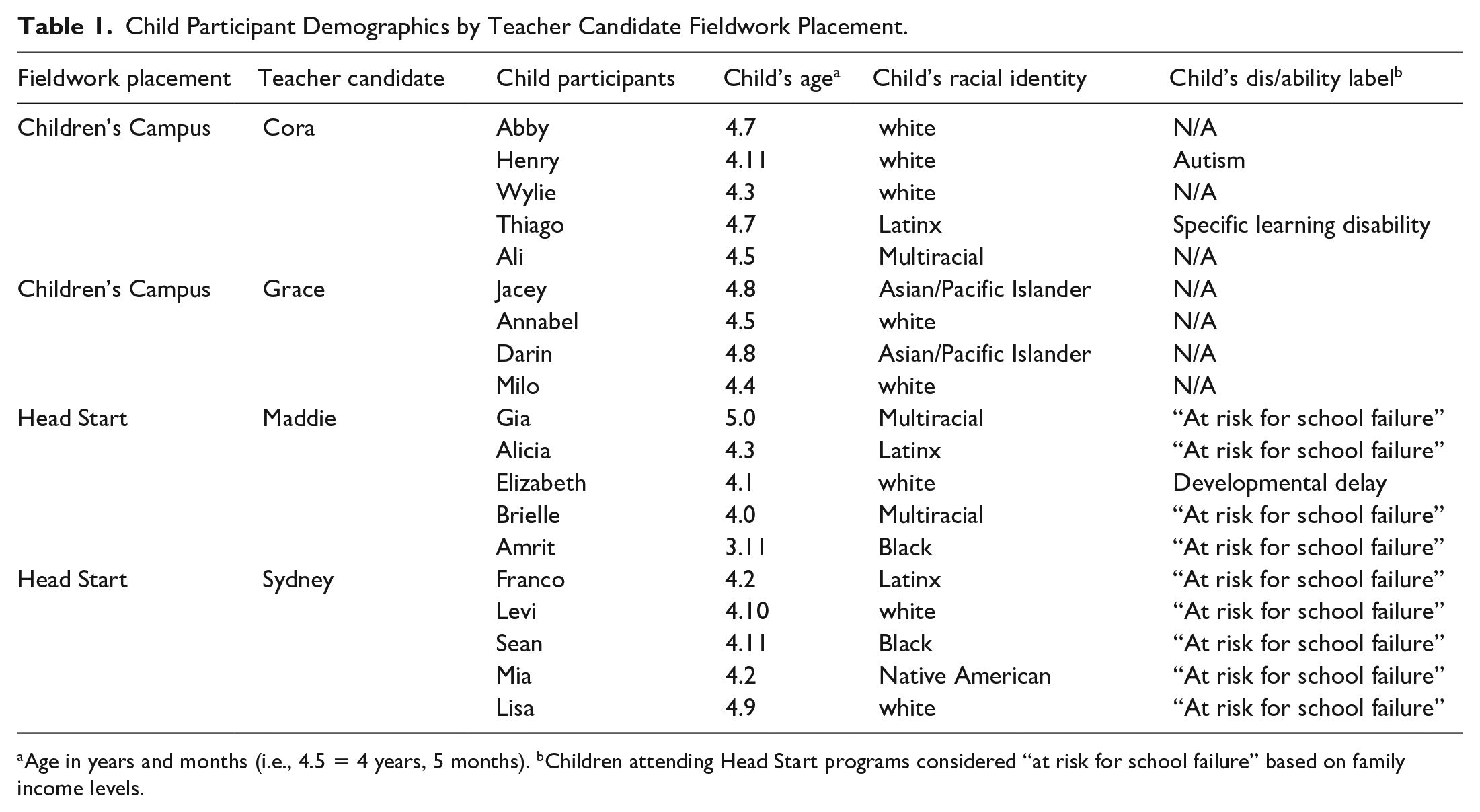
Age in years and months (i.e., 4.5 = 4 years, 5 months). bChildren attending Head Start programs considered “at risk for school failure” based on family income levels.
Picture books were selected from two of Teaching for Change’s (2019) Early Childhood Anti-Bias Education Booklists, which are designed to support teachers in talking about race and dis/ability with young children through a social-justice lens. Through a process of book nomination and consensus, we worked with program directors, mentor teachers, and TCs to select two books for TCs to read with small groups of children in their respective fieldwork classrooms. From the “Learning About Different Abilities” booklist, participants selected The Amazing Erik (Huber, 2014). This book introduces Erik, a white character illustrated using a wheelchair. The text narrates Erik’s experience playing in a classroom water table, feeling upset when water splashes on his sleeves, and working with a friend to clean up the spill. Erik’s wheelchair is only mentioned in print when Erik “slid out of his chair” to dry the floor. From the “Learning About Racial Identity” booklist, participants also selected Bein’ With You This Way (Nikola-Lisa, 1994). This book, influenced by poetry, rap, and playground rhymes, features a racially diverse group of children on the playground. The syncopated text describes children’s racial identities in terms of skin color (i.e., “Her skin is light, his skin is dark”) and in the context of other physical differences (e.g., hair texture, eye color).
Data Generation
Video Recordings of Book Reading
Teacher candidates were interested in using books to facilitate conversations about dis/ability and race with children and knew we were interested in examining their discourse. As Grace explained, “I definitely want to find a way to incorporate [dis/ability and race] into the curriculum . . . [I]t’s something that I realize needs to be talked about.” Teacher candidates had several weeks to look over the books in advance and independently planned their small-group reading with the stated goal of engaging children in dialogue to resist deficit framings of dis/ability and race. Teacher candidates and small groups of four or five participating children gathered for reading in regularly used small-group classroom meeting areas. Read-alouds were scheduled during 45-min literacy times to ensure that TCs had ample opportunity to read and facilitate conversations. Author 1 (Maggie) observed and video-recorded book reading 4 times in each classroom, as TCs and children read and revisited both texts. Of the 16 recorded book readings, reading time ranged from 4 min and 42 s to 13 min and 22 s in duration.
Additional Data Sources
Additional data sources provided context for analyzing book-reading discourse, including interviews with TCs, mentor teachers, and children. Following Seidman (2013), Maggie interviewed each TC 3 times. Interviews focused on previous experiences talking about dis/ability and race, perspectives on book reading, experiences with coursework, observations of mentor teachers, and reflections on practice. Interviews ranged from 43 min to 1 hr and 17 min. Semistructured interviews (Merriam, 2009) with mentor teachers explored issues related to teaching philosophy, book-reading practices, and dialogue about dis/ability and race with young children. Maggie conducted six mentor-teacher interviews, ranging in time from 19 min and 5 s to 35 min and 34 s. Finally, immediately following each book-reading session, Maggie followed Park’s (2011) format for child interviews, inviting children to share what they knew about book topics and guide her through each text. A subset of 14 children participated in individual child interviews, ranging in time from 1 min and 24 s to 9 min and 55 s.
Data Analysis
Guided by our conceptual framing, we engaged in multiple iterative cycles of analysis, looking at micro-interactions between TCs and children both within and across classrooms. Maggie was the primary analyst, but discourse interpretations were developed to consensus between researchers. We first created utterance-by-utterance transcripts of each book reading, attending to pauses, adjacent speech, and overlapping talk (Ochs, 1979). Video was used to incorporate nonverbal behavior (i.e., gaze, shifts in body position, page turns) into transcripts.
Next, we counted utterances within each transcript, which we defined as completed words, partial words (e.g., “fa-,” “ki-”), and on-record back-channel responses (e.g., “mm-hm,” “uh-huh”). We compared the number of utterances spoken by TCs to children across transcripts using descriptive statistics (i.e., means; see Table 2 in the online appendix). Given our interest in understanding how TCs and young children participated in dis/ability and race talk, utterance counts helped us to understand the frequency of participants’ verbal contributions during book reading across classrooms.
We then examined intonation. Tonal markers helped us understand participation frameworks during each book-reading event, including how speakers signaled they had taken a “turn,” completed a thought, or asked a question. A focus on intonation also afforded understanding how TCs, whose verbal contributions disproportionately outweighed those of children across readings, prioritized topics. We organized transcripts into lines, determined based on speakers’ intonation—attending to final intonation (represented in transcripts as “//”), nonfinal tone (represented in transcripts as “/”), question intonation, and on-record speaking that was interrupted by another speaker.
We then analyzed conversational topics. We segmented lines into stanzas, or a set of connected lines about a topic (e.g., Gee, 2011), which allowed us to sequentially highlight units of speech, drawing attention to topic initiation and subsequent talk on that topic (see Figure 1 in the online appendix). Within each idea unit, we noted content words and phrases TCs and children used to describe dis/ability and race (e.g., “super different,” “needs help,” “kinda Black”). Based on the literature and the results of our previous research (Beneke & Cheatham, 2019), we examined how TCs used language from the text (represented in transcripts with italicized words) and nonverbal cues (e.g., page turns) to initiate and maintain topics (see Figure 2 in the online appendix).
Finally, we looked across book-reading transcripts, examining the density of language practices (i.e., intonation, topic, page turns), searching for connections and incongruencies in the data. We asked ourselves how discursive moves signaled values particularly about normativity and deviance, and what “Big D” discourses the communication expressed. We widened our frame (Gee, 2011), examining TC, mentor-teacher, and child interviews to further contextualize our analysis in terms of social and institutional discourse practices. We also turned to the extant literature and our conceptual framework (Ravitch & Riggan, 2016) as a means to strengthen our understanding of the relationship between classroom micro-interactions and “Big D” discourses (e.g., “Teacher as Authority,” “Anti-Bias Educator”).
Throughout analysis, we engaged in regular analytic memo-ing (Maxwell, 2012) and peer debriefing (Glesne & Peshkin, 1992), seeking to question, reflect on, and decenter whiteness and ability in our interpretations. We continuously returned to literature by dis/abled authors of Color (e.g., Hernández-Saca & Cannon, 2019; Lewis, 2019), whose perspectives supported us in interrogating messages perpetuated through discourse practices and their potential consequences for intersectionally marginalized young children.
Findings
Across sites and fieldwork classrooms, we identified three discursive patterns that TCs employed as they talked about dis/ability and race with young children during book reading: (a) turning the page, (b) naming physical differences, and (c) emphasizing sameness.
Turning the Page
Book-reading routines typically began with TCs reading a page from a book to set the agenda for talk. Overwhelmingly, after each TC read from a page, she provided limited opportunities for children to contribute to the topic or initiate a new topic for discussion, which she signaled through final intonation and turning the page. When children did find opportunities to participate, TCs typically evaluated or briefly expanded on children’s comments and then shifted topics. Throughout this process, TCs frequently relied on textual descriptions in the books to communicate meanings of dis/ability and race.
Below, we present transcript excerpts that illustrate this pattern. As Cora read The Amazing Erik and got to the moment when Erik slid out of his wheelchair (line 1), she made no additional comment about him being in or out of the wheelchair. When two children—including Thiago, a Latinx child with a dis/ability label—commented about the pictures (lines 1.a and 1.b), Cora quickly affirmed their contributions with a final tone (“Mm-hmm” in line 1.c) before nonverbally signaling that children’s opportunities to talk were closed by turning the page and reading from the text, shifting to a new topic (line 2).
1. Cora: Erik sniffed back his tears and said / “You really made the floor wet” // He slid out of his chair and began to dry the floor // He wiped his rag back and forth / and it soaked up some of the water // “Like magic” / Erik thought //
a. Ali: There’s his wet sleeve / b. Thiago: He made a mess // c. Cora: Mm-hmm // d. [Cora turns page]
2. CORA: Erik held his rag up in the air and said / “The Amazing Erik will now make the water disappear” //
Although Ali pointed out Erik’s “wet sleeve” as a consequence of the spill, and Thiago evaluated the situation as potentially being Erik’s fault, Cora did not take up these ideas. By turning the page, Cora avoided understanding children’s ideas about the text and illustrations, leaving children to draw their own conclusions about the meaning of Erik’s wheelchair and the cause of the spill.
Similarly, TCs used page turns to manage race talk, relying on text from Bein’ With You This Way to guide conversation. In the following example, Grace introduced a page of this book in which “skin color” is discussed in terms of lightness and darkness (line 3). While this was a potential opportunity for Milo, Darin, Annabel, and Jacey to share ideas about skin color and their own racial identities, Grace signaled her expectation for how to engage with the text by turning the page to initiate a new topic (line 3.a).
3. Grace: Now isn’t it terrific / simply exquisite / bein’ with you this way // Her skin is light / his skin is dark / how perfectly remarkably strange / uh-huh!
a. [Grace turns page]
These two transcript examples represent a consistent pattern that cuts across the data. By staying close to the texts and employing page turns to manage talk, TCs limited children’s participation and evaded direct discussion about the meanings of identity markers (i.e., dis/ability, race). The TCs, as adults in these small-group discussions, had access to differential rights (e.g., holding the book) and resources (e.g., reading the print) than children. By using the texts to set the agenda and regulate children’s participation, TCs controlled the kinds of topics discussed during book reading, signaling that children were to spend the majority of time listening.
Examining our broader data set allowed us to further contextualize TCs’ discourse practices. During interviews TCs explained how, despite their beliefs that talking about dis/ability and race talk is important, they felt unsure about how to lead discussions. As Maddie explained, I was hesitant to read [The Amazing Erik]. That’s why I read the other book [first] . . . ’cause I was like, I don’t know how to . . . It showed you his wheelchair, but it didn’t necessarily talk about it, and so I didn’t know how to talk about it . . . and I was so confused, I was like . . . should I . . .?
That is, when the texts themselves did not include language for discussing dis/ability and race, TCs expressed uncertainty about whether and how to bring these topics up with young children, often choosing, instead, to remain silent. Given this uncertainty, turning the page allowed TCs to avoid dis/ability and race talk.
Moreover, TCs described challenges with anticipating and responding to children’s questions. Grace explained, It just all goes back to not knowing the questions [children are] gonna ask . . . and that’s something that makes me nervous because kids say whatever they wanna say and it’s hard to have time to think about a response, and give them a good response without making it look like it’s taking too much effort.
Teacher candidates’ desires to be perceived as “knowledgeable,” in combination with discomfort about bringing topics up themselves, help explain their tendency to turn the book pages. Yet, by remaining silent and limiting children’s participation, TCs did little to resist oppressive notions of normalcy.
Teacher candidates’ reliance on turning book pages to manage dis/ability and race talk was unsurprising when we considered how they had learned to silence conversations about dis/ability and race throughout their educational trajectories (see Beneke, under review), including in their fieldwork experiences. By and large, mentor teachers seemed to believe young children had limited awareness of race and dis/ability, and rarely engaged them in conversations about these topics. For instance, when Maggie asked if mentor teachers ever talked about race in the classroom, Cora explained, “I have never heard a conversation come up about it.” Similarly, Maddie shared, “Since I’ve been there, nothing [has been said] about skin color.” Likewise, mentor teachers rarely engaged children in talk about dis/ability. As Grace explained, “We don’t really have a lot of ability, dis/ability conversations.” Mentor teachers rationalized that children were oblivious to ability differences, which is why the topic had not come up. Sydney’s mentor stated, “As far as abilities go, I would say they’re less aware.” Teacher candidates’ histories avoiding dis/ability and race talk were reinforced by field experiences in which mentor teachers claimed children’s naïveté to justify silence.
Yet child interviews revealed that children were actively making meaning about dis/ability and race, connecting book topics to their own lives in various ways. After reading The Amazing Erik, many children talked to Maggie about Erik’s wheelchair. For example, Thiago pointed to the illustration of Erik at the water table and said, “There we go. There’s a wheelchair, right here.” Gia, a Multiracial child labeled “at risk,” associated wheelchairs with illness, explaining that wheelchairs are for “people that are sick . . . [and] there’s people in Walmart that use wheelchairs.” As children reflected on the book, children from all four classrooms used the word wheelchair, shared ideas about why people use wheelchairs, and noted places where they had seen wheelchairs. Children also talked about skin color after reading Bein’ With You This Way. For instance, Amrit, a Black child labeled “at risk,” compared herself with an illustration of a light-skinned child, “Um, I just have brown skin, but I don’t look like him. My mommy said, um, my mommy said I have brown skin but . . . but that’s why I don’t look like him.” Ali reflected on his friend’s skin color, “I play with Ben and his skin is this color [pointing to the character with light skin].” In interviews, children noted skin-color differences and recalled experiences talking about skin color at home. Thus, children—including intersectionally marginalized children—were actively building a range of ideas about dis/ability and race even when these topics were not explicitly addressed during book reading. By turning pages, TCs limited children’s potential contributions to talk as well as opportunities to collectively question the construction of whiteness and ability as normative.
Naming Physical Differences
Although TCs limited children’s book talk through the previously described participation framework, at times, TCs used texts to initiate discussion of dis/ability and race as topics. When they did, TCs modeled expectations for talk by pointing out and labeling physical differences. This pattern can be seen in the transcript below. After Maddie read from a page in The Amazing Erik, she initiated talk about Erik’s dis/ability by pointing to the illustration, using the noun “dis/ability” (line 4), and explaining Erik’s impairment with a nonfinal tone (line 4.b). Alicia, a Latinx child labeled “at risk,” took a turn, attempting to explain Erik’s impairment (i.e., “because it’s slippery”; line 4.c) in reference to water spilled in the text. Maddie signaled that Alicia’s response was possible by partially validating Alicia’s comment (i.e., “Maybe”; line 4.d), redirected focus to Erik’s legs (line 4.d), and shifted the topic by turning the page.
4. Maddie: [points to illustration] So he has a dis/ability so he may not be able to walk / a. Amrit: Yeah // b. Maddie: So he may not be able to use his legs / c. Alicia: Yeah because it’s slippery // d. Maddie: Cuz it’s slippery? Maybe / so his legs don’t work like ours so he has to use a wheelchair to walk // [turns page]
Alicia’s comment offered an opportunity to discuss how environments can limit mobility and dis/able people. Although Maddie acknowledged this was “maybe” true, Maddie did not expand on Alicia’s comment. Instead, Maddie emphasized Erik’s physical difference (i.e., “his legs don’t work”; line 4.d) in relation to a nondisabled norm (i.e., “like ours”; line 4.d), framing dis/ability as a property of Erik’s body.
Similarly, during the rare moments when TCs addressed race with children, they also focused on naming physical differences. This pattern is illustrated in the example below. After reading a page from Bein’ With You This Way, Sydney set the agenda for race talk, initiating discussion by listing physical attributes that she had previously read (i.e., “curly hair and straight hair”), pointing to the illustration, and directly asking, “Is their skin color different?” (line 5). When Lisa, a white child, responded in agreement (line 5.b), Sydney evaluated Lisa’s response, confirming she was correct by pointing back to the illustration and stating, “They have brown skin” with a final tone (line 5.d). Although Sean, a Black boy, attempted to gain the floor (potentially as a means to talk about his own racial identity; line 5.e), Sydney did not acknowledge or build on his comment. Instead, Sydney signaled that she wanted children to continue naming skin-color differences in the text by expanding on Mia’s comment (line 5.g). Sydney then shifted the topic by turning the page.
5. Sydney: I want you all to look / come here Lisa / come look // And / so we were talking about hair color / and we were talking about eye color / and we were talking about curly hair and straight hair / and big arms and little arms / and big nose and little nose / but what else is different about all these friends? [Sydney points to illustration] Is their skin color different? a. Sean: Yeah // b. Lisa: Yeah / brown // c. Mia: It’s this one / d. Sydney: [points to illustration] They have brown skin // e. Sean: I’m right here // f. Mia: And that one // g. Sydney: And light skin / h. Lisa: And pink skin / i. Sydney: And tan skin // [turns page]
By demonstrating how to label skin-tone differences and validating when children followed her lead, Sydney focused children’s talk on identifying the skin color of book characters without discussing race as a socially constructed identity marker ascribed to groups of people and embedded in power relations. This emphasis on listing the skin tones of others displayed a value for color classification, minimizing the relevance of skin color in children’s lives.
As both examples above illustrate, when TCs attempted to directly engage children in dis/ability and race talk beyond textual descriptions, they emphasized naming physical differences. Managed through the participation structure previously described, TCs left little space for children to share their experiences or expertise. Teacher candidates’ discursive focus on concrete physical differences seemed to mirror discourse models they saw in fieldwork classrooms. While mentor teachers rarely discussed dis/ability or race with children, when these topics did come up, mentors emphasized keeping conversation concrete. For instance, Grace’s mentor explained, The only time I have ever heard anything [about skin color] was [the children] comparing color, not to each other, but to objects . . . [O]ne time a little boy said, “Look, the tree bark is the same color as me.” I [said], “Wow, you’re so observant!”
In a similar vein, Cora’s mentor shared concrete ways she talked with children about one child’s dis/ability: [With] children it’s usually a direct comment: “You don’t have hair!” . . . They’re just very direct. And so . . . we said, “Oh, you’re right.” And [the child with the autoimmune disease] didn’t like talking about it . . . and so we would just talk about it [generally]: “Everybody’s body is a little bit different, and this person doesn’t have hair, but that’s awesome because it looks great on him.”
Mentor teachers’ recollections highlighted the everyday milieu of dis/ability and race talk in their classrooms. As shown in the above quotes, the rare moments when mentor teachers did address dis/ability and race were typically initiated by children. In these instances, mentors modeled and recommended a focus on physical differences. While reading books about dis/ability and race with young children, TCs seemed to appropriate mentor teachers’ discourse strategies, hesitating to extend talk beyond physical differences. As Cora explained, “[The children] are at the age where, concepts they can’t feel or touch are a little bit more difficult to grasp.”
Through their instructional emphases on naming physical differences, TCs conveyed a narrative that young children learn best through labeling with concrete examples and simple explanations, which they, as adults, could provide. Moreover, TCs named physical differences (i.e., skin color, physical impairment) without acknowledging ways that dis/ability and race gain meaning through social processes that center nondisabled white people as normal. By emphasizing individual physical differences without a conversation about issues of power or fairness, TCs likely perpetuated for children an ideology that dis/ability and race are neutral, biological identities. Given the ways young children experience and witness hierarchies based on both dis/ability and race in educational contexts, TCs’ emphasis on physical differences alone concealed these intersectionally marginalizing processes.
Emphasizing Sameness
Finally, TCs overwhelmingly closed book-reading conversations by utilizing display questions (i.e., teacher bids for “known answers”; Mehan, 1998) to emphasize universal sameness. For instance, the transcript excerpt below is emblematic of how TCs closed conversations about racial differences. After Cora read Bein’ With You This Way, she first asked a display question (line 6), signaling that she was not opening this topic up for discussion. Instead, her expectation was that children agree with her, which they did (lines 6.a–6.c). Cora evaluated their responses, confirming they answered correctly as she expected (line 6.d). She then closed the conversation with a final tone and by closing the book.
6. Cora: Okay / so if we all have different color skin / does that mean that anyone is better or worse than anyone else? a. Thiago, Abby: No / b. Cora: No // c. Wylie: Nope / nope / d. Cora: No / right? Because we’re all the same // [closes book]
Similarly, after discussing The Amazing Erik, Sydney asked a series of display questions (lines 7, 7.b, 7.d), drawing attention to the things Erik could do (i.e., “playing at centers,” “playing at a water table”). After children responded in agreement (lines 7.a, 7.c, 7.e), Sydney asked a final display question, emphasizing sameness (line 7.f). When Sean responded, “Yep” (line 7.g), Sydney closed the conversation by setting down the book.
7. Sydney: Now just ’cause he’s in a wheelchair does this mean he’s super different than everyone? Was he still playing at centers? a. Sean: Yep // [Lisa nods head yes] b. Sydney: Was he still playing at a water table like you guys play at water tables? c. Sean: Yep // [Mia nods head yes] d. Sydney: Was he still making magic like you guys do sometimes? e. Sean: Yep // [Mia nods head yes] f. Sydney: Right? So it’s / it’s not the way you and I walk around / but do you think that he could be in our classroom and do everything that we do? g. Sean: Yep // [Sydney closes book and sets it down]
As the above transcript excerpts illustrate, after naming physical differences, TCs repeatedly closed conversations by highlighting the importance of seeing everyone the same. Children’s agreement to these assertions were evaluated as “correct” and valued displays of their learning. We recognize TCs’ emphasis on the topic of “sameness” was likely an attempt to communicate that people should be treated equitably. Yet, by emphasizing universalism, TCs suggested that we all have the same achievement possibilities, unmarked by dis/ability or race (see Bonilla-Silva, 2006; DiAngelo & Sensoy, 2014). In doing so, TCs disregarded the significance of ableism and racism in constructing notions of normativity.
Discussion
In this study, as four white, nondisabled TCs attempted to talk with young children about dis/ability and race, they maintained control over conversation topics by turning book pages, defined dis/ability and race as separate constructs, focused on labeling physical differences, and emphasized sameness. Teacher candidates’ discourse strategies were informed by and reinforced through discourse practices in fieldwork classrooms, in which mentor teachers emphasized children’s naïveté to avoid conversations. Although children were actively making meaning about dis/ability and race in relation to their identities and experiences, children’s ideas went unrecognized by TCs during book reading. As Ferri and Connor (2014) noted, discourses of dis/ability and race (and class) are always already present, but their connections are rarely acknowledged in school settings. In our study, by talking (but not talking) about dis/ability and race, both TCs and mentor teachers enacted a “Big D” discourse of “Early Childhood Identity Talk,” perpetuating a view that young children are “not ready” to engage in critical discussions of power or fairness. Although TCs’ and mentor teachers’ discourse strategies were consistent across sites and classrooms, this “Big D” discourse may be especially damaging in contexts such as Head Start, where labels of “risk” based on family income level lead to practices that emphasize children of Color’s presumed deficits and acquisition of “academic readiness” skills.
Racism and ableism intersected through participation frameworks that constricted intersectionally marginalized children’s participation in dis/ability and race talk. Based on their educational histories, TCs had few discursive tools to build talk moments that disrupted normativity. As a result, they circumvented discussion with children about collective belonging, compounding forms of inequity (i.e., issues of curricular representation), or processes of identity construction (i.e., dis/ability, race) in children’s lives. Although corporeal variation may exist, categories of dis/ability and race have historically been constructed in response to perceived variation, invoking biology to justify educational inequities (Annamma et al., 2013). By signaling that dis/ability and race are neutral, biological identities, TCs’ talk masked the ways racism and ableism interconnect. Therefore, despite their intentions to resist deficit-based framings of dis/ability and race with young children, TCs’ discourse strategies reconstituted whiteness and ability as normative—a construction that perpetuates harm for intersectionally marginalized children.
While previous research has separately examined the discursive construction of dis/ability or race, this study demonstrates the ways beliefs about both dis/ability and race were mutually constituted through talk with young children. Scholars have documented how dis/ability is often discursively framed as an individual problem to be corrected, in combination with the view of dis/ability identity as ahistorical, apolitical, and asocial (Erevelles & Minear, 2010; Goodley, 2014). Moreover, white people’s avoidance of direct racial language (Bonilla-Silva, 2006), in combination with rhetorical strategies such as downplaying racial differences and emphasizing sameness (Haviland, 2008), has led to power evasiveness (i.e., discursively pacifying inequities by acknowledging difference only when it does not entail acknowledging power; Frankenberg, 1993). In the present study, TCs’ alternating use of page turns, emphasis on physical differences, and focus on similarities worked in tandem to evade intersectional forms of power.
Second, this study adds depth to current understandings about how—even with intentions of advancing educational justice—white, nondisabled TCs may draw on discourse models that reinforce status quo notions of normativity during book reading. As previously stated, reading literature with young children is an important entry point to engage children in critical discussions about dis/ability and race in early childhood classrooms. Yet, as our data suggest, engaging in this practice with young children is more complex than simply reading texts from recommended social-justice booklists. As they were learning what it means to be early educators, TC participants had few discourse models for critical conversation with young children. Given their own socialization and professionalization into cultures of silence around dis/ability and race, TCs defaulted to talk strategies that protected their own feelings of comfort and decentered the lived experiences of intersectionally marginalized children. In this way, TCs discursively invested in whiteness and ability, delegitimizing young children’s capacity to meaningfully engage in conversations about identity and power. This finding is consistent with extant literature demonstrating how whiteness and ability work together in educational systems (Annamma, 2015; Leonardo & Broderick, 2011).
Implications for Teacher Education
Study findings reveal opportunities in teacher education to directly engage TCs in examining how racism and ableism work together through early childhood classroom talk. First, TCs may benefit from considering how critical literacy practices may be used to disrupt racism and ableism. Critical literacy scholars see language, text, and discourse structures as a central means to disrupt and transform inequitable ideologies in educational contexts, and to imagine new ways of constructing the world (Kuby, 2013; Vasquez, 2014). Taking a critical literacy approach with young children means recognizing that texts are never neutral and creating curricular spaces in which children can enter into dialogue with texts to explore the politics of representation. Teacher educators can create opportunities for TCs to position young children as language users (as opposed to language recipients), recognizing children’s capacity to wrestle with notions of fairness, consider meanings of dis/ability and race in texts, and trouble notions of normativity. For example, teacher educators might engage TCs in critical literacy frameworks for introducing texts to young children (Labadie et al., 2012) through book choice, extending purposeful prompts, asking open-ended questions, and providing wait time, with the aim of explicitly generating young children’s ideas about dis/ability and race. In addition, teacher educators might share examples from anti-ableist and antiracist curricular approaches (see Husband, 2010; Lalvani & Bacon, 2019), asking TCs to consider how they might apply these ideas to book reading.
Moreover, for TCs to enact their commitments to educational justice, they likely need more opportunities to recognize the relationship between language use and ideologies in their own discursive practices. Teacher educators may consider drawing on the tools of critical language awareness to raise TCs’ metalinguistic awareness, including recognition of the intersecting ideological processes that occur through language use (Alim, 2005). For example, teacher educators might utilize retrospective video analysis (Wetzel et al., 2017) to help TCs, coaches, and mentor teachers co-construct tools for refining dis/ability and race talk during book reading. In addition, teacher candidates might benefit from explicitly observing how their participation (and the participation of children) changes when book topics explicitly center dis/ability and race.
Relatedly, teacher educators can reexamine opportunities and resources for supporting both mentor teachers and TCs to engage in dis/ability and race talk in fieldwork placements. A variety of models for university–school partnerships exist that may be useful for teacher educators, mentors, and TCs to coach one another (e.g., Hoffman et al., 2015; Zeichner, 2010). For instance, a literacy course that incorporates critical literacy and DisCrit perspectives may be held on-site in preschool programs, allowing TCs to engage in dis/ability and race talk through practice with children, while also supporting mentor teachers to reflect on their own teaching. Furthermore, TCs, mentor teachers, and university faculty could engage in ongoing dialogue about classroom dis/ability and race talk, examining challenges in context, building collective understandings about critical literacy, and working together to revisit practice.
Conclusion
In early childhood settings, racism and ableism work together to constitute whiteness and ability as normative, equate “difference” with individual deficiency, and pathologize young children of Color. Book reading offers an important platform for dismantling these interlocking ideologies with young children. Yet, engaging in such practice is particularly fraught for white, nondisabled TCs—who represent the majority of the early childhood teaching force and whose own subjectivities are continuously centered in educational systems. As our study shows, even with explicit aims to advance justice, as white, nondisabled TCs attempt to talk about dis/ability and race with young children, they may employ discursive strategies that oversimplify these constructs and their impact on young children’s lives. Ultimately, early childhood teacher educators have a critical responsibility to recognize and disrupt the ways TCs utilize discourse practices to reconstitute notions of normalcy as they talk (or avoid talk) about dis/ability and race with young children.
Supplemental Material
939561_Translated_Abstracts_Adams – Supplemental material for Teacher Candidates Talking (but Not Talking) About Dis/ability and Race in Preschool
Supplemental material, 939561_Translated_Abstracts_Adams for Teacher Candidates Talking (but Not Talking) About Dis/ability and Race in Preschool by Margaret R. Beneke and Gregory A. Cheatham in Journal of Literacy Research
Footnotes
Declaration of Conflicting Interests
The author(s) declared no potential conflicts of interest with respect to the research, authorship, and/or publication of this article.
Funding
The author(s) received no financial support for the research, authorship, and/or publication of this article.

References
Supplementary Material
Please find the following supplemental material available below.
For Open Access articles published under a Creative Commons License, all supplemental material carries the same license as the article it is associated with.
For non-Open Access articles published, all supplemental material carries a non-exclusive license, and permission requests for re-use of supplemental material or any part of supplemental material shall be sent directly to the copyright owner as specified in the copyright notice associated with the article.
