




Abstract
This study explores the disciplinary literacy perspectives of middle school students of color attending urban parochial schools and the reader subject positions they took up across content-area classrooms. Qualitative analysis of 19 student interviews and accompanying observations of subject-area classes revealed that students’ constructions of reading, circumscribed by classroom literacy activities, inhibited discipline-specific reading subject positions. In particular, this study highlights how teachers’ reading activities promoted reading as being about accomplishing a task rather than being apprenticed in ways of taking discipline-specific knowledge from text. When the boundaries between students’ home literacy experiences and school disciplinary literacy experiences were more contiguous, and when more meaningful, authentic literacy experiences were provided, students evidenced deeper disciplinary literacy engagement. Educational implications, including troubling disciplinary knowledge to open the disciplines to wider ways of knowing and learning for all learners, are discussed.
Introduction
A vital area of educational improvement is middle school instruction that meets the literacy needs of students of color. Scholarship on middle school instruction shows that students of color commonly report feeling disengaged and marginalized by the classroom curriculum (Tatum, 2003, 2006). Students of color from low-income backgrounds, in particular, face systemic barriers to school success, with literacy assessment scores that indicate that only 17% and 22% of eighth-grade Black and Latinx students, respectively, achieve reading proficiency, compared with 40% of similarly aged White students (National Assessment of Educational Progress, 2017). Standardized literacy assessments, while not capturing the full range of literacy abilities students possess, are associated with school persistence and academic performance (Biancarosa & Snow, 2006) and thus further document inequitable outcomes across student populations.
Quality middle school literacy instruction, more broadly, is uniquely difficult. Meeting middle school readers’ needs is complex, as adolescents are no longer learning to read, but instead are reading to learn—reading to understand concepts across different subject-area classrooms (Snow et al., 1998). Therefore, students who struggle with reading skills in middle school also face curricular obstacles, as they are expected to learn disciplinary content through reading grade-level text (Biancarosa & Snow, 2006; Shanahan & Shanahan, 2008). One avenue for bolstering reading in middle school for all learners may be disciplinary literacy instruction. Adolescent literacy experts have emphasized the critical role of developing disciplinary literacy (e.g., International Literacy Association, 2017; National Governors Association Center for Best Practices & Council of Chief State School Officers, 2010), defined as “cognitive strategies, language skills, literate practices, and habits of mind” used by disciplinary experts that must be explicitly taught as inseparable from disciplinary thinking (Fang & Coatoam, 2013, p. 628). For example, applying this disciplinary literacy lens to science reading, students must approach text thinking like a scientist, attending to close connections between prose and charts as well as to knowledge about the way the world works (Shanahan & Shanahan, 2008). For students of color reading in the content areas, some scholars have posited that embracing the discourse, habits, and cultures of disciplinary experts is crucial to teaching students to read critically and challenge mainstream knowledge and practices (Moje, 2007), while others argue that promoting the literacy practices of disciplinary experts reifies existing power structures, as some children will not find these forms of knowledge relevant for their lives, potentially leading to marginalization in school (Dobbs et al., 2019).
Amid this debate, research indicates that disciplinary literacy practices are infrequently adopted (D. Fisher & Ivey, 2005; Gillis, 2014; Siebert & Draper, 2008). Furthermore, teachers, by and large, have not been prepared to teach disciplinary literacy practices in ways that connect to students’ everyday experiences, help students reconstruct and challenge mainstream knowledge, or facilitate more critical discussions about text and disciplinary knowledge hierarchies (Lewison et al., 2002; Rainey et al., 2018; Spires et al., 2016). Training is particularly lacking in supporting teachers in meeting the needs of marginalized learners, including students of color from underresourced schools (Moje, 2010; Papola-Ellis, 2016). By contrast, emergent research in resource-rich, high-achieving contexts indicates that these practices are more likely to be available in these contexts and to influence students’ conceptualizations of disciplinary literacy practices (Rainey et al., 2019). This scholarship capturing the mixed uptake of disciplinary literacy practice has focused primarily on teacher instruction, but far less is known about student experiences of disciplinary literacy amid the uneven implementation of these practices in schools (Rainey et al., 2019). Indeed, the discrepancy among recommended and actual practice likely influences how students come to understand and conceptualize reading across these spaces.
Yet, scant disciplinary literacy research has focused on the voices and perspectives of students of color in content-area classrooms (Moje et al., 2000). Deeper understanding of students’ perspectives on reading in subject-area classrooms is critical to identifying ways to improve reading across middle school classrooms and to understanding student discourses about reading texts associated with the disciplines, materials posited by some to potentially empower and by others to marginalize. Therefore, in this study, we listened to the voices of low-income middle school students of color attending urban parochial schools to learn more about how students construct disciplinary reading to understand how students experience reading across disciplines as practiced in their schools and specific content-area classrooms.
Relevance and Context in Subject-Area Content/Reading
Broadly, scholarship focused on students of color and content-area learning sheds light on ways in which students embrace and take up subject-area knowledge through connections to their own lives. For example, in middle school science classrooms with predominantly students of color, learners’ participation increased when they bridged their literate worlds and science concepts, such as using pop song lyrics to learn bones in the body (Barton et al., 2008). Sutherland (2005) found that African American girls had greater engagement in English class when they were able to analyze and contest the world views of classic texts. In a reading class with largely Latinx students, the integration and contrasting of popular culture symbols, including slogans, tattoos, and web-based media, enhanced critical in-class discussions about genre characteristics (Skerrett & Bomer, 2011). These study findings support claims that students’ embrace of disciplinary knowledge is influenced by how they conceptualize content-area material as connected to their lives. Educational psychologists term such associations relevance, finding that making content relatable and meaningful helps students engage deeply in the learning process (Hulleman & Harackiewicz, 2009).
Reading research exploring how students of color understand reading and make meaning of text suggests that classroom contexts play an important role. For example, in a study of a highly prescriptive literacy curriculum used with predominantly Latinx students, McCarthey (2001) found that some fifth-grade struggling readers saw reading as a means of gaining points, as opposed to accessing information from text, and as a result, their “sense of self” as a reader was negatively influenced (p. 143). Carlone et al. (2014) followed strong readers from diverse backgrounds from fourth to sixth grade in science classrooms and found that students affiliated more strongly as scientists with their fourth-grade science teacher who adopted a disciplinary literacy approach (e.g., engaging in scientific observation, holding conversations with scientific explanations and inferences, and using everyday examples of science concepts), but not with their sixth-grade science teacher who used minimally demanding activities and emphasized low-level tasks and texts. These studies demonstrate how content-area instruction sets the stage for students’ understanding of disciplinary reading and how the curricular approach influences students’ positioning as disciplinary readers.
Notably, the majority of studies on students’ reading experiences in content-area classrooms focuses on reading in a single content area, and few studies have explored how students of color take up and construct understandings of reading and position themselves as disciplinary readers across varied content-area classrooms. Capturing students’ literacy experiences across these myriad learning contexts provides a more comprehensive view of how they see these worlds.
Theoretical Framework
To understand students’ conceptualizations of reading in this study, we take up a discursive theoretical approach, drawing from Gee’s (2001, 2004) theory of situated literacy. This theoretical perspective gives us tools to explore the ways students understand reading in the disciplines and how educational practice provides (or often fails to provide) access to deep, playful engagement with disciplinary texts. Discourse scholars posit that individuals learn how to understand the world and their place in it by taking up and negotiating “commonsense” ideas and assumptions from the language they encounter across various social contexts (Edley, 2001). We specifically align our approach with discourse scholars who explore the broad “discursive resources” (Willig, 2001, p. 107), “big D” Discourse (Gee, 1999), or language tools available to construct understanding within a social context. In particular, we utilize the concept of subject positions (Davies & Harré, 1990; Willig, 2001) to explore how speakers or writers use language and discourse to open up particular situated locations from which to speak and act.
Gee’s (2001, 2004) theory of situated literacy aligns with this approach. Gee (2001) proposes that social languages and genres are rarely learned through direct instruction; rather, novices acquire skills through social immersion in communities of practice, often with support of modeling, scaffolding, and mentoring. Gee (2001) argues that traditional literacy instruction and assessment neglects the centrality of situated meanings, negotiation of perspectives, and social action involved in language and literacy learning, instead focusing on skills such as decoding, simple comprehension or recall, and the internal relations in texts, in stark contrast to disciplinary literacy approaches. Gee (2004) theorizes that the contrast between teaching literacy as a set of bounded, concrete skills (often the focus of early literacy instruction) and the rich social knowledge and access to situated meanings children need to become competent in complex academic language discourse adopted by the disciplines sets up children without such access to fail as they transition to the middle grades. Children can take on, and can meaningfully access, the subject positions of a scientist or historian, for example, “‘playing’ to be a certain sort of person and to have had a certain sort of history in the learning trajectory of this classroom” (Gee, 2004, p. 104) as they learn the embodied social language associated with the disciplines. Thus, we utilize a discursive, situated literacy theoretical approach to inform our investigation of how students construct reading in the disciplines and how they position themselves as readers in the context of their classroom reading practices.
Research Questions
Given the uneven implementation of disciplinary literacy and the absence of research on whether and how students attending schools serving predominantly students of color construct views of themselves as disciplinary readers, this study explores the perspectives of 19 Black and Latinx middle school students attending three urban parochial schools solely serving students of color. We ask the following questions:
How do these students construct reading across the disciplines?
How do these students position themselves as disciplinary readers in relation to their situated experiences in content-area classrooms?
Method
School Context and Participants
We conducted research in three urban parochial schools composed entirely of Black and Latinx students, selected because they engaged in what has been documented in the literature as common literacy practices across the disciplines (Neugebauer, 2016a, 2016b), practices described further in the “Findings” section. These three parochial schools were similar to their neighborhood urban public schools demographically, including similar racial composition and high proportions of students from low-income backgrounds (>90%) and similar teacher–student ratios, number of teachers hired yearly, and number of teachers with master’s degrees (National Center for Education Statistics, 2018). Research has also documented that parochial schools often have better graduation rates than their public school competitors (Altonji et al., 2005) and have students who report more positive attitudes toward reading (National Catholic Educational Association, 2014). Therefore, site selection aimed to capture the perspectives of students of color with a range of skill levels who may be more likely to be engaged with literacy across the disciplines. While our choice to focus on parochial schools may constrain the generalizability of our data in some ways, it is important to note that these schools demographically and instructionally resemble many of the high-minority and high-poverty schools in the study city.
The 19 participating students included eight students who self-identified as female and 11 males, and eight sixth graders, six seventh graders, and five eighth graders. Nine (47%) students self-identified as Black and 10 (63%) identified as Latinx. All students were proficient in English.
Participant Selection
Participating students were recruited from a larger quantitative study conducted in these schools that followed 161 middle school students across content-area classes. The larger study focused on a related area—reading motivation, commonly defined as students’ values, goals, and beliefs about reading. In this larger study, we conducted systematic classroom observations of teachers’ reading practices during each subject-area class on three different occasions, noting texts used and the format of the lesson. We also collected daily student surveys about their reading motivations after each subject-area observation (i.e., 12 classroom observations per student and 1,932 survey data points in total), as well as reading achievement data. Notably, students recorded divergent motivations to read across classrooms with similar reading practices on the reading motivation surveys. This emergent finding precipitated the research questions and qualitative design of this portion of the study, which focused on deepening our exploration of students’ divergent experiences across classrooms. Through student interviews and discursive analysis, we aimed to more closely listen to students, analyze how they understood literacy, and explore how subject-area classroom contexts influenced their access to disciplinary reader subject positions.
We used the Daily Reading Motivation Measure (DRMM) survey data to purposively select three subsamples of interview participants: students who (a) reported high levels of motivation across content areas, (b) reported low levels of motivation across content areas, and (c) reported a mix of high levels of motivation and low levels of motivation. Participants were randomly chosen from each of these profiles for a total of 19 participants. Table 1 provides student pseudonyms and their profile based on survey data (high, low, or mixed motivation across classes). Online Appendix A provides a detailed description of the measure used as part of the larger study to assess their motivation in content-area classrooms. To provide further context, we include results of affective and cognitive literacy assessments—a maze reading assessment (Fuchs & Fuchs, 2007) and the Motivation for Reading Questionnaire (Wigfield & Guthrie, 1997)—administered to the interviewees in the larger study in Table 1 (Neugebauer & Gilmour, 2020); while these assessments come from a different theoretical perspective than our current inquiry, they also provide perspective on how participants’ reading competencies were likely viewed in school and additional information about ways in which participants interacted and engaged with reading. The maze reading assessment revealed that 63% of students in study classrooms would be considered “at risk” by their schools, needing supplementary or more intensive small-group supports. Notably, previous studies have found that students with varied reading competencies often have divergent conceptualizations of reading (Jiménez et al., 1996; McCarthey, 2001; Troyer, 2017). We included this measure to put our work in conversation with these studies.
Participant Demographic Information, Reading Risk, and Motivation Levels.
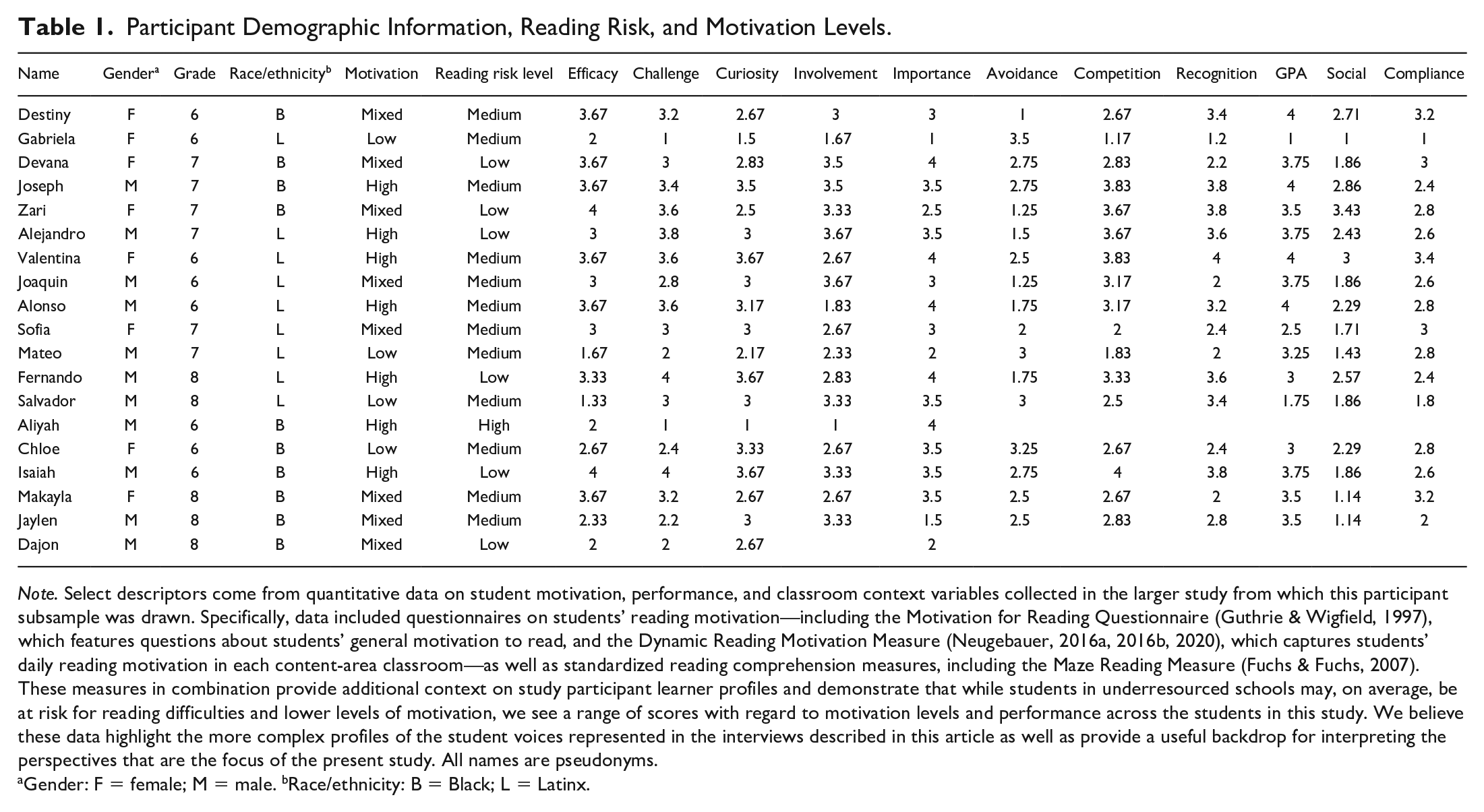
Note. Select descriptors come from quantitative data on student motivation, performance, and classroom context variables collected in the larger study from which this participant subsample was drawn. Specifically, data included questionnaires on students’ reading motivation—including the Motivation for Reading Questionnaire (Guthrie & Wigfield, 1997), which features questions about students’ general motivation to read, and the Dynamic Reading Motivation Measure (Neugebauer, 2016a, 2016b, 2020), which captures students’ daily reading motivation in each content-area classroom—as well as standardized reading comprehension measures, including the Maze Reading Measure (Fuchs & Fuchs, 2007). These measures in combination provide additional context on study participant learner profiles and demonstrate that while students in underresourced schools may, on average, be at risk for reading difficulties and lower levels of motivation, we see a range of scores with regard to motivation levels and performance across the students in this study. We believe these data highlight the more complex profiles of the student voices represented in the interviews described in this article as well as provide a useful backdrop for interpreting the perspectives that are the focus of the present study. All names are pseudonyms.
Gender: F = female; M = male. bRace/ethnicity: B = Black; L = Latinx.
Interviews
Participants took part in individual, semistructured interviews lasting 20 to 30 min with Sabina in a private location at their school, during the school day. Interview questions asked students to discuss their definitions and constructions of reading and describe their experiences reading across content-area classrooms; see online Appendix B for more details about our interview questions. In addition, interviews drew on observational data to ask students specific questions about targeted activities or texts used in their classrooms, prompting students to describe daily events and experiences in their classrooms in more detail. Interviews were audio recorded and transcribed.
Data Analysis
Our qualitative data analytic approach was grounded in a process of inductive, data-driven, descriptive coding (Corbin & Strauss, 2008; Saldaña, 2009). Utilizing tools from critical discourse analysis (Gee, 1999; Willig, 2001), we began the first cycle of coding by asking: How do students describe reading practices, position themselves as disciplinary learners/readers, and construct disciplinary texts? Drawing specifically on Willig’s (2001) methods of discourse analysis, we first explored how participants discursively constructed the concept of reading, identifying “the different ways in which the discursive object is constructed in the text” (p. 109). We analyzed the relations between these constructions and the broader discourses they evoked. Then, we explored the subject positions participant discourse produced, or how they talked about themselves as readers and learners in their content-area classrooms, and literacy practices related to these positions. Finally, we considered how these constructions produced or delineated particular reader subjectivities for participants (Willig, 2001). To move through this discursive analytic process, we began by engaging each analytic step through an open coding process with a subset of the interview data; then, we collaboratively used these codes to identify patterns and to connect, group, and extend codes, developing our understanding of emerging discourses and subject positions (Saldaña, 2009; Willig, 2001; see online Appendix C for a coded data excerpt example). We refined our analysis to create an array of focused codes and an initial codebook (Corbin & Strauss, 2008); then returned to the data, coding another group of interviews, testing the effectiveness, and collaboratively refining the codebook (see online Appendix D); and confirmed the dependability of the codes by engaging processes of constant comparison (Corbin & Strauss, 2008). Trained graduate research assistants coded the complete data set using Dedoose software. Two researchers overlap coded for 30% of the interviews, collaboratively reviewing coded interview transcripts with the research team, discussing any coding discrepancies throughout the analytic process. Transcripts showed 90% inter-rater reliability.
Once focused coding was complete, the research team wrote memos about the coding process and emergent findings (Luttrell, 2010). We also utilized data displays to examine data within codes and to explore how participant descriptors such as the grade level, classroom context, and reading performance related to participant reading constructions and reader subject positions. We relied on analytic and reflective memoing, consistent review and comparison of rich data excerpts, and collaborative conversations with our interpretive community of scholars to enhance the trustworthiness of our analysis (Gee, 1999; Maxwell, 2005).
Researcher Positionality and Reflexivity
To promote the trustworthiness of our qualitative analysis, we acknowledge our role as the instruments of our research: Our subjectivities, experiences, and curiosities influenced the path of investigation, which we reflexively considered across the analytic process (Luttrell, 2010). We want to make our positionality as researchers transparent here: We are both professors and teacher educators and identify as White, middle-class women. Sabina is trilingual and Jewish. We acknowledge that our participants have different educational and life experiences and that our backgrounds put us in a position of relative privilege in relation to our participants. While this tension remains, one way we attended to these power dynamics was by ensuring that our interview interactions were warm, open, and welcoming of student perspectives. Indeed, we had feared students would view us as similar to their teachers, as we demographically match the majority of the teaching force (Ingersoll et al., 2018). However, their open, blunt, and exacting critiques of their classroom experiences suggest that they felt the interview was a safe space. In our analysis and writing, we aimed to honor participant voices and included rich interview excerpts to ensure this work centers on participant perspectives.
Findings
We begin by providing contextual findings from our classroom observations that set the stage for student constructions of reading in the content areas. Across schools and classrooms in the study, we found similar routines: In 79% of the classroom observations, students received direct whole-class instruction, largely in a lecture format, with textbooks and worksheets utilized as the main text, regardless of the discipline. Only 1.7% of teachers used trade books. These text activities, using authoritative and proscriptive texts (Eco, 1979), limited the kind of textual interactions students experienced because students were encouraged to approach these texts as authorities on a topic, as opposed to approaching texts as spaces for critique and knowledge construction (Weinberg & Wiesner, 2011). Therefore, the majority of texts utilized did not authentically represent disciplinary thinking. Indeed, students were reading for similar purposes across disciplines—to complete a set of comprehension questions at the end of a textbook chapter, correct a worksheet, or fill out a worksheet on main ideas—and their interpretations of reading across these contexts were grounded in the demands of these task-specific, assigned readings.
Set in this curricular context, three central findings emerged in participant interviews: First, students constructed reading across the disciplines as a generic or transactional process focused on decoding or searching for information, regardless of the content area. Second, students grounded these definitions in their everyday class activities, based on instructional similarities across their content-area classes. Finally, students’ instructional experiences, definitions of reading, and interpretations of subject-area reading activities obstructed their taking up particular disciplinary ways of thinking and knowing, unless these ways of knowing synchronized with messages about the everyday relevance of disciplinary tasks and knowledge that they received outside of school or through experiential learning activities.
Constructions of Disciplinary Reading
Students often constructed reading as a generic process of extracting meaning focused on decoding, understanding, and defining challenging words or recalling information and main points, regardless of the content area. For example, Gabriela, a Latinx sixth grader who reported low reading motivation across all content-area classrooms, explained in response to being asked what makes a student a good reader that being a good reader means “you’re able to pronounce hard words. You’re able to identify words.” Here, reading is decoding and pronunciation. Similarly, Devana, a Black female seventh grader with varying levels of reading motivation across content-area classrooms, when asked whether reading is the same or different across classrooms, elaborated on different experiences reading a book aloud or on her own: I think when I read it out loud, I can understand it more. ’Cuz when I read it in my head, and I see something that I don’t understand, I just skip it. But, if I read it out loud, and I pause, then she [her teacher] can help me out with the word . . . They [her teacher] be like, “The word is this.” And I say it and keep going. And she gives us the definitions and stuff.
Here, Devana suggested that she can comprehend more when she is actively decoding each word by reading aloud. Once her teacher provided a definition or once her decoding was corrected, Devana felt she understood the text. This definition of reading forgoes active interpretation or constructing meaning. Indeed, Devana explained that it was reading aloud that kept her accountable for retaining information—otherwise she just skipped words. Devana’s description suggests that she largely associated reading with decoding individual words. These two examples show how students identified successful reading as a distinctive skill related to pronouncing and accessing word meanings, rather than connecting reading with developing content knowledge.
A few students acknowledged some disciplinary differences in consuming text across content-area classrooms. However, the disciplinary differences they identified similarly reflected a conceptualization of reading focused on decoding and linguistic challenges, rather than variations in disciplinary meaning making. Sofia, a Latinx seventh grader who reported being motivated to read in some classes but not others, in response to a query about differences in reading across content-area classrooms explained, “In science they have more scientific words, and more harder words, more longer words, versus in ELA [English language arts] and, uh, writing, it’s just the tiny—the tiny words of a sentence.” Similarly, Alonso, a seventh-grade Latinx student who was highly motivated to read across content-area classrooms, explained that reading for English and social studies “feels different because it’s different topics of different things but they all have a similarity of the way they say it.” He went on to explain that “they have different topics but they all revolve around the same thing. So, when they say things they say it similar or the way they say it are narrative or a first person or a third person.” According to Alonso, the topics in his classes made texts different, but the language of these texts—that is, the academic language that conveyed information in these texts, whether a first-person persuasive essay or a third-person science text—made them similar. Student definitions of good reading as decoding, or identifying large words (e.g., content words) or small words (e.g., grammar and sentence mapping), or recognizing distinct pronouns that shift the point of view, informed student understandings of literacy in the disciplines. The curriculum students encountered promoted a view of disciplinary differences centered on small linguistic distinctions, rather than diverse disciplinary habits of mind.
Students’ focus on surface-level aspects of texts in many cases contributed to their construction of reading as transactional—as a tool for memorizing information necessary for future assessments. For example, Dajon, a Black eighth grader who was motivated to read in some classes, whereas unmotivated in others, when asked what makes a good reader in science, social studies, math, and English language arts (ELA), described all reading across subject-area classrooms as serving a similar instrumental function. He elaborated, “First you read the notes on the board, then you think about how is there a way to memorize this, how can I remember this more easily?” Constructing reading as a skill set that supports memorizing, he continued, “If you comprehend more and memorize more, read more, then you could, it would be stuck in your mind and when you get to the test, you’ll be able to do well ’cause you would’ve read and memorized.” For Dajon, reading was a means to knowing material that will need to be reproduced. Relatedly, Fernando, a Latinx eighth grader who reported being motivated to read in all content-area classrooms, described that across content areas, “You look at the passages and you just kind of read through it and you’re like, ‘Okay, I know where the information is at.’” Likewise, Alonso proposed that reading in all his subjects was similar by elaborating on his experience in math: “My reading skills are helpful in math because I focus on the main point and then I have to try to figure out the answer.” These examples highlight students’ transactional constructions of reading, as a tool to identify and memorize facts for proscribed assignments and assessments.
In contrast to these reading constructions focused on surface-level aspects of text, one student, Jaylen, an eighth-grade Latinx student with varied motivation to read across content areas, described disciplinary concepts as being embedded in language specific to a content area. When asked if he saw himself as a good reader across the disciplines, Jaylen contrasted speaking Spanish with understanding science and social studies: In Spanish, you already know that you’ve been born Spanish, you’ve been around so long that you understand it mostly everything in that language you probably already know. So, for all of us it is easy, because all of us talk the same way and we all understand it, so it’s easier for us to make meaning, so it’s already in our brains.
Here, Jaylen highlighted his home experiences being “born Spanish” and comfort in the Spanish-speaking community as reasons that studying Spanish “is easier for us to make meaning.” The comfort and fluidity with the disciplinary language is “already in our brains.” He contrasted this with science and social studies: Yeah, it’s not really the same language because even though we speak in it but then again, it’s a different concept. ’Cause this is, you know, speak in it, verbal concepts, but this is science and social studies, this is why you gotta do history or gotta do the immune system, it’s not something that you already know.
For Jaylen, reading in science and social studies was not grounded in his previous knowledge: These subjects required learning a new language, one with unfamiliar concepts and ideas. Jaylen framed language and concepts as inseparable; to fully understand disciplinary knowledge, you need access to the language of the discipline. His description indicated that he saw language as situated—immersion in a Spanish-speaking environment helped him understand Spanish, implying he would need to be similarly immersed and apprenticed in science to be a good reader of science.
Across student interviews, with the exception of Jaylen, whether students noted reading differences in the disciplines or saw reading as the same across subject-area classrooms, participants constructed reading as transactional, a means to accomplishing teacher-directed assignments. Jaylen’s more complex construction of disciplinary language also showed barriers to taking up disciplinary habits of mind, as he reported feeling inadequately immersed in science and social studies communities of practice.
Constructions of Disciplinary Reading Grounded in Static Classroom Practice
Student constructions of disciplinary reading, and consequently their reader subject positions, were situated in classroom practices: Their understandings of reading were informed (and constrained) by the ways in which curricular texts were used to support content-area learning. For example, Fernando described how reading was separated from learning in the disciplines. When asked if he thought he was a good reader in science, he explained that he did not claim an identity as a scientist because he saw the literacy practices in classrooms as reductive of the actual process of science: You know if you have to plan out a hypothesis and all of that, that’s different from being able to read a packet in science and understand the main points of the packet. So, I could say you could be a really good reader in science, but not really be good at science. And that’s kind of one of those things where, in science, we do have a lot of worksheets sometimes. But sometimes, it does feel like we’re good at reading science, but not good at being in science. With worksheets it’s trying to find the same main ideas or what does this do? But, let’s say some kind of experiment and we’re, okay, what was their hypothesis? What was their conclusion? What could they have done differently? That’s actually I think—that’s more being, understanding the process of how projects work—of how science works, which would be in experiments.
In this example, Fernando emphasized that reading in his science class did not necessarily improve his science knowledge or ability to think scientifically. He delineated reading in science as looking for information, having little connection to scientific thinking or knowledge. Here, classroom reading activities did not provide a space for Fernando to embrace scientific thinking.
Students’ constructions of reading and definitions of disciplinary reading reflected teachers’ use of similar, static practices across subjects. Both Joseph and Jaylen described similar routines around texts occurring across their content-area classrooms when asked about what reading activities they engage in across classrooms. Jaylen explained that in social studies, they engaged in individual reading, followed by talking as a group, where the teacher explored questions students might have. He explained that for math, it was the same routine: “We work by ourselves, it’s the same way as in social studies, then we come together and we talk about it.”
Joseph, a Black seventh grader with high levels of reading motivation across classrooms, explained that in all his subjects, we talk about [the text] when we get done reading. Say if one paragraph is over, we have a question there for us to answer. And maybe he’ll [his social studies teacher] talk with us about it and answer the question.
Both students reported that engaging in reading across these subjects usually entailed some individual work followed by teacher questioning about the reading. Each emphasized similarities in practice and did not describe the questioning as distinctive, as capturing different kinds of discipline-specific inquiry.
Restricting Subject Positions in School
Students faced challenges in taking up disciplinary reader subject positions because of the ways reading was understood in their academic context. When we asked participants about how they felt about reading, participants were often reticent to position themselves as readers, particularly if they saw themselves as struggling with decoding or comprehending text. For example, when asked in which subject he thought he was the best reader, Mateo, a Latinx seventh grader with low levels of reading motivation across classrooms, responded, “I know how to read and all, but it’s hard for me to pronounce words. So, I don’t know.” He later shared that he was interested in science, but because he struggled with pronunciation, he did not think of himself as a good reader in science. In this way, Mateo’s definition of reading was an obstacle to his willingness to take up a subject position as a disciplinary reader.
Similarly, Salvador, an eighth-grade Latinx student with low motivation across classrooms, identified math as his favorite subject, but when we asked if he thought he was a good reader in math, he replied negatively, explaining, “I don’t like reading out loud. I think I’m very slow.” When prompted to describe himself as a reader when reading to himself, Salvador shifted his assessment, responding, “I think I’m—I think I’m good.” Salvador went on and explained that when he chooses a book to read to himself, “it’s more reading for me,” but in subjects like social studies and English, “the words are too big” and “a lot” of the words are “difficult,” so he refused disciplinary reader subject positions. He continued, “You gotta understand the words to connect to it . . . I don’t like reading.” Both Mateo and Salvador’s circumscribed definition of reading as decoding influenced their rejection of possible subject positions as “good readers” in the disciplines, despite their seemingly being motivated to immerse themselves in these topics.
In contrast, Destiny, a Black sixth grader with mixed levels of reading motivation across classrooms, took up a subject position as a skilled reader. When asked about whether she sees herself as a good reader in ELA, Destiny explained that reading is a skill she has already mastered, and thus, she preferred not to do it outside of required school activities: “Reading isn’t that interesting. I already passed my reading level. I already passed A–Z and 1–4. So, I don’t read that much.” When asked if she enjoyed reading about topics or characters of interest, she responded, “I don’t like reading. I only like reading some stories. We do read a book, I do, I won’t be trying sometimes, only on the stories I like.” Destiny went on to share that she only gets good grades on stories she enjoys, “’cuz I like it and my full attention was on it. But the other ones, no attention, just don’t care.” While Destiny positioned herself as a strong reader, she also generally rejected reading as enjoyable and refused the position of “trying hard” as a reader in school, except in rare cases when school stories were of interest. Across these examples, participants’ definitions of reading focused on bounded skills, delineated by academic contexts, and limited their willingness to take up subject positions as engaged readers.
Exceptional Cases: Students Enacting Disciplinary Reader Subject Positions
While academic environment may have circumscribed reader subject positions and students’ desire to adopt disciplinary ways of thinking for the vast majority of participants, we next explore two emergent patterns in the data where students took up disciplinary reader subject positions: through connecting content-area schoolwork with parents’ enactment of disciplinary knowledge at home, and through authentic, experiential classroom activities. These moments in our analysis stood out as exceptions and suggest potential pathways for schools to support students’ nascent disciplinary reader subject positions.
Connecting content-area literacy with disciplinary knowledge from home
Some participants who took up disciplinary reader subject positions described the influence of home contexts in supporting these positions. For example, Isaiah, a Black sixth grader with high levels of reading motivation across classrooms, suggested his interest in reading disciplinary texts was directly tied to his parents’ interests. He explained that he enjoyed reading science and ELA texts at home for out-of-school assignments. When asked why he liked these subjects, Isaiah responded, “’Cause my dad likes science and we’re always watching the science show. So, that’s why. ELA ’cause my mom likes to read. So, I guess I have picked it up from my parents.” Here, Isaiah directly connected the disciplinary interests and identities of his family with his positioning as a disciplinary reader. Later, he shared that science was a subject he did really well in, and again, he noted his parents’ support of this position: “We don’t really do a lot of work, in-class work. We do a lot of homework. So, that’s kind of easy ’cause my dad and my mom help me with it.” Again, Isaiah’s parents gave him access to strategies and supports in science that reinforced his perception that he was an excellent student in science. This quotation suggests that alignment between valued literacy practices in Isaiah’s inside and outside school contexts supported his embrace of disciplinary literacy subject positions (Gee, 2004).
Similarly, Alonso, a Latinx sixth grader with high levels of motivation across classrooms, identified himself as a strong reader in math, and he linked these skills to his family identity. He shared, I don’t know if this has anything to do with it, but my dad’s an accountant. He loves math. So, I think that has to do with me liking math a lot. I think that’s my—that’s what I get my best grades in usually. ’Cause I usually get A’s.
Here we see how Alonso’s adoption of a mathematical reader subject position is modeled by his father, who “loves math” and uses math in the everyday. The direct associations participants drew between their disciplinary reader subject positions and their parents are notable, in part because these kinds of connections to everyday disciplinary knowledge were rare for participants. These exceptional examples suggest that access to adult models of everyday use of disciplinary knowledge promoted students’ positionings as disciplinary readers in school.
Experiential curriculum in content-area classrooms
In the second group of exceptional cases, a few students described embracing disciplinary reader subject positions through experiential classroom activities. For example, when Chloe, a Black sixth grader with low levels of reading motivation across classrooms, was asked in which class she was the “best reader,” she immediately responded “science” and explained how the disciplinary literacy activities captured her interest. She elaborated, Sometimes when I’m doing science, I be like, I can’t believe I’m doing science. But, certain things that we learn in science is kinda cool to me . . . Sometimes we kinda, like the water cycle. I like doing projects in science, which makes me also happy.
After prompting, Chloe explained reading activities she engaged in for her project-based science class: “You have to take notes on that certain thing that you . . . you have to do the project on. And you have to read information about it and look them up on websites.” Here, Chloe emphasized her surprise at taking up a scientist subject position—“I can’t believe I’m doing science”—and was able to identify literacy-rich research activities that she associated with scientific work. This disciplinary reader subject position engagement was tied to the active, project-based curriculum of the course, in which Chloe was given agency not only to learn science, but to do science. This pattern was affirmed by other participants who noted the influence of project-based learning in courses in which they thought of themselves as the “best reader.”
Dajon, a Black eighth grader with mixed levels of reading motivation across classrooms, shared how his social studies teacher used simulations to engage students. He explained, She gives examples and everything and she gets to put herself in some of the situations . . . imagining herself as the queen, making laws and everything. Yet she’s using tables as different, like . . . fractions and everything, and some people may have different roles.
Dajon went on to suggest that his teacher’s experiential approach was a good way to captivate students who might not initially be interested in the course material. Our classroom observations suggested that these more active and experiential practices were relatively rare in these schools, yet participants highlighted the impact of these practices on their academic engagement and willingness to take up subject positions as disciplinary readers.
Similarly, Joseph expressed how in his social studies class students participated in a dramatic reading of a historical play, which he found particularly engaging. He explained, It was fun and I had a good time doing it and reading . . . ’Cuz it’s about a play. And you get to read, when you read you, ah, you have to, it’s all you. Nobody else can take it away.
For Joseph, reading and inhabiting a part in the play gave him ownership over a historical role and access to a disciplinary reader subject position. He noted his specific interest in this disciplinary literacy activity, compared with other experiences in classrooms where “you have nothing to do . . . sitting around, being bored.” Here, Joseph’s experience of the projective identity of a historical figure activated his interest in the topic and engaged his sense of agency as a student.
Another student, Fernando, noted how imagining the diverse perspectives of historical figures engaged his interest in social studies. He explained why the perspectives represented in such texts were compelling compared with those of a more traditional history textbook: If it’s a book like a history book, sometimes we have one view that we always have to read over and over again and I mean the book will be interesting just like that. But sometimes it’s more fun when you read different views of the same story because when you get one view all the time, the book itself isn’t as interesting as when you can see other sides of the same story because a story is complex in its ways and it’s not just one thing.
Mirroring Joseph’s experience, the opportunity the class texts provided for Francisco to embody the perspectives of various historical figures promoted his engagement with a disciplinary reader subjection position and facilitated the disciplinary practice of considering how historical sources influence historical narrative. Although we rarely saw such instructional practices in our classroom observations, students noted the power of being able to practice as an imagined scientist would, or to engage diverse perspectives of historical figures as a practicing historian would. We suggest that such processes gave them space, experience, and confidence to take up disciplinary reader subject positions, and could be further enhanced by drawing on students’ knowledge and lived experiences and by apprenticing students in tools of disciplinary critique.
Discussion
This study revealed several ways in which students of color in urban parochial schools were generally thwarted in taking up subject positions as readers across the disciplines. First, students’ constructions of reading, circumscribed by curricular literacy activities, inhibited discipline-specific reading subject positions. Classroom reading activities promoted reading as being about accomplishing a task rather than being apprenticed in ways of taking discipline-specific knowledge from text. In rare cases, students described greater affinity with disciplinary reader subject positions when home experiences provided meaningful contexts for school disciplinary literacy experiences, or when they had access to meaningful, authentic literacy experiences in class.
Across this study, we found that most students constructed reading as engaging surface-level features of the text. This finding is consistent with studies in elementary contexts that found that students often prioritize completing assignments instead of deep, meaningful learning of concepts ( Anderson, 1981; Rohrkemper & Bershon, 1984), and with studies in middle school urban settings in which students primarily saw reading as being about acquiring code-based skills rather than a metacognitive experience (e.g., Troyer, 2017). Our findings provide important additional insights for the field, in two substantive ways. First, while previous studies with younger students found that students saw the goal of learning as “getting the answers right” ( Anderson, 1981; Rohrkemper & Bershon, 1984, p. 141), this study identifies how student constructions of reading, particularly in content-area classrooms, influenced their willingness to take up disciplinary reader subject positions. Students’ shame about struggling to pronounce words correctly or read fluently served as a barrier to imagining themselves as disciplinary readers, even when students described an interest in a content area and engagement with disciplinary knowledge. Second, this study adds nuance to literature that suggests only less-competent readers espoused these more skill-based and concrete views of reading (Jiménez et al., 1996; McCarthey, 2001; Troyer, 2017). This study included a wide range of reader profiles, from students deemed “at risk” by their school to those who achieved high levels of reading proficiency on traditional reading assessments. However, contradicting these previous findings, we found that across profiles, students constructed reading as a necessary skill to accomplish teacher-requested, finite tasks. These surface-level constructions of reading left little room for students to embrace reading as exposure to new ways of thinking and opportunities to take up new disciplinary subject positions. Notably, these previous studies did not comprehensively capture instructional variables, factors documented in this study, which may have influenced discrepancies in views of reading between reader profiles; for example, stronger readers may have received access to higher quality instruction or more diverse textual resources.
Students’ constructions of reading were driven by reading assignments largely focused on memorization or finding main ideas, regardless of the content area. Research in urban schools with high numbers of students of color and students from low-income backgrounds finds that these schools commonly have an overemphasis on managing behaviors and an underemphasis on content learning and authentic reading tasks (Michie, 2012). Our observation data substantiated this finding, demonstrating that indeed the majority of texts used by teachers (e.g., textbooks and worksheets) did not target disciplinary thinking and instead required students to hunt and peck for information in the text—a particularly disheartening finding given that a wealth of research in the 1980s bemoaned the use of worksheets and seat work (R. Anderson et al., 1985; Dole et al., 1991; Doyle, 1983). Such practices left little room for students to learn about disciplinary discourses, engage in debates, or explore differing and critical perspectives. These activities kept classrooms orderly and students “busy” but did not promote students taking up disciplinary subject positions or integrating disciplinary knowledge with their everyday knowledge and experiences. One could argue that these activities indoctrinated students to see reading as a job rather than a pleasure, a pattern that echoes claims made in other educational research that students of color are “adultified,” positioned as less deserving of the playfulness of childhood compared with more privileged peers (Ferguson, 2000, p. 80). Furthermore, while such instructional activities may support students’ success on standardized assessments, they failed to give students opportunities to connect their prior knowledge with their school knowledge or to engage with critical tools to raise questions about disciplinary understandings, patterns that may exacerbate broader race- and class-based inequities in the disciplines as these students move to high school and college.
Our findings also suggest that in the rare classroom where students did engage in reading activities that incorporated disciplinary thinking and used more experiential approaches to learning—such as reading a play in which students can identify with characters, conducting a laboratory experiment, or reading two primary sources and comparing them—students described greater access to disciplinary reader subject positions. However, when students shared these experiences, as Chloe expressed, they seemed taken aback that they were given access to authentic disciplinary experiences. Such sentiments suggest that these practices provided opportunities for students to take up new disciplinary subject positions, but given their relative rarity, participants took up these positions tentatively. As such, while students acknowledged the pleasure and engagement of disciplinary reading in these rare moments, these same students also retained transactional understandings of reading, as these opportunities to take up disciplinary reading stood out as exceptional in their school experiences and thus were still relatively unfamiliar.
Students’ reluctance or hesitance to embrace disciplinary literacy can also, in some cases, be interpreted as a form of protest. To elaborate, the way in which curricular disciplinary literacy instruction was delivered may have reified existing power dynamics in that certain knowledge, authors, and figures were conceptualized as expert, limiting space for other ways of communicating beyond those that are valued by experts, who are historically Western, White, and male. The way disciplinary literacy content is presented may not represent or welcome other communities. As such, student decisions to focus on getting the disciplinary task done may reflect an act of protest: getting the job done as opposed to engaging in a community that they do not see as their own, or that they perceive as unwilling to embrace them.
This perspective can be contrasted with some of the students in our study who had a greater alignment between school disciplinary literacy activities and everyday disciplinary knowledge enacted at home. These students’ literate worlds were more porous, with the emphasis on reading in ELA mirrored by the reading passions of a parent, or the importance of attending to precise language in math made relevant and important in the context of a parent’s work as an accountant. For these few students, the alignment between contexts facilitated their embrace of disciplinary subject positions with ease, as they were relevant to everyday life. Gee (2004) suggests that to promote equity in literacy, teaching practice must both value students’ home knowledge and directly engage and support the development of projective disciplinary literacy identities or subject positions for students who may not have access to such models at home.
Disciplinary literacy has been conceptualized by some as a way to provide more socially just literacy instruction compared with skill and drill reading instruction that can position students, particularly students of color, as struggling learners (Lee, 2004; Lee & Spratley, 2010; Moje, 2007). Our findings, that students viewed reading as transactional and rarely adopted subject positions as disciplinary readers, provide supporting evidence that current disciplinary literacy instruction in schools still privileges ways of knowing that may be less relevant and more marginalizing for many youth of color.
Conclusion
Middle school students of color in our study often constructed reading as a transactional process and rarely identified disciplinary reading practices or shared distinct curricular experiences of reading in the disciplines. Participants situated these understandings in examples of their everyday classroom activities centered on simple comprehension with few opportunities for students to explore disciplinary literacy or engage in critical problem-solving or dialogue. These findings suggest a pressing need for deeper and more meaningful integration of disciplinary literacy practices, and specifically critical disciplinary literacy practices, into middle school content-area classrooms serving students of color (Gee, 2004; Moje, 2007). In particular, schools need to find ways to support teachers in using disciplinary literacy practices that can be meaningful and bridge the new and familiar for students. Schools predominantly serving students of color need to support instruction that engages with disciplinary literacy in ways that make course content relevant to students’ everyday lives to facilitate their access to disciplinary practices, to model shifting among subject positions, to integrate disciplinary subject positions across students’ lives, and to skillfully critique disciplinary practices that exclude and marginalize particular ways of knowing.
This research suggests several specific implications for practice. First, school curriculum must scaffold students’ understandings of the language and literacy demands of disciplinary texts, along with knowledge of how to dissect and critique disciplinary texts. Students in this study were rarely exposed to instruction that scaffolded development of these higher order critical thinking skills, and as a result, neither struggling nor strong readers were engaging in deep comprehension of diverse texts. A wealth of research documents compelling support for instructional approaches that draw students’ attention to discourse differences at the sentence level, as well as instruction that highlights linguistic patterns particular to certain disciplines (Fang & Schleppegrell, 2010; Fillmore & Fillmore, 2012) and critical conversations about power and difference in disciplinary text (Brooks, 2006; Fisher, 2007; Tatum, 2006). In contrast, reading activities documented in this study, specifically the use of textbooks and worksheets, conveyed implicit messages to students about disciplinary learning and the role of reading to learn broadly. As a result, students largely described disciplinary knowledge as facts and as separate from their own experiences and realities, and saw reading as disassociated from learning, limiting their interest in and curiosity about disciplinary literacy.
The present study was centrally focused on individual students as the focus of analysis and incorporated varied and rich forms of data including interviews, classroom observations, and cognitive and affective assessments. We recommend that future scholarship go even further in studying students’ experiences in schools that serve students of color, including public, charter, and parochial schools—investigating the school ecology more broadly—and exploring how students’ racial, ethnic, and class identities intersect with reader identities. In addition, future research could explore structural aspects of schooling that may influence the uptake of disciplinary literacy instruction by students and teachers, including teacher training and retention, school leadership strategies, school resources, mandated assessments, and familyinvolvement.
Our research shows that current content-area literacy practices can reify the exclusion of low-income students of color from exploring disciplinary knowledge, as students in our study were rarely provided access to varied ways of engaging disciplinary reading, thinking, and knowing in the classroom. These flat reading practices disadvantage marginalized students. However, our findings suggest that schools may be able to build on students’ experiences beyond the classroom to increase their engagement with disciplinary reading (Hulleman & Harackiewicz, 2009). Indeed, for some students, such as Alonso and Isaiah, alignment between content-area literacy and the enactment of disciplinary knowledge at home contributed to more positive disciplinary subject positions, and highlights the potential of increasing fluidity between literate spaces.
Existing literature on fluid literate spaces touts the benefits of multimodality in disciplinary literacy instruction, using images, videos, and other modes to address disciplinary thinking (Castek & Beach, 2013; Gabriel & Wenz, 2017; Gillis, 2014; Tang & Moje, 2010). In this study, students did not explicitly talk about these other modalities, nor did we ask them specifically about their use of varied forms of text beyond print. However, it stands to reason that participants may have access to a variety of literacy modalities outside of school—for example, communicating by text, following Instagram stories, or singing along to the lyrics of a favorite song—that may contribute to their developing subject positions. Indeed, Isaiah’s feelings about watching science shows support the potential of this approach. Future work should delve deeper into how utilizing multimodalities may also open up and enhance students’ conceptualizations of reading and their subject positions as readers.
In addition, taking a cue from Jaylen, who contrasted being a comfortable Spanish speaker with the discomfort of engaging in the language of science, teachers might explicitly acknowledge and build on the skills of critical cultural straddling that many students of color already utilize during the school day as a model of the kind of skills needed to engage with critical disciplinary literacy as they move between subject-area classrooms (Carter, 2008; Carter, 2006). Overall, if we want to support low-income students of color, and indeed all students, to be passionate, engaged, and critical disciplinary readers, we must develop curricula and support everyday classroom practice that encourages relevance, inculcates students’ complex and critical understandings of literacy, and apprentices students in disciplinary subject positions through active, playful engagement with disciplinary texts.
Supplemental Material
938780_Translated_Abstract_Adams – Supplemental material for “I Know How to Read and All, but . . .”: Disciplinary Reading Constructions of Middle School Students of Color
Supplemental material, 938780_Translated_Abstract_Adams for “I Know How to Read and All, but . . .”: Disciplinary Reading Constructions of Middle School Students of Color by Sabina R. Neugebauer and Elizabeth E. Blair in Journal of Literacy Research
Supplemental Material
AppendixSRNLB_final – Supplemental material for “I Know How to Read and All, but . . .”: Disciplinary Reading Constructions of Middle School Students of Color
Supplemental material, AppendixSRNLB_final for “I Know How to Read and All, but . . .”: Disciplinary Reading Constructions of Middle School Students of Color by Sabina R. Neugebauer and Elizabeth E. Blair in Journal of Literacy Research
Footnotes
Declaration of Conflicting Interests
The author(s) declared no potential conflicts of interest with respect to the research, authorship, and/or publication of this article.
Funding
The author(s) disclosed receipt of the following financial support for the research, authorship, and/or publication of this article: This research was supported by the International Literacy Association’s Elva Knight Research Grant and Temple University’s Summer Research Grant. The authors thank Michelle Lia, Laurie Shirley Esposito, Mariah Davis, and Cristina Perez for their assistance with coordiating, coding, and entering data for this study.

References
Supplementary Material
Please find the following supplemental material available below.
For Open Access articles published under a Creative Commons License, all supplemental material carries the same license as the article it is associated with.
For non-Open Access articles published, all supplemental material carries a non-exclusive license, and permission requests for re-use of supplemental material or any part of supplemental material shall be sent directly to the copyright owner as specified in the copyright notice associated with the article.
