




Abstract
Drawing from theories of identity, language, and race, we conceptualize gateway moments to literate identities in high school English language arts classrooms enrolling language-minoritized youth. Gateways were interactions that afforded particular kinds of literate identities for youth. Deficit literate identities often invoked racialized language and literacy ideologies; authoritative literate identities engaged youths’ full cultural and linguistic repertoires to create and critique knowledge. Occasionally, youth enacted authoritative classroom literate identities alongside or in response to dominant deficit frames of their literate abilities during planned and spontaneous classroom interaction. We note in each type of gateway opportunities for teachers to open space for youths’ authoritative knowledge-producing literate identities. We aim to illustrate how a single instructional choice or classroom interaction ranges in effect from maintaining and reinforcing oppressive legacies and deficit literate identities to centering youth and their language and literacy repertoires in learning experiences for more socially just interactions and learning.
Keywords
Introduction
The past decade has witnessed a shift in secondary literacy instruction. The federally mandated accountability paradigm of No Child Left Behind (NCLB) reduced curricula to basic measurable skills (Afflerbach, 2005). Partly in response to this reduction, the Common Core State Standards emphasize the literacy demands of disciplinary and informational texts in college classrooms and career settings. Although some teachers use genre and functional linguistic approaches to emphasize ways texts represent disciplinary communities (Schleppegrell, 2004; Shanahan & Shanahan, 2008) and construct arguments (de Oliveira, 2010), others bring NCLB's reductionist approaches into students’ engagements with complex texts by “breaking things down” and taking them “in steps” (Enright et al., 2012; Enright & Wong, 2018). Neglected in both cases are the rich repertoires of communicative practices engaged by minoritized and multilingual youth to interpret and produce complex texts for many purposes in their everyday lives (Martinez et al., 2017). These contexts and constraints of literacy instruction have consequences for the literate identities available to minoritized youth in secondary English language arts (ELA) classrooms.
The absence of minoritized youths’ communicative repertoires in literacy instruction undermines their classroom-based access to authoritative literate identities, identities enacted when youth draw from their full repertoires of language and literacy to negotiate or produce knowledge for purposes and tasks that are personally and culturally meaningful to them. Systemic and institutionalized racism shape what counts as literacy, who counts as literate, and how racialized conceptions of literacy guide the sorting of students into privileged or restricted learning environments (Baker-Bell, 2020; Flores & Rosa, 2015). Consequently, most minoritized youth are taught in traditional transmission-oriented classrooms, often by monolingual teachers who do not share their histories and cultural backgrounds (Neri et al., 2019), and whose often unexamined language and literacy ideologies reproduce inequalities (Martinez, 2017).
Although wholly equitable and just literacy instruction requires a radical systemic transformation of schools (Tate, 1997), our urgency is to inform change now at our level of influence: the classroom. In many classrooms, youths’ rich and authoritative literate identities are dismissed when compared with constrained school-based uses of literacy. Our examples from two California ELA classrooms highlight the significance of discursive interactions to support or constrain authoritative literate identities for minoritized and marginalized youth. We conceive of everyday classroom interactions as potential gateways to literate identities that are authoritative, engaged and standardized, standardized and subordinating, or deficient or deviant. Our goal is to expose injustices in literacy classrooms by marking these gateways so educators can work intentionally toward more socially just instruction. We aim to inform literacy instruction that encourages authoritative literate identities for minoritized youth, with possibilities to self-author literate identities in relation to curriculum or concepts (ideologically), to their teachers and peers (relationally), and to oral and print texts as producers and interpreters of meaning.
We began with an exploratory study of the types of literacies and language practices evident in ELA classrooms. Our early orientation to data was temporally and discursively focused on observed and recorded interactions with an emphasis on language and literacy practices. Our lens became more critical, however, as early analyses of classroom literacies revealed consequences of standardization on youths’ literate identities—the legacy of colonialism played out at the level of classroom interaction. In these moments, we came to identify gateways to literate identities that could disrupt or reinforce inequalities in classrooms.
Literature Review
The following literatures informed our understanding of literacies across contexts of adolescents’ lives, emphasizing those with the greatest relevance for classroom meaning-making if youth could enact authoritative knowledge-producing identities by mobilizing their full language and literacy repertoires.
Standardized Literacies
Standardized school-based literacies reflect dominant ideologies of “appropriate” language and literacy forms and practices for academic settings (Flores & Rosa, 2015). These include specialized genres and registers of disciplinary literacies (Shanahan & Shanahan, 2008), procedural approaches and prescribed forms of literacy associated with accountability-driven instruction (Enright et al., 2012; Enright & Wong, 2018), and classroom language and literacy practices emphasized in curricular standards past and present.
Much research has failed to problematize what language and literacy practices count as “academic.” Some scholars, however, highlight the limitations and consequences of these frames, which neglect advanced language and literacy practices of language-minoritized youth in classrooms (Enright et al., 2012; Martinez, 2017). School-based literacies are both global and local. Teachers’ prior language and literacy ideologies shaped by their own status in society, often determine how they position themselves and students within text-based classroom interactions; teacher uptake controls what student ideas receive validation (Handsfield & Crumpler, 2013). These studies illustrate cultural resources mediating literacy and identity in ELA classrooms. They do not examine how particular teacher choices or classroom interactions use, promote, or withhold authoritative, literate, knowledge-producer identities for learners.
Community-Based Literacies
Our initial conception of community-based literacies drew from literatures on adolescent literacies (Alvermann & Moje, 2018; Ives, 2011) and language-minoritized youths’ community-based communicative repertoires (Fecho, 2004; Martinez et al., 2017) and cultural practices (de los Ríos, 2018; Keehne et al., 2018). These literatures highlight minoritized youths’ negotiation of literate identities in classrooms or across different cultural and institutional spaces. For example, a US–Mexico transnational youth employed critical literacies and translanguaging to engage with corridos—a Mexican music genre with sociopolitical and historic roots—to make sense of his world in home and school contexts (de los Ríos, 2018). A framework for culturally responsive instruction in native Hawaiian communities includes teaching and learning with authentic content and assessment, engaging students in real-life uses of literacy (Keehne et al., 2018). This framework situates literacy and cultural identity as interrelated, integral to cultural revitalization. In contrast, Ives's (2011) study of an advanced sixth-grade ELA classroom documented how African American students hid interests and literacy practices when the teacher routinely failed to acknowledge their literacy achievements.
Popular Culture and Youth Literacy Practices
As we analyzed data, we expanded community-based literacies to include studies attending to popular culture and youths’ everyday experiences. Petrone (2013) argued that youth engagement in popular culture affords distinct opportunities for literacy education to be “more responsive to, respectful of, and useful for the rich literate and cultural lives of today's young people” (p. 256). Teachers engaging in critical self-reflexivity of their positionality, privileges, and experiences are better equipped to open spaces for students’ community-based literacies, important for developing authoritative knowledge-producing identities (Garcia & O’Donnell-Allen, 2015; Mirra et al., 2018). However, pre- and in-service teachers sometimes misunderstand or devalue youth popular culture (Morrell, 2002), often dismissing students’ cultural values as inappropriate for curricular learning. Students’ attempts to integrate everyday literacy artifacts into classrooms are often perceived as derailing instruction (Lee, 2001). Some teachers struggle with integrating popular culture meaningfully into the curriculum, missing opportunities to use culturally relevant texts to invite personal experiences and voices into learning. Others, who integrate literacy artifacts from youths’ out-of-school lives into instruction, do so without a framework for how to design or support these integrations purposefully toward more socially just and culturally relevant instruction (Aronson & Laughter, 2016).
Reproducing Inequalities in Classrooms
As we noted instances of societal inequalities reproduced in focal classrooms, we added societal discourses to our community-based literacies category. Here, we address concerns about ways inequities can be enacted and sustained through uncritical integration of youths’ everyday literacies into instruction (DeNicolo, 2010; Paris & Alim, 2014). For example, in a classroom that encouraged bilingual students’ use of Spanish or English, DeNicolo (2010) found that English-proficient bilinguals reinforced hegemonic practices by insisting on English usage or excluding Spanish-dominant peers. The classroom promoted monolingual English practices, and students were ill-equipped to mobilize cultural resources beyond socially established and unequal norms.
Personal–Relational Literacies
Prior literatures informed our focus on what practices we saw in our data. Often, however, our data led us to focus on how teachers and youth negotiated identities and knowledge. We labeled practices overtly mediating relationship and interaction as personal and relational literacies—discursive moves from participants that marked identities, attempted to build relationships, or drew clear relationship boundaries. An example from the literature is the unwitting hierarchical positionings reinforced by the researcher and teacher in Frankel et al. (2018), despite project goals to position 12th-grade literacy mentors equitably and work collaboratively to serve 10th-grade ELA students.
Alternatively, personal–relational literacies could reveal authoritative identities for youth. Vetter (2013) examined how a white English teacher positioned adolescent users of African American language as important class contributors by employing practices that leveraged their communicative repertoires for academic meaning-making. Hikida (2018) used the “holding space” metaphor to illustrate how one white teacher reframed the positioning of fifth-grade students of color, identified as “struggling” readers, by deliberately inviting their contributions to text-based discussions. In sum, personal–relational literacies are types of interactions reinforcing positional identities or opening space for their renegotiation.
These literatures highlight the range of official and unofficial literacy practices evident in ELA classrooms, and how these practices are often situated in instruction. Next, we describe the theoretical lens we applied to classroom interactions.
Framework: Racialized Identities and Standardized Literacies
We employ a raciolinguistic perspective (Rosa & Flores, 2017) to understand how youth were institutionally and societally positioned into categorical identities of deficit and illegitimacy. Next, we center classroom activity and interaction through conceptualizations of scripts, counterscripts, and third space as means of maintaining, disrupting, and reinventing hierarchical forms of participation, power, and knowledge (Gutiérrez et al., 1995). Finally, we build on raciolinguistic perspectives on the positioning of youth, and the activity and interactionist focus of third space approaches by incorporating Holland et al.'s (1998) theory of identities in practice.
Raciolinguistic Perspectives
According to Rosa and Flores (2017), a raciolinguistic perspective examines how historical and structural factors shape the joint construction of “linguistic and racial forms rendered mutually recognizable as named languages/varieties and racial categories” (p. 629). They described how colonial histories created these categorical sets to maintain power relations and keep the supremacy of Europeans (whites) over non-Europeans (nonwhites). Although a minoritized youth, for example, may speak, behave, and appear in ways that support classroom literacy learning and use, any particular act or appearance can be “inversely indexed” in the white imagination to signal a raciolinguistic category of deviance or deficiency (Rosa & Flores, 2017, p. 628). These raciolinguistic categories are reified through schools’ hierarchical structures (e.g., programs and practices) and things, such as assessments to measure “the capacity to inhabit and enact idealized whiteness rather than empirical linguistic practices” (Rosa & Flores, 2017, p. 633). Using a raciolinguistic perspective, we highlight the consequences of colonialism and white supremacy on the differential positioning and treatment of minoritized and European-descent teachers and students.
Scripts, Counterscripts, and Third Space
Although Gutiérrez et al. (1995) acknowledged “the larger meta-narratives and systemic structures and practices re-invoked in schools” (p. 448), their analysis of scripts, counterscripts, and third space focus on the “micro-politics of the classroom” to examine how teachers and students negotiate and renegotiate power relations locally. Drawing on Bakhtin's (1986) notions of dialogue and heteroglossia, Gutiérrez et al. (1995) described the monologic instruction observed in their study as the official script, which appears to be entirely controlled by the teacher, preventing dialogue and critical perspectives. Counterscripts are forms of participation from students “who do not comply with the teacher's rules for participation” (p. 449). Third space is the possibility of these exclusive teacher and student spaces intersecting to create potential for more authentic dialogue and interaction such that “no cultural discourses are secondary” (Gutiérrez et al., 1995, p. 447). As an example of third space, they described a bilingual classroom with a white teacher deeply involved in students’ local communities, designing interactive classroom activities with locally meaningful materials and practices.
Identities in Practice
Notions of identity are central to Holland et al.'s (1998) theory of identity in practice, which differs from positioning theory in that it separates “the figurative from the positional” in the analysis. This aids our analysis since figurative identities normalize colonial Eurocentric cultural norms and values, often reinforcing the subordination of minoritized youth in classrooms. Three contexts of identity described by Holland et al. are central to our analyses: the figured world, positionality, and space of authoring. A figured world is “a socially and culturally constructed realm of interpretation in which particular characters and actors are recognized, significance is assigned to certain acts, and particular outcomes are valued over others” (Holland et al., 1998, p. 52). Identities in a figured world are essentially the character types or roles mutually recognized in that context: mother, daughter, teacher, and student.
Positional or relational identities involve how one's behavior signals social positioning in relation to others in a given moment. One's positional identities depend on “the others present” and on one's “greater or lesser access to spaces, activities, genres, and through those genres, authoritative voices, or any voice at all” (Holland et al., 1998, p. 128). In classrooms, they may be signaled by how teachers are addressed—“Ms. Ford” or “Ms. Michelle.” They may be signaled by desks in rows versus a circle, or by which students teachers call upon, correct, or ignore. The space of authoring is a space of improvisation and orchestration, of shepherding cultural resources (discourses, materials, images, ideas) within a context and moment to renegotiate one's positional/relational identities, self-authoring identities that increase status or expand opportunities for participation. A student positioned as a “thug” or “gangster” may renegotiate status and opportunity in a classroom by self-authoring an “artist” identity during an elaborate classroom presentation.
Together, these theoretical orientations allow us to examine classroom interaction from the perspective of histories and structures of inequality, teachers’ power to incorporate or prohibit students’ cultural discourses and related scripts into classroom interaction, and students’ ability to renegotiate and self-author identities of authority and literacy in classrooms. The following questions guided our analyses:
What literate identities are negotiated by students when popular culture and/or youths’ cultures or experiences are introduced into discourse in ELA classrooms? What affords or constrains these literate identities in classroom interactions between the teacher, students, and texts?
Methods
Context and Design
The guiding questions for this inquiry emerged from our analyses in prior work. The Diverse Adolescent Literacies (DAL) Project was an exploratory qualitative study of language and literacy practices in 12 high school classrooms, examining what “counts” as academic language and literacy within and across subjects, curricular tracks, and student populations. Findings indicated that district and school accountability norms resulted in a narrowing of the ELA curriculum, with academic literacy taught as static knowledge and formulaic writing in the honors section and reduced to even narrower discrete standardized performances of language and writing in general-track ELA sections. These overwhelming norms led us to question what happens, and what potential for inclusive teaching practices lies, in the rare moments when students’ backgrounds and experiences were referenced or visible in these classrooms.
The Integrating Literacies Project (ILP) study is more asset-oriented in purpose and design, examining Latinx youths’ language and literacy practices in visible and invisible work in work-study placements, family contexts, and high school classrooms. Rather than emphasizing the affordances and constraints of contexts for youths’ language and literacy use, the ILP study aims to capture the broadest range of youths’ language and literacy practices across formal and informal institutional contexts to note possibilities for leveraging their abilities across all settings. The notion of “work” emerged as a focal construct early in the study to facilitate comparisons of youth practices—and the conditions in which they are situated—across the three settings that were central in youths’ experience according to survey data from Santa Maria High School (SMHS; all names are pseudonyms). A central premise is that youths’ informal family-based responsibilities in language-brokering, caregiving, and managing household needs contribute to advanced repertoires of language and literacy practices, requiring skills as complex as those emphasized in classrooms and professional work-study settings. Although the purposes, designs, contexts, and populations of each study differed, classroom-level data from each school site were gathered using similar methods. See Table 1 for details related to research questions, school sites, focal classrooms, and inquiry approaches. ILP data were added to this study's final analyses to include curricula and classroom practices that may be more culturally responsive than those in the DAL data and to test our “gateway” construct across diverse contexts.
Research Contexts, Communities, and Youth Across Studies.
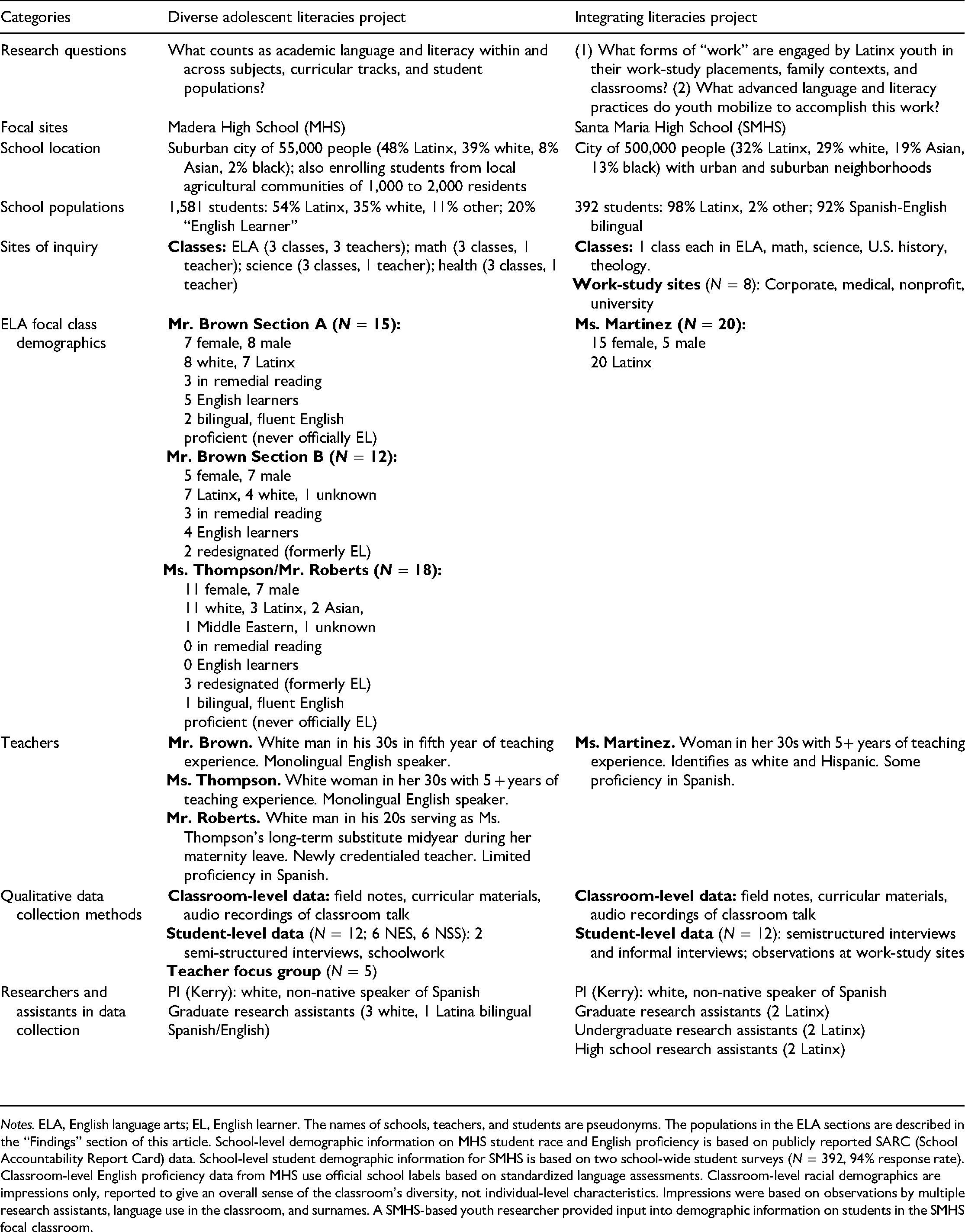
Notes. ELA, English language arts; EL, English learner. The names of schools, teachers, and students are pseudonyms. The populations in the ELA sections are described in the “Findings” section of this article. School-level demographic information on MHS student race and English proficiency is based on publicly reported SARC (School Accountability Report Card) data. School-level student demographic information for SMHS is based on two school-wide student surveys (N = 392, 94% response rate). Classroom-level English proficiency data from MHS use official school labels based on standardized language assessments. Classroom-level racial demographics are impressions only, reported to give an overall sense of the classroom's diversity, not individual-level characteristics. Impressions were based on observations by multiple research assistants, language use in the classroom, and surnames. A SMHS-based youth researcher provided input into demographic information on students in the SMHS focal classroom.
Theories of scripts and counterscripts (Gutiérrez et al., 1995) helped contextualize the language and literacy practices observed within official and unofficial classroom discourses and the often varied practices and value systems ascribed to performances of language and literacy in classrooms. Official “scripts” often reflected language and literacy practices that invoked a figured world of schooling as standardization; counterscripts highlighted possible gateways to a range of literate identities beyond such standardization. A theory of identities in practice with attention to positional and self-authored identities (Holland et al., 1998) brought coherence to our framework to explore racialized and self-authored literate identities.
Different figured worlds were salient at each school site. As an accountability-driven public school, institutional labels associated with performance on standardized tests of literacy and language proficiency (English learner [EL], fluent English proficient, struggling reader) shaped student identities negotiated by youth participants at Madera High School (MHS), primarily by determining the curricular tracks and courses into which students were enrolled. Racialized student identities were more marked at MHS, where the student population was more racially and linguistically diverse. Honors classes enrolled primarily white and Asian American students, and remedial courses had the greatest proportion of Latinx bilingual students. Ofelia, one of two Mexican-origin students in honors English, noted the conflation of race with other school and academic identities when she remarked that in her class, “all the quiet people and Mexicans were over here, and all the white people and all the preps were over there.” She added that their teacher, Ms. Thompson, only called on students from the side with whites and preps, but that the long-term substitute was more fair. Newcomer immigrant students were excluded from “mainstream” ELA classes, including general-track sections. Native English speakers officially identified as “struggling readers” and bilingual learners with low-intermediate levels of English proficiency were enrolled in a companion English class that spent an additional class period each day with the skills and materials from the ELA curriculum of their “regular” English classes.
Fewer institutional student categories operated at SMHS. The private school had fewer tests and resources to measure, sort, and intervene in students’ performance and trajectories. Standardized test scores and grades determined students’ curricular tracks, but the school did not test bilingual learners’ proficiency in English, despite one administrator's estimate that 85% would be identified as “English learners” with such tests. Of the 354 enrolled students who responded to the open-response survey item “Race/ethnicity, Raza/etnia,” 348 gave a label generally identified with a Latinx community, with the most frequent responses being Mexican (197) and Hispanic (118). Fifteen of these students identified as Mexican or Latina plus another ethnicity and seven identified with non-Latinx labels (four Filipino, one Native American, one African American, and one white). One Mexican-origin student said that Mexican culture was so dominant among students that an Indian classmate bought Mexican botas (boots) to wear to school dances.
Also unique to SMHS was the context of a private college-preparatory school funded by work-study contracts and philanthropy. School outreach materials presented students as aspiring first-generation college-going youth, but fundraising events and promotional videos positioned students and their families as hopeful, but suffering from poverty and in need of charity, rather than capable and talented. A video on the school's “Support SMHS” website, for example, shows a Latina teenager describing her dream to be a doctor and saying, “Even though we come from a hard back story, that doesn’t define what our future holds and we can become better versions of ourselves.” Classroom activities generally invoked the “college prep” figured world, with frequent visits from alumni who were in college. Teachers frequently noted how assignments would prepare students for college. These two figured worlds of college-preparatory school and place of charity played out as a constant tension in school activities where potential donors might be present.
Data Collection
The DAL project focused mostly on classroom-level data (12 classrooms, 4 subject areas, 120 students), with youth interviews to inform data collection and interpretation. Four graduate students assisted with data collection. In the ILP study, data collection began with surveys of the entire student population, and of 12 focal youth who were observed in their professional work-study sites, interviewed, and involved in designing and providing professional development to their work supervisors. Three focal youth eventually became members of the research team, in addition to graduate and undergraduate assistants. Work-study and home/community settings were our top priorities, since Kerry's ethnographic field notes from classrooms suggested practices consistent with themes in the extant literature and Kerry's prior work (Enright et al., 2012; Enright & Wong, 2018). Audio-recording in classrooms began more recently but was cut short by COVID-19. Still, forms of classroom-level data across both sites were very similar, as noted in Table 1.
Positionalities
Collectively, we are multilingual educators with varied experience teaching K–12 ELA and preparation of literacy/ELA teachers in the United States and Latin America. Kerry's Irish-descent whiteness masked her ignorance about navigating educational institutions, but bestowed privileges that tracked her into advantageous school-based educational opportunities. She acquired Spanish through study, through friendships and marriage, and from Spanish-speaking students. Identifying and confronting white supremacy in her behaviors and understandings is a lifelong project. Joanna, a second-generation Chinese American, grew up in a diverse working-class California neighborhood, where official curricula and values socialized her into accepting the white literary canon as the norm for literate expression. Joanna learned additional European languages while experiencing home-language loss and was denied advanced English classes in favor of the white middle-class minority of students. Sergio is a native Spanish-speaker doctoral candidate from Argentina, where he learned English as a young adult and later taught English as a foreign language courses in rural and urban low-socioeconomic status public schools. Sergio never questioned his Eurocentric-oriented education, reading critical texts but without challenging deficit-oriented practices often affecting students from historically oppressed groups.
Our unique positionalities gave us different understandings of what counted as popular culture or youth culture, for example, particularly since none of us are from the same communities as the study participants. Joanna had unique insights as the only team member to experience K–12 schooling in the United States from a subordinated position. Kerry was the only one to teach in secondary classrooms similar, demographically, to the MHS classrooms. Surprisingly, Sergio's familiarity with youths’ US-based popular culture references surpassed that of Joanna and Kerry, essential for coding some instances in the data. For example, when a male student asked Mr. Brown what he would call a biography about Bonnie (a female), the teacher answered, “Blonde Ambition.” Sergio immediately recognized Madonna's controversial world tour in the response, a possible source of Mr. Brown's comment.
Data Analyses
Phase 1: Integrations Beyond Standardized Literacies
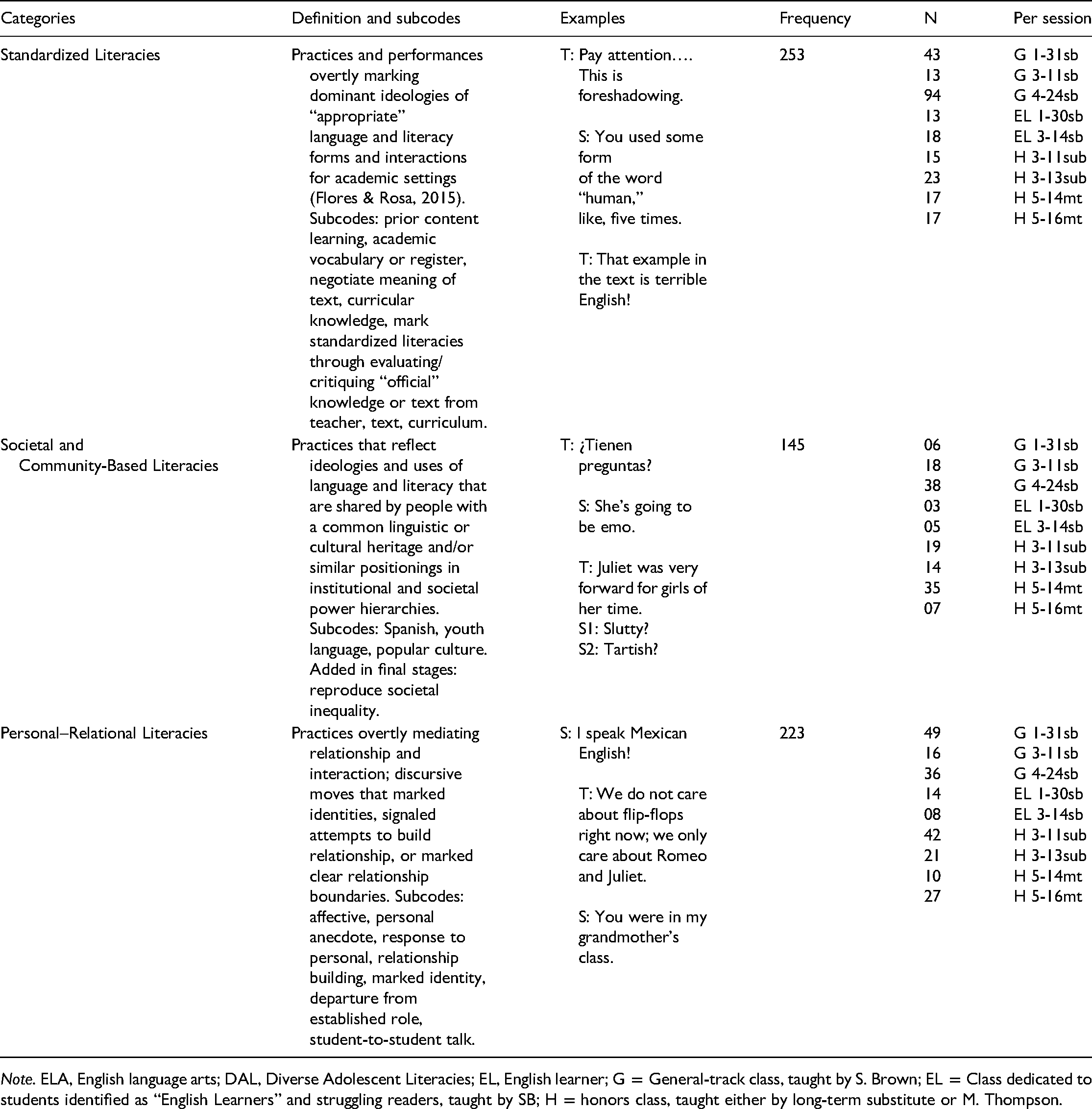
Our Enright and Wong (2018) study of the standardization of literacies in the DAL ELA classes left us questioning, “When textbook-driven curricular standards are not the sole focus of classroom literacy practices, what is being integrated into literacy instruction?” In response, we selected five transcripts with the greatest prevalence of these “exceptional” literacy integrations. Marking units of analysis in the discourse based on changes in the dyad (Teacher–Student 1, Student 2–Teacher) and/or topic, we identified all instances of “exceptional” integrations, sorted into 20 codes. These codes directed our literature review, which helped to refine definitions. Upon finalizing code definitions, we recoded the original five transcripts, then organized them into parent codes of Classroom-Based Literacies, Societal and Community-Based Literacies, and Personal/Relationship Literacies (see Appendix Table 1). We coded four additional “talk heavy” transcripts in the data set for instances of these parent codes.
We coded approximately 70% of all transcripts together. Coding sessions began with collaborative coding of a partial transcript, pauses to clarify code definitions and rules, additional independent coding time, and reliability checks at the end of a session. These were followed by individual coding between meetings, with at least two members coding the same transcript. Reliability checks would launch the next coding session. With all transcripts coded, we recoded samples from earlier transcripts to ensure the fidelity of code definitions throughout the process. We agreed readily when coding for standardized and personal literacies. Subcodes related to societal and community-based literacies required more negotiation. Since parent categories required less inference, interrater reliability was easier to achieve at that level.
The prevalence of literacy integration types varied based on curricular track (see Appendix Table 1). Mr. Brown taught general-track ELA sections. One section enrolled bilingual learners with more limited English proficiency; talk during this class was less interactive, with the most tightly scripted I-R-E (Initiate-Respond-Evaluate) sequences (Mehan, 1982). Student utterances were shorter; they generally initiated talk only to ask for the meaning of words or clarification of instructions. Mr. Brown often repeated himself and answered his own questions.
As we examined coded data for themes, we noted differences in teacher interactions with students based on raciolinguistic categories that seemed to be ascribed to them. We also noted instances when societal inequalities were overtly reproduced in discursive interaction. We proceeded with the following question: What happens when popular culture and/or youths’ cultural knowledge and linguistic practices are integrated into classroom discourse? We reduced DAL data to six sessions, two from each teacher, cutting sessions that lacked integrations of popular or youth culture and language practices, including both sessions enrolling bilinguals with less proficiency in English and struggling readers. With each transcript, we clustered instances when popular and youth culture and language practices were marked or integrated into classroom discourse, attending to how youth negotiated their participation, how they were positioned, by whom or what, and with what consequence for their engagement with and production of knowledge in the classroom.
Phase 2: Coding for Gateways to Literate Identities
We developed our “gateways” concept to capture realized and potential literate identities afforded by the integration of popular culture and/or youths’ cultural and linguistic practices. Since DAL data failed to yield examples of culturally relevant, socially just instruction, we introduced a transcript from an ELA classroom in the ongoing ILP study. We only had one ELA transcript from SMHS, since the pandemic prompted remote instruction shortly after we began audio-recording. We included the ILP transcript in our data because the class discussion was based on the documentary Precious Knowledge (McGinnis & Palos, 2011), which depicted the voices and experiences of Mexican-origin students. This discussion in an ELA class exclusively enrolling Mexican-origin students had potential for connections between youths’ cultural and linguistic backgrounds and knowledge lacking in DAL data. Also, this different instructional context allowed us to see whether the phenomena from early analyses held true across different instructional contexts and student demographics. With the additional transcript, we continued to see patterns in the interactions that led to more or less authoritative engagement in classroom literacy encounters.
Our analytic process was similar to earlier analyses, but the inferential nature of the questions required more meetings to identify, categorize, and recategorize the types of literate identities enacted, or signaled but not taken up, in the data. We marked interactions when literate identities were salient, defining “literate identity” as an identity related to one's uses of and capacities for language, literacy, and other semiotic modes of representation. We then coded discursive interactions during literacy instruction in which youths’ linguistic and literate capacities were marked, explicitly through teacher or student comments, or implicitly through uptake, neglect, or redirection. The “gateway” metaphor was our conceptual response to the second analytic question. During analyses, we identified many instances of student-initiated or teacher-elicited questions or comments that, if taken up by the teacher or given the floor for students to discuss, debate, and analyze, had the potential to center students’ cultures and language practices in relation to curricular knowledge and skills. In the MHS classes particularly, these student-initiated questions or comments were most often ignored or dismissed by teachers. Four gateways were prevalent in the data: deficit or deviant, standardized and subordinated, engaged standardized, and authoritative (Table 2). Gateways are identified at the level of interaction, not event; a sexist comment related to a piece of literature might open a Gateway to Deficit and Deviant Literate Identities for girls in the class, but a teacher's or student's critical response could pivot into a Gateway to Authoritative Literate Identities.
Phase 2 Coding and Frequency Counts: Gateways to Literate Identities (5 DAL transcripts, 1 ILP transcript).
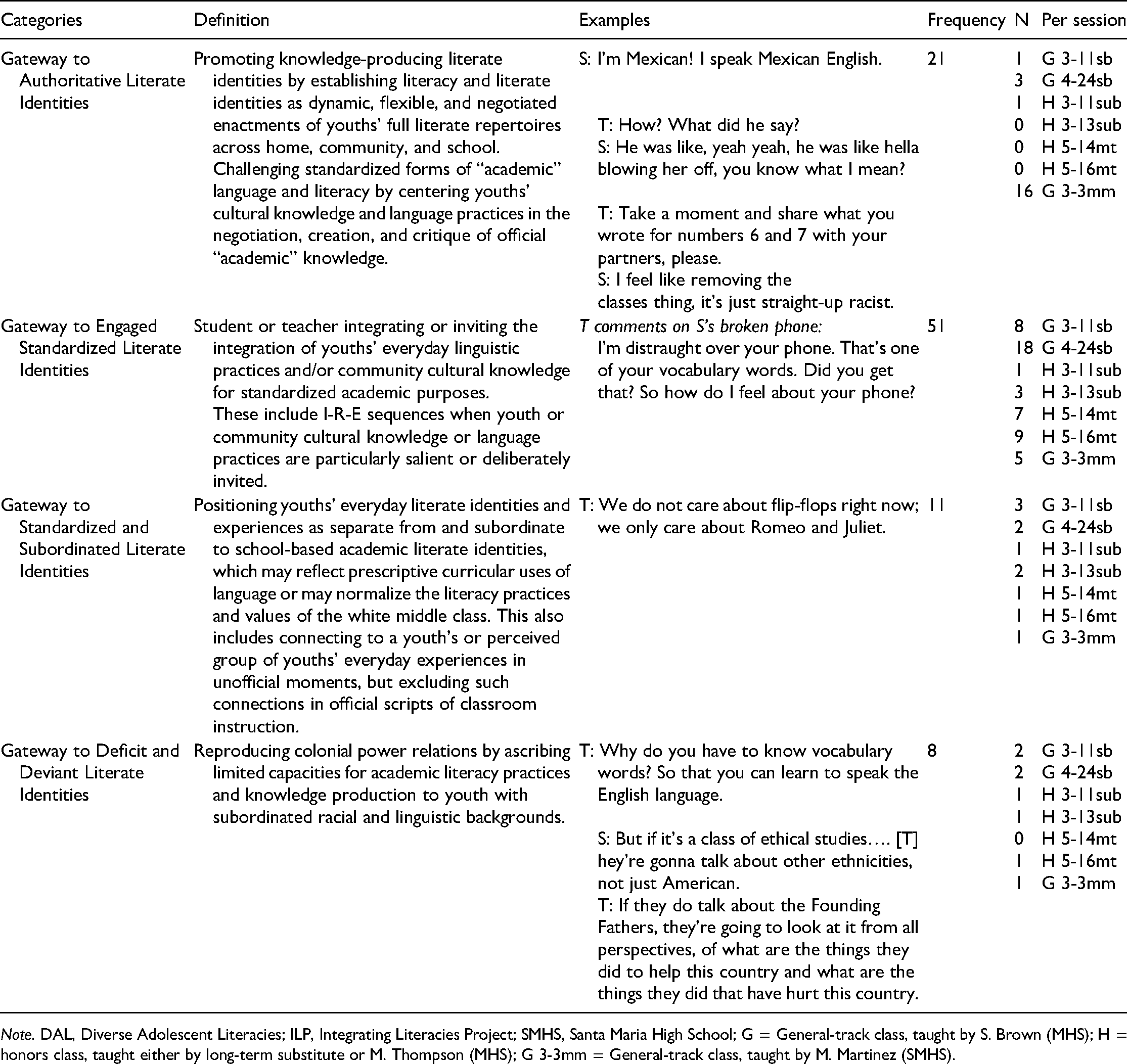
Note. DAL, Diverse Adolescent Literacies; ILP, Integrating Literacies Project; SMHS, Santa Maria High School; G = General-track class, taught by S. Brown (MHS); H = honors class, taught either by long-term substitute or M. Thompson (MHS); G 3-3mm = General-track class, taught by M. Martinez (SMHS).
We included one session each from MHS and SMHS to contextualize gateway moments within the interactional flow of classroom life. Activities and interactions described below reflect the messiness of identity negotiations in daily classroom life. They also illustrate multiple gateways to literate identities that center, dismiss, or pathologize the language and literacy practices and everyday experiences of minoritized youth.
Findings
Multilingual Youth in Mr. Brown's ELA Class
According to standardized assessments of language and reading, 8 of the 15 students in Mr. Brown's class struggled to display the privileged language forms and practices deemed institutionally “appropriate” for classrooms (Flores & Rosa, 2015). The principal named Mr. Brown as the most effective English teacher for students identified as ELs. In interviews, bilingual learners said that he “explains better than other teachers” and “doesn’t scream at us.” Five students in the focal class were institutionally labeled English learners, or ELs (intermediate English proficiency), and three white students were assessed as “remedial readers.” Two more had English and Spanish in their communicative repertoires but without institutional labels. Positional identities related to disability were not marked in our data, but as illustrated in this section, language ideologies positioned bilinguals as deficient for using language in ways distinct from privileged white middle and upper class norms.
Mastery of academic literacy in Mr. Brown's class was defined by official curricular standards and performed by answering textbook questions, writing district-mandated benchmark essays, and analyzing textbook-assigned poems (Enright & Wong, 2018). Mr. Brown voiced urgent concern to Kerry about helping his students through the standardized benchmark essay assignments to help them advance to Grade 10. To support students, he made explicit the components of narrowly prescribed written products, transforming the drafting process into a series of steps and rules. He prioritized direct instruction but included interaction for rapport and engagement. Occasionally, students reviewed textbook answers in pairs or made group posters to share in class; mostly, monologic scripts (Gutiérrez et al., 1995) guided students toward standards-based understandings, facts, or steps.
Mr. Brown never described his students in terms of background factors such as race, language, or immigration experience. In the teacher group interview, he noted that most students had trouble “putting thoughts down” in writing for the district-mandated benchmark essay assignments. When asked if teachers saw any differences among bilingual learners, Mr. Brown answered: “Oh yeah, of course. But it was more with just basic language knowledge, things like grammar, subject-verb agreement.” He added that “they sometimes had a more difficult time expressing, like they had the thoughts in their head, like: ‘This is what I want to say, I just don’t know how to say that.’” He agreed with the other four teachers on his ninth-grade team that vocabulary was bilingual learners’ greatest limitation and barrier to academic success, and he wanted “training in how to do vocabulary, subject-specific vocabulary and how to work through that vocabulary.” He was disappointed in the packaged curriculum's approach to vocabulary, which only drew words from assigned readings, noting that “there's just like ridiculous words, you know? Whereas they need to know what words like, you know, ‘analyze,’ mean.” We see evidence of his concern for students’ learning and use of academic words in the first student–teacher interaction reported below.
The focal session involved several activities typical in Mr. Brown's classes: a review of familiar material, assessment, introduction of new curricular concepts, and student engagement through monologic scripts. Class began with a vocabulary review and quiz, followed by Mr. Brown's explanation of primary and secondary sources.
Vocabulary Review as Gateways to Racialized Literate Identities
Informal chatter hummed as students settled into seats. Mr. Brown asked two students how they were doing and responded to their greetings as others arrived; such personal interactions were always apart from the official script of classroom instruction, signaling a Gateway to Standardized and Subordinated Literate Identities by positioning students as cultural beings in unofficial moments, but less so during official learning time. A student asked if their written answers should be exactly the same definitions as in the textbook. He replied, “Yes, with slight variations but basically the same sentence,” encouraging students to reproduce prescribed forms of language from the curriculum rather than draw on their own linguistic repertoires to convey the vocabulary words’ meanings. We coded this as a Gateway to Standardized and Subordinated Literate Identities. The inflexibility of language norms in this instance constrained all students from drawing on their full linguistic repertoires, but even more so for youth from minoritized communities, whose language varieties would be furthest from the prescribed standard. Some students rehearsed textbook definitions from notecards; others continued chatting. Rebecca, after complaining to friends about her phone, said, “Mr. Brown, my phone is so stuck!” Bonnie, a white monolingual English speaker, replied with a vocabulary word: “It's dilapidated!” Here, Bonnie initiated a Gateway to Engaged Standardized Literate Identities, leveraging her classmate's personal experience to demonstrate her mastery of the standardized academic language centered in the morning's quiz preparation. Mr. Brown positioned Bonnie's contribution as authoritative by taking it up into his official script.
I’m distraught. I’m distraught over your phone. That's one of your vocabulary words. Did you get that? So how do I feel about your phone? Rebecca?
Deeply troubled.
Deeply troubled. Bonnie's getting an A on this. Your phone is dilapidated. I can provide some solace for you.
Bonnie's gateway, and the teacher's affirming response, allowed her to self-author an academically literate identity for herself. Mr. Brown praised Bonnie's performance of academic literacy, then added vocabulary words and definitions. If he had used the vocabulary to engage Rebecca authentically about her experience, the gateway may have supported authoritative literate identities. Instead, Rebecca's experience was subsumed by the teacher's recitation of additional vocabulary words and their prescribed definitions, suggesting a Gateway to Standardized and Subordinated Literate Identities. Pablo interrupted.
Why do we have to do this?
Why do you have to know vocabulary words? So that you can learn to speak the English language.
Oh.
I’m Mexican! I speak Mexican English.
The teacher responded by telling students to gather their flashcards, write their names, and submit them to his in-basket. Roberto handed a girl a piece of paper with “SUR” (“SOUTH” in Spanish, and the gang tag for the sureños) written in big letters.
When Pablo asked why they had to do this, he questioned Mr. Brown's authority and curricular purposes. The teacher could have followed Pablo through this gate, inviting Pablo and others to negotiate authoritative literate identities in a third space of mutual questioning and critique. Instead, Mr. Brown reproduced raciolinguistic ideologies, positioning Pablo and his bilingual classmates into deficit literate identities by suggesting they still needed to “learn to speak the English language.” After drawing on Rebecca's experience and praising Bonnie for her language performance, this racialization of literate identities was a marked Gateway to Deficit and Deviant Literate Identities.
Roberto swiftly renegotiated this deficit positioning from Mr. Brown, claiming, “I’m Mexican! I speak Mexican English.” With his declaration and the “Sur” note-passing a few minutes later, Roberto acknowledged the racialization of language and literacy while rejecting the constrained notion of one standardized English grounded in the practices of the privileged. He powerfully performed a literate identity of bilingual/biliterate/binational authority. He resisted the normalizing of monolingual middle-class English, claiming legitimacy as a member and speaker of an equally capable speech community.
We do not know if the teacher failed to acknowledge Roberto's declaration to mark it as inappropriate and outside the official classroom script, or because he felt unprepared to respond thoughtfully and facilitate the third space that might ensue. As a teacher driven by accountability and standards, he also may have prioritized his curricular goals over an unplanned discussion. Regardless, the consequence was to support colonial racialized power relations over promoting equity.
Bonnie's language play afforded an entrée to engaged standardized literate identities. Gateways to Standardized and Subordinated Literate Identities became more salient as recitation of definitions emphasized the scripted nature of classroom literacy and classroom limits on making meaning authentically with new words. The sanctioned literate identity was that of “reproducers of text,” leaving little room for self-authoring greater authority or deeper understandings. Teacher and students renegotiated these literate identities throughout the episode, however.
In one classroom activity, myriad gateways emerged, but only the most constrained were pursued by the teacher, maintaining the status quo racialization of language and literacy. Such interactions in Mr. Brown's class were fairly consistent across sessions (see Appendix Table 1). He would make overtures to connect with young people's lived experiences and worlds, and youths would attempt to introduce their expertise and knowledge into the curriculum, but in most cases with minoritized youth, teacher uptake was minimal, superficial, or deficit-oriented, positioning youth in subordinating identities. The next section illustrates how gateways emerged two cities away, in a more urban environment with culturally relevant and social justice–oriented materials.
Latinx Youth in College Prep ELA With Ms. Martinez
In Ms. Martinez's classroom, students reflected the overall school population: all with parents from Mexico or Central America, mostly bilingual, from low-income households. Fifteen were female, five were male. In interview data, students identified Ms. Martinez's classroom as one with a “good vibe” where they felt valued; many gathered in her classroom at lunchtime. All three youth researchers on the ILP team were taking, or had taken, 11th-grade English with Ms. Martinez, noting that she did not police students’ language like many other teachers did; instead she focused on their ideas and reactions. Although she did not share students’ family histories of recent immigration or many of the cultural traditions of their heritage, the three SMHS youth on the ILP research team named her as the teacher with the most overt convictions related to educational justice and equity.
Every year, a new cohort of students asked Ms. Martinez to explain her racial and linguistic background, giving her many opportunities to reflect on the different raciolinguistic categories ascribed to her and her students. In an email communication with Kerry, she wrote, “I usually say I’m Hispanic and white when people ask,” explaining, “my dad's father's family is from Mexico and his mother's family is from Spain. My mom is Scottish, German, and I think a mix of a few others (European/white).” She added that she understands Spanish well but speaks it “at a kindergarten level,” although her Spanish reading and writing are more proficient.
Ms. Martinez believed her students were fully capable of advanced academic work if given equitable learning opportunities. During the study, she sought professional development from the California History Project and a conference on “Culturally Responsive Teaching and the Brain,” which she shared with colleagues upon her return. During five observed faculty meetings, two professional development sessions led by Kerry, informal interactions, and the focal session below, Ms. Martinez voiced a commitment to equitable opportunities and support for her students. In these instances, however, she did not critique what counts as academic excellence, whose practices and forms of language are privileged in measures of “excellent learning,” or what serves as indicators of successful performance. Without these critical perspectives, standardized curricula retain white supremacist values and ideologies.
Ms. Martinez's classes typically included a combination of direct instruction and varied participation structures (e.g., group/pair work, student board work) toward clearly articulated learning goals. Ms. Martinez's literacy routines included interactive analysis and interpretation of texts (print, visual) and demonstration of learning outcomes loosely based on the ACT College and Career Readiness Standards (American College Testing, 2017). Feedback from alumni on their college readiness also informed her practices. These “feedback” visits from alumni were regular occurrences at SMHS; alumni often had younger siblings at the school, and many maintained relationships with teachers for many years after graduating. In fact, a member of the ILP research team visited regularly after graduating from SMHS and gave presentations in Ms. Martinez's class on college life and the importance of self-care in college.
In the focal session, students were watching the documentary Precious Knowledge (McGinnis & Palos, 2011), which portrayed a Tucson Chicano studies class when a legislative ban on ethnic studies was debated, and ultimately decided, in Arizona's capital. The teacher added the documentary to her curriculum after attending the professional development session on culturally relevant teaching and the brain (personal communication, June 6, 2019). Proposals to require ethnic studies in California high schools and some public universities connected local politics to the documentary's themes. These debates were outside students’ direct experience, however, since SMHS had no ethnic studies program.
After discussing PSAT results, Ms. Martinez briefly mentioned her instructional focus on identifying bias and logical fallacies; students previewed worksheet questions they would answer while watching the film's conclusion. The worksheet's open-ended descriptive and interpretive questions positioned youth as sense-makers capable of evidence-based argument. Before viewing each segment, the teacher highlighted a handout question, alerted students to target themes, and then began the next video segment.
Bias and Logical Fallacies: Gateways to Multiple Literate Identities Within a Social Justice Curriculum
In this example, students walked around the room comparing and discussing worksheet answers.
Let's head back to our seats in 5, 4, 3, 2, 1. All right. Somebody tell me what you put for number 6. [Describe Arizona Superintendent of Public Instruction (2011–2015) and State Senator John Huppenthal's visit to the Tucson High School classroom. What effect does the visit have on him?]
It was not like a debate. It was more of a discussion, than, like, you know, watching. And then he said how the teacher [dark-skinned with facial features that appeared Indigenous], like the way that he was dressed it was like a classic American, so like the presentation of the teacher, but he still disagrees on the ethical background. [[Note: Many students used the words “ethic” and “ethical” to mean “ethnic.” Ms. Martinez never corrected their speech.]]
Did you guys hear him say anything else? Whether he was in the classroom or afterwards?
He was super rude.
Yeah.
How? What did he say?
I don’t know… He was like, yeah, yeah, kind of like, blowing her off—you know what I mean?
Carla? [whose hand was raised]
In the last part, where like Mina also said was about the “putting on a show” like he wasn’t sure if it was like, for real, or if it was just like to show off or something.
Carla noted the white senator's dismissal of academic language and literacy by Latinx teachers and students in the classroom, positioning them into imposter identities that must conceal deviance or deficiencies. By naming this injustice, Carla negotiated a possible Gateway to Authoritative Literate Identities and potential third space in the classroom. Rather than pursue this gateway, however, the teacher directed them to a remark from the senator: “And then he mentioned some of the things on the wall. Did you guys catch that?”
That thug guy.
Yeah, he calls Che Guevara a thug.
And he says, “There's no Benjamin Franklin.” Well, in Spanish class you don’t see Benjamin Franklin either.
And what did the teacher say when he said there's no Benjamin Franklin?
That he was against inclusion.
Yeah, Benjamin Franklin was like he said, against the darkening of the country =
= Racist! =
= but John Huppenthal wants there to be a picture of him because he was a Founding Father and he believes that Ben Franklin is someone to be admired.
In his reference to Ben Franklin and Spanish classes, Sammy self-authored an authoritative literate identity that combined institutional literacy norms with personal experience. He cited the “official” curricular source, supporting his argument with his own experience of classrooms where Franklin would be irrelevant, signaling a Gateway to Authoritative Literate Identities. The teacher asked students to expand on part of Sammy's contribution about Benjamin Franklin, incorporating his contribution into her instructional script, leading Lupe to declare, “Racist!” Instead of having students unpack the racism in Huppenthal's language, Ms. Martinez justified Huppenthal's response, saying that “he believes that Ben Franklin is someone to be admired” because he was a Founding Father. Her assertion may have been an attempt to highlight her instructional focus on bias and logical fallacies, but it was not based on evidence from the film; moreover, she did not remind students of the instructional focus. Ms. Martinez did not invite students to problematize the relationship between Huppenthal's racism and his beliefs about Ben Franklin, ethnic studies, or Mexican-origin youth, suggesting a sudden Gateway to Standardized and Subordinated Literate Identities, where personal experiences and declarations of racism were allowed but were not engaged as legitimately academic. A failure to pursue their understanding left Huppenthal's deficit positioning of Mexican-origin people unchallenged.
Sylvia asked, “But if it's a class of ethical studies, don’t they notice like, of course, they’re not gonna talk about, like, the US and like all the Founding Fathers. They’re gonna talk about other ethnicities, not just American.” The pervasiveness of raciolinguistic ideologies is evident in Sylvia's conflation of ethnicity, American, and whiteness. Ms. Martinez replied: Well, if they do talk about the Founding Fathers, they’re going to look at it from all perspectives, of what are the things they did to help this country and what are the things they did that have hurt this country. They’re not just gonna idolize someone.
The interdisciplinary field of ethnic studies privileges the perspectives of underrepresented and historically oppressed groups (de los Ríos et al., 2015). In response to Sylvia's explanation of Huppenthal's flawed logic and expectations for ethnic studies, however, Ms. Martinez suggested that if these courses addressed the Founding Fathers, they would present the systemic harm experienced by Black and brown people as an equal perspective to how the Founding Fathers helped the country, opening a Gateway to Deficit and Deviant Literate Identities by closing this part of the conversation without thoughtful discussion of the racism displayed in the documentary, exposed in classroom discourse, and experienced in students’ lives. Ms. Martinez ignored the systemic consequences of Latinx youths’ racialization and the literate identities available to them in institutional settings.
When Ms. Martinez asked, “Any other questions, comments about his visit to the classroom?,” Pilar self-authored an authoritative literate identity by redirecting the discourse to their local experiences of the documentary's key issues, asking why their school did not have an ethnic studies class. Another student took up and extended her question, asking, “Is it banned over here, too?” This signaled the possible initiation of a third space, and a Gateway to Authoritative Literate Identities. Ms. Martinez explained that ethnic studies courses were actually required in local public schools.
Isn’t that like La Raza Unida?
Yeah, La Raza Unida is a club that could be associated with it. But that, I mean, we should probably ask Mr. Anastas [the principal] that question. I get the sense that it probably has to do with the fact that we have a very limited schedule with our [work-study] days and that is why we don’t have very many electives on this campus. That's sort of the answer that I’ve been given.
By truncating discussion, the possibility of third space was abandoned as Ms. Martinez opened a Gateway to Standardized and Subordinated Literate Identities, avoiding deep engagement with students’ concerns about racism, and reinforcing raciolinguistic norms that privileged whiteness and legacies of colonialism by not contradicting them. Silences in the face of students’ bids to critique and explore issues of race and inequality could also activate a Gateway to Deficit and Deviant Literate Identities, since the subordination of literate identities involved marginalizing personal and communal experiences of injustice.
Discussion and Implications
Our Gateways to Literate Identities offer an analytical framework for conceptualizing the ways and degrees to which literacy classroom interactions invite students’ engagement in authoritative literate identities. The dominant paradigm for literacy instruction is shifting in recent years from discrete measurable skills and outcomes toward greater engagement with complex texts. Information-rich, linguistically dense, or historically nuanced texts require sophisticated skills to interpret and compose. We argue that the histories and experiences of youth in our classrooms are also complex “texts,” rich with meaning and essential to ground and expand on school-based uses of literacy. From these “lived texts,” youth develop a range of sophisticated language and literacy practices—ways of making meaning, sharing information, and presenting ideas. For minoritized youth, these lived “texts” also include understandings of complex systems of power and oppression shaping their everyday experiences of school and society.
As yet, youths’ lived texts and knowledges are often invisible to teachers and are rarely invited to shape and renegotiate what counts as a school-based literate identity. When youth enact authoritative literate identities to integrate their full experiences and communicative repertoires into curricular interpretations and discussion, they are often dismissed or positioned as deficient and deviant if they did not serve the teacher's I-R-E script. For example, Pablo's “Why do we have to do this?” was off-script but relevant and locally meaningful. The teacher's response racialized Pablo's language practices, positioning him and the imagined raciolinguistic category ascribed to him as deficient in English, even though the teacher described as “ridiculous” many vocabulary words emphasized by the textbook publisher during the teacher group interview.
Even after such a move, the teacher had another chance to follow students into a third space when Roberto declared: “I speak Mexican English!” Mr. Brown could have paused, questioned the potential linguistic racism of his reaction, and invited youth perspectives about varieties of English used in their everyday lives. Students could discuss the systemic inequalities that reified one English variety as “standard” in textbooks, and question why certain words and stories are selected (and by whom) within the official ELA curriculum. Such a pivot in instruction may allow students to engage and expand on their everyday knowledge-producing literate identities by using them to critique and transform the official curriculum. With enough shared gateway experiences, teachers may improve at identifying white supremacist influences on curricula and instruction, choosing youth-centered approaches instead of positioning minoritized youth with deficit literate identities. Ultimately, few students enacted authoritative identities within our study contexts. These rare instances revealed missed opportunities for teachers to expand on students’ critical engagement with themes and texts in their course of study or critique of standardized languages/literacies in their lives.
Our analyses indicated that youths’ critical engagements with curricula or classroom discourse were occasionally acknowledged and even invited (e.g., in Ms. Martinez's class). Youth attempted to renegotiate default deficit positionings by bringing lived experience into critical interaction with official curricula, opening gateways to authoritative knowledge-producing academic literate identities. Prescribed time-bound curricular goals and pervasive systemic inequalities that defined these goals and curricula trumped these gateways, however, as teachers pursued “standards” over active learning and authoritative literate identities. Ms. Martinez centered the systemic dismantling of ethnic studies classes in her curriculum, while also denying her students the chance to explore its absence from their school's course offerings. When teachers did take up students’ authorship of literate identities, these initiations typically aligned with teachers’ instructional goals and I-R-E scripts.
Gateways to Engaged Standardized Literate Identities mirror assimilationist principles of teaching diverse youth. These classroom interactions integrate youths’ societal/community-based knowledge or community-based discourse patterns to achieve standardized instructional goals. Accordingly, teachers’ integration of popular culture, students’ interests, and community-based discourse patterns into discussion most often served to achieve goals of standardized interpretations of text or doing school. More subtle were the ways Gateways to Standardized and Subordinated Literate Identities reified representations of privileged English, subordinating literate identities and practices of language-minoritized youth, positioning them as deficient and inappropriate for classroom meaning-making (Flores & Rosa, 2015). Such standardized and subordinated literate identities harm all students when literacy is presented as a set of prescribed rules to reproduce, rather than a flexible repertoire of practices to engage with authority for personal, community, and school-based purposes (Enright & Wong, 2018). They especially harm minoritized students, since they are deployed as tools to restrict access to prestigious learning opportunities and enable the funneling of minoritized youth into restrictive and underresourced classroom environments. Standardized and subordinated literate identities are also sustained when teachers position youths’ personal lives as only important for rapport or behavior management but not classroom learning, separating culturally meaningful literacies from academic literacies and learning.
The promise of our findings and the gateways, however, is that dominant scripts and default deficit or standardized and subordinated literate identities were disrupted and shifting constantly throughout each class session. Literate identities were imposed, resisted, adapted, and abandoned. It was not an all-or-nothing endeavor; teachers typically had many chances to choose differently. Literacy is not a curriculum; it is a series of choices, some planned, some spontaneous, all within a larger community of actors and an endless array of cultural resources from everyday experience and curricula-in-action. On reviewing data, we were disappointed by how rarely teachers followed their students’ lead and took up an idea from the learner's experience to develop it collectively toward richer understandings of curriculum and youths’ worlds. Instead, Bonnie's performance of official literacy was applauded and extended by Mr. Brown, whereas Roberto's authentic literate declaration on Mexican English was ignored and dismissed.
Mr. Brown's response to Roberto represents a Gateway to Deficit and Deviant Literate Identities. Initiation of this gateway negates students’ societal/community-based knowledge and/or language use, subordinating students’ ways of knowing while normalizing white, middle-class values and expectations for doing and knowing literacy. In many instances, Gateways to Deficit and Deviant Literate Identities reproduced societal harms such as raciolinguistic discrimination. Notably, students were often most engaged during these instructional moments, a call to their potential for deeper learning or harm.
Regardless of the tightly scripted or more open nature of curricula, students in both classrooms experienced the constraints of traditional passive literate identities and the potential for playful, powerful, critical, and creative literate identities. Whether a teacher's instruction more closely resembles Mr. Brown's moment-to-moment choices or Ms. Martinez's more complex layering of constraints for literate identities over culturally relevant critique-framed curricula, an examination of these gateways in the unfolding of their daily choices could inform instructional change. These gateways are a tool to notice injustices and entry points to more youth-centered, and at times critical, interactions in classrooms. Even when teachers support minoritized youths’ authoritative knowledge-producing literate identities, they do so within institutions that are steeped in histories of oppression and marginalization and that carry forward these inequalities in myriad ways. Gateways to Engaged Standardized Literacy Identities reinforce norms that ultimately impose subordinated literacy identities. It is impossible to prepare youth with authoritative literate identities if standardized practices are the only ones centered. Subordinating their language and literacy practices ultimately subordinates their authoritative literate identities. A radical reenvisioning of schooling may be necessary (Tate, 1997). Rethinking the roles of youth and teacher practices in promoting classroom-based authoritative literate identities is one way to effect small but important changes in the classroom experiences of minoritized youth as we continue to work toward systemic change.
Future research may examine these gateways to negotiations of literate identities in other subject areas, such as mathematics or history, each with unique legacies of colonialism and culturally situated ways of demonstrating and using authority among minoritized communities. Extending our analyses to classrooms noted for the culturally sustaining negotiations of literacy would provide a more nuanced sense of the range of ways Gateways to Authoritative Literate Identities can be supported. Finally, an essential next step in this type of inquiry is to explore this framework's usefulness in teacher preparation and professional development as a tool for examining classroom practices, identifying gateways that restrict authoritative literate identities, and practicing alternatives toward more culturally sustaining, socially just pedagogy.
Acknowledgments
The authors would like to acknowledge the important contributions of Jessica Avila, who gathered the data in the SMHS classroom session included in our narrative, as well as the youth and teacher participants in our studies. The authors also wish to thank the reviewers for their thorough and thoughtful comments and critiques.
Footnotes
Declaration of Conflicting Interests
The author(s) declared no potential conflicts of interest with respect to the research, authorship, and/or publication of this article.
Funding
The author(s) disclosed receipt of the following financial support for the research, authorship, and/or publication of this article: Both studies reported in this article were funded by the Spencer Foundation.

Appendix
Phase 1: Codes and Frequency Counts for Types of Literacies (9 ELA Transcripts From DAL Data).
| Categories | Definition and subcodes | Examples | Frequency | N | Per session |
|---|---|---|---|---|---|
| Standardized Literacies | Practices and performances overtly marking dominant ideologies of “appropriate” language and literacy forms and interactions for academic settings (Flores & Rosa, 2015). Subcodes: prior content learning, academic vocabulary or register, negotiate meaning of text, curricular knowledge, mark standardized literacies through evaluating/critiquing “official” knowledge or text from teacher, text, curriculum. | T: Pay attention…. This is foreshadowing. S: You used some form of the word “human,” like, five times. T: That example in the text is terrible English! |
253 | 43 | G 1-31sb |
| 13 | G 3-11sb | ||||
| 94 | G 4-24sb | ||||
| 13 | EL 1-30sb | ||||
| 18 | EL 3-14sb | ||||
| 15 | H 3-11sub | ||||
| 23 | H 3-13sub | ||||
| 17 | H 5-14mt | ||||
| 17 | H 5-16mt | ||||
| Societal and Community-Based Literacies | Practices that reflect ideologies and uses of language and literacy that are shared by people with a common linguistic or cultural heritage and/or similar positionings in institutional and societal power hierarchies. Subcodes: Spanish, youth language, popular culture. Added in final stages: reproduce societal inequality. | T: ¿Tienen preguntas? S: She's going to be emo. T: Juliet was very forward for girls of her time. S1: Slutty? S2: Tartish? |
145 | 06 | G 1-31sb |
| 18 | G 3-11sb | ||||
| 38 | G 4-24sb | ||||
| 03 | EL 1-30sb | ||||
| 05 | EL 3-14sb | ||||
| 19 | H 3-11sub | ||||
| 14 | H 3-13sub | ||||
| 35 | H 5-14mt | ||||
| 07 | H 5-16mt | ||||
| Personal–Relational Literacies | Practices overtly mediating relationship and interaction; discursive moves that marked identities, signaled attempts to build relationship, or marked clear relationship boundaries. Subcodes: affective, personal anecdote, response to personal, relationship building, marked identity, departure from established role, student-to-student talk. | S: I speak Mexican English! T: We do not care about flip-flops right now; we only care about Romeo and Juliet. S: You were in my grandmother's class. |
223 | 49 | G 1-31sb |
| 16 | G 3-11sb | ||||
| 36 | G 4-24sb | ||||
| 14 | EL 1-30sb | ||||
| 08 | EL 3-14sb | ||||
| 42 | H 3-11sub | ||||
| 21 | H 3-13sub | ||||
| 10 | H 5-14mt | ||||
| 27 | H 5-16mt |
Note. ELA, English language arts; DAL, Diverse Adolescent Literacies; EL, English learner; G = General-track class, taught by S. Brown; EL = Class dedicated to students identified as “English Learners” and struggling readers, taught by SB; H = honors class, taught either by long-term substitute or M. Thompson.
References
Supplementary Material
Please find the following supplemental material available below.
For Open Access articles published under a Creative Commons License, all supplemental material carries the same license as the article it is associated with.
For non-Open Access articles published, all supplemental material carries a non-exclusive license, and permission requests for re-use of supplemental material or any part of supplemental material shall be sent directly to the copyright owner as specified in the copyright notice associated with the article.
