




Abstract
Issues of representation and identity are paramount in youth media. These issues are further complicated when youth draw on popular culture and other media resources as vehicles to interpret and represent themselves (Alvermann, 2008, Jenkins et al., 2006). While youth-produced media often draw on popular culture resources and are frequently accused of reproducing dominant stereotypes, many young media makers are often acutely aware of their audiences and deliberately use media resources to establish social connections that will enhance and manipulate audience reception. Using mediated discourse analysis (Norris & Jones, 2005), this paper examines the documentary video production process of one such group of youth, exploring their process of purposeful selection and assemblage of popular culture and media resources. Findings reveal nuanced patterns of multimodal combination to establish and maintain attention of key audiences while asserting alternative social positions.
Keywords
Allow me to reintroduce myself. My name is Felicia Mason. I am a 17-year-old African American senior at Crosstown High School. I don't have any kids. I am not pregnant. I don't have a boyfriend with problems. Although my father passed away when I was young, I have a very loving mother. I am employed. I plan to go to college and be very successful. But, I refuse to be another negative statistic.
In the excerpt above, taken from one of her high school essays, Felicia speaks out against stereotypical representations of African American females in the media. In the same school essay she describes the media as “flooded” with stereotypical representations of African American women as “welfare recipients, ghetto, having no fathers, hot mama, … sexually explicit women.” She comments that she often feels pressure to gain weight because “the media has sculpted what a race should want in women.” For African American women Felicia claims that means being “thick, light skinned, with long hair.” Although Felicia admits in her essay to being somewhat “vulnerable to media messages,” she uses her school writings and video productions to boldly assert otherwise, intending to avoid what she calls, “the media trap.”
Felicia’s questions of identity, social affinity, and peer acceptance, are common among adolescents, especially for young women of color negotiating their social positions within and across contexts dominated by Eurocentric notions of beauty (see Collins, 1990; Sutherland, 2005; Wissman, 2011). Concerns of representation and identity are intensified when students are encouraged to produce their own media productions, drawing on popular culture and other media resources as vehicles to interpret and represent themselves (Alvermann, 2008; Jenkins et al., 2006).
While youth-produced media often draw on popular culture resources and are frequently accused of reproducing dominant stereotypes, youth media makers such as Felicia and her classmates are often acutely aware of their audiences and deliberately seek to establish social connections that will enhance and manipulate audience reception.
In other words, young media producers often sense intuitively that production of media content alone does not lead to communication. Rather, media content needs an audience, and popular culture resources can maintain that audience. This paper examines the media production process of one such group of students, exploring their process of purposeful selection and assemblage of popular culture and media resources to maintain attention of key audiences and assert alternative identities.
Digital video production as vehicle for social assertion
Writing, in its traditional, print-based forms, has long been praised as a medium for personal exploration and expression, an identity practice that Deborah Brandt (2001) has called “self-sponsored writing.” The multimodality and interactive features of new media further heighten diversification and visibility of such performances and self-publication, which in turn increase potentials for shifting identity positions (Lewis and del Valle, 2007).
Various studies have described digital video production, in particular, as a generative process for creative exploration, formulation, and revision of individual identities (cf. Erstad et al., 2009; Halverson, 2010; Ranker, 2008). In many cases, these processes are forwarded as empowering or “agentive” for media users (cf. Curwood and Gibbons, 2010; Erstad and Silseth, 2008; Hill and Vasudevan, 2008; Hull and Katz, 2006). For some scholars it is the multimodal complexity of digital video that allows for a continual negotiation of identity. Nelson et al. (2008) describe this remixing of modes and media as one of “semiotic logics” in which individuals are able to rewrite and re-represent themselves.
In their description of “multimodal counternarratives,” Curwood and Gibbons (2010) offer the example of one youth, Tommy, who identifies as Asian and gay. Through video production, Tommy is able to remix the poetry of Whitman and Hughes along with sound and visuals to assert his identity as “viable American,” in ways that challenge notions of masculinity and nationalism. In other words, through creative juxtaposition of modes and media, or media remix, youth are able to sift, mix and disrupt identity discourses. Described as media “curatorship” by Potter (2011), this purposeful “collecting, cataloguing, and assembling” of various multimodal resources allows media users to author themselves rather than accept the sometimes-limiting identities projected onto them by social institutions.
In addition to multimodal complexity, many scholars also emphasize the social spaces created via video production (see Rogers et al., 2010; Vasudevan, 2010). Vasudevan (2010) uses the concept of “digital geographies” to describe the hybrid digital spaces brought into being as youth participate in and across multiple contexts while gathering and remixing resources into digital media texts. Such an emphasis on space foregrounds the social dynamics that govern different spaces.
In their studies of international youth media programs, Podkalicka and Campbell (2010: 6) urge for a shift away from individual notions of voice, which emphasizes “the right to speak” towards the notion of “social connectedness,” which instead emphasizes “the right to be understood.” Further emphasizing voice as social connectedness, Couldry (2010: 7) urges us to view “voice” in media as a social process stating that voice is “the capacity to make and be recognized as making narrative about life.” Thus for Couldry, to have voice requires not only expression but also recognition on the part of that audience. Couldry further explains that voices do not exist on their own, rather “require social resources” for sustenance and distribution. Such semiotic resources might include intertextuality and juxtaposition with common social texts such as popular culture texts or purposeful distribution via social networks. Thus, when making media one must explore what his or her own values and tastes are and in turn consider how the selection of social resources creates a shared space with the values and tastes of intended audiences.
It is the purposeful collection and placement of social resources for purposes of creating shared spaces that are illustrated in the digital video work of Felicia and her group members. Of interest is how youth, like Felicia, arrange and assemble media resources in ways that appropriate meaning and foster dialogue across multiple discourses and spaces. In other words, how do youth use digital video production to establish and assert themselves into new social contexts?
Social assertion: theoretical frameworks
Given the interpersonal, technological and multimodal complexity of media production, this research utilizes an action-based framework that draws on the analysis of activity afforded by mediated discourse analysis (see Norris and Jones, 2005; Scollon, 2001; Wohlwend, 2009). Mediated discourse analysis (MDA) builds on the ambitious work of critical discourse analysis (CDA), which examines social practices and identity work as they occur within discourses (see Fairclough, 1989; Gee, 2005). Like CDA, MDA is also concerned with the interaction of competing discourses, and how such dynamics of struggle foster situations of hybridity and what Scollon and Scollon (2003) call “interdiscursive dialogicality.” In the case of MDA, however, the domain of focus shifts from linguistic expression to human action as locus of meaning (Norris and Jones, 2005; Kress, 2005). In this sense, MDA places emphasis on everyday actions over discourse, analyzing how meaning and significance are attached to objects and the ways we use them (Wohlwend, 2009). In looking at both the objects and actions of making meaning, MDA helps to identify cultural artifacts that perform identities and mark status within a given community (Wohlwend, 2009: 68). In the case of video production, different semiotic resources such as sound, image, transitions, special effects, etc. become the objects, which are composed into scenes. Completed media texts, then become the cultural artifacts that communicate affiliation and social position.
To facilitate an examination of objects and actions and how they mediate discourses, MDA offers key constructs for looking at object usage. Constructs such as interperformativity (Scollon, 1997), attention structures and sites of engagement (Jones, 2005), push understandings of multimodal expression beyond the idea of modal plurality, towards representations of new space-time dimensions. For example, sites of engagement, represent the locus of mediated action, a convergence of social practices, which Norris and Jones (2005: 139) describe as opening a “real-time window” for observing mediated action. Within the sites of engagement exist attention structures, which are the specific sets of mediated action that construct spaces of shared focus through funneling attention on specific spaces relevant to the participants and their actions (Jones, 2005).
And finally, interperformativity describes the hybrid performances in which actions simultaneously speak to multiple audiences in different timescales and different spaces. Observing the interperformativity of actions proves important to understanding the effects of various attention structures that occur within sites of engagement where social practices, perhaps conflicting, intermingle. Such interperformativity reveals relationship building and identity positioning among multiple audiences. Considered collectively, the above MDA constructs allow for a focus on objects and activity, while also attending to their spatial relations to each other. Such an approach is essential considering the various multimodal resources selected and arranged during the process of digital video production.
For purposes of this paper, I examine the multimodal composition process of one group of female media makers, focusing specifically on how the group selected and arranged popular culture texts as social resources to engage audiences and gain recognition. Of interest in this group is how multimodal resources were combined at key moments of both content exploration and content expression. Although all three group members collaborated in the overall production of the documentary, special emphasis is given to one member, Felicia, who took the lead on most of the popular music and video selections and arrangements for the piece.
Methods of study
Setting for the study
The data for this study is drawn from a larger yearlong study focusing on the social and multimodal struggle in collaborative digital video production. Situated in a large city in the Midwestern region of the United States, the secondary school serves around 2200 students. Respected for its International Bachleaureate program, the school prides itself in providing academic excellence to a student body that speaks over forty languages, as is evident in its motto: “Many Traditions: One School.” While the school is viewed as one of the best public schools in the city, it is also known for being a highly tracked and racially segregated school. This was not the case, however, in the documentary analysis and production course where Felicia’s group composed their film. The media production focus of class drew students from across racial, economic and academic groups, representing a much more diverse enrollment than other courses at the school.
This ethnographic case study focused mainly on descriptive and multimodal data gathered via a variety of different media: participant observation, field notes, interviews, think-aloud protocols, and artifact/literacy object collection (print, audio, video, photo, online content, media products, etc.). To gather this information, I worked closely with ten documentary production groups (30 students total) across two sections of the course, following them through the media production process of the radio documentary project in the winter and then again through the film documentary production process in the spring. This paper in particular focuses on the group production process of three females as they plan, produce, and present their film documentary.
Data collection and analysis
Phases of data analysis.
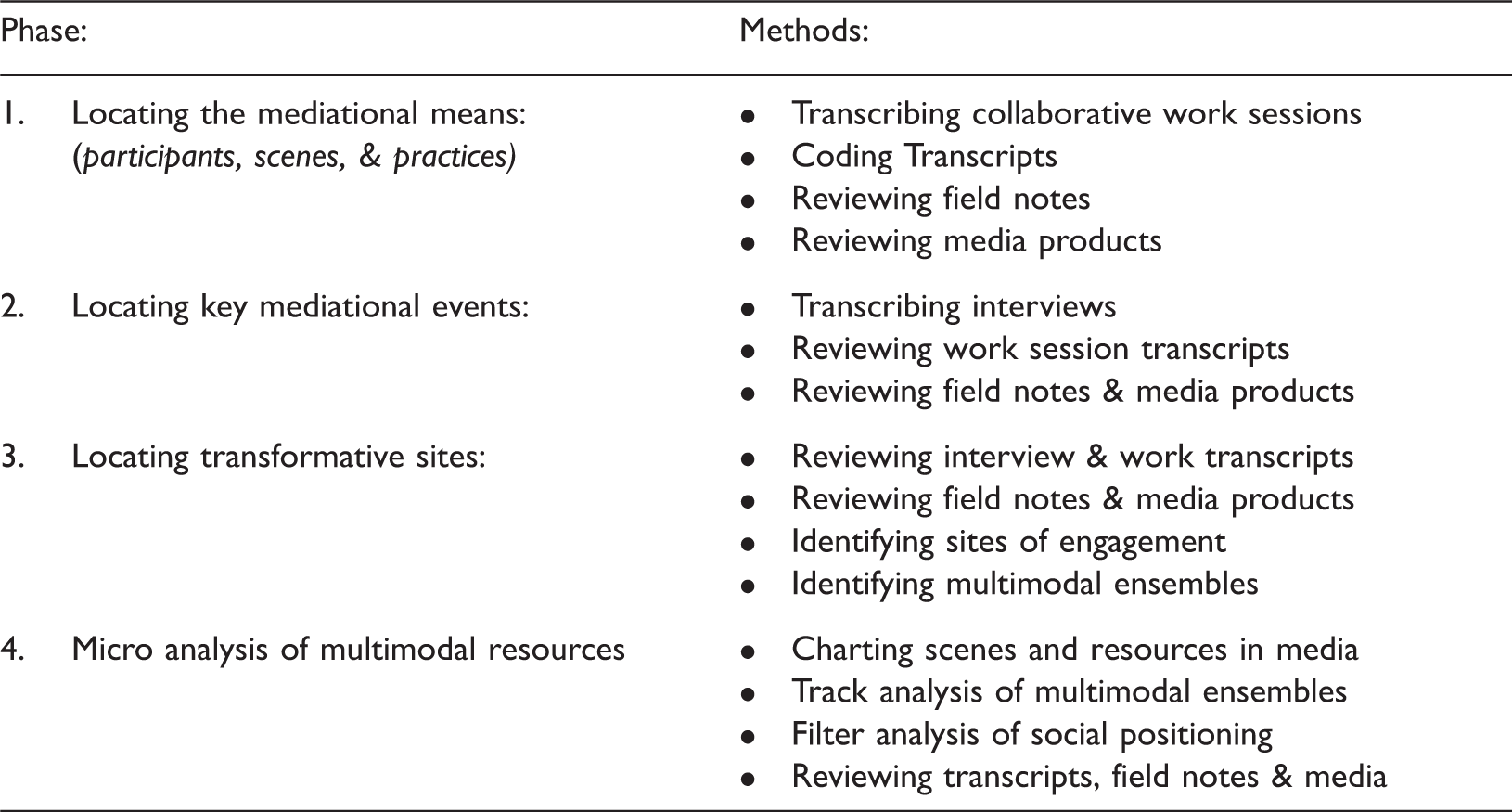
Summary of scenes and mediational resource use in Parents, Do They Matter?.

Key: TS: title slides; VO: voice over; ML: music lyrics; ID: interview dialogue.
Table 2 presents a summary of scenes in Parents, Do They Matter?, illustrating the use of various multimodal resources. The music of hip hop musician 2Pac, for example, intersects with other social practices and resources such as student interview clips and 2Pac archival footage, creating sites of engagement that contain conflicting representations of single-parent households. In other words, stereotypical representations were often placed alongside other more complex renderings of parenthood. These multimodal ensembles are examples of social action in that they garner audience attention as well as mediate alternative social positions for multiple audiences. While the film documentary, Parents, Do They Matter? contains several multimodal ensembles, I will address only a select set of ensembles that occur at key shifts in focus, purpose, and audience in the documentary, representing moments of social assertion for Felicia and her group members.
Research findings: selection and arrangement of key social resources
Analyzing the multimodal composition in Parents, Do they Matter? revealed three key patterns of mediation made possible via multimodal ensembles. First it was observed how the music and cultural resource of rap musician 2Pac helped the group identify a focus and organization for their documentary. Next, the music of 2Pac, when aligned with certain types of interview footage facilitated a repositioning of children of single parents, as well as single parents themselves. Each thread is illustrated and described in more detail below.
Finding focus with 2Pac
As mentioned above, Felicia and her group members, Miriam and Eleni, were all seniors at Crosstown High School. All three were friends previous to working together on the film documentary together, an aspect that Felicia felt promoted a more positive and collaborative production experience. At first Felicia, Miriam and Eleni had intended to make a documentary exploring the “controlling” nature of parents. This topic had emerged from the group members’ growing frustration with their own parents’ or guardians’ insistence on enforcing certain rules even though they were almost 18 years old and about to graduate from high school. Hoping to gather several interviews with fellow classmates describing how “annoying” parents are, the group was surprised to find that few people would openly rant, at least on camera, about their parents. Instead, most everyone responded positively about parents. As a result, the group felt compelled to change their topic. Given that the three group members each had different family situations, Felicia living with a single mom, Miriam living with a brother as legal guardian (both of her parents had passed away), and Eleni, a second-generation immigrant, living in a two-parent household, the group decided to shift their focus to how family structures differ.
With this new focus, the group reviewed their interview footage and found that most of their interviews were with people from single-parent homes. When they returned to the field to interview more of their classmates, they found it difficult to find peers who had both of their parents in the home. As a result, the documentary took on an unofficial focus on single parenting with mention to other family structures.
In line with this new focus, Felicia suggested to the group that they should use the song “Dear Momma” (Shakur, 1995), a song in which 2Pac praises his mom for being there for him, despite being a single parent. The excerpt below, from one of the group’s work sessions, presents the discussion in which the group members first discussed the use of 2Pac music. Note below how Felicia broached the topic of music with a group member who was uploading video files. Felicia: As for music, what other types of music do you want to put in there? We are putting “Dear Momma” in there. We are definitely putting in “Dear Momma.” Miriam: Oh yeah we have to have “Dear Momma” Felicia: We could base it all on 2Pac songs. Miriam: What’s a song about parents? I’m going to go on Google and search songs about family. Felicia: We could put “Brenda’s Got a Baby” on here, (they both laugh softly) you could put “Keep Ya Head Up” on there. Miriam: Yeah, let’s put that in there when somebody is talking about how their mom goes through a hard time. Felicia: (clicking her tongue with certainty) I am going to interview my Momma. Ok? Miriam: Yeah, we should get parents too.
When working with the group two days after the work session above, I sensed that the group was no longer frustrated with their focus or direction of the documentary. Curious as to what had changed, I asked the group how things were going. Felicia quickly replied that things were good and that they had “everything planned out.” When I asked her to elaborate she replied, We, or well I’m, basing a lot of our music on the music of 2Pac: “Dear Momma,” “Brenda’s Got a Baby,” “Keep Ya’ Head Up,” you probably don’t know these songs. … [A]nd then there is a clip of him talking about his mom. And I want to put that in there just to keep everybody engaged. They’ll be like ‘Oh 2Pac!’ … It is only 15–20 seconds and what he is talking about is his momma, nothing more nothing less, but it’s a good clip. He is inspirational.
In this moment, Felicia was noting the social currency that 2Pac has as cultural icon and the impact of his music as common cultural text. Both 2Pac’s music and the interview footage of him were positioned as social resources, that Felicia believed were necessary to pull in viewers and maintain engagement. In selecting each of these three songs both Felicia and Miriam explained that it is the content of 2Pac’s music, his lyrics, which are backed by his personal experiences that give credibility to his music. In other words, 2Pac was more than just “cool.” He also provided a legitimizing force that brought credibility to their documentary.
In this situation the 2Pac songs, rich in cultural currency, become texts or objects that do something. Not only do they build social connectedness with peer audiences in order to garner and maintain audience attention, they also mediate the importance of parents, the difficulties they face, and the need to persevere. Furthermore the convergence of 2Pac music with the interview footage of peers creates multiple sites of engagement at the intersection of real and perceived life experiences. These sites become spaces for Felicia to explore her own feelings about being the child of a single parent. The allure and ethos of these social resources is addressed in more detail in the section below, which examines the ways in which multimodal resources and their intertextuality are knit together to form multimodal ensembles that both harken attention and reposition social identities.
Shifting representation of single-parent households
2Pac and his music are prevalent throughout most of the six-minute documentary, Parents, Do They Matter? For purposes of illustrating multimodal ensembles that perform social positioning in rhetorical ways, I address only four key ensembles within the documentary, devoting special attention to those that occur later in the documentary. All four ensembles occur at key moments of rhetorical expression related to single parents, and ultimately Felicia’s social positioning among her peers. Similar to Halverson’s (2010) discussion of transitions as key moments of identity construction for youth media makers, these multimodal ensembles represent combinations of meditational resources, which articulate pivotal moments of social positioning.
The first multimodal ensemble of focus occurs in the opening scene of the documentary (see Table 2). This opening scene, lasting just 27 seconds was the first part of the documentary that the group edited and was intended to establish the focus and tone of the documentary. While minor changes were made after the initial editing of this scene, the use of 2pac’s song “Brenda’s Got a Baby” as the lead-in song was decided early on in the editing process. The song is played for a nine-second lead and then continues playing as an underlay to the opening voice-over, playing for a total of 31 seconds. The voice-over is layered atop four still images depicting families of different racial ethnicities. One photo included is that of the affluent African American family from The Cosby Show, an American situational comedy popular in the 1980s. The opening voice-over, read in segments by each of the three members, reads as follows. Children grow up around the world with either one parent, two parents, a legal guardian, or even in foster care. The impact of these important figures in our lives tends to shape us into the people we will become in the future. So without these important figures in our lives how will life take its route?
When asked why the group chose to use the song “Brenda’s Got A Baby” to open the documentary, Felicia explained that the song is supposedly a true story about a young teen who got pregnant, turned to prostitution to provide for the baby and eventually ended up getting killed. When I asked what that song adds to the documentary, Felicia replied that it relates to their introduction when they talk about kids and parents. She also described it is a “serious song” that would “set a serious mood.” Felicia’s concern for creating a serious tone was evident during other moments in the media production process as well, such as when she repeatedly requested that Miriam change the colors and fonts of the text slides so that they would be consistent and look more “professional.”
Noting Felicia’s desire to create a “professional” piece that challenges media stereotypes, I further questioned her use of “Brenda’s Got a Baby,” given the song’s representation of “Brenda” as a fatal victim. Specifically I asked her if she felt “Brenda’s Got A Baby” would reproduce the stereotypes that she and her group members intended to challenged. She responded, I don’t know. I think we want to show how real it is, how these songs play out both ways, not like there’s never a happy ending, but there isn’t, that everybody is not living a fairytale. Some of us are, and some of us are not. So nothing make-believe. Nothing pretend. You know?
In this sense, Felicia’s group seeks to represent the complexity of the situation for single parents. Instead of presenting an idealized representation to combat stereotypes, the opening multimodal ensemble combines various semiotic resources such as images, fonts, color, music, and voice over, to set a serious tone for a complex issue. Images of affluent, two-parent families such as the Cosby’s are juxtaposed alongside music depicting victim, teen mothers to represent the existence of various family situations, single-parent families being just one.
Another key ensemble occurs in scene three (see Table 2), as the documentary transitions from the soft-spoken interview clips of Felicia’s peers to a clip from a 2Pac interview, downloaded from YouTube, in which he talks about the societal importance of parents. To highlight this transition, the group used a spinning block transition known in iMovie as the “cube,” along with 3 seconds of a strong rap beat. The interview clip begins with a series of 2Pac photos that were part of the downloaded video clip and then cuts to a close-up of 2Pac as he talks about his mother. In the selected clip, 2Pac describes the importance of parents, I think my mother knew that freedom wouldn’t come in her lifetime just like I know that it won’t come in mine. But it is a matter of either we stay like this or somebody sacrifices. Somebody has to lay a track so that we don’t stay in a 360-degree, deadly circle. You know what I’m saying. Somebody has to break out and risk losing everything and being poor, and being beat down. But somebody has to do something.
In seeing that 2Pac had become a prominent figure in the group’s documentary, I asked again, during a process-protocol interview, why they chose the music of 2Pac. As mentioned already, their first response was that “2Pac is cool” and will keep everyone engaged. Yet, when I probed specifically at what it is about him as a person the group replied that 2Pac provides more than flashiness. Candance: Tell me a little bit about 2Pac. Why did you choose his music? Felicia: I don’t know why I choose 2Pac. I just like him. He’s the truth. Candance: He’s the truth? Felicia: Yes. Candance: How is he the truth? Felicia: No, it’s just a lot of things he says. He is just relatable and makes a lot of sense. Candance: What does he add to this documentary? Felicia: Interest. I just feel like … Miriam: (interrupting) Yeah. If we just had us doing what we have, people would be interested, but with 2Pac it brings it to another level, like more interest. When they see it they will be like “ok” and then when you bring 2Pac in people are like, “Hey 2Pac.”
In the case of these two multimodal ensembles, 2Pac’s music and his identity garner attention, seriousness, and credibility. Used together, “Brenda’s Got A Baby” as the lead-in song and then the 2Pac interview clip as testimony for the importance of parents to step out of deadly circles, the first scenes of the group’s documentary begin to formulate an alternative representation of single parents, one that presents them not as victims or burdens on the system but rather as key players in the lives of their children and change agents in the reconstruction of society.
In addition to attracting attention and providing credibility to the documentary’s content, these multimodal ensembles also serve to assert an aspect of Felicia’s personal identity. Delivered together, the multiple modes of expression mediate a call to attention saying in essence “Listen up! This documentary has something serious, and worthwhile to say!” Furthermore, the ensembles, present single parents as more complex than they first appear; stereotypes of single mothers as helpless and dependent present only one part of the story. This re-positioning of a single-mother identity helps Felicia to see her own mother differently and also to see herself and her own possibilities as different, an aspect of personal positioning to be developed further in the scenes and ensembles that close the documentary.
Embracing struggle
The final multimodal ensembles of focus shift in their use of meditational means and thus will be given more attention. Instead of using a cultural icon 2Pac to “speak the truth,” the group begins selecting and arranging key interviews gathered from their fieldwork as primary sources to speak the truth. These interview clips are presented alongside or framed within 2Pac music to both maintain engagement and endorse their credibility.
In the transition between scenes six and seven, the documentary shifts focus from the struggles of single parents to the resilience of single parents. Drawing on various meditational means of media and editing techniques, this multimodal ensemble maintains audience attention while also connecting the notion of resilience with single moms. See Figure 1.
Multimodal ensemble shifting focus from struggle to resilience.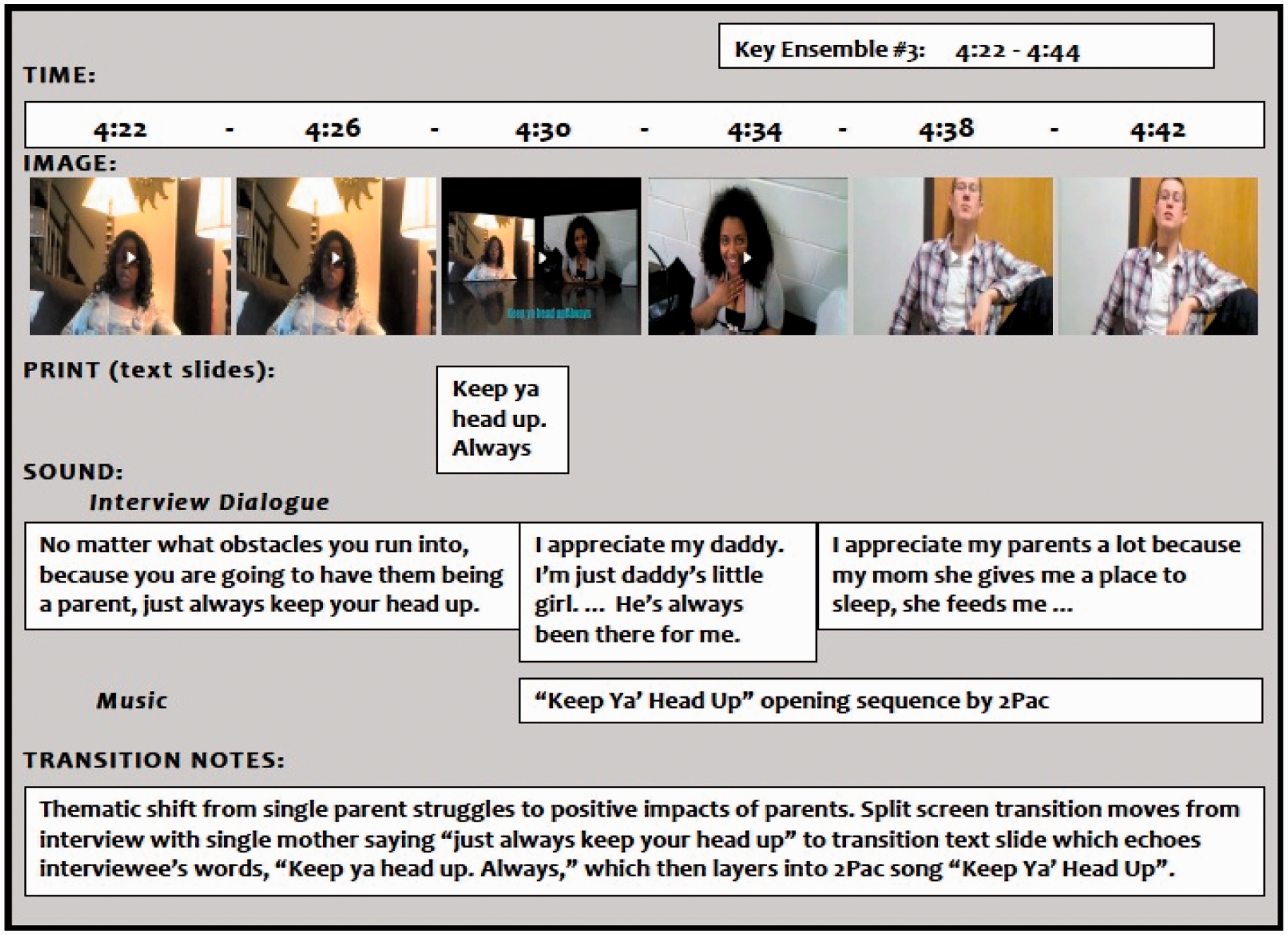
The track analysis shows a layering of multiple modes and editing techniques that work together to achieve a thematic shift from the struggles that single parents face to the resilience and positive impacts of parents. The transition begins with an interview clip in which Felicia’s mom, a single mother, discusses that parents will face many obstacles “no matter what,” but that they should not be downtrodden, rather they must move forward and “always keep your head up.” This interview clip is directly followed by another interview clip in which a daughter of a single parent says that she appreciates her daddy and that he has always been there for her. To bridge these two interview clips, however, the group adds a transition effect known in iMovie as the “swap.” This effect transitions one clip to the next by having the proceeding clip shrink, as the next clip grows larger to fully engulf the screen. In the middle of the effect, both clips are visible on the screen as equal in size, providing a split screen effect.
This visual effect serves to dovetail two interview clips, the one of Felicia’s Mom and another of a student talking about her dad. To further connect these two clips, the group layers a text slide atop the transition, with the phrase “Keep ya head up Always!” This phrase echoes the advice of Felicia’s mom in the first interview clip while also ushering in the beginning of the next 2Pac song, by the same title “Keep Ya Head Up.”
In putting so much effort into bridging these two scenes of their documentary, the part that focuses on single parent struggles and the part that focuses on positive relations with parents, the group members attempted to shift the focus and purpose of the documentary. Moving away from victim-based representations, they focus instead on the resilience and positive relationships single parents have with their children. To further draw attention to this transition, the group brings in a new 2Pac song, “Keep Ya Head Up.” This song then continues to play under nine positive interview clips that follow.
This arrangement of various meditational means: (1) interview clip placement, (2) “swap” transition effect, (3) text placement, and (4) 2Pac music, produces an ensemble transition that expresses a thematic shift from struggling single mothers to resilient parents capable of positive relations. In doing so, this convergence of media complicates canned identities of victimhood for children of single parents. Instead children of single parents are presented as positive benefactors of close relations with committed parents. Furthermore, this multimodal ensemble highlights the need to remain strong in the face of adversity an echo of the message presented in the 2Pac interview clip.
Following this transitional ensemble are nine interview clips, which recount positive relations with parents. This montage lasts 65 seconds, a substantial portion of the six-minute documentary. This montage then leads into the closing scene and credits, which comprise the fourth and final multimodal ensembles to be discussed.
The final ensemble of focus occurs as the documentary closes and transitions from the positive relations of scene seven to the closing credits of scene eight (see Table 2). Along with the closing credits, the third song by 2Pac, “Dear Momma,” begins playing and is cued specifically to the lyrics which state, “There’s no way that I could pay you back. My plan is to show you that I understand. You are appreciated.” See Figure 2.
Final multimodal ensemble mediating gratitude to parents.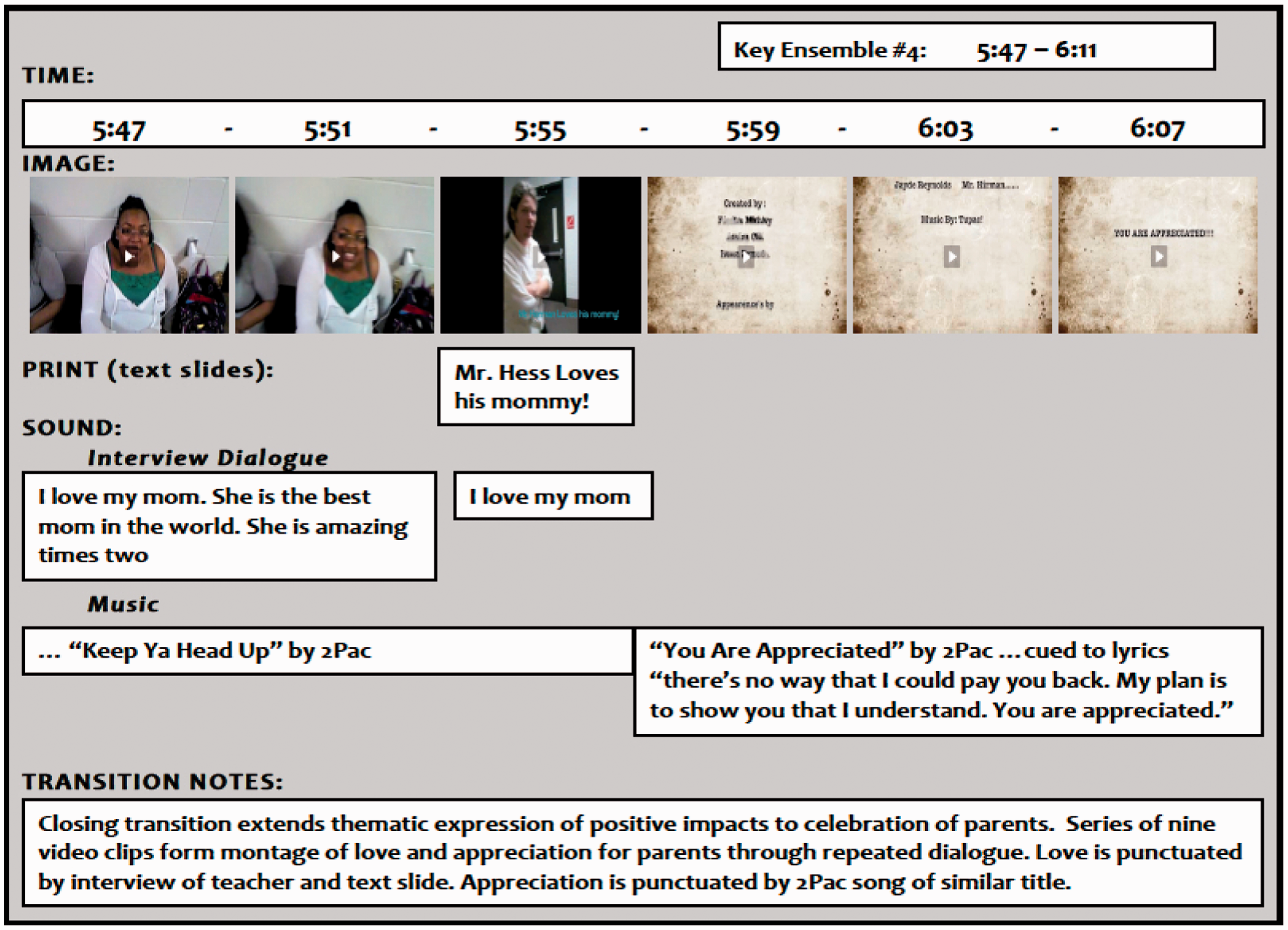
This closing transition further intensifies the thematic shift away from single parents to celebration of parents. Throughout the series of nine video clips, the interview clips shift from positive relations to direct statements of love and appreciation for a certain parent. Love for parents is reiterated in a somewhat humorous ways in the final interview clip when the class teacher states directly into the camera that he too loves his mom. The idea of loving appreciation is punctuated by the selection, placement, and cueing of the final 2Pac song, “Dear Momma” and also by the final text line of the credits, presented all in capital letters, “YOU ARE APPRECIATED!!!”
This repeated occurrence of phrases of love and appreciation for parents from interview subjects, along with 2Pac’s song “Dear Momma,” convey an expansion of the target audience for the documentary as well as purpose. Instead of being a documentary about single parents, geared primarily for peers, the final scene shifts in perspective and voice, speaking directly to parents stating, “You are appreciated.” Such a direct address to parents, assumes parents may view the documentary and communicates gratitude to this audience. While producing the video, I asked Felicia why she chose to include “Dear Momma” at the end of the documentary. Felicia shared with me, that the song “Dear Momma” makes her cry. She explains, Ok normally when I heard this song, like last year and the years before this, it didn’t really mean much to me, until this year. Now with me getting older and growing up and realizing how much my mom does for me and like how much she sacrifices for me and my sister. It touches me. I don’t know but it does.
Discussion: video production as vehicle for multimodal self-assertion
According to Felicia and her group members’ the social resources of 2Pac helped to represent single parents as they “really are,” that some do live the fairy tale life and some do not. Yet, considered collectively the multimodal ensembles accomplish far more than this. The music, lyrics, and life experience of 2Pac provided social currency to grab and manage the attention of their classmates. 2Pac combined with other meditational resources into multimodal ensembles, also helped the group establish focus and legitimize more complex understandings of single-parenthood for African Americans. More importantly, the multimodal ensembles forged a space for Felicia and somewhat Miriam and Eleni to explore and experiment with different social positions and trajectories for young, African American women.
Such purposeful media ensembles grant Felicia and her group members what Scollon (1997) would call an “interperformativity” of identity expression, a capacity to harness and distribute attention in different ways across different spaces and audiences. In this case, Felicia performs an identity to her peers in the present, that of atypical child of single mother. She performs another identity for her peers and her mother, that of appreciative daughter. She enacts yet another identity for herself in the future, that of college-bound, young woman, making it through high school without getting pregnant.
The fruits of this interperformativity are most evident in Felicia’s cumulative description of her experience, in which she links the documentary to her own life experiences. When asked in a post-production interview what she learned from making the documentary, Felicia responds, I think if anything this documentary kind of showed me what I am, what I’ve become, because statistically, I’m not supposed to be the way I am, because you know people say that without a father figure in your life you are supposed to crave attention from boys. I mean that’s what I hear and what I SEE on TV … So I guess this doc has shown me who I am, because I am not like that. That’s not something I was, I am, or am ever going to be.
Such interperformativity allows Felicia to accomplish four key assertions that shift her personal alignment outside cliché notions of victim to legitimate outlier. To begin, through selecting and foregrounding the music, lyrics and personal experience of 2Pac, Felicia is able to represent 2Pac as hip-hop artist/philosopher who speaks the truth. As philosopher 2Pac garners attention from peers while also articulating apparatuses of institutional racism with clarity and urgency. Secondly, she uses 2Pac to transform the cultural cliché of African American teen-mom stereotype from one of poor victim to a community call for action, using Brenda’s Got A Baby to strike a serious tone about a “community issue” in need of attention. She next draws on 2Pac yet again to reclaim African American motherhood, downplaying cliché representations of domineering matriarch to foreground assertions of resilient caregiver, deserving of praise and appreciation. And finally, across the production process as a whole, Felicia asserts for herself an alternative identity placed in opposition to the readily available stereotypes. Instead of voicing anger at an unjust system, which would be one way to challenge stereotypical representations, her group’s documentary steps out and above deficiency-based discourses of single motherhood, that present one as either succeeding or failing in the face of traditional notions of nuclear family. Instead, the documentary activates a new discourse, that of parental appreciation regardless of family structure. This new discourse celebrates her mother’s resilience, thus forging a new trajectory to understand and position herself, both now and in the future.
Conclusion
All three young women began the project wanting to create a documentary about the overprotective and controlling aspects of parents but found themselves, in the end, actually seeking the perspectives of and celebrating those they had planned to critique. Moreover, through the documentary process they all gained a deeper understanding of their parents’ or guardian’s experiences, even to the point of feeling compassion and gratitude for their efforts.
The testimonies of her peers, crafted with the music lyrics and interview clips of 2Pac also allow Felicia new social positions toward her mother, and to herself. Considered collectively, these social positions compose a counter-narrative for what it means to be young, African American, and female, a narrative that speaks against readily available stereotypes, an alternative narrative that equips Felicia with positions and pathways outside the media trap.
Footnotes
Funding
This work was supported by a graduate research fellowship grant provided by the researcher's graduating institution.