




Abstract
This study examines how instructional conversations revealed the ways two teachers’ argumentative epistemologies (ideational and social process) shaped literacy events focused on the warranting of evidence. A microethnographic study of the literacy events within each teacher’s respective instructional unit revealed that each teacher’s epistemology shaped how students were asked to consider differing sources, relevancy, and sufficiency for warranting evidence within the context of writing extended argumentative essays. Events within an ideational epistemology required students to generate warrants as ideas to be applied to arguments in on-demand writing situations. Within a social process epistemology, students constructed warrants as a social practice appropriate for a specific rhetorical context. Each teacher supported his or her students in developing differing understandings of the nature of warranting. These findings highlight the importance of analyzing the teaching and learning of argumentative writing not only as written products of instruction but as a socialization into argumentative writing practices.
We live in an era of Common Core State Standards (Council of Chief State School Officers, 2010). “Critical thinking” and the ability to compose high-quality arguments (and their claims, warrants, and evidence) are essential skills for the academic success of high school students (Graff, 2003; Kuhn, 2005; Newell, Beach, Smith, & VanDerHeide, 2011; Newell, Bloome, & Hirvela, 2015). However, in the wake of numerous calls for reform, the teaching and learning of writing has exhibited a strong “textual bias” (Horner, 1999) that treats writing as primarily a linguistic object prepared for assessment, with text valued over praxis. Our approach to studying the teaching and learning of writing differs in that we are concerned with not only the argumentative texts produced by students but also the social practices that informed the generation of those texts (Bloome, Carter, Christian, Otto, & Shuart-Faris, 2005). We view social practices as ways of socializing students to act, think, and use language in thoughtful and productive ways (Newell et al., 2015).
In our Argumentative Writing Project (AWP), we rely upon Toulmin (1958, 1972, 2001) to define argumentative writing as situation-specific, as a type of critical thinking and rhetorical production. Although the Toulmin model is often used pedagogically to perpetuate argumentative writing as a set of forms, we prefer to disrupt this notion and instead use it to talk about the shared knowledge and history of argumentative writing in a particular context. For us, the Toulmin model involves the identification of a thesis (also called a claim), supportive evidence, and assessment of the warrants that connect the thesis, evidence, and situation within which the argument is being made predictive of counterarguments respectful of diverse views within a heterogeneous society (Newell et al., 2015). We believe authentic arguments anticipate how an audience may or may not receive an argument. This anticipation can generate responses establishing social and intertextual relationships through dialogue. This idealized vision of argumentation contrasts with the current state of writing instruction in U.S. secondary schools (Applebee & Langer, 2013).
We and many of the English language arts (ELA) teachers with whom we have collaborated now understand that argumentation and argumentative writing involves more than using a structural “recipe” of argumentation components. First, it requires deep understanding of the context for the argument, and this understanding of context can enhance thinking and inquiry (Murphy et al., 2016). Second, it can help construct new knowledge and perspectives (Ghiso, 2015). Moreover, the teaching of argumentative writing requires development of adaptive expertise (Athanases, Bennett, & Wahleithner, 2015) in related pedagogical strategies for teaching students from a range of academic experiences and backgrounds (Newell, Goff, et al., 2017).
Research has consistently found that students develop stronger arguments when teachers have discipline-specific knowledge of written argumentation and provide scaffolding for locating, generating, and integrating warranted evidence into arguments (National Council of Teachers of English, 2012). By evidence, we mean all of the verifiable information a writer might use as support for an argument, such as facts, observations, examples, cases, testimony, experimental findings, survey data, statistics, and so forth. By warrant, we mean the establishment of reasoning that connects one’s evidence to one’s claim. Warranting often entails unstated beliefs, values, and understandings regarded as more or less appropriate according to context of use, writerly moves that Hillocks (2002) reported as mostly ignored by statewide writing assessments.
Our vision for argumentative writing, built upon the often-overlooked situation specificity and adaptability of the Toulmin model, has also been shaped by the drama/role-playing gateway activities associated with the first environmental mode (Hillocks, 1986) and later the structured process approach (Applebee, 1986; Smagorinsky, 2010) to writing instruction. Some popular gateway activities used in argumentative writing instruction include Lost at Sea and The Soldier’s Dilemma from Johannessen (2003), Anniversary Dinner from Smagorinsky (2010), and Slip or Trip and Lunchroom Murders from Hillocks (2011). Such gateway activities concern students with more than structure. By creating a rhetorical context that mirrors so-called real-world applications of argument, students, in one sense, construct a localized context imbued with practices rooted in the teacher’s epistemological stance toward argumentation (Newell, Bloome, & AWP, 2017). Teachers provide scenarios that require students’ arguments to be both situation- and audience-specific while also being cognizant of warrants for both the generation of and response to counterarguments.
Significance of Warranted Evidence in Argumentation
When composing arguments, students must locate relevant data and then warrant them so that they are both significant and sufficient to their situated arguments. Studies of classroom discourse indicate that discourse enables students to further develop their understanding of discipline-specific ideas, and, under certain conditions, allows students to learn the disciplinary discourse of science (Driver, Newton, & Osborne, 2000), history (Monte-Sano, 2008), and literary studies (Wilder, 2002). Through the modes of spoken and written argumentation, students warrant evidence. Students must understand and interpret their discipline-specific data to build successful warrants. This encourages the comprehension of what claims can be made known by warranting evidence, rather than simply repeating the “facts.” How one warrants a piece of evidence is not constant. Such constancy, however, is implied when argumentative writing is seen, as it often is, as a recipe with so many parts claim, data, and warrant.
During a 3-year federally funded study of teaching and learning argumentative writing in 31 high school ELA classrooms, we found that only a small portion of teachers had well-developed instructional strategies for engaging students in task-specific knowledge for argumentative writing (Newell et al., 2015). Specifically, most teachers regarded the warranting of evidence as a structural maneuver where students slotted evidence into a preset form. Disciplinary experts, however, treat their initial claims as merely “working” hypotheses and hold them lightly to judge them critically as new evidence and social and disciplinary understandings emerge (Geisler, 1994; Toulmin, 1958).
Among the teachers we studied, some focused on not only structural elements but also how those elements might be orchestrated into a coherent argument for a particular reader in a particular context. These teachers shared a two-part understanding: first, that test preparation is not the only purpose for writing instruction (Applebee & Langer, 2013), and second, that argumentative writing must be read by a particular reader at a particular time with his or her own assumptions and beliefs on the topic at hand. For this article, we reexamined the pedagogical approach of two of the 31 teachers from our previous study (Newell et al., 2015) to illustrate contrasting teacher epistemologies—ideational and social process—of how students are taught to warrant evidence. We argue that a teacher’s epistemology shapes students’ emerging understanding of what it means to engage in arguments.
Teachers’ Argumentative Epistemologies
Writing teachers’ epistemologies and the relationships between teachers’ and students’ epistemologies (Johnston, Woodside-Jiron, & Day, 2001) suggest that teachers with different epistemologies will interact differently with students, organize instruction differently, and make differing assumptions about how students learn and develop over time (Langer & Applebee, 1987; Newell et al., 2015). Although there has been much research into teachers’ epistemological stances (Kardash & Scholes, 1996), the linkages among classroom discourse and teachers’ epistemologies have been largely overlooked.
Our classroom observations revealed a wide variety of approaches to teaching the warranting of evidence. We have identified three argumentative epistemologies (Newell, VanDerHeide, & Wynhoff Olsen, 2014): structural, as applying a set of rules to construct a predetermined argument (De La Paz, Ferretti, Wissinger, Yee, & MacArthur, 2012); ideational, or evidence-based writing, as a primary and necessary means for practicing ways of developing, organizing, and presenting ideas (Langer & Applebee, 1987); and social process, as purpose-driven argumentation in a social context (Ivanič, 2004). While each of the two case study teachers described in this study included instruction on structural issues, one teacher’s approach to argument demonstrated an ideational approach grounded in teaching students how to manage timed writing assignments, while the other focused on social process grounded in a rhetorical approach. We think that these epistemological differences shaped the ways students learned to warrant evidence.
Theoretical Frame
We frame the teaching and learning of argumentative writing as a social practice. The way things are done in a particular social situation is shared, learned, evolved over time, and located historically (Newell et al., 2015). A given student’s understanding of argumentative writing is particular to his or her experience with particular argumentative writing practices.
Because we are investigating how students from different classrooms experience argumentative writing, we have employed a case study approach. We explore the “local particulars” (Dyson & Genishi, 2005, p. 3) of two different contexts. We understand context as how people do things together according to “mutually shared and ratified definitions of situation” (Erickson & Schultz, 1997, p. 22), meaning we were interested in what counted as argumentative writing for the members of an ideational classroom versus a social process classroom.
Scholars of argumentation provide a useful way to think about situated participation. Prior (2005) relies upon Andrews’s (1995) metaphor for argumentation as choreography (a set of responses) to capture how argumentation practices are not universal but situated. This is useful given that the field relies so heavily on Toulmin’s (1958) model of argument to foreground the teaching of argument as structural. Prior (2005) builds on Lunsford’s (2002) assertion that the Toulmin model lays out two major elements: (a) the generic and now ubiquitous textual elements of argument—claim, data, warrant, qualification, backing, and rebuttal—and (b) the social/cultural constructions of arguments within disciplines of thinking, or what Prior (2005) refers to as “the locally situated emergence of a specific argument” (p. 131). The first element dominates the teaching and learning of argumentative writing in schools, while the second one has been largely overlooked. Through our study, we hope to disrupt the “textual bias” (Horner, 1999) spoken of earlier and show the promise of developing the dialogic, situational, and adaptive immediacy of any given argument.
Method
Methodological Perspective
Research on the teaching of argumentation and argumentative writing has been primarily conducted from cognitive and structural perspectives (e.g., Kuhn, 2005) and from rhetoric and composition perspectives (e.g., Graff, 2003; Lunsford, 2002). Although we incorporate insights from those perspectives, our theoretical framework is grounded in social constructionist perspectives (cf. Gergen, 1999), emphasizing how people jointly construct definitions of their activities, themselves, social relationships, and experiences through language (Bakhtin, 1986; Bloome et al., 2005). We employ a microethnographic approach to discourse analysis (Bloome et al., 2005), identifying key events, transcribing them from video recordings, and analyzing each line (utterance) with regard to how it builds upon previous utterances, how it implies social relations among people including the reader and the author, indexes particular kinds of evidence, constructs opportunities for engagement with others, shifts between the substance of an argument (content) and the structure of an argument (form), references previous and future events, and links to various social contexts.
Although our general concern is how teachers and students interactionally construct a discernible pedagogy for the teaching and learning of argumentation and argumentative writing, two specific questions enabled us to focus on the social construction of warranted evidence:
What epistemologies are enacted in the instructional conversations of two ELA teachers’ approaches to argumentative writing?
How do these argumentative epistemologies shape and get shaped during teachers’ and students’ instructional conversations about warranted evidence for claims regarding differing kinds of arguments?
We approached each of the teachers described in this study because of their local reputation as “excellent” writing teachers. We observed in each classroom during one argumentative writing unit as defined by the teacher. Through those observations, we recognized their contrasting epistemologies—ideational versus social process. Our assessment of these two teachers’ contrasting argumentative epistemologies is based on their instructional conversations and activities, interviews, and their responses to student writing. Our goal has been to understand the mediating effects of each teacher’s underlying epistemology on his or her approach to the warranting of evidence.
Participants
The findings are based on our field research with Ms. Houston and Mr. Clark, two ELA high school teachers in two suburban high schools, both with experience in teaching Advanced Placement (AP) language and composition courses. Each of the teachers represents a telling case (Mitchell, 1984) regarding particular aspects of teaching warranting; we relied on these teachers’ classroom instruction “to show how general principles deriving from some theoretical orientation [argumentative epistemology] manifest themselves in some given set of particular circumstances [teaching warranting as a social practice]” (p. 239). Moreover, we use these case studies to construct a theory of teaching argumentative writing and represent our concept of argumentative epistemology as manifested through instructional conversations. Appendix A in the Online, supplementary archive displays demographic information on each case study teacher.
Ms. Houston, a White female, taught a 12th-grade college prep course in a relatively wealthy, suburban district. The student body (1,269 students) was approximately 83.5% White, 7.1% Asian, 3.6% Black, 3.4% biracial, and 2.3% Hispanic, with smaller numbers of American Indians and Pacific Islanders. Ms. Houston’s school had a history of success with AP programs in English, history, math, and science. The class we studied had 19 total students, most college-bound. Ms. Houston believed “these seniors needed to learn how to write for college professors who demand academic writing.” Much of her writing instruction emphasized effective moves for timed test writing.
Mr. Clark, a White male, taught an 11th-grade college prep English class at a different high school in the same district. The student body (1,605 students) was approximately 87.5% White, 7.3% Asian, 1.4% Black, 2.4% biracial, and 1.3% Hispanic, with smaller numbers of American Indians and Pacific Islanders. Mr. Clark noted the supportive school community: “Whenever I talk with parents, they tell me that . . . they like how we are getting the students ready for academic work.” Mr. Clark has presented at local and national teacher conferences on the teaching of argumentative writing. He is a teacher consultant in the local and affiliated National Writing Project.
Data Sources
Observational data
We used case study methods to collect data in these two case study classrooms in three interrelated stages. During Stage 1, we observed and video-recorded an argumentative writing instructional unit as defined by each teacher. In Stage 2, we collected documents: instructional materials, student writing samples, and so on. Finally, in Stage 3, we conducted semistructured interviews. We interviewed four case study students in each class. We also interviewed each teacher a minimum of 3 times.
Interview data
We interviewed each teacher at the end of the instructional unit about their response to the unit and two student writing samples (one successful and one less successful as determined by the teacher). We interviewed each teacher 1 month after the unit to consider whether teachers extended their teaching of argumentative writing beyond the observed unit. Finally, we interviewed teachers during collaborative data sessions in which teachers commented on video clips of their instruction.
Each teacher identified four students (two “successful” and two “less successful” students) based on academic performance up to that point. The four students from each class agreed to share their writing with us and participate in an interview (ranging between 25 and 30 min each) after the conclusion of the unit. We asked the students a series of questions (a) about their identity as a writer in and out of school, (b) about their experience with writing assignments in ELA contexts, (c) about their experience in this class during discussions regarding interpretations of literature and how the teacher handled disagreements about interpretations, (d) about how they would describe this teacher’s approach to teaching argumentative writing, (e) about a specific piece of argumentative writing they had produced for this class, and finally, (f) about advice they would give to students taking English from this teacher next year. We collected writing samples, representing both in-class impromptu writing activities and more formal argumentative writing requiring more than a single class session, from each student.
Context for data sources
We asked each teacher to name a significant event during instruction during our postobservation debriefings and used those events to create instructional chains (VanDerHeide & Newell, 2013) to represent the 150 min most critical to helping students be successful on their respective teacher-sponsored summative assessments (see Appendices B and C in the Online, supplementary archive). We selected events in which Ms. Houston’s class analyzed the implied argument of an editorial cartoon where Santa appears ready to cut the head off a Thanksgiving turkey (Stahler, 2011) and in which Mr. Clark’s class analyzed a sketch of a lunchroom murder (Hillocks, 2011) to determine the perpetrator. In each case, instruction on the warranting of evidence was in preparation for students writing a summative argumentative essay. The chains (explained in our analysis section below) helped us identify one video-taped event from each teacher’s unit to analyze because of its “thematic coherence” (Bloome et al., 2005, p. 33).
Ms. Houston’s summative argumentative writing task was a timed essay in response to a passage from King Lear, excerpted from the 2000 AP language exam. The task asked students to warrant evidence according to their agreement or disagreement with the passage. We selected two events for transcription and coding: In Session 1, Ms. Houston introduced a fill-in-the-blank heuristic called SCANS (Subject, Content, Attitudes, Narrative, Symbolism) that she said had been developed by the College Board for AP English classes (see Appendix D in the Online, supplementary archive). Ms. Houston’s students used SCANS to quickly analyze the Santa cartoon. In Session 4, the students again used SCANS to analyze a portion of Julius Caesar, as excerpted on the 2002 AP language exam. The chain and the interviews demonstrated that Ms. Houston’s notion of good writing was to quickly read a prompt, take a stance, and deliver an argument that effectively warranted the supplied evidence to support a particular textual claim.
Mr. Clark’s final writing assignment asked students to write a policy argument for a proposal to extend high school by another year. Because he identified warranting as a paramount learning “hurdle” for students, he created activities and assignments that foregrounded warranting in relation to evidence and claim. As preparation, Mr. Clark asked students to write a crime scene investigation report to a fictional police chief where they supported their claim by warranting several pieces of visual and textual evidence (Hillocks, 2011). This writing assignment and its surrounding activities of small-group and whole-class discussion became a gateway to additional understanding of warranting. The instructional chain and the interviews all demonstrated that Mr. Clark’s notion of “good” argumentative writing detailed how evidence was warranted to support a central claim for a particular audience.
Data Analysis
Instructional chains build upon “Hillocks’s (1995) argument that teaching should take place in episodes that are coherently linked together” (VanDerHeide & Newell, 2013, p. 305). To create instructional chains, we broke each lesson into 5-min chunks and coded each of those chunks of time according to what seemed to be the most salient instructional moves, interactions, and topics articulated by teachers and students at that time. See VanDerHeide and Newell (2013) for more detail on how to code 5-min chunks of video according to six different categories: grouping, teacher interaction, expected student response, argumentative writing instruction, student active engagement, and instructional materials. We then examined the unit as a whole and selected those 150 min (30 five-minute chunks) that seemed to best prepare students for the summative assessment. For example, Ms. Houston’s summative assessment asked students to make an argument agreeing or disagreeing with King Lear’s view of the relationship between wealth and justice. What episodes throughout the unit best prepared students to do well on this assessment? Creating instructional chains helped us recognize that Ms. Houston subscribed more to Brandt’s (1990) “strong text” model where meaning was to be found in the text, while Mr. Clark was more in line with Rosenblatt’s (2005) transactional approach. They also allowed us to choose a representative event of each teacher’s contrasting argumentative epistemology (Newell et al., 2014). For this article, we selected “telling” moments (Mitchell, 1984) of instructional conversations from each teacher’s class and placed analyses of these two events next to each other to show how notions of warranting evidence are socially constructed and varied. Specifically, we selected events representative of each teacher’s epistemology regarding warranting—linking claims with evidence.
From each lesson within each teacher’s instructional chain, a representative event of about 10 min was selected, and the instructional conversation was transcribed and analyzed according to the methods of microethnographic discourse analysis. These analyses were triangulated with data from interviews and student work. First, we analyzed and discussed the transcribed events and possible emergent codes that became visible across each chain. We continuously asked, “What is happening here?” with regard to the creation of learning opportunities. We focused on the contextualization cues the teacher and students used (cf. Gumperz, 1986) and how they acted and reacted to each other. Second, to describe what occurred in the instructional conversations within the events, we worked on a message-unit-by-message-unit basis, using procedures from Green and Wallat (1981) and Bloome et al. (2005). The labels (e.g., warranted/sourcing) provide a description of how the teacher and students responded to one another. Third, we wrote initial memos to capture our unfolding interpretations of the analysis, and then integrative memos to integrate other bits of data such as interviews and student work and thus identify emerging themes (Emerson, Fretz, & Shaw, 1995).
Toulmin’s (1958) terminology helped us describe the construction processes in each instructional conversation. As we worked through a moment-by-moment analysis of the transcript, we moved back and forth across the events as the teachers and students “offered,” “elaborated,” “clarified,” and “challenged” evidence and warrants. At times, “counter-arguing,” “backing (evidence),” and “authorizing ideas” also developed during exchanges. The warranting of evidence was not discussed in isolation of other elements, requiring us to include claim and evidence in the coding system as a way of capturing Ms. Houston’s and Mr. Clark’s efforts to teach students how to orchestrate coherent arguments.
We realized we needed a more nuanced description of how evidence was warranted during the instructional conversations, because each message unit represents an unfolding event for how argumentation is enacted, understood, and practiced within each classroom context. We applied three subcategories—sourcing, relevancy, and sufficiency (National Council of Teachers of English, 2012)—as a way to code for types of warranted evidence. Sourcing references the author’s intentions surrounding the use of particular evidence; it accounts for where one retrieved evidence. Relevancy notes the timeliness of the evidence used at a particular time or place. Sufficiency references the big-picture effect of the evidence used, meaning whether it accounts for evidence from all sides of an issue. Finally, we coded for consensus, as coming to consensus was an important distinction between the teachers. Each code is defined in Appendix E of the Online, supplementary archive.
Findings
Ms. Houston: Providing Evidence in On-Demand Argumentative Writing
Ms. Houston fit the eight sessions of her argumentative writing unit around the reading of Shakespeare’s Hamlet. She relied on previously published AP language test prompts requiring students to generate textual analysis arguments from passages excerpted from Julius Caesar and King Lear. Her experience as an AP teacher shaped much of her ideational approach to argumentative writing, even in this non-AP class. For example, she described SCANS “as a quick way to develop a lot of content,” as “training wheels,” as “a place to start,” and as a way to get “unstuck,” terms suggestive of tactics to be employed in evaluative contexts.
Ms. Houston first used SCANS to engage her students in an analysis of visual arguments. After reading a text, students made notes for each category. In another box labeled “Conclusions,” students used the evidence they gathered in the boxes to answer these questions:
Based on various details, what can you say is the artist’s purpose in creating this piece?
What is the artist’s attitude or feeling about the subject portrayed in this image?
When the class shifted to analyzing print texts, the questions were adjusted to ask about the author’s purpose and attitude, but they still focused on filling in “prepatterned slots” (Nystrand & Graff, 2001, p. 485). For example, when considering the Julius Caesar prompt that asked students to argue why Decius was more persuasive to Caesar than Calpurnia, Ms. Houston asked for a five-paragraph structure.
SCANS helped students generate arguments within the time constraints of writing assessments. In short, Ms. Houston valued what is valued by timed AP tests, that is, a carefully structured and well-elaborated essay highlighting major rhetorical (and thus textual) features such as audience, purpose, and rhetorical appeals (logos, pathos, ethos) with a clearly stated thesis statement and coherently structured evidence.
An ideational approach to timed argumentative writing
In an interview, Ms. Houston identified several instructional goals for teaching argumentative writing, but her intention to “prepare students for the reality of taking tests and for on-demand college writing” took precedence. She focused almost exclusively on a combination of structural issues (to create a form) and idea development (to fill the form). Accordingly, her approach to argumentative writing began with concerns for evidence in that “in a test situation you have to read the prompt and then generate lots of ideas which are actually evidence.” As prompts typically offer a claim or a choice of claims, a strategic move, according to Ms. Houston, would be “to quickly take a stance and begin to explain it with reasons and evidence.”
Ms. Houston taught that evaluators want to see elaboration: “You need lots of evidence that follows just after your thesis.” She defined warrants as “elaborating further.” She hoped her students would take away the “importance of supporting their positions, how extensive it has to be.” Ms. Houston felt compelled to control discussions “because they [students] struggle with where to put their claims and evidence.” She was concerned that students would struggle with how to “defend, challenge, or qualify” King Lear’s “view of the relationship between wealth and justice,” as stated in an excerpt from the original AP prompt. Consequently, she revised the prompt’s language to ask students to simply “agree or disagree” with King Lear.
Case study students, referred to below according to their initials, reported that Ms. Houston’s instructional conversations focused on finding a particular correct response, what AS called “the thing that is most prevalent.” SM spoke of Ms. Houston using discussions to make sure students were on “the right path” and “right track.” JP said of Ms. Houston explaining Shakespeare to her: “I was so confused at home [reading alone]—then when she would explain it, I would be like, ‘Now I know what I’m reading.’” JP’s comments suggest that there was a particular meaning (“it”) to be had, rather than learning how to participate in a dialogue of competing ideas. Early in the unit, when introducing SCANS, Ms. Houston said, “Just like in a text, we have to examine all of the details. All roads will take you to the same place.” We take Ms. Houston’s notion of “same place” to mean an agreed-upon interpretation.
Discourse analysis of a representative event
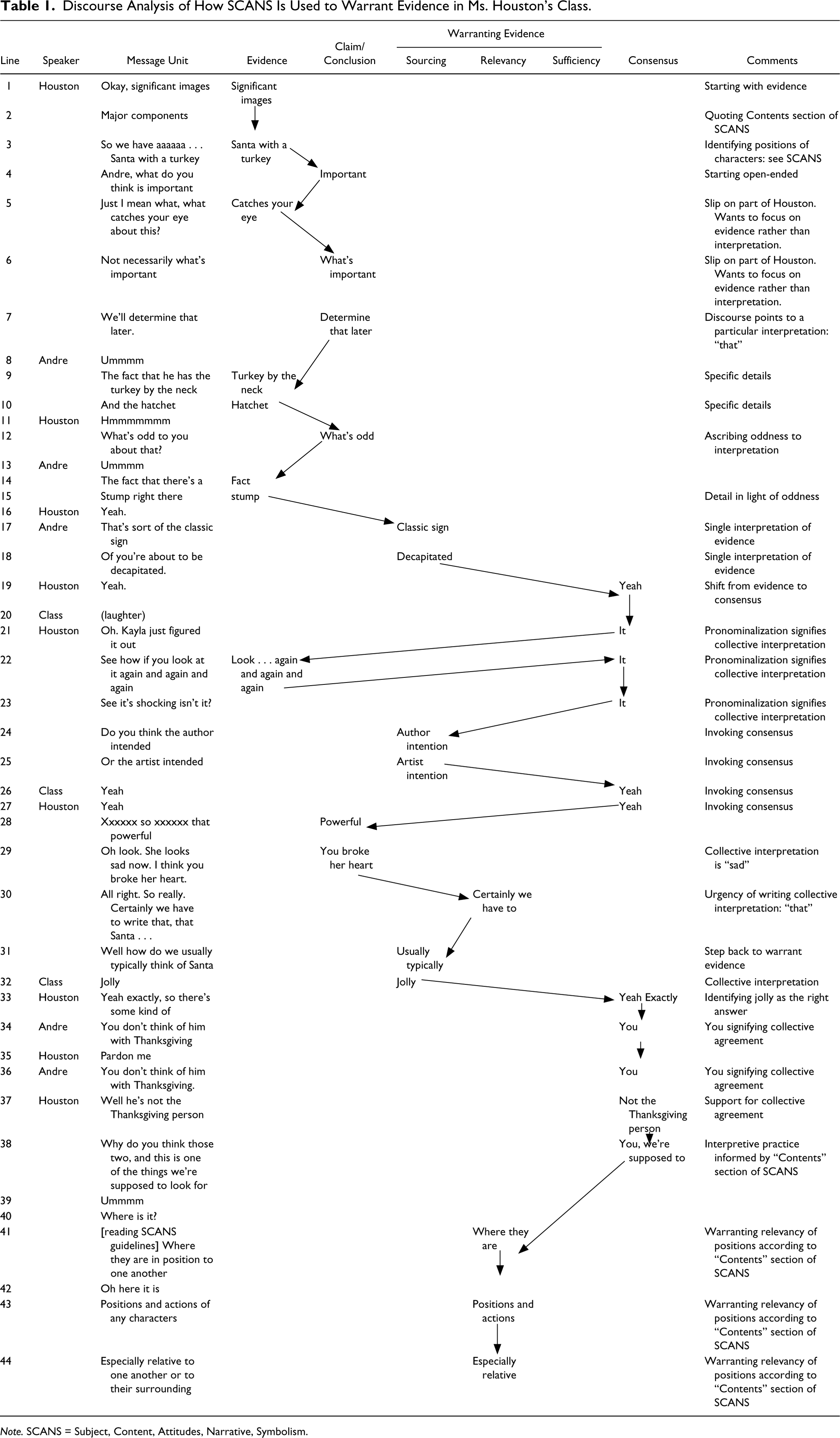
The first session of Ms. Houston’s argumentative writing unit began with the examination of the Santa cartoon (Stahler, 2011). In this cartoon, Santa holds an axe in one hand and a turkey by the neck in the other. A stump is in the background. The turkey is thinking, “This season’s so confusing.” Ms. Houston introduced SCANS to teach her students to gather details (evidence) before making claims. Table 1 is a transcription and analysis of this event (45 message units).
Discourse Analysis of How SCANS Is Used to Warrant Evidence in Ms. Houston’s Class.
Note. SCANS = Subject, Content, Attitudes, Narrative, Symbolism.
The first 23 lines, framed by the use of SCANS, use a four-part pattern to establish a shared interpretation of the cartoon: (a) identifying textual details, (b) interpreting the idea(s) represented by those details, (c) establishing consensus regarding their interpretation by warranting (sourcing) ideas presumed to be collectively held by society, and (d) delivering the interpretation as academic content in the form of SCANS and on-demand writing. This pattern repeats 3 times during the entirety of the instructional conversation during this class session. Only the first occurrence is represented here.
Ms. Houston first draws her students’ attention to potential evidence (lines 1-8). While she makes an initial move toward a claim (line 5) by asking a student to identify something “important,” Ms. Houston quickly returns the focus to “what catches your eye” (line 6) and states that judgments regarding importance (a claim) will be determined “later” (line 8). Together, they identify Santa, a turkey, the fact that Santa is holding the turkey by its neck, and the presence of a hatchet (lines 3-11). It is here that Ms. Houston again asks an interpretive question: “What is odd to you about that?” (line 13). When Andre suggests that Santa is going to decapitate the turkey (lines 18-19), Ms. Houston validates his interpretation by saying “Yeah” (line 20), and when the body language of one student indicates that he has arrived at that same interpretation, Ms. Houston tells the class, “[He] just figured it out” (line 22). The pronominalization of the decapitation interpretation with the word it is significant because this captures how Ms. Houston labels “it” as correct, suggesting that this is the meaning of this text.
There is no further discussion on other possible meanings. “It” is repeated 3 times (lines 22, 23, and 24). Through these moves, Ms. Houston voices that the decapitation claim is the correct claim and the text of the cartoon contains even more evidence to support this claim “if you look at it again and again and again” (line 23). The fact that she does not entertain other claims suggests that there are no other possible interpretations. Within 20 lines, the work of interpreting the meaning of the cartoon is done. Now Ms. Houston and her students focus their attention on finding additional evidence that warrants their claim about Santa decapitating the turkey. They then flesh out why Santa might be decapitating a turkey and use SCANS to quickly make an interpretation warranted by evidence, just as they would be required to do in a timed testing situation.
In lines 24 to 44, Ms. Houston encourages her students to warrant their interpretation according to the demands of SCANS. “It” is again sourced as the cartoonist’s intention (lines 25-26). These sourcing moves quickly transition into consensus moves (lines 27-28) when a collective agreement about the interpretation is reached. Issues of relevancy and sufficiency are not discussed except through brief references to assumed, or unquestioned, warrants. The first happens when a student named Andre adds up the images of the stump, the hatchet, and the turkey held by its throat to equal “the classic sign” (line 18) of decapitation. The second comes when Ms. Houston interrupts the classroom discussion to establish agreement that “we usually typically think of Santa” (line 32) as “jolly” (line 33). Finding evidence to support a claim matters more than exploring the validity of such warrants. Because of such little explicit warranting, the relevancy and sufficiency of the evidence have to be connected to the claim by the reader. These moves suggest that Ms. Houston’s epistemological ambition is to show her students how to quickly provide elaborated ideational support for a claim in a timed writing situation. Her students do not warrant multiple points of view. Rather, they use assumed warrants (stump + hatchet = decapitation; Santa is typically jolly) to quickly connect argumentative moves to the demands of academic content such as SCANS and on-demand writing (lines 39-45). This event demonstrates how test preparation can become a writing curriculum, an approach demonstrated in other middle school and high classrooms in the United States (Applebee & Langer, 2013).
Pronominalization (lines 22-39) allows Ms. Houston to quickly bring the class to consensus. Repetition of three different pronouns implicates the entire class into a collective agreement regarding the interpretation: it (3×), we (3×), and the generic you (3×). The it positions the suggested interpretation as correct and does not make room for other interpretations. The we implicates the entire class, suggesting that if one does not share the interpretation, he or she is not part of the we group. The generic you implicates the entire class and is used to solicit an explanation for the class’s shared interpretation. While contrasting interpretations have not been explicitly forbidden, little room is provided for their introduction. Rather, Ms. Houston is using SCANS as a heuristic to generate support for a common claim.
Ms. Houston presses for elaboration when she asks students how “we usually typically think of Santa” (line 32) and why Santa and the turkey are paired in this cartoon (line 39). Having quickly established consensus, though, Ms. Houston matches the reasoning behind the students’ shared interpretation with the demands of SCANS (lines 39-45). This is how this work is “supposed” (line 39) to be done, she says.
As the class continues through repetitions of the above discourse moves—listing of potential evidence, stating the claim, invoking pronominalization to implicate consensus, elaborating on the evidence—they do not sway from the initial interpretation that Santa is metaphorically decapitating the turkey and thus replacing Thanksgiving with the ever-earlier celebration of Christmas. In fact, they strengthen support for this interpretation by going through the above discourse moves 3 times in this class session. Because these discourse moves repeat in not only this session but in other sessions too, Ms. Houston is defining “good” argumentative writing as having particular underlying messages: Evidence will support a certain claim; collectively held warrants (mostly unstated) will provide elaboration after the evidence is presented; evidence is not audience- or context-specific; a text means what it means; and the meaning of a text can be quickly identified by using an on-demand writing strategy such as SCANS.
Mr. Clark: Warranting Evidence as a Social Process: Writing for an Audience
Teachers with a social process epistemology ask students to take up writing in ways both socially and personally meaningful: “The text and the processes of composing it are inextricable from the whole complex social interaction which makes up the communicative event in which they are situated, and meaning is bound up with social purposes for writing” (Ivanič, 2004, p. 234). Accordingly, teachers such as Mr. Clark understand learning to write as engaging their students in socially situated literacy events that fulfill meaningful social goals. This involves not just learning how to compose a well-structured essay but also consideration by whom, how, when, where, under what conditions, and for what purposes they may be making an argument. Teaching and learning argumentative writing with a social process epistemology encompasses writing in all social and cultural contexts, rather than privileging the types of writing associated with schooling and other formal contexts such as test preparation.
Mr. Clark drew upon Hillocks’s (1995, 2011) notion of teaching argument and his experience teaching AP language. In interview, he discussed how he integrated a series of tools for teaching argumentative writing grounded in a particular kind of instructional scaffolding.
What works for me is making arguing seem very real and very authentic rather than some assignment we have to plow through. One thing that I got from AP is the importance of high standards, but Hillocks gave me a way to organize my teaching around certain issues or problems to deal with like murder investigations. I didn’t think this would work but [my colleague] made it pretty clear that it works to teach that way.
Mr. Clark self-identified as a “rhetorician” grounded in the principles inherent in the rhetorical triangle (audience, self, and subject) he learned by teaching AP language. In teaching his 11th-grade “college prep” students, he also employed the elements of the rhetorical triangle as a tool to focus on arguments inherent in particular rhetorical situations. He emphasized the orchestration of arguments, not as set structures or as providing information for teacher evaluation but as social processes shaped by what, when, and whom one addresses in a particular context.
Case study students noted that Mr. Clark’s teaching of argumentative writing prepared students to engage with the content and each other to strengthen their own individual understandings. AR said Mr. Clark strove to “provide fun activities to engage the students,” which allowed students to “see other students’ opinions.” Those activities provided concrete scenarios for students to discuss and debate, but as BM noted, “[Mr. Clark] loves to back things up. He loves evidence, but if you provide a warrant it will take it to the next level.” Likewise, OW described the murder mystery activity as central to her understanding of how warrants related to claims and evidence, but she added that Mr. Clark “gave us time” to learn the material and left interpretations “vague” so that students could decide for themselves once the evidence was explicated.
A social process approach to argumentative writing
Mr. Clark engaged students in discussions of evidence and warranting within the context of an imagined crime scene investigation that culminated in an investigation report for a police chief. By relying on a visual and short narrative of a murder scene (Hillocks, 2011), he had students inquire into arguments of fact. This session followed the teaching of a similar murder mystery, “Slip or Trip” (Hillocks, 2011), and provided opportunities for students to engage each other in small groups, the whole class, and their own writing.
Mr. Clark transitioned between three major instructional emphases as he recontextualized the Toulmin (1958) model to move from arguments of facts to judgments and then finally to policy (Hillocks, 2011). The first three sessions represented an introduction to the Toulmin model’s terminology through consideration and analysis of another murder mystery. The next two sessions (4 and 5) built on these sessions using a gradual release of teacher control with students working in small groups and then independently to write (Fisher & Frey, 2003). In the final three sessions (7, 8, and 9), Mr. Clark transitioned again to introduce an argument of judgment by foregrounding warranting with an activity he referred to as “lifeboat ethics.” The culminating argumentative essay required students to take a policy stance on the value of extending high school by another year.
A significant moment occurred near the end of the unit with a consideration of the “facts” of a visual representation of the lunch crime scene and a request for the students to generate claims based on what Mr. Clark referred to as “a preponderance of evidence.” Near the end of the 50-min session, Mr. Clark shifted the instructional conversation away from the details of the report to a metacognitive consideration of the sources of warrants and their utility in convincing an audience by anticipating its beliefs and values.
I want to talk about what we just did (with warranting). We wrote a whole bunch of rules to interpret evidence in this murder scene. Okay. Where do rules come from?
From our experiences. How we live . . . like everyday things.
Like what?
Speeding, for example. You get a ticket or you crash—we need rules.
So experiences give us rules—like the child who learns not to touch a hot stove.
They’re your beliefs and morals.
And that is not always obvious to us. Where do these come from?
Parents, society, movies . . .
Yes. Church, religion, maybe science . . . like authorities. They give us rules too. These rules are applicable to arguments you make—we carry these rules with us. Warranting just makes this more obvious to us . . . This is what argument is: You are starting with something you believe is true from your experience or from another source and you combine it with something you observe to form an opinion. But then you have to hope that the beliefs that are warrants will hold up for other people—often they don’t. This is the big challenge—even when evidence is observable, will the audience believe our warrants?
Notice that Mr. Clark defines argument as “something you believe is true” (claim), combined “with something you observe to form an opinion” (evidence), and then an exploration of the warrants to make an audience believe one’s evidence. Second, Mr. Clark defines the success of a warrant according to its persuasive power with an audience. Of particular interest in this unit is his reframing of the concepts of claim, evidence, and warrant from a murder investigation to anticipating the demands of an audience across a range of contexts: “They give us rules. These rules are applicable to any argument you are going to make in many different situations—we carry these rules with us.” Warranting, then, is at the heart of the argument and understanding one’s audience is fundamental to success.
Discourse analysis of a representative event
Mr. Clark’s instructional unit began with definitions using the Toulmin (1958) model as a heuristic, but he quickly moved into the use of murder mysteries (Hillocks, 2011) to teach argumentation. The use of the lunchroom murder scene contextualized an imagined real-world event with particular consequences. Students review textual and visual details of a murder scene at Ernie’s Lunchroom. Four stools, labeled A to D, correspond with the abandoned plates and checks of diners A to D. The victim is dead on the floor. There is a right-handprint on the wall as well as footprints leading away from the handprint. Ernie told police that “the murderer had leaned against the wall while firing at point-blank range” (p. 31). The cash register has been rung up for $8.75. Several questions help students investigate both the textual and visual clues that may identify the murderer. During Session 3 of the unit, the students read and wrote an investigative letter to a hypothetical police chief. In Session 4, the focus of this analysis, the students reviewed the letters in small groups, and then engaged in a class discussion to evaluate the evidence they each used to determine the killer.
As in Ms. Houston’s class, Mr. Clark implicitly suggests a favored structure for composing arguments through classroom discourse. As shown in Table 2, evidence is not fully realized until it is positioned in relation to the claim and warrant as they are discussed in class. For instance, the class responds to the teacher’s question about the identity of the killer with a choral “C” (line 2). The teacher then responds with a follow-up question of “How do we know?” (line 3). The following two message units demonstrate how this class socially constructs the warranting of evidence. Sarah suggests that the killer is “C” because “he eats left-handed” (line 4), but she does not elaborate. Mark chimes in with “left-hand dominant” (line 5) to warrant the relevancy of this detail.
Discourse Analysis of How Evidence Is Warranted in Mr. Clark’s Class.
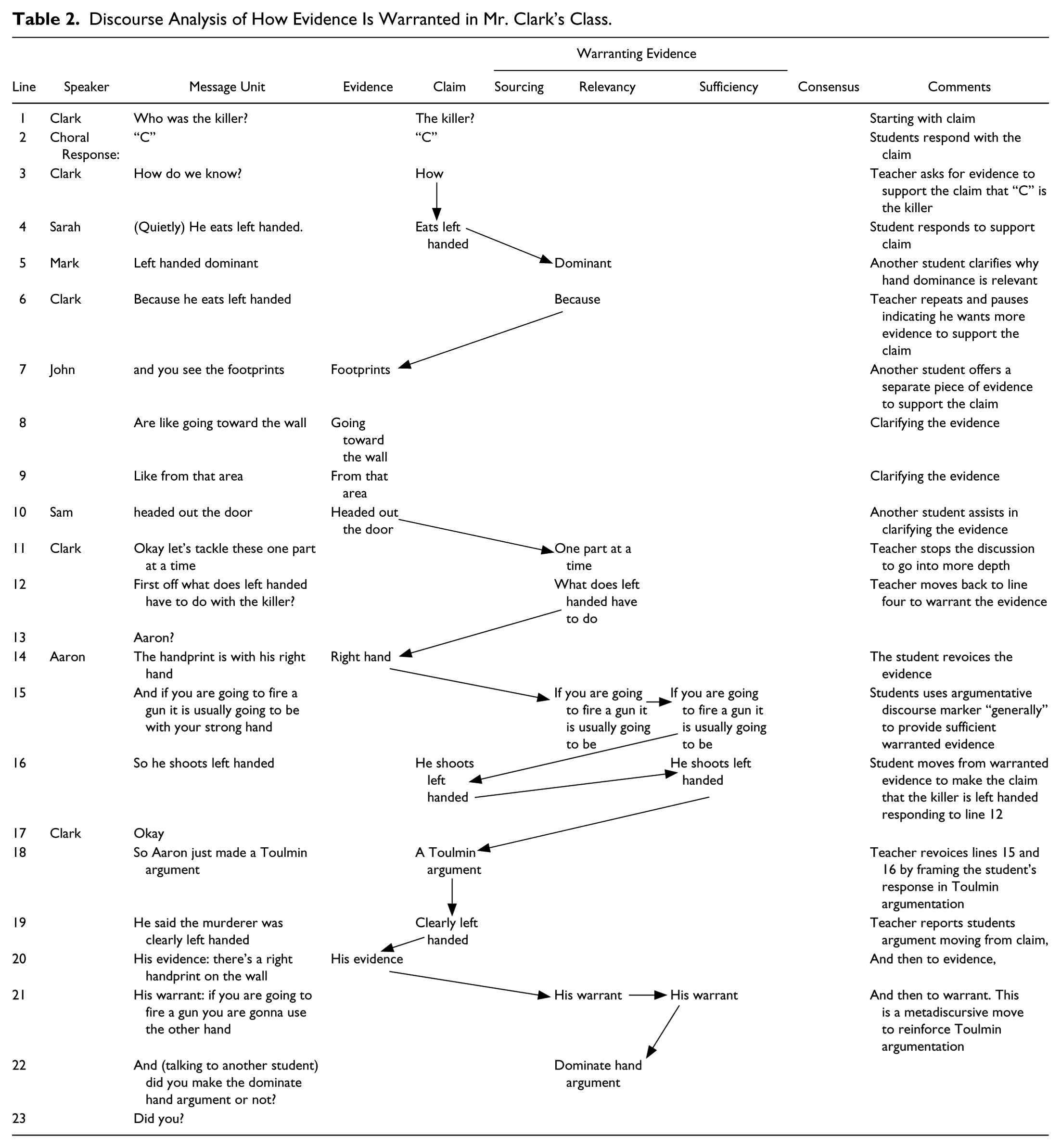
Mr. Clark takes up this issue of relevancy by connecting Sarah and Mark’s comments (line 6). The repetition of this content and the cadence in his voice suggest that he wants to pause here and further warrant the “left-handed” evidence provided by the class. Notice how Transcript 2 maps the progression from claim to evidence to warrants of relevancy. This is an important difference when compared with Ms. Houston’s class as what counts as a good use of the claim–evidence–warrant structure is not the same. The discourse of Ms. Houston’s class shows them quickly moving from a gathering of evidence to a declaration of a single interpretation, which is elaborated by gathering more details. Warrants of relevancy and sufficiency are not invoked. Here, however, Mr. Clark is attempting to spend time elaborating on the relevancy of character “C” being left-handed. It is not enough to just state the warrant. It must be explained to be truly convincing.
While Mr. Clark seemingly wanted to continue warranting visual evidence for the claim of “left-handed,” John and Sam resume the listing of new evidence (lines 7-10). This description of the footprints “going toward the wall” (line 8) and “headed out the door” (line 9) is not clearly warranted, however, because it does not clearly connect to the class’s claim that “C” is the killer. In this instructional conversation, talking about evidence in isolation of other argumentative elements, most notably warrants, is not good enough. This is evidenced by Mr. Clark saying, “Let’s tackle [the evidence] one part at a time” (line 11). When Mr. Clark does this, there is a sense that he wants the students to slow down, first by going back to more fully analyze the “left-handed” evidence originally offered by Sarah (line 4).
Later in this event (lines 12-21), Mr. Clark returns to an exploration of the “left-handed” evidence by pushing the talk to warrants of relevancy and sufficiency. He starts by asking, “First off, what does left-handed have to do with the killer?” (line 12). This question pushes the students to strengthen their warrants. In effect, he’s asking, “Why is ‘C’ being left-handed significant to our claim that he is the killer?” Aaron introduces the evidence of the right-handprint on the wall (line 14) and then makes what we have coded as a warrant of both relevancy and sufficiency: “And if you are going to fire a gun it is usually going to be with your strong hand. So he shoots left-handed” (lines 15-16). This is a warrant of relevancy because it speaks to information contained in a description of the murder scene: “Ernie, who is both the owner and only employee, had only one fact to tell: the murderer had leaned against the wall while firing at point-blank range. The imprint of his hand is in clear view” (Hillocks, 2011, p. 31). As Aaron suggests, if the murderer’s right-handprint is on the wall, that means the gun was fired with a left hand (line 16). Lines 15 and 16 are also a warrant of sufficiency because they account for multiple pieces of evidence: the right-handprint, Character “C” being the only character with a cup on the left side of the plate (and thus left-handed), and Ernie’s testimony. Because the positioning of the cups and flatware for diners “A,” “B,” and “D” suggests that they were right-handed, “C” is the most likely murderer.
Mr. Clark repeats Aaron’s claims, evidence, and warrants (lines 19-21). Mr. Clark never implicitly labels anything as the correct or single interpretation; no message units in the transcript are labeled as “consensus,” suggesting multiple ways to warrant this evidence. He is careful to say things like “his evidence” (line 20) and “his warrant” (line 21) to articulate how students warrant particular pieces of evidence in situ and putting those warrants forth for further investigation. Exploration of the suggested warrants is significant here rather than slotting information into a preset structure. Through the improvisation of argument, or what Prior (2005) refers to as “the locally situated emergence of a specific argument” (p. 131), students take into account audience as well as the type of warrants that will persuade that audience. This moment captures what we referred to previously as the social construction of argumentation during a particular classroom literacy event.
Discussion and Conclusion
As we have considered the current state of writing instruction in general and argumentative writing in particular in U.S. secondary schools (Applebee & Langer, 2013; Newell et al., 2011; Newell et al., 2015), we recognize that lost in many evaluative, formulaic approaches and projects are two critical features of Toulmin’s (1958) attention to an argument’s context and the shaping effects of classroom interactions on students’ and teachers’ argumentative practices. The research reported here is one small effort to redress these two issues. For instance, by using an interactional analysis in a study of how evidence is warranted, we argue that knowledge of argumentation and argumentative writing is socially constructed by participants in particular contexts, and that looking across contexts, it is apparent that how teachers and students take up the Toulmin model and warranting can vary considerably. The two classroom contexts described here reveal that the warranting of evidence can become more than a static decontextualized practice that teachers adopt for a given unit. Rather, warranted evidence is socially constructed and interconnected to claim and warrant in differential ways, leading to more complex argumentation and more intellectually engaging ways of discussing and writing about ideas and experiences.
In Ms. Houston’s instructional unit, students learned to quickly identify textual details, interpret the idea(s) represented by those details, establish consensus regarding their interpretation by warranting (sourcing) ideas presumed to be collectively held by society (e.g., stump + hatchet = decapitation; Santa is typically jolly), and deliver the interpretation as academic content in the form of on-demand writing. The impetus for this efficiency is to quickly establish the meaning of the ideas represented in a text. Thus, we labeled her guiding epistemology as ideational. In her classroom, a warrant is something that has argumentative power when it can be sourced. Her concern for efficiency comes from her experience as an AP teacher, in which students (and their teachers) are evaluated on how well they can generate ideas (interpretations) through writing within a specified amount of time.
During Mr. Clark’s instructional unit, he shifted the instructional conversation away from the details of the crime scene investigation (CSI) report to a metacognitive consideration of the sources of warrants and their relevancy and sufficiency in convincing an audience by anticipating its beliefs and values. Mr. Clark asks students to examine the relevance (e.g., the issue of left-hand dominance) and sufficiency of each detail raised by students. Here, a warrant cannot just be sourced; it must be explained. The main objective of Mr. Clark’s discourse is to engage students in using evidence to explain one’s warrant to a specific audience. Mr. Clark requires students to examine evidence, one piece at a time, while withholding judgment on the students’ interpretations. By not labeling the students’ interpretations as “correct,” he pushes them to be sufficient in how they account for all of the evidence.
The literacy events considered for this study suggest that teachers’ argumentative epistemologies shape instructional conversations, a phenomenon easily overlooked if teachers and researchers only consider students’ written arguments. Clearly, teachers have a legitimate concern (and responsibility) for teaching students how to compose a coherent and cogent argumentative essay. However, there are a myriad of ways of accomplishing this (cf. Heilker, 1996; Smith, Wilhelm, & Fredricksen, 2012). This discourse analysis of literacy events in the two classrooms reveals that literacy practices in which teachers and students engage in process-oriented writing instruction shape students’ opportunities to learn new ways of writing and learning. What we have not explored here are the possible interrelationships between the students’ written texts and our discourse analysis of telling moments that influenced the composition of those texts.
In our view, researching the teaching of argumentative writing requires a concern for how teachers’ argumentative epistemologies shape the social practices for sharing and developing ideas. We hope our study problematizes and disrupts an inclination to view argumentation as a single, static practice. Based on a rather limited analysis of teaching and learning within two classrooms, we cannot say with certainty that a social practice perspective will improve argumentative writing instruction and performance. However, we think that such a perspective raises significant questions worth pursuing, such as how social systems, such as ELA classrooms, depend on and promote particular kinds of linguistic, rhetorical, and graphic resources for meaning making.
A significant motive for our research enterprise is to urge teachers and researchers to consider alternatives to formalist approaches to writing instruction to capture a more complex picture that is possible with analysis of discourse and textual practices. For instance, Ms. Houston’s ideational epistemology for test preparation aligns with the formalist orientation of how AP assesses student writing. Her approach seems quite rational given the pressures surrounding timed writing tests. However, we join other researchers (Applebee & Langer, 2013; Hillocks, 2002) in questioning the pedagogical value of using test preparation as a writing curriculum. We need research that studies the social contexts for learning to write (cf. Bazerman & Prior, 2004). What are students in classrooms such as Mr. Clark’s learning about the uses of writing and argumentation beyond the simple deployment of claim, data, warrant? We believe answers to this question will correspond with our view of argumentative writing as not an end unto itself (not a set of basic skills to be mastered) but as a way of learning how to read, think, and share ideas and experiences.
Footnotes
Author’s Note
The opinions expressed in this article are those of the authors and do not represent views of the Institute or the U.S. Department of Education. We also gratefully acknowledge support from the Center for Video Ethnography and Discourse Analysis and the Department of Teaching and Learning at The Ohio State University.
Declaration of Conflicting Interests
The author(s) declared no potential conflicts of interest with respect to the research, authorship, and/or publication of this article.
Funding
The author(s) received financial support for the research, authorship, and/or publication of this article: The research reported here was supported by the Institute of Education Sciences, U.S. Department of Education, through Grant No. 305A100786 to The Ohio State University (Dr. George E. Newell, Principal Investigator).
References
Supplementary Material
Please find the following supplemental material available below.
For Open Access articles published under a Creative Commons License, all supplemental material carries the same license as the article it is associated with.
For non-Open Access articles published, all supplemental material carries a non-exclusive license, and permission requests for re-use of supplemental material or any part of supplemental material shall be sent directly to the copyright owner as specified in the copyright notice associated with the article.
