




Abstract
This article examines the alternative English spelling practices of a student who is considered to be a long-term English learner. It draws on a theoretical framework that integrates a social perspective on spelling with a rejection of idealized conceptions of bilingualism. The analyzed English spellings presented in this article were identified in eight texts that the focal student composed during her English language arts class. Notably, this examination was contextualized within the focal student’s linguistic and schooling history. The resulting findings document that the focal student was a simultaneous bilingual who had a troubled history with formal schooling—the place where many young people learn spelling conventions. The predominant practice that characterized her alternative spellings was her use of conventional English sound-to-letter relationships to create a written echo of the speech patterns of her home, school, and community. When her alternative spelling did not reflect these Englishes, they typically illustrated her familiarity with the normative spelling of particular words. Yet the practices that characterized her spelling meant that they strayed from accepted conventions (e.g., transposition/omission/insertion of letters). The focal student’s alternative spelling practices illustrated her familiarity with the English writing system and the depth of her knowledge of multiple Englishes.
Keywords
Demonstrating the ability to compose texts that conform to normative spelling conventions has academic consequences for students globally, but especially in countries like the United States, as ideologies about the significance of spelling to writing quality are institutionalized into assessments of academic achievement (e.g., California State University, Office of the Chancellor, 2014; Dutro, Selland, & Bien, 2013; National Assessment Governing Board, 2016; Texas Education Agency, 2016a). Furthermore, spelling plays an additional role in the educational trajectory of bilingual high school students. For instance, the English language spelling practices of bilingual high school students who are classified as English learners (ELs) are considered in making determinations about English language proficiency. On some English language proficiency assessments, spelling is explicitly named; however, on others, it is implicitly considered under a broader heading of conventions or mechanics (e.g., California Department of Education, 2012; Texas Education Agency, 2016b). In both cases, spelling plays a role in the classification of bilingual high school students as ELs.
Being classified as an EL can shape the (in)formal policies and practices that characterize students’ educational experiences. For example, this classification can affect the courses to which students have access, the types of teachers with whom they work, the ways in which teachers conceptualize students’ academic needs and strengths, and which instructional approaches are deemed appropriate for students’ educational success (Ascenzi-Moreno, 2016; Bunch, 2013; Dabach, 2014; Enright & Gilliland, 2011; Estrada, 2014; Faltis & Arias, 2007; López & Mendoza, 2013; Menken, 2006; Souto-Manning, 2016; Umansky, 2016). Sometimes classification as an EL permits students to experience instructional contexts that can facilitate their academic and linguistic development (e.g., Durán, 2017; García & Bartlett, 2007; Salazar & Fránquiz, 2008). Regrettably, being identified as an EL can often relegate students to a substandard educational system (e.g., Kanno & Kangas, 2014; Poza, 2016; Valdés, 2001). When the latter type of educational experience becomes an isolated and parallel educational track, Valdés (2001) calls it an “ESL ghetto” (p. 145).
Given the heightened significance of English spelling for high school students who are classified as ELs, this article examines the alternative spelling practices used by a sophomore in high school. This teenager had been classified as an EL since kindergarten. I use the term alternative spelling practices to capture the ways in which she constructed words that diverged from normative conventions. These ways of forming words are popularly referred to as spelling errors or misspellings. Specifically, this analysis focuses on eight texts that she composed during her sophomore English language arts (ELA) class. Notably, this article also draws on an examination of the focal student’s linguistic and schooling experiences. Two research questions guided this analysis:
The first research question facilitated the construction of the focal student’s linguistic and academic profile. This profile informed the codes developed to investigate the second research question. As a result, the codes used to examine the focal student’s alternative spelling practices were informed by both the study’s theoretical framework and her life experiences.
Why Spelling? Digging Into the Surface of Writing
Within academic research, spelling is often studied through the broader lens of orthography. English language orthography includes the rules and patterns, both phonological and morphological, of how words are visually represented with letters (Varnhagen, McCallum, & Burstow, 1997). However, orthography can also include rules related to written language, which include but are not limited to hyphenation, capitalization, word breaks, and punctuation (Nuessel, 2015). This article’s focus on alternative spelling practices does not imply that spelling is the most important aspect of writing, or that it should be the primary focus of literacy instruction; rather, it reflects the institutionalized significance of spelling to determinations of English language proficiency for bilingual high school students in the United States.
Two Definitions of English Proficiency
U.S. legislative policies and testing practices create an educational environment in which there are two definitions of English proficiency (Brooks, 2015). Part of the criteria required for bilingual students classified as ELs to be considered proficient in English includes achieving specific scores on assessments of English proficiency and academic achievement—which draw on both oral and written language. Yet the only criterion for students from monolingual English-speaking households is the language background they claimed for their home. That is, monolingual English-speaking students’ English proficiency is never contingent on demonstrating specific literacy practices that are traditionally associated with formal schooling. For bilingual high school students who are classified as ELs, these differential criteria mean that English spelling that diverges from normative conventions is seen as evidence of “limited English proficiency.”
By acknowledging the unique role that spelling plays in the lives of high school students classified as ELs, I am not implying that monolingual English-speaking students do not experience negative consequences for their alternative spellings. The openness with which spelling is ridiculed in popular culture makes the social acceptability of these judgments evident (e.g., Wiens, 2012; Yankovic, 2014). Moreover, peer-reviewed research that does not focus specifically on second language learners documents the varying degrees of negative impacts that not adhering to normative spelling conventions can have on judgments about writing and writers (e.g., Beason, 2001; Figueredo & Varnhagen, 2005; Kreiner, Schnakenberg, Green, Costello, & McClin, 2002; Varnhagen, 2000).1 Finally, as noted in the introduction, the significance of spelling is institutionalized into assessments of academic achievement that can affect course placements and other educational opportunities. Nevertheless, it is still necessary to acknowledge the unique significance of English spelling for bilingual individuals who are classified as ELs.
The Curricularization of English Proficiency and Raciolinguistic Ideologies
In naming the process of curricularizing language, Valdés (2015) provides an interpretive framework for understanding how two contrasting definitions of English proficiency can coexist within the U.S. school system. Valdés writes that the process of curricularizing language for pedagogical purposes transforms the nature of language. Language is no longer “a species-unique communicative system acquired naturally in the process of primary socialization” (p. 262). Curricularizing language requires “organizing and selecting elements from a particular dialect/variety of a language . . . for instructional purposes as if they could be arranged into a finite, agreed-upon set of structures, skills, tasks, or functions.” Specifically, she notes how this curricularization process is informed by particular conceptions of language, language ideologies, and other governing structures (e.g., textbooks, language policies, etc.). Kibler and Valdés (2016) demonstrate that the impact of curricularization extends beyond what aspects of language are taught in the classroom. For instance, they identify specific categories of language learners that are developed for research and practice (e.g., EL) as products of the curricularization of language. They are not neutral descriptions of linguistic states of being.
The curricularization of English for the purposes of English language development instruction has allowed for a unique set of linguistic and literate requirements to become considered English proficiency for students who are classified as ELs. There is nothing inherently problematic with the existence of different standards of English proficiency. For instance, the inclusion of reading and writing in a curricularized conception of English proficiency can help to ensure that classes do not solely address oral English language development for students who are new to the English language. However, it can have negative consequences. For instance, conceptualizing specific literacy practices as a part of English proficiency can hide non-language-related factors that could affect language testing outcomes (Brooks, 2015, 2016a, 2016b). In addition, the ways in which some bilinguals use English may not be officially recognized as English proficiency. Nonetheless, these same students may consider English to be their primary language, find their linguistic positioning as learners to be inaccurate, and reject the way in which school understands their identities (Flores, Kleyn, & Menken, 2015; Talmy, 2004).
Flores and Rosa (2015) add another dimension to the way in which specific language and literacy practices have different meanings for different groups of students: raciolinguistic ideologies. This perspective underscores the importance of acknowledging the impact of how students are racialized on the ways in which their linguistic abilities are interpreted. They contend “linguistic stigmatization should be understood less as a reflection of objective linguistic practices than of perceptions that construe appropriateness based on speakers’ racial positions” (p. 152). It may be tempting to dismiss the role of raciolinguistic ideologies and solely focus on the curricularization of language. However, it is necessary to recognize the extensive body of research that highlights how ideas about race, ethnicity, and nationality influence perceptions of intelligibility and linguistic/literate ability (e.g., Alim, 2010; Alvarez, Canagarajah, Lee, Lee, & Rabbi, 2017; Brutt-Griffler & Samimy, 2001; Davila, 2012; Faez, 2012; Kinloch, 2005; Leung, Harris, & Rampton, 1997; Rubin & Smith, 1990; Shuck, 2006). Acknowledging the role of raciolinguistic ideologies emphasizes that the curricularization of language does not impact all individuals in the same way.
Research About the English Spelling of High School Students Who Are Bilingual
In spite of the unique significance of English spelling in the lives of bilingual high school students, there is limited research available about this population’s spelling practices in English (e.g., Danzak & Arfé, 2016; Nyamasyo, 1994; S. Olsen, 1999; Wilcox, Yagelski, & Yu, 2014). For example, Figueredo’s (2006) review of 27 studies that examined the influence of a bilingual’s first language on his or her English language spelling did not include research on high school students. Most research that systematically addresses the English language spelling practices of bilinguals enrolled in K–12 schools focuses on younger bilingual students in elementary and middle school (e.g., Abu-Rabia, & Sammour, 2013; Bahr, Silliman, Danzak, & Wilkinson, 2015; Cronnell, 1985; Escamilla, 2006; Fashola, Drum, Mayer, & Kang, 1996; Gort, 2006; Howard, Green, & Arteagoitia, 2012). Research on the spelling practices of bilingual high school students is important, as their linguistic and literate experiences, and schooling demands and trajectories, are distinct from those of younger students. For example, on one hand, research on young elementary school students frequently addresses children who are learning both a new language and new writing system(s). On the other hand, bilingual high school students may have experienced a decade or more of formal school, may not be new to English language or literacy, and generally have at least 14 years of linguistic experiences (e.g., D. C. Martinez, 2017; Menken, Kleyn, & Chae, 2012; Paris, 2010).
The term high school bilingual can be applied to a broad range of students. Among multiple variations, this term can include students who are institutionally classified as ELs and those who are not (e.g., Athanases & de Olviera, 2014; Kibler, 2010; Stewart & Hansen-Thomas, 2016). In addition, it can include students who were born in the United States, who immigrated during early childhood, or who recently immigrated (e.g., Harklau, 2001; Rosa, 2014; Skerrett & Bomer, 2013). This article focuses on a student group that is popularly referred to as long-term English learners (LTELs). This population is often characterized by the number of years a young person remains in the EL classification. The specific number of years generally ranges from five to seven or more (e.g., Menken & Kleyn, 2010; U.S. Department of Education, 2016). Descriptions of students who are considered to be LTELs can be accompanied by other criteria. For example, they are often described as being orally bilingual for social purposes, yet experiencing extreme difficulties with reading, writing, and academic language (e.g., Freeman, Freeman, & Mercuri, 2002; L. Olsen, 2010).
In looking at English spelling in particular, research has discussed students who are considered to be LTELs’ spelling practices. However, spelling was not the primary focus of these studies. The authors reference English spelling in the course of addressing distinct research goals. Escamilla’s (2015) and Thompson’s (2015) longitudinal case studies of students who are considered LTELs in high school mention the spelling of focal students in their elementary school years. Reflecting the focus of this article, I discuss the existing research about LTELs’ English spelling practices in high school. Jacobs (2008), a high school teacher who described her instructional practices with this population, noted that student writing was “fraught with mechanical errors” (p. 87). 2 Similarly, Freeman et al.’s (2002) analysis of a single 50-word writing sample produced by a student who had been educated in the United States for 9 years notes that she “misspells or confuses common words” (p. 45). The sample contained two words that did not conform to normative spelling conventions. The student wrote recored (record) and exsrcias (exercise). In two publications (Kim & García, 2014; L. Olsen & Jaramillo, 1999), interviewed high school students identified English spelling as an area of growth. Their comments suggested they were aware of how their alternative spellings influenced others’ conceptions of their writing. Given the paucity of peer-reviewed research on spelling for this demographic, the following case study of a high school bilingual is one step toward developing a more robust understanding of the English literacy practices of students who are considered to be LTELs. In addition, it contributes to the limited research on high school bilinguals’ spelling practices in English.
Theoretical Framework
This study takes a distinctive approach to analyzing the English spelling of a student in high school who was bilingual and had been classified as an EL since kindergarten. Explicitly recognizing how raciolinguistic ideologies (Flores & Rosa, 2015) affect the way in which students who are considered to be LTELs experience the curricularization of language (Kibler & Valdés, 2016; Valdés, 2015) allows me to reposition how I understand the focal student’s bilingualism. Therefore, I reject understandings of language, literacy, and bilingualism that are traditionally associated with the LTEL label. Like other bilingualism researchers (e.g., García, 2009; García & Wei, 2014; Grosjean, 2008), I reject the notion that a “true” bilingual mirrors an idealized vision of a standard monolingual speaker in each language. Instead, I emphasize the significance of language use. This emphasis reflects a socially oriented perspective that contends that language is learned through experience and use (Valdés, Poza, & Brooks, 2015).
Along with this conceptualization of bilingualism, I consider language and literacy to be distinct, but interrelated. Thus, I argue, “While all human beings, except those with major developmental difficulties, acquire language, the acquisition of what comes to be called literacy in an academic setting reflects particular sociocultural experiences that are traditionally associated with formal schooling” (Brooks, 2015, p. 386). This distinction is situated within the literacy-as-social-practice theoretical orientation (Street, 1984). When literacy is understood as a social practice, it cannot be a neutral aspect of language proficiency because social and political forces shape what becomes recognized as literate practice. In this research, I draw on a theoretical lens that conceptualizes orthography as social practice. Sebba (2003, 2007, 2012) extended the theorization of literacy as a social practice to specifically address orthography. This theoretical perspective emphasizes that orthography functions as not merely a neutral tool through which literacy practices are enacted, but as social acts in and of themselves. This orientation to researching spelling is not frequently used in the analysis of writing within the context of formal schooling.
Orthography: More Than Language Written Down
Fundamental to understanding orthography as a social practice is acknowledging that what comes to be recognized as correct spelling is the result of political and social processes. It is not the natural representation of oral language written down. Notably, there was not always a requirement that English spelling follow a particular norm. Sebba (2003, p. 153) notes that this uniformity of English spelling is a recent phenomenon. The standardization of spelling in English became more prevalent as the power of print increased. This historical occurrence highlights the sociopolitical, cultural, and ideological nature of orthography. Moreover, studies of recent movements to standardize spelling and to enact spelling reform illustrate similar forces (e.g., Cook-Gumperz & Gumperz, 2012; Schieffelin & Doucet, 1994). These perspectives on spelling and its social significance are often overlooked in the realm of education.
When the orthography-as-social-practice theoretical lens is applied to research with individuals or particular social groups, it tends to focus on the purposeful use of written language in ways that deviate from the norm. In particular, there is a focus on the way in which orthography can be used to index particular identities (e.g., Androutsopoulos, 2000; Vaisman, 2014). For instance, when discussing participants in an oral history project’s request for transcriptions to reflect their region’s speech patterns, Jaffe (2000) comments on a potential power of nonstandard orthography. She writes, “Non-standard orthography invites the reader to imagine the varied voices ‘hiding behind’ standard orthographies and in this respect, challenges the ‘standard language myth’ by reminding people of the socially-constructed nature of linguistic norms” (p. 505). Similar to the ways in which orthography-as-social-practice research highlights the social processes inherent in the reification of entire orthographic systems, this type of research also stresses social power on a more local level.
In this study, I use the orthography-as-social-practice perspective in a way that is distinct from the previously described purposes. Namely, I use this theoretical orientation to decouple spelling from English proficiency. This perspective allows me to acknowledge that correct spelling is neither neutral nor the best way to represent specific words. It encompasses ways of representing words that are historically and currently backed by the power of academic institutions. Whether or not someone draws on the appropriate combination of symbols to form a word has less to do with one’s knowledge of the language than with his or her specific socialization with respect to the dominant orthographic discourses of that language. It is this perspective on spelling together with the previously described orientation to bilingualism that undergirds this article.
Method
I situate this case study within the tradition of research that focuses to varying degrees on the schooling experiences, literacy learning experiences, and linguistic practices of individuals (e.g., Caraballo, 2012; Skerrett, 2012; Willis, 1995). This type of focused research is a necessary complement to larger-scale research about this population (e.g., Callahan, Wilkinson, & Muller, 2010) because it reveals the people behind the numbers.
Participant Selection
Jamilet Lopez 3 is the adolescent bilingual student who is the focus of this research. She was one of five focal students who participated in a multiple case study about the literacy learning experiences of students who were considered to be LTELs. These five teenagers were selected from a broader group of female students in 10th grade who spoke English in various contexts of their lives, but remained classified as ELs. 4 During the course of this study, I noticed that Jamilet engaged in the most frequent use of alternative spelling. To draw on the words of Patton (2015), I selected Jamilet as the focal student because her linguistic background and alternative spelling practices made this an information-rich case. Then, I returned to the previously collected data to analyze Jamilet’s English spelling practices. The reexamination of existing data has the power to illuminate the overlooked abilities of young people (e.g., R. A. Martínez & Morales, 2014).
Data Collection
Data collection involved classroom observations, interviews with selected teachers, and interviews with Jamilet. Field notes supplemented by classroom audio-recordings, audio-recordings of interviews, official school records, and writing samples composed the data that were collected during these activities.
Classroom observations
Classroom observations took place at Jamilet’s high school, which was located in South Central Los Angeles. The total enrollment of the school included approximately 600 students. Ninety-five percent of the student body was considered to be Latino. The remaining student population was identified as African American. Ninety-seven percent of the students were on free or reduced-price lunches; 30% of the students were classified as ELs. The school-level demographics reflected the neighborhood that surrounded it.
The classroom observations upon which I draw for this study took place twice a week during 105-minute periods of Jamilet’s 10th-grade ELA class. In total, I observed 55 periods of ELA. During these observations, I took field notes about the literacy practices in which Jamilet and the other focal students engaged. In addition, I audio-recorded each observed class session and made copies of selected written documents (e.g., writing assignments).
Jamilet’s written texts
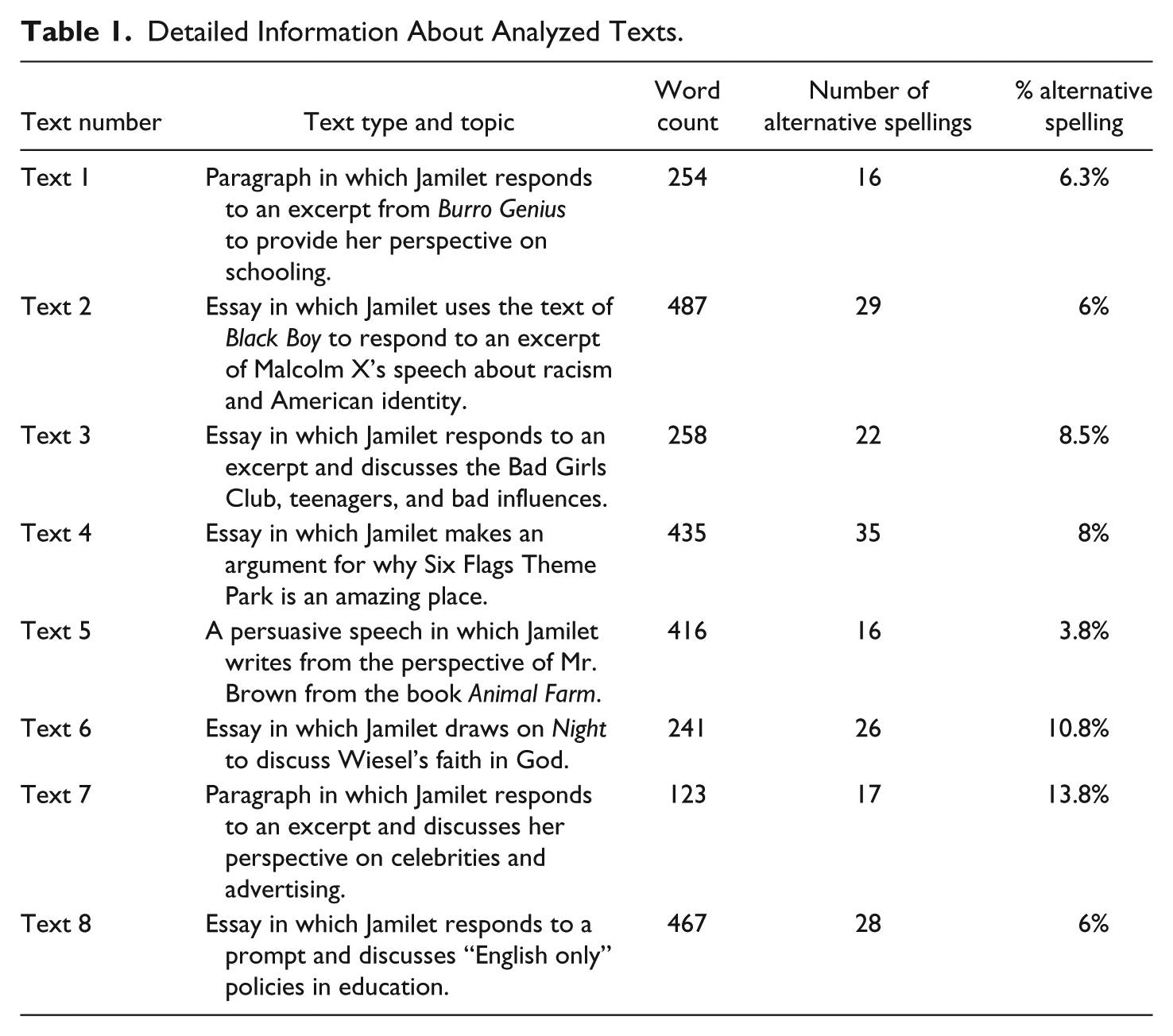
The eight texts written by Jamilet were collected during her ELA class. Each of these texts was composed as the result of a timed, in-class writing assignment. There were two primary reasons that I selected this type of writing task. Since these writing assignments took place in-class, I could be sure that Jamilet completed these assignments independently and without the assistance of a computer’s spell-check feature. Second, on-demand writing tasks were characteristic of the assessments that were used to evaluate Jamilet’s English language proficiency and academic achievement. Table 1 provides a description of the topic and the relevant characteristics of each text.
Detailed Information About Analyzed Texts.
Interviews
Over the course of the year, I conducted five semistructured interviews with Jamilet. The data analyzed in this article are drawn from the transcripts of two of these interviews. The sections of the semistructured interviews on which I focused were those in which we discussed her language, literacy, and educational background. In addition to interviews with Jamilet, I conducted a single semistructured interview with six of her current and former teachers. The section of each individual teacher interview on which this analysis draws was related to that teacher’s perceptions of Jamilet’s linguistic practices and academic performance.
Data Analysis
Documenting Jamilet’s experiences
The first step in my data analysis was to create a profile of Jamilet’s linguistic and schooling experiences. I used five data sources to construct this profile: field notes that described Jamilet’s observable behavior during in-class assignments, official school records (e.g., testing data, home language survey, etc.), a linguistic survey (which I designed), transcripts of interviews with Jamilet, and transcripts of interviews with her teachers. Within each data source, I identified the sections that discussed Jamilet’s specific linguistic practices, conceptualizations of Jamilet as a student and writer, and information about her educational history. Then, I weaved together the identified data segments from these multiple sources in analytic memos (Saldaña, 2013) to create descriptions about each of these specific aspects of Jamilet’s linguistic and literate experiences. This information was necessary to provide the contextualized analysis fundamental to this study’s theoretical framework.
Analyzing Jamilet’s alternative spelling practices
I began this analysis by reading through each of the texts individually and highlighting the words that did not coincide with normative spelling conventions. I turned off the automatic spell-check function and typed each text into Microsoft Word. I represented the way that Jamilet spelled words using all-capital letters (to reflect a general pattern in her handwriting). Then, I printed out each typed text and verified it against the handwritten copy. I used Microsoft Word to highlight the words that were highlighted on the handwritten texts. Finally, I used Microsoft Word’s spell-check feature to provide a secondary review of my initial identifications.
Initial analysis
Once I had identified the alternative spellings evident in Jamilet’s writing, I created eight tables in Microsoft Word and coded the various types of spelling practices using a priori codes from the literature (Androutsopoulos, 2000; Bahr et al., 2015; Bestgen & Granger, 2011; Cook, 1997; Penfield, 1984). After coding all of Jamilet’s texts, like Smagorinsky (2008), I found that “codes need to be developed in a dialectic relation among the data, the theoretical framework, and whatever else a researcher brings to the analytic process” (p. 406). Therefore, I reanalyzed the texts using emergent descriptive codes (Saldaña, 2013). These newer codes reflected the theoretical framework of this article, information from Jamilet’s linguistic and schooling profile, and my academic training in bilingualism, language variation, and literacy studies. The detailed description of this analysis is below.
Final analysis
After I uploaded the typed documents into Dedoose software, I identified 189 instances of alternative spelling. During the next two rounds of coding, I developed and revised emergent descriptive codes that described the nature of Jamilet’s alternative spelling patterns (see Online Appendix A for the final code list; see Online Appendix B for an example of coded text excerpts from Text 5). Then, I recoded the eight texts by applying one of the five following codes to each of the 189 alternative spellings: Oral-Language-Influenced Spelling Code (139 applications), Quasi-Normative Spelling Code (39 applications), Partially Repeated Words Code (6 applications), Incomplete Words Code (3 applications), and Handwriting Code (2 applications). In addition, both Oral-Language-Influenced Spelling Code and Quasi-Normative Spelling Code contained subcodes that will be discussed below. Multiple subcodes could be applied to one coded alternative spelling. The application of two subcodes occurred with eight words.
The Oral-Language-Influenced Spelling Code was applied to the alternative spellings that echoed Jamilet’s oral language. Words in this code represented oral speech using English sound-to-letter conventions. Sound-to-letter conventions refer to the sounds associated with individual letters and letter combinations. Within this code, there are four subcodes. Words to which the Colloquial Spelling 5 subcode was applied reflected oral speech using English sound-to-letter conventions. However, the way in which Jamilet spelled these words was not normatively correct (e.g., writing GOSE instead of goes 6 ). The Homophonic Spelling subcode was applied to a normatively spelled word, which matches the sound of an oral language rendition of the word. However, the written word does not have the appropriate meaning in the context of the sentence (e.g., using BY instead of buy). American Englishes Spelling 7 subcode was used to identify spelling that reflects the grammar of what is considered to be a “nonstandard” variety of English (e.g., possessive -s is not necessary to illustrate belonging in African American English). The final subcode, Distinctive Segmentation Spelling, was used to mark words whose segmentation meant that they did not follow traditional norms (e.g., writing MY SELF instead of myself).
Quasi-Normative Spelling was the overarching code that housed a variety of subcodes that comprised spellings that do not follow English sound-to-letter relationships. Slight variations from the normative spelling that characterized Jamilet’s oral language were coded as oral-language-influenced spelling (e.g., SPEACKING [speaking]). As a result of this choice, quasi-normative spelling was characterized by Jamilet generally using normative spelling patterns. However, due to the insertion of one or more letters, the transposition of letters, the substitution of one letter for another, or the omission of a letter, it did not fall into the normative spelling pattern. In addition, I included a subcode to identify when punctuation contributed to a quasi-normative spelling.
The final three codes were initially unified into one Miscellaneous Spelling Code. After reanalyzing this code, I identified three additional codes: Handwriting, Incomplete Words, and Partially Repeated Words. The Handwriting Code was applied when the way in which Jamilet composed the letters made the word difficult to decipher. The Incomplete Word Code contained instances in which Jamilet did not finish writing the entire word. Finally, the Partially Repeated Words Code occurred in a pair of two words. The first word added on a letter or a word segment that was repeated in the following word. The section entitled “Jamilet’s Alternative Spelling Practices” provides examples of these codes.
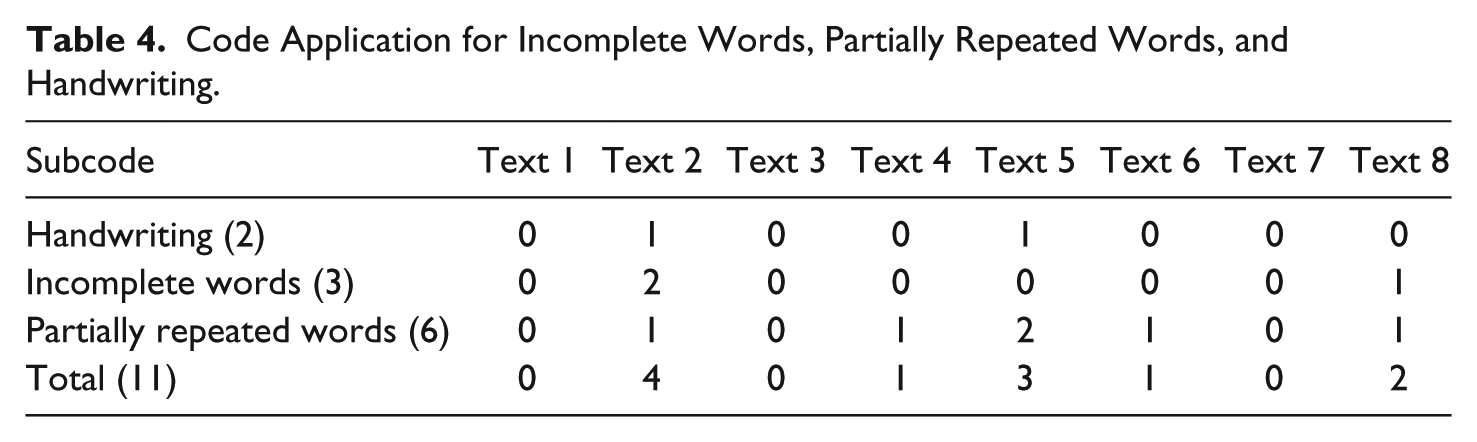
The final round of coding resulted in the analysis presented in Tables 2, 3, and 4. The total number of subcodes applied in Tables 2 and 3 exceeds the number of alternative spellings for each code. This difference reflects the eight alternative spellings that were coded with two subcodes. As I reviewed my final coding, I realized that many of the words that Jamilet wrote may have accurately reflected oral speech but meant something different in their written form. These words with double meanings extended beyond those identified in the Homophonic Spelling Code. Therefore, I created the Multiple Meaning Code to identify these words. There were 50 words with multiple meanings in this data set. The findings from this multilevel analysis are discussed below.
Subcode Application Within Oral-Language-Influenced Spelling Code.
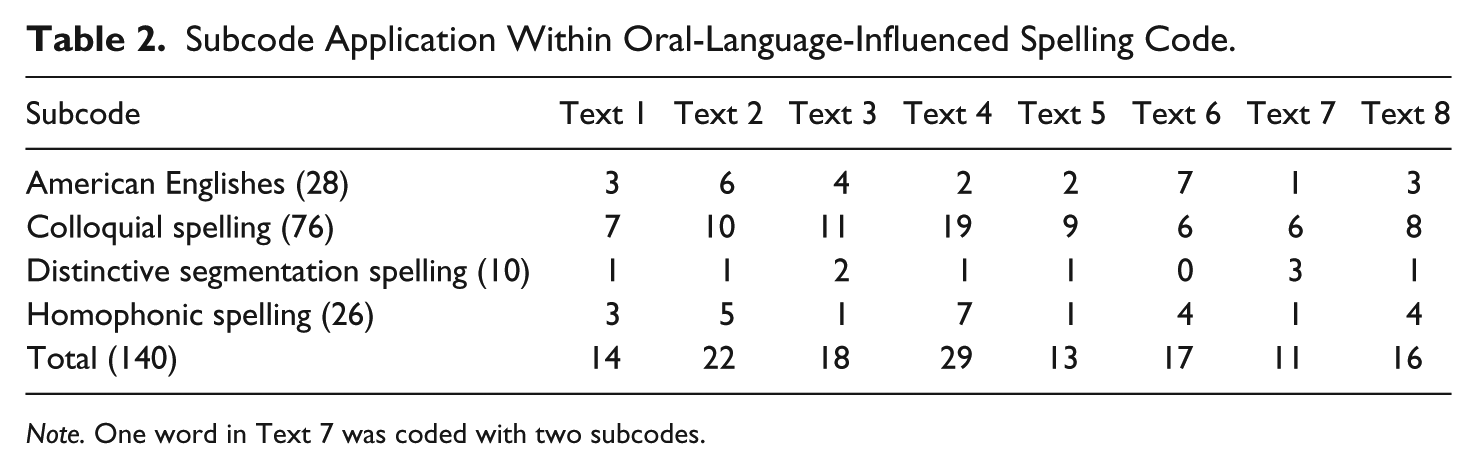
Note. One word in Text 7 was coded with two subcodes.
Subcode Application Within Quasi-Normative Spelling Code.
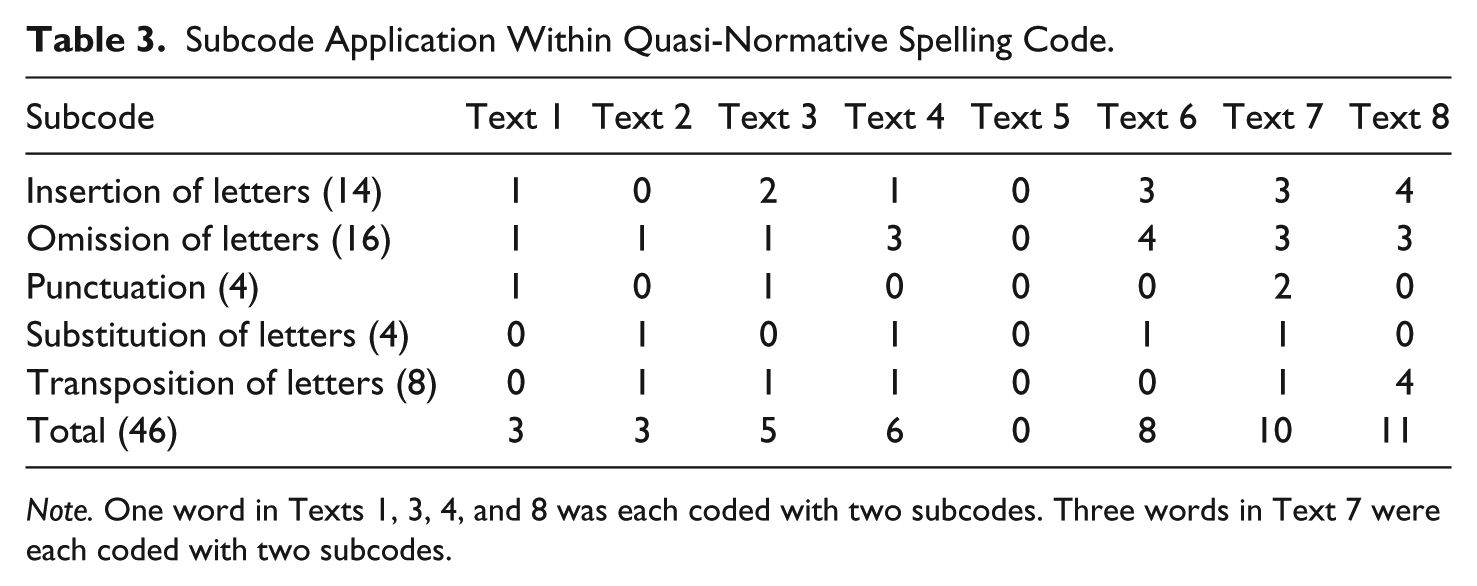
Note. One word in Texts 1, 3, 4, and 8 was each coded with two subcodes. Three words in Text 7 were each coded with two subcodes.
Code Application for Incomplete Words, Partially Repeated Words, and Handwriting.
Findings
Jamilet Lopez: An English-Speaking Bilingual
Jamilet was raised in a household in which both English and Spanish were spoken. Her father was a monolingual Spanish speaker, and her mother was an English-Spanish bilingual who spoke predominantly English to Jamilet. When Jamilet was 10, her mother was incarcerated. Her mother’s incarceration meant that her father, who had become a Spanish speaker with receptive English abilities, became her primary caretaker. At the time of the study, she was living with her father, her brother, her stepmother, and her stepbrother. Since her father had married another English-Spanish bilingual, everyone in the household, except for her stepbrother, who was diagnosed with a developmental disability, understood the English language.
English had been the medium of instruction throughout Jamilet’s educational experiences. Her 10th-grade “Spanish for Native Speakers” course was the first time that she had been formally taught to read and write in a language other than English. However, English was not the only language present in her schools and community. She was raised in a community and attended schools in which multiple varieties of English and Spanish were spoken. Although Jamilet interacted with monolingual Spanish speakers and Spanish–English bilinguals daily, she described herself as relying primarily on English to communicate at home, in school, and with friends.
Whenever Jamilet was given the opportunity to position herself linguistically, she usually identified as an English speaker, but not as an English monolingual. On the high school enrollment paperwork that she filled out on behalf of her father, Jamilet indicated that English was her first language as well as the language that she continues to use most frequently. However, she noted that Spanish was the language that her father spoke to her. Several teachers also recognized the role of English in her life. For example, her Spanish teacher recounted her surprise at the way that Jamilet communicated with her father during a parent–teacher conference. She shared that while she and Jamilet’s father spoke Spanish, Jamilet only spoke in English. Her 10th-grade ELA teacher viewed “Spanglish” as being her primary language. This concerned him because he worried that she did not have “the basic understanding of a language.” In each of these descriptions, Jamilet’s bilingual, but English-dominant, life is recognized. However, her ELA teacher did not assess this type of bilingualism as something positive or helpful for academics.
Jamilet: The “Problem” Student
As Jamilet explained to me in one of our first conversations, “Teachers always know my name.” Her reputation as a troublemaker, which was evidenced by the fact that she had been expelled from three different middle schools in the eighth grade, preceded her everywhere she went. When discussing her middle school experience, Jamilet described an antagonistic relationship with schooling. She was often sent out of the classroom or suspended. Even when she attended school, academic development was not always the central focus of her classes. In Text 1, she describes the pedagogical approach of one of her sixth-grade teachers in the following manner: “THERE WAS A TEACHER THAT WOULD GIVE US A HANDOUT AND HE WOULD GO TO HIS DESK AND SIT THERE AND NOT TEACH US ANYTHING JUST LEAVE US THERE TILL THE BELL RING.” This was not an isolated experience. Jamilet recounted how in one of her middle schools, her ELA class had a cast of rotating substitutes for 3 months. This kind of educational neglect was not the entirety of her experience with schooling. In the same essay from which the previous quotation was taken, she describes a fifth-grade teacher who diligently worked with her to help her become more successful in school. Moreover, Jamilet admitted that she was frequently an unwilling participant in the learning process. For example, when describing eighth grade she explained, “I didn’t pay attention. I didn’t even look at the teachers.”
In high school, Jamilet’s journey through formal education was not smooth. However, high school was a space in which she felt like all of the teachers “actually cared.” Each teacher that I interviewed about Jamilet mentioned her behavior as being something that affected her classroom performance. In the year that I observed her, she was suspended for getting into a fight, she was involved in several verbal altercations with fellow classmates and teachers, and she received lunch detentions. Despite these difficulties, many of her 10th-grade teachers commented on the marked improvement in her behavior. Her history teacher shared with admiration the fact that there had been “no problems at all second semester.”
Jamilet as a writer
When I asked Jamilet how she felt about writing she explained, “Mmmmm . . . I could . . . well, the grammar sucks, but I could like write like pretty long paragraphs. But, it is just the grammar.” When I asked her how she excelled as a writer, she discussed identifying quotations, explaining what they mean, and sharing why they were important. This pattern for writing about literature was a literacy practice that was part of her ELA instruction in ninth and 10th grade. Jamilet’s 10th-grade history teacher described her as a “confident writer.” However, her ELA teacher worried about her “limited” vocabulary and lack of punctuation. He imagined that her combative personality meant that previous teachers had chosen to ignore—rather than educate—her.
Although her ELA teacher was concerned about her writing abilities, Table 1 illustrates that he had no doubts about her ability to think critically. Jamilet was asked to complete assignments that addressed issues such as racism, xenophobia, and propaganda. She completed each of these in-class writing tasks. In fact, she spent much of her time writing during ELA. However, the majority of this writing was not school-focused. She was frequently on the phone texting friends and chatting on Facebook. Sometimes, she would alternate between completing the assignments and texting. At other times, she would attend more to her phone than to the assignment. Then, she would rush to complete her assignment. This behavior was not unique to ELA. Her ninth- and 10th-grade science teachers raised concerns about whether Jamilet’s academic work reflected her ability or her effort. This aspect of Jamilet’s in-class behavior suggests that the following analyzed texts may not reflect the totality of her spelling ability.
Jamilet’s Alternative Spelling Practices
In this section, I move from discussing Jamilet’s schooling and her writing experiences to sharing the results of the analysis of the eight formal in-class writing assignments. The eight texts that Jamilet composed contained 2,681 words; 189, or 7%, of these words diverged from normative conventions. Table 1 provides detailed information about each text that Jamilet composed.
Oral-language-influenced spelling
Approximately 74% (73.5%) of the words that used alternative spelling patterns reflected Jamilet’s use of English sound-to-letter conventions to mirror her speech. The influence of her oral English on her written English was illustrated in four specific ways: colloquial spelling, homophonic spelling, American Englishes spelling, and distinctive segmentation spelling. I draw on Texts 2 and 4 to illustrate how these types of spellings characterized Jamilet’s written work. In these two texts, oral-language-influenced spelling represented 75.9% (Text 2) and 82.9% (Text 4) of the alternative spellings.
Colloquial spellings
Colloquial spelling was the most frequent type of alternative spelling in each text (see Table 2). This type of spelling represented 40.2% of the total alternative spelling. Moreover, it represents 54.7% of total oral-language-influenced spelling. As a result, it was the most used type of spelling within this category. Colloquial spelling was characterized by the reliance on traditional English sound-to-letter conventions. Yet these relationships do not conform to normative spelling expectations. Table 5 illustrates the colloquial spelling in Texts 2 and 4.
Colloquial Spelling From Texts 2 and 4.
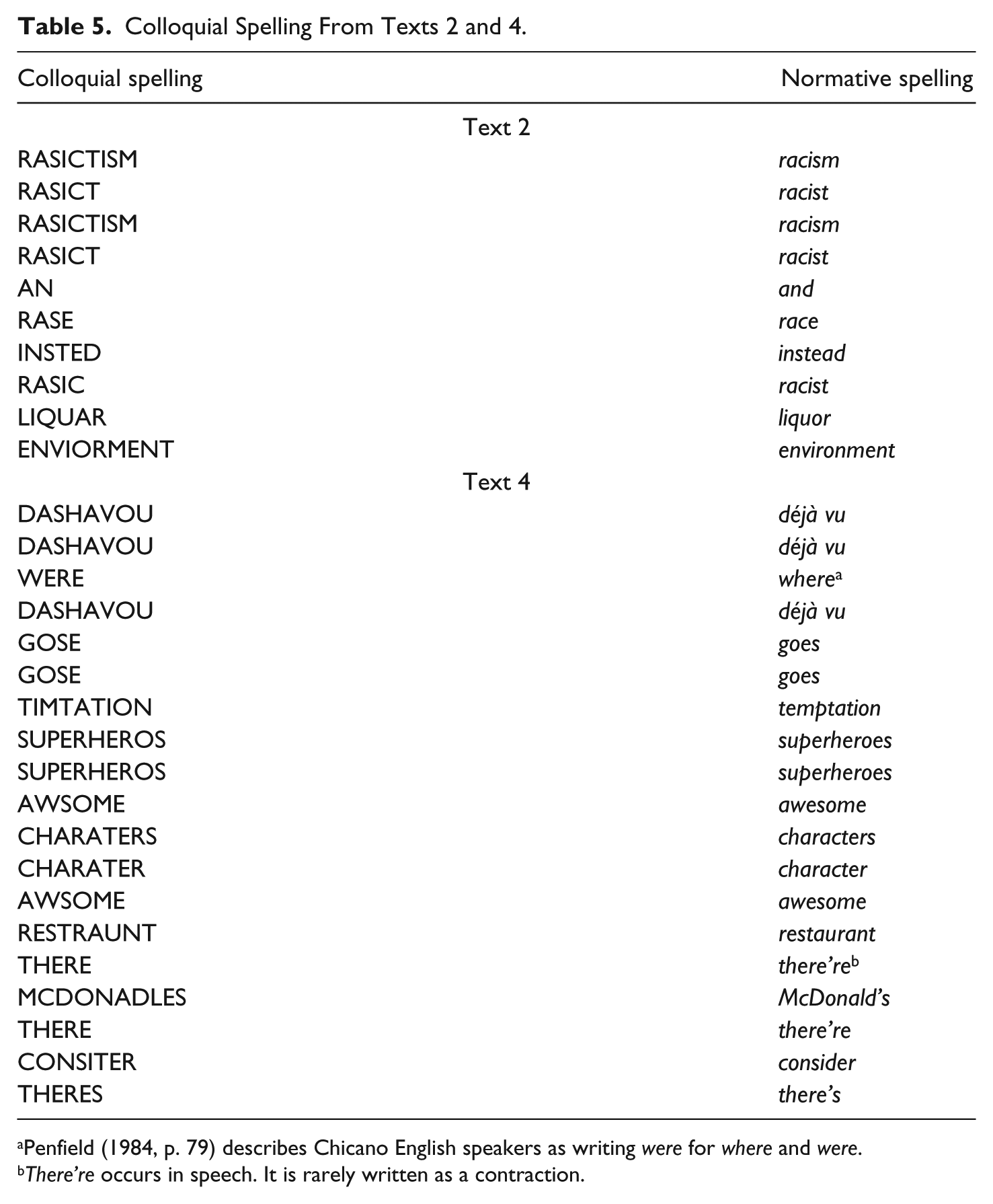
Penfield (1984, p. 79) describes Chicano English speakers as writing were for where and were.
There’re occurs in speech. It is rarely written as a contraction.
Notably, Table 5 illustrates how Jamilet repeats specific alternative spellings of words—for example, DASHAVOU, GOSE, and SUPERHEROS. This repetition reinforces the fact that Jamilet is not randomly throwing letters on the paper. She selected specific letter combinations that reflected the pronunciation of words in English. Moreover, as Table 5 illustrates, her treatment of the words CHARATER and RASICT exemplifies the application of both inflectional and derivational morphemes. For example, she writes RASE (race), RASICT (racist), RASIC (racist), and RASICTISM (racism). Only in one instance, RASIC (racist), does she deviate from applying normative grammatical rules to the alternative spellings of these words.
American Englishes spelling
Spelling that reflected the grammar of different American Englishes represented 14.8% of total alternative spelling and 20.1% of oral-language-influenced spelling. The mere existence of this type of spelling for individuals who are unfamiliar with the linguistic patterns of different Englishes may be interpreted as spelling or grammar errors. In total, there were six instances of spellings that reflected the grammars of different American Englishes in Text 2 and two instances in Text 4. To illustrate what these types of spellings looked like, I provide three examples below. In Text 2, Jamilet’s writing evidenced the absence of the adverbial -ly (e.g., Murray & Simon, 2004). For example, she wrote, “BECAUSE I HAVEN’T BEEN TREATED
Homophonic spelling
Homophonic spelling represented 13.8% of the total alternative spellings and 18.7% of oral-language-influenced spellings. Through this kind of oral-language-influenced spelling, Jamilet replicates the sound of words with conventional English spellings. However, the way she matches particular word formations with sounds does not mirror traditional conventions. Homophonic spelling practices have the potential to cause confusion because the grouping of letters represents a different meaning than is appropriate in the context of the sentence. For instance, in Text 2, Jamilet wrote, “RICHARD’S BOSS DON’T REALLY CARE ABOUT RICHARD OR HARRISON THEY JUST
Distinctive segmentation spelling
Distinctive segmentation spelling was the least common oral-language-influenced spelling type. It represented 5.3% of the total alternative spellings and 7.2% of oral-language-influenced spellings. These ways of spelling reflect common intonations in speech. However, the ways in which Jamilet represented these words differed from the normative spelling. There was one occurrence of this type of spelling in Text 2 and one occurrence in Text 4: HIM SELF rather than himself (Text 2) and NO WHERE rather than nowhere (Text 4).
Quasi-normative spelling
Quasi-normative spelling generally reflects normative spelling patterns. Yet, the way in which Jamilet wrote the word includes a variation that prevents it from following English sound-to-letter relationships and normative spelling conventions. This type of spelling represented 20.6% of all documented alternative spellings. To illustrate quasi-normative spelling, I focus on Texts 7 and 8. Quasi-normative spelling represents 41.2% and 35.7% of the alternative spellings found in these texts, respectively. These two texts present a wide range of examples of different kinds of quasi-normative spelling practices.
Table 3 illustrates that the most frequent types of quasi-normative spellings involved the insertion or omission of letter(s). Looking specifically at Texts 7 and 8, there were a total of seven instances of insertion-related alternative spellings. Five of these letter insertions involved only a single letter. For example, in Text 7 Jamilet wrote the word arguing as ARGURING. In Text 8, she wrote the word convince as CONVIENCE. An example of an alternative spelling in Text 8 that involved the insertion of two letters was APPLILY (apply). Jamilet included an extra “L” and an extra “I.” There were six instances in which letters were omitted from words across Texts 7 and 8. For instance in Text 8, Jamilet wrote OFFICAL (official) and ENLISH (English). The remaining four instances of omission co-occurred with other quasi-normative spelling practices. For example, in addition to inserting an extra “o” into the word boycotting, Jamilet did not incorporate a “t.” She wrote: BOYCOOTING (Text 7).
Less frequent types of quasi-normative spelling included the transposition of letters, the substitution of a letter, and punctuation-related alternative spellings. In Texts 7 and 8, there were five instances of transposition. All except for one of these instances involved switching two adjacent letters. For example, Jamilet wrote MEIDA (media, Text 7) and BILIGNUAL (bilingual, Text 8). Among the two texts, there was only one instance of substitution. This occurred in Text 7, where Jamilet wrote PROTECTING instead of protesting. The apostrophe was the only punctuation involved in punctuation-related quasi-normative alternative spellings. This occurred only twice in Text 7, but was not evident in Text 8. The only time that punctuation-related alternative spellings were considered quasi-normative is when they were found in a word that did not mirror Jamilet’s oral language. As a result, punctuation-related quasi-normative spellings were always coded with another type of quasi-normative code (see the “Multiple Meanings” subheading below for an example).
Handwriting
Jamilet typically wrote in rather legible all-capital letters. When she wrote quickly, her letters began to run together; therefore, it often became difficult for me to decipher specific words. There were certain words that I thought were evidence of alternative spelling, but I later realized that they were my misinterpretations of her handwriting. There were two instances (1.1% of total alternative spellings) in which I was not able to determine the way in which a particular word was spelled. Based on the shape of the letters and the context, the meanings of the words were evident. An illustration of this type of confusion caused by handwriting occurred because Jamilet sometimes wrote “L” and “I” with the same long vertical stroke. Without asking Jamilet, it is not possible to know whether she represented the word field in Text 5 as FELLD, FEILD, FEIID, or FELID.
Incomplete and partially repeated words
There were three instances of incomplete words (1.6% of total alternative spellings) and six instances of partially repeated words (3.2% of total alternative spellings) across all analyzed texts. I marked words as being “incomplete” because they were not similar to any of the other alternative spelling patterns. It appeared as if she had just stopped in the midst of writing a word or statement. In Text 2, Jamilet writes, “THEY JUST WONT
Multiple meanings
Approximately 26.5% of words that Jamilet wrote using alternative spelling had meanings other than the one that is expected in the context. These instances were not merely limited to the 26 identified homophonic spellings, but included 24 words that were coded in other ways. A line from Text 1 underscores how these particular alternative spellings could impact meaning. Jamilet wrote, “
Discussion
In this case study, I examined the patterns of alternative English spellings that Jamilet Lopez used while composing eight in-class texts for her ELA class. The codes used to analyze her writing were informed by the theoretical framework and her linguistic and schooling experiences. The findings add to the limited existing research that documents the use of alternative English language spelling among students who are considered to be LTELs (e.g., Freeman et al., 2002; Jacobs, 2008; Kim & García, 2014 L. Olsen & Jaramillo, 1999).
Approximately 74% (73.5%) of Jamilet’s alternative spelling practices revealed the influence of oral English on her written English. Jamilet drew on normative English sound-to-letter conventions to create an echo of speech patterns that were present in her home, school, and community environments. When her alternative spelling did not reflect the sounds or grammars of these Englishes, they typically illustrated her familiarity with the normative spelling of particular words. Yet, the practices that characterized her spelling meant that they strayed from normative conventions. Many of these spelling practices that were not reflective of her oral English appeared to be the result of hasty writing (e.g., transposition of letters, handwriting, omission of letters, etc.). Because English spelling was used in making determinations about Jamilet’s English proficiency, it is important to acknowledge that the identified alternative spelling practices are also found in the writing of monolingual English speakers (e.g., Ball, 1999; Coleman, 1997; Cook, 1997; Greenberg, Ehri, & Perin, 2002; Perryman-Clark, 2013). Her spelling was not unique to someone who is in the process of learning English.
Before discussing the implications of this research, I want to contextualize these findings within Jamilet’s linguistic and schooling experiences. Jamilet was a simultaneous bilingual for whom English and Spanish had always been a part of life. She lived and went to school in a community where multiple Englishes and Spanishes were spoken. The predominance of oral-language-influenced spelling in this analysis provides a window into the way she and those around her spoke English. Moreover, her alternative English spelling underscores her knowledge of linguistic features associated with African American English, Chicano English, and other American Englishes. In this way, her alternative spelling actually signifies the depth and extent of her English language knowledge, not a deficiency. Narrow interpretations of Jamilet’s spelling as solely “error” and evidence of “limited English proficiency” attempt to erase her English abilities.
Jamilet’s writing across all of the identified categories of spelling illustrate that she relied on her knowledge of the English writing system to construct words. She did not rely on sound-to-letter relationships that are found solely in Spanish. This practice reflects her educational history. Jamilet’s first formal literacy instruction and almost all of her schooled literacy instruction was in English. Furthermore, the grasp of the normative spelling conventions evidenced through her alternative spelling practices (e.g., distinct segmentation spelling, homophonic spelling, etc.) reflects another aspect of her educational history. From kindergarten through eighth grade, Jamilet had attended schools that were overcrowded and underresourced. While she did have committed teachers, some of her classes were taught by multiple substitutes or a full-time teacher who did not teach. Moreover, her encounters with the school discipline system meant that she spent a lot of time in middle school outside of the classroom. As her 10th-grade ELA teacher noted, her combative personality meant that some would choose to ignore rather than educate her. As a result, the majority of her educational experiences had been in environments that did not provide her with an opportunity to learn particular academic practices (e.g., spelling). Nonetheless, I want to reiterate the concerns of her ninth- and 10th-grade science teachers. They were unsure whether what they saw of Jamilet’s work was a reflection of her ability or her effort. In my observations of her in ELA, I noted that she was frequently on her phone texting or on Facebook. Therefore, it is possible that she could spell in ways that were not demonstrated on these timed in-class writing tasks.
Implications for the Broader Educational Community
Although this particular analysis focused on a student who was considered to be a LTEL, these findings have important implications for all bilingual high school students. This research calls attention to the fact that researchers, test developers, practitioners, and policy makers need to account for the education of bilingual students whose linguistic development follows a different trajectory from the one that appears on test blueprints, English language development standards, and other types of educationally significant documents. Importantly, this research emphasizes that having a different developmental trajectory does not necessarily coincide with a lack of English proficiency. These findings suggest that individuals involved in the education of bilingual students should be careful about what they assume can be determined about a student’s linguistic and literate abilities merely because they diverge from accepted norms. This study directly delves into the significance of this caveat for stakeholders influencing the educational trajectory of students who are labeled LTELs, like Jamilet. The tyranny of a focus on English proficiency means that other information that language and literacy practices can indicate about a student is overlooked.
For schools to effectively serve students like Jamilet, those involved in the education of bilingual young people need to draw on ways of thinking that are not mainstream in language and literacy education. This perspective requires that they become familiar with ideas about bilingualism and bilingual learners that refute idealized conceptions of bilingualism and monolingualism. For instance, it is necessary for them to consider how raciolinguistic ideologies (Flores & Rosa, 2015) affect different types of bilingual high school students’ experiences of the curricularization of English (Kibler & Valdés, 2016; Valdés, 2015). These types of perspectives on language and schooling can offer new ways of engaging with students who are often misunderstood and overlooked. As this research demonstrates, they provide a lens to see the strengths in young people who are so often characterized by purported deficits.
Implications for High School Literacy Teacher Education
As a teacher educator, I want to take a moment to discuss how one might integrate the previously described ideas into literacy teacher education within a policy and social context that marginalizes these perspectives. First, it is important to situate these courses in a multifaceted conception of adolescent literacy instruction (Alvermann, 2002). Next, it is necessary to problematize the literacy abilities that are frequently attributed to high school students who are labeled native speakers or monolinguals. The literacy-as-a-social-practice perspective (Street, 1984) provides an excellent framework to begin to question these assumptions. Moreover, using texts that specifically talk about linguistic diversity among monolinguals and its implications for literacy instruction is fundamental to breaking down myths about this population (e.g., Charity Hudley & Mallinson, 2011; Valdés, Bunch, Snow, Lee, & Matos, 2005). Similarly, it is vital to explicitly discuss research that addresses the ideological nature of the native speaker identification and how race/ethnicity and nationality are integral to determining who receives this status (e.g., Brutt-Griffler & Samimy, 2001; Faez, 2012). These theoretical perspectives can be integrated with examples of actual student work that illustrate the diversity of literate practices among monolingual individuals.
Furthermore, literacy teacher education courses should provide every teacher with the opportunity to become knowledgeable about the actual writing practices of bilingual students. Lewis and Zisselsberger’s (2016) research with secondary ELA preservice teachers documents how engaging preservice teachers with the writing of bilingual students and instruction about theories of holistic bilingualism can begin to shift thinking about the nature of bilingual student writing. The preservice teachers in their study struggled to reconcile seemingly conflicting viewpoints about being a “good” ELA teacher with what they learned in class about bilingualism. Nevertheless, the discussion among the preservice teachers illustrated the potential of this type of classroom practice for helping teachers to see the strength in the writing of bilingual students. This type of instruction is a necessary first step to ensure that educators are familiar with writing practices of students like Jamilet.
Conclusion
Jamilet’s oral language was very much intertwined with the way in which she spelled. Still, her spelling—as was the case with her linguistic identity—was often misunderstood because her voice was not one that others were prepared to hear. That is, she did not fit neatly into the idealized categories of English learner or English monolingual. This analysis of Jamilet’s spelling illustrates what researchers, teachers, test developers, and policy makers miss when they fail to use frames of analysis that are able to recognize the complexity of young people.
Footnotes
Acknowledgements
The author thanks Eurydice B. Bauer, Sara P. Alvarez, Maritza Lozano, Carlos G. Anguiano, and the anonymous reviewers for their feedback on earlier versions of this article. Any opinions, findings, and conclusions or recommendations expressed in this article are those of the author and do not necessarily reflect the views of the individuals who are acknowledged above.
Declaration of Conflicting Interests
The author(s) declared no potential conflicts of interest with respect to the research, authorship, and/or publication of this article.
Funding
The author received financial support for the research, authorship, and/or publication of this article: Funding for data collection was from the National Council of Teachers of English Research Foundation’s Cultivating New Voices among Scholars of Color Fellowship and Stanford University’s Diversity Dissertation Research Opportunity Grant.
Supplemental Material

Notes
Author Biography
References
Supplementary Material
Please find the following supplemental material available below.
For Open Access articles published under a Creative Commons License, all supplemental material carries the same license as the article it is associated with.
For non-Open Access articles published, all supplemental material carries a non-exclusive license, and permission requests for re-use of supplemental material or any part of supplemental material shall be sent directly to the copyright owner as specified in the copyright notice associated with the article.
