



Abstract
This study explores the possibilities and tensions that emerged when a literacy specialist brought a culturally sustaining lens to her work in a reading intervention setting with five emergent bilinguals. Utilizing a case study methodology, the study draws on data from class transcripts, interviews, student writing and artwork, and fieldnotes collected over 2 years. During data analysis, three themes, “get proximate,” “get connected,” and “get moving,” were constructed. Findings illustrate the complex relationship between practices designed to bring students’ linguistic and cultural resources into the classroom (“get proximate” and “get connected”) within a context designed to facilitate measurable growth in students’ reading skills ("get moving"). Findings contain seeds for further exploration related to engaging students’ languages and lived experiences to build foundational skills. The study suggests that more cohesive incorporation of culturally sustaining practices would require a (re)consideration of monolingualism and narrow definitions of literacy within interventions and assessments.
Keywords
Recent studies provide vibrant portraits of multilingual students drawing upon multiple languages and transnational literacies within communities (Ghiso, 2016), writer's workshop (Bauer et al., 2017), and dialogic book discussions (Aukerman et al., 2017). Building on students’ linguistic and cultural resources can lead to enhanced literacy learning (Keehne et al., 2018); however, within intervention contexts aimed at identifying and filling gaps in foundational literacy skills, these resources are often overlooked (Ascenzi-Moreno & Quiñones, 2020; Orosco & Klingner, 2010). Although grounded in aims to provide equitable learning opportunities for all students, many response to intervention (RTI) and multitiered system of support models promote the use of universal screenings, standard treatment protocols, and curricula that are not attuned to the assets of diverse multilingual learners (Moore & Klingner, 2014).
Calls for intervention models to become more responsive to students from culturally and linguistically diverse backgrounds are not new (e.g., García & Ortiz, 2008; Klingner & Edwards, 2006); however, they take on a renewed urgency in light of the continuing reproduction of inequalities in reading intervention (Willis, 2019). These calls have added dimensionality as the broader educational community reckons with how to embrace multilingualism as a resource instead of as a deficit (García & Kleyn, 2016) and as the literacy field grapples with how many students do not see themselves reflected in the texts read and revered in schools (Thomas & Stornaiuolo, 2016). With this backdrop, the purpose of this exploratory study is to consider how Lauren (all teacher and student names are pseudonyms), a literacy specialist, endeavored to create a reading intervention context more attuned to the linguistic and cultural resources of emergent bilinguals and their families. I analyze Lauren's efforts to incorporate diverse picturebooks into her teaching more prominently and to engage with families more intentionally within an intervention context in which she was also expected to produce tangible growth in students’ foundational reading skills. I frame the study with the lens of culturally sustaining pedagogy (CSP; Paris & Alim, 2014). CSP highlights the need not only to foster but also to sustain “linguistic, literate, and cultural pluralism as part of schooling for positive social transformation” (Paris & Alim, 2017, p. 1). I ask the following research questions: How did a culturally sustaining lens shape Lauren's teaching within a reading intervention class? How did Lauren navigate existing practices and embedded expectations of reading intervention to enact a culturally sustaining approach?
Although a growing body of literature documents how CSP has been taken up in classrooms and communities (e.g., Nash et al., 2021; Paris & Alim, 2017), we know less about CSP within intervention settings. With CSP as a framework, this exploratory study addresses a long-standing problem that emergent bilinguals are commonly viewed through monolingual and monocultural lenses (Hopewell & Escamilla, 2014; Noguerón-Liu, 2020) and responds to the need for descriptive studies that explore how school culture, teacher practice, and student differences shape teaching and learning within intervention (Artiles, 2015; Orosco & Klingner, 2010). Following García (2009), I use the term “emergent bilingual” to refer to students who speak multiple languages. By emphasizing potential rather than limitation, this term recognizes students’ and families’ languages as strengths. At the time of the study, the school used the term “English as New Language Learner” (ENL).
Theoretical Framework
CSP illuminates enduring educational inequities while also providing a more expansive and liberatory vision of schooling for students from nondominant backgrounds (Paris & Alim, 2017). With its emphasis on pluralism, CSP calls for a fundamental reenvisioning of pedagogical and assessment practices that uphold white middle-class monolingual norms to the exclusion of others and calls for educators to resist policies and practices meant to keep those norms in place. In offering a “loving critique” of culturally relevant pedagogy (CRP), Paris and Alim (2014) embraced and built upon CRP's core principles of fostering students’ cultural competence, developing sociopolitical consciousness, and supporting academic success (Ladson-Billings, 2014). By replacing “relevant” with “sustaining,” however, CSP asks educators to recast the entirety of their practice and its ultimate purpose. First, rather than offering an isolated lesson or holding a single cultural celebration (as in some common but misguided interpretations of CRP), CSP encourages educators to leverage students’ linguistic, cultural, and community resources across the entire curriculum. Second, CSP replaces static understandings of culture with a focus on the shifting, hybrid, and dynamic expressions of culture, including youth cultures, as lived and produced across geographies, time, and language. Third, CSP encourages educators to draw on students’ multiple community, familial, and linguistic resources to sustain heritage languages and practices as valuable in their own right, not as metaphorical bridges to meeting monolingual and monocultural standards of academic achievement. Finally, CSP is situated within larger struggles for social justice. Paris (2021) conceptualized CSP as “resistance work” (p. xvi) that decenters whiteness and interrogates forms of oppression rooted in patriarchal, capitalist, monolingual, ableist, and heteronormative ideologies.
Given its focus on sustaining heritage practices often passed down through intergenerational literacies and languages and its focus on embracing emergent youth cultures as instructional resources, CSP offers many possibilities to literacy educators. In the present study, bringing a culturally sustaining lens to the reading intervention setting inspired practices and framed inquiries related to (a) incorporating texts across the curriculum reflective of linguistic and cultural diversity; (b) engaging in inquiries arising from students’ cultural worlds and critical questions; (c) offering ongoing invitations for multilingual, intergenerational storytelling; and (d) creating embedded opportunities for multiple languages, literacies, and heritage practices to travel fluidly across home and school contexts.
Literature Review
CSP Within Literacy Classrooms
Extant literature shows that educators enact teaching practices sustaining of cultural pluralism by embracing the multiplicities of language and centering familial, student, and community knowledge toward social justice ends. CSP educators make explicit choices to value linguistic diversity and to draw on the linguistic resources of students and families by creating opportunities for students to notice and contrast different languages, welcoming hybridized language practices, and encouraging children to draw from their entire linguistic repertoires to compose multimodal texts (Machado, 2017). By embedding translanguaging across learning environments and engaging in multilingual literacy practices with families, Nash et al. (2021) illustrated how CSP can shape teaching in pre-K settings. Language was also central to Zapata and Laman (2016), who asked, “How are we building metalinguistic awareness of the languages sustaining our community? Where in our curriculum and instruction are we intentionally teaching translingual approaches to students?” (p. 376).
In addition to welcoming and protecting multiple languages within and across learning environments, a growing number of studies framed by CSP document efforts to center the knowledge of communities, students, and families to cultivate critical inquiries (Jaffe-Walter & Lee, 2018). Wynter-Hoyte et al. (2019) invited students to share lived experiences with immigration and family separation during interactive picturebook read-alouds, whereas Kganetso (2016) conducted surveys with families, performed neighborhood walks, and took pictures of community sites to develop her own culturally sustaining informational texts for students. In addition to this inclusion of a broader range of texts reflective of experiential and familial knowledge, CSP also welcomes popular culture as a text and as a site of inquiry. Love (2015) considered how grounding early childhood education in the linguistic creativity and cultural hybridity of hip-hop fosters and sustains young children's “complex language-shifting abilities, kinesthetic brilliance, … and critical thinking skills” (p. 126). Similarly revealing of this verbal dexterity and of participation in a multilingual globalized world, the adolescents in the study by Jones and Curwood(2020) leveraged multiple languages and literacies through spoken-word performances that critiqued social injustices.
These studies suggest that CSP helps students maintain their languages, showcase their transnational literacies, and engage in justice-oriented literacy practices; however, many studies also reveal barriers to CSP resulting from English-dominant policies (Wynter-Hoyte et al., 2019), high-stakes testing (Zoch, 2017), and resistance to pedagogies that challenge dominant ideologies (Woodard et al., 2017). While educators faced these challenges in traditional classroom settings, the languages, literacies, and heritage practices of students from diverse cultural and linguistic backgrounds are often even more marginalized within intervention contexts, suggesting that bringing a culturally sustaining lens to reading intervention may be both more vital and more difficult, as I explore next.
Culturally and Linguistically Diverse Learners in Reading Intervention Settings
When RTI models began to take hold in literacy research and practice, Klingner and Edwards (2006) sounded a prescient cautionary note that race, culture, and language were not being sufficiently addressed within the studies informing the interventions. These omissions persist (Moore & Klingner, 2014) and contribute to “substantial equity consequences” (Artiles, 2015, p. 5) for children of diverse cultural and linguistic backgrounds. Within intervention contexts, the language assets of emergent bilinguals are often not reflected in instructional materials and pedagogical practices (Ascenzi-Moreno & Quiñones, 2020). Core reading programs designed to accelerate reading achievement rarely include children's literature featuring diverse characters, languages, and settings (Wu & Coady, 2010). In a critical content analysis of 20 books within the Fountas and Pinnell Leveled Literacy intervention system, Thomas and Dyches (2019) found that characters of color are routinely “demeaned and relegated to the margins” (p. 12). Furthermore, teachers within intervention settings often carry deficit views of emergent bilinguals and their families (Kim & Viesca, 2016; Orosco & Klingner, 2010) and report feeling unprepared to teach them (López & Mendoza, 2013).
Although limited in number, descriptive studies have explored reading intervention instructional contexts with explicit twin goals of drawing on the linguistic and cultural resources of emergent bilinguals and building foundational literacy skills. In the design-based research by Cavallaro and Sembiante (2020) with middle school emergent bilinguals in an intensive reading support class, students engaged in translanguaging practices and built metalinguistic awareness through the genre of personal narrative. Within guided reading, Ascenzi-Moreno and Quiñones (2020) illustrated multiple approaches to drawing on the linguistic repertoires of emergent bilinguals to work on decoding, comprehension, and vocabulary. Ascenzi-Moreno’s (2018) research showcased how teachers made adaptations to informal and mandated assessments to allow emergent bilinguals to draw on their full linguistic repertoires and then tailored future instruction based on the assessment modifications.
Method
This exploratory case study (Dyson & Genishi, 2005) took place in a public urban elementary school in a midsize city in the Northeast with five emergent bilinguals in a reading intervention setting and their teacher, Lauren. Within the school, 26% of the students were classified as “ENLs” and 78% qualified for free lunch. Lauren's school was part of a district that had adopted an RTI framework that involved processes for ensuring high-quality teaching within the general classroom setting, assessing students’ literacy capabilities at regular intervals, and providing targeted instructional supports at various tiers to assist students in meeting benchmarks. Of particular pertinence to this study is that the first two named core components of the district's RTI process were also the ones that Lauren prioritized and that were often in tension: (a) provide support in five foundational skills of reading (phonemic awareness, phonics, vocabulary development, fluency, and comprehension) and (b) provide ENLs “appropriate instruction,” which was defined as “linguistically and culturally responsive (i.e., consider and build upon a student's cultural background and experiences, as well as their linguistic proficiency).” At the time of the study, Lauren was responsible for administering three literacy assessments at regular intervals: AIMSweb, Fountas and Pinnell, and NWEA-MAP.
This case study considers the bounded system of Lauren's reading intervention classroom. Through multiple data sources and through extended time in the setting, case study is well suited for this study because it aims to capture the complexity of experience from the point of view of participants (Dyson & Genishi, 2005). This study is also situated within the tradition of collaborative inquiry conducted by and with teachers in partnership with university researchers. These partnerships are often pursued in the service of creating more equitable educational spaces, while also endeavoring to produce knowledge beneficial to the wider educational field (Campano et al., 2013). At the time of the study, anti-immigration rhetoric in the country was elevated, and Lauren's school was welcoming increasing numbers of students whose families were leaving countries experiencing political and economic unrest. The study was designed as a collaborative inquiry into the creation of a reading intervention context more responsive to emergent bilinguals and their families and as a case study of what occurred.
Lauren, a teacher with whom I had an existing research relationship dating back 5 years prior to the start of this study, is an experienced educator with advanced degrees in literacy. In her work as a literacy specialist, she draws from a broad knowledge of reading development gleaned from coursework, ongoing professional learning, and experience in the classroom. With a firm belief that all children should have opportunities to read real books and participate in authentic literacy practices (Allington, 2013), she also embraces instructional practices that explicitly target foundational skills within the context and in the service of meaning-making (Bear et al., 2019). Across her two decades in the education field, she has taken her own initiative to seek professional learning within reading intervention, diverse children's books, and equity.
The five students who came to Lauren three or four times a week for 30 minutes of reading instruction spoke home languages of Karen, Arabic, Spanish, and Black Language, a rule-based linguistic system “connected to Black people's ways of knowing, interpreting, resisting, and surviving in the world” (Baker-Bell, 2020, p. 9). When the study began, all five students were in the first grade and had scored below grade-level expectations in reading as determined by formal and informal assessment measures. Four of the five families in the study included members who were recent immigrants to the United States.
The Pedagogy and Practices of the Names, Dreams, and Journeys Project
The study took place over 2 years in four phases (see Table 1). During planning sessions in Phase 1, Lauren and I read and discussed a range of articles on CSP (Paris & Alim, 2014), diverse books (Thomas, 2016), and engagement with multilingual families (Rowe & Fain, 2013), as well as a selection of picturebooks featuring representations of multiple languages and diverse families. Lauren's reading intervention class was embedded in a broader school and district context that maintained fixed expectations related to curriculum, assessments, and student achievement, but also afforded flexibility in instructional choices. As a result, we concentrated on cultivating two central practices to bring into the setting: interactive read-alouds of diverse picturebooks accompanied by narrative writing invitations and family engagement efforts that included family gatherings in the school library and sending home tote bags with books and a journal. These practices were not designed to replace direct, explicit, and systematic instruction in foundational skills, which Lauren intended to continue pursuing in other aspects of her teaching, nor did we design the read-alouds and family engagement efforts to serve as conduits for teaching those skills directly. Instead, the engagements with picturebooks and with families were designed to bring another dimension to Lauren's understanding of and support for her students across a range of their literate, cultural, and linguistic identities.
Timeline.
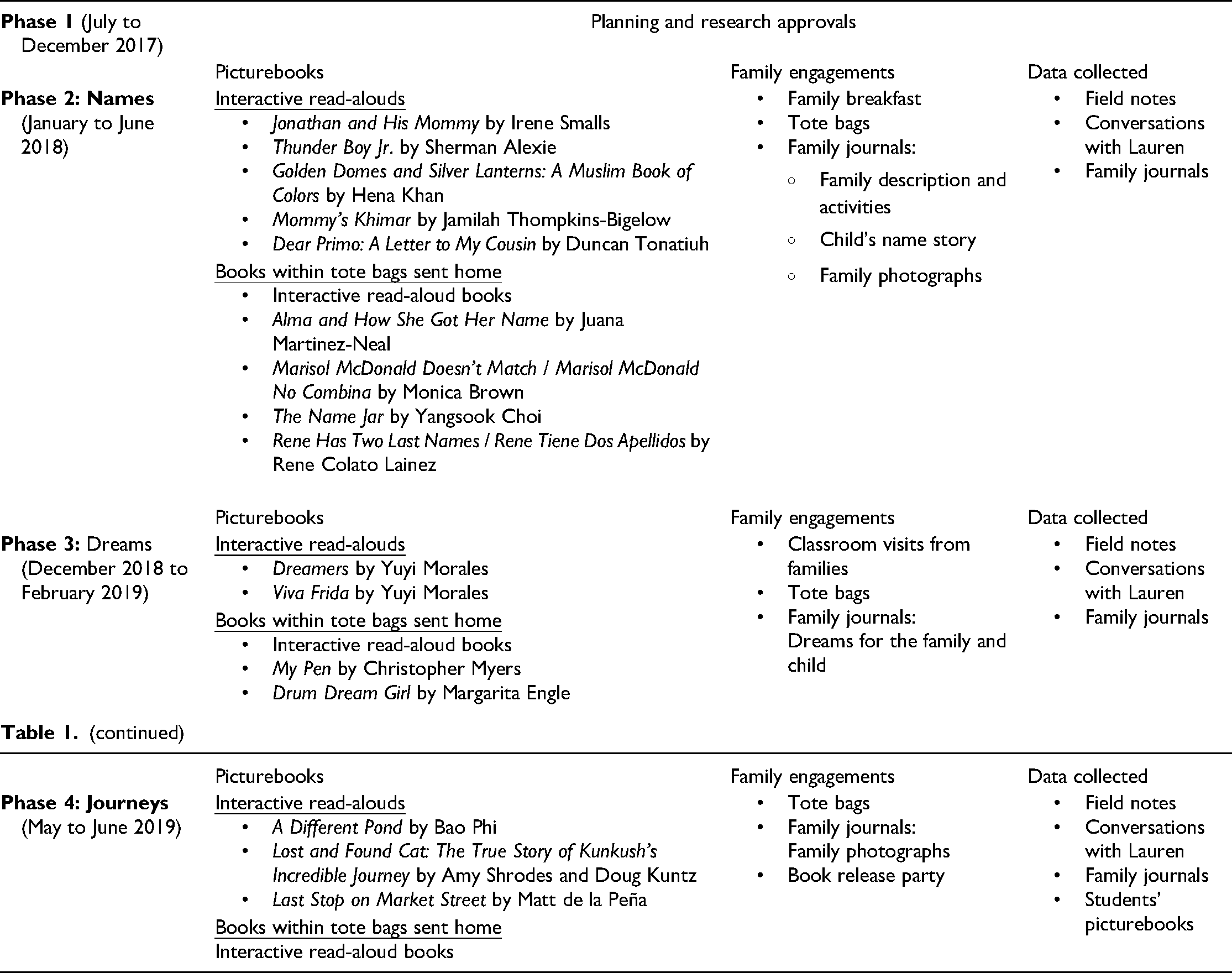
After concluding our planning process and securing research approvals in Phase 1, Phase 2 kicked off with a family breakfast in the school library, where the five children in the reading class plus their grandparents, parents, younger siblings, and translators gathered for introductions to the project and to many of the books that would be shared during the study. Across Phases 2 through 4, classroom and family engagement efforts were framed by inquiries into names, dreams, and journeys through interactive read-alouds and by sending home tote bags that included the books the children were reading in class and additional thematically related books. The tote bags also included a camera, markers, crayons, and a journal for the families to write, draw, or paste in pictures in response to open-ended prompts (e.g., What's important to your family?) and more specific inquiries (e.g., the child's name story). Where possible, materials sent home in the tote bags were translated into each family's home language. All families participated in receiving the tote bags a minimum of three times, and all families contributed to the journal. The purpose was to connect and enrich the in-school work by inviting families to read culturally sustaining texts together and to create texts reflective of their experiences and languages. Phase 4 culminated in a “book release party” where the children, families, teachers, and administrators gathered in the school library to celebrate the children's creation of their own picturebooks.
Although Lauren and I developed a variety of curricular goals and sequencing for a 1-year collaborative inquiry, this work did not proceed in a continuous manner as Lauren navigated increased assessment demands and changes to her schedule. As a result, our work became more episodic and took place over 2 years, with the four main phases each lasting between 2 and 6 months with gaps of time in between. I revisit these gaps later in the article as they were revealing of the particular challenges of bringing a culturally sustaining lens to the setting.
Practitioner and Researcher Roles
To varying degrees, Lauren and I both took on roles as researchers and as teachers throughout the study. By “studying side by side” (Erickson, 2006), we constructed knowledge within the immediate context of moment-by-moment instructional decisions as well as during reflections directly afterward on what we were noticing and what pedagogical shifts might be considered next. In the classroom, I was primarily a participant observer who audio recorded and took notes, but I also shared books during read-alouds, offered contributions to group discussions, and read with students one-on-one. Although I served as a sounding board for Lauren and as a resource related to diverse picturebooks, interactive read-alouds, and multimodal response, she took primary responsibility for the teaching, day-to-day planning, and family outreach. While I took on the share of data collection, analysis, and writing, Lauren also kept detailed notes and reflections. Both Lauren and I are white, middle class, and monolingual. These identities presented limitations to our pedagogical and research practice as we experienced difficulties in communicating with the multilingual participants and lacked the embodied understanding of their cultural and linguistic experiences.
Data Sources
I was a participant observer in 44 reading group sessions, each averaging 30 minutes. I attended classes at Lauren's invitation that she identified would be most reflective of the study's goals (i.e., sessions that featured interactive read-alouds of diverse books, discussions of the family journals, and the creation of the students’ own picturebooks). For each session, I wrote observational field notes and audio-recorded and transcribed classroom talk. When Lauren's schedule allowed, we spoke after class, resulting in 32 transcribed conversations, ranging from 3 to 30 minutes. Additional data sources included copies of student writing and family journals, field notes from family engagement events, and field notes from planning sessions.
Data Analysis
Data were analyzed continually throughout the study through memoing and coding. I started with first-level descriptive coding (Saldaña, 2016) to identify topics across the entire data set. Codes captured the nature of students’ responses to the read-alouds, the features of Lauren's pedagogy, and the contours of family engagement efforts. From this inductive coding, I then moved to deductive coding with concepts from my theoretical framework of CSP. I coded for instances where multiple languages were invoked and where family and community resources and narratives were intentionally invited in or spontaneously shared. I also coded for articulations of opportunities and tensions involved in teaching from a culturally sustaining lens.
Over multiple rounds, I continuously refined and collapsed the codes. I then grouped the codes into categories or “families” (Saldaña, 2016) and shared them with Lauren (see Table 2). In response to the first two categories, “children and families becoming the curriculum” and “embracing children's multidimensional literacy identities,” Lauren described how she would often remind herself to “get proximate” when making instructional decisions. She heard this phrase from Bryan Stevenson, a public interest lawyer and the executive director of the Equal Justice Initiative. He used it to describe how becoming closer to the experiences of marginalized people is key to social transformations of any kind. Drawing on Lauren's explication of this term and confirming its resonance with the data in these two categories, I constructed the theme “get proximate” to highlight how CSP shaped the invitations Lauren extended to the children and families related to language, culture, and heritage practices and how the children responded by bringing their multidimensional identities into the intervention setting. I then looked at codes and data exemplars related to Lauren's pedagogical decisions that reflected a negotiation between these CSP-informed materials and practices and the existing practices and goals within the reading intervention setting. From there, I constructed the second theme of “get connected” to capture how she attempted to connect CSP with foundational skills instruction. Finally, upon returning to the data in the “navigating limitations and impediments to incorporating CSP” and “naming and accepting irreconcilabilities” categories, I noticed Lauren's repeated use of terms like “we gotta move” and “moving them academically” when referring to students’ reading progress and her need to teach more explicit lessons on foundational skills. I created the theme “get moving” to capture how the embedded expectations of reading intervention also shaped the teaching and learning in the space. I engaged in the following validation strategies: (a) triangulation across multiple data sources (e.g., drawing on field notes, artifacts, and interviews to render and analyze the children's responses to a picturebook); (b) extended time in the setting (2 years); and (c) member checking (sharing data, data analysis, and manuscript drafts with Lauren).
Codes, Categories, and Themes.
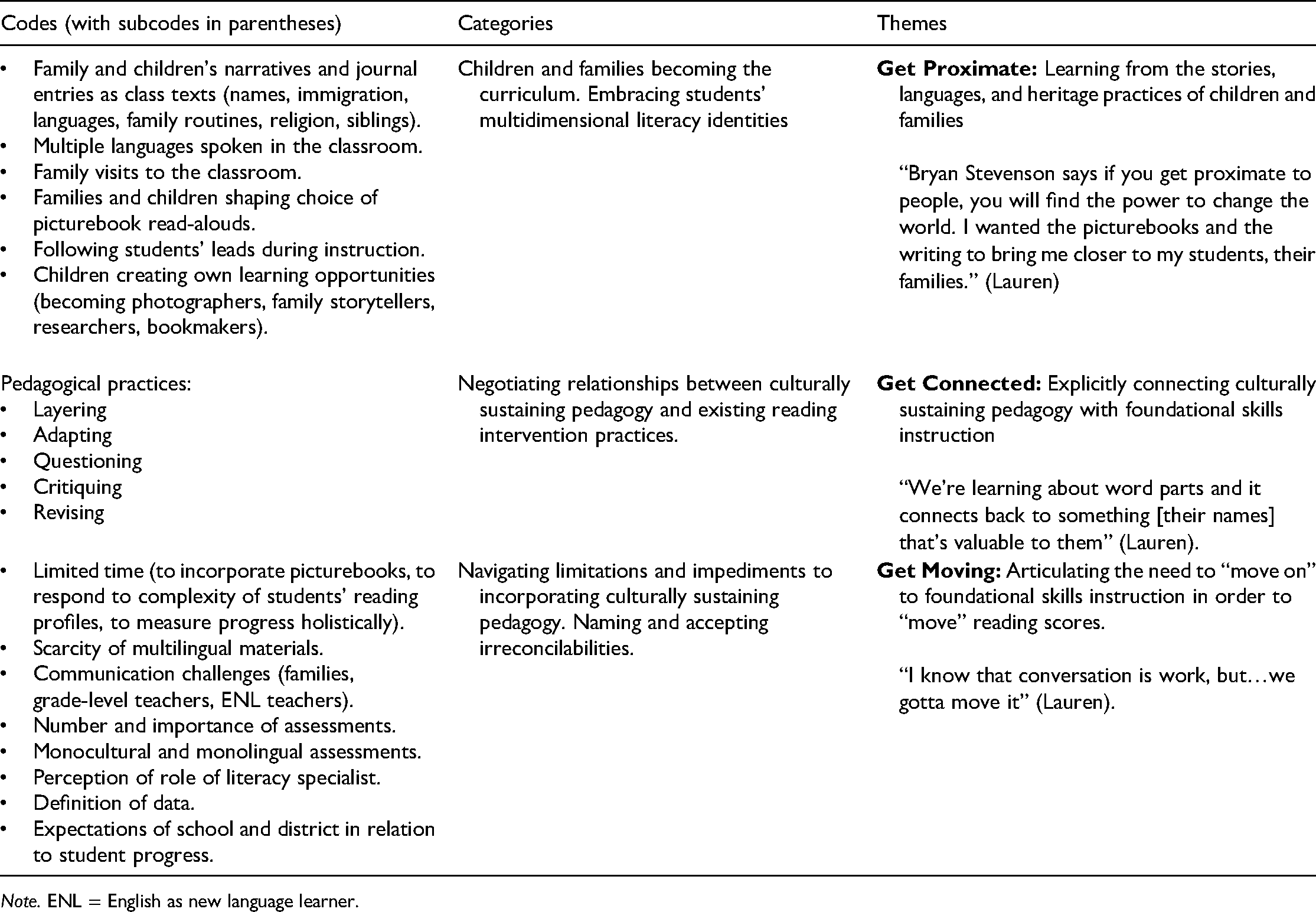
Note. ENL = English as new language learner.
Findings
The findings illustrate the possibilities and tensions that emerged through Lauren's incorporation of culturally sustaining pedagogical practices designed to bring students’ linguistic and cultural resources into the classroom (“get proximate” and “get connected”) within an intervention context designed to facilitate measurable growth in students’ reading skills ("get moving"). Endeavors to “get proximate,” “get connected,” and “get moving” existed in a complex tension, where they sometimes complemented each other, sometimes conflicted with each other, and at other times stayed resolutely separate from each other.
“Get Proximate”
In this section, I describe and analyze Lauren's efforts to bring a culturally sustaining lens to her practice in reading intervention by intentionally choosing materials and designing pedagogical practices that explicitly centered on family stories, multiple languages, and diverse picturebooks. In response to these new materials and practices, the children's multiple languages, transnational identities, and heritage practices were not just welcomed into the setting but often became the central texts of the class that inspired individual and collective inquiry and language awareness.
Shortly after the family breakfast that launched the project, Lauren began to assemble materials to include in the tote bag to be sent home with each child for 1 week at a time: picturebooks about names, a family journal, markers and crayons, and a letter translated into the families’ home languages. Sending home materials in this way was new to Lauren and was a reflection of her effort to “get proximate.” Each time a family sent back the tote bag after keeping it for 1 week, Lauren would suspend whatever lesson plans she had made for the session. On these celebratory days, the children would gather around the table as Lauren carefully opened each page from the family journal and paused, asking the child featured to tell us about it. The contributions included baby photos, drawings of superheroes, and depictions of what the family enjoyed doing together, from shopping at Wal-Mart to playing video games. Tahir-Ra drew pictures of his dad and grandmother at Christmas, while La Eh San read to us about the beautiful trees in his yard and joyful times with his grandparents in Thailand. He also explained pictures of his parents dressed in traditional attire for a religious ceremony. Alina's mother drew pictures of each family member, while also responding to Alina's request to draw Cinderella. In addition to revealing long-standing cultural traditions expressed through attire and celebrations alongside more modern popular culture artifacts, the family journals also showcased multiple languages.
During this sharing of family journals, the children sought clarification of terms they did not recognize or practices they did not understand. Thus, the family journals prompted not only awareness but also inquiry into language, culture, and heritage practices. For example, when Yasir's mother wrote, “We are a strong Muslim family” in the family journal, Tahir-Ra and La Eh San asked Alina and Yasir to describe what it means to be Muslim. On another day, the children noticed Alina's mother had added Arabic words next to her daughter's English writing in the family journal. Lauren then explained to the children what it means to be bilingual. A few weeks later, when Salvador's mother wrote both of his last names in the journal, the children and Lauren first expressed surprise, and then consternation, as school records included only one last name. The children were also upset when they learned they had been mispronouncing one of Salvador's last names. As Salvador provided more details of his name story, he led us in multiple practice sessions on pronouncing all three of his names correctly. These examples show how languages, literacies, and cultural knowledge began to flow more fluidly across home and school contexts as Lauren brought a CSP lens to the setting. Importantly, however, they also reveal how the children began to engage in critical inquiry into language and institutional practices that may not recognize the significance of names or attend carefully to their pronunciation.
The inclusion of family narratives as curriculum and the positioning of children and families as knowers helped to create a context where multiple languages came into the intervention setting in an embodied and proximal way. For the two Arabic-speaking children in the class, Alina and Yasir, who both also identified as Muslim, the texts Lauren chose and the pedagogical practices that surrounded them changed the nature of what they shared and how. During a read-aloud of Golden Domes and Silver Lanterns: A Muslim Book of Colors (Khan, 2015), the children spoke about their faith and also spoke in Arabic for the first time in this setting: The story we’re going to read is Golden Domes and Silver Lanterns. It's a Muslim book of colors. Oh! Muslim? Yeah. Like me! And you (looking at Alina). [Alina laughs] And you! [laughs] I’m not Muslim, but you and Alina are Muslim. Maybe Alina and Yasir, you’ll recognize some of the things in the story. If you do, let us know. OK? Tell us if you know what these things are. It's called Golden Domes and Silver Lanterns. Before we read it, I would really like to just look at the pictures on the front cover and tell me what you think about the pictures. What do you notice? Lah Eh San? It's like a castle. Show me what you think is a castle. This! This right here looks like a castle? That's the mosque. You see that? Is that the mosque? Yeah, that is the mosque.… In Syria I go in the mosque to pray.
The combination of both family journals and interactive read-alouds also inspired the children to write narratives that reflected their heritage practices and multiple languages. When students began to compose their own picturebooks in Phase 4, Alina asked Lauren if she could view Golden Domes and Silver Lanterns: A Muslim Book of Colors (Khan, 2015) again. Using the camera provided in the tote bag, Alina directed her mother to photograph her as she prayed. Without any prompting, Alina then wrote step-by-step directions on how to pray, incorporated a lyrical repetition of the line “I am praying,” and carefully placed photographs of herself by each step. Lah Eh San asked Lauren to photocopy pages from a picturebook that contained Karen to paste into his picturebook, writing next to it, “This is my language of Thailand.” Yasir included photographs of flowers from his home country of Syria alongside his own drawings of contemporary superheroes. In both their talk and in textual productions, students constructed multidimensional literacy identities in which they reflected and produced dynamic cultural identities.
A culturally sustaining approach helped create entry points for families and children to draw on their languages, faith traditions, and cultural resources to support literacies across home and school settings. In response to Lauren's efforts to “get proximate,” the children and families took up literacy practices such as reading, writing, and speaking in often agentive and pedagogical ways, purposefully making visible their multiple languages, providing tangible representations of their cultural backgrounds that included their uptake of popular culture, and using multiple modalities to construct knowledge fluidly across contexts.
“Get Connected”
In this section, I explore how Lauren endeavored to connect culturally sustaining pedagogical practices with direct instruction in foundational skills. I also consider how she made connections between students’ cultural identities and her instruction.
Within Phase 3 of the project, Lauren started an in-depth study of the picturebook Dreamers (Morales, 2018), in which a young mother and her son navigate a new country and language. Fluidly invoking both English and Spanish, the narrative also chronicles the mother's journey toward becoming an artist and writer. During the second read-aloud of Dreamers, Lauren started by asking if students could recall a scene that was important to them. Yasir described the moment when the mother and child were reprimanded by a police officer after going into a public fountain, positing, “Maybe she didn’t know, ‘cuz the police was speaking English and she didn’t know how to speak English and, um, that's why she went to the library to learn some English.” Lauren then reminded the students of their earlier exploration and definition of the word “immigrant.” At this moment, Alina excitedly called out “Yeah!” to signal she remembered and then attempted to pronounce the word. After Lauren assisted Alina in both hearing and pronouncing its three syllables, she encouraged the whole class to clap out the syllables with her. Alina's face scrunched up as her attempt yielded only two syllables and then filled with smiles when she pronounced it with three. Within these moments at the beginning of the read-aloud, Lauren connected culturally sustaining approaches with direct, but contextualized, instruction. First, she invited the children to recall, retell, and build on what they learned from a book featuring multiple languages and a story of immigration. While engaging in the practice of retelling, Yasir also named an event of particular salience to experiencing the world as a recent immigrant and learning a new language, experiences he had recently navigated with his family. Second, Lauren reminded students of the vocabulary word they had learned. Finally, she claimed the opportunity to help the children identify syllables and to practice sounding out words.
During a subsequent read-aloud of Dreamers, Lauren came across the page where the mother and son cross into their new country. When she read, “One day, we bundled gifts in our backpack,” Alina asked, “Bund-led?” Lauren pronounced it “bun-dled” and then invited students to look at the illustration and to offer their own definitions of the word: I think that means a lot of stuff. Yeah! Bundled means put a lot of stuff together and put it in one place. You know when you get all your stuff at the end of the day and you put it in your backpack? Like pencils, pens? Like this is a bundle of pencils. It's all together, right? It's a bundle. This is a bundle of things that are very important to the mom and her baby. Yes. These are important things. It says, “One day, we bundled gifts in our backpack.” So, they have gifts here. Listen to the rest of it. It says, “and we crossed a bridge outstretched like the universe.” So, they have all these important things.
Here, a student's question about a word's pronunciation also prompted a discussion of its meaning. Lauren did not define the word right away, instead asking students to draw inferences from the illustrations. Alina comes up with her own meaning of bundled as “a lot of stuff.” Lauren built on this offering to add an example pulled from everyday life. Finally, Lauren closed out this portion of the conversation by returning to the significance of the word—not just its literal meaning—by describing the bundle as “important things” to accompany the characters on their journey. It is notable that Morales (2018) furthered this sentiment in the author's note to Dreamers, writing that immigrants carry “special gifts,” a counternarrative to prevailing discourses related to how immigrants take resources from their new countries. In both examples of word work during interactive read-alouds of Dreamers, Lauren seized opportunities to embed direct instruction in foundational literacy skills in ways connected to the children's own lived experiences, responses, and inquiries into a culturally sustaining text.
As Lauren continued to bring a culturally sustaining lens to the reading support class, she made modifications to existing practices. For many years, she had created name charts with the children in her reading groups. By bringing a culturally sustaining lens to that practice, however, Lauren not only guided students in attending to the letters, sounds, and word parts in their own names but also broadened her instruction to include more attention to the deeper cultural and personal significance of all the children's names. During one session, Lauren placed each child's name on a chart and asked the class to describe what they noticed. Lah Eh San commented on the dash in Tahir-Ra's name, and Salvador noted the two as in Alina's name. Lauren counted the number of syllables in Yasir's name, and Alina made the “ya” sound in response. At various points, Lauren also prompted the students to recount the stories they heard from their families about their names. She later described to me how her aim to incorporate the teaching of foundational skills through the name charts was enhanced by the existing connections students had to their classmates’ names given their ongoing inquiries into names through the family journals, as well as through the accompanying picturebooks read in class and sent home in the tote bags. Lauren explained her thinking further: My experience of the name chart is we do it so that we can connect sounds and word parts…. And so, if we’re learning about word parts and it connects back to something that's valuable to them, then they make the connection quicker…. But I was really trying to find ways to connect and collect things that could help them to make connections. Like what kind of connections? Connections between their name and how important it is and like how these books are all kind of developing an identity.
In a subsequent class, Lauren broadened the identity work with names, engaging the children in a discussion of the cultural significance of Salvador's two last names from both his mother and father, explaining that Lah Eh San has one full name rather than a first and last name, and describing her choice to sometimes use both her maiden and married last names. After that class, Lauren shared with me what she was learning about connecting culturally sustaining practices to the work of reading intervention: For me, I’m seeing more how a regimented guided reading structure might not be the thing for every kid in Tier 2.… We can choose something, and we can work on that, and we can try to see growth. It doesn’t necessarily have to be the sound of long and short vowels. We have to find ways to motivate and engage kids in the reading process in ways that look and feel different. I think the picturebooks and the focus on identity are working, even though it's not always easy to see and not always easy to measure.
“Get Moving”
In this section, I explore how Lauren navigated barriers, tensions, and frustrations within her attempts to bring a culturally sustaining lens to the intervention setting, while also contending with both internal and external pressures to “get moving” to show measurable improvement in students’ foundational literacy skills. Within nearly every conversation we had after a session I observed, Lauren named her strategies for dealing with challenges, such as limited multilingual resources (e.g., calling on the services of a teacher who could translate a letter to families) and limited time (e.g., negotiating for an occasional extra day a week with this reading group). As much as she found ways to expand her practice to hold space for CSP, however, she named the prevailing definitions of what counted as data as well as the number and nature of the assessments she was required to give as the most imperiling to these aims.
Across the data in this study, it was evident that Lauren felt her attempts to bring a CSP lens to her work were not always understood or supported within the existing RTI framework and its interpretation of what constituted data or proficiency. On one occasion, after the children had engaged in a particularly rich discussion of Dreamers (Morales, 2018), Lauren sighed, “I wish I could bring that to the data team,” indicating that the kind of thinking, reading, and writing that the children engaged in during interactive read-alouds of diverse books would not be understood as indicators of growth and proficiency. The embedded expectations of her role as a literacy specialist were also challenging. During one session I observed where the children were drafting entries for their picturebooks, Lauren reluctantly pulled each student from their writing to complete a mandated 5-minute assessment. Later, as she rushed to another class and apologized for not being able to reflect on the session with me, she called out, “I have to go AIMSweb people,” referring to an assessment she had to give and making it a verb.
Although Lauren consistently looked for opportunities to embed the teaching of foundational reading skills in responsive ways, at times she found the assessments designed to assess those skills imperfect, especially when they were not illuminating of students’ strengths or beneficial to shaping her instruction. Nevertheless, they loomed largely and impacted her instructional decisions to “get moving” to teach in ways she believed would result in measurable progress on tested skills. During the 2-month time frame in Phase 3 when the children were inquiring into dreams through interactive read-alouds and narrative writing, I noticed Lauren becoming more tense as each session concluded. She also increasingly canceled my scheduled visits. In conversation with me after classes I did attend, she repeatedly said, “We gotta get moving,” and “Tomorrow, we’ll get down to business,” with “tomorrow” being a day for a planned lesson on vocabulary or for using leveled texts to teach a particular skill. Although she was finding students’ conversations about Dreamers (Morales, 2018) valuable, she worried, “I’m not moving the kids academically.” Further explaining her thinking related to conducting interactive read-alouds with culturally sustaining picturebooks, she said, “I know that conversation is work, but…we gotta move it.” After a final day with Dreamers (Morales, 2018), I did not return until months later, after the assessment pushes concluded.
In addition to how assessment demands often curtailed time to engage more fully with CSP-informed practices, Lauren found that some of the assessments were misaligned with her beliefs about language and literacy. Here, she described her misgivings: I was sitting next to a kid doing his test. The passage was written like how you would talk to a kid on the street and the question was, “What word is wrong in this sentence?” So, it's like a trick question. So, they’re saying his language is wrong? You’re asking him to correct something that he says! It's the way a kid would say it. And, as teachers we would typically say, “In books, it sounds like this….” But not every book, like, read bell hooks! That kind of question on a first-grade test, I just think it's unfair…. And he didn’t pick the “correct” word.
Discussion
Paris and Alim (2017) asserted that CSP exists “wherever education sustains the lifeways of communities” (p. 1). For Lauren, bringing a culturally sustaining lens to reading intervention contributed to a context where, at times, children fluidly drew on their multiple languages, faith traditions, and immigration experiences while building multidimensional literate identities. When Lauren invited the children to respond to Golden Domes and Silver Lanterns: A Muslim Book of Colors (Khan, 2015), Alina's mix of surprise and recognition when she exclaimed “Oh! Muslim?” was suggestive of the rarity of seeing a book featuring a mosque on the cover in school and the rarity of hearing the word that denoted her faith in this context. When Lah Eh San responded to the invitation to create his own picturebook, he not only wrote about his grandparents but was also compelled to include a tangible representation of the language they spoke together and to claim it as his own: “This is my language of Thailand.” Invitations like these started to cultivate connections across homes, schools, and communities and started to link literacies, languages, and lifeways in ways resonant with a culturally sustaining approach.
However, pedagogical invitations that created opportunities to “get proximate” to the linguistic and cultural resources of children and families were layered on top of existing practices and expectations of a reading intervention setting designed to “get moving” on acquiring skills as measured through a range of assessments not fully aligned with the children's linguistic and cultural repertoires. Given the centrality of these assessments and their representation of a primary goal of reading intervention to address deficits in foundational reading skills, they were an ever-present force and carried a considerable shaping influence on teaching and learning. The primacy of assessments, coupled with the lack of materials and practices designed to simultaneously build foundational skills and be responsive to students’ linguistic and cultural resources, led to the episodic nature of the incorporation of CSP-inspired practices.
This study nevertheless suggests that possibilities do exist for CSP within intervention settings. As examples in the “get connected” section revealed, there were occasions when the prerogatives to “get proximate” and “get moving” were complementary. When Lauren engaged the children in both close analysis of the letters in their names and in storytelling about their cultural significance, and when the children discussed the complex experience of immigration in Dreamers (Morales, 2018) while at the same time learned new vocabulary and sounded out words in context, it is possible to see how skills and meaning-making can be brought together in dynamic and enriching ways. This study thus contains seeds for further exploration related to engaging students’ languages and lived experiences as resources for building foundational skills.
While opportunities exist to create more responsive curricular materials and more sensitive assessments for use in intervention contexts with emergent bilinguals, I suggest there could be additional lessons to learn. When Alina created a multimodal guide to praying, when Yasir alluded to his own immigration experiences in response to Dreamers (Morales, 2018), and when Salvador revealed he had two last names and demonstrated how to pronounce them, the identities of the children expanded beyond that of students in need of reading support to knowledgeable, agentive, multilingual readers and writers of the world. For a moment, the space also shifted, from one focused on mastering discrete skills in one language to a space of collaborative meaning-making with multiple languages, with books, with the world, and with each other. However momentarily, there was a “frame shift” (Aukerman et al., 2017) in which the identities of the children and the purpose of the setting expanded. Certainly, it was vital to continue the work of building foundational skills that would afford the students even more access to more books and to more knowledge; however, I suggest there is value, too, in pausing and learning from these shifts.
To practitioners facing daunting assessment climates and the adaptation of commercial reading programs, this study suggests that even the most constrained learning environments can be punctuated and enlivened by becoming proximate to children and families through cultivating the very languages and literacies that are already there: choosing picturebooks reflective of children's multilingual worlds, building curriculum from family narratives and heritage practices, and inviting children to compose their own books from the stories and languages of their lives. Given this study's findings related to the role of assessments in shaping instruction, expanding pedagogical practices to be more inclusive of CSP might require expanding the definition of what counts as data as well as reimagining the work of data teams, where, for example, transcripts of meaning-making within an interactive read-aloud or evidence of growth in a child's authentic writing samples might be considered alongside more quantitative measures. This study showed that the perceived purposes and desired outcomes of intervention to demonstrate measurable improvement in foundational skills often hindered a fuller and less episodic incorporation of practices informed by CSP, a finding resonant with the analysis by Zoch (2017) of how high-stakes testing constrained teachers’ efforts to sustain students’ cultural competence. In reconsidering the nature and emphases of assessments, we might take guidance from studies like the one conducted by Noguerón-Liu et al. (2020) that provide insight into the roles of parents in shaping reading assessments more reflective of the linguistic and cultural resources of emergent bilinguals.
Paris and Alim (2014) have called for “explicitly pluralist outcomes that are not centered on White, middle-class, monolingual, and monocultural norms of educational achievement” (p. 95). To realize these pluralist outcomes within reading intervention may necessitate the assertion that culturally sustaining pedagogical practices are just as foundational to the aims of literacy education as the teaching of foundational reading skills, a daunting prospect given the historic and ongoing lack of attention to the assets of students from diverse cultural and linguistic backgrounds (Klingner & Edwards, 2006) and the disinclination to acknowledge racial disproportionalities (Willis, 2019) within RTI.
Limitations
This study adds to the small number of qualitative studies exploring reading intervention within the complex lifeworld of the classroom and with lenses attuned to cultural and linguistic diversity. Across the design and enactment of the study, however, there were missed opportunities to instantiate a CSP perspective more thoroughly and to engage in practices more aligned with its transformational vision. Taking a cue from Nash et al. (2021), the efforts detailed here may be more accurately described as reaching toward CSP rather than an enactment of it. Furthermore, this study did not aim to embed explicit foundational skills instruction in direct correspondence to the picturebooks and family engagement efforts, nor did it draw from instructional and assessment models attuned to the reading profiles of emergent bilinguals (Goldenberg, 2020; Hopewell & Escamilla, 2014). Finally, a study of this nature conducted by multilingual educators of color would better align with CSP's mission to be a “project of solidarity and coalition” (Paris, 2021, p. xv).
Conclusions
The young people who came to Lauren's class, speaking multiple languages and embodying transnational experiences, are illustrative of the growing cultural and linguistic diversity within school spaces. These students are now continuing their educational careers at the same time as the Science of Reading movement, characterized by increasingly narrow and decontextualized conceptualizations of literacy, has reemerged with new momentum (Vaughn et al., 2020) and with potentially deleterious effects on emergent bilinguals (Noguerón-Liu, 2020). In light of this movement and in response to the long-standing calls for reading intervention to be more responsive to diverse learners, we might ask through a culturally sustaining lens: How do we move away from a white-dominant, monolingual gaze for defining what literacy is, what we mean by reading achievement, and how we assess it? How have the multitude of formal and informal assessments, both externally mandated and teacher initiated, served as impediments to implementing new pedagogical practices sustaining of cultural and linguistic pluralism? Across our instructional and assessment practices, how do we more fully understand and take into account how emergent bilinguals draw from their multiple languages and literacy resources within intervention contexts? In asking these questions in concert with families and communities, we might begin to reimagine educational contexts for emergent bilinguals more worthy of their gifts and more sustaining of their literacies and languages.
Footnotes
Declaration of Conflicting Interests
The author(s) declared no potential conflicts of interest with respect to the research, authorship, and/or publication of this article.
Funding
The author(s) disclosed receipt of the following financial support for the research, authorship, and/or publication of this article: This work was supported by the Children’s Literature Assembly of the National Council of Teachers of English (grant number Children’s Literature Assembly Research Award).

References
Supplementary Material
Please find the following supplemental material available below.
For Open Access articles published under a Creative Commons License, all supplemental material carries the same license as the article it is associated with.
For non-Open Access articles published, all supplemental material carries a non-exclusive license, and permission requests for re-use of supplemental material or any part of supplemental material shall be sent directly to the copyright owner as specified in the copyright notice associated with the article.
