




Abstract
There is a relationship between children's ability to formulate theories of mind (i.e., metacognitive hypotheses) about persons or characters in a text and their comprehension of the text. Nevertheless, few studies examine how young children engage their ontological background knowledge to formulate their theories-of-mind. Set in a public library of a new Latinx diasporic community of the U.S. southeast, this case study examines how, within the context of family literacy program, a group of emergent bilingual children (ages 4–8) employ their ontologies to interpret the mental states of persons in a target-text. Data sources include artifacts, audio-visual recordings, and a group exit interview. Qualitative content analysis methods were employed. The results recognize children's ontologies as relevant sources of background knowledge on which to scaffold their reading comprehension.
Keywords
Children of historically marginalized communities arrive at school with rich sources of knowledge that receive limited attention (Heath, 1983). As theory-of-mind research advances, attending to the ways in which background knowledge informs theory-of-mind development is essential to supporting the reading comprehension of children from historically marginalized communities.
This article illustrates how a group of young children's tacit ontological background knowledge (e.g., views of reality) influenced their theories of mind while engaging with a nonfiction narrative text. A fundamental bidirectional relationship exists between children's text comprehension (both written and spoken) and their ability to formulate theories of mind (i.e., suppositions about the mental states, emotions, motivations, and thoughts of people or characters) relative to texts (Tompkins et al., 2024). This descriptive case study extends the existing research, highlighting the role of background knowledge on this relationship.
The data set points to a dynamic tridirectional, rather than a bidirectional, relationship. This triangular relationship is grounded in literacy education research showing the following. First, children's theory-of-mind and reading growth are related (Tompkins et al., 2024). Second, children's background knowledge supports text comprehension (Peng et al., 2024) and informs theory-of-mind development (Carpendale & Lewis, 2006; Devine & Hughes, 2018; Lecce et al., 2024). Third, children's reading and theory-of-mind development help to expand background knowledge (Ivey & Johnston, 2013; Lysaker & Nie, 2017; Lysaker et al., 2016).
Moreover, although there is substantial research on the role of background knowledge in supporting children's reading comprehension (Cervetti & Wright, 2020; Hattan & Lupo, 2020; Lee, 2020; Peng et al., 2024), there is limited inquiry into how children's tacit ontologies about the nature of reality inform their interpretations of “blanks” in texts (i.e., areas in which readers must bridge gaps in information; Iser, 1978, p. 169). This case study contributes to this budding corpus of research.
Ontologies and Epistemologies
Ontology regards people's worldviews about reality and truth. It is linked to spirituality, which can be religious or nonreligious in nature (Thayer-Bacon, 2017). As described by Anzaldúa (2015), spirituality is an ontological belief in the existence of something greater than the material or physical world. When considered through a cognitive science lens, this view is common to most religious traditions and to many spiritual beliefs, which can be entirely nonreligious (Apud, 2017). It highlights what I am calling an ontological “view of reality” (VoR) that transcends (non)religious creeds and systems.
Ontological knowledge plays a pivotal role in shaping the perspectives of many communities of people. In discussing the Mestizo/a/x consciousness, Anzaldúa (2015) suggested that this knowledge, which she called conocimiento, transcends the purely intellectual and extends into an embodied, deeply internalized understanding that integrates both physical and spiritual realms of existence. This often-tacit “inner knowledge” (Peterson & Robinson, 2020, p. 5) originates from connecting the affective, cognitive, and physical aspects of learning with the spiritual and natural worlds and is core to how Indigenous and Aboriginal peoples understand the world (Battiste, 2013; Justice, 2018). For many, the universe includes interconnected physical and spiritual realms (Battiste, 2013) where everything holds spirit, and knowledge evolves from recognizing how these spirits connect holistically (McKeough et al., 2008). Dillard and Neal (2021) have suggested that in some African American communities, inner spiritual knowledge extends beyond what is perceived through one's physical senses and experiences. It is deeper often more profound forms of knowing that have been essential to surviving and thriving throughout history. They argued that (re)membering what constitutes knowledge involves a conscious acknowledgment of inner spiritual knowledge.
This holistic view of knowledge affirms the strength of tacit ways of knowing in many historically marginalized cultural groups. It reflects a distinctive ontology (view of reality) and epistemology (view of knowledge) that is often implicit and rooted in the lived experiences of many communities of people. Such knowledge grows through embodied practices such as meditation, prayer, dance, and introspection (Anzaldúa, 2015; Battiste, 2013), which typically occur outside of school, in children's familial and community contexts. In this article, I adopt the term “inner knowledge” to describe the holistic, if not intuitive, knowing (conocimiento) that corresponds with children's VoR.
Children's VoR development can occur independent of religious systems (Adams, 2019; Coles, 1990; Jirásek, 2023; Polemikou & Da Silva, 2022). Studies suggest that children's VoR development emerges from repeated exposure to discussions or testimonies about the spiritual/supernatural realm (McLoughlin et al., 2021) and engagement in testimonial activities (e.g., communal prayer, rituals, celebrations) that reinforce the VoR (Kapitány et al., 2020). A nonreligious example of testimonial exposure appears in psychology research about the Tooth Fairy, a supernatural being of mainstream American culture. Principe and Smith (2008) found that young children exposed to parental testimonies and testimonial evidence (fairy dust on bed pillows) were more convinced of the existence of the Tooth Fairy, as described in their recounting of personal memories and stories, in comparison to children who did not receive such exposure. This and other studies about children's exposure to testimonies about supernatural beings (e.g., Santa Claus and the Easter Bunny; Harris et al., 2006) provide a ray of insight into the complex and integrated cultural processes that steep children in the VoR of their families and communities (Rogoff, 2003), which is relevant to this case study.
Enciso et al. (2011) alluded to children's VoR about the existence of a spiritual realm and supernatural entities in documenting the lunchtime “ghost” stories retold by a group of immigrant and nonimmigrant sixth graders. After multiple lunches, it became clear that these stories featured spiritual beings whose real-world existence was verified by the testimonies of the children's families and communities (religious, nonreligious, or otherwise). In turn, Enciso et al. (2011) called for “a more nuanced understanding of students’ cultural knowledge” (p. 365) because students’ VoR is not explored or revealed in the ways cultural knowledge is typically recognized and employed in literacy education.
This case study responds with a nuanced examination of the roles young children's VoR play in their higher-order thinking about a target text. This project grows the corpus of literacy education research about the explicit influence of children's VoR on their reading engagements. Set in the commons of a public library's early literacy program for immigrant families in the U.S. Southeast, it shows how a group of young, emergent bilingual children (ages 4–8) utilized their inner knowledge in formulating theories of mind about the mental states of people described in a nonfiction narrative target text. This project has implications for how literacy researchers and educators recognize and navigate children's divergent VoR and inner knowledge as valuable resources for reading growth and comprehension.
Reading Comprehension and Background Knowledge
What follows is a synthesis of multiple scholarly reviews of literacy education research about the role of background knowledge in students’ reading comprehension. For the purposes of this discussion, children's VoR and inner knowledge can be viewed as tacit elements of cultural background knowledge that are not explicitly examined in the studies.
To begin, in their meta-analysis of reading comprehension strategy interventions for struggling readers, Peng et al. (2024) found that activating students’ relevant background knowledge before teaching reading strategies significantly improves their comprehension. When students already have a foundation of knowledge related to the text, they can focus on learning the new strategies. In other words, they do not have to split their cognitive resources between processing unfamiliar content and practicing new skills, which can be mentally demanding in and of itself (Peng et al., 2024). These findings imply that contextualizing reading instruction in relevant background knowledge supports students’ comprehension.
Cultural Background Knowledge
Lee (2020), in her extensive review of the research about students’ learning and reading comprehension, argued that the role of students’ cultural schema merits greater attention. Via scaffolding, the repertoires of cultural knowledge, epistemologies, and language practices that youth develop in nondominant communities, Lee (2020) observed, offer a foundation for making students’ comprehension of text explicit and public. In other words, educators can facilitate students’ reading comprehension and meet the expectations of reading curricula standards when they activate and build instruction upon students’ out-of-school cultural background knowledge, beliefs, and practices (Lee, 2020).
In another review of the scholarly literature, Cervetti and Wright (2020) highlighted studies in which students tap their sociocultural experiences as background knowledge for comprehending text (Moll et al., 1992) and in which teachers foster culturally relevant and sustaining instruction in literacy education (Ladson-Billings, 2014; Paris, 2012). Nevertheless, Cervetti and Wright (2020) argued that significantly more work is needed to develop and facilitate classroom literacy education programs that explore the connections between students’ sociocultural knowledge and reading comprehension.
Hattan and Lupo (2020), in their review of the literature, emphasized that readers use their pools of everyday, cultural, linguistic, experiential, and other knowledge resources when they process and engage with texts. They highlighted studies in which children's reading comprehension is influenced not only by children's own cultural background knowledge but also by the cultural contexts in which children engage in reading (e.g., Ladson-Billings, 2000; Orellana, 2016). They, too, pointed to the ways children's out-of-school knowledge informs children's learning experiences.
Finally, it is important to note that children's pools of cultural knowledge are dynamic because they reflect the ever-evolving repertories of practices of the cultural communities to which the children belong (Gutiérrez & Rogoff, 2003). In this project, the children's VoR and inner knowledge are reflected in their discussion of a culturally relevant nonfiction picturebook, In My Family / En mi familia (Garza, 1996).
Theories of Mind
Shifting gears, children's background knowledge informs their theory-of-mind development (Carpendale & Lewis, 2006; Devine & Hughes, 2018; Lecce et al., 2024). In the field of cognitive psychology, theory of mind is regarded as one element of the social cognitive imagination of young children (Kushnir, 2022). As young children begin to theorize that people have different psychological states, Kushnir (2022) explained, they also begin to “construe people as moral agents, norm-followers, members of groups, and as having social (and intersecting) identities” (p. 5), all of which contribute to children's social cognitive imaginations.
During reading, children use the collective elements of their social imaginations, including their theory-of-mind abilities, to make sense of narratives (Lysaker et al., 2016). Lysaker et al. (2016) explained that young readers use their social imaginations to (a) enter the minds of characters where they “imagine [the] thoughts and feelings of semiotically represented people” and (b) understand the larger “community of minds represented and enacted in the vicarious social world of a story” (p. 247). This case study focuses on children's use of their imaginations to develop hypotheses (theories of mind) about the mental states of semiotically represented people in the nonfiction narrative text En mi familia (Garza, 1996).
Theory of mind regards children's abilities to “mentally represent [both] one's own and other people's beliefs, desires, feelings, and intentions,” as described by Deane et al. (2019, p. 3). Contemporary theoretical models for reading instruction such as the active model of reading (Duke & Cartwright, 2021) and the direct and indirect effects model of reading (Kim, 2017) advocate for the development of children's theory-of-mind capacities as important tools for reading growth.
Children's capacities for formulating theories of mind about others are predictive of their reading comprehension and merit the attention of early literacy researchers and educators (Deane et al., 2019; Dore et al., 2018; Tompkins et al., 2024). Deane et al. (2019), in synthesizing multiple studies, argued that young children's early development of theory-of-mind abilities strengthens their sentence comprehension, increases their metacognitive awareness of reading, and supports their overall reading comprehension both during reading and throughout their lives. Furthermore, they observed that when it comes to comprehending texts, readers engage their theories of mind both to model the mental states of and to empathize with characters in the text. Deane et al. (2019) explained that in developing theories of mind, children modify their thinking to consider the standpoints of others.
Of significance to this case study, psychoanthropological research also shows that children's VoR can uniquely shape the theories of mind they develop about the mental states of others (Luhrmann et al., 2021). To illustrate this concept, I employ the framework of Dore et al. (2018), whose synthesis of the theory-of-mind research shows a temporal (not a causal) alignment between children's theory-of-mind development and their narrative processing abilities during early childhood. This framework suggests that when “a reader can represent given information about a character's emotional state or thoughts,” the reader is well positioned “to engage in increased inferencing about these mental states when they are not explicitly stated,” which could yield improved comprehension of the text (Dore et al., 2018, pp. 1078–1079).
The framework highlights three tiers of theory-of-mind development. Starting as early as age 3, most children develop primary-tier theory-of-mind capacities to understand the visual perspectives of others, which might differ from their own. At the same time, they are developing primary-level narrative-processing abilities to track the spatial perspectives of characters in multimodal texts, broadly defined. Expanding upon these abilities, as early as ages 4 or 5, most children develop secondary theory-of-mind capacities to understand the mental representations of the world held by others. At the same time, they likewise develop a second tier of narrative-processing abilities to track the mental thoughts and perspectives of characters in a text. Growing beyond the first and second tiers, as early as age 7 most children develop a third tier of theory-of-mind capacities to understand the complex emotions of others. During this same period, they also develop a third tier of narrative-processing abilities in tracking characters’ advanced mental states (e.g., emotions, goals, motivations). The data set in this study provides glimpses of young children's different tiers of theory-of-mind development within the context of a text engagement.
Aesthetic Higher-Order Thinking
In this case study, the children employ their higher-order thinking skills in formulating theories of mind and aesthetic responses about the target texts.
Aesthetic Reading
When children read aesthetically, they construct meaning based on their personal lived experiences and their real-time, participatory transactions with the text (Rosenblatt, 1978). Rosenblatt's transactional theory provides a lens for understanding the children's responses in this case study. Sipe's (2008) taxonomy of aesthetic responses to picturebook read-alouds offers a structure for interpreting these transactions. Sipe identified several categories of aesthetic responses, including personal, intertextual, and analytical, that children commonly exhibit during read-alouds. Each of these aesthetic responses provides insight into the children's lives. Personal responses occur when children connect the text to their own experiences, using their personal knowledge to enhance understanding. Intertextual responses involve making connections between the picturebook and other cultural texts. Analytical responses treat picturebooks as multimodal objects, with children interpreting both the visual and verbal elements of the text.
Speculative Hypotheses and Theories of Mind
Sipe (2008) suggested that some children who respond analytically to picturebooks develop “speculative hypotheses” (p. 99) about the thoughts, feelings, and actions of the characters. Although Sipe did not explicitly link these speculations with theories of mind, they share similarities with the formulation of mental models about the people in a text. Sipe (2008) argued that during book discussions, children often extend each other's ideas via their speculative hypotheses, which in this case study are expressed as theories of mind about the mental states of semiotically represented people.
Expanding on Sipe's work and the research of Taylor et al. (2003, 2005), Peterson (2017) observed that when young readers interpret characters’ thoughts and motivations (e.g., develop theories of mind about the characters’ mental states), they engage in higher-order thinking that supports their reading growth and comprehension of the text. Peterson argues that children practice these skills when responding to literature discussion questions, making personal text-to-life connections, and when considering the themes of the text. The case study herein extends the work of Sipe (2008) and Peterson (2017) by examining how the children's aesthetic responses and higher-order thinking about the target text were informed by their VoR and inner knowledge.
Methods
Study Design
This descriptive case study was generated within the context of a larger project focusing on an early literacy program for immigrant families of young emergent bilingual children (ages 4–8) at a public library in the U.S. Southeast. As a research methodology, case studies are in-depth investigations of contemporary phenomena (cases) within their “real world context, especially when the boundaries between phenomenon and context may not be clearly evident” (Yin, 2017, p. 42). In this case, the contemporary phenomenon revolved around the children's and families’ use of ontological inner knowledge in formulating aesthetic responses and theories of mind about a target text during a Cuentos literacy engagement.
Context of Study
One of the objectives of the Cuentos program was to introduce families to the public library's Spanish, dual-language, and bilingual picturebooks. The program included free transportation and a community meal for all participants, including extended family. Families received a weekly set of picturebooks to read at home prior to each 90-minute session. At the library, families engaged in intergenerational discussions about the picturebooks. This case study focuses on the fifth session in the six-week series.
Program Facilitation
Facilitation of the Cuentos program was primarily in Spanish, the families’ home language. This is because emergent bilingual children's literacy competencies in their home language support their development of additional languages, like English (Cummins, 1979). Recent empirical studies likewise reinforce the significance of children's home language and literacy practices on their emergent skills in English (e.g., Luo & Song, 2022; Wagley et al., 2022). Hence, a goal of the program was to strengthen the children's emergent bilingualism by supporting their familial repertories of linguistic and literacy practices in Spanish.
La Virgen
The broader Cuentos study included visits to families’ neighborhoods and participation in local activities. Within this context, families shared and discussed everyday cultural practices, including devotions to La Virgen de Guadalupe (hereafter La Virgen), which is relevant to the target text of this case study. La Virgen, a symbol of Indigenous-Spanish Mestizo/a/x heritage, embodies both Tonantzin, the pre-Cortesian spiritual mother of the Gods and Indigenous peoples of Mexico (Anzaldúa, 2015; Lara, 2008), and the Catholic mother of God, patroness of the Americas (Rodriguez, 1994). Below I describe the legend in which La Virgen revealed herself in the physical realm in December of 1531 atop the snow-covered Tepeyac Hill near modern-day Mexico City, where Indigenous people venerated Tonantzin prior to Spanish conquest.
The legend begins when Juan Diego, an Indigenous man, hears a beautiful voice and then sees La Virgen approach. Next, he hears La Virgen's instructions to tell Bishop Juan de Zumárraga, the inquisitor of the viceroyalty of New Spain, to build a church atop Tepeyac in her honor. Unsuccessful with the inquisitor, the next day Juan Diego hears new instructions from La Virgen. He gathers and places in his tilma (apron) armloads of fragrant roses, which are native to Spain, but which La Virgen miraculously produces here in the cold of winter. This time, when Juan Diego visits Bishop Zumárraga, it is the bishop who encounters a series of sensory events. Zumárraga smells and touches the roses from his homeland. Then, as Juan Diego's tilma slackens, the bishop sees the image of La Virgen's likeness in the apron. Astonished, Zumárraga recognizes the miracles and initiates the construction of the church.
For many devotees, this is the first of countless miracle stories in which ordinary people have extraordinary sensory experiences of La Virgen. Correspondingly, La Virgen is seen as a mediator between “humans and the divine” and “this reality and the reality of spirit entities,” both of which exist in the world as defined by the VoR of devotees of La Virgin-Tonantzin (Anzaldúa, 1996, pp. 54–55). Relatedly, the target text of this case study regards the visual sensory experience of La Virgen among members of a South Texas ranch community, as described in the painting of La Virgen's image on a water tank, El Milagro, in the picturebook En mi familia (Garza, 1996).
Participants
Cuentos Leaders
At the time of data collection, Leader A, a bilingual literacy education scholar of Mexican heritage, was a local university faculty member. Leader B, a bilingual STEM education scholar of Mexican heritage, was a doctoral student who supported community learning experiences. Finally, I, a literacy education scholar of Central American heritage, was a local university faculty member and primary lead of the Cuentos program.
Program Participants
Program participants were recruited by the public library. Library staff contacted local elementary schools to identify struggling emergent bilingual readers in need of additional support. At the time of the study, local schools were not providing bilingual instruction. Instead, some students received English language development services in a push-in model. Mischaracterizing the Cuentos program as remedial reading instruction, elementary school personnel led parents to believe that they were required to attend to improve their children's academic performance. After learning that the program was neither mandatory, remedial, nor an extension of school reading instruction, families attended Cuentos sessions at their own discretion.
Approximately 9–14 families with children ages 4–8 participated in each of the weekly sessions of the six-week program. Living on the outskirts of town, families were provided free chartered bus transportation to and from the library. This case study features multiple families. (All names are pseudonyms.) The Alegro family includes parents and children Andrés (age 4) and Alonso (age 7). The Gomez family includes one parent and one child Gloria (age 6). The Marte family includes a parent and children Manuela (age 4) and Matteo (age 7). The Perez family includes parents and children Pedro (age 4) and Pati (age 6). The Rosario family includes parents and children Raquel (age 7) and Regina (age 8).
Materials
Garza's picturebook memoirs of her childhood in south Texas, Family Pictures / Cuadros de familia (1990) and En mi familia (1996), were central to the session. In these texts, some of Garza's paintings include images of La Virgen as Garza's mother was a member of the local Guadalupanas Society (Ramirez-Salinas Funeral Home, 2018). The data set primarily focuses on the painting and written description of El Milagro, in which La Virgen appeared on a water tank of a local ranch.
Procedures for Focal Literacy Event
The procedures for this case study were inspired by Lee's (2021) cultural modeling framework for scaffolding literacy instruction in the context of students’ cultural background knowledge. They also respond to the calls of Enciso et al. (2011), who advocated for greater attention to children's tacit cultural knowledge, and Orellana et al. (2010), who urged literacy educators to support students, especially those (mis)identified as “remedial,” by drawing upon their cultural knowledge as valuable resources for reading development. Orellana et al. (2010) foreshadowed the call of Peng et al. (2024), who encouraged educators to use familiar, everyday texts as foundational tools for supporting the reading comprehension of “struggling” readers.
The procedures for this case study included opportunities for the children to aesthetically consider the multimodal target text (Sipe, 2008) and respond to higher-level thinking questions about the target text (Peterson, 2017). First, in alignment with Lee's (2021) approach, the Cuentos leaders and I identified a source of cultural background knowledge that was familiar to the children in the program (i.e., a common VoR that includes La Virgen). Second, we verified the relevance of this VoR. Third, we invited the children and their families to share their connections with the illustrations of the target text. Fourth, we introduced the written target text of the study. Fifth and finally, we facilitated a conversation in which the children used their VoR and inner knowledge resources to bridge a gap in the target text. Via a higher-level thinking question (Peterson, 2017), we prompted the children to formulate theories of mind about the mental states of semiotically described people in the target text. Nonverbatim transcripts associated with each procedural step appear in the next section of this article.
Data Collection and Reduction
All data, including relevant program artifacts, observational field notes, memos, and audio recordings of both the focal session and parents’ exit interview, were collected within the context of the Cuentos program. Leaders A and I collaborated in developing nonverbatim transcripts of the audio recordings in which we focused on participants’ words and statements, excluding pauses and nonverbal sounds. Then, we used our field notes and memos as contextual resources for translating the participants’ words and statements from Spanish to English. For the purposes of this project, I reduced the data set for data specific to the target text. Omitted were transcripts about program logistics and other activities of the evening.
Data Analysis
I engaged in an iterative process of qualitative content analysis (Corbin & Strauss, 2007) in examining the participants’ words and statements. In alignment with the theory that adults’ testimonies reinforce children's VoR (Kapitány et al., 2020; McLoughlin et al., 2021), I identified instances in the transcripts in which the adults’ talk reinforced that La Virgen is supernatural entity in the world. I applied Sipe's (2008) theory that young children are capable of many kinds of aesthetic responses to texts and book discussion prompts, coding the transcripts for children's personal, intertextual, and analytical responses. In association with the framework proposed by Dore et al. (2018), I coded the children's expressions of first-, second-, and third-tier theories of mind about the mental states of the people referenced in the target text, reflecting the children's speculative hypotheses (Sipe, 2008) and higher-level thinking skills (Peterson, 2017).
Transcripts, Discussion, and Implications
The organization of this section follows the procedures of the focal Cuentos session, inspired by Lee's (2021) cultural modeling framework. Each subsection includes an overview of the activity, the associated transcript, a discussion of the findings, and relevant implications for the field.
Step 1: Identifying an Everyday Element
Within the context of the larger study, the Cuentos leaders and I observed that several families participated in local feast day celebrations and carried artifacts of La Virgen in the form of jewelry, clothing, prayer cards, and the like. With this in mind, we were interested in the kinds of connections the families would make, if any, with Garza's picturebook memoirs. A few of the illustrations (paintings) in each of these books include artifacts of La Virgen (e.g., small household statues, church paintings, framed images). We hypothesized that some of the Cuentos families might notice these artifacts. Garza's paintings indicate that people in her childhood shared a VoR that La Virgen is a spiritual entity in the world. For some audiences, Garza's illustrations could be interpreted as tacit testimonies (Kapitány et al., 2020) validating La Virgen's existence.
Step 2A: The Match Game
The Cuentos leaders and I verified the relevance of our hypotheses through two different activities. We started the Cuentos session with the “Match Game” exercise. With their families, the children responded to a higher-order thinking prompt (Peterson, 2017) to identify commonalities between two or more pictorial scenes from Garza's childhood by analyzing the picturebook illustrations (Sipe, 2008). As expected, several children and their families paired illustrations featuring piñatas, family pets, special events, and food preparation, among others.
What is noteworthy, however, is that four families chose to meticulously analyze the illustrations for visual references to La Virgen in Garza's childhood home and community. The transcript below features the exchange between the Cuentos leaders and the four families, which followed an opening discussion about the other matches (e.g., pairs of piñatas).
Step 2A: The Match Game
A1. Leader A: A ver quien hizo este? / Let's see, who made this? (pointing to the first of the four pairs) A2. Manuela: Yo. / Me. A3. Leader A: Dinos en que se parecen. / Tell us how they’re similar. A4. Manuela: La virgen está en los dos. / The Virgin is in both. A5. Leader A: La virgen está en los dos. ¿Y, ¿que está pasando? / The Virgin is in both. And, what is happening [in the paintings]? A6. Manuela: [Están] rezando. / Praying. A7. Leader A: Rezando en los dos. / Praying in both. A8. Leader A: ¿En donde estan [las vírgenes] aca? / Where are they [the virgins] here? (pointing to a new pair of paintings) A9. Mrs. Marte: En su casa. / In their house. A10. Leader A: Vamos a hablar de esta después. / We’re going to talk about this later. A11. Leader B: Es un tema popular. / It's a popular theme. A12. Leader A: Si. Tenemos una, dos, tres, cuatro vírgenes. / Yes. We have one, two, three, four virgins.
The results of the Match Game offer several insights. First, in terms of facilitating an adaptation of Lee's (2021) cultural modeling framework, they provided initial evidence verifying our observation that some of the Cuentos families were familiar with La Virgen. The transcript indicates that the reader-response practice of analyzing picturebook illustrations (Sipe, 2008) was informed by some of the families’ VoR. Within the secular space of the public library, these families’ analyses were testimonial in nature (Kapitány et al., 2020). Some children and adults searched for signs of La Virgen's existence in the paintings of Garza's family and community, making connections between the text and their lives (Sipe, 2008). Moreover, some participants, like young Manuela (age 4) and her mother Mrs. Marte (lines A2–A9), also noticed that the people in Garza's childhood engaged in communal and private prayer, which grows inner knowledge (Anzaldúa, 2015; Battiste, 2013). The Martes’ observation is a relevant precursor to the next activity.
Step 2B: Where Would You Be?
To verify families’ interests and connections to the visual content in Garza's memoirs, the Cuentos leaders and I invited them to place sticky notes on illustrations that reflected familiar scenes from their own lives, encouraging higher-order thinking (Peterson, 2017) and life-to-text connections (Sipe, 2008). Unsurprisingly, several children affixed sticky notes to Garza's paintings about celebrating birthdays in the backyard, attending quinceañeras, and filling cascarones (hollowed eggs) with confetti. However, many also affixed sticky notes to Garza's paintings, Virgen Guadalupe and El Milagro (see Figure 1). El Milagro depicts the day in which a young Garza accompanied her mother and brother to a ranch in South Texas where La Virgen's image appeared on a water tank. In this painting, another young child, who appears to be dressed in pajamas, is visible in the window of a ranch house watching the pilgrimage of visitors. The following transcript features the children's comments about El Milagro.
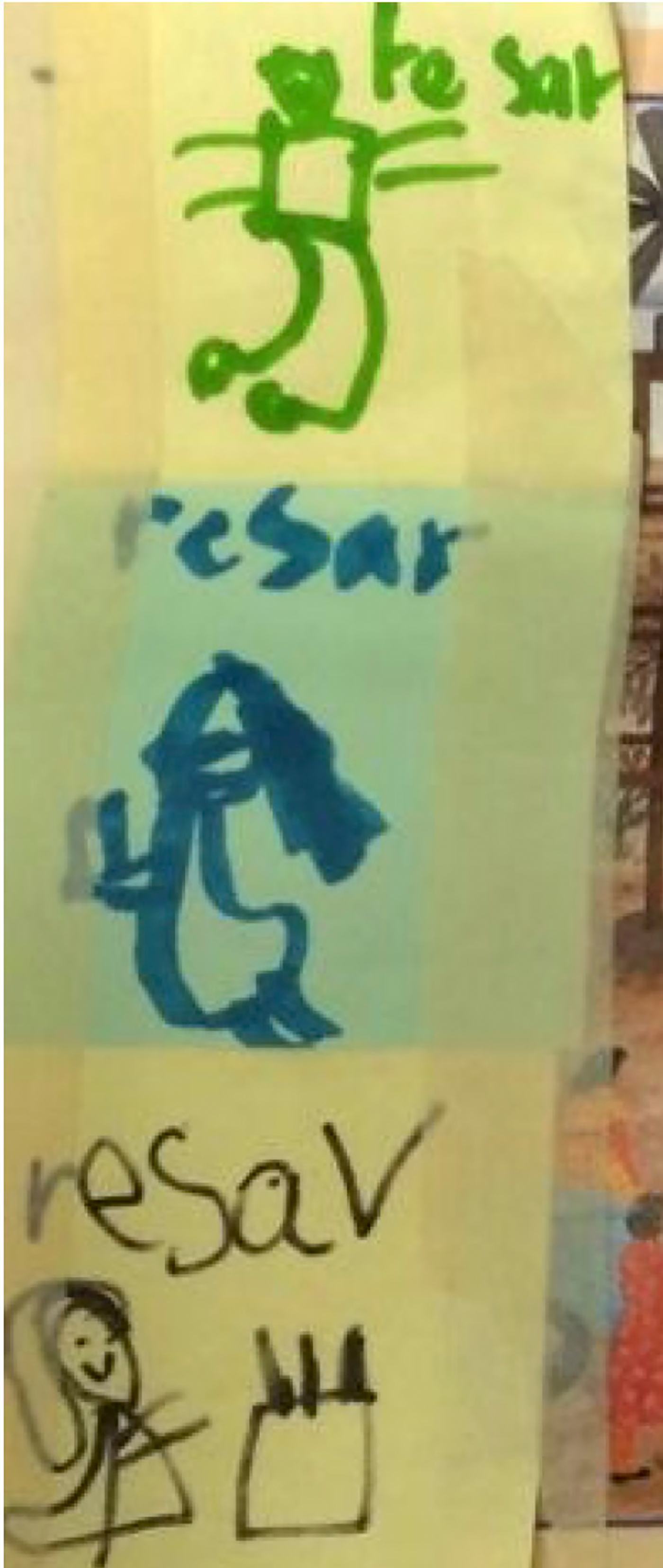
Three of the sticky notes affixed to El Milagro.
Step 2B: Where Would You Be?
B1. Leader A: Esta muy popular la virgen.… Que bonito! / The Virgin is very popular. How beautiful! (pointing to the sticky notes on the painting El Milagro) B2. Leader A: ¿Por qué escogiste esta [pintura]? ¿Qué estas haciendo? / Why did you choose this [painting]? What are you doing? B3. Andrés: Rezando. / Praying. B4. Alonso: Rezando. / Praying. B5. Author: Si estuvieras aquí [en el rancho], ¿dónde estarías? ¿Estarías de rodillas? ¿Estarías de pie? / If you were here [at the ranch], where would you be? Would you be kneeling? Would you be standing? B6. Gloria: Rezando, porque yo rezo cuando me duermo. / Praying, because I pray when I sleep. B7. Leader B: ¿Y tu Pedro, donde estarias? / And you, Pedro, where would you be? B8. Pedro: Rezando. / Praying. B9. Leader A: ¡Rezando! / Praying!
The outcomes of this exercise provide additional data for consideration. The quantity of sticky notes on Virgen Guadalupe and El Milagro reinforced to the Cuentos leaders and me that La Virgen exists in many of the children's VoR. The children's attentiveness to the people engaged in prayer in the painting (lines B2–B4) suggested to us that as an embodied act of growing inner knowledge, prayer was part of the children's everyday lives. We sought to confirm this assumption by asking about the physical postures the children would assume at the ranch (lines B5–B9). Gloria's (age 6) response, that she would be praying (kneeling) as she does before sleep (line B6), possibly like the pajama-clad child in the ranch house window, and Pedro's (age 4) comment that he, too, would be praying (lines B7–B9), are both life-to-text connections and public testimonies reinforcing their VoR.
These initial findings informed how we approached the next steps (below) in the Cuentos session. They highlight (a) the children's and families’ higher-order thinking in analyzing the illustrations and making connections between their lives and the text, and (b) how picturebooks about family life can reveal, if not affirm, the VoR of young readers and their families. For these reasons, it is important that teachers and teacher educators understand that even in secular spaces like the public library, readers’ responses to texts can sometimes serve as testimonies, engaging readers’ inner knowledge. Thus, it is essential to be familiar with the written and visual elements of the books and to recognize readers’ VoR and inner knowledge as valid sources of background knowledge to support reading development.
Step 3: Sharing Background Knowledge
Singing “La Guadalupana”
After the sticky-note activity, several of the children initiated their own embodied testimony. Suggestive of an intertextual connection (Sipe, 2008) with Garza's painting, the children spontaneously began to sing “La Guadalupana,” a folk song retelling of La Virgen's miraculous apparition to Juan Diego in 1531. Nearly everyone in the room joined the refrain.
Step 3A: Singing “La Guadalupana”
(children singing extemporaneously) C1. Leader A: Guaooo! ¿Cómo le cantas a la virgen? / Wow! How do you sing to La Virgen? C2. Nearly Everyone: Desde el cielo, una hermosa mañana. Desde el cielo, una hermosa mañana. La Guadalupana, la Guadalupana, la Guadalupana, bajó al Tepeyac. / From heaven, one beautiful morning. From heaven, one beautiful morning. The Lady of Guadalupe, the Lady of Guadalupe, the Lady of Guadalupe, came down to Tepeyac. C3. Leader A: ¿Cuando cantan esta canción? / When do you sing this song? C4. Mrs. Rosario: En diciembre. / In December. C5. Leader A: También en Mayo. / Also in May.
This transcript documents the families’ song (lines C1–C2) and establishes that among many families of Mexican heritage singing to La Virgen is traditional in December (in honor of La Guadalupana's Feast Day on December 12) and in May (in alignment with the Catholic Church's recognition of the Virgin Mary). Castañeda-Liles (2018), a scholar of testimonial practices to La Virgen, explained that some Mexican and Mexican American families teach their children to sing “popular songs [like] La Guadalupana and A Ti Virgencita (loosely translated as ‘To You, Virgencita’), which articulate the Guadalupan devotion in a Mexican nationalistic context” (p. 60). From this perspective, singing together was a celebration of the families’ shared Mexican identities as well a communal testimony of a shared VoR about La Virgen.
In short, young children's intertextual connections with picturebook illustrations can yield testimonial activities like singing in public spaces. This matters because singing is an embodied literacy practice that promotes language development (Lawson-Adams et al., 2022) and supports children's understanding of story grammar and reading comprehension when thoughtfully included in literacy development experiences (Shaw, 2021). Thus, there are opportunities for teachers and teacher educators to integrate children's joy of singing into (in)formal literacy engagements and learning experiences (Norton, 2008), affording space for children's embodied skills and knowledge.
Regional Representations of La Virgen
Progressing the conversation about the children's familiarity with La Virgen, Leader A initiated another line of inquiry with the question, “Who knows where there are photos of the Virgin of Guadalupe here, in the area?” (line D1). The families respond as though the question was “Who knows where there are local representations of the image of La Virgen?”
Step 3B: Regional Representations of La Virgen
D1. Leader A: Quien sabe donde hay fotos de la Virgen de Guadalupe aquí en el área? / Who knows where there are photos of the Virgin of Guadalupe here, in the area? D2. Andrés: En iglesias. / In churches. D3. Niña: En casas. Yo tengo un cuadro. / In houses. I have a painting. D4. Raquel: Con la Sister Rosa! / With Sister Rosa! D5. Leader A: Con la Sister Rosa. / With Sister Rosa. D6. Mrs. Gomez: Hay aca cerca una virgen que se apareció localmente. / There is, nearby, one Virgin who appeared locally.
In this transcript, the children make text-to-life connections (Sipe, 2008). Like Garza's childhood home and community, in the children's homes and local community, representations of La Virgen's likeness were accessible: in churches, nearby where a statue is prominently exhibited in the neighborhood after-school tutoring space of Sister Rosa, even nearer in houses, and in paintings belonging to the children (lines D2–D4). Furthering the discussion, Mrs. Gomez makes an intertextual (text-to-text) connection between a local story, the miracle narrative of La Virgen, and Garza's picturebooks. She uses the Spanish verb aparecer, “to appear” (i.e., se apareció), in describing a local apparition of a virgin (not La Virgen de Guadalupe; line D6). In doing so, Mrs. Gomez testifies that Marian apparitions, like the one Garza remembers in her painting El Milagro, are real in the local region, reinforcing the families’ VoR (McLoughlin et al., 2021).
These data points contextualize the families’ aesthetic responses to the text (Rosenblatt, 1978; Sipe, 2008). The families’ knowledge of and familiarity with local apparitions provides a lens for interpreting El Milagro and for developing speculative hypotheses about the mental states of people described at the ranch, discussed below. The local apparition is but one example of the types of spiritual encounters that exist across cultures, offering evidence of a spiritual realm (Luhrmann et al., 2021). Awareness of such stories, which is often unrecognized in literacy learning environments (Enciso et al., 2011), is embedded in children's VoR, both religious and nonreligious (Adams, 2019).
In the next section, I argue that children's VoR shapes the interpretations children bring to texts and literacy learning spaces, blending the physical, cultural, and spiritual contexts of their lives. Here, the Cuentos families’ stories and testimonial practices are compatible with those of Garza's childhood community as described in the picturebook. Importantly, readers with dissimilar background knowledge or VoR may interpret the same text differently. Therefore, I advocate that teachers and teacher educators must be prepared to navigate divergent aesthetic responses, including their own, understanding that varying VoR influence readers’ text interpretations.
Step 4: Introducing the Target Text
The written target text of El Milagro states that the Garza family made a pilgrimage to view an apparition on the day Garza's mother learned “la imagen de la Virgen de Guadalupe se había aparecido en un tanque de agua de un ranchito en el sur de Tejas / an image of the Virgin of Guadalupe had appeared on the water tank of a little ranch in south Texas.” For this step of the session, I projected an image of Garza's painting, El Milagro, onto the library wall. I posed a new higher-level thinking question (Peterson, 2017), “¿Crees que es verdad que se apareció [La Virgen] en el rancho? / Do you think it is true that she [La Virgen] appeared at the ranch?” The transcript describes the children's responses.
Step 4: Introducing the Target Text
E1. Author: ¿Crees que es verdad que se apareció [La Virgen]? / Do you think it is true that she [La Virgen] appeared at the ranch? E2. Niños: Si. / Yes. E3. Author: ¿Por que si? / Why yes? E4. Alonso: Porque se apareció. / Because she appeared. E5. Leader A: Porque se apareció, y es cierto. ¿Otra idea? / Because she appeared and it's true. Another idea?
In this exchange, multiple children shared a resolute agreement that La Virgen had, indeed, revealed herself at the ranch (line E2). For Alonso (age 7), there was no need to explain his perspective (line E4). The children's unwavering confidence that a miracle had occurred was consistent with their VoR and knowledge of other apparitions.
Speaking for many of the children, Alonso's declaration is significant. First, it implies that Alonso identifies with devotees who know the story of La Virgen and whose VoR recognizes La Virgen as a supernatural entity in the world. Second, it suggests that Alonso was certain La Virgen had appeared on the water tank in Garza's community. His certainty corresponds with the ways in which people interpret unexplained phenomena as miracles according to their VoR (Adams, 2019; Luhrmann et al., 2021). Third, Alonso's response is consistent with the families’ earlier conversation about local representations and apparitions of La Virgen. It reinforces that as an entity of the spiritual realm, La Virgen is not a figment of the past. She is present in the here and now (Luhrmann et al., 2021; McLoughlin et al., 2021). Fourth and finally, Alonso's declaration indicates that, like Mrs. Gomez, Alonso was not only familiar with the meaning of the verb aparecer but also proficient in his use of the term in discussing La Virgen.
This said, more research is needed to determine how young children with different VoR would respond to the same question, “Do you think it is true that she [La Virgen] appeared?” (line E1). One study shows that within a culturally diverse and religiously pluralistic neighborhood community, middle school students of varied worldviews would acknowledge that for members of Garza's childhood community, the miracle had occurred (Dávila & Volz, 2018). Conversely, another study in the same geographical region as the middle school (Dávila, 2015) shows that members of predominantly homogeneous group of preservice teachers (education majors at the local university) would not only reject the notion that La Virgen had appeared but would also typecast the community of people in El Milagro as being irrational.
When differences exist between the VoR of teachers, students, and people described in nonfiction texts for children, it is incumbent upon state-funded schools to exercise neutrality in neither privileging nor dismissing children's VoR, religious or nonreligious. This is because educators are giving testimony to a particular view of reality when they demonstrate a preference or a distaste for any VoR, which can significantly impact children (Anti-Defamation League, 2012).
Step 5: Conversing About the Target Text
For the final step of the evening, the children considered two other lines in the target text. The first explains, “Había una larga fila de personas hacienda una peregrinación hacia el sitio traían flores y ofrendas / There was a constant stream of people making a pilgrimage to the site, bringing flowers and offerings.” Of the apparition on the water tank, the second line states, “No todos podían ver la imagen, pero casi todos sí podían verla. / Not everybody could see the image, but most people could.” The target text does not explain why, leaving readers to bridge the gap (Iser, 1978). Pointing to a large projected image of El Milagro / The Miracle, I initiated a higher-level thinking prompt, “Here, with the blue dress, little Carmen says, ‘Not everybody could see the image [of La Virgen].’ Why?” (line F1). The transcript describes the children's speculative hypotheses (Sipe, 2008) or theories of mind about the mental states of the people in the target text who could not see the image.
Step 5: Conversing About the Target Text
F1. Author: Aquí, con el vestido azul, esta niña dice que algunas personas no podían ver la imagen [de La Virgen]. ¿Por qué? / Here, with the blue dress, little Carmen says, “Not everybody could see the image [of La Virgen].” Why? F2. Pati: Porque nunca la han visto. / Because they have never seen her. F3. Leader A: Nunca la han visto; no saben. / Because they have never seen her; they don't know. F4. Matteo: Porque creen que nada mas la pintaron. / Because they think people painted it. F5. Raquel: No tienen fe. / They don't have faith. F6. Regina: Porque sólo la [aparición] puedes saber en tu mente. / Because you can only know it [the apparition] in your mind. F7. Leader B: A ver, Pedro tiene la manita levantada. A ver, ¿que quieres decir? / Let's see, Pedro has his hand up. Let's see, what do you want to say? F8. Pedro: Porque estaba allá arriba y la gente no lo veía. / Because it was up there, and people didn't see it.
I have structured this discussion to show how the children's speculative hypotheses (Sipe, 2008) evolve in complexity with age and maturity (lines F1–F8). The transcript provides evidence of the children's higher-order thinking and theory-of-mind development, which is related to reading comprehension (Dore et al., 2018; Peterson, 2017; Tompkins et al., 2024). This data set highlights the children's proficiency, offering a counternarrative to the deficient labels often assigned to them by their schools, as discussed in the Methods section.
Inadequate Sightlines: A Primary-Tier Theory of Mind
I begin with Pedro (age 4), the youngest child to use his imagination to enter the minds of the onlookers who couldn't see La Virgen's image on the water tank. Consistent with other children his age, Pedro formulates what Dore et al. (2018) called a primary-tier theory of mind in considering the spatial perspectives of people in a target text. He theorizes that some people couldn't see La Virgen because her image was above their lines of sight (line F8). For Pedro, La Virgen's image is a given; she is part of the world and had revealed herself to Garza's childhood community. For Pedro, the issue is purely spatial: Some people couldn't see the apparition due to their physical locations on the ground.
Inadequate Background Knowledge: A Second-Tier Theory of Mind
Next, Pati (age 6) uses her imagination to enter the minds of people who couldn't see La Virgen's image on the water tank. Like her brother Pedro, Pati shares a VoR in which La Virgen is part of the spiritual realm. However, being two years older, Pati formulates a second-tier theory of mind (Dore et al., 2018) about the onlookers’ knowledge of the visual image. She imagines that some spectators were not familiar with La Virgen's likeness and were unable to discern her appearance on the water tank (line F2). Pati's statement implicitly submits that people need adequate prior exposure to mentally recognize images in novel contexts.
Sufficient Ordinary Explanation: A Third-Tier Theory of Mind
Following Pedro and Pati, Matteo (age 7) uses his imagination to enter the minds of onlookers. He proposes that the reason some could not see La Virgen is neither about their spatial perspectives nor their prior exposure to her image. Matteo proposes a third-tier theory of mind, which considers the complexities of human thoughts and emotions (Dore et al., 2018). He speculates that some spectators assumed that the image of La Virgen was painted onto the water tank (line F4). For him, the issue is whether people interpreted the image as an apparition of the spiritual realm or the handiwork of humans in the physical realm.
Lack of Faith: A Third-Tier Theory of Mind
Expanding upon Matteo's theory of mind about the internal assumptions of some onlookers, Raquel (age 7) imagines that the situation is more nuanced. She hypothesizes that some spectators couldn't see the image of La Virgen because they don't have faith (line F5). Applying Raquel's higher-level thinking (Peterson, 2017), the people whose VoR recognizes the existence of La Virgen were able to see the image. Others could not. Moreover, Raquel's theory is unique because it corresponds with the research of Luhrmann et al. (2021), who found that people interpret visual stimuli in alignment with their VoR, which can be religious or nonreligions in nature (Adams, 2019).
To contextualize Raquel's theory of mind in a mainstream context, what Raquel knows is consistent with what Charlotte the spider knows in the canonical children's novel Charlotte's Web (White, 1952). Set at the Zuckermans’ farm, Charlotte understands that the families living in the region share a VoR that includes both a physical realm and a spiritual realm. Using her social cognitive imagination to contemplate these humans’ thoughts and emotions (Kushnir, 2022; Lysaker et al., 2016), Charlotte develops a theory of mind that could prevent the slaughter of her friend, Wilbur the pig. She hypothesizes that if the humans see an inexplicable phenomenon in the silk of her web (i.e., the words “Some Pig”), they will interpret the phenomenon as a miracle. As described in “The Miracle,” Chapter 11 of Charlotte's Web, upon seeing the web, the humans assume Wilbur is a spiritual being who is living in the physical realm of their farm community. Like Charlotte, Raquel understands the influence of people's VoR in interpreting visual stimuli.
Mind Over Matter: An Advanced Theory of Mind
Going one step further, Regina (age 8), the eldest contributor to the conversation, speaks directly to the deep inner knowledge that verifies a phenomenon is miraculous. She expands upon Matteo's and Raquel's third-level theories of mind, proposing that some people couldn't see the image in the water tank because people can only know it's an apparition in their minds (line F6). At age 8, Regina's understanding of the mind's power in interpreting images is profound given that such awareness is more typical of adolescents and young adults (Deane et al., 2019; Dore et al., 2018). Regina's observation is likewise consistent with the scholarship of Luhrmann et al. (2021), who found that people use their minds to “watch for signs of the presence of a [spiritual] being that cannot be seen” (p. 7). In other words, the mind's eye has the capacity to detect the presence of spiritual beings in unexpected places of the physical realm. Anzaldúa (2015) recounted such an experience in recognizing an apparition of La Virgen in a cypress tree on the California coastline. Hence, Regina's theory of mind is remarkable in hypothesizing that some people did not have the inner knowledge to recognize La Virgen with their mind's eye.
Summary of Step 5
During this final conversation of the evening, the children formulated first-, second-, and third-tier theories of mind (Dore et al., 2018) in their home language of Spanish to fill in the gaps of the written target text about why some people couldn't see the image of La Virgen. The children's hypotheses were developmentally consistent, if not advanced, for their age groups (Deane et al., 2019; Dore et al., 2018). Moreover, the children's theories were informed by their background knowledge and higher-order thinking skills (Peterson, 2017), which also support their reading growth in additional languages, like English (Cummins, 1979; Luo & Song, 2022; Wagley et al., 2022).
Conclusion
This descriptive case study is noteworthy for several reasons. Theoretically, this study illustrates the influence of young children's tacit VoR and inner knowledge in formulating theories of mind about people in visual and written text, extending the corpus of research about the role of background knowledge in children's theory-of-mind development (Carpendale & Lewis, 2006; Devine & Hughes, 2018; Lecce et al., 2024). Here, the data set expands the notion of a bidirectional relationship (Tompkins et al., 2024) and contributes to the concept of a tri-directional relationship between children's background knowledge, theory-of-mind development, and reading comprehension. It offers evidence to suggest that these elements cannot be separated in the process of interpreting texts about people or characters. Children's tacit inner knowledge, shaped by their family experiences and VoR, informs how they interpret texts and formulate theories about people and events in text. Future theory-of-mind research could focus on the tridirectional relationship, exploring the influence of children's cultural knowledge, including their VoR and inner knowledge.
Pedagogically, this study illustrates how Lee's (2021) cultural modeling framework for literacy instruction in middle and high school settings can inform literacy instruction in an informal, community-based early childhood setting. The procedures of this study were inspired by Lee's framework, using familiar texts from students’ cultural backgrounds (e.g., the image and miracle story of La Virgen) to scaffold higher-order reasoning (Peterson, 2017) about a target text (e.g., Garza’s [1996] El Milagro). Lee (2021) recommended coordinating a metacognitive conversation where students analyze and apply the salient features of the familiar text to interpret the target text. In this case, during a discussion about the mental states of semiotically represented people in the target text, the children used their VoR and inner knowledge of La Virgen to formulate theories of mind about these people, bridging gaps (Iser, 1978) in the target text.
The data set offers a springboard for future research on using Lee's framework with young children, particularly in response to Orellana et al. (2010), who urged literacy educators to explore approaches like cultural modeling to support the reading development of students (mis)identified as “remedial.” While local elementary schools applied deficient labels to the emergent bilingual children in the Cuentos program, this study indicates that many children were highly proficient in exercising their higher-order thinking and reasoning, which is predictive of reading growth (Peterson, 2017; Taylor et al, 2005) and transferable to their emergent skills in English (e.g., Cummins, 1979; Luo & Song, 2022; Wagley et al., 2022).
This study also provides insights into the ways familial and community-based testimonial practices such as analyzing visual text, singing, and (re)telling stories inform children's VoR and support their inner knowledge. These are culturally relevant literacy practices that can frame formal literacy learning experiences. As observed by McKeough et al. (2008) in writing about the importance of oral narratives in Aboriginal children's literacy instruction, literacy educators have long advocated for culture-based resources and teaching methods that address the unique sociocultural VoR and inner knowledge of Indigenous children. Relatedly, Norton (2008) in writing about song and movement as spiritual practices of an African American first grader, advocated for the exploration of singing, music-making, and body movement within the curriculum, employing young children's embodied inner knowledge. Together, these studies point to the often-untapped resource of children's rich out-of-school literacy practices that, through testimonial activities, validate their VoR and inner knowledge.
Finally, this study demonstrates that young children are profoundly capable of engaging in abstract aesthetic responses to texts, particularly when drawing from their own VoR and inner knowledge. In terms of professional development, this modest case study underscores the need for literacy teachers and teacher educators to stop and ask, “Whose reality matters?” The data set indicates that, while significant, instructional efforts to activate children's cultural background knowledge without recognizing children's VoR and inner knowledge are missed opportunities for exercising an inclusive, holistic view of knowledge that affirms children's tacit ways of knowing.
Whether they are religious or nonreligious, inclusive or exclusive of a spiritual realm, children's VoR can differ significantly from those of educators and teacher educators. Hence, it is incumbent upon the literacy education community to treat children’s varied ontological views of reality as valid and valued sources of knowledge (Anzaldúa, 2015). In this way, it could be possible to facilitate reading experiences in which young children are welcome to utilize all their knowledge resources to engage deeply with texts and increase their reading comprehension.
Supplemental Material
sj-docx-1-jlr-10.1177_1086296X251330836 - Supplemental material for Whose Reality Matters? Children’s Ontologies, Theories of Mind, and Reading
Supplemental material, sj-docx-1-jlr-10.1177_1086296X251330836 for Whose Reality Matters? Children’s Ontologies, Theories of Mind, and Reading by Denise Dávila in Journal of Literacy Research
Supplemental Material
sj-docx-2-jlr-10.1177_1086296X251330836 - Supplemental material for Whose Reality Matters? Children’s Ontologies, Theories of Mind, and Reading
Supplemental material, sj-docx-2-jlr-10.1177_1086296X251330836 for Whose Reality Matters? Children’s Ontologies, Theories of Mind, and Reading by Denise Dávila in Journal of Literacy Research
Supplemental Material
sj-docx-3-jlr-10.1177_1086296X251330836 - Supplemental material for Whose Reality Matters? Children’s Ontologies, Theories of Mind, and Reading
Supplemental material, sj-docx-3-jlr-10.1177_1086296X251330836 for Whose Reality Matters? Children’s Ontologies, Theories of Mind, and Reading by Denise Dávila in Journal of Literacy Research
Supplemental Material
sj-docx-4-jlr-10.1177_1086296X251330836 - Supplemental material for Whose Reality Matters? Children’s Ontologies, Theories of Mind, and Reading
Supplemental material, sj-docx-4-jlr-10.1177_1086296X251330836 for Whose Reality Matters? Children’s Ontologies, Theories of Mind, and Reading by Denise Dávila in Journal of Literacy Research
Supplemental Material
sj-docx-5-jlr-10.1177_1086296X251330836 - Supplemental material for Whose Reality Matters? Children’s Ontologies, Theories of Mind, and Reading
Supplemental material, sj-docx-5-jlr-10.1177_1086296X251330836 for Whose Reality Matters? Children’s Ontologies, Theories of Mind, and Reading by Denise Dávila in Journal of Literacy Research
Footnotes
Acknowledgements
A heart-felt thanks goes to Dr. Silvia Noguerón-Liu for her support of this project. A special acknowledgement goes to Dr. Max Vazquez Dominguez for his contribution, as well.
Declaration of Conflicting Interests
The author declared no potential conflicts of interest with respect to the research, authorship, and/or publication of this article.
Funding
The author received no financial support for the research, authorship, and/or publication of this article.

References
Supplementary Material
Please find the following supplemental material available below.
For Open Access articles published under a Creative Commons License, all supplemental material carries the same license as the article it is associated with.
For non-Open Access articles published, all supplemental material carries a non-exclusive license, and permission requests for re-use of supplemental material or any part of supplemental material shall be sent directly to the copyright owner as specified in the copyright notice associated with the article.
