



Abstract
A qualitative think-aloud study, informed by social literacies and holistic bilingual perspectives, was conducted to examine how six emergent bilingual, Mexican American, fourth graders approached, interacted with, and comprehended narrative and expository texts in Spanish and English. The children had strong Spanish reading test scores, but differed in their English reading and oral proficiency test scores. All but one of them varied their cognitive and bilingual strategy use according to the demands and genre of the text and their oral English proficiency. The most frequent bilingual strategies demonstrated were translating and code-mixing. Only two children used cognates. The children often employed one language to explain their reading in the other language. They displayed a wider range of strategies across two languages compared with a single language, supporting the use of a holistic bilingual perspective to assess their reading rather than a parallel monolingual perspective. Their reading profiles in the two languages were similar, suggesting cross-linguistic transfer, although the think-aloud procedures could not determine strategy transference. The findings supported a translanguaging interpretation of their bilingual reading practices. Future research on how emergent bilingual children of different ages develop translanguaging and use it to comprehend texts was recommended.
Keywords
In the United States, the number of Latina/o children who are emergent bilinguals (children who know one language at home and acquire another language at school; O. García, Kleifgen, & Falchi, 2008) continues to increase (U.S. Department of Education, Institute of Education Sciences, National Center for Education Statistics, 2014). In 2060, 29% of the U.S. population is projected to be Latina/o, compared with 17% in 2014 (Colby & Ortman, 2014). Although the reading test scores for Latina/o students on the National Assessment of Educational Progress improved between 2002 and 2009, the Grade 4 scores still were significantly below those of Anglo (non-Latina/o White) students (Hemphill & Vanneman, 2010). Federal reform efforts, such as Race to the Top (U.S. Department of Education, 2009) and the Common Core State Standards (National Governors Association Center for Best Practices & Council of Chief State School Officers, 2010), emphasized instructional improvements and standards for all students, including emergent bilingual children, based on what was known about the English reading performance of monolingual, native English-speaking students, but not on what was known about the bilingual reading performance of Latina/o students. Our aim in this article is to contribute to what is known about the bilingual reading practices of Latina/o children who are emergent bilinguals so that educational reforms and instructional standards can be based on their literacy strengths.
The Reading Comprehension Development and Instruction of Emergent Bilingual Children
The RAND Reading Study Group (2002) defined reading comprehension as “the process of simultaneously extracting and constructing meaning,” involving interactions among “the reader, the text, and the task or activity,” all situated in and affected by the sociocultural context (p. xiii). Although the RAND definition appears to apply to children who are emergent bilinguals, several unique factors also affect their reading development and instruction: their first language (L1) reading development, use of cross-linguistic transfer, second language (L2) oral proficiency, and bilingual status (G. E. García, 2003).
L1 Reading Development
Authors of three recent meta-analyses concluded that Latina/o children who are emergent bilinguals who were taught to read for 2 to 3 years in Spanish and English scored significantly higher on English reading measures than those who were taught to read only in English (Francis, Lesaux, & August, 2006; Rolstad, Mahoney, & Glass, 2005; Slavin & Cheung, 2005). Despite this finding, we do not know very much about how L1 reading actually affects L2 reading (Goldenberg, 2011).
Cross-Linguistic Transfer
In his interdependence hypothesis, Cummins (1981, 2000) argued that once bilingual students develop a literate base in one language, they could transfer knowledge and skills gained while reading in that language to reading in another language, as long as they were adequately exposed to the other language and motivated to acquire it. As evidence for cross-linguistic transfer, several researchers reported that bilingual students’ reading comprehension performance in their two languages was highly correlated (Genesee, Geva, Dressler, & Kamil, 2006). However, what transfers, how, and under what conditions still need to be investigated (Goldenberg, 2011).
Genesee et al. (2006) recommended that use of the term “cross-linguistic transfer” be informed by Bransford and Schwartz’s (1998) conceptualization of transfer as “preparedness for future learning” (p. 70). They proposed that the meaning of cross-linguistic transfer be broadened to refer to “corresponding or analogous skills” and “meta-linguistic or meta-cognitive skills that emerge [in the L2] from competence in the [L1]” (Genesee et al., 2006, p. 161). Chuang, Joshi, and Dixon’s (2011) study of Taiwanese ninth graders, who had learned to read in Mandarin Chinese (their L1) and had been learning English as a foreign language for 3 to 5 years, supported Genesee et al.’s (2006) interpretation of transfer. They found that the Taiwanese ninth-grade students’ reading test scores in Mandarin Chinese not only predicted their English reading test scores but also significantly accounted for about 63% of the English reading test variance, indicating that the students had transferred meaning-making strategies from Mandarin to English.
A specific bilingual strategy that appears to indicate cross-linguistic transfer of knowledge from one language to another is the use of cognates (Lubliner & Hiebert, 2011). Cognates are words in two languages with ancestral roots that look similar and have similar meanings. In a study with Latina/o bilingual fourth, fifth, and sixth graders, Nagy, García, Durgunoğlu, and Hancin (1993) found that when they controlled for the students’ English vocabulary knowledge, the students’ Spanish vocabulary knowledge and post hoc ability to recognize cognates significantly predicted their comprehension of previously unknown English words. The researchers concluded that cross-linguistic transfer had occurred, although they questioned whether cognate awareness was developmental because the fourth graders’ cognate performance was significantly poorer than that of the fifth and sixth graders.
Translating is another bilingual strategy that appears to involve cross-linguistic transfer. Orellana, Reynolds, Dorner, and Meza (2003) provided ethnographic portrayals of two Latina/o bilingual adolescents’ oral interpretations of texts, or what they called “para-phrasing.” They considered translating or paraphrasing to be a social literacy event that had an important purpose in the lives of the youths and their adult relatives, who knew less English than the youths. Because Orellana and her colleagues viewed translating as a process that results in bilingual children’s active engagement with and interpretation of texts, they proposed that it should be tapped in their school instruction.
L2 Oral Proficiency
Researchers who investigated bilingual children’s L2 reading development in Grades 2 and below reported that L1 reading was a stronger predictor of their L2 reading compared with their L2 oral proficiency, whereas the reverse was true for bilingual children in Grades 3 and above (G. E. García, 2000). Durgunoğlu (2002) proposed that children who were strong L1 readers but weak L2 readers probably had not transferred their L1 expertise to their L2 reading because of insufficient L2 oral proficiency. Given the above findings, and the significant correlations that Goldenberg (2011) reported between bilingual children’s low oral English proficiency and low English reading performance, we need more research on the role of L2 oral proficiency in children’s L2 reading.
Bilingual Status
Several researchers discovered that tapping into Latina/o children’s bilingualism revealed enhanced information about their reading comprehension. Martínez-Roldán and Sayer (2006) reported that Latina/o bilingual third graders sometimes revealed greater comprehension of English stories when they were asked to retell them in Spanish. In a think-aloud study with middle school Latina/o bilingual students, Jiménez, García, and Pearson (1996) reported that the Latina/o students who were successful English readers demonstrated high-level cognitive strategies, similar to those of a sample of monolingual English-speaking students who were successful English readers, even though the bilingual students knew less of the English vocabulary and had less background knowledge. The Latina/o successful English readers also had a unitary view of reading across their languages and sometimes used strategies unique to their bilingual status to demonstrate text comprehension, usually while reading in Spanish, their weaker language. They paraphrased what was read in one language by using the other language, translated, occasionally accessed cognates, code-mixed (switched to the other language in the same utterance), and code-switched (switched to the other language in different utterances).
Reading Comprehension Instruction
Many of the instructional programs implemented with Latina/o children who are bilingual were derived from the monolingual English reading research with the aim of improving their English reading performance, not their Spanish or bilingual performance (August & Shanahan, 2010). Shanahan and Beck (2006) reported that the programs had less impact on bilingual children’s English reading comprehension than on that of monolingual English-speaking children. For example, instructional programs that focused on improving bilingual children’s oral reading fluency in English attained that goal but did not improve their English reading comprehension. When researchers incorporated children’s L1 and features of English-as-a-second-language instruction to support their L2 comprehension, then the instructional programs increased in effectiveness (August & Shanahan, 2010).
In a review of instructional strategy research, Wilkinson and Son (2011) concluded that students who were taught how to flexibly use a small set of comprehension strategies improved their reading comprehension. However, the researchers warned that many teachers had difficulty teaching the strategies flexibly. Handsfield and Jiménez’s (2009) Bourdieuian analysis of a third-grade teacher’s literacy instruction in a multilingual classroom confirmed Wilkinson and Son’s concern. They reported that the teacher taught the strategies in a lock-step fashion, with her textual interpretations dominating those of the students. Wilkinson and Son (2011) proposed that strategy instruction had positive effects on student comprehension not because students received strategy instruction, but because they used the strategies to actively discuss and interpret texts, engaging in dialogic reading.
The instructional strategy findings for Latina/o emergent bilingual children were mixed. Dalton, Proctor, Uccelli, Mo, and Snow (2011) compared how children in fifth grade (one group was English monolingual, another Latina/o bilingual, and a third was bilingual from non-Spanish language backgrounds)—assigned to either vocabulary instruction, cognitive strategy instruction, or combined strategy and vocabulary instruction in a digital reading context—performed on English comprehension and vocabulary measures. They reported that the monolingual students and the two groups of bilingual students in the combined strategy and vocabulary group outperformed the strategy group on a narrative comprehension measure and wondered whether the lack of dialogical reading opportunities might have affected their findings. In contrast, an observational study of teachers’ vocabulary and comprehension instruction with monolingual English-speaking students and Latina/o bilingual students in the same third-, fourth-, and fifth-grade classrooms (Silverman et al., 2013) found that teacher “instruction that attended to comprehension strategies was associated with greater positive change in comprehension [test scores] for bilingual (but not for monolingual) students” (p. 31). The discrepancy in findings highlights the importance of understanding what differentiates the effective reading comprehension instruction of bilingual students as compared with that of monolingual English-speaking students.
Theoretical Perspectives
Our work draws from three theoretical perspectives: Street’s (2003) sociocultural view of literacy, Hopewell and Escamilla’s (2014) holistic bilingual perspective, and O. García’s (2009) theory about translanguaging. According to Street, a sociocultural view of literacy emphasizes literacies that hold cultural meanings for the participants and that are situated in and created by participants’ communities. Street rejects the technical, autonomous, and hegemonic view of English literacy promoted in U.S. schools and views literacies as social and cultural practices, shaped by ideologies and power relationships. Informed by Street, we designed our research so that the sociocultural contexts in which bilingual students read and discussed their reading supported their use of Spanish and strategies unique to their bilingual status—strategies that bilingual communities value and promote (i.e., code-mixing), but that often are forbidden or ignored at school. To heighten the status of Spanish, we chose to present transcripts in the original language, summarizing what was said in Spanish in the brief narratives preceding the transcript examples. We provide translations of the Spanish examples with each example numbered in the text (e.g., Translation 1) in an appendix in the online supplementary archive.
Recently, a “holistic bilingual perspective” (Hopewell & Escamilla, 2014) and the theoretical concept of “translanguaging” (O. García, 2009; O. García & Leiva, 2014) have been proposed as more useful ways to characterize bilingual individuals’ communication and literacy practices than cross-linguistic transfer. According to Hopewell and Escamilla (2014), a holistic bilingual perspective acknowledges that bilingual individuals’ competence in more than one language allows them to uniquely approach reading from the “totality of what is known and understood across languages” (p. 73). In an analysis of reading test data for Latina/o elementary-age bilingual students, Hopewell and Escamilla showed that using monolingual assessments to examine the students’ reading test performance in each language underestimated their biliteracy development.
Several researchers have called bilingual individuals’ integrated and dynamic use of two languages “translanguaging” (O. García & Leiva, 2014). O. García (2014) explained that translanguaging involves “the normal discourse practices of bilingual individuals and families,” in which they strategically use all their linguistic resources to communicate (p. 1). Daniel and Pacheco (2016) defined translanguaging as “moving across languages and registers of speech to make meaning” (p. 653). Although translanguaging may include translating, code-switching, and code-mixing, it is not limited to these strategies and does not involve the parallel monolingual analysis (Heller, 1999) that often occurs when the above strategies are analyzed for appropriate syntactic and lexical usage in each language. According to Velasco and García (2014), Cummins’s interdependence theory is part of translanguaging, although translanguaging emphasizes skills and knowledge employed across languages, rather than separating them into L1 and L2.
Other researchers documented how bilingual elementary students employed translanguaging while writing (Bauer, Presiado, & Colomer, 2017; Velasco & García, 2014). In a discourse analysis of Hispanic bilingual first graders’ talk, Gort (2012) showed how the children code-switched between Spanish and English to discuss and plan their writing. Several researchers illustrated how translanguaging could be used as an instructional strategy to improve bilingual youths’ reading comprehension and engagement (Daniel & Pacheco, 2016; Jiménez et al., 2015). To our knowledge, how bilingual children enact translanguaging to approach, interpret, and discuss texts while reading has not been studied.
Purpose of the Study
The purpose of this study was to use qualitative think-aloud procedures, informed by social literacies and holistic bilingual perspectives, to examine how six children at the fourth-grade level who are Mexican American and emergent bilingual approached, interpreted, and discussed texts in Spanish and English while reading. We purposefully focused on fourth graders who had been in bilingual education for 3 to 4 years and who scored relatively high on a Spanish reading test because we wanted to understand how bilingual students who were strong readers in Spanish employed what they knew in Spanish to approach reading in English. We also wanted to examine the utility of comparing the students’ demonstration of cognitive and bilingual strategies across their two languages—what we refer to as a cross-linguistic analysis—with a translanguaging approach. Four research questions guided our work:
Method
A constructivist/interpretive paradigm (Mertens, 2010), consistent with Street’s (2003) view of social literacies, informed the study, while qualitative methods informed by ethnography of communication (Saville-Troike, 2003) were used to collect and analyze the findings. The constructivist/interpretive paradigm was appropriate for the think-aloud study because the students did not announce the strategies they were using; rather, the strategies had to be inferred from the students’ gestures or physical reactions to the text (e.g., frowns), what they said about the text, what they included in their retellings, and what actually was in the text, requiring triangulation across the data sources. Our study also was informed by constructivism because we did not expect students to demonstrate the same strategies at specific points in the text or in the same texts. Although our findings included frequency counts, we were primarily interested in what characterized the students’ reading, thinking about, and discussion of texts, which is best captured through qualitative methods. Saville-Troike (2003) advised that there are times when quantitative methods, such as frequencies, are helpful in a qualitative analysis of language because they provide for consistency and indicate how much variation occurs.
Research Context
The study was conducted in a school district (K-8) of approximately 8,000 students in a small urban city of approximately 77,000 people in a metropolitan area in the Midwest. Approximately 49% of the district students were Anglo, 29% African American, 18% Latina/o, 2% Asian/Pacific Islander or Native American, and 2% “Other.” Six percent were classified as emergent bilinguals, the majority of whom were Latina/o of Mexican background.
The district provided an early-exit transitional bilingual education (TBE) program for Latino/a bilingual children in Grades K-5. The TBE program goals were for the bilingual children to move from Spanish to English instruction so that they could participate in all-English classes and attain and continue grade-level performance in Spanish during the transition. Teachers in the TBE program were to provide Spanish-speaking students with Spanish literacy instruction during kindergarten and first grade and introduce them to English literacy instruction during second grade. The program’s goal was to move the bilingual students to the all-English classroom by the end of third or fourth grade.
The think-aloud findings reported in this study were from a larger study on Latina/o emergent bilingual students’ language and literacy instruction and performance that took place in three of the district classrooms. To recruit participants, the district bilingual coordinator invited all the fourth-grade teachers with Latina/o bilingual students (former and current) at four district schools to participate. Three teachers from two schools agreed to participate: a fourth-grade all-English teacher and a third/fourth-grade TBE teacher from Preston School and a third/fourth-grade TBE teacher from Karl School (pseudonyms are used for the schools and participants). Almost 65% of the students at Preston School were of Mexican descent, with 18% in bilingual education. At Karl School, 80% of the students were African American and 18% were Mexican American; only 10% were in bilingual education.
None of the fourth-grade teachers reported or were observed teaching their students metacognitive or cognitive strategies, although the district curriculum guidelines for fourth grade stated that students were supposed to be able to make inferences and predict outcomes, develop questions and answers that explained and substantiated what was read, and summarize an oral message. The bilingual teachers used a basal reading series available in English and Spanish published by Macmillan, while the all-English teacher used the same basal series but only in English.
Participants
All of the fourth-grade Latina/o students who had been in TBE and for whom parental consent and student assent had been attained participated in four pen-and-pencil tasks administered by the first author, G.E.G.; the tasks took place in the students’ classrooms during the latter part of the fall semester. Those students (n = 17) who demonstrated on the pen-and-pencil tasks that they could read in Spanish and English then were selected for possible participation in two think-aloud studies, which took place over 4 months during the spring semester.
For the think-aloud study in this article, we used criterion-based purposeful sampling (Corbin & Strauss, 2008) to select six of the 17 students. Table 1 presents descriptive data for the six students. We selected these students because they scored above the 85th percentile on La Prueba, a Spanish standardized reading test; had been in a TBE program for at least 3 years; and varied in their English reading test performance and oral English proficiency. We also wanted two students from each of the three classrooms and, if possible, equal numbers of male and female students. School district personnel previously selected and administered the standardized reading and language assessments and provided us with the test scores.
Student Background Data.
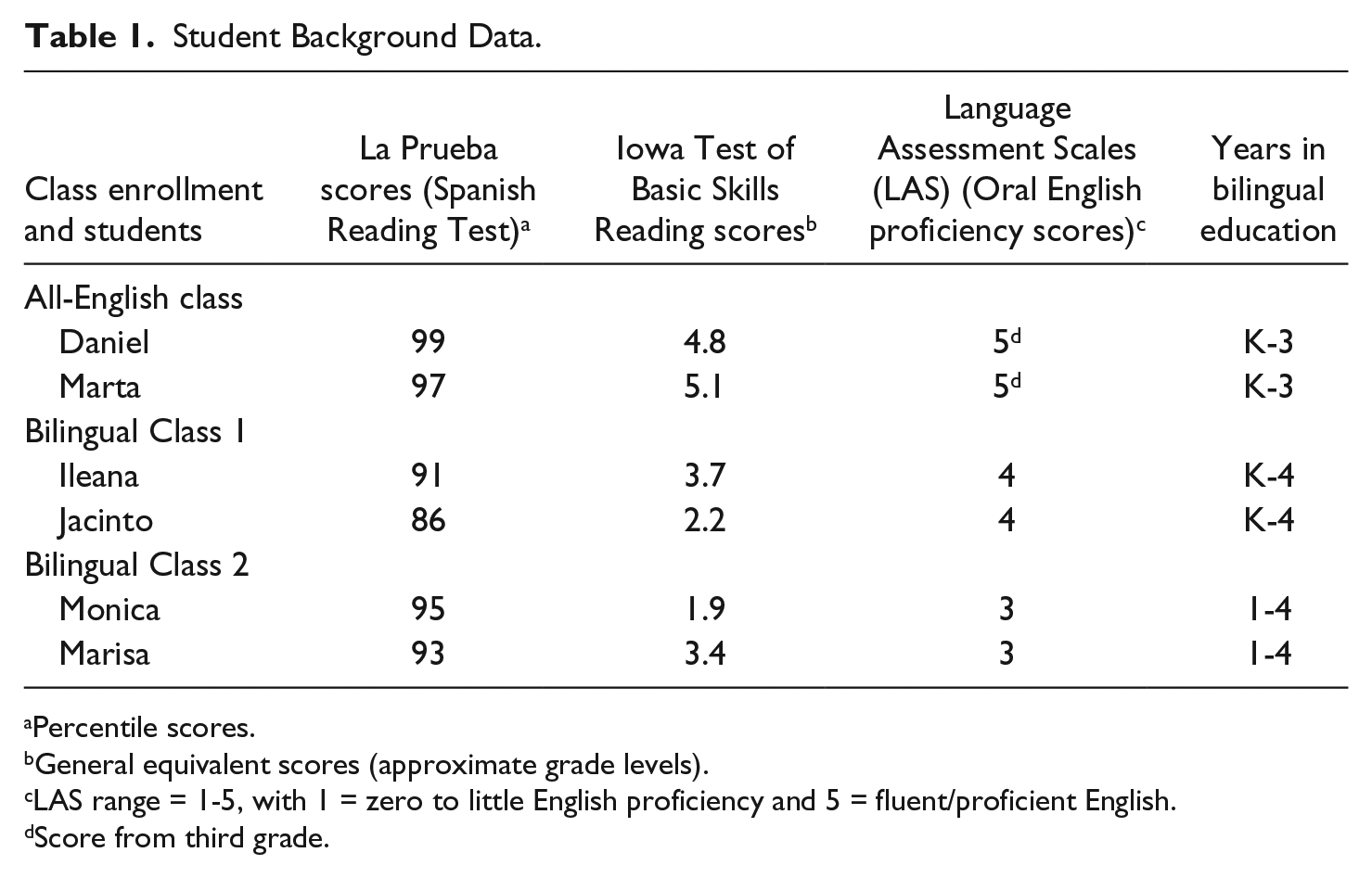
Percentile scores.
General equivalent scores (approximate grade levels).
LAS range = 1-5, with 1 = zero to little English proficiency and 5 = fluent/proficient English.
Score from third grade.
During the study, Daniel and Marta were students in the same all-English fourth-grade classroom at Preston School. After 4 years in the TBE program (kindergarten through third grade), they had been exited from the program. As Table 1 shows, they had high scores on the Spanish reading test (in the 99th and 97th percentiles, respectively), were above grade level on the English reading test (4.8 and 5.1), and obtained the highest possible score, a 5, on the oral English proficiency test (range = 1-5). Although the majority of their Latina/o classmates previously had participated in the district TBE program, their Anglo teacher, who spoke some Spanish, taught only in English.
Ileana and Jacinto had been in the TBE program from kindergarten through fourth grade and were enrolled in the same third/fourth-grade TBE classroom at Karl School. They scored relatively high on the Spanish reading test (in the 91st and 86th percentiles, respectively) but below grade level on the English reading test (3.7 and 2.2). Their oral English proficiency scores of 4 were high but not at the level needed for exiting the TBE program. Their teacher was a Latina woman from South America, bilingual in Spanish and English, and certified in bilingual and elementary education. In the fall, she taught reading in Spanish and English, and in the spring, emphasized English expository texts.
Monica and Marisa had been in TBE classrooms from first through fourth grade and were enrolled in the same third/fourth-grade TBE classroom at Preston School. They scored high on the Spanish reading test (in the 95th and 93rd percentiles, respectively) but below grade level on the English reading test (1.9 and 3.4). Their oral English proficiency scores of 3 indicated that they were developing this skill. Their teacher was a Latina woman from South America, dominant in Spanish, and certified in bilingual and elementary education. Although the girls’ Spanish reading instruction emphasized grade-level basals, their English reading instruction emphasized second-grade basals.
The first author, G.E.G., is Anglo and bilingual in Spanish and English. The second author, H.G., is Mexican American and bilingual in Spanish and English. Both authors previously taught Latina/o students in bilingual settings and are advocates of bilingual education. G.E.G. collected the data from the students, interviewed the teachers, and collaborated with H.G. on the data coding, analysis, and interpretation. They both conducted classroom observations. G.E.G. is the researcher mentioned in the findings.
Data Collection Procedures
To introduce the selected students to think-alouds, we had them participate in two group sessions in which G.E.G. modeled how to do think-alouds and had the students practice as a group and in pairs. Based on the students’ practice performance on an unprompted think-aloud, in which they sometimes forgot to stop and explain their thinking, we decided to place numbers in each of the think-aloud passages at key points, related to an analysis of major ideas and supporting details in the expository texts and to a story grammar analysis of the narrative texts. This would remind the students to stop and discuss how they approached the text, explain what they were thinking, and identify any problems they were encountering. We viewed the think-aloud prompts as a way to scaffold the students’ responses during the think-alouds.
G.E.G. met with each student for four sessions (45-60 min each) over 3 to 4 weeks. During the individual sessions, each student read a passage silently as she or he participated in a prompted think-aloud of the passage—stopping at marked places in the text to discuss what had been read and comprehended so far—and afterward participated in a retelling interview. When students did not have anything to say about what they had read, G.E.G. reminded them to read to the next number in the text.
Each student read at least four passages: a Spanish narrative passage, a Spanish expository passage, an English narrative passage, and an English expository passage. All the students read the same English narrative passage from a fourth-grade basal (not used at the school) and an English expository passage on Venus. However, the initial Spanish passages that Daniel and Marta read were too difficult for the other four students. When these students began to read the two Spanish passages that Daniel and Marta had read, they identified too many unknown vocabulary words for them to comprehend the passages. So, they were offered other selections to read. Monica also demonstrated difficulty reading the passage on Venus, so G.E.G. wrote an additional passage on whales for her to read, so that she could demonstrate her thinking while reading an English expository text.
Daniel and Marta read a Spanish expository text about the King of Siam’s correspondence with Abraham Lincoln on the importance of elephants and an excerpt from a short story originally written in Spanish, both from a fifth-grade Spanish basal not used at the school. The other four students read a Spanish expository text on dinosaurs and an excerpt from a short story from a fourth-grade Spanish basal not used at the school.
During the think-aloud interviews, the students were free to use English, Spanish, code-switching, or code-mixing. G.E.G. used the language that the student preferred. All of the sessions were audio-recorded and transcribed.
Data Analysis
We initially used cognitive strategy definitions that previously had been published, keeping the analysis open to new definitions or characterizations of strategies. Tables 2 and 3 list the strategies identified in this study. In terms of the bilingual strategies, transfer of knowledge was not included as a strategy because when the students demonstrated transfer of knowledge, they employed another strategy to do so (e.g., invoking prior knowledge, using cognates, translating). We viewed transfer of knowledge as a theme that helped to characterize how the students approached and interpreted texts, and discuss it under cross-linguistic transfer.
Demonstration of General Strategies by Language.
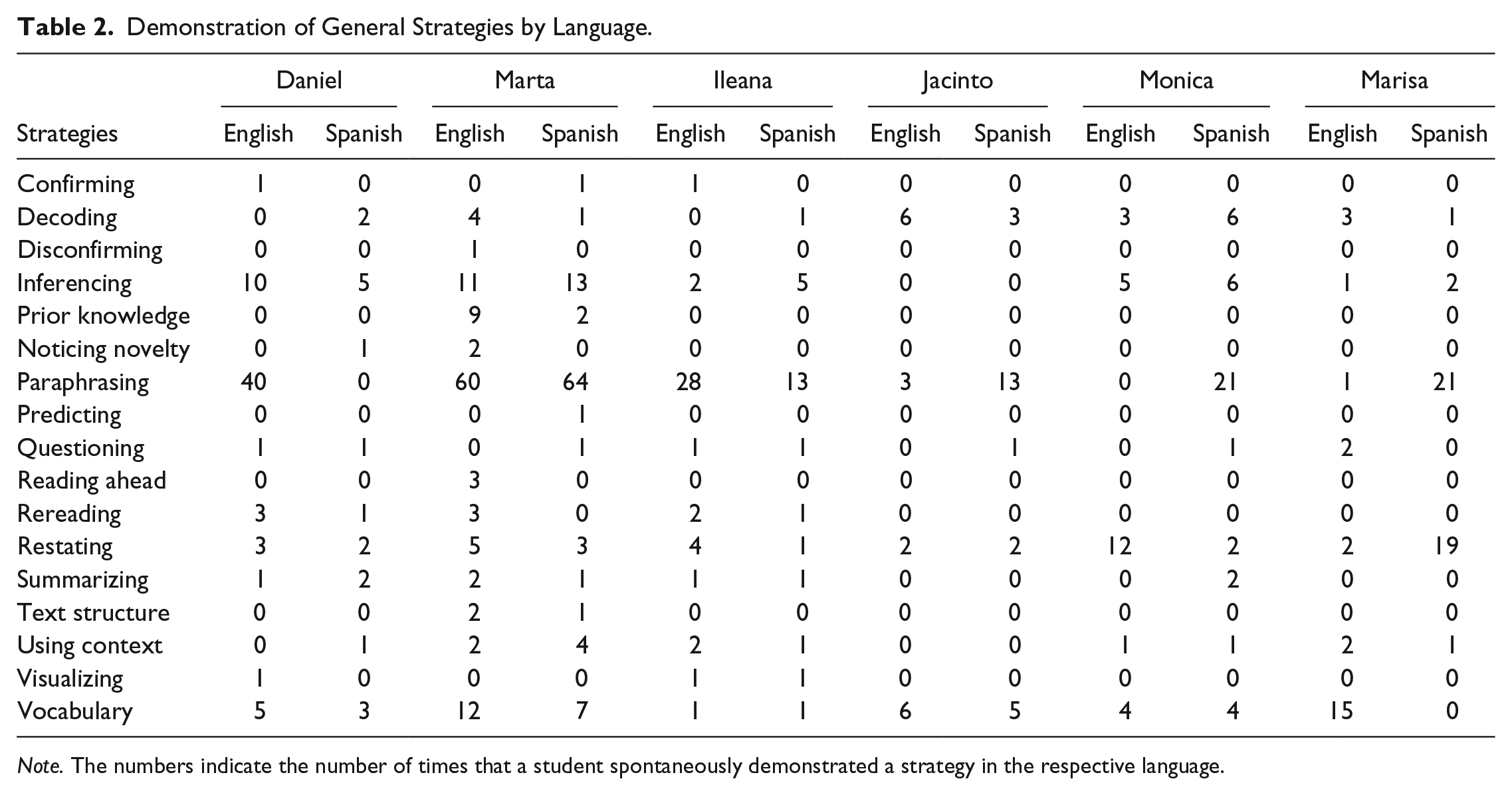
Note. The numbers indicate the number of times that a student spontaneously demonstrated a strategy in the respective language.
Demonstration of Bilingual Strategies by Language.
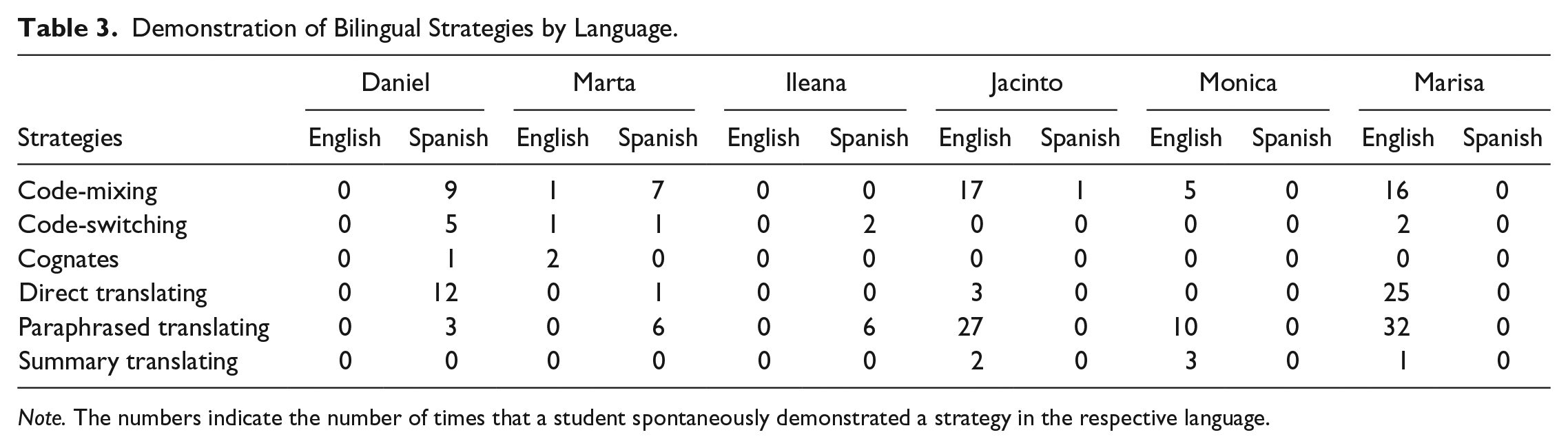
Note. The numbers indicate the number of times that a student spontaneously demonstrated a strategy in the respective language.
Also, we divided students’ use of translating into three categories: paraphrased translating, to characterize when students used their own words; direct translating, for when the students gave a literal translation; and summary translating, for when students reported the main ideas for a section of text but deleted details. Strategies that the students spontaneously demonstrated and strategies that G.E.G. provoked also were differentiated. For example, if G.E.G. sensed that students were having trouble with specific vocabulary, but they did not volunteer this information, she sometimes asked if this was the case. If the student responded yes, she coded this as an instance of a provoked focus on vocabulary. When students reported that they did not know or could not understand a specific vocabulary item while participating in the think-aloud, this was coded as a spontaneous strategy. The analysis presented in this study is based on the students’ demonstration of spontaneous strategies.
We identified the strategies demonstrated by comparing the student’s think-aloud and retelling interview transcripts for a particular passage with the written text. We independently coded the strategies in the transcripts, and then met to arrive at consensus about coding differences. We calculated the frequency with which a strategy occurred for each passage, by passage type (expository vs. narrative), and by language. If a student made inferences, but they were improbable for the text, we did not include these in Table 2. Because Marta and Daniel read one set of Spanish passages and the other four students read a different set of Spanish passages, it is possible that any variation in Spanish strategy use that characterized Marta’s and Daniel’s performances as compared with those of the other four students was due to the passages, and not to differences in the students’ use of strategies. This point is addressed in the findings. We used Strauss and Corbin’s (1998) constant comparative analysis to identify themes that characterized the individual student’s reading performance and strategy use, as well as those of the group, across the passages, passage genres, and languages. Examples of the group themes are general strategy variation, unknown English vocabulary, translating, code-mixing, bilingual strategy variation, cross-linguistic transfer, reading levels, and oral English proficiencies.
Demonstration of General Strategies
We use the term general strategies to refer to those strategies derived from the monolingual literature. Table 2 shows the general strategies demonstrated by the students in their two languages, reflecting how often a student spontaneously demonstrated a strategy in the respective language. Most of the general strategies identified in the monolingual literature were found in this data set, with the exception of evaluating and demonstrating awareness. We added a new strategy, reading ahead, which Marta, one of the stronger readers in both languages (97% on the Spanish reading test; 5.1 grade equivalent score on the English reading test), demonstrated while reading the English expository text. In fact, Marta was the only student to display five of the 17 strategies listed in Table 2 (disconfirming, invoking prior knowledge, predicting, reading ahead, and text structure). In the following example, Marta demonstrates how she invoked prior knowledge while reading the Venus passage (M = Marta; 12 = think-aloud prompt):
I knew that, this sentence right here, “The sunlight is partly reflected by clouds . . . ”
. . .
. . . from the book I read at home.
Variation in General Strategies
There was considerable variation in the demonstration of general strategies among the students, even though they all scored relatively high on a standardized reading test in Spanish and had participated in bilingual education for at least 3 years. When the types of strategies that each student demonstrated across the four passages (see Table 2) were calculated, Marta, Daniel, and Ileana—the three students with the highest English reading scores (5.1, 4.8, and 3.7, respectively) and oral English proficiency scores in the range of 5 and 4—demonstrated the widest range of general strategy use. Marta demonstrated all but one of the strategies listed in Table 2, visualization. Daniel demonstrated 12 of the 17 strategies, Ileana 11, Jacinto five, Monica eight, and Marisa seven.
Some of the differences in strategy use could be due to the fact that Daniel and Marta read one set of passages in Spanish and the other four students read another set of passages in Spanish. However, even in English, where they all read the same passages, a similar difference in the range of strategies existed between Marta, Daniel, and Ileana and the other three students, who scored lower on the English reading test (Jacinto = 2.2, Monica = 1.9, and Marisa = 3.4) and who had oral English proficiency scores in the 4 to 3 range. For example, while reading in English, Marta demonstrated 13 different types of strategies, Daniel nine, Ileana 10, Jacinto four, Monica five, and Marisa seven.
Just looking at the number of different types of strategies demonstrated was somewhat deceptive. A better indicator of how well the readers comprehended a text seemed to be the amount of plausible or accurate inferencing that they demonstrated. For example, the only students who made plausible or accurate inferences while reading the English expository text were Daniel and Marta, although Ileana, Monica, and Marisa made plausible or accurate inferences for the other texts.
In the following example, Daniel elaborated on what he read in the expository text, showing how he was interpreting the information (D = Daniel; inference = italics):
It says Venus is hotter and drier than any place on Earth, so it can be hotter and drier than our deserts.
In the next example, Ileana illustrated how she made a plausible inference about who was responsible for the bird disappearing in the English narrative (I = Ileana):
“Why do the Browns think you do all that?” asked Kathy.
“Because I’m there every time it occurs,” said Chocolate. “But I’m always asleep.”
The Browns think that Chocolate opened the door to the bird’s cage and scared him because he is near the cage.
Unknown English Vocabulary and Decoding
A textual problem that affected all the students was unknown English reading vocabulary. When the students were asked if they were having problems with English vocabulary, all but Marta volunteered additional words that they did not know (classified as provoked vocabulary and not included in Table 2). For example, Daniel identified 16 additional English words, Ileana 31, Jacinto 13, Monica 16, and Marisa seven.
The students demonstrated a range of strategies for figuring out unknown vocabulary. One of the most popular strategies not listed in Table 2 was continuing to read. If students skipped key words when they paraphrased or used paraphrased translating (i.e., put the text into their own words but in a language different from the text), then it usually was a clue that they did not know them. In the following example, Daniel skipped two words (“orbiting” and “obtained”) that he later admitted he did not know, although he constructed a rather coherent rendition of the text:
It says it has been in space since 1978 and sending back photographs of what’s in space and send it back to the scientists.
Not too surprisingly, there were unfamiliar words in English that four of the students—Marta, Jacinto, Marisa, and Monica—had problems decoding. However, two of the students (Marta and Jacinto) said that they sometimes knew a word but could not pronounce it. For example, while reading the English passage on Venus, Marta (5.1 in English reading; 97% in Spanish reading) had difficulty decoding the word “significant” but said that she knew what it meant:
The atmosphere of Venus has another sci, science, sickness, significant. I know that word but I can’t say it. I can’t pronounce it.
Demonstration of Bilingual Strategies
Table 3 shows the students’ demonstration of bilingual strategies in their two languages. The bilingual strategies that the fourth graders demonstrated most frequently were translating and code-mixing.
Translating
The students demonstrated three types of translating: paraphrased translating, direct translating, and summary translating. Their use of paraphrased translating, when they put the text into their own words but in a language different from the text, helped to reveal their text comprehension. It accounted for 64% of their translating. Sometimes, their use of paraphrased translating closely paralleled the text they were reading, as illustrated by Daniel’s think-aloud with the Spanish narrative (translations of the Spanish examples are in an appendix in the online supplementary archive):
(Translation 1)
—Todo lo que necesitamos está en nuestro valle, que es lo más bello del Universo.—
The adults say to their children that the only thing they really want is their valley, that . . . there ain’t nothing more beautiful than in the universe.
Other times, they conveyed the general meaning of the text but did not paraphrase it closely, as shown in an example from Marisa’s think-aloud with the English narrative (Ma = Marisa):
(Translation 2)
Él dijo un problema malo.
When students gave an overview of what they had read, skipping sentences, this was coded as summary translating. In the following example, Monica combined inferencing with summary translating to describe what had happened in the English narrative (Mo = Monica; inferencing = italics):
Text: “Why do the Browns think you do all that?” asked Kathy.
“Because I’m there every time it occurs,” said Chocolate. “But, I’m always asleep. So I don’t know who is doing it.”
Él es el uníco que está en la casa todo el tiempo.
Sometimes the students used direct translation to convey what they were reading. Direct translation worked when they could translate the text without making any word order changes, or when they made necessary word order changes and appropriate word choices according to the language being used. This type of translation actually indicated that they had processed the text. For example, Daniel’s direct translation of the following sentence from the Spanish narrative passage, “En el valle hay una fantástica ciudad llamada Bruma,” as “It says that in the valley there’s a fantastic city called Bruma,” indicated that he understood what he read. However, when the students translated the text word-for-word as they read it without putting it into the appropriate syntax or using the appropriate word choice, then they revealed that they did not comprehend it. In the following example, Marisa attempted to use direct translating to explain what she was reading, but finally admitted that she did not understand what she had read:
(Translation 4)
Text: Much of what we know about Venus was discovered in most recent years by spaceships sent there by Russia and the U.S. One of the hardest working spaceships ever sent into space is Pioneer Venus Orbiter.
Que mucho . . . de que saben de Venus, es que descubrieron una razón de años por (pause) cuetes, o algo así, mandaron por Rusia y USA. Uno de los difíciles trabajadores o trabajan, o algo así, cuete (pause) uno mandó en un espacio es Pioneer Venus. No lo entiendo tampoco.
Code-Mixing
All the students with the exception of Ileana demonstrated code-mixing. They used code-mixing for three purposes: to figure out unfamiliar vocabulary, when they did not know what a word meant and could not translate it, and when they knew what a word meant in both languages but preferred to use the word from the text (e.g., Jacinto used the word “spaceships” in his Spanish discussion of the expository text). In the following example, Marisa (93% in Spanish, 3.4 in English) used the first two types of code-mixing strategies. She appeared to juxtapose “blanket” and its Spanish equivalent, “cobija,” to figure out what “blanket” meant, and she imported “atmosphere,” a word she did not know in English or Spanish, from the English text into her Spanish response (code-mixing is underlined):
(Translation 5)
Las nubes eran una parte especial del planeta, cobija,
Limited Use of Cognates
Daniel and Marta, the strongest readers in English and Spanish, were the only students who occasionally demonstrated effective use of cognates. Daniel used a cognate once while reading the Spanish narrative text, while Marta used cognates twice while reading the English narrative text. Below, Marta explained that she sometimes used Spanish cognates to figure out difficult English words but rarely used English cognates to figure out Spanish words because she usually knew the Spanish words (R = researcher):
(Translation 6)
A veces en libros trabajosos, cuando están duros para leer, busco palabras que se escriben un poquito igual como en español.
¿Y cuándo estás leyendo en español?
En español, casi no necesito.
Variation in Bilingual Strategies
Although bilingual strategies involve using knowledge from one language to figure out or represent the other, the students predominantly used the bilingual strategies while reading in only one language. For example, Monica and Marisa, the two students with the lowest English oral proficiency scores (3), along with Jacinto (who scored a 4), primarily used the bilingual strategies to discuss the English passages and only translated when they read in English. Jacinto predominantly translated when he interacted with English expository text.
Daniel, Marta, and Ileana, the strongest English readers with the highest English oral proficiency scores, predominantly used the bilingual strategies to discuss the Spanish passages. Daniel employed translation when he interacted with narrative and expository texts in Spanish, whereas Marta and Ileana only translated when they interacted with the Spanish expository text. Ileana, who was orally dominant in Spanish, commented that she would not translate if the text was too difficult.
Cross-Linguistic Transfer
Two characteristics of the students’ think-alouds suggested that cross-linguistic transfer had occurred, even though the frequency with which they used general and bilingual strategies across languages varied. First, the fact that all the students were able to use one language to explain their reading of another language demonstrated transfer of knowledge from one language to another. Second, although the students did not always use the same exact general strategies across languages, they demonstrated enough of the same types of strategies across languages to suggest that they were approaching reading in their two languages in a similar fashion. Of the types of general strategies that Daniel used, 50% occurred in both languages, as did 56% of Marta’s strategies, 81% of Ileana’s, 80% of Jacinto’s, 63% of Monica’s, and 71% of Marisa’s.
Whether cross-linguistic transfer of strategies is positive depends on the strategies that are transferred. Although we do not know whether Jacinto transferred strategies from one language to the other, he used four of the same five general strategies while reading in Spanish and English. The only strategy that he did not use while reading in the two languages was questioning, which he only demonstrated once while reading the Spanish narrative text. His use of decoding, paraphrasing, restating, and focus on vocabulary suggested that he was tied to the text when reading in both languages. Although he made inferences while reading in both languages and in narrative and expository texts, they were not plausible or accurate, as illustrated in this example from the English narrative text (J = Jacinto):
“Trouble,” he said. “Big bad trouble!”
…
“What type of trouble, Chocolate?” [asked Kathy.]
She had trouble. She had trouble with Chocolate.
Strategies, Reading Levels, and Oral English Proficiencies
Although all the students had relatively high scores on a standardized reading test in Spanish, there were differences in the quality of their Spanish reading and English reading. Daniel and Marta, who had the highest Spanish reading and English test scores, demonstrated higher levels of reading comprehension in both languages compared with the other students. Analysis of their think-alouds and retelling/interview protocols revealed that they were focused on comprehension when reading in both languages. Below, we briefly discuss the reading performance of Marta and Monica and provide examples of Monica’s reading to illustrate how her strategy use related to her English and Spanish reading levels and oral English proficiency.
Marta’s English and Spanish Reading Performance
When Marta read in English or Spanish, she carefully monitored her comprehension, paraphrased and commented on what she was reading, invoked prior knowledge, made effective inferences, recognized and repaired comprehension problems not due to vocabulary, and demonstrated a range of repair strategies for figuring out unknown vocabulary. Compared with the other students, she demonstrated the most general strategies and widest range of strategies (13 types of strategies in English, 12 types of strategies in Spanish). Marta had high reading test scores in Spanish (97%) and English (5.1) and a high oral English proficiency score (5).
The following example shows how Marta used a range of strategies (rereading, focus on vocabulary, use of context, summarizing, invoking prior knowledge) to resolve a vocabulary comprehension problem that she identified while reading the English passage on Venus:
Can I read this over? I didn’t understand. . . .
I don’t know this word.
Which one?
Reveal.
Reveal, does that cause some problems?
Uh-huh. Hmm, I think maybe it means that it’s telling information about (pause) the clouds, and the clouds are a special part of the (pause) planet’s blanket of air, its atmosphere. Yep, that’s what we were talking about last Friday.
Monica’s English and Spanish Reading Performance
In contrast to Marta, Monica only demonstrated five types of strategies while reading in English and eight types of strategies while reading in Spanish. Monica was a strong Spanish reader (95%) but a developmental English reader (1.9), and her oral English proficiency was not high (3).
Although Monica had some prior knowledge for the Venus passage, she really did not comprehend it. In her think-aloud, she used Spanish to briefly paraphrase two major ideas: that Venus was like Earth’s sister planet and that spaceships were sent to Venus. However, she was unable to provide any details or identify the other major ideas in the passage. In addition to her use of bilingual strategies, two general strategies characterized her reading of the Venus passage: focus on vocabulary and decoding. When questioned, she identified 12 unknown words (provoked vocabulary) in addition to the four words that she had spontaneously identified.
Monica comprehended the English narrative and the Spanish expository texts with much greater ease than the Venus passage. When she read the English narrative, she demonstrated three additional strategies: restating, inferencing, and using context. Although she did not always understand what was happening at the time that she read the story, by the end of the story she showed that she understood the setting, characters, and plot.
When Monica read an English expository passage on whales with simpler vocabulary than the Venus passage, she demonstrated increased comprehension, although she still had occasional decoding problems (strategies for the whale passage are not in Tables 2 or 3). Her use of a new strategy, noticing novelty (identifying new information not known to the reader, which she demonstrated in the last line when she remarked that she had not known that the whales could hear far away with small ears), revealed that she was capable of thinking about and reflecting on what she was reading in English when the vocabulary load was reduced:
(Translation 7)
¿Por qué te sorprendió?
Porque no pensaba que las balleñas podían oír de lejos con los oídos chiquitos.
Monica demonstrated the same strategies when reading in Spanish that she had demonstrated when reading in English, along with three additional strategies: paraphrasing, questioning, and summarizing. The Spanish narrative seemed too easy for her, possibly limiting the number of strategies that she demonstrated. However, when she read the Spanish expository text, she still had problems with unknown vocabulary and decoding. In contrast to how she dealt with unknown vocabulary in the English expository text on Venus, in the following example, she used information in the Spanish text to figure out the meaning of the Spanish word for “fossils,” which enabled her to understand a key point in the passage:
(Translation 8)
¿Qué te parece?
Un poquito difícil.
¿Qué fué difícil acá?
Fósiles (pronounced fulsiles). (pause) A lo mejor fósiles quiere decir cuando encuentran (pause) como huellas? (pause) hueso.
Discussion of the Findings and Implications
Our use of a holistic bilingual perspective (Hopewell & Escamilla, 2014) meant that we aimed to understand how emergent bilingual children were approaching, interpreting, and discussing texts by examining what they did in both languages, not just in one language. Although the children had much lower reading test scores in English than in Spanish, based on Hopewell and Escamilla’s work, we knew that this type of imbalance between L1 and L2 reading was not that unusual for Latina/o bilingual children in the United States.
Street’s (2003) social literacies perspective made us aware of the importance of paying attention to the sociocultural context in which our research took place. In particular, given the devalued and marked status of Spanish and bilingualism in U.S. schools and larger society, we needed to make sure that our Latina/o participants felt comfortable and safe using Spanish and bilingual strategies when they participated in the think-alouds at school.
A major finding was that most of the children, even those who had relatively limited oral English proficiencies and low English reading test scores, used general and bilingual strategies to construct meaning while reading in both languages. Although four of the six children reported using decoding strategies while reading in English, their focus on decoding did not appear to impede their comprehension of English texts. One of the strong English readers reported that she often understood the meanings of words she could not decode, suggesting that for bilingual children who score high on a Spanish reading test, educators should not use their ability to decode in English to evaluate their English reading comprehension. Before generalizing this finding to other bilingual children, more researchers need to investigate the role of oral reading fluency in emergent bilingual children’s English reading comprehension.
All the children reported problems with unknown English vocabulary. When one of the children with low oral English proficiency and reading test scores was given an English expository text with simpler vocabulary to read, she demonstrated not only more comprehension but also the use of a sophisticated strategy not previously displayed. It may be that a high level of unknown L2 vocabulary in L2 text masks the L2 comprehension potential of emergent bilingual children with strong L1 reading skills. Because L2 vocabulary is a key component of L2 oral proficiency, our finding does not necessarily contradict Durgunoğlu’s (2002) claim that emergent bilingual children need a certain level of L2 oral proficiency to benefit from cross-linguistic transfer, but it does highlight the importance of investigating the relationship between the different components of L2 oral proficiency and L2 reading. Due to test bias issues, understanding how to interpret the English reading test performance of emergent bilingual children also is difficult (Hakuta & Beatty, 2000; Solano-Flores & Trumbull, 2003). Providing these children with English reading passages with different levels of vocabulary knowledge might be an informative way to evaluate their English reading comprehension.
Five of the six children in this study were skilled in their use of general strategies in Spanish and English, varying their use according to the demands of the texts and genre. However, they also varied their use of general strategies according to the language of the text and their reading and oral language proficiencies in the two languages, with the stronger readers in English predominantly using English to discuss Spanish text and the weaker readers in English predominantly using Spanish to discuss English text. From a social literacies perspective (Street, 2003), it is important to acknowledge that the sociocultural contexts in which the children were receiving reading instruction might have affected their language preference, with the children in the all-English classroom preferring to use English and most of the children in the TBE classrooms preferring to use Spanish. In constructing profiles of strategic bilingual readers, we recommend that educators include variation in strategy use according to the language of the text and emergent bilingual children’s reading and oral language proficiencies, taking into account the languages emphasized in the instructional contexts.
Translating was the most frequently demonstrated bilingual strategy. The children with the higher English proficiency and reading test scores translated while reading in Spanish, while the children with the lower English proficiency and reading test scores translated while reading in English. Although a child with a lowest English reading test score was not successful in her use of direct translation to figure out a section of the English expository text, her realization that she did not comprehend the text revealed the potential of translating to help emergent bilingual children improve their English reading monitoring and comprehension. Whether the children’s comfort with translation was a function of their translating at home or in the community, as reported by Orellana et al. (2003), is a topic that merits further investigation, as does the inclusion of translation in the reading instruction of emergent bilingual children (see Jiménez et al., 2015).
The children with the lowest oral English proficiencies predominantly used code-mixing to figure out the meanings of unknown English vocabulary words, while the two children with the higher oral English proficiencies predominantly used code-mixing to figure out the meanings of unknown Spanish words. The positive role of code-mixing in aiding students’ reading in either language suggests that this is a bilingual strategy that teachers should accept and encourage in their reading instruction.
Similar to the children in Nagy et al. (1993), the children in this study did not demonstrate much use of cognates. Only the two stronger readers in Spanish and English very occasionally used cognates while reading. Our findings suggest that cognate awareness may be developmental and need to be explicitly taught to elementary-age bilingual students.
Whether our analysis actually indicated cross-linguistic transfer has to be questioned. All the children had relatively high Spanish reading test scores, suggesting that they had a strong L1 literate base that could affect their L2 reading. They demonstrated using many of the same general strategies in their two languages, indicating that they had a uniform approach to reading in their two languages, similar to the middle school bilingual youths who were successful English readers (Jiménez et al., 1996). However, they displayed some general strategies in English that they had not displayed in Spanish, making it difficult to assess how their reading in one language was related to their reading in the other language.
In reflecting on our findings, “translanguaging” (O. García, 2009, 2014) appears to characterize how the fourth graders in our study approached, discussed, and interpreted texts, especially if we use Daniel and Pacheco’s (2016) definition of translanguaging as “moving across languages and registers of speech to make meaning” (p. 653). Other researchers reported that elementary-age emergent bilingual children implemented translanguaging when they planned and discussed their writing (Bauer et al., 2017; Gort, 2012; Velasco & García, 2014). We call for future researchers to move beyond the question of how L1 reading affects L2 reading (Goldenberg, 2011) to investigate how emergent bilingual children’s exposure to two or more languages results in their employment of translanguaging to comprehend texts. This line of research needs to examine children at different ages, taking into account their bilingual reading expertise, their oral language proficiencies, and the home, school, and community contexts that support their bilingual and biliteracy development. We also encourage researchers to investigate the effectiveness of teaching bilingual children to improve their reading comprehension by focusing on their bilingual reading development, not their separate reading development in English or Spanish. To evaluate their reading performance and instruction, bilingual standards, based on what is known about bilingual children’s reading performance and assessment (Hopewell & Escamilla, 2014), also need to be developed and implemented. If we had just examined the children’s strategies in one language in this study, we would have underestimated their capabilities.
A number of researchers have argued that if we want to improve the reading performance of emergent bilingual children, we need to incorporate the social literacies (Street, 2003) that characterize their communities into U.S. classrooms at the same time that we use them to bridge their access to the literacies valued in U.S. schools (Daniel & Pacheco, 2016; Jiménez et al., 2015; Orellana et al., 2003). We agree with these recommendations and present our findings as a way to provide direction for such efforts.
Limitations
We chose to employ think-alouds to collect our data even though other researchers warned that their effective use requires participants who are comfortable verbalizing their thinking (Johnstone, Bottsford-Miller, & Thompson, 2006). Whether the children verbalized all their thinking while participating in the think-alouds has to be questioned. It is possible that the child who did not make plausible inferences while discussing his reading in Spanish and English was not motivated to participate in the think-alouds and did not pay careful attention to what he was reading. Given the social nature of the think-aloud process (Street, 2003), it also is possible that the children might have displayed different strategies with a different researcher.
A significant limitation of think-alouds is that they do not show how participants are mentally processing what they read. So, we do not know to what extent the placement of the prompts interrupted the children’s comprehension and artificially resulted in their reporting strategies or problems.
Another limitation is text selection. It is likely that different texts would have resulted in the children demonstrating different strategies. Several researchers have found that Latina/o bilingual children often are motivated to read and discuss their reading when culturally responsive texts are used (Ebe, 2011; Jiménez, 1997). We initially provided the children with expository and narrative texts originally written in Spanish because we thought they might better reflect Spanish syntax, vocabulary, rhetorical styles, and cultural emphases; however, all but two of the children reported that the high level of unknown Spanish vocabulary made it difficult for them to comprehend the texts. This raises the question of whether children in bilingual classrooms are being prepared to comprehend texts originally written in Spanish or English translations of Spanish texts.
In terms of cross-linguistic transfer, a major limitation of think-alouds is the procedure itself. Think-alouds cannot indicate when participants acquire or learn a strategy first in one language and then apply it to the other language. To test this, we recommend that longitudinal studies of bilingual children’s reading instruction and practices be conducted so that researchers document what children have been taught and the practices that they demonstrate at one point in time and then compare these to their reading instruction and practices at a later point in time.
Last, our study did not examine the relationships among children’s bilingual reading practices, their teachers’ classroom instruction, and the sociocultural contexts of the school, home, community, and larger society. Compton-Lilly, Papoi, Venegas, Hamman, and Schwabenbauer (2017) presented longitudinal case studies of two immigrant bilingual children to show how “intersectionality,” or the different ways in which the children “navigate[d] and were position[ed] relative to multiple subject positionings” in and out of school, shaped their biliterate performance and views of themselves as bilinguals (p. 121). This type of information also is needed if we are to develop bilingual standards to guide Latina/o emergent bilingual children’s reading instruction, performance, and assessment.
Footnotes
Declaration of Conflicting Interests
The author(s) declared no potential conflicts of interest with respect to the research, authorship, and/or publication of this article.
Funding
The author(s) received no financial support for the research, authorship, and/or publication of this article.
Supplemental Material

Author Biographies
References
Supplementary Material
Please find the following supplemental material available below.
For Open Access articles published under a Creative Commons License, all supplemental material carries the same license as the article it is associated with.
For non-Open Access articles published, all supplemental material carries a non-exclusive license, and permission requests for re-use of supplemental material or any part of supplemental material shall be sent directly to the copyright owner as specified in the copyright notice associated with the article.
