




Abstract
While a wealth of research shows the social and academic benefits of bilingualism and multilingualism, the education of bi/multilingual learners often focuses on transitioning students to English. Based on this fact, the first aim of this article is to highlight translanguaging as a model that challenges monoglossic language ideologies. The second aim is to present a systematic review of peer-reviewed studies (2000–2020, 47 studies) that highlight translanguaging as a pedagogy for elementary bi/multilingual students’ writing development. Due to the historical scholarly focus on reading over writing, especially at the elementary level, this study focuses on translanguaging pedagogy in the context of elementary writing. Findings showed four themes: (a) audience awareness and authentic products, (b) collaborative learning and composition, (c) multimodal composition, and (d) simultaneous literacy instruction. I argue for further engagement with students’ families, communities, and identities in the writing process and an exploration of the transformative potential of translanguaging writing pedagogy.
Keywords
Despite the advantages of being bilingual or multilingual (Bialystok, 2007; Callahan & Gándara, 2014; Orellana et al., 2003), students who speak language(s) other than English at home are frequently viewed as “semilingual” (Escamilla, 2006), and their bi/multilingualism is often seen as an obstacle to academic achievement (Martínez, 2018). In reality, bi/multilingualism is a central part of cultural identity (Anzaldúa, 1987; Izquierdo, 2011), family relationships (Orellana et al., 2003), and healthy senses of self for linguistically minoritized and racialized youth (García-Mateus & Palmer, 2017; Paris & Alim, 2017). In this article, I use the term “bi/multilingual” to describe students that are labeled as English language learners to emphasize the proficiency and diversity within these students (Martínez, 2018). Bi/multilingual students are not two or more monolinguals in one; rather, bi/multilingualism is a dynamic process in which individuals are constantly drawing on their full linguistic repertoire (Grosjean, 1982).
Translanguaging, both as a theory of bi/multilingualism and a pedagogy, is critical to this perspective. Translanguaging describes the hybrid language practices of bi/multilinguals (García & Wei, 2014) and pedagogical strategies that support these language practices (García & Wei, 2014). Biliteracy is defined as “any and all instances in which communication occurs in two (or more) languages in and around writing” (Hornberger, 1990, p. 213), and research suggests that translanguaging pedagogy supports the development of biliteracy (e.g., Bauer, 2019; Durán, 2016a; Gort, 2012). At this time, there is a gap in syntheses of studies that explore how translanguaging pedagogies support the development of biliteracy, especially regarding writing development (García & Kleifgen, 2020). Literature reviews on literacy and bi/multilingual learners frequently review a broad range of studies, such as Reyes’s (2012) review of biliteracy and children and youth, and Williams and Lowrance-Faulhaber’s (2018) review of both bilingual children's writing development and pedagogies that support it. In addition, reviews are often focused on the secondary level, for example, Bacon’s (2017) review of critical literacies in English language teaching and Pacheco et al.’s (2021) review of secondary emergent bilinguals’ digital composing practices. I chose to focus on writing rather than reading or other content areas for several reasons. First, historically, reading has taken a greater precedence over writing in literacy research (Cremin & Myhill, 2013). It is critical that we research writing because through student autonomy over their topic and language use (e.g., Machado & Hartman, 2019), writing has the possibility to represent students’ full funds of knowledge (Moll et al., 1992). Second, while there is an established body of research on translingual writing at the secondary and university levels (e.g., Canagarajah, 2011; Li & Zhu, 2013; Pacheco et al., 2021), research on translingual writing at the elementary level is an emerging field (Zapata & Laman, 2016) and there is a need for a synthesis of the existing research.
To provide context to the way that translanguaging and writing are conceived of in the literature review, I begin with a discussion of the theoretical background of translanguaging, writing development, and models of writing instruction. In the second half of this article, I present a systematic review of 47 studies published between 2000 and 2020 that highlight how translanguaging has been enacted as a pedagogy to support writing development in bi/multilingual elementary students. I focused on pre-K-5 children to demonstrate that biliteracy develops from an early age. Furthermore, I look at both English as a Second Language (ESL) and bilingual settings to examine diverse ways to support bi/multilingual students. My analysis utilizes Bazerman et al.’s (2017) principles of writing development to explore the body of research around how elementary teachers engage in translanguaging writing pedagogy. It addressed the following research question: What do we know about how elementary teachers enact translanguaging pedagogy to support bi/multilingual students’ writing development?
Theoretical Frameworks
Theoretical Underpinnings of Translanguaging
I begin this review by situating translanguaging in the context of the single linguistic repertoire understanding of bi/multilingualism (Canagarajah, 2011; Creese & Blackledge, 2010; García & Wei, 2014). Next, I highlight the ways that García, Wei, and their collaborators have taken up translanguaging, both because they are the most visible scholars, in terms of number of citations, and because they have received the most pointed critiques (Jaspers, 2018; MacSwan, 2017). I outline their original theory, address a common misconception, and highlight two prominent critiques. I conclude with an overview of writing development and instruction and provide a rationale for the importance of translanguaging to writing instruction.
Origins of translanguaging
Translanguaging is built on the framework of dynamic bilingualism, which rests upon the idea that bilinguals have one linguistic repertoire and challenges the conception of bi/multilingualism as separate linguistic entities (García, 2011). The term “translanguaging” originates from the Welsh term trawsieithu, which was developed by Williams (1994), a Welsh bilingual educator, to describe the intentional use of two languages within the same lesson (Williams, 1994, as cited in Baker, 2011). Baker (2011) popularized the term, and since its inception translanguaging has also been used as a theory of bilingualism to describe the way that bilinguals “do” language (e.g., Canagarajah, 2011; Creese & Blackledge, 2010; Garcia & Wei, 2014; MacSwan, 2017). In García and Wei’s (2014) foundational book on translanguaging, they defined it as “the enaction of language practices that use different features that had previously moved independently constrained by different histories, but that now are experienced against each other in speakers’ interactions as one new whole” (p. 21). Translanguaging is a unique way of thinking about languaging that disrupts static definitions of named languages and highlights the active nature of languaging. Languaging is defined as “the simultaneous process of continuous becoming of ourselves and of our language practices, as we interact and make meaning in the world” (García & Wei, 2014, p. 8). García and Wei (2014) used translanguaging as a heuristic for understanding languaging and as a pedagogical tool for bi/multilingual students that centers their full linguistic repertoire.
Translanguaging versus codeswitching
A common misconception is that “translanguaging” is a new way to say “code-switching” (Otheguy et al., 2015). For example, there is scholarly disagreement over whether to categorize an utterance, such as “ellos son muy cool,” as translanguaging or code-switching. The important difference is that classifying this communication as translanguaging takes a different epistemological stance than the term “code-switching.” Code-switching starts from the perspective of named languages, such as Spanish and English, and uses these categories to describe communication. It is an external view of language. In contrast, translanguaging focuses on language as an internal process that is built on speakers’ social interactions. In a conversation between Grosjean and García (2016), García explained that “translanguaging is more than going across languages; it is going beyond named languages and taking the internal view of the speaker's language use.” This contention challenges central conceptions of the ways that language functions and has faced strong criticism.
Critiques of translanguaging
MacSwan (2017), a prominent critic of this perspective, valued the way that translanguaging “problematizes conventional assumptions regarding language mixing in classroom settings” and explained that “as a pedagogical approach, translanguaging emphasizes the dynamic use of multiple languages to enhance learning and make schools more welcoming environments for multilingual children, families, and communities” (p. 191). However, he argued that in disregarding the concept of code-switching and denying the existence of multilingualism, we also disregard empirical evidence that challenges deficit perspectives on language mixing (e.g., Durán & Palmer, 2014; Fuller, 2009; García et al., 2015; Gort, 2012; Grosjean, 1982, 2010; Martínez, 2010; Valdés-Fallis, 1978). According to MacSwan (2017), we cannot both utilize code-switching scholarship to defend bilingualism and deny that code-switching exists. Thus, we need to keep the idea of discrete languages to advocate for bilingualism. MacSwan (2017) appreciated the way that translanguaging contributes to disrupting the hegemony of monolingualism but disagreed with the idea that distinct languages do not exist and argued for a multilingual perspective on translanguaging.
In addition to critiques about the linguistic implications of translanguaging, it has also faced criticism over its use as a pedagogy (Jaspers, 2018). Jaspers’s (2018) primary concern was that translanguaging as a pedagogy is not likely to be as transformative as it has been presumed to be. Jaspers conceded that saying that translanguaging is capable of transforming schools is not the same thing as saying that it will transform schools; however, he was concerned about the frequency with which the transformative potential of translanguaging is predicted. He worried that because such claims are not qualified, the implication is that these effects are assured. Finally, Jaspers drew on the work of Cenoz and Gorter (2017) to point out that some minority-language activists are concerned that advocating for fluid language practices will diminish their efforts to sustain minority languages He did allow that García and Wei (2014) have addressed this issue and have noted that it is important to maintain a space where “the minority language does not compete with the majority language” (García & Wei, 2014, p. 74). In conclusion, Jaspers (2018) argued that disrupting the hegemony of monolingual instruction is a powerful goal, but we cannot assume that translanguaging is as transformative as it claims.
Responses to critiques of translanguaging
In García and Wei’s (2018) entry on translanguaging in The Encyclopedia of Applied Linguistics, they addressed some of these critiques. For example, in response to MacSwan’s (2017) critique, they contended that “translanguaging pedagogy insists on keeping both senses of language visible—the external one, the named languages(s) that is the medium of instruction, and the internal one, the language repertoire of students” (García & Wei, 2018, p. 4). When translanguaging is conceived in this way, it is possible to both welcome students to use their full linguistic repertoire and acknowledge the need to prepare students for monolingual settings without positioning monolingualism as more valuable.
Regarding Jaspers’s (2018) claim that translanguaging pedagogy may not be as transformative as it has been presumed, García and Wei (2018) highlighted the importance of understanding it as an epistemological shift. Language is no longer understood to be a standardized entity but rather a “product of sociopolitical constructions of nation-states and institutions such as schools” (p. 1). García and Wei contended that translanguaging transcends traditional linguistic boundaries to make use of multiple semiotic resources; transforms social relationships, structures, and individuals’ beliefs; and is transdisciplinary because it breaks down traditional separations between linguistics, psychology, sociology, and education. When translanguaging is conceived of in this way, it has the potential to transform how languaging is perceived, which could have a significant impact on schooling.
In García and Kleifgen’s (2020) article on translanguaging and literacies, they highlighted the ways that translanguaging pedagogy challenges dominant epistemologies about language and multilingualism and centers language practices that cross the borders of what have been labeled as separate sign systems. They argued that the translanguaging approach to literacy instruction has the potential to give minoritized bilingual students access to deeper understandings of texts and the ability to create texts that are reflective of their language practices, to foster confidence in performing literacies, and to develop critical multilingual awareness. It is important to keep this understanding of translanguaging in mind in the next section, which examines writing development and instruction at a broad level.
Theoretical Underpinnings of Elementary Writing
Writing development
In Bazerman et al.’s (2017) interdisciplinary analysis, they identified eight principles of writing development across the life span:
“Writing can develop across the life span as part of changing contexts” (p. 354). “Writing development is complex because writing is complex” (p. 354). “Writing development is variable; there is no single path and no single endpoint” (p. 354) “Writers develop in relation to the changing social needs, opportunities, resources, and technologies of their time and place” (p. 355). “The development of writing depends on the development, redirection, and specialized reconfiguring of general functions, processes, and tools” (p. 355). “Writing and other forms of development have reciprocal and mutually supporting relationships” (p. 356). “To understand how writing develops across the lifespan, educators need to recognize the different ways language resources can be used to present meaning in written text” (p. 356) “Curriculum plays a significant formative role in writing development” (p. 356). If we let our students express themselves and present their ideas in their primary language, we give them opportunities to continue to develop their thinking. With this development uninterrupted, they are able to write well in a second language once they develop proficiency in it. (p. 74)
These principles cover a wide range of areas of writing and demonstrate the need for further exploration of writing development and instruction. In this review, I use Bazerman et al. (2017) seventh principle of writing development, which relates to writers’ varied language resources, as a rationale for translanguaging writing pedagogy. Bi/multilinguals’ writing development is connected across languages, even if they do not share the same writing systems (Edelsky, 1986). In addition, a range of studies have shown that bi/multilingual writers draw on their full linguistic repertoire throughout the writing process (Gort, 2012; Kibler, 2010; Velasco & García, 2014) and that they utilize writing strategies in drafting that are specific to bi/multilinguals (Cumming, 1990). To this end, Fu (2003) reflected:
Translanguaging pedagogy in writing instruction allows students to draw on their full linguistic repertoire and thus fully develop their writing.
Models of writing instruction
To understand how to support bi/multilinguals’ dynamic writing development, it is important to be familiar with broader conceptions of writing instruction. In Ivanič’s (2004) meta-analysis of writing and writing pedagogy, she found six discourses that were critical to writing instruction. First, a skills discourse focuses on developing knowledge of language (i.e., phonics) and grammar (i.e., how sentences are formed). Second, a creativity discourse of writing emphasizes content and style over “correctness.” Third, a genre discourse focuses on the ways that different types of text perform distinct purposes in particular contexts. Fourth, social practices discourse highlights the centrality of cultivating a community of writers. Fifth, sociopolitical discourse weighs the role of power relations and larger social forces on writing. Finally, a process discourse describes the mental processes that make up the writing act and practical processes of constructing a written product (i.e. planning, drafting, revising). Within this discourse, people improve at the processes of writing by engaging in them. Each of these discourses adds to a nuanced understanding of writing and writing instruction.
In terms of how teachers are taught to teach writing, Bomer et al.’s (2019) literature review of teaching writing in literacy teacher preparation courses found that social practices and process discourses were most prevalent in teacher education courses in the United States. At the in-service level, in Cutler and Graham’s (2008) survey of U.S. primary-grade teachers’ instructional practices in writing, they found that the most common discourses were skills and process discourses. It is important to note that while literacy teacher educators infrequently take up the skills discourse, it has a large sway in schools because it is aligned with the goals of high-stakes tests and standards. These competing discourses can put teachers in difficult positions where they must balance how they learned to teach writing and their schools’ demands (Athanases et al., 2013).
The translanguaging approach to writing instruction enriches each of the three most common discourses. For instance, in terms of the social practices discourse, when the focus is on the community of writers it is critical to center the linguistic repertoire of that community. In the case of the skills discourse, a translanguaging approach allows students to develop metalinguistic awareness and make connections across the writing systems of their linguistic repertoire. Finally, in terms of the process discourse, for students to produce complex writing pieces, they must be able to draw on their full linguistic repertoire throughout the writing process. In conclusion, translanguaging is critical to writing because while there are cultural and language-specific conventions that differentiate writing, at its core, “writing is the construction of meaning” (Ascenzi-Moreno & Espinosa, 2018, p. 14). To be able to truly construct meaning, students need to have the opportunity to draw on their full linguistic repertoire throughout the writing process. Despite this vital need, such an approach has not been well explored in the literature around elementary writing. Given the importance of bi/multilingual students drawing on their full linguistic repertoire in writing, this review explores the intersection of elementary writing instruction and translanguaging pedagogy through the lens of Bazerman et al.’s (2017) principles for writing development.
Methodological Approach
Translingual writing instruction is not the norm (García & Kleifgen, 2020), and it is important to explore how teachers engage in it. The following question guided my analysis: What do we know about how elementary teachers enact translanguaging pedagogy to support bi/multilingual students’ writing development?
In this literature review, I used Academic Search Complete, ERIC, Education Source, and PsycInfo. These databases include a range of journals within education and across related disciplines. The search terms were (translang* OR “code switch*” OR codeswitch* OR biliter*) AND (writing OR composition). The search was limited to peer-reviewed articles published from 2000 to 2020. After removing duplicates, the search yielded 925 articles. I began the search in 2000 because in terms of translanguaging scholarship, the term dates to Williams’s (1994) description of pedagogy in Wales, but it was not widely taken up until Baker (2011) extended it to describe language practices. The time range covers the majority of scholarship on translanguaging.
Inclusion Criteria
I included studies if they met the following criteria:
Peer-reviewed article published from 2000 to 2020 that presented original empirical findings. Multilingual writing development as the focus of the study. Pedagogy explicitly described as translanguaging or supported the use of students’ full linguistic repertoires. Participants in pre-kindergarten to fifth grade. Participants either simultaneous bilinguals, children who were exposed to and learned two (or more) languages between birth and the start of formal schooling, or sequential bilinguals, children who develop proficiency in one language before learning a second language (Baker, 2011). Bilingual or ESL classroom, before/after-school enrichment activities, or out-of-school language learning settings.
Many of the studies were excluded because they were related to other areas such as secondary English classrooms (e.g., Stewart & Hansen-Thomas, 2016) or reading (e.g., García & Godina, 2017). I also excluded studies that did not present original research, such as Reyes’s (2012) review of biliteracy and children and youth. After applying the inclusion criteria, 47 articles were selected for further analysis. I organized the articles in a Microsoft Excel chart. For each article I included the reference, abstract, setting (bilingual classroom, ESL classroom, out of school), research questions, methodology, theoretical framework, and findings.
Data Analysis
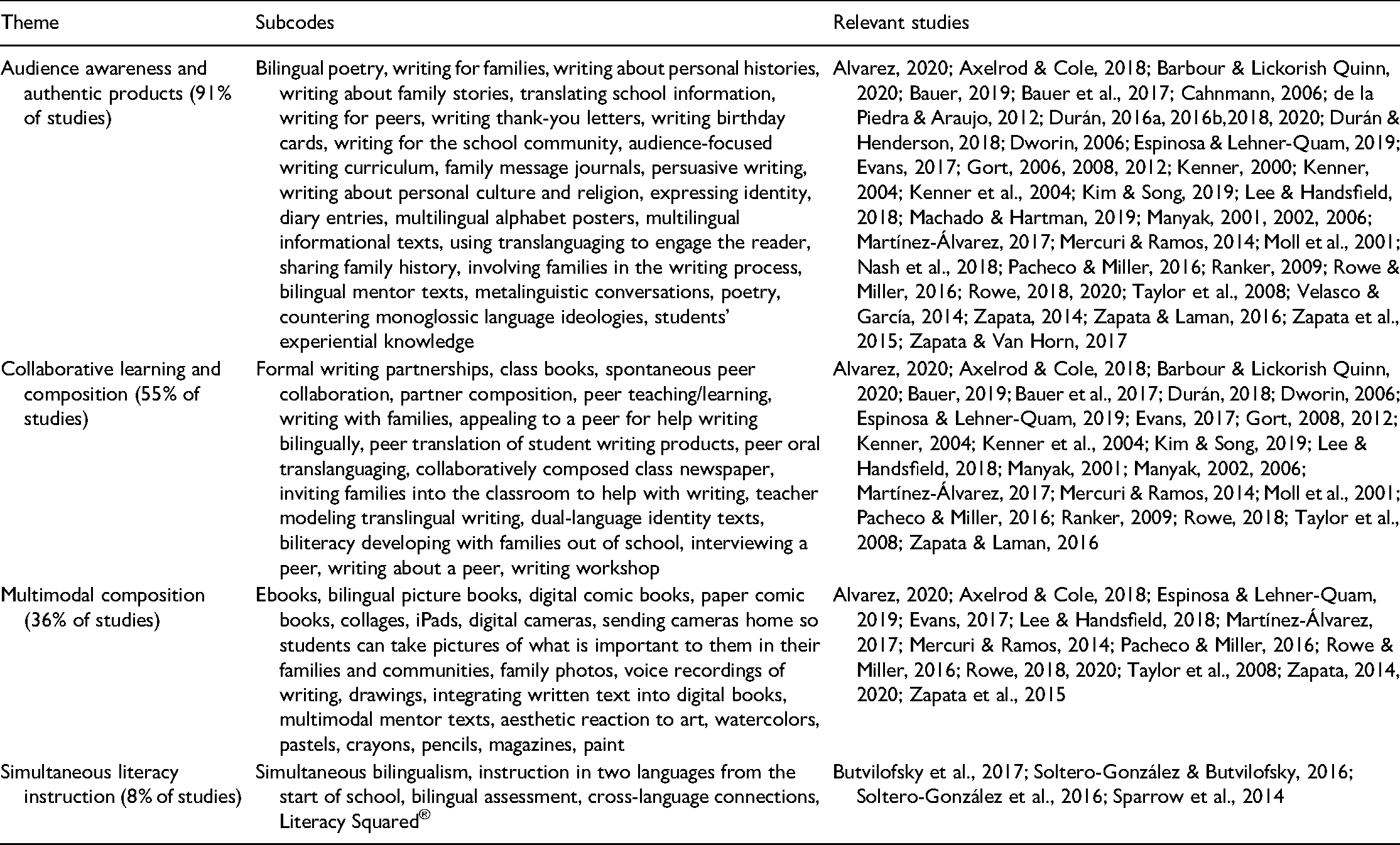
My analysis applied Saldaña’s (2015) conception of first- and second-cycle coding to the literature review process (Onwuegbuzie et al., 2016). In the first cycle, I descriptively coded (Saldaña, 2015) general observations about pedagogy, such as writing partners and class books. As I coded, I wrote analytic memos (Saldaña, 2015) about my initial thoughts about commonalities across the codes. For example, in one memo I wrote about how I frequently noted codes related to students working together (e.g., writing partners, class books). In the second cycle of coding, I engaged in pattern coding (Saldaña, 2015) to derive meaning from similarities between codes. First, I read across my analytic memos to identify concepts that I wrote about multiple times. Next, I wrote each of my general observations about the pedagogy on sticky notes. I manually grouped the sticky notes into similar groups (e.g., ebooks, picture books, iPads). When I had found a group for each of the sticky notes, I developed descriptions of the commonalities among the codes. I collapsed the codes into four themes: multimodal composition, audience awareness and authentic products, collaborative learning and composition, and simultaneous literacy instruction. For example, the previous codes, writing partners and class books, were collapsed into the collaborative learning and composition theme. See Table 1 for a representation of my second-cycle pattern coding. Table 1 sums to more than 100% because articles that could be collapsed into more than one theme are included in both. See Appendix A in the online, Supplemental File for a full list of the articles that includes their themes, subcodes, and settings. After I developed the four themes, I grounded them within an ongoing conversation in the field and drew on Bazerman et al.’s (2017) principles to frame the themes in the context of what foundational scholars in the field contend about writing development.
Second-Cycle Pattern Coding: Percentage of Articles, Subcodes, and Articles in Each Theme.
Findings
In this section, I present my themes using Bazerman et al.’s (2017) principles of writing development across the life span to show how translanguaging pedagogy supports multiple aspects of writing development. In general, translanguaging pedagogy is aligned with Bazerman et al.’s (2017) seventh principle of writing development that highlights the importance of educators understanding the varied ways that language resources can be drawn upon to create meaning in written text. They noted that “learning to write draws on meaning-making experiences gained through prior language experience, whether with the related oral language or another (oral or signed)” (p. 356). For this reason, it is critical that students are not limited to a sole named language in the writing process. Across the 47 studies, students had the flexibility to use their full linguistic repertoire throughout the writing process, and teachers demonstrated that they valued the students’ full linguistic repertoires. Beyond these commonalities, there were four main trends in how teachers approached translanguaging writing pedagogy: (a) audience awareness and authentic products (91%), (b) collaborative learning and composition (55%), (c) multimodal composition (36%), and (d) simultaneous literacy instruction (8%). It is important to note that authentic products and an awareness of writing for an audience were often prerequisites for the studies with multimodal composition and collaborative learning. I chose to present audience awareness and authentic products as a separate theme to highlight the studies where this was the focus. In each of the sections, I present an overview of the subcodes within the themes and highlight specific articles that were representative of that trend. I showcased studies that occurred in a diverse range of settings (bilingual, ESL, in school, out of school) to demonstrate the myriad ways that elementary teachers engage in translanguaging writing pedagogy.
Audience Awareness and Authentic Products
In 91% of the studies, audience awareness and authentic products were present. Writers who have an awareness of their audience “learn to distance themselves from a text and imagine how someone else might receive it” (Durán, 2016a, p. 93). Writers are set up to develop audience awareness when they are given the opportunity to produce authentic products such as classroom newsletters, stories for their families, letters to pen pals, and so on. This aligns with the notion that writers must understand the purpose of their writing and write in a way that accomplishes their purpose and engages their audience (Bawarshi, 2003). This theme connects to Bazerman et al.’s (2017) second principle, related to the complexity of writing. They highlighted the internal processes of writers: “Much of the work of writing occurs in the mind of the writer, who draws on histories of meaning making, language experiences, social relations, and communicative interactions” (p. 354). In this theme, we see the role of fostering audience awareness and providing students with the opportunity to produce authentic products in activating complex internal writing processes. In these studies, an awareness of the way the students’ authentic audiences used language was critical. To develop this skill, teachers often gave students the opportunity to write about their lives in the language of their choice that was determined by their writing's audience and purpose (Moll et al., 2001). In this section, I highlight the minority of studies where audience awareness and authentic products were the primary focus of the research. In subsequent sections, I discuss studies where audience awareness and authentic products intersected with other themes.
Writing for families and peers
In an exploration of writing in a first-grade ESL classroom with predominantly Spanish/English bilingual students, Durán (2016a) highlighted the language of students’ entries in family message journals as examples of how the students were aware of their Spanish-speaking audience. The children had only been instructed in English, and at the beginning of the year the students primarily wrote messages to their families in English. However, as their families wrote back in Spanish, students tailored their writing for their audience by drawing on emergent literacy practices to approximate writing in Spanish. For example, when the task was to write to their families to convince them to buy a pet, the students translanguaged, which is indicative of writing with their bilingual audience in mind. The combination of authentic audience and products facilitated translanguaging and biliteracy development.
In another classroom setting that did not traditionally foster biliteracy, Machado and Hartman (2019) used case study methodology to investigate students’ translingual writing in a highly linguistically diverse second-grade classroom. They focused on a poetry unit where students used languages beyond English for the first time in the poems they wrote to share with their classmates. Machado and Hartman found that the children engaged in translingual writing for a variety of purposes, such as claiming their identities and engaging their audience. It is important to note that despite the teacher's support for and modeling of translingual writing, there were several multilingual students who composed solely in English.
Writing about personal experiences
Axelrod and Cole (2018) explored how students demonstrated biliteracy at a before-school program for Latinx students at an English-dominant elementary school. The students in the program wrote letters to pen pals in Mexico, composed “all about me” PowerPoint presentations for their pen pals, and translated school newsletters. The final project of the year was a presentation to the school, “¡Somos latinos! ¡Pero no somos todos mexicanos!” (“We are all Latinos! But we are not all Mexican!”). Axelrod and Cole found that despite not being in bilingual education, when given a bilingual audience, even the youngest writers utilized their full orthographic and syntactic resources to compose bilingual texts and share their personal experiences.
De la Piedra and Araujo (2012) examined the literacy practices of transfronterizo elementary students at a dual-language school at the U.S.–Mexico border. They focused on the ways that one teacher created a generative space for students to share their transfronterizo experiences and make cross-linguistic connections. For example, in the context of learning features of various genres, students produced texts that represented their lived experiences while fulfilling the demands of the genre. Students wrote personal narratives about their experiences visiting family in Juárez and compared Northern Mexican singers when asked to write in the compare/contrast structure. In this way, the required writing standards were reimagined through the lens of the students’ personal experiences that represented their full linguistic repertoires.
Throughout this set of studies, teachers employed bi/multilingual mentor texts, modeled translanguaging, and provided opportunities to write for their bi/multilingual families and communities. These patterns resonate with Zapata and Laman’s (2016) conception of three features of translingual approaches to writing: valuing classroom communities as linguistic resources, teachers serving as linguistic resources, and teachers sharing linguistically diverse mentor texts. Zapata and Laman (2016) provided this framework based on their work in ESL classrooms, and it is important to note that the strategies are also applicable to bilingual classrooms. There does not have to be a distinction between the two settings.
Collaborative Learning and Composition
In 55% of the studies, collaborative learning and composition was a central focus. Collaborative learning is based upon the idea that people learn through social interaction (Vygotsky, 1978). This is especially true in the context of developing literacy: “Becoming literate is not an individual accomplishment. Children inherit the historical conventions of written language and learn them with the assistance of others (adults and peers) in specific sociocultural contexts or settings” (Moll et al., 2001, p. 435). This theme is related to Bazerman et al.’s (2017) fifth principle, which highlights the way that writing draws on activities from other areas. The authors reflected that “many of the functions, processes, and tools relevant to writing are not specific to it, but require development, redirection, and specialized reconfiguration so that they are put into the service of writing” (p. 355). In this theme, we see how broad skills such as collaboration and translation are reconfigured in the context of writing.
Peer collaboration
Bauer et al. (2017) observed oral translanguaging in writing partnerships in a kindergarten two-way dual-language classroom where Latina/o and African American children made up the majority of the students. This demographic is noteworthy because two-way dual-language classrooms are often a mix of Latina/o and white students; it is rare to see the combination of two minoritized student groups, that is, Latina/o and African American students. The writing partnerships were between a Spanish-dominant and English-dominant student. In their examination of one writing partnership, Bauer et al. (2017) found that the students “received opportunities to expand their linguistic repertoires across both languages, metalinguistic awareness of their languages, and appreciation for Spanish” (p. 32). For example, in the writing partnerships, the students took turns leading the conversation based on who had expertise around the topic, and thus through translanguaging, the students were able to draw on each other's language skills to expand their linguistic repertoire and more fully express themselves.
Ranker (2009) examined the ways that two groups of first-grade ESL students appropriated writing lessons in their hybrid composing practices and found that “the students’ appropriation of overt instruction was inseparable from their collaborative composing practices and their collaborative discussions in particular” (p. 426). For example, after a lesson on “stretching out the word” and “writing what you hear,” one of the groups worked together to use the “escribe lo que oyes [write what you hear]” strategy (p. 414). The students took the initiative to translate the strategy taught in English to Spanish. In this exchange, they demonstrated the power of social interaction and shared language practices to writing.
Finally, Kenner (2004) examined how 6-year-olds who attended English-dominant public schools and learned Chinese, Arabic, or Spanish in a Saturday school used writing and how they taught Chinese, Arabic, or Spanish to a peer. The students all noticed differences between Chinese, Arabic, or Spanish and pointed them out when they were teaching a peer. In addition, they made conscious decisions about when to use one or both representational systems they had available. Unfortunately, Kenner (2004) found that “even in settings where both [representational systems] were encouraged, children were sensitive to the dominance of English” (p. 58). The invisible force of monoglossic ideology is an important tension to keep in mind throughout this literature review.
Translation
A more intentional focus on collaboration can include an explicit encouragement of translation, an area not usually emphasized in language arts (Dworin, 2006). For example, Dworin (2006) examined the Family Stories Project, a Spanish/English bilingual fourth-grade class's bilingual anthology of family stories. During the drafting process, the students gave each other feedback on their stories. After the final draft was completed, the students paired up to translate each other's stories. The students wanted their writing to be accessible to a wide audience, so they translated their writing with monolingual Spanish, monolingual English, and bilingual Spanish/English speakers in mind. Dworin (2006) found that written translation can develop metalinguistic awareness and demands that students draw on their full oral and written language practices.
In another study of translation, Manyak (2006) observed an activity in two first-grade ESL classrooms that served bilingual Latina/o students. Every morning, two students shared personal or school news in English or Spanish, the class collaboratively translated the news to the alternate language, and the teacher scribed the translation. The teachers validated both Spanish and English and engaged the students in sophisticated syntactic and orthographic analysis of the differences between the two language systems. At the end of the month, the teachers published each news story in the class library. This simple act of publishing The Daily News/Las Noticías in their class libraries is a signal of the value of collaboratively written translated texts in those classrooms. It is important to keep in mind that in both previous examples, the translations were produced for an authentic audience, and this focus on authenticity is crucial to pedagogy involving translating.
Explicitly engaging families in the writing process
Kim and Song (2019) presented findings from a family literacy project they facilitated at a Spanish-immersion elementary charter school. They created a workshop for parents and children to collaboratively compose a picture book about their family. The workshop involved five families from a variety of language backgrounds. Within the workshop, the parents and children collaborated to use their full linguistic repertoires and drew on their extended family for support. Kim and Song emphasized the power of community translanguaging, defined as the process by which language is understood through collaborative meaning-making. In this process, both the children and the parents are positioned as learners and experts.
In Nash et al.’s (2018) inquiry into a bilingual second-grade teacher's practices, they explored the ways that the teacher enacted culturally sustaining pedagogy (Paris & Alim, 2017) through a “historia de mi nombre”/“story of my name” project. At the beginning of the unit, the teacher read a mentor text and shared her name story. Next, the students interviewed family members about their name story and wrote a narrative of what they learned. Throughout the process, the students were encouraged to use translanguaging to represent their families’ authentic literacy practices. In this project, the teacher communicated to her students the importance of honoring their culture and language in school and engaged the students’ families.
Across these studies, teachers played a crucial role in modeling translanguaging (e.g., Manyak, 2006; Zapata & Laman, 2016), students were consciously partnered to help mutually develop their linguistic repertoires (e.g., Bauer, 2019; Moll et al., 2001), and families’ knowledge and engagement were valued (e.g., Alvarez, 2020; Taylor et al., 2008). Collaborative learning as an enactment of translanguaging pedagogy goes beyond providing flexibility for students to draw on their full linguistic repertoire. Rather, an important feature is intentionally promoting metalinguistic awareness through opportunities to discuss language choices with a peer, the class, or a family member.
Multimodal Composition
In 36% of the studies, students created multimodal compositions. Multimodal composition is often described as having an “interaction of two or more discrete sign systems” (Duncum, 2004, p. 253). Such sign systems could be, among other things, visual art, audio/visual performances, music, technology integration, and multiple languages (Duncum, 2004). This theme connects to Bazerman et al.’s (2017) fourth principle, which highlights the way that writers develop in the context of the “changing social needs, opportunities, resources, and technologies of their time and place” (p. 355). In this theme, we see how teachers prepare their students to be multimodal composers. Across the studies, a great deal of the students’ writing products were bilingual, and this section focuses on studies where the students used an additional sign system, such as visual (e.g., Zapata et al., 2015) or audio (e.g., Pacheco & Miller, 2016; Rowe, 2018). Students often produced multimodal compositions with their families, and I highlight the way that multimodal composition intersected with collaborative composition.
Picture books
Evans (2017) explored bilingual picture book composition to disrupt perceptions of “otherness” based on languages in a two-way dual-language classroom. To do this, the teacher engaged the class in creating a bilingual picture book, Somos Diferentes, Somos Iguales: We Are Different, We Are the Same. The teacher made cross-linguistic and cross-cultural pairings of the students and the students interviewed each other. The students engaged in the writing process to produce reports about what they learned. In addition, the art teacher worked with the class to guide the students in creating portraits of their partners. Throughout the process, students were encouraged to write in Spanish and/or English and/or to use translanguaging.
Drawing on principles of design-based research, Zapata (2014) collaborated with a third-grade teacher to develop a Latino picture book unit for the bi/multilingual Latino students in her ESL classroom. During the literacy workshop, the teacher led the students in an exploration of Latino picture book authors’ craft moves; she focused on elements of multimodal composition. The students engaged in transmediation to create their own multimodal, bi/multilingual picture books that reflected their experiences. This unit of study positioned the student as experts and challenged the limits of national and state literacy standards.
Ebooks
Martínez-Álvarez (2017) highlighted a digital comic book project that first-grade students created about their lives. The students were given digital cameras to take photos of their families and neighborhoods. These photographs acted as an invitation for the students to draw on their families’ dynamic language practices in school. Martínez-Álvarez (2017) reflected that “digital comics might be particularly conducive to hybrid languaging practices, as they integrate children's social worlds visually and through words in an authentic manner (i.e., moving across spaces and speakers)” (p. 274). One reason this type of multimodal composition was particularly impactful was that it incorporated students’ families and communities.
Rowe (2018) guided the linguistically diverse second graders in her English-dominant classroom in utilizing touch-screen tablets to produce multilingual ebooks. The students drafted their text on paper, uploaded photos of their text to the ebook, and recorded audios of themselves and their peers reading their text in multiple languages. The purpose of this project was to foster students’ translanguaging in an English instruction setting. Students who were the sole speakers of their language, such as Farsi, collaborated with their families to produce multilingual texts. This collaboration shows the benefit of developing home–school connections.
Across these studies, the importance of providing writing opportunities beyond traditional text composition stands out. Students displayed strong engagement and produced complex products when they were given the chance to draw on tools such as technology (e.g., Rowe & Miller, 2016) and drawing (e.g., Lee & Handsfield, 2018). These products are not traditional components of writing, and an expansion of what counts as writing is an important aid to biliteracy development.
Simultaneous Literacy Instruction
Finally, in 8% of the studies, students were exposed to simultaneous literacy instruction. Simultaneous literacy instruction is grounded in the idea that children can acquire literacy in two languages simultaneously (Escamilla, 2006) and that dual-language instruction should start when students enter school (Soltero-González et al., 2016). It is important to note that the articles in this group all highlighted Literacy Squared®, “a comprehensive biliteracy framework made up of four main components: paired literacy instruction, professional development, assessment of biliteracy skills, and research” (Soltero-González et al., 2016, p. 85). In this model, simultaneous literacy instruction is referred to as “paired literacy” and the goal is to develop bilingualism and biliteracy, rather than transition students to all-English instruction (Soltero-González et al., 2016). This theme was present at a significantly lower frequency than the other themes, and I chose to highlight it because it represents the growing turn away from traditional transitional bilingual education models that draw on Spanish as a bridge to English proficiency. This theme is related to Bazerman et al.’s (2017) sixth principle, about the significance of recognizing that “writing and other forms of development have reciprocal and mutually supporting relationships” (p. 356). In this theme, we observe the benefits to students when teachers take an integrated approach to bilingual reading and writing instruction. In the spirit of translanguaging pedagogy, students are encouraged to draw on their full linguistic repertoires and teachers utilize the preview-review method where they use both named languages in a lesson (Soltero-González et al., 2016). In addition, teachers develop students’ metalinguistic awareness in integrated reading and writing units by directly teaching students about cross-language connections, using bilingual books, and valuing translation as an academic skill (Soltero-González et al., 2016). Finally, the Literacy Squared® approach places special emphasis on assessing students in both languages to develop a full picture of students’ abilities (Hopewell & Escamilla, 2014).
The impact of the Literacy Squared® approach on the biliteracy development of bi/multilingual students has been explored in a five-year mixed-methods study that gathered data from 15 schools across two states. A wide range of articles have been published from this rich data set. For example, Soltero-González et al. (2016) used this data set to conduct a quasi-experimental study of 167 bilingual third-grade students who had received paired literacy instruction from kindergarten to third grade and 191 bilingual third-grade students who only received paired literacy instruction in third grade. The researchers used the students’ outcomes on informal reading and writing assessments and third-grade state test reading scores as the comparison measure. Soltero-González et al. (2016) found that across all measures, the students in the experimental group achieved higher scores than students in the comparison group, and the differences were statistically significant with moderate to large effect sizes. Finally, a higher percentage of students in the paired literacy group met or exceeded the state test standards. The findings across the articles about Literacy Squared® make the case that paired literacy instruction results in higher literacy outcomes in both languages than sequential literacy instruction (e.g., Butvilofsky et al., 2017; Sparrow et al., 2014).
Discussion
The goal of this article was to provide both an analysis of the body of scholarship on translanguaging as a linguistic theory and a systematic review of translanguaging as a pedagogy to support elementary writing development. As a theory, translanguaging challenges the conception of named languages and societally imposed barriers between languages. As such, it takes both an internal and an external perspective on language use that emphasizes how individuals’ languaging is impacted by their social interactions. This epistemological shift has implications for how we view bi/multilingual students and for pedagogy because it centers the language practices of minoritized bi/multilinguals (García & Kleifgen, 2020). Within the scholarly discourse around translanguaging, there is debate over the transformative power of translanguaging pedagogy (Jaspers, 2018), and in the second part of the study I explored the potential of translanguaging writing instruction for elementary students. Across the 47 studies published between 2000 and 2020, there were four main themes: (a) audience awareness and authentic products (91%), (b) collaborative learning and composition (55%), (c) multimodal composition (36%), and (d) simultaneous literacy instruction (8%). The importance of students’ relationships and providing space for them to express their identity are undercurrents throughout these themes.
The impact of students’ relationships on writing is evident in the two most common themes, audience awareness and authentic products (91%) and collaborative learning and composition (55%). Students collaborated throughout the writing process and were motivated by writing for people that they cared about, such as other classmates (e.g., de la Piedra & Araujo, 2012), their school community (e.g., Axelrod & Cole, 2018), and their families (e.g., Durán, 2016a). In addition, writing was a social activity that included one-on-one partnerships with their peers (e.g., Bauer et al., 2017), whole-class composition (e.g., Manyak, 2001), and familial composition (e.g., Kim & Song, 2019). When students’ relationships were prioritized, regardless of the language of the final product, students translanguaged during the writing process. The use of their full linguistic repertoire meant that they were able to use writing as a tool for thinking and to produce complex texts that reflected their full potential (Ascenzi-Moreno & Espinosa, 2018).
Related to the cross-cutting commonality of the significance of relationships, the importance of centering students’ identity is present across all the themes. For example, when producing multimodal compositions (36%), students often used this as an opportunity to highlight their identities. This was especially important in English-dominant classrooms where students had few opportunities to use their full linguistic repertoire. Through the production of bi/multilingual identity texts (Taylor et al., 2008), bi/multilingual picture books (e.g., Evans, 2017), and bi/multilingual ebooks (e.g., Rowe, 2019), students were able to showcase their identities. In addition, in the simultaneous literacy instruction theme (8%), the instruction was responsive to students’ identity as simultaneous bilinguals and did not confine their language development to models that were developed for sequential bilingual students (e.g., Sparrow et al., 2014). Across the studies, the way that students’ bi/multilingual identities were honored challenged traditional views of how language is used in school and promoted heteroglossic language ideologies (García, 2011).
Implications
This review of translanguaging writing pedagogy for elementary students has implications for both classroom practice and research. While there is growing support for translanguaging in writing at the secondary and postsecondary levels (e.g., Canagarajah, 2011; Li & Zhu, 2013; Pacheco et al., 2021), there is less support at the elementary level (Zapata & Laman, 2016). It is important to note that bi/multilingual students are more prevalent in elementary grades than in middle and high grades, and this number is growing (National Center for Education Statistics, 2022). Given the increasing number of bi/multilingual elementary students, it is critical that writing pedagogy is responsive to their linguistic repertoires.
I envision specific implications that address the connecting threads of students’ relationships and identities through the lens of the remaining of Bazerman et al.’s (2017) principles of writing development that were not addressed in the findings. This work can be taken up both by researchers and through teacher-led initiatives, such as the National Writing Project. First, research and practice need to be responsive to the first principle, which highlights how “writers can develop across the lifespan as a part of changing contexts” (p. 354). This means that further research must explore the way that biliteracy develops across contexts and the role of students’ relationships throughout these contexts. This could take the form of longitudinal studies that follow children throughout their K-12 schooling. Second, research is needed to develop a better understanding of the third principle: “Writing development is variable; there is no single path and no single endpoint” (p. 355). In terms of translingual writing, it would be helpful to explore holistic assessment measures that highlight how translanguaging is used at various stages of the writing process.
Finally, research needs to address Bazerman et al.’s (2017) eighth principle, “curriculum plays a significant formative role in writing development” (p. 356). One area for further research in curriculum is writer's workshop. While 44% of the studies were situated in writer's workshops, it was rarely the focus of the study. Writer's workshop is a common instructional model, and it would be helpful to explore how this model supports bi/multilingual students’ translingual writing process—in particular, how the writing process approach makes space for students to share their identities. Future studies could also address challenges with translanguaging pedagogy. For example, what does translanguaging pedagogy look like when teachers are constrained by strict curriculum language-allocation policies? Finally, studies should explicitly address the debate on the transformative power of translanguaging pedagogy and explore how using their full linguistic repertoire impacts students.
At the ideological level, one challenge that students and educators face is the power of monoglossic language ideology. Even in some of the studies where teachers and other adults were actively encouraging children to use both representational systems, researchers observed that students internalized English as the dominant language system (e.g., Kenner, 2004). I encourage researchers to explore the role of students’, families’, and teachers’ linguistic ideologies in their writing process. Understanding language ideology is especially important given that relationships and identity are such an elemental part of translanguaging pedagogy.
Conclusion
Across the studies, the educators challenged monoglossic ideologies by giving their students flexible and targeted opportunities to translanguage. School became a place where there was joy in writing that came from deepening relationships and sharing identities. Students’ families and communities were at the center of their writing. While this type of environment is critical to building a writing community and developing lifelong writers, students’ families and communities are often not centered in school. This pattern changed with the way that the COVID-19 schooling experience necessitated families’ engagement. I encourage educators and researchers to reflect on how families have been engaged in classroom writing communities during the COVID-19 schooling experience. What lessons have we learned that we can take forward into reenvisioning face-to-face classroom writing communities? Through this process of reflection, we can work toward radical change that builds on what we have learned from the COVID-19 restructuring of schooling that centered family engagement.
Supplemental Material
sj-docx-1-jlr-10.1177_1086296X221117188 - Supplemental material for Elementary Translanguaging Writing Pedagogy: A Literature Review
Supplemental material, sj-docx-1-jlr-10.1177_1086296X221117188 for Elementary Translanguaging Writing Pedagogy: A Literature Review by Cori Salmerón in Journal of Literacy Research
Supplemental Material
sj-docx-2-jlr-10.1177_1086296X221117188 - Supplemental material for Elementary Translanguaging Writing Pedagogy: A Literature Review
Supplemental material, sj-docx-2-jlr-10.1177_1086296X221117188 for Elementary Translanguaging Writing Pedagogy: A Literature Review by Cori Salmerón in Journal of Literacy Research
Supplemental Material
sj-docx-3-jlr-10.1177_1086296X221117188 - Supplemental material for Elementary Translanguaging Writing Pedagogy: A Literature Review
Supplemental material, sj-docx-3-jlr-10.1177_1086296X221117188 for Elementary Translanguaging Writing Pedagogy: A Literature Review by Cori Salmerón in Journal of Literacy Research
Supplemental Material
sj-docx-4-jlr-10.1177_1086296X221117188 - Supplemental material for Elementary Translanguaging Writing Pedagogy: A Literature Review
Supplemental material, sj-docx-4-jlr-10.1177_1086296X221117188 for Elementary Translanguaging Writing Pedagogy: A Literature Review by Cori Salmerón in Journal of Literacy Research
Supplemental Material
sj-docx-5-jlr-10.1177_1086296X221117188 - Supplemental material for Elementary Translanguaging Writing Pedagogy: A Literature Review
Supplemental material, sj-docx-5-jlr-10.1177_1086296X221117188 for Elementary Translanguaging Writing Pedagogy: A Literature Review by Cori Salmerón in Journal of Literacy Research
Supplemental Material
sj-docx-6-jlr-10.1177_1086296X221117188 - Supplemental material for Elementary Translanguaging Writing Pedagogy: A Literature Review
Supplemental material, sj-docx-6-jlr-10.1177_1086296X221117188 for Elementary Translanguaging Writing Pedagogy: A Literature Review by Cori Salmerón in Journal of Literacy Research
Footnotes
Declaration of Conflicting Interests
The author(s) declared no potential conflicts of interest with respect to the research, authorship, and/or publication of this article.
Funding
The author(s) received no financial support for the research, authorship, and/or publication of this article.

References
Supplementary Material
Please find the following supplemental material available below.
For Open Access articles published under a Creative Commons License, all supplemental material carries the same license as the article it is associated with.
For non-Open Access articles published, all supplemental material carries a non-exclusive license, and permission requests for re-use of supplemental material or any part of supplemental material shall be sent directly to the copyright owner as specified in the copyright notice associated with the article.
