




Abstract
This case study examines the multimodal literacy practices of 11-year-old Nigel as he plays with assemblages of people, objects, and practices in his storywriting. The study asks “How does following the seemingly off-task multimodal literacy practices of one pre-adolescent youth across his home-community-school terrain provide insight into contemporary literacy learning and instruction?” Using assemblage theory, the article maps a period in time, the early months of his fifth-grade experience, when one boy approached the literacies privileged in his classroom with what appeared to be a certain amount of disregard, while engaging in personal literacy practices that were both rich and, at times, subversive. The analysis maps the people, signs, material objects, events, and places in the unfolding of Nigel’s play with two symbolic figures, the line rider and the stick man. Viewed across time and place, Nigel’s textual and embodied play with these figures demonstrate ways a young adolescent, fully immersed in and engaged with his digital and material world, “overwrites” official texts and produces rich stories that go unnoticed by the adults around him. This unfolding took place in unpredictable ways, and as it occurred, literacy practices that brought intellectual and visceral engagement, pleasure and pride, and agentive recourse to Nigel in his practice of literacy came into focus. The emergence of Nigel’s inscriptions across multiple terrains provides insight into ways in which a socio-material perspective, with its focus on the role of affect and the body, may assist us in re-thinking multimodal writing development.
Keywords
Yeah! I usually use stick men. I illustrated my planner pages because there’s these little pictures in the corner. I do, like, little stick men jumping off stuff and . . . yeah. I like stick man humor. I go on this internet thing called Stickpage. And it has games, and funny stuff, and shooting. It’s really fun. Some of it’s really hard.
While I had initially asked Nigel whether he enjoyed the role of Illustrator in his fifth-grade literature circle, Nigel soon turned the conversation to a discussion of his stick figures. Responses such as this were frequent occurrences in my interactions with him. These conversations generally began with me asking a “teacherly” question, followed by polite but brief responses from Nigel that served as segues into the literacy practices he really wanted me to know about. I met Nigel at the outset of a study on home-community-school literacy practices. His teacher had identified him as a possible candidate for the study based on her observation that he was a youth with a wry sense of humor and potentially interesting literacy practices, both in school and in other contexts. From the start, Nigel did, indeed, present as a remarkable youth.
Early on, and frequently throughout the study, I observed Nigel, during large-group instruction periods, sitting cross-legged at the outer edges of the group, quietly drawing his friend’s attention to something in the margins of texts he brought to the carpet—most frequently his planner (agenda or school daytimer). Once I began to see a pattern in these interactions, I asked Nigel about his planner and he proudly introduced me to his stick men. From the very beginning, I asked myself what all of this meant. Was Nigel pushing back against the demands of classroom routines? Was this doodling in the margins simply off-task behavior or possibly some other misrecognized aspect of multimodal literacy practice?
Set within a web of competing notions of what counts as literacy and how students should perform it in the fifth grade, this article engages with the following questions: How does following the seemingly off-task multimodal literacy practices of one pre-adolescent youth across his home-community-school terrain provide insight into contemporary literacy learning and instruction? And how might examining literacy as an affective encounter further our understanding of youth like Nigel? In this critical instance case study (Davey, 1991), I argue that Nigel’s case may help us better understand literacy learning in the context of our present-day conflicted educational milieu. Twenty-first century literacies call for the kind of divergent and independent thinking displayed by the “Nigels” in our classrooms, and yet, accountability requirements lead educators to pursue tightly regulated literacy practices that marginalize students like him. For the analysis, I draw on assemblage theory, situated within a socio-material perspective (Deleuze & Guattari, 1987/2004; Latour, 2005) to map the people, signs, practices, material objects, and places in the unfolding of Nigel’s passionate play with two symbolic figures, the line rider and the stick man. My aim is to add to the nascent body of research exploring assemblage theory in literacy studies, and simultaneously, to consider the way this new approach may assist educators who work with students, like Nigel, whose multimodal literacy play may seem unproductive or even subversive.
Affect in Literacy Learning: Minds, Bodies, Objects, Practices, and Associations
This study works from the conceptual, epistemic, ontological, and methodological perspective of socio-materiality, and in particular, assemblage theory. Assemblage theory views life and learning as enacted within “assemblages” or networks of people, objects, and practices (DeLanda, 2006; Deleuze & Guattari, 1987/2004; Ingold, 2011) and departs from the language-centered approach of social-constructivist ontologies (Clough & Halley, 2007). Applied to literacy studies, assemblage theory views affect and its place in the body as an integral consideration in the social practice of literacy (Enriquez, Johnson, Kontovourki, & Mallozi, 2016; Lemke, 2013) and views objects and practices associated with literacy as central participants in an individual’s literacy learning assemblage (Brandt & Clinton, 2002; Fenwick & Edwards, 2012). I begin this review with an examination of the current use of social practice approaches to multimodal literacy learning to make a case for an “affective turn” (Clough & Halley, 2007) and then examine, in greater detail, concepts associated with assemblage and affect in literacy studies.
Expanding Perspectives on Multimodal Literacy
Over the last two decades, largely in response to the increasingly digitally mediated literacy worlds, social practice perspectives on literacy (e.g., Barton, Hamilton, & Ivanic, 2000; Heath, 1983; Street, 1984) have directed progressively greater attention to multimodal meaning-making. Much of the literature on multimodal literacy learning with children and youth has been informed by the work of social semioticians, Gunther Kress and colleagues (e.g., Jewitt & Kress, 2003; Kress & van Leeuwen, 1996). However, recent critiques of social semiotics have highlighted an inherent bias toward the linguistic for understanding multimodal literacy. While it is not within the scope of this article to elaborate on these critiques (see Bazalgette & Buckingham, 2013; Kendrick et al., 2010; McDonald, 2012, for comprehensive discussions), they call for careful attention to social aspects of the site of production in research on multimodal meaning-making.
Social semiotic approaches lean toward Cartesian rationalism—an understanding of the mind focused not only on the individual but on an understanding of the individual as one whose cognitive function is tied to mental images of external objects and divorced from the rest of the body—a theory of mind that has implications for literacy learning (Leander & Boldt, 2013). First of all, individuals do not become literate in isolation. This learning is always in conjunction with others, for example, people, technology, and as I will argue, other literacy objects. Further, as DeLanda (2006) explains, many components of social assemblages play expressive roles, and a focus on the linguistic precludes exploration of other forms of bodily expression (e.g., posture, dress, facial gesture, tone of voice). Finally, as Masny (2012) notes, “Representation limits experience to the world as we know it—and not the world as it could be” (p. 27). A rational and representational view of multimodal literacy, therefore, sees an autonomous subject at the center of the literate activity, acting as an agent of meaning-making, applying fixed meanings or interpretations to objects and symbols in that meaning-making. Thus, the social semiotic focus on interpretation of sign and the agency afforded the individual who is able to interpret and manipulate these linguistic sign-systems, closes down the possibility for open-ended experience and expressivity, and ignores the role of the collective in meaning-making.
As I observed Nigel’s multimodal literacy practices involving the stick figure, a social semiotic analysis seemed the place to begin examining his productions. What meanings might be encoded in his annotations and what, for example, might their particular placement on the page communicate? However, as I looked at the data, it soon became clear that much more was taking place. In particular, a social semiotic lens simply couldn’t account for the role Nigel’s body played in his multimodal literacy practices and productions. It didn’t provide the means for addressing the roles that people and objects (such as the stick figures) appeared to be playing in these practices. And it didn’t account for the sheer delight Nigel demonstrated as he engaged with these figures and practices. In short, my own impasse echoed the theoretical concerns outlined above. By considering social and material aspects of the sites of his productions and the role affect played in Nigel’s multimodal literacy practices, a much richer analysis and ultimately more helpful picture of his literacy development became possible. This approach to understanding literacy practices—an assemblage approach—offers great potential for understanding seemingly off-task literacy practices, in which students like Nigel engage.
Assemblage Theory in Literacy Studies
Assemblage theory (DeLanda, 2006; Deleuze & Guattari, 1987/2004) provides a framework for considering the social and material realms of multimodal literacies. It offers conceptual tools that enable an examination of multimodal literacy—not only at sites of production but also sites of consumption—by considering the ever-shifting assemblages of people, objects, and practices in literacy learning, and the agency that is produced through new associations between them (Brandt & Clinton, 2002; Leander & Boldt, 2013).
The term assemblage refers to Deleuze and Guattari’s (1987/2004) conception of social order. Living beings move through the world by producing assemblages. These assemblages are heterogeneous groupings of human and non-human components, which may be either material or expressive, gathered within a particular context. Within an assemblage, these components are conceptualized as participants, and relationships between the human and non-human participants (components) are non-hierarchical. Thus, when an assemblage is mapped, people are significant participants, but the assemblage will also include signs, material objects, events, practices, and utterances. The participation of humans is not automatically foregrounded in the functioning capacities of the assemblage, as it would be in sociocultural approaches, for example.
Assemblages are temporal in nature—they form for a particular purpose (territorialize) and continually re-form (deterritorialize) as circumstances, purposes, and interests change. Territorialized assemblages tend to produce territorial motifs—for example, the sets of rules and procedures they generate—as a means of consolidating themselves and providing predictability (DeLanda, 2006). A particular instructional routine that features prominently in this study, writer’s workshop (Graves, 1983), provides a good illustration of territorialization in assemblages. While initially conceptualized as a means for young writers to learn to write by adopting processes of professional writers, in some classrooms practices advocated by writer’s workshop scholars came to be used in tightly controlled or rule-governed ways (Graves, 2003). Even in its infancy, the routines associated with process writing in this innovative writing assemblage were turned into orthodoxies that constrained the writing process for some students (Barrs, 1983). Assemblage theory recognizes territorialization as a persistent and inevitable social tendency. However, while practices, procedures, policies, and rules may offer stability, the territorialization they bring also rigidifies the assemblage’s function (DeLanda, 2006).
Deleuze and Guattari argue that the main question of philosophy is not “What is it?” (a question of being) but rather, “What can it become?” (Holland, 2013, p. 350). This ontological shift views life as never lived in stasis but rather as continually unfolding and provides a means for examining the emergent potential of an assemblage and its participants. As a central concept in assemblage theory, becoming is defined as a process of change or movement. Deleuze and Guattari are careful to note that becoming is not synonymous with imitation—in a becoming, participants are in the process of becoming something new, something other, as they come into association with other participants (new or existing). As assemblages and relations within them are ever-shifting, participants in an assemblage are always becoming, ever-emerging, continually transforming in response to each new set of relations or associations.
Through the process of becoming, a participant in an assemblage experiences deterritorialization—it is decontextualized and subsequently resituated elsewhere, while maintaining similar functional capacities to those it performed in the previous iteration of the assemblage. The effect of deterritorialization can also be reterritorialization—that is, the functional capacity of the deterritorialized participant changes. Challenges to the territorialized assemblage, through the flight of participants or the re-organization of relationships within, make the composition of the assemblage precarious. However, it is in this exercise of agency that creativity ensues and transformation of people, objects, and practices takes place (Ingold, 2011; Semetsky, 2013). Development and creativity, from an assemblage perspective, require an individual to continually engage in deterritorialization.
In a classroom assemblage, students, teachers, objects, and practices may (and should) all undergo continual processes of deterritorialization—becoming other—and reterritorialization. These linked processes might be exemplified as follows: a social studies textbook (object) may be found to be lacking critical perspectives on particular events by students and their teacher. As students re-write it in an online wiki, they deterritorialize the textbook topic, changing its content and resituating it in the wiki. This deterritorialization results in an object of similar function to that of the textbook: educating others about the topic. However, students might also choose to reterritorialize the textbook topic by taking up and exploring the absence of a critical perspective and they might do so in the context of a blog or a newspaper editorial. In this reterritorialization, the new treatment of the textbook topic is given a political capacity. We might also look at the human participants and their own becoming-something-new through engaging in the deterritorialization and reterritorialization that ensues from critical literacy. To do this, the concept of affect in assemblages must be examined.
Affect and Literacy Practices
Multimodal literacy research grounded in assemblage theory directs our attention to the notion of affect (Burnett, Merchant, Pahl, & Rowsell, 2014; Ehret & Hollett, 2014; Leander & Boldt, 2013; Vasudevan, 2009). Vasudevan’s work explores engagement and performance of multimodal literacy practices in an alternative program for adolescents. By examining aspects of affect as “the confluences of practices, interactions and relationships” (p. 357), Vasudevan highlights the ways in which play and strategic extensions of classroom spaces may be used to cultivate new educational geographies for disenfranchised youth. Also foregrounding the role of affect in literacy learning, Ehret and Hollett argue that much of the social semiotic research related to adolescents’ mobile digital composing focuses on the digital screens used and pays little attention to the bodies that move with those screens. By including considerations of students’ “feeling-histories, affective atmospheres, and felt experiences of time” (p. 428), the body-centered rather than techno-centered literacies of two students, Adela and Yvette, are illuminated. This understanding of body-centered literacies highlights the tensions between learning institutions and adolescents’ affective histories of mobile engagement with literacies. In their re-reading of the work of the New London Group (1996), Leander and Boldt also focus on affect as they map the literacy practices of a young adolescent, 10-year-old Lee, and his engagement with Japanese manga. In this work, they seek to “reassert the sensations and movements of the body in the moment-by-moment unfolding or emergence of [literacy] activity” (p. 22), which, they argue, is lost in the rational approach to literacy instruction that underpins multiliteracies pedagogy.
Affect is a central concept in assemblage theory but what exactly does the term mean? Affect is defined as “those visceral forces beneath, alongside, or generally other than conscious knowing that can serve to drive us toward movement, thought, and ever-changing forms of relation” (Gregg & Seigworth, 2010, p. 1). Semetsky (2013) characterizes affect as deep knowledge that begins as unconscious knowing and, yet, often informs our immediate practical actions. In literacy learning, consideration of affect provides a means for exploring those unconscious forces—physical and cognitive intensities—within an individual’s learning assemblage that work to support, motivate, and inspire literate engagements.
Social practice perspectives have addressed certain aspects of affect over the years. Literacy studies of the last four decades have often provided portraits of individuals and communities engaging in literate endeavors for purposes of pleasure and personal interest. Examples of what Barton and Hamilton (1998) labeled “ruling passions” are evident in many literacy practices involving children and youth: for instance, adolescents creating fan fiction and fan art, stemming from their deep engagement with a particular novel, film, or television show (Curwood, Magnifico, & Lammers, 2013); young children bringing the superheroes they watch on television into their classroom story writing (Dyson, 2003); or children bringing the embodied texts of schoolyard play into texts produced in the school lunchroom (Lenters, 2007).
The concept of ruling passions reminds us that people’s everyday literacies, the literacies that fulfill and sustain the literacies that keep people “reading and writing” beyond school walls, are guided by personal interests and desires. And yet, among educators, I argue the tendency may be to consider these embodied responses to literacy objects and practices in classroom contexts as incidental and unimportant, or simply unwelcome. The omission of passion or visceral engagement with story and the place from which it is seen to emanate—the body—may well point toward a latent tendency to consider the mind as the primary and more scholarly site of literacy engagement. It may also be the case that visceral engagement with literacy is not viewed as a means by which the design and production of serious texts is fostered. Leander and Boldt (2013) state, [A] nonrepresentational approach describes literacy activity as not projected toward some textual end point, but as living its life in the ongoing present, forming relations and connections across signs, objects, and bodies in often unexpected ways. Such activity is saturated with affect and emotion; it creates and is fed by an ongoing series of affective intensities that are different from the rational control of meanings and forms. (p. 26)
As we move away from considering literacy activity as rational and controlled, questions of conduct and decorum arise. Visceral enjoyment of literacy objects does not easily align with the sub-text of many literacy curricula, which hold that literacy is best learned by the body at rest and ready for cognitive acts of encoding, decoding, and comprehending (Luke, 1992).
A focus on affect, the unconscious resonance (or discordance), that is produced when students come into association with objects and practices in literacy assemblages requires acknowledgment of the role of the body in literacy learning. As Semetsky (2013) observes, “Deleuze specifies the body’s power as the capacity to multiply and intensify connections. The Deleuzian philosophy is ‘not a question of intellectual understanding . . . but of intensity, resonance, musical harmony’” (p. 88). Furthermore, as Lemke (2013) suggests, . . . how we feel about places (our homes, our personal offices, our familiar neighborhoods real and virtual) and the things and people persistently found in them, and how we feel about meaning relationships across texts, are fundamental to the specific kinds of continuities we make. ( . . . ) The feelings we have about and the evaluations we make of the possibilities for constructing continuities are fundamental to which of those possibilities we actually enact. (p. 65)
Feelings, saliencies, desires, relationships, connections—each an affective response—propel learning. Returning to the previous example, when students come into contact with new perspectives on a social studies topic, affective responses ensue. Some students may be incensed that they didn’t know this information, while others may be troubled or worried. These new affective forces may propel students to take action—for example, write the wiki contribution, blog entry, or letter to the editor. Some, not wanting their previous conceptions challenged, may proceed to assume an intractable stance to the topic.
Attention to the body’s affective response offers new and important means for understanding the literacy development of a wide array of learners. It can also provide conditions in which learners’ literacy assemblages expand to include a rich and growing array of participants that spark the kinds of affect needed to nurture vibrant literacy practices.
Materiality and Literacy Practices
Any consideration of affect in literacy learning assemblages requires an understanding of the role of objects in assemblages. Assemblages are heterogeneous in composition; that is, an assemblage is comprised of people, and may also include signs, material objects, events, practices, and utterances—all of which are viewed as participants—bodies that relate to one another in networked interactions. Because of its understanding of objects as participants alongside of human actors in the enactment of literacy practices, assemblage theory provides a response to the critique of anthrocentrism of social practice perspectives on literacy (see Brandt & Clinton, 2002; Lenters, 2014; Kuby, Gutshall, & Kirchhofer, 2015) and critiques of social semiotic theory that characterize it as text-centric (see Chandler, 2007; Leander & Boldt, 2013).
While social practice perspectives have brought much needed attention to the practices associated with literacy development, the objects utilized as children and youth pursue literate endeavors are often disregarded in discussions of literacy development (Brandt & Clinton, 2002; Carrington, 2012). The social practice literature has no shortage of examples of young people who present as low-literate in school contexts and highly competent in other contexts involving literacy (e.g., Alvermann, 2001; Knobel, 2001; Skilton-Sylvester, 2002). A social practice perspective rightly views these anomalies as socially constructed, but when assemblage theory is applied to these studies, the pleasure and the angst derived by these young people as they interact with particular literacy objects comes into view. Grady and his Pokémon trainer’s manual (Alvermann, 2001), Jacques and his lawn-care promotional flyer (Knobel, 2001), and Nan and her playscripts (Skilton-Sylvester, 2002), are potent examples of the affect produced when children and adolescents come into association with particular literacy objects.
Studies utilizing assemblage theory, in which literacy objects are viewed as participants in literacy learning assemblages, provide new avenues for exploration of the literacies of students seen to be struggling in school-based literacies (Carrington, 2012; Leander & Boldt, 2013). A mapping of 10-year-old Lee’s literacy practices as he reads and plays with Japanese manga over the course of a day demonstrates the emotional and physical intensity with which he engages with Manga (Leander & Boldt, 2013). By following Lee’s meandering interactions with Manga texts and practices, glimpses of his literacy practices come into view. Leander and Boldt state, “We look at Lee’s engagement in activities that involve text not primarily as efforts toward generating signs or meanings, but rather as generating intensity and the excitement of emergence” (p. 25). Carrington’s (2012) object ethnography, Roxie’s iPhone®, explores the textual assemblages associated with one adolescent’s use of her smartphone. Carrington argues, this artefact is clearly important in the dynamic of Roxie’s everyday lifeworld. Her interactions and the personalizations she has made, alongside the design affordances of the iPhone®, enable particular demonstrations of identity and belonging. Together, Roxie and her iPhone® bring this world into being, everyday. The ways in which Roxie accesses and creates text do not sit outside this co-construction. (p. 38)
In the cases of Lee and Roxie, by taking into account the kinds of objects with which they engage, the intensities connected to their interaction with them, and the texts produced or not produced, breadth and depth is added to our understanding of their literacy practices. The affect produced by their associations with these literacy objects and the deterritorialization connected to breaking with normative social practices created spaces of agency for these two young people.
Literacy objects are significant participants in the unrecognized literacies of young people in the research literature, especially when juxtaposed with the literacy objects with which many struggle at school. Videogames, computers, arts and crafts materials, comic books, novel series, and fan fiction websites, with their potential for stimulating the mind and engaging the body, all function as powerful objects in child and youth literacy development. Materiality and the affective responses associated with young people’s interaction with literacy objects matter in literacy development—for students who struggle, for those who do not, and for those whose literacy practices we may fail to recognize.
Bringing assemblage theory to the examination of literacy practices directs our attention to the people, objects, practices, and events which, to paraphrase Leander and Boldt (2013), have no necessary relation to one another, generally lack organization, and yet, in coming together in happenstance assemblage may produce any number of possible effects on the elements within it (p. 25). These effects are the place of transformation (Fenwick & Edwards, 2012) and with this transformation, the opportunity for agency. In the analysis that follows, the examination of the shifting writing assemblage that included Nigel, and the agency that ensued from in his interactions within it, provide a view of a young adolescent whose multimodal literacy practices might, otherwise, be viewed as off-task and out-of-step in his classroom literacy milieu.
Research Design
Context of the Study and Participants
I focus on the writing assemblage of one boy, 11-year-old Nigel at a particular time in his educational history. Nigel was a White male, from a middle-income family, whose first language was English and whose parents were university educated. Nigel’s father was a security specialist, who ran his own company and worked from his home office. Nigel’s mother also worked from home, running a small business that designed and manufactured accessories for infant care. He was the eldest of two boys in his family of four. Outside of school, Nigel watched “freaky” movies and played video games, particularly Monkey Ball®; built elaborate structures with Lego®; and spent a great deal of time skateboarding on the neighborhood’s walking paths. He also played video games on the internet when allowed by his parents. On different occasions, Nigel announced that when he grew up he wanted to be a standup comedian, a bungee jumping guide, or a ski resort worker.
Nigel attended school in the neighborhood in which his family resided. The neighborhood was located on the edge of the downtown core of a major city in western Canada. The dwellings ranged from high-end condominiums to government subsidized co-operative housing, all located in close geographic proximity to each other. Nigel’s high-rise condominium was approximately 15 min on foot from the school. The majority of children in Nigel’s school also resided in the neighborhood.
Nigel was in the fifth grade at the time of the study. His fifth-grade class was part of a blended fourth/fifth grade group of 60 students, team taught by two teachers, Ms. Wynn and Ms. Little, with Ms. Wynn serving as the enrolling teacher for the fifth-grade students. In this classroom, like much of North America, accountability measures had been mandated and tensions between the demands of accountability and the progressive philosophies in which Ms. Wynn and Ms. Little had been trained frequently surfaced, particularly in the area of Language Arts. An example of this tension may be seen in the assemblage Ms. Wynn and Ms. Little constructed for writing instruction in their classroom. Ms. Wynn explained that they introduced writer’s workshop part way through the year to give their students the opportunity to experience the “joy of writing” but that they had waited to do so until the students displayed the “maturity” to productively engage in process writing. The draft-revise-publish cycle approach to process writing in writer’s workshop the teachers adopted was based on the work of elementary writing pedagogues such as Donald Graves (1983) but was infused with a high degree of structured or teacher-directed activity. For example, during the first cycle of writer’s workshop, a period of time encompassed by this study, the teachers engaged the fifth-grade students in daily activities intended to develop story ideas and bring one of those story ideas to publication by a fixed date. (The cycle was subsequently repeated for the remainder of the school year.) Ms. Wynn felt this degree of regulated activity was necessary to avoid the “pointless” writing she had seen in other classroom’s writing workshops, that is, writing that was never finished or didn’t follow a beginning-middle-end story structure. Adding to their perceived need to employ structured process writing, the teachers were also under pressure to have the students produce finished pieces of work by certain fixed dates for assessment purposes (see Lenters, 2012). Looking at this classroom context through the lens of assemblage theory, the writer’s workshop in Nigel’s classroom, with its highly structured approach to writing instruction and its focus on the production of publishable texts, was a highly territorialized assemblage.
Ms. Wynn and Ms. Little also held the belief that the intermediate years were important for developing student independence, and worked to cultivate a classroom culture in which students would learn to adhere to classroom routines and assignment deadlines. This high degree of territorialization worked to provide stability and predictability (DeLanda, 2006) in a class of 50 students; however, from the start it proved to be a difficult space for Nigel.
Upon entering the fifth grade, for the first time in his educational career, Nigel was introduced to a setting in which he was expected to be on-task and on-time all of the time. Expressing this situation in Deleuzian terms, Nigel (and his family) had been “thrown into a becoming” (Deleuze & Guattari, 1987/2004, p. 292), a new way of relating to the school assemblage, that resulted from a new set of associations between themselves, teachers, school practices, and material objects that deterritorialized once familiar territory. Nigel’s parents took one approach to this new set of relations and, as the findings will illustrate, Nigel took another.
Method
This study draws on data collected as part of a larger case study on home, community, and school literacy practices of six fifth-grade students, conducted over a 5-month period of time. For the study, I treat Nigel’s case as a critical instance case study (Davey, 1991)—one in which a situation of unique interest is examined to highlight an instance of concern that may connect to a larger societal issue. As a critical instance case, the examination of Nigel and his writing assemblage may provide a useful starting place for discussing the literacies of similar students. As a White, middle-class woman, who had at one time taught in elementary school settings, I brought to the study my previous experience as a classroom teacher, my status as a researcher, and my concern over what I perceived to be a growing disjuncture between the literacy practices of many youth and classroom literacy instructional practices.
Data Collection
The research was conducted using the informed consent process as delineated by Canada’s Tri-Council Agreement for the ethical conduct of research. Nigel, his family, and his teachers’ identities are protected through the use of pseudonyms (which they selected). Using ethnographic methods, I collected a range of artifacts with which Nigel played, and noted social practices in which Nigel engaged, in his home, community, and school contexts. The data set includes field notes of observations made in home, community, and school contexts; informal interviews and conversations with Nigel; photographs taken by Nigel; worksheets and the planner supplied to Nigel by the school; illustrations he created in the margins of these worksheets and the planner; Nigel’s writer’s notebook; public websites used for play by Nigel; video connected to Nigel’s online play and posted publically online; objects that figured in Nigel’s play, such as the stick figures, his skateboard, and scooter; and some of the physical sites in which he played. I chose the data from a larger set of data, basing my selection upon the plausible connections each item had to Nigel’s shifting writing assemblage over the course of the study (see Data Analysis section for more on this process). I collected the data over 5 months (October-February), during approximately 470 hr of fieldwork. I digitally recorded the informal interviews and had full transcriptions made. I recorded conversations in as much detail as possible in my handwritten field notes made on site. At the end of each day of data collection, my practice was to type out these notes, add any missing information, and make reflective notes.
Data Analysis
To analyze the data associated with Nigel’s multimodal literacy practices, I used a rhizomatic analysis or rhizoanalysis. Rhizoanalysis, which maps “movement, indeterminacy and emergent potential” (Leander & Boldt, 2013, p. 24) by following lines of becoming, is the primary mode of analysis in assemblage theory. It enables the examination of important aspects of literacy practices, not recognized in rationalist, cognitivist, or even language-based, social-constructivist analyses of literacy (Clough & Halley, 2007; Leander & Boldt, 2013).
Three foundational concepts in assemblage theory are important for understanding the analysis. First, rhizoanalysis within an assemblage allows for a non-hierarchical or flattened examination and interpretation of data. One implication of this being that the mapped data may be entered and exited at multiple points (Deleuze & Guattari, 1987/2004). Equally important is the non-hierarchical relationship between human and non-human participants. When an assemblage is mapped, people are significant participants, but the assemblage will also include signs, material objects, events, practices, and utterances. The participation of humans, although vitally important, is not automatically foregrounded in the functioning of the assemblage.
A second key aspect of a rhizomatic mapping is that networks are not mapped for the simple purpose of determining what or who is connected to something else, that is, connectivity in network analysis studies. Rather, the analysis is interested in what takes place in the space between these connections, that is, what affect is produced and what kinds of becomings ensue when a participant in the network assemblage comes into association with other participants as they move through space and time (see Ingold, 2011, pp. 89-94). When mapped, an assemblage comes to resemble a bundle of lines and within this bundle of lines, significant moments occur. These are seen on the mapping as places where several lines cross paths with each other. Ingold (2011) labels these as knots, referring to the way in which these moments of significant intertwining work to hold the whole assemblage together. And it is these knots—the significant intertwining—that often attract the researcher’s gaze.
Finally, lines of becoming follow the trajectory of new deterritorializations (the flight of participants from an assemblage or the re-organization of relations or associations within) that come into focus as the participants in a networked assemblage are mapped.
The rhizoanalytic process
For the rhizomatic analysis, I followed the three steps for an Actor-Network-Theory (ANT) analysis as outlined by Latour (2005) in his interpretation of assemblage theory: map the assemblage, examine the assemblage, and address political relevance. I incorporated specific applications for literacy studies as articulated by Brandt and Clinton (2002) in these steps and also included specification from Affect Theory (Gregg & Seigworth, 2010) to further focus the examination of the assemblage.
Mapping the assemblage
The first step in the rhizoanalysis is to map the participants in a non-hierarchical manner. In these assemblages, plotting who and/or what is participating in the action (Brandt & Clinton, 2002) is accomplished by carefully laying down plausible or traceable connections between participants and sites (Latour, 2005)
To begin mapping the writing assemblage of which Nigel was a part, I surveyed the many artifacts and practices present in my data—those which I observed Nigel using and to which he directed my attention in conversations, interviews, or photographs he had taken—to determine the artifacts and practices he considered important. I triangulated these artifacts and practices with my observations of Nigel across the terrain of his home, community, and school over the course of 5 months.
The temporal starting place for my mapping of this writing assemblage begins on the day in October of his fifth-grade year when Nigel introduced me to his two favorite websites, Line Rider (InXile Entertainment, 2009) and Stickpage (Stickpage, 2013). While he had interacted with the sites prior to this day, it was the day on which I was first introduced. (This point is important in assemblage theory—assemblages are fluid, dynamic, and shifting and do not have fixed beginnings and endings. The research study enters an assemblage that is already in motion.) The moments when Nigel introduced me to the line rider and stick figure community in his home stood out as one of the very few times in the 2 weeks that I had known Nigel in which he expressed noteworthy excitement, an intensity for literacy practices in which he was involved that I had not previously observed. Thus, his associations with the line rider and stick man stood out as a useful entry point for the rhizoanalysis.
I then followed the participants (Latour, 2005)—people, objects, events, and practices connected to Nigel’s play with the line rider and stick man as they came into relationship with each other in my data over the next 5 months—to map Nigel’s emergent writing assemblage. An example of the way I followed participants connected to Nigel’s interaction with Stickpage may be expressed as follows: Nigel (participant-people) plays (participant-social practice) with the stick figure (participant-literacy object) in his home, on the Stickpage website (participant-literacy object), accessed via the family computer (participant-literacy object). Stick figure (participant-literacy object) annotations (participant-social practice) begin to show up in Nigel’s school planner (participant-literacy object) and worksheets (participant-literacy object), texts used by Nigel, his parents, and his teachers (participant-people). These annotated texts (participant-literacy objects) are shared by Nigel with a friend (participant-people) on multiple occasions (participant-social practice). See columns 1 to 3 of Table 1 for the list of participants mapped in Nigel’s writing assemblage.
Data Analysis Matrix.
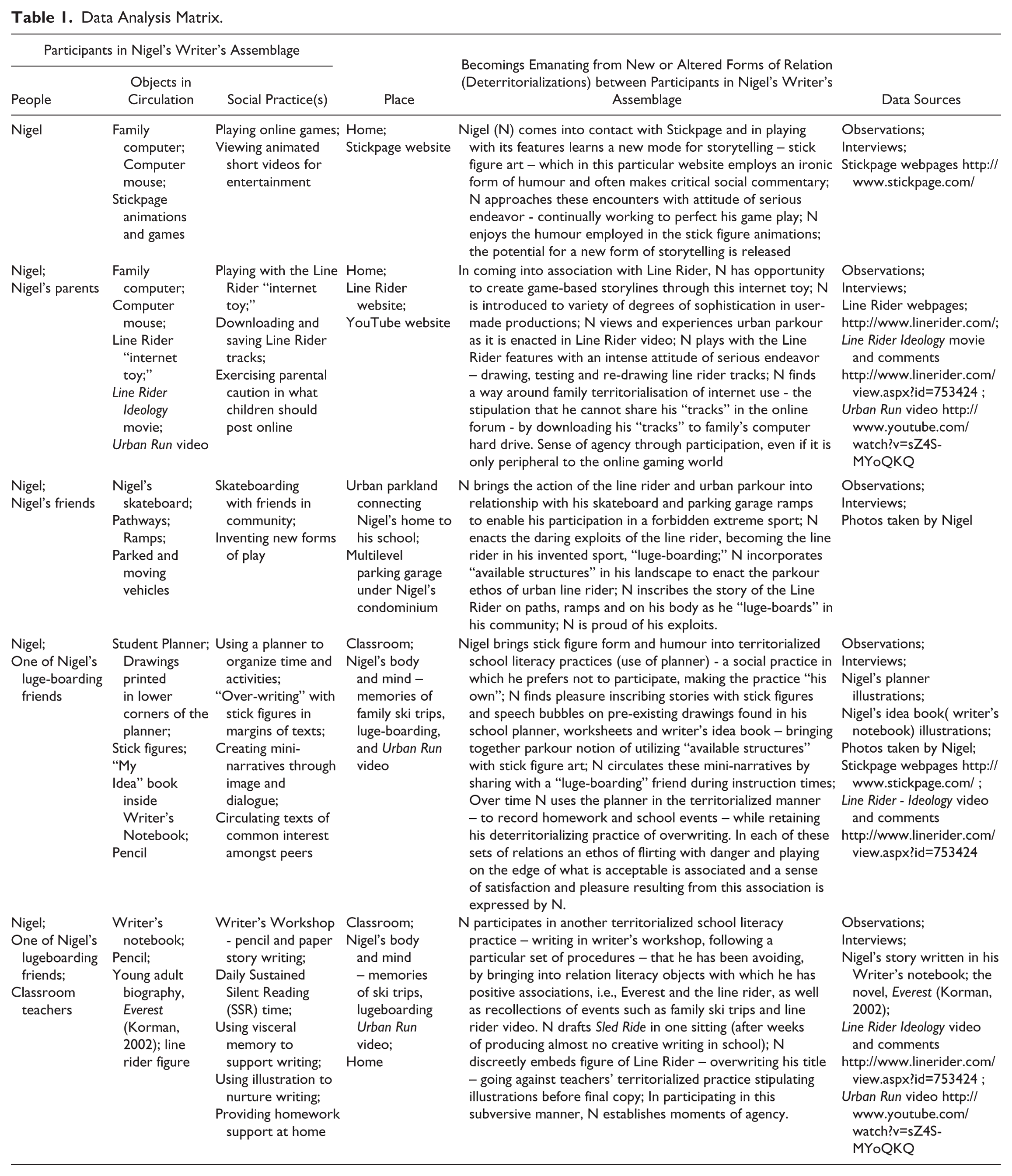
Examining the assemblage
The next step is to examine the assemblage for an understanding of what is happening between participants in the assemblage as they come into association with each other—that is, in the spaces between the participants that open up as a result of their interaction (Latour, 2005). Two specific sets of questions are asked: “How do these participants work together as a durable whole in this moment of interaction?” (Deleuze & Guattari, 1987/2004; Latour, 2005), that is, what new associations are taking place in the assemblage? Expressed in terms of literacy-in-action (Brandt & Clinton, 2002), “What are people doing with literacy (new associations)?” The second set of questions asks, “What is generated through the interactions (new lines of becoming, deterritorializations) between participants?” (Deleuze & Guattari, 1987/2004; Latour, 2005). What role is literacy, as a participant, playing in that action?” and “What circulates from site to site (literacy objects in action)?” (Brandt & Clinton, 2002). “What visceral forces other than conscious knowing (affective states) flow from these interactions?” (Gregg & Seigworth, 2010).
As I asked these questions of the data, five salient knots along two lines of becoming emerged across Nigel’s home, community and school contexts (see Table 1). I have labeled the two lines of becoming Stickman-Nigel and Nigel-Linerider, as these figures are the primary literacy objects that circulated across time, place, and space in Nigel’s writing assemblage. Two of the significant knots appear along the Stickman-Nigel line of becoming and another two appear along the Linerider-Nigel line of becoming; the final is located along both lines of becoming (see Figure 8). In the Findings and Discussion section that follows, I elaborate on these lines of becoming by focusing on the five knots. In this section, I continue with the example provided in Step 1 to demonstrate Step 2 of the analysis as it proceeded along the Linerider-Nigel line of becoming.
It became clear in the mapping undertaken in Step 1 that Nigel’s new associations with the Stickpage website, the stick man, stick humor, and others (see Table 1) formed a significant bundling of lines of becoming of numerous participants who had recently entered his world. It also became clear, as I looked at the stick man associations Nigel made over time, that this knot had provoked a deterritorialization and initiated a new line of becoming. To paraphrase Deleuze and Guattari (1987/2004), Nigel went off on a deviation from the majority after being captivated by a little detail that started to swell and soon carried him off (p. 292).
Nigel’s play with the stick man on the Stickpage website (accessed via the family computer in his home) introduced him to an online community (new association). Through his interaction with Stickpage he was also introduced to a new form of storytelling (new association) that used stick figures to tell humorous stories that incorporate irony and engage in social commentary. As Nigel viewed videos on this site and played the online games involving stick men, he interacted with this new form of storytelling and humor, became infected by it, and tried it out for himself (new becoming). Initiating, multiplying, and intensifying this new becoming is the affect (physical and cognitive intensities) produced through the new associations—the stick men, engaged in a variety of exploits in the videos made him laugh; playing the stick games required intense cognitive and bodily focus; winning those games produced a sense of self-efficacy; participating in the stick forum made him feel quite grown-up. Moving along the Stickman-Nigel line of becoming into the school context, two more knots emerge. In one of these knots the stick man came into association with other objects associated with official school literacy practices (deterritorializations): worksheets (new association) and the printed illustrations on the corners of Nigel’s planner pages (new association). Transformed by his association with the stick figure and Stickpage, Nigel became increasingly adept (new becoming) with deploying stick figure annotations on these literacy objects as a form of storytelling. And Nigel experienced several affective intensities that lead to a sense of agency as he shared these illustrations with a peer.
Political relevance
Once these associations were laid out and considered, I addressed the matter of political relevance. In an ANT approach to rhizoanalysis, larger questions of political relevance are not addressed until the researcher has a strong sense of what the participants—distant and local—are doing, and is able to realistically make observations, posit explanations, and draw conclusions about what is happening. I initiate this aspect of the analysis in the Findings and Discussion section by considering explanations connected to the writing assemblage of which Nigel was a part and then move to more global explanations in the Implications and Conclusion sections that follow.
Findings and Discussion
In this section, I provide a narrative account of two lines of becoming in Nigel’s writing assemblage—Linerider-Nigel and Stickman-Nigel—by elaborating on the five knots (or significant moments that seem to hold the whole assemblage together) through an examination of the participants therein. Both of these lines of becoming span the terrain of Nigel’s home, community, and school spaces.
From this assemblage-mapping, the networks of people, objects, places, and practices that played important roles in Nigel’s emergence as a multimodal writer over the 5-month period of the study come into focus. Looking at the way these participants interacted and the affect produced in this interaction, provided a means for understanding new and important forms of agency, learning transformations that were a part of Nigel’s emergence as a multimodal writer.
The Line Rider, Stick Men, and Nigel Meet Online
Two knots provide a starting place for examining the two lines of becoming in the writing assemblage in which Nigel was a participant: his introduction of the Line Rider and the Stickpage websites to me (see Knots 1 and 2 on Table 1). On this particular day in early November, as he engaged in serious play with the two figures he had met online, Nigel spoke openly of his fascination with the quirky characters and demonstrated the ways he deployed them in exploits and stories that drew upon assemblages associated with urban parkour.
Line rider
Line Rider is classified as an “internet toy” by its creator, Boštjan Čadež, a Slovenian student at the time of its creation in 2006 (Wikipedia, 2013). On the official Line Rider site (http://www.linerider.com/), users can interact with the game, which, as Nigel explained to me, involves drawing series of lines to form a race track on which the line rider will subsequently ride when the player clicks the “Play” icon. Players work to build elaborate racecourses, called tracks, which can be saved to the hard drive on their computers. Many players post completed tracks to the Line Rider site or post them to video sharing sites.
As he came into association with the Line Rider site, Nigel was drawn into the practice of creating game-based storylines. The line rider game became a part of Nigel’s writer’s assemblage and his play with it, a new becoming—Nigel the virtual game storyteller. As he continued playing with the game, Nigel was introduced to a range of degrees of sophistication in user-made productions and new intensities emerged as he worked to develop his skill in creating line rider tracks to the level of these exemplars. Simultaneously, this becoming as a virtual game storyteller, while it took place in a manner that was peripheral to the online gaming world, fostered a sense of agency in a boy who eagerly wanted to participate in virtual spaces, such as online gaming forums, but was prohibited by his age. The timing of the events, elaborated in examples that follow, coincide with the early months of fifth grade, a time when Nigel was feeling highly circumscribed by the learning territory laid out by his teachers.
Oh! I really wanted to show you this game called Line Rider. You draw lines and you can actually make a guy on a sled go down the lines and do jumps and stuff. It’s really, really fun. (Nigel)
Similar to Nigel’s introduction of stick men, recounted at the opening of this article, the line rider first entered our conversation with a swift change of topic. We were seated at his family computer and had been talking about his family rules for internet use when he suddenly remembered he wanted to show me Line Rider (InXile Entertainment, 2009). Because of his age, Nigel’s parents did not allow him to post his designs online but he had a couple saved on the family’s hard drive, to which he frequently returned to refine. On the day he introduced me to Line Rider, he showed me a track on which he was working. Nigel prefaced the introduction with the delighted observation, “He always has that little scarf! On every single one of them!” (see Figure 1). For Nigel, the work was fun. He preferred Line Rider 2, which employed a sled, calling it “one of the funnest ones” and “better because you get to do more tricks.” But his relationship to it was more than entertainment. While together screening the line rider’s race down the track Nigel had designed, he commented, “Oh that’s not good. I’m going to change some of the lines [using the mouse to draw as he speaks] . . . There we go. Now’s let’s try.” And deep in thought on the next run-through, “That’s going to be hard to land on. Better erase that. 174 lines . . . ” This kind of think-aloud continued throughout the 20 min we spent with his Line Rider track.

The line rider figure.
The commentary provided by Line Rider fans on the official site echoes Nigel’s convergence of work and play. Fans view tracks created by other members, learn from, and support each other in the creation of highly elaborate designs (for example see, “Line Rider–Ideology”; FlagCapper, 2008). One commenter, miamoneyz, writes, “Wow! Line Rider parkour!” in response to the “Line Rider–Ideology” video posted to the site. Indeed, the sophisticated run the line rider makes through a complex urban scene is highly reminiscent of urban parkour, a sport in which youth (typically) use the available structures of urban streetscapes—stairs, railings, roof tops, and dumpsters—as objects on which to perform stunts. In general, the stunts involve using only their bodies to perform flips, rolls, and other types of acrobatics that make “the urban landscape [a] personal obstacle course, a playground for strength, freedom, courage and discipline” (Lawrence, n.d.). A practitioner of parkour is called a traceur and in the sport, there is an ethos of pushing the boundaries of acceptable behavior, a sense in which the traceur engages in unsanctioned activity that runs along the edges of what is lawful and what is physically safe.
Stick men
Nigel’s pleasure in playing with Line Rider was paralleled by his enjoyment of Stickpage (Stickpage, 2013). As the quote from Nigel at the opening of this article explains, Stickpage is a site where users may participate in a variety of activities involving stick people. Tabs on the home page (http://www.stickpage.com/) take the reader to Stick Games, Stick Fights, Stick Humor, and a Stick Forum. By following these tabs, Stickpage users may play online video games and watch animated videos featuring stick figure characters, created and posted by members of the Stickpage forum. In the forum, members discuss stick figure animation and video game making. The stick figures, whether stationary or animated, are drawn in a manner that connotes fluidity, motion, and dimension, contrary to our common perception of stick figures as lifeless icons or fallback illustrations for the artistically disinclined.
When Nigel came into contact with Stickpage and began to play with its features, the site and the stick man figure became a part of his writer’s assemblage, along with the line rider. Nigel learned a new mode for storytelling from Stickpage—stick figure art—which in this particular website employs an ironic form of humor and often engages in social commentary. Nigel was particularly fond of ironic humor—for example, he was a great fan of Far Side comics and its creator, Gary Larson’s sardonic look at human practices through the eyes of the animal world. As noted in the introduction, Nigel found Stickpage to be both “fun” and “hard.” He enjoyed the raucous stick humor that runs throughout the games and videos. Nigel also found the Stickpage games to be challenging because of the physical coordination required of the keyboard-controlled video games. Being introduced to a form of visual storytelling he was physically capable of producing, which also demonstrated a means for ironic storytelling, likely resonated deeply with Nigel and the potential for a new form of storytelling was released in this new association.
Nigel’s play with the line rider, urban parkour, and the stick men embodied an important deterritorialization in his writer’s assemblage. These new becomings took flight as he brought objects and practices into a productive association, a space from which he could begin to create the kind of stories with which he had, up until that time, only been able to interact as a consumer. Nigel’s interest in participating in online assemblages—such as the Line Rider and Stickpage forums—was keen; however, his actual participation was limited by his age. He very much wanted his own e-mail address and looked forward to the day he would be allowed to have one. With the entry of the Line Rider and Stickpage sites into Nigel’s writer’s assemblage, spaces in which he could play online with safety—and, yet, with the sense of the satisfaction that comes from being allowed to play with older youth and adults—opened up for Nigel. The kind of think-aloud I observed during the 20 min we spent with his Line Rider track was a clear indication to me that Nigel considered himself to be engaged in serious work as he played with this internet toy. His serious pursuit was very much in tune with that of older youth and adults who posted on Line Rider site. Similarly, Nigel’s love of action and humor would have resonated well with the affective atmosphere of these sites, and, in the case of the downloadable Line Rider tracks, provided him with a digital space in which to inscribe and read his own action-packed storylines and become a digital traceur. The stories, evoking the ethos of parkour, were then read again and again by Nigel as he raced the line rider figure down on-screen tracks.
Nigel the Line Rider
In this particular knot along the Linerider-Nigel line of becoming, Nigel is assembled with friends, their skateboards, and his condominium’s underground parking garage (see Knot 3 on Table 1). Nigel’s becoming as urban lugeboarder, illustrated in our conversation below, is reminiscent of the digital exploits in which he involved the line rider and viewed in the line rider user-created video, Urban Run (UnConeD, 2006b). Here, the virtual action of the line rider and urban parkour come into association with his skateboard and parking garage ramps to actualize his participation in a forbidden extreme sport. In this activity, Nigel incorporates “available structures” found in his landscape to enact the parkour ethos of urban line rider and inscribes the story of the line rider on paths, ramps, and, indeed, on his body as he “lugeboards” in his community. In the conversation below, Nigel proudly describes his exploits.
So tell me, how long have you lived here?
My whole life, so 10 years.
What’s the best thing about your neighborhood?
Um. It’s a great place for skateboarding, like lugeboarding, which is one of my favorite sports but . . .
Is there a park for that?
It hasn’t been invented but I sit in my garage. It’s like a little hill. It goes down, I just need to lean to turn, and it goes down bigger, and then it goes like 90 degrees almost.
So you’ve made your own luge track?
Yes. The goal is not to get hit by a car [deadpan expression].
Yeah! [laughs somewhat uncomfortably] Do you have to have someone watching out for you when you play?
Oh no [non-chalant tone]. Well, yeah, mostly.
Just to be safe, huh?
If you dodge a Ford F150 you get 100 points, if you dodge a Porsche, you get 350, and if you dodge a GMC Yukon, you get 500.
You like action, don’t you?
Yeah! [laughs]
The garage to which Nigel refers in this conversation was the multilevel parking garage under his family’s high-rise condominium complex. Nigel lived in a community situated on the edge of the city’s downtown core. He was fortunate to have parks and pathways adjacent to his family’s condo on which to use his skateboard and scooter. However, it was the ramps snaking through the parking garage that constituted prime track for “one of his favorite sports”: lugeboarding. Aware of the danger to which they were exposed, he and his friends had clearly made a game of it, attaching scores to the dodging of particular makes and models of vehicles that enter the garage.
Nigel’s luge track revelation represented one of those uncomfortable instances for me as a researcher, a situation in which I was made a party to unsanctioned and potentially unsafe behavior. But it was also a fascinating moment. In this activity, Nigel was enacting a line rider story on a surface beyond his computer screen—turning his skateboard into a luge (sled) in his parking garage, he was the Line Rider.
A. J. Rosen, a former member of the U.K. Olympic luge team describes luge as “the fastest sport on ice.” In this form of sled racing, “competitors lie on a small sled feet first. They hurtle up to 90 mph through 17 curves on 4,318 ft. of track in less than 1 minute [with] no brakes” (Rosen, 2012). Professional luge racing is performed on cement tracks, constructed specifically for the sport, but has been adapted for amateur participation through specially designed go-carts and asphalt paths snaking down mountain slopes. Skateboarders have adapted the sport in the form of street luge, lying flat on skateboards, longboards, or specially adapted street lugeboards and using city hills and other available structures as slopes for their tracks (Turner, n.d.). Street luge is an activity whose inherent danger earns it categorization as an extreme sport.
The street luge ethos of speed and death-defying activity is integrally woven into Nigel’s lugeboarding in his parking garage, his personal “available structure.” As he engaged in this act of embodied storytelling as a traceur hurtling down the parking ramps, Nigel wove a sense of the serious pursuit of dangerous sport into his storyline. And, as he laid down his own tracks, Nigel inscribed his story of the lugeboarding line rider within his body and on the pavement of his parking garage.
The Stick Men, the Line Rider, and Nigel Overwrite at School
The stick men and the line rider also circulate in the assemblage that constitutes Nigel’s classroom writing space and are part of the two lines of becoming that continue their unfolding in this space. Both of these figures embody what Nigel held to be true of good books and good writing: they must contain action and humor. The deterritorializations in which Nigel and these figures engage often run counter to the territorialized terrain from which his teachers sought to teach self-organization and creative writing in the classroom.
Using planners and worksheets
In this knot along the Stickman-Nigel line of becoming, Nigel brought stick man form and humor into his daily use of his school planner and the worksheets that were part of the Science curriculum (see Knot 4 on Table 1). Using his planner in the sanctioned manner—to record homework—was a social practice in which Nigel preferred not to participate because of its implications for his homework load. By bringing stick men into association with his planner, he made the practice “his own” by inscribing stories with stick men and speech bubbles on pre-existing drawings found in the corners of the pages. I have coined the term overwriting to describe this practice of reterritorialization.
Do you put anything else in your planner? I see a little cartoon here!
Yup.
What’s that say?
“Helloooo!” It’s a guy hanging on!
[laughing] Do you like to draw quirky little cartoons?
Yeah!
This is the stick man art you were telling me about before, isn’t it?
Yeah, the stick man!
Much like the traceur in parkour, and just as he did with his lugeboarding, Nigel involved the majority of his stick men in the performance of stunt maneuvers using “available structures”: in this case, printed illustrations conveniently placed at the bottom of the right hand margin on each of his planner pages (see Figures 2-4).
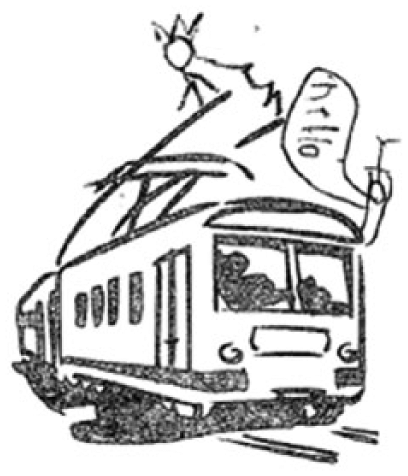
Stick figure overwriting in Nigel’s planner.
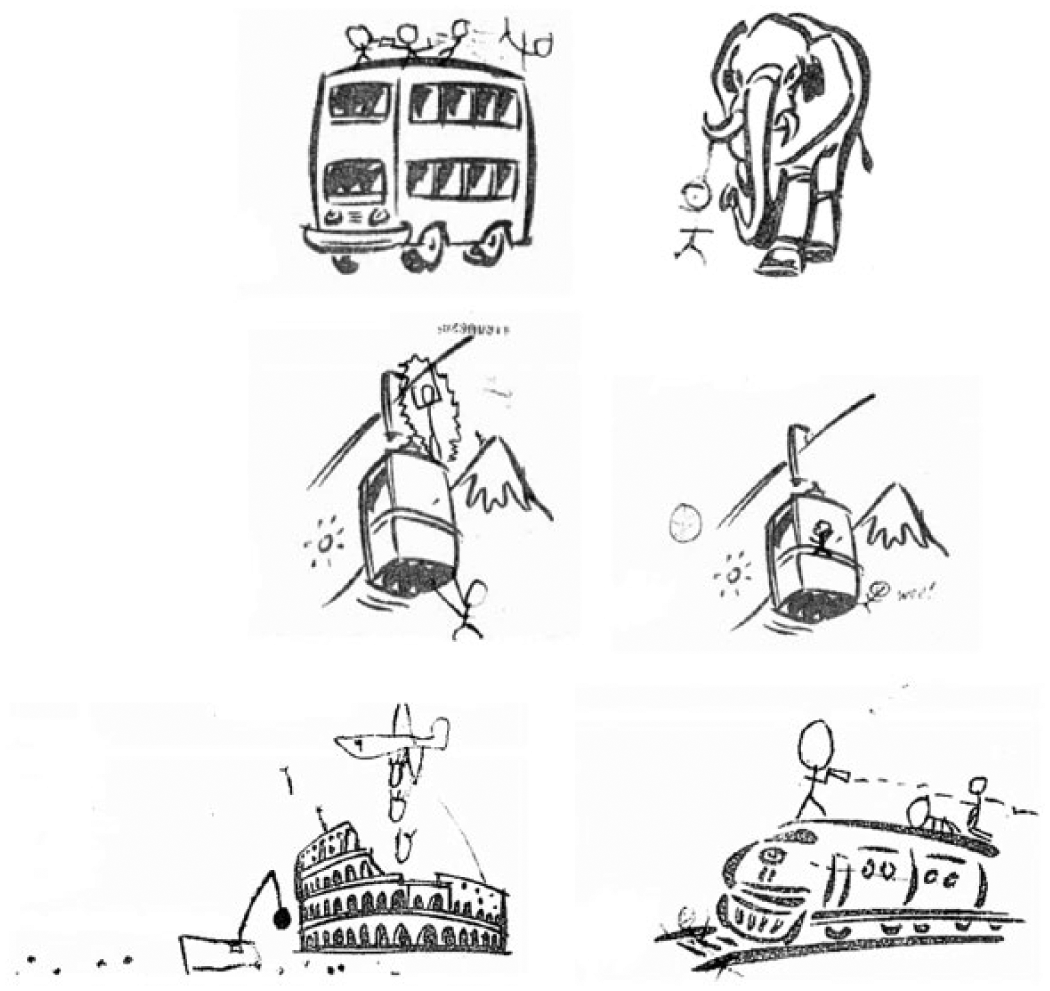
Montage of planner images with Nigel’s overwriting (October through February).
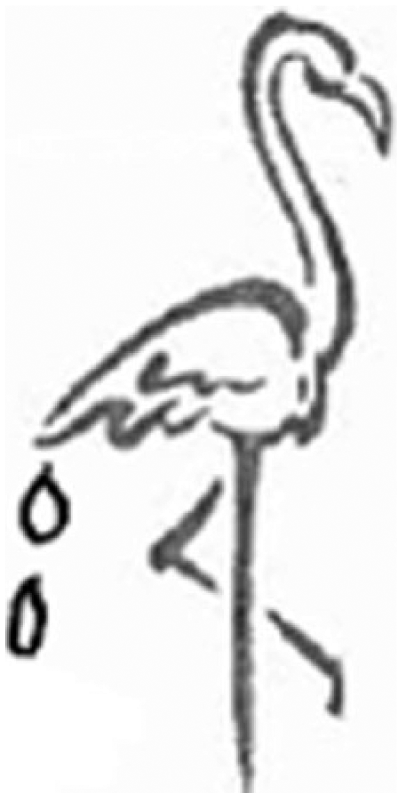
September planner image with overwriting.
His becoming as a stickman-overwriter is also visible in his use of worksheets, where Nigel once again came into association with the parkour practice of utilizing “available structures.” On one occasion, in yet another redirected conversation about literature circles, I asked Nigel about his favorite part of this aspect of the language arts program. His response was as follows: Illustration. I love drawing. Yeah, I take—like in Science today—I took the picture of that [pointing to a graphic on a worksheet] and I put stick men falling off the blocks. Funny illustrations mostly.
By this time, it had become a common feature in our conversations for Nigel to tell me about his practice of overwriting found illustrations with stick men engaging in feats of humorous action. These figures also graced the pages of his social studies worksheets, his planner, and, as we will see, the idea book glued into the back of his writer’s notebook.
As I watched, this practice of overwriting emerge in the writing assemblage over the course of the half year, his drawings developed from what one might categorize as silly “potty humor” in September (see Figure 4), to stick men taking advantage of the terrain provided in photocopied workbooks to embody the parkour ethos of the Line Rider–Ideology (FlagCapper, 2008) and Jagged Peak Adventure (UnConeD, 2006a) user-created videos Nigel viewed online in October through February (see Figure 3).
In this activity, Nigel was not simply doodling or embellishing his workpages but rather engaging in the practice of overwriting official school texts. These annotations, at first glance, appear to be superfluous or counter to the official purposes and meanings of those texts. However, in each of these examples, the stick men came into sets of associations that evoked an ethos of flirting with danger and playing on the edge of what was acceptable. They embodied a sense of motion (not an easy feat when working with the minimal pencil strokes of the stick figure genre) similar to fluid contours of stick figure characters on Stickpage. These figures were infused with the action and humor he loved. The effect of this was a deterritorialization from imposed literacy practices that inflected these in-school practices with Nigel’s personal sense of what makes a good story.
Writer’s workshop
In the final knot in this examination of Nigel’s writing assemblage, located along both lines of becoming, the parkour practice of utilizing “available structures,” along with the line rider and the stickmen took flight to enter the territorialized classroom writer’s workshop (see Knot 5 on Table 1). In their assembling of a writer’s workshop, Nigel’s teachers sought predictable routines by providing the students with a writer’s notebook and attached a booklet inside of the back cover, which they titled, My Idea, borrowing on strategies from Amy Buckner (2005). Following the December holidays, the teachers led the students through a variety of writing explorations with the intention that they would have a piece of writing ready for publication by the end of February (see Lenters, 2012).
During several sessions where students were to free-write for seven continuous minutes, Nigel rarely wrote more than a sentence. However, in this knot where the Stickman-Nigel and Linerider-Nigel lines converge, Nigel played with new participants and practices (new associations) in the officially sanctioned assemblage. At the end of the first 4 weeks of writer’s workshop (the month of January), having avoided conventional writer’s workshop writing, Nigel embarked on a new deterritorialization (see Figure 8 where this is depicted as a knot that only peripherally contributes to Nigel’s lines of becoming). In this deterritorialization, the stick men enter into storytelling relationship with one literacy object located within his writer’s notebook: the title of his “My Idea” notebook. From there, other literacy objects, practices, and events can be seen coming into association with each other. Some of these practices fall into line with school-sanctioned use of time and materials in writer’s workshop, while others do not. The examples that follow outline the unfolding of the two lines of becoming that were part of this de/reterritorialization.
The wild west
In one example of his evolving sophistication with overwriting, created in January (see Figure 5), Nigel inscribed a scene on the cover of a mini-notebook, stapled to the back of his writer’s notebook and officially intended to serve as a place for jotting down writing ideas. The scene plays out upon the available structure of the title, My Idea, and an image of a treasure chest—supplied by the teacher on a photocopied slip of paper glued to the mini-notebook—as the stage for a drama evocative of the North American Wild West. In the scene, a stick man in a cowboy hat stands atop the M, pointing a revolver at three figures. The cowboy states, “I hate Monday.” Two hatless stick men lie dead atop the I and d and a third stick man runs from the bullets being fired, stating, “Not good not good not good.” Another stick man in a cowboy hat stands nearby, arms outstretched, as though preparing to commandeer the stagecoach, now vacated by its besieged owners. Beside this drama, another stick figure is seen diving into the now unprotected treasure chest, gleefully proclaiming. “Mine!!!!” In this simple comic, Nigel communicated an in-depth understanding of the genre of the Western and told a story of stagecoach robbery his teachers had not foreseen when they asked Nigel and his classmates to record their writing ideas in these mini notebooks.
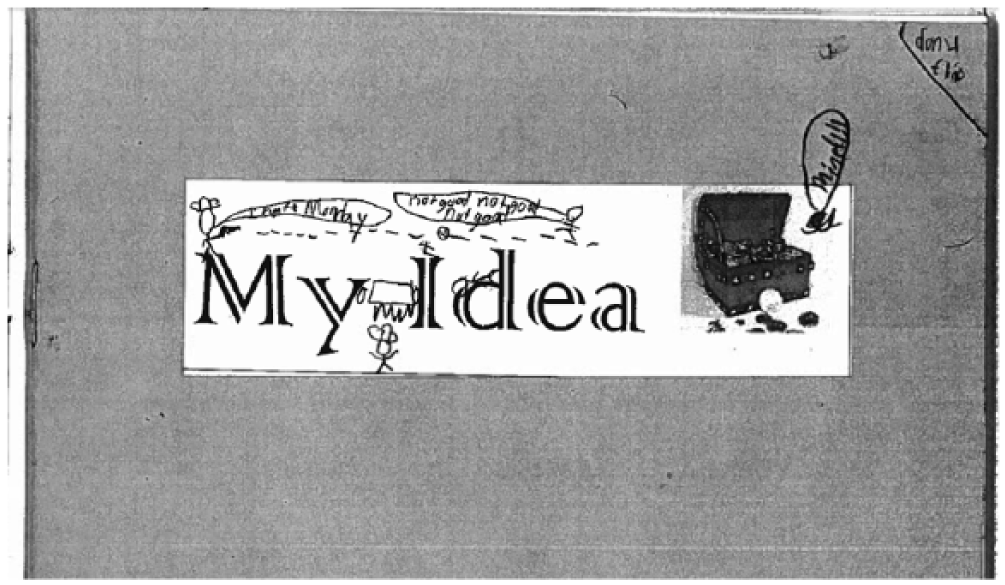
“My Idea” title as available structure for Wild West stick figure overwriting narrative.
In the depiction of this narrative, Nigel and the stick men engaged in overwriting, reterritorializing a school text Nigel struggled to use in the conventional manner suggested by his teachers. When compared with a statement Nigel made about the idea book when we were looking through his writer’s notebook a couple of weeks earlier, the juxtaposition is stark:
And then, what’s this little guy, here at the back?
Oh. That’s my idea book.
So what do you do with it?
I just write in all ideas. But I haven’t used it yet . . . ‘cause I don’t get a lot of ideas.
The contrast between the kind of energy depicted in the Wild West comic overwritten on the cover of the idea book, and the defeated tone with which he described his participation in its intended (territorialized) use are striking. Stick figure art provided him with numerous avenues for storytelling, yet, when he thought about writing through the lens of sanctioned classroom practice, Nigel felt he had few ideas. It was clear that the highly territorialized way in which writer’s workshop was assembled was not working for Nigel in his development as a writer. While set up to provide a connected trajectory on which Nigel (and his peers) could draw writing inspiration, the opposite appeared to be true for Nigel: the largely cognitive activity of constructing idea lists appeared to be more stifling than encouraging to Nigel’s emergence as a writer.
Sled ride
As the first publication due-date for writer’s workshop approached, Nigel had no material to bring to the peer editing session his teachers had devised. Nigel was asked to sit at the back of the classroom with others who also were not ready. He went straight to work and, astonishingly, in comparison to every writing session that preceded it, in one 30-min sitting, Nigel wrote a story he titled Sled Ride (see Figure 6). He later told me that he had to get something done and Sled Ride was what he came up with in the press of time.
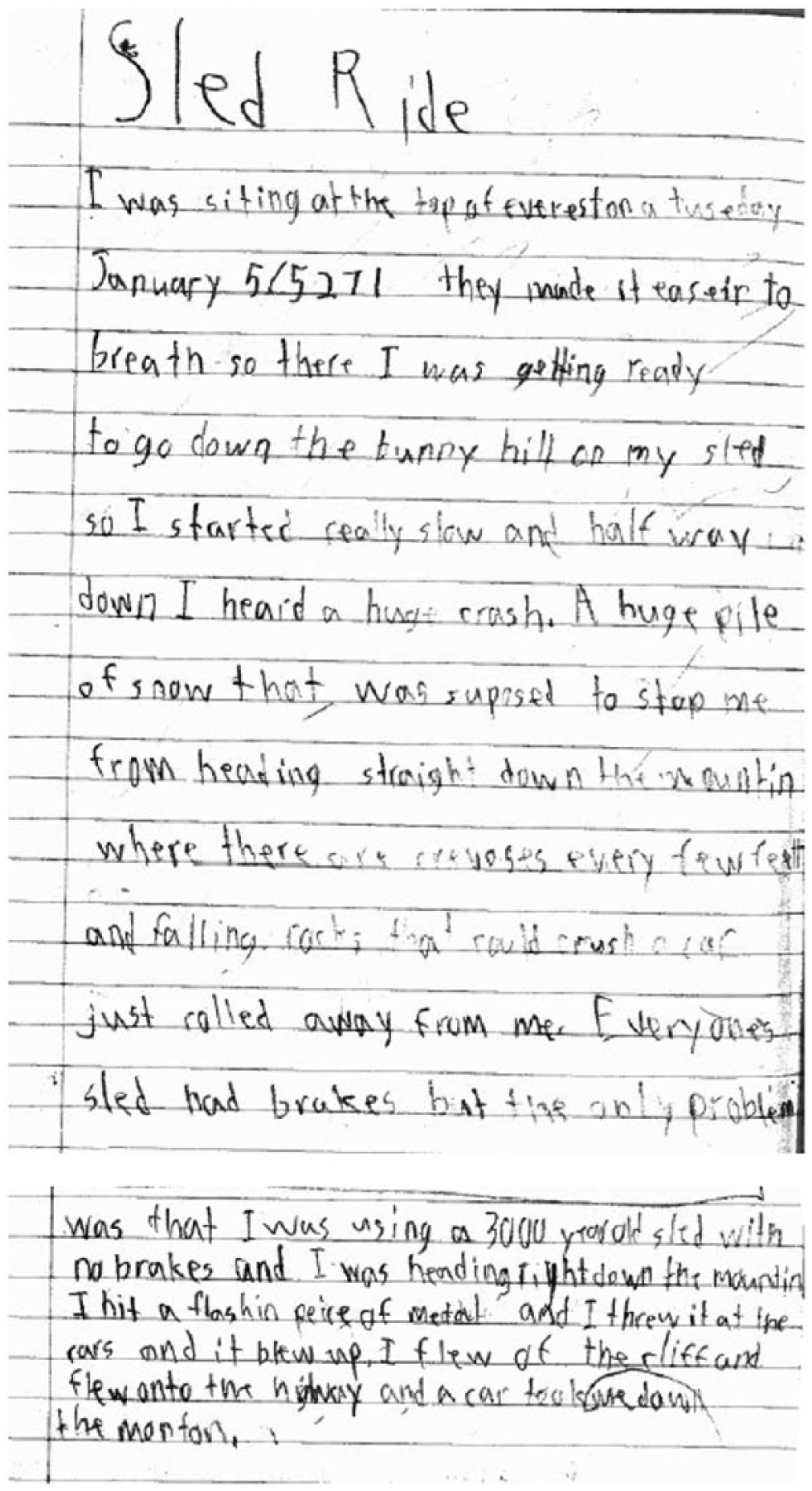
Nigel’s Sled Ride story.
The students in Nigel’s class had been instructed that they must first complete the written part of their stories and then, once they had selected and edited the story they would publish, could they work on an illustration that would serve as its cover page. Fully aware of this rule, Nigel wrote the title of his story, Sled Ride, and then in minute detail embedded an image of the line rider, hurtling down the inner slope of the S (see Figure 7). Aspects of the adventure story Everest (Korman, 2002), he was reading during free reading appear in the story and it reads with the same affective atmosphere found in the line rider user-created video, Jagged Peak Adventure (UnConeD, 2006a): speed, adventure, danger, and opportunistic landings on available structures, which magically appear to catch the figure with the jaunty red and white scarf as he hurtles through alpine terrain.
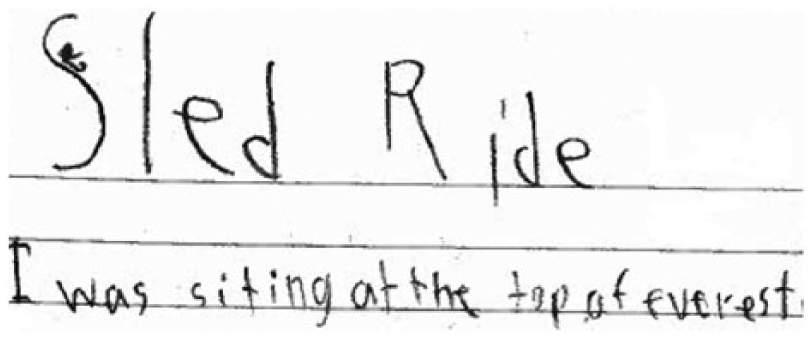
Nigel’s overwriting in his Sled Ride story.
The intensity displayed in Nigel’s posture and focus as he wrote Sled Ride stood in startling contrast to virtually every other pencil and paper, in-school writing session in which I had observed him in the four preceding months. Noise and activity surrounded him as his peers exchanged work, talked, and moved about—potential distractions abounded. Yet in this moment, in spite of feeling unhappy about being excluded from the feedback session, Nigel’s attention was on his writing. The breathless pace of his story suggests he was living that sled ride down the mountain. Perhaps the embodied storylines of racing down the ramps of his parking garage and mountain slopes on family ski trips were called into the present as he wrote. Inserting the clandestine line rider figure into his story title, in spite of the “write-first, illustrate-later” rule in his classroom’s highly territorialized writing practice, may well have been a move to reterritorialize a contested space.
Sled Ride did not come to a place of completion, by school standards—it was never revised and written up in good copy for others to read. Nonetheless, for Nigel, and for me as a researcher interested in assemblage, affect, and literacy development, the writing of Sled Ride is an important part of the knot binding together a network of intersecting storylines along the Linerider-Nigel and Stickman-Nigel lines of becoming. As he enjoined the stick man and the line rider in his home, community, and school literacy life, Nigel laid down literal lines and took flight on figurative lines of becoming. Figure 8 depicts a simplified mapping of this process. The unfolding took place in unpredictable ways, and was often in opposition to the kinds of territorialized relationships with writing texts and practices Nigel’s teachers felt would foster his becoming as a writer. In this unfolding, strained relations between participants often ensued; however, literacy practices that brought intellectual and visceral engagement, pleasure, and pride, and agentive recourse to Nigel in his practice of literacy also came into focus.
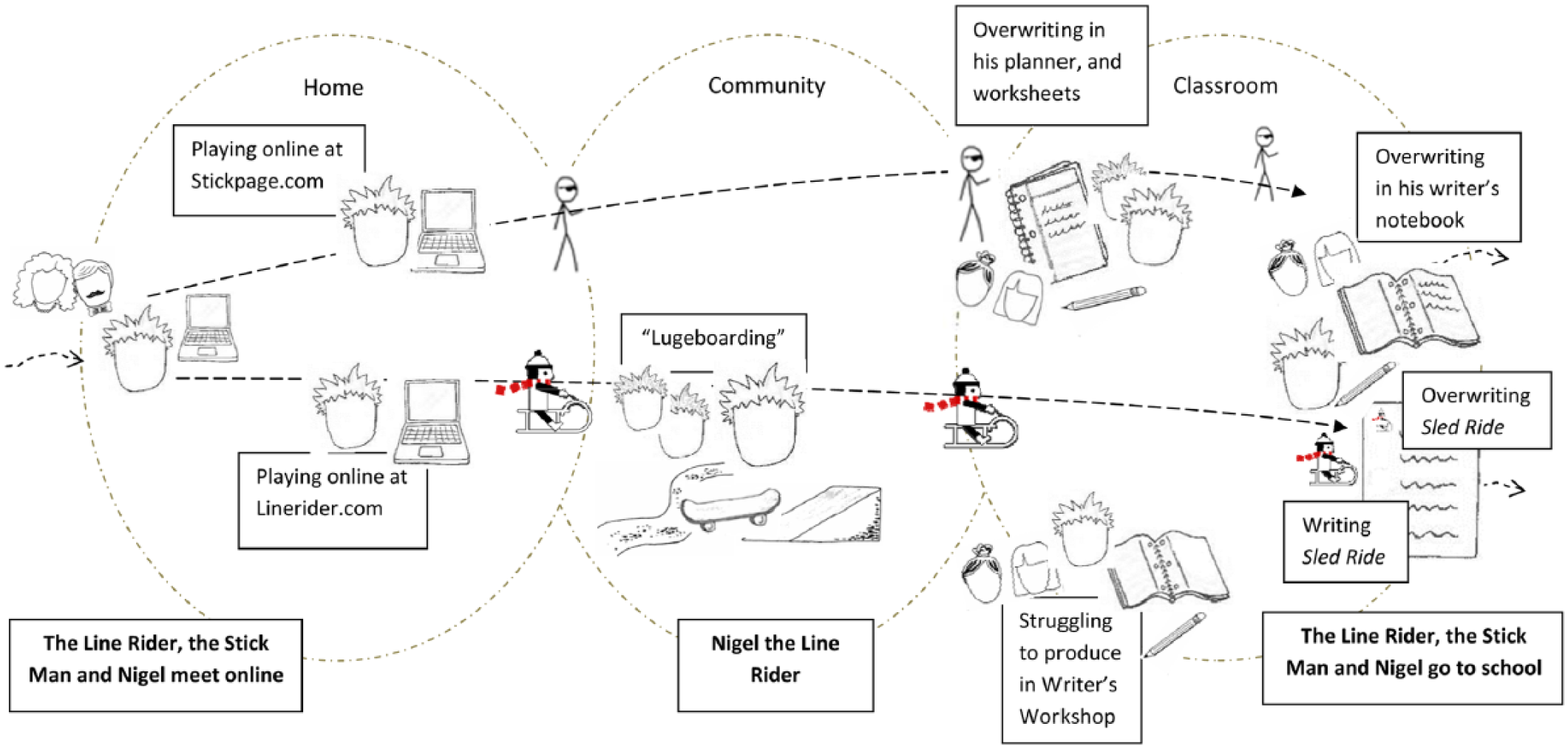
A map of knots and lines of becoming in the emerging writer’s assemblage, in which Nigel, the stickman, and the line rider participated.
Implications
While appearing to be out-of-step and, at times, non-compliant with the literacy instructional procedures of his classroom, Nigel was actually involved in writing assemblages that opened up new trajectories in his writing life. In school, Nigel’s overwriting in the margins and unfinished creative writing assignments might be categorized as off-task productions, at best, and, at worst, a failure or refusal to engage with the opportunities offered by his teachers. Alternatively, his overwriting might be seen as an act of avoidance or, possibly, subversion. I suggest here, that none of these categorizations are helpful and, in fact, when applied to Nigel and others young adolescents like him, they position the educator to completely miss the rich literacy learning in which children and youth may be engaged. What if, instead, we were to think of these kinds of de/reterritorializing practices as opportunities for becoming-other?
An assemblage understanding of literacy views literacy development as an open and ongoing process of multiple becomings (Masny, 2012). As Deleuze and Guattari state, “ . . . we can be thrown into a becoming by anything at all, by the most unexpected, most insignificant of things. You don’t deviate from the majority unless there is a little detail that starts to swell and carries you off” (p. 292). Nigel’s play with the line rider and stick man, while seemingly insignificant when viewed in isolation, sparked becomings as a new kind of multimodal writer. The introduction of these characters to the writing assemblage of which he was a part, indeed, seemed to start a swell—a place of intensity, enchantment, resonance, and harmony (Semetsky, 2013)—that carried him off on further de/reterritorializations, deviations from the majority that opened up new possibilities for him as a writer.
Play with online games or writing sessions such as the Sled Ride draft are often viewed as unproductive uses of time in highly territorialized classrooms. Territorial motifs—fixed sets of rules and procedures generated in territorialized assemblages—may provide the means for consolidation and predictability in social assemblages such as classrooms but much is lost through the rigidity that ensues (DeLanda, 2006). In the outcome driven milieu that characterizes so many elementary school classrooms, rigid territorial motifs too easily order the sequencing of instruction and rules for textual production. Consequently, opportunities for young writers to play in open-ended ways with storytelling have become the casualties of production-oriented classrooms. As educators, we might step back from a focus on work completion a little more often and allow students the luxury of playing with story writing. Whether the writing “works” in the end or not, it is the experimentation with the people, objects, practices, events, and the deterritorialization that ensues when the young writer brings these assemblage participants together in new ways, which form the stuff of creativity.
While creativity is one transformative aspect that may derive from allowing time and space for experimentation in storytelling and writing, agency is another. Similar in some ways to graffiti, Nigel’s overwriting allowed him to interact with canvases meant for particular school-sanctioned purposes—circumscribed, territorialized purposes to which he did not subscribe in the early months of school—reterritorializing them on his own terms. While, unlike the graffiti artist or tagger, Nigel only engaged in overwriting texts he owned (his planner pages, writer’s notebook, worksheets), the deterritorializing practice was, nonetheless, unsanctioned. This multimodal literacy practice seemed to foster a sense of agency in Nigel as he brought the figures, for which he was passionate, into school assigned tasks. What might have happened had Nigel’s teachers noticed this overwriting as a line of flight, a becoming-other in the writing assemblage? Might the affective atmosphere, the feeling histories (Ehret & Hollett, 2014) generated by his play with the line rider and the stick figures and held in his body have led others in the class on new and creative writing trajectories?
Many students doodle and engage in notebook graffiti. Rather than sanctioning, disparaging, or ignoring these annotations, educators might ask what stories are being told by those drawings in the margins. Are they just doodles? Might they embody aspects of agentive overwriting, like Nigel’s? And might they be part of a larger meaning-laden assemblage? Are they actualizing important aspects of sense-making (Aukerman, 2013; Masny, 2012)? By viewing these annotations as significant associations, places through which agency may develop, educators might use them, not only as starting places to help students write narratives in a variety of modes, but also as a means for exploring critical responses to texts or practices students find unfair, unjust, or in need of social commentary.
The analysis I have undertaken in this study is not meant to suggest practices associated with writer’s workshop (or writing instructional routines like it) should not continue to be pursued in the classroom. Similarly, my intention is not to romanticize literacy learning by suggesting that schools should simply allow it to unfold without intentional scaffolding. Nor do I want to imply that had he been left to his own devices, Nigel would have been further ahead in his literacy development. In fact, had Nigel’s teachers not insisted he produce a written story, he might not ever have settled into formally writing Sled Ride or any of the other stories that followed later in time. But I do want to suggest that in missing the affective aspect of Nigel’s storywriting—his intense play with the line rider and the pleasure derived from his multimodal stick figure overwriting across the terrain of his home, community, and school—the adults in Nigel’s world at the time of the study initially missed what he was up to because we were not attuned to look for it.
It was by pondering affect—the delight with which Nigel spoke of the line rider and the stick man, and the intense focus visible in posture and movement as he engaged with them and lived their stories—that I became aware of Nigel’s embodied texts. As written by Nigel on screen, on asphalt and pavement, on his body, on pre-printed worksheets and planner pages, and finally in his notebooks, Nigel’s storylines were rich inscriptions, full of possibility for him, the emerging multimodal storyteller. But they did not take place in a linear, methodical, or structured manner—they unfolded as Nigel played with the other participants in his writing assemblage and was carried forward by the affective intensities that flowed from the interaction.
In classrooms where outcomes and benchmarked standards provide the main guidance for providing and assessing literacy learning, educators may easily miss the affect driven literacy practices of students like Nigel. Rather than tightly controlling all instructional routines, we might at times want to stand back and make space for the creativity and agency that ensues when students are encouraged to draw upon that for which they are passionate: that which engages them at a visceral level. What might happen if we were to make space for the meandering emergence, embodied story writing, and for overwriting—practices so often unrecognized or unwelcome in classrooms? What might happen if we were to encourage affectively charged networks that harness the body’s power to multiply and intensify connections as a part of meaning-making (Semetsky, 2013)? In this space, students would be invited to connect the mind and the body to draw upon visceral, passionate engagements with story as resources for sense-making (Aukerman, 2013; Masny, 2012). Similarly, educators would be able to assist students in capitalizing on the creativity and engagement that flow from embodying a favorite character and “being the story,” and the agency that comes of playing with de/reterritorializing literacy practices, such as overwriting. By allowing a widened array of participants in students’ writing assemblages and acknowledging the affect produced when these participants come together in new and unexpected ways, conditions of possibility that foster new trajectories for literacy development—transformations—for all students may more easily emerge.
Conclusion
Viewed across time and place, Nigel’s textual and embodied play with the stick man and another figure he met in virtual spaces, the line rider, demonstrate ways a young adolescent, fully immersed in and engaged with his digital and material world, de/reterritorialized his school writing assemblage. The unfolding of Nigel’s inscriptions across multiple terrains provides insight into ways in which assemblage theory, with its focus on the ever-changing interactions between human beings, objects, events, and practices, and the affect that is produced in the process, may assist educators concerned with the literacy development of youth like him who appear to be off-task in our classrooms. Seemingly meandering engagements with literacy that involve the body, visceral enjoyment associated with consuming and producing text, and passionate attachment to literacy objects, such as those that played out in the writing assemblage of which Nigel was a part, can provide a helpful path for both recognizing hidden literacy practices and questioning taken-for-granted territorialized approaches to literacy instruction in the classroom. How much greater might the conditions of possibility be for youth, such as Nigel, were we to find ways to support the lines of becoming they so often initiate for themselves?
This work furthers the larger project of considering what counts as student literacy to mobilize against a continued practice of misrepresenting youth literacies as off-task indulgences. The range of possibilities for youth composition has grown by exponential leaps and bounds in the past 20 years and the possibilities for this kind of misrepresentation have grown proportionately. While this article has featured just one boy, his case is not anomalous—children and youth worldwide are discovering and exploring new textual terrain in their homes, communities, and classrooms, and too often educational systems misrecognize this exploration. This is an important project in our conflicted educational milieu. By valuing the de/reterritorializing multimodal literacies in which youth engage during moments they are “off task” in school (and elsewhere), we can extend our conception of the myriad ways young people come to be literate and provide important, new avenues for pedagogical exploration.
Footnotes
Acknowledgements
The author would like to acknowledge the contributions of Drs. Kinga Olszewska and Alan Luke to early drafts of this work.
Declaration of Conflicting Interests
The author declared no potential conflicts of interest with respect to the research, authorship, and/or publication of this article.
Funding
The author received no financial support for the research, authorship, and/or publication of this article.