




Abstract
Systems thinking is a holistic framework recognizing the natural and human worlds as interconnected and interdependent. A systems thinking perspective using multimodal literacies can help children address current environmental, social, and economic problems. This qualitative case study captures the possibilities for young children’s expansive and sustained critical thinking across content areas. We asked how do teachers and students in a K-1 classroom apply a systems thinking view of the world’s interconnectedness using multimodal literacy practices to analyze problematic social and ecological issues? During a one-year period, data collection included classroom observations, photographs, student artifacts, and interviews with teachers and students analyzed through distinctions, systems, relationships, and perspectives (Cabrera and Colosi, 2008). We found that students made connections and explored relationships within and across complex systems, imagined solutions to broken systems, and developed as change agents. This article captures children’s ability to be agentive when facing “wicked problems.” These findings demonstrate the capacity of young children to make connections, see relationships, and wrestle with complex social and environmental issues as they develop imaginative solutions.
Keywords
Introduction
One spring morning, five- and six-year-olds gathered in small groups to solve environmental and social problems. On the floor of their school’s multipurpose room, Traci and Fiona’s K-1 students (all names are pseudonyms) were sharing “block builds” of imagined futuristic machines. Two students described how their machine would replant trees in the Amazon Rainforest to stem deforestation. Another group shared their plan for preserving Arctic glaciers from melting. Elsewhere, students had built a ship with a large mechanical arm intended to scoop debris to restore an ocean’s habitat. A student dyad had created a robot, humanized with facial features, to recycle materials and output beds for the unhoused.
These young students showed awareness of current issues and understood their own capacity for designing solutions. Their attentiveness to global environmental concerns (Johnson et al., 2019) was noted by their school’s systems thinking professional development consultant who remarked that children are “observers of how the world [worked].” She added, “And we really have underestimated what young children are watching and what they’re thinking. And, more importantly, what it is they want to talk about, what they’re thinking about.” Even though classroom discussions of current complex topics are difficult, they are important “because these discussions can strengthen students’ sense-making, civic engagement, and achievement” (NCTE, 2024). In order to capture the possibilities for young children’s expansive and sustained critical thinking across content areas, we explored how teachers and primary grade students in one K-1 classroom applied a systems thinking view of the world’s interconnectedness using multimodal literacy practices to analyze problematic social and ecological issues.
Multimodal literacy
Multimodal learning is grounded in situated practice in which knowledge is based in a local context (Cope and Kalantzis, 2000; New London Group, 1996). Individuals use available resources and shared experiences for meaning making and learning (Kress and Jewitt, 2003). In the classroom, conventional literacy forms such as reading and writing are often privileged (Kress and Jewitt, 2003; Kuby et al., 2015; Powell and Sommerville, 2018). In contrast, multimodal literacy encompasses a range of communicative approaches including but not limited to “image, gaze, gesture, movement, music, speech and sound-effect” (Kress and Jewitt, 2003: p. 1, cf. Pahl and Rowsell, 2006). The International Literacy Association’s definition of the term multimodal literacies includes “print, drawing, photography, and audio and visual recording” as means for “expressing one’s self” (International Literacy Association [ILA], 2024). Literacy theorists assert that an expansive perspective of literacy allows individuals greater opportunities to express and communicate their understandings (Watts-Taffe, 2022).
Teachers can support learners through overt instruction in multiple literacy practices and provide guidance in the unique affordances of a specific modality (Jewitt, 2008). For example, they might show students how to craft a video by integrating still shots, action, sound, and captions. This engagement affords students’ agency in the creation of and interpretation of complex texts in light of their own social contexts and intentions. Transformed communicative practices are apparent when students (re)construct their ideas, (re)imagine modalities, and (re)present creations of their thinking (Jewitt, 2008).
Children’s multimodal literacy engagement has been examined in different learning contexts and allowed students to critically examine their world and represent their thinking. For example, Brownell (2023) documented how a 9-year-old amplified their conventional letter writing to oppose the contentious political building of a border wall to stem immigration. Using multimodality to demonstrate active opposition, the student, labeled as academically struggling, drew upon multimodal resources and invented water filtration cups. His invention communicated his understanding of the obstacles inherent in crossing the border, compassion for human welfare, and a sense of agency to affect change. Brownell challenges educators to fashion classroom spaces that promote students’ abilities to demonstrate their expertise in different communicative forms.
Stein (2003) documented how primary grade teachers in Johannesburg, South Africa, encouraged first- and second-grade students to create original characters for plays. Across school and then to their home contexts, students’ semiotic chains progressed from two-dimensional drawings, written text, and 3-D dolls in their representations of characters. Each multimodal representation fostered their own “narratives of identity and culture” (Jewitt, 2008: p. 250). In a second-grade classroom, Kuby and colleagues (2015) explored a writing workshop in which the teacher was transitioning to the inclusion of multimodal interactive materials. When students used drawing, poetry, 3-D projects, and creation of a to-scale giraffe, they demonstrated a broad range of understanding. The researchers asserted that, “These intra-actions with materials are a way of communicating and deserve the respect, validation, and privileges that traditional writing (i.e., alphabetic print) commands in schools” (p. 423). In a cross-continental critical literacy project, Janks and Comber (2006) documented elementary students’ use of texts and images in their creation of neighborhood-themed alphabet books. The students’ meaningful topics represented their respective neighborhoods’ uniqueness as well as its complexities. The researchers concluded that learners’ local knowledge and “reconstructive elements of critical literacy” allowed the development of texts that “represents their interests in powerful ways” (p. 115). These studies provide examples of how multimodal literacy can provide avenues for students to critically represent their ideas.
They also provide a glimpse into the potential when educators welcome a range of multimodal resources in a classroom’s communicative landscape (Pahl and Roswell, 2006). Loerts (2010) contends, “The access that students have to a full range of communicational options will allow them to represent their meanings in ways that provide possibilities—possibilities for them to look at issues of importance for them in new ways so that they are empowered—both for themselves and for those around them” (p. 30). Students explored different identities and engaged in the creation of 3-D projects. Shirley Brice Heath (2016) asserts the significance of haptic learning which includes the purposeful sense of touch: As youngsters produce and create projects in either the arts or sciences, they literally ‘feel’ themselves as agents or builders who make things happen. However, they can do so only as they gain practice and ideally encouragement in listening, observing, envisioning, and then enacting or dramatizing their internal images and scenarios (p. 122).
As multimodal literacy encompasses a variety of dynamic engagement including gaze, gesture, speech, movement, sound (Jewitt 2008), drawing, 3-D forms (Kuby et al., 2015; Stein, 2003), photography, and audio and visual recording (ILA, 2021), it allows for an expansive expression of cognition. Its non-linear nature pairs well with understanding and representing the dynamic aspects of a systems thinking approach which was the framing pedagogy in this K-1 classroom.
Systems thinking
Systems thinking is a long-established framework that recognizes the natural and human worlds as interconnected and interdependent (Capra and Luisi, 2014; Meadows and Wright, 2008; Wheatley, 2006). With its roots in biology and physical sciences, a system can be defined as a collection of elements operating towards a common goal or in a manner to achieve a purpose (Meadows and Wright, 2008). Extended to social, economic, and historical domains (Capra and Luisi, 2014; Stroh, 2015), this approach recognizes that systems are dynamic, have patterns, are self-sustaining through feedback loops, are interdependent, and are subject to disruption.
Capra and Luisi make distinctions between natural and human-made systems (2014). A tree, for example, is a natural system whose changes are seasonally patterned; it is interdependent with birds and other small animals who use it as a habitat and for food (Capra, 1990). In contrast, a bicycle is a human-created system. The parts—wheels, handlebars, seat, chair—are independent elements until they are assembled and connected (Capra and Luisi, 2014). A systems thinking perspective recognizes a system’s interdependency with other systems. A system can also be disrupted by identifying a point of leverage where the greatest impact can be made. A forest fire, for example, could seriously undermine a tree system, just as a reforestation effort can repair it.
A system thinking approach can be applied to solving a number of seemingly intractable societal problems or as they are known, “wicked problems,” (Checkland and Poulter, 2006) such as climate change, poverty, and homelessness. Cabrera and Colosi (2008) contend that one way to understand these types of complexities is through the use of four conceptual patterns: distinctions, systems, relationships, and perspectives or DSRP. Distinctions are the identifiable differences between things or concepts. Systems are composed of parts that work together to achieve a particular goal. Relationships indicate actions between people or phenomena, while perspectives indicate varied points of view. Cabrera and Colosi (2008) assert that the engagement of these four patterns foster a learner’s deep understanding and application of systems thinking.
In systems thinking, the interrelationships among different systems, ideas, concepts, objects and parts of a system involve nested systems, feedback loops, and change over time. As such, systems thinking is non-linear. In texts explicating systems thinking (e.g., Cabrera and Cabrera, 2015; Capra and Luisi, 2014; Checkland and Poulter, 2006; Meadows and Wright, 2008; Stroh, 2015), narrative descriptions of both simple and complex systems are augmented and expressed in a multimodal manner using models with graphic shapes (e.g., circles, rectangular figures, squares, triangles) to represent major ideas. Straight and circular lines and arrows depict the relationships and connections between them.
Systems thinking is not inherently multimodal, but the interrelationships and interconnectedness within and among systems are made visible when represented by multimodal means. One multimodal tool used by individuals in multiple disciplines is a software application tool, Plectica (https://www.plectica.com/), developed by systems thinkers Cabrera and Cabrera. This tool enables users to create design models of thinking and work processes. In elementary grades, a common systems-based multimodal text is the water cycle, where words, images, and arrows convey the interrelatedness of the circular directionality and physical change of water (e.g., evaporation, condensation, precipitation, collection,). The multimodal literacy skills used to understand relationships among graphics and visuals are different from the traditional skills used to decode words written left-to-right and top-to-bottom on a page. Thus, multimodal literacy enhances individuals’ ability to “read” and understand a complex representation of ideas, as well as providing individuals with agency to express the interrelatedness of their thinking (Loerts, 2010). For young children, drawing, painting, making gestures, and using manipulatives such as wooden blocks are multimodal literacy tools they can use in addition to conventional reading and writing practices to represent their complex thinking.
In this K-1 classroom where teachers and their students were using systems thinking, they engaged in multimodal literacy practices that allowed them to explore new understandings and develop a conceptual understanding of systems. Systems maps showed teachers and their students the interrelatedness of parts and processes within a system and to other systems. Collectively developing systems thinking maps, producing individual drawings, collaborating and building with blocks, and creating with different material forms were communicative practices in which students represented their evolving ideas to ameliorate environmental and social problems.
Literature review
Young children have the capacity for inquiry (Johnson et al., 2019). Because critical thinking skills are important, classroom environments must move from linear curriculum and transmission models of learning to ones that foster children’s curiosity and interests (Cassell and Nelson, 2010). Many teachers facilitate students’ critical literacy skills through multimodal literacy (e.g., Brownell, 2023; Harwood and Collier, 2017, Janks and Comber, 2006; Kuby et al., 2015). These include learning experiences that involve “inquiry and investigation, application of knowledge to new situations, production of ideas and solutions, and collaborative problem-solving” (Darling-Hammond et al., 2020: p. 100).
Peter Senge and other educators assert the importance of a systems thinking perspective at both the school-wide and classroom levels (2012). Systems thinking in middle school and high school classrooms has been documented with natural systems (e.g., Assaraf and Orion, 2010; Hmelo-Silver et al., 2007), while research in elementary settings, particularly early childhood, is more recent and tends to focus on the acquisition of a singular systems thinking concept or model. For example, Koski and De Vries (2013) used pre- and post-testing of eight- to 10-year-olds understanding of an engineering system’s (1) input and output; (2) relationship between parts and whole; and (3) system boundary by using familiar household appliances. After one lesson about a washing machine’s elements, process, and bounded system, students described the user’s experience instead of the machine’s function, thus blurring boundaries between a system and a process. Hokayem et al. (2015) explored first- through fourth graders’ ability to understand feedback loop reasoning with food webs in a sustainable context and a context with no predators. The researchers concluded that explicit teaching of feedback loop reasoning in the early grades is important since the concept is a “stepping stone” leading to complex conceptual systems thinking in secondary and higher education.
Danish et al. (2017) investigated first- and second graders’ systems understanding and reasoning skills. Students participated in a computer simulation with explicit scaffolding questions designed to encourage attention to an individual honeybee’s interaction with the complex hive system. Their initial reasonings of a bee’s behavior were more fully articulated only after a sequence of prompted interview questions. Authors concluded that “students’ knowledge of the systems needs to be treated as both situated and dynamic” (p. 23) and within students’ zone of proximal development.
Of note are classroom studies that document how teachers adopting a pedagogy infused with a systems thinking perspective drew upon student voice and inspired students to take action in their communities both locally and globally (Ardell and Curwen, 2020). These include classrooms where second-grade students explored themes of kindness within their urban school. They conducted a kindness audit of their school system and wrote letters to their principal with suggestions for improving the school environment (Ardell et al., in press). At a different school, a second-grade class developed solutions to a statewide drought and took steps to encourage change in their school and with families (Curwen et al., 2018). In another case study, fifth graders explored modern day slavery throughout the world through incorporating social studies inquiries, poems, and graphs of countries’ trafficked populations as an awareness project for students’ families and community (Curwen et al., 2019). Lewison et al.’s report (2015) of a seventh-grade class captured how students made connections to understand the circumstances of famine in Malawi and applied their knowledge of systems to similar problems in other countries. After researching each country’s context, students crafted realistic solutions to solve hunger and presented their ideas to their peers. In each of these classroom studies, students’ agentic steps sought to disrupt an out-of-balance system for the betterment of the social world or natural environment.
This qualitative case study in a K-1 classroom complements earlier investigations with young children in important ways. That is, the students: 1) engaged in systems thinking inquiry throughout the academic year and across content areas; 2) applied their systems thinking learning across subsequently introduced social, technological, and natural systems; 3) recognized the impact of human action on the environment; and 4) engaged in developing solutions to social and ecological problems.
Later in this article, we will share a representative student end-of-year project, the students’ self-titled project—Trash Robot and Beds for the Homeless—to exemplify how their investigation into their neighborhood and environment was manifested through engagement in inquiry, development of ideas, and problem-solving throughout the curriculum. As early childhood educators Halsip and Dullo (2018) note: [W]hen young students participate in an integrated curriculum, that is genuinely holistic and ethically guided, they more naturally make connections between and across subject matter, triggering heightened creativity, becoming better skilled at reasoning in a multidisciplinary and integrative manner, and are more likely to think beyond the constraints of a discipline and focus instead on wider purposes for learning (p. 253).
Similarly, students in this study engaged in classroom multimodal literacy practices in a year-long exploration. In doing so, the teachers and students integrated social studies and the arts, named connections between local and global systems, articulated the link between human actions and consequences, and developed agency by using their voice to critically analyze the impact of humans’ actions and relationships to their natural and social worlds.
Methods
This study is part of a broader investigation on the nature of elementary classroom teachers’ use of systems thinking at two school sites: one independent (private) school and one Title I public school located in a large urban area of the southwestern United States. (Title I schools are places in which more than 40% of the student population are “low income.” This designation allows them to receive supplemental federal funding to improve student achievement [NCES, 2024].) The two schools formed a partnership to develop pedagogical practices associated with systems thinking through a grant secured by the independent school. Across both school sites, there were eight K-5 educators and 70 students who participated in the study. The partner schools shared their respective classroom’s learning experiences with one other at various times during the year, allowing us to gain insight into how systems thinking evolved in two different contexts.
This qualitative case study reports on one K-1 classroom at the independent school, Sycamore School. It valued research-based practices as well as innovation. The school has a reputation as a progressive school and takes a leadership stance in educating families about new instructional initiatives through parent education programs that include school-wide book clubs as well as guest speakers and teacher presentations. At the time of the study, the school’s population was 77% white and 23% students of color. As an independent non-religious institution, the school is not required to disclose family income levels. However, since families must pay tuition to attend, it attracts families with discretionary income.
Pedagogical practices at Sycamore School included thematic instruction, project-based learning, design thinking, and a focus on the development of life skills such as personal responsibility and care for others. The teachers had expanded their science, technology, engineering, math (STEM) curriculum with environment, multicultural, and art components. As part of the professional development, the teachers were supported by a systems thinking consultant who used in-class observations, coaching and individual and grade level meetings to support individual teaching needs relevant to their classroom context. This professional development was shared with its local partner Title I public elementary school and took place over 3 years. Teachers at both sites shared ideas with one another on how to enact systems thinking strategies with their respective students.
In the teachers’ second year of systems thinking when this study took place, Traci and Fiona’s first graders were seasoned in the approach. They had spent their prior kindergarten year with the same teachers learning about the systems of a farm and identifying systems within children’s literature. During year two of the study, the pedagogical focus shifted as it followed students’ new interests. As a result, the three major points of inquiry in Tracy and Fiona’s classroom were community, the relationship between humans and machines, and students’ own social and environmental concerns at both the local and global levels. Throughout the year, students investigated and researched their immediate and larger world as a complex network of interacting and interdependent systems. They were engaged in what some educators recognize as an increasingly important inquiry into the consequential effects of human activity on the environment (Cervetti, 2021; McCormick, 2019). With this awareness, these students saw themselves as responsible problem-solvers committed to restoration and preservation of the world.
Data collection and analysis
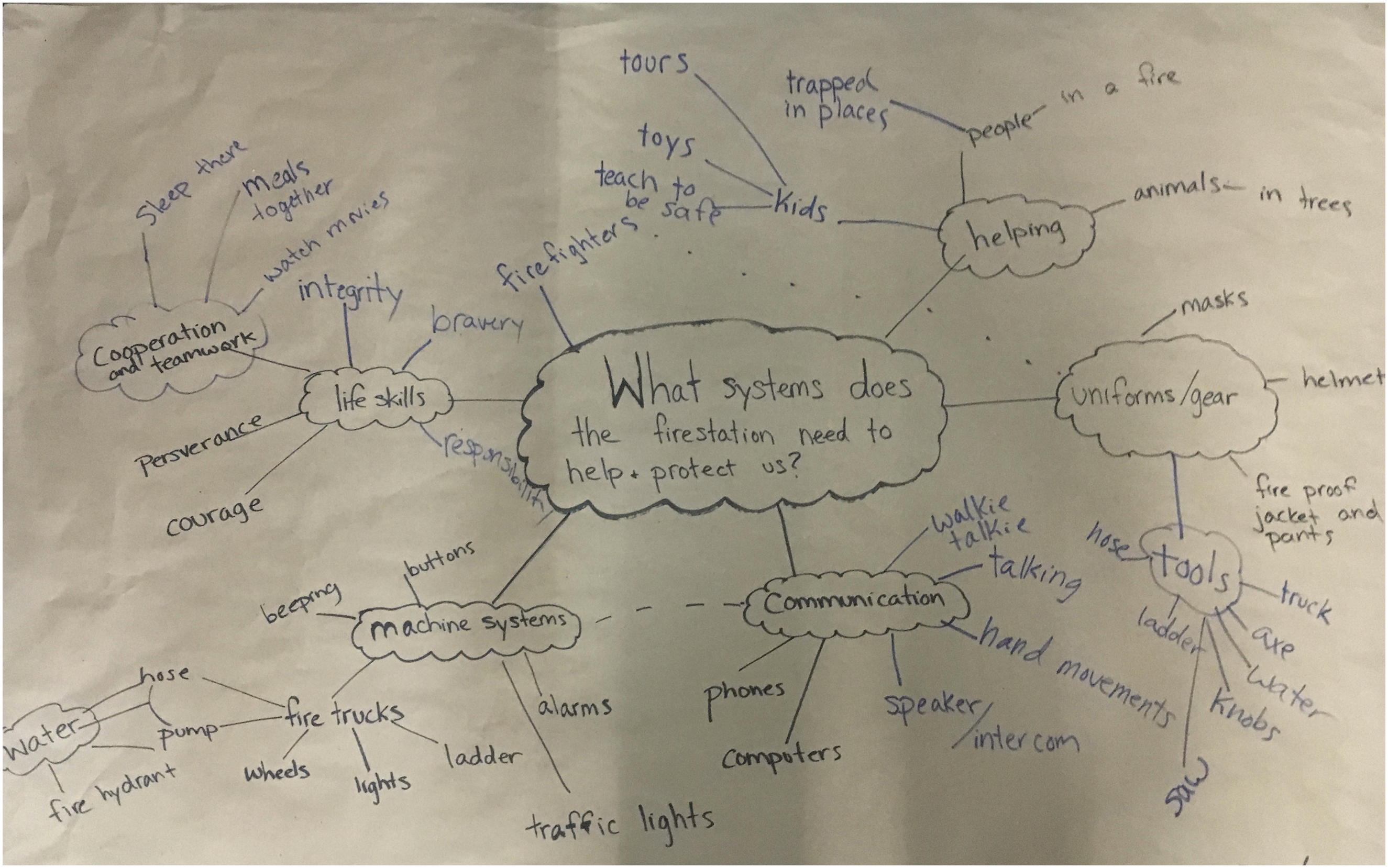
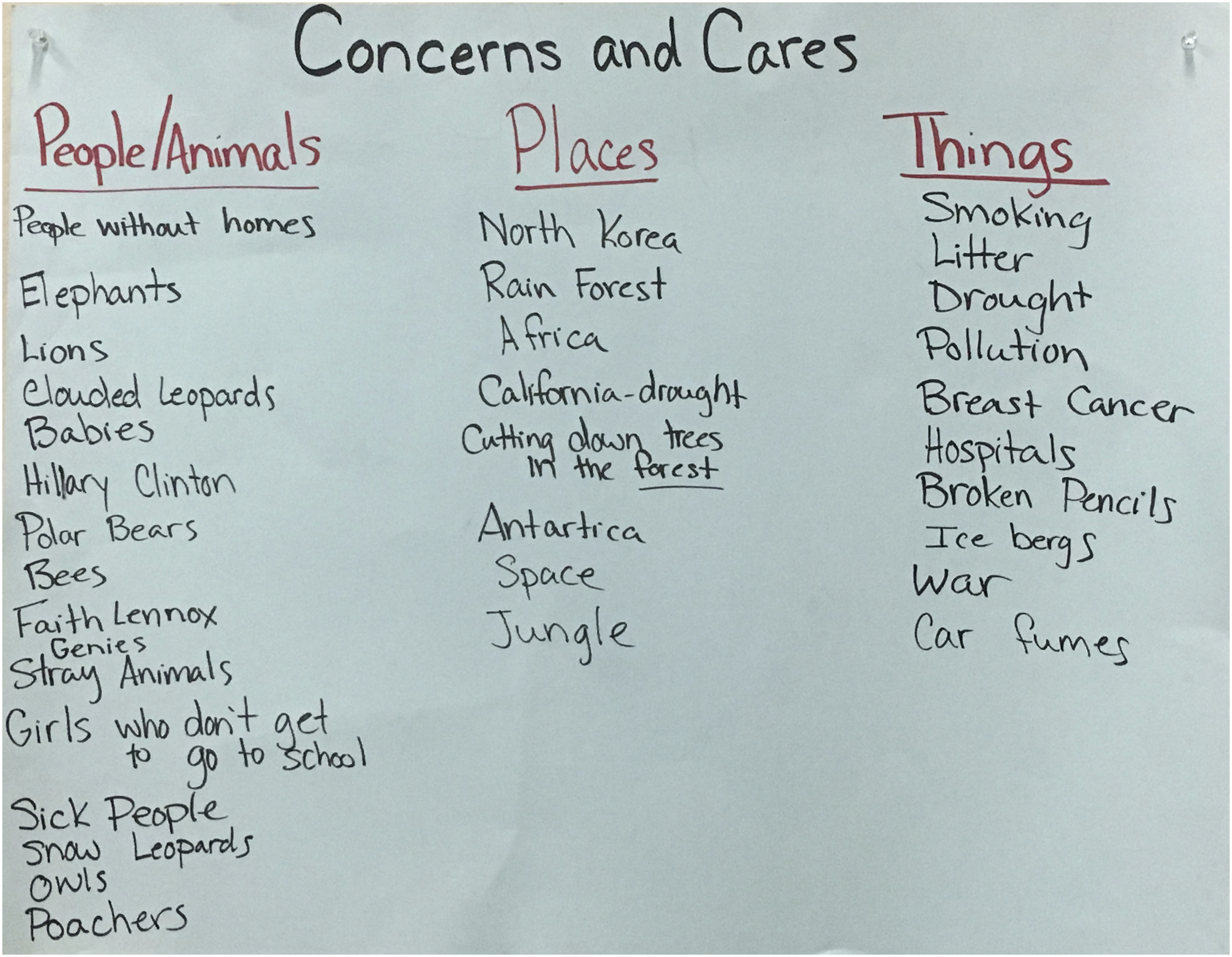
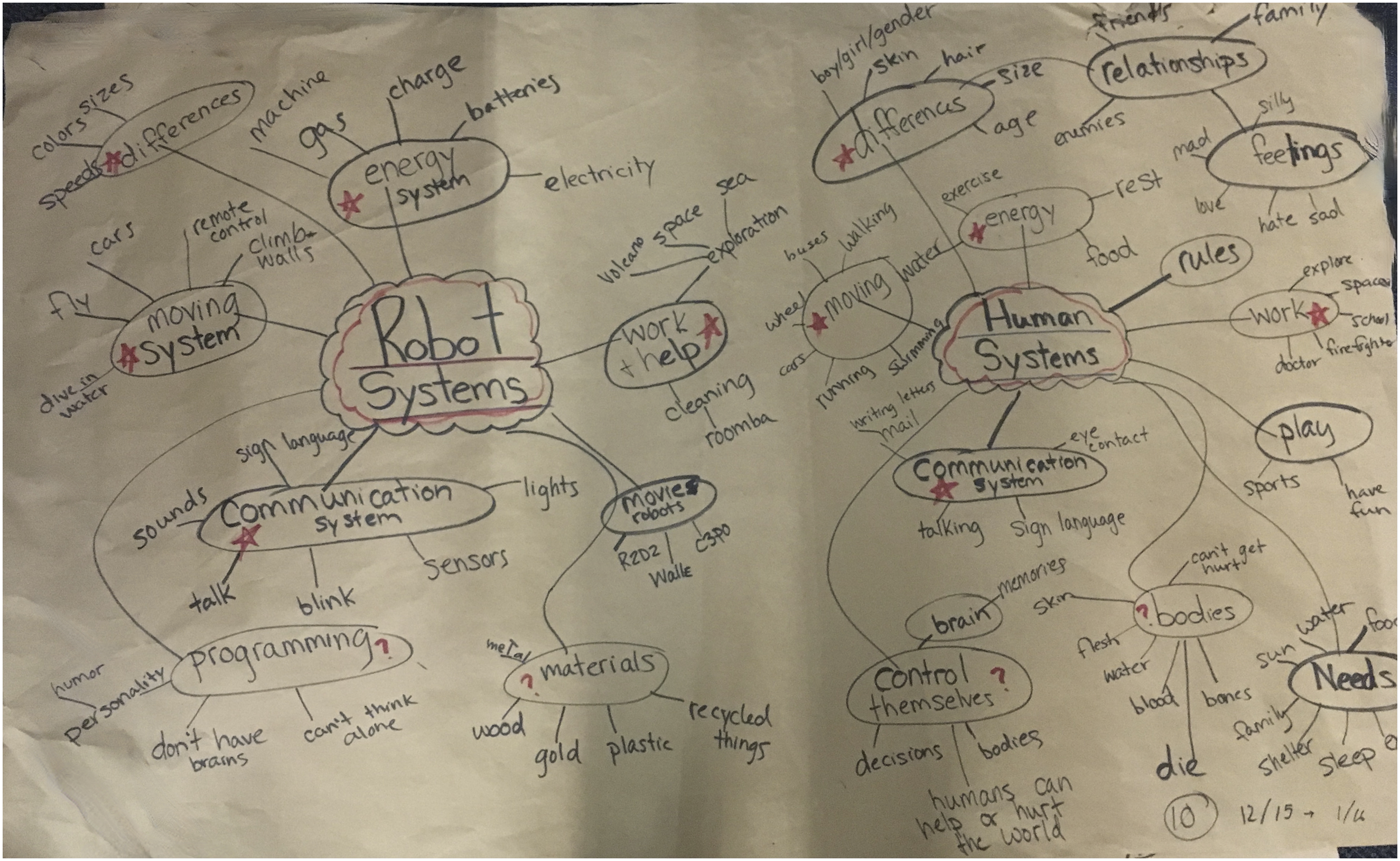
Multiple ethnographic methods of data collection were used. Ethnographic methods are particularly useful for identifying the meaning of individual and group practices. The first author collected data during the spring to learn more about the year’s systems thinking learning. She visited the classroom eight times, conducted five semi-structured interviews with the teachers, school administrators and the consultant; conducted two focus groups with students, collected 120 photographs of the classroom environment, and attended a full day teacher-led professional development session devoted to systems thinking. As part of their professional development, the teachers knew they would be formally sharing their systems thinking focused pedagogy with other educators. Accordingly, since the start of the school year, Traci and Fiona had carefully preserved their systems thinking maps and also taken photographs documenting student learning. Essentially these systems thinking maps, charts, and photographs served as a palimpsest of the progression of instruction and classroom dialogue. Analyzed in conjunction with teacher interviews, these classroom artifacts were especially helpful in the reconstruction of the students’ evolving interest in machines from the beginning of the year. Systems thinking maps and charts captured the complexity of students’ projects and documented students’ thinking (see Figures 1–4). Analytic notes after each observation and interview documented key moments and the researcher’s early analysis, conjectures, and hypotheses. These notes also set the stage for follow-up questions with school site educators, consultants, and students. Multimodal social studies systems thinking map on community needs. Multimodal social studies’ systems thinking map on a fire station’s internal systems. Students categorize their concerns and cares about the world. Making distinctions between robot systems and human systems.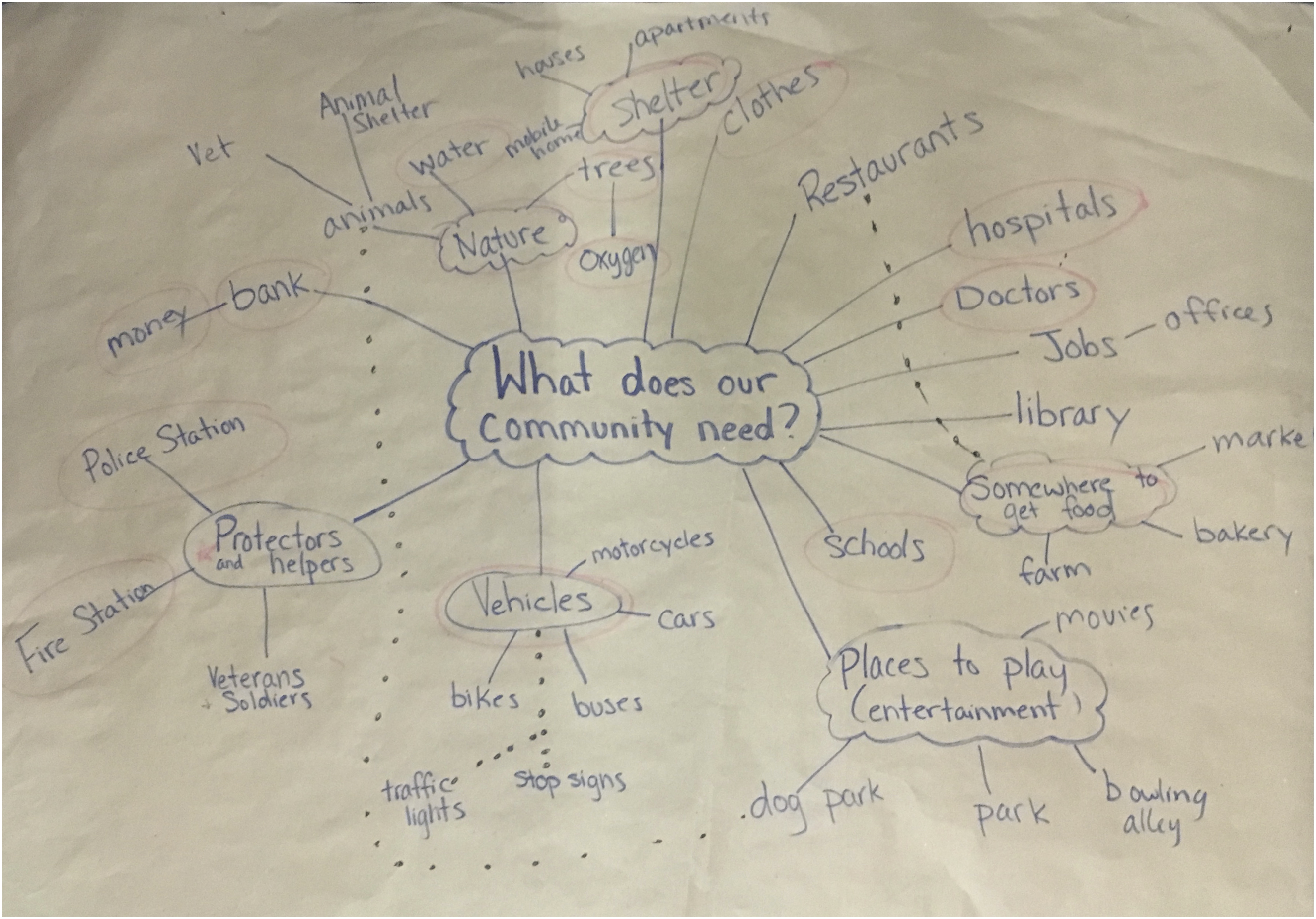
Because we noticed that systems thinking was prevalent in the context of interdisciplinary literacy activities, the first analytical step was the coding of key multimodal and traditional literacy events (Barton and Hamilton, 2000) such as building machines with blocks, reading literature, creating systems charts, drawing their imaginative machines, and writing poems. In the second analytical step, these instances were then analyzed using Cabrera and Colosi’s (2008) four patterns of thinking: distinctions, systems, relationships, and perspectives (DSRP) to organize knowledge and build metacognition. This analysis provided insight into how systems thinking concepts of interrelationships and interdependencies (Capra and Luisi, 2014; Meadows and Wright, 2008) guided teachers’ and students’ collective thinking.
The third level of coding was to use a grounded theory approach (Strauss and Corbin, 1994) to categorize these thinking patterns into three themes: cultivating connections, students’ developing solutions, and students’ agency. The cultivating connections’ theme captured the teachers’ facilitating and scaffolding an understanding of systems particular to the youngsters’ lived experiences. Children then developed solutions by creating imaginary future-oriented machines to solve problems they identified. Students’ agency was exemplified by their discussing a social or ecological problem, identifying how their machine solved the problem, and sharing their machine prototypes to an audience of family members and with their “buddy class” from the Title I partner public school.
As former classroom teachers and currently as university professors who teach literacy courses in teacher preparation programs, our research team was captivated by the ways the different literacy modalities of reading, writing, talking, drawing, and building (Taylor and Leung, 2020) throughout the curriculum deepened students’ connections to environmental and social systems and ultimately spurred them into recognizing the importance of people taking action.
Findings
This article describes a year-long journey into the development of these teachers and K-1st grade students, co-learning and co-researching the interconnectedness and interdependence of machines and humans using a systems thinking perspective often enacted through multimodal literacy experiences. As co-researchers, the teachers explored ideas generated by their students to recognize patterns and relationships of human-created problems. They aided the five- and six-year-olds in providing solutions by applying human agency to find leverage points (Senge et al., 2012) to disrupt broken ecological and social systems by providing solutions. In this classroom, systems thinking encouraged children's agentic optimism and their hope to solve wicked problems (Cabrera and Cabrera, 2015).
Systems thinking: Making connections and exploring relationships
From the onset, Traci and Fiona cultivated a systems thinking orientation. In fall, they began by examining the self and community. They facilitated students’ discussions and created a multimodal concept map of varied systems in their community. Through making distinctions (Cabrera and Colosi, 2008), students identified a range of local systems from family, classroom, school, and neighborhood, looking at the world from their different perspectives (Cabrera and Colosi, 2008). Their multimodal systems thinking map represented their collective ideas and meaning making as they noticed relationships between familiar institutions in which they participated.
Recognizing a local system
The teachers engaged in a specific multimodal practice by creating systems maps during whole class discussions. These dynamic records of student dialogue supported them in making connections and building upon students’ natural curiosity, an attribute recognized as increasingly important in children’s development (Shah et al., 2018). For example, a wall-size systems map was created about community helpers, which is a typical first grade social studies topic. The teachers posed a question, “What does our community need?” (See Figure 1) in the center of a web. Children’s funds of knowledge (Moll et al., 1992) served as the starting resource. The class’s collective understandings were documented. Children identified “protectors and helpers, hospitals, school, places to play, nature, and shelter” among other important community elements. Through listing ideas, questioning, and evaluating, the teachers developed students’ aptness for understanding distinct community institutions (e.g., fire station, bank, library, restaurants).
Building upon this shared knowledge, the teachers explored a specific community institution by posing a more focused question on a new systems chart: “What systems does the fire station need to help and protect us?” (See Figure 2.) Students identified multiple systems and their interdependency that ensured efficient operation. On the systems map, they linked interdependencies between different elements within its system (Capra and Luisi, 2014; Meadows and Wright, 2008). For example, students noted the technological relationships between a fire station’s machine system of alarms and traffic lights and its communication system of phones and computers. Multimodal systems maps, such as these, were created and used throughout the school year forefronting the meaning-making process. Posted on classroom walls, the charts remained visible touchstones of students’ evolving understandings (Zoch et al., 2018). Capitalizing on the students’ fascination with fire engines, the teachers developed the broader essential question that triggered a year-long STEM-based investigation into, “What machines help people do work?”
Machine systems aiding humans
Once again, the inquiry tapped into students’ background knowledge. Children drew machines they were familiar with. Using cut-and-paste methods, they then categorized and spatially organized their machine drawings into various systems on a new chart. For example, machines in a home system included a coffee maker and waffle iron and in a school system, machines included clocks and a photocopier. This process called for students to simultaneously use conceptual thinking patterns - making distinctions, systems, relationships, and perspectives (DSRP) (Cabrera and Colosi, 2008) - by making distinctions between various types of machines, understanding the relationships between those machines and their respective contexts, and identifying how they functioned in existing systems. The teachers pressed students to respond to the essential question and elaborate on their initial contributions. Using image representations of different types of everyday machines and their components, students further developed their understanding of technology’s role in affecting human work and lifestyle needs and problems.
Children’s literature furthered discussions about human agency and ingenuity. One conventional literacy practice, a read aloud, of the children’s literature trade book Blackout (Rocco, 2011), the story of how a New York city family copes with a power outage, provided an entry into alternative energy approaches such as solar-powered ovens. The teachers revisited the book’s message and guided their students’ thinking beyond the text, “You don’t know what the future looks like. You have to be able to problem-solve.” The teachers were encouraging students to imagine possibilities for themselves and their communities thus nurturing transformative thinking.
Possibility for disrupting broken systems
Taking time to address students’ arising concerns was important. In a springtime discussion, the teachers and systems thinking consultant guided the students to better understand a system’s fragility. The local and global environmental concerns emanated from the students when the teachers posed the open questions, “Okay, if we’re talking about problems in [sic] the Earth, what do you know? What problems do you see in your world?” During the class discussion, students recognized and identified multiple broken systems that weighed on their minds, and the teachers recorded-students’ observations-and aptness for representing their individual perspectives. This discussion led to the creation of a chart titled “Concerns and Cares.” Teachers recorded three categories of “People/Animals, Places, Things.” (See Figure 3.) The category of “people/animals” included “girls who don’t get to go to school” and “poachers.” The students’ agility in moving from their immediate to distal concerns was surprising. They identified local animals of concern such as stray pets and bees, as well as animals in distant regions such as elephants and polar bears. In the category of broken “places,” they cited the current local drought as well as happenings in other countries, continents, and places such as North Korea, the rainforest, Antarctica, and forest where “cutting down trees” took place. Importantly, in identifying these environmental concerns, they noticed the deleterious relationship that human action was having on the natural world both locally and internationally. In the category of “things,” they identified the daily school problem of broken pencils with larger health and environmental concerns of smoking, pollution, and litter. Undaunted by their long list of wicked problems (Checkland and Poulter, 2006), the teachers and systems thinking consultant energized students by reminding them of another key system principle, “When a system is broken, it needs another system to fix it.” Essentially, the teachers intimated that-the world's social and ecological conditions are not fixed nor are negative outcomes inevitable. They raised the possibility of human agency to affect change. It would start with the K-1 students’ imagination.
Overall, the teachers used a systems thinking approach to support students in seeing the interrelatedness and interconnectedness (Capra and Luisi, 2014) of their lives to a larger world, a natural world that they understood was in danger. Teacher Fiona commented on their systems thinking pedagogical approach, Because we wanted them to think big and think about these machines that could one day be created…we’re in awe [where] technology is [right now], but to also feel powerful that they have a way to shape their own world. It might be something small like, oh, if you’re walking around and you see trash on the floor, pick it up or if you’re bringing water bottles to school like try to make them reusable water bottles. So, we think it’s really important to not just have them think that machines are going to solve everything but realize that we have a problem because of people and it’s going to be up to people to solve that problem.
Multimodal systems maps graphically depicted these relationships between humans and their local and global worlds. Children were learning and representing their ideas—through literature, informational texts, and multimodal practices including drawings and tactile materials—that humans could take action to disrupt broken systems. Machines might have a helpful role. Their systems thinking learning was hopeful.
Imagining solutions to broken systems
Helping individuals understand a broken system was purposeful because it-generated a “creative tension” between current reality and possibility, and it sparked the process of taking action (Senge et al., 2012: p. 78). The systems thinking consultant observed the similarity to Freire’s assertion, “It’s about children having a voice in the world to name their world, and by naming their world then they’re able to change it.” The consultant noted that the interdependency - of systems thinking compels individuals towards intervening because they recognize how “they’re one part of this giant system.”
Traci, Fiona, and the consultant were concerned about students wrestling with “wicked problems.” As they learned that students’ existing “cares and concerns” were both local and global, they engaged systems thinking to help them better make sense of why these things were happening and to look for points of leverage to interrupt them. Drawing upon young students’ imaginative abilities through the use of multimodal literacies, they were able to engage students’ agency to design possible solutions. They were able to articulate “What People Can Do” and then communicate their ideas through both multimodal and traditional literacy practices to each other, their teachers, and their families. In an interview, the consultant voiced her concern and ultimate understanding of the impact of listening to children: The depth of their understanding of what the problems are for six-year-olds seems both profound and astonishing, and at the same time—and this is the part I’m kind of struggling with is—it seems sad that at such a young age kids are needing to feel so responsible for, and saving… The saving is not appropriate for kids. It’s appropriate for the adults… the scientists… the people in government. But to see five-, six-, seven-year-olds feeling that they really need to take this on, I just can’t quite figure out what to do with that... And maybe that’s what’s going to save everything. Because children at such a young age have such a profound understanding and they don’t see the complications, they just see the solutions. And maybe this is going to be the generation. Because they’re going to go, “Wait a minute. We’ve been thinking about this for a long time and we have some really good ideas” and everybody needs to listen.
The teachers took steps to be sensitive to the students. They noted that the student-generated list of possible inquiry topics included local issues such as pollution, sick people, and those without homes. Global issues such as deforestation, pollution, and war were also topics to research. Documenting students’ comments validated and helped them make sense of their cares and concerns and conceptualize the interrelatedness of a wicked problem. Then through imaginative invention of a machine, they could leverage a point of disruption. As evidenced by the students’ end-of-year presentations, the teachers had scaffolded these five- and six-year-olds’ learning by fostering their agency and empowering them to communicate to their families and peers how human actions could positively affect change.
Reading texts to expand knowledge
At the beginning of the school year, the teachers followed the students’ expressed interests in machines and by November had progressed to a study of robots. Teachers used this progression to introduce conceptual understandings about how both “humans and machines need some sort of energy” and how “humans and communication” systems are developed. Children’s books across genres such as the picture book If I Built a Car (Van Duesen, 2005), informational texts such as Robots Work: Robots and Robotics (Hyland, 2007) and Building Big (Macaulay, 2004), and poetry collections such as Click, Rumble, Roar: Poems About Machines (Hopkins, 1987) complemented other informational trade books on the environment that were within a child’s easy reach. YouTube videos such as one about a plastic bottle factory helped advance ideas about machines and human work.
Constructing knowledge
In the study of robots, the teachers guided their students to make distinctions (Cabrera and Colosi, 2008) between robots and humans. This was accomplished by the completion of a multimodal systems chart titled, “What do we know about robots?” that included a balance of attributes, some positive such as, “People control them,” “They help people,” “They can be good or bad,” and some concerning such as, “Robots can be wrong.” In further developing students’ identity and agency as inventive creators, teachers placed photographs of students’ making meaning through block building. Making use of varied modalities, teachers and students contributed to the creation of a side-by-side comparison systems chart to ponder and distinguish robot systems from human systems (Figure 4). Robots and humans shared systems such as a “communication system,” “moving system,” and “energy system.” In an end-of-year reflection, Traci noted how their mapping process enabled students to realize a major distinction, “There was overlap of everything [between humans and robots] except emotions. Humans have empathy. At the core, humans have feelings and emotions and thoughts. [That’s] what makes them special. [Robots don’t.]”
Building on this class chart, students were encouraged to choose one of these distinctions and elaborate on it during a class writing project titled “Systems of Machines and People.” Students’ multimodal drawings and writing were posted on the classroom wall. One child drew a picture with the accompanying message, “Machines communicate.” Another drew a picture of a smiling robot and human and wrote “Machines help people.” One student’s drawing included an airplane, bus, and tree and was titled, “Machines can hert natir” (Machines can hurt nature.) In an elaboration of this statement, the child noted how humans also negatively impacted nature. These were their words captured and typed by the teachers: Machines hurt nature because of pollution. Machines cut down trees. They [machines] use some of the materials that we need so that they can be built. People hurt nature too. They litter and pollute and use things. People eat animals and build things where animals live.
As in Kuby and colleagues’ (2015) study of writing workshop and inter-active materials, these K-1 students complemented conventional writing with multimodal engagement to communicate their deep understanding.
Creating and refining models
The discussions led to students inventing and creating machines. The springtime project incorporated design thinking (Razzouk and Shute, 2012), and in the teachers’ words, they described the reiterative multimodal engagement in the process: the “challenge was to design a machine to solve a problem. [The students] did a block build, they sketched it out. [We discussed that] when you are designing, you do things over and over.” Children’s imaginations were unleashed, and they created machines and robots, using futuristic technology, as solutions to find a system’s leverage point (Senge et al., 2012) and disrupt community and environmental problems. This experiential learning became a recursive process (Davis et al., 2015). Students first drafted their ideas on paper through drawings. In a dedicated work area of the school, students used these drawings as guides to assemble assorted wooden blocks to bring their drawing to three dimensions. This step was critical because, “when you make ideas tactile, you make understanding tangible” (Cabrera and Cabrera, 2015; cf. Heath, 2016), and students could “gain an understanding of how systems work” (Vattam et al., 2011).
As projects were constructed, peers and teachers posed questions to one another. Re-working their projects in a range of different multimodalities spurred increasingly complex thinking. Students revised their machine/robot model through addition or deletion of components, through considering the whole and parts of their creations. They experimented with their solutions and explored their machine/robot’s subsystem components and imagined its sequenced chain of events (Vattam et al., 2011) to ascertain its ability to complete a task (e.g., first the trash goes here and then the beds come out here). In a tour of the completed machines, each student group explained to their teachers and peers how their work ameliorated a social or environmental problem. Models included a boat that scooped up ocean trash; a machine that replenished the Amazon rainforest trees; and an igloo designed to halt Antarctic glacier melting among others. One group’s robot could simultaneously solve both littering and the lack of beds for people who were homeless. These building-block conceptual models were just temporary iterations of students’ design, and although easily identifiable to their creator, the models required more precise representation enabled by different materials so it would be recognizable by others. That was the next step.
Armed with their building design sketches, students re-assembled their inventions with a new set of resources. Students visited a local recycling center to gather empty cardboard boxes, pipe cleaners, yarn, bits of fabric, tennis balls, and assorted plastic pieces. The final model of their machine was a revisioning and recreation of the original project. In each representation, the students further refined their project so their “internal images and scenarios” (Heath, 2016: p. 122) would be more apparent to an observer. This reconceptualization process captured the affordances of specific materials—in this reiteration, the recycled materials afforded a permanent machine/robot model to replace the transitory block build—as well as the richness of multimodalities to afford transformative thinking.
Developing as change agents
Throughout the year, Traci and Fiona fostered their K-1 students’ agency in recognizing that they could make a difference in the world.
Empowering students
In the spring was the culmination of their year-long systems inquiry into the relationships and interdependencies among humans, machines, and the environment. In a showcase for the school community and their families, as well as their buddy class from their partner school, students shared their imaginative machines/robots and provided documentation and a chronology of their project’s development. In their explanatory writing, students included: 1) a statement of the broken social or environmental system that their invention aimed to solve; 2) an explanation of how their futuristic machine or robot helped solve the problem; 3) an identification of the various systems involved in their design; and 4) practical suggestions for how individuals could make a difference now. A representative student example in Figure 5 is shared to illustrate the full impact of these projects and reveal students’ understanding of interrelating systems.
Trash robot and beds for the homeless
One student group’s project, Trash Robot and Beds for the Homeless, (see Figure 5), was designed to solve both trash pollution and homelessness. As students were engineering their project during their early block build, they explained its complex components and their relationships to the researcher, “This is...a trash machine that makes beds. Laser eyes…disintegrate the trash. Claws that take the trash… [and turn into] a bed the robot made. Beds go to the homeless people.” When asked how the students knew there were people without homes, one said that they had seen people who were homeless while driving with their parents and another shared how their family was involved in community-service projects, “Me and my mom bought lots of stuff and put it in Ziploc bags and gave it to the people.” Their final project was a robot with human facial features that expressed compassion. In their presentation project’s display, the students articulated the systemic social problem of homelessness they wanted to disrupt in a conventional descriptive paragraph (see Figure 6). Children’s invention of a Trash Robot and Beds for the Homeless. Students identifying a social problem and their robot solution to disrupt homelessness.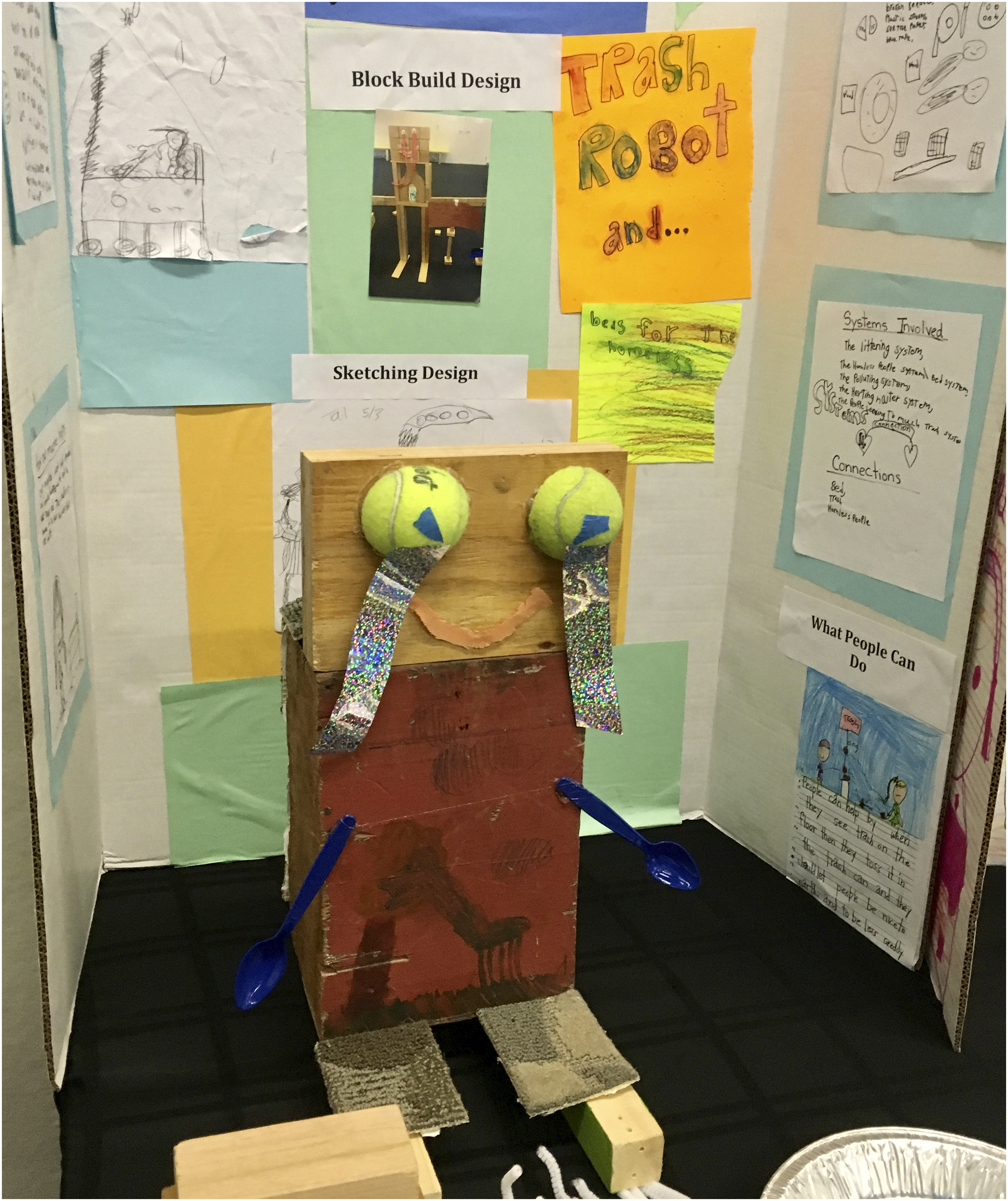
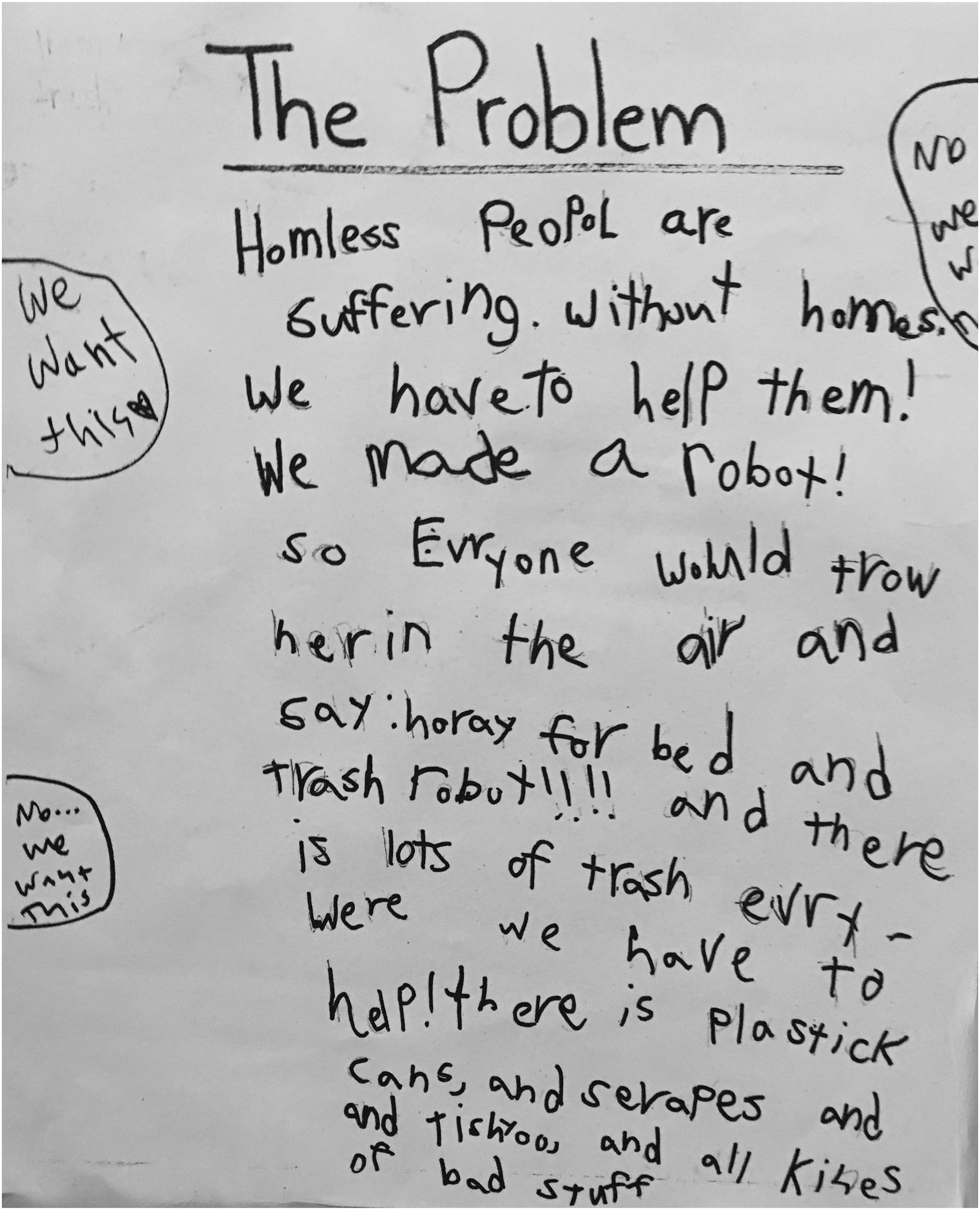
The students further described how their futuristic design helped, “Our machine works hard day and night, and homeless people use the beds the robot makes and they sleep on it. Because of the beds, the homeless people are happy.” They suggested, “People can help when they see trash on the floor and they toss it into the trash cans and they could let people be nice to Earth and to be less greedy.”
This is just one example of students’ projects in which they identified real-world problems that required others to contribute to practical solutions. In the final weeks of school after the students’ presentations, the teachers found a short YouTube documentary about a ship clearing pollution from the ocean. When the students saw the video, they were excited to learn that their problem-solving ideas—which some adults might think idealistic and improbable—were already being used and not as futuristic as one might imagine.
When sharing their students’ experiences with other classroom teachers, Traci and Fiona reflected on this year-long systems thinking inquiry and described how they incorporated a subsequent service project which entailed using their school’s 3-D printer to create a child’s prosthetic hand. Their multimodal project showed an understanding of how the cost of frequent prosthetics, required by a young person's growth spurts, might be reduced with a 3-D printer. They described this project as “the perfect melding of what humans and machines can do together to save the world.”
Discussion
This study contributes to the field by analyzing how teachers and primary grade students used pedagogy with a systems thinking focus to analyze problematic social and ecological issues. The findings provide insight into the aptness of young students’ thinking and their ability to assume agency to affect change (Curwen et al., 2018).
Capacity to understand systems
Children in this classroom were adept in understanding systems thinking in relation to their everyday world. Throughout the school year, students were engaged in authentic problem-solving drawn from their observations, interests, and knowledge about their world. Although it might be tempting to assume that the privilege attached to Sycamore School students’ socioeconomic status might support this type of thinking, this case study only reinforces what we have learned from classrooms at the partner public school: that all children have a capacity to think critically using the funds of knowledge they bring to school (Ardell et al., in press; Curwen et al., 2019). The only difference is the reference points they are drawing from, which are informed by their specific lived experiences (e.g., identifying a waffle maker as a household machine, which may only exist in certain cultural contexts). Learners in this K-1 classroom developed an awareness of the world with distinctions (things/ideas) embedded in a system that could be working and/or broken (among other principles) in relationship to other systems that accounted for multiple perspectives (Cabrera and Cabrera, 2015). A systems thinking approach supported their understanding of connectedness in which the relationship between “family and community well-being are recognized as inseparable” (Halsip and Dullo, 2018: p. 263).
Expressing evolving understandings through multimodal literacy practices
The multimodal nature of the activities that the teachers and K-1 students in this study engaged in allowed them to benefit in distinct ways. First, multimodal engagement enabled the students to express their ideas in multiple, increasingly complex ways over time as other classroom researchers have noted (cf., Brownell, 2023; Kuby et al., 2015; Stein, 2003). Through continually evaluating, reassessing, and refining, they transformed their imagined robots from two-dimensional drawings, 3-D block building, and using recycled materials to create realistic robots/machines. Such multimodal activities involving haptic learning (Heath, 2016) allowed students to have agency in how they conceived, developed, refined, and presented their ideas.
Secondly, throughout the process, students collaborated with one another. Their “individual repertoires became collective repertoires” (Watts-Taffe, 2022) as students’ ideas built on one another and contributed to the creation of an encompassing project.
Finally, the collective experience communicated an important systems thinking principle that the whole was greater than the sum of its parts and systems were interrelated (Dalton, 2020; Capra and Luisi, 2014). The students in this study communicated their awareness of different natural systems broken through human encroachment and sought points of leverage (Senge et al., 2012). More importantly, the cumulative effect of students’ inventive problem-solving projects suggested these children’s critical awareness of the world around them and their willing agency to “center their own voice as a producer of text” to address them (Watts-Taffe, 2022: p. 604).
The teachers were already at ease in using different multimodal literacy activities. Through the lens of systems thinking (Capra and Luisi, 2014), the teachers and students gained greater awareness of belonging to their local community and with the world. They focused on a social and environmentally conscious approach to the Earth, and within that larger sphere, they felt a sense of responsibility (cf. Freire, 1970/1996).
These multimodal literacy practices are “challenging conventional conceptions of literacy” (Powell and Somerville, 2018, p. 845, cf. Kuby et al., 2015). In this classroom, multimodal activities supported students with tools to express their complex systems thinking understandings through drawings, writing, block building, designing, and presentations (ILA, 2021; Jewitt, 2008; Kress and Jewitt, 2003). When primary grade students are still developing conventional writing skills such as sentence structure, paragraph development, letter formation, and correct punctuation, multimodal literacy practices provide then with alternative expansive avenues to meaningfully communicate their elaborate thoughts.
Recognized wicked problems
As teachers and students immersed themselves in exploring different types of systems in their homes and community, their multimodal engagement through drawings, block building, creating with recycled materials, and presentations, captured their understanding of the interrelatedness and social consequences of human behavior upon natural systems (Capra and Luisi, 2014; Meadows and Wright, 2008). They identified wicked problems in the social world and the environment. Furthermore, through a meaning making process they recognized how human interaction and machines can negatively affect the environment.
Identified and explored points of leverage
Rich, ongoing dialogue allowed students to identify and explore a system’s point of leverage (Senge et al., 2012). Children readily assumed agency in making a change in the world (Freire, 1970/1996) and proposed several future-oriented solutions for improving the world (Strachan, 2009) using both multimodal literacy (Jewitt, 2008; Kress and Jewitt, 2003; Pahl and Roswell, 2006) and conventional literacy practices. Each newly created machine was talked through, drawn-out, physically constructed, presented for feedback, revised, and refined. Each iteration revealed a new set of problem-solving opportunities (Cabrera and Cabrera, 2015; Vattam et al., 2011) and encouraged students to sharpen their thinking. Children were unbounded by temporal and current technological constraints when provided an opportunity to imagine solutions for wicked problems (Checkland, 1999). They could imagine boats that could scoop trash from the ocean and machines to - re-plant depleted rain forests. They learned how to grapple with the complexity, interrelatedness, and consequences of human behavior upon natural systems (Capra and Luisi, 2014; Meadows and Wright, 2008). Their ongoing study in machines, meaningfully driven by students’ interests, prompted them to develop technologically oriented solutions.
Conclusion
Systems thinking, with its orientation for solving current social, environmental, and economic problems, is relevant to educators interested in developing a more democratic and inclusive world (Cabrera and Colosi, 2008). It is an approach to learning and connectivity that encompasses other teaching approaches, for example, thematic units, interdisciplinary teaching, project-based learning, life skills training, and design thinking but with a focus on relationships. This includes relationships between systems as well as the placing of oneself in relation to the world. A systems thinking curriculum has the potential to elevate individual need to create a more inclusive society that promotes social justice, economic equity, and environmental protection. It supports pursuits through comprehensive and creative solutions (Capra and Luisi, 2014; Strachan, 2009).
Through the engagement of systems thinking and multimodal literacy, students in this study realized their ability to make connections between the local and global (Janks and Comber, 2006; Pahl and Rowsell, 2006). The students understood the relationship between human action and its consequences. They expressed their hope for the future, and they developed agency for restoration of their world. Literacy events and social interaction (Taylor and Leung, 2020) intersected with other curricular areas and social justice topics. This case provides insight into what it looks like when a classroom is transformed into “...a unity in which personal aspirations contribute to grander collective responsibilities” (Davis and Sumara, 2009: p. 38). The use of systems thinking in the classroom can be transformative for students (and potentially society). It orients young learners in how they think about the world and their role in it (Curwen et al., 2018).
Implications
This article encourages educators to see the possibilities for children’s critical thinking and problem solving when using a systems thinking approach to engage in real world problems and their level of experiences. Educators can also recognize the capacity of young students to make connections, see relationships, and wrestle with wicked problems to develop imaginative solutions. As documented in this case, students’ lived experiences can be meaningfully and powerfully integrated into the curriculum through multimodal representations. Importantly, the use of systems thinking as a pedagogical lens broadened the curriculum beyond factual knowledge acquisition to conceptual understandings of global interrelatedness. We call for further research in this area in order to examine the possibilities of curriculum to expand and meet the potential of young students’ minds.
Footnotes
Declaration of conflicting interests
The author(s) declared no potential conflicts of interest with respect to the research, authorship, and/or publication of this article.
Funding
The author(s) received no financial support for the research, authorship, and/or publication of this article.
