



Abstract
Advocating for inclusive literacy teaching pedagogies, to support 3–5-year-old children’s multimodal and multilingual storying, is fundamental in diverse nations. In Australia, for example, there are over 26% of 5-year-old children connecting with language backgrounds other than English, 7% are Aboriginal, and over 5% are diagnosed with special needs (AEDC, 2021). Arguably, children draw from their own cultural, linguistic, and neuro diverse ways of expressing; hence, visual, gestural, spatial, auditory, and touch-type modes of expression, deserve greater recognition in literacy. Our critical participatory action research advocates for an expanded view of literacy focusing on children’s assets to communicate stories beyond vocal or written versions of story’telling’ in English, by incorporating translanguaging. We consider ‘storying’ to be a more inclusive term that incorporates multiple and multilingual modes in story creation. Our research on Kaurna country (the Adelaide Plains), involved 66 three to five-year-old culturally, linguistically and neuro diverse preschoolers, and their families. They interacted and translanguaged with 10 educators to explore multilingual, Aboriginal, and autistic children’s storying. The 6-month research project questioned: ‘How do diverse children communicate stories and how can children’s storying be encouraged with culturally responsive community involvement?.’ Observation, interview, questionnaire, artefact and reflective journaling data identified diverse children’s storying capabilities, highlighting touch, embodied expression and movement of props, as children expressed imagined stories. Thematic analysis led to the emergence of the concept, ‘communicative capital,’ a component nestled within Bourdieu’s (1991) ‘cultural capital,’ highlighting multiple modes of expression beyond named languages (as per the concept of ‘linguistic capital’). We argue that children’s communicative funds of knowledge and semiotic systems for meaning-making deserve increased value in inclusive literacy education, curriculum development, teacher education, pedagogy, practice and policy, so to embrace and expand the storying strengths of children with autism, First Nations children, multilingual children, and all children worldwide.
Introduction
A central issue in the field of literacy education is agreeing on a definition of literacy that is inclusive. This article, therefore, begins by defining literacy in the broader sense, as a means to communicate, taking into consideration past research investigating diversity. Inclusive conceptual frameworks of multimodal and multilingual communication are then introduced in this article to explore ‘
Our participatory action research methodology, methods of data collection and findings, are later presented to uncover three children’s experiences of expressing stories through multiple modes in many ways. Three children were selected for inclusion in this article to indicate variations in culture (e.g. Aboriginal/Kurdish, Indian and Korean), languages (e.g. English/Pitjantjatjara, English and English/Korean/Arabic), and variation in diagnosis (e.g. one child was diagnosed with autism). This study, however, acknowledges the problematisation of labelling thus these three cases are not representative of all culturally, linguistically or neurodivergent children – each are individual scenarios. The terms bilingual (i.e. a person speaking two languages), trilingual (i.e. a person speaking three languages) and multilingual (i.e. bilingual and trilingual people collectively) are used in the article. The article proceeds to discuss contributions from our study to offer expansion of past multimodal and multilingual concepts derived from the last two decade of research. In the conclusion, various roles of inclusive literacy educators in supporting diverse children’s communicative capital, in the preschool years of education, are recommended.
Definitions of literacy
Traditionally, literacy has focused upon the skills of reading and writing; however, in recent times, literacy has been redefined and expanded to involve social semiotics, the study of signs for meaning-making (Kress, 2019). Research has identified that being literate involves various modes of communication in cultural and social contexts (Halliday, 2004). An issue in our culturally diverse world, however, is that a deficit mindset of multilingual children’s communicative capabilities often results when literacy focuses solely on English communication in reading and writing traditional texts (AEDC, 2021). Contemporary studies promoting translanguaging (utilising children’s full linguistic repertoires) has served to combat educational institutions’ monolingual mindset in teaching (García and Wei, 2014; D’warte, 2020). However, a deficit assessment of literacy for neurodiverse learners, can also arise, when multiple modes are not valued in children with autism too. We know through case studies that children with autism often prefer visuals, non-verbals, and gestures; some also use diverse languages to communicate (Tabernero and Calvo, 2019).
The need to expand inclusive definitions and to determine the foci of literacy teaching pedagogy, practice and assessment, has been raised over two decades by a multitude of academics in the field of education (Flynn et al., 2021; García et al., 2018; García and Wei, 2014; Giæver and Jones, 2021; González et al., 2005; Robinson and Jones Díaz, 2006; Kamler and Comber, 2005; Puzio et al., 2020). Giæver and Jones (2021) recently drew attention to the issue that children have diverse ways of communicating yet systems can make these skills invisible in education. Many argue that literacy teaching in education settings solely emphasises the English language rather than communication and languages more broadly; appreciating children’s full linguistic and communicative repertoires is often overlooked (Flynn et al., 2021; García and Wei, 2014). Research studying multimodality has promoted communicative modes: visual imagery, gestural, spatial, touch and audio/sound-based, as well as linguistic communication (Anstey and Bull, 2012; Hill, 2021). The definition of a text has also evolved beyond script to ‘things that we read,
Currently defined in Australia’s Early Years Learning Framework (EYLF) version 2.0 for zero to five-year-old children, literacy and language includes: a range of modes of communication including music, movement, gesture, dance, song, drama, storytelling, visual arts, digital literacies, and media, as well as listening, talking, signing, viewing, reading and writing.
An educator’s consideration of what literacy is, and whether multiple language
The EYLF’s focus on communication contrasts with the heading of the ‘Australian Curriculum:
Literature review
The following literature review highlights the culmination of theory and concepts (derived from past research) that are synthesised in our study to call attention to inclusive literacy teaching pedagogy. Statistics on the diversity of 5-year-old children in Australia then follow to highlight the necessity of working towards social justice over the issue of inclusive literacy in Australia and worldwide. The review concludes with a summary of research concerning diverse forms of storytelling in literacy education in preschools.
Culturally sustaining pedagogies
Extensive research in multicultural and multilingual education promotes culturally responsive and sustaining pedagogies that build on children’s strengths (Sisson et al., 2020)—their funds of knowledge (González et al., 2005) and assets (Kamler and Comber, 2005; García et al., 2018). Such pedagogies involve families and combat English monolingualism while advocating for actions such as translanguaging—children’s use of their full linguistic repertoires, and diverse ways to make-meaning (García and Wei, 2014; García and Kleifgen, 2019). Another version of translanguaging from Canagarajah (2011: 401) entails “the ability of multilingual speakers to shuttle between languages, treating the diverse languages that form their repertoire as an integrated system.” Studies surrounding inclusion with regards to multimodality demonstrate synergy with the Reggio Emilia principle of the 100 languages in early childhood (Rinaldi, 2013) which raises educators’ awareness of young children’s diverse ways of expressing themselves through art and body movement. The 100 languages and other Reggio Emilia principles correlate with Yunkaporta’s research (2009) that presents eight Aboriginal ways of learning (incorporating connection with community links, land links, story sharing experiences, non-verbal communication, use of symbols and images, learning in non-linear ways, deconstructing and reconstructing, and learning maps). Studies of Aboriginal ways support an expanded view of literacy learning, particularly with respect to incorporating non-verbals, symbols and images while communicating with the community through story sharing. Such visual and gestural aspects of communication connect with the specialisation of semiotics (Anstey and Bull, 2012). Taking all into consideration, we argue that modern and culturally sustaining literacy teaching requires differentiation—modifications to literacy teaching practices, and the processes and products of children learning to communicate (Puzio et al., 2020). Finally, research on physical, embodied, or body-based learning (Macedonia, 2019) promotes children’s total physical responses (Al Harrasi, 2014) to develop children’s diverse ways to express themselves.
A critical perspective concerning inclusive literacy research draws attention to the framework of Bourdieu (1991), identifying cultural and linguistic capital and impacts of power. As a sociologist, Bourdieu explored values in society, using a market analogy, to identify cultural ways of being. Cultural capital considers ‘cultural knowledge, skills and abilities possessed and inherited by privileged groups in society’ (Yosso, 2005:76)—including language use (linguistic capital). Jones Díaz and Harvey (2007:208) argue that in Australia the linguistic capital of children’s languages is ‘constrained by and negotiated against the backdrop of the more dominant form of capital—English.’ While the notion of ‘cultural capital’ relates to ethnicity, backgrounds, and heritages of people (and encompasses the customs and values and ways of being as practiced within one’s home, family and community), ‘linguistic capital’ in contrast draws attention to the value society places on the certain languages spoken in community interactions. The concept of ‘communicative capital,’ has not been explicitly represented within Bourdieu’s theory although some scholars discuss ‘diverse communicative competence’ (D’warte and Somerville 2014: 57) and ‘symbolic capital’ (Leander and Boldt 2013: 28). We believe that communicative capital offers a conduit between language and culture, drawing attention to our expanded view of literacy incorporating communication in many ways—communicative capital requires exploration.
Communicative capital has previously been described in the fields of media and politics as ‘communicative capitalism’ to identify the growing social media and information communication technology capabilities to share a message (Dean, 2005) and in journalism to define digital communication and its relationship with advertising (Nixon, 2013). Our research with diverse preschoolers explains ‘communicative capital,’ as a sub-component of cultural capital which comprises of linguistic capital, yet it includes other modes of communication. Communicative capital encompasses a multimodal view of communication, taking into consideration culture and language, while also giving attention to sound, movement, gesture, visuals and touch, used in combination to express ideas beyond language.
Diversity in Australian early years populations
In the early years, respect for diversity requires responsiveness which invites educators to… “respond to children’s expertise, cultural traditions and ways of knowing, the multiple languages spoken by some children, particularly Aboriginal and Torres Strait Islander children, and the strategies used by children with additional needs to negotiate their everyday lives” (DEEWR, 2009: 16).
Responsiveness “includes promoting greater understanding of Aboriginal and Torres Strait Islander ways of knowing and being” (DEEWR, 2009: 14) and all children’s knowing. The Australian Early Development Census (AEDC, 2021) reports that there has been an increase to 81,885 five-year-old children in Australia with a language background other than English (26.8% of the population) with 3.1% of those children not yet proficient in English, 7% Aboriginal, and over 5% diagnosed with special needs (AEDC, 2021). Much is unknown about children’s communication proficiency in their ‘community languages’ spoken with family and alternate methods of storying for diverse learners. Meaning-making and translanguaging with 6–8-year-old children has been recently researched and language mapping has been explored (D’warte, 2020) to better understand children’s family and community language use; however, in the years, prior to school, diverse 3–5-year-old children’s storying is under researched.
The AEDC (2021) data on language and communication domains is largely collected in a biased English-speaking school context by Australia’s high proportion of English monolingual speaking teachers focusing on oral and written language. It is worth noting that the census does not take into consideration children’s gestural or other multimodal capabilities to make-meaning through body language or facial expression. Another shortcoming of the AEDC (2021) is that apart from seeking information about children’s ability to use Aboriginal and Torres Strait Islander children’s languages effectively (if applicable), children’s effective use of global community languages is not included in the census data where a growing 20,646 children are Aboriginal or Torres Strait Islander (AEDC, 2021). Aboriginal children, however, are entitled to start preschool a year earlier at 3 years of age in South Australia (and in 2026 all children will start from age three). Families of children with autism also negotiate additional preschool support with paraprofessionals such as psychologists and speech pathologists.
In Australia, 15,895 children have special needs status, such as autism diagnoses (AEDC, 2021). Research has demonstrated that children with autism are master visual communicators who are often challenged by verbal communication hence other forms of communication are essential in their expression (Tabernero and Calvo, 2019). The AEDC’s rating of children’s ‘ability to
A review of story’telling’ research
A plethora of literacy-based research has explored children’s oral story ‘telling’ and narrative development (Flynn et al., 2021; Heppner, 2016; Strekalova-Hughes and Wang, 2019). Heppner (2016) is one of few to research story ‘acting’ in the early years as opposed to story ‘telling.’ Others refer to onomatopoeic sounds children make such as grunting sounds as part of Zombie-themes storytelling (Powell and Somerville, 2021) or use of drawing to assist story creation with Spanish-English bilinguals (Flynn et al., 2021).
Research with bilingual learners and parents argue for translanguaging approaches—using the culmination of children’s many spoken languages in preschools to write dual-language stories with parents’ support (Farndale et al., 2016; García and Wei, 2014; D’warte, 2020; Lotherington et al., 2008). Studies combining and exploring a range of diverse children’s inclusive storying, collectively, is limited. Few have explored diverse ‘children connecting with their bodies and the world as a way of being and communicating’ and ‘sensory integration’ in literacy learning with children with ‘additional’ needs through embodied learning in drama-based literacy (Powell and Somerville, 2021:3– 4). In most studies, researchers visit sites to observe children, however, in the present study, the educators were the researchers who collected and acted upon the data. Educators critically reflected and knew the children and families personally over time. Undertaking a combined role teacher and researcher was challenging, mentally, but worthwhile.
The methodology
Our 6 months of action research at Green Park Preschool uniquely combined exploration of preschoolers’ storying with bilingual and Aboriginal and Torres Strait Islander children, as well as children with autism. In Australia, a preschool generally offers 15 hours of play-based formal education a week prior to school. In 21st century preschools, it is increasingly common for educators to encounter diverse groups of children, although, research generally tends to focus on case studies of single characteristics of children, that is bilingual children (Bligh and Drury, 2015; Farndale et al., 2016; Lotherington et al., 2008; Tabors, 2008), Aboriginal or Torres Strait Islander children (Fluckiger et al., 2012); and children diagnosed with autism (Broun, 2004; Tabernero and Calvo, 2019). Studies on inclusion rarely combine children learning English as an additional language (EALD), First Nations, and children diagnosed with autism, together.
The authors of this study led 10 educators to undertake the Critical Participatory Action Research (CPAR) (Gaffney, 2008; Kemmis et al., 2014) to reflect on the preschool context, practices and pedagogies, and the real-life challenge of supporting many diverse children to create and communicate their stories. The strength of CPAR entails educators thinking critically about their practice to respond in a flexible cycle of change to individual children’s responses, needs and preferences, as well as parents’ advice (Pappas and Tucker-Raymond, 2011). The team chose to implement CPAR as this type of research is ‘a [social] practice—changing practice’—to develop ‘just and inclusive’ teaching pedagogies and practice through critical reflection (Kemmis et al., 2014, p. 85). Having a critical stance (Kemmis et al., 2014, p. 87) on the educators’ values and understandings of literacy enabled educators to become more inclusive in their literacy teaching in partnership with the community, particularly those who are multilingual, Aboriginal or Torres Strait Islander, and diagnosed with autism.
Researcher positionality statement
Academic researchers are often outsiders of their researched communities. In this innovative study, however, the lead academic researcher/author (Amy) was an insider teacher part-time, having taught in the preschool community for 6 years while also a part-time academic researcher of early childhood literacy during the same 6 years. Practitioner research with experienced insider academic researchers is advantaged by the background knowledge and pre-formed trusting relationships with participants which enables greater understandings of context-driven investigations (Greene, 2014). The second lead researcher was the preschool’s director. While it was intellectually demanding to merge teaching with research, the education department partnership leadership team requested we undertake teacher research at the site with a focus on early years literacy with colleagues and children for our annual quality improvement plan. A disadvantage of teacher research might be for a full-time teacher finding the time to fulfill teaching and research duties combined.
The research aim
The aim of the CPAR research was for educators to reflect on their own literacy pedagogies and practices, to gain stronger understandings of individual children’s communicative capabilities, and to identify how to support children’s story expression by developing a more inclusive literacy pedagogy.
The conceptual framework
The conceptual underpinnings of the study drew from a crystallisation of understandings and ways of knowing from both social constructivist and critical theories of capital mentioned in the literature review (Ellingson, 2009; Halliday, 2004; Bourdieu, 1991), in linguistics, sociology and education, as identified in Figure 1. Multiliteracies encompassing semiotic systems, multimodality, the 100 languages, and the eight ways of Aboriginal learning (focusing on children’s story sharing, community links, symbols and images and non-verbals, in particular), were also incorporated as the second phase developed. Due to the nature of the site being linguistically diverse, translanguaging was a valued component of the study. The conceptual framework.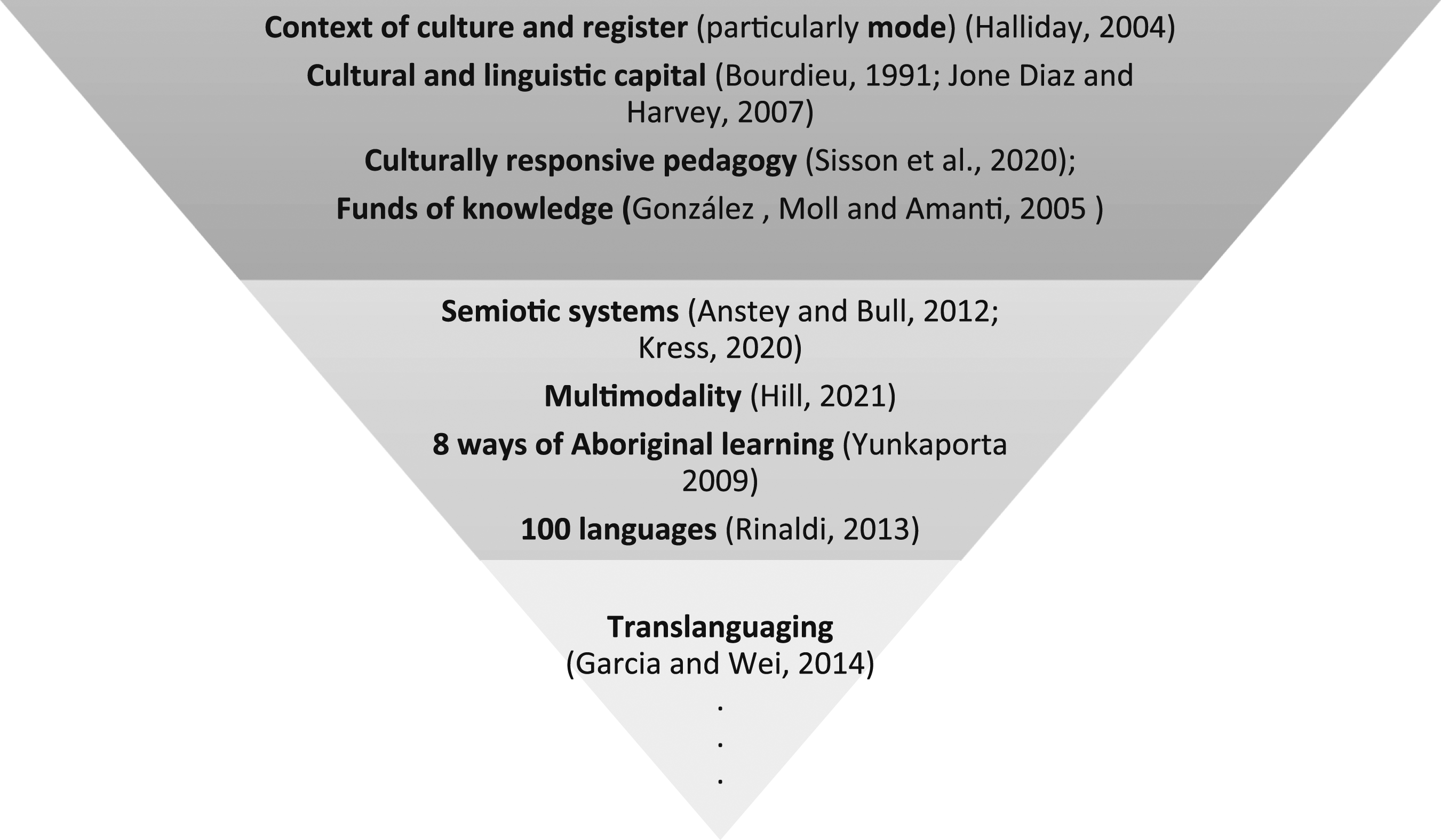
The site
Located 7 km West of Adelaide, Green Park Preschool (pseudonym) served an area populated with unit housing for recently immigrated families. In the local region, 48% of the population were born overseas and 42% of households spoke a non-English language at home (ABS, 2016). Children attended the play-based preschool 2 or 3 days a week, Monday to Friday from 9 a.m. to 3 p.m. Approximately 33 children attended each day and children were divided into two groups each with an allocated teacher and support educators.
The participants
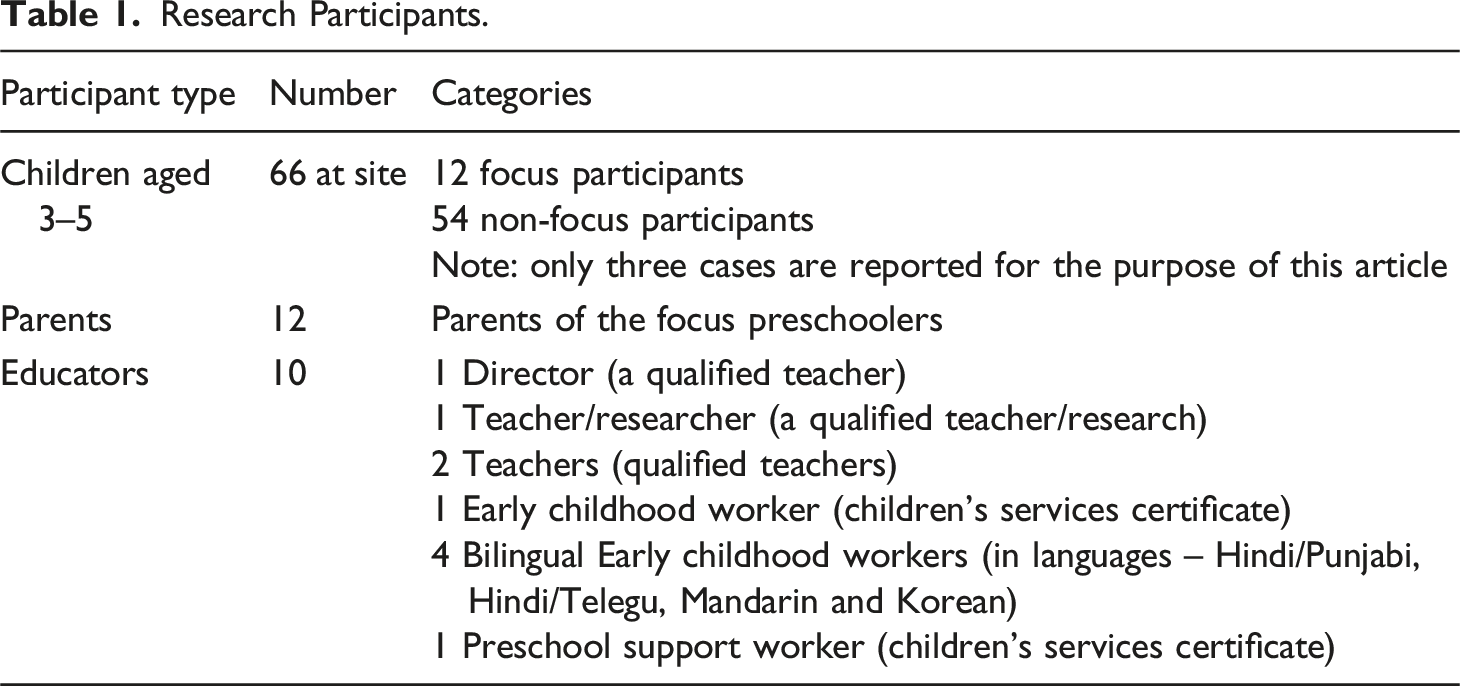
The 6-month CPAR involved 10 educators, 66 children (inclusive of 12 focus children) and their 12 parents. Pseudonyms are used for all participants and the site in this article.
Sixty percent of preschoolers were bilingual in languages such as Hindi, Punjabi, Mandarin, Korean and Indonesian at Green Park Preschool. Three children were Aboriginal and identified with Kaurna and Pitjantjatjara communities. Three children were diagnosed with autism, and another three were diagnosed with various speech and language disorders. The following section documents the experiences of an Indian/Australian child with an autism diagnosis, a multilingual Korean/Arabic/English speaking child, and a Pitjantjatjara (First Nations)/Kurdish child, to demonstrate their diverse multimodal assets during storying. The educator team included two Hindi/Punjabi/English-speaking educators, two Mandarin/English-speaking educators, and a Korean/English-speaking educator. Two English speaking teachers were incipient bilinguals in French, and the academic, an incipient multilingual in Indonesian/French/Swahili and English. Two preschool support educators also participated.
Research Participants.
Research questions and phases
The final primary research questions were:
The Phases.
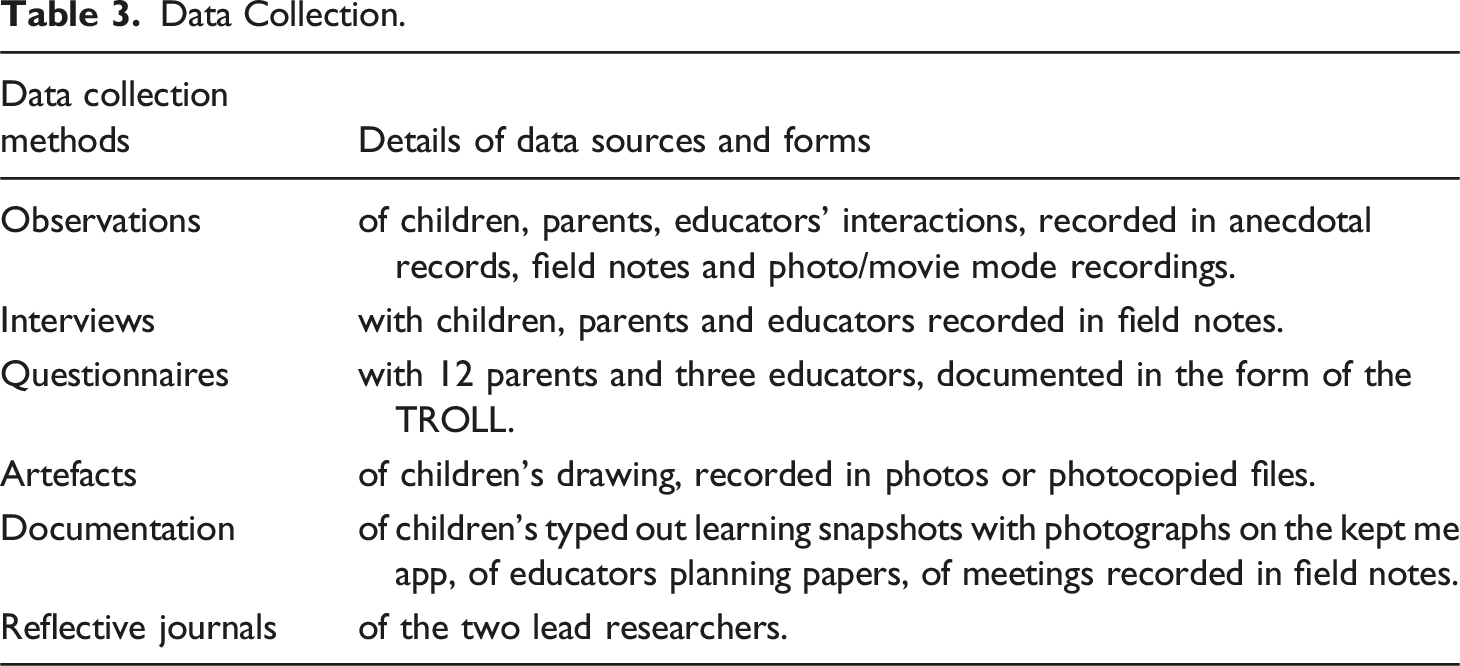
Data collection methods
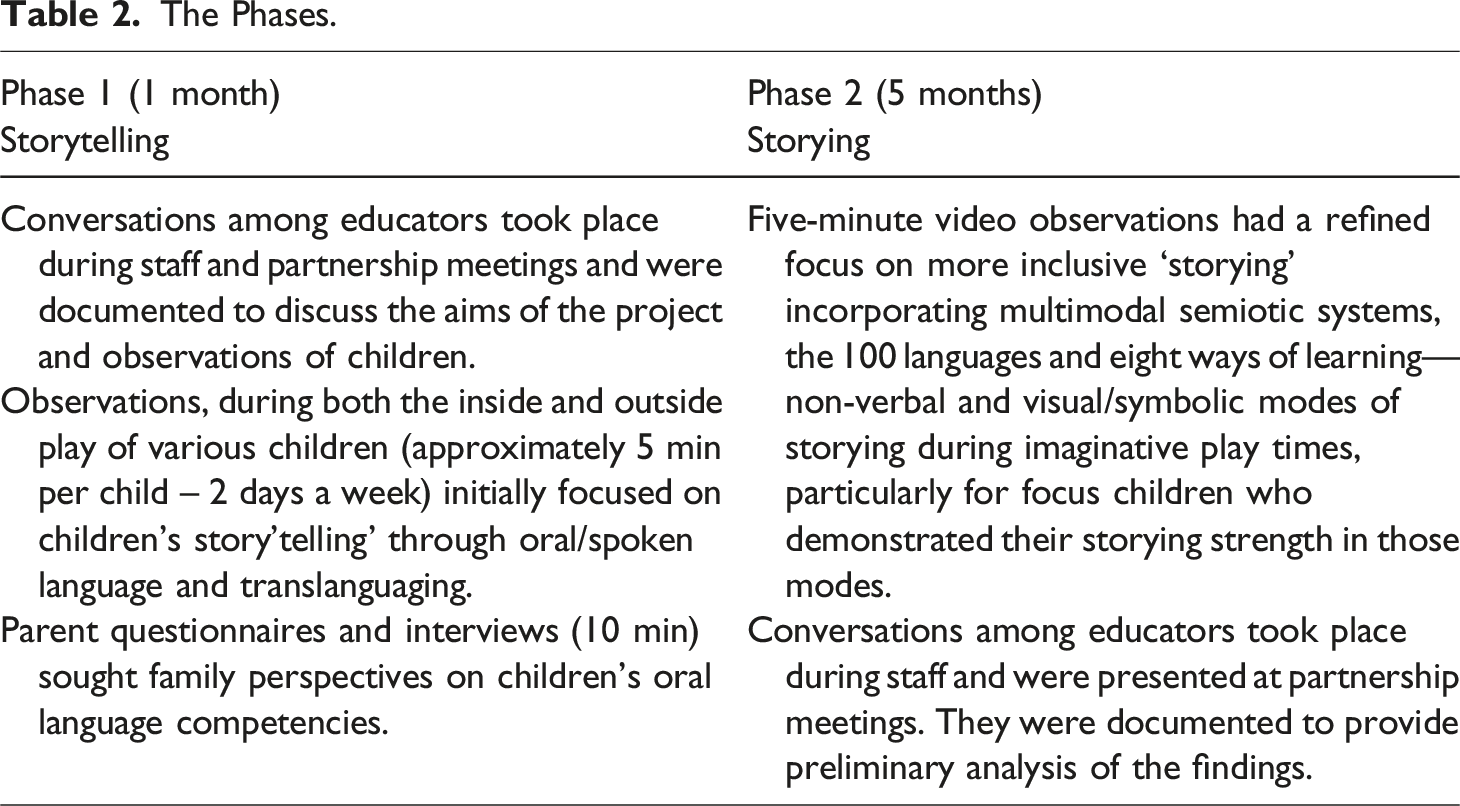
The project was a form of emancipatory CPAR in that the ‘practitioner group [took] joint responsibility to change and improve practice’ (Gaffney, 2008: 10). Data collection spanned two terms of preschool and was blended with usual teaching documentation. The research entailed observing, planning change, acting and reflecting and repeating the cycle (Kemmis and McTaggart, 2000: 595). Educators drew on the concepts of reflective practice (McAteer, 2013) to bridge theory and practice and develop an inclusive pedagogy for literacy teaching to promote children’s storying abilities, as seen in Figure 2. Action research phases and cycles (an adaption of Kemmis and McTaggart’s (2000) model and Riding et al.’s work (cited in McAteer, 2013)).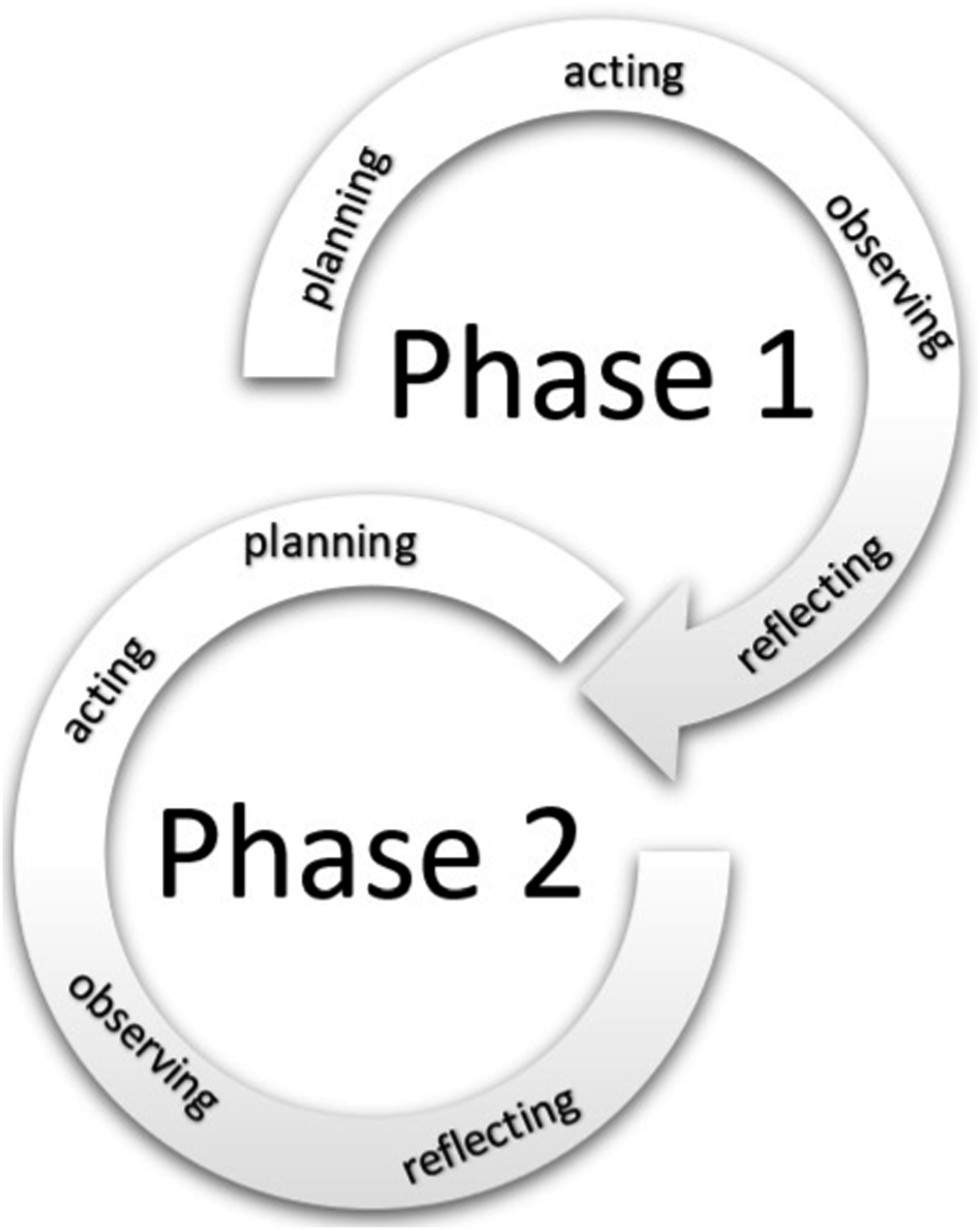
In term 1, thick descriptive detail was collected via interviews with parents following questionnaires concerning their children’s oral language skills and storying practices. Questionnaires collated parents and educators’ views about individual children’s ability to initiate conversation, occurrence of pretend play and commonality of clarity of expression—scoring each from 1 (never) to 4 (often) in rating (see Figure 3). Parent record of oral language learning (PROLL).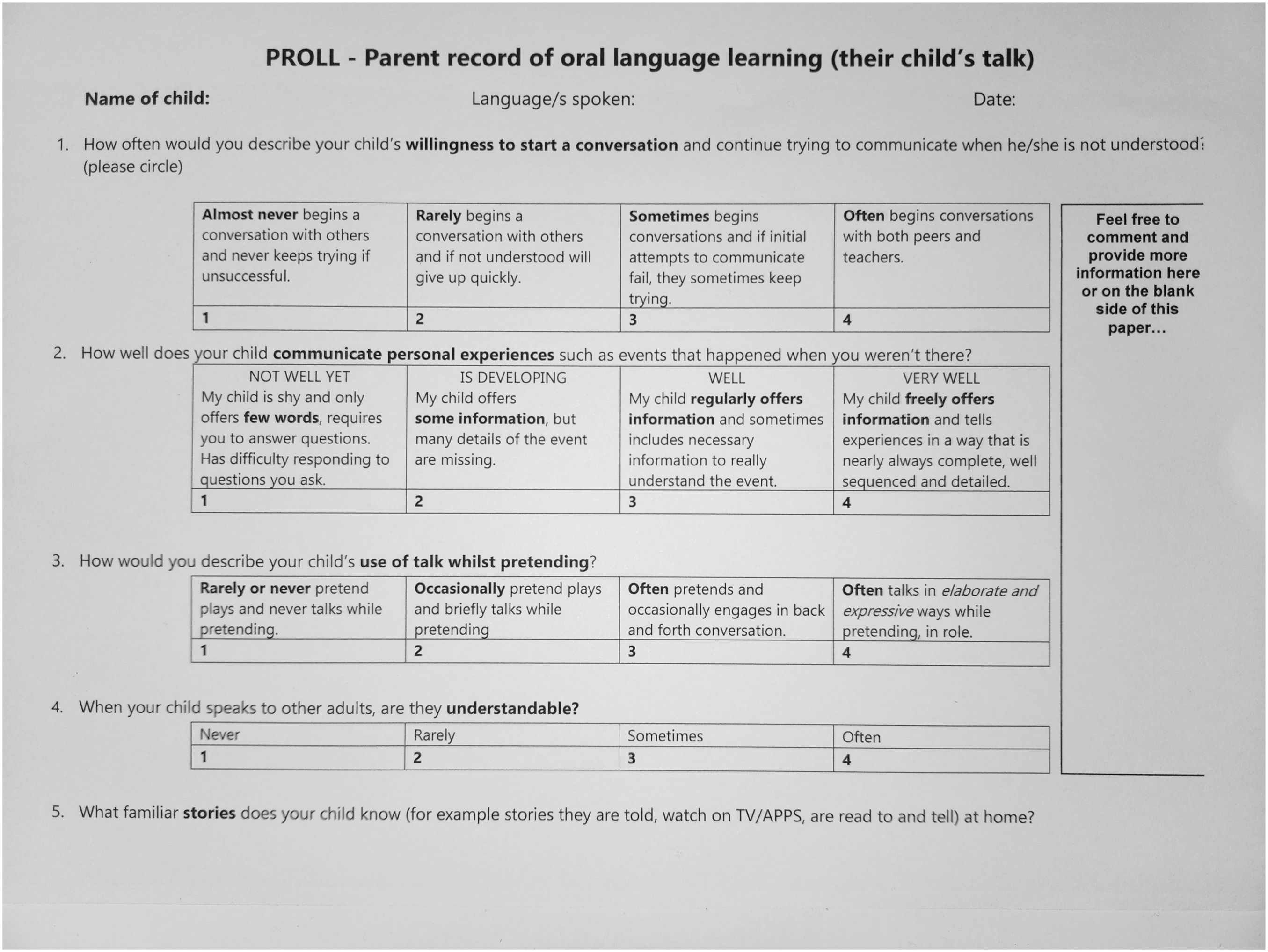
The questionnaires for parents were a modified parental version of the Teacher’s Record of Oral Language and Literacy (TROLL) (Dickenson et al., 2001) which was also undertaken by educators for comparison. Informal conversations with parents, as well as teacher-parent-child interviews (in term 2), identified children’s storying experiences at home. Children’s artefacts were collected and transcriptions of their accompanying spoken stories in their first language and English were recorded alongside. Participant observations of children, with educators and families during storying events, were documented in photographs, film and field notes.
Data Collection.
Analysis
Reflective journaling was prominent in our interpretivist research to record children’s multimodal and multilingual communication (Chowdhury, 2014). Interpretation of observations/artefacts was guided by thematic analysis (Greene, 2014) reflecting on cultural and linguistic capital, multimodality, the 100 languages and Aboriginal ways of learning. A priori coding of the multiple modes were implemented (Kress, 2019), noting gestural/non-verbals and visual/symbols and auditory communication as well as incidences of translanguaging (García and Kleifgen, 2019). Inductive coding identified how parents and educators supported diverse children’s multimodal and multilingual communication through providing resources to negotiate meaning (García and Wei, 2014; Halliday, 2004). Peer debriefing was also undertaken amongst educators during meetings to select samples of data to report. Public presentations affirmed themes such as the ‘moving language’ after noticing focus children communicating stories by moving props while making ‘sound effects’. This led to the evolution of the concept of ‘communicative capital’ to draw attention to children’s communicative assets to express stories beyond words in English.
The findings: Children’s stories
Although the first phase of the study initially focused on spoken versions of story’telling’, the second phase considered multimodal storying more explicitly. Three children’s documented stories are presented in this article (a child with autism, a Pitjantjatjara child and a trilingual child) to demonstrate varied communicative capabilities (in multiple languages and modes) highlighting communicative capital in semiotic mode tables. The stories of Rushan (aged 4), Nyakul (aged 3) and Hyuk (aged 4) incorporate few examples of oral language in English yet demonstrate much visual, auditory and moving language (as well as community languages). The examples expand beyond a traditionally dominant English oral language focus of literacy and illustrate the power of noticing children’s communicative capabilities and capital.
Story 1: Rushan, ‘the producer’, communicated through gestures, sound effects and movement
Rushan, aged 4, a child with an autism diagnosis was a capable communicator via his moving language. He moved his body and props in representative ways both erratically and contemplatively while incorporating dramatic sound effects and onomatopoeic verbalisations to produce his stories.
The role of the educator
In Rushan’s case, the role of the educator was to provide resources for Rushan to communicate with and be inspired by to make sound effects and actions for events to occur. As a sensory-seeking tactile explorer, Rushan communicated mostly through touch and action. He regularly used his hands to manipulate items surrounding him—bringing characters to life. Rushan’s mother informed us how he “combined words and gestures to communicate.” Movement and stimming behaviours were welcome by Rushan’s one-on-one preschool support educator and speech pathology guidance. His communication was reliant on an assemblage of semiotic modes.
Rushan’s royal story
One afternoon, Rushan was recorded when discovering a community-donated castle set. He picked up the king and tapped its feet on the table, simulating it walking around inside, the castle (see Figure 4). Rushan made grunting noises, ‘neruh’, as the king plodded along. Next, he picked up the queen, and with figurines in each hand, he tapped the king and queen to promenade. Rushan rotated and re-positioned the king and queen slowly face to face. He laughed a deep evil laugh, ‘heh, heh, heh, heh!’ (for the king) and a separate high-pitched feminine sound, ‘ooh’ and ‘aaargh!’ (for the queen) before the king continued with Rushan tapping it in pursuit of the queen. At a diagonal edge of the TV cabinet, Rushan continued to slide the queen down (like a slippery dip) while exclaiming ‘Wheeeee!’ in the queen’s voice. The king followed in chase, as Rushan made the deeper sound ‘Wheeeee!’ The king and queen then plodded along until they reached another castle across the room. Inside was a princess, a throne and a jester. Rushan re-positioned the jester at the door entrance and moved the king in a swift manner to bang on the castle wall ‘errr!’ Rushan moved the jester in a reactive motion punching the king. He then made battle sounds synchronised with fighting actions. Rushan arranged the throne inside the top castle tier. He placed the king on the throne, then swapped for princess, placing the king on one side and jester on the other. Next Rushan rotated the faces of the king and jester to both view the queen from opposite sides. Commencing an attack, Rushan made a suspenseful predatorial sound effect “Der ne! Der ne!” (similar to the Jaws movie sound). Rushan then collided the jester and king with the queen in battle for the chair. The furniture was dismantled, chaos erupted, and all characters (with the chair) crashed down simultaneously while Rushan sirened a pterodactyl-like high-pitched squeal ‘Arghhhh!!!’ Through multiple semiotic systems, movement, speed and sound effects Rushan’s story sequenced through numerous events. Competent and capable of producing with props, Rushan made meaning as educators spectated his moving displays with community-provided props. Rushan’s story with donated props.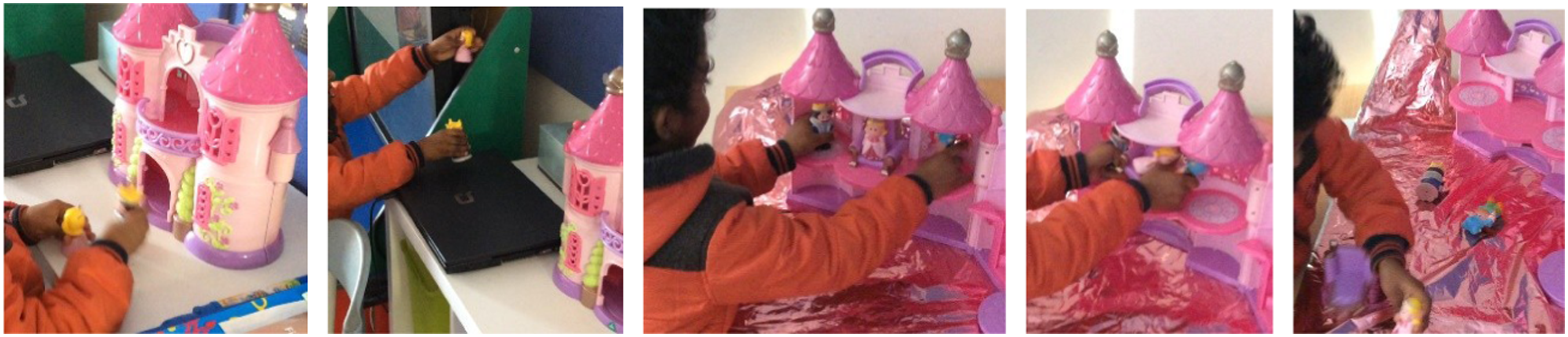
Rushan’s Modes of Communication.
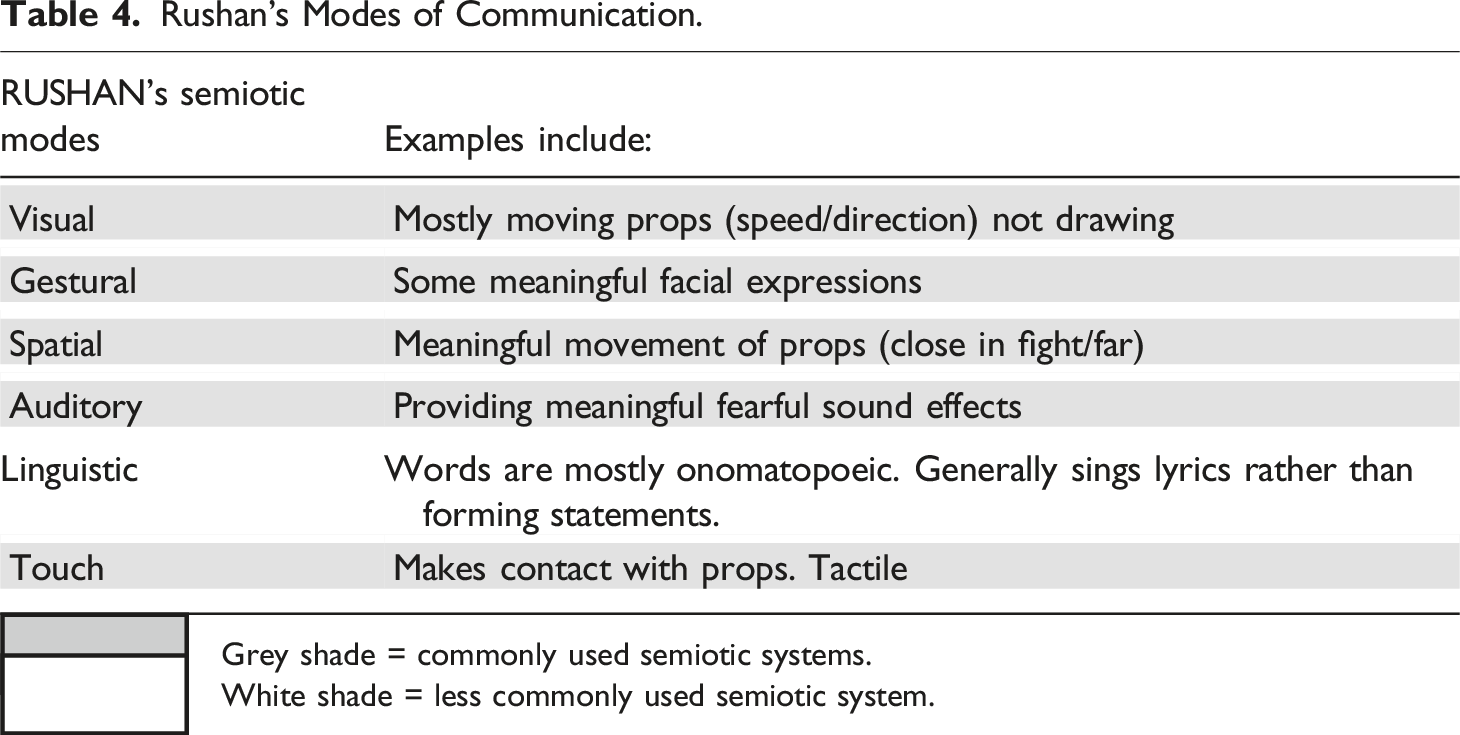
 Grey shade = commonly used semiotic systems.
 White shade = less commonly used semiotic system.
Rushan thrived from movement and expressed his stories using his body, Nyakul, similarly, communicated through movement in interactions with others.
Story 2: Nyakul, ‘the interactive director’ and gesturer, warmed up through touch, play and movement with props collaboratively
Nyakul, aged 3, an Aboriginal child, similarly created animal stories by moving props. He eventually touched educators, maintained eye contact with them, showed them items and expressed some English speech. Nyakul refused invitations to draw on paper.
The role of the educator
The role of Nyakul’s educator involved scaffolding verbal commentary in co-constructed storying, playing alongside and within reach while narrating layers of words to complement actions. Providing interesting resources for manipulation and body/prop-based expression was essential.
Nyakul’s Australian animal kingdom story
Nyakul identified with the Pitjantjatjara community on his mother’s side and Kurdish on his father’s side. Nyakul’s older brother, Hapē, had attended Green Park Preschool the year prior to Nyakul’s early entry enrolment, thus a connection had previously formed with Nyakul’s family. His brother had an autism diagnosis and the research/teacher who taught the brothers consecutively had previously visited their home. Chloe, an additional preschool support educator, also offered one-to-one care and education to both brothers. Nyakul’s parents informed educators that Nyakul talked a lot more than at home than at preschool. His mother recorded Nyakul playing at home on her phone and demonstrated to teachers that Nyakul was quite vocal in the home context compared to preschool. Nyakul’s father explained that at preschool Nyakul ‘felt shame to talk’.
In his earlier preschool days, Nyakul would coyly hold his mother’s leg demonstrating caution. His cousins also visited the preschool during his transition visits and he yarned with family in the dramatic play area. As noted by Frazer and Yunkaporta (2021: 90), “Yarning is deeply embedded in the structures and processes of Aboriginal society, a traditional process of knowledge sharing in which community and family members produce and keep knowledge through story…”
Nyakul watched from the periphery at group times—curiously observing, yet hesitant, to join in. He demonstrated a strong interest in animals, as was reinforced when his mother revealed that Nyakul loved watching animal documentaries.
Nyakul’s ways of communicating align with Yunkaporta’s (2009) ways of learning, particularly non-verbals, community connection and land links. He used several semiotic systems—often visual and spatial with touch and movement. Nyakul created story worlds (see Figure 5), parallel to other children and sometimes with them, crashing animals together in interactive joint construction. Nyakul playing with large animal kingdom props.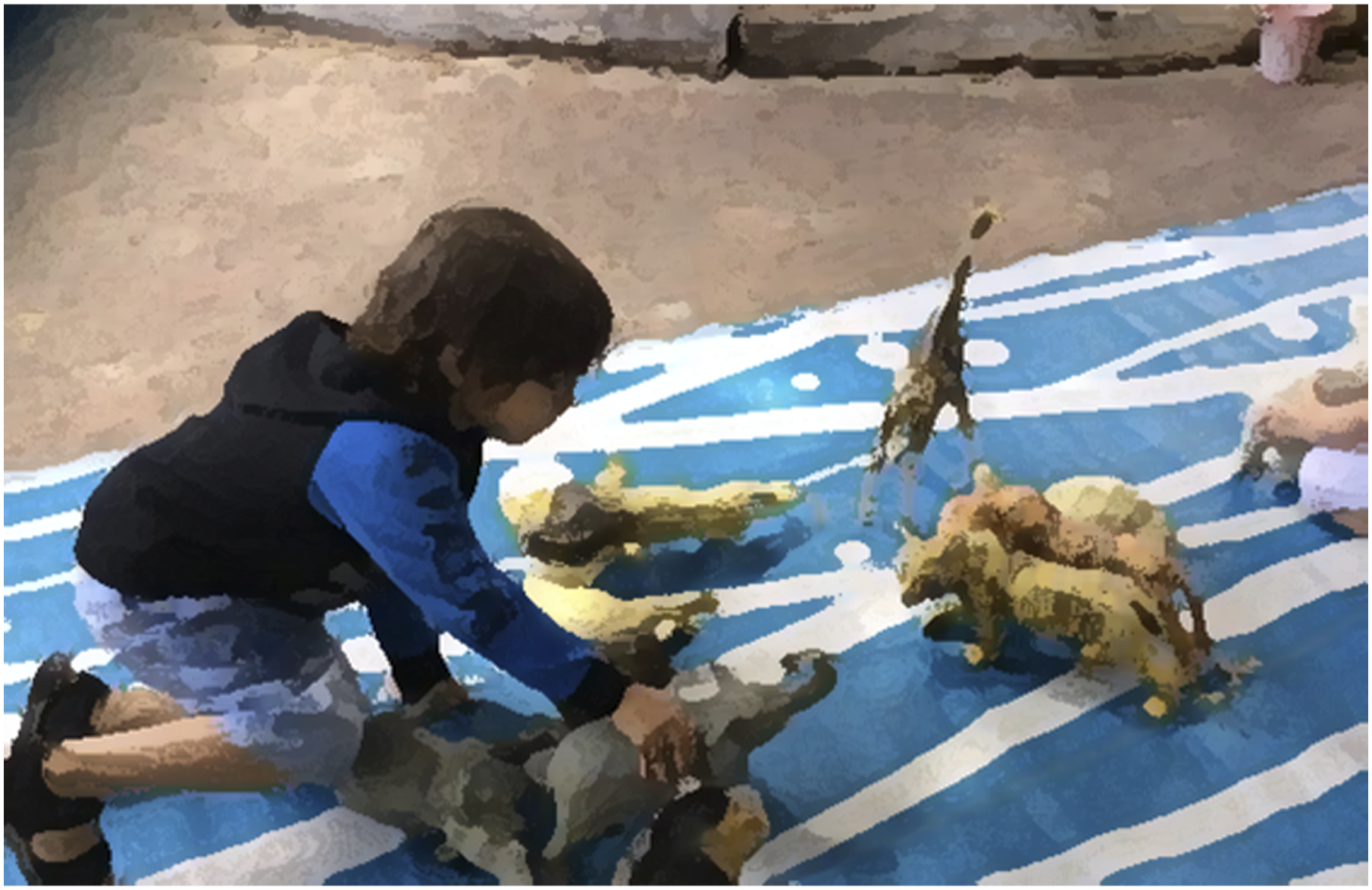
Sustaining conversations with Nyakul was challenging for educators. When educators approached Nyakul during initial weeks (solely for verbal exchanges, without props), he would retract his neck and head and avoid responding to questions. Educators became aware of power, emotion and the tenor in interactions with Nyakul (with regards to age, power, status and familiarity) (Halliday, 2004). Educators consciously displayed joyful, approachable, prop moving co-play alongside Nyakul, so to invite him in a less-intimidating fashion to communicate. In a culturally responsive manner, educators mirrored Nyakul’s movements while moving props.
Over time, Nyakul instigated interactions with educators—reaching out his arms, passing objects to them and moving in closer while murmuring a few words. On Nyakul’s terms, educators co-played and created dramatic play scenarios while he guided them with his eyes, holding figurines up for acknowledgement, occasionally mumbling, ‘look’, to gain attention. Attending play in animated and humorous scenarios (together) was essential for educators.
Educators introduced hand puppets and located an Aboriginal puppet program online, Pirltawardli, meaning Possum House in Kaurna (the local First Nations language of Adelaide). Sourcing texts in Pitjantjatjara was initially challenging; Nyakul’s mother mentioned that Nyakul’s Aunty spoke Pitjantjatjara and his mother was keen for Nyakul to learn Pitjantjatjara language.
During small world play with Australian animal figurines in red sand (see Figure 6), Nyakul slid a large crocodile along, making a track. He opened its jaws, filled it with sand, and inspected it while squeezing the jaws together. He held the crocodile up to Amy and murmured, ‘It’s in mouth’. Nyakul then picked up the baby crocodile. He held it to the teacher and said, ‘Look at baby’. Nyakul pushed the baby croc through the sand, making tracks. He kept looking back, glancing at his teacher’s face, checking whether she was watching his actions with the crocodiles. His teacher picked up a kangaroo and bounded it along. Nyakul then interrupted to say, ‘Look it mouth’ again. He watched his teacher’s movement as she picked up a bilby, then he searched for another animal for himself. He lifted an emu to stand, and then let it go to select a platypus. He commenced to slide the platypus making it travel though the sand, still making contact with the teacher’s eyes. He shuffled and approached his teacher in closer proximity and then transferred his attention to a spiky bearded dragon. When Nyakul noticed that his teacher had a Tasmanian devil in her hand, he swiftly took it and handed her the platypus in exchange. Nyakul moved the Tasmanian devil to knock over a koala in an aggressive manner, then a kangaroo, and pushed all the animals around much like a bulldozer. He took the wombat and jumped on the teacher’s platypus’s back. A game of chasey with animals began. Nyakul grabbed the platypus, growled “grr”, and then passed the teacher the bearded dragon and said, ‘You!’ He then slid the animals together and commanded ‘Squeel em der’—an incomprehensible phrase directing actions socially. Nyakul creates a story with animal figurines.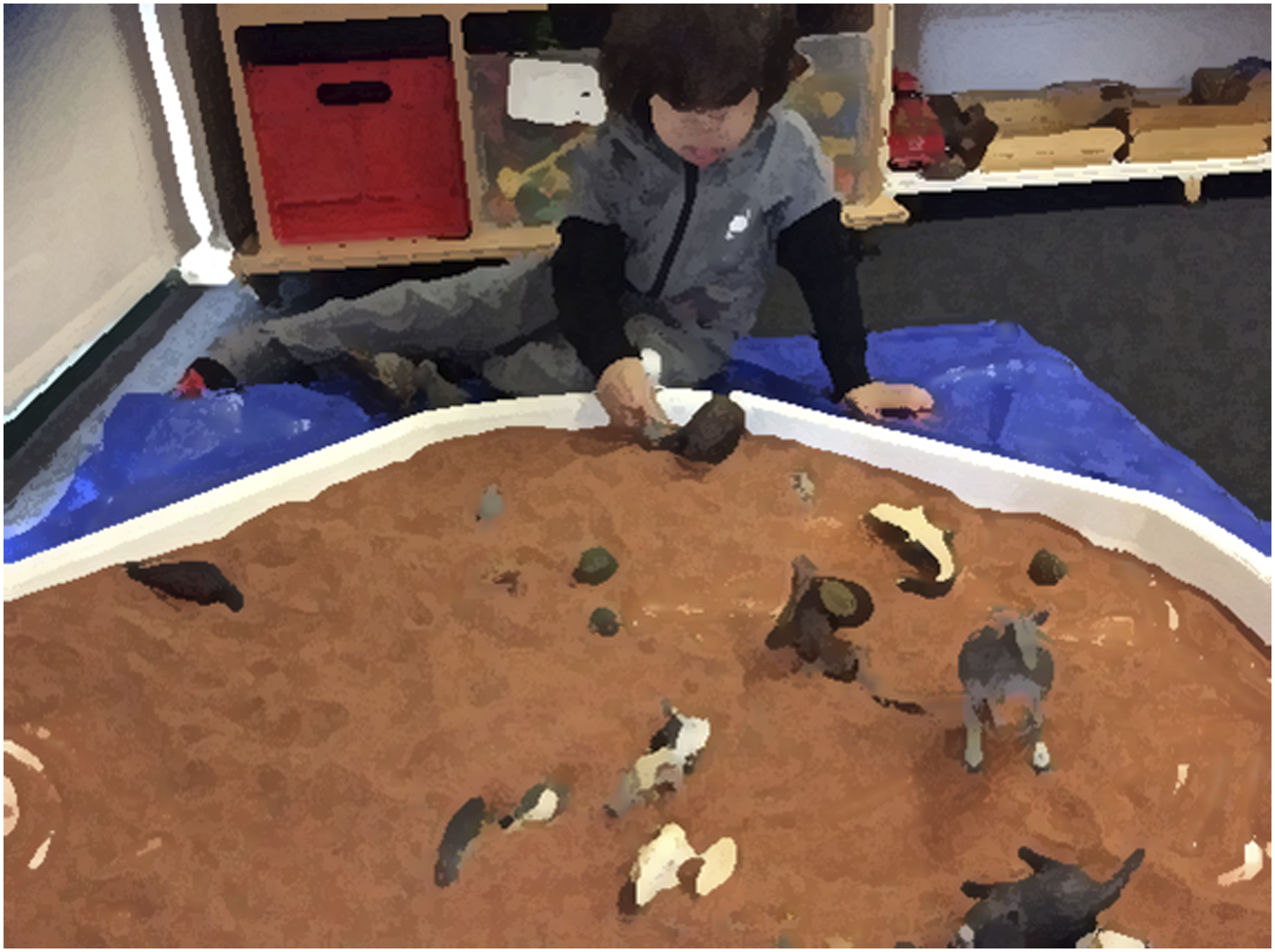
Nyakul’s Modes of Communication.
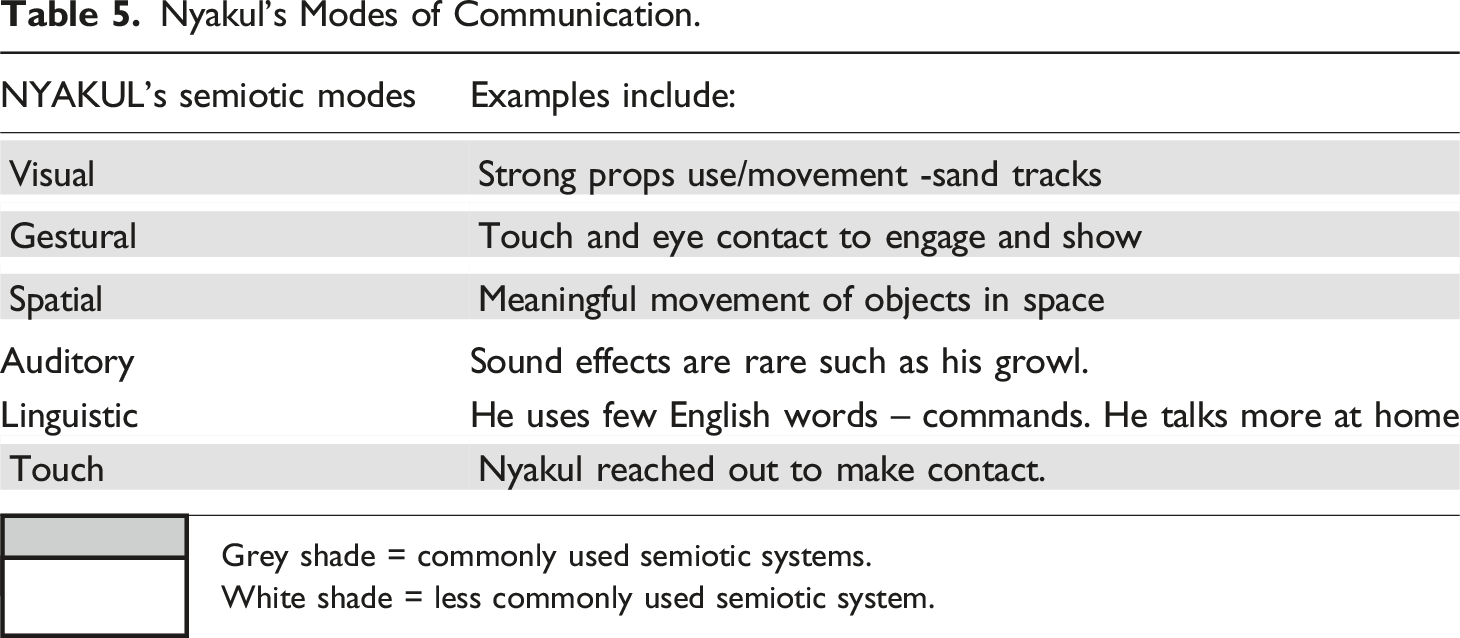
Grey shade = commonly used semiotic systems.
White shade = less commonly used semiotic system.
Nyakul enjoyed making marks in the sand; Rushan moved props with sound effects; Hyuk, on the other hand, loved to paint and draw on paper while speaking multiple languages.
Story 3: Hyuk, ‘the visual artist’, described his painted and drawn stories in his community languages
Hyuk, a Korean/Arabic/English trilingual child, was a new arrival to the preschool and his parents were very supportive to assist with translanguaging. Hyuk created visual art stories by painting outdoors and drawing inside. He competently expressed and described his images in his Korean language and used some words of his developing his English to explain his storying ideas. His parents and bilingual support educator assisted him to record his drawn stories in Korean scripts with English translation.
The role of the educator
The role of the educator was to provide Hyuk with props, observe, discuss and transcribe his art explanations, and record his Korean descriptions with bilingual support and parental assistance to value and translanguage in his first language.
Hyuk’s monster story
Hyuk’s mother spoke Korean and English, and his father spoke Arabic and English. Hyuk was a strong Korean communicator and incipient learner of both Arabic and English. He drew representational images, such as trees, monsters and toy babies going on adventures. He was fortunate to have a Korean bilingual support educator (see Figure 7) supporting his transition from home to preschool to document his story ideas through drawings, in Korean and in English. Hyuk’s adventure with toy baby story.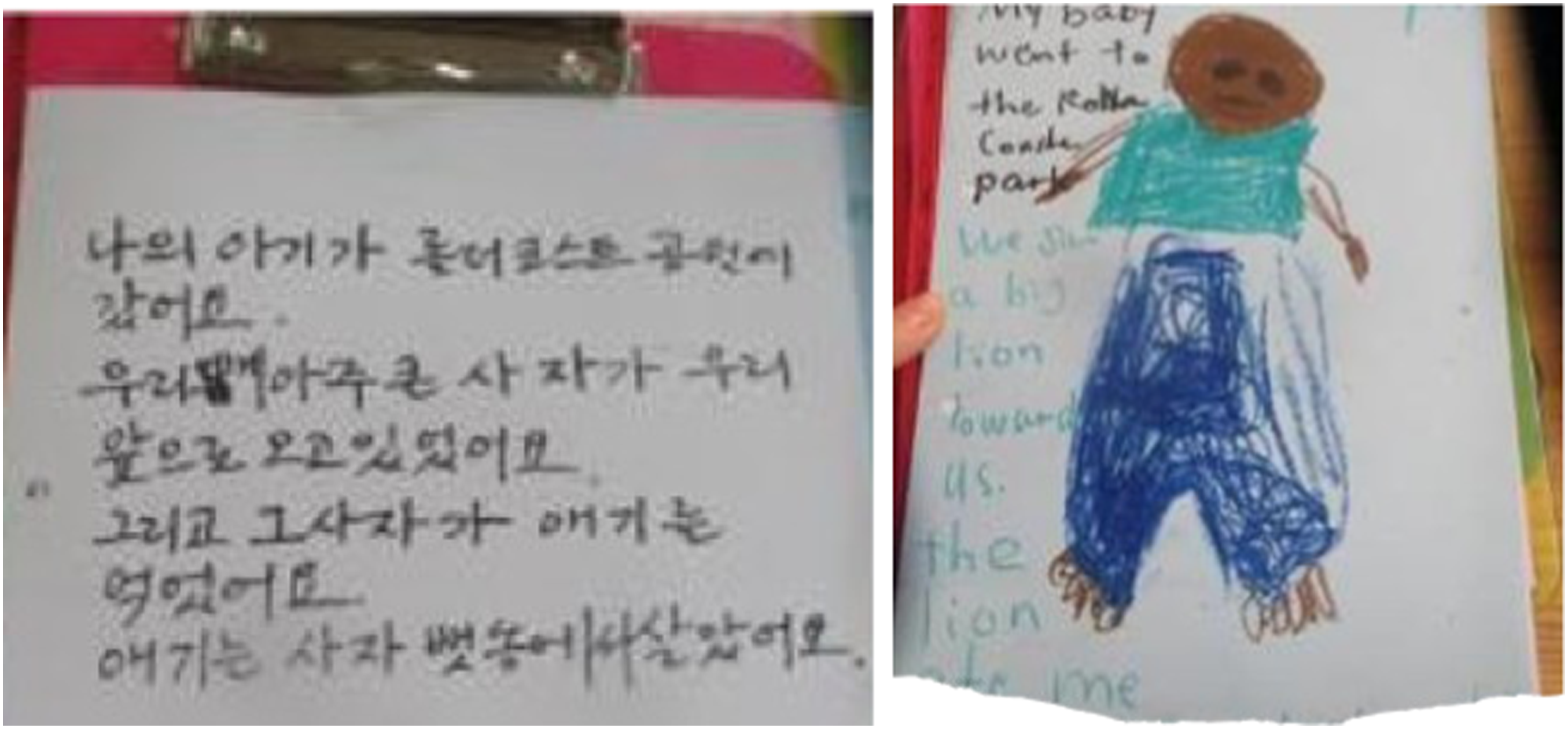
One day, Hyuk painted a picture under the tree. In solely English, he communicated to his teacher ‘monster this’, ‘tree’, ‘person’, ‘crazy monster’ while pointing to the parts (see image 2 in Figure 8). Contrastingly, in Korean with parents, Hyuk later expressed additional detail for the same story: ‘This is a tree, and someone is hiding here … And there are monsters, two monsters. And these are the teeth of the monster’ (Korean). Educators and parents together supported translanguaging, the combination of expressions from his full linguistic toolkit. (left) Hyuk expresses himself through moving props (centre) through artist representations and (right) through his community language (Korean) scribed and translated into English with parental and Korean bilingual educator support.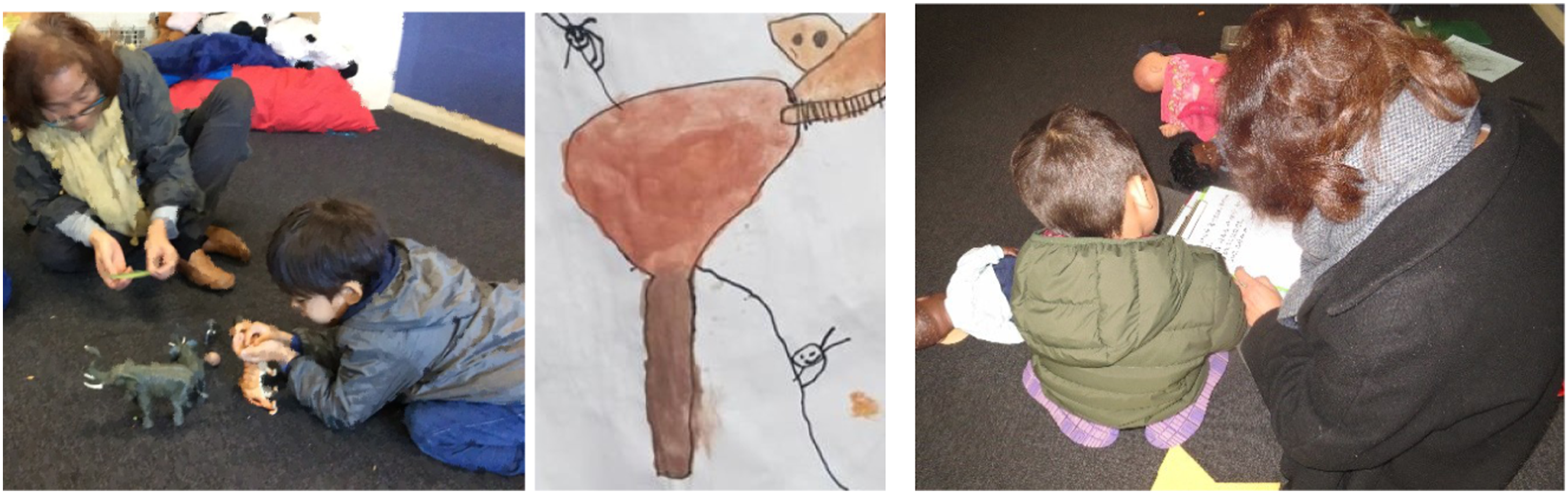
Hyuk’s Modes of Communication.
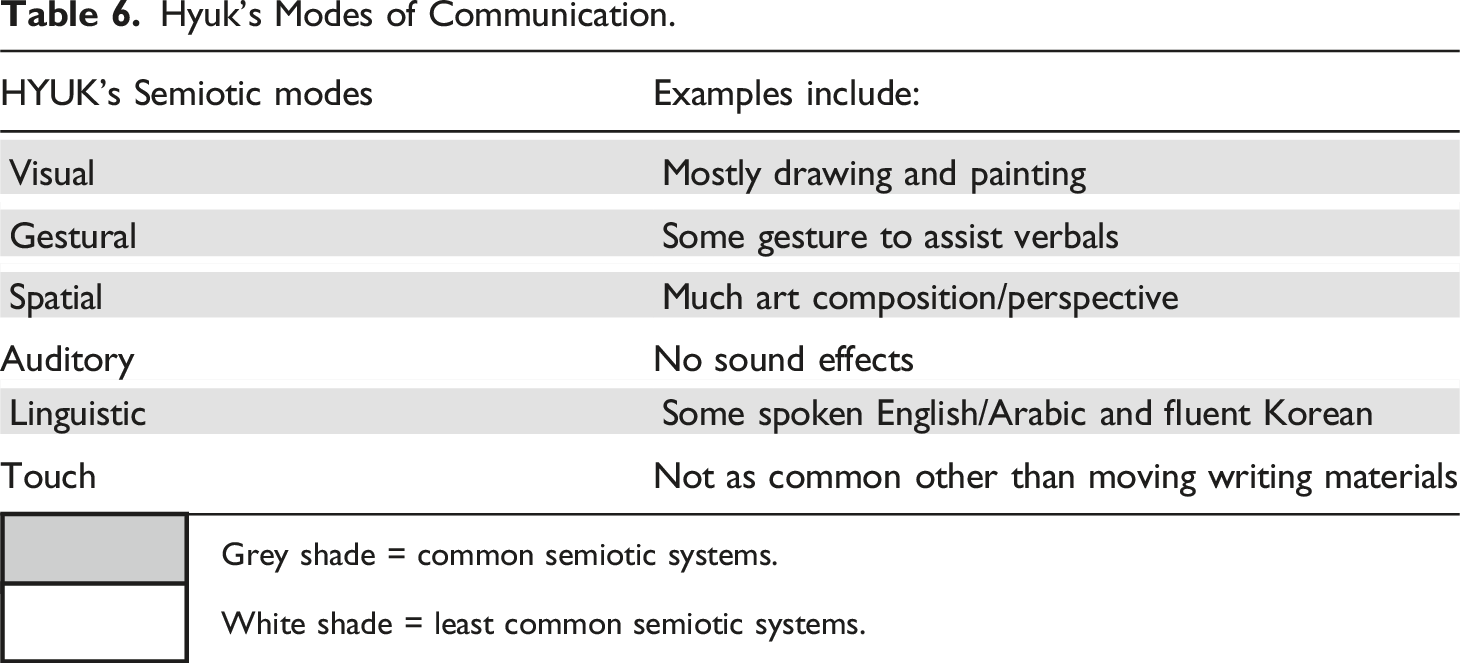
Grey shade = common semiotic systems.
White shade = least common semiotic systems.
Hyuk contrasted with Nyakul and Rushan in that he depended on his multiple languages daily. Similarly though, he expressed through visuals requiring educators’ observation.
Discussion on literacy teaching pedagogies and practices
The royal, animal kingdom, and monster-tree stories of Rushan (the producer), Nyakul (the director), and Hyuk (the artist), presented in Tables 4–6, demonstrate the children’s strength of assemblages in semiotic systems for meaning making (Kress, 2019), as displayed in intensity in grey. The results highlight the three children’s multimodal diversity (Hill, 2021) and multiple assets (Kamler and Comber, 2005; García et al., 2018), their ways of communicating, additional to verbalising in English. The diverse preschoolers’ communicative capital is prevalent in the texts they produced, or the living expressions they experienced. They expressed via movement of body and/or props, touch, eye gaze, visual art, sound effects and community language use. There is a need for more research into the moving language and spatial semiotic systems (Anstey and Bull, 2012) where children story by moving animal props through force, such as enacted by Pitjantjatjara/Kurdish child, Nyakul. Leander and Boldt’s (2013) research with a 10-year-old child engaging with Manga previously highlighted value of the body in motion during multimodal interaction with literature in character. Similar to Rushan’s movements and onomatopoeic sound effects, children in research undertaken by Powell and Somerville’s (2021) grunted and growled to produce noises complimenting Zombie play—onomatopoeia is another area to further explore.
At Green Park Preschool, all three children were fortunate to be allocated one-on-one bilinguals or preschool support educators (for autism, Aboriginal early entry and EALD), to assist communication and provide opportunities for translanguaging (García and Wei, 2014). A limitation of the storying project was not having a Pitjantjatjara speaker in the team for Nyakul—a consideration for future research is to engage with Elders for greater understandings of culture, communication and non-verbals, and to increase culturally expanding research (learning from others' ways). The visual and moving forms of communication (Anstey and Bull, 2012) and Aboriginal ways of non-verbal and symbolic expression (Yunkaporta, 2009), complemented children’s literacies.
Our educators agree with D’warte’s statement (2020: 663) that ‘[in] 21st-century classrooms, we must go beyond celebrations of cultural and linguistic difference and begin to enhance and reimagine teaching and learning.’
Respect for ‘the moving language’, ‘sound effects’ and ‘translanguaging’, endorses children’s ‘communicative capital’. Promoting communicative capital expands the concept of linguistic capital and restructures the broadness of Bourdieu’s (1991) cultural capital. The ‘moving language’, in sync with embodied communication, body-based learning (Macedonia, 2019), total physical response (Al Harrasi, 2014), the 100 languages (Rinaldi, 2013), and the essence of non-verbals promoted by Yunkaporta (2009), deserves greater emphasis in inclusive and diverse literacy teaching.
Our study found that a deeper regard for the multimodal (Hill, 2021), multilingual, and multicultural context of situation (Halliday, 2004)—the field (the setting/topic), tenor (aspects of the relationship concerning power, status, age and familiarity, and culturally responsive practice in communication), as well as the mode (spoken, written, drawn or ‘moved’)—needs to be factored into modern literacy teaching. As advocated for by Flynn et al. (2021) and experienced by Hyuk, translanguaging with parents, peers, educators and bilingual support, scaffolds greater detail in expressions of thought through bilingual preschoolers’ storying via drawing. Inclusive literacy teaching expands beyond English oral or spoken language and prioritises communication to expand perspectives of children’s linguistic capital (Bourdieu 1991). Developing children’s communicative capabilities is fundamental to bring stories to life beyond oral language and spoken English, which has historically dominated teaching and led to reductive assessments of children’s strengths (Flynn et al., 2021).
The stories of Rushan, Nyakul and Hyuk reinforce the issue that a focus on English-only story ‘telling’ alone would have ‘silenced’ the children’s storying abilities greatly. Reducing modes of expression to only the linguistic spoken boxes of the analysis Tables 4–6, would have resulted in a deficit perspective. By focusing on literacy more broadly in this study, children’s expressive storying competencies as producers, directors and artists was brought to light.
Our study identified ‘
Implications and conclusion
On reflection, CPAR, involving observations, informal conversations and interviews (with children and families) enabled educators to identify children’s communicative capital in contexts where children were familiar (such as at home) as well as unfamiliar (such as at a new preschool). Funding for bilingual educator support is essential as children commence preschool, and after children progress in English, to sustain community languages and promote translanguaging. In this CPAR (Gaffney, 2008; Kemmis et al., 2014), educators (through planning, acting, observing and reflecting) learned that story ‘telling’ is a restrictive term that limits and excludes learners from expressing themselves fully. We find storying to be more inclusive as it embraces multimodality and recognises diverse communicative capital.
Communicative capital
The social justice and activist message of this article is to challenge the dominant colonised political and curriculum view that English spoken language versions of storytelling are more essential than other languages or ways of communicating storying through drama and drawing. The term ‘communicative capital’, derived from this study, offers as a conceptual expansion and bridge between Bourdieu’s (1991) cultural and linguistic capital to draw attention to the power and strength in children’s communication noting the societal values placed upon multimodal and culturally/linguistically diverse forms of expression (see Figure 9). Communicative capital – it’s conceptual place.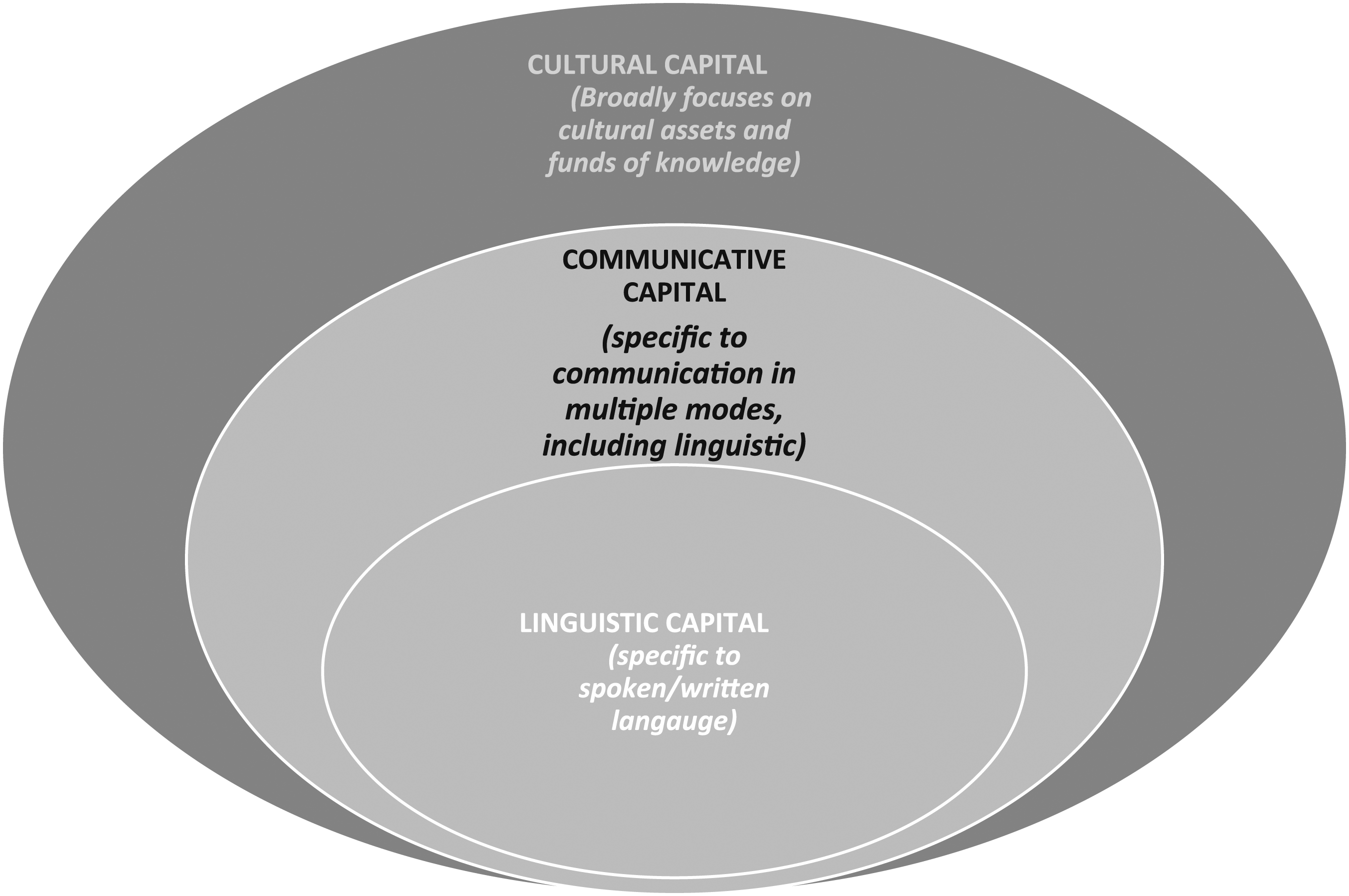
Communicative capital, or ‘communicative capitalism’, has previously been described in the fields of media and politics to identify the growing social media and information communication technology capabilities to share a message (Dean, 2005). In journalism, communicative capital defines digital communication and its relationship with advertising (Nixon, 2013). In preschool contexts, communicative capital offers an inclusive way to consider the lenses we use to view and assess children’s cultural and linguistic capabilities and beyond, and takes into consideration multiple modes of expression, specific to communication, further refining the general funds of knowledge concept (González et al., 2005). Recognition and reflection on communicative capital incorporates appreciation of the broad abilities of children to express themselves in multiple ways. Attention to semiotics—visual, auditory, movement, gestural expression, tone, pitch, colour and touch (including the body and materials)—has broadened the conceptualisation of literacy, merging ‘literacy’ together with the term ‘communication’ for culturally, linguistically and ability diverse and all children (Anstey and Bull, 2012; Hill, 2021; Giæver and Jones, 2021). We need to decolonise the curriculum (Rigney 2011); it requires cultural expansion if it is to better suit our children, to be more inclusive, and to acknowledge, celebrate and promote diversity. This is particularly crucial before South Australia’s new government initiative for all 3-year-old children to start attending preschool alongside four-year-old children in 2026.
Footnotes
Declaration of conflicting interests
The author(s) declared no potential conflicts of interest with respect to the research, authorship, and/or publication of this article.
Funding
The author(s) received no financial support for the research, authorship, and/or publication of this article.
