



Abstract
Representational logic cannot account for the entanglements of all that matters in making new media: feeling bodies, vibrant matter, feeling bodies and vibrant matter all moving and at different rates. In the currently shifting communicative landscape, where mobile technologies are the primary means for youths’ digital production, all this movement, all this moving matter, is integral to generating fuller, more (than) human expressions of youths’ new media making. This article therefore develops a non-representational theory of new media making through an intra-action analysis of five adolescents making a digital book trailer while moving within and across three locations. As guiding poststructural methodology, intra-action analysis attuned the authors to moments when bodies-materials-place became perceptibly entangled in the drawing of boundaries and exclusions. Analysis expresses how emergent (re)shapings of boundaries and exclusions across production settings were concurrent with a process of privileging text-based/media-based ideas and thereby various students’ becoming agencies and capacities to act as new media makers. The article concludes arguing that poststructural attention to literacy in the making matters as an ethical imperative for researchers and educators. Literacy in the making enacts boundaries and exclusions that participate in ongoing discursive-material practices, which have potential to produce histories differently in as yet unimagined futures.
Language matters. Discourse matters. Culture matters. There is an important sense in which the only thing that doesn’t seem to matter anymore is matter.
Making new media is no longer a primarily sedentary process. In the currently shifting communicative landscape, where mobile technologies are the primary means for youth digital production (Lenhart et al., 2015), it is impossible to ignore that technology is “as mobile as we are” (Merchant, 2012, p. 770). Now youth hold their screens up to the world, making meaning alongside and through them, not only on or behind them. Bodies, movements, materials, and place affect new media making as much, or more, than software on screens (Burnett, Merchant, Pahl, & Rowsell, 2014; Ehret, 2016). As technologies for learning with and making new media continue to become more mobile, literacy researchers must mobilize new paradigms. Literacy studies need expansive theories to account for all that matters in the making: feeling bodies (Ehret & Hollett, 2013), vibrant matter (Bennett, 2009), all moving and at different rates (Ingold, 2015).
Most theories for understanding new media making practices in literacy studies invite linguistic analogies, critiques of cultural constructions, and practices of representation that elide this moving life of literacy that resists representation. For example, research on multimodal composition most often leverages the linguistically rooted paradigm of social semiotics (McDonald, 2013) to understand processes involved in designing multimodal texts (see Smith, 2016, for a review). Importantly, this representational perspective has illuminated how youth develop linguistic and cultural identities locally and transnationally by composing, communicating, and cultivating shared literacy practices (e.g., Domingo, Jewitt, & Kress, 2015; Hull & Stornaiuolo, 2014). On a more locally situated scale, literacy researchers have shown how culturally and academically marginalized youth make themselves known differently in the process of making new media, thereby allowing scholars to critique how normative discourses can translate differences into inequalities (e.g., O’Brien, 2012; Vasudevan, Schultz, & Bateman, 2010).
Literacy researchers continue to show that language, discourse, and culture matter in research on youth and new media making. However, in appeals to unitary social structures that are argued to exist outside of embodied activity, these perspectives make it difficult to think how language, discourse, and culture “come to matter” in processes of making new media (Barad, 2007). Literacy theory is underdeveloped in coming to know how discursive practices relate to material phenomena—how new media making comes to matter in discursive-material relations. This form of knowing requires resisting representational logic that creates an ontological gap between the domain of words, signs, discourses, and the vital materialities—matter—of which human bodies are (only) a part. This form of knowing requires closing this ontological gap as a starting point, as opposed to representational logic, which requires closing the gap to generate knowledge. As Barad (2007) puts it to representational logic, “if words [and modes] are untethered from the material world, how do representations gain a foothold?” (p. 137). If contemporary new media making with evermore mobile technologies is abstracted from bodies, movements, materials, and place, how do multimodal texts gain a foothold?
Overview and Research Focus
We develop poststructural perspectives in literacy research to advance an agential realist account of new media making that starts from a closing of this ontological gap. Agential realism “doesn’t presume the separateness of any-‘thing,’ let alone the alleged spatial, ontological, and epistemological distinction that sets humans apart” (Barad, 2007, p. 136). Agential realism is an onto-epistemology that knows as a part of the phenomena under study. From this perspective, all that is available as knowledge is immanent to—is an inextricably material part of—the world’s continuous and differential becoming (Deleuze & Guattari, 1987). This is not to ignore matters of language, discourse, or culture, but to meet them in their materiality, to argue that how they are known is the same as the nature of their being: this is a non-representational logic (Harrison & Anderson, 2010). Language, discourse, culture, and, indeed, new media making, are emergent phenomena that are more than locally and transnationally situated: they are materially entangled in the world’s becoming. They matter in discursive-material relations, where there is no ontological gap between discourse-and-material.
With an agential realist account of five adolescents using iPads to produce a digital book trailer across their middle school, we develop literacy theory toward knowing the discursive-material relations of new media making. We focus specifically on the intra-actions of bodies—both human and non-human—and, importantly, how this entanglement of agencies constantly produces and reproduces boundaries and exclusions. Intra-action refers to the dissolution of boundaries between bodies in moving activity, as opposed to interaction, which freezes activity before generating a constructivist gap between bodies, and between bodies and materials, to generate knowledge. We describe how all matter works together to co-produce meaning in the ongoing flow of experience and the entanglement of agencies. Non-representational logic is a realist account of agency, therefore, giving all matter its due as being real, vital, and vibrant (and sometimes dull). All matter affects and is affected, where affect is the circulating force of moving and being moved through emergent, material, and social relations (Massumi, 2002).
But while giving credence to all matter’s affects, we are especially concerned with how the affects of entangled practices are productive of boundaries and exclusions, because “who and what are excluded through these entangled practices matter: different intra-actions produce different phenomena” (Barad, 2007, p. 58). This perspective opens new questions about the nature of literacy and new media making as form-taking activities. By form-taking activity, we mean that there is also no ontological separation between mental representations and matter, which would assume that human agents perform upon a separate and inert material world. For example, how do bodies-materials intra-act and affect each other in processes of making texts? How do bodies-materials co-produce meanings and alter paths of production? How do some movements of bodies-materials simultaneously affect capacities to move, make, and be heard, while also stymying, immobilizing, and frustrating?
Galvanized by the potential implications of these questions, we begin with a brief overview of representational approaches to multimodal text-making, before describing how poststructural insights are building upon them. Next, we use Ingold’s (2013) anthropological description of brickmaking as an emergent and enmeshed activity of mutually agentive bodies-materials to better understand new media making. We then diffract Ingold’s anthropology of making through Barad’s insights from feminist, posthuman science studies. We do so in the poststructural spirit of diffraction as a metaphor for thought, specifically as a mode of reading “insights from different areas of study through one another” (Barad, 2007, p. 25). We then develop intra-action analysis, which decenters the human body and analyzes instead the bodies-materials moving and producing in emergent, felt response to each other. This approach to analysis scrutinizes the moving human body, in all of its gestures, sighs, and handwringing; moving artifactual bodies, like books and shoes; and body-thing assemblages, such as the body-shovel as enmeshed moving entity.
These bodies include five adolescents working with Reading master’s candidates (RMCs) to produce a digital book trailer for the young adult novel Holes. Digital book trailers are an emergent, hybrid genre, blending elements of book reports, book reviews, and movie trailers. Students worked on their trailer across six sessions during school hours as an enrichment project for their English class. We chose this small sample to microanalyze the intra-action among bodies-materials with an intensive focus not otherwise possible. Furthermore, we were able to follow production across multiple spaces; for example, an auditorium, a stairwell, and a sports field, which enabled us to analyze how ideas for the trailer took form in discursive-material relations of moving bodies, and how those discursive-material relations across sites of production enacted boundaries and exclusions.
The following questions guide our analysis:
Related Literature
With the proliferation of digital communicative tools, literacy scholars have argued for the importance of (re)conceptualizing literacy as a multimodal (Jewitt, 2008) or multisemiotic practice (Prior & Hengst, 2010). Much of the research extending from this call has employed representational paradigms, most often a social semiotic theory of multimodality (Kress, 2009), to understand new media making as a design process requiring the manipulation of semiotic modes to construct meaning in texts (e.g., Smith & Dalton, 2016). Moving beyond the examination of modal orchestration, others have used social semiotics as a starting point from which to explore cultural mediation in youths’ composing processes (e.g., Ranker, 2007). In addition to describing the role of software as a cultural tool (e.g., Gilje, 2010), these researchers have illuminated youths’ new media making processes as “transactional spaces” between school and leisure activity (Erstad, Gilje, & de Lange, 2007), and as mediated by popular culture (e.g., Mills, 2010).
While the communicative landscape has continued to expand with the proliferation of, for example, mobile devices and youth engagement in virtual worlds, perspectives for researching new media making in literacy studies have also necessarily grown. These perspectives have shown the inextricably imbricated nature of making new media across digital-physical space, using concepts such as real virtuality (Ehret & Hollett, 2014), (im)materiality (Burnett, 2015), and embodiment (Enriquez, Johnson, Kontovourki, & Mallozzi, 2016) to illustrate the relationship between the human senses, place, and meaning-making in the production of digital texts and virtual worlds (see also, Mills, Comber, & Kelly, 2013). As this line of inquiry in literacy studies has grown, the human body, moving, sensing, and feeling in place, has become central to analyses of youth digital media production.
Yet, poststructural trends in literacy studies are beginning to challenge the representational logic determining such analyses of youths’ embodied literacy experiences (e.g., Leander & Rowe, 2006). Leander and Boldt (2013) critiqued how representational logic can drain the affective life from expressions of youths’ literacies in use. In their analysis of a 10-year-old boy’s, Lee, play, they argued that his reading and making with manga exceeded appeals to abstractions, such as social structures and pre-defined categories of “interests” that would be posed as ontologically separate from Lee’s immediate experience (p. 43). Nor, they argued, could his experiences of reading, making, and playing, be “formulated through processes of ‘design’” (p. 43). They expressed his literate activity as an emergent “production of sensation, the unfolding of possibility” that escapes structures, hierarchies, and a priori categorization abstracted from outside of experience.
Advancing this poststructural perspective on literacy, we resist the anthropocentricism that in previous studies of youth new media making has elided the full, intra-active matter of embodiment. Embodiment is about more than the human body, or the human body moving in and across place(s): Embodiment “is a matter not of being specifically situated in the world, but rather of being of the world in its dynamic specificity” (Barad, 2007, p. 377). A fully embodied experience of new media making cannot be framed through representational logic in a linear chorology of human-driven interactions: a teen tapping her iPhone to capture images of falling leaves, selecting her Instagram filter, hashtags, and social media platforms on which to publish. Rather, the dynamic specificity of new media making is immanent to the unfolding of endlessly equal relations of bodies-materials moving each other: for example, sidewalks-leaves-teen-iPhones-rain-breakups-Instagram-glares-static-and-. Matter, in all its relations, in all its ands-, is not fixed, inert, awaiting representation from the outside, whether mediated through software, popular culture, or even human bodies. We therefore understand new media making as a discursive-material practice that is more than modes, movement, and human. Making requires the entangling of more-than-human agencies.
How Materials, Meanings, and Texts Emerge in Meshworks
The concept of meshwork, or the entanglements of moving bodies, materials, and temporalities (Ingold, 2013), aids our understanding of how discursive-materialities of human-bodies-and- work together in co-production while concurrently making and moving. Developing Lefebvre’s (1991) representational conception of meshwork, Ingold focused his theoretical development on a non-representational critique of hylomorphism: the assumption of an ontological separation between mind, matter, and form. Bound within the representational logic of hylomorphism, material things are passive objects waiting for agentive human bodies to use them, to give them purpose as materials with which to realize human ideas already formed inside the mind, which is conceived as separate from the body. Ingold critiqued this model, arguing that human and non-human bodies affect each other as equal agents in emergent social, cultural, and material production. In his critique, Ingold provided the anthropological example of making a brick. Rather than conceive of the brickmaking process as the clean production of uniform rectangular rocks (of human bodies imposing their visions of “bricks” onto materials), Ingold described the reciprocal process of production between form and materials; bricks’ rectangular forms “result not from the imposition of form onto matter but from the contraposition of equal and opposed forces immanent in both the clay and the mould” (p. 25, emphasis in original). The mold itself is shaped for the clay, built specifically from hardwood such that the “clay can take to the mould and the mould can take to the clay” (p. 25). From this perspective, brickmaking must be understood as an emergent form-taking activity and not as a generic activity of giving form. The brick takes form in the meshwork of, at least, tilled soil, sieved clay, kneading (calloused) hands, and wooden mold.
Without attempting to follow and feel such meshworks in all their moving, dynamic specificity, it is impossible to generate fully embodied expressions of production processes, digital or otherwise. Furthermore, freezing meshworks and parsing them into parts and pieces artificially delineates the enmeshed movements without which nothing can be produced. Our participants’ digital book trailer took form in movements through diverse meshworks: for example, a scene filmed on an athletic field brought together hard dirt, heavy shovels, and swinging arms. The reciprocal felt relations between all of these enmeshed bodies-materials affected both what and how ideas emerged and moved toward an eventual book trailer. Even when adolescents have a vision “in mind” for a text, it is not this in-mind-vision that makes the book trailer but the mind-in-body entanglement with materials—with pencils, props, and sounds. Meanings are not imposed on or “frozen in” a multimodal text (cf. Kress, 2009); they are the constantly emerging phenomena of body-world-text-activity that extends beyond and exceeds texts and representation. Meanings and texts, like bodies-materials, do not have definite boundaries.
How Agencies Emerge in Intra-Action
Understanding new media making as a form-taking activity, we have argued that ideas for new media texts are enacted in discursive-material relations across multiple settings. Crucially, agency is also processual, emergent, and distributed among multiple, vital materialities. Thus, rather than conceive of bodies a priori as potentially having agency in this or that place, we argue that agency is co-constituted in the intra-activity of bodies-materials-environments. For example, recent research in childhood disability studies (e.g., Stephens, Ruddick, & McKeever, 2014), and childhood play (Änggård, 2016; Rautio & Winston, 2015) has employed intra-actional perspectives to illuminate how particular assemblages of bodies, environments, social regulations, and cultural norms enhance or constrain the capacity to act.
Stephens et al. (2014) described how children with physical disabilities experienced their mobilities—falling, crawling, and “plopping,” for instance—across everyday settings, such as home and school. They showed how the intra-action of components, including human bodies, built forms, and social meanings, were active constituents in the composition of forces that affected students’ agency from place to place. Whereas students felt comfortable falling, crawling, and “plopping” at home, as they moved across everyday places, the built environment (e.g., handrails for accessibility), emerging social relations, and adult surveillance affected their capacities for movement. The authors’ analysis evinced how “different combinations of bodies and environments surface different qualities of human identity and experience, in ways that are negotiated in situ, not predetermined, nor rigidly tied to a priori distinctions between public and private” (p. 7). Students’ agencies as moving bodies, therefore, could not be predicted outside of their moment-to-moment movements within and across settings. They therefore argued for analyzing the mutable and “varied strategies and attitudes of children as they navigate multiple environments” rather than assume universal norms for built environments or social expectations (p. 20).
Similarly, we wonder how an intra-actional perspective might illuminate becoming capacities to act in relation to the intra-action of meanings, social relations, and bodies-materials while making new media. We have argued that new media making is a phenomenon that is made and unmade through the intra-actions of bodies-materials-technologies-social regulations-cultural norms—indeed, in meshworks. Diffracted through poststructural insights around becoming agencies, we further develop this notion, adding that capacities to act, to make new media, are enmeshed in ongoing, moving intra-activity, wherein bodies-materials’ capacities to act shift across settings. There is no fixed interior agency, only becoming capacities to act. Thus, opening opportunities for literacy learning with new media—opening opportunities for all students’ to participate fully in the emergent intra-activity of idea forming—requires attention to how bodies-materials are moving, feeling, and making—or not—from moment to moment, place to place.
Analyzing Intra-Action
The Digital Book Trailer
The growing popularity of commercial, digital book trailers, the traditional book report’s new media counterpart, has led teachers, librarians, and others to explore their potential academic value as school projects. Commercial, digital book trailers assume an expert stance, persuading their audience to read or reject a particular text. Although book reports and reviews are typically distributed in print or audio format, digital book trailers are a visual-auditory experience, a narrative collage of film and soundtrack constructed by an invisible author to sell and tell a remixed film narrative. Creating a trailer requires navigating a series of complicated decisions that assess knowledge of the text in a multifaceted and recursive process. In the planning stages, students must decide the purpose of the trailer (e.g., to persuade, dissuade, or entertain), select elements of the text to highlight (e.g., characters, settings, and quotes), and determine the media to be used (e.g., live acting, images, sound, and music).
Research Site and the Digital Book Trailer Project
Heritage Middle School (places and participant names are pseudonyms) is located in an urban area of the Southeastern United States. The school serves 490 students, primarily African American (38%) and Hispanic (38%), in Grades 5 to 8. Eighty-nine percent of students receive free or reduced price lunch. In 2012, 24% of students passed the math section of the state standardized assessment, and 36% of students passed the English language arts (ELA) portion. Both percentages are significantly below state and district averages.
This study involved participants from a number of Heritage and university-based programs: graduate students in an Urban Schools master’s program, who were employed as Heritage middle school teachers; graduate students in a Reading master’s program designed to prepare certified teachers for roles as literacy coaches or reading specialists (RMCs); Heritage middle school students; and university-based researchers. Members of the research team were first introduced to the five Heritage teachers enrolled in the Urban Schools MEd program by a colleague who was teaching a course on adolescents and digital media to a group of 10 RMCs. Part of the coursework required the RMCs to have hands on experience working with adolescents and digital media, and our colleague elicited our help in designing and implementing the digital book trailer project.
To begin the project, we asked each Heritage teacher to identify groups of four to five students from their sixth-grade ELA classes. To guide their selection, we asked only that students have (a) the potential to work well together across at least six 60-min sessions and (b) the ability to serve as peer leaders who would later mentor their whole class in making digital book trailers. After providing a new media making workshop for the RMCs, we then paired them and assigned each pair to a student team. Although we assisted all 10 RMCs and their students throughout the book trailer project, we chose to focus our analysis on one team to devote the substantial resources essential to giving, to the best of our ability, all matter its due in our analysis. A focal group comprised of two RMCs and five Heritage students was selected for two reasons: First, this group’s new media making became the most mobile within and across production settings, which better enabled us to address our research questions related to how entangling agencies emerge and shift not only from moment to moment but also from place to place. Also, the two RMCs were experienced teachers who eagerly volunteered to participate in the research project and demonstrated interest in developing their abilities to support students’ digital literacy development.
Focal Group, Focal Participants, and Researchers’ Roles
Two of the five students in the focal group were present for all six sessions: Domiana, 11-year-old White, European American female and Marcus, 12-year-old African American male. Three other students were present for four of the six sessions: Ciera, 12-year-old Hispanic female, Claudia, 11-year-old African American and Hispanic female, and Jack, a 12-year-old White, European American male. Students assumed various roles throughout the trailer’s planning, enactment, and editing, which extended over 8 weeks, and consisted of seven sessions, two each for planning, filming, and editing with an additional session for exit interviews with each student, providing them the opportunity to reflect on their processes and what they had learned. These interviews also allowed us the opportunity to member check emerging interpretations against students’ own perceptions. Sessions lasted between 45 and 110 min each. In addition to these sessions, students presented their final trailer to their ELA class.
Our analysis features two focal participants, Domiana and Marcus. We focus on these students because they were present at all sessions and because their intra-activity was most indicative of how agencies emerged and transformed across production settings. Domiana described herself as an actress and a dancer who likes to perform. She took a leadership role throughout the book trailer making process, often directing other students and assigning them roles, such as “artist” or “actor.” Her ideas for the trailer were almost always based on the book version of Holes; she repeatedly referred to the importance of “staying close to the text” and “saying lines exactly like the book.” Marcus had a very different vision. During the first planning session, he often referred to “scenes,” using his hands and arms to mimic a director’s body movements. He was often most concerned with how images and other visuals would “appear,” and rarely used the text to make a case for his ideas.
Researchers refrained from intentionally interfering with these making experiences. However, we did serve in an advisory capacity, offering pedagogical suggestions, technical assistance, and general advice before and after each session. We also held frequent debriefs, which provided opportunities for the RMCs to reflect on their experiences and to ask questions about plans for future instruction.
Intra-Action Analysis
Attempting to gather experiences of new media making in all its dynamic specificity, we produced video and audio recordings of each session, wrote extensive field notes, collected artifacts from the instruction and production processes, interviewed all participants individually, made digital copies of the book trailer as it took form through the project, and talked to the students and RMCs about their experiences whenever we had the chance (e.g., walking students back to their classrooms or waiting for sessions to begin). We recorded these informal chats in field notes, often with audio recorders. We use the word “attempt” in all reporting of data collection because the moving textures and rhythms of social life are not, of course, representable or “capturable” in such artifacts (St. Pierre & Jackson, 2014). We therefore also attempted attunement to the intensities of experience during production sessions, with the understanding that our bodies were a part of the matter of new media making we sought to understand.
At least three members of the research team used multiple video cameras and audio recorders to record sessions, following emergent lines of production that we could not have predicted in advance. Students often split into smaller groups, who dispersed around school grounds. For example, during Filming Day 1, Domiana, Marcus, and one of the RMCs traveled throughout the school and its grounds to film various scenes for the trailer, while the remaining students were split into two groups: Ciera and Claudia created hand-drawn visuals for the final trailer, while Jack selected pictures from the iPad.
We thought-felt these experiences through our developing theory of new media making: our experiences in (a) moments of making; (b) working and talking together over video, audio, and artifacts as a research team; (c) hanging out with students and writing field notes individually; and (d) reading each other’s field notes; all this and, more repeatedly, attempting to know the phenomenon—new media making—differently in each encounter. As we worked through this process of gathering experience toward the analysis we express below, we used what we call intra-action analysis to focus ourselves not only on our research questions but also on the developed theory that informs them. Intra-action analysis follows the ways in which both human and non-human bodies “perform actions, produce affects and alter situations” (Bennett, 2004, p. 355). In this view, all materials matter in how agencies are distributed from moment to moment, place to place. Thus, analysis aims toward understanding how non-human forces are “equally at play and work as constitutive factors in children’s learning and becomings” (Hultman & Lenz Taguchi, 2010, p. 527).
With intra-action as guiding poststructural methodology, analysts are attuned to the “data” of emergent experience that “cannot be neat, tidy, contained” (St. Pierre & Jackson, 2014, p. 717). As we gathered experience, we were particularly attuned to moments when bodies-materials-place became perceptibly entangled in the enactment of boundaries and exclusions. We witnessed—and felt—the intensities of our participants’ frustrations, for example, when they jumped up-and-out of chairs. We witnessed—and felt—the intensities of our participants’ excitement when the echoes from a dropped-shoe resonated throughout a stairwell. For analytical purposes, we called these perceptible entanglements—these moments that registered upon our bodies, or our participants’ bodies, or both—felt focal moments (Hollett & Ehret, 2015).
These felt focal moments were critical in making the digital book trailer in that they disrupted, perceptibly, the flow of experience. We recognize that all moments of affective intensity, entangled as they are across all matter of matter, were not always evident to us as analysts. Still, we feel the disruptions we perceived were especially important to the process of these bodies-materials making new media, as the flow of collaborative production broke down, transformed, frustrated, or excited. Attuning to these felt focal moments, as we express in our analysis, opened our feeling-thinking to the ways in which entangled agencies were productive of ideas, boundaries, and exclusions.
To find felt focal moments most relevant to the emergence of ideas, boundaries, and exclusions, and thus to our research questions, we began with a multimodal transcription of participants’ finished trailer (Norris, 2004). First, we parsed the trailer into scenes, which we defined as the narrative action contained between two transitions. For each scene, any and all of the following might be present: writing, images, photographs, music, special effects, live acting, and so on. Furthermore, there might be a variety of ideas within a specific mode in a scene. For example, “live acting” often included distinct ideas for characters, noises, text, voiceover, props, and costumes. Likewise, music was often comprised of a student-recorded sound, a pre-existing clip, two or more different music clips layered together, sound effects, filters, or any combination or variant of the above.
Our primary interest, however, was in analyzing how bodies-materials were productive of ideas during the planning process. After the initial transcription process was complete, we collaboratively developed an approach that we call idea tracing as a means for showing how bodies-materials were productive of ideas at different points in the planning and composition processes, and how they actualized in the eventual trailer. We generated this technique to illustrate the emergence and progression of ideas in intra-action across the new media making process. We treated each mode in each scene as an idea unit and traced backward to the moments in our experiences when the ideas for these scenes took form. By “take form,” we mean when ideas were first expressed to when they were actualized in the processes of production. This required, as we described above, the recursive engagement with video, audio, and field notes from the planning, filming, and editing processes to see how bodies-materials were productive of ideas, and how ideas shifted, transformed, and produced intensities across space-time. For example, Figure 1 traces the origination of Scene 7, which appears in the trailer as a hand-drawn image of a sun that gradually fades into a bus; a banjo-heavy country beat plays in the background.
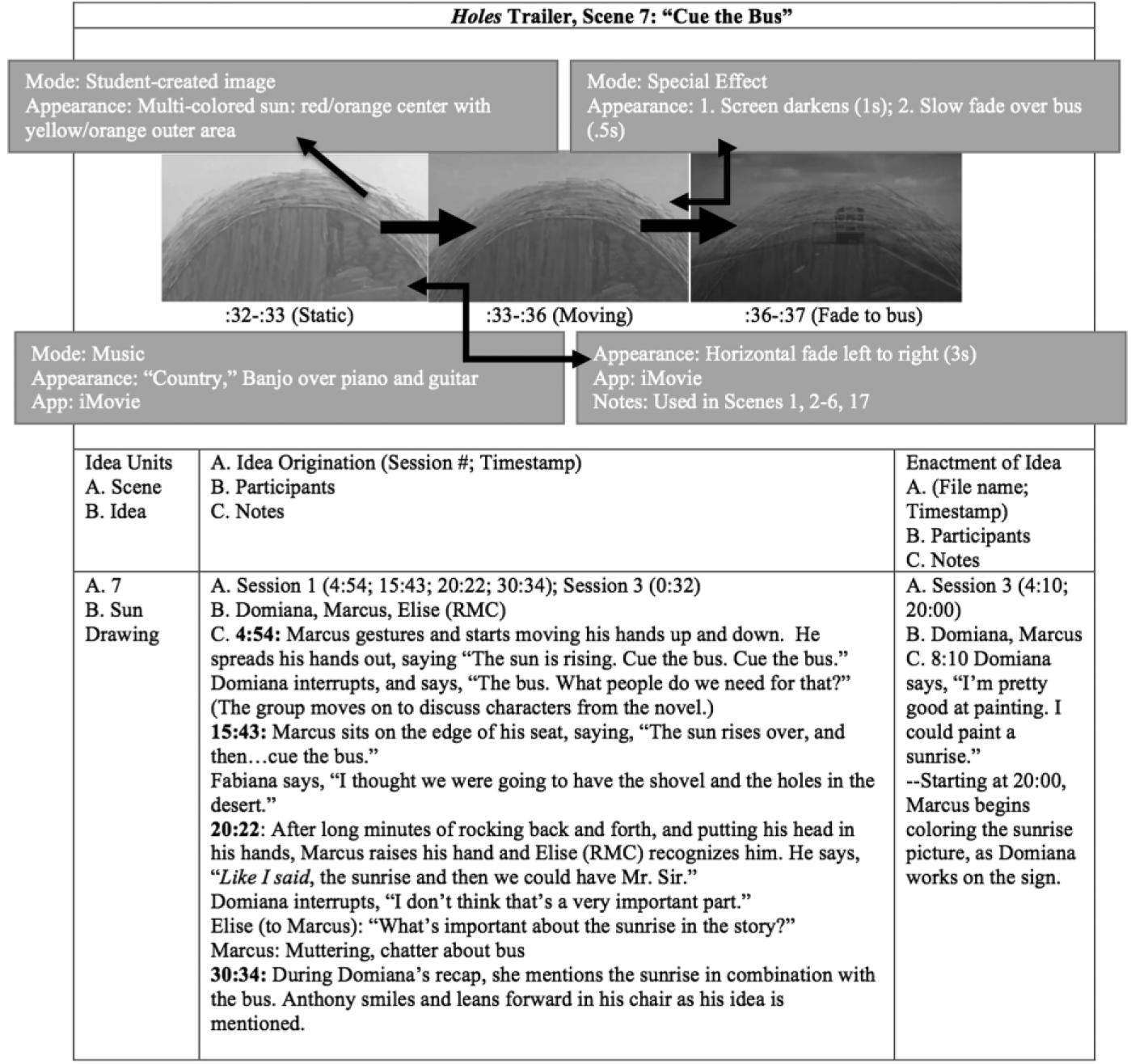
Excerpt from multimodal transcript with idea tracing.
This scene began as a point of contention between the two focal participants, Domiana and Marcus, which we express in our analysis. Although Marcus’s vision for the trailer includes a cinematic version of a sun appearing on the horizon, Domiana originally dismisses the idea as “unimportant” because “it’s not a big part in the book.” Idea tracing to this event allowed us to identify felt focal moments wherein we, the researchers, felt tensions in our own bodies. These perceived affective intensities registered across students’ bodies as they debated conflicting visions; for example, during this debate, Marcus suddenly rose from his seat, excitedly gesticulating, wanting to speak but waiting for his turn to talk. As other students debated the importance of various characters within the novel, Marcus had a vision that he only elucidated after many minutes of growing frustration: “The sun is rising. Cue the bus. Cue the bus.” As researchers in-the-moment, we felt this affective intensity, sensing Marcus’s frustration with the book trailer discussion and the direction in which the project was heading. This is a felt focal moment in which agency is co-constituted, unevenly distributed, and affects textual production—the researchers sensing Marcus’s frustration of not being heard (or seen, or felt); Marcus recognizing his lack of voice.
Having identified such felt focal moments, we then analyzed anew how these moments (a) emerged and (b) affected the trajectories of both the book trailer and the entangled agencies of bodies-materials within and across settings. We questioned the catalysts for the felt focal moments. How did, for example, voices echoing throughout the auditorium space, the circular arrangement of bodies-materials, the circulating clipboard, and much more become entangled in this moment to affect these intensities across these bodies-materials thereby forming this idea while excluding those ideas, if only for a moment? Analyzing such entanglements, such moments, we therefore illuminate how matter comes to matter in the enactment of agencies, boundaries, and exclusions from moment to moment, place to place. We express three such analyses below, immediately after thick descriptions of ideas-taking-form across three settings: an auditorium, a stairwell, and an athletic field.
Entangling Agencies and Enactments of Boundaries and Exclusions: A Digital Book Trailer Emerging in Intra-Action
We begin with a brief description of the discursive-material environment of the Heritage Middle auditorium, the base for students’ production sessions. This description focuses on the first session during which students were introduced to the book trailer genre and began production planning. Following, we express our analysis in three main sections. In the section, “Ideas and Agencies Emerging in the Auditorium Circle,” we describe the initial planning session within the auditorium, illuminating how movements and circulations of bodies-materials enacted boundaries of idea formation excluding text-based ideas. This emergent exclusion limited potentials for one student’s “media” vision to take form. Furthermore, we illustrate the discursive-material effects of this exclusion, expressing the affective intensities felt across ourselves, students, and RMCs.
In the sections “Agencies Entangling in the Stairwell” and “Intra-Action in the Sports Field,” we move alongside our participants, following them as their digital book trailer takes form in other locations: first in a stairwell and then in the school athletic field. In these sections, we show how bodies-materials’ movements through differently felt entanglements outside of the auditorium generated potentials for alternative ideas to take form. These more media-like ideas emerged in experiences that affected capacities for students to move and make differently than while seated inside the auditorium. Within sections, we organize our analysis by (a) providing thick description of discursive-material entanglements during bodies-materials’ negotiations and enactments of ideas, (b) identifying a felt focal moment, and (c) microanalyzing how ideas and agencies emerged and enacted boundaries and exclusions while bodies-materials moved and made.
Discursive-Material Context of Heritage Middle Auditorium on Day 1
The RMCs, Ginny and Elise, met with their students for the first time in the school’s auditorium, which houses a stage and stadium-like seating with long, mounted tables running the length of each row. Free-standing, metal chairs were tucked under the tables. The fluorescent lighting was harsh and the whistling of a loud, centrally located ceiling fan carried to the far corners of the auditorium. Ginny and Elise selected chairs and arranged them in a circle. As the students filed into the room, they took their seats in the circle; Elise and Ginny sat apart from one another. The seating arrangement prompted certain actions, such as turning toward the speaker, taking turns, and raising hands. Meanwhile, the fan’s loud whistling interfered with conversation, causing listeners to lean forward and pull their chairs in evermore tightly to hear one another. Thus, as we turn to our analysis, we forefront the various bodies-materials moving in intra-activity: chairs, sounds, and arrangements all matter to what this experience of planning the digital book trailer feels like. As we proceed, we follow discursive-material entanglements among these intra-actors as they thread their way into other spaces, other intra-actions—meanwhile drawing and re-drawing boundaries and exclusions that affect becoming agencies and ideas.
Ideas and Agencies Emerging in the Auditorium Circle
“Like in the book. . .”: Paperbacks-bodies-sounds-chairs modulating intensities of text-based boundaries
The initial planning session begins with an RMC-posed question: “What is the purpose of a digital book trailer?” Domiana immediately responds, stating loudly and clearly that book trailers are created to “get the audience to read the book,” a definition that remains unquestioned by the RMCs and students alike. It is quickly decided that students will create a digital book trailer based on Louis Sachar’s Holes, a novel all students had read in English class. Sensing that the book-as-text—its literary content—is central to the project as a whole, Domiana then uses specific events from the text, direct quotations, and even the book-as-thing—the one paperback copy present in the circle—to validate or discredit her ideas and the ideas of others.
Domiana uses the text as a way of gaining leverage for her ideas. Throughout the session, she repeatedly refers to the book-as-text to specify the contents of a particular scene, wielding the book-as-thing to embody the authority of her words. For example, as the students discuss ideas for portraying key plot points in an effort to entice viewers to read the book, Domiana suggests,
I think we should do . . . there’s a part in the book with the two boys. I think we should do some acting and use the narration of the book. If I had the book with me, I would be able to show you.
One of the RMCs then hands her the paperback, and after flipping through it for about a minute, Domiana leans forward on the edge of her seat and attempts to gain the attention of the group by raising her hand. She conspicuously flips the pages again, and the response from the other members of the group is immediate—both RMCs and all students—save Marcus—instantly direct their eyes toward the book-as-thing (Figure 2). The ceiling fan muffles Domiana’s voice, and as the participants lean forward, gazing at the paperback, her words take on an intense presence, a heft that is louder, and heavier, than the immediate resonance of their soft sound. The book-as-thing is attuning bodies in the circle to its emerging affective heft.
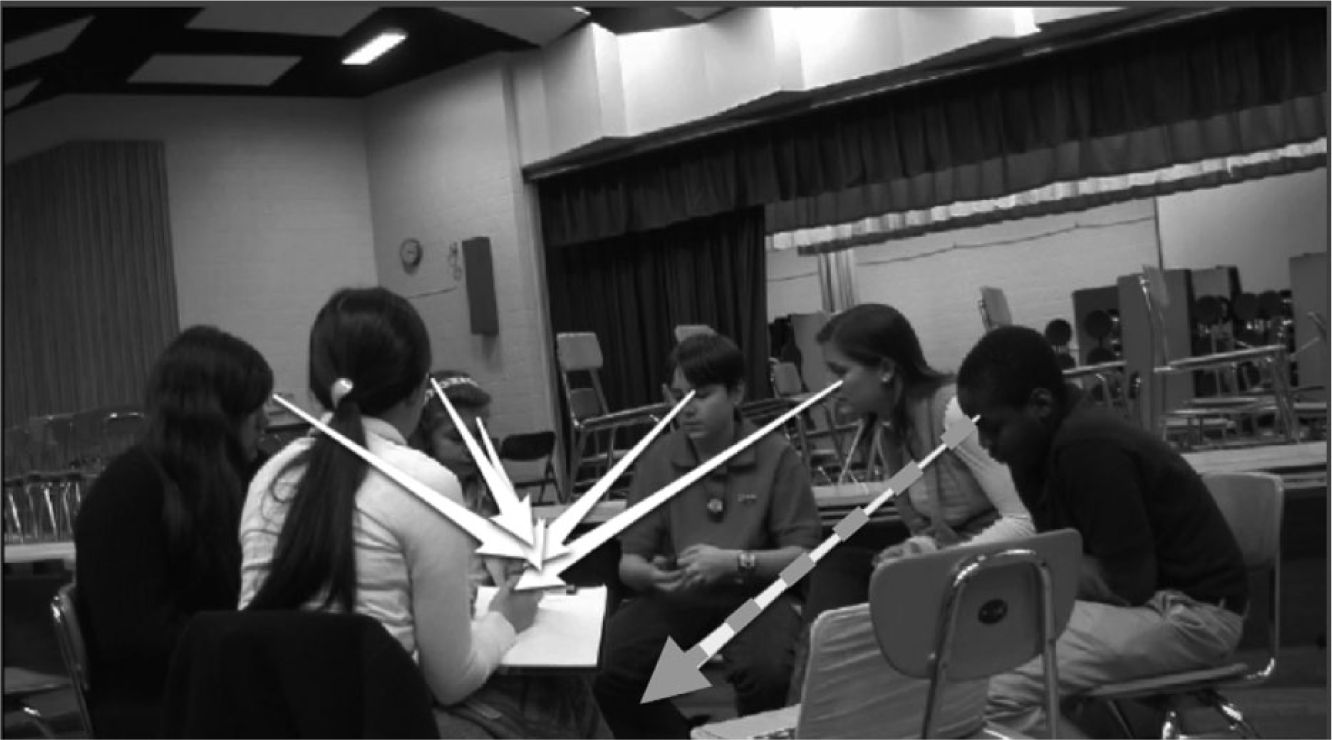
The book-as-thing attracts gazes (save Marcus’s) and affects postures.
At this early juncture, Marcus already seems frustrated. He has an idea, but he doesn’t hold the book—in either of its discursive-materialities. When he starts to speak, Domiana glances quickly at him, then quicker still down at the book before hastily reading a quote that justifies her literal rendering of the scene for the trailer. As a result, the group focuses on how to depict what they discern as a key event: Stanley’s, the protagonist, transition to Camp Greenlake, a prison camp. As they bandy ideas, Domiana begins dictating scene content:
Elise: How are we going to show that? [The protagonist’s transition to Camp Greenlake] Domiana: Then we could go ahead and skip all the way to the bus. Marcus: Or the courtroom. Domiana: Or the courtroom. We could have them saying, like in the book, saying, “I don’t know what kind of person would take the shoes.” And then show him on the bus. And then maybe we could show quotations marks and it will say, “Now you get to choose, Stanley. Camp Greenlake or jail.”
Intensities accrue and become in Marcus’s frustration. Domiana co-opts his idea, giving it credence in tandem with book-as-thing and book-as-text. She again overtly flips pages and leans forward while holding the book in her lap, reading silently and calculatedly. She reads her quotation aloud, explaining how the scene could be “like in the book,” stating that the book trailer could even quote the passage directly. Domiana further suggests that the trailer, like a print book report, “could show quotation marks.” This instance evokes many more throughout the session during which the book-as-thing draws attention to her contributions; she flips pages, waves it in the air, and conspicuously hands it to the RMCs and to other students. In each of these instances, frustration manifests in Marcus’s movements (Figures 3a to 3f).
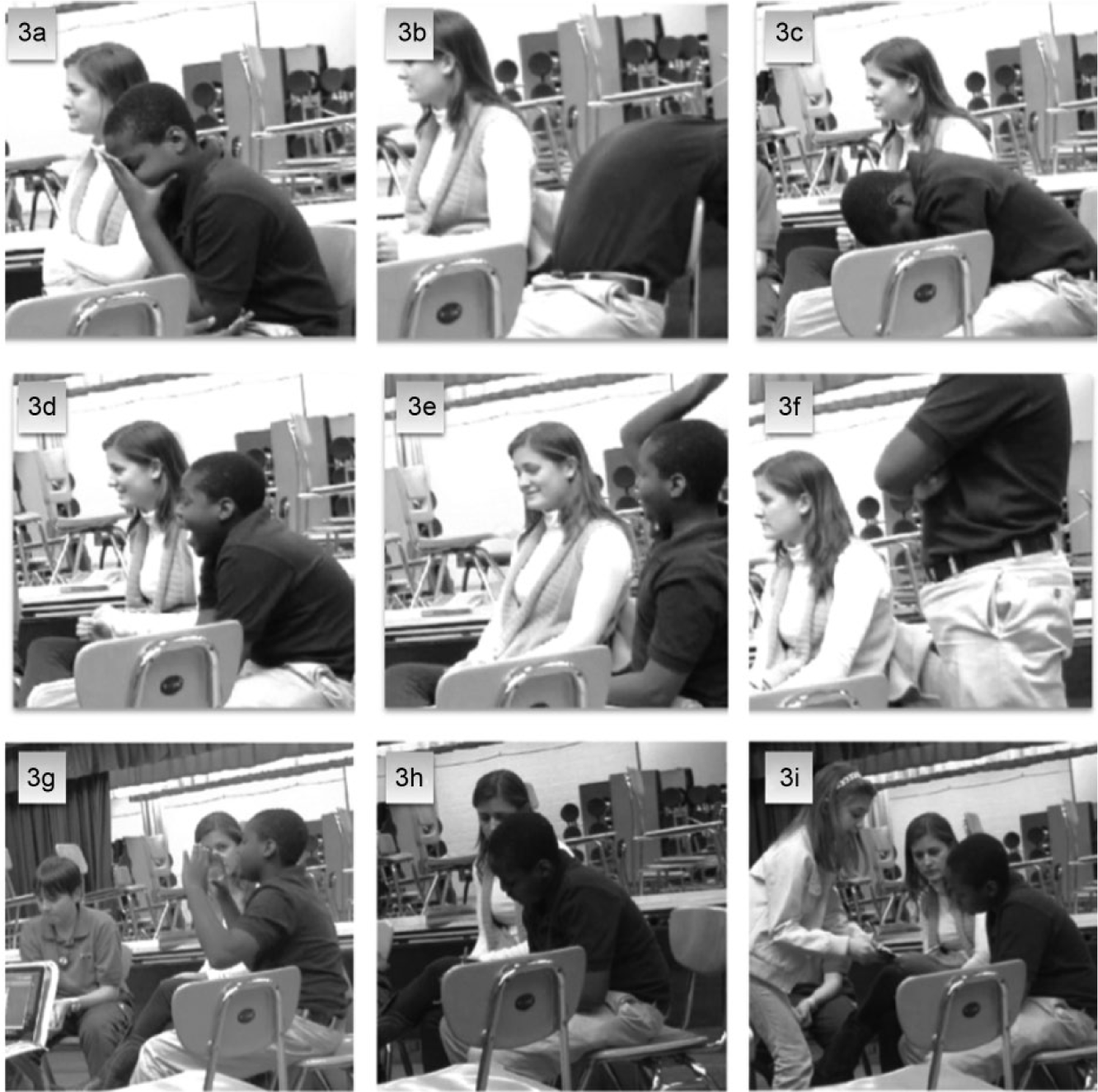
Figures 3a to 3f depict Marcus’s embodied responses. Figure 3g depicts Marcus gesturing like a film director, while saying, “Cue the bus.” Figures 3h and 3i depict the sequence of action during which Marcus draws his media-vision on a clipboard and Domiana grabs it from him.
These frustrating intensities crescendo when Marcus finally stands up, without the paperback—which Domiana is holding—and asserts his idea for Stanley’s transition scene: a sunrise over Camp Greenlake. When he fails to capture the group’s attention with his movements alone, Domiana leans back in her chair, closes her book, and “recognizes” Marcus’s contribution by pointing to him. Marcus fumbles to express the idea verbally; he moves his hands in front of his face, embodying a film director saying, “The sun is rising. Cue the bus. Cue the bus” (Figure 3g). Domiana responds first:
Domiana: No, because I don’t think that’s a very important part. Elise: Which part? Marcus: It’s like sunrise, the bus . . . Elise: What’s important about the sunrise in the story? Marcus: It’s like that thing, it’s like, you know like it’s a trailer, then you have the bus, and then you see the sun.
Marcus’s idea for the scene to be “like it’s a trailer” is subordinate to ideas that are more “like in the book.” Still feeling intensely for his vision, however, Marcus attempts to show it using paper and pen on a clipboard (Figure 3h). When Domiana sees that the clipboard has attracted the attention of others in the group, she stands up, crosses the circle, and takes the clipboard from Marcus’s hands to connect the drawing back to a scene in the book-as-text (Figure 3i).
Analysis of felt focal moment
The researchers and RMCs all felt the moment that Marcus stood up to gain attention. It was an accrual of other entanglements, moments of boundaries becoming, exclusions inscribing, when Marcus’s body took frustrated interest waiting to be heard, not being heard (Figures 3a to 3f). As researchers and as mentors to the RMCs, we also felt this accrual: in our awkwardness, our nervousness, our hesitancy to intervene because we wanted these intensities to move the RMCs without our interference. This made the felt focal moment all the more intense. Motioning histrionically while attempting to verbalize his idea for the sunrise scene, Marcus used the iconic gestures and words of a film director to impart his idea in a manner more media-like than the ways in which others had expressed their own ideas. He felt passionate, and we felt relieved, until our stomachs sunk when Domiana responded to the clipboard, taking both it and momentary control of Marcus’s idea.
The clipboard participated in the boundary drawing, limiting potentials for media-like ideas to form. Its capacity to move Domiana toward it accrued while this meshwork cultivated text-based ideas as forceful. It imbued those ideas with discursive-material intensity that augmented their capacities to move bodies and diminished the felt-potential of media-based ideas. Assemblages and arrangements of bodies-materials-sound-chairs, text-based ideas, and, indeed, books-as-things, affected a boundary drawing exclusionary of more media-like ideas, a boundary drawing that diminished the potentials and intensities of more media-like ideas. Understanding this session as a form-taking intra-action reveals how some ideas have potential, how they take form easily while others struggle to emerge. The ideas that took form and moved toward the eventual trailer were not just determined by what semiotic resources were available to students and how they learned (or did not learn) to orchestrate them: Ideas took form in a meshwork that itself was taking form as a mold—as if to a brick—fitting print-based ideas better than media-like ideas. This meshwork formed reciprocally with how bodies-materials felt, moved, and affected agencies.
For example, leading up to this felt focal moment, chairs—their height and arrangement—compelled bodies to lean in to hear over the fan. At the moment that Domiana first felt the book-as-thing was affecting what ideas took form, all eyes, save for Marcus’s, moved to the paperback, not to her, as she expressed her idea being “like in the book.” When Marcus starts to speak, Domiana glances quickly at him, then quicker still down at the book, following the book’s cue in amplifying her text-based idea’s importance. She again overtly flips the pages, affecting bodies’ gazes and forcing them to lean forward by holding the book-as-thing in her lap and reading quietly.
Later, after he stands to gain attention, Marcus decides to sit—composing himself before he affects his media-vision with directorial gestures and phrases: “Cue the bus”; “like in a trailer.” He draws his media-like idea, and, as the intensity of the idea develops and gains the gazes of other bodies on the clipboard, Domiana tries to co-opt Marcus’s idea. The clipboard moves her just as other bodies-materials were moved to the book-as-thing. These moves dampen Marcus’s intensely felt and frustratingly expressed idea. Indeed, his idea for Stanley’s transition scene did not take form further until Domiana moved toward him, took the clipboard, and began writing underneath his drawing.
Marcus’s assessment of the planning session—offered during an interview—echoes many of the tensions that we felt in the moment, especially as Domiana took the clipboard: “Domiana—she tried to control everything. Like, every time any of us had an idea . . . she would take it away from us and make it exactly the way she wanted it.” The idea, like the clipboard, is something that can be “taken” in discursive-material relations, formed differently. For Marcus, ideas have the feeling of materiality in this process of making a digital book trailer, a feeling intensified in the process of imagining the potentials of words for expression in digital video. Marcus feels the ideas that he draws and gesticulates—ideas that Domiana often carried away.
But for Domiana, the ideas did not leave the book-as-text in the planning session. In her interview, when she claims credit for a specific idea—for example, the use of direct quotes for the courtroom scene—the book-as-text continues to carry weight in her perception of others’ responses: “Everyone thought it was a really good idea as that was a main part in the book.” The book-as-text feels comfortable, the literary-feeling language providing an anchor that Marcus’s weakly verbalized ideas do not. Indeed, Domiana’s reflections imply her interpretation of Marcus as instigating tensions that led away from her anchoring. In her mind, Marcus was the one who tried to “control everything.” As she said, “He thought that he could be the main role, and he could be, like, ‘I’m the best and stuff like that.’”
Through these felt entanglements we, as analysts, came to know how affective intensities are co-produced in material environments and how the augmenting and dampening of intensities affect new media making as a form-taking activity. Specifically, we came to know how boundaries emerge in the intra-action of fans-chairs-bodies-paperbacks, generating more potential for text-based ideas to take form and excluding more media-based ideas. The book-as-thing reciprocally shapes the book-as-text’s increasing agency in intra-action. The book is agentive in its ability to affect, both in its materiality—book-as-thing—and its content—book-as-text. The arrangement of bodies-materials in this circle, in this auditorium, with these sounds, and these movements affects intensities that draw boundaries that privilege print-based ideas and exclude Marcus’s becoming, media-like discursive-material potential—even when making new media.
Agencies Entangling in the Stairwell
In the sections “Agencies Entangling in the Stairwell” and “Intra-Action in the Sports Field,” we analyze the intra-action surrounding felt focal moments outside of the auditorium. In the section, “Agencies Entangling in the Stairwell,” participants filmed a pair of shoes hitting the protagonist on the head. We show the ways bodies-materials-texts-spaces are productive of becoming agencies throughout an emerging soundscape, or the mixture of sounds that arise within the stairwell. Specifically, we describe how these becoming agencies mold emerging meshworks that allow for more media-like ideas to take form.
“Like in a trailer”: An enmeshing stairwell soundscape
In the novel Holes, the main character, Stanley, is wrongfully accused of, and sentenced for, stealing a pair of sneakers. According to Stanley, the shoes “fell from the sky” when he was walking home after school. Because he believes the shoes falling from the sky to be a sign, Stanley picks them up and runs home with them. On the way, a police officer stops him and says “that the sneakers had been stolen from a display at the homeless shelter” (p. 24). This critical moment catalyzes the events that take Stanley to prison, where he is forced to dig holes. The students felt that this critical moment was essential for their trailer.
Thus, on the third day of production, Ginny, Marcus, and Domiana set out to film the scene in which the shoes fall and hit Stanley on the head. Elise had brought what Domiana called “the perfect sneakers.” Marcus, gearing up for his role, quips, “Oh! Can I throw them at you?” The group decides that Domiana will play the role of Stanley, Marcus will drop the shoes, and Ginny will record the scene. As they prepare to film, Elise mentions a potential setting, the stairwell. Excited to leave the auditorium and venture through the school while others were in class, Marcus, Domiana, and Ginny go in search of a suitable stairwell. After examining several options, the group determines that the one in the sixth-grade wing would be best: its overlook signals that Marcus could drop the shoes off-camera and that it would not be readily identifiable as a “school” stairwell.
Marcus climbs the stairs quickly, readying himself to drop the sneakers on Domiana; Ginny positions herself to record the moment. While Ginny and Domiana discuss the appropriate angle to capture the shot, Marcus smiles and whispers to passersby, “I’m throwing shoes around here.” After a quick countdown, Ginny taps record, Domiana begins walking up the stairs, and Marcus drops the shoes. The stairwell bellows with a loud smack, Domiana yells in (fake) pain, and Marcus, realizing they have not achieved the desired shot, calls for “take two” while clapping his hands as if he holds a director’s slate.
Analysis of felt focal moment
The initial “shoe dropping” moment, illustrates a complex entanglement of agencies among bodies-materials: shoes smack, Marcus’s ideas-potentials intensify, and Ginny and Domiana’s ideas-potentials-capacities cascade. Ideas, somewhat abstract until this point, begin to take a more material form, although nebulously. The group continues to refine the scene through multiple takes. The emerging soundscape affects how entangling agencies produce boundaries, forming molds apt for media-like ideas. Throughout these moments, agencies ebb and flow with more indeterminacy than in the auditorium. Marcus’s agency builds as he begins to drop the shoes, and amplifies as sounds reverberate throughout the stairwell (Figure 4a). The emerging soundscape—shoes hitting tile, Domiana-as-Stanley yelping in pain, the group laughing—energizes him. Marcus expresses this intensity as he moves and speaks quickly and excitedly while others defer to his direction. His movements and the emerging soundscape entice students outside of the group, who are roaming the halls, to stop and watch. Their illicit presence (they should be going back to class) further energizes his performance. The affective intensities modulating this moment are not indicative simply of interaction between Marcus and the onlookers; rather, they are emergent from the intra-action of sneakers smacking + stairwell echoing + bodies feeling and sensing these vibrations, the noisy meshwork of which energizes and intensifies how Marcus and onlookers feel the textures of this social experience. These intensities are evident in how bodies move, giggle, cringe, and hunch sneakily in this becoming-boisterous soundscape.
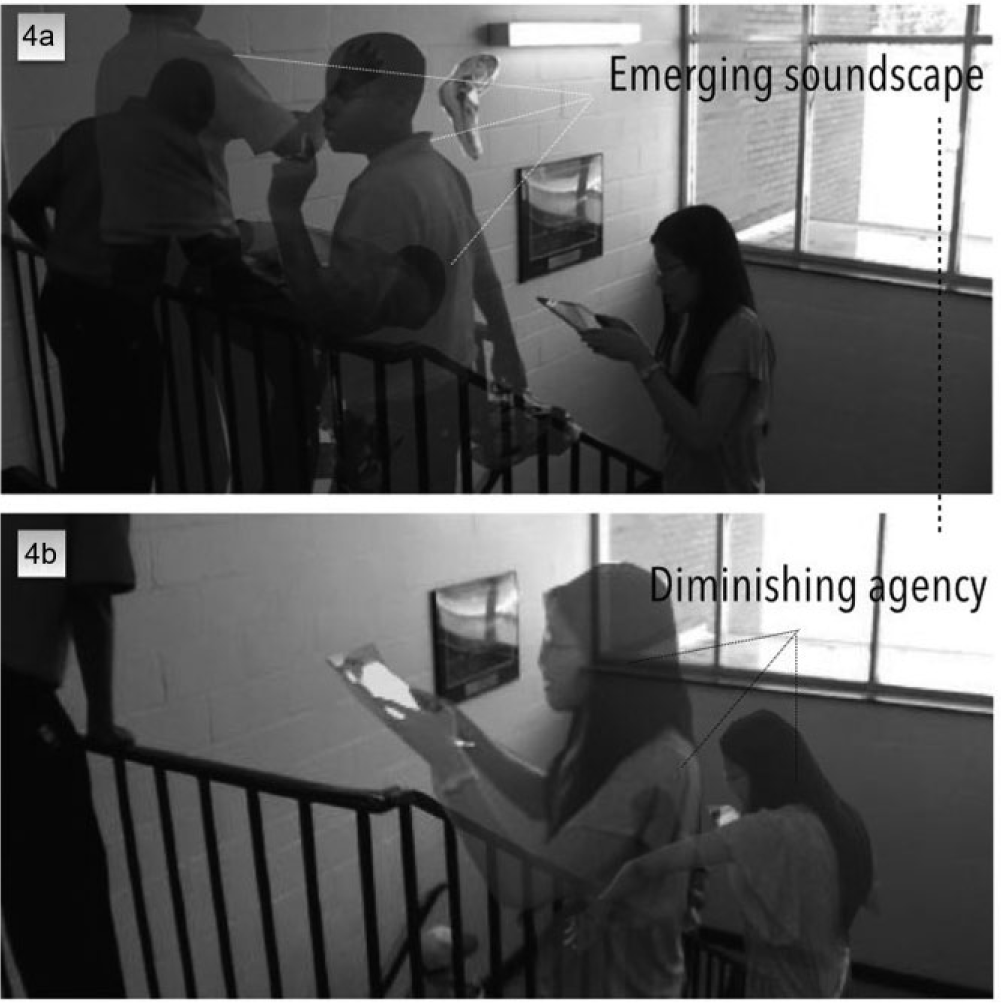
Transparent images of bodies are layered onto the setting to illustrate some of the movements that surrounded the felt focal moment. In Figure 4a, the soundscape is emerging. In Figure 4b, Ginny’s agency is diminishing in the soundscape.
In this momentary meshwork, Marcus’s agency emanates most intensely. His capacity to act is amplified through his expressions to onlookers; Marcus performs, playing the role of the cool guy and the iconic film director. No longer confined in the auditorium planning circle, Marcus’s directorial vision becomes more assertive as he calls for “take two,” loudly clapping his hands and asking his audience to “quiet down” during filming. Ginny, trying to juggle both the recording and the subsequent discussion about the second take, appeases Marcus and allows another student to observe their filming. Ginny’s agency, at this moment, diminishes. Domiana runs up the stairs, maintaining book-as-text verisimilitude to her character who, she says, “thought [getting hit with the shoes] was a miracle and started to run.” Domiana’s agency, at this moment, transforms in tandem with the book-as-text, which does not imbue her with the same capacity to act that it did in the auditorium, though she clings to it quietly.
But this agentive procession is more than human. The shoes, for instance, not only provide Marcus with the important role of dropping them, but they also enable him to take part in shaping the emerging soundscape in the stairwell. Upon falling and hitting the tiled floor, the echo from the rubber-soled shoes draws in the passersby, one of whom stops to watch (and hear) the action. After a take, he crowds around the iPad with Marcus and Domiana, his excitement becoming a part of the meshwork. Marcus feeds off this energy, becoming more boisterous—and yet more like a director. He directs Domiana back down the stairs, telling her that he and Ginny will yell “action” when they are ready. As a result, Marcus’s cinematic visions—dismissed in the auditorium—begin to take form. He calls for Domiana to go up the stairs in a certain way, at a certain speed. She obliges. The intra-action, intensified most acutely by the emerging soundscape, affects the movements of bodies-materials up and down the stairs—it generates noise; it attracts human bodies; it gathers potential for media-like visions to take form. In other words, this enmeshed intra-activity provides a better mold for Marcus’s media-vision to emerge and, at least momentarily, augments his becoming agency as new media maker.
As media making in the stairwell moves on, sound continues to be the primary conduit through which agency ebbs and flows. After the second take—and another miss with the shoes—Domiana tries to throw the shoes back up to Marcus. The throw is off, the shoes fly up against the wall, a loud smack follows once again and Domiana squeals. The shoes mobilize Ginny, now more aware of the noise surrounding this production. She leaves her post as camera operator, walking down the stairs to take—or rather demand—the shoes from Domiana and deliver them to Marcus (Figure 4b). Suddenly, Ginny grows flustered by the noise in the stairwell and by the observers who are now accumulating and, when asked if they should be in class, claim, “It’s okay, this is our free time.” Establishing a firmer presence, Ginny steps in to manage the scene, telling Marcus and Domiana that no one can talk when they are filming—overtly working to control the soundscape.
The discursive-materiality of the stairwell is an important part of this meshwork too, especially in producing the becoming soundscape. The stairwell is liminal, away from classrooms and well-traveled lines of movement by teachers and students. There is an element of freedom that comes with being off the grid. This freedom affects bodies-materials, including noticeably increasing the volume of voices. Moreover, spikes in sound—echoes, laughter, shrieks—re-calibrate Ginny’s potential as an instructor: She intensifies her attempts at management. The stairwell’s acoustics—and the emerging soundscape—become entangled with both Marcus’s burgeoning capacity to act and his directorial confidence, as well as Ginny’s effort to wrangle discursive-material practices that are quickly becoming unwieldy.
Agency does not exist in someone or something. Agencies are protean and entangled in discursive-material relations of bodies-materials-sounds-stair-shoe. Agencies do not adhere to hierarchical relations of RMC to student to inert old pair of sneakers. In this intra-action, we, as researchers-bodies-materials, did not just watch: We felt-heard the entangling agencies flowing, shifting, and manifesting in Marcus, Domiana, and Ginny’s capacities to act differently in the stairwell than in the auditorium circle. Furthermore, by de-centering the human, and considering all of the intra-actors at work across this scene, from Marcus and Domiana to shoes and sounds, we evince how matter, again, matters. Just as Marcus played with the shoe, the shoe played with Marcus—it smacked the floor, caused laughter, and invited observers. And Marcus responded in kind, further adopting his role as a director in response. In this intra-action, something as simple as a shoe falling in a stairwell modulates the entangling agencies that form ideas, draw boundaries, and exclude, or not, if only in this momentary meshwork of new media making.
Intra-Action in the Sports Field
In-place-affects and enmeshed shovel-bodies-dirt-sunlight in the sports field
Having filmed the shoe drop scene, the crew (now consisting of Marcus, Ginny, Domiana, and Ciera) moved outside to the sports field adjacent to the school, hoping to find a suitable spot to film Stanley digging holes at the prison camp. In the following section, we show how the in-place-affects, the intensities of bodies and materials moving each other in dynamic specificity with this place, not only modulate agencies but also generate meaning and give form to media-visions.
As the crew moves outside to the field, Marcus sings, repeatedly, “on the road again . . . !” and hops along in front of the group. Domiana, wearing a ball cap and orange crossing guard vest meant to evoke a prison uniform, lingers behind with Ginny to show her how the scene they are about to film matches a passage in the paperback copy of Holes. Ciera tries to grab the shovel from Ginny but is unsuccessful and as a result, she trails behind the group. Marcus runs outside first, beyond the view of researchers’ cameras and the group, returning just as the rest of the crew exits the building. Marcus runs to Ginny, takes the shovel she has been carrying, and plants it in a location close to the pavement and in earshot of another class outside for recess.
Domiana grabs the shovel while Marcus is still holding it, both of their hands grasping it momentarily before Domiana jerks it away and runs forward to a new location. The field is patchy: spots of green grass brindled with balder, browner swaths of sandy soil. Domiana sticks the shovel in a sandy area; Ginny worries that they may be digging too close to the school, where it could be dangerous for children and unsightly for adults. The crew moves forward to follow Domiana, who now holds the shovel, and Marcus points into the distance at a spot close to the tree line. Domiana, seeing Marcus point, almost immediately sticks the shovel in place in front of her, declaring this the right place to film. Marcus turns, takes the shovel, and keeps moving forward. He plants the shovel again, Domiana takes it and starts digging, and Marcus declares that he will “keep scouting” and runs ahead toward the tree line he had pointed toward previously.
Domiana starts to dig again, but the ground pushes back: It is sinewy, tough, and she cannot get the shovel in. Ginny takes the shovel, sets it down, and the crew runs toward Marcus, who is now about 50 yards away at the tree line. The crew congregates around Marcus, who informs them, “the teachers don’t let the students here.” Having just had difficulty digging in a grassy spot, Domiana implores the group to find a dryer, sandier patch. Ignoring her, Marcus and Ciera walk along the tree line, out of the sun and into the shade. Domiana follows but complains, “It’s too shady. It’s good for a picnic, but we’re not here to have a picnic.” Ginny, tired of wandering and indecisiveness, directs the group back to the original sandy patch, and the students run toward it, Marcus yelling, “Woohoo!”
Marcus runs forward to pick up the shovel from the sunny, sandy spot. He grabs it, and plants it in the sand. After he begins digging, Domiana gently takes the shovel and continues working on the hole—This sandy soil allows for easier shoveling. Ciera grabs the shovel and playfully flings dirt onto Domiana, gently grazing her with the shovel. “Oh my God!” she cries, dropping the shovel, covering her mouth, and slinking away from the action. “It’s okay, it’s okay,” Domiana reassures her. Ginny attempts to remind Domiana and Marcus, who remain transfixed on digging, what they wanted to convey in the scene. They ignore her, and Marcus plays with the dirt, joking that Domiana needs to look dirtier as he tosses dirt toward her denim-covered knees. Domiana giggles and drops the shovel, “No . . . I’m good without getting dirty.” Ginny continues to prompt with the book-as-text, clearly growing frustrated with Marcus and Domiana’s inattention. Marcus picks up the shovel, and now digs rhythmically in the sand. One scoop: shovel swishes into dirt, dirt swishes to the side. Another scoop: shovel swishes into dirt, dirt swishes to the side. Four scoops, and then Domiana takes a turn, mimicking Marcus’s rhythm.
When Marcus moves back to the hole and attempts to take the shovel again, Domiana resists. As he begins his reply to Ginny, Marcus watches Domiana and has an idea:
Marcus: We can dig the hole deep and then show a picture of him going like that [pivots his upper body as if shoveling dirt over his right shoulder]. Domiana: Oh yeah, and then the dirt and when we lift [the shovel] up [swings forearm up toward her shoulder] it’s going to say “Holes” remember? Marcus: [grabs for the shovel again]. Ginny: You guys have to be careful. Domiana: No I’m Stanley I have to dig [pushes Marcus away]. Marcus: [throws hands up in response to Ginny-Domiana] No, but it sounds like a video, like a picture.
As Marcus describes the media-like quality of the moving-shovel-Holes idea, Domiana swings the shovel up in another scooping motion and, completely by accident, narrowly misses Marcus’s face. Ginny grabs Marcus’s shirt, pulling him away. Domiana continues digging, and Marcus continues moving. He quickly embodies another media-vision, this time with an imaginary shovel in hand: “Or! Or, we could just go like this . . .” He takes a step forward with his right foot, pretends to plant the shovel in front of him, and makes a swishing sound as the imaginary-material shovel grinds through the dirt. He continues the swish sound as his hands move away from the imaginary-material shovel handle and up toward his face, where he spreads his palms outward and says with extended breath . . . “Holes.”
Analysis of felt focal moment
Intensities of playfulness, excitement, and nervousness accrue and flow through this felt focal moment when Domiana nearly hits Marcus in the face with the shovel. Agency ebbs and flows among the shovel, dirt, Ciera, Ginny, Marcus, Domiana, the book-as-text, and so forth. Ginny, as she did in the stairwell, feels nervous about the students’ amplifying energy, and she is clearly and understandably concerned about free-flying shovels. Playful imaginings, tossing dirt, and running from place to place all diminish the book-as-text’s agency. Marcus’s agency, and his media-visions, reach a crescendo as the intra-action of shovels-arms-heavy dirt (re)affect media-visions: a moving shovel with a “Holes” graphic. Agency is protean as students’ bodies move from (a) place to place in field, and (b) within filming locations (Figure 5). These movements accrue in intensity toward the moment in which media-visions take form.
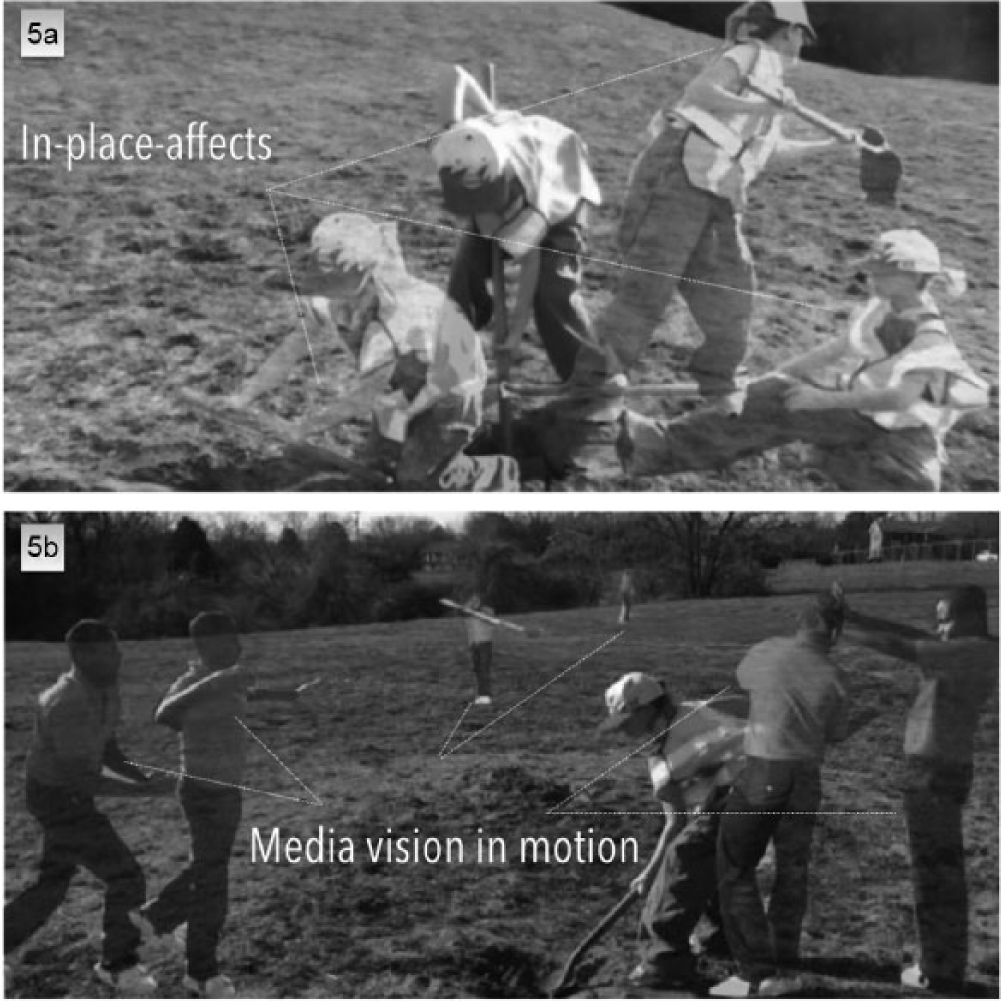
In Figure 5a, Domiana digs and falls. Figure 5b depicts Marcus’s movements within and across filming locations, from the tree line to final location, as his media-vision takes form.
Moving from place to place across the field, students felt specific in-place-affects of sunlight and grass. Unlike the scene in the stairwell, criteria for a filming location were not set a priori. Students moved freely about the field and felt out locations. At first, the students were afraid that they were too close to the school for digging, and when they moved toward the tree line they felt the imaginary boundary of being where “teachers don’t let kids go.” This historical, discursive-material becoming of boundaries differed from both the immediate in-place-affect of afternoon sunlight on (and not on) the grass, and the resistance of dirt in the grassy patches. These in-place-affects of, for instance, the shovel struggling through sinewy earth moved bodies within and across places as students felt, sensed, and saw. Moving and feeling within and across settings, their bodies became attuned to what encountering the right place would feel like. Affects accrued in becoming new media making sensibilities. Becoming boundaries now productively excluded what would not fit the trailer as it was taking form.
Students’ movements from location to location evince a process of becoming increasingly attuned to in-place-affects, where enmeshed bodies-materials become the locus of idea generation. The movement of the Marcus-shovel-dirt assemblage in this felt focal moment re-affects a media-vision Marcus had during the planning session (for the word “Holes” to appear over the moving shovel at the end of the trailer). Movie trailers, a genre where titles usually appear in the penultimate frame, animate in Marcus’s becoming media-vision as part of the discursive-material assemblage. The movement of the Marcus-shovel-dirt assemblage, the felt weight of dirt pushing back against shovel head as it moves over his shoulder, re-affects the idea from the planning session. This idea gains traction, intensity, in the moment: Domiana takes it up and similarly embodies it in her movements. Marcus, now more intensely agentive, affects a new vision-in-motion as the idea takes form differently with his imaginary-material shovel (Figure 5b). These in-place-affects take to becoming media-visions, like Ingold’s clay to the mold and the mold to the clay, just as the emerging meshwork in the stairwell becomes a better “mold” for media-visions than the auditorium circle.
In-place-affects also move Domiana toward the book-as-text differently than in the planning circle. Domiana struggles to remove dirt from the hole, which is growing deeper. The weight of the dirt comes more strongly into play, and she falls backward, landing on her backside when she tries to fling dirt over her shoulder. “It’s like Stanley in the book,” she exclaims, “I need to look like I’m struggling” (Figure 5a). The size of the hole and the weight of the dirt give form to the book-as-text.
Novels like Holes are written from the feeling of being alive, the feeling of having shoveled, the imagining-materiality of dirt-bodies-sunlight-shoveling. The problem with assuming that adolescents work from representations in mind to make representations on screens is that it elides the feeling of dirt, of actually making those representations in discursive-material relations. As Ingold (2013) puts it,
The problem with hylomorphism . . . is that in assuming “a fixed form and matter deemed homogenous” it fails to acknowledge, on the one hand, the variability of matter—its tensions and elasticities, lines of flow and resistances—and on the other hand, the conformations and deformations to which these modulations give rise. (p. 25)
The deeper the hole became, the more connected to Holes, and to Stanley, Domiana became. The movements of dirt-bodies-sunlight-shovels were the conformation of media-visions and the deformation of book-as-text-only ideas. In the intra-activity of making new media, the dirt’s resistance, variability, weight, even its dirtiness when Marcus playfully threatened to toss it on Domiana, enabled ideas to take form, and it generated connections to imagined worlds available only as bodies moved, felt, and made across this meshwork of intra-activity under this afternoon sun. Dirt inserted itself into the digital expression of a print-based story.
Literacy in the Making Matters
Our analysis expresses how new media making is entangled in the unpredictable intra-actions of moving bodies-materials, including chairs, fans, and dirt. Specifically, we have illustrated how the enactment of meanings (i.e., ideas for the trailer), boundaries, and exclusions emerge as agencies entangle from moment to moment, place to place. We have shown, therefore, how a digital book trailer gains a foothold not from representing experiences from the outside but from ideas taking form in intra-activity. This onto-epistemology of discursive-material practices understands experiences of literacy as more than “situated” (cf. Gee, 2014) or even “emplaced” (cf. Fors, Bäckström, & Pink, 2013). We have shown that adolescents’ new media making is not only the result of, for example, situated, tool-mediated action, nor is it only the emplaced product of sensuous intersections of mind-body-environment. New media making, indeed literacy, is also the intra-action of shovel-dirt-Domiana-hole-book-as-text affecting each other reciprocally in the ongoing production of meanings immanent to discursive-material moments. New media making, literacy, cannot be situated because it is always emergent and enmeshed in intra-activity that is continuously situation-making. Literacy is not something that exists outside of its discursive-material mattering (cf. Brandt & Clinton, 2002) but a phenomenon of always moving bodies-materials and the living intensities of making meaning. Literacy experiences, in all their vital materiality, are lived intensely while making meanings immanent to the ongoing flow of experience. These intensities cannot be felt-thought through constructed contexts or mind-body-environment intersections alone. Literacy in the making matters.
In the making, discursive-material practices matter, in part, because they enact boundaries and exclusions that we, as part of the intra-action of making this digital book trailer, came to know through the constant production of affective intensities. For us, the RMCs, and our students, making the digital book trailer was replete with moments of intensity where agencies ebbed and flowed through bodies-materials-space-time. We came to know these encounters through affectively laden experiences of noticing as bodies-materials took interest, that is, as bodies-materials evinced being affected and affecting others. Importantly, and in contrast with methodologies of situatedness and emplacement, we came to know these feelings more deeply in analysis because we approached material things as agentive bodies, as integral intra-actors. The book-as-thing participated intensely in producing power in the planning circle, and we would have missed this all together had we only been interested in, for example, situated discourse structures thought to determine interaction from the outside (cf. Snell, 2013). The book’s production of power, as both thing and text (as discursive-material), was enmeshed in the ongoing production of boundaries that excluded media-like ideas and that dampened Marcus’s becoming agency as a new media maker in this emergent literacy experience.
Encountering literacy in the making is therefore not to ignore power, discourse, culture, or language, but to know them as very real, to know them in all their intensities, and to know them in how they matter. What before has been understood as abstractions outside of experience, must also come to be known in discursive-materialities immanent to literacy experiences. In our analysis, we expressed how discursive-material practices produced affects of exclusion. The drawing of boundaries in this becoming auditorium intra-action produced potentials for text-based power, thereby (re)producing discursive-material histories of what counts in literacy education, namely, the all too common exclusion of multimodal texts (Jewitt, 2008). We came to know, therefore, how such histories are (re)produced immanently in discursive-material practices of boundary drawing. We came to know how those emergent boundaries can exclude what/whose ideas take form, and how those exclusions produce very real embodied affects (see again Figure 3) in experiences of making texts, of texts taking form.
Bringing discourse and power to matter in literacy studies, that is, to meet discourse-materials in their emergent affecting of power, therefore, does not veer toward relativism or chaos. On the implications of agential realism, Barad (2007) argued that
we are responsible for the world of which we are a part, not because it is an arbitrary construction of our choosing but because reality is sedimented out of particular practices that we have a role in shaping and through which we are shaped. (p. 390)
As Barad suggests, agential realism is more than a dissolution of abstracted notions such as context to meet the world in its becoming dynamic specificity. Coming to know literacy in the making means taking responsibility for the moment to moment (re)production of the discursive-material practices through which we, as researchers and educators, take shape, and through which we participate in affecting how youth take shape. As for Ingold’s brickmaker, the molds we participate in shaping as researchers and educators constantly generate boundaries that exclude potentials for ideas, texts, and meanings.
For example, how would bodies-materials arranged not in a traditional literature discussion circle, not in an echoing auditorium, experience the planning process of new media making differently? What if bodies-materials were moving in front of a producer’s idea board as in professional media practice, sketching and drawing as Marcus and the clipboard attempted? How would the meshwork that emerges work reciprocally with ideas to mold a different digital book trailer? Questions such as these suggest a potential shift in approaches to planning literacy learning from outside of experience to an affective becoming from the inside. For instance, considering how educators might mold meshworks for democratic idea generation around new media making involves less pre-planning than in situ attunement to how intensities of idea potential emerge in intra-action. To what extent, if at all, are literacy educators prepared to respond in situ to boundary drawings that can exclude texts and ideas, and dampen becoming agencies?
To what extent are literacy educators prepared to take matter seriously? In the sports field sun-field-dirt-holes entered the intra-action of making the digital book trailer. As the dirt came into play, we understood, as analysts, the enmeshed multisensoriality of production: the soil’s tactile toughness, visible brown patches, moving bodies, and motion of dirt-in-air (re)affecting media-vision. Digital making is never without moving bodies-materials, here moving bodies-shovels-dirt. Participants moved through the field freely, wayfaring, looking for the best place to film their scene, but the “idea” of the best place was not an in-mind-vision, formed before in-field-movements. The scene took form, for example, as they moved the dirt and as the dirt moved them—moving both from patch of earth to patch of earth, and from shovel swing to shovel swing. Attention to the intra-action of moving bodies-places-materials illuminates new media making as a form-taking activity unthinkable through representational logic. Similarly, literacy educators might consider their discursive-material entanglements with students. How are boundaries (re)produced that may exclude movements around sports fields, which may exclude digging the holes of Holes?
This is not to say that more is better—more things, more people, more spaces—but that we must consider the “imagined geographies of learning” (Leander, Phillips, & Taylor, 2010) most readily produced in literacy education. We therefore add a consideration of not only where and when we might expect literacy learning and meaning-making to take place but also a consideration of what entanglings in what discursive-material relations. How do we expect learning and meaning-making to sound? The dissolving of Ginny’s becoming agency and her attempt to regain control are examples: Smacks, echoes, laughter, and shrieks all came part-and-parcel with the move to the stairwell, yet it was once those noises reached a tipping point that Ginny sought to regain control. These enactments have material consequences for soundscape’s potentials to participate in idea formation and meaning-making, in generating energy that can exclude students like Marcus, whose agency often diminished in the auditorium.
Following the lines of these intra-actions and exploring their emergent boundary drawings and exclusions, we have taken the “ethical charge” of agential realism seriously (St. Pierre, 2013, p. 655). Arguing that educational design is “out of time” (Boldt, Lewis, & Leander, 2015), poststructural literacy researchers are exploring not only how matter matters but also how an onto-epistemology compels living and being differently inside of moments. An onto-epistemology means meeting the world in moments of dynamic specificity that matter to who we are becoming, to who we as entangling agencies of researcher-educator-youth are becoming together. Literacy research and education becomes a question, therefore, of how we are continuously generating justice by being in time with others who are an entangled us, not just looking for justice abstractly or deconstructing injustice’s effects. Every moment comes to matter as profoundly producing (or not) potentials for justice. Literacy research, in this sense, can generate potentials for opening education to an entangled we of sorts, wherein every moment is of profound importance because those moments are all that is becoming, and all that is becoming toward the (re)production (or not) of (in)justice. Because “if we see ourselves as always already entangled with, not separate from or superior to matter, our responsibility to being becomes urgent and constant” (St. Pierre, 2013, p. 655). Every pedagogic move draws boundaries with potential exclusions of bodies-materials, texts, ideas, and agencies. And enactments of boundaries and exclusions participate in ongoing discursive-material practices that have the potential to produce histories differently in as yet unimagined futures.
But focusing on pedagogic moves puts too much pressure on, and paradoxically not enough on, the “individual” literacy educator. Barad (2007) argued that
there are no individual agents of change. Responsibility is not ours alone. And yet our responsibility is greater than it would be if it were ours alone. Responsibility entails an ongoing responsiveness to the entanglements of self and other, here and now, now and then. (p. 394)
We suggest an explicit move in literacy research and education that attends to the emergent and entangled “we” of experience as an ethical imperative. This requires not only an onto-epistemology of new media making, which we have advanced in this article, but a continued exploration of the emergent intra-activity of literacy in the making. Situated approaches to literacy elide becoming intensities that matter. In our analysis, we followed lines of movement—falling shoes, echoing laughter, swinging shovels, straining arms—as they became entangled in forming meanings. We traced ideas backward from product not to privilege the product, that is, the digital book trailer, but to explore the ongoing flow of privileging: how ideas, imaginings, and passions were moving toward product while generating boundaries and exclusions. Attending to the matter of literacy is therefore an ethical charge. Attending to the matter of literacy matters for knowing and responding to the ongoing production of intensities-justice-text-self-world that cannot be thought from the outside.
Footnotes
Declaration of Conflicting Interests
The author(s) declared no potential conflicts of interest with respect to the research, authorship, and/or publication of this article.
Funding
The author(s) received no financial support for the research, authorship, and/or publication of this article.