



Abstract
Introduction
Plotosus lineatus, also known as the striped eel-tailed catfish, is a marine catfish easily identifiable with its black and white stripes and 4 pairs of barbels. This beautiful species is capable of inflicting an intensely painful sting caused by heat-labile venom toxins. Its presence has been widely confirmed, particularly in the Indo-Pacific Ocean, but cases of human envenomation are rarely reported in the medical literature.
Methods
In this report, we describe a case series of presumed envenomations by P lineatus registered in the Indian Ocean French territories of Reunion Island and Mayotte Island from 2011 to 2023.
Results
A total of 30 cases were reported, most of which involved males (n=27; 90%). Most stings occurred when fishing (n=22; 73%) and involved the hand (n=29; 97%). All individuals reported pain (100%) that was accompanied by local or extensive swelling in 12 cases (40%). Most cases were of moderate severity (persistent spinal pain syndrome type 2, n=27; 90%). The main treatment involved the use of analgesics (ie, paracetamol, tramadol, or morphine), exposure to hot water or alternating cycle of exposure to hot and cold sources, and local anesthetics. For 10 patients (33%) for whom information was available, there was full recovery within 24 h in most cases (after 7 d in 1 patient) without sequelae.
Conclusion
These findings show that stings by P lineatus may occur in the Mascarene Islands and that fishermen are the most likely to be stung because of handling P lineatus.
Introduction
Catfish (order Siluriformes) are found worldwide. Most are freshwater fish, but some are marine, such as those in the Ariidae and Plotosidae families.1,2 Striped eel-tailed catfish (Plotosus lineatus), identified more than 200 years ago is a marine catfish (family Plotosidae). 3 Of all the species in the Plotosus genus, it seems to be the most widely distributed. P lineatus has been recorded in Japan, South Korea, Ogasawara Islands, Australia, Lord Howe Island, Micronesia, Samoa, East Africa, Madagascar, the Persian Gulf and the Red Sea. 4 New locations in the Mediterranean Sea have been added since the opening of the Suez Canal in 1869. P lineatus is currently considered a Lessepsian species, an invasive species migrating from the Red Sea. The first specimens were found in 2001 along the Israeli coast; then they moved westward. 5 Its occurrence has been reported in Egypt, Lebanon, Syria, Turkey, and Tunisia.4,6 P lineatus is easily identified by its 4 pairs of barbels around the mouth, its elongated shape, and the alternating white and black stripes running its length. Juveniles tend to move in schools or balls of hundreds of individuals, whereas adults tend to move in small groups.7,8 This catfish has 3 erectile spines located at the front of the dorsal fin and at the front of each pectoral fin. Each spine is enveloped in a sheath that contains venom glands. 2 P lineatus secretes 2 types of toxins: plototoxins from the spines and crinotoxins from the epidermis. They have been little studied, but we know that the crinotoxin of P lineatus contains edema-forming and hemolytic factors. 2 In animals, the venom produces swelling, necrosis, and muscle spasms and has neurotoxic effects. It also induces hemolysis and leukopenia. Experimental studies on rodents, crabs, and fish have even shown lethal effects. This venom is also known to be heat labile.2,7,9–12 Envenomated human victims report symptoms characterized by intense throbbing pain with erythema, paresthesia, and numbness that may be accompanied by symptoms such as swelling, cyanosis, or even general signs such as nausea, vomiting, and hypotension.11,13,14 The most severe complications are related to secondary bacterial infection, and some patients remain symptomatic for more than a year after injury.15,16
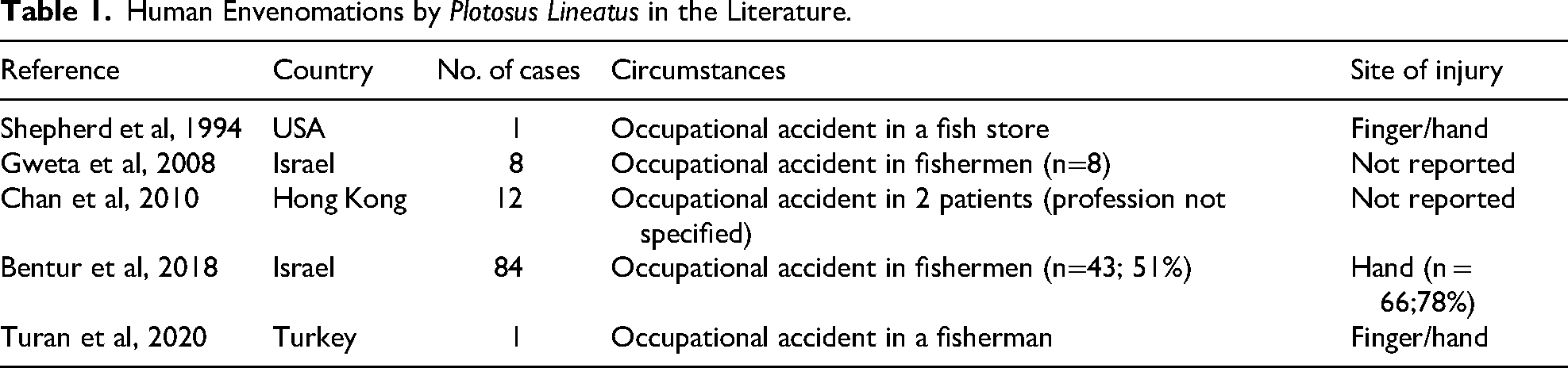
If this catfish is well known, especially in the Indo-Pacific Ocean, only a few publications report human envenomations13,14,16–18 (Table 1). Having found no data on human envenomations by P lineatus in the Indian Ocean, the intent of this investigation was to describe a series of cases of presumed envenomations occurring in the French territorial communities of the Indian Ocean.
Human Envenomations by Plotosus Lineatus in the Literature.
Methods
Case Sources
The cases come from 2 databases: the Poison Control Center in Marseille (PCCM) database and the Indian Ocean Toxicovigilance Department (IOTD) database. The role of PCCM toxicologists is to provide toxicologic advice as part of the telephone emergency response service on any case of poisoning occurring in their area of responsibility. This includes southeastern France, Corsica, and the Indian Ocean. All the exposure cases collected are compiled in the French Poison Control Center Information System. In 2006, a toxicovigilance department was set up specifically for the French overseas territories in the Indian Ocean, based on Reunion Island. Its role is to monitor toxic effects on humans in this geographic area, which also includes Mayotte Island. A database specific to the IOTD also has been set up to record poisoning cases, which comes mainly from hospital data.
Methods
This is a retrospective study of all cases of P lineatus poisoning from these 2 databases since 2002. However, because the first case of envenomation by P lineatus registered in the system was from 2011, the actual period for which envenomations were compiled was from 2011 to 2023. In each case, the fish was easily identified by the patients themselves or their relatives because it was the only black and white-striped venomous fish in the area. A single duplicate was identified between the 2 databases. For each case, the patient's age, sex, circumstances of exposure, body area affected, clinical description, place of care, treatments carried out, and outcome were collected. Severity was assessed according to Poison Severity Score (PSS) criteria, graded into 5 levels: from PSS=0, no symptoms, to PSS=4, fatal issue. 19 The PCCM and IOTD databases are authorized by the French Data Protection Authority (Commission Nationale Informatique et Liberté; Accreditation No. 747735).
Results
A total of 30 cases were recorded (Table 2), the oldest dating back to 2011. There were 4 children and 26 adults. All the envenomations took place on Reunion Island, except for a 13-y-old boy on vacation in Mauritius (Case 9). Most victims were male (n=27; 90%). Most stings occurred when victims were fishing (n=22; 73%), but we do not know whether this was in a professional or private context. The region stung was the hand or finger in 29 cases and the foot in 1 case. Pain reported by the patients was intense in at least 18 cases (60%). It was radiating in 11 cases. There was local or even extensive swelling in 12 cases (40%). Some patients had associated general symptoms such as asthenia, hot flush, headache, sweating, palpitations, and faintness. Most cases were of moderate severity (PSS=2; n=27; 90%). The majority of patients consulted the emergency department (n=27; 90%), 2 patients visited their general practitioner, and 1 patient refused to consult. Most patients were treated with analgesics (n=23; 77%), including 13 with Stage 2 or 3 analgesics. Eight patients were treated with a hot-water immersion, 5 with thermal shock (ie, exposure of the affected limb to alternating heat and cold sources), and 4 with local or locoregional anesthesia. The young patient envenomed in Mauritius, with a history of multiple allergies, was treated with a Seqirus CSL Stonefish Antivenom (made by Seqirus CSL, Maidenhead, UK, for neutralizing envenoming by the Australian stonefish Synanceia trachynis. It is made from horse immunoglobulin G). This treatment was combined with anti-inflammatory agents and amoxicillin. A few hours later, this patient developed an anaphylactic reaction with mottling and dyspnea, which was treated with hydrocortisone and antihistamines. For 10 patients (33%) for whom information was available, there was full recovery within 24 h in most cases (after 7 d in 1 case) without sequelae.
Descriptions of Plotosus Lineatus Poisoning Cases.
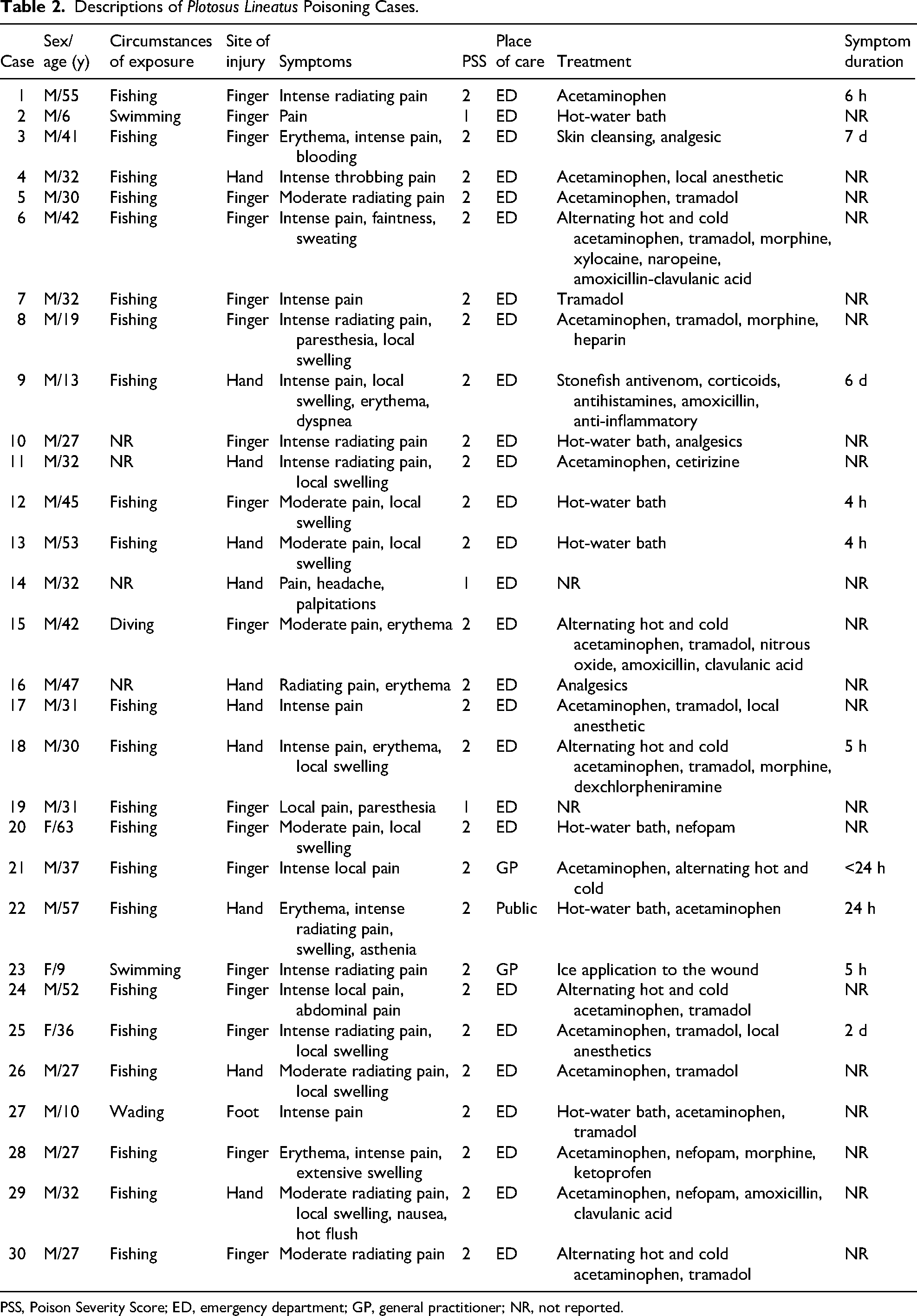
PSS, Poison Severity Score; ED, emergency department; GP, general practitioner; NR, not reported.
Discussion
P lineatus is widely distributed, but human envenomation cases are rarely reported. The cases we found are fairly recent and mostly described in the Mediterranean Sea. (Table 1). This is not surprising given the current situation in the Mediterranean Sea, which is being invaded by Red Sea species, introduced through the Suez Canal (so-called Lessepsian species), of which P linaetus is a specimen. 6
Although we already knew that the fish was present in the Indian Ocean, this study has shown that envenomations may occur in humans in this part of the world. Synanceia verrucosa, a stone fish also found on the coasts of Reunion Island, exhibits similar limitations. Although its reputation is well established, cases of envenomation are rarely reported in the literature. However, a recent study conducted on the island revealed that its harmful effects on humans are not uncommon, with 135 cases of envenomation recorded between 2020 and 2024. 20 The limited information on human envenomation by P Lineatus in the Indian Ocean is probably caused in part by their occurrence in areas with inadequate medical facilities or with teams that have not documented their data on marine envenomations. The fish is not always seen by the victim; it is also likely that sometimes the sting is falsely attributed to a stonefish or a lionfish. As in our case series, the majority of literature report P lineatus envenomation in males during fishing activities. Gweta et al reported 8 cases of envenomation among fishermen on the Israeli coast. 16 Ten years later, Bentur et al described 84 cases of envenomation on the same coast, 51% of which involved fishermen. 14 The most recent reported case dates back to 2020 in Turkey, once again in a fisherman. 18 Those who handle fish regularly, such as cooks or workers in tropical fish stores, also may experience envenomation.13,21
Most stings in our case series occurred when the victim was fishing (n=22; 73%). We do not know whether this was in a professional or private context, but according to some inhabitants, leisure fishing is widespread on their island.
As our case series and literature data show, most stings occur on the hand. In the case series of Bentur et al, 78% of envenomations were located in this area. 14 In summary, as illustrated in our case series, injuries occur most often in males, on the hand, during fishing activities. All individuals in our case series complained of pain, often intense (63%), and accompanied by swelling (40%). Some of them had general signs, such as faintness, headache, or sweating, but there were no secondary infections or severe cases (PSS=3–4).
Most of our patients consulted the emergency department (n=27; 90%). This rate is higher than in the study by Bentur et al (n=56%). 14 There is no specific antidote, and stonefish antivenom had no indication in the Plotosus envenomation of the 13-y-old child on Mauritius Island (Case 9). Because intense pain was the predominantly reported symptom, most of our patients were treated with analgesics (n=23; 77%), including 13 with Stage 2 or 3 analgesics. Only a few received treatment with local anesthetics (n=4). Because the venom is heat labile, a hot-water bath is often recommended for pain relief.13,15,17,21 In our study, 8 of our patients were treated in this manner, of whom 2 had favorable outcomes in 4 h and 1 in less than 24 h. For the past 20 y, still with the aim of destroying the venom and relieving the pain, poison control centers have been suggesting a sudden change in local temperature by approaching a hot source for a few minutes followed immediately by a cold source such as an ice pack. 22 Five of our patients benefited from this treatment, 2 of whom had a favorable outcome within 24 h.
As our data illustrate, antibiotic prophylaxis is not frequently prescribed but may be suggested in the case of large wounds, persistent debris, or immunocompromised patients. The chosen antibiotic will have to cover the Vibrio genus, which is most problematic in seawater. In any cases, the condition of the wound must be closely monitored because secondary infection can occur.2,15
Limitations
Because IOTD cases are only collected within hospitals, there may be missing envenomations involving patients who did not consult a hospital facility. These patients did not necessarily call the PCCM, so this series cannot claim to be exhaustive. In most cases, the specimens were not made available for identification, meaning that the specimens involved in our patients’ envenomations could not be identified by a specialist; however, because P lineatus is the only black and white-striped venomous fish in the region, the risk of confusion is low. Because there was no formal identification of the species responsible for these envenomations, they are considered presumed. What's more, because this study is retrospective, some details are missing regarding the patients’ comorbidities and medication regimens, specific vital signs, pain intensity ratings, the precise names of the medications used, the doses administered, and their effectiveness.
Conclusion
The presence of P lineatus in Mediterranean countries is a growing concern, but it should be noted that the species has a very wide range, particularly in the Indo-Pacific region. There is evidence that it continues to cause human envenomations, although these are rarely reported. The negative impact on tourism could be one of the reasons, but further studies are needed to support this hypothesis. This case series corroborates the presence of this fish in the French Indian Ocean overseas territories, exhibiting a victim profile analogous to previously documented cases, that is, male fishermen affected on the hand, with pain frequently characterized as intense. Fortunately, the evolution of our patients was favorable, but it is imperative to acknowledge the potential for complications, predominantly secondary infections.
Footnotes

Author Contribution(s)
Financial/Material Support
The authors received no financial support for the research, authorship, and/or publication of this article.
Declaration of Competing Interest
The authors declare that they have no known competing financial interests or personal relationships that could have appeared to influence the work reported in this paper.