






Abstract
Objective
There is not a single data source for information on the extent of nonfatal injuries inflicted by animals. Although individuals bitten or stung by animals may not visit a health care provider, they may call poison control centers (PCCs) for information. These centers are one source of information on the frequency of occurrence of injuries from animals.
Methods
The American Association of Poison Control Centers compiles an annual report of exposure calls to various agents, including chemicals, medications, animal bites and stings, plants, and use of antivenoms from their network of PCCs. An estimate of the severity of exposure for each call is also determined. This review examines summary data on different species of animal bites and stings reported by PCCs from 2001 to 2005.
Results
From 2001 to 2005 there were 472 760 reports of animal bites and stings, an average of 94 552 per year. There was a trend noted for increasing use of antivenom over this period. Twenty-seven deaths were recorded, most from snakebites.
Conclusions
Poison control centers are a source of information for health care workers on management of animal bites and stings. The database maintained by the American Association of Poison Control Centers is another source of information on the magnitude and public health impact of injuries from animals.
Introduction
Injuries from animals continue to be a significant public health issue. The cost from injuries and fatalities due to animals is estimated to be more than 2 billion dollars per year in the United States. Deer collisions with cars alone are estimated by insurance companies to cost more than 1 billion dollars annually.1,2 A study of dog bites in the United States found an estimated 4.5 to 4.7 million bites occur yearly. 3 The economic burden of dog bites in the United States exceeds 1 billion dollars. 4 Not included in these figures are the costs from the tens of thousands of injuries from cats and other household pets, injuries from farm animals, and zoonotic infections that occur each year. Thus, the extent and cost of adverse encounters with animals are enormous.
Recent studies have reported on mortality events due to animal-related injuries. 5 –7 Information on morbidity is more limited. Some information about visits to emergency rooms for nonfatal animal injuries is available from the National Electronic Injury Surveillance System All Injury Program, which is a sample of 100 hospital emergency rooms throughout the United States 8 or from the Centers for Disease Control and Prevention.9,10 There have also been a few surveys of injuries among specific occupational groups, such as veterinarians and agricultural workers. 11 –17 Studies of the frequency of occupational injuries among workers from animal-related events have recently been conducted, and an estimated 12 500 nonfatal and approximately 58 to 63 fatal work-related injuries are reported yearly.18,19
However, many persons exposed to animals do not go to the emergency room, urgent care facilities, or even their personal physician for evaluation but may seek other sources for information, one being poison control centers (PCCs). These centers provide both the general public and health care professionals with information on the management of poisonings and animal bite and sting exposures. The American Association of Poison Control Centers (AAPCC) is a not-for-profit nongovernmental association representing 61 PCCs in the United States as of 2005. Since its inception in 1983, the number of poisonings reported by the country's regional PCCs has grown as the number of centers has increased and the population served has increased. In 1983 there were 16 participating centers serving an estimated 43.1 million citizens. In 2005, there were 61 participating centers, serving an estimated 296.4 million U.S. citizens. 20 The AAPCC compiles information reported from the regional PCCs into a national database. A summary of the data is published annually.
This paper looks at animal bite and sting exposure calls the PCCs have received from 2001 to 2005. 20 –24 The AAPCC is an additional source for information on animal bite and sting exposures. Poison control centers also are a source of information on prevention of exposures.
Methods
The number of centers providing data during the period of this study ranged from 61 to 64, and the population served ranged from 270.6 to 296.4 million. Human exposures are reported by PCCs to the AAPCC Toxic Exposure Surveillance System database, and summary data are published annually (accessible at
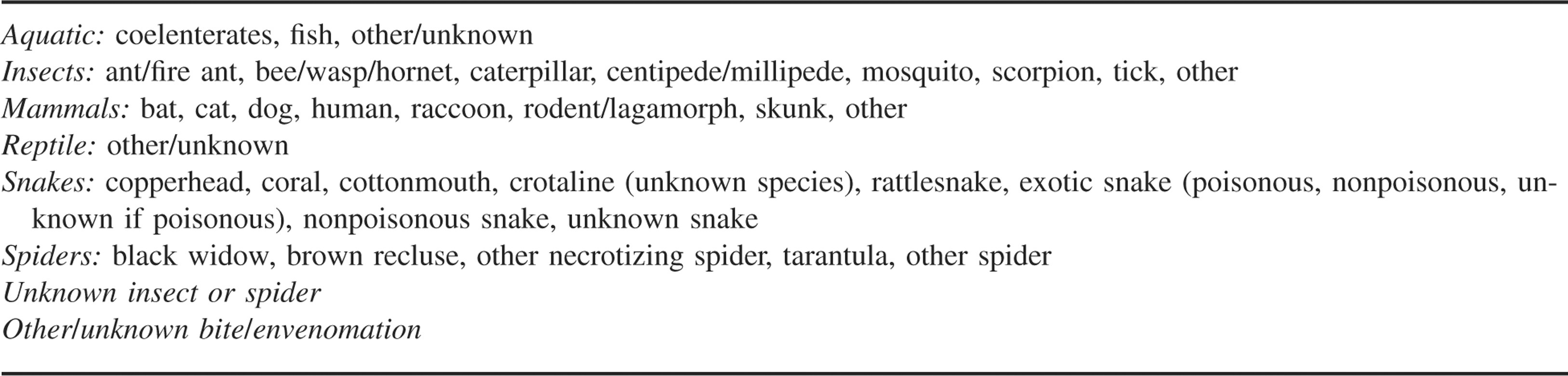
Bites and stings, with or without envenomation, are included in the database, and annual summary results are presented. Information on the number of people treated with antivenom is also reported. Specific case information on fatalities is also reported. Categories of animals included in the database are shown in Table 1.
Categories of animals included in the American Association of Poison Control Centers database
Information compiled in the summary data and reported here includes age, treatment in a health care facility or not (usually resident's home), and medical outcome. Age is grouped into 3 categories: younger than 6 years, 6 to 19 years, and older than 19 years. (Totals may not add to 100% due to rounding or missing data.)
The medical outcome of each case is listed in 1 of 5 categories: no effect, minor effect, moderate effect, major effect, and death. These categories are described as follows: No effect: The patient did not develop signs or symptoms as a result of the exposure. Minor effect: The patient developed signs or symptoms that were minimally bothersome and generally resolved rapidly with no residual disability or disfigurement. Moderate effect: The patient exhibited signs and symptoms that were more pronounced, more prolonged, or more systemic in nature than minor symptoms. Usually some form of treatment was indicated. Symptoms were not life threatening, and the patient had no residual disability or disfigurement. Major effect: The patient exhibited signs or symptoms that were life threatening or resulted in significant residual disability or disfigurement. Death: The patient died as a result of the exposure or as a direct complication of the exposure.
Descriptive statistics are used to present the data.
Results
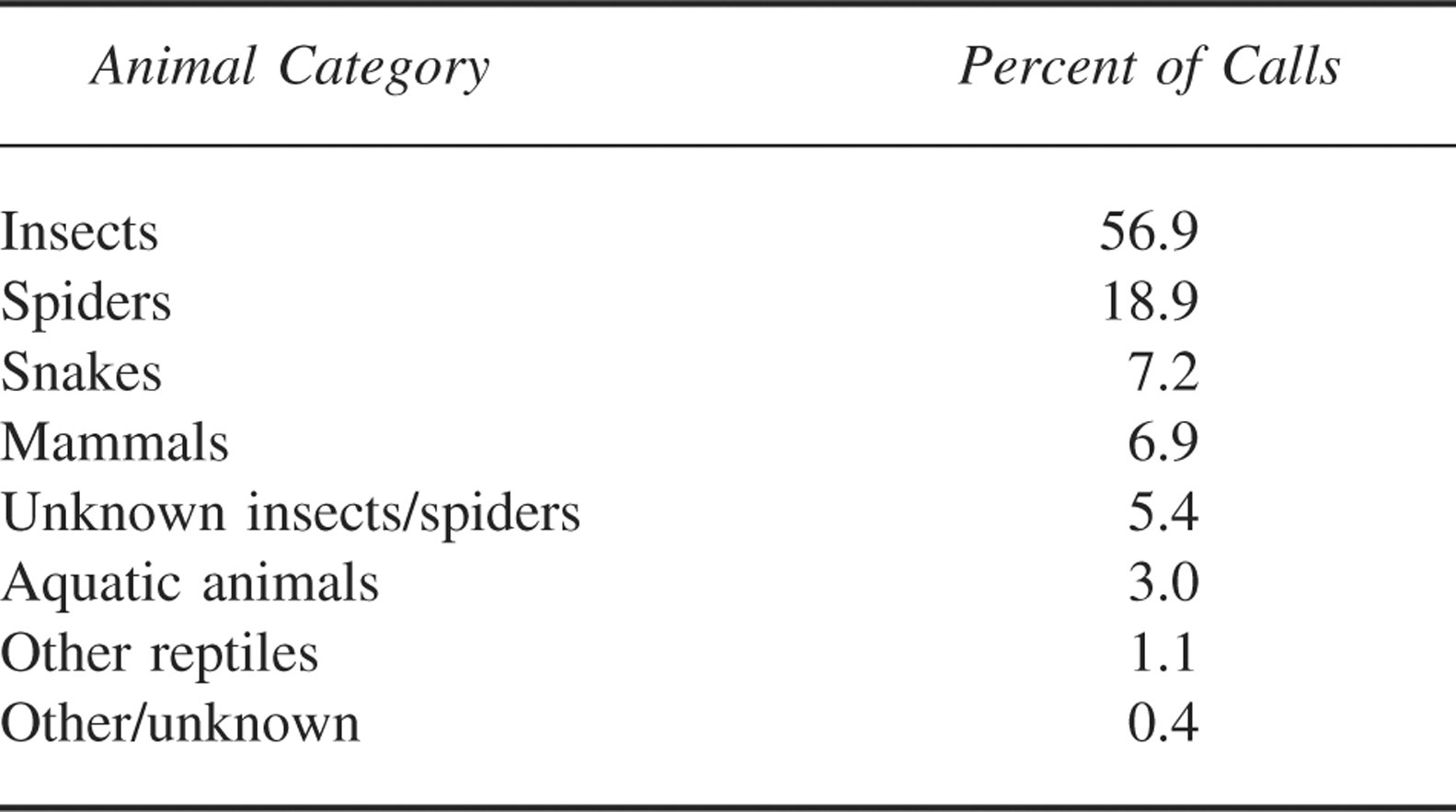
From 2001 to 2005, 11 906 412 human exposures were reported to the AAPCC Toxic Exposure Surveillance System database. Of these reports, 472 760 (3.97%) were due to animal bites or stings, a mean average of 94 552 calls per year. During this period, 92 829 (0.78%) animal bite or sting cases referred to the AAPCC were treated in health care facilities, an annual average of 18 568 cases. The percentages, by animal category, of the average number of yearly exposure calls are noted in Table 2.
Percent of animal exposure calls by animal category reported by the American Association of Poison Control Cen ters, 2001–2005
Aquatic Animals
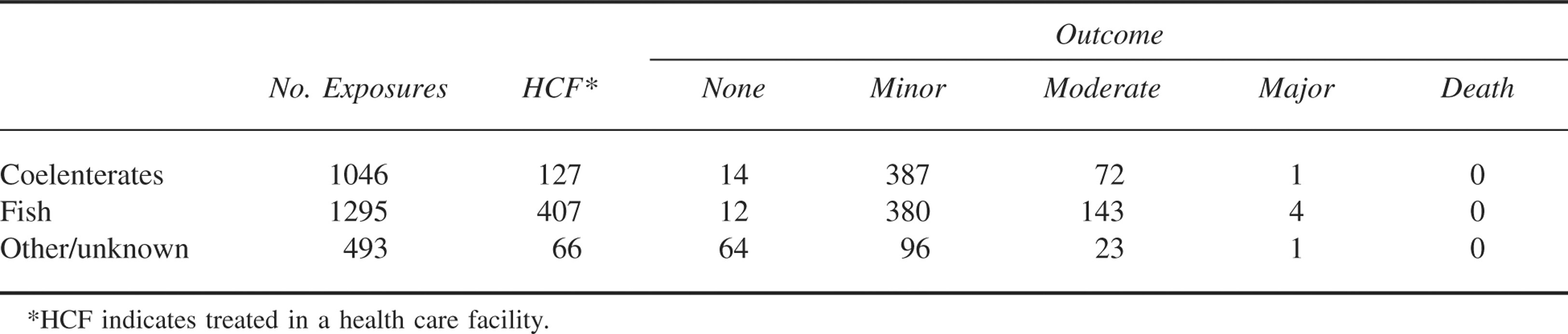
An annual average of 2834 exposures was reported to PCCs, of which an average of 90 cases was evaluated yearly in health care facilities. No deaths were reported, and only 29 major adverse outcomes were noted during this 5-year period (Table 3). By age, if reported, 13.3% were younger than 6 years, 29.3% were 6 to 19 years, and 56.5% were older than 19 years. By specific category, however, 49% of the other/unknown aquatic animal injuries occurred in those younger than 6 years, and the majority (50.3%) of coelenterate stings occurred in the 6- to 19-year-old group.
Annual average number of bites or stings from aquatic animals reported to the American Association of Poison Control Centers, 2001–2005
Mammals
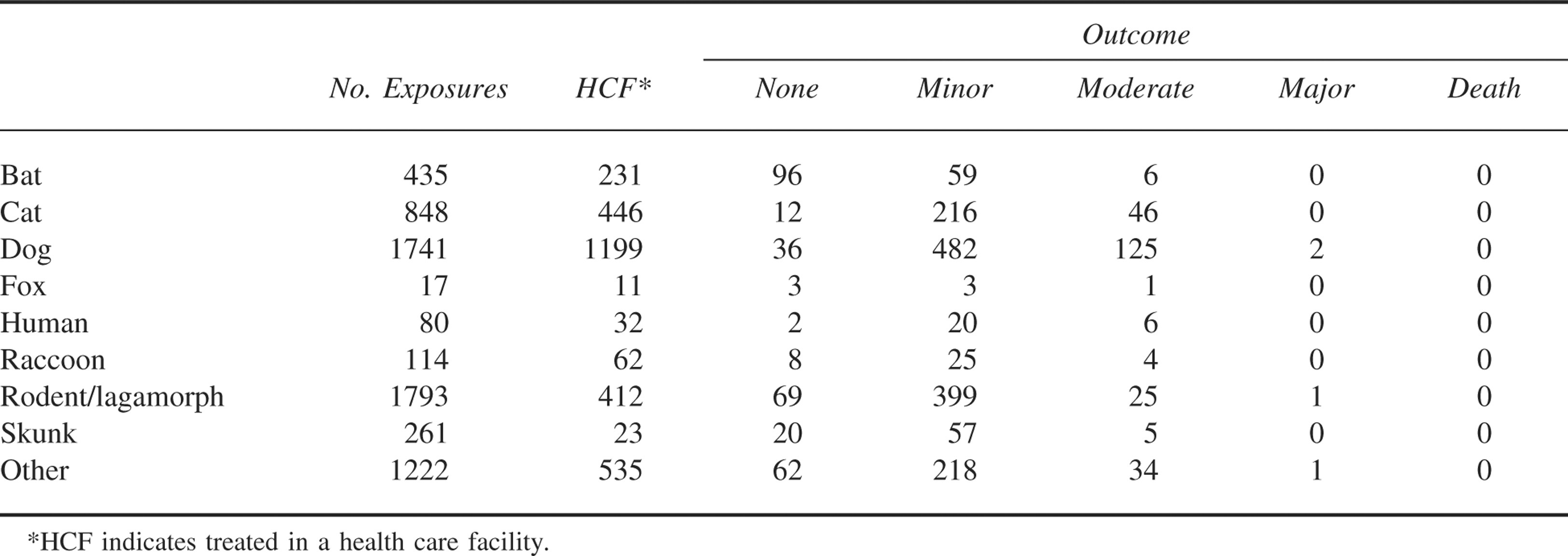
An annual average of 6511 calls was reported for exposure to mammals. The majority of calls were due to dog and rodent/lagomorph bites or scratches. One death from rabies was reported due to a bat. An annual average of 2951 cases referred to the AAPCC was treated in health care facilities (Table 4). By age, 18.2% of exposures were in those younger than 6 years, 31.7% were 6 to 19 years, and 47.8% were older than 19 years. Except for dog bites and rodent bites, more than 49% of the reports were in individuals older than 19 years. For dog bites, almost 20% were younger than 6 years and almost 40% were 6 to 19 years old. For rodent bites, 23.5% were younger than 6 years and almost 35% were 6 to 19 years old.
Annual average number of bites from mammals reported to the American Association of Poison Control Centers, 2001–2005
Insects
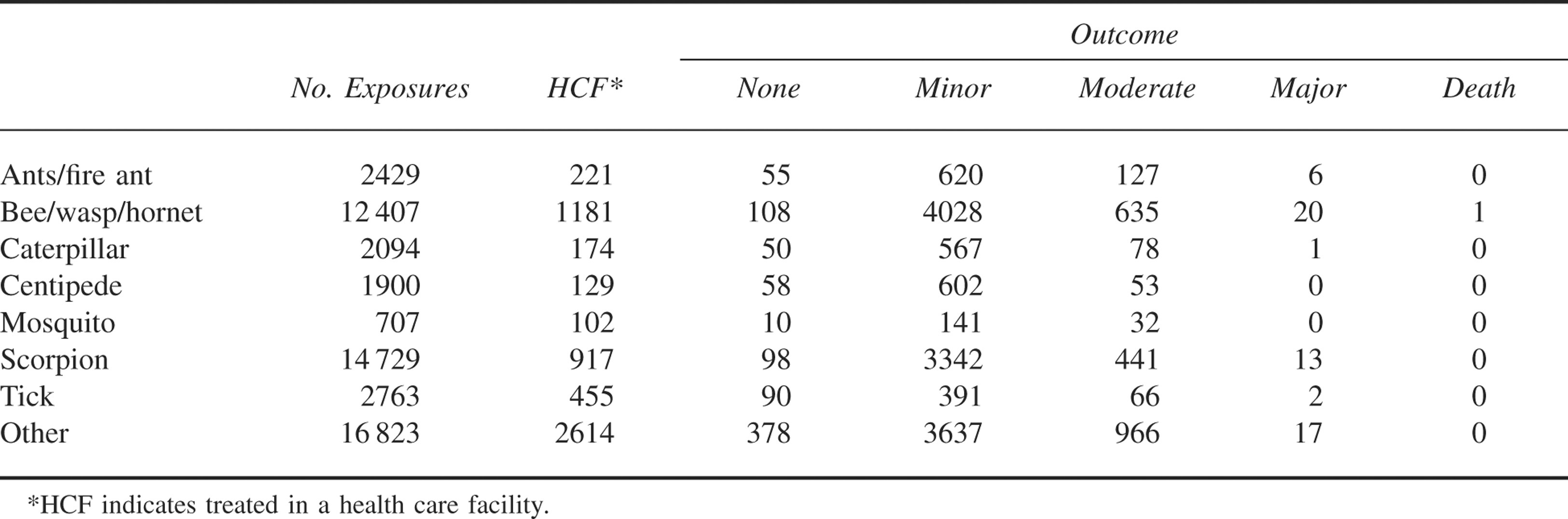
An annual average of 53 852 calls was made to PCCs for stings or bites from various insects or nonspider arthropods (Table 5). There were 8 deaths reported during this period, 1 from an ant/fire ant, 3 from a bee/wasp/ hornet, 2 from scorpions, 1 from a tick, and 1 from another insect. By age, 17.5% were younger than 6 years, 18.5% were 6 to 19 years, and 65.7% were older than 19 years. Except for ant stings and caterpillar stings, greater than 55% of cases were older than 19 years. For ants and caterpillar stings, 37% and 24% of cases were younger than 6 years, respectively.
Annual average number of bites or stings from insects or arthropods (nonspider) reported to the American Association of Poison Control Centers, 2001–2005
Snakes
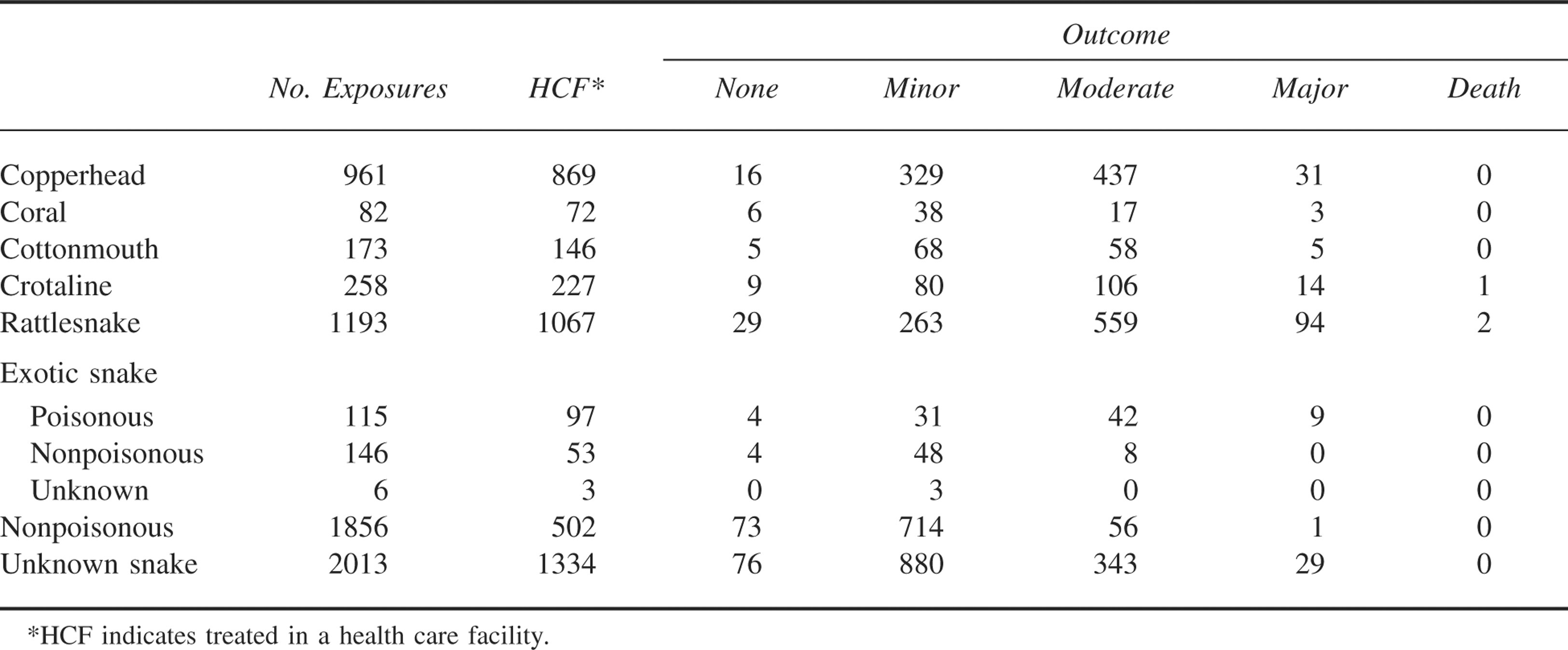
An annual average of 6803 cases of exposures to snakes was reported. Of these, the majority of the species were unknown. Of the venomous species known, most were rattlesnakes followed closely by copperheads. Exotic snakes were reported to cause an average of 267 exposures annually. Of the snake exposures, an average of 4370 were treated in health care facilities annually. Of outcomes, there were 16 deaths during this time and an additional 881 people had a major effect. Of individuals bitten by an exotic snake, 7.6% of the bites resulted in a major effect, and 7.9% of rattlesnake bites, 3.2% of copperhead, 4.1% of coral, 3% of cottonmouth, and 5.4% of unknown crotaline bites resulted in a major effect. Of the 16 deaths, 1 was from a copperhead, 4 from unknown crotaline bites, 9 from rattlesnakes, and 2 from exotic poisonous snakebites (Table 6). By age 6.8% of reports were younger than 6 years, 28.3% were 6 to 19 years, and 64% were older than 19 years. Except for nonpoisonous bites, the majority of the cases were older than 19 years. For nonpoisonous snake bites, 9.6% were younger than 6 years, and 40% were 6 to 19 years old.
Annual average number of bites from snakes reported to the American Association of Poison Control Centers, 2001–2005
Spiders
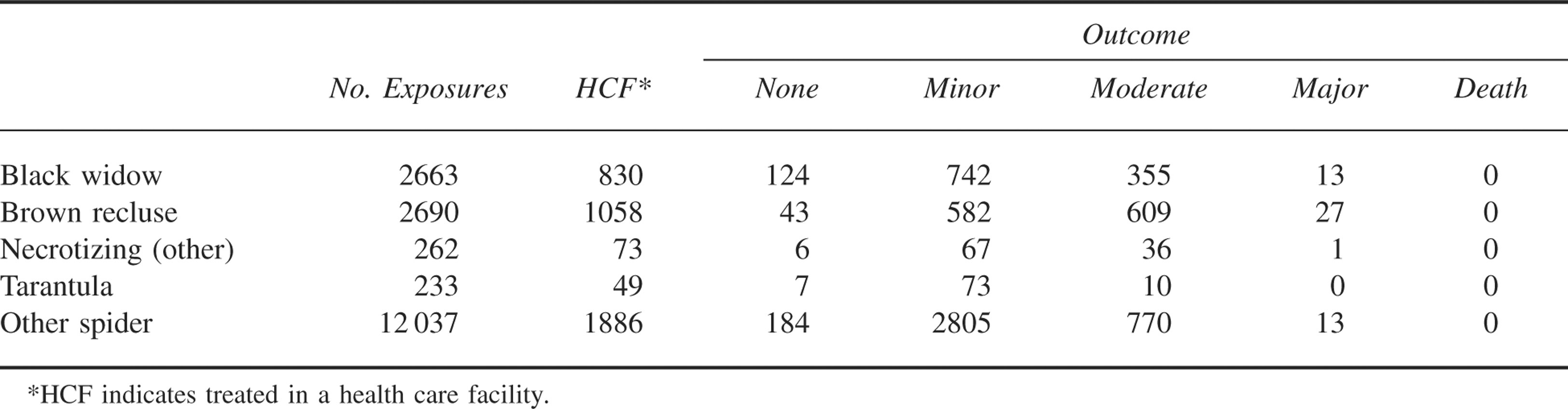
An annual average of 17 885 exposure calls to PCCs for spider bites occurred, with 3896 of these treated in health care facilities. There were 2 deaths reported, both attributed to brown recluse bites. Major effects were reported in 0.5% of black widow bites and 1% of brown recluse bites (Table 7). By age, 10.4% were younger than 6 years, 17% were 6 to 19 years, and 71.6% were older than 19 years. Except for tarantulas, more than 68% of all cases were older than 19 years. For tarantulas, 8.2% were younger than 6 years, 33% were 6 to 19 years, and 57.9% were older than 19 years.
Annual average number of bites from spiders reported to the American Association of Poison Control Centers, 2001–2005
Other/Unknown Reptiles
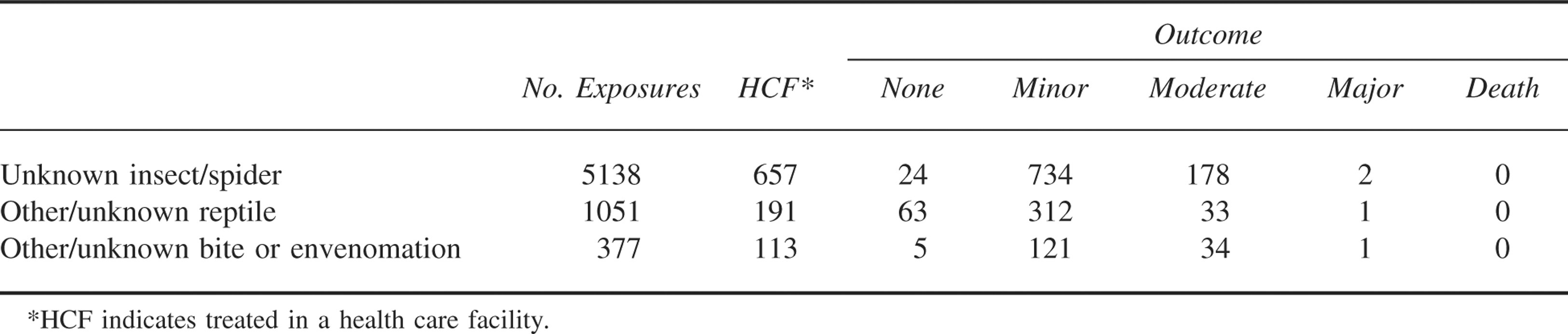
An annual average of 1051 cases was reported. One death occurred during this period. An average of 191 people was treated in health care facilities (Table 8). By age, 32% were younger than 6 years, 35.2% were 6 to 19 years, and 31.2% were older than 19 years.
Annual average number of bites or stings from unknown or other animals reported to the American Association of Poison Control Centers, 2001–2005
Unknown Inspects/Spiders
An annual average of 5138 exposures was reported, with 657 of these being treated in health care facilities. No deaths and only 11 major effects over this 5-year period were noted (Table 8). By age, 13.5% were younger than 6 years, 17.2% were 6 to 19 years, and 68.6% were older than 19 years.
Other/Unknown Bites/Envenomation
An annual average of 377 exposures was reported to PCCs, with 113 being evaluated in health care facilities. There were 6 cases with a major effect and no deaths over this 5-year period (Table 8). By age, 16.2% were younger than 6 years, 18.3% were 6 to 19 years, and 68.2% were older than 19 years.
Antivenom Therapy
During this 5-year period, 6512 cases (annual average of 1302) were treated with antivenom. The type and species of animal exposure requiring antivenom therapy were not reported, however.
An average of 519 cases was treated with antivenom (excluding Fab), while an average of 783 cases was treated with Fab antivenom. Over this 5-year period, the number of cases treated with antivenom showed an upward trend, as did the use of Fab antivenom.
Fatalities
During this 5-year period, there were 27 deaths reported. Six deaths were reported in children younger than 6 years and 19 deaths in people older than 19 years. The species of animal involved in the fatality was listed, if known, as the following: Crotalus adamanteus (2), Crotalus horridus horridus (3), Agkistrodon contortrix (1), Bitis nasicornis (1), Bothrops alternatus (1), Crotalus viridis lutosus (now C. oreganus lutosus) (1), crotaline unknown (4), rattlesnake (3), fire ant (1), yellow jacket (1), triamtoma sp (1), hymenoptera (2), Loxosceles reclusa (2), Centruroides sp (1), Centruroides sculpturatus (1), tick (1), bat (1).
The bat exposure resulted in a fatal case of rabies. One child had an adverse reaction to antivenom from a scorpion sting, and 1 adult bitten by an unknown crotaline aspirated during surgical debridement of an arm bite and subsequently died.
Discussion
Traumatic encounters with animals result in numerous injuries, deaths, and a large economic expense both worldwide and in the United States. The quality of information on animal-related injuries and fatalities varies by country. In many developing world countries, data reporting is often lacking because people are treated by nontraditional healers and no official reporting systems exist. Even in most developed countries, animal bites and stings are not reportable. Given these limitations, the World Health Organization (WHO) has attempted to address the magnitude of certain animal bites/stings and resultant fatalities. It is estimated by the WHO that more than 4.5 million persons are bitten by snakes worldwide yearly, more than 1.8 million are envenomed, and more than 80 000 deaths occur. 25 Scorpions sting more than 300 000 people worldwide each year, causing hundreds of deaths. 26 Worldwide, an estimated 10 million vials of antivenom are needed annually for the management of snakebites and scorpion stings. 27
The WHO estimates 56 000 deaths per year worldwide from rabies. 28 Millions of people receive postexposure rabies prophylaxis. The WHO estimates an annual global requirement of 16 million vials of rabies immune globulin. 27 In the United States and Puerto Rico, 6417 cases of rabies in animals were documented in 2005. 28 Relative contribution by animal group was 39.5% in raccoons, 23% in skunks, 21.9% in bats, 5.9% in foxes, 4.2% in cats, 1.5% in cows, and 1.2% in dogs. It is estimated that 15 000 to 40 000 people in the United States receive rabies prophylaxis annually.29,30 While effective, prophylaxis is expensive. 30 Fortunately, fatalities from rabies in the United States are very rare.
Although the data on fatalities from animal encounters in the United States are fairly accurate, the information on nonfatal injuries is not as well defined. There have been a few studies looking at emergency department visits for injuries due to specific animal encounters and estimating the extent of animal injuries nationwide. For example, the Centers for Disease Control and Prevention performed a study on individuals involved in nonfatal animal-vehicle collisions who were evaluated at emergency departments and estimated that there were 26 647 injuries per year; however, the frequency of injuries treated in urgent care centers or by personal physicians or injured persons not seeking medical attention is not known. 9 One source of data that provides additional information on exposures to animals in the United States is the AAPCC. It is obvious from the data that many if not most nonvenomous animal encounters are not reported to PCCs compared with other limited emergency department or community surveys. Still, a large number of calls do get reported. It is likely that health care workers unfamiliar with management of venomous bites or seeking updated information on venomous bite therapy may call PCCs for the latest recommendations. Thus, information on snakebites, scorpion stings, spider bites, and possibly coelenterate and fish stings may be a crude indicator of the magnitude of venomous animal encounters in the United States.
The PCCs reported an average of 6803 snakebites yearly, with 2782 (40.9%) being venomous snakebites. A recent study of a sample of U.S. emergency departments utilizing the National Electronic Injury Surveillance System All Injury Program from 2001 to 2004 estimated 9873 snakebites treated per year, with 3188 (32.3%) bites from venomous snakes. 8 Parrish 31 estimated there were 45 000 snakebites, 6680 being venomous, treated in medical facilities per year in the United States from a survey in the late 1950s. Gold and colleagues 32 report that the true incidence of venomous snake bites in the United States is probably closer to 7000 to 8000, with 5 to 6 deaths per year.
What physicians may not appreciate is the number of exposures to caterpillars, centipedes, and scorpions that are reported to PCCs. Although rare in the United States adverse outcomes and deaths can occur from encounters with these arthropods, especially after scorpion stings.5,6
The use of antivenom has shown an upward trend during this 5-year period. Many former manufacturers are no longer producing antivenoms, and this is a concern, especially for venomous snakes found in developing world countries. The WHO has called for more funding for the development of antivenoms. 25
Weaknesses in the use of summary data from the AAPCC include limited data on age, no information on gender or race, limited information on specific species involved (even in fatal cases), and reporting by both lay persons and health professionals, resulting in both misdiagnosis and misidentification of the offending species. Additionally, many physicians may feel comfortable treating envenomations and bites and do not seek advice of the PCCs, resulting in under reporting. It is likely that bites and stings from invertebrates (eg, mosquitos) are vastly underreported because many people do not seek medical attention for bites/stings they may consider trivial. In cases that may have developed a secondary infection, no information is provided. Deaths from anaphylaxis are a concern from hymenoptera stings, although few were reported to PCCs. There may also be over reporting for a few species. The estimate of brown recluse bites is questionable. Vetter and colleagues33,34 feel most encounters attributed to the brown recluse are due to misidentification because the range of this spider is more limited than commonly assumed.
Despite these limitations, the AAPCC data, if used with other data sources, give us a better understanding of the magnitude of animal bites and stings, especially venomous ones. Because most types of bites and stings are not required to be reported to state officials, the true magnitude of the problem is unknown. Perhaps national household surveys would provide a better picture of the magnitude of the problem.
Conclusions
Poison control centers are an up-to-date source of information for health care workers who treat animal bites and stings. They should be consulted for sources of antivenom and the latest treatment guidelines. They can also help find sources of rabies immune globulin and vaccine when numerous people may need treatment for possible exposure to a rabid source. Poison control centers also answer informational calls from the public, many regarding removing pests or using pesticides.