






Abstract
Many marine catfish have serrated bony stings (“spines”), which are used in defense against predators, on the dorsal and pectoral fins. While catfish-induced injuries are generally characterized by the pain associated with envenomation, the stings in some species are sufficiently long and sharp to cause severe penetrating trauma. Most injuries are to the hands of victims, commonly fishermen. We report the death of a fisherman caused by myocardial perforation from a catfish sting. To our knowledge, this is the first such description in the medical literature.
Introduction
Catfish are found in marine and freshwater environments worldwide. From the perspective of envenomation risk, important marine catfish families include Ariidae (worldwide marine distribution) and Plotosidae (Indo-Pacific region). To date, the family Ariidae is comprised of 20 genera and 153 species, found particularly in estuarine regions. 1
Many marine catfish have three serrated bony stings (Figure 1), sometimes referred to as “spines,” 1 each within the single dorsal and 2 pectoral fins. These spines are intended for defense against predators. When the animal is provoked, the stings can extend from a relatively flaccid and flattened position adjacent to the body to a nearly 90° vertical (from the body) position, which can be maintained in a rigid fashion for the purpose of wounding a perceived assailant. The stings in some species have venomous glandular tissue under the epithelium.2,3 Catfish stings can therefore cause both severe trauma (lacerations and punctures) and envenomation in humans. Most injuries are to the hands of fishermen, and more are reported in freshwater than marine environments. 4
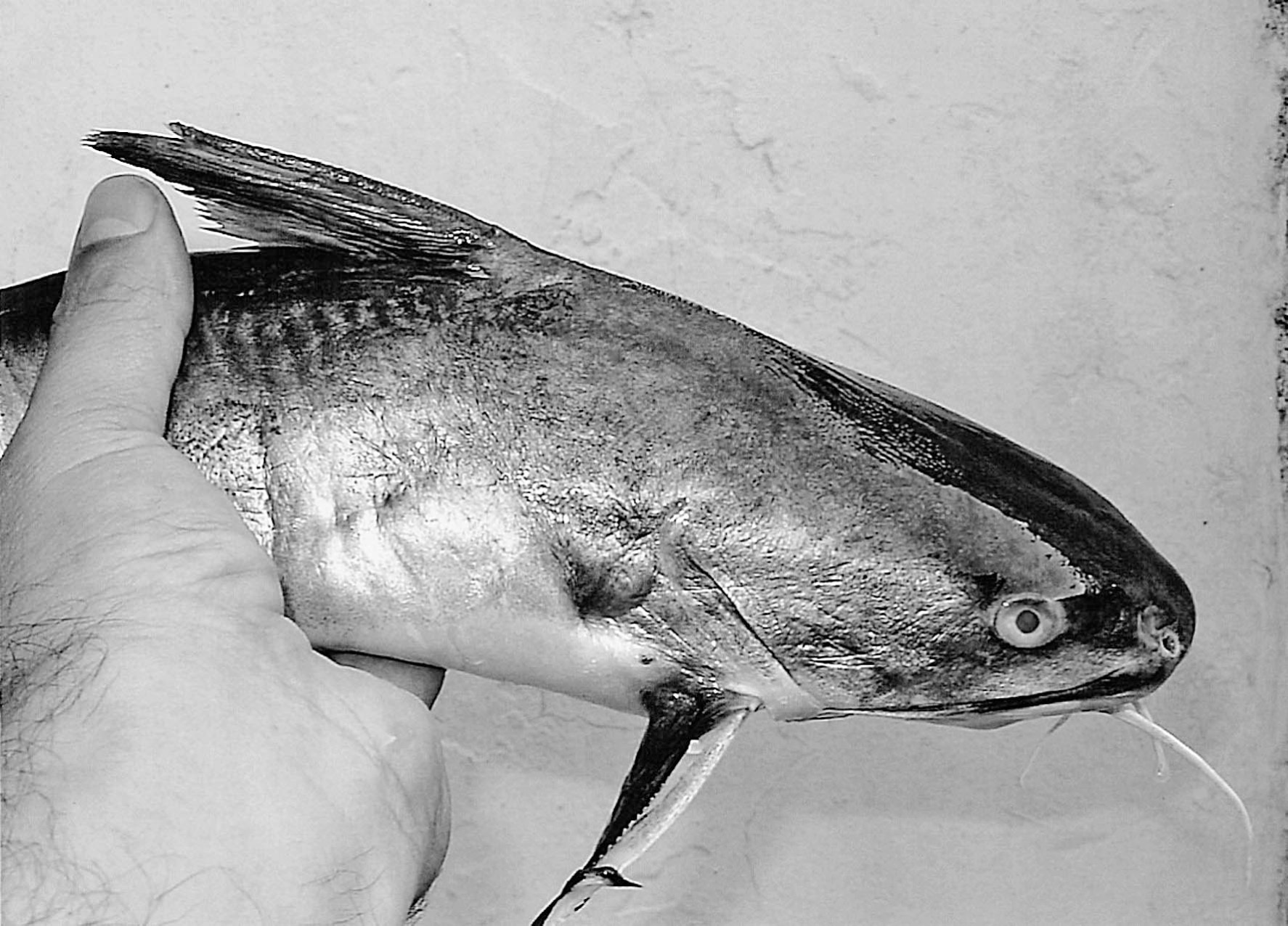
Snake catfish Genidens genidens. Note the serrated bony stings in relationship to the dorsal and pectoral fins.
Envenomation manifests as local intense pain, edema, erythema, and paleness and is occasionally followed by cutaneous necrosis. 3 –15 Systemic manifestations rarely occur during the first symptom hour (acute envenomation phase).3,4,14,15 Punctures caused by catfish are always painful to some degree, but when the sting deposits venom, the pain is intense and can persist for up to 6 hours. Complications occur when there are lacerations accompanied by intense bleeding, there is injury that requires repair of an anatomical structure, or when a sting(s) breaks away from the fish and remains inside the wound as a foreign body. Bacterial infections are most commonly caused by Streptococcus and Staphylococcus species and occasionally by Vibrio, Aeromonas, Pseudomonas, or Edwardsiella species 16 –18; fungal infections can be caused by Sporothrix schenkii. 14
We report the death of a fisherman who sustained a myocardial puncture from the sting of a catfish.
Case report
The victim was a 39-year-old male fisherman of São Sebastião town, São Paulo State, Brazil. He was fishing with colleagues, who reported that he was holding a net carrying several catfish against his thorax. He was attempting to remove the net from the water when he related that he felt badly, was agitated in the water for a minute or two, and then submerged under the water's surface. Submersion was witnessed, so he was nearly immediately rescued from the water by his companions, but expired within minutes. At the scene, it was possible to see immediately that he had suffered a catfish sting to the left anterior hemithorax. The sting was extracted and collected (Figure 2), and the corpse was sent for autopsy, the report of which is as follows:
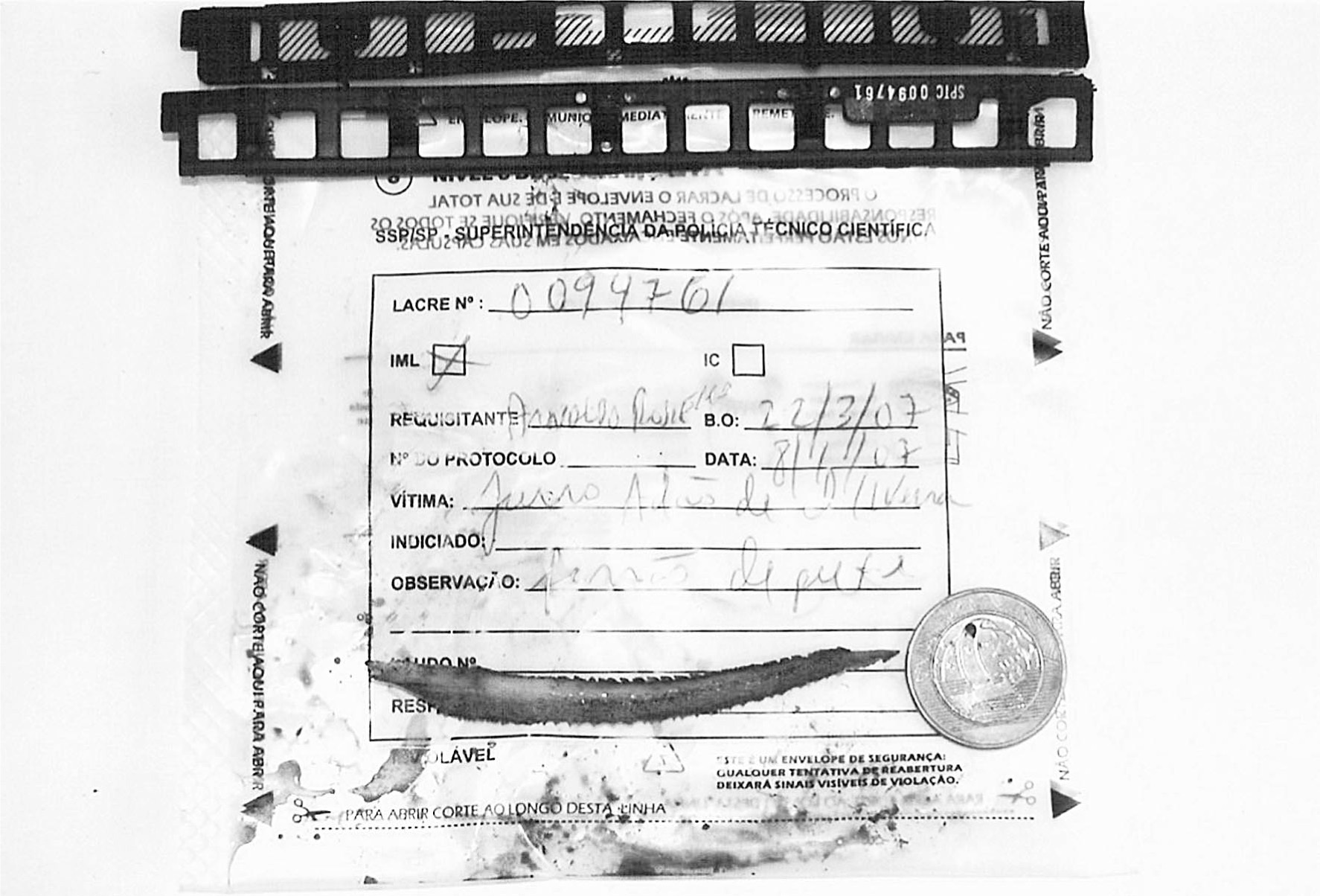
Catfish sting collected during necroscopic exam by the Scientific Police.
Police examination report by the specialist criminal group (number 107/02), São Sebastião, North Coast of São Paulo state, Brazil. Nature of exam: finding of a dead man. The body of the victim was found on Enseada Beach, Canto do Mar, São Sebastião, São Paulo State, Brazil. In the above place, the corpse was laid on the pavement in dorsal decubitus, he was a male individual, 39 years of age, black skin, black hair, wearing shorts, shirt, and barefoot, without identification documents. The in situ external necroscopic examination revealed a small perforating wound to the upper left chest suggestive of an injury caused by a piercing and cutting instrument (Figure 3). The autopsy found a perforation in the victim's left ventricle and intense intrathoracic hemorrhage (hemothorax), which was not measured (Figure 4). There was no cardiac tamponade, probably due to the perforation of the pericardium. Additionally, the exam showed no water in the victim's lungs.
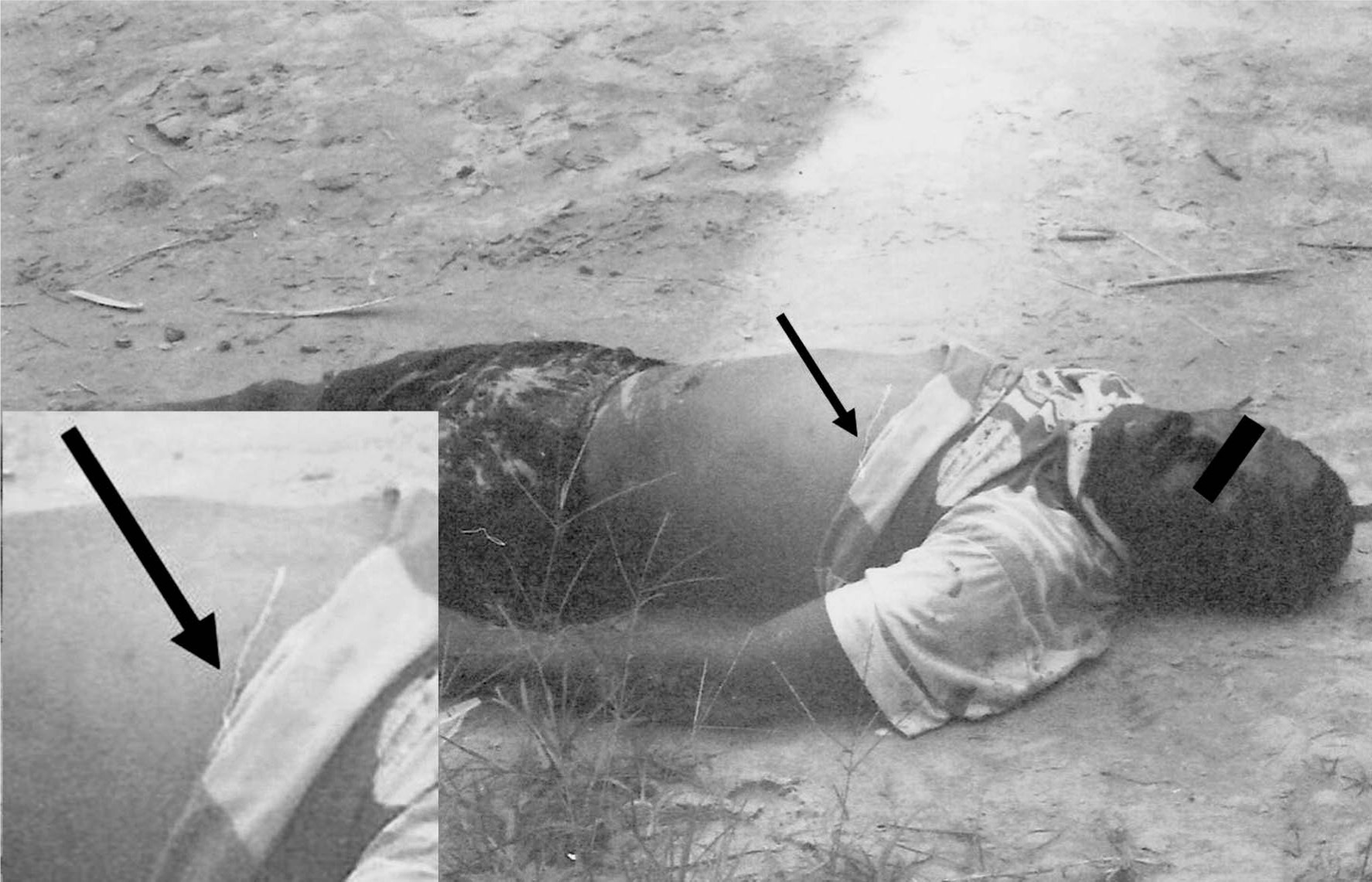
The victim's body at the scene of the accident. The left side of the thorax was perforated, but there was no external bleeding. The small entrance wound is partially hidden (arrow).
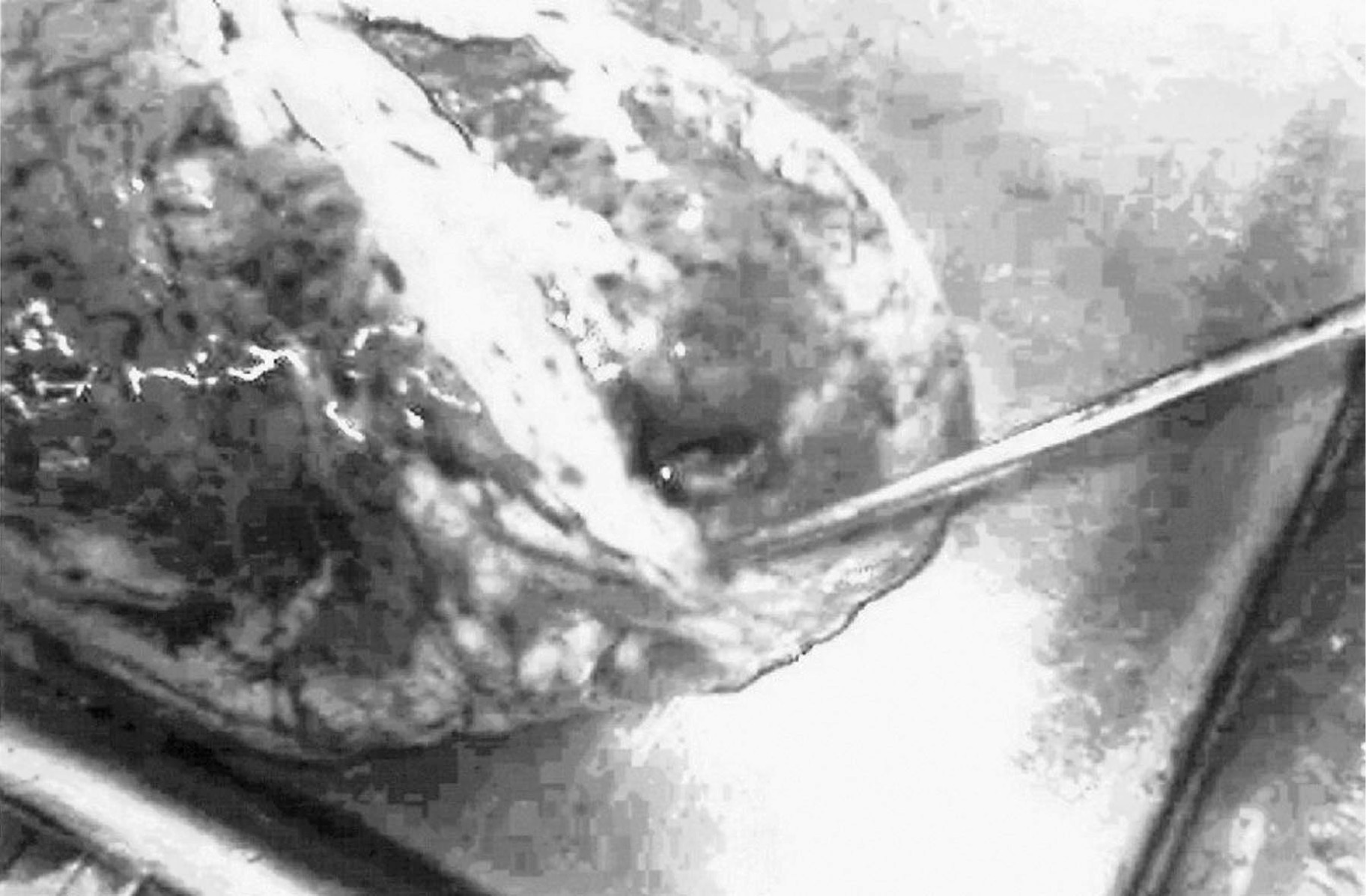
The necroscopic exam revealed a perforated left ventricle and large quantity of blood in the victim's thorax.
Discussion
Myocardial perforation by a catfish spine, with or without a fatal outcome, has not previously been reported in the medical literature. This unfortunate victim sustained a rapidly fatal wound caused by such a perforation. The laceration to the left ventricle caused intense bleeding, evidenced by the large quantity of blood present in the thoracic cavity identified on autopsy. The eyewitness report of rapid rescue from underneath the surface of the water and lack of sea water in the victim's lungs discourage a diagnosis of drowning, although it is acknowledged that laryngospasm upon submersion might have been present.
Myocardial perforation can be caused by the spine(s) of stingrays, 19 –24 as we are very much aware following the two most recently publicized cases, one involving the celebrity naturalist Steve Irwin, and the second involving an elder fisherman in Florida struck in the chest by a boated eagle ray. By comparison, the sting(s) of a catfish is (are) quite small. The species of catfish in this reported incident is the snake, or Guri sea, catfish (Genidens genidens), a very common fish in the southwest Atlantic Ocean. This catfish is frequently observed in the nets of fishermen and is commonly found in sand and shallow waters when small specimens are discarded by fishermen. The snake catfish lives in marine water but is also common in estuarine regions and can reach approximately 35 cm in length. As do other catfish, it presents a serrated bony sting in its dorsal fin and each of its pectoral fins. The venom-bearing glandular tissues are diffuse under the epithelium that covers the stings. Venom components include biogenic fractions that act in a fashion analogous to “mild” stingray venom; to date, there are no identified anticoagulant fractions. Venom inoculation occurs during penetration by the sting. In the field, the victim may benefit from immersion of the envenomed area into hot water to tolerance (45°C or 113°F) for pain control. 15 There is no specific in-patient treatment other than supportive therapy.
To these recommendations must now be added the same advice as is offered for impalement by a stingray spine. If there is a retained spine that has potentially penetrated the pericardium and entered the heart or is retained in a location such that it is felt to be preventing (eg, tamponading) potentially significant hemorrhage, it should be secured from motion and left in place until the victim can be brought to proper surgical attention in a setting where prompt control of bleeding can be obtained during the extraction process.
This report should alert individuals to the possibility of accidents by catfish causing severe wounds, including deep and potentially catastrophic puncture wounds. Because their capture by fishermen is important economically, particularly in economically disadvantaged populations, it is important to remind persons handling catfish to exercise appropriate caution.
Footnotes
Acknowledgments
We thank Humberto Mattiazo, criminal forensic expert, and Dr Alvaro Esteves Migotto, Director of São Paulo State University Center of Marine Biology, for their support in preparation of this report.