




Abstract
Platform economy politics reflect a trend of corporations working with civic actors to achieve shared political goals, reconfiguring once adversarial relationships (e.g., management vs. labor, homeowners vs. tenants). Yet theories on urban politics and policymaking often do not account for such “Baptist-Bootlegger” coalitions (Smith and Yandle 2014; Yandle 1983). This article analyzes how the efforts of two competing Baptist-Bootlegger coalitions shaped the 2018 short-term rental (i.e., Airbnb, HomeAway) ordinance in Los Angeles, CA, USA. I argue that a subtly coordinated partnership of housing groups, neighborhood activists, and hotel market incumbents leveraged their individual authenticity and resources to successfully articulate a shared vision with policymakers. Conversely, an opposing coalition of short-term rental platforms and hosts more explicitly combined their efforts under an organizational framework that conflated economic and moral claims; this hybrid organizational identity was perceived as less authentic by policymaking audiences and precluded potentially more strategic forms of organizing.
Introduction
As regular participation in associations declines, innovators, consumers, and social movements increasingly channel their civic energies via the marketplace (Cohen 2003; King and Pearce 2010; Putnam 2001; Rao 2008). Corporations field calls from activists to change products and practices or sometimes become activists themselves, utilizing (or co-opting) social movement participation and tactics for their own purposes (Rao 2008; Rea and Walker 2014; Walker and Oszkay 2020). In “Baptist-Bootlegger” coalitions, civic and market actors combine their respective moral authority (Baptists) and resources (Bootleggers) to advance a shared regulatory agenda (Yandle 1983). While these alliances can be politically strategic, they can also engender infighting and cognitive dissonance by bringing together moral and economic motives. How, then, do these coalitions organize their distinct interests toward shared policy goals, and what consequences do these forms of political organization have for urban policymaking?
These questions are particularly consequential for short-term rental markets in the platform economy, which reconfigure once opposed interest groups (e.g., management vs. labor, homeowners vs. tenants) in the context of urban market regulation. These markets employ “gig” workers or “hosts” who rent housing space for income via online platforms like Airbnb (Ravenelle 2019). Because of their popularity and how they reorganize urban housing, they pose a problem for municipal policymakers, who eventually must incorporate these markets into regulatory schemes. As local officials draft policies, they involve platform participants as well as incumbents in accommodation and housing markets, who feel short-term rentals threaten hotels’ competitive advantage, valuable housing stock, and neighborhood character. These contentious politics pit short-term rental firms and their users against hotel corporations, hotel labor, and local neighborhood and housing advocacy organizations.
Expanding on theories of urban governance and political organization, I compare two such Baptist-Bootlegger coalitions in a local case of short-term rental market (i.e., Airbnb, HomeAway/VRBO) regulation, showing how they organized their distinct moral and economic interests to influence the policy in Los Angeles, California, USA. I argue that a subtly coordinated partnership of local housing groups, neighborhood activists, and hotel market incumbents leveraged their individual authenticity and resources to articulate a shared vision with policymakers. Conversely, an opposing coalition of short-term rental platforms and hosts more explicitly organized their efforts under a framework that conflated economic and moral claims; this hybrid organizational identity was perceived as less authentic by policymaking audiences and precluded potentially more strategic partnerships. This study contributes to theories on urban politics and policymaking while also highlighting the policy outcomes associated with new forms of urban civic engagement.
Urban Political Mobilization and Policymaking
Urban political theory highlights how policymakers collaborate with either business or civic actors to articulate a shared vision of the city. Classic perspectives emphasize the capitalists who power the “growth machine” in urban development (Besek 2020; Molotch 1976). More pluralistic approaches focus on the policy regimes that serve certain interest groups (e.g., development, “slow-growth,” or community-based regimes) (DeLeon 1992; Imbroscio 1998; Reese and Rosenfeld 2001; Stone 1989; Whittemore 2012) or the city leaders who rely on civic partnerships when they lack capacity or need an image of grassroots, community power (Marwell, Marantz, and Baldassarri 2020; Pacewicz 2016; Pierre 2014; Reckhow, Downey, and Sapotichne 2020). However, while these theories illuminate different forms of urban political organization, they do not typically account for the more unconventional and cross-cutting coalitions between market and civic actors with shared policy goals (see similar discussion in Hunter, Loughran, and Fine 2018; McQuarrie and Marwell 2009).
Such dynamics are salient in the contemporary politics of the platform economy. Platform technologies are urban phenomena that derive resources from the “scale, proximity, amenities, and specialization that mark city life” through crowdsourcing and a “gig” model of contractual work (Davidson and Infranca 2016, 218; Powell 2016; Ravenelle 2019). As such, they introduce new urban problems, challenging the entrenched interests of local residents and markets as well as the laws that protect them (Gurran, Searle, and Phibbs 2018; Thelen 2018; Wachsmuth and Weisler 2018). On the one hand, market competitors, labor movements, and civic activists frame platform economy markets as a threat to their rights (Aguilera, Artioli, and Colomb 2021; Thelen 2018). On the other, the platforms, as “regulatory entrepreneurs,” also use crowdsourcing technology to mobilize their user base for political advocacy (Pollman and Barry 2016; van Doorn 2020; Yates 2021).
However, like the literature on urban politics, the growing research on the platform economy has yet to fully explore and conceptualize the consequences of this shifting political organization for urban policymaking (see similar critique in Aguilera, Artioli, and Colomb 2021). The limited work that does examine these dynamics either focuses on the various policy responses to platform economy markets (e.g., Marques Pereira 2020; Nieuwland and van Melik 2020) or how actors become political, as users of the platform or incumbents in resistance (e.g., Aguilera, Artioli, and Colomb 2021; Doorn 2020; Marrone and Peterlongo 2020). What is largely missing from this analysis is how platform economy markets, in their politicization, also create new urban coalitions between corporate and civic actors with once-disparate interests, and how these coalitions’ organizational strategies can succeed or backfire with policymakers.
Baptist-Bootlegger Coalitions and the Politics of Authenticity
The management literature offers the Baptist-Bootlegger model to conceptualize these alliances. Based on the example of religious groups with a moral objection (Baptists) and businesses with an economic interest (Bootleggers) having a shared stake in Sunday alcohol bans, this concept generally describes coalitions that blend economic and moral interests to influence regulatory policy (Murphy, Walker, and Jia 2022; Yandle 1983). Through various organizing strategies that can be tacit (i.e., indirectly coordinated), covert (e.g., front groups), or explicit (e.g., a public partnership), Bootleggers, or those with conspicuous economic interests, solicit the involvement of Baptists, who are more civically oriented, less motivated by pecuniary reasons, and thus lend “moral authenticity” to the cause (Carroll and Wheaton 2009; Murphy, Walker, and Jia 2022; Shogren 1990; Yandle 1983). While there are costs in coordinating these alliances—as they require mutual trust and a commitment to staying “on message”—these blended coalitions can be mutually beneficial when they combine strengths to generate support among policymakers and the public (Murphy, Walker, and Jia 2022).
In addition to the moral authenticity that Baptists provide, these coalitions may achieve “institutional authenticity” by dividing labor so that each member performs the expertise for which they are recognized (Levitsky 2007; Walker and Stepick 2020). For example, business groups (i.e., Bootleggers) are well-resourced and versed to hire lobbying and public affairs consultants, who work with strategically selected policymakers and public to advance their agenda (Baumgartner and Jones 1993; Hall and Deardorff 2006; Walker 2014). Traditional social movement organizations and activists (i.e., Baptists) can offer a favorable “face” for such efforts with compelling storytelling and framing (Benford and Snow 2000; Ferree 2003; Polletta 2009; Walker 2012; 2014); for example, activists have reframed local debates over property rights, housing, and urban development into emotional appeals about “homes,” “human rights,” or “a right to the city” (Becher 2010; Graham 2012; Mayer 2012). Policymakers are thus receptive to these broad coalitions because their agenda satisfies more than one interest group and offers a morally sound rationale (Smith and Yandle 2014; Yandle 1983). However, while the literature on these coalitions highlights their strategic advantages, it often neglects the mechanisms through which Bootleggers’ attempts to find moral cover with Baptists do or do not resonate with audiences in the broader organizational environment.
Indeed, political organizing that spans too many identities and categories can also confuse audiences who, not knowing where to cognitively place them, perceive them as less legitimate (Kovács and Hannan 2010; Zuckerman 1999). In Baptist-Bootlegger coalitions, combining economic and moral logics can evoke a sense of “hostile worlds” among policymakers and public who, lacking resources and context, value organizations with clear motives and expertise (Walker and Stepick 2020; Zelizer 2005). By working with Baptists, Bootleggers are especially vulnerable to accusations of “astroturfing,” or manufacturing grassroots support (Smith and Yandle 2014; Walker 2014; Walker and Stepick 2020). They, therefore, risk participating in a counter-productive effort in which policymaking audiences, instead of being drawn to the broad appeal of these coalitions, find them confusing or, worse, inauthentic.
Expanding on theories on urban politics and blended coalitions, I propose that the efficacy of Baptist-Bootlegger coalitions in urban policymaking depends on how they organize their efforts vis-à-vis policymakers’ goals. More successful coalitions are loosely coordinated, maintaining strict organizational boundaries and identities. They delegate public claim-making and leadership to Baptist organizations, who have the moral authority to articulate such claims, and private lobbying efforts to Bootleggers, or those business elites who have the resources. This division of labor affords these coalitions both moral and institutional authenticity. With Bootleggers acknowledging their economic stakes and keeping Baptists at arms-length and frontstage, the coalition can make sure that their activities remain consistent with their belief systems (i.e., moral authenticity) (Carroll and Wheaton 2009). In doing so, they also leverage each coalition member’s expertise to propose solutions that speak to the immediate policy problems of lawmakers and a shared vision of the city (i.e., institutional authenticity) (Levitsky 2007; Walker and Stepick 2020). Less successful Baptist-Bootlegger coalitions, in contrast, have a more integrated organizational framework and, thus, struggle with the problems of hybridity and perceived astroturfing, unable to articulate a coherent set of solutions in a way that appears authentic and relevant to policymakers and public audiences.
Case Selection
To test the propositions outlined above, I analyze a case of short-term rental politics in Los Angeles, California, the United States. Case studies, through historical narrative and contextual specificity, identify causal patterns and mechanisms that can elaborate on theories of change (Emigh 1997; Ragin and Becker 1992; Steinmetz 2004). I choose short-term rental markets in the platform economy as an exemplary case of Baptist-Bootlegger politics because they represent a significant portion of the growing platform economy and they, through their social organization, engender two opposing and comparable coalitions comprising both economic and moral interests. Los Angeles is an ideal site for testing these politics, because of its history of contested politics over land use and housing that could make it favorable to either coalition.
The Social and Political Organization of Contemporary Short-Term Rental Markets
Platform economy markets (e.g., Airbnb, HomeAway/VRBO, Uber, Lyft, Instacart, Doordash, Rent the Runway, Poshmark, TaskRabbit) crowdsource their products and labor from a community of users, rent those products out to customers, and mediate these exchanges through the internet- or app-based platforms. Platform companies commonly argue that, in addition to facilitating such exchanges, they help to provide extra income in an uncertain economy, repurpose unused goods, reduce waste, and encourage egalitarian communities characterized by diversity, hospitality, and trust (Frenken and Schor 2017; Schor et al. 2015; Yates 2021).
One of the largest firms in this economy, Airbnb, advertises short-term rentals of rooms and homes and has grown exponentially since its founding (Franklin 2020; Sonnemaker 2020). While organizations and technologies mediating short-term rental transactions existed prior to Airbnb (e.g., HomeAway/VRBO, Craigslist, and travel booking sites), they largely served an already well-established but niche market of vacation rentals and bed and breakfasts. In marketing Airbnb to people wanting to rent a spare bed or room in their private home, 1 the platform expanded the short-term rental community so that nearly everyone was a potential “microentrepreneur” (Curtis 2014; Frenken and Schor 2017; Zhang, Bufquin, and Lu 2019).
With this model and its organizational identity, Airbnb promotes an ethos of intimacy, social connection, and local knowledge associated with previously unmonetized versions of hosting (e.g., Couchsurfing, Servas International) while also scaling up and monetizing these practices for maximum profit. While many hosts and users are drawn to the platform because of its social benefits, the technology increasingly invites the participation of those with more narrow economic motivations, including large-scale short-term rental operators who use the platform to identify new customers (Adamiak 2019; Dolnicar 2021; Ikkala and Lampinen 2015). Thus, short-term rental platforms, and Airbnb in particular, now group together small-scale hosts, who operate intimate exchanges that more closely resemble “sharing,” and professional hosts, who use the technology to expand profits (Adamiak 2019; Oszkay 2022; Yates 2021).
As a result, homeowners, renters, and hotel companies in marketplaces where short-term rentals are popular feel that they are exacerbating housing shortages, contributing to rising rents, deteriorating neighborhood character, and threatening hotels’ competitive advantage. As short-term rentals grow, these incumbents call on local policymakers to update or create new regulatory policies. In response to these regulatory threats, Airbnb in 2015 launched a “100 Club” initiative to create home-sharing clubs that would organize hosts (van Doorn 2020; Yates 2021). While the company emphasized the social aspects of these clubs, they became a major vehicle through which Airbnb advocated for deregulation, deploying “community organizers” who helped hosts curate narratives to influence regulatory policy (Yates 2021).
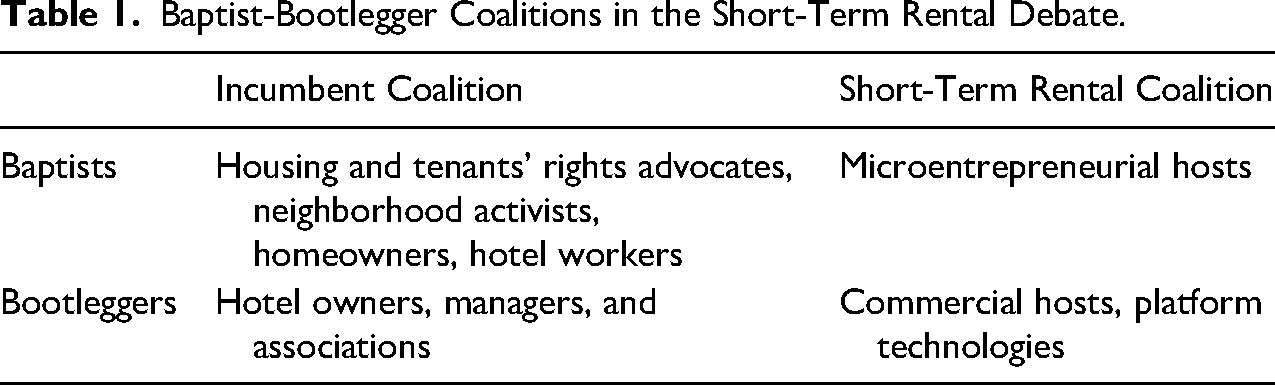
The emergence of platform-facilitated short-term rental markets, thus, reorganizes urban political alliances into competing Baptist-Bootlegger coalitions (see Table 1). Tenants’ rights groups, housing advocates, homeowners’ movements, and labor—representing the moral causes of economic equity and neighborhood preservation—have joined hotel corporations in an incumbent coalition. A competing short-term rental coalition involves commercial hosts and platforms who, having narrow economic interests, seek moral cover with microentrepreneurial hosts, who uphold a narrative of local exchange, social connection, and economic mobility.
Baptist-Bootlegger Coalitions in the Short-Term Rental Debate.
Los Angeles as a Battleground for Urban Political Coalitions
Los Angeles, with an extensive history of political organizing around land-use policies, is a good “testing ground” (Milkman 2006, 5) for short-term rental politics. Throughout the twentieth century, business interests and bureaucrats created a policy regime focused on revitalizing downtown, and building apartments in wealthy neighborhoods to accommodate the city's growing population. However, a new regime emerged in the 1980s, when homeowners partnered with small businesses and environmentalists to form anti-growth coalitions that worked to challenge the political influence of commercial developers (Deener, Kogan, and Stuart 2013).
In 2002, in response to local secession movements, the City Council created a neighborhood council system, providing residents a new institutional channel to challenge major development projects, pursue quality-of-life goals, and contentiously debate who represents a community (Deener, Kogan, and Stuart 2013; Purcell 1997). For example, in the coastal Venice neighborhood, disputes within the neighborhood council fractured an earlier partnership of homeowners and progressive activists, with middle-class homeowners blaming activists for local criminal activity and homelessness and activists accusing homeowners of an elite and racist quality-of-life agenda (Deener, Kogan, and Stuart 2013). These neighborhood politics reflect a broader tension in Los Angeles between “haves” (i.e., homeowners and developers) and “have-nots” (i.e., low-income and minority populations) (Whittemore 2012).
The contemporary policy regime arbitrates among these interests in debates about the city's growing inequality, particularly around housing (Whittemore 2012). While the influential neighborhood councils are whiter and wealthier than the communities they are intended to represent, low-wage immigrant workers, through the local labor movement and other progressive organizations, are increasingly powerful (Milkman 2006; Milkman, Bloom, and Narro 2010; Musso et al. 2007). These changing dynamics, and a growing consensus that housing prices are unaffordable, have made city officials accountable for challenging anti-growth advocates and creating new housing opportunities (Whittemore 2012). Through state mandates, ballot initiatives, and updates to the city's general plan, the city has upzoned more than 1,400 acres, encouraged affordable housing development along transit corridors, and streamlined permitting, all in the name of creating more housing (Gabbe 2019).
The rise of platforms like Airbnb dramatically shifted these alliances once again. The growth of short-term rentals transformed the historical tension between once-distinct commercial development, homeowner, and labor interests into new cross-cutting alliances that pit corporation against corporation, worker against worker, and neighbor against neighbor. Amid these competing coalitions, policymakers face mounting pressure to address high housing prices and high rates of homelessness, yet are still accountable to commercial real estate and homeowners’ movements. This continuously evolving balance of political power makes Los Angeles a compelling site for examining what kinds of Baptist-Bootlegger strategies are successful.
Analytic Approach
I used a comparative approach that emphasize how interests, social action, and bureaucracy form a “totality” or social context (Emigh, Riley, and Ahmed 2016; McMichael 1990). Instead of functionalist explanations that attribute case outcomes to their variation, this approach involved incorporated comparison, analyzing how a case “emerges via comparative analysis of ‘parts’ as moments in a self-forming whole” (McMichael 1990, 386). While typically used to analyze nation-states, this approach can be scaled down to the local level, focusing on how interacting social units produce a historical conjuncture (Besek 2020). Thus, I compared how local policymakers and two competing coalitions (i.e., three social units), in the context of one another, produced Los Angeles's 2018 short-term rental ordinance (i.e., the conjuncture).
I first focused on the incumbent coalition (see Table 1) that, as short-term rentals became increasingly popular in Los Angeles, prompted the regulatory process. Using a database of Los Angeles listings I collected from Airbnb.com in 2016, I analyzed the extent to which different kinds of short-term renting (e.g., commercial, small-scale) were impacting the city. I complemented these data with media reports and city documents on pending legislation. In the summer of 2015, following a Council motion to draft an ordinance, I interviewed Judy Goldman of Keep Neighborhoods First (KNF), an organization heavily involved in influencing the motion. From Goldman's contacts, news media reports, and analysis of over 200 public comment documents from Los Angeles's City Clerk files, I identified 12 more interview participants from the incumbent coalition. Additionally, I analyzed these incumbents’ lobbying expenditures from 2015 to 2018, using the Los Angeles Ethics Commission data interface.
In analyzing the short-term rental coalition (see Table 1), I applied a similar data collection approach, conducting six interviews with key representatives and stakeholders and examining newspaper articles, organizational media, public comments, and lobbying data. Completing interviews with Airbnb representatives was difficult because company employees, as implied in my informal discussions with them, were constrained by nondisclosure agreements. Airbnb has historically been protective of company information, requesting confidentiality and nondisparagement agreements from prospective employees, journalists, and company visitors (Carville 2020; Griffith 2020; Lazzaro 2017). I did, however, interview a former employee, as well as key hosts involved in forming Los Angeles's home-sharing club. I also gleaned the company's corporate strategy by analyzing news reports, company documents and public relations campaigns, and by attending the Airbnb Open conference in Los Angeles in 2016. I triangulated these data with alternative narratives from news media and interviews.
Finally, I collected and analyzed data on the Los Angeles policymaking bureaucracy to understand how the efforts of the incumbent coalition, the short-term rental coalition, and policymakers converged to create the short-term rental ordinance. These data included the City Clerk policy archive, local news media, eight interviews I conducted with city planners, councilmember staff, and neighborhood councilmembers, and notes from my observation of city hearings over a three-year period.
I compared each coalition's goals—gleaned from interview answers and public comments about their aspirations for the policy—with the final ordinance produced by policymakers. I also analyzed the comments from city officials and policymakers to identify biases toward either coalition. Finally, I contextualized the policy outcome with a larger dataset on short-term rental regulation (see details of this analysis in the supplement). I noticed that the Los Angeles policy—in restricting the scale of short-term rentals through a primary residence requirement and cap on booked days, and requiring some accountability from platforms in enforcement—was among a subset of American cities with the most restrictive regulations (see Table S1 in the supplement). This analysis confirmed my qualitative findings from the case study: that in the context of the two coalitions, the final policy was more acquiescent to incumbents.
Limitations
The analysis presented in this article has some limitations. First, as a case study of the policymaking process for one policy and city, it cannot definitively argue that Baptist-Bootlegger strategies determine regulatory outcomes. Instead, as an effort in theory elaboration (Emigh 1997; Ragin and Becker 1992; Steinmetz 2004), I suggest certain strategies that, relative to each other and their context, have varying levels of success. In my examination of other ordinances in the United States, I found that Los Angeles's policy was part of a subset of 26 major American cities that, along with having high housing costs and a high number of Airbnb listings, had the most restrictive regulations (see Table S1 in the supplement). I expect that some of the findings from Los Angeles may illuminate some policy outcomes in these other cities.
Additionally, even though I consider Los Angeles among the most restrictive American short-term rental policies, this work does not analyze whether these ordinances actually, effectively, or significantly curbed short-term rental practices. Compared to other municipal ordinances, Los Angeles was among an even smaller subset of eleven cities that also attempted to include enforcement mechanisms; however, even with these provisions, the policy's ability to preserve housing stock or seriously scale back short-term rental exchanges remains unclear and contentiously debated. Rather than arbitrate on these debates, I limit the scope of analysis to my central research question, assessing the ways the two coalitions’ strategies did or did not affect the policy as they hoped to with their stated political agenda. Such a discussion focuses on each coalition's actions to achieve what they perceived to be an effective policy, leaving the analysis of the policy's actual efficacy and effects for future research.
The Incumbent Coalition
Analyses of short-term rental listings, public comments, media reports, and interviews with various incumbent groups, indicate that incumbents overcame their tenuous history in opposition to working toward a shared goal of short-term rental regulation. While Keep Neighborhoods First (KNF) loosely coordinated the coalition's activities, incumbents otherwise articulated their grievances quite separately. The Baptists in this coalition (i.e., housing and tenants’ rights advocates, neighborhood and homeowners’ associations, and labor unions) worked on research, storytelling, and mobilizing the public that supported their moral appeals while Bootleggers (i.e., hotels) used their resources to lobby privately. This division of labor preserved Baptists’ moral authenticity, allowing them to separate their work from economic interests and activities. Furthermore, each coalition member leveraged their institutional authenticity, covering a policymaking domain in which they were experts.
Shared Stakes: The Threat of Short-Term Rentals
Prior to the emergence of technology platforms like Airbnb and HomeAway/VRBO, short-term rentals could only operate in areas of the city zoned for commercial use and were required to apply for a business license. In residential zones, leasing housing units for less than 30 days was explicitly prohibited. However, following Airbnb's launch in 2008, many residents and businesses began defying these regulations, using the platform to advertise vacation rentals (i.e., rentals of entire units) and home-shares (i.e., room rentals). According to my analysis of Airbnb listings from 2016, neighborhoods that were traditionally known for their residential character and lacking in hotel infrastructure—such as Venice, the Hollywood Hills, and Silver Lake—became centers for these listings, with more than 70% of listings representing vacation rentals. A large number of listings in these areas involved commercial operators advertising multiple units with long-term housing potential.
This demand for housing units and commercial growth created grievances among hotel stakeholders, homeowners, and housing advocates. While there is not definitive evidence that short-term rentals co-opted hotels’ customers (Zervas, Proserpio, and Byers 2017), both corporate and boutique hotel stakeholders felt it was unfair that short-term rental platforms and hosts were not subject to the same taxation and safety standards as hotels. 2 The hotel labor force also felt threatened, with worries that a vulnerable hotel industry might lead to layoffs or reduced wages. These low-income, largely Latinx workers shared the anxieties of housing advocates, worrying that short-term rentals would not only affect their work but also their already precarious housing situations. 3
Homeowners in largely single-family neighborhoods (e.g., Bel Air and the Hollywood Hills), on the other hand, were concerned with the increased transiency and foot traffic caused by short-term rentals. These residents noted the rapid influx of tourists into their neighborhoods and the emergence of “party houses,” where tourists renting large mansions in the hills would host extravagant parties (Van Dyke 2015). 4 In their view, the growth of short-term rentals in residential neighborhoods was a threat to neighborhood safety and quality of life.
In 2013, Judy Goldman, a psychologist and longtime homeowner in Venice, channeled the grievances of both housing advocates and homeowners, arguing that short-term rentals threatened neighborhood quality and, through gentrification and transience, exacerbated an already-rampant housing crisis. Writing an impassioned plea to Councilmember Mike Bonin's office, she asked the city to address the parking, trash, noise nuisances, and “illegal hotels” that had been created by the increased short-term rental activity. This initial effort led to the creation of KNF, which, modeled after Bonin's campaign slogan “Neighborhoods First,” was organized to challenge short-term rentals in Los Angeles. 5
Political Strategy and Organization
KNF was the touchstone through which incumbents in housing, neighborhoods, and hotels came together. By 2016, KNF was meeting regularly with the local hotel labor union, well-established housing and progressive organizations, hotel trade associations, homeowners, and neighborhood activists. Together, the coalition articulated grievances about the quality of life, housing, and fair market standards by dividing the political labor based on each organization's particular expertise and skills.
For example, hotel stakeholders provided support with lobbying and valuable institutional knowledge about city politics. Hotel trade associations and unions constituted the majority (around 70%) of the coalition's total lobbying expenditures. 6 Goldman also mentioned in her interview that a hotel representative advised KNF to hire a lobbyist; she was initially hesitant but followed the advice shortly thereafter. Additionally, she commented on the mutually symbiotic relationship between KNF and hotel industry advocates, stating “[I was] happy to have us put forward the housing issue for them. And I’ve been happy to have them because they’ve got a team of lawyers who can look at things and interpret things that I don’t really understand, some of the verbiage.” 7 In her view, hotels’ valuable legal expertise helped the coalition navigate the proposed legislation.
Hotel industry professionals were also already deeply embedded in city politics. Rachel Torres of the hotel labor union UniteHere! remarked on hotels’ unique and extensive knowledge of land-use policy, saying that, because every new hotel development has to undergo environmental and community review, hotels spend “millions of dollars and many years” hiring lawyers and lobbyists to navigate the process. 8 Just prior to the onset of short-term rental politics, hotel associations had already been lobbying city hall regarding a minimum wage ordinance, standing in opposition to hotel workers. These adversaries, however, set aside their differences, using their distinct sets of expertise to collaborate on the short-term rental ordinance. 9
Through the coalition, UniteHere! drew on their connections and skills in community organizing to connect different organizations with a mutual interest in regulating short-term rentals. UniteHere! fiscally sponsors Los Angeles Alliance for a New Economy (LAANE), a policy planning organization focused on economic and labor issues. Recruited by the union and KNF, LAANE wrote reports documenting the prevalence of short-term rentals and their effects on housing in Los Angeles (Samaan 2015b; 2015a). UniteHere! also had a relationship with the housing and economic justice group Strategic Actions for a Just Economy, which joined the coalition. The union also mobilized its membership to speak at public hearings on the ordinance; however, hotel workers’ narratives were sometimes met with accusations they were being paid to show up. 10 Torres and several other members of the coalition thus saw KNF as the central face and leader of the campaign, with other organizations like the union playing to their specific strengths. In describing the coalition, she said LAANE was the research arm, UniteHere! was a coalition-builder, and KNF was “straight up grassroots.” 11
To be sure, KNF and other housing organizations, in advancing the moral causes of preserving neighborhood character and affordable housing, were more often perceived as authentic. Members of these groups had compelling narratives about being evicted so that their landlord could rent their unit on Airbnb. KNF also produced a video entitled “Where have all the neighbors gone?,” documenting egregious cases of hosts renting out whole apartment buildings online, which they aired at a Venice Neighborhood Council meeting. They also kept extensive records on these buildings, sharing them in meetings with the city attorney and organizing protests outside the buildings. 12 With compelling narratives, data, and public actions, KNF and housing advocates argued that short-term rentals had a deleterious effect on neighborhoods and housing.
The Bootleggers in the coalition—the hotels—allowed their Baptist partners moral authenticity by taking a more backstage role. A representative of the hotel trade association acknowledged the futility of having hotel leaders make a public case for short-term rental regulation, suggesting that their economic stakes would make any claims not sound “authentic or genuine”; he followed, “frankly we’re in Los Angeles: I have the benefit of having advocates from those areas to speak to those issues.” 13 Because community-based organizations represented local residents lacking a direct economic stake in short-term rental regulation, they conveyed a more authentic narrative about the broader benefits regulations could have for the community.
The incumbent coalition thus leveraged its institutional authenticity by playing to its individual policymaking expertise. Neighborhood, housing, and economic justice groups, as the Baptists in the coalition, made the moral case that short-term rentals were threatening housing supply and neighborhood quality through compelling storytelling and research. While labor unions, as Baptists representing the moral cause of economic equity, also engaged in grassroots organizing, their connections to the hotel industry and other groups made them more effective as coalition-builders. Recognizing the strengths of their civic counterparts, hotel leaders took a background role, pouring resources into less visible political activities such as lobbying.
The Short-Term Rental Coalition
The short-term rental coalition consisted of hosts organized through affiliate groups of the two major short-term rental platforms, Airbnb and HomeAway/VRBO. In my analysis of news media, research reports, advertising, and interviews with hosts and organizers, I found that Airbnb tried to present an image of short-term renting that involved a diverse, middle-class, and grassroots community. At the same time, the company distanced itself from HomeAway/VRBO, which was associated with more professionalized forms of short-term renting. This organizing framework, which combined Baptist and Bootlegger interests under a hybrid “Airbnb Citizen” identity that attempted to obfuscate economically motivated interests, posed challenges in articulating a clear policy vision.
Shared Stakes: The Threat of Regulation
By the time the debate over a Los Angeles ordinance began, short-term rental platforms and hosts already recognized the common threat that regulation would pose for operating short-term rentals and were organizing together in various U.S. municipalities. In 2014, San Francisco, Airbnb's headquarters and another city with high housing costs, was the first major city to pass an ordinance regulating short-term rental platform exchanges. Recognizing the threat that such regulations would pose to their bottom line, Airbnb, with its competitor HomeAway/VRBO, responded with a lawsuit in 2016 (Conger 2016). The two companies also had several ongoing lawsuits against other municipalities, as part of a political strategy for influencing regulations. When Los Angeles's neighboring city Santa Monica banned vacation rentals in 2015, the platforms filed a lawsuit that eventually reached a federal appeals court (Dolan 2019; Nguyen 2019). The two companies were also involved in contentious lawsuits with the cities of Boston, Miami, and New York over providing host data to municipal enforcement agencies (Dolan 2019; Martineau 2019).
However, as Airbnb began preparing for an IPO and faced increased public scrutiny, the company shifted toward settling these lawsuits, wanting to convey a narrative of cooperation more consistent with its organizational identity (Alba 2017; Griswold 2016). In 2015, during a ballot proposition campaign that would have further restricted San Francisco short-term rentals, Airbnb came under fire for tone-deaf advertisements (Griswold 2015a). Despite this flack, however, the company mobilized public opinion to defeat the proposition, attributing the victory to a middle-class movement of home-sharing supporters (Griswold 2015b). After this success, Airbnb replicated the “home-sharing club” campaign in other cities, including Los Angeles.
Political Strategy and Organization
While the threat of a lawsuit loomed in negotiations, Airbnb's approach in Los Angeles largely involved mobilizing hosts and private lobbying efforts at city hall. In 2015, Airbnb launched its 100 Club plan and Airbnb Citizen website, modeling the successes of the San Francisco ballot campaign (van Doorn 2020). In articulating the vision for the clubs, Airbnb's head of global policy framed them as entirely grassroots, likening them to previous labor movements that achieved protections for the American middle class (Lehane 2015). Los Angeles was among the select cities where Airbnb planned policy support for its hosts, including training and advice. However, Lehane asserted that the clubs would be “independent and free to make their own decisions” (Lehane 2015).
Airbnb also hired several “community organizers,” to mobilize hosts in Los Angeles. In 2016, the company hired a former labor organizer with connections to city hall 14 to lead policy efforts in Southern California. These efforts included notifying hosts of public hearings and helping them frame their narratives for policymakers. Commercial hosts were often excluded in order to present “a more benign narrative” (Yates 2021, 5). Kathrina Abrot, a former Airbnb organizer in Los Angeles, described her responsibilities, stating, “I didn’t do anything. I didn’t explain anything. I just provided some of the … I helped articulate the messaging.” 15 Abrot said her role was to help organize hosts so “they would know exactly what to do” and leverage their narratives to resonate with councilmembers. Like Lehane, she emphasized the grassroots nature of this work, reiterating Airbnb's background role.
This effort also included lobbying at city hall and public relations campaigns. During ordinance deliberations, Airbnb spent $2.9 million dollars on lobbying, nearly three times more than the entire incumbent coalition and 10 times more than HomeAway/VRBO. 16 Most of these expenditures ($1.7 million) were spent on research and advertising. Advertisements featured a diverse, middle-class community of hosts explaining how home-sharing helped them stay economically afloat (Barragan 2016). In 2014, Airbnb also released a report arguing that it had generated $312 million in revenue for the city, supported 2,600 jobs, reduced energy use, water use, and emissions, and cultivated meaningful social connections (Airbnb 2014). Through this storytelling and research, Airbnb tried to elevate a positive image of home-sharing to policymakers.
At the same time, other short-term rental platforms focused on lobbying on behalf of commercial hosts. The less popular but more veteran HomeAway/VRBO consisted almost entirely of vacation rentals, and thus, were concerned about regulations that would prohibit rentals of entire units. Along with another platform that largely represented commercial hosts, AJJK Inc. (Wheatley 2018), they spent close to half a million dollars on lobbying. 17 Additionally, HomeAway/VRBO underwrote the efforts of the Los Angeles Short-Term Rental Alliance (LASTRA), 18 a group that eventually dissolved before the passage of the ordinance.
LASTRA also represented hosts, but unlike Airbnb, more staunchly emphasized commercial hosts’ interests. This group also leveraged its membership to mobilize hosts and operators to show up at Council meetings and write letters. Representatives from the organization conveyed that short-term rental critics were actually Not-In-My-Backyard (NIMBY) activists, suggesting that the activists opposing short-term rentals in the name of housing, hypocritically, would also oppose any large-scale housing development. In my interview with the Executive Director, he mentioned that he aspired to work with Airbnb more closely to create a “common and unified voice.” 19 However, he noted that Airbnb was concentrating on community organizing efforts, preventing a more cohesive coalition.
While Airbnb was working with vacation rental platforms like HomeAway/VRBO on lawsuits throughout the United States, there was a tension between the two companies, and their hosts, when it came to public advocacy in Los Angeles. As Abrot described:
20
[HomeAway/VRBO's] messaging … has nothing to do with community …. It's business-minded … [At hearings,] you would have Airbnb hosts, and then you would have these companies that are representing commercial properties … their messaging would be completely off … that they were stealing units off the market … [Airbnb] always made sure to separate itself from vacation homes.
In contrast to the incumbent coalition, however, this coalition of Baptists and Bootleggers did not fully separate their efforts to articulate distinct moral and economic claims. As Bootleggers, Airbnb could have worked more closely with other platforms, strictly devoting their resources to lobbying, and emphasizing the lost tax revenues from the proposed legislation, as they had in previous campaigns. This strategy would have allowed their hosts, as Baptists, to advance their own moral argument, emphasizing economic justice, community solidarity, and the “NIMBY”-ist approach of their opponents. However, Airbnb instead played a visible and active role in organizing hosts. This approach would eventually backfire with policymakers, who could not ignore that their moral claims were so closely linked with narrow economic interests.
The Policymaking Process
The two coalitions’ efforts converged during policymaking deliberations in Los Angeles from 2015 to 2018. My analysis of public documents, news media, public hearings, and interviews with city officials and neighborhood councils, suggests that policymakers, under pressure to address the city's housing and homelessness crises, found the incumbent coalition's arguments more persuasive. As such, they created a policy framework for short-term rentals that reflected mutual housing- and neighborhood-preservation goals. While the short-term rental coalition did negotiate some lenient restrictions, particularly on a cap that would have affected microentrepreneurial hosts, policymakers often viewed their arguments with skepticism.
The Policymaking Bureaucracy
In June 2015, Councilmembers Herb Wesson (Council District 10) and Mike Bonin (CD3) motioned for the city to begin looking into regulating short-term rentals. City officials involved in this first stage credited KNF and Venice residents for prompting the motion with their early campaign against short-term rentals. 21 This motion initiated an extended process that involved several municipal bodies and took over three years to legislate (see Figure 1).
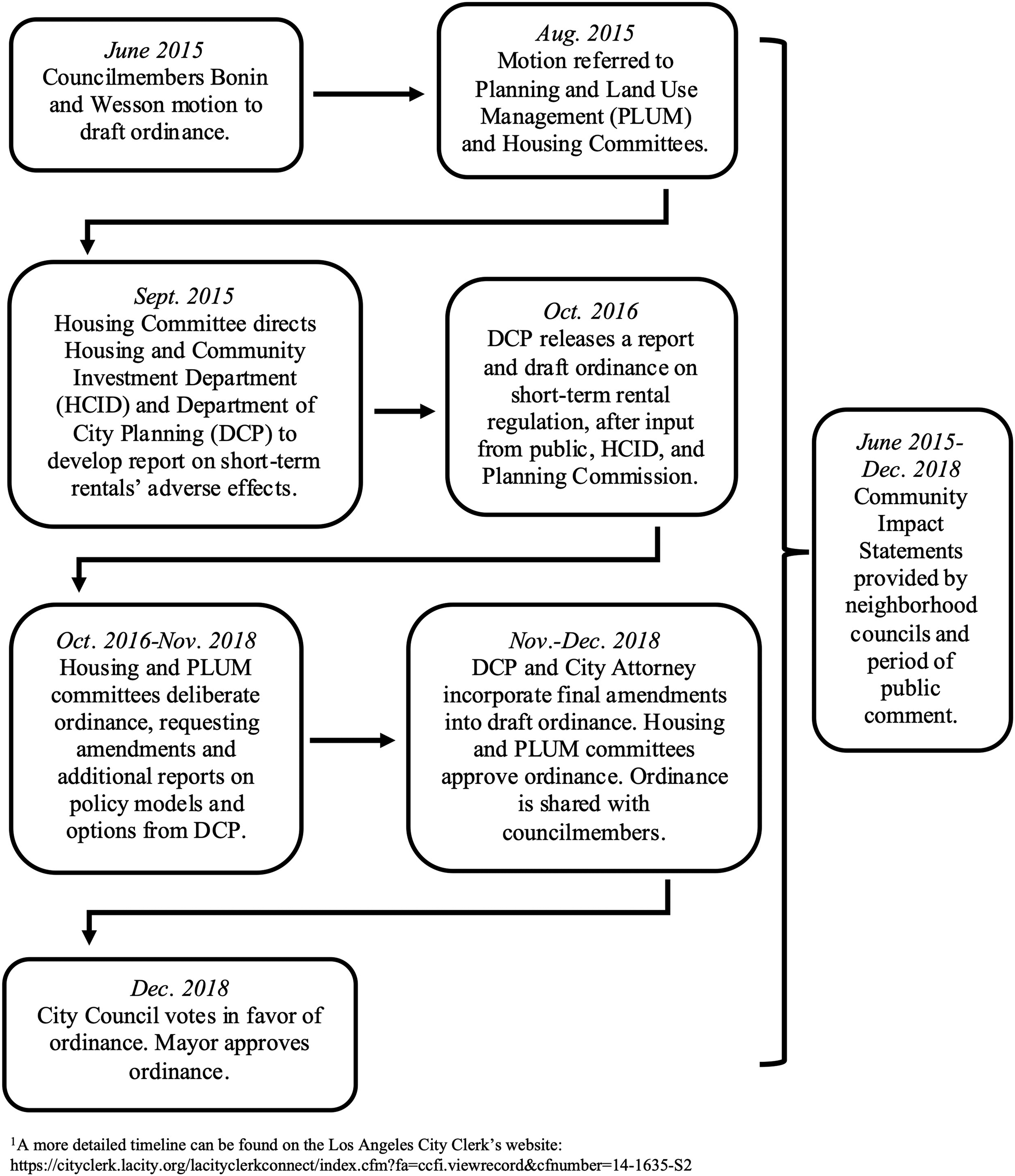
General Timeline1 of short-term rental policymaking, Los Angeles, 2015–2018.
The Department of City Planning (DCP), with support from the City Attorney's office, Planning Commission, Housing and Community Investment Department, and Office of Budget and Finance conducted research and drafted four versions of the ordinance. They also collaborated with CD10 and CD3 staff. These district offices, along with others from highly affected districts, such as West Los Angeles councilman Paul Koretz's CD5, faced intense pressure from constituents about neighborhood transiency and unaffordable housing, and generally supported more restrictive regulations. Throughout the policymaking process, councilmembers from these districts often publicly pressed planning staff and the rest of the council to move the legislation forward.
The Planning and Land Use Management (PLUM) committee also compelled DCP to hold community hearings. 22 These hearings convened citizens in different neighborhoods to speak on the issue of short-term rentals. While the incumbent coalition was well represented at these hearings, especially at meetings where UniteHere! union members were present, more often, they overwhelmingly consisted of Airbnb hosts, who often attended multiple meetings. A city official present at the listening sessions described their frustration at seeing the same hosts at each, saying “we actually were trying to have the same meeting in different neighborhoods, so you didn’t have to show up to each one … just come to the most convenient one, don’t come say your story three times.” 23 As such, these meetings often lasted for hours, with an overflow room of speakers waiting for their turn.
Los Angeles's neighborhood councils also provided input. When legislation is under consideration at city hall, neighborhood councils often submit a Community Impact Statement, which outlines a neighborhood's official position. Even though Airbnb mobilized extensively at neighborhood council meetings and members disagreed about particular regulatory priorities, most neighborhood councils supported either enforcing the existing residential ban on short-term rentals or imposing strict regulations that would curb commercial short-term rentals, with only two Community Impact Statements explicitly taking a pro-market stance. Neighborhood councils, thus, were largely aligned with the incumbent coalition.
Finally, the city's PLUM and Housing committees held hearings to deliberate the regulations. Like in other hearings, members of both coalitions presented their cases. Several members, including Marqueece Harris-Dawson (CD8), Jose Huizar (CD14), Gilbert Cedillo (CD1), and Curren Price (CD9), overlapped on both committees and therefore had a great deal of input. Huizar and PLUM member Mitch Englander (CD12) were distinctly more pro-market in their stances; both were under federal investigation for “pay-to-play” schemes with corporations, some of which involved Airbnb (Alpert Reyes and Zahniser 2019; Denkmann 2020). Other committee members, such as Harris-Dawson, Cedillo, and PLUM member Bob Blumenfield (CD3) appeared more neutral, trying to balance the concerns of “mom and pop” hosts with concerns about neighborhood quality and housing stock.
Policymaking Priorities
In my analysis of ordinances passed between 2009 and 2020 (see Table S1 in the supplement), it is clear that many cities were struggling with bans on short-term rentals that were outdated and unenforceable, given that platform technologies like Airbnb had enabled short-term rentals as a widespread and commonplace residential use. Cities that did not institute new regulations following the emergence of Airbnb were effectively acknowledging that short-term rentals did not pose an immediate policy problem and were, either implicitly or explicitly, allowing their use. Cities that did enact regulations during this time period were changing laws to incorporate these rentals into a legitimate policy framework that attempted to address their problematic effects on neighborhoods and housing.
In Los Angeles, policymakers fell into the latter category, agreeing that the existing city code on short-term rentals was unenforceable given the rampant growth of platform technologies like Airbnb. The code at the time outlined short-term rentals as an illegal residential use but did not specify ways for collecting adequate evidence to prosecute such cases. Committee members, DCP staff, and the city attorney discussed how current regulations had “no teeth, or no legal basis, by which to bring [short-term rental operators] into compliance” and that all the city could do with a violation was “make a suggestion that they stop.” 24 In particular, the city could not prosecute operators who converted multi-family units for illegal short-term rental use and thus degraded the long-term housing stock. Policymakers wanted to be able to create a “balanced” ordinance with mechanisms to prosecute commercial short-term rental operations while also allowing residents to host on a limited scale. They generally agreed that the first priority was protecting valuable housing stock, an issue that DCP took an especially strong position on. 25
Matthew Glesne, the primary planner on the project, emphasized that DCP was in fact wedded to this priority, as outlined in the general plan for the city. Glesne described how the city's general plan dictated policy priorities such as protecting the long-term housing stock, conserving single-family neighborhoods, and preventing commercial use in residential areas, giving them a “strong policy rationale to be skeptical” of short-term rental use. 26 However, DCP also believed these priorities still allowed some leniency for hosts wanting to rent a spare room and earn extra money.
With these goals, plus Council's direction and input from other city entities (see Figure 1 and glossary in the supplement), DCP created a regulatory framework. Initially, they were tasked to investigate: (1) a primary residence requirement, permitting short-term use only in residences for which the host could prove they lived there at least six months a year, (2) a prohibition on short-term rentals in units under the Rent-Stabilization Ordinance (RSO) and other affordable housing initiatives, and (3) a restriction on converting residential properties into “Transient Occupancy Residential Structures” or de facto hotels. Later, Council also asked them to explore a cap on the total number of days rented, modeled after San Francisco's ordinance. 27 Additionally, the Planning Commission advised DCP to include a requirement that platforms remove illegal listings and share their data with the city, to help the department with enforcement. 28 While policymakers adjusted these measures’ particularities under pressure from outside stakeholders, the core of the ordinance remained the same throughout the policymaking process. 29
Shared Visions for the City: Coalitions’ Influence on the Final Policy
The ordinance's framework closely resembled the measures favored by the incumbent coalition and neighborhood councils. These groups largely opposed the commercial operation, and except for a few vocal residents and neighborhood councils who wanted bans on all types, were open to home-sharing on a limited scale. Many incumbent groups like KNF would have preferred a 90-day cap on hosting, instead of the 120-day cap that passed, but were pleased that planners had aligned the policy with KNF's recommendations on the primary residence requirement, the RSO restriction, and enforcement through the platform accountability. 30
A city official described how KNF influenced the ordinance by raising “some really legitimate issues about what is a neighborhood for, what are we trying to accommodate?.” Repeating KNF's campaign video slogan, this official demonstrated policymakers’ aligned interest in preserving neighborhood quality, stating “we wanted to really continue that community-centric vibe … people talk about ‘where have all the neighbors gone,’ so that was an issue that sparked concern.” 31 Incumbent influence was also indicated in DCP staff's reports, which drew on findings reported by LAANE in making recommendations. Many of the incumbents’ policy priorities, then, were reflected in the final ordinance.
The short-term rental coalition, on the other hand, was strongly opposed to two key regulations in the ordinance: the primary residence requirement, and requiring platform involvement in enforcement. While Airbnb representatives publicly appeared disinterested by following the lead of hosts, in private meetings with policymakers Airbnb and HomeAway/VRBO representatives argued aggressively against these measures. 32 However, for policymakers, the two measures were nonnegotiable, and the companies did not provide a resonant justification for removing these measures. In DCP's view, both platforms and hosts were understood to represent “economic interests,” and thus DCP took their arguments, as Glesne described, with “a grain of salt.” He also mentioned how they were skeptical of such arguments because they did not see any “average citizens coming out and saying, ‘you know I don’t do Airbnb, but I think it should be widespread and legal for everybody’.” 33
However, in late discussions on the proposed ordinance, councilmembers appeared to be swayed by hosts’ arguments that a cap would limit their ability to stay afloat economically. 34 A housing group representative from the incumbent coalition noted the “overwhelming” persuasiveness of “mom and pops” with councilmembers and some waning enthusiasm for the ordinance. 35 In a signal of this shift, Councilmembers Bob Blumenfield, David Ryu, and Paul Koretz introduced a motion to consider opportunities that would extend the cap to certain hosts. 36 Primary residency would still be required and the default cap on hosting would be 120 days per year, however, hosts who underwent an extensive application process could qualify for an “extended home-sharing” permit for 365 days a year. Glesne noted that DCP staff were not “thrilled” with the motion, insinuating it reflected a councilmember pattern of whimsically “doing things” to appease constituents. 37
The final ordinance passed in December 2018 included this extension option, along with late additions that were favorable to incumbents. These included a prohibition on short-term renting in accessory dwelling units built after 2017, in order to preserve this housing for long-term use, as well as fire and event restrictions to clamp down on “party houses.” The final ordinance was passed unanimously. 38 In passing the legislation, Council agreed that while imperfect, the ordinance worked to reconcile many voices. 39
Los Angeles's passed ordinance, then, largely reflected the incumbent coalition's goals. The short-term rental coalition had some influence in the latter stages of the policymaking process when they emphasized the struggles of “mom and pops.” However, policymakers often responded to the short-term rental coalition's arguments with skepticism, perceiving hosts’ and platforms’ motives as strictly economic. Policymakers instead echoed the incumbent coalition's policy rationales and preferences, making arguments about the effect of short-term rentals on local housing stock and neighborhoods when creating a short-term rental policy that cracked down on commercial operation.
Discussion and Conclusion
The emergence of Airbnb and short-term rental technologies in the 2000s brought about a rapid influx of new short-term rental listings, prompting a reorganization of local civic alliances and policymaking frameworks. Existing research illuminates the disruptive effects of these markets on urban politics and governance, highlighting the ways incumbent groups and platform users become politically organized, and the various policy approaches to regulation (e.g., Aguilera, Artioli, and Colomb 2021; Nieuwland and van Melik 2020; van Doorn 2020). However, the literature has yet to fully tease out the alliances that form from once opposed economic and civic interests, and how their political strategies resonate in policymaking contexts. Incorporating the literature on urban governance and blended “Baptist-Bootlegger” coalitions, I examined how these partnerships can have varying levels of success based on how they organize vis-à-vis policymakers’ goals.
In the case of short-term rental regulation in Los Angeles, two Baptist-Bootlegger coalitions formed: an incumbent coalition of hotel, housing, and neighborhood advocates and a short-term rental coalition of hosts and platform companies. However, I argue that the coalitions were not equally successful. While the incumbent coalition leveraged its moral and institutional authenticity to propose solutions that emphasized shared goals with policymakers, the short-term rental coalition struggled with problems of hybridity (Kovács and Hannan 2010; Walker and Stepick 2020; Zuckerman 1999).
The Baptists in the incumbent coalition, including neighborhood, housing, and labor groups, effectively connected short-term rentals to the city's problems with housing, homelessness, and neighborhood transiency. They argued that commercial operators of short-term rentals were diminishing the city's valuable housing stock, leading to residential displacement and fractured neighborhood character. Furthermore, they highlighted the disruption and danger of “party houses” and illegal hotels in residential neighborhoods. The coalition's Bootleggers—the hotel industry—recognized the value in having their Baptist partners make this moral argument and provided lobbying and legal support. Through this arms-length framework, the Baptists in the coalition appeared disconnected from the narrow economic interests of Bootleggers, allowing them “moral authenticity” (Carroll and Wheaton 2009) with policymakers.
Beyond claims-making, the incumbent coalition's clear division of labor also leveraged each organization's individual strengths. Each coalition member had a distinct role and purpose: mobilizing (e.g., housing and neighborhood groups), lobbying (e.g., hotels), research (e.g., LAANE), and coalition-building (e.g., UniteHere!). Excepting the newly formed KNF, which specifically emerged from the short-term rental issue, these organizations had established relationships with policymakers on housing and development issues. This history and division of labor allowed the coalition “institutional authenticity,” with policymakers recognizing each group's policy domain (Levitsky 2007; Walker and Stepick 2020). With this strategy, the incumbent coalition effectively aligned its goals with policymakers’ own priorities.
In contrast, the short-term rental coalition's organizational strategy created difficulties. The two competing platforms, Homeaway/VRBO and Airbnb, while previously collaborative in other cities, did not work together as Bootleggers in Los Angeles to put political pressure on policymakers about lost tax revenue for the city. Instead, each company decided to coordinate mobilization among their hosts (through LASTRA and the home-sharing clubs). However, this active role in organizing made it hard for policymaking audiences to disassociate moral arguments about middle-class mobility and community solidarity from elite economic motives. This hybrid organizational identity, thus, drew skepticism from policymaking audiences (Kovács and Hannan 2010; Walker and Stepick 2020; Zuckerman 1999), who wanted input from “average citizens.” 40
The short-term rental coalition's strategy, on the one hand, fragmented a potentially powerful coalition of elites, and, on the other, conflated economic and moral agendas in a way that made both platforms and hosts less persuasive overall. Neither company posed solutions for the top concern of policymakers: the possible effect of short-term rentals on long-term housing stock. Airbnb sidelined the issue by touting its “grassroots” operation, 41 an approach that often yields the opposite result: appearing inauthentic and calculated (Walker and Stepick 2020). A more cohesive strategy among the platforms that explicitly acknowledged the economic stakes, such as that adopted by the hotel lobby, could have been more convincing to policymakers who wanted housing solutions and were skeptical of such populist narratives.
Similarly, while the home-sharing clubs were effective in mobilizing hosts and sensitizing them to the political process, policymakers did not consider them as seriously because of their connections with big business (Yates 2021). Because Airbnb explicitly organized hosts for political advocacy, policymakers, and public audiences could not easily discern how their interests may be separate and autonomous from those of the corporation; hosts’ narratives were thus received with a “grain of salt,” 42 even when many of them, like their opponents, struggle with the city's high cost of living. As such, these hosts won an extension on the cap but lost on the RSO restriction that would have allowed more “mom and pop”-style rentals.
Thus, even though the short-term rental coalition devoted significant resources, the final ordinance reflected the vision policymakers shared with the incumbent coalition. The housing crisis, as well as policies on housing and land use that had already been passed, steered policymakers’ agenda priorities to preserving Los Angeles's precious and limited stock of affordable housing. This context provided an opportunity for groups with already-established political power in Los Angeles (Whittemore 2012) to make a case about short-term rentals that were politically popular for councilmembers. While the short-term rental coalition had small achievements, their less-established and less-coordinated political alliance did not achieve enough moral authenticity, and thus moral cover, for policymakers to scale back the ordinance's most severe restrictions.
However, the short-term rental debate in Los Angeles, even after the ordinance's passage, still continues, providing an opportunity for stakeholders to try new strategies. In Los Angeles, enforcement continues to be an issue that mobilizes the incumbent coalition (Zahniser 2022). While the number of listings has declined since the policy was enacted, this decline was largely attributable to the Covid-19 pandemic and around a third of overall listings still operate illegally (Wachsmuth 2022), suggesting that the incumbent coalition's goals may have been insufficiently realized. Policymakers are also considering revoking the RSO requirement and drafting a separate ordinance that would have some leniency for hosts to rent a second home (Chandler 2019; City News Service 2019). These developments suggest that there are more opportunities for stakeholders to refine their political strategies and advocate for further policy change.
The short-term rental coalition, in particular, now seems to be attempting the more tacit organizing strategy that characterized the incumbent coalition. In its own business model, Airbnb is more explicitly consolidating around Bootlegger interests, incorporating hotel bookings and more standardized, large-scale listings into the platform (Dolnicar and Hardy 2018). The company also seems to have abandoned its Airbnb Citizen and 100 Club initiative, 43 with microentrepreneurial hosts now engaging in more independent policy efforts. For example, in late 2017, a cadre of Los Angeles hosts formed the Homeshare Alliance, 44 which, departing from the Airbnb Citizen model, embraces an organizational identity separate from Airbnb. Future research comparing the outcome of these efforts to the 2015–2018 policymaking process and outcome could yield further insights into Baptist-Bootlegger coalitions’ changing strategies, influence, and efficacy.
Furthermore, there are other interesting alliances in platform economy markets that warrant scholarly attention. In the case of regulation of ride-sharing applications (e.g., Uber, Lyft), drivers, like short-term rental hosts, have often sided with platforms. More recently, however, these drivers, along with gig workers from Instacart and Amazon, are part of a more traditional labor movement challenging the conditions of contractual work. These cases of shifting bedfellows provide promising new directions for expanding scholarly knowledge of markets, politics, and civic engagement.
Supplemental Material
sj-docx-1-uar-10.1177_10780874231162938 - Supplemental material for Sharing Homes and Beds: Baptist-Bootlegger Coalitions and the Politics of Authenticity in the Regulation of Los Angeles's Short-Term Rental Markets
Supplemental material, sj-docx-1-uar-10.1177_10780874231162938 for Sharing Homes and Beds: Baptist-Bootlegger Coalitions and the Politics of Authenticity in the Regulation of Los Angeles's Short-Term Rental Markets by Yotala Oszkay in Urban Affairs Review
Footnotes
Acknowledgments
The author would like to thank Ed Walker, Rebecca Emigh, Eleni Skaperdas, Kyle Nelson, Kevin Shih, Andrew Herman, Johanna Hernandez Perez, Michelle Marinello, Carrie Miller, Caroline Reilly, Gabriel Locke Suchodolski, and David Coles who provided feedback on multiple drafts on this article. Many thanks also to the Movements, Organizations, and Markets at UCLA, ASA Section on Urban Sociology, and the editors and reviewers at Urban Affairs Review for their very helpful comments. Funding for the research was provided by the Haynes Foundation Dissertation Fellowship and NSF Doctoral Dissertation Research Improvement Award (Award Number: 1801745).
Declaration of Conflicting Interests
The author(s) declared no potential conflicts of interest with respect to the research, authorship, and/or publication of this article.
Funding
The author(s) disclosed receipt of the following financial support for the research, authorship, and/or publication of this article. This work was supported by the Haynes Lindley Doctoral Dissertation Fellowship and NSF Doctoral Dissertation Research Improvement Award (Award Number: 1801745).

Supplemental Material
Supplemental material for this article is available online.
Notes
Author Biography
References
Supplementary Material
Please find the following supplemental material available below.
For Open Access articles published under a Creative Commons License, all supplemental material carries the same license as the article it is associated with.
For non-Open Access articles published, all supplemental material carries a non-exclusive license, and permission requests for re-use of supplemental material or any part of supplemental material shall be sent directly to the copyright owner as specified in the copyright notice associated with the article.
