




Abstract
In the digital gig economy, workers generally have limited power and are disadvantaged compared to platform operators, who are usually large technology firms. Workers are often independent contractors rather than employees in this emerging form of work. While beneficial to platform companies, these arrangements place considerable risk on workers. Moreover, the structure of the gig economy presents challenges to traditional labor organizing strategies. To identify strategies used by ridehailing drivers to improve their working conditions and highlight points of intervention for policy makers and labor organizers, we draw upon an analysis of interviews and videos posted by YouTube diarists working for Uber. We find that ridehailing drivers improve their working conditions through business planning, leveraging competition between platforms, building solidarity through social media, and using technology to manage the workplace. We find that drivers favor individualistic strategies and often lack the institutional support and knowledge to benefit more fully from these strategies. We argue that local governments and labor market intermediaries offer the potential to empower ridehailing drivers and reinvigorate interest in collective action through workforce development tools if they build on the strategies these gig workers already use.
Introduction
This article examines the strategies that digital platform workers, Uber and Lyft drivers specifically, use to improve their own working conditions in a precarious workplace that lacks institutions of labor protection and formal collective action. Digital platforms, like Uber, Deliveroo, and other smart phone applications that manage the delivery of services, have grown in popularity over the past decade. These platforms match consumers and workers on a task-by-task basis to produce a labor market defined by the “gig” (Kenney and Zysman, 2016).
Ridehailing applications are one kind of platform that match passengers and drivers for transportation services. In this matching process, platforms manage drivers by distributing rides, overseeing work, and subjecting drivers to more intense competition with an expanding pool of other drivers (Lee et al., 2015). As part of their business model, ridehailing platform firms classify drivers as independent contractors, often as a means to sidestep employment standards and benefits (Rosenblat, 2018). This independent contractor model has been cost-effective for ridehailing platform firms and is often viewed as offering flexibility for both the firms and drivers (Sundararajan, 2016). However, flexibility can be illusory for workers. Ultimately, platforms place significant demands and risks on drivers. While many nations and states are expanding labor rights for ridehailing drivers (Lee, 2021), drivers commonly remain undercompensated resulting in debt, poor health, and exploitation (Ravenelle, 2019; Rosenblat, 2018; Wells, 2019). For local policy makers, not-for-profit organizers and union organizers seeking to balance industry and worker interests, there is value in empowering drivers to campaign for improved workplace conditions.
While legislation by senior levels of government often shapes employment, local organization and activism in industries such as public transit and construction have been effective in raising standards (MacDonald, 2017; Schragger, 2016). This capacity may also apply to vehicle-for-hire services due to its history of local control and regulation. Municipal regulation often includes standards for maximum hours and fare rates (Cooper et al., 2010; Dubal, 2017). In ridehailing, there is a patchwork with respect to the locus of regulatory control with higher levels of governments being responsible in some jurisdictions, and local governments retaining regulatory powers in many others (Collier et al., 2018). Labor, too, has produced examples of local organization, even as international solidarity movements gain momentum (Dolber, 2019a, 2019b; Dubal, 2017, 2019). For example, in New York, cooperation between unions, associations of workers, and municipal staff has resulted in regulations that raise standards for workers (Johnston, 2018). However, studies find that platforms undermine worker solidarity due to high rates of worker turnover and surge pricing (Graham and Anwar, 2019; Wells et al., 2021). Furthermore, there are barriers to worker organization, including the precarious finances and job insecurity faced by drivers (Dubal, 2017, 2019; Hua and Ray, 2018; Ravenelle, 2019; Rosenblat, 2018). This article examines strategies used by drivers to improve their work conditions to identify challenges and find points of engagement for organizing local labor, as well as advocate for anchoring local programs and policies to the capabilities and practices of drivers in the gig economy.
One set of tools that may allow local policy makers, activists, and other organizations to improve conditions for drivers working on ridehailing platforms are workforce development tools. Delivered at the local scale by municipalities, government agencies, not-for-profit organizations, and unions, workforce development tools aim to better integrate residents into the workforce. In doing so, they fulfill a range of policy goals, including local economic development, poverty reduction, and public health (Bramwell, 2012; Melendez et al., 2004; Pastor and Carter, 2009; Schrock, 2013). Workforce development programs directed toward diverse participants, including those outside of the workforce, self-employed individuals, and platform workers, can improve working conditions and support more equitable local economies (Harper-Anderson and Gooden, 2016; Holland, 2016; Nugent, 2017). Scholars have criticized workforce development programs where they add new mechanisms of control, which can funnel workers into low-quality jobs (Peck, 1996). For this reason, such programs are desirable only where they empower workers and value skills (Hewitt and Anderson, 2015; Peck, 1996). Therefore, understanding the current interests and capabilities of workers is paramount to developing meaningful tools for worker empowerment. Yet, we still know little in this regard with respect to gig workers, including ridehailing platform drivers. Our article contributes to this understanding.
We begin with a discussion of platform work and worker power, including reviewing the limited evidence on using workforce development programs to address the challenges of gig workers. In order to pinpoint appropriate local workforce development interventions, our analysis focuses on identifying and assessing the strategies drivers use to improve their working conditions. We draw upon in-person interviews with 32 drivers in the Greater Toronto Area (GTA), as well as an analysis of English-language YouTubeTM video commentaries posted by North American drivers working on ridehailing platforms. While a worker-centric approach places less emphasis on the role of industry structure and state/national policies, it reveals an important—and often overlooked—layer of coordination, which may be valuable for encouraging worker engagement and bridging the shift from individual to collective action. We find that ridehailing platform drivers use strategies in four areas to improve their conditions: business planning, leveraging competition between platforms, building solidarity through social media, and applying technology to manage their workplace. We find that workers use individualized, market-based strategies and technological solutions, rather than strategies involving formal organization and collection action. As a result, the benefits of these strategies are not broadly realized. Thus, our article concludes by discussing how local policy makers and others can support greater organization among drivers through workforce development programs and tools.
Platform workers and worker power in the gig economy
While there remains no consensus on the definition of the gig economy, the term normally refers to temporary and informal jobs. Many studies interpret the gig economy as including any alternative work arrangements, including on-call work, temporary contracts, or contracting via temporary staffing agencies (Katz and Krueger, 2018). Other studies define the gig economy more narrowly to refer to jobs mediated by digital platforms (De Stefano, 2016). Typically, digital platforms bring together service providers and customers in proprietary, digital markets where the platform facilitates and monetizes interactions (Kenney and Zysman, 2016). Key to such arrangements is that service providers are treated as independent of the platform rather than as employees; workers are often described as small business owners whose relationship to the platform is governed by terms of service contract (Rosenblat, 2018).
The size of the gig economy is likewise uncertain. A recent study estimates that the gig economy accounts for 16% of the US workforce, with only 0.5% of the labor force working for digital platforms (Katz and Kreuger, 2018). Estimates suggest that ridehailing employment accounts for more than half of all digital platform workers (Farrell et al., 2018). These studies likely underestimate the number of platform workers; many individuals who work on digital platforms do so casually or irregularly (Farrell et al., 2018). However, an analysis of JP Morgan Chase Institute data shows that, in 2018, 4.5% of their US account holders received payments from digital platforms during the previous year (Farrell et al., 2018). In Canada, a recent study found that 9% of GTA residents had worked in the gig economy over the past year with a quarter of those in ridehailing (Block and Hennessy, 2017). Most studies recognize the rapid growth of ridehailing over the past decade (Farrell et al., 2018; Hathaway and Muro, 2016). Undoubtedly, the global COVID-19 pandemic has influenced the trajectory of ridehailing (Rana, 2021), but it remains too soon to evaluate fully the impacts across jurisdictions; such discussion is beyond the scope of this article.
Ridehailing platforms have been the subject of widespread scrutiny, leading to legal and legislative challenges to the contractor model (Paul, 2019). Industry proponents argue that platforms make work opportunities more accessible allowing workers to address immediate financial challenges (Hall and Krueger, 2018; Kumar, 2018). Indeed, Farrell et al. (2018) find that platform workers work more hours during months when other sources of income are low. Yet, flexibility can also result in low pay and irregular work (Hua and Ray, 2018; Peck, 1996).
There are concerns about the power imbalances between drivers and digital platforms. Contrary to claims that drivers are independent, platform operators coordinate many aspects of work. While local governments have often structured the traditional taxi industry around training systems, tribunals, and other institutions that coordinate drivers, these systems are largely absent in ridehailing. Consequently, there is a risk that platform firm interests will dominate over local worker or public interests. For instance, in jurisdictions without labor standards for drivers, drivers have no minimum pay or holiday pay based on the time they work and are unpaid between rides (Rosenblat, 2018). Drivers also have no formal protections against arbitrary dismissals or access to programs like workers compensation (Ravenelle, 2019; Rosenblat, 2018; Ticona et al., 2018). Court decisions and legislation has expanded labor protections for platform drivers in countries like France, Spain, and the United Kingdom (Lee, 2021). However, legislation and its implementation through policy remains highly uneven across jurisdictions.
Ridehailing platforms commonly develop and deploy networked tools to control the work. Ridehailing platforms commonly vary fares and rates of pay without sharing information about the formulas or algorithms with drivers. For example, Uber’s route-based pricing uses a range of undisclosed variables to adjust fares and maximize profit (Calo and Rosenblat, 2017; Newcomer, 2017). Organizations like the App Drivers and Couriers Union and Worker Info Exchange in the UK have successfully litigated for greater access to that data for workers (Butler, 2021). However, workers in most jurisdictions have no access to these data and must guess how their actions will influence their earnings (Mohlmann and Zalmanson, 2017). Additionally, the combined disciplinary power of the platform and customer can require that drivers provide all manner of additional services free of charge (e.g., refreshments), place drivers in demeaning and unsafe conditions, or even trick drivers into performing illegal tasks such as distributing narcotics (Ravenelle, 2019; Rosenblat, 2018). Overall, studies reveal the experience of platform drivers to be precarious and unpredictable (Kessler, 2018; Ravenelle, 2019; Ticona et al., 2018; Wells, 2019).
Worker power in the digital gig economy
A key variable in explaining the exploitation of platform workers is their lack of worker power or collective voice (Ravenelle, 2019). In the past, vehicle-for-hire drivers have built worker power based on informal relationships, collective bargaining, and collective action. Studies identify strong informal bonds between drivers that provide mutual protection between co-workers facing unsafe conditions (Hoffman, 2006). And, in some jurisdictions, there is a history of unionization and collective action in the vehicle-for-hire industry beginning at the turn of the 20th century and continuing to the present (Cooper et al., 2010; Dubal, 2017; Mathew, 2008; Wells et al., 2021). Nonetheless, platform drivers have only begun to organize in significant numbers in major centers such as New York and Los Angeles, and organization among platform drivers in the United States and Canada is not widespread (Dolber, 2019a, 2019b; Dubal, 2019; Johnston, 2018). The lack of formal organization is often attributed to the gap between casual and full-time drivers’ interests, as well as competition between workers in the platform marketplace (Dubal, 2019; Hua and Ray, 2018).
Without a strong collective voice or formal organization, there is greater pressure on individual drivers to take measures to improve their own working conditions, maximize their pay, mitigate risks, and limit vulnerabilities. In the past, it has been common for drivers to decline undesirable work, avoid fees, raise fares, and perform other forms of resistance (Dempsey, 1996; Vidich, 1973). When adopted widely, these individual strategies have led to change as they have motivated municipalities to set regulatory standards (Dempsey, 1996). Benkler (2011) identifies strategic actions that individual platform workers can take to improve their conditions, including leveraging competition between platforms, making political demands, and influencing platform policies. Digital tools, such as internet-based discussion boards, work-review listings, and messenger applications, allow individual workers to identify and develop resources that support their work, as well as build solidarity with other workers (Ettlinger, 2017; Harmon and Silberman, 2018; Mohlmann and Zalmanson, 2017; Schoneboom, 2011). In some instances, individualized forms of resistance have led to collective action, such as price fixing strategies (Sweeney, 2019) or wildcat strikes (Foster, 2016). However, we know little about the specific individual strategies and practices of ridehailing platform workers to improve their working conditions, let alone whether these strategies and practices could be “scaled up” to increase worker power and implement collective action to reduce workers’ vulnerability and risk.
Supporting workers and improving working conditions on digital platforms
Several mechanisms could support platform workers and improve their working conditions. Top-down approaches, including the creation of regulations and employment standards are the most obvious source of support for these workers. Certainly, there is evidence that courts and senior levels of government are beginning to demand higher standards of platforms (Lee, 2021). For example, state legislation and judicial rulings in California—the home of several platform firms including Uber and Lyft—set a new test of employment that promised greater protections for platform workers (Paul, 2019). However, platform companies successfully lobbied against California’s regulations and continue to lobby elsewhere (Korosec, 2020), even supporting unionization on the condition of eliminating claims for employee status, thus creating the potential for counterproductive labor power dynamics (Lichtenstein, 2021).
Recalling that local interventions have historically been central to setting standards in the vehicle-for-hire industry, local policies and programs may also play a role in supporting platform workers to the benefit of the local economy. Indeed, programs that support local vehicle-for-hire drivers, where allied with local regulators, have secured benefits for drivers (Dubal, 2017; Johnston, 2018). Local policies do not exhaust the possibilities of activism and are not sufficient to challenge the power of platforms. However, local workforce development efforts can provide tangible targets leading to policies being crafted and adopted by higher levels of government, for instance in the “Fight for US$15” campaign to raise to the minimum wage (Spicer et al., 2020).
More generally, local workforce development policies focus on improving work and labor market conditions, particularly for the most vulnerable. Policies and programs often address broad community goals such as reducing poverty and challenging social exclusion (Bramwell, 2012; Harper-Anderson and Gooden, 2016; Melendez et al., 2004; Pastor and Carter, 2009; Schrock, 2013; Wolf-Powers, 2012). To pursue these goals, workforce development programs coordinate workers and businesses (Fitzgerald 2004; Schrock, 2013), thereby socializing some of the costs, risks, and responsibilities for investment in workers (Fleming, 2017). Scholars have criticized workforce development programs for being more effective at channeling government budgets to private-sector service delivery, rather than achieving substantive benefits for workers (Peck, 1996). Programs have often integrated training and welfare policies forcing workers into any available work without addressing weak labor demand, and thus further burdening workers and destabilizing markets (Peck, 1996; Peck and Theodore, 2000). Worker-led organizations and unions have also used these programs to support workers, define workplace practices, and create ties with the broader local community (Kriechel et al., 2014; Nugent, 2017; Stuart and Huzzard, 2017). As a result, workforce development programs are valued most when they are conceived as tools for the benefit of workers and prioritize careers rather than just filling jobs (Bramwell, 2012; Hewitt and Anderson, 2015).
Local policy makers and other stakeholders have recognized the value of these coordinating and mediating roles and have expanded workforce development programs to pursue goals originating from diverse stakeholders including worker rights organizations, local businesses, and unemployed workers (Fitzgerald, 2004). One emerging focus of workforce development relates to encouraging self-employment and entrepreneurship among low-income and marginalized workers, where vulnerabilities and risks are often acute (Harper-Alexander and Gooden, 2016). In these contexts, workforce development programs provide a mechanism for collective approaches to improving work conditions in areas where formal organization is scarce. This re-orientation of workforce development moves away from building relationships between firms and employees toward building capacity among workers and developing a web of relationships oriented to supporting their small businesses. Such re-orientation aligns well with the dominant characteristics of the gig economy, defined less by employment relationships and more by a series of contracted gigs. Indeed, some local municipalities and not-for-profit organizations have targeted workforce development programs in the gig economy to reduce poverty and to improve outcomes for workers (Kessler, 2018; OEWD, 2019). However, given the relative newness of such programs, there has been limited academic study of these programs Kessler’s (2018) more popular account identified that programs failed to align with participant capabilities. She concludes that local workforce development programs cannot transform the gig economy to tackle problems like poverty. Rather, Kessler’s account suggests that these programs need to develop strategies that align with capabilities of individual gig workers.
Thus, in this article, we identify strategies used by drivers working on ridehailing platforms to inform local and regional policy makers as to potential entry points for programmatic and policy interventions to improve outcomes and working conditions for platform drivers and empower drivers both individually and collectively. An example of these tools in the labor market can be found among emergent labor organizations. Organizations like the Independent Drivers Guild and New York Taxi Workers Alliance provide resources for drivers including education, support in accessing government services, and collective purchasing of protective equipment. These programs develop ties between drivers and encourage a collective orientation to problem solving (Johnston and Land-Kazlauskas, 2019). These programs are, therefore, both an end in themselves and a means of building collective power.
Research data and methods
To gain an understanding of the strategies that platform drivers use to improve their working conditions, improve pay, reduce risk, and mitigate vulnerabilities our study draws upon three sources of data. First, we analyzed video logs (vlogs) by individuals (herein referred to as diarists) who drive or have driven with a ridehailing platform. Vlogs, posted on YouTube, offer insights into the experiences of drivers. Second, we use insights gleaned from a survey of these diarists, which probed the personal perspective of these drivers and assessed the extent to which drivers use particular strategies to improve their work conditions and reduce risk. Finally, we conducted in-person, semi-structured interviews with platform drivers. Such an approach is limited to the insights generated by individual users rather than providing a broader structural account of the industry; however, it does generate insights into how individuals interact with these larger structures.
Our analysis proceeded as follows. We analyzed videos from diarists to reveal strategies that drivers use to improve their workplace and reduce risk. Qualitative analysis of videos posted to online platforms, such as YouTube, has become increasingly common in social science research as it provides extensive, rich and in-depth data on various phenomena (Snelson, 2015, 2016; Vergani and Zuev, 2013; Wesch, 2008). Using the YouTube search algorithm and functions, we limited our search to diarists who were English-speaking, based in North America, and active within the 12-month period between March 2017 and March 2018. This allowed us to identify 127 diarists who were vlogging about ridehailing. Due to the amount of video footage associated with these diarists and the time required to view and analyze this content, we selected a sample of videos based on their relevance to working on ridehailing platforms, as well as to maximize topic coverage. Drivers were located across many different geographic settings, including the largest urban centers in Canada and the United States. While a detailed regional breakdown would provide additional insight into the role of specific local rules and regulations, such data were not available. In total, we reviewed 213 videos from 27 diarists constituting over 26 hours of video footage. Once collected, videos were downloaded, viewed, and coded by theme using NVivo software (Braun and Clarke, 2006; Guest et al., 2014). This included two full viewings of each video to identify the types and frequency of different strategies used by drivers to improve their working conditions.
Vlogs made by diarists normally include video footage where an individual, usually alone, speaks directly to the camera at close proximity. Vlogs have been described as conversational, “casual, close-up and uncut” videos that use a low fidelity videographic style to encourage realism, intimacy, and authenticity, whether purposefully or not (Werner, 2012: 8; see also Burgess and Green, 2009; Wesch, 2008). This style can appear to give viewers access to an unfiltered view of the diarist’s life; however, the literature on videographic analysis advises careful scrutiny about both the explicit and implicit content of the videos (Pace, 2012; Rose, 2001). Careful scrutiny revealed that diarists might have financial incentive to produce videos through a “dual career” on both ridehailing and YouTube platforms (Chan, 2019). Diarists earn financial rewards from recruiting people to the Uber and Lyft platforms and from advertising on their YouTube channel. For the most part, diarists did not hide this commercial relationship and took steps to maintain their credibility by showing screen shots of their phones and ridehailing applications and by performing critiques of the ridehailing platforms from the worker’s perspective. As diarist Your Personal Driver (2018) argues “Would I do an Uber commercial? Of course... You don’t think I make money from advertising? This video is monetized… [but] Uber will never ever ask me to do a video because I keep it real on this channel and I say that there are a lot of things on Uber that suck...”.
To understand this dynamic and probe the possibility that diarists could mislead viewers for their own benefit, we collected two sets of additional data using survey instruments to triangulate the findings of our video analysis.
First, we conducted a survey that we sent to all of the identified diarists (127). We distributed the survey via email and the YouTube channel messaging board, yielding a 24% response rate (30 responses). While diarists could potentially earn more from YouTube than from driving, our results indicated that the majority of diarists earned less from YouTube than driving. Moreover, as we will discuss in more detail, our survey results corroborate the findings from our video analysis. Taken together, we are confident that our analysis captures the actual strategies used by these diarists.
Second, we conducted 32 in-depth interviews with drivers in Toronto, Canada, between October 2018 and May 2019 to identify strategies that were more widely used by drivers. We recruited drivers in person while they were parked and waiting for rides at malls, libraries, and an airport parking lot. The interviewer was not a passenger and took no rides with the drivers. Interviews lasted approximately 40–60 min and were audio recorded and transcribed. Based on multiple readings of the transcripts, we coded the interviews by theme as they emerged in the accounts from interviewed drivers. After the first round of coding, interviews were reviewed a second time to refine the codes. We examined these refined themes to understand the range of observations made by drivers on key issues, as well as to record the frequency of these varying perspectives. We also identified quotes that captured these themes (Braun and Clarke, 2006; Guest et al., 2014).
There were some differences between diarists and our interview subjects. In general, diarists more clearly and explicitly identified the strategies they used to improve their working conditions compared to interviewed drivers. This is not surprising, given that diarists have taken an active role providing commentary on this type of platform work. Reflecting on these relationships, we argue that while diarists may not be fully representative of all drivers, they present a useful class of key informant because they are motivated to think through the problems and challenges experienced by drivers and present their thoughts in a coherent manner to viewers. 1 Taken together, insights from diarists and interviewed drivers can help local policy makers identify potential issues and appropriate intervention strategies related to platform work. While these informants do not provide a system-wide perspective, their narratives do identify worker interests and capabilities and provide a basis for considering how workers might coordinate despite the challenges of collective organization.
Hustling the hustle: Strategies to build digital platform worker power
Historically, collective action has allowed workers to build power and improve their working conditions and wages. Whereas vehicle-for-hire drivers have a long history of union organization and cooperative ownership in some jurisdictions, platform drivers have only rarely organized in any formal way (Dubal, 2019). Evidence from our analysis of vlogs and interviews revealed little enthusiasm for collective action. Only three driver diarists mentioned traditional forms of worker power achieved through collective action. As diarist Your Personal Driver (2017) explained, the interests of full-time, part-time, and hobbyist drivers were widely perceived as too divergent to allow for meaningful collaboration between individuals in those groups. Similarly, our survey found that 23 of 28 (or 82%) drivers dismissed collective forms of worker power due to the lack of unity among drivers. Our interviewees indicated a slightly different story, with almost two-thirds of drivers (20 of 31) indicating an interest in some form of collective organization. However, here again, only three of 32 drivers supported the idea of protest and only one said they would participate in protest. Like the diarists, these participants described collective action as a “waste of time,” pointing to the lack of common interests between full-time and part-time drivers.
Strategies for building worker power by YouTube video diarists (n = 27).
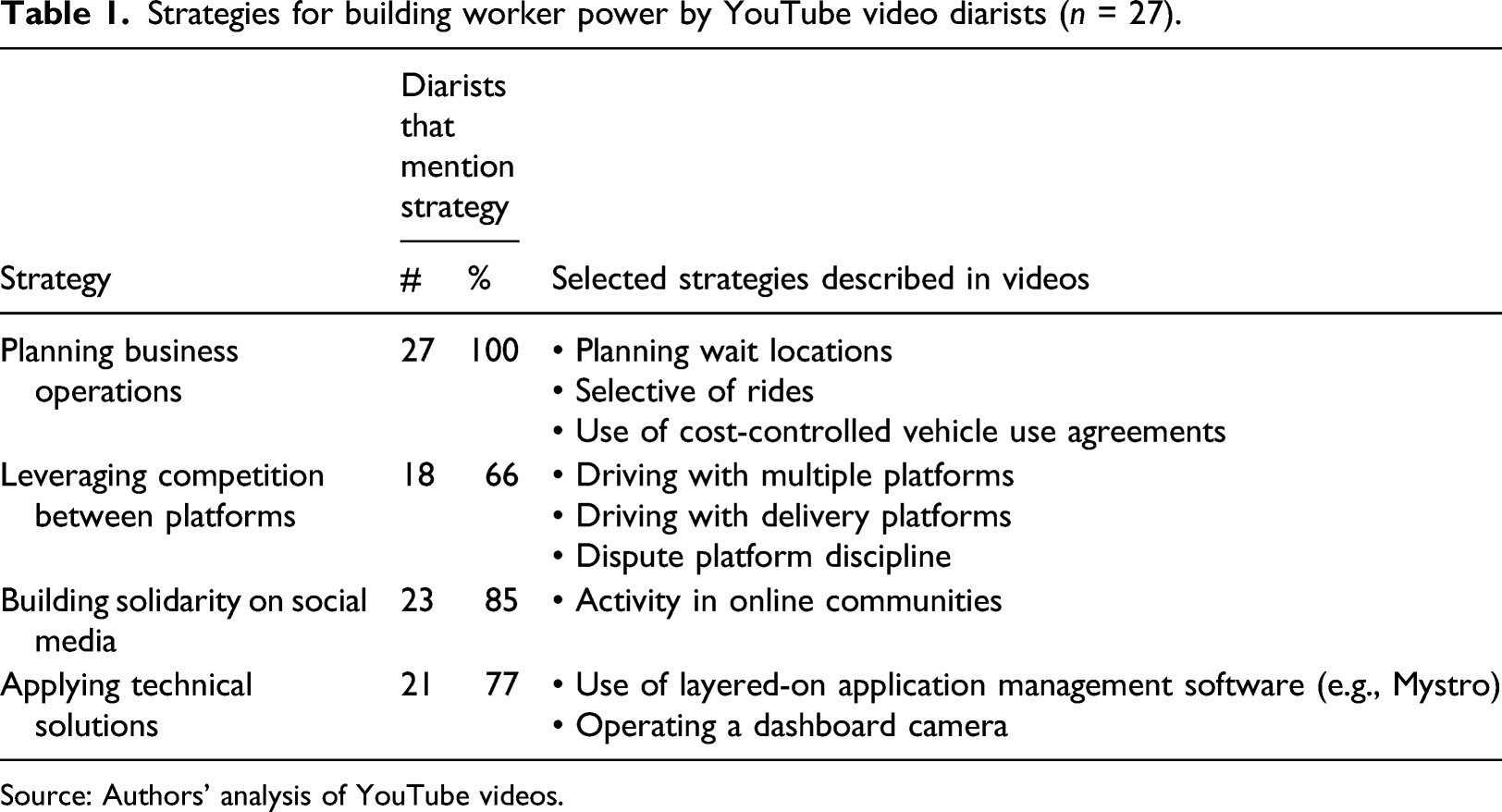
Source: Authors’ analysis of YouTube videos.
However, even enthusiastic diarists revealed frustrations about being managed by an algorithm and coping with financial risk. The same diarist, who encouraged viewers to hustle, also lamented her relationship to the platform, recounting her experience with a platform that dehumanized her. I got the email twice. The first time I got it, it was addressed to [redacted]. I don't know who that is. And they sent it to me again and then they addressed me in the email by my name. Which was ok, I guess, I was just a code and they was sending it out, instead of my name being placed where the code was, they sent, I was just a number, I was literally just a number to them. Soak that in (ToyaATL, 2017b).
Such concerns were even more pronounced among our interviewees, who reported little capacity to improve their work conditions or mitigate risk on the platform. Drivers could not identify any consistent strategy to engage with the platform directly regarding work conditions, rates of pay, or the disciplinary policy.
While interviewees were thoughtful about how they performed their work, their comments were tempered by their lack of knowledge about the platform algorithms. Diarists engaged with multiple strategies to improve their working conditions and performance on the platform. By comparison, our interviews revealed that local drivers were more passive in their use of the platforms, less knowledgeable about how the platform worked, and often hesitant to reach out to other drivers.
The remainder of our discussion focuses on the four categories of worker strategies that emerged from our vlog analysis: business planning, leveraging competition between platforms, using social media, and technological solutions. In most cases, there is consistency in the perspectives offered by drivers. However, in some cases, there are important differences in the perspectives of diarists and our interviewees. We explore these differences to add nuance to those insights that policy makers may use in seeking policy solutions.
Business planning
The ability of drivers to plan their driving operations was a central theme for diarists. Diarists typically focused on practical considerations such as where to position your car, and they presented numerous individual strategies and practices that drivers could leverage to improve their working conditions and performance. For example, Diarist Corona (2017) described two general strategies for drivers, one that emphasizes seeking long trips and another that emphasized seeking frequent quick trips. These strategies, used alone or in tandem, can increase earnings for drivers. Many diarists emphasized that drivers should avoid following the advice of the platform regarding when and where to work. Rather, drivers described benefitting from learning about the intricacies of the market, such as locating safe places to park in busy neighborhoods, identifying shift change times at large employer sites, and identifying neighborhoods where there was interest in on-demand services.
Other diarists identified strategies to build their own clientele by distributing a business card or making connections. For example, IgorRyltsev (2018) noted “…those people call me sometimes. They want me to be their Uber driver … [they] get into my car and then they start the Uber application [so] then I get a ride request.” While ridehailing companies highlight interpersonal connections within their value proposition to riders, drivers too can leverage this personal connection to their own benefit and subvert the platform’s system. Yet, such a strategy had limits. Many diarists warned against taking this strategy too far and taking cash rides without using the platform, as it would leave the driver uninsured.
Strategies used by drivers to build worker power.
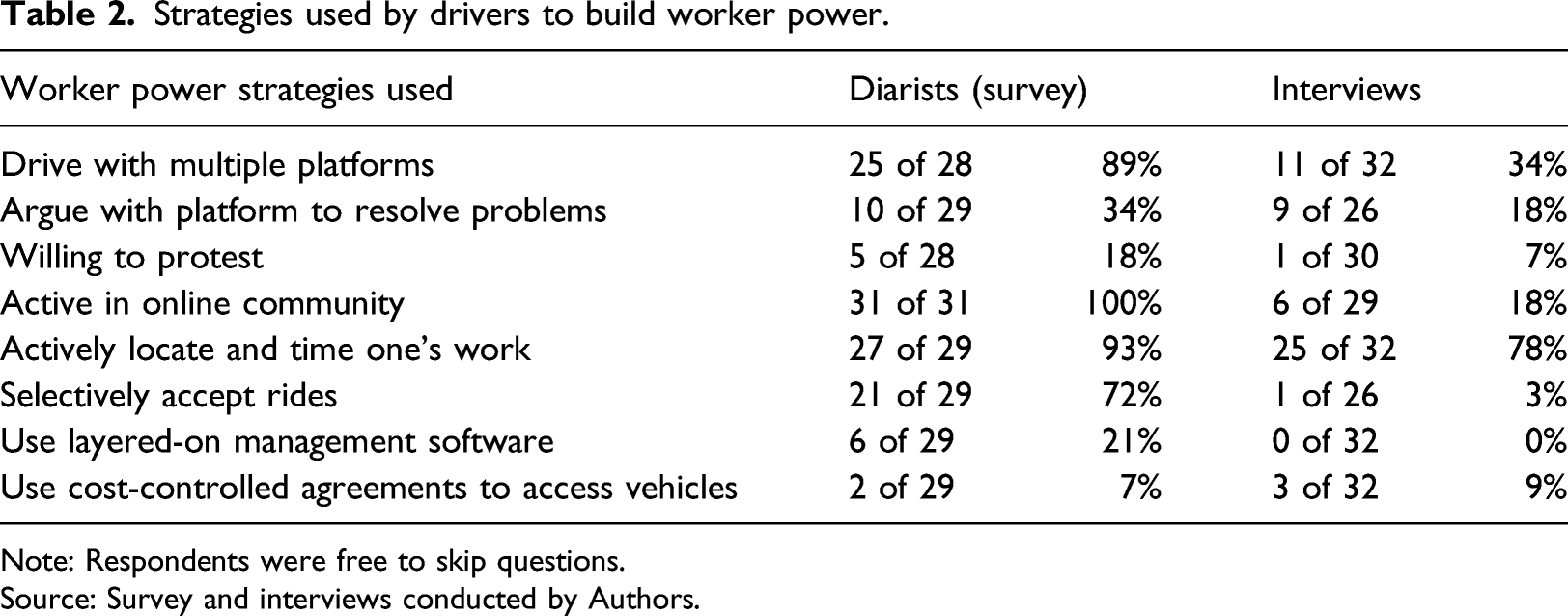
Note: Respondents were free to skip questions.
Source: Survey and interviews conducted by Authors.
Leveraging platform competition
Another important opportunity for drivers was to understand their own position within the platform. By understanding themselves to be customers of the platform, drivers could register complaints with the platform, or dispute platform policies through official channels of communication. Drivers who saw themselves as customers of the platform were empowered to take advantage of competition between platforms and work with whichever platform had the best terms and rates at any given time. Diarists frequently encouraged drivers to move between platforms for better rates. Diarists also encouraged other drivers to use a mix of platforms at different times of the day and week to ensure a consistent stream of customers. Our survey of diarists showed that a large majority (25 of 28 or 89%) used multiple platforms to perform ridehailing work. Diarists used an average of three different platforms and some individuals used as many as six platforms over a given month (Table 2). However, such variety may overstate the level of competition among ridehailing platforms in North America. It is important to note that many of the platforms identified by the drivers were delivery platforms for food and other services, rather than ridehailing platforms. In fact, diarists almost exclusively focused on Uber and Lyft in their commentaries, reflecting the market dominance of these two firms in the United States and Canada. Only three of 230 videos made mention of ridehailing companies other than these two platform companies.
Similarly, our interviews with drivers revealed a focus on these two dominant platforms. Despite the fact that the City of Toronto had approved the operation of a number of other ridehailing platforms, including Facedrive, DriverHer, and InstaRyde, all of the interviewed drivers used Uber, Lyft or both; none reported working for an alternative ridehailing platform. Our interviews found that, unlike diarists, less than half of drivers (11 of 32 or 34%) worked for both platforms and just over a third of interviewees (9 of 25) reported working on delivery platforms at some point, with the majority of those working for Uber’s food delivery platform, UberEATS. Our interviews suggested that drivers were hesitant to work across different platforms. As one driver described, “going back and forth seems to be a waste of time, because I’ve heard other drivers say they get two rides at the same time and they have to cancel one… [they can be] deactivated because they were cancelling too many rides. So, why go through all the hassle. Pick one” (Driver 7).
We note that Lyft only entered the Toronto market in the year prior to data collection, so it may be that the use of multiple platforms will increase over time. However, among those drivers who had experienced Lyft’s entrance into the Toronto market, only one indicated that additional competition seemed to have improved working conditions or pay and several felt their conditions of work had declined. Drivers explained that it appeared that the platforms prioritized competition for passengers, leading platforms to make greater efforts to retain passengers through lower prices, often at the expense of drivers’ incomes.
Personal connections and social media use
While there is a lack of formal organization among drivers in most North American jurisdictions, our vlog analysis and interviews highlighted the importance of informal relationships. It was common for drivers to describe calling on personal connections to reduce the risks to their own safety. Drivers often emphasized the importance of making sure there was someone available to help them should they encounter a problem on the road. These connections were typically enabled through digital messenger applications or other digital means. Whereas earlier studies of solidarity between for-hire drivers suggest that drivers relied on other drivers to overcome safety risks, thus creating strong informal bonds between drivers (Hoffman, 2006), our evidence suggests that platform drivers rely much more on personal connections and resources to provide this support, including friends and family. Furthermore, when drivers referenced other drivers as a source of support, they were typically friends prior to becoming drivers.
Diarists encouraged platform drivers to build solidarity with other drivers through social media, including discussion boards and microblogging platforms. For instance, diarist Drive Girl Drive (2017) advises her audience to “… look for the Facebook group addressing the job that you’re doing in your city. For instance, Doordash Houston, Doordash LA. If it doesn’t exist, take the initiative and create that group… share with your community… When you are generous and you are giving to people you are opening yourself up to so many blessings”.
Diarists demonstrated how such informal solidarity might work. Videos referencing other diarists often build upon or critique other vloggers’ and diarists’ ideas. And, live stream question and answer sessions hosted by these diarists allow drivers to interact in real time to consider concrete examples or offer emotional support. Vlogs by these diarists showed their audience the value of exchanging ideas and information among drivers, as well as demonstrating ways to solve common problems encountered by drivers on ridehailing platforms.
While it is clear that diarists, themselves active on social media, advocate for using these channels as a strategy for improving working conditions, our interviews told a different story. Few interviewed drivers reported using social media to access knowledge regarding their work. Only four of 22 drivers stated that they reviewed online discussion boards or YouTube videos. The lack of engagement did not appear to be due to technical barriers or time constraints. Rather, interview participants expressed little interest in spending their time online within such communities and were more invested in using messenger applications with acquaintances whom they already knew. We note that a recent study identifies successful examples of worker mobilization that leveraged social media (Dubal, 2019). However, our results suggest that the use of social media and personal communications platforms as a strategy for improving working conditions may be limited to specific places or sub-populations of drivers.
Mobilizing technology
Finally, our vlog analysis suggested that drivers mobilize new technologies as a strategy for improving working conditions on the platform. Such technologies, including both hardware and software tools, give drivers control in areas where they would otherwise be subject to the decisions of the platform and its algorithms. For instance, the use of cameras, where permitted, on the dashboard of the car (dashcams) was a popular strategy among diarists to dissuade poor behavior by passengers. Diarist PrimeTime TV (2018) explained that “when people get in your car and they see that you have a camera, that’s the last thing they are going to try to do now is try to lie on you, because you got the truth. You got big brother.” Diarists also found value in using dashcams to provide evidence in relation to complaints and disputes registered with the platform. Drivers may be suspended or even terminated from the platform due to customer complaints (Rosenblat, 2018), thus customer complaints remain a source of major concern for drivers. Dread Pirate Trucker (2018) explained “…it don’t take much man. All it takes is for somebody to give you negative stars or hit one of them buttons there ‘I had an issue’ and that’s it man, you’re deactivated.” While the rationale for using a dashcam is clear, only one-fifth of our interviewees (6 of 30) made use of a dashcam. When pressed on this issue, drivers reported that cameras were too expensive or that it had not occurred to them to use a camera for this purpose.
Other technologies gave drivers a means of further understanding and managing their use of the platform. Third-party layered-on software was one tool that diarists described using to monitor or manage ridehailing platforms. For example, the application Uber Cheats provides software to monitor platform payments to catch underpayments (https://youtu.be/nNI2kVAyEQ4). Driver’s Seat Cooperative provides data for drivers subsidized by sales to municipalities (https://www.driversseat.co/). Another example noted by several diarists was Mystro, an application that allows drivers to filter requests based on variables such as service tier, bonuses, or customer rating. As diarist Primetime TV (2017) explains, [Mystro is] supposed to snatch up surge rides... it’s going to push the [accept] button for you… It is definitely worth it. It's definitely worth the money because imagine if you're going to run both your apps [Lyft and Uber] on one phone. [With Mystro] You don't have to worry about touching the phone at all.
While many diarists were enthusiastic about Mystro and other layered-on software applications, other diarists noted that these programs could be unreliable since they are not coordinated with the platform’s application architecture and software. For example, the design of Mystro allows it to interface with Uber and Lyft through a feature on Google’s android operating system designed to adapt applications for individuals with disabilities (Buhr, 2017). This “backdoor” approach to managing platforms makes these third-party applications vulnerable to changes made by the platform. Further, it is unclear how widely these types of strategies are adopted. Our survey of diarists revealed that 21% (6 of 29) used management software similar to Mystro and none of our interviewees were familiar with or reported using Mystro or similar applications. Consequently, while layered-on applications hold promise for improving work conditions, this potential appears to be underutilized.
Opportunities to support digital platform workers
Overall, our article sought to recognize challenges to organizing workers in the gig economy and identify existing worker strategies where policy makers and labor organizers may engage drivers and build on existing capabilities to secure better workplace outcomes. Our findings revealed that while drivers are subject to the rules of the platform and often lack the support of formal government institutions, such as state employment protections or extensive local regulatory standards, they are not passive actors. Our analysis of vlogs identified that ridehailing platform drivers actively use a number of strategies to improve their working conditions. These strategies fall into four categories: business planning, leveraging competition between platforms, using social media, and using technology to manage the workplace.
However, our findings also show that not all drivers are aware of or use these strategies. Where diarists were proactive about using strategies to improve their work conditions, our in-depth interviews with ridehailing drivers in Toronto suggested a somewhat different story. These drivers were less likely to use the strategies revealed through our vlog analysis and often indicated a lack of knowledge or awareness of these approaches. Moreover, the strategies identified by drivers were primarily individual, technical, and market-oriented strategies and there was little interest in or mention of broader scale collective action. We recognize that ridehailing is a fast-changing industry and that our study precedes the global COVID-19 pandemic. At the time of writing, the longer-term—and likely uneven—effects of the pandemic on ridehailing across different jurisdictions remains largely unknown. However, our results suggest that despite the potential value of collective action, labor market intermediaries looking to support drivers may find dampened responses to calls for collective action. At the same time, a focus on collective efforts that include technical and market-based elements may help encourage driver engagement, overcome individual limitations, expand driver capabilities and build solidarity.
Training and education, which are a hallmark of workforce development programs, would seem to be a particularly germane area of intervention. Whether offered by community organizations, local unions or mandated by the local municipality, education and training programs can raise awareness and help drivers to better understand the ridehailing business and develop tools to protect themselves against risks while taking advantage of opportunities. Critics may worry that focusing solely on driver responsibilities may displace the need for structural solutions and maintain existing inequalities between drivers and platforms. However, training and programming aimed at helping drivers understand their costs of operations, improve their income, learn about how interact with ridehailing platforms, and understand how to protect themselves could allow drivers greater voice in setting their work conditions. Such programs have the potential to empower drivers to assert more agency in their workplace and provide a foundation to interact with and learn from other drivers, as well as develop solidarity and collective voice that can potentially develop into collective action over time.
Another example of where new institutions could be valuable for drivers to develop collective strategies is in the realm of data sharing. As noted, drivers can use layered-on software applications to automate and control elements of the ridehailing platforms. Yet, where these software programs have relied on scraping data without any formal collaboration with the platform, it has made these services unreliable and has demonstrated the limits of these institutions. Rulings in the UK and Holland now call on platforms to make some data available to drivers (Lee, 2021). Local and municipal governments could build on this development with support for layered-on software tools where cities have the authority to collect data such as the City of Toronto’s mandatory data sharing agreement (City of Toronto, 2021). Where these programs collect data, the provision of a publicly accessibly application programming interface (API) such as the “Where Are The Taxis” API developed by Washington, DC (Department of For-Hire Vehicles, 2018; Runyon, 2018) could encourage more formal data sharing and software tools for the benefit of drivers. Driver initiatives such as Driver’s Seat Cooperative and The New York Taxi Workers Alliance already support such approaches, which build upon the individualized strategies that drivers already use and allows them to be scaled up to generate collective strategies that benefit a wider group of workers.
We note that given the orientation of our research to individual drivers, we are unable to grapple fully with issues related to power structures beyond the perspectives of our participants. Nonetheless, we argue that a focus on individual workers remains valuable to understand how drivers relate to larger structures. Correspondingly, workforce development tools are not likely sufficient to challenge platform power but they do provide a potential means for organizers to engage drivers and develop new strategies for building worker power that warrant further exploration.
Overall, our article highlights the inherent tensions in the gig economy. Individual workers use coping strategies to reduce potential vulnerabilities and risks arising from the nature of work arrangements supported by digital platforms. However, simultaneously many drivers remain opposed to—or uninspired by—collective action, arguably because drivers view it is as a potential threat to their already precarious livelihood. We recognize that one may a contradiction between noting drivers’ lack of interest in collective action and recommending that local governments and labor market intermediaries support broader collective action. However, our point is to document existing strategies and consider how they might be used to build broader interest among drivers for collective action. Thus, we argue that there is an opportunity for local policy makers and labor market intermediaries to improve the balance of power between ridehailing platforms and drivers by building local institutions and formal structures around individual strategies that drivers may already use.
Extending our analysis to the gig economy more broadly, our results suggest that organizers would benefit from developing tools that are immediately relevant to gig workers and show tangible benefits for workers. We argue that by aligning programs with workers’ existing practices and predispositions, organizers can demonstrate what collective worker power means in practice, thus potentially building broader support for collective action. In this regard, care must be taken to meet workers where they are by aligning interventions with the current knowledge, capabilities, and practices of drivers to support the development of worker solidarity in this relatively new social and technical context.
Footnotes
Declaration of conflicting interests
The author(s) declared no potential conflicts of interest with respect to the research, authorship, and/or publication of this article.
Funding
The author(s) received no financial support for the research, authorship, and/or publication of this article.
