



Abstract
If platform-based business models are seen to disrupt traditional place-based markets and production relations, we await a fuller appreciation of their impacts on the intricate and interconnected nature of the spatial economy. This article employs panel regression models to assess the impact of distances to urban places of different sizes and of administrative boundaries on the formation of Taobao villages aggregated to the county level for 1603 counties nationwide from 2014 to 2020. Our results reveal that there are fewer Taobao villages in the regions closer to the nearest urban centre of any size or the nearest second large urban centre (when the distance to the second large urban centre is less than that to the large urban centre), suggesting that e-commerce businesses in these settings are subject to agglomeration shadow effects. However, this significant effect cannot be observed when the distance to the second large urban centre is greater than that to the large urban centre, suggesting that the shadow effects are less in these settings. Moreover, our results also reveal that provincial borders act both as barriers, allowing e-businesses to benefit from the nearest second large urban centre within the same province, and as protective shields, preventing e-businesses from the agglomeration shadow of the nearest large urban centres outside the province. In conclusion, some of the complexity of urban systems and their positive and negative effects on patterns and processes of e-commerce business formation are revealed.
Introduction
The platform business model has demonstrated its very real power in subverting markets and traditional firms. Different from the simple ‘pipeline’ linear economic model, platforms connect people, institutions and resources in different locations with the application of big data, new algorithms and cloud computing, and create unexpected use as well as exchange value (Kenney and Zysman, 2016). For example, in a classic instance of a digital platform business model, Uber has transformed the taxi industry into a digital realm where passengers and drivers are matched through the platform with larger geographical and vehicle coverage. Platforms are increasingly utilized in urban production and consumption, which is believed to have far-reaching implications for business and labour markets. In essence, platforms exert immense power over the geography of economic activities in urban space (Graham, 2020).
Critical attention has been paid to the ways that platforms mediate and reconfigure core activities of daily lives (Barns, 2019; Barratt et al., 2020). In these views, the platform monitors and controls the spatial movement of participants through innovative coordination technologies that can reterritorialize existing infrastructure (Richardson, 2020). While these tasks give rise to concerns regarding different geographical relationships in platform urbanism, there remains a lack of evidence concerning the geographical consequences of the platform economy.
The effects of platform technologies on place- and proximity-based economic relations can be put in the context of longstanding interest in the effects of information technology (IT) within economic geography. The speculative and empirical literature here tends to bifurcate into that which emphasizes IT’s reinforcement of the agglomeration advantages of central places (Acs, 2002; Le Bas and Miribel, 2005; Tu and Sui, 2011) and that which foresees the end of geography (Bates, 1996; Kolko, 2000) and the dissolution of the city (Fathy, 1991), with IT undermining the importance of place and proximity in economic relations. However, neither of these accounts of the spatial effects of ITs can be directly employed to anticipate the geographical impact of the platform economy, not least since both sets of accounts disregard the intricate and interconnected nature of effects within complex and extensive urban systems. These effects include the sizes of central places and distances between them but also subnational jurisdictional effects as well as borrowed size, function and shadow effects (Alonso, 1973; Meijers and Burger, 2017; Phelps, 2004; Phelps and Ozawa, 2003; Phelps et al., 2001). The extent to which the platform economy affects the location choice of economic activities within complex urban systems awaits empirical elaboration and substantiation.
The focus of this article is to examine the impact of the platform economy on the spatial distribution of economic activities. To do this, we examine the geography of the Taobao village (TV) phenomenon. Taobao is Alibaba’s proprietary platform that creates an e-market connecting businesses to consumers (B2C). TVs are those administratively defined villages in which there is a significant collection of businesses using the e-commerce platform based on Alibaba’s own criteria (Ali Research, 2020). A number of studies have assessed TVs’ macro distributions (Liu et al., 2020; Zhang et al., 2022). Those studies employing the distance metric of TVs are orientated towards evaluating shifts in urban–rural income disparities (Liu and Zhou, 2023). These studies leave a notable gap in explorations of the nuanced impact of proximity on platform-based economic activities. In an effort to bridge this gap, our first research question is: how do distances to urban centres of different sizes moderate platform economy-driven redistributions of economic activities in the case of the TV phenomenon? In order to investigate this, distances of TVs to centres of cities of different sizes are measured and panel regression models are applied to estimate whether the proximity to urban centres still has an impact on the formation of TVs from 2014 to 2020.
This study also expands our understanding of the effect of urban system structure via platform economy effects on the spatial distribution of economic activities. One complexity within China’s dynamic urban process arises from the intertwining of the administrative hierarchy of cities with economic growth through factors such as administrative autonomy and tier classification (Ma, 2005). The hierarchical governance structure likely shapes the capacity to establish spatial linkages and access resources, particularly in interactions with cities across different administrative regions. Therefore, the second research question for validation in this article is: to what extent are platform economy effects on the distribution of economic activity moderated by urban administrative structure? In order to examine this question, we estimate the influence of borders at the subnational level on the relationship between TVs and distances to urban centres.
The structure of the article is as follows. In the next section, we provide a brief introduction of the possible effects of platforms in shaping the geographical location of economic activities in the urban system. Here we focus on the distance of TVs to central places of varying sizes, the effects of jurisdiction and borrowed size and agglomeration shadows. Next, the definitions of variables, data sources, as well as methods are explained. This is followed by the main empirical results and analysis. A summary of the findings and their implications for future empirical and theoretical research as well as policies are elaborated in a conclusion.
The power of platform in shaping urban economic geography
The transformative effects of platforms
The term ‘disruption’ frequently appears in the literature on platform economy to signify that the existing economic geography and urban systems are undergoing a profound and intense reconfiguration under the spread of platform capitalism. The disruptive ability of digital platforms is related to their digital nature. They combine three operational layers: network or community, infrastructure and data layer (Choudary, 2015). At the network or community level, platforms function as ‘interfaces’ or ‘intermediaries’ that connect supply and demand (Richardson, 2020). Network effects generated in this process are the core mechanism driving the rapid growth of platform users and the expansion of platform value (Narayan, 2022). Specifically, an increase in the number of users leads to an increase in platform value, which further enhances its appeal to new users, thus creating a self-reinforcing positive feedback loop. The infrastructure layer of digital platforms exhibits a layered modular architecture, consisting of a stable core set of components and a complementary set of variable peripheral components (Gawer, 2014). This structure allows users to share the platform’s technological infrastructure, thereby reducing the average cost each user needs to bear. This explains the appeal of digital platforms as a space for entrepreneurial activities (Nambisan, 2017). Furthermore, data becomes the most important production input in the platform economy (Couldry and Mejias, 2019). As the manager and controller of the data, platforms employ a hidden algorithm management system to analyse data and match users (van Doorn and Chen, 2021). From this perspective, the conditions for economic interactions are no longer constrained by geographical factors – participants located anywhere can establish linkages through the platform. Additionally, platforms supported by algorithms and big data possess the ‘residual right to exclude unreliable members’ (Montalban et al., 2019: 808). They establish and enforce a set of ‘private governance rules’, which includes membership criteria, evaluation and reputation systems, monitoring processes, etc. This framework helps to mitigate issues of distrust within the virtual interaction space.
In the context of pervasive digitalization, platforms fundamentally restructure the spatial relationships of economic activities within urban systems by redistributing resources and power, thereby redefining the economic landscape. Unlike traditional IT tools, platforms, with their reliance on algorithms and big data, exhibit a stronger and broader influence on the spatial distribution of economic activities, provoking the classic debate over whether this new wave of IT diminishes or reconfigures the significance of geography or physical distance.
Proximity to central places stands out as a significant embodiment of geographical dependence (Hans and Koster, 2018), owing to the fact that urban centres offer superior resources requisite for the advancement of economic activities compared to the countryside. As early as the late 20th century, proponents of IT proclaimed that the rise of the Internet would liberate individuals or businesses from the constraints of the distance to central places. As for the platform economy, the network externalities upon which platform business models leverage make it possible for well-connected platform-based businesses to communicate with consumers and suppliers from remote areas, and there is no longer a need to pay a premium for superior (central place) geographical locations to obtain business information and access consumers. The transactional efficiencies associated with platforms surpass existing Internet-based sales relationships (Langley and Leyshon, 2017) and radically undermine the advantage of cities in economizing on these same costs and having a wide variety of consumption options for which urban residents are willing to incur higher living costs (Tabuchi and Yoshida, 2000). This effect of platforms suggests a radical undermining of the importance of the largest central places as locales of both production and consumption. Besides, when platform enterprises expand, the marginal cost is almost negligible such that the limit of possibilities for value creation is the boundary of the network, not the boundary of the firm or even the boundary of particular urban places. In this context, any undermining of the size of, and distance to, central place effects is one which is qualified, since much of the value creation opportunities of platforms are those which leverage surplus capacities of assets found in the largest urban centres. Furthermore, the level of trust in platforms currently appears to be high and growing (Etzioni, 2019), which may further weaken the importance of physical distance in establishing interactions. While platform technologies may have distinct effects of reducing qualities to quantities (including those relating to place and its intimate relationship to where stuff comes from (Mau, 2019; Molotch, 2004)), these metrics serve as new reference points with which to navigate a world in which there is a surfeit of information of variable quality.
Conversely, an alternative perspective suggests that IT may instead intensify the concentration of economic activities within urban centres. Advocates of this view highlight the concentration of digital infrastructure in urban areas, where high population density and advanced economic conditions ensure more extensive and dense construction (Dadashpoor and Yousefi, 2018; Sternberg, 2022). Platforms still depend on physical components such as wires, optical fibres and hardware, alongside logistics networks that bridge merchants and consumers – an essential factor influencing locational choices of platform-based firms. Moreover, proximity and face-to-face communication in urban areas promote the generation, diffusion and accumulation of knowledge. While platforms’ lower entry barriers encourage rapid business expansion, the resulting competitive environment necessitates continuous innovation, a process that is better supported by the dense knowledge spillovers and tacit knowledge exchanges characteristic of urban centres (Morgan, 2004).
In addition, the current understanding of the mechanisms behind the formation of China’s TVs (as an instance of platform economy-enabled e-commerce formation) remains a subject of debate. One perspective emphasizes the transformative role of platform technology. In the framework of network urbanism established by Lin (2019), the layer of ICT infrastructure and production network constitutes the foundation of the development of TVs. Zeng and Guo (2016) contributed to this narrative by pointing out that the significant catalyst for encouraging potential entrepreneurial ventures in rural e-commerce lies in the low entry costs associated with joining platforms like Taobao. However, criticism has been directed towards this perspective for its inability to elucidate why only specific villages have transformed into TVs (Zhou et al., 2021). Expanding upon this perspective, another viewpoint argues that the formation process of TVs is closely tied to local conditions, with platform technology, infrastructure and logistics, economic foundations and supporting industries collectively affecting the e-commerce development (Mei et al., 2020; Xin and Qiao, 2018; Zhang et al., 2023).
Despite these insights, existing research is often rooted in traditional spatial science paradigms, such as the ‘friction of distance’. Much of the existing discussion remains constrained by a binary framework that interprets the impact of platforms on the spatial distribution of economic activities solely in terms of centralization or decentralization. Besides, the empirical investigations on TVs are limited to preliminary analyses of location mechanisms, leaving the impact of platforms on the role of physical distance in Taobao-based economic activities insufficiently explored. In fact, the development of cities is rarely unidirectional; rather, complex changes take place continually affecting the geographical impacts of digital platforms.
The complex effects in the urban system
With the development of globalization processes, cities do not function in isolation but are part of systems of cities, which are characterized by the interactions between cities (Peris et al., 2018; Phelps, 2021). Scholars have therefore used urban networks to describe the major cities and the physical and/or functional connections generated by interactions between them in a geographical area (Arndt et al., 2000; Camagni and Salone, 1993). In this new geography, urban economies are viewed as many superimposed nodes of networks, and the development of cities is highly related to the extent of their connections with other regions (Meeteren et al., 2016).
The rapid evolution of urban systems has led to the emergence of studies on the geographical scope of agglomeration externalities (Burger and Meijers, 2016). Scholars believe that agglomeration externalities may extend beyond the borders of cities through interactions and be shared in networks of cities (Meijers et al., 2016). Importantly, urban network externalities are not limited in space and vary with network connectivity. There is evidence that the size of places and proximity to them have been moderated by ‘borrowed size’ effects, which explains the situation that smaller cities perform better as they benefit from agglomeration spillovers of larger neighbouring cities, and ‘agglomeration shadow’ effects, wherein large cities exert a negative influence on their surroundings due to the offsetting effects of spatial price competition on positive agglomeration spillovers (Meijers and Burger, 2017; Phelps, 2004; Phelps et al., 2001).
Although interactions between cities are necessary for borrowed size, most existing empirical studies have predominantly emphasized geographical proximity as the primary mechanism enabling this phenomenon. They often measured connectivity levels through physical networks such as highways, railways or water systems (Burger et al., 2015; Hans and Koster, 2018; Meijers and Burger, 2017). However, the power of IT and platforms suggests that they have the potential to amplify the spatial reach of agglomeration externalities, allowing them to extend beyond the constraints of geographical proximity. For instance, de Vos et al. (2020) provided compelling evidence of borrowed size effect in the spatial dynamics of the impact of place-level broadband penetration on employment, demonstrating the ability of digital connectivity to reshape traditional spatial interactions. Thus, the occurrence of borrowed size may no longer be limited to geographical proximity, and non-adjacent cities – even at some distance – can borrow agglomeration benefits through platform networks between cities.
Apart from borrowed size and shadow effects, the hierarchical structure of cities also emerges from self-organization and coevolution in the urban system through the connections and interdependencies of cities (Pumain, 2018). The hierarchical levels defined by these structures typically correspond to different scales, which are often measured by population size (Bettencourt, 2021). Larger cities possess numerous positive externalities and serve as key nodes connecting diverse resource networks. These networks can actively facilitate the continuous production and accumulation of data essential to platform operations. As a result, the ongoing process of digitalization and the expansion of interconnected platform networks may further reinforce existing urban hierarchies (Stehlin et al., 2020). Moreover, larger places have historically exerted relatively greater impact on their peripheries than places lower in the urban hierarchy (Meijers et al., 2016). Thus, connecting with larger cities may benefit businesses more than connecting with cities at lower hierarchical levels in the platform economy.
Moreover, the hierarchical organization of cities is also mirrored in the hierarchical governance structure, which further increases the complexity of interactions between cities within the system. Local officials, under a decentralized governance system, prioritize actions and decisions that contribute to economic development and prosperity within their jurisdictions as their performance is measured by the impact of their policies and initiatives on the economic well-being of the places they serve (Xu, 2011). At the same time, higher-level urban governments possess the advantage of engaging in negotiation processes to secure more favourable allocations of resources for their jurisdictions (Feldman and Martin, 2005). It can be assumed that proximity to higher-level cities within the same province may grant access to more resources compared to cities in other provinces.
Clearly, these effects, including borrowed size, agglomeration shadow, the size of cities and jurisdictional advantages, highlight the intricate spatial relationships between cities and challenge the binary view of platform impacts. Hence, understanding the effects of physical distance on the spatial distribution of platform-based economic activities requires careful consideration of the complex effects inherent in urban systems.
Research design
The formation of so-called TVs – administrative villages with more than 10% of families operating online shops on Alibaba’s proprietary platform trading system Taobao and the total business turnover of the village exceeding 10 million yuan (Ali Research, 2020) – has rapidly become a social and economic phenomenon in China, with optimism regarding its effects on rural poverty lauded by international organizations (World Bank, 2016). Similar to specialized villages where most residents engage in a single production or service activity, TVs represent new forms of low-cost manufacturing clusters. They are formed by capitalizing on the cost benefits associated with rural regions and the low entry barriers presented by digital platforms (Qi et al., 2019). TVs are typically classified into three distinct types – market orientated, agricultural orientated and industrial orientated – with the daily light industry sector accounting for the highest number (Space Planning Centre of Nanjing University and Ali Research, 2018). The predominant products sold in these villages include clothing, furniture, footwear and other consumer goods well-suited for express delivery. Notably, despite the term ‘village’, TVs refer to geographical areas classified at the ‘village’ level within China’s administrative divisions, 1 which does not necessarily indicate their exclusive location in traditional rural settings or regions distant from urban centres.
We focus on the TV phenomenon – the numbers and geographical spread of these e-commerce villages – as an ideal case and means to examine the recursive relationship between emergent platform economy effects on the extant distribution of economic activity in the Chinese urban economic system. To date, previous studies making use of aggregate data on TV formation have provided descriptions of the national geography of this phenomenon – skewed, as it is, to the more developed eastern coastal areas of China (e.g. Zhang et al., 2022), or else case studies of individual or limited numbers of TVs in selected administrative units (e.g. Phelps et al., 2022; Wang et al., 2021; Wei et al., 2020).
Ideally, the TV itself should be the preferred spatial unit for exploring the distance effects on the formation of TVs. Unfortunately, the official national village-level statistical data has not been released at present. We therefore chose data on TVs aggregated at the county level as the dependent variable unit of analysis in what follows. Two further reasons account for the selection of county-level data. On the one hand, counties are the basic units of the national economy and have a certain minimum level of autonomy and relative independence in administration. On the other hand, counties are the smallest geographical unit in China’s official economic and social data statistics. Thus, obtaining county-level data is feasible in practice.
Using the aggregate number of TVs at the county level as the dependent variable for analysing how the formation of TVs is affected by distance may reduce a certain degree of accuracy, but this low level of aggregation is appropriate. The difference in economic and social development between villages in a town is rather small, and the distance between villages in a county is not great. Counties with at least one TV are included in this part of the analysis. There are 2019 sample counties from 2014 to 2020. However, after excluding counties with missing or anomalous values in the control variables, the final sample size used for this study consists of 1603 counties.
Data and variables
Dependent variable: Formation of Taobao villages
If a county can attract more e-commerce merchants, it will be more likely to form a greater number of TVs in this region. Therefore, the formation of TVs at the county level is used as an indicator of the geographical consequences of the rise of the e-commerce platform economy. The state of formation of TVs at the county level is captured by the total number of TVs in a single county. The identification of the formation of TVs at the county level is based on the official list of TVs published by Ali Research every year. If a village appears in the list of that year, it will be included in the number of TVs in one county in that year.
Independent variables: Distance variables
To assess the effect of place and proximity on the formation of TVs in China, a set of distance variables to the nearest cities of different sizes are incorporated into the analysis. These additional distance variables are used to isolate the impact of urban centre size on the results.
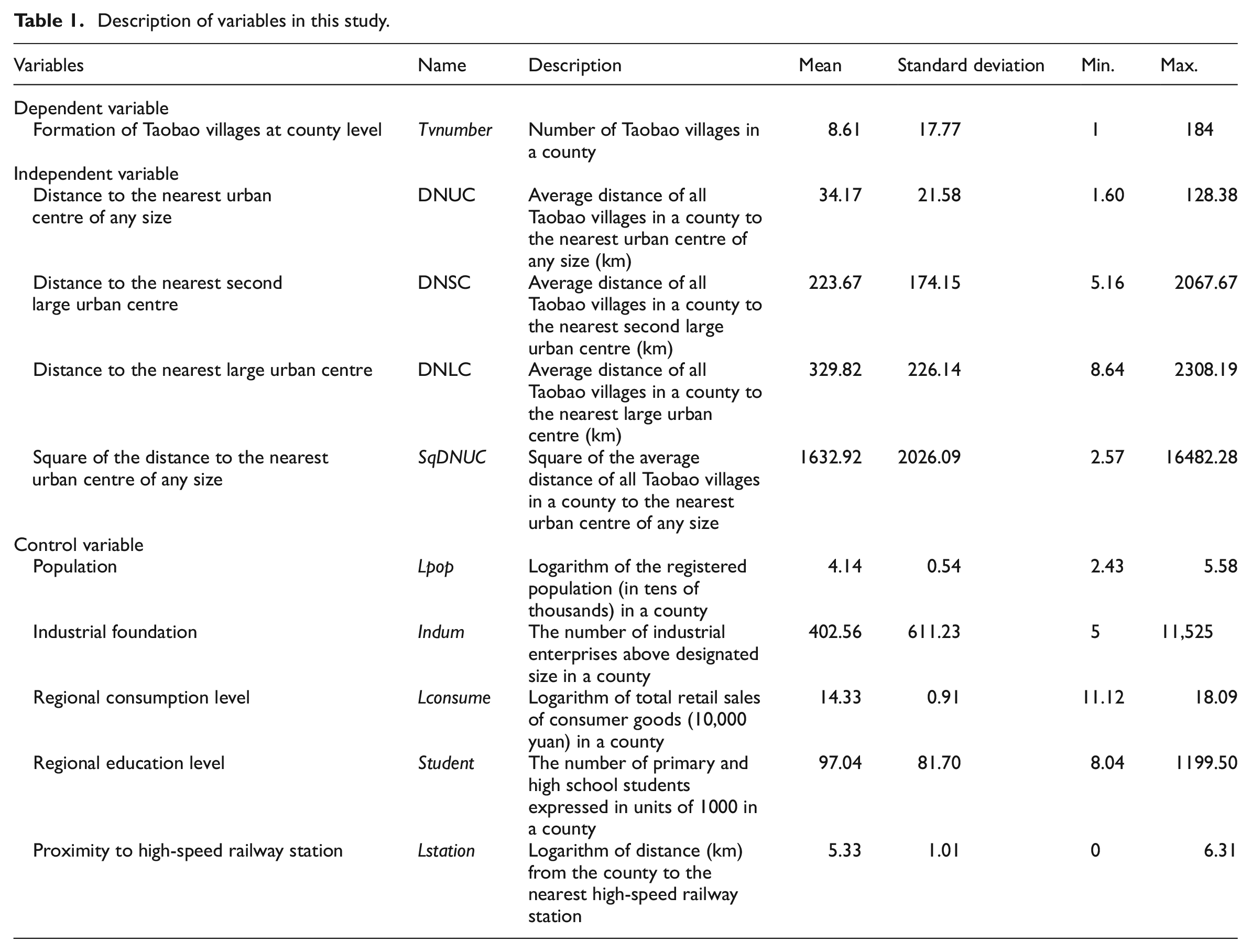
This study incorporates the following distance variables: (1) the distance to the nearest urban centre of any size (DNUC); (2) the distance to the nearest second large urban centre (DNSC); and (3) the distance to the nearest large urban centre (DNLC) in a county. To classify the size of urban centres, this study adopts the criteria outlined in the ‘Notice of the State Council concerning the Standard for Adjustment of Urban Size’ (State Council of the People’s Republic of China, 2014). Accordingly, large cities are identified as those with a population of urban residents greater than 10 million, and second large cities as those with a population greater than 5 million but less than 10 million. To calculate distances, we regard the locations of municipal government as the locations of urban centres, and their geographical coordinates were obtained from the Baidu coordinate picking system.
Distances were calculated using the proximity tool in ArcGIS, which requires geo-location data of TVs. In this study, the coordinate data of TVs from 2014 to 2020 comes from the Baidu coordinate pickup system. Aligning with the above selection method of urban centre location, we specifically selected the coordinate position of the village committee or community office as the coordinate data of each village. After collecting the distance data of all villages, we calculated the average distance of TVs in each county according to the administrative division. As a result, the independent variables – the physical distances to the urban centres – are the average distances of all TVs in a county to the nearest urban centre of any size, to the nearest second large urban centre and to the nearest large urban centre.
Furthermore, we also included the squared term of DNUC in the analysis to capture the potential nonlinear relationship between the number of TVs and geographical distance. Specifically, the significance of this nonlinear relationship might suggest that the marginal effects of distance differ at varying levels. For example, counties farther from urban centres may experience reduced external competitive pressures, while this distance protective effect may only manifest within a certain range of distances.
Control variables
The formation of TVs is normally recognized as a multi-dimensional and interconnected phenomenon. Therefore, it is important to control for several regional factors that may also affect the dependent variable. Here, a focus is made on the variables that are related to the commencement of e-commerce businesses, and the selected control variables are: (1) Population is measured by the logarithm of the registered population (in tens of thousands) in a county; (2) Industrial foundation is reflected by the number of industry enterprises above designated size in a county; (3) Regional consumption level is measured by the logarithm of the total retail sales of consumer goods in a county; (4) Regional education level is calculated by the number of primary and high school students expressed in units of 1000 in a county; (5) Proximity to high-speed railway station is calculated by the logarithm of the distance in kilometres from the county to the nearest high-speed railway station.
The list of high-speed railway stations from 2014 to 2020 is obtained from official sources such as the China Railway Administration and the China Railway 12,306 website. The geographical coordinate data of high-speed railway stations also comes from the Baidu coordinate pickup system. Most of the data for other control variables come from the China County Economic Statistical Yearbook (2015–2021), while the remaining data are obtained from the statistical yearbooks of the cities where sample counties are located. In particular, the latter step further checks the accuracy of the data obtained through the previous step. The variables used in this study and their descriptions are listed in Table 1.
Description of variables in this study.
Method
The fixed effects model has been used extensively within economic geographical research on the spatial distribution of economic activities (de Vos et al., 2020; Özyildirim and Önder, 2008). In this study, we employed it to estimate the effect of time variation in physical distances to different urban centres on time variation in the formation of TVs in a county. This model can control for time-invariant characteristics at the county level, which means that fixed, unobservable characteristics within each county (such as culture, institutional environment and geographical conditions) will not influence the model’s estimates. This effectively addresses within-county heterogeneity and isolates the pure effect of geographical distances on the number of TVs in a county. The model in this study is specified as follows:
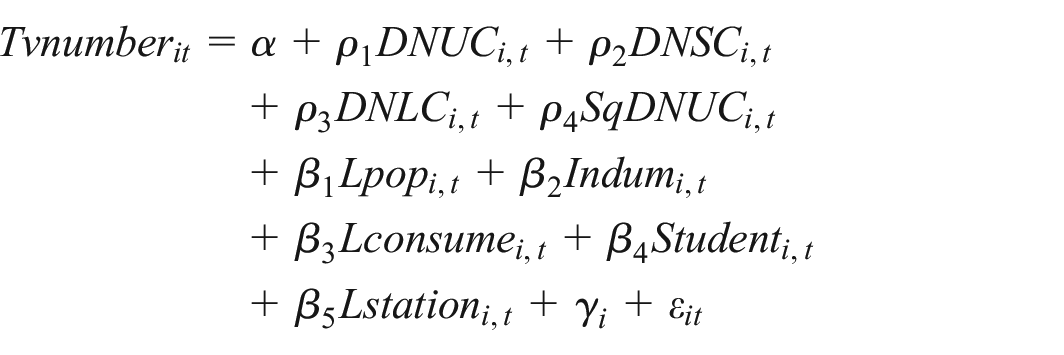
Where
Place and proximity and Taobao village formation
Descriptive analysis
The maps in Figure 1 compare the number of TVs in each county across the country in 2014, 2016, 2018 and 2020. The distribution of TVs exhibits extreme regional variation and unevenness, with the number declining from east to west across counties. On the whole, southeast coastal regions accommodated the highest concentration of TVs. These areas with a larger number of TVs are economically advanced and have highly developed transport networks, which are highlighted as factors facilitating e-commerce development (Xin and Qiao, 2018). Also, there was a general trend of new TVs spreading from the eastern to the middle and western regions. In particular, TVs were popping up in more counties in the middle regions. Furthermore, it is noteworthy that there was a further expansion of existing agglomerations in eastern areas. Not only had the number of TVs in these counties experienced rapid growth but agglomerations were also extending to nearby areas. The original agglomerations continue to accumulate resources conducive to the development of e-commerce, the process of which could further promote the formation of TVs in these regions.
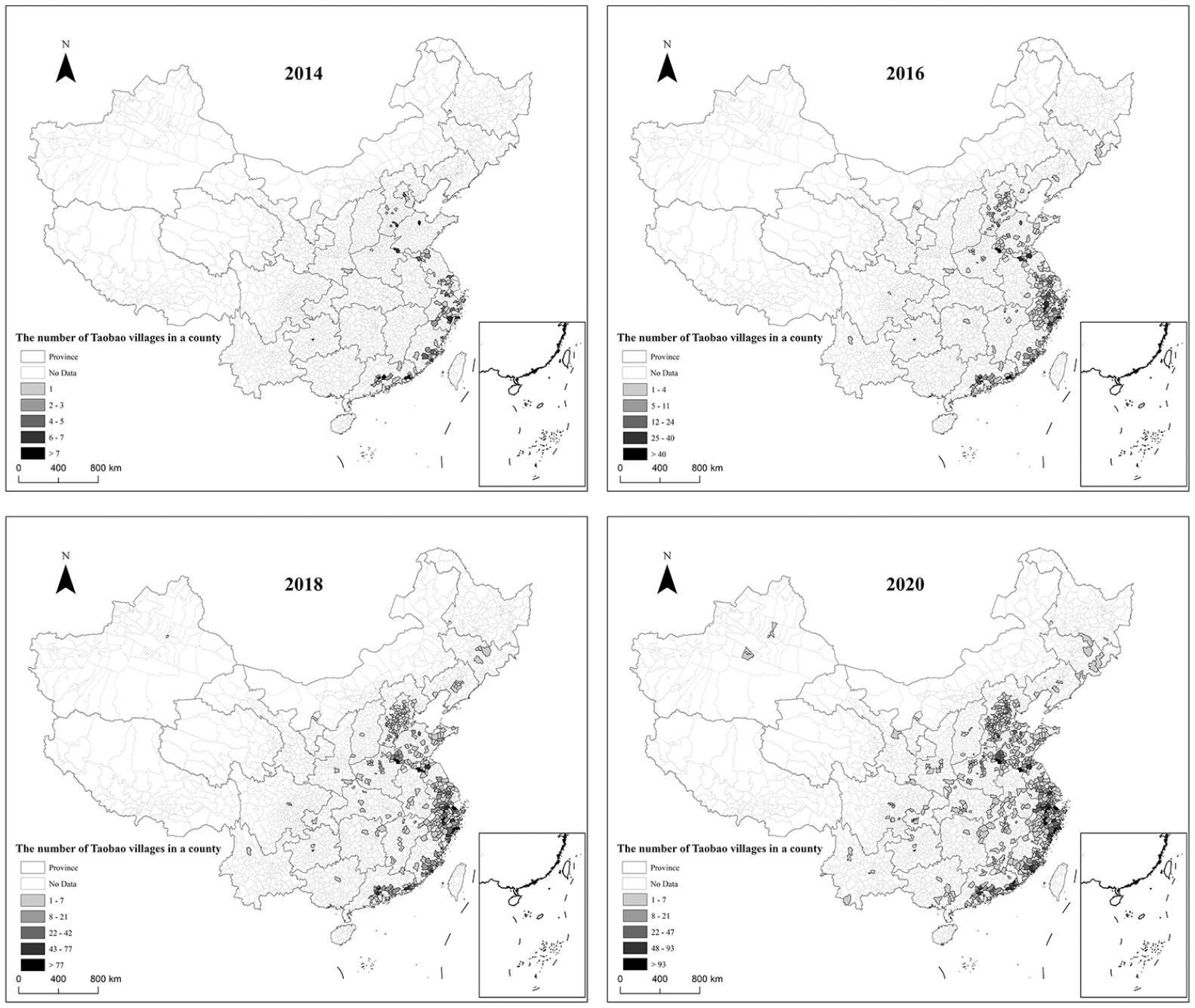
The number of Taobao villages in each county in 2014, 2016, 2018 and 2020.
The line chart in Figure 2 illustrates the average distances from TVs to the nearest urban centres of three sizes from 2014 to 2020 across the whole country. Over the study period, the average values of DNLC have changed little, and the DNSC has remained basically stable since a significant drop in 2015. It is found that TVs are distributed predominantly in the southeast coastal areas, but it was not until 2015 that the trend of clustering became obvious (Space Planning Center of Nanjing University and Ali Research, 2018). These new e-commerce merchants emerging in 2015 may have limited local resources and therefore need to be closer to the second large urban centres to capture their agglomeration benefits. It should also be noted that DNSC and DNLC fluctuate around 210 km and 280 km respectively, which corresponds to approximately one hour and 90 minutes of travel time by high-speed rail. Additionally, DNUC varies around 32 km, equivalent to a one-hour driving distance from the TVs. These not-too-distant relations imply that proximity to urban centres may still be necessary for platform-based firms.
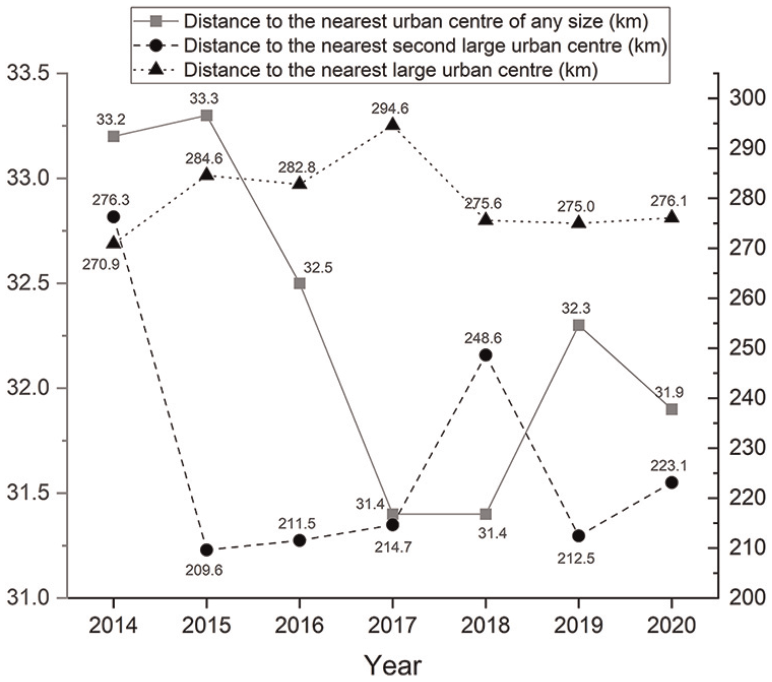
Distances from Taobao villages to different urban centres from 2014 to 2020.
Regression analyses
Distances to urban centres and the formation of Taobao villages
Without a doubt, among the three distance variables, DNUC always represents the shortest distance of TVs to urban centres. However, the sample in this study contains both instances where DNLC exceeds DNSC and instances where DNLC falls short of DNSC. When all samples are combined for regression analysis, the results of the two categories of samples mentioned above may cancel each other out, making it hard to observe the effects of distances to large urban centres and second large urban centres because the two different sizes of urban centres may have different effects (borrowed size and shadow effects) on the formation of TVs at different distances. Therefore, the samples in this study are divided into two categories – when DNLC is greater than DNSC and when DNLC is less than DNSC – to conduct fixed effects regression separately in order to better estimate the impacts of distance to urban centres of different sizes.
As shown in column 2 in Table 2, firstly, DNUC leads to a positive and significant effect on the formation of TVs in a county, suggesting that the number of TVs would be lower in the regions closer to urban centres. This result does not echo those of other studies in the economic geography of entrepreneurship literature that highlight the higher start-up rate in areas closer to urban centres (Audretsch et al., 2015; Bosma and Sternberg, 2014). Indeed, scholars have verified that being close to larger neighbouring cities allows smaller areas to ‘borrow size’ from them, but increased competition that comes with proximity can also put smaller areas in their ‘agglomeration shadow’ (Sohn et al., 2022). Thus, this distance effect observed in this study may be related to the negative competitive effects of the nearest cities and e-commerce merchants closer to the nearest urban centre being more likely to be trapped in the negative externality fields of those centres. Meanwhile, given that both borrowed size and agglomeration shadow effects normally coexist, another possible explanation for this ‘agglomeration shadow dominant’ distance effect is that e-commerce merchants in TVs do not rely on their nearest cities to obtain the resources they need. That is to say, there are few positive externalities they can ‘borrow’ from the neighbouring cities. Instead, they appear to benefit more significantly from platform network externalities.
Regression results of the distance effects on the formation of Taobao villages from 2014 to 2020.
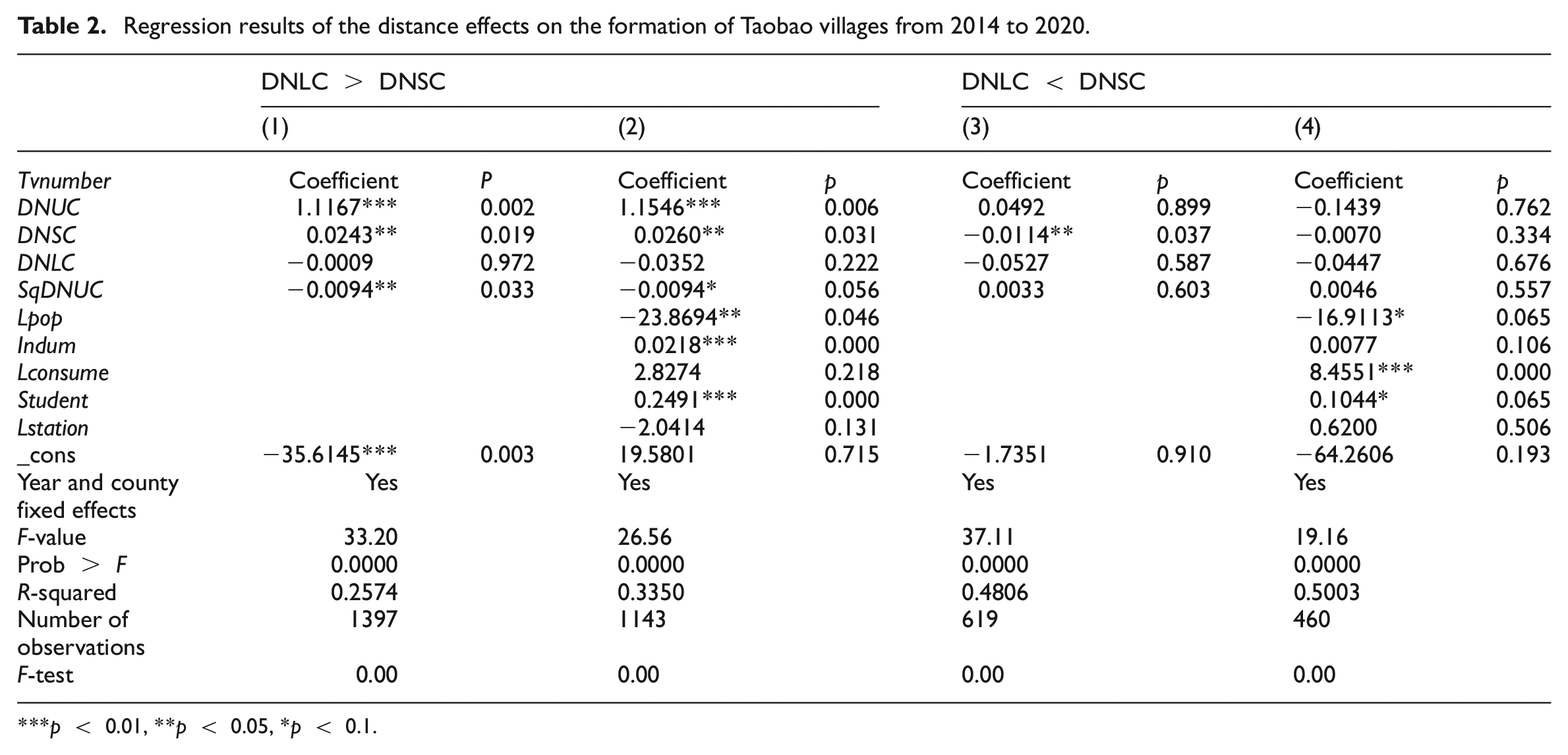
p < 0.01, **p < 0.05, *p < 0.1.
However, the number of TVs does not consistently increase with greater distance from urban centres of any size. The significantly negative coefficient of SqDNUC in column 2 suggests a nonlinear dynamic, where the competitive pressures from urban centres gradually diminish as distance increases. Nevertheless, when distance surpasses a critical threshold, challenges such as reduced resource accessibility and rising logistics costs begin to offset the benefits of reduced competition. This shift weakens the growth trend in TV numbers, potentially reversing it into a decline. Thus, the observed nonlinear relationship underscores the complex interplay between the spatial interactions based on physical distances, local economies and platform-based externalities in shaping the location pattern of TVs.
Another interesting finding from the regression result in column 2 is that distances to urban centres of different sizes have different impacts on the formation of TVs. While the variable DNSC exhibits a positive and statistically significant coefficient in the regression, the variable DNLC shows a negative but insignificant correlation with the formation of TVs in a county. In line with the relationship between DNUC and the formation of TVs, a greater distance to the nearest second large urban centre is associated with higher levels of e-commerce entrepreneurship in a county. It appears that even more-distant second large cities cannot fully shield e-commerce merchants from the agglomeration shadow, but the disadvantages they bring are comparatively less severe than those arising from the nearest urban centre of any size.
Moreover, turning to column 4, it can be observed that none of the distance variables are statistically significant. This indicates that the location choice of e-commerce merchants is not correlated with the physical distance to urban centres when DNSC exceeds DNLC. Notably, the coefficients of DNUC and DNSC become negative (albeit not significant), suggesting a potential reduction in competitive effects from both urban centres of any size and second large urban centres.
Figure 3 summarizes some of these complexities regarding the different effects of distances to urban centres of different sizes in two regressions in stylized terms.
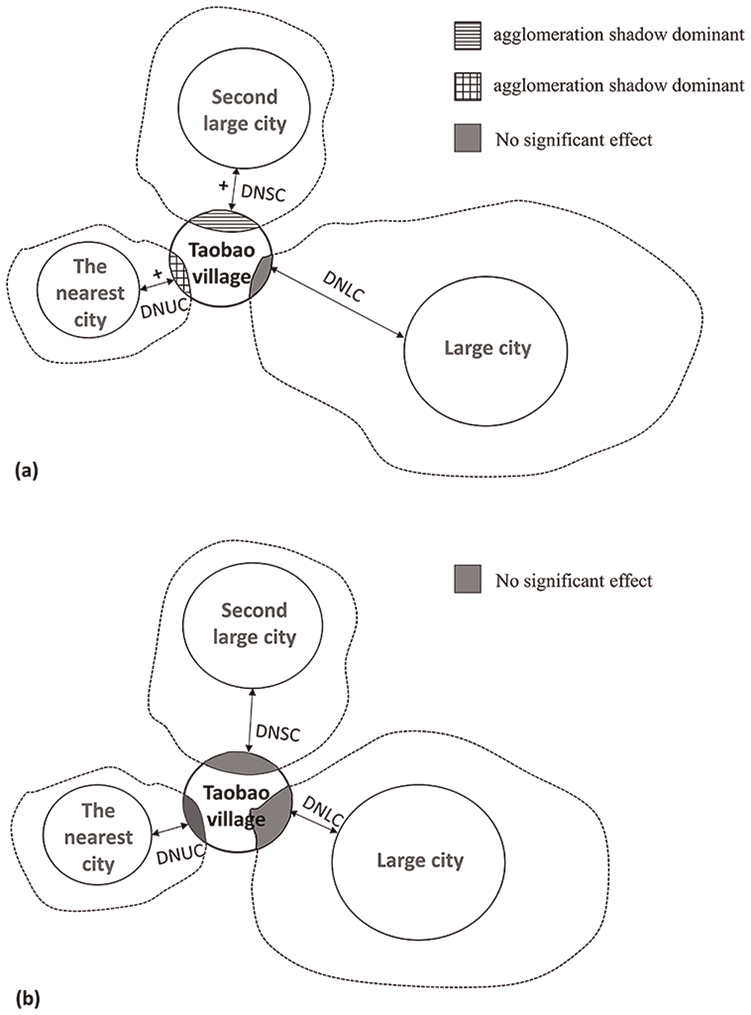
The effect of distances to urban centres of different sizes when (a) DNLC > DNSC and (b) DNLC < DNSC.
Administrative borders and the distance effect of Taobao village formation in Chinese urban systems
Figure 2 shows that the average DNUC is around 30 km. In the Chinese context, this distance typically represents the spatial relationship between the sample county and a prefecture-level city. In contrast, the average distances for DNSC and DNLC are around 300 km, which generally exceeds the administrative jurisdiction of a prefecture-level city. In such cases, using provincial-level administrative borders as dummy variables is more appropriate for analysing the effects of administrative borders on the distance effects of DNSC and DNLC on the number of TVs. Therefore, to further explore the specific effects of the administrative location of urban centres on platform-based economic activities within China’s urban system, this study introduces three dummy variables based on the average distances to define the effect of different administrative borders: (1) UCsamecity–assigned a value of 0 if the nearest city of any size to the sample county does not belong to the same administrative division (prefecture city level) as the county, and 1 if it does; (2) SCsamepro – a value of 0 is assigned if the nearest second large city to the sample county belongs to other provinces and 1 if it belongs to the same province; and (3) LCsamepro– a value of 0 is assigned if the nearest large city to the sample county belongs to other provinces and 1 if it belongs to the same province.
We used the random effects model to measure the impact of different levels of administrative borders on the distance effect on the formation of TVs, with the results presented in Table 3. One important reason for choosing this model is that administrative borders generally do not change over time, making this model suitable for variables that are constant over time but that vary across cross-sectional units.
Regression results of the effect of administrative borders.
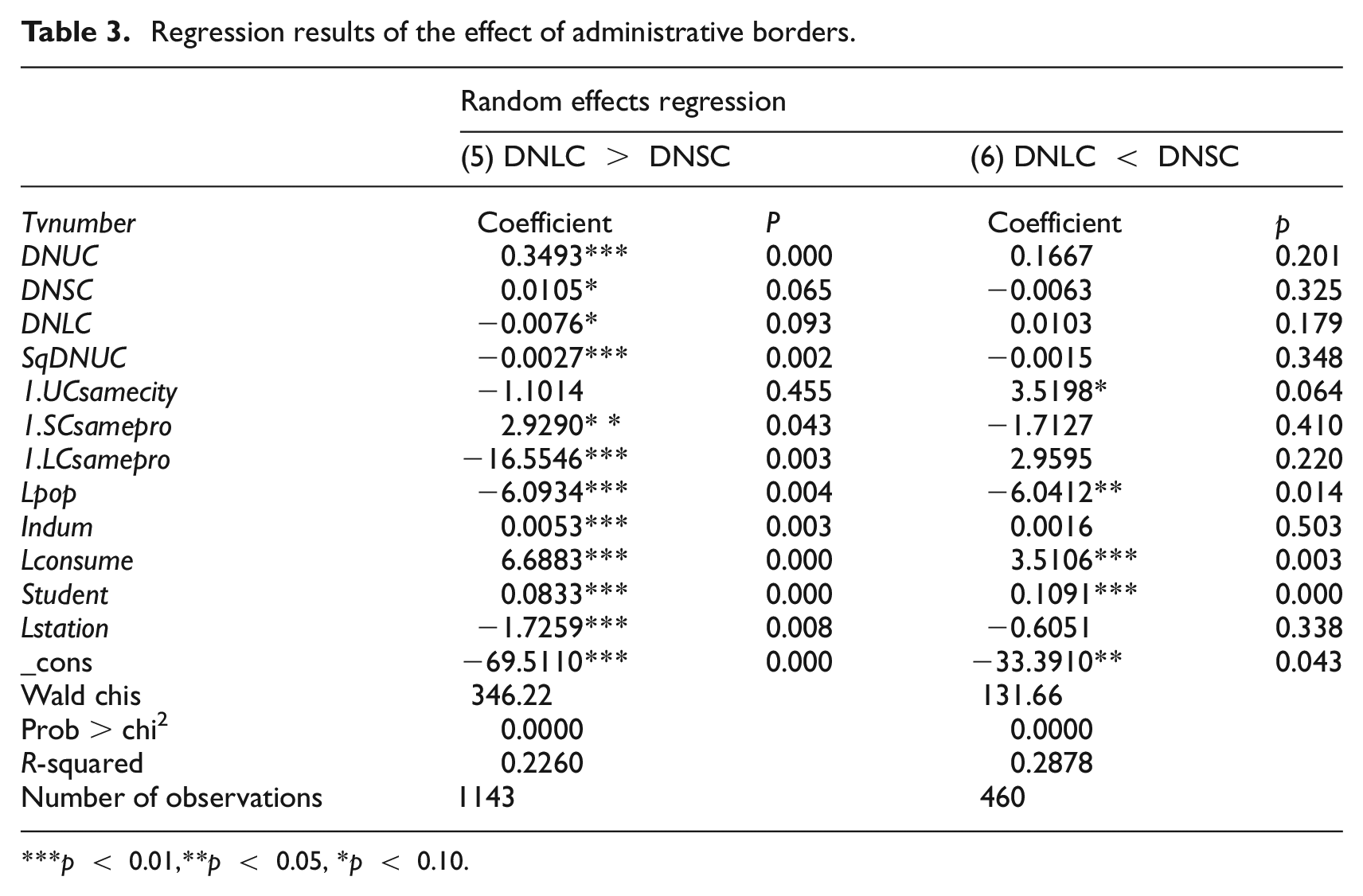
p < 0.01,**p < 0.05, *p < 0.10.
In Table 3, we observe similar results for the main distance variables – the effects of the variables DNUC and DNSC are consistent with the results in columns 2 and 4, while DNLC demonstrates a significantly negative effect on the formation of TVs. Meanwhile, we note the statistical significance of some estimated coefficients related to administrative borders.
First, no significant effect is observed for UCsamecity, indicating that the administrative location of the nearest city to the sample county has no impact on the formation of TVs. In other words, the administrative border does not play a moderating role in the interaction between the county and its nearest city of any size.
Second, a positive and statistically significant coefficient is associated with SCsamepro in column 5, suggesting that the sample county is more conducive to the formation of TVs if the second large city closest to the sample county is in the same province as the county. It points to the barrier effect of provincial-level administrative borders preventing TVs from accessing agglomeration benefits from second large cities located outside the province.
Third, the results also confirm that proximity to large cities facilitates the formation of TVs when the nearest large city is in a different province. Unlike the barrier effect of administrative borders for second large cities, these borders protect e-commerce merchants from the shadow effect of large cities outside the province. Therefore, when DNSC is smaller than DNLC, no significant borrowed size effect from the large cities is observed in column 2, probably because it is offset by the shadow effect from the large cities within the same province as TVs.
Fourth, on the contrary, county-level collections of TVs that are closer to the large cities than to the second large cities are likely to be less affected by both the distance and administrative border effects. In column 6, only the UCsamecity has a significant positive parameter, indicating that there would be more TVs in a county if the nearest city belonged to the same administrative division as the county. However, this result fails to capture the moderating effect of borders on distance effects in the formation of TVs, as no significant effect is found for the three distance variables when DNLC is smaller than DNSC.
Spatial heterogeneity: Regional model
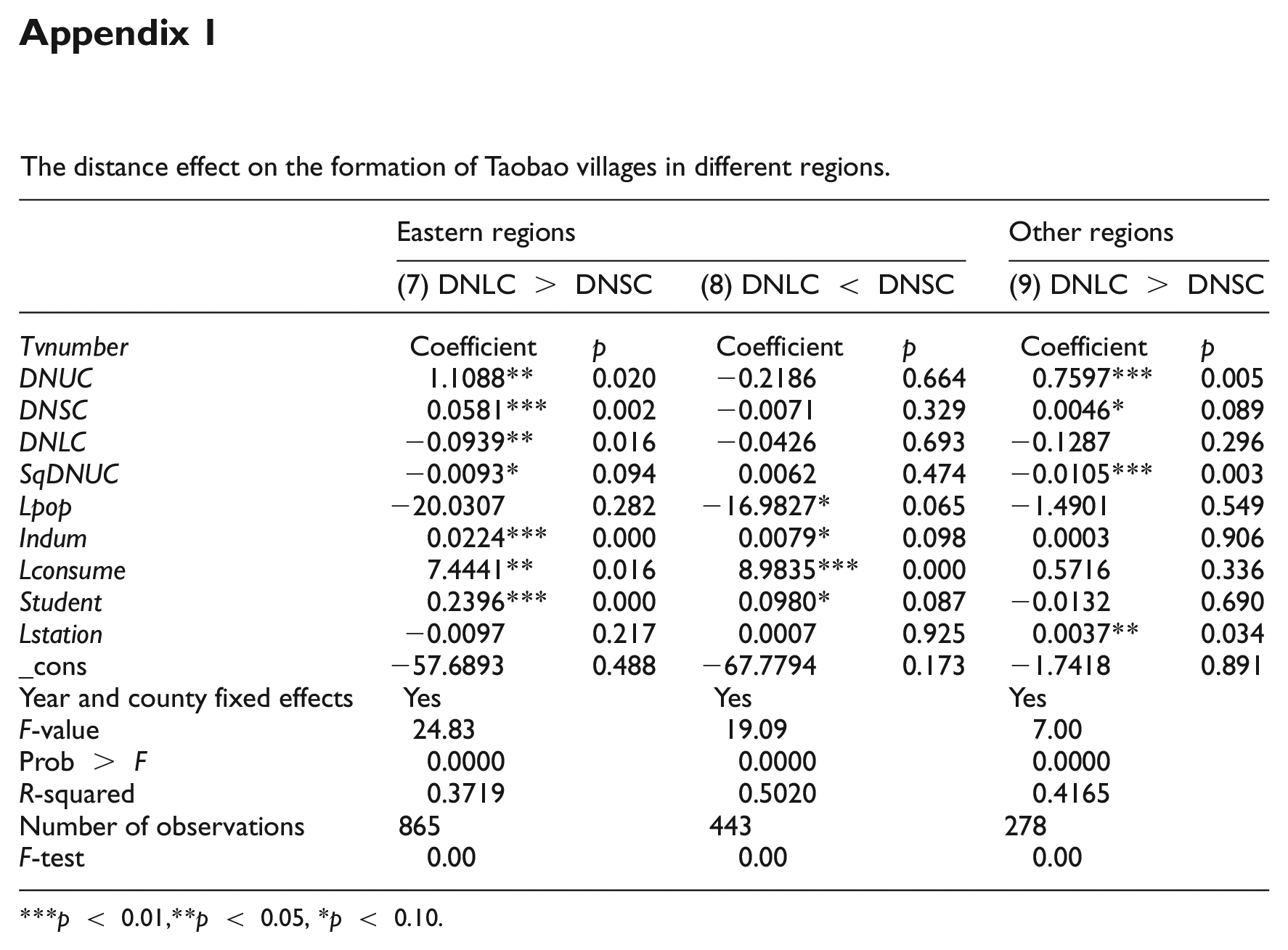
The extensive geographical distribution and pronounced spatial concentration of TVs in China – manifested in their earlier emergence and clustering predominantly in the eastern region – indicate that the relationship between proximity to urban centres and the formation of TVs may not be homogeneous across different geographical contexts. To uncover the potential spatial heterogeneity in the distance–TV formation relationship, the fixed effects model is estimated separately for the eastern and other regions (see Appendix 1).
Due to the insufficient number of observations where the condition of DNLC being less than DNSC in non-eastern regions is satisfied, the model could not produce reliable estimates for this context. As a result, the regression result for this case is not reported. Surprisingly, in columns 7 and 9, the distance to the nearest urban centre of any size continues to exhibit a significant protective effect on the formation of TVs in both regional categories, as evidenced by the significantly positive coefficients for DNUC. Even in the relatively resource-scarce non-eastern regions, e-commerce entrepreneurs do not demonstrate a reliance on proximity to urban centres. This finding suggests the extensive and powerful geographical influence of the platform economy.
However, it is important to highlight that the effects of DNSC and DNLC demonstrate significant spatial heterogeneity. Compared to TVs in eastern regions, those in other regions appear to experience significantly weaker competitive pressures from the second large urban centres and are unable to benefit from the agglomeration advantages associated with proximity to large urban centres. One possible explanation is that e-commerce entrepreneurs in TVs in eastern regions face more pressure in competing for resources with firms located in the nearby second large cities. Although eastern regions are endowed with more abundant industrial development resources, this also implies that e-commerce firms within these areas face stronger and more mature competitors. Moreover, the lack of a significant effect of the distance to large urban centres on the number of TVs in non-eastern regions may be attributed to the limited ability of e-commerce entrepreneurs in these regions to access resources from the large cities. Despite their geographical proximity, these entrepreneurs may lack the capability and experience to establish connections with suppliers, partners and markets in those cities.
Conclusion and discussion
The literature has presented compelling evidence regarding the significance of agglomeration benefits for entrepreneurs. However, to what extent and how platforms have replaced the role of place and proximity in entrepreneurial activities remains unclear. In this article, we investigated how distances to urban centres of different sizes affect the formation of TVs in a county during the period from 2014 to 2020. By adopting panel regression models, we compared the distance effect on the formation of TVs in a county when DNLC exceeds DNSC and vice versa. This approach allows for a comprehensive assessment of the impact of varying distances to urban centres of different sizes on the formation of TVs, thus contributing valuable insights to the evolving landscape of platform-based entrepreneurial activities.
Our findings indicate that DNUC exhibits a significant positive effect on the formation of TVs when DNLC is larger than DNSC, but no significant effect when DNLC is less than DNSC. E-commerce merchants, it appears, do not choose to obtain the agglomeration benefits they need through physical proximity to urban centres.
Another noteworthy discovery from the analysis is the different impacts of distances to urban centres of different sizes on the location choice of e-commerce merchants. When DNLC is larger than DNSC, DNSC has a positive impact on the formation of TVs. However, in instances when DNLC is less than DNSC, DNSC shows no significant effect. Furthermore, the regression results also reveal the fact that DNLC does not exhibit a significant effect on the formation of TVs in the two cases examined in this article. The spatial heterogeneity analysis offers additional insight into this observation: the formation of TVs in economically developed eastern regions is more significantly influenced by DNLC than by DNSC; in contrast, in less developed non-eastern regions, it is significantly associated only with DNSC and shows no significant relationship with DNLC. Although proximity to large cities is theoretically expected to exert a greater influence than proximity to second large cities, these findings suggest that the effects of platform networks on the relationship between geographical distance to different levels of cities and TV formation are uneven, and several TVs may still lack the capacity to effectively establish spatial linkages with large cities. While platform networks are powerful and pervasive, the spatial interaction capabilities of platform-based entrepreneurs remain influenced by context-specific factors such as the availability of local resources (He et al., 2017) and local government policies (Dawley et al., 2019; Yu et al., 2016).
Taken together, our empirical results provide evidence suggesting that e-commerce merchants in TVs may not establish interactions with neighbouring cities through geographical proximity. On one hand, the advent of platform technology has somewhat diminished the traditional significance of proximity to urban resources. On the other hand, the nuanced impact of place-specific costs such as congestion and competition associated with proximity to urban centres may also lead to the results. For instance, our research echoes the insights of Zhang and Zhang (2018), who underscored that the development of rural e-commerce may largely involve simple business models with a predominant focus on general handicrafts and agricultural products, neither of which possesses distinct competitive advantages. In this case, e-commerce entrepreneurs adopting cost-efficient strategies may find themselves more vulnerable to intense competition when located in close proximity to urban centres. Empirical studies on European cities have similarly highlighted the concept of ‘agglomeration shadow’, wherein smaller cities within polycentric metropolitan areas may face greater challenges arising from intense competition compared to their counterparts in monocentric metropolitan areas (Meijers and Burger, 2017). Although their findings pertain specifically to Europe, they resonate with our thoughts and findings on the evolving dynamics of place and proximity in the context of platform-driven economies. The prevalence of TVs in China’s eastern regions, characterized by a high degree of polycentricity, underscores the relevance of these findings in regions where platform-based entrepreneurship and polycentric urban development intersect (Liu and Wang, 2016).
Consideration of the hierarchy of power relations inherent in the administrative divisions of China’s urban system is essential when delving into the interaction dynamics between e-commerce merchants and other regions. Administrative borders, as revealed by our analysis, do not moderate interactions between e-commerce merchants and the nearest city of any size. On the contrary, the presence of provincial administrative borders acts as a barrier that limits e-businesses from benefitting from second large cities located in other provinces, while simultaneously providing a protective effect by shielding merchants from the agglomeration shadow of large cities outside their own province. From this perspective, while most studies emphasize the formidable expansion of platform capitalism in urban space, the frameworks of urban and regional governance, along with policy interventions, still possess the capacity to precisely shape the geographical patterns of capital investment. This finding introduces a layer of complexity with regard to the meaning of places in the platform economy, and e-commerce entrepreneurs may need to navigate a patchwork of regulatory environments and localized conditions.
This evaluation of the proximity effects on the formation of TVs in a county has revealed an interesting interaction trajectory of platform-based entrepreneurs that deviates from popular perceptions. Contrary to common assumptions, platforms do not entirely substitute for place- and proximity-based advantages, and the power of geography remains evident. This realization implies that any geographically creative destruction wreaked by the platform-based economy is partial and is overlain on or interacts with enduring properties of place and proximity associated with traditional industries and business models. The fundamental challenge for the government is to recognize the way that platform-based entrepreneurs interact with different places and pursue a more balanced spatial development that aligns with each locale’s specific characteristics. The challenge to urban economic geographical analysis is both theoretical and empirical: to continue to better theorize some of the geographical complexity of urban economic agglomeration effects within city systems – as referenced in the concepts of borrowed size, function and shadow effects (Alonso, 1973; Meijers and Burger, 2017; Phelps, 2004; Phelps and Ozawa, 2003; Phelps et al., 2001); and to better understand the reasons for these aggregate patterns of e-commerce formation by way of examining (individual) business- and (collective) village-level location dynamics. In China, these dynamics lead to questions regarding the transformation of rural economies (Wang et al., 2021) across greatly extended metropolitan regions with complex mixes of still rural, accessible rural, suburban and urban economic specialization and emerging trajectories of development, including localized e-commerce-related economic development specifically (Wei et al., 2020; Zhang et al., 2023).
Footnotes
Appendix
The distance effect on the formation of Taobao villages in different regions.
| Eastern regions | Other regions | |||||
|---|---|---|---|---|---|---|
| (7) DNLC > DNSC | (8) DNLC < DNSC | (9) DNLC > DNSC | ||||
| Tvnumber | Coefficient | p | Coefficient | p | Coefficient | p |
| DNUC | 1.1088** | 0.020 | −0.2186 | 0.664 | 0.7597*** | 0.005 |
| DNSC | 0.0581*** | 0.002 | −0.0071 | 0.329 | 0.0046* | 0.089 |
| DNLC | −0.0939** | 0.016 | −0.0426 | 0.693 | −0.1287 | 0.296 |
| SqDNUC | −0.0093* | 0.094 | 0.0062 | 0.474 | −0.0105*** | 0.003 |
| Lpop | −20.0307 | 0.282 | −16.9827* | 0.065 | −1.4901 | 0.549 |
| Indum | 0.0224*** | 0.000 | 0.0079* | 0.098 | 0.0003 | 0.906 |
| Lconsume | 7.4441** | 0.016 | 8.9835*** | 0.000 | 0.5716 | 0.336 |
| Student | 0.2396*** | 0.000 | 0.0980* | 0.087 | −0.0132 | 0.690 |
| Lstation | −0.0097 | 0.217 | 0.0007 | 0.925 | 0.0037** | 0.034 |
| _cons | −57.6893 | 0.488 | −67.7794 | 0.173 | −1.7418 | 0.891 |
| Year and county fixed effects | Yes | Yes | Yes | |||
| F-value | 24.83 | 19.09 | 7.00 | |||
| Prob > F | 0.0000 | 0.0000 | 0.0000 | |||
| R-squared | 0.3719 | 0.5020 | 0.4165 | |||
| Number of observations | 865 | 443 | 278 | |||
| F-test | 0.00 | 0.00 | 0.00 | |||
p < 0.01,**p < 0.05, *p < 0.10.
Acknowledgements
The authors are sincerely grateful to the three reviewers and the editorial team for their valuable feedback and thoughtful guidance, which played a crucial role in enhancing the quality of this article.

Funding
The authors disclosed receipt of the following financial support for the research, authorship, and/or publication of this article: This work was funded by the China Scholarship Council (CSC), grant number 202006320038.
Declaration of conflicting interests
The authors declared no potential conflicts of interest with respect to the research, authorship, and/or publication of this article.