




Abstract
This article takes the standpoint that, due to high levels of uncertainty, local economic development work suffers from both input- and output-based legitimacy. Nevertheless, local governments are active development agents and try to come up with economic development initiatives. In order to better understand the legitimate basis for uncertain economic development work, this article offers an unconventional analysis of economic development projects. Drawing on scholars of organization theory, legitimacy is defined as congruence in values between the studied projects and the stakeholders in the surrounding environment. The article examines what kinds of values pervade local governments’ economic development projects. The empirical material is based on thick interview and observation data derived from a study of eight local development projects in Sweden. The results show that values of professionalization and deliberation pervade the analysed projects. Taking the two sets of values together, the results indicate that local government administration seeks to legitimize its economic development work as being based on professional directed processes of public deliberation. Both these sets of values challenge the local representative democratic system of government as the prime source of the legitimacy of local governments’ interventions.
Introduction
Due to high levels of uncertainty, local governments’ economic development work has an unclear basis for legitimacy. Within the policy process of local economic development, there are often multiple, ambiguous and complex forms of democratic input. In addition, the outcome and impact of development policies are hard to measure and evaluate.
Legitimacy for public policy and administration is a fundamental pillar in a democratic political system. In addition, legitimacy is a necessary resource for organizational survival (Pfeffer and Salanick, 1978) and successful policy implementation (Wallner, 2008). Given the unconditional need for legitimacy, and its unclear basis, new and unconventional research approaches are needed in order to understand how local governments’ interventions are or seek to be legitimized.
This article offers a critical examination of the basis for legitimacy of local governments’ economic development work. This is achieved through an empirical exploration of which values pervade local economic development projects in Swedish local government. Drawing on scholars of organizational theory, legitimacy is defined in terms of congruence in values, in this case between local development projects and stakeholders, both within and outside the local government administration. The first step in order to understand the projects’ foundation for legitimacy is to examine the values that pervade the projects, and that can thus potentially constitute a basis for legitimacy.
In recent decades, scholars of political science and public administration have contributed to a deeper understanding of the governance of local and regional development. Several studies have examined public actors’ complex roles in this governance at various levels of government. A shift in the state’s role has been observed since the 1980s and is often described in terms of new regionalism. The state has gone from a position as a provider to become an enabler and a facilitator of local and regional development (Keating, 1998; Syssner, 2006; Vernon et al., 2005). Some researchers believe that the state has gone from taming the market to promoting market mechanisms and a competitive localism (Allmendinger et al., 2015).
Likewise, contemporary studies have described the role of local government agencies as network coordinators with a responsive planning mode in the governance of local development (Aarsaether and Ringholm, 2011; Nyhlen, 2013; Ringholm et al., 2009). These trends could be an argument for the public agencies’ resignation from local development processes and the ‘hollowing out of the state’ (Rhodes, 1994). However, the crucial roles of both the central state (Hudson, 2006; Verma, 2016) and the local administration (Bjarstig and Sandstrom, 2017; Bjornå and Aarsaether, 2010) in managing public–private partnerships for local and regional development have been emphasized in the research.
Other studies have examined the complex relationships between governmental actors, in terms of multilevel governance (Bradford and Wolfe, 2013; Hanssen et al., 2011). Hanssen et al. (2011) conclude that all levels from the European Union to the local level are involved in the governance of local and regional development, although the legal responsibilities do not always correspond to the instruments allocated to the specific level.
Even though the governance of local and regional development has not been fully examined in terms of values and legitimacy, democratic aspects of local and regional development have not been neglected. Regarding the content of development policies, questions of equality have been examined in terms of both gender equality (Hudson and Rönnblom, 2007) and economic equality versus maximizing growth (Scott and Storper, 2003) in local and regional development governance. Pike et al. (2007, 2017) note that development policies are being depoliticized and reduced to technical questions; in return, they call for a normative discussion, asking ‘What kind of local and regional development and for whom?’ (Pike et al., 2007). Regarding the processes of development policymaking, trends towards a more decentralized and collaborative governance in local and regional development have been elaborated on in two ways. First, decentralization towards local and regional institutions could democratize the governance of development (Hanssen et al., 2011; Pierre, 2013). Second, a more critical examination would be that collaborative governance based on local and regional institutions – in other words, public–private partnerships, co-creation and policy networks – systematically encourages some interests while excluding others (Hudson, 2001; Hudson and Rönnblom, 2003; Swedish Government Official Reports (SOU), 1999:83 p. 327 ff.). Some of these democratic aspects will be further elaborated on later.
The main ambition of this study is to contribute to research on governance-related aspects of local economic development work. The study takes an empirical and non-normative approach to legitimacy, defining legitimacy in terms of congruence in values. Scholars of organizational and institutional theory presume that organizations seek legitimacy through a dynamic integration with the organizational environment. This dynamic integration can take many forms. Following this reasoning, an empirical exploration of values that pervade development initiatives is a contribution to a wider discussion of local policymaking and the dynamics of policymaker and stakeholder relations.
Local economic development work seems to have an unclear base for legitimacy due to high levels of uncertainty. Because legitimacy is here defined as congruence in values, the first step in a legitimacy analysis is to answer the overarching research question of this article, namely: Which values pervade local economic development work? By exploring the values that pervade Swedish local governments’ economic development initiatives, this article aims to make a substantial contribution to that research question. Further, the article elaborates on what these values mean for the legitimate basis for local economic development work.
The empirical study is based on in-depth studies of eight economic development projects during a period of three years (2015–2018). The projects are organized as an integrated part of the municipalities’ administration, although they have financial support from – and are part of – a local economic development programme organized by the Swedish Agency for Regional and Economic Development.
Uncertainty and legitimacy in local economic development work
This article sets out from the standpoint that local economic development work has an unclear basis for legitimacy. The argument is mainly based on the position that the field of local and regional economic development is, in many aspects, characterized by high levels of uncertainty.
First, local economic development processes are hard to govern and suffer from uncertainty in policy theory. Development policies have been called ‘planning for the unknown’ (Forde and Kramvig, 2016), and the research can hardly define what is a good policy for economic development (Erlingsson et al., 2011). Economic development is created in markets, which the government has limited possibilities to control (Pierre, 2009). Rothstein (2010) has pointed out that uncertainty in policy theory requires high levels of discretion, adaptation and precision in the implementation phase, which further leads to low levels of political control. This is significant for place-bound development politics, which are often vaguely formulated in policies and thus impose high standards of administrative discretion and flexibility during implementation.
Instead of top-down government based on representative democratic procedures, it has been argued that local development politics include stakeholders via new forms of involvement. Procedures for stakeholder involvement have gone from representation, via participation, to co-creation (Hedensted Lund, 2018). The result, it has been argued, is a loss of political control and accountability (Pierre, 2011: 14). In sum, we can talk about this as uncertainty in the input phase (Schmidt, 2013) of local development policies.
Second, local and regional development policies and interventions are hard to evaluate properly (Bartels et al., 1982; Nicol, 1982; Poèlse, 2013; Turok, 1991). The effect of an intervention is hard to define because the affecting variables are hard to isolate. The recent discussion about progression in evaluation approaches and methods has first and foremost regarded evaluations of international, national and regional policies (see, e.g. Morra Imas and Rist, 2009). The extent to which those methods are applicable to the local government level remains a gap in the literature. In addition, this gap indicates that advanced methods are rarely available to the local government level, probably because of a lack of economic and personnel resources. This leaves us with a situation of ignorance regarding whether or not policies for local development are effective. We can talk about this as uncertainty in the output and outcome (Schmidt, 2013) of local development policies.
To conclude, local and regional development policies suffer from considerable uncertainty in both the input and output phases. This creates a weak and fragile basis for both input-based and output-based legitimacy in the policy field. It has been argued that large scale decentralization reforms of the policy field could potentially strengthen input-based legitimacy (Hanssen et al., 2011). In addition, local development policies have been reviewed as being based on output legitimacy (Hedensted Lund, 2018: 12). However, a solid grounding for either input-based or output-based legitimacy seems to be missing. Therefore, the basis for the legitimacy of local and regional development policies is still a mystery, and empirical studies of values that pervade the policy field are needed.
Project organization has become a matter of routine in Western public administration (Brunsson, 2009; Johansson et al., 2007) and in Swedish local government (Fred, 2018). Likewise, local and regional development is a projectified (Godenhjelm et al., 2015) policy field (Andersson, 2009; Hillo, 2015). The coherence policy of the European Union, which is mainly based on temporal organization, has a greater influence on financing, organization and governance in the field in general (Andersson, 2009; Mukhtar Landgren and Fred, 2018).
The relationship between the uncertainty in the policy field and the project organization can be seen in two ways. First, one could argue, project organization per se adds uncertainty to an already uncertain policy field. A lack of long-term perspectives, continuity and stability in organization could contribute to uncertain conditions. In addition, projects often, but not always, aim to create innovation and change, which in general are highly associated with uncertainty (Sahlin-Andersson and Söderholm, 2002: 16). However, the opposite perspective has been taken more frequently in the literature. Instead, project organization, with its flexibility, has been seen as a way to handle uncertainties of policies in themselves, as well as in the environment (Cui and Olsson, 2009; Olsson, 2006).
Husby et al. (1999) define project flexibility as ‘the capability to adjust the project to prospective consequences of uncertain circumstances within the context of the project’. Considering the fact that project organization is mainly seen as an organizational form – with its flexibility – that is suitable for handling high levels of uncertainty, it is not surprising that the policy field is characterized by project organization.
This leads to two statements. First, studying projects in local development does not involve studying anomalies. Rather it is a commonly used organizational form, from which we can generate observations of interest for the policy field in general. Second, project-based organization can be seen as a consequence of uncertain policy conditions, thus strengthening the argument that the policy field is characterized by uncertainty.
Outline of the article
The first section has introduced the research problem and the aim of the study. It has also offered a very brief introduction to the literature to which this study aims to contribute. In the next section, the theoretical conceptualization of values and legitimacy used in this study is outlined. At the end of the second section, a more delimited analytical framework is presented. The third section discusses the research method and material. The empirical findings are presented and briefly analysed in the fourth section, focusing on process values and loyalty values of local governments’ development projects. Finally, in the fifth section, the findings are discussed and conclusions are drawn.
Perspectives on the legitimacy of public policy and organizations
Legitimacy has been one of the key concepts in the study of political systems and organizations including public administration, albeit with somewhat different conceptualizations. Conceptualizations of legitimacy have been distinguished in many ways. Beetham (1991) distinguishes between the legal expert’s, the moral or political philosopher’s and the social scientist’s approaches to legitimacy. While the legal expert sees legitimacy as conformity with the law, the political or moral philosopher adds normativity and is concerned with the justification of law itself. However, I take Beetham’s third approach to legitimacy as my point of departure: that of the social scientist. The third approach is, unlike the former two, primarily an explanatory one. Following this approach, the concerns addressed are the power relations and what empirical consequences legitimacy has on power relations, in particular within societies rather than universally (Beetham, 1991).
According to the non-normative approach, Beetham differs from the many theories of democratic legitimacy (see, for example Barnard, 2001; Fabienne, 2009; Rosanvallon, 2011), which are concerned with procedures and components in legitimate democratic political systems, rather than legitimacy in any type of power relation.
The non-normative approach also forms the basis for organizational and institutional studies of legitimacy. In the field of organizational theory, the concept of organizational legitimacy has been developed in order to understand what role legitimacy plays in organizations’ interaction with their environment. Within the strategic approach of organizational legitimacy (see Suchman, 1995; Zapata Campos, 2008), one point of departure is that organizations seek to be perceived as legitimate in order to fulfil their strategic aims. However, the extent to which the project organizations in this study act more or less strategically in relation to stakeholders can only be carefully discussed in the concluding remarks. Organizational legitimacy arises when social values associated with or implied by an organization are in congruence with norms and values in the social system that constitutes the organization’s environment (Dowling and Pfeffer, 1975; Pfeffer and Salanick, 1978: 193). Like the non-normative and empirically oriented approach suggested by Beetham (1991), organizational legitimacy is conferred, and therefore also controlled, outside the organization (Pfeffer and Salanick, 1978; 194). In practice, organizations may identify strategic fields or specific organizations by which they attempt to be perceived as legitimate. Therefore, it has been pointed out, empirical studies of specific relations, rather than studies of particular organizations’ relations to the social system as a whole, are needed (Hybels, 1995).
What do organizations do, then, in order to gain legitimacy? In literature we can identify some scholars who distinguish different ways to obtain better congruence between the values associated with the organizations and the values held by strategic parts of the larger organizational environment. Dowling and Pfeffer (1975) point out that organizations can either adapt values held by (the whole or parts of) the social system, change the values held by the social system (again, as a whole or just parts of it) or, finally, be identified with legitimate symbols. The first alternative can be described as a fundamental pillar in a resource dependence perspective (Pfeffer and Salanick, 1978), where organizations have to be adaptive to their environment in order to get access to necessary resources and, in the long term, to survive as an organization. The second alternative, changing the values and norms in the social system so that they better conform to the values and norms held by the social system, can be a difficult task. Even so, a strategic selection of relevant actors or organizations in the organization’s environment seems to make it more manageable. The third alternative, identification with legitimate symbols, can be achieved with communication alone (Dowling and Pfeffer, 1975). In addition, more substantial collaboration with other organizations or single actors can, aside from the actual congruence of values and norms, have a communicative effect on which values are associated with the organization in question (Zapata Campos, 2008).
Brunsson (2007) offers another typology of tools to increase organizational legitimacy. Through decisions, action or talk, Brunsson (2007) suggests, organizations can ensure that the values associated with themselves are more in congruence with the values held by the social system. Theoretically, decision, action and talk can all be combined with the adaptation of values, an attempt to change values in society and identification with legitimate symbols. In addition, Brunsson (2007: 113) highlights organized hypocrisy as a way of managing inconsistent demands or expectations from different actors in the social system. By saying one thing, making a decision in another direction and taking a third course of action, organizations can be perceived as legitimate among organizations and actors with different, and even inconsistent, values and norms.
So far, the discussion has dealt with the legitimacy of organizations acting in a social system. In the overwhelming majority of the research conducted, the level of analysis has been organizations in terms of government agencies, firms or NGOs acting within a social system of other similar organizations and individual actors in terms of customers or citizens. In this paper, the empirical focus is limited to project organizations included in local government administration. This level of analysis needs to consider not only the relations to external organizations and actors, but also the internal relations within the local government organization. In other words, the social environment includes the projects’ internal relations to stakeholders within the local government organization as well as relations to external stakeholders. The simple point of departure is that a study of local development projects’ legitimacy must consider both external relations and internal relations within the local government organization.
Internal and external legitimacy is not a widespread conceptualization in the study of government organizations. Nevertheless, the distinction has been made before. In a study of Swedish regional governments, Nedlund (2012) refers to internal legitimacy as ‘consent given by actors within the [current] organization for arrangements and activities that are present within the democratic organization’ (45). Consent in this case is to be seen as an expression of congruence in social values. In highly diversified organizations such as local or regional governments, consent from other divisions characterized by different objectives, professions and logics stands out as a delicate organizational problem. Seeing the studied projects as organizations, relations to stakeholders within and outside the local government are both external relations. However, the point here is to clarify that legitimacy for development projects has relevant stakeholders both within and outside the formal local government. Internal legitimacy has been discussed in relation to policy legitimacy (Nedlund, 2012). Here, it is important to separate policy legitimacy in terms of substance from policy legitimacy in terms of procedure (Wallner, 2008). Empirically, it can be hard to make a clear separation between the legitimacy of a specific policy’s substance and the procedures that relate to it. However, specific policies can gain internal legitimacy mainly through their substance. In addition, a specific policy can gain legitimacy with respect to its procedures, although the substance is not appreciated by everyone in the organization. However, my point here is that both substance and procedure can be in congruence with social values held by members of the organization and can thereby contribute to internal legitimacy. This remark is of importance in the study of projects since projects tend to be highly characterized by both their substance and their procedures.
Legitimacy has been elaborated on not only in relation to policies, processes and organizations, but also in relation to individual civil servants. Based on a major literature review, Stout (2013) identifies three separate logics of legitimacy in contemporary public administration. The three logics of how legitimacy is created are formulated as different traditions of public administration praxis. The first tradition is the constitutional tradition, within which civil servants are conceptualized as bureaucrats and legitimacy derives from the political representation at the top of the hierarchy. Second, a discretionary tradition is identified, where civil servants act entrepreneurially. The source of legitimacy in the discretionary tradition is the expertise, wisdom and integrity of the entrepreneurial civil servants who produce public benefits. Third and last, Stout identifies a collaborative tradition. The collaborative tradition’s source of legitimacy is the democratic sovereignty and the capability to synthesize dichotomies in society. Within that tradition, civil servants act as stewards who serve the synthesizing and collaborative process.
Building on Stout, Hysing and Olsson (2018) develop three potential grounds for legitimate actions taken in the grey zone of what is comprised by civil servants’ formal positions. These grounds for legitimacy enable us to understand the logics of legitimacy in relation to the project organization level of abstraction.
A first ground for legitimacy is what Hysing and Olsson (2018) call doing things with democratic support. This follows the logics of a representative democracy with elected politicians converting the will of the people to support specific activities within public administration. The second ground is doing the right things. In simple terms, what is right for a public official – disregarding the democratic will – could be based on two different grounds. First, a professional virtue of ethics – or, as Lundqvist (1998) puts it, a public ethos. Second, a specialized expertise in a meritocratic sense. Finally, a third ground for legitimacy is identified as doing the things we (all) can agree on (Hysing and Olsson, 2018). This ground for legitimacy ignores the public administrator’s formal position in the political–democratic system. Instead, what is the right thing to do is identified in the public administrator’s integration with society – the citizens and specific stakeholder organizations.
These three grounds for legitimacy offer a framework for understanding the logics of the actions taken by the project managers in this study. Taken alone, none of these three grounds can allow for a proper understanding of actions taken during a full project period. Instead, it has been shown how – with a large degree of discretion and personal dedication to their tasks – public administrators develop strategies and act flexibly in order to legitimize their work in relation to different stakeholders in the environment (Svensson, 2017). From a formal position, public administrators can – with informal methods – cope with value conflicts and legitimate actions in different ways in relation to different stakeholders. However, it has been pointed out that too much strategy and flexibility in the search for organizational legitimacy can be counterproductive (Ashforth and Gibbs, 1990). Instead, this can be perceived as hypocrisy and results in decreased legitimacy.
Exploring values in local economic development projects – An analytical framework
According to the resource dependence perspective (Dowling and Pfeffer, 1975; Pfeffer and Salanick, 1978), one analytical point of departure is that organizations – including project organizations – have agency and seek legitimacy. Legitimacy is created through congruence in values between the organization and its social environment. Identifying what kinds of values pervade the project can therefore say something about opinions in the social environment of what is perceived as legitimate. In other words, exploring which values pervade local development projects can say something, not about whether the projects are legitimate, but about the basis on which the projects seek (implicitly or explicitly) to be legitimized. Given the perspectives outlined above, two specific sets of values are selected for the empirical analysis.
First, process values will be analysed. Process values address questions of how projects are organized and managed, as well as rationales behind decision-making processes. The distinction between policy substance and process (Wallner, 2008) makes it clear that how policy is made and implemented is highly relevant in relation to development projects. This is because the governance of development process is characterized by high levels of uncertainty, and appropriate and legitimate administrative models are not well defined in the literature. This study states that process values that pervade local governments’ development projects need to be investigated empirically.
Second, loyalty values will also be analysed. Loyalty values address the questions of who is seen as the principal of the projects and on whose behalf the projects are working. As seen above, public administrators and organizations can work on behalf of, for instance, the citizens, the representative democratic system or professional duties (Hysing and Olsson, 2018). Because stakeholders are multiple and views on authorities differ in different logics of legitimacy, the loyalty values that pervade development projects are a relevant issue to investigate empirically.
Research method and material
In an overarching and international context, Swedish municipalities have moderate levels of supralocal supervision (national regulation) and high levels of local capacity (Sellers and Lidström, 2007). Due to the relatively large population of Swedish municipalities (with a median population of 16,500) and extensive responsibility for welfare services, the organizational capacity is high. In addition, Swedish municipalities are free to formulate their own policy initiatives which can be financed by local taxes. The majority of Swedish municipalities’ revenues are financed by local taxes, with only a minority coming from state grants (Lidström, 2016; Sellers and Lidström, 2007). The municipalities have a long tradition of taking their own initiatives for local economic and business development (Pierre, 1992), although the formal responsibility of implementing the national Swedish regional development policy lies with the regional governments. In other words, Swedish municipalities have favourable preconditions for taking policy initiatives for local development. Formally, they are free to address local challenges with locally formulated goals, processes and interventions. This is why Swedish municipalities offer an interesting case, compared to countries where local development work is more influenced by regional or national policies.
This study searches for common values in cases with substantial differences regarding how the projects aim to create local development. Common values in the cases may say something about local development work and its relationship to local governments’ social environments in general. In the concluding remarks, the findings are discussed in relation to the larger framework of perspectives on legitimacy.
The analysis in this study is based on observations of development projects in eight different Swedish municipalities. The analysed material is derived from a three-year (2015–2018) ongoing evaluation research project. Based on locally experienced problems or unexploited potential, the local governments have in some way initiated a policy or development process.1 The projects focus on local development through different kinds of approaches and with different kinds of stakeholders in mind. As a part of the local governments’ own development initiatives, they have all applied and been selected to take part in a regional development programme organized by the Swedish Agency for Regional and Economic Development (SARED).2 As a result of the development initiatives’ involvement in the development programme, they have received minor financial support from SARED. Over and above the financial support, the local governments have been free to organize, formulate and implement their initiatives however they want. SARED has not defined any rules or substantial criteria for how the funding should be used. In practice, the majority of the funding from SARED has been used for specific working time in the projects for development practitioners. SARED’s aim with the programme has been explorative, and the agency wants to study and learn from the local governments’ different methods and approaches to local development. Variety in development initiatives has therefore guided SARED’s selection. Accordingly, SARED has been interested in evaluating and learning from the initiatives, not in formally steering and influencing the ongoing processes. In this study, the initiatives are treated and referred to as projects because of their formal status as projects with support from SARED.
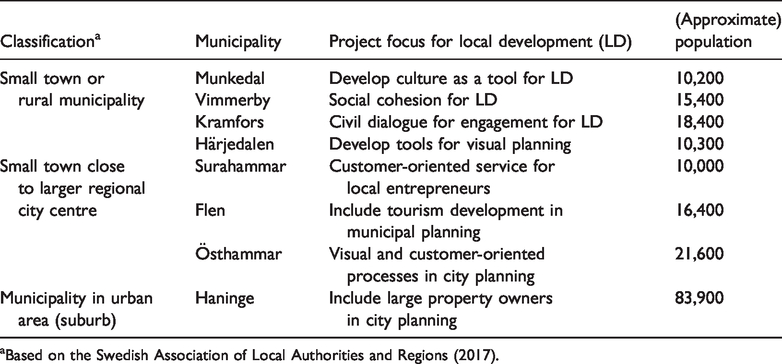
The selected municipalities represent small- and medium-sized municipalities in Sweden. This study searches for generic and commonly shared values of contemporary local development work. As a result, there are no reasons why the selected cases would differ systematically from the larger population of small- and medium-sized Swedish municipalities. Commonly shared findings would, with some limitations to which I will return in the concluding discussion, indicate general features of development work at the local level. The selected cases are summarized in Table 1.
Overview of the studied cases.
The overall methodological approach is to interpret which values pervade the studied projects. Here, ‘pervade’ means that the analysis focuses on the generic structures and inherent logics that guide the whole project. Because of these values’ pervasive character, the analysed values are likely to be unelected to the actors in the projects. Furthermore, it is not of interest to analyse or compare individual actors’ interpretations. Rather, the studied projects are treated as wholes. The research process is informed by the two fundaments of reflexive methodology: interpretation and reflexivity (Alvesson and Sköldberg, 2009). A good interpretation of sometimes ambiguous empirical observations is fulfilled through a theoretical well motivated analytical framework (described above). Reflexivity comes with an openness about how and why empirical observations are interpreted in terms of values. Furthermore, limitations and critical reflections regarding the interpretative research process are saved for the concluding remarks.
One important point of departure is that the projects can express values in a lot of different ways. In other words, the researcher can interpret values by making reference to different aspects of the projects. This point of departure is reflected in the different characters of the empirical observations. The research approach assumes that values can be expressed in (i) what is said (interviews), (ii) what is written (document analysis) and (iii) what is done (project reports), and through formal organization.
The core of the analysed material consists of interviews with the project managers. All project managers have been interviewed three times (in 2016, 2017 and 2018). In order to supplement the information and viewpoints given by the project managers, additional interviews were carried out with leading politicians and municipal managers in 2016. All interviews were conducted on-site at the respective municipality and took around 45–90 minutes. Furthermore, municipal documents relevant to the projects (both formal documents and working material) have been collected and analysed. Through project reports to SARED, activities in the projects have been described and compiled in a comprehensive way. Finally, all projects have been mapped regarding their formal organization, including steering groups, networks, partnerships and stakeholder inclusion. These different kinds of empirical observations make it possible to study the projects as wholes, with in-depth understanding as a guiding principle for the interpretative research process.
Values in local economic development projects
Process values
This section presents the empirical findings seen through the analytical lens of process values. In other words, the findings in this section relate to values of how policy is made and implemented.
The most clear and prominent finding is that dialogue pervades project organization, management and decision-making rationalities in the studied cases. This finding is analysed further in terms of deliberative values. However, dialogue and deliberation are not synonymous. The reason why the focus on dialogue is interpreted as a deliberative value relates to the second interesting finding, namely the almost complete lack of articulated ideas about ‘what actually creates growth and development’ in the projects. A consistent focus on dialogue, in combination with a clear lack of substantial content, is interpreted as an ambition to form the content through the dialogue – in other words, deliberation (Theodorsson, 2004). Deliberation does not imply that all stakeholders must come to an agreement. However, it builds on a belief that good arguments from different views can form the rational best decision, which is in line with the findings.
The prominent existence of deliberative values is demonstrated in a number of ways. First, it is shown in the way the projects are organized. In some projects (Municipality C; Municipality D; Municipality B), permanent (during the project period) boards bring together representatives from politics, government administration, enterprise and the third sector. Within these boards, the idea is that relevant groups of actors will both ‘talk together’ and come to a common understanding of a desirable development, as well as contributing to the rational best decision. These forums for cross-sector dialogue are highlighted as the core of the projects. However, not all studied projects have been organized in this way. Those that are not are instead characterized by other kinds of dialogue activities directed towards different groups of stakeholders. Although these are not permanently organized as boards, it is pointed out by many project managers that the dialogue should be permanent: In my opinion, part of this extensive work involves establishing continuous dialogue with citizens – in other words, not the type that would otherwise normally be held by the municipality on X date. Ideally, you should speak with a citizen every day, on your way to work, or out running, or wherever. This dialogue with citizens must work differently, so that you’ve also had citizen dialogues throughout the process, continuously, daily, with real people. This entire project has included and involved having continuous citizen dialogue. (Municipality G) The thing is, I didn’t have any clear answers to what strengthens the force of attraction. It’s more a case of ‘How shall we work with these issues?’. Having forms of dialogue, drawing up a strategic document that is then broken down into action plans. (Municipality F) ‘And I’d like politicians to take more of an interest. […] Not perhaps in such a steered manner, but so it can be seen that now we’re really focusing on this’ (Municipality H).
A project manager describes the benefits of the deliberative workshops with the elected representatives: We’ve carried out processes with politicians where they’ve worked in groups across party lines to work out what the strengths, weaknesses and opportunities are in [our] municipality. […] I’d say that the best results have been getting politicians to agree, across party lines, on what needs to be communicated. (Municipality G)
Loyalty values
This section considers loyalty values in the projects studied. In other words, who do the project managers perceive as the principal of their work? On whose behalf are the projects working?
Two main findings are presented and elaborated on. First, major characteristics of professional values are found in almost all cases. This means that project managers express loyalty to a professional authority and profession-based values. Professional loyalty means that the work is guided by professional duties rather than, for instance, organizational or political duties. Legitimacy through loyalty to a professional authority is theoretically close to what Hysing and Olsson (2018) call ‘doing the right things’ based on expertise.
Second, but less prominent, is loyalty to stakeholders in the community – citizens, local enterprise or civil sector interests. Loyalty to external (outside the local government) stakeholders is theoretically close to what Hysing and Olsson (2018) call ‘doing the things we all can agree on’, where the municipal administrators do not consider their formal role in the politically governed organization but respond directly to ‘the will of the community’. Although the findings are not very prominent, fragments of ideas of ‘external stakeholders as the principal of the work’ are found.
In the studied cases, professional loyalty seems to be the most empirically relevant framework of understanding, due to the ideas of the project managers. This can be evidenced in two ways. Most project managers do not communicate that ‘their’ projects correspond to some principal – either the elected representatives or the citizens of the local community. Instead, project managers are frustrated by politicians, administrators, and people from enterprise and the third sector not showing sufficient commitment to the projects and to local development in general.
In addition, the empirical relevance of the professional authority can be proven with reference to the project managers’ criticism of both elected representatives and external stakeholders. Rather than seeing elected representatives, local enterprise or citizens as the principal of their work, they are seen as the ‘problem to be solved’. Behaviours that do not contribute to the common good (defined in terms of economic or population growth) must be changed by reference to the project managers’ professional authority (Municipality D; Municipality F; Municipality B).
In many of the cases, project managers express how they have to struggle against what they perceive as attitudes from elected representatives, entrepreneurs and citizens that do not contribute to growth and development. A new project manager talks about the former project manager, who quit his job after struggling to achieve involvement from politics, administration and civil society: ‘But he was a little disappointed because he hadn’t got the support for the project. I believe this was partly within the organization, and partly externally’ (Municipality F). It won’t work unless the politicians pull themselves together. So we had to start the project differently to what we planned – we brought in [a consultant]. He had to carry out in-depth interviews with the leading politicians. He asked them to calm down and start thinking again about a strong local force of attraction and [the city’s] best interests, instead of standing up on the barricades and screaming about every issue. (Municipality B) ‘[The project manager] had told all the administrative managers to describe their operations in 10–20 years’ time or something like that, and there was quite a lot of frustration. They thought she was encroaching on political grounds’ (Municipality C).
The external stakeholder loyalty approach treats the local community or some of the community’s groups of stakeholders as the authority and principal of the work conducted within the projects. Thus, the principal of the project is here defined regardless of the project’s position in a politically governed organization. The project corresponds to the will and public good, as defined by the local community or specific groups of stakeholders. In the studied cases, evidence for this approach can be found among the project managers.
In one case, the project aims to improve the conditions for local enterprise (Municipality D). The project manager is a former business development consultant and defines ‘the businesses good’ as the common good. Therefore, from the project manager’s point of view, enterprise is the principal of her work. Enterprise, in turn, serves the citizens and the common good. This approach to political authority has not been uncontroversial. The project manager has been accused of being disloyal to the elected representatives and the administrative managers.
The case described above is not unique in any way. Rather, conflicts regarding political authority have been commonplace. In another case, leading politicians in the municipality remonstrated against the fact that municipal development strategies were developed as a part of a project they had very limited possibilities to control. In other words, they felt overridden as the political authority in the municipal administration. One thing that we learnt throughout this process is that even with politics, although they’d sat in on advisory boards and all these meetings, there were indications that certain politicians had felt ignored. ‘Is that how we work in a democracy? A project team draws up our development strategy?’. (Municipality B)
Conclusions and discussion
The main results of this study can be formulated as a paradox. First, the processes in the projects seem to be pervaded by deliberative values, including ideas of participation and bottom-up policymaking. Second, the project managers seem to be loyal to a professional authority, including the idea that they are working on behalf of a professional authority of economic development, rather than the citizens or the politicians that are taking part in the deliberative processes. In other words, two sets of values stand out as especially prominent in the studied projects: values of deliberation and professionalization. At the same time, the development practitioners who work in the projects do not convey any substantial expertise competence regarding what to do to strengthen development and growth. Furthermore, they do not show that much loyalty and obedience to formal democratic institutions.
The results illustrate a mix of values of deliberation and democracy on the one hand, and values of professionalization and meritocracy on the other. If projects and practitioners’ roles are based on values of deliberation and professionalization, what kinds of projects and practitioners are they? The development practitioners could, based on this study, be called professional deliberative practitioners (cf. Forester, 1999). The projects could be called forums in which the process of deliberation is prominent, while the deliberative work models in the first place originate from the practitioners’ professional assessments.
Regarding whether these two sets of values form a legitimate ground for local economic development initiatives, two – roughly speaking – alternative scenarios are possible. In this study, the values that pervade local development initiatives are examined. However, this does not say anything about the values held by the stakeholders and the other actors in the social environment, and whether values are in congruence or not.
In the first scenario, the stakeholders of the development initiative – primarily the citizens, but also politicians and civil servants within the local government administration – hold values that are in congruence with the values that pervade the development initiative. In this case, and with reference to seminal scholars of organizational studies, the development initiative is to be examined as legitimate. The major implication of this scenario is that we have to redefine which values make local governments’ development initiatives’ legitimate. The implication of this scenario would be that the bureaucratic context, where policy initiatives are initiated with loyalty to a democratic authority and the public administration’s processes are characterized to some extent by professional and values, is obsolete or never has been a reality – at least in the case of local economic development initiatives. Instead, this scenario indicated the inverse, that development initiatives are created because the development practitioners’ professional assessments say that initiatives of deliberation are needed in order to provide a common ground for politicians, administrators and entrepreneurs. If this scenario is true, we are facing a situation where public administrators and practitioners set their own agendas and the democratic authority of local governments’ development initiatives are disquietingly weak.
In the second scenario, the stakeholders do not hold values in agreement with the values that pervade the development initiatives. In this case, the public spending in the form of development initiatives is considered illegitimate in the eyes of the stakeholder. This does not mean that all conceivable forms of development initiatives are considered illegitimate, only the ones pervaded by the values identified in this study.
Following the second scenario, it is likely that both citizens and politicians want a more authoritarian role, via the representative democratic institutions, and for the development practitioners to be more loyal to them. In the eyes of the stakeholders, it would perhaps be more legitimate if the development initiatives were initiated on their behalf, and not (as in some cases in this study) for them to be denounced as problematic, uncomprehending and in need of interventions in form of deliberation. In accordance with Wallner (2008), illegitimate policy interventions are not just problematic from normative democratic standpoints. They are also unlikely to be successful because of implementation problems in relation to the disapproval of stakeholders.
In this study, projects for local economic development are studied as cases for local governments’ development initiatives. However, the conclusions and scenarios raised in this article call for an urgent discussion regarding economic development initiatives and policies at all levels of government. If the development initiatives studied here are part of a larger policy system of ideas and discourses, it is likely that the same results would be found in studies of other local and regional economic development interventions. Finally, this study makes an empirical contribution to the general discussion of the role of local government administration and the governance of uncertain policy areas, indicating a clear professionalization of public administrators who see citizens and politicians as targets for interventions rather than the authority on behalf of which they are working.
List of interviewees
Tourism Manager/Project Manager, Flen Municipality
Municipal Chief Executive, Flen Municipality
Project Manager, Haninge Municipality
Communications Manager, Haninge Municipality
Planning Manager, Haninge Municipality
Project Manager, Härjedalen Municipality
Environment and Building Manager, Härjedalen Municipality
Urban Planning Manager, Härjedalen Municipality
Chief Financial Officer, Härjedalen Municipality
Municipal Chief Executive, Härjedalen Municipality
Mayor, Härjedalen Municipality
Urban Planner/Project Manager, Kramfors Municipality
Development Strategist/Project Manager, Kramfors Municipality
Municipal Chief Executive, Kramfors Municipality
Urban Planning Manager, Kramfors Municipality
Mayor, Kramfors Municipality
Business Development Manager/Project Manager, Munkedal Municipality
Culture Manager/Project Manager, Munkedal Municipality
Municipal Chief Executive, Munkedal Municipality
Mayor, Munkedal Municipality
Business Development Manager/Project Manager, Surahammar Municipality
Municipal Chief Executive, Surahammar Municipality
Urban Planning Manager, Surahammar Municipality
Mayor, Surahammar Municipality
Business Development Manager/Project Manager, Vimmerby Municipality
Project Manager, Vimmerby Municipality [Mismatch]
Municipal Chief Executive, Vimmerby Municipality
Development Manager, Vimmerby Municipality
Mayor, Vimmerby Municipality
Urban Planner/Project Manager, Östhammar Municipality
Municipal Chief Executive, Östhammar Municipality
Business Development Manager, Östhammar Municipality
Footnotes
Declaration of Conflicting Interests
The author(s) declared no potential conflicts of interest with respect to the research, authorship, and/or publication of this article.
Funding
The author(s) received no financial support for the research, authorship, and/or publication of this article.
