



Abstract
We explore the framing of people living with HIV in news photos from China through two studies. Study 1 consists of a Q-sort exercise and post-sorting qualitative interviews with 10 Chinese individuals. Insights are used to develop operational definitions of visual frames for use in Study 2, a quantitative content analysis. News photos of 290 people living with HIV are analyzed in Study 2 (2000–2015). Results reveal unique features of Chinese news photos, such as blurring and pixelation despite positive framing. They also suggest variations in news framing by region (community structure).
Many factors can exacerbate, or on the contrary, ameliorate the stigma and discrimination experienced by those whose lives are touched by the human immunodeficiency virus (HIV). Of them, great importance is attached to media coverage. This study uses a quantitative content analysis to investigate the ways in which people living with HIV were depicted in one national and six local Chinese newspapers between 2000 and 2015. Using framing as a theoretical guide, our analysis sets out to identify the aspects of HIV that are highlighted in news photos and those that are suppressed (see Entman, 1993). This analysis is preceded by a Q-sort exercise and post-sorting qualitative interviews with 10 Chinese individuals, intended to validate constructs for use in the quantitative analysis, and thus, ensure that the frames for people living with HIV described in Western literature can be used in a study of Chinese news photos.
We aim to advance scholarship in several ways. First, by investigating Chinese news coverage, this study underpins efforts to test widespread theories and assumptions about the nature of journalism in non-Western contexts. Second, by focusing on photos—a common yet much neglected component of news—we add to the body of empirically validated propositions on the role of visuals in the social construction of reality. Third, by analyzing news photos from newspapers published in diverse communities, we hope to strengthen the case for including data on prevalent ideas, values, and norms in framing analyses. Fourth, through our use of a mixed-method design, we set out to show how framing research can benefit from cross-pollinating qualitative and quantitative methods. Finally, by focusing on how people living with HIV are depicted in news, the studies contribute to the field of health communication.
HIV in China
HIV is an incurable but manageable disease that weakens one’s immune system. It affects less than 0.1% of the Chinese population, but numbers soared in recent years from nearly 18,000 to over 500,000. Sexual intercourse, especially commercial or among men, and drug use are the primary modes of transmission (National Health and Family Planning Commission of the People’s Republic of China [NHFPC], 2015). Given the public denunciation of these behaviors in China, people living with HIV are often considered to have lost their lian, or moral face. Indeed, stigmatizing attitudes toward people living with HIV are highly prevalent (Chen et al., 2005).
All three administrations that have governed China since the turn of the century—Jiang–Li–Zhu (1993–2003), Hu–Wen (2003–2013), and Xi–Li (since 2013)—have pledged to prevent and control HIV. Of them, the Hu–Wen Administration was perhaps the most devoted, as illustrated by the expansion of various action plans. This administration instructed journalists to disseminate information on HIV prevention and took steps in combating stigma and discrimination, including Wen Jiabao’s routine meet-and-greet with people living with HIV on World AIDS Day (see, e.g., State Council of the People’s Republic of China, 2012).
Literature Review
Framing as a Theoretical Lens
The turbulent history of what is now known as framing research is marked by four milestones, which are as follows: (1) the early 1900s, its genesis, (2) the turn of the century, when the number of empirical studies appeared to grow exponentially, and (3) the sobering period caused by the stagnation of theory-building work that culminated with the criticism voiced by Cacciatore et al. (2016), Krippendorff (2017), and others. Currently, as interest in framing has remained steadfast and research has begun to re-prioritize theory building, we seem to be entering a new stage, that of (4) normalization, in which framing is employed due to its benefits while addressing inconsistencies and criticisms. Indeed, as argued in a recent forum, looking beyond framing is neither possible nor meaningful as it remains the best suited theoretical framework for guiding our study of the social construction of reality and its effects (see D’Angelo et al., 2019).
Framing scholarship aims to describe, explain, and predict the occurrence of verbal and visual interpretive patterns in various forms of communication, the factors influencing their use, and their effects on the members of the audience (see Entman, 1993). More than one pattern of interpretation exists for every given issue—that is, there are multiple versions of what the problem is, who is responsible, what can be done to solve the problem, and how this should be evaluated (Entman, 1993). These patterns are known as frames.
While the idea that framing can occur through either words or visuals is almost as old as the concept itself (see Coleman, 2010), empirical studies typically choose to focus merely on the verbal aspects of communication, neglecting that, in the words of Rodriguez and Dimitrova, “visuals are framing devices on steroids” (D’Angelo et al., 2019, p. 22). Of the framing studies published between 1990 and 2005, 83% analyzed texts in isolation (Matthes, 2009). This neglect seems unjustified for a number of reasons, including that most forms of journalism consist of both words and visuals; visuals are typically awarded more attention than words and are processed faster and ahead of words; and visuals tend to be remembered better than words (see Dan, 2018). Given the slow pace at which our discipline is developing methodological advice able to guide the uncovering of meanings conveyed by visuals, we believe that, for the time being, visuals should be prioritized. We see this as adequate given that studies on Chinese news barely ever acknowledge visuals (Ren et al., 2014) and our discipline’s limited understanding of photojournalism in China—in addition to persisting methodological challenges posed by visual analyses.
Frames come into being when actors like journalists select and emphasize some aspects of social reality while neglecting others (Entman, 1993). Actors develop and advance frames either strategically or automatically, without any ulterior motive. The former has been the focus of scholars interested in framing contests, especially in political communication. The latter occurs when selected ideas, values, and norms prevalent in the underlying culture guide the process of framing almost by default (Dan et al., 2019). The act of framing becomes obscured, and the frames advanced appear as commonsensical or natural—that is, as the only reasonable way to think about the issue at hand. In the research reported here, we have attempted to include the underlying culture in framing analysis. The community structure approach can guide this endeavor.
The Community Structure Approach
This approach posits that the characteristics of the community in which journalists pursue their job affect their coverage (Demers & Viswanath, 1999). These characteristics serve as surrogates for power distribution. Scholars test if differences in news coverage across outlets are associated with the way power is distributed in the communities studied. Thus, journalists may use frames that reflect the concerns of the most vulnerable members of their community.
The Framing of People Living With HIV in the News
Recently, Dan (2018) has provided an in-depth review of previous work on the media framing of people living with HIV in news. There, previous research was boiled down to the following four frames. The normal frame underscores how people living with HIV go on with their lives as anyone else would despite their disease (e.g., the person has friends, family, and a job). The survivor frame highlights power in the body and mind of people living with HIV (e.g., the person is an advocate for HIV awareness or an athlete). The victim frame emphasizes the weakness of people living with HIV (e.g., the person is ill and depressed). The carrier frame underlines the perceived lack of self-control and perceived dangerousness of people living with HIV (e.g., the person does not disclose his or her HIV diagnosis to sexual partners). The portion of analysis dealing with U.S. news visuals revealed that the normal frame was visually conveyed in almost half the sample, followed by the survivor (27.7%), carrier (17.9%), and victim frames (10.7%). Also, significant associations were found between the use of the frames and selected characteristics of the U.S. regions in which newspapers were published (Dan, 2018): The survivor frame was conveyed more in news visuals from states with high HIV rates and news texts in states with high urbanism. By contrast, the victim frame was more common in news visuals from states with low HIV rates. The normal frame was used more in states characterized by high HIV prevalence, while the carrier frame was more common in news from states characterized by low HIV prevalence (verbal and visual) and low urbanism (just verbal). To our knowledge, no study to date has investigated the ways in which people living with HIV are framed visually in Chinese newspapers.
Research Questions and Hypotheses
We begin our study by validating the four visual frames reviewed above (Study 1) before analyzing news photos and potential variations in framing related to community characteristics (Study 2). Study 1 consists of a Q-sort exercise and qualitative interviews with 10 Chinese individuals. This is a necessary preparatory step for Study 2, as it would be naïve to assume that the operational definitions of key constructs designed for a U.S. news sample can be used without change in a Chinese context. After all, people of different cultures can use the same visual conventions to convey different interpretations. It is conceivable that this also holds for conventions in Chinese versus Western photojournalism (see Li, 2008). For instance, placing a black bar over a person’s eyes to conceal their identity may be a sign of respect of that person’s privacy in one culture and suggestive of illicit behavior in another. We ask:
The potential for polysemy notwithstanding (Geise & Baden, 2015), it has been argued that, across cultures, people assign similar meanings to variations in camera angles and camera distances in photos (see Coleman, 2010). A high-angle shot—obtained by pointing the camera down toward the person depicted—is likely to suggest that the person shown is weaker than the viewer. The power dynamics between the viewer and the person depicted are likely to be perceived as balanced in photos at an eye-level shot, that is, those in which the camera is located at the eye level of the subject. Finally, a low-angle shot—where the camera is placed lower than the subject—is likely to evoke the idea that the subject is powerful. Camera distance refers to the true distance (and implicitly, social distance) of a subject from the camera. Variations reproduce human relations and make the subject seem close or distant. In political communication, closeups are considered intimate and have positive connotations, medium shots are said to be neutral, and long shots are interpreted as negative (Coleman, 2010; Fahmy et al., 2007). In the context of HIV, these connotations may vary. One study found that long and medium shots were more typically associated with the normal and survivor frames, whereas closeups were typically used with the carrier frame (Dan, 2018). We ask,
We expect that the use of the four frames under investigation will differ according to how power is distributed in the communities in which the respective outlets were published. Like Dan (2018), we factor in political views, HIV prevalence, and urban/rural density because classifying Chinese regions based on these characteristics is possible and meaningful. Yet, instead of data on religiosity, we include data on ethnic diversity. This adjustment is necessary because nearly 90% of Chinese people describe themselves as atheist (Lu, 2012) and large differences exist in the ethnic makeups of the communities studied, while minority populations are disproportionately affected by HIV (National Bureau of Statistics of China [NBSC], 2017; NHFPC, 2015). We predict:
Study 1
Methodology
Participants
We recruited 10 Chinese individuals in a metropolitan area in China in July 2017 using convenience and snowball sampling strategies. We aimed for gender parity and as diverse as possible a sample in terms of age, origin, and profession. Three of the participants were originally from a rural area and had only recently moved to the city. Nine had graduated from or were currently attending college. Six were female, four were male. Three were students in their early 20s, one worked as an accountant (22 years old), and two were self-employed individuals in their early 40s. A housewife (44), engineer (44), driver (50), and clerk (50) also participated in the study.
Stimuli
Based on Dan’s (2018) operationalization of the four frames of interest, we selected 34 photos to function as stimulus material in the Q-sort exercise. We aimed to include both photos that clearly conveyed one of the four frames and more ambiguous ones. Nineteen of the photos selected were deemed by the authors to be clear (five for the normal frame, six each for the survivor, and victim frames, and two for the carrier frame); 15 were considered ambiguous. The latter contained mixed cues, that is, elements pointing to frames that were diametrically opposed. One such photo showed a family living with HIV (parents and two children) meeting a government official at a public event. The people living with HIV were shown shaking hands with the politician, and several cameras recording the event were visible in the background. This could convey the survivor frame. However, protagonists’ faces were pixelated beyond recognition. This technical choice had not been described in any of the studies to date, but we believed that it may conjure up the victim frame. Another photo showed children living with HIV who were about to eat in a dining hall. They wore everyday clothes and their facial expressions were neutral to positive. To this point, this photo would be suggestive of the normal frame. However, the person in charge of distributing the food—though smiling—wore a nurse uniform. This suggested to us that the children were sick. Hence, we thought that this may alter viewers’ interpretation and convey the victim frame instead of the normal frame.
Procedure
The study participants met individually with one of the authors for a Q-sort exercise paired with a face-to-face interview. Each meeting lasted 20 to 40 min and proceeded in the same way. First, the participant was asked to introduce himself/herself; information on age, education, and profession was recorded. Second, the four visual frames were orally explained to them. Participants were allowed to ask follow-up questions. Third, the 34 photos were shown to the participants in random order as high-quality printouts. It was explained to them that the photos showed authentic people living with HIV and that they were taken from Chinese newspapers. Fourth, the participants were asked to spontaneously assign each photo to one of the four frames on a board located on a desk. This board only contained the names of each frame (normal, survivor, victim, and carrier) in the table header. The participants were told that there was no right or wrong answer and their personal views were the point of interest. Finally, the participants were asked to justify each assigning decision; all the justifications provided were written down.
Results
After compiling the data collected per photograph, we recorded how many of the study participants categorized each photo as conveying the normal, survivor, victim, or carrier frame. Then, the justifications for each categorization were considered. The authors discussed the quantitative (number of people) and qualitative (justification) data collected for each photo and agreed on how similar photos should be coded in Study 2. Figure 1 shows photos illustrating the four frames.
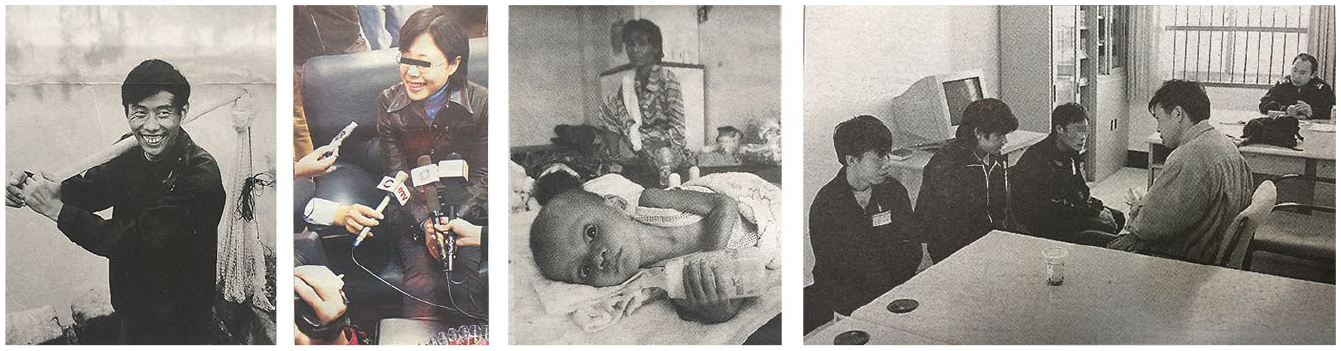
Examples of the four frames.
In response to RQ1, we found that the four frames could be operationally defined in this study of Chinese media in similar ways as in studies of Western media. However, some important differences existed. The normal frame was conveyed by photos showing people living with HIV in a work-related setting, in an education setting, or in meaningful positive interaction with others (e.g., hugging, kissing, reaching life milestones like getting married). The survivor frame was cued by photos in which people living with HIV were at the center of attention at a public event and photos in which people living with HIV engaged in positive interaction with celebrities and politicians. The former could be denoted by props like microphones, stages, and sponsor walls. The latter referred to press conferences or (staged) events like cooking together. Yet, an important exception was noted here: Celebrities and politicians meeting people living with HIV in a hospital setting cued the victim frame instead. The victim frame was conveyed when the people depicted looked sad, poor, and/or ill. Sadness was indicated by negative nonverbal behavior, while poverty was suggested by thinness, humble living conditions, accepting donations, and unkempt appearance (e.g., hair, clothes). Illness was put forward by thinness, the hospital setting, the presence of medical personnel or medical equipment (e.g., wheelchair), and the use of patient clothes (i.e., hospital pajamas rather than everyday clothing). The impression conveyed was one of passivity, vulnerability, and helplessness. Props suggesting illness overpowered positive nonverbal behavior. Images of people living with HIV smiling broadly into the camera consistently conveyed the victim frame whenever the photo was taken in a hospital or medical personnel was also shown, even if the doctor/nurse was smiling. Finally, the carrier frame was suggested by photos showing people living with HIV in police custody, in prison, or with law enforcers.
Discussion
Study 1 revealed ways in which Chinese people made sense of images of people living with HIV, and it showed both similarities and differences compared with the meanings extracted by people from Western countries, as suggested by Li and Zheng (2020). Practical and theoretical implications arise from this, offering insights for Study 2. First, we incorporated the insights gained from Study 1 in our operational definitions of the four visual frames. Moreover, the codebook for Study 2 included some variables recording the use of techniques for photo taking/editing that obscure the face of the subject. Such techniques are rarely documented in Western literature and are in stark contrast to Western ways of depicting people in a positive way. Examples include the following: obscuring subjects’ faces by depicting them with a black bar over the eyes or retroactively pixelating or blurring their faces (editing techniques), obscuring subjects’ faces by showing them from the side with hair covering their face or from behind (choice of angle), or visually cutting off subjects’ heads from the image (either when taking the photo or as an editing choice). Study 1 strongly suggested that they are not associated with different frames: Photos of people talking into microphones, for instance, were unanimously categorized as conveying a survivor frame even when the subjects’ faces were pixelated. Still, Study 2 evaluates the extent to which such techniques are typical of Chinese photojournalism and whether their use can be explained with reference to the subject’s sociodemographic characteristics. It is possible that ethnocentrism—that is, in-group favoritism—will lead Chinese journalists to protect the identity and privacy of Chinese people living with HIV, but not that of non-Chinese people living with HIV (Rivenburgh, 2000). We add the following hypothesis:
From a theoretical perspective, the takeaway from Study 1 is that images showing different people (age, gender, etc.) in different contexts (e.g., shaking hands with government officials, being interviewed, addressing a crowd from a stage) can convey the same frame. This is in line with Dan and Coleman’s (2014) findings that people were able to identify a specific frame of people living with HIV across photos with different content. This suggests that holistic measures of visual frames may be more suitable than splitting frames into elements and merging them during the data analysis. Another theoretical implication of Study 1 is that there appears to be a hierarchy of cues pointing to frames, where some clearly convey a frame regardless of their pairing with other contradicting cues. For the development of research instruments, this means that coders should be instructed to account for standalone cues and if-then cues.
In addition to the limitation posed by the relative homogeneity of study participants that we already mentioned above, we also caution that our decision to identify the frames prior to the sorting exercise may have prompted the study participants to see the photos in light of the frames. While we had the impression that the participants were intrinsically guided by their assessments of deservingness and morality when grouping the photos, we cannot be certain how/if our identification of the frames interfered with their reasoning. Future studies should consider asking participants to sort photos without such guidance. An additional limitation arises because people from urban areas were overrepresented in our sample. Perhaps more variations would occur if residents from non-urban areas, where communities are more tight-knit, were to evaluate visuals of people living with HIV. Forthcoming studies should attempt to include more participants from rural areas.
Study 2
Methodology
Sample
The visual framing of 290 people living with HIV was analyzed in 129 news articles from one national, three metropolitan, and three provincial Chinese newspapers from 2000 to 2015 (Table 1). They represent the newspapers with the highest circulations in the nation or relevant region. The metropolitan outlets were selected as representative of northern, eastern, and southern China; the provincial ones were chosen to represent the three regions with the highest HIV prevalence after 2000 (UNAIDS, 2008). Figure 2 shows the location of the regions under investigation on the map.
Sample Overview.
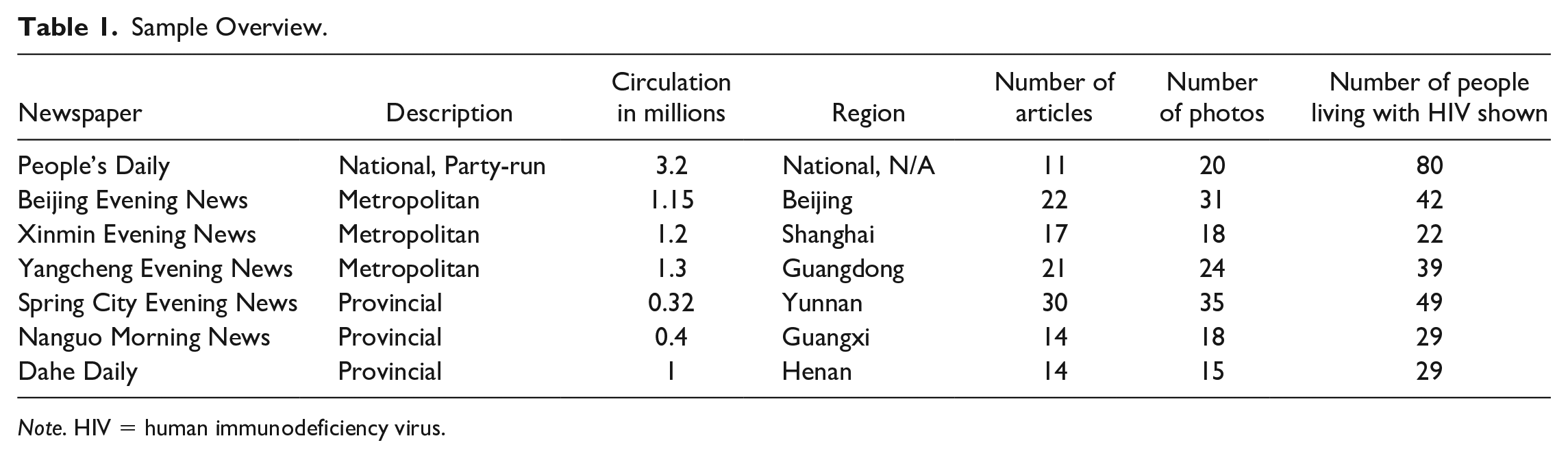
Note. HIV = human immunodeficiency virus.
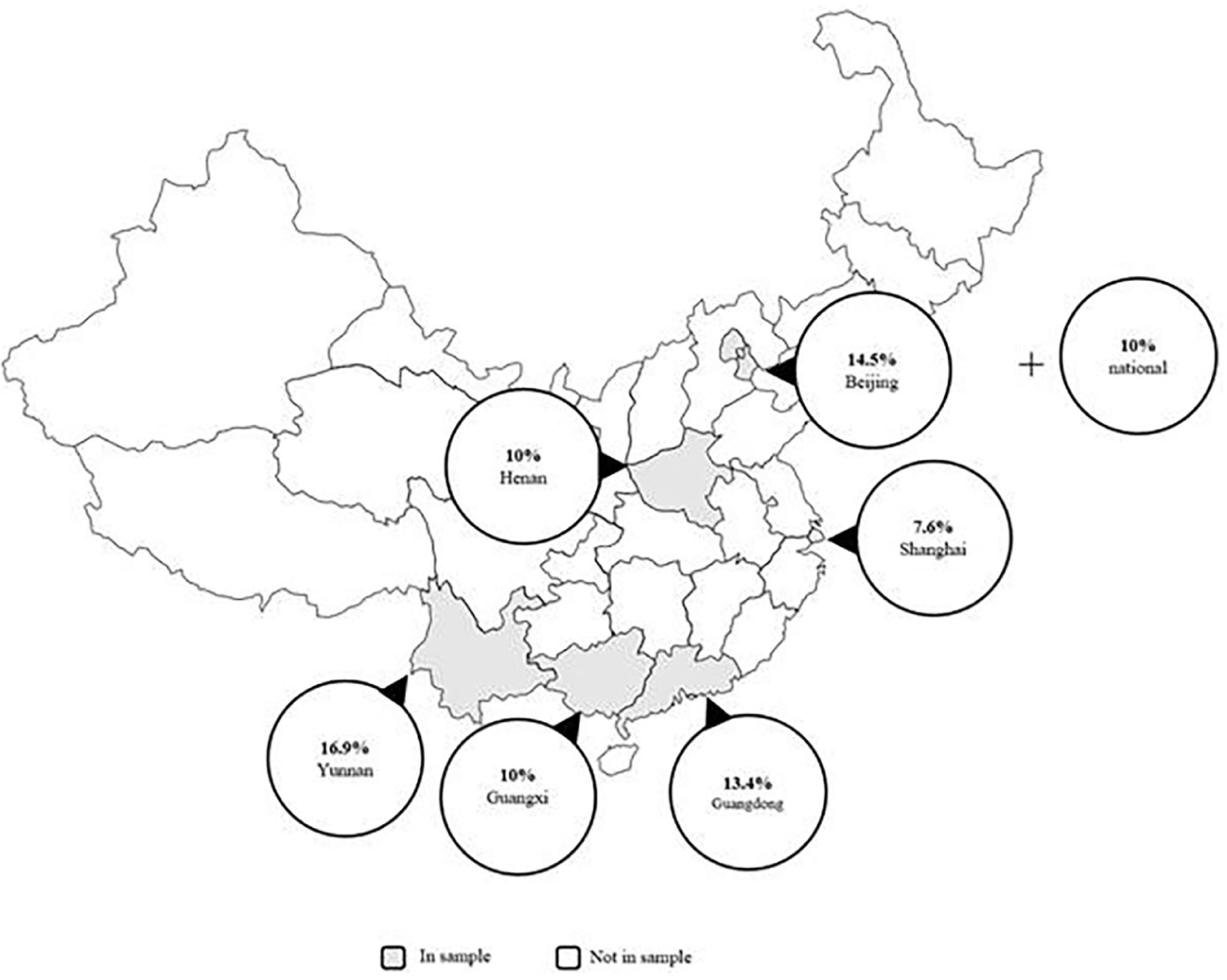
Location of the provinces, municipalities, and autonomous regions in sample.
To identify relevant articles, one of the authors manually scanned the print copies of each newspaper at the National Library of China in Beijing. All articles dealing with HIV that were published 1 week before and 1 week after World AIDS Day (November 24 to December 7) were included in the sample, provided that the visual showed at least one person identified as living with HIV in the accompanying text.
Choosing an extensive period of analysis was necessary to obtain a copious sample despite the Chinese media’s modest interest in HIV. Indeed, most Chinese newspapers publish an average of only three articles about HIV per year, and even less if the newspaper’s scope is local as opposed to national (Gao et al., 2013). Most of these articles appear in print around World AIDS Day (Yu, 2006). Furthermore, this period of analysis allowed us to examine news coverage during three administrations that, as explained above, were more or less devoted to tackling HIV. While this does create a disequilibrium given that the Q-sort exercise and qualitative interviews (Study 1) were conducted only once, in 2017 (the year that the sample collection for Study 2 was completed), pairing analyses of news coverage with Q-sorts and interviews conducted in those same years would have meant 15 more sets of Q-sorts and interviews being carried out in real time during the entire period of analysis.
Codebook and coding
Next to identifying information (ID number, newspaper, and date), the codebook contained variables on the frame and sociodemographics for each person living with HIV, namely, gender (male/female), age (adult/child), and nationality (Chinese/non-Chinese). Thus, the unit of analysis was the individual person living with HIV shown in the photo. In addition, a variable asked if the faces of the people living with HIV depicted were clearly visible (yes/no) and—when this was not the case—if they had been pixelated (yes/no). In addition, the codebook contained variables on camera distance (closeup, medium, long) and camera angle (low, eye-level, high).
The operationalization of the four visual frames began deductively (Dan, 2018) and was refined with the insights gathered in Study 1 (see “Results” section above). For reasons explained in the discussion on Study 1, we used holistic measures for the four frames. We adapted Dan’s (2018) measures to fit the Chinese context. Specifically, some framing cues were eliminated because no examples of them could be found in the material; others were included inductively, even though they had not been featured in previous studies. Specifically, mug shots were removed from the list of cues for the carrier frame as they are not typical of Chinese journalism. Furthermore, images of people living with HIV engaging in strenuous physical activity were not encountered, and they were eliminated from the list of cues for the survivor frame. Similarly, power poses—such as raising one’s arms at shoulder height to frame the head—were not used, and hence, they were removed from the codebook. By contrast, images of visible symptoms and signs of disease (e.g., purple blotches)—which were so atypical in the United States (Dan, 2018)—appeared quite widespread in our sample, so we included them as cues for the victim frame. The codebook included multiple images as examples of each cue.
The researchers pretested the codebook on a stratified sample of 20% of the material. Differences were discussed, solved by consensus, and resulted in more details on some of the categories in the codebook. Two Chinese undergraduate students at a large midwestern university coded the material. The authors trained the coders in three sessions lasting 90 min each. The photos used for training were randomly selected and interspersed in the final sample. Intercoder reliability was measured on another 20% of the sample using Krippendorff’s alpha. Scores were between .74 and 1.0 for each variable and between .89 and 1.0 for the frames. The following coefficients were obtained: camera distance (closeup = 1, medium = .81, long = .89), camera angle (low = 1, eye-level = 1, high = 1), face visibility = .77, pixilation = .82, sociodemographics (age = .74, race = .85, gender = .77), and frames (survivor = 1, victim = .89, carrier = 1, normal = .89).
Strategy of analysis
For H1a and H1b, data from the National Bureau of Statistics of China, the China AIDS Response Progress Report, and a recent survey were used to classify news photos in the sample as coming from newspapers published in regions scoring high, medium, or low on the indicators of interest (NBSC, 2017; Pan & Xu, 2017; UNAIDS, 2015). The thresholds were as follows: HIV prevalence (NBSC’s categories of low, medium, and high), urbanism (high ≥ 65%; low < 65%), ethnic diversity (high < 70% Han Chinese; low ≥ 70% Han Chinese), and ideology (Pan and Xu’s categories of politically liberal/nontraditional/non-nationalist, neutral, and politically conservative/traditional/nationalist). The classification is given in Table 2.
Metropolitan and Provincial Newspapers in Sample by HIV Prevalence, Urbanism, Ethnic Diversity, and Ideology.
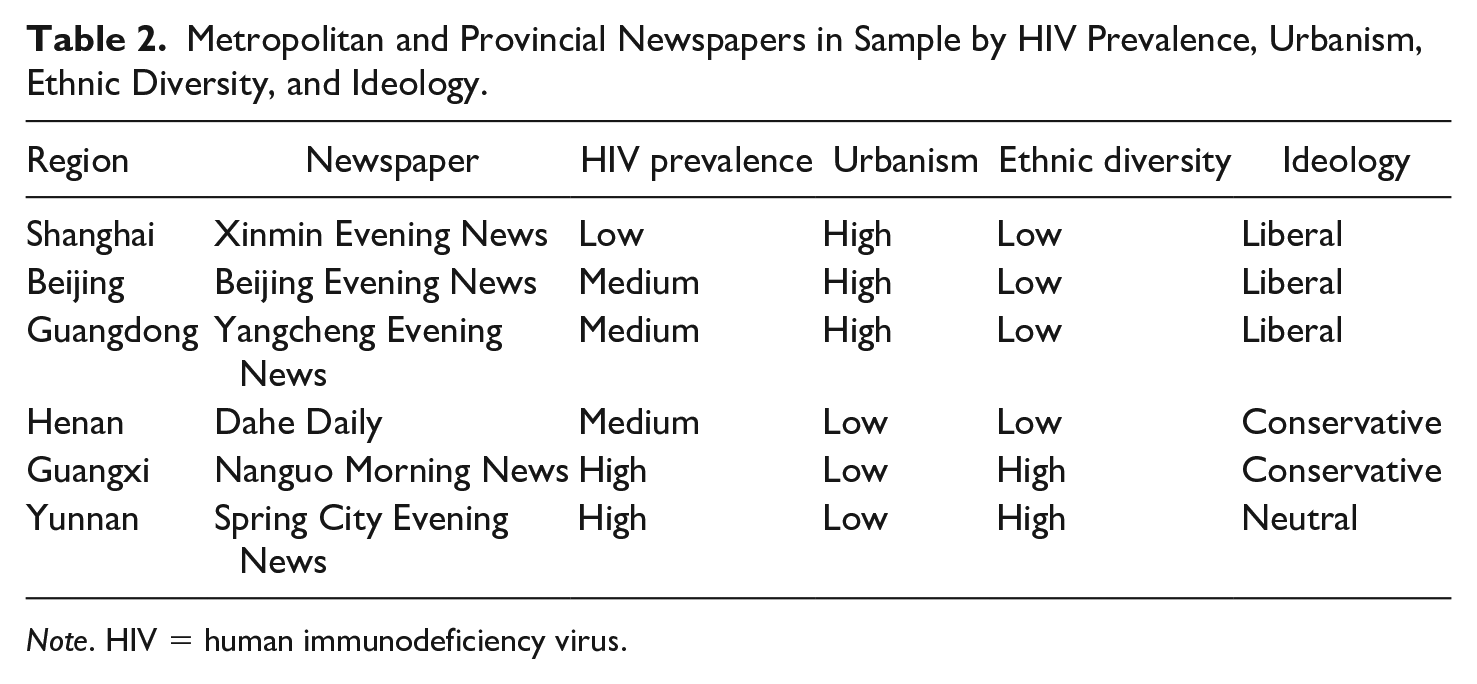
Note. HIV = human immunodeficiency virus.
Results
Descriptives
The framing of 290 people living with HIV in national and local news was analyzed. Most of the protagonists were adult (59.2%, n = 171), male (61.9%, n = 164), and Chinese (77%, n = 218). Overall, the most common frame was victim (49.8%, n = 144), followed by normal (34.3%, n = 99), survivor (13.1%, n = 38), and carrier (2.8%, n = 8). Figure 3 below shows the evolution of the frames in time; the asterisks highlight significant differences, Fisher’s exact test (FET) = 122.355, p < .001 (Monte Carlo method), Cramér’s V = .415). As shown in the figure, the normal and victim frames had a similar V-shaped trajectory, with the lowest points evident in 2007 and 2008, respectively. No significant differences were observed for the survivor and carrier frames. Overall, the year with the most news photos depicting people living with HIV was 2003, while 2015 was the year with the least coverage.
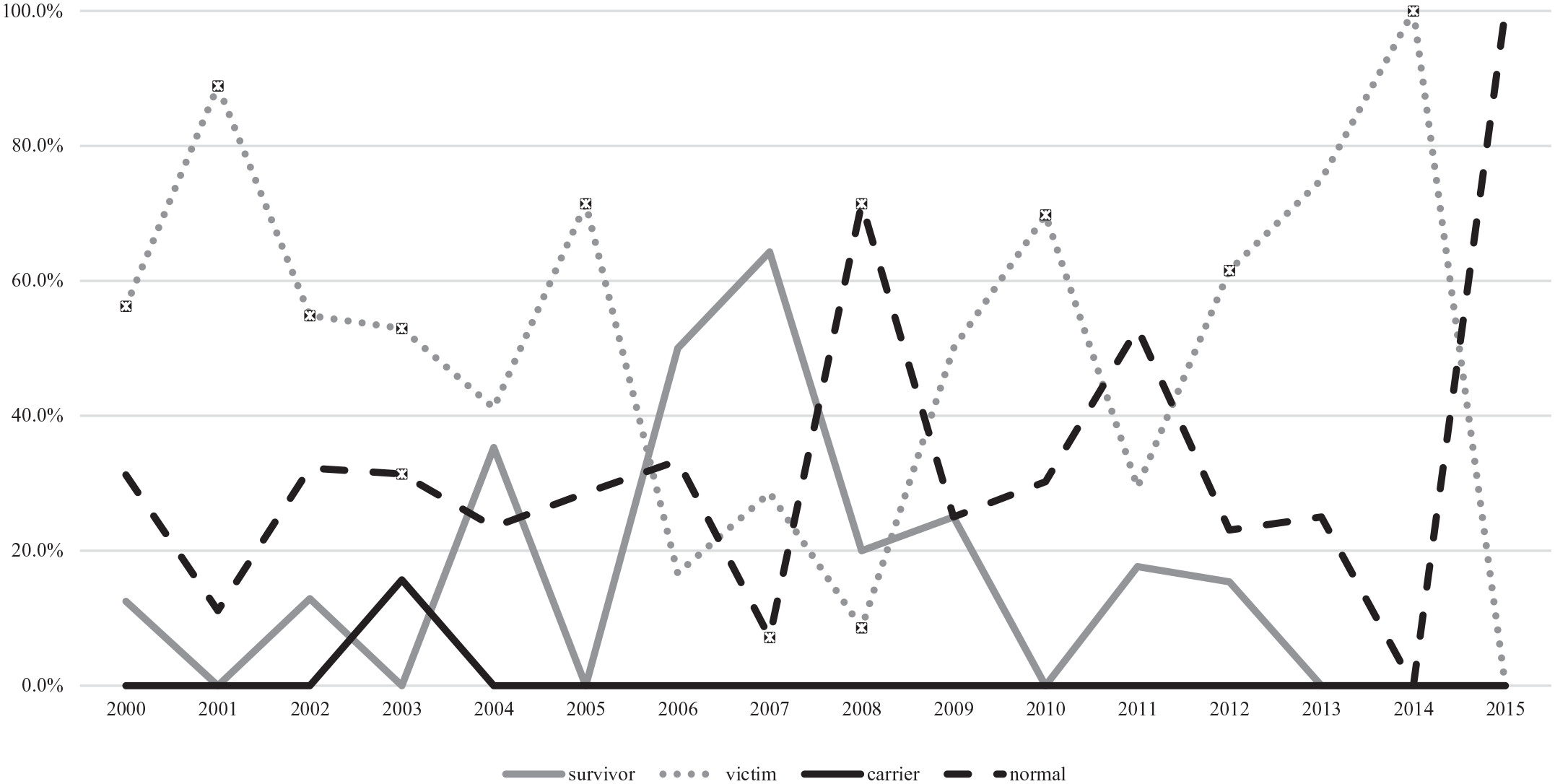
Evolution of the normal, survivor, victim, and carrier frames between 2000 and 2015.
Hypotheses and Research Questions
H1a and H1b, which predicted significant differences in framing by community structure, were partly confirmed (see Table 3). Differences were found with regard to HIV prevalence, FET = 26.202, p < .001, Cramér’s V = .258; ideology, FET = 29.520, p < .001, Cramér’s V = .284; urbanism, FET = 16.518, p < .001, Cramér’s V = .276; and ethnic diversity, χ2(3) = 27.527, p < .001, Cramér’s V = .363. As predicted, the survivor frame was conveyed more often in regions characterized by high HIV prevalence and high ethnic diversity, and the victim frame was more common in liberal and ideologically neutral regions, as well as highly urban regions. Also in line with our predictions, the carrier frame was more common in news from regions characterized by conservatism and low urbanism. Contrary to our predictions, the survivor frame was more common in regions characterized by conservatism and low urbanism; the normal frame was more prevalent in regions with low and medium HIV prevalence, as well as regions with low ethnic diversity. Finally, the carrier frame was encountered exclusively in regions with high ethnic diversity. No other significant differences were evident.
Chi-Square Test of Significance/Fisher’s Exact Test for HIV Prevalence, Ideology, Urbanism, Ethnic Diversity, and Visual Frames.
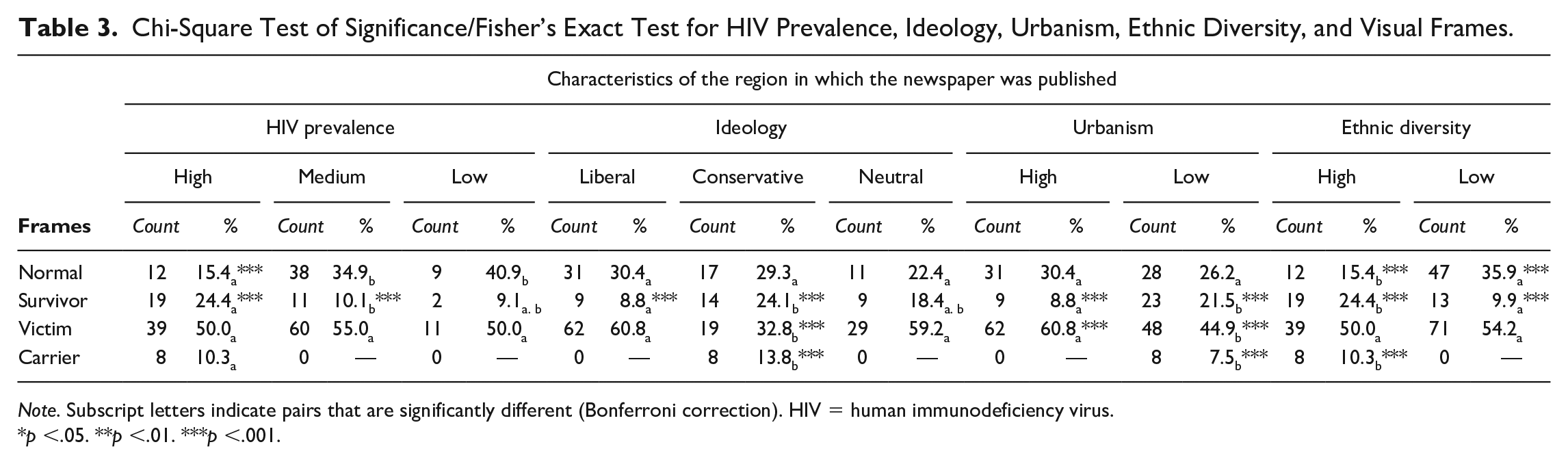
Note. Subscript letters indicate pairs that are significantly different (Bonferroni correction). HIV = human immunodeficiency virus.
p <.05. **p <.01. ***p <.001.
In response to RQ2, we found no significant differences in the camera distances used in photos of people living with HIV by the visual frame, FET = 7.326, p = .24 (results not tabled). While the analysis initially suggested significant differences by camera angle, FET = 11.762, p < .05, the application of Bonferroni correction revoked this effect (results not tabled).
The faces of people living with HIV were not clearly visible in about one-third of the sample (30%, n = 87). Faces were pixelated in almost one-quarter of the sample (22.1%, n = 64). There were significant differences between Chinese and non-Chinese people living with HIV in terms of face visibility, χ2(1) = 90.247, p < .001, Cramér’s V = .565, and pixelation, χ2(1) = 24.659, p < .001, Cramér’s V = .295. Specifically, the faces of Chinese people living with HIV were clearly visible in only 16.5% of the cases, whereas those of non-Chinese people living with HIV were clearly seen in 78.5% of the cases. Furthermore, natives’ faces were pixelated in 29.4% of the cases; this never occurred with foreigners. H2 was supported.
Discussion
One finding was that the victim frame was the most common one, and it was also more frequent than that in a recent study focusing on U.S. news, where the normal frame was at the fore (Dan, 2018). This difference between United States and Chinese photojournalism may be due to both cultural differences and practical reasons. First, unlike in the United States (see Dan, 2018), assigning a victim identity to people living with HIV is not negatively connoted in Chinese culture. Rather, in China, using a victim frame for people living with HIV is likely to be culturally appropriate, and thus, well received. Second, these variations may be due to politicians’ photo opportunities with people living with HIV, which have generated an increase in the otherwise modest media coverage (Gao et al., 2013; Yu, 2006). As politicians visited people living with HIV in hospitals, the news photos contained many cues suggestive of disease, and following the lessons learned from Study 1, were coded as pointing to the victim frame. Thus, the accumulation of victim-framed news photos is partially a byproduct of the official agenda and symbolic politics. The relative absence of survivor frames may be due to the pervasive stigma associated with HIV in China. This may have prevented people living with HIV from disclosing their identity and speaking in public at HIV awareness events. (To reiterate, this was one way in which the survivor frame was operationalized). Hence, Chinese journalists may have encountered difficulty in finding exemplars to feature in their photos in ways suggestive of the survivor frame. The finding that the normal frame was the second most common may be due to the Chinese media’s imperative to report news in a way that endorses the Party. The normal frame is arguably suggesting the Party has HIV under control. Finally, one commonality existed between the United States and Chinese reporting: The carrier frame was only marginally conveyed. From a public health perspective, this is good news, as the criminalization of HIV evokes stigma and contradicts efforts to contain the epidemic.
Another descriptive finding worth discussing concerns the variations in the use of frames during the period of analysis. We conducted extensive searches in an attempt to link the fluctuations to specific events or governmental/civic initiatives, but we were unable to do so. Attributing most of the peaks to the Hu–Wen Administration and its progressive agenda seems like a plausible explanation, but it reaches its limits when considering that the carrier frame also peaked during this period. Future studies could survey journalists in an attempt to elucidate the fluctuations reported here.
Differences in visual framing related to the community structure (H1a and H1b). Like Dan (2018), we found that the survivor frame was conveyed more in news visuals from regions with high HIV rates. However, the finding that the survivor frame was associated with conservative regions is puzzling. A closer look revealed that most survivor frames in our sample originated in the key newspaper from Guangxi, a region characterized by high ethnic diversity. This makes sense given that minority populations are disproportionately affected by HIV (NBSC, 2017; NHFPC, 2015). Journalists in these communities may respond to this characteristic with empowering visuals. Unlike in Dan’s (2018) study, it was low urbanism which was associated with a stronger use of the survivor frame, not high urbanism. This is an unexpected result, and it relates to the finding that the victim frame was more common in highly urban regions. This can be understood with reference to the poverty characterizing many rural areas of China. In the absence of gainful employment in rural areas, many Chinese farmers join the workforce in urban regions (so-called migrant workers) and/or sell plasma as a source of income (Yu, 2006). Because of the confirmed cases of HIV transmission during plasma donations, it is possible that rural Chinese are more inclined to survivor frames. Furthermore, the rural areas included in this study happen to be the regions with high HIV prevalence. Hence, it is possible that government officials in these rural regions take the HIV epidemic more seriously than do their counterparts in urban areas (where HIV prevalence is low). When this occurs, Chinese journalists have more opportunities to take pictures of people living with HIV at press conferences and other public events in those regions.
In the absence of significant differences, this study could neither confirm nor undercut previous findings on the prevalence of the victim frame in regions with low HIV prevalence. However, it did find that the victim frame was more common in liberal and ideologically neutral regions.
In visual framing analyses of U.S. samples, the normal frame was used more in states characterized by high HIV prevalence (Dan, 2018). In our sample, the opposite was the case. This may mean that Chinese communities with low HIV prevalence are more likely to perceive the few people living with HIV in their communities as ordinary people, while communities with high HIV prevalence may be overwhelmed by the high proportion of people living with HIV, and thus, less prone to perceive them as normal. The finding that the normal frame was more prevalent in regions with low ethnic diversity differs from those of previous studies suggesting that news in the most affected regions covered HIV in inclusive ways (Clarke et al., 2006). Considering the specific Chinese context is once again necessary to understand this finding. The ethnically diverse regions in our sample are those where the HIV epidemic is most severe, and an HIV diagnosis is often associated with intravenous drug use and commercial sex work here (He & Detels, 2005). Previous studies showed that people living with HIV who are also ethnic minorities experience pervasive stigma and discrimination (Deng et al., 2007). This may explain why journalists in regions with high ethnic diversity may have steered clear of the normal frame. Furthermore, it is possible—and even likely—that journalists in minority regions are still Han Chinese and they do not perceive the problems of the minorities in the community as a problem of the community as a whole. Future research could use surveys with journalists to test this hypothesis.
Finally, in our sample, just like in studies in the U.S. context, the carrier frame was found in regions characterized by low urbanism. In addition, the carrier frame was associated with a conservative ideology. This makes sense, as HIV transmission has been linked with behaviors perceived as immoral and urban life, including drug use and sex work. Quite surprising is the finding that the carrier frame was encountered exclusively in regions with high ethnic diversity. The explanation provided above for the connection between the normal frame and low ethnic diversity could also apply here.
We found no significant differences in the camera distances or camera angles used in photos of people living with HIV by the visual frame (RQ2). It is possible that Chinese journalists do not use this technique in the same way U.S. journalists do. News photos showed the faces of non-Chinese people living with HIV much more often and clearly than photos of Chinese people living with HIV did (H2). More pixelation and obscuring angles were applied to the latter, resulting in news photos reminiscent of crime reporting and potentially othering/dehumanizing. Ethnocentrism may be behind the Chinese journalists’ decision to protect the identity and privacy of Chinese people but not of foreigners . An alternative explanation could be that the photos of non-Chinese people living with HIV had not been taken by Chinese journalists, and in the absence of copyright, they refrained from editing them. Future research could survey Chinese people living with HIV featured in the news and ask them about their preferences with regard to face visibility and pixelation. In addition, surveys or interviews with Chinese journalists could help understand their motives in using these techniques. Finally, experiments with the general public may be needed to reappraise the effects of these techniques, which may be different in China than they are in the West.
Overall, our findings suggest that Chinese photojournalists frame people living with HIV in ways that, although deviating from Western standards through the preferred use of the victim frame, are likely to help public health efforts while being culturally appropriate. This result alone is encouraging. Yet, having focused merely on news photos, we cannot know if our results are representative of the entire news coverage, that is, of texts as well. Previous verbal-only research has suggested pervasive stigmatization in news texts (e.g., Ren et al., 2014). Such questions can be answered in integrative framing analyses in which verbal frames are compared with visual ones (Coleman, 2010). It is possible, as found by Dan (2018), that news images tell a different story than the associated texts do. Should research uncover differences between the frames conveyed in the two modalities, then the next step would be to test which ones become seared in memory and/or whether new and complex multimodal frames emerge.
Conclusion
This study makes several contributions to theory and methodology. First, it expands framing research by illustrating the role of visuals in constructing social reality. Specifically, it reveals how news visuals work to de/stigmatize HIV, and by extension, how photojournalists can affect people’s prospects for regaining dignity in a society in which they are thought to have lost their lian (i.e., their moral face). It accomplishes this by revealing which elements of the lives of people with HIV are emphasized in news visuals and to what frequency. This is also achieved through an investigation of photojournalists’ use of structural features, such as camera angle, camera distance, and—specific to the Chinese context—inventive means of concealing the identity of protagonists living with HIV. Overall, the insights reported here contribute to framing theory by acknowledging the role-played by visuals and by testing the applicability of theoretical assumptions in a non-Western context and in the subfield of health communication.
Second, finding evidence that local news reflects the views of those living in the community they cover, this study has shown the benefits of using the community structure approach in visual framing studies. Indeed, if a theory describes, explains, and predicts the occurrence of a specific phenomenon, then factoring in the way power is distributed in the context studied can help make meaningful predictions and bring us one step closer to uncovering the factors influencing news framing. From the perspective of journalism studies, the finding that news reflects community views is bittersweet. On the one hand, this could yield heterogeneous, and thus, nuanced news relevant to local communities. On the other, this diversity is limited by certain characteristics and can contribute to fissures in social cohesion—as people are exposed to interpretations of events that confirm their pre-existing views. Currently, we do not know if journalists self-censor when reproducing the views of their communities or if they share these views. However, what has already been determined is that character frames are necessarily fragmentary, and favoring one over the other is likely to bear serious consequences for the quality of life of people living with HIV and efforts to contain the epidemic.
Third, this study suggests that our understanding of visual frames may be advanced when they are conceptualized as constructs articulated by cues with various degrees of explicitness (Dan & Arendt, 2021; Dan et al., 2020). Furthermore, we have confirmed an earlier intuition that “completely different pictures (e.g., one showing a man biking in full gear and one showing a woman addressing a crowd from a stage) can convey the same frame even though these visual characteristics do not occur together in one photo” (Dan, 2018, p. 133).
Finally, this study shows how studies can be combined to better understand visual framing patterns. We used a two-step procedure and validated our frame definitions in Study 1, which combined a Q-sort exercise with qualitative interviews, before starting the quantitative content analysis in Study 2. This goes to show how “poets and quants” can work together (Lule in D’Angelo et al., 2019, p. 19), as well as how a mixed-method approach can help overcome the obstacles inherent to research.
Footnotes
Acknowledgements
Both authors have contributed equally to this paper.
Declaration of Conflicting Interests
The author(s) declared no potential conflicts of interest with respect to the research, authorship, and/or publication of this article.
Funding
The author(s) received no financial support for the research, authorship, and/or publication of this article.
