




Abstract
This article explores the nationality, ownership, and governance of news agencies in Europe, and suggests that we need to rethink and problematize the categories previously used when studying these. Drawing on recent data from a pan-European study, the article suggests that the concept of hybridity could be applied to analyzing news agencies’ nationality, ownership, and governance. It reviews the concept through different fields: (a) cultural studies, (b) organizational studies, and (c) political-regime and media-system studies, each of these contributing to a complementary understanding of the concept of hybridity. It concludes that (a) the previously fixed categories of national and international news agencies have become more integrated, (b) the different ownership forms of national news agencies have been partly amalgamated in terms of both owners and clients, and (c) ownership category alone cannot determine whether governance is democratic or nondemocratic, so we also need to look at governance. The article suggests that, by using the concept of hybridity when analyzing news agencies, we are able to see crossing boundaries of earlier ideal types and even developing possible alternative approaches to studying news agencies in future.
Keywords
Introduction
Witschge et al. (2019) have recently argued that the field of journalism studies has overused the concept of hybridity, and that it is time to move toward new concepts. They (Witschge et al., 2019) give several examples of how what they call a hybrid turn in journalism studies has given rise to the use of new blurred categories, for example, those of produsagers (Bruns, 2006), of media cultures (Hermida & Young, 2017), of forms of production (Papacharissi, 2015), and of political campaigning (Wells et al., 2016). However, so far, the hybrid turn has not yet become evident in news-agency studies, and in this article, I argue the opposite: that to be able to develop fresh approaches to news-agency studies in Europe, we need to re-explore the concept of hybridity, drawing on not just one but three different strands of literature: (a) cultural studies, (b) organizational studies, and (c) political-regime and media-system studies.
This is important because the existence and continuity of national news agencies—because these are the oldest electronic media organizations in Europe—have been taken for granted for a very long time. There is a national news agency in every European country except Estonia, Ireland, and Iceland, and they still play a significant role as intermediary organizations that provide their service to most media in the country concerned, and also—through their own networks—beyond it. However, as a recent report (Rantanen et al., 2019b) shows, many of them are confronting a crisis that has threatened their viability and very existence. Their changing role or potential disappearance is crucial to any analysis of media transformation, but news agencies remain underresearched when compared with many other media, especially social media, and more updated research with alternative study approaches is needed.
Furthermore, the theorization of news agencies has often been based on fixed, taken-for-granted “either/or” categories concerning their nationality, ownership, operations, and markets. In this article, I argue that these categories no longer entirely hold (if they ever did) and that news agencies today are more complex and more mixed, both within and across these categories. I use the results from a recent pan-European study (Rantanen et al., 2019b) to problematize these categories and to put forward an argument about the usefulness of the concept of hybridity in analyzing news agencies in future.
Previous Research on News Agencies
A good deal of academic research has focused on international news agencies and on the globalization of news (see, for example, Alleyne & Wagner, 1993; Boyd-Barrett, 1980; Boyd-Barrett & Palmer, 1981; Boyd-Barrett & Rantanen, 1997; Giffard & Rivenburgh, 2000; Paterson, 2011). There is also an overemphasis on historical research. Much of the scarce research on news agencies is nowadays the work of media historians (see, for example, Renaud, 1985; Silberstein-Loeb, 2014; Tworek, 2019; Vyslozil & Wippersberg, 2014).
There has been a distinct preference for research on privately owned agencies, resulting in one-sidedness and in an ignoring of state ownership in Europe (except—but this is now outdated—Rantanen & Boyd-Barrett, 2005). Finally, there is very little research on European national agencies in general. The last studies of European national news agencies date from 2000 (Boyd-Barrett, 2000; Boyd-Barrett & Rantanen, 2000).
Conceptual Framework
If empirical research on national news agencies has recently been lacking, the absence of theoretical and/or conceptual thinking has also been very striking. Either they have not been theorized at all or, when they have been theorized, this has been with the use of concepts that mainly concentrate on the relationship between international and national news organizations, that is, emphasizing how dependent national agencies are on international agencies for their exchange of news, and that this relationship is uneven (see, for example, Meyer, 1989). The division between international and national news agencies, where the former have been viewed more negatively and the latter as often unproblematically positive, has often taken attention away from the study of national agencies and presented the division between international and national as the most significant factor, as if other factors were insignificant. The two categories of international and national have not always been problematized and thus have been taken for granted.
The other categorization taken for granted is that of ownership. In the past, news agencies have traditionally been categorized and divided in terms of their ownership into (a) private, (b) cooperative, and (c) state (United Nations Educational, Scientific and Cultural Organization [UNESCO], 1953). A recent report suggests a new categorization of news-agency ownership into (a) private, (b) state, and (c) public (Rantanen et al., 2019b). The ideal form of ownership of news agencies has always been a contested issue among both academics and practitioners. It has not helped that news agencies are absent from so many studies of media ownership (see, for example, Djankov et al., 2001; Dragomir, 2018; Noam, 2016), of cultural economy and creative industries (De Beukelaer & Spence, 2019), and of media systems (Hallin & Mancini, 2004)—this although national news agencies are to be found in most countries around the world. Almost nothing has been written about news-agency governance since the UNESCO study in 1953 (UNESCO, 1953).
Another dimension of discussions around media ownership, and perhaps particularly news-agency ownership, is polarization. There are those who argue that either private or cooperative ownership guarantees the most objective news content, whereas government ownership is seen as the enemy of a free flow of news (see, for example, Champagne, 2005). The private, and especially the cooperative, ownership models have been seen as ideal models for guaranteeing, as a former director of the Associated Press (AP) put it, “true and unbiased” news (Cooper, 1942), whereas the state ownership model has not received similar praise. Leading international news agencies Reuters and AP have both crusaded for private or cooperative ownership forms as a guarantee of the freedom of news (Cooper, 1942; Mant, 1939). This discourse is still often shared by both academics and news-agency executives (Rantanen & Kelly, 2019).
The new data (Rantanen et al., 2019b) call for new academic research and alternative concepts. In this article, I suggest that the concept of hybridity could be useful when studying news agencies. The reason for doing this is that the present “container model,” where news agencies are separated from each other solely on the basis of their nationality and ownership form, is in my view unhelpful when attempting to analyze changing news-agency operations. Because ownership is viewed so ideologically—often “us against them” (Rantanen & Kelly, 2019), using fixed categories of nationality and/or ownership prevents us from seeing what all news agencies share, irrespective of their nationality and/or ownership form.
Here, I use the concept of hybridity originating from the natural sciences, where it denotes “the offspring of two animals or plants of different specie” (Hybrid, n. and adj., 2019). The concept has been “borrowed” by cultural, journalism and postcolonial studies, political science, organizational, management, and even warfare studies—to mention just a few—but not used in news-agency studies. Anheier and Krlev (2014) call hybridity an “umbrella concept that can be applied to a multitude of organizational phenomena” (p. 1395). I argue here that by using the concept of hybridity when analyzing news agencies, we are able to see what has not been seen before, crossing the rigid boundaries of earlier ideal types and even developing alternative approaches to studying news agencies. In the following section, I first review how the concept of hybridity has been defined in some of the fields I consider relevant.
The Concept of Hybridity in Cultural and Postcolonial Studies
In cultural studies, Garcia-Canclini (1989) has described Latin American countries as hybrid cultures where “previously separate cultural systems mingle, symbolic interactions are de-territorialized, and impure genres rule” (Kraidy, 1999, p. 460). As Kraidy goes on to write, the usefulness of Garcia-Canclini’s approach lies in how he considers local/global interactions as a “hybridity” of both process and product, rejecting the polarity between global (production and dissemination) and local (reception) aspects of mass-mediated culture (p. 460, my emphasis). As Kraidy (2002) also observes, hybridity needs to be understood as a “communicative practice constitutive of, and constituted by, socio-political and economic arrangements” (p. 317).
In postcolonial studies, Bhabha (2004) is acknowledged as having introduced the concept of hybridity to analyze cultures and identities, their “impurity,” and “mixed-ness.” He uses the term hybridity rather than hybridization, insisting that hybridity is an ongoing process, because cultures, rather than being solid and authentic, are unexpected, messy, hybrid, and fortuitous. The starting point is never a “pure” culture, but that cultures are born after the hybridity process rather than existing before it (Huddart, 2006, pp. 1, 4, 5, 99).
Garcia-Canclini, Bhabha, and Kraidy all define the concept of hybridity in the contexts of culture, media, and identity. They all emphasize the nonpolarity of cultural forms and their interconnectivity and “impurity.” They, like many cultural and globalization theorists (Rantanen, 2019b), have argued against an unambiguous division between the international and the national, and proposed new levels of analysis including the local. Their approach is rather general, and not necessarily useful when studying news agencies except when discussing their nationality. This is why I need to bring in the notion of hybridity as found in the study of organizations.
The Concept of Hybridity in Organizational Studies
The concept of hybridity (or hybridization, both terms are used) first became popular in this field with reference to third-sector, nonprofit, voluntary, civil-society, and nongovernmental organizations that were difficult to study because of their “fragmentation, fuzziness, and constant change” (Brandsen et al., 2005, p. 749). These organizations had different institutional logics, but often with a mission of societal change (Haigh & Hoffman, 2012). Hybrid organizations can most broadly be defined as “heterogeneous arrangements, characterized by mixtures of pure and incongruous origins, (ideal) types, ‘cultures,’ ‘coordination mechanisms, ‘rationalities,’ or ‘action logics’” (Brandsen et al., 2005, p. 750) that mix the characteristics of state, market, and civil society. Hybrid organizations may be anything from purely governmental agencies to commercial firms, and can both function like “customer oriented and efficient firms and/or carry out intrinsically public tasks” (Kickert, 2001, p. 148).
Many authors (Brandsen et al., 2005; Minkoff, 2002; Smith, 2010) argue that hybridity reflects the restructuring role of the state in a financial crisis and how nonprofit organizations respond to this in an uncertain environment. Although earlier studies of organizations divided them by categories of ownership, funding, and mode of social control, Billis (2010) writes that if ownership is taken as the primary category, it leaves third-sector organizations excluded from any categorization, and that this is why it has become equally important to study governance (Cornforth & Spear, 2010). Hybrid organizations can be seen as presenting complex governance challenges (Smith, 2010), and more recent research has emphasized the need for multilayered analysis (Brandsen & Karré, 2011), including measurement of performance, innovation, regulation, and sustainability (Skelcher & Smith, 2017).
These studies show us that the concept of hybrid organizations has become established in this field of study, where they are seen as new types of organizations with mixed ownership and governance. These studies help us to understand that all organizations do not fit into categories based solely on ownership, but that we also need to look at other factors that define them. However, to understand media organizations, and specifically news agencies, I also need to review the concepts of hybrid regimes and of hybrid media systems.
The Concepts of a Hybrid Regime and a Hybrid Media System
The relationship between a political and a media system has been seen as unquestioned. The definition of a media system usually implies its dependence on a specific political system (Engesser & Franzetti, 2011). According to Almond and Powell (1966), this interdependence means that when the properties of one component in a system change, all other components also change and the system as a whole is affected. In their and in media-system models, the degree of state control or intervention plays a key role (Blumler & Gurevitch, 1975; Hallin & Mancini, 2004), which then directly or indirectly determines how democratic the system is (Rantanen, 2013).
The idea of a media system emerged from political science, which classified political systems and regimes into democratic or nondemocratic categories. Diamond (2002) argues that these classificatory schemes have reached their end and now “impose an uneasy order on an untidy empirical world” (p. 33). Diamond puts forward an argument that regimes have become more and more “mixed,” and that “the black and white distinctions between democratic and non-democratic regimes have now turned into different shades of grey.” He recalls (Diamond, 2002) research that recognizes these differences: As democracies differ among themselves in significant ways and degrees, so do contemporary authoritarian regimes, and if we are to understand the contemporary dynamics, causes, limits, and possibilities of regime change (including possible future democratization), we must understand the different, and in some respects new, types of authoritarian rule. (p. 33)
The concept of hybridity can be used in regime and media-system studies in three different ways: (a) to challenge the set-in-stone division between democratic and undemocratic regimes or (b) to challenge the separation of older and newer media logics, or (c) to argue for a blurring of boundaries between the system’s key components, such as news agencies, including organizational structures. This is why I propose that the concept of hybridity in regime and media-system studies may help us to understand how news agencies have changed.
Research Questions and Materials
In this article, I use the concept of hybridity to study the nationality, ownership, and governance of national news agencies in Europe. I concentrate specifically on ownership, including nationality and governance, but not on their operations or markets, which have been studied separately and using the concept of diversity (Jaüaüskelaüinen & Yanatma, 2019; Surm, 2019).
My research question here is as follows:
This article draws empirically on data collected as part of the pan-European research project on The Future of National News Agencies in Europe, conducted in collaboration with the European Alliance of News Agencies (EANA) and based at the London School of Economics and Political Science (LSE; Rantanen et al., 2019a). EANA has 32 national news agencies as members, with one agency—except in the case of the Baltic states—as an institutional member from each European country, as well as from Azerbaijan, Russia, Turkey, and Ukraine (About EANA, 2020). A survey was conducted in 2018, in which 25 of the 32 EANA member agencies participated (their chief executive officers [CEOs] or other members of their senior management filled out the questionnaire). Due to the possibility of sensitive business information being raised, all participants were assured of full confidentiality and anonymity. This is why it is not possible to identify individual news agencies. This article is based largely on an analysis of the survey results, but also uses, when possible, publicly available data on news-agency ownership (Rantanen et al., 2019b).
Discussion and Results
The Categories of National and International Agencies
Taking Garcia-Canclini’s concept of hybridity to reject the polarity between the global and the national, one could use it to challenge the concept of nationality of national news agencies. One of the longest standing divisions drawn by news-agency research is between “international” and “national” agencies (UNESCO, 1953). This division goes back to the 19th century, when three European news agencies, Havas, Reuter, and Wolff, established a news cartel by dividing the world’s news market among themselves. These three international agencies were the only ones that could operate outside their own home countries, whereas national agencies could only operate in their own countries (see, for example, Rantanen, 2009).
Since the 19th century, it has been argued that every country should have its own national news agency, which would serve national interests. News agencies were largely a European invention and, apart from the AP in the United States, most of the early national news agencies were founded in Europe in the late 19th and early 20th centuries (Rantanen, 2009). It has long been taken for granted that national news agencies have a “nationality,” as their names reflect—for example, Norsk Telegrambyrå (Norwegian Telegraph Agency [NTB]), or Agence Télégraphique Suisse/Schweizerische Depeschenagentur (Swiss Telegraph Agency [SDA])—and that the nationality and/or location is a crucial factor in analyzing their influence (Tunstall, 1977). This assumes that ownership, location of headquarters, and language(s) always coincide. It has also been assumed that the ownership of national news agencies, even if they operate internationally, should be in domestic hands (Rantanen, 2019).
However, this is not necessarily any longer the case. Most national news agencies in Europe have long provided their services in countries other than their own. Their decisions to provide a service outside their home countries have been prompted by language, capital flows (clients interested in their news service), new avenues of profitability, or by geopolitical factors (e.g., historical links, neighboring location of countries; Bhat, 2018). We have also witnessed the first signs of change in terms of national agencies turning their operations into regional ones and of ownership shifting into a neighboring country in terms both of operation and of ownership. The Estonian Telegraph Agency (ETA), founded in 1920, went bankrupt in 2003 and for the first time since it was founded, there was no national news agency in Estonia. The Baltic News Service (BNS), established in 1991 in Moscow to cover all the Baltic countries, was bought by the Finnish media corporation Alma Media in 1998 and operated as a national agency in Estonia. Alma Media sold it in 2014 to an Estonian businessman. Today, there are two branches: BNS Estonia and BNS Lithuania (Lauk & Einmann, 2019). In Switzerland, in 2018, the national news agency Schweizerische Depeschenagentur/Agence télégraphique suisse/Agenzia telegrafica svizzera (SDA-ATS) was merged with Keystone AG, a picture agency, which was 50% owned by the Austrian national news agency Austria Presse Agentur (APA). After the merger, APA became 30% owner of the merged company (“SDA und Keystone fusionieren, NZZ,…” 2018).
National news agencies also have international aspirations (Figure 1). According to Rantanen et al. (2019b), 96% of news-agency executives agreed with the argument that a national news agency is vital to national media and should be kept alive, but at the same time, 88% agreed strongly that national news agencies should pursue more international collaboration (Bhat, 2018).
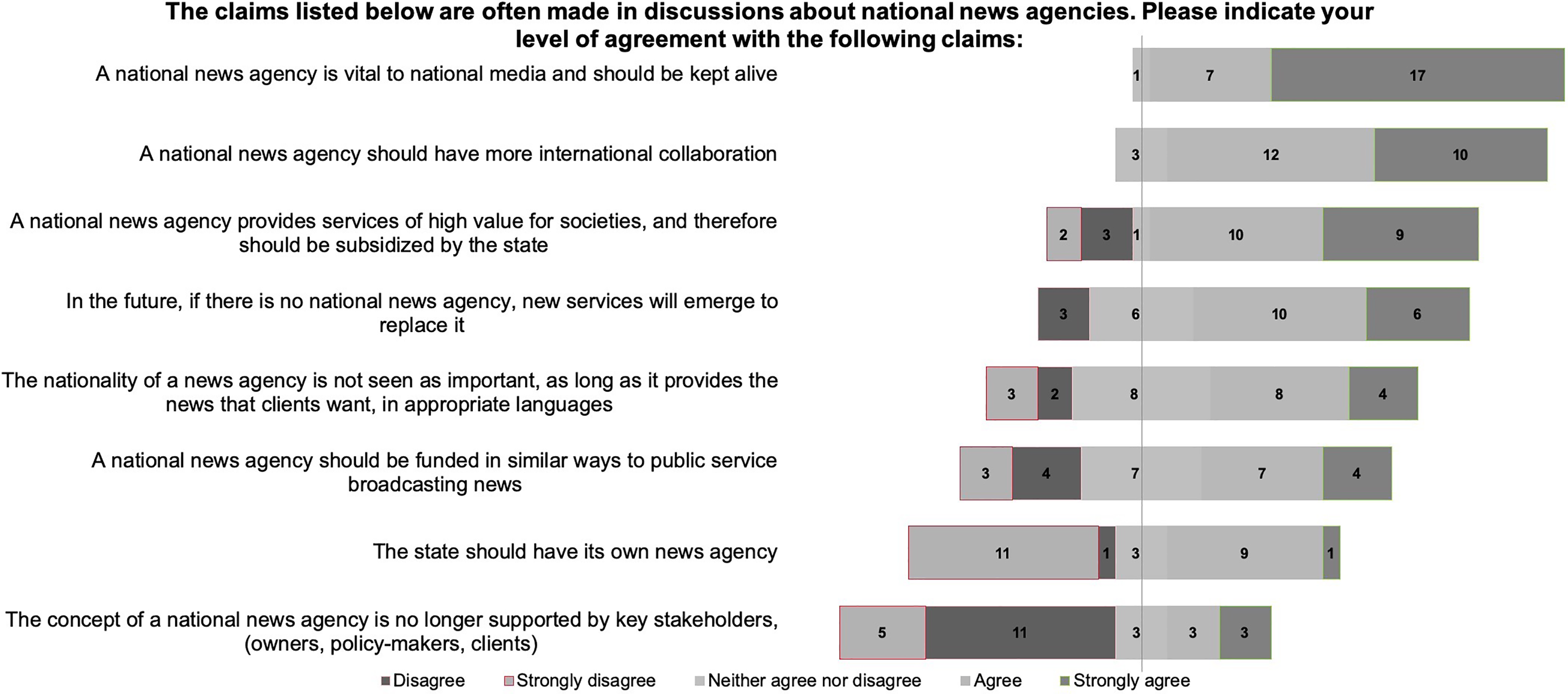
Attitudes of EANA member agencies, 2018.
It is still possible to divide news agencies into the two categories of international and national if we consider their size, and the number of their correspondents and clients, as Vyzlosil and Surm (2019) have suggested. But news agencies have always been both international and national, because the raison d’être of their activities has been news transmission across national borders, even when national news agencies’ activities were restricted by the international news cartel. What we see now is that national ownership has in a few cases turned into regional ownership beyond the borders of the nation-state where the agency is located. We also see the aspiration of most national news agencies in Europe to operate outside their home countries.
Forms of Ownership
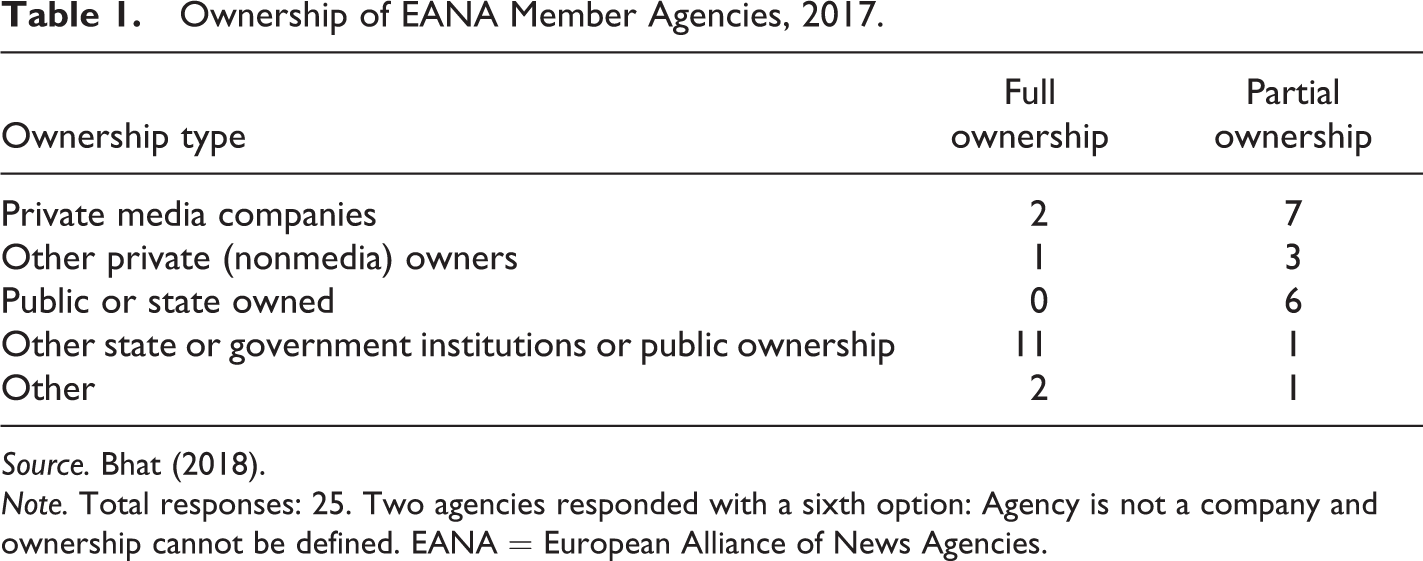
According to Grossi and Thomasson (2015), hybrid organizations are those that borrow components and logics from three different sectors: public, private, and nonprofit. Because, as far as I know, there are no studies that investigate news agencies as hybrid organizations in terms of their ownership, in this section, we concentrate on how news agencies have become hybrid both within and across categories of ownership (Table 1).
Ownership of EANA Member Agencies, 2017.
Source. Bhat (2018).
Note. Total responses: 25. Two agencies responded with a sixth option: Agency is not a company and ownership cannot be defined. EANA = European Alliance of News Agencies.
There have been changes in all categories of ownership, but even more within different ownership forms. The cooperative ownership form has practically disappeared in Europe, as has the nonprofit-making corporation (UNESCO, 1953) without shareholders or other commercial forms of ownership. In the survey results from 2017, nine news agencies defined themselves as private shareholder companies (see Figure 2) where the majority of shares are owned by shareholders or by one shareholder (Rantanen et al., 2019b). As Jaüaüskelaüinen and Yanatma (2019) write, the “agencies turned from cost-sharing cooperatives into profit-seeking media services companies, taking risks and aiming to create a return on capital for the owners. This has fundamentally changed the capabilities needed by the firms” (p. 5).
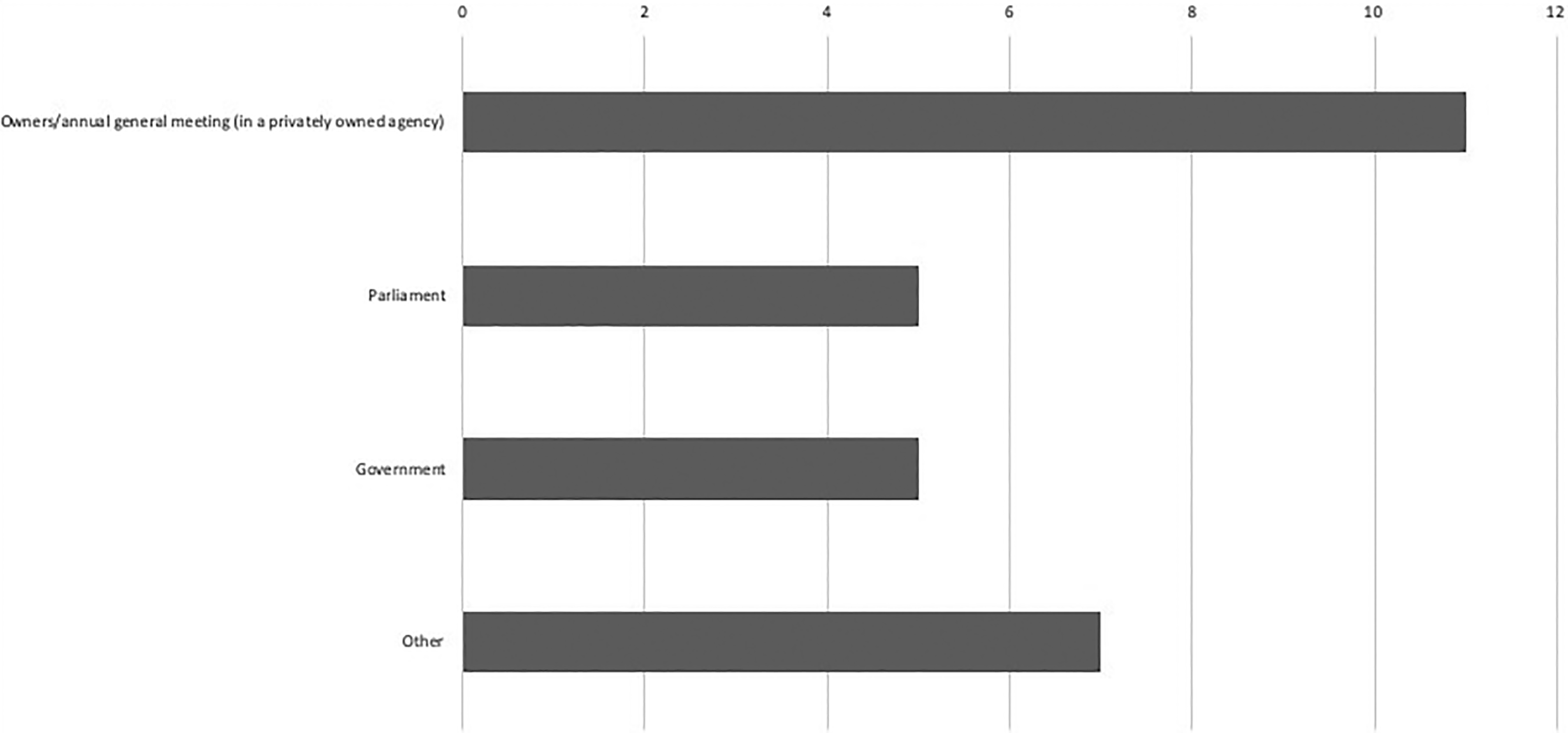
Largest clients by revenue of EANA member agencies, 2017.
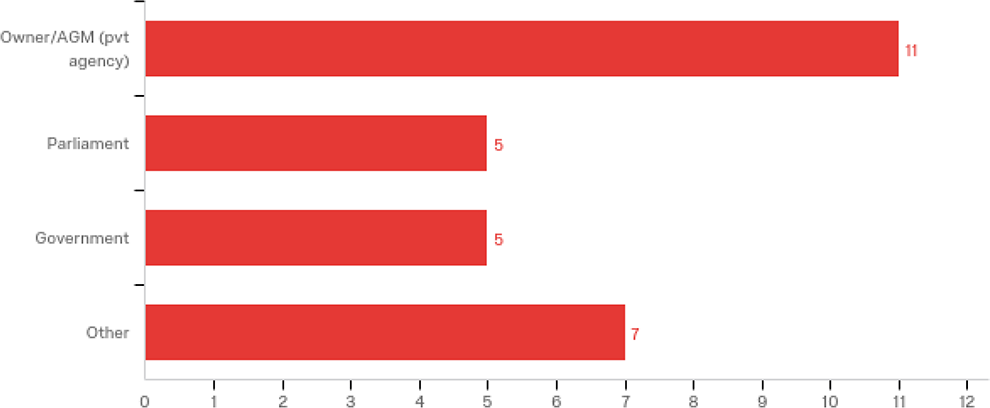
Who appoints the boards of EANA member agencies? (2017).
The state-ownership category has become much more diversified than previously thought (Rantanen & Boyd-Barrett, 2005). Half of agencies in the state-ownership category could be defined in terms of the state being the sole owner, whereas for the other half the ownership structure consisted of different combinations (Bhat, 2018) where the state was one of the shareholders. The state needs the market and cannot maintain its ownership without private revenues except in those agencies that give their products to customers free of charge. State-owned agencies are also vulnerable and not always able to survive, especially in small markets (Lauk & Einmann, 2019).
Vyslozil and Wippersberg (2014) suggest a new category of public (service) news agencies. A public agency may be financially supported by the state, although not owned or controlled by the state but by parliament or another type of public organization (Rantanen et al., 2019b). In 2017, six European agencies reported themselves as public news agencies (Table 1). This was why the researchers decided to define a new category of public agency, as distinct from that of state agency, although this category was not included in their original survey questions.
However, even the concept of a publicly owned agency is difficult to define. For example, AFP, which was previously defined as a state agency, can now be defined as a public agency. It was founded under the joint control of the French government and the French press in 1944, under the terms of a law that would ensure the agency’s financial stability and independence from the state (UNESCO, 1953). As Juntunen and Nieminen (2019) write, the sui generis status given to the agency makes it neither a state-owned nor a commercial entity, which differentiates AFP both from other global news agencies operating purely on a commercial basis and from those operating under the direct control of the governments that finance them. (p. 4)
When we study the ownership of national news agencies in Europe, it is clearly seen that categorization by “pure” ownership forms is over. Mixed ownership forms cross different categories of ownership, especially when we take into account clients with a double role as owners. Private ownership also loses its “purity” through state funding of private agencies and through public-service broadcasting (PSB) companies being their clients. In short, most agencies combine the organizational logics of three different sectors: public, private, and state—either through their owners or through their clients.
Forms of Governance
One of the issues raised by studies of hybrid organizations is governance, which is often neglected by news-agency studies that concentrate only on ownership. The challenge for hybrid organizations, as Jay (2013) writes, is to combine the different logics of government bureaucracies, business firms, and nonprofit associations. Because we need to determine whether news agencies can be called hybrid organizations in terms of their governance, we first need to find out who the decision makers are in these organizations.
When it comes to the profitability of media-owned companies, as shown earlier, some of their clients play a double role as both owners and clients. Within the category of private news agencies, the ownership of many agencies has shifted to a structure in which a single media company or a small group of media companies owns a controlling proportion of shares (Rantanen et al., 2019b). Simultaneously, their governance has shifted from a cooperative to a corporate ownership form, where the largest shareholders make major decisions, in place of cooperative governance that was based, at least in principle, on more democratic decision making.
Whereas in private agencies, the owners always appoint the board, in state and public news agencies, it was previously parliament and/or the state. However, in the 2019 study (Rantanen et al., 2019b), there were shown to also be many agencies that did not fit either of these models (Bhat, 2018), again problematizing the clear-cut divisions between different forms of governance. In most cases, even where government or state representatives are involved in board appointments, their influence is only through an intermediary institution such as a council or a foundation. It is also limited by the involvement of other industry or civil-society representation aimed at counterbalancing government or state influence (Rantanen et al., 2019b).
In some publicly owned news agencies, board members are appointed by parliament, whereas in others, they are appointed through other processes (Bhat, 2018). In some cases, for example, employees may nominate a board member, whereas in others, councils are appointed by the president, parliament, experts, or government representatives (Rantanen et al., 2019b). The main aim of these strategies seems to be the creation of an “arms-length” relationship between the state or government and the board appointments process. For example, some news agencies make board appointments through a public media foundation, whereas others appoint their boards through a council consisting in its turn of representatives of parliament. There are other strategies that also attempt to balance the power equations in the appointments process (Rantanen et al., 2019b).
Publicly owned and financed news agencies are also vulnerable to political and financial pressures from outside. Their constitution is not set in stone, but can change with a new governmental majority. Some of the agencies founded as public news agencies in Central and Eastern Europe (CEE) after Communism collapsed now seem to be under increasing government control. For example, following the passage of a new media law (Opinion of the Commissioner for Human Rights, 2011) in Hungary in 2010, the Hungarian news agency MTI, as a part of the public-service media, was placed under the new National Media Council. Although critics see this as a new centralized news-production system that threatens the public media’s diversity and pluralism, the Hungarian government claims that the new system is more cost effective and efficient, while still safeguarding the autonomy of Hungary’s public media (Public Service Media, n.d.). In short, news agencies seldom have more safeguards from government control than a national PSB company in the same country.
When it comes to the state’s role as legislator and regulator, there are special laws on the status of state-owned agencies. But it is not only the nation-state that legislates for news agencies in the European Union. As Juntunen and Nieminen (2019) point out, EU state-aid rules now set the framework for state funding in member countries and this also affects state funding of national news agencies (recent decisions have concerned AFP in France, EFE in Spain, and STT in Finland, which all had received state funding). The EU state-aid rules are another example of cross-border hybridity, where a “national” institution is also governed by a regional organization.
Governance of national news agencies in Europe predominantly reflects their ownership. However, when one looks more closely at what is happening inside and outside these organizations, one starts to see more similarities across ownership forms. The conflicts that arise from attempts to combine the different logics of state, private companies, and public organizations are not easy to solve and the boundary problems inside and outside organizations come to the surface as a result of their different interests. We start to see mixed forms of governance where, as Diamond (2002) suggests, “the black and white have now turned into different shades of grey” (p. 33).
Conclusion
In this article, I have argued that we still need the concept of hybridity to better understand the crisis that national news agencies in Europe are currently experiencing. Using the concept of hybridity as defined in (a) cultural studies, (b) organizational studies, and (c) political-regime and media-system studies, I have explored three fixed categories earlier used in news-agency studies: (a) nationality, (b) ownership, and (c) governance of national news agencies in Europe. I have argued, on the basis of data from a recent survey and because they are the oldest electronic media organizations in Europe, that
the previously fixed categories of national and international news agencies may have become more integrated,
different ownership forms of national news agencies in Europe may have been partly amalgamated through their owners and clients, and
ownership category may not be the only factor determining whether governance is democratic or nondemocratic.
But why did we need to review here three sets of literature on hybridity rather than using only one? I would argue that each approach complements the others and makes an additional contribution. A cultural studies approach clearly focuses on cross-national border activities that are not seen as important in media-systems or organizational-studies approaches. When we study news agencies, even national agencies, we simply cannot completely separate their international from their national activities. We are now seeing the emergence of the new regional news agencies that are no longer in national ownership, and all agencies in the European Union are also subject to supranational legislation. This further complicates the governance of news agencies, which need to combine different organizational logics not only inside their country of location but also outside it. Neither a media-system nor an organizational-studies approach alone would have been able to help us to understand this change.
The concept of hybridity as used in organizational studies contributes to changing the level of this study: Rather than studying cultures and systems, it becomes possible to concentrate on exploring whether a concept of hybridity can be used in the study of news agencies as organizations. News agencies have not hitherto been seen as hybrid organizations in terms of their ownership and governance, but it still becomes possible to argue that their ownership is mixed, even if they are not traditional third-sector organizations. They do combine the different logics of state, business, and nonprofit (public service) organizations through their ownership, governance, and clients.
When it comes to hybrid-regime and media-system studies, we again learn the importance of interdependence and the end of “purity” when using the concept of fixed categories. News agencies can be understood as systems even if they are not often studied in the framework of a national media system. As Boyd-Barret and Rantanen (2000) write, a system comprises interdependent parts, and this is what we find with news agencies: they use each other as sources, they sell to each other, they forge alliances with one another, they sell services to client media and use client media as sources of information. (p. 87) power in the hybrid media system is exercised by those who are successfully able to create, tap, or steer information flows in ways that suit their goals and in ways that modify, enable, or disable the agency of others, across and between a range of older and newer media settings. (p. 285)
The data available to this article cannot help to answer the question of how news agencies’ news production and reporting have changed—a topic for another study. It has only used the most recent research on news agencies to argue that hybridity is a useful concept, and that rather than leaving it behind, we should further explore it. At a time when news agencies are in crisis, as some of those in Europe are, academic researchers are invited to shift some of their attention from the newest media to news agencies. Even if these are often seen as “old media,” their continuing role in providing news to both old and new media, even while finally themselves struggling, needs further research, both conceptual and empirical.
Footnotes
Acknowledgment
The author would like to thank Ramnath Bhat, Anthony Kelly, and Jean Morris for their contribution and Ramnath Bhat, Atte Jääskeläinen, and Richard Stupart for their role in collecting and collating data used in this article.
Declaration of Conflicting Interests
The author(s) declared no potential conflicts of interest with respect to the research, authorship, and/or publication of this article.
Funding
The author(s) disclosed receipt of the following financial support for the research, authorship, and/or publication of this article: This research was funded by the Media Research Foundation, Finland; Jyllands-Posten Foundation, Denmark; LSE Knowledge Exchange and Impact (KEI) Fund, UK; Department of Media and Communications at LSE, UK.
